Category: News

  • Match.com Picks Fight With Competitor Plenty of Fish

    Match.com has sent a strongly worded letter — written by the company’s lawyer — to competitor Plenty of Fish, accusing the free dating service of making unsubstantiated claims about its traffic and number of users. The letter, which Plenty of Fish founder Markus Frind has posted on his blog, lists a series of almost a dozen claims that the site makes about how many dates its members have been on and how many people sign up every day (20,000 people, according to Plenty of Fish). Match.com’s lawyer Marshall Dye in the letter alleges that these claims “cannot be supported and are misleading and/or false.”

    The letter from Match.com — which is owned by entertainment and media giant IAC — goes on to demand that Plenty of Fish “immediately cease and desist from making these false claims.” But then it takes a dramatic shift in tone, with the Match.com lawyer offering an olive branch to its largest competitor:

    If your position is that these claims are substantiated, please promptly provide me with substantiation for each of these claims by return letter. If disclosing the substantiation data concerns you, Match.com is open to entering into a confidentiality agreement.

    Judging by the tone of Frind’s response on his blog — not to mention the posting of the letter itself — there doesn’t seem to be much chance of such a friendly and confidential meeting. He notes that Match.com tried to launch its own free service called Down to Earth to compete directly with Plenty of Fish (which has always had a free service), but that it has since backed away from that attempt. Frind has also posted what he says are the comScore metrics for the top dating sites worldwide, which puts Plenty of Fish in the No. 1 spot with 1.2 million average daily visitors, almost twice Match.com’s average of 680,000.

    As one commenter noted on the Plenty of Fish blog post, the letter from Match.com is very similar to one that Quicken sent to competitor Mint last year asking for proof of its claims. Could the letter to Plenty of Fish be a prelude to a marriage of some kind between the two sites? Match.com has been expanding recently, and acquired Singlesnet in February. Plenty of Fish, which Frind started in his Vancouver, British Columbia apartment and still runs with only a handful of people, is by far the company’s biggest competitor, and reportedly gets over a billion page views a month.

    In an ironic twist at the end of his blog post about the Match.com letter — which refers to claims about how many users of the service eventually marry one another — the Plenty of Fish founder notes that he doesn’t have a lot of time to pay attention to his competitor’s threats because he’s tying the knot this weekend.

    Related content from GigaOM Pro (sub req’d): Why New Net Companies Must Shoulder More Responsibility

    Post and thumbnail photos courtesy of Flickr user Mark Sebastian

  • Ford Annual First Quarter Profit Sits at $2.8 Billion

    Ford has been one automobile outfit that has withered the storm of the credit crisis in the best possible manner, compared to other giants from this arena. The Blue Oval posting a profit in the first quarter of 2010 therefore does not come across as a huge surprise. What is a surprise though is the quotient of the profit against the expected profit for Q1, 2010.

    ford

    While analysts thought that Ford will make around $1 billion in profit in Q1, the actual profit at the end of the first three months for 2010 sits at a whopping $2.8 million. The biggest reason for this successful quarter is Ford’s largest quarterly gain (2.7%) in the US market since 1977. Ford Europe though was a bit of a disappointment as the pre-tax operating profit posted was a modest $107 million despite Ford being the best selling brand with a hefty market share.

  • Sponsor post: Sponsor post: Carriers Must Open Up to Be Successful With Their Mobile App Market

    We live in an Apple-dominated application development environment and it doesn’t need to be that way. Carriers can stay relevant by making application enablement more open and agile. Network operators have been offering app stores for a lot longer than Apple, but none of their “walled gardens” have been nearly as successful as Apple’s in such a short period of time.

    Alcatel-Lucent’s strategic white paper “Driving the Application Explosion: Implications for network providers – challenges and recommendations” (PDF) offers up this great app store development advice:

    Build a holistic financial case: Direct revenues must also be combined with indirect benefits such as application delivery, cost-cutting and brand loyalty.

    Explore new business models: It recommends five different models (Operator Led, Aggregator, Mass Wholesale, Enterprise Customer and Trusted Partner), all of which are currently used by carriers. They vary in terms of control and alignment of relationships in the mobile ecosystem.

    Industrialize processes: When you get a dramatic increase in application enablement, simply standardize processes and support systems (e.g., business process management, catalogs, automated testing, governance,and monitoring) to streamline costs.

    Lessen fragmentation to achieve scale: The more standardization across network providers for application development, the greater opportunity for all to bring aboard more users.

    The current “everybody’s got their own rules” carrier environment can no longer work. Developers don’t have the bandwidth to mine through all the complicated relationships. Success requires adopting new business models and embracing open development. Make sure you read the full article. There’s some fantastic advice.

    Click here to view all Alcatel-Lucent posts

  • Dramatic restructuring of dinosaur feathers revealed by two youngsters of same species | Not Exactly Rocket Science

    SimilicaudipterxAt the Chinese Academy of Sciences, Xing Xu is looking at two beautiful dinosaur fossils, both with clear feathers on their arms and tails. In the smaller specimen, the feathers are like thin ribbons at their base and quills at their tips (with vanes coming off a central shaft). The larger specimen is different – its arm and tail feathers are like quills across their entire length.

    With such different feather structures, you might assume that these animals belonged to different species, but you’d be wrong. They’re actually different life stages of the same animal – Similicaudipteryx. Both are youngsters, but the one with the quill-like feathers is an older version of the one with the ribbons. Together, they demonstrate that the feather of some dinosaurs changed dramatically as they grew older, in a way that we don’t see in any modern bird.

    By now, readers of this blog should be familiar with the idea of feathered dinosaurs (and, indeed, Xing Xu has discovered many of them). A spectacular series of fossils have revealed a wide range of plumes in a wide range of species, and we even know something about their colour. But we still know very little about how these feathers developed as the animals matured, because fossils of young feathered dinosaurs are few and far between. So for Xu to find two, and two of the same species no less, is a real treat.

    Both hailed from Liaoning province of China (where else?), and based on their skulls, spines and hips, Xu has confidently classified them both as Similicaudipteryx, a small predator from the oviraptosaur group. Both animals are clearly youngsters. Although one is larger than the other, they’re both smaller than adult specimens of the same dinosaurs, and some of their bones haven’t fused completely yet.

    The younger animal (a-c below) has downy feathers over much of its back and hips. Elsewhere, it has larger pennaceous feathers (with a shaft and vanes) – 10 on each arm, and 11 much larger ones on its tail. All of these are ribbon-like at the base and quill-like at the tips. The more senior juvenile (d-f below) also had downy feathers on its head, back and hips but its pennaceous feathers are very different to its younger peer. Each arm has 10 primary feathers and 12 secondary ones, and the tail had at least 12 pairs. All of them are quill-like from base to tip and the arm feathers are just as long as the tail ones.

    Similicaudipterx_youngSimilicaudipterx_olderThese differences suggest that Similicaudipterx’s feathers changed dramatically as it grew from hatchling to adult. The move from partial ribbons to complete quills is the most obvious one, especially since the arm and tail feathers of modern birds hardly change after they moult their initial downy birthday suits. It’s possible, but very unlikely, that the individual feathers changed; instead, Xu says that the animal probably moulted its feathers as it grew and replaced them with new ones of a different type.

    There were other changes too. If the younger animal really lacked secondary arm feathers (and it’s possible these just didn’t fossilise well), then Similicaudipteryx must have grown these as it matured. Modern birds have them from hatching. And the fact that the tail feathers outsized the arm ones in the younger individual but not the older one suggests that the feathers developed at different rates. Xu suggests that the arm feathers became more important as adulthood loomed.

    We can probably even guess the genetic events that lay behind these changes. In modern feathers, scientists are well aware of the genes that control the formation of the rachis (the central shaft) and the barbs (the branches that come off the rachis). If you switched off genes that promote the production of barbs, such as sonic hedgehog (don’t ask – developmental biologists make their own fun), you’d get a flat continuous ribbon on either side of the rachis. That’s probably what happened in the younger animal, resulting in a feather that’s half-ribbon and half-quill. These genes were then switched on more forcefully in the older juvenile and in adults.

    The half-ribbon feathers, formally known as “proximally ribbon-like pennaceous feathers” or PRPFs, are found in other dinosaurs, including primitive birds like the confuciusornithids. But they’re nowhere to be seen in modern birds. Because of this, Xu says that the development of the earliest feathers was probably much more varied and flexible than in today’s birds. It takes the discovery of rare and stunning specimens to reveal these programmes, which have since been lost in the course of evolution.

    Reference: Nature http://dx.doi.org/10.1038/nature08965

    More on feathered dinosaurs:

    Twitter.jpg Facebook.jpg Feed.jpg Book.jpg

  • Crist to Run as Independent in FL Sen Race

    Republican Florida Governor Charlie Crist has decided he will run as an independent in the race to fill the Florida U.S. Senate seat, Crist allies tell Fox News. The official announcement is scheduled for Thursday at 5pm ET in St. Petersburg, Florida.

    The Senate campaign has been rough and tumble for Crist, he was once the front-runner — but in recent months began trailing his GOP opponent, Florida State Speaker Marco Rubio.

    Crist has said that under no circumstance would he drop out of the race, saying he will do what is best for the voters of Florida. The governor says Republicans in Washington want him to stay in the Republican party but voters in Florida have told him they want him to run as an independent.

    His campaign and the governor’s office have not officially confirmed anything, however this move by Crist has made internal communications difficult because some staff are unlikely to continue to work with Crist as an independent candidate.

    The governor is expected to use much of Thursday for courtesy calls to supporters, allies and some Republican officials nationwide. Close advisers expect him to say tomorrow that he looks forward to caucusing with Republicans but that is not a certainty, there are still some issues being worked out and discussed.

    Rubio has clinched endorsements from big name Republicans including former Vice President Dick Cheney, New York Mayor Rudy Giuliani and former 2008 presidential candidate and Massachusetts Governor Mitt Romney.

    “Washington is broken and Congress is already overflowing with politicians who need pollsters to tell them what to think. It certainly doesn’t need another one. Now more than ever America needs leaders with the strength of conviction. That is why I am proud to endorse Marco Rubio,” Cheney said in a statement.

    Senate Minority Leader Mitch McConnell, R-Ky., who initially supported Crist, indicated Sunday that if Crist switched to run as an independent, he would no longer support him.

    Crist had until Friday at noon to pick his party affiliation.

    Fox News’ Carl Cameron contributed to this report.

  • Review: 2010 BMW 550i Gran Turismo is the Ultimate Passenger Machine

    Filed under: , , , , ,

    2010 BMW 550i Gran Turismo – Click above for high-res image gallery

    BMW recently launched a new marketing campaign titled “BMW is Joy.” The new tag line is explained as, “Part of a big-media strategy the company is doing to raise its profile worldwide with a more emotional, optimistic voice.” Raising a company’s profile is never a bad thing, however, we question if anything is more high-minded than “The Ultimate Driving Machine,” one of the very best auto-related taglines ever concocted. BMW says it isn’t moving away from its TUDM slogan, but we can’t help but wonder, is BMW is trying to tell us something? What if instead of appealing to those who actually might value the ultimate driving machine, they’re looking instead for other customers?

    Our man Paukert sampled the 535i Gran Turismo last September and came away impressed by the combination of packaging and driving dynamics offered up by BMW’s curious new kinda-wagon. The party piece of the cynically-named Gran Turismo is a slick, trick two-way tailgate that opens either as a tiny trunk or as a cavernous hatch. Or maybe it’s not such a stretch, name-wise. After all, translated the moniker simply means “grand touring,” and after a hard day of driving, being able to easily unload your luggage and get checked into your hotel is its own kind of luxury. Is it possible that the even more potent BMW 550i Gran Turismo is an even better proposition than its slightly weaker sibling? What about compared to a 5 Series Wagon or even an X5? And what about competition from other brands? Given its unconventional form and unique packaging, is there any competition to speak of? More importantly, is it joyful, the ultimate driving anything or a bird of an entirely different feather?

    Make the jump to find out.

    Photos by Drew Phillips / Copyright (C)2010 Weblogs, Inc.

    Continue reading Review: 2010 BMW 550i Gran Turismo is the Ultimate Passenger Machine

    Review: 2010 BMW 550i Gran Turismo is the Ultimate Passenger Machine originally appeared on Autoblog on Wed, 28 Apr 2010 11:58:00 EST. Please see our terms for use of feeds.

    Permalink | Email this | Comments

  • Toyota recalls 50,000 2003 Sequoia SUVs to upgrade stability control system

    2003 Toyota Sequoia

    Toyota Motors Sales U.S.A., Inc., announced it will conduct a voluntary safety recall on approximately 50,000 early-2003 Toyota Sequoia SUV to upgrade program logic in its Vehicle Stability Control (VSC) system.

    “The VSC system can help control a loss of traction in turns as a result of front or rear tire slippage during cornering,” Toyota said in a statement. “In vehicles without the upgrade, the VSC system could, in limited situations, activate at low speed (approximately 9 mph) for a few seconds after acceleration from a stopped position and, as a result, the vehicle may not accelerate as quickly as the driver expects. There have been no reported injuries or accidents as a result of this condition.”

    Toyota said that it instituted a running production change during the 2003 model year and published a Technical Service Bulletin to address this issue when it was first identified in fall 2003.

    Since then, Toyota has responded to individual customer concerns by replacing the Skid Control Engine Control Unit in Sequoias impacted by this condition. Of the approximately 50,000 vehicles included in the recall, approximately half have already been serviced under warranty.

    – By: Omar Rana


  • 10 Coolest Secret Safes

    Safes are handy for safekeeping stuff you don’t want other people to get, like money. The only problem is most look so “safey.” Given enough time, any of them can be broken open. The best solution is if the robbers can never find it in the first place. No, that fake-bottomed can of Campbell’s Soup in your closet isn’t going to fool anyone. To this end, Budgets Are $exy has rounded up “The 10 Awesomest Safes I’ve Ever Seen.” They have a surge protector safe, bread safe, and dirty underwear safe, but my favorite is the iceberg lettuce safe.

    The 10 Awesomest Safes I’ve Ever Seen [Budgets Are $exy]

  • Brooke Shields does her part for the environment

    BrookeShields.jpg
    There have been many reports in the recent years which question the impact of global warming on the environment. Commenting on this widely debated topic, Hollywood actress Brooke Shields says that irrespective of the fact whether global warming has an impact on the environment, it is in everyone’s best interest to adopt eco friendly practices such as conserving water and electricity, and switching to green products. Her new film “Furry Vengeance”, a family comedy, also focuses on the subject of human encroachment in areas inhabited by wildlife. The makers have also teamed up with Participant Media, a Los-Angeles based company, to integrate a social action campaign to co incide with the release of the film.

    This campaign will focus on spreading the message of wildlife and habitat preservation by educating children in more than 16,000 schools across the country.
    [foxnews]

  • Is Geolocation a Real Business or Just a Feature?

    If there was any doubt that location-based services such as Foursquare, Gowalla and Hot Potato are the next hot web thing, the South by Southwest Interactive conference in Austin in March hammered the point home (Om has called 2010 “the year of location”). The annual gathering of technology geeks was the site of thousands of “check-ins” from different venues, and the emergence of “flash mobs” as all the attendees saw crowds forming at various spots and rushed to join them. Watching a time-lapse visualization of those check-ins is like watching the outbreak of a virus on a medical show, or the firing of synapses in a brain.

    Foursquare has gotten the most attention of all the location-based mobile applications, with Gowalla and Brightkite taking second and third place, although Hot Potato is coming up in popularity quickly. In part, Foursquare’s profile is a result of having attracted the most users — it recently hit one million users, a number that doubled in less than three weeks, and it only launched a year ago. There have been unconfirmed reports recently that some Internet giants are looking to acquire the startup: one rumor has Yahoo looking to pay as much as $100 million for the company.

    So there’s no question that such services are popular — but are they a business, or are they just a feature that belongs inside another business or service? And if they are a business on their own, how do they make money? I’ve explored these questions and more in a report for GigaOM Pro (subscription required), looking at the major players and their prospects. At the moment, none of them are likely generating much revenue, since they are focused on building out their user base, but several have signed deals with media companies and other partners. Foursquare has done deals with services such as Zagat, the travel guide company, as well as several entertainment companies including HBO and Warner Brothers — and recently formed a partnership with the Wall Street Journal.

    Meanwhile, two of the giants of social networking — Twitter and Facebook — are also busy integrating location into their networks and services. Twitter has implemented geo-tagging of tweets, partly by buying MixerLabs for its geolocation API, and Facebook is widely expected to launch some form of location-based features (although it didn’t do so at its f8 conference, as some anticipated).

    As Om described in a post earlier this year about location, many mobile industry insiders believe that location will eventually become a core offering of major platforms such as iPhone, Android and BlackBerry, or major web platforms such as Twitter or Facebook or Google. With that kind of integration, users will be able to use location in virtually any app — such as watching a movie and checking in with Flixster or checking in at a restaurant with your Urbanspoon app — instead of using a specific app like Foursquare or Gowalla.

    For a more in-depth look at this market, see my GigaOM Pro report. We’re also discussing these issues and others at our GigaOM Bunker Session today; you can view a live stream of this exclusive event here.

    Post and thumbnail photos courtesy of Flickr user Dunechaser

  • HTC Desire Coming to U.S. Cellular in July

    The HTC Desire is still one of the most wanted Android devices available. Many of thought this device will not see the light of day here in the US. Luckily we were all wrong. US Cellar will be releasing the HTC Desire this July.

    Hungry for more Android info? How about a peek at some specs for the gorgeous HTC Desire including a 3.7″ AMOLED touchscreen display, 5 MP camera with LED flash, Wi-Fi, GPS, Android Market and an 8 GB microSD card. How about news of a launch date around July? We’ll need to make sure our rigorous testing is complete before you can get your hands on this sweet phone. Stay tuned here for more exclusive Android updates!

    The quote above was taken from US Cellular’s Facebook page. Like the rest of US Cellular’s phones, this will be a CDMA based device. This may be good news for you Verizon and Sprint owners. If they can get a CDMA version, maybe the big boys can too. This phone was also rumored in the past to make its way to T-Mobile.

    [via ubergizmo]

  • Rielle Hunter “Oprah” Interview Sneak Peek

    In a new tell-all interview with Rielle Hunter, the former mistress of presidential candidate John Edwards, reveals the most intimate details of her nearly two year affair with the former North Carolina senator to The Queen of Talk. Oprah sits down with Hunter for her first TV interview on the scandal on Thursday, April 29.

    The affair — which was first undercovered by The National Enquirer — resulted in Hunter’s pregnancy with Edwards’ “lovechild,” Frances Quinn. Last month, Hunter answered personal questions about the affair for GQ Magazine and posed for pictures “partially undressed.”


  • Keeping an Eye Out

    By Matt Hawes

    Homeland Security Secretary Janet Napolitano spies one of our Audit the Fed ads that ran on Drudge.  Thanks for your support in making our Banner Bomb such a success!


  • Cape Wind offshore project approved by Obama admin after nine-year battle

    by Jonathan Hiskes

    Turbines like these will likely be coming to Cape Cod.Photo: Andjohan via Flickr

    It’s been the mother of
    all NIMBY battles, but now it’s closer to resolution: The Obama administration OK’d
    the nation’s first offshore wind farm in the Nantucket Sound today, with
    Interior Secretary Ken Salazar making
    the announcement
    in Boston.

    “I am approving the
    Cape Wind project,” said Salazar. “This will be the first of many projects up
    and down the Atlantic coast.”

    The $1 billion project
    will include 130 turbines off the coast of Cape Cod. It’s expected to produce
    enough electricity to meet 75 percent of the demand on the Cape and the nearby
    islands of Nantucket and Martha’s Vineyard.

    Local
    opponents—including the Kennedy family—have opposed the project during a siting
    dispute that’s lasted more than nine years. They’ve argued that the project would
    disrupt the marine environment, mar ocean views, create too much noise, and
    hurt commercial fishing. Many clean-energy advocates, on the other hand, have
    argued that it’s an important flagship project for a fledgling industry that
    needs to succeed if we’re going to put up a serious fight against climate
    change. The result has been a public
    intra-movement dispute
    among environmentalists, the most prominent example
    of wilderness conservation priorities and clean-energy infrastructure running
    into conflict.

    Massachusetts Gov. Deval
    Patrick (D) and Ian Bowles, secretary of the Massachusetts executive office of
    environmental affairs, have long championed Cape Wind and are claiming the administration’s
    decision as a victory.  Bowles called the
    announcement “the shot heard ‘round the world for American clean energy.”

    Of course, other
    countries are already far ahead of the U.S. in offshore wind: farms are churning off the coasts of Denmark, the U.K., and other coastal European
    nations. In fact, Germany’s first offshore farm was just launched.

    And even now, it’s not
    clear how quickly the U.S. will catch up. Cape Wind faces several more regulatory hurdles and court challenges
    that could take years to resolve.  And
    other offshore-wind proposals are likely to face serious scrutiny and
    opposition too.

    Related Links:

    The politics of the Gulf oil spill

    Oil burn operation begins in Gulf of Mexico

    Automakers go ‘green’ in Beijing


  • Final days to purchase tickets to meet Ron Paul

    By dljholt

    The Virginia Liberty Forum with Ron Paul, Bob Marshall, and Patrick McSweeney is just a week away.

    Hundreds of liberty enthusiasts have reserved their seats for the free Liberty Forum and purchased their tickets to the Reception and Private Briefing with Ron Paul.

    There are still a limited number of tickets available for the Reception. But ticket sales have been heavy over the last week, so don’t delay if you want to take advantage of this rare opportunity to meet Ron Paul.

    For an even greater chance of getting some personal time with Ron Paul, we have a small number of tickets still available for the Private Briefing, but you’d better act fast.

    Virginia Campaign for Liberty is providing complimentary hors d’oeuvres and cocktails at the Reception and Private Briefing.

    Want an opportunity to meet personally with Ron Paul but just can’t spend the money to attend either of these great events? Perhaps you’d like to take a chance an winning admission to both.

    Raffle tickets are only $25, but the winner gets $350 worth of tickets. Can you imagine how amazing it would be to be able to attend the Reception and the Private Briefing? The winner will also get their name in the event program.

    But you’d better act fast.  Raffle ticket sales end at midnight on Friday, April 30.  The drawing is on May 1 at noon.

    May 6 in Springfield is going to be an exciting evening filled with the words of liberty in what will be the Virginia event to beat all others this season.

    Time is running out to reserve your seat for the Liberty Forum and purchase tickets to the Reception and Private Briefing. 

    Get your tickets today!

  • Google Introduces Similar Page Suggestions

    Google is constantly trying to customize search results and make them more relevant to each individual user. It’s also adding more info to the search results page, besides the regular entries. One feature that has actually been around for many years, but that gets rarely used, is the ‘Similar’ websites link. This is probably part of t… (read more)

  • China’s Much-Vaunted Rebalancing Is A Joke

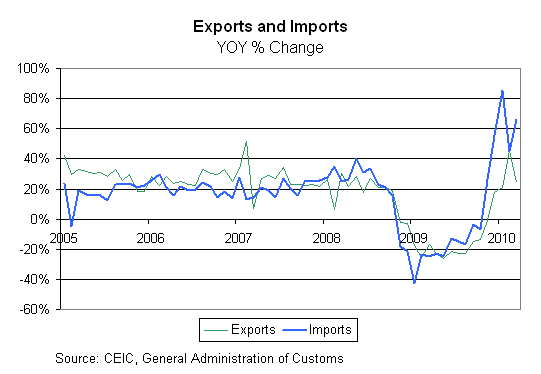
    In March, China’s trade surplus turned into a deficit, prompting some pundits to proclaim that China’s economy was rebalancing. Others pointed to a surge in auto buying as proof consumer demand in China was picking up steam.

    I did not buy either of those arguments, and instead proposed the numbers were indicative of collapse in US demand for Chinese goods coupled with massive surge in Chinese buying of commodities at ever increasing prices.

    Samuel Sherraden, writing for the New America Foundation, makes that case nicely in Why Trade Figures Do Not Prove China Is Rebalancing

    China’s trade surplus declined in the first quarter, and during March the country ran a deficit of $7.2 billion, its first monthly trade deficit since 2004. Contrary to some analyses, this is not proof that the economy has made significant progress toward rebalancing or a reason for the United States to back away from pushing China on yuan appreciation.

    The short-run decline in the trade balance was driven by seasonal effects, a slowdown in China’s export markets, and a surge in raw materials imports – none of which indicate that China is making a transition to an economy driven by greater consumer demand.

    On the contrary, a breakdown of trade figures indicates that although demand has returned, it is largely related to investment-led growth, not to consumer demand.

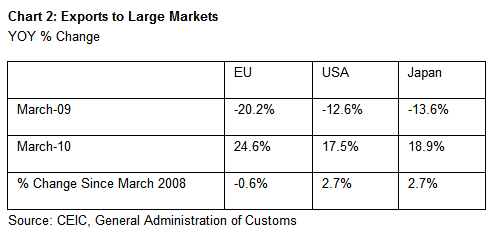
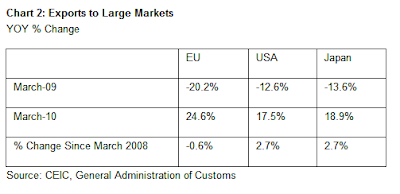
    Weak export growth was a consequence of weak recoveries in the European Union, United States, and Japan, which accounted for 46% of China’s exports in 2008. Even though exports to the EU, US, and Japan increased by 25%, 17%, and 19% YOY in March 2010, these gains barely made up for the decline during the previous year. In other words, exports to China’s major trading partners have remained flat since 2008 (see Chart 2).
    Import Demand Increased

    While export growth remained subdued, import growth has surged. But the increase in imports reflects an intensification of investment-driven growth and demand for commodities and materials, not a move to greater consumer demand.[1] Fixed asset investment grew 25.6% in the first quarter of 2010 compared to the first quarter of 2009. Partly as a result, China imported $27.6 billion more commodities and materials in March 2010 than in March 2009, an increase of 77.1% YOY. This was the major driver of the $25.8 billion decline in the trade balance during the same period.

    Evidence of Consumer Goods Imports?

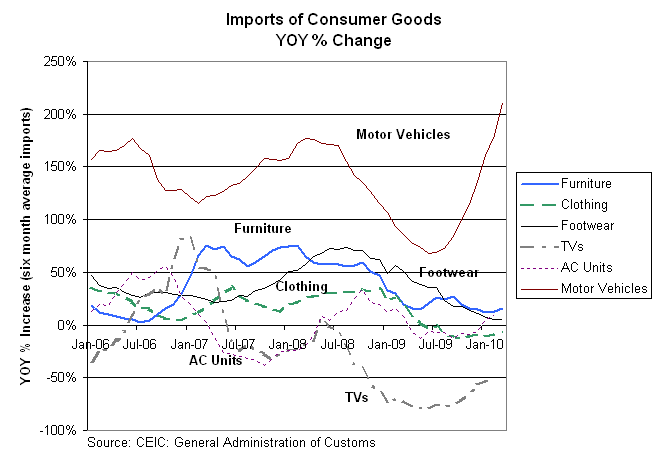
    Motor vehicles imports have soared on the back of strong government subsidies and increased demand, but imports of other consumer goods have not grown as quickly and in some cases have declined. During the last six months (October 2009 – March 2010), motor vehicle imports increased 211% from the same period last year. During the same period, imports of furniture and footwear increased by 15.4% and 5.3%, respectively, but clothing imports declined by 6.9% (see Chart 5). During the six months between September 2009 and February 2010, imports of air conditioners increased 9.0% but imports of televisions declined 54.6% from the same time period last year. In short, with the exception of motor vehicles, imports of consumer goods remained relatively weak, with some areas showing modest gains and others showing losses.

    At first glance, increased imports of motor vehicles would tend to support the argument that China is rebalancing. But on closer examination, one would see that the demand for cars has been driven by a government strategy to develop a strong domestic auto sector, not by a goal of creating a more consumer-oriented economy. Policies to support the auto sector, which included significant subsidies for purchasers and producers of fuel efficient vehicles, were partly responsible for dramatic increases in sales during 2009 and the first quarter of 2010. While some stimulus to the auto sector will expire in 2010, subsidies will continue for gas vehicles with engines smaller than 1.6 liters; “cash for clunkers” rebates in rural areas of up to 18,000 yuan ($2,632); and rebates for “new energy” cars, or fully electric cars, of up to 60,000 yuan ($8,775).

    Conclusion

    China’s trade balance has declined because China’s stimulus program intensified investment-led growth, increasing demand for commodities and capital goods. Based on our analysis, it is not evident that China has made progress toward rebalancing to a more consumer-oriented economy. …

    Excessive bank lending since the beginning of 2009 incentivized stockpiling of commodities and materials and the development of spare capacity. A tightening cycle could force enterprises in China to reduce imports and rely on existing commodity stockpiles and excess capacity to increase exports, leading to a rise in the trade surplus.

    There is a danger, then, that the recent trade figures will temporarily reduce pressure on China to rebalance its economy. Given the likelihood that China’s investment-heavy stimulus will lead to a new surge in China’s net exports, it is even more important that the United States develop a strategy to encourage China to undertake structural reforms to rebalance its economy. Revaluation of the yuan, although no substitute for longer term structural changes, would be a good place to start.

    There are more charts in the article related to Chinese demand for commodities. I encourage everyone to take a closer look.

    Artificial Demand

    The important point, but one that the article did not explicitly make is that China’s demand for commodities is hugely artificial, predicated on round after round of stimulus and outright monetary printing that has also fueled massive property bubbles and speculation.

    So before one can even talk about ways to rebalance, global stimulus needs to stop. Yet, China Business says Another $586 billion “Stimulus” Coming to China.

    Regardless, hoping to balance the US trade deficit with China by pegging the Renminbi (RMB) to some arbitrary level is a fool’s mission as noted in Why Repegging the Yuan and Other Non-Free-Market Solutions to Trade Imbalances With China Will Fail

    The notion the RMB is hugely undervalued is in part predicated on a belief the Chinese economy is a lot better than it is. Indeed, near unanimous opinion suggests the RMB would soar if China floated it.

    Here’s a question to ponder: What would happen if China stopped its stimulus cold turkey, pricked its property bubbles, and allowed the RMB to float freely, and in response the Chinese stock market collapsed, social unrest picked up, and hot money poured out of China?

    Would the RMB soar in those conditions? I rather doubt it. Yet those conditions are what I would expect if China stopped its speculative bubbles.

    The way to find out the true state of affairs is for China to float the RMB, central bankers to allow the market to set rates, and for governments worldwide to stop fiscal madness. That is also the way to rebalance the global economy.

    Unfortunately, central bankers and governments won’t take that set of actions, preferring instead to blame China’s RMB peg for the world’s ills.

    Join the conversation about this story »