Category: News

  • The QNX Bentley Demo Onstage at BlackBerry Live [VIDEO]

    BlackBerry Live has seen some amazing demos and if you ask me, rolling a Bentley out on to the stage during the BlackBerry Live 2013 keynote definitely takes the cake. The car is an iconic symbol of passion and power; a car that only the truly ambitious covet. The task of embedding it with the latest mobile computing technology is quite ambitious as well.

    [ YouTube link for mobile viewing ]

    Mark Rigley, of QNX, and Thorsten Heins showed off the power of the BlackBerry platform with a the first BBM Video call from a phone to a car. On the line was none other than Vivek Bhardwaj who was jokingly taking a vacation, while at BlackBerry Live. Check out that video conference and the gorgeous QNX Bentley in the video above.

    In a true demonstration of the power of mobile computing, they were able to update software on the vehicle wirelessly via a BlackBerry 10 smartphone. What do you think about the QNX Bentley? Are you excited for the future of mobile computing?

  • Google+ gets major revamp, 41 new features

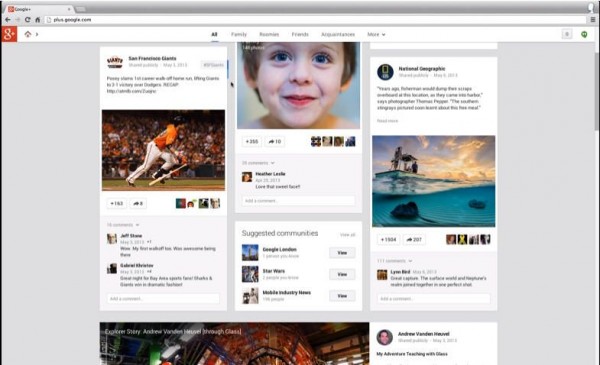
    The Google I/O keynote has revealed some major changes to Google+. Highlights include a new multi-column stream aimed not only at providing a cleaner design but also at offering greater depth to the user experience.

    The columns are customizable so that you can organize them to show the things that are most important to you. Tiles of information can be flipped to show alternative details and thanks to clever landmark recognition technology you can click on a picture to find more information about the location.

    Hangouts are heavily revised too with the focus on making conversations simpler and not just concentrating on video. Hangouts becomes a standalone app on mobile devices and allows you to create ongoing conversations that stretch back over months or even years. You can see at a glance who is taking part in the chat stream and what point they’ve read up to. The new Hangouts will also allow group video chat at no charge — take that, Skype!

    On the photo side Google+ now offers 15GB of free cloud storage for your images. It can pick the best pictures from a folder for you by weeding out duplicates, blurred pictures or poor exposures. It also analyzes shots looking for smiling people and family images in addition to using the landmark recognition mentioned above to pull out the best shots.

    There’s an Auto Enhance feature too that corrects a range of common photo problems. Google also introduced what it calls Auto Awesome in order to create good shots by combining other pictures. This allows you to, for example, ensure you get group shots where everyone is smiling.

    These changes make Google+ much more attractive in both looks and in function but will they be enough to boost its popularity? Let us know what you think.

  • Apptio Raises $45M From Janus, Hillman, Andreessen, Madrone, Others

    Apptio said it raised a $45 million Series E round of funding led by Janus Capital, the Hillman Company and an unnamed institutional investor. The round was joined by existing investors Andreessen Horowitz, Greylock Partners, Madrona Venture Group, Shasta Ventures, and accounts managed by T. Rowe Price Associates. The new round brings the total raised to $136 million.

    PRESS RELEASE

    Apptio Closes $45 Million Series E Funding Round

    New Investors Join Existing Investors to Accelerate Apptio’s
Market Leadership of the Emerging TBM Category

    BELLEVUE, Wash. – May 15, 2013 – Apptio, the leading provider of on-demand Technology Business Management (TBM) solutions, today announced it has closed a $45 million Series E funding round. Led by new investments from funds managed by Janus Capital, The Hillman Company, and an unnamed global institutional investor, the round also included additional funds from existing investors Andreessen Horowitz, Greylock Partners, Madrona Venture Group, Shasta Ventures, and certain accounts managed by T. Rowe Price Associates, Inc. The Series E round brings the total amount raised by Apptio to $136 million.

    Plans for the new capital include further investment in the company’s fast-growing technology platform, expanding Apptio’s international presence—most immediately in Western Europe—and accelerating growth of the emerging TBM category.

    Information technology (IT) in large enterprises is undergoing a fundamental shift as rapid changes in cost structures and business models—cloud computing, for example—meet higher expectations from business executives. IT costs are moving from fixed to variable, computing assets are shifting from owned to shared, and business executives increasingly expect the CIO to play a more strategic role, spending less resources “keeping the lights on” and more on innovation that drives the business forward.
    “In the midst of this services transformation, TBM is a must-have set of business management applications and analytics for Global 2000 enterprises,” said Apptio founder and CEO Sunny Gupta. “Every CIO needs to understand and measure the cost, quality and value that IT delivers to the business—and be able to communicate them in terms that matter to the CEO and the CFO.”

    Apptio established the TBM category and is the only provider completely focused solely on it. This dedicated, unbiased approach has won subscriptions from 29 of the Fortune 100 companies in the three years since Apptio entered the market, and enabled the company to play a seminal role in the founding of the TBM Council, a non-profit group of more than 600 IT executives committed to advancing the discipline.

    “Every other executive in the enterprise has a purpose-built system for managing their business,” said Kurt Shintaffer, co-founder and chief financial officer of Apptio. “We’re delivering the system for the CIO, and we’ve combined it with a proven methodology and a strong community of leaders who are literally writing the book on best practices.”

    Since closing its Series D round in March 2012, Apptio has demonstrated momentum across all facets of its business. The company’s revenues nearly doubled in 2012, with customers coming in from nearly every industry vertical—Apptio now has more than 125 global enterprise customers including Boeing, Royal Bank of Scotland, Safeway, Target and Xerox. In response to increased market demand, Apptio has also nearly tripled its employees from 115 in December 2010 to nearly 350 today.

    About Apptio

    Apptio is the leading independent provider of on-demand Technology Business Management (TBM) solutions for managing the business of IT. Apptio enables IT leaders to manage the cost, quality and value of IT Services by providing deep visibility into the total cost of IT services, communicating the value of IT to the business through an interactive Bill of IT™, and strategically aligning the planning, budgeting and forecasting processes. Apptio’s TBM solutions play a critical role in helping companies understand and drive chargeback, virtualization, cloud and other key technology initiatives. Global enterprise customers such as Bank of America, Boeing, JPMorgan Chase, Microsoft, St. Luke’s Health System, and Swiss Re rely on Apptio® products and services to reduce costs and align IT with business priorities. For more information, visit the Apptio website or the Apptio blog.

    The post Apptio Raises $45M From Janus, Hillman, Andreessen, Madrone, Others appeared first on peHUB.

  • President Obama Honors Law Enforcement Officers Killed in the Line of Duty

    President Barack Obama bows his head after placing a flower in a wreath during the National Peace Officers Memorial Service

    President Barack Obama bows his head after placing a flower in a wreath during the National Peace Officers Memorial Service, an annual ceremony honoring law enforcement who were killed in the line of duty in the previous year, at the U.S. Capitol in Washington, D.C. May 15, 2013. Chuck Canterbury, National President, Fraternal Order of Police and Linda Hennie, President, FOP Auxiliary stand with the President.

    (Official White House Photo by Pete Souza)

    Today, President Obama spoke at the National Peace Officers Memorial Service, an annual ceremony honoring law enforcement officers killed in the line of duty in the previous year. 

    The President said that the 143 officers honored today “exemplified the very idea of citizenship — that with our God-given rights come responsibilities and obligations to ourselves and to others.”

    They embodied that idea. That’s the way they died. That’s how we must remember them. And that’s how we must live.

    We can never repay our debt to these officers and their families, but we must do what we can, with all that we have, to live our lives in a way that pays tribute to their memory. 

    read more

  • Google Adds Conversational Search To Desktop As Part Of ‘The End Of Search’ [Google I/O]

    Amit Singhal, head of Google’s core ranking team, took the stage at Google I/O today to declare “The End of Search”.

    “Search is dramatically changing right before our eyes,” he said. This involves Google getting closer to the company’s famous “Star Trek” dream – that is, making tools that put us closer to a Star Trek-like reality.

    He announced some new capabilities of the Knowledge Graph, which includes anticipating your next question. For example, if you search for the population of India, it will show you other populations as well, and compare these. From the sound of it, it will mostly be doing this with stats.

    Knowledge Graph is also rolling out in additional languages: Polish, Turkish, Simplified Chinese and Traditional Chinese. Singhal also noted that Knowledge Graph already has over 570 million entities, and continues to grow.

    Then, Singhal announced that the conversational search available on Android is coming to Chrome. You can ask Google questions by saying, “Okay Google” and asking your question, without having to push the microphone button, and Google will respond to you with its voice.

    Additionally, there are some new cards coming to Google Now, including Public Transit, and some new cards for music, TV shows, books and video games. You will also be able to set reminders in Google Now. These are launching today.

    All of this, as Singhal notes, will make Google more useful as assistive tool.

    Here’s a blog post about the new stuff. There’s also some new stuff in the search field trial:

  • Prepaid gives Google a huge Android boost (and Apple has noticed)

    Wondering where the big surge in Android activations Google announced at I/O is coming from? In the U.S. at least, Google should be thanking the prepaid operators. According to The NPD Group, one out of every three smartphone activations (32 percent) in the U.S. last quarter was on a prepaid no-contract plan.

    Since Android has long been the prepaid carrier’s OS of choice, the vast majority of those devices ran Google’s software. NPD’s Mobile Phone Track service show that year-over-year prepaid smartphone unit sales doubled in the first quarter. Quarter over quarter, prepaid’s overall share of the smartphone market jumped form 22 percent to 32 percent. NPD’s VP of industry analysis Stephen Baker said Q1 marked the twelfth straight quarter of triple digit sales increases in the U.S.

    Q1 2013 Chart - NPD Prepaid

    Apple certainly isn’t blind to the trend. In fact, it’s been actively seeking out prepaid carrier partnerships in the last year working with carriers like Cricket Communications, Straight Talk and T-Mobile USA. Though the iPhone’s share of the prepaid smartphone market was only 8 percent, that’s up considerably from last year when it was a mere 2 percent. Samsung share of the prepaid smartphone market is big, 32 percent, but it’s relatively stable, while Apple is on a big growth trajectory.

    “For consumers looking at prepaid phones today, value does not equate with finding phones that are cheap or obsolete,” Baker said in a statement. “In fact, the Galaxy S2 and the iPhone 4S, two of the top five prepaid smartphone models in 2013, were among the top-selling phones overall just one year earlier.”

    Related research and analysis from GigaOM Pro:
    Subscriber content. Sign up for a free trial.

  • Samsung Galaxy S III comes to StraightTalk using Sprint’s LTE network

    galaxys3_order

    Pre-paid carriers are getting more and more high-end phones every day, and StraightTalk is no different now that they offer the Samsung Galaxy S III. A user on HowardForums posted a photo of the Galaxy S III’s StraightTalk retail packaging, and as of now you can purchase it directly from StraighTalk’s website. The phone is unbranded and comes at the very reasonable price of $439.99. Aside from StraightTalk’s website, the S III should be available at Wal-Mart soon.

    Now for the bad news, the device runs on Sprint’s CDMA-LTE network. If you live in an urban area this should pose no problems, but Sprint’s service is notoriously spotty outside of cities and its LTE coverage is still sparse in comparison to Verizon and AT&T. Normally this wouldn’t be a problem, but considering the carrier (StraightTalk) uses multiple networks depending on what phone you have, its unfortunate that StraighTalk customer’s first LTE experience will have to be on Sprint’s network.

    galaxy_s3_box

    Source: HowardForums

    Come comment on this article: Samsung Galaxy S III comes to StraightTalk using Sprint’s LTE network

  • Google announces ‘the end of search as we know it’

    Google Search
    During what may be one of the longest keynotes in history, Google on Wednesday announced a number of new features for its core search product under the heading, “the end of search as we know it.” The company has updated its intelligent search feature “knowledge graph,” which now anticipates future searches based on past and current queries. So a search for “what is the population of India?” might also display the population of neighboring countries or all of Asia. Google search also now offers more personalized search results as well. For example, searching “what time is my flight?” will return an intelligent response based on flight confirmation emails in Gmail, even though the user did not offer any specific details in his or her query.

    Continue reading…

  • Updater Raises $5M From SoftBank, IA Ventures, Others

    Updater said it raised about $5 million in a Series A round led by SoftBank Capital and IA Ventures. The company did not disclose its other investors. It said the money would be used to hired, expand technology resources and for marketing.

    PRESS RELEASE

    Updater Makes Moving Fun, Convenient and Stress Free

    Fastest Growing Website in Relocation Industry Raises $5M from SoftBank Capital, IA Ventures and others

    Americans Can Rest Easy with this Exclusive Free Service

    New York, May 15, 2013 — Widely considered one of life’s most stressful moments, moving homes is commonly fraught with overwhelming decisions, unforeseen roadblocks and unexpected costs. Enter Updater.com, the one-stop solution enabling families and individuals to update all of their personal accounts and records, connect home services and change of address, all from one easy-to-use free website.

    Updater announced today that it has raised approximately $5 million, including a Series A financing round led by SoftBank Capital and IA Ventures. The company plans to invest in first-class talent, technology resources and marketing.

    David Greenberg, Updater’s CEO and Founder commented, “We’re thrilled to partner with SoftBank and IA, who share our vision to reinvent address change and simplify the moving process. We have introduced seamless technology for the 40 million Americans who relocate each year to securely manage vital information and update it all with a touch of a button. Fueled by our growing partnership base, we’re excited by the opportunity to provide free services and a rich user experience to a demographic who, during this brief period, have both disposable income and flexible loyalties.

    “Before Updater, people were forced to inefficiently notify dozens of businesses and service providers when they were preparing to move,” said Joe Medved, Partner at SoftBank Capital. “Updater is a game changer for people moving- it helps them stay organized and save time and money.”

    Ben Siscovik, General Partner at IA Ventures added, “Updater’s data enables businesses and organizations to maintain an accurate database of customers, alumni or constituents. Thousands of businesses and organizations already accept Updater’s near real-time address change updates and those numbers continue to rise each month. We look forward to working closely with the Updater team to grow the business.”

    About Updater
    Modern moving begins with Updater, the fast and free way to update accounts with a new address in just a few clicks. Easily schedule cable, electric, and other utilities to be transferred to your new home. File your official mail forwarding form with the USPS. Plus, get access to exclusive discounts through our extensive network. Updater helps relocating families and individuals simplify the moving process, saving them time and money. Visit www.updater.com for more information.

    About SoftBank Capital
    SoftBank Capital makes early and growth stage investments in companies that connect people, devices and the world. SoftBank Capital invests in category leaders in consumer and enterprise mobile, online advertising, ecommerce, social media and cloud computing.  We have been making investments since 1995, with recent exits including Bluefin Labs, Buddy Media, Hyperpublic, Huffington Post, OMGPOP, Pivot and ZipList. Our investors include SoftBank Corp., which introduced the iPhone to the Japanese market and recently announced the strategic acquisition of Sprint; and Yahoo! JAPAN, the largest search engine and content portal in Japan. To learn more, visit www.softbank.com.

    About IA Ventures
    IA Ventures is an early-stage venture capital firm that invests in companies creating competitive advantage through data. We believe that using data as a core asset will drive innovation in everything from storage and processing infrastructure to analytics to data-driven products and services. With that in mind, we focus on businesses that use cutting-edge technology to manage and extract value from today’s massive, occasionally unstructured, often real-time datasets. For more information, please visit www.iaventures.com.

    The post Updater Raises $5M From SoftBank, IA Ventures, Others appeared first on peHUB.

  • VMware takes on the BYOD problem with — you guessed it — virtualization

    If you’ve talked to a CIO lately, you’ve likely got an earful about having to support employee smartphones and the problems they bring — users sending off company files to Dropbox or their personal Gmail account or God knows where else. They loathe the idea that a user may be running Twitter or Scrabble on what they view as a piece of business equipment. If only there were a way to cordon off the personal from the professional …

    vmwarephoneNow, VMware and Verizon Enterprise Solutions say their newly released VMware Horizon Mobile service eases that angst. The news comes two years after the effort, called Project Horizon, was first announced. Two new VMware-ready phones — the Motorola Razr and LG Intuition — will run the new service with additional “VMware Horizon”-ready devices to come. And these devices running this service will bring fulfill “dual persona” promisew which segregates work email and access to applications from Twitter and Facebook.

    According to the press release, those devices running in VMware Horizon Mobile environments provide:

    ” …  a corporate workspace that is controlled and managed by IT, and is completely separate from the employee’s personal information, applications and data on the device. The workspace contains its own operating system, applications and policies, enabling IT to remotely manage the entire lifecycle of the workspace. IT is able to provision the workspace, deploy applications and monitor the flow of information to and from the workspace for security.”

    According to a blog post VMware’s Srinivas Krishnamurti:

    “Irrespective of who actually buys or owns the device, the corporation or the user, most employees tend to download personal apps onto these devices – Facebook, Angry Birds, Temple Run, etc. coexist with work email/PIM. It is fair to assume then that most devices will have both personal and corporate content (apps, data and services).”

    A perpetual license for the service costs $125 per user.

    Ah, Angry Birds and truly secure corporate email in one small package. If these devices deliver as promised, that is the best of both worlds — although one might quibble at the lack of immediate support for iPhones or Samsung Galaxies –both hugely popular among business users.


    Related research and analysis from GigaOM Pro:
    Subscriber content. Sign up for a free trial.

  • Khloe Kardashian: Braces, Or Not?

    Khloe Kardashian reportedly got braces recently, and posed for a picture with her dentist which she posted on Twitter. But later, in response to a fan’s comment, she said she didn’t have braces. Was it just a cheeky nod to the Invisalign hardware she got put on?

    The photo is now sweeping the web as fans try to figure out whether she actually had work done. But it appears that she already had a near-perfect smile, so many are confused as to why she would need braces in the first place. Her dentist, Dr. Kevin Sands, may have cleared that up.

    “She’s a perfectionist and so am I. We’ll take her from a 9.5 to a 12,” Sands said.

  • What Google was thinking when redesigning the new Google+

    When I am feeling kind, I think of Google+ as a social network by dictat — err, Larry Page’s mandate. And when I am in my curmudgeonly mood (which is pretty much every second day), then I think of it as a fly that keeps buzzing your face: you try and swat it, but you fail and it makes your angrier. Yet, I can’t help but admire the newly announced version of Google’s social network. It is a much needed improvement and Google has finally developed an aesthetic that is visually different from Facebook.

    Before Google’s senior vice president, Vic Gundotra announced the new Google+ Wednesday at Google’s annual developer conference, Google I/O, I sat down with Fred Gilbert who heads up design for Google+, who explained how the company arrived at this new, improved look; I see it as a hybrid of a stream and Pinterest-style cards that doesn’t look awkward and ungainly.

    Google-io

    It is a responsive design and with a click you switch how you want to see your content — as a stream or as these tiles, Gilbert pointed out. A lot of the new design actually takes a lot of cues from the current mobile versions of Google+, which are actually more advanced compared to the desktop version. At first blush this looks like a unification of mobile and desktop, but there are changes that are visible only on Google’s Chrome browser.

    FredGilbert

    Fred Gilbert, lead designer for the new Google+

    Gilbert, who has worked for Google for over five years, explained that a lot of the new design has been shaped by how the web has changed. He pointed out that we are sharing more things more often and as a result the social web is getting busier. You can say that again!

    “What I saw was a chance to make people and the content they share the star,” Gilbert said. “Everything else just fades into the background.”

    Flat design for a busy world

    The design of the new Google+ is muted and flat. The colors are actually quite neutral, allowing mostly the content to shine brighter. “Flatter design keeps the distraction away,” Gilbert said. This new philosophy is reflected in this new version of Google+, which is marked by simplicity and fewer distractions. For instance, unless you are ready to engage with a piece of content, the links appear as regular text, without the distraction of the blue link. Both the left and right sidebar and menus disappear, sliding in and out as needed.

    Google has come up with a unique twist on the #hashtag concept and is using it as a way to surface contextual information on the new Google+ service. The new design also liberally uses the concept of cards (that first showed up on Google Now). Hover over an item, and on the back side of the card you get more information and related links and action items.

    Gilbert explained that when Google started working on the new look, the idea was to take a lot of information and show it in as simple a manner, giving the eye the visual cues to understand the importance of content. Bigger photos, for instance are indicative of their importance. Photos become bigger based on analysis of past relationships to the people and the content and their ensuing interactions, Gilbert explained.

    Data, Design, Experience

    Underlying these visual cues are a lot of data analytics. This data-informed design is actually a clever approach and the wave of the data-informed design. Gilbert said that usually when companies undertake a redesign of their website, it is based on some kind of data they have collected over a period of time. For Google+, data is informing the design, except at a much faster speed and is hyper-personalized based on who you really are. “Data and design have to be used together to tailor experiences,” said Gilbert.

    We’ll take a close look at how data is informing design at our RoadMap event in November in San Francisco. If you sign up here you can get first access to tickets that will go on sale this Summer.

    While Google still is a few years away from developing the human quotient of Apple, the new Google+ shows that the company is thinking correctly about its design identity, not forgetting that its core competency is its infrastructure: its ability to crunch large sets of data cheaply and quickly and then deliver them at blazing speed to our browsers.

    The biggest challenge for Google is that Google+ doesn’t really feel like a social network like Facebook or Twitter. Instead it is something that was launched because of a degree of fear and a dash of hubris. It was a social network that Larry wanted, not you and I.

    However, it has slowly evolved and has found some fanatical users such as photographer Trey Ratcliff, blogger Robert Scoble and our very own Janko Roettgers, who has turned to Google+ to build a community for his Cord Cutters show and podcasts. Google needs accidental visitors such as me to become active participants. I think the new design will help.

    Related research and analysis from GigaOM Pro:
    Subscriber content. Sign up for a free trial.

  • Google+ Gets 41 New Features, Including Stream Redesign [Google I/O 2013]

    At Google I/O 2013, Google announced that Google+ was going to get 41 new features in the coming year. Those new features will be added to three key areas – stream, hangouts and photos.

    The first major change is an entire upheaval of the Google+ stream on desktop from a single column to a multi-column design. Some photos and videos will take up multiple columns while smaller stories will take up one out of three columns.

    Google is also introducing a new feature called related hashtags. In short, it tags stories based on contextual clues from photos and posts. One example is a photo of the Eifel Tower being tagged #eifeltower based solely on Google’s image algorithm recognizing the subject of the photo.

    For Hangouts, Google is introducing an app called Hangouts that’s separate from Google+. It’s kind of like Facebook Messenger, but with all of the sharing and video chat capabilities found in Google+ Hangouts. Google says that those participating in the Hangout app will feel like they’re in the same room together.

    Photos on Google+ will be adopting a new philosophy of “Your darkroom is a datacenter.” In other words, photographers on Google+ will be able to utilize Google’s cloud technology to make highlighting and sorting photos easier. The latter is especially impressive as Google+ can now automatically sort photos by landmark, human presence, aesthetics and other indicators. Photos will also be getting auto-enhance – a new application that automatically applies image enhancements without having to use complicated software like Photoshop.

    The final feature is called “auto-awesome.” One of its applications is called motion – it will take photos that are taken in burst mode and turn them into animated .gifs. The motion application is only one of five new features comprising the auto-awesome feature. Some other auto-awesome features include HDR and auto-collage.

    Most of these new features, including the new stream, will be rolling out to Google+ this afternoon.

  • What Is Organizational Culture? And Why Should We Care?

    If you want to provoke a vigorous debate, start a conversation on organizational culture. While there is universal agreement that (1) it exists, and (2) that it plays a crucial role in shaping behavior in organizations, there is little consensus on what organizational culture actually is, never mind how it influences behavior and whether it is something leaders can change.

    This is a problem, because without a reasonable definition (or definitions) of culture, we cannot hope to understand its connections to other key elements of the organization, such as structure and incentive systems. Nor can we develop good approaches to analyzing, preserving and transforming cultures. If we can define what organizational culture is, it gives us a handle on how to diagnose problems and even to design and develop better cultures.

    Beginning May 1, 2013, I facilitated a discussion around this question on LinkedIn. The more than 300 responses included rich and varied perspectives and opinions on organizational culture, its meaning and importance. I include several distinctive views below, illustrated by direct quotes from the LinkedIn discussion thread — and then I offer my own synthesis of these views. (There often were multiple postings with similar themes, so these are simply early selections; unfortunately it was not possible to acknowledge everyone who made helpful contributions.)

    “Culture is how organizations ‘do things’.” — Robbie Katanga

    Culture is consistent, observable patterns of behavior in organizations. Aristotle said, “We are what we repeatedly do.” This view elevates repeated behavior or habits as the core of culture and deemphasizes what people feel, think or believe. It also focuses our attention on the forces that shape behavior in organizations, and so highlights an important question: are all those forces (including structure, processes, and incentives) “culture” or is culture simply the behavioral outputs?

    “In large part, culture is a product of compensation.” — Alec Haverstick

    Culture is powerfully shaped by incentives. The best predictor of what people will do is what they are incentivized to do. By incentives, we mean here the full set of incentives — monetary rewards, non-monetary rewards such as status, recognition and advancement, and sanctions — to which members of the organization are subject. But where do incentives come from? As with the previous definition, there are potential chicken-and-egg issues. Are patterns of behavior the product of incentives, or have incentives been shaped in fundamental ways by beliefs and values that underpin the culture?

    “Organizational culture defines a jointly shared description of an organization from within.” — Bruce Perron

    Culture is a process of “sense-making” in organizations. Sense-making has been defined as “a collaborative process of creating shared awareness and understanding out of different individuals’ perspectives and varied interests.” Note that this moves the definition of culture beyond patterns of behavior into the realm of jointly-held beliefs and interpretations about “what is.” It says that a crucial purpose of culture is to help orient its members to “reality” in ways that provide a basis for alignment of purpose and shared action.

    “Organizational culture is the sum of values and rituals which serve as ‘glue’ to integrate the members of the organization.” — Richard Perrin

    Culture is a carrier of meaning. Cultures provide not only a shared view of “what is” but also of “why is.” In this view, culture is about “the story” in which people in the organization are embedded, and the values and rituals that reinforce that narrative. It also focuses attention on the importance of symbols and the need to understand them — including the idiosyncratic languages used in organizations — in order to understand culture.

    “Organizational culture is civilization in the workplace.” — Alan Adler

    Culture is a social control system. Here the focus is the role of culture in promoting and reinforcing “right” thinking and behaving, and sanctioning “wrong” thinking and behaving. Key in this definition of culture is the idea of behavioral “norms” that must be upheld, and associated social sanctions that are imposed on those who don’t “stay within the lines.” This view also focuses attention on how the evolution of the organization shaped the culture. That is, how have the existing norms promoted the survival of the organization in the past? Note: implicit in this evolutionary view is the idea that established cultures can become impediments to survival when there are substantial environmental changes.

    “Culture is the organization’s immune system.” — Michael Watkins

    Culture is a form of protection that has evolved from situational pressures. It prevents “wrong thinking” and “wrong people” from entering the organization in the first place. It says that organizational culture functions much like the human immune system in preventing viruses and bacteria from taking hold and damaging the body. The problem, of course, is that organizational immune systems also can attack agents of needed change, and this has important implications for on-boarding and integrating people into organizations.

    In the discussion, there were also some important observations pushing against the view of culture as something that it is unitary and static, and toward a view that cultures are multiple, overlapping, and dynamic.

    “Organizational culture [is shaped by] the main culture of the society we live in, albeit with greater emphasis on particular parts of it.” — Elizabeth Skringar

    Organizational culture is shaped by and overlaps with other cultures — especially the broader culture of the societies in which it operates. This observation highlights the challenges that global organizations face in establishing and maintaining a unified culture when operating in the context of multiple national, regional and local cultures. How should leaders strike the right balance between promoting “one culture” in the organization, while still allowing for influences of local cultures?

    “It over simplifies the situation in large organizations to assume there is only one culture… and it’s risky for new leaders to ignore the sub-cultures.” — Rolf Winkler

    The cultures of organizations are never monolithic. There are many factors that drive internal variations in the culture of business functions (e.g. finance vs. marketing) and units (e.g. a fast-moving consumer products division vs. a pharmaceuticals division of a diversified firm). A company’s history of acquisition also figures importantly in defining its culture and sub-cultures. Depending on how acquisition and integration are managed, the legacy cultures of acquired units can persist for surprisingly long periods of time.

    “An organization [is] a living culture… that can adapt to the reality as fast as possible.” — Abdi Osman Jama

    Finally, cultures are dynamic. They shift, incrementally and constantly, in response to external and internal changes. So, trying to assess organizational culture is complicated by the reality that you are trying to hit a moving target. But it also opens the possibility that culture change can be managed as a continuous process rather than through big shifts (often in response to crises). Likewise, it highlights the idea that a stable “destination” may never — indeed should never — be reached. The culture of the organization should always be learning and developing.

    These perspectives provide the kind of holistic, nuanced view of organizational culture that is needed by leaders in order to truly understand their organizations — and to have any hope of changing them for the better.

  • BlackBerry Enterprise Service 10 Gaining Traction in North America

    The successor to BlackBerry Enterprise Server, BlackBerry Enterprise Service 10 is a cross-platform mobility management and deployment solution that gives you all sorts of options for smartphone and tablets wether they be corporate issued or BYOD.

    Screen Shot 2013-05-15 at 1.53.01 PM

    As BlackBerry 10 continues to roll out and ship new handsets, BES 10 has been adopted by more and more companies. A BlackBerry deployment is known for being able to be managed with minimal effort by IT support staff and BES 10 extends that ease of use to iOS and Android phones and tablets.

    A couple of years ago, BYOD was one of the bigger talking points when discussing BlackBerry’s waning market share. The company seems to have reversed that trend by embracing the competing platforms when managing mobility for the enterprise.

    Click here for more info on BlackBerry Enterprise Service 10 including their latest 10.1 update.


  • How RelayRides is making money from long-term car sharing

    This article originally appeared on GigaOM Pro, our premium research subscription service.

    Peer-to-peer car sharing service appeals to the urban and young people, and  that partly explains why college campuses and large cities like San Francisco have been the labs for companies such as RelayRides and Getaround.

    One of the benefits of this type of the service is the ability for customers to rent a car by the minute or hour, something that traditional rental car companies don’t allow. But for San Francisco-based RelayRides, an increasing number of its customers are paying for daily, weekly or even monthly rentals, said Steve Webb, the company spokesman. The majority of RelayRides’ revenues come from those types of rentals, he said.

    That trend is good news for car owners who are able to part with their cars for an extended period of time. They could make more money with fewer renters. That also cuts the amount of time the car owners would need to meet with their customers — RelayRides switched to promoting the in-person exchange of keys last year when it pushed for a national expansion.

    The peer-to-peer car sharing market is growing but remains very small. To scale up, a car sharing service has to market well and sign up a large network of cars, create an easy way for car owners to manage rentals and get paid and for renters to reserve and find the types of cars they want. A good customer service unit to settle any dispute and resolve insurance and other issues is also a must. As GigaOm’s Katie Fehrenbacher pointed out, getting people to feel comfortable using the service remains a hurdle. Webb said many car owners prefer to meet their renters in person before handing over the keys.

    Still, RelayRides decided it wanted a way for renters to access cars without having to arrange for a meet up. It announced yesterday the purchase of a competitor, Wheelz, which has developed software that allows renters to find, reserve and unlock cars using their smart phones. An electronic device installed inside the car makes unlocking with the phone possible.

    This automated tech was something RelayRides used to hire people to install regularly. But it was too costly and time consuming that the company largely ditched that effort, though it still offers it to car owners who rent out their cars frequently, Webb said. The device and software aren’t proprietary technology and are designed for running fleet services. Buying Wheelz gives RelayRides its own technology that it can then customize and compete more effectively against the likes of Getaround, which gives the car owners the unlocking device that they can install themselves.

    Will the long-term focus for peer-to-peer car sharing be a long-term trend? What do you guys think?

    Related research and analysis from GigaOM Pro:
    Subscriber content. Sign up for a free trial.


  • Google Play Developer Console gets a major injection of new features

    Google_Play_Developer_Console


    Google I/O 2013 keeps churning out awesome new additions to services they offer, and the Google Play Developer Console is no exception either. As you can see in the picture above, the service includes Optimization Tips, App Translation Service, Usage Metrics & Referral Tracking, Revenue Graphics and the most applauded, Beta Testing & Staged Rollouts. All of these services are intended to help developers make better apps. App Translation helps users see were there app is used the most. If the developer see that his app is being used in Russia, however the app isn’t translated into Russian, the new service can help in that area.

    As I stated earlier, Beta Testing & Staged Rollout got the most reception from the group at I/O. The service is just what the name suggests. Developers will now be able to rollout better apps in the form of betas as well as getting updates to them faster. Revenue Graphs allow developers track where they are making most of their money from, whether it be in-app purchases or the app itself.

    Stay with us as we try to bring you all the info for these new features, as Google I/O progresses over the next few days.


    Come comment on this article: Google Play Developer Console gets a major injection of new features

  • Google unveils Hangouts unified messaging service

    Google Hangouts Announcement
    Google on Wednesday took the wraps off its new Hangouts unified messaging service aimed at pulling together all Google messaging services including Google Talk, Google+ Hangouts and Google Messenger. The new service will be available starting Wednesday on Google Chrome OS, Android and iOS, and can also be accessed through desktop versions of Google+ and Gmail. The service will also allow users to save text, images and videos from all chats conducted across all platforms and access them through Google’s cloud storage service. What’s more, Hangouts will allow users to initiate video calls with up to 10 of their friends at the same time.

    Continue reading…

  • Google Just Took Out Thousands Of Linksellers

    Earlier this week, Google’s Matt Cutts ran down a bunch of new stuff Google’s web spam team is working on. Cutts tweeted an extension of that today, noting that Google will continue to tackle link networks, and that in fact, they just took action on “several thousand linksellers” today.

    Let the good times roll.

    Webmasters continue to anxiously await an upcoming, bigger version of the Penguin update, and Cutts also indicated that Panda would be easing up a bit.

    As part of Cutts’ big video, he said Google would continue to be vigilant when it comes to all types of link spam. Already, the webspam team is making good on its word.

  • Google announces unlocked Samsung Galaxy S 4 with stock Android coming June 26 for $649

    google_edition_galaxy_s4We told you last night about the possibility of this happening, and today at the I/O keynote, Google made it official that they will be releasing an unlocked Samsung Galaxy S 4 running stock Android.  The LTE compatible, completely unlocked phone will come with an unlocked bootloader and will work on AT&T and T-Mobile. Storage will be 16GB and the device will arrive on June 26 for $649.  The crowd at I/O went silent, with a few boos audible when they heard about the high price tag.

    This is the first non-Nexus device to get this kind of Google treatment. It’s a little surprising Samsung is on board with this, considering how much they market their TouchWiz UI’s additions to the Android experience.

    A huge advantage of owning this device will be system updates that will arrive as promptly as they do for the Nexus. Instead of waiting for the carrier and manufacturer to customize and approve the new software, owners of this “Google Edition” device will receive updates very soon after Google releases them. With an unlocked bootloader, this device will be ready to go for developers to test on without having to unlock their device themselves.

    Come comment on this article: Google announces unlocked Samsung Galaxy S 4 with stock Android coming June 26 for $649