Category: News

  • Hussman: This Market Is Excruciating For Investors Who Take Valuations Seriously

    johnhussmanportrait.jpg

    Every week John Hussman speculates on why the market shouldn’t but does keep rising.

    (It shouldn’t because the price-to-normalization ratio is at extremes not seen since 2007 and 1929. It does because investors are stupid.)

    He says this is the kind of market that investors who take valuations seriously find excruciating:

    As of last week, the Market Climate in stocks remained characterized by an overvalued, overbought, overbullish, rising-yields syndrome that has historically produced periods of marginal new highs, slight declines, and yet further marginal highs, followed somewhat unpredictably by nearly vertical drops. I’ve often accompanied the description of this syndrome with the word “excruciating,” because the apparent resiliency of the market and the celebration of each fresh high, can make it difficult to maintain a defensive stance. Interestingly, the analysts at Nautilus Capital recently noted that the most closely correlated periods in market history to this one were the advances of 1929 and 2007. While exact replication of those advances would allow for a couple more weeks of further strength, we’ve generally found it dangerous to expect history to do more than rhyme. These hostile syndromes have a tendency to erase weeks of upside progress in a few days.

    Read the full letter at Hussman Funds –>

    Join the conversation about this story »

  • 2011 Ford Mustang GT 5.0 vs. 2010 Chevrolet Camaro SS – Comparison Tests

    Double Jeopardy: A classic confrontation that never seems to get old.

    You’re forgiven if you feel you may have seen this movie before, because you probably have. Like Hamlet, or Macbeth,
    its core is a classic confrontation that never seems to get old, thanks to the arrival of new players and fresh productions, as one generation succeeds another.

    You may be thinking, “New? Don’t see no new here.” With little more than a year in Chevy showrooms, the Camaros roll into summer unchanged. And it takes the experienced eye of a longtime Mustang cognoscente to see the updates for these 2011 models. The dashboard surface is revised, softened to make impacts with one’s head a little less unpleasant. There are also suspension tweaks aplenty, but the real giveaway is a 5.0 badge on the flanks of GT models.

    Keep Reading: 2011 Ford Mustang GT 5.0 vs. 2010 Chevrolet Camaro SS – Comparison Tests

    Related posts:

    1. 2011 Ford Mustang V6 vs. 2010 Chevrolet Camaro RS – Comparison Tests
    2. 2010 Lingenfelter Chevrolet Camaro SS vs. 2010 Roush Ford Mustang Stage 3 – Comparison Tests
    3. 1999: Chevrolet Camaro Z28 vs. Ford Mustang GT – Archived Comparison
  • Gap Jeans Promise The Impossible, To Fray And Tear Without Unraveling?

    Reader Nick would like to ask how Gap managed to design a pair of jeans that would fray and tear without unraveling, since that seems sort of impossible.

    Thought you guys would appreciate this: I bought these jeans over the weekend from a Gap here in San Francisco. They were a great deal (marked down from almost $90 to about $30), but check out the dueling labels.

    The top one says “they’re extra durable and designed to keep the fabric from unraveling.”

    The bottom one says “they’re intentionally designed to fray and tear.”

    Is it really possible to design a product to do BOTH those things?

    Hmmm. Merriam-Webster:

    Fray: 1 a : to wear (as an edge of cloth) by or as if by rubbing : fret b : to separate the threads at the edge of 2 : strain, irritate

    Unravel: 1 a : to disengage or separate the threads of : disentangle b : to cause to come apart by or as if by separating the threads of

    Sounds like a tall order. Glad I don’t design jeans.

    4-26-2010 1-17-26 PM.jpg

  • Master Plan for Governors Island Unveiled


    Dutch Landscape architecture firm West 8, working together with Diller Scofidio + Renfro and Rogers Marvel, has released the master plan for Governors Island, a 172-acre island off the southern tip of Manhattan. The first phase of the master plan details the roll-out of 2.2 miles of waterfront promenades and a new 40-acre park. The new design features artificially-created hills that focus attention on the park’s center, as well as a “hammock grove,” a grotto-like shelter, athletic fields and marshlands, writes the The New York Times. The New York City government has allocated more than $40 million in funds to the new plan, but will need to raise more than $220 million for future phases of development. Control of the island recently passed from New York state to the city, enabling Mayor Bloomberg’s plans for the island to move forward.

    The Governors Island master plan includes the development of a new ferry landing area and shaded lawn overlooking the Lower Manhattan skyline. According to Fast Company, a man-made canyon will also create framed views of the Statue of Liberty. The entire master plan call for a network of promenades to circle the entire island, but the first phase will cover only the northern half. Walking along the promenade, visitors will get views of everything from the Statue of Liberty to Brooklyn Heights.  

    In the future stages of development, pathways will lead further south through sloping lawns, leading to the hammock grove. Nicolai Ouroussoff, architecture critic for The New York Times, describes the area: “Scores of hammocks will be suspended in a forest of oak and birch trees. In a rendering that shows the hammocks sagging under the weight of people napping inside them, they bring to mind human-size cocoons.” Also, under development is a new cafe designed by Diller Scofidio + Renfro at the water’s edge. “A lawn expands out onto the building’s roof, where visitors will be able to climb down through a large hole into a grotto-like shelter open to the water.”


    The southern end of the island will feature man-made marshes and tidal basins. “A raised concrete walkway wraps around the marshes at the tip of the island, so that visitors should feel as if the edge of the land were dissolving around them. To add to the sensory experience, [Adriaan] Geuze [of West 8] plans to plant the area with strong-smelling plants, like sea asparagus and lavender.” The marshes may be designed as “green” or “soft” infrastructure, providing a natural system to accomodate sea level rises that threaten New York City. Geuze of West 8 seems very focused on climate change and incorporating adaptation schemes into his designs (see earlier post). 

    Ourrossoff says the site’s building plans are still in flux. New York University is exploring adding dormitories and classroom space. There’s also discussion about luxury hotels or a conference center.

    He also contends that while Mayor Bloomberg’s ambitious park plans are “democratic” and will benefit many New Yorkers, they also end up raising property values of buildings nearby, accelerating gentrification. “Sitting in the middle of the harbor, [Governors Island] ought to be accessible to working-class families from Staten Island and the Lower East Side of Manhattan, as well as to wealthier downtowners and Red Hook’s bourgeois bohemians. The nature of the developments that flank the park will be critical to determining whether the island feels as if it belongs to all of them, or just to those few who can afford to pay for its upkeep.”

    Despite the equity issues that will need to be addressed, Ouroussoff concludes that the new park, together with Michael Van Valkenburgh’s new set of parks along the Brooklyn waterfront (see earlier post), mean a “shift in the character of the city’s park system as a whole that is as revolutionary as Robert Moses’ early public works projects or Frederick Law Olmsted and Calvert Vaux’s Central Park.”

    Read the article and see a slideshow of renderings of the new Governors Island. Also, learn more about the upcoming changes to the Island’s governance with its move from New York State to city control.

    In other Governors Island news, Ann Ha and Behrang Behin’s “Living Pavilion” won the City of Dreams Pavilion competition sponsored by FIGMENT, the Emerging New York Architect Committee (ENYA) of the American Institute of Architects New York Chapter (AIANY), and the Structural Engineers Association of New York (SEAoNY). The winning project will be assembled on Governors Island this spring, and will be open to the public from June 6 through October 3. “Living Pavilion is a low‐tech, zero‐impact structure that employs reclaimed milk crates as the framework for growing a planted green wall surface.”

    Image credit: West 8; Rogers Marvel Architects; Diller Scofodio & Renfro; Mathews Nielsen; Urban Design +

  • Citroen DS High Rider Interior Images

    Citroen DS Hight Rider Concept 1

    The Citroen DS High Rider was present at the Geneva Auto Show last month but what was on the inside of the car wasn’t its final interior layout. It is now that the moniker has revealed the very fist mages of the interior which the commuter will finally arrive with. Even now, High Rider’s rear portion remains a mystery while on the inside it gets a bi-color dark brown and gold leather scheme along with the white cross stitching that covers the seat and the dash. The entire interior trim has been finished in Chrome while the door inserts get the Midas touch. The concept is just a preview of the upcoming Citroën DS4 which will likely be available by the beginning of 2011.


  • Giannoulias ad turns bank failure into Kirk attack

    Update by John Chase at 3:47 p.m., Giannoulias to go to Obama event; originally posted by John Chase at 12:25 p.m.

    Democratic Senate candidate Alexi Giannoulias today starts his first TV commercial of the general election campaign, turning the bad news of his family bank’s failure into an attack on Republican opponent Mark Kirk.

    The commercial, which aides say will air across Illinois, comes just three days after federal banking regulators seized control of Broadway Bank.


    In the ad, black and white photos of Broadway Bank and Giannoulias’ father are shown as the 34-year-old Democratic state treasurer says Broadway helped “thousands of people achieve the American dream.”


    Arguing that the bank was another example of a “family business” that has gone under with the recession, Giannoulias then slams Kirk, a North Shore congressman, for voting for policies backed by President George Bush that “got us into this mess.”


    Unlike other major political obstacles, the Broadway Bank seizure had been known for weeks, giving the Giannoulias camp plenty of time to put together a counter strategy.


    In addition to the commercial, Giannoulias was seeking to change the subject by conducting a campaign swing today near Carbondale and Champaign where he was scheduled to discuss mine safety and education. And on Wednesday he’s scheduled to attend a rally in Chicago to lend his support for President Obama’s Wall Street reform legislation.

    Giannoulias also plans to appear that same day with Obama, whom he considers a political mentor, in Quincy as part of the president’s Midwest tour to promote jobs. Giannoulias earlier said he didn’t plan to attend the president’s event, to which other statewide officials have also been invited. The White House has not embraced the Giannoulias candidacy, a potential problem for Democrats trying to keep a Senate seat that Obama once held.

    Broadway Bank went under after numerous problems, most notably suffering major losses on scores of commercial real estate loans. Federal regulators earlier this year cited the bank for unsound banking practices. Now run by Giannoulias’ brothers after their father died, Broadway Bank was unable to meet last week’s deadline to raise $85 million.


    Running for treasurer in 2006, Giannoulias used his bank experience as a major qualification for the job. After graduating from law school, he worked at Broadway from 2002 to 2006, serving as a senior loan officer from 2004 until he left.


    Four years ago, the bank was doing well financially. But in recent years it has become a political problem for the candidate as critics have questioned Giannoulias’ role in the bank’s failures and what role he played in making specific loans at Broadway, including to a pair of men with criminal records during his time as a senior loan officer.


    As part of Friday’s seizure, Broadway Bank was acquired by MB Financial Bank last week. In the hours after the announcement, Giannoulias held a press conference in which he said Broadway’s failures shows he and his family are also victims of the economy, just like many voters. It’s a theme he repeats in the new commercial.


    “People want someone…who’s been through tough times…someone who’s seen, looked at those problems in the face and continues to move on…and continues to fight and to struggle for people,” he says in the ad.

  • Samsung To Pre-Load Yahoo Services Onto Smartphones


    Dr. Ho Soo Lee, EVP, of Samsung Electronics and David Ko, SVP of Yahoo's Audience, Mobile and Local,

    Yahoo and Samsung have extended a three-year-old partnership that will bring the internet search provider’s content to millions of Samsung handsets running both its homegrown bada operating system and Google’s Android.

    The deal is not exclusive, but if Samsung decides to, it could do something as extreme as replacing Google (NSDQ: GOOG) search on Android devices with Yahoo (NSDQ: YHOO). Previously, Yahoo was providing a limited number of applications to Samsung, including Go, Flickr and Finance, to lower-end handsets. This new agreement expands to more countries, more devices and more Yahoo services.

    Samsung will now pre-load a number of Yahoo services on to its handsets, including Yahoo! Mail, Yahoo! Messenger, Yahoo! Front Page, Yahoo! Search, Yahoo! Flickr, Yahoo! News, Yahoo! Finance, Yahoo! Contacts, Yahoo! Calendar, and Yahoo! Weather on a global basis starting in May.

    Yahoo’s partnership with Samsung comes at a confusing time in the wireless industry, where carriers, handset makers and operating systems are all forming conflicting search deals that clash with one another. In recent months, AT&T (NYSE: T) replaced Google search with Yahoo on an Android device to comply with a search deal it has with Yahoo. In addition, T-Mobile USA recently ended its multi-year contract with Yahoo to begin a new one with Google.

    Imagine a confusing scenario in which Samsung makes an Android phone with Yahoo services for Verizon Wireless, which has an exclusive deal with Microsoft’s Bing. While these partnerships are still being signed, their importance is definitely being diminished—end-users can easily bypass pre-loaded applications by downloading applications from the competition in open marketplaces, or by going to a web site from within the browser.

    Related


  • For the children

    Since it was first published 41 years ago, a copy of acclaimed author and illustrator Eric Carle’s children’s book “A Very Hungry Caterpillar” has been sold every minute somewhere in the world. Carle, 81, is still surprised and humbled that his work has become so accepted and well-loved by readers and educators.

    Carle shared his story of becoming a “good picture writer” at a packed Harvard Graduate School of Education (HGSE) Askwith Forum last Thursday (April 22). Since “Caterpillar” was published, Carle has illustrated more than 70 books — many of them best-sellers and most of which he also wrote. More than 90 million copies of his books have sold around the world. His work is even in a museum, the Eric Carle Museum of Picture Books, in Amherst, Mass., which aims to inspire children and families to appreciate and understand picture book art.

    “As an educator, you can appreciate Eric Carle’s great work on so many levels,” said HGSE Dean Kathleen McCartney. “These books are perfect teaching tools. They utilize predictions, patterns, and picture cues … and they foster emotional development.”

    However, for many at HGSE — including McCartney — the fondness for Carle’s books goes beyond the educational and into the personal. McCartney talked about Carle’s “Brown Bear, Brown Bear, What Do You See?” and recalled that “My daughter Kimberly’s first word was not ‘mama’ — it was ‘bear.’ ”

    HGSE was the first school of education that Carle has addressed, and he said he was in awe of speaking to a roomful of educators. “I know so little about education,” Carle said as the audience chuckled. “It’s true.”

    He said his own education was a “disaster,” and he dropped out by 16. But many of Carle’s teachers and mentors encouraged him to pursue his talents along the way. In fact, it was a teacher who first noticed Carle’s penchant for drawing and told his parents to nurture his talent. While Carle was growing up in Germany, his father taught him about nature and perspective in comic books, fueling his passion for art. However, as a pre-teen and teenager Carle did not see his father, who had been drafted to fight in World War II.

    During this time, Carle’s grandfather encouraged him to be a doctor or a dentist, which he rejected. This greatly disappointed his grandfather, who told Carle he’d amount to nothing in life. Instead Carle followed his heart, using color, texture, nature, and friendships as muses — themes that are directly reflected in his work to this day. As he grew older, he had more teachers and mentors, many of whom “opened doors” secretly showing him abstract art, which was considered degenerative and socially forbidden in Germany at the time.

    When Carle arrived in 1950s America, he had built up a significant portfolio. He landed work as a designer at The New York Times and later at an advertising agency. In 1967, Carle illustrated “Brown Bear” for writer Bill Martin Jr., which prompted him to leave the advertising business to pursue more creative work.

    While working on a cookbook, Carle was asked to illustrate more children’s books.  He pondered becoming an author himself, though he admitted he wasn’t strong on grammar, spelling, or commas, which he quipped was why his first book, “1, 2, 3, to the Zoo,” only had pictures.

    Now,  “I really do the books for myself — it sounds arrogant, but that’s how it’s done,” he said, noting that in 99.9 percent of cases it is more of a free-flow process that’s intuitive. To this day, Carle said, “Do You Want to Be My Friend?” is his favorite, though not his most successful, book.

    Although Carle said he felt terrible for not providing “helpful hints that might advance your work as educators,” many attendees took the time to thank him for how his books had impacted their own teaching.

    Calling Carle an “amazing educator,” a teacher of 20 years said that he truly is a gift. “Nothing that I have seen in all my years of experience or the three education degrees I’ve earned connects with children the way your work does,” the teacher said.

  • Teaching Basic Addition and Subtraction in First Grade

    I have created this list to help teachers who are teaching basic addition and subtraction facts. This will help assist students to learn the basic fact families up to 18 ( Virginia Standard of Learning 1.5 and 1.6)

    Text Annotations:

    images4.jpg


    Chrysanthemum  by Kevin Henkes is book about a younger girl who is going to school and discovers that her name is too long. She had always loved her name but now with all of her classmates mocking her, she decides that she needs a shorter name. Although the book does not directly use addition and subtraction, as the teacher you can uses this book to jump start and activity of adding up all of the letters in your student’s names. It also teaches a lesson on being nice to others and acceptance.

    images-13.jpg

    What’s New at the Zoo? An Animal Adding Adventure by Suzanne Slade and illustrated by Joan Waites is book that counts and adds up the several different animals at the zoo. The illustrations are watercolor paintings and are really great. This book is a great introduction to basic skills. I like how the book also uses a lot of rhyming patterns which is important for young readers. There is also a section in the back of the book with educator notes and ideas for lessons

    images-22.jpg

    Alexander, Who Used to Be Rich Last Sunday by Judith Viorst and Illustrated by Ray Cruz is a book about Alexander and how he looses all of his money. It makes the connection of subtraction and can also introduce the concept of spending money and how you can have to make decisions. This book is part of the series that talks about Alexander and his adventures. I really enjoy how real the book is and how easy Alexander is to relate to. There are plenty of ways that you can use this book while teaching subtraction such as subtracting the money as he spends it but do that without using the decimals.

     51tm5dcfetl_sl500_aa300_.jpg

    Domino Addition by Lynette Long, PhD is a great piece of literature to introduce dominoes to the class. Each page walks through a set of dominoes and adds them up to 12.  The photographs in the book are vivid and could be clearly seen if being read to the class. This book is great to introduce basic addition and subtraction. It helps children understand how fact families work and gives a visual for the visual learners in your class. This book will keep students actively engaged with the questions they ask.

    9780689808920.jpg

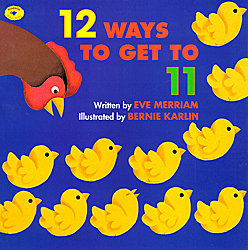
    12 Ways to Get to 11 by Eve Merriam and Illustrated by Bernie Karlin is a small book that uses several items to establish how the students add to 11. “Out of the magician’s hat: four banners, five rabbits, a pitcher of water, and a bouquet of flowers”; or, “Go past four corners and two traffic lights, then past the house with two chimneys and the garage with two cars and a bicycle. Now look, you’re at Eleventh Street” ‘ The book has a lot of great illustrations. The text would be great way to introduce number stories and have students make their own number stories.  The author has written the book to allow for good class discussion.

    Web Annotation:

    Alien Addition Game is  a fun game that helps students review basic addition facts. The game is noisy so students would need headphones if playing at a center. The game provides good practice in the commutative principal. It is also great because it a fast-paced games and is something that boys would like because it blowing up space ships.

    Funbrain Math Baseball is a game that helps with addition facts. I like this game because it has 4 levels so that it can be changed depending on the skill of the student. The website has several other games and also some worksheets that go along with the addition game.

    The ArithmAttack is a game for kids where you can decide if you would like to  be test on either addition or subtraction. It also has division for the more advanced students. The player can select the highest number that can be added or subtracted and the lowest number as well. Each problem allows the student 60 seconds to answer and if you get it wrong, the site provides the correct answer.

    Adding Bricks is a game that uses bricks to guide the players in addition. There are pictures of each brick and it also has the addition problem set up vertically. The game does not give the correct answer but it does have the visual of the bricks  that a student can count.  The game is loud so headphones would be needed if a students were using during centers or in the classroom.

    Subtraction Magician is a subtraction game that the player can select the degree of difficulty. The game allows 1 minute for 20 questions. There are 2 different ” mixes”. This game is a great way to review subtraction without using standard flashcards. It is a fun game and helps students work quickly to insure that they are memorizing the fact families.

    Additional Resources:

    Math and Literature is a website with lists of several pieces of literature that could be used during math and have elements of language arts. The website tells the importance of reading and using reading in cross-curricular ways. Using reading can help develop language skills and vocabulary associated with math.

    Math Activity Worksheets is a website that has themed worksheets for addition and subtraction. There are several different worksheets and some other math skill other than addition and subtraction. The website is set up by grade level and features what are grade level appropriate activities and worksheets.

    Mrs. McGowan’s Fact Family is a page on Mrs. McGowan’s website that allows her to share her classroom ideas. The Fact Family page explains how she teaches the concept of fact families in addition and subtraction. The site gives alternate webpages and activities for explaining addition and subtraction. Mrs. McGowan also includes the importance of the  connection of literature in math.

  • Open vs. Closed: What Does Open Really Mean?

    The Open vs. Closed debate, which we’re covering as an ongoing series on the GigaOM Network, continues to bubble and boil around Facebook and the social networking site’s attempts to extend its “social graph” out into the broader web. Is this move by the company truly open, or is it a cynical attempt to co-opt the rest of the web and aggregate value for Facebook — or could it be both? That all depends on what the term “open” really means. Can a company or a service be partly open, or is it a binary thing? Can a service start out as mostly closed and then become open? And is it OK for a company to be open with some things and closed with others?

    Chris Dixon, co-founder of Hunch, launched a project last week called Open Like, which he says is intended to jump-start an open standard for recommendations, as an alternative to Facebook’s open graph protocol. After a series of Twitter debates with Keith Rabois — VP of business development for Facebook app maker Slide — and startup investor and adviser Dave McClure about the benefits and meaning of the term “open,” Dixon tried to come up with an overview of the different ways in which companies and platforms can be open as well as the tradeoffs involved by using the following table from Harvard Business School professor Tom Eisenmann:

    So, in other words, Windows is open for “demand-side” users and “supply-side” users (developers) but closed when it comes to design and intellectual property, meaning the look and the underlying code can’t be changed or used by anyone other than Microsoft. An open-source platform like Linux, of course, is open in every sense of the word. And while the iPhone is open for users, it’s closed to developers and anyone who wants to change the platform. Even these definitions are open to debate, however: Dixon says that some see the iPhone as only partly closed to developers — a truly closed platform wouldn’t allow third-party apps at all, as most phones didn’t before the iPhone.

    The point is that different services, companies and platforms can be open in some ways and closed in others. As Dixon described in a recent interview about the Open Like project, a company like Google is happy to be open when it comes to mobile operating systems or browsers — things that aren’t core to its business — but when it comes to the details of its search and advertising algorithms, not so much. This just makes economic sense, he says, and is known in economic terms as “commoditizing the complement.” In other words, companies benefit by being open with things that will help drive demand for their core product or service.

    Being closed, Dixon argues, may make sense for a company such as Facebook or Twitter or Google, but that doesn’t mean it’s good for the industry as a whole, or for society.

    Chris Saad of DataPortability.org also took a crack at defining what “open” means, both in a post on his own blog and at the Data Portability site. What he calls “Torvalds open” works for software such as operating systems (Linus Torvalds is the founder of Linux) but doesn’t work as well for web-based products and services, because in those cases “the software itself has less value than the network effects and up-time provided by a branded, hosted experience.” Running Twitter as open source wouldn’t matter, he argues, because “Twitter’s lock-in is not their software, but rather their name space (@chrissaad) and their developer ecosystem.”

    As for Facebook and its new features, Saad says that “when Mark Zuckerberg talks about open, he is not talking about technology. He is talking about human interactions.” He add that:

    [Facebook has] gone to great lengths to redefine the word Open to mean the way people interact with each other. In doing so, they have managed to, in large part, co-opt the word and claim their platform makes people ‘more open’.

    Saad says that his view of what open should mean is “interoperable and distributed.” Twitter wouldn’t meet this definition, he says, because while it has an open API, it controls the “namespace” (i.e., user names such as @chrissaad), limiting what you can do with the API and when, as well as charging for access.

    Open advocate David Recordon, who is now working at Facebook, has also written about his view (and presumably Facebook’s view) of what is open about the new services and features the site has launched, including the fact that the open graph protocol is licensed under Open Web Foundation standards. His blog post came in response to comments from Chris Messina — another prominent open advocate who now works at Google — about how the company’s “open” protocol and API weren’t really open. The bottom line, Messina said, is:

    [I]t’s dishonest to think that the Facebook Open Graph Protocol benefits anyone more than Facebook — as it exists in its current incarnation, with Facebook accounts as the only valid participants.

    And so the open vs. closed debate continues. Who is the most open? Who is open where it really matters, as opposed to just being open where it’s convenient or low-risk? Who can convince users, developers and — most importantly — advertisers and other businesses to join their open or closed platform? More than anything, this appears to be shaping up as a battle between Google (which published an “open manifesto” late last year) and Facebook over who can out-open the other. All we can hope is that users will ultimately benefit.

    Related content from GigaOM Pro (sub req’d):

    There’s No Stopping Facebook

    Post image courtesy of Flickr user Tony Duarte

  • The aliens are out to get us! | Gene Expression

    Several people have pointed me to Stephen Hawkings’ warning about ‘First Contact’ with aliens. Specifically that we’d be on the short end of the stick. His worry reminded me of something I read as a child which shocked me somewhat when I encountered it, as I was conditioned by a post-Cosmos optimism. Here’s the author:

    …I find it mind-boggling that the astronomers now eager to spend a hundred million dollars on the search for extraterrestrial life never thought seriously about the most obvious question: what would happen if we found it, or if it found us. The astronomers tacitly assume that we and the little green monsters would welcome each other and settle down to fascinating conversations. Here again, our own experience on Earth offers useful guidance. We’ve already discovered two species that are very itnelligent but less technically advanced than we are-the common chimpanzee and pygmy chimpanzee. Has our response been to sit down and try to communicate with them? Of course not. Instead we shoot them, dissect them, cut off their hands for trophies, put them on exhibit in cages, inject them with AIDS virus as a medical experiment, and estroy or take over their habitats. That response was predictable, because human explorers who discvered technically less advanced humans also regularly responded by shooting them, decimating their popualtiosn with new diseases, and destroything or taking over their habitats.

    Any advanced extraterrestrials who discovered us would surely treat us in the same way….

    That was Jared Diamond in The Third Chimpanzee. In terms of this particular concern I have to admit that my attitude is encapsulated by Arthur C. Clarke’s third law of prediction. An advanced alien race is basically going to have magical powers in relation to humanity, and I doubt anything we do will matter either way (i.e., I don’t think we could hide, or, get their attention). But my main question is why haven’t the von Neumann machines already co-opted all the matter and energy in the universe? The Fermi paradox is a real issue. There are still big questions that we have idea clue about.

  • Field Notes: The Revolution of the Moons

    Seen through Galileo’s telescope, the moons of Jupiter appeared as mere points of light, indistinguishable from one another. Even so, they fomented an instant scientific revolution. Their existence gave evidence for what Copernicus had merely intuited: Not all heavenly bodies circle Earth.

    The first morning’s session focused on the moons’ entry into 17th-century society. Although today we know these bodies—Io, Europa, Ganymede, and Callisto—as the Galilean satellites of Jupiter, Galileo himself wanted to call them the Cosmian Stars, in honor of his potential patron, Cosimo de’ Medici, the grand duke of Tuscany. Cosimo accepted the moons as a gift but preferred the name Medicean to describe them. Galileo of course complied, in a calculated move that won him a lifetime appointment as court mathematician and philosopher, plus generous Medici support for his research. I saw several scientists in the audience nod on that note, sympathetic with the time-honored need for government funding of big science.

    After the initial discovery, Galileo faced the tougher job of studying and timing the moons’ regular orbits. He noted how they were periodically occulted by Jupiter or eclipsed in the planet’s shadow, and he applied these data to the practical problem of determining longitude at sea. (A navigator could compare the precise times at which these phenomena were observed from shipboard with the times they were predicted to occur if seen from a place of known longitude, such as Padua, then use the time difference to calculate his position east or west.) Although sailors never adopted Galileo’s technique, the moons proved a boon to cartography, helping to redraw land maps all over Europe.

    Galileo’s successors followed the moons to other new conclusions about nature. Danish astronomer Ole Roemer, for example, watching the moons from the Paris Observatory, noted how their eclipses preceded the predicted times when Jupiter and Earth came nearest each other. Similarly, the moons’ eclipses fell minutes behind predicted times when Jupiter and Earth lay farthest apart. Roemer attributed these discrepancies to the time needed for light to travel across space from Jupiter to earthly observers. With the moons as his touchstone, he clocked the speed of light for the very first time, in 1676. His answer fell 25 percent below the modern value but greatly improved on the previous estimates of “infinite” and “immeasurable”…

  • BMW unlikely to grab sales crown in U.S. in 2010, despite Lexus’ recall woes

    BMW, which has trailed behind Lexus as the No.2 luxury brand in the U.S. for the past decade, is unlikely to benefit from the Japanese brand’s recall woes. Analysts say that BMW will probably come in at the No.2 spot again in 2010.

    BMW sales will be suppressed this year by the wind down of the old 5-Series, says BMW AG global sales chief Ian Robertson. The 5-Series accounts for about 25 percent of BMW’s sales volume in the United States.

    “Effectively, we’ve run out our existing 5 Series and won’t launch our new 5 Series until June,” Robertson said. “So a full-year effect won’t be felt. We still see we will have some growth this year, but it’s a few digit points. How that turns out with competitors’ volumes remains to be seen.”

    Analysts say that Lexus has been hurt by parent Toyota’s recall issues and the recent recall of the Lexus GX. However, Lexus sales were still up 42 percent to 20,219 vehicles in March, compared with 2009. During the first quarter of 2010, Lexus sales were up 18 percent to 49,523 vehicles.

    – By: Omar Rana

    Source: Automotive News (Subscription Required)


  • Obama Administration to use health care law to increase tax enforcement

    By Matt Holdridge

    From the DailyCaller

    Most people understand that the IRS is likely to need thousands of new agents to enforce the Obama Administration’s new health insurance mandate – starting in 2014, you can either buy health insurance or the government will confiscate your tax refund, at least.

    But hidden deep within the 2,000 plus page law is a vast new authority for the IRS that proponents admit has nothing at all to do with health care.

    Instead, its purpose is to squeeze more and more tax dollars from businesses to eliminate the so-called “tax gap” – bureaucratese for every red cent Americans owe the IRS but don’t pay up come April 15.

    In section 9006 of the health care law, many businesses will be required for the first time to report every expense they incur over $600.

    Right now, businesses must report the wages they pay employees. But they are exempt from reporting payments to other businesses and for merchandise.

    Interesting how everyday, after the vote of course, we learn about a new provision in this “health care” bill. 

  • Novatel MiFi 2372 rises from the ocean, stomps its way to Japan

    I sort of love the MiFi. (What’s a Mifi? It’s a portable, battery-powered WiFi router that pulls data over a 3G connection.) If I had a box of candy for every time the MiFi got me out of a jam, I’d be.. well, I’d probably be crazy fat.

    Good news, people of Japan! Now you have the opportunity to get crazy fat, too!

    Today, Novatel is announcing that the MiFi is now available in Japan via Inter Communications, a big ol’ mobile tech retailer. Alas, it seems like this is a per-day rental deal only — and at about $17 USD per day, it’s not exactly cheap.

    NTT DoCoMo MVNO a2network has also announced plans to carry the MiFi 2372 beginning sometime around the end of April, though pricing hasn’t been announced there yet. Lets hope it’s cheaper than 17 bucks a day, yeah?


  • Lieberman: Reid Will Likely Move Climate Bill Ahead of Immigration Reform

    Appearing on MSNBC’s Andrea Mitchell Reports just now, Sen. Joe Lieberman (I-Conn.) sounded an optimistic note about the prospects for comprehensive climate legislation this year and expressed dismay at Majority Leader Harry Reid’s (D-Nev.) indication that immigration reform would be a higher priority — a move that led Sen. Lindsey Graham (R-S.C.) to call off his work on the climate bill in protest this weekend.

    “A not-so-funny thing happened on the way to the announcement,” said Lieberman, who along with Graham and Sen. John Kerry (D-Mass.) was expected to unveil the climate bill today before Graham’s change of heart.

    But he emphasized that Graham is still fully on board, that “this is his priority.”

    The ball is in Reid’s court now. Lieberman says he talked with Reid yesterday, and the majority leader “explicitly” reassured him that he was still committed to putting the climate bill to a vote once it’s ready. “He assumes that will be before the immigration reform bill is ready,” Lieberman said. “He knows our bill is ready and the immigration reform bill is not.”

    Once Graham is convinced of that, the climate legislation process will be back on track. “Lindsey Graham will come back to where he is and never left,” Lieberman said.

  • Motorola ditching Google location services on Android phones for Skyhook

    Skyhook

    Here we go again. First it’s Samsung going with Yahoo services, and now comes word that Motorola’s switching to Skyhook for its location-based services over Google. Devices with the new service will "begin shipping later this year," Skyhook says, and "will have the ability to better support a new wave of location-aware applications by leveraging Skyhook’s precise, reliable and fast-performing location engine."

    Hey, fair enough. No reason why it shouldn’t be as good or better than Google’s default services, right? [via Engadget]

  • Home Depot Convinced Me To Take My Business Elsewhere

    Reader Dan writes in to let us know that Home Depot convinced him to shop at Sears. No easy feat, we assume.

    Here’s Dan’s story:

    I was rather disappointed and frustrated at a recent experience at your store in [redacted]. I went there on Sunday, April 25, in order to purchase a new Maytag Bravo series washer and dryer.

    I had done my research and did some in-store price comparison at Home Depot, Sears, Best Buy and Fry’s. Sears happened to have the washer on sale, but your store had the best price on the dryer and included free delivery/installation/haul away.

    I walked in and spoke with the associate in the appliances section and asked if he would price match the Sears price on the washer. He immediately brought up some unknown, nondescript website that displayed the Sears price as nearly $200 higher than it really was.

    I had the phone number for the local Sears store and he spent about 15 seconds waiting for someone to answer the phone. He quickly gave up and told me that he could not match that price. He then showed me the inventory and told me that I wouldn’t be able to get delivery until approximately June 1.

    He also mentioned that Sears probably didn’t have then in stock either. At that point, he seemed uninterested in working with me further and moved on to another customer who came into the department after I did.

    I walked out, drove to Sears, negotiated down the price on the dryer and will have them delivered next week.

    Next up is a new dishwasher, range and refrigerator. I have a pretty good idea of where I won’t be shopping for those.

    Good work, Home Depot! Sears should send you a thank you card.

    Has anyone else had trouble haggling with Home Depot?

  • The Fantastic Four … Fed presidents against the Dodd bill

    ffAgain, it isn’t just Republicans making the charge that the Dodd bill does not end Too Big To Fail. So are a quartet of regional Fed bank presidents:

    1) Thomas Hoenig of the KC Fed (in a chat with the Huffington Post):

    As for Dodd’s treatment of Too Big To Fail, Hoenig said the bill puts too much power in the hands of regulators. “What I worry about [is] if you have a large institution, and it got into very serious trouble and you only have a weekend to take care of it, the procedures under the Dodd bill would make that very difficult,” Hoenig said. “Let’s say you were coming into Monday morning and you didn’t have the ability to get to the judges in time to get this thing approved, and you had to get to another day. What you would tend to do is lend to that institution — if it were not a commercial bank, you would even use the [Fed’s] so-called 13-3 authority… and you would lend to it,” he said in a reference to the legal authority that the Fed claimed gave it the power to lend taxpayer money to AIG. “So you would still have it as an operating bank, you would not have taken control of it, not put it in receivership yet, and yet you would be bailing it out. That’s what we have to avoid.
    “There’s still this desire to leave discretion in the hands of the Secretary of the Treasury, and while I understand that desire — because you never know what the circumstance is going to be — the problem is in those circumstances you always take the path of least resistance because of the nature of the crisis.

    “You don’t want to be the person responsible for the meltdown, so you take the exception and you move it through.

    “But if you had a good firm rule of law, and the markets knew… there were no exceptions… you would be in the long run much better off. It does affect behavior,” he said.

    2) Richard Fisher of the Dallas Fed (in a speech):

    The dangers posed by TBTF banks are too great. To be sure, having a clearly articulated “resolution regime” would represent steps forward, though I fear they might provide false comfort in that a special resolution treatment for large firms might be viewed favorably by creditors, continuing the government-sponsored advantage bestowed upon them. Given the danger these institutions pose to spreading debilitating viruses throughout the financial world, my preference is for a more prophylactic approach: an international accord to break up these institutions into ones of more manageable size—more manageable for both the executives of these institutions and their regulatory supervisors.

    3) Jeffrey Lacker of the Richmond Fed (in a CNBC interview with Steve Liesman):

    Lacker: The issue of our time has to do with the government safety net for financial firms. And it’s grown tremendously, and containing that, establishing clear boundaries of that, is the number one priority. As I read the Dodd bill and the mechanism it sets up for the resolution authority, it doesn’t strike me that it’s likely to help us there. And in fact, it seems to me like a major danger is that there’s going to be more instability in financial markets instead of less.

    Liesman: The Dodd bill allows for a three-bankruptcy judge panel to declare insolvency. It allows losses to go to unsecured creditors; it allows management to be replaced and shareholders to be wiped out. How much clearer could the government be in this bill that there will be real losses to investors?

    Lacker: It allows those things, but it does not require them. Moreover, it provides tremendous discretion for the Treasury and FDIC to use that fund to buy assets from the failed firm, to guarantee liabilities of the failed firm, to buy liabilities of the failed firm. They can support creditors in the failed firm. They have a tremendous amount of discretion. And if they have the discretion, they are likely to be forced to use it in a crisis.

    4) Charles Plosser of the Philly Fed:

    In order to end TBTF, we must have a way that credibly convinces large financial firms and the markets that firms on the verge of failure will, in fact, be allowed to fail. If the resolution mechanism is either too vague or allows for too much discretion by regulators or Congress to rescue firms through subsidies or bailouts, then troubled firms will surely argue that the risks of failure are so severe and systemic that they must be bailed out. This is what we saw in the recent crisis. A credible commitment by government not to intervene or bail out firms must be the centerpiece of the resolution mechanism.

    I believe the best approach to making such a credible commitment and thus ending TBTF is amending the bankruptcy code for nonbank financial firms and bank holding companies, rather than expanding the bank resolution process under the FDIC Improvement Act (FDICIA). While the Senate bill has tightened up the proposal with a stronger bias toward liquidating a troubled firm, the bill would still give a great deal of discretion to policymakers to avoid the discipline of a bankruptcy court. I recognize that the current bankruptcy code does not adequately address the inherent challenges in liquidating large financial institutions without risks to the market, but I believe a modified bankruptcy process would eliminate discretion and strengthen market discipline, by permitting creditors as well as regulators to place the firm into bankruptcy when it is unable to meet its financial obligations.