Category: News

  • Election Antics

    The televised leaders debates are changing the way we think about elections… The third and final debate will be broadcast from Birmingham on Thusday. And it’s the big one, The Economy. Its a perfect chance for us to get leaders thinking about the ROBIN HOOD TAX.

    So, we are going to greet them as they go into the dabate and get them thinking about the Robin Hood Tax even before it kicks off. We will be dressed as Robin Hood, Maid Marion and co. We want as many Merry Men and Women to join us! And that means you!

    The location is as yet unconfirmed, so watch this space or get in contact with us if you are able to come!

    Alternatively… if you live in Hereford, come to the Climate Question Time and ask your local candidates about their views and policies on climate change and other international development issues. More info:

    http://www.facebook.com/l/64aee;asktheclimatequestion.org.uk/geo/hereford-herefordshire-south/

  • Obama blandly invokes ‘American Dream’ in tribute to miners who were denied it

    by David Roberts

    This weekend there was a memorial service for the 29 miners killed in the explosion at Massey’s Upper Big Branch mine. President Barack Obama, Vice President Joe Biden, and West Virginia Gov. Joe Manchin (D) all spoke. I found Obama’s address infuriating.

    Look, obviously, it’s a memorial service. The focus was on the miners and their families, and that’s entirely appropriate. Turning memorials into political rallies is never a good idea.

    Nonetheless, Obama’s speech was so bland and gauzy, so resolutely inert, that for me at least it amounted to an insult to the miners’ memories. Why must a tribute involve papering over the realities of their lives and the circumstances that led to their deaths? Do we honor them by romanticizing what they did? Do we honor them by referring to the explosion that ended their lives as though it were an unforeseeable act of God?

    Look at this:

    All the hard work; all the hardship; all the time spent underground; it was all for their families. For a car in the driveway. For a roof overhead. For a chance to give their kids opportunities they never knew; and enjoy retirement with their wives. It was all in the hopes of something better. These miners lived—as they died—in pursuit of the American dream.

    So anybody who works to feed their family is living the American dream? What a lazy, limpid bit of rhetoric. People work to feed their families in other countries too. It seems to me what separates the American dream from the dreams of others is that in America every citizen is afforded a measure of dignity. Every citizen can expect to be treated as a human being, not a cog in a machine. Every citizen has the right to unionize, to protect employee interests. Every citizen has a right to a workplace that conforms to reasonable safety standards and an employer who obeys the law. Every citizen has a right to a working and living environment that does not slowly poison their family. Every citizen has a right to speak out without fear of reprisal or bullying from the owners of capital.

    Massey miners had none of those rights. Exploitative work, without union representation, in a patently unsafe environment, run by bullying managers who break the law with impunity? That’s not the American dream. That’s a Third World nightmare. The deaths of these miners was a failure of the American dream. And it didn’t just happen. There were real people behind it, who made real decisions that prioritized rocks over human lives.

    Greed and venality killed these miners. Can’t we feel just a little bit of anger about that? Is it really “politics” to allow ourselves that anger?

    ———

    As an addendum, how are the barons and lobbyists of the coal mining industry reacting to Obama’s kind words? Are they giving him any credit? Being reasonable in return?

    No:

    “You’d be hard pressed to find a president whose actions have been more warlike on coal. There are those who say the president has parked his tanks on our front lawn, and it’s hard to dispute that,” said Luke Popovich of the National Mining Association.

    “Tanks on our front lawn.” This from a lobbyist living a comfortable life in D.C., whose manicured nails have never once been stained by a piece of coal, who faces no risk more severe than failing to get a table at The Palm, heading an organization that resolutely fights worker safety protections at every turn. Repulsive. (See Appalachian Voices for more.)

    Related Links:

    Oil rig leak and the week in fossil-fuel industry disasters

    A near thumbs-up for Joe Romm’s ‘Straight Up’

    More lessons from Wales for moving beyond coal


  • Rooftop farming and beekeeping boom in New York

    by Agence France-Presse

    Rooftop garden in Queens. Photo courtesy Your Secret Admiral via FlickrNEW YORK—Urban farming is a growth industry in New York City’s concrete jungle, and with little open land available, agriculturalists and beekeepers have taken to the rooftops to pursue their passion.

    Andrew Cote uses the emergency fire ladder to climb up to the roof of his East Village building, where he tends to 250 beehives. Cote, a professor of Japanese literature, doubles up as president of the New York City Beekeepers Association and is happy that the city authorized beekeeping in mid-March after an 11-year ban. The ban forced beekeepers into hiding, fearing a $2,000 fine if caught.

    “The city wants to plant one million trees, and the trees need to be pollinated,” Cote said. “Our bees pollinate, and they clean the air. It is a way to connect with nature.”

    Bees also produce around 100 pounds of honey per hive per year, he said—honey that he sells at the city’s various farmers markets.

    Cote said he has received several requests to install rooftop beehives and has scheduled a course for aspiring apiculturalists.

    On the other side of Manhattan, in the posh Upper East Side, Eli Zabar, owner of the upscale Vinegar Factory delicatessen, inspects the crops he is growing on the roof of the old factory bought in 1991.

    “I began the greenhouses 15 years ago,” Zabar said. “I grow heirloom tomatoes, lots of different kinds of lettuce, herbs, basil, rosemary, thyme, raspberries, figs, beets. We use the heat of the bakeries and pastries, we recycle the heat. With the use of the heat we have eliminated our [carbon] footprint.”

    About half of the items Zabar sells in his deli come from rooftop farms. “You harvest in the morning, you sell in the afternoon, you don’t refrigerate, it tastes better,” said Zabar. “We pick everything ripe and ready to eat. All our products here are organic.”

    Depending on the time of day, Zabar says with a smile, “the greenhouses smell of bread, brownie, or croissant.”

    From Manhattan to Brooklyn, whether on rooftops, backyards, or in any of the city’s 600 community gardens, urban farming is a growing phenomenon.

    The movement is helped along by Mayor Michael Bloomberg, who seeks to turn the city into a sustainable development champion. Through “PlaNYC 2030,” a program he launched on Earth Day 2007, people who install “green roofs” can get a tax break.

    At Randall’s Island, in New York’s East River, the city’s Parks and Recreation Department is currently testing 16 different types of vegetation that could be placed on the roofs of schools, hospitals, or other public buildings. “These are patches of succulent vegetation, like sedum, which protect the roofs [and] isolate the buildings from the heat because the UV sun is not hitting,” said senior project manager John Robilotti.

    The rooftop vegetation also helps maintain a steady temperature inside and captures storm water, which would otherwise run off into the street. “The water that does come out is filtered and kept in tanks, and we use it to water when there is no rain,” Robilotti said.

    The roofs “absorb carbon and create oxygen, so we take carbon from the carbon cycle,” he said. “And they attract birds, butterflies, bees. We even saw a red-tailed hawk.”

    Related Links:

    World’s first taxis with easily swapped batteries hit Tokyo

    Oil rig leak and the week in fossil-fuel industry disasters

    ‘Green tea party’ closes out U.S. Earth Day celebrations


  • Lenovo, Sony, HP launch ‘green machines’ in deeper stripes

    By Jacqueline Emigh, Betanews

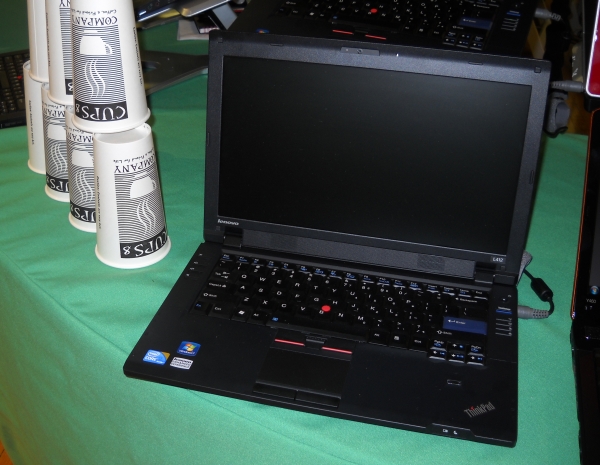
    The Lenovo L412 is pictured here alongside...yes, that's right, a stack of recyclable cups.

    Lenovo L412 notebookFlanked by other eco-wares ranging from Philips light bulbs to a home soda-making machine, PC manufacturers on hand at Pepcom’s EcoFocus conference touted new computers that, while Energy Star 5.0-compliant, also happen to be made from recycled and/or non-hazardous stuff.

    Lenovo demo’d its new 14-inch L-412 (pictured right) and 15-inch L-512 ThinkPads, two laptops launched last week with customer’s choice of Intel Core i3 or Core i5 processors. Both feature palm rests, covers, and cases which are 20% comprised of recycled material, such as office water jugs and old IT equipment.

    Likewise, Sony’s Vaio W Series “mini-notebook” (pictured below) also on display — based on a 1.66 GHz Intel Atom processor, with 10.1-inch 1366 x 768 backlit LCD — uses reprocessed plastic from DVD and CD waste in its palm rest, cover, and incidental parts.

    Sony Vaio W-series mini-notebook

    Not to be left out of the eco equation, HP demo’d an all-in-one PC that was introduced last week. The new computer-targeted Pavilion All-in-One 200-5020 PC is designed not just to save on energy and space, but also to reflect HP’s commitment to ridding PCs of hazardous materials.

    HP has issued company directives to halt the use of mercury in notebook LED displays by the end of this year, and to stop any remaining use of brominated flame retardant (BFR) and polyvinyl chloride (PVC) in computing products launched in 2011.

    Meanwhile, Soda-Club Group’s soda making machine requires no electricity whatsoever — and no disposable bottles or metal cans, either, for that matter.

    Consequently, Sodastream is reminiscent in some ways of the old-fashioned home ice cream-making machines that were apparently all the rage partly through the last century. But forget about any hand cranking here.

    You can make your own carbonated soda or sparkling water in just about any flavor you want at the proverbial push of a button. All you need is a Sodastream starter kit — varying in configuration from model to model, but basically including a carbonator and carbonating bottles with “fizz-preserving caps” — and some flavoring, also company-supplied. Oh, yeah, and some water, too.

    At the same time, Philips proved that the emphasis on energy conservation keeps working its way down from data centers and laptops to the light bulb level.

    Philips’ environmentally friendly LED bulbs last longer than traditional incandescent bulbs, while also gobbling up less electricity and producing brighter light, Betanews was told.

    The latest additions to Philips’ line-up, released last week, include ten new models, geared to specific purposes such as indoor spot and flood lighting, track fixtures, outdoor security lighting, along with wall sconces and other “mood-setting applications.”

    Copyright Betanews, Inc. 2010


    Add to digg
    Add to Google
    Add to Slashdot
    Add to Twitter
    Add to del.icio.us
    Add to Facebook
    Add to Technorati


  • Conference: The Signs of Which Times?

    Royal Academy for Overseas Sciences

    I’ll see you there if you are attending.

    International conference: The Signs of Which Times? Chronological and Palaeoenvironmental Issues in the Rock Art of Northern Africa

    3-4-5 June 2010

    Palais des Académies / Paleis der Academiën
    Espace Baudouin
    Hertogsstraat / Rue Ducale,1
    1000 Brussels

    Programme

    Text of introduction

    Registration form

    Abstract book

  • ExtraHop, F5 Networks Team Up

    Gregory T. Huang wrote:

    Seattle-based ExtraHop Networks, a network-management technology startup, said today it has formed an alliance with F5 Networks (NASDAQ GS: FFIV), also based in Seattle, to collaborate on new products and marketing and distribution efforts. Financial terms of the deal weren’t given. ExtraHop was founded in 2007 by F5 alums Jesse Rothstein and Raja Mukerji. It makes software to help corporate IT organizations monitor and manage their applications environments and network transactions. The company announced a $5.1 million Series A funding round a year ago, led by Madrona Venture Group and including angel investors Marc Andreessen and Ben Horowitz.

    UNDERWRITERS AND PARTNERS


  • Unofficial Android app count reaches 50,000+

    AndroLib has reported that the total number of applications on the Android Market has exceeded 50,000; this number is a wee bit bigger than what Google itself has reported during a Q1 earnings report. Jeff Huber, Google’s senior VP of engineering reported the number to be a respectable 38,000, which stands as Google’s “official” count.

    “We’re sticking to 38,000 for now. We’ll announce when we do our next formal count.”
    -Google, to Android Central

    50,000 seems to be quite a big over-estimate if Google is sticking to their lower figure; however, I could see the numbers getting easily inflated due to the amount of not-quite-apps on the marketplace. Any search for “Beautiful Widgets” or “Better Home” will give you a sea of entries that are just for skins, which just make finding the original app that much harder. This flood is one of the main critiques of the marketplace, and something I believe needs to be fixed ASAP to bring us a more functional environment to find apps.

    Related Posts

  • With iPhone out, Google Navigation headed to various platforms

    Google Maps iPhone

    Last week it only took about four hours to send US iPhone users on an emotional roller coaster from which they may never recover.  Early Friday morning, BGR (among others) reported that Google’s turn-by-turn navigation system – which is currently only available to Android users – would come to other platforms, including the iPhone.  The report was based on an article from UK site MacUser which stated that “Google confirmed at a London press conference that it plans to bring free satnav to other smartphone platforms, including the iPhone, although it wouldn’t say when.”

    Later in the afternoon, however, a different story was being told.  According to BGR (who later posted a follow up story), in an article from PCWorld, a Google spokesperson makes it quite clear that iPhone users should not expect to see Google Navigation any time soon.  The spokesperson clarified, “We did not say we would bring it to iPhone, we said to date we’ve had it on Android and that in the future it may come to other platforms but did not confirm this will be coming to iPhone at all.”

    This was likely disappointing news for iPhone users.  However, Google did point out an interesting feature that their navigation app will have which was previously unknown.  According to PCWorld, while using Google Navigation, you won’t need to use as much data as you may think.  The app uses the data connection to calculate your directions, but saves and uses that route unless you take an unexpected turn, at which point the connection is re-initiated in order to reroute.  This is good to know considering in the coming months/years all-you-can-eat data plans may become a thing of the past.

    Right now Google Navigation is only available to Android users, any readers have alternative phone-based navigation systems (paid or free) they’d recommend?  Please leave your nav-of-choice in the comments!

    Via BGR, PCWorld, MacUser


  • Interview with Zahi Hawass

    ArtInfo (Interview by Anthony Haden-Guest)

    According to Hawass, who worked with National Geographic to engineer both displays, the twin Tuts have already pulled in a hundred million dollars — much of which is destined for the construction of a new Tut museum in Cairo. I met with Hawass in the darkened Times Square venue to talk about the exhibition, the scientific discoveries since the Met appearance, and his spectacle-seeking brand of Egyptology.
  • M2Z Is Back With Free Wireless Broadband Plan

    The County Executives of America plans to build a nationwide wireless broadband network to cover residents of its 700 member counties, and has applied for $122 million in stimulus grants to kick off the effort. The money would fund networks in 12 counties and would cover more than 14 million people.

    The CEA hopes to let M2Z, a Kleiner Perkins-backed startup that’s been trying to build a free wireless broadband network since May 2006, build out the network using the AWS-3 band of spectrum. We explained why M2Z was a bad bet back in 2008,  but the utopian idea of free wireless broadband isn’t going away, especially since the current Federal Communications Commission Chair is so keen on mobile broadband as the great equalizer.

    Here are the details on the CEA plan:

    Specifically, the CEA broadband stimulus application aims to bring free broadband access to 12 major counties and serving the residents of Allegheny County, Pa.; Bronx County, N.Y.; Chambers and Kaufmann Counties, Texas; DeKalb County, Ga.; Kenosha County, Wis.; New Castle County, Del.; Prince George’s and Montgomery Counties, Md.; Will and Cook Counties, Ill.; and Salt Lake City County, Utah.

    But the plan submitted by the CEA offers two service options: a paid 6 Mbps offering (the application cuts off right as it says what the paid version would cost) and M2Z’s original free service with speeds of 768 kbps — what most would call barely broadband. The FCC in March suggested that it would create a free nationwide wireless broadband network, but my sources there assured me it wasn’t related to M2Z.  Looks like now M2Z is attempting to take its free wireless broadband proposal to other entities.

    Image courtesy of Gavin St. Ours on Flickr.

  • YouTube Direct 2.0, Citizen Reporting Made Easy

    Unless you’re a big publisher, you probably haven’t heard of YouTube Direct, a tool which enables websites to embed YouTube upload functionality. But you might have spotted it in the wild, in places like The Huffington Post, The Washington Post and so on. The platform is now getting a major revamp and a bunch of new features.

    read more)

  • Private Equity as ‘Environmental Crusaders’? The Times They Are a-Changin’

    This is a guest post by Ian Bailey, Managing Partner of Capital C Partners, a strategic communications firm.

    What do mattress maker Sealy Corp., discount retailer Dollar General and consumer guides publisher PRIMEDIA all have in common? They’re all private equity-owned and have adopted new, environmentally sound business practices delivering millions of dollars in annual savings.

    Given the turbulent ride the financial services sector has endured over the past few years it seems counter-intuitive that anyone in the sector would be devoting special attention to environmental matters. The private equity industry has been beset with multiple issues, including constrained access to capital, overleveraged portfolio companies, a paucity of public market exits, the tax treatment of carried interest under scrutiny and growing calls by LPs for greater transparency. So it would seem the industry is a particularly unlikely candidate for embracing new thinking on environmental matters. However, that’s precisely what has happened.

    When we here at Capital C Partners first started working with Environmental Defense Fund (EDF) on its Green Returns program over six months ago, we reached out to a cross section of our contacts in the PE world to get a sanity check on just how receptive investment professionals might be to the concept that environmental measurement and management practices could deliver tangible bottom line value. The feedback was consistently equal parts of interest, skepticism, a need to see supporting data and ‘this just isn’t a priority when I’m worrying about potential covenant breaches…’ The final kicker from several of our PE friends was ‘my institutional investors really don’t care about this stuff, whatever they publicly say – it’s all about the returns.’

    Fast forward to today: Kohlberg Kravis Roberts & Co. (KKR) and The Carlyle Group (Carlyle), the world’s two largest private equity firms by assets under management, now both have dedicated programs specifically designed to ensure that environmental best practices are hard-wired into their processes. KKR’s Green Portfolio investment management program now extends across 20 percent of its global portfolio and Carlyle’s EcoValuScreen due diligence tool will be applied to all new investments in its U.S. and European buyout funds.

    EDF is now in conversation with many of the world’s leading PE firms about Green Returns and the conversations have moved from “why should I do this” to “how do I do this?”

    This change has not happened overnight, and there’s undoubtedly still much to be done. But private equity leaders such as KKR and Carlyle, through their collaborations with EDF, are providing the pathway and proof that many in the industry needed to see in order to take that first important step towards incorporating environmental management practices into their business processes and those of their portfolio companies.

    This video from The Deal.com – featuring conversations with EDF, Carlyle, KKR and Sealy – makes it clear that Green Returns now has all the hallmarks of an emerging industry trend – one with the potential to live up to EDF’s ambition that it become a new best practice for the entire private equity industry.

    For more information about EDF’s Green Returns initiatives, look for them at the Private Equity Insight Forum 2010 in London in May and SuperReturn US in Boston in June, or contact Tom Murray, managing director of corporate partnerships at EDF.

    This content is cross-posted on Greenbiz.com

  • WI Senate Race: Leinenkugel’s On Tap

    The latest entry to the Wisconsin senate race asked us to meet him Sunday at a neighborhood bar called Spanky’s in a blue collar section of Kenosha (near the Illinois border).

    The tavern is owned by a friend of Dick Leinenkugel. This morning, Leinenkugel will announce what’s been rumored for weeks, that the former Wisconsin Commerce Secretary for Democratic Governor Jim Doyle will enter the Republican primary for the US Senate seat held for the last 17-years by Russ Feingold.

    Leinenkugel is well-known statewide largely because of the family business…beer. Jacob Leinenkugel Brewing Company out of Chippewa Falls may not be as big as Milwaukee brewing behemoth Miller-Coors…but it’s a popular line of beers. Dick Leinenkugel left the company when he joined the Doyle administration in 2007.

    When Leinenkugel officially joins the GOP contest…he will enter a race where two candidates have been at work for months getting ready for the September primary. They are Terrence Wall, a real estate entreprenuer  from Madison and Dave Westlake, a West Point grad and Army vet turned small businessman from Watertown.

    Just last week, former Governor Tommy Thompson said no to a bid for the Senate seat even though polls suggested a Feingold-Thompson race was a deadheat. So…why did Leinenkugel decide to jump into the Senate battle?

    That’s the question we started with when we sat down at Spanky’s for Leinenkugel’s first campaign interview. The bar was busy and a Brewers/Cubs game was on…so there were some interruptions. And yes, “Leinies” were in the hands of more than a few patrons.

    (Click on the attached video to see and hear the Leinenkugel interview.)

  • New Dry Max Pampers Causing Rash, Burns, Sores, Boils?

    Pampers new brand of Dry Max diapers causes rashes, burns, sores, and boils on their babies, some parents are alleging in a growing online backlash. But is it really Dry Max, or just typical diaper rash that the parents are incorrectly correlating with the new diaper?

    One parent posts, “We were using Pampers diapers with the dry max and at 2 weeks old she developed a diaper rash that turned into horrible open sores.”

    Another, “my 2.5 year old experienced an inflamed reddness on his legs, bottom and genitals. I couldn’t explain where it came from. I doused him with desitin for two days and it bled instead of clearing up. It didn’t hit me til I read a post on facebook. Now I will switch him to another diaper.”

    And another, “I was in the store the other day and didnt pay any attention and picked up a box of Pampers just thinking they changed the packaging. My youngest will be 2 next week and has NEVER had a diaper rash. Night before last he woke up with a leaking diaper (no surprise, we go thru it every night) and when I went to change him, his bottom was blistered and bleeding.”

    To fix the rashes, parents say they have had success with using frequent rinsing, oatmeal baths, and Aveeno.

    Reached for comment, P&G said:

    At Pampers, nothing is more important to us than the health and well being of babies. That’s been our reason for being for over 40 years.

    Whenever we make an improvement to our diaper – whether it was the introduction of adhesive tape followed by stretch many years ago up to the new Dry Max technology today – our overriding concern is that the product is safe. We have an entire division that is devoted to product safety, and we conducted extensive safety assessments including clinical tests before we introduced our new diaper.

    Pampers with Dry Max is the most mom- and baby-tested diapers in our history. More than 20,000 babies from around the world involving more than 300,000 diaper changes were part of the development of Dry Max. This is one of Pampers’ most thoroughly researched and tested new products ever.

    According to Dr. David Schonfeld, a member of the Pampers Parenting Network and Thelma and Jack Rubinstein Professor of Pediatrics, Cincinnati Children’s Hospital Medical Center, “I’ve reviewed the consumer and clinical data and feel comfortable that Pampers with Dry Max underwent rigorous safety testing and is a safe product. As a pediatrician, this is exactly the kind of testing I would hope to see in a diaper. Diaper rashes are usually caused by irritation from feces and urine – it’s called a diaper rash because it appears in the area that diapers are worn. Although a good diaper helps to protect the baby’s sensitive skin, some diaper rashes are still going to occur no matter how good the diaper is. The testing that Pampers conducted before the diapers were sold and the monitoring of complaints since it has been on the market do not show any evidence that Dry Max causes more diaper rashes than the product it replaced.”

    Diaper rash is one of the most common ailments affecting babies and toddlers with many causes and symptoms of varying severity. In general, a healthy baby is expected to get a diaper rash roughly 3-4 times a year with some percent deemed severe – meaning the rash is deep red, with possible blisters and/or breaks in the skin. Some of these rashes can have appearance characteristics typically associated with burns. When you consider that there are about 10,000,000 babies in diapers in the US alone combined with the frequency of the rash, it makes sense that as hundreds of thousands of parents switch to Dry Max diapers, some many have children that coincidentally develop diaper rashes at the same time.

    As background, our Dry Max diaper uses the same type of ingredients as our other diaper and in fact, many other disposable diapers on the market. The improvement is in the design and manufacture of the diaper, which allowed us to create a diaper that is 20% thinner than before and is our driest diaper ever as it helps lock in wetness.

    Moms are voting for Pampers with Dry Max in a big way with their purchases. Millions of bags of Pampers Swaddlers and Cruisers have been purchased in the last several weeks alone. We’re also proud that Pampers Cruisers with Dry Max has received product awards from Parenting Magazine, iParenting Media, Mom’s Choice Awards and Parent Tested/Parent Approved.

    And in a recent survey of parents requesting samples of Pampers with Dry Max, 70% preferred our new diaper over their usual brand – the highest score of this kind we’ve seen. This is consistent with the overall positive feedback we’re seeing from parents.

    Still, we know that every product change can be a source of stress for some parents who have grown to love their current products and don’t always understand why we made a change. We are always concerned to hear from any parent who has a bad experience with our diapers and take reports of rash or skin health concerns seriously. Babies’ well-being has always been and continues to be our top priority.

    Pampers also addresses the concerns in an FAQ on their website. They encourage anyone with questions or concerns to call1-800-PAMPERS. Commenters say that got refunds from the company after calling up and making complaints.

    Pampers bring back the OLD CRUISERS/SWADDLERS [Facebook]
    Pampers Swaddlers & Cruisers with Dry Max FAQs [Pampers]
    Pampers Dry Max causing rashes and burns, parents allege [WalletPop] (Thanks to Sierra!)

  • Book Review: A Companion to Ancient History

    Bryn Mawr Classical Review (Reviewed by Sara Saba)

    Andrew Erskine (ed.), A Companion to Ancient History. Blackwell Companions to the Ancient World. Chichester/Malden, MA: Wiley-Blackwell, 2009.
    Andrew Erskine is not new to the task of editing a Companion,1 but the aims of the volume under review are somewhat different from those of his earlier achievement. In this preface, he states that this work “aims to provide a series of accessible introductions to key topics in the study of Ancient History …”, which it certainly accomplishes, while its second purpose, namely to “reflect the vitality and the excitement of scholarship at the front line” is only partially fulfilled.

    The volume is arranged into eight thematic sections to which 49 authors contributed. These are for the most part well-known scholars who can write comfortably about both the Greek and Roman aspects of specific themes, which is indeed no easy task. Examples are E. Meyer with her introductory but rock solid chapter on law or Lisa Nevett on housing, although her pages read as if they had been too often revised. Other specialists in more technical fields, in particular Walter Scheidel on demography, contribute by sharing their unmatched expertise.

    Forewords by five international scholars precede these sections and among them figures that of the late Peter Derow, one of the dedicatees of the volume, together with George Forrest. The editor asked them to offer their personal perspectives on ancient history, in other words to answer the question that we have all been asked at some point: why it matters.

  • The Sad Truth About HDTV [Comics]

    Interestingly enough, I did some 1080P PC gaming last weekend for the first time in a while, and all I could think was, this would look so much better on my 50-inch plasma than this 24-inch monitor. [xkcd] More »


  • Tremble before Boobquake! | Bad Astronomy

    san_andreas
    The actual cleavage
    that causes earthquakes.

    If you are a geek, a skeptic, or a man, then you’ve probably heard that today is Boobquake: a day for women around the world to show off their cleavage in an attempt to debunk a fundamentalist Iranian cleric who blames natural seismic events on women dressing immodestly.

    In other words, all that shaking and jiggling in the ground is caused by… well, I don’t need to belabor the point.

    To be clear, I happily endorse both of these things (the cleavage and the debunking). But I do have one niggling doubt. Bear with me here…

    First, last week an Islamic cleric in Iran said that all the earthquakes occurring in that country are caused by women dressing “immodestly”. Yes, this same screwed-up thinking that brought us the Taliban and the idea that burning, throwing acid upon, and beheading women is all their own fault for being, y’know, women, gives us this:

    “Many women who do not dress modestly … lead young men astray, corrupt their chastity and spread adultery in society, which (consequently) increases earthquakes… What can we do to avoid being buried under the rubble?” Sedighi [the cleric] asked during a prayer sermon Friday. “There is no other solution but to take refuge in religion and to adapt our lives to Islam’s moral codes.”

    I got news for you, Sedighi: if I were God, I’d be throwing more earthquakes your way for the way you treat women. In fact, I’d send a few thousand mini ones that open the Earth and just swallow up the twinkie clerics who say such profoundly horrid things.

    Serious note: I’ve said this before, but it bears repeating: not all cultures are created equal. Any culture that sweepingly and maniacally oppresses half their population is what I would call evil. Moral relativism be damned: that kind of crap is wrong, plain and simple.

    Now, the response on the skeptical and science blogs was pretty good; mockery, for the most part, which is what this kind of insanity deserves (Maria at Skepchick, for example, took this opportunity to debunk myths about breasts). But Blag Hag, a female blogger, came up with an interesting idea: Boobquake. The idea is for women around the world to show off their assets today, Monday, April 26, in an attempt to debunk the cleric. When there is no earthquake today, it will show the cleric for what he is: a sexist jerk* mired in an ancient and ridiculous mode of thinking.

    I like the idea of Boobquake for many reasons. It’s an excellent display of physical mockery, which is a great way to raise awareness. It also resonates in American culture because we have so many people who are so twisted up about such things morally; I support poking them in the eye with this kind of thing as well. Also, I’m unapologetically a heterosexual man, so c’mon.

    But I have a major reservation with this idea as well, and it has to do with the number of earthquakes around the world. Here is a table from the USGS giving the number of earthquakes per year listed by magnitude:

    worldquakes_2000-2010

    As you’d expect, there are very few huge quakes, and a lot of little ones. We expect to rack up maybe one quake more powerful than magnitude 8 in a year, but on average we get one in the magnitude 6 – 6.9 range every couple of days somewhere in the world, and one in the 5 – 5.9 range something like three to five times every day. That’s every few hours!

    And there’s the weakness in the Boobquake plan. The idea of Boobquake is to debunk the cleric by saying that women can reveal their boobs and not start a seismic event (ignoring perhaps the tremors caused by geek guys habitually running to their computers every few minutes and checking for updates). But without defining the time period, the earthquake size, and the region in advance, this can actually reinforce the cleric’s claims! Given the huge tracts of land involved, no matter when women of the world unveil their decolletage, there is bound to be a magnitude 5 quake within an hour or so of the event, and a mag 6 quake within a day.

    We also know that supernatural thinking makes people see correlations where none exist, and to also retroactively assign credit after an event to something that happened before it. They cling desperately to such measures like a drowning man to a life preserver. And when the parameters (like time and size) aren’t defined in advance, that makes uncritical thinking easier. If there is even a modest earthquake today, then that cleric can declare victory. If there’s a big quake, then it’s more like sending that drowning man a motorboat!

    Still and all, this is perhaps a minor complaint given the positive nature of the cause itself. I really like the idea of web-based activism, especially when it comes to rallying a lot of people to make a clear statement… and in this case, the more people who see that cleric for the fool he is, the better.

    So I stand with my XX-oriented friends against the neolithic thinking of gender-oppressing religions. As Ben Franklin would say were he here today:

    We must, indeed, all hang together, or most assuredly we shall all hang lifted and separated.


    *You didn’t seriously think I’d call him a boob, did you?


  • British bookie taking bets on Super Street Fighter IV match

    British bookies Paddy Power has announced that they’re opening their books to include individual videogame tournaments. First up, a Super Street Fighter IV match between Ryan Hart and Femi Adeboye.

  • This Week at the Foundation Center (April 26-30)

    Monday, April 26, 2:00-3:15 pm Finding Foundation Support for Your Education 

    Tuesday, April 27, 9:30-11:00 am Grantseeking Basics; and 11:00 am-12:00 pm Introduction to Foundation Directory Online 

    Wednesday, April 28, 5:30-7:00 pm Proposals Writing Basics; and 7:00-8:00 pm Proposals Budgeting Basics

    Thursday, April 29, 1:00-2:15 pm Fundraising in a Challenging Economy

    Friday, April 30, 1:00-2:30 pm Grantseeking Basics for Individuals in the Art and 7:00-8:00 Getting Started with Foundation Grants to Individuals Online

    Our library is open Monday through Friday free of charge and no appointment is necessary.

    Library Hours:

    Monday/Tuesday/Thursday/Friday
    10:00 am-5:00 pm
    Wednesday
    10:00 am-8:00 pm

  • America Is Now Filled With At Least 4.4 Million ‘Squatters’

    Charles Smith of Fort Pitt Capital Group points out that an enormous number of Americans are no longer paying for the properties they live in:

    Seeking Alpha:

    Chart

    The above table from the FDIC and Foresight Analytics reveals the steady climb in the number of people living in their homes but not paying for them. The data, which go back 9 quarters (and include an estimate for the first quarter of 2010), show that 14% of the approximately 52 million residential mortgages outstanding in the U.S. were delinquent in the first quarter. This amounts to 7.3 million mortgages. Only 5.5% were on nonaccrual status, however. This amounts to 2.9 million mortgages.

    Assuming that all loans on nonaccrual status represent vacant properties, it means at least 4.4 million (7.3 – 2.9 = 4.4) are occupied by people who are not paying for them, for whatever reason. This number has increased by 3 million since the end of 2007.

    Mr. Smith equates this group with ‘squatters’ and believes their number has yet to peak. Most of these households are probably experiencing extreme financial duress. So it’s not as if most of these people are exactly cruising even if they don’t need to pay for their living space (though of course, there are likely to be a few gaming the system).

    What we’d like to add is that 4.4 million households means that more than 4.4 million Americans might actually be in this situation, given that the average household has more than one person. So we think it’s fair to imagine that at least 4.4 million Americans are ‘squatters’ right now.

    Join the conversation about this story »