Category: News

  • Mazda i-stop engine-idling-stop system wins another major award

    Mazda i-stop engine-idling-stop system wins another major award

    Mazda’s innovative i-stop engine-idling-stop system has won yet another award, this time at the lchimura Industrial Awards. While idling stop systems are now becoming commonplace due to the approximate 10% fuel savings they offer, conventional engine stop systems rely on a motor to restart the engine, whereas Mazda’s i-stop restarts the engine through combustion: fuel is directly injected into a cylinder while the engine is stopped and ignited to generate downward piston force. Mazda’s use of principles unique to the direct injection spark ignition (DISI) engine restarts the engine in just 0.35 seconds, about half the time of most other competing systems, while minimizing noise and vibration and drain on the batteries…
    Continue Reading Mazda i-stop engine-idling-stop system wins another major award

    Tags: ,
    ,
    ,
    ,

    Related Articles:


  • Thanko’s full-size USB keyboard folds to fit your pocket

    Thanko's full-size USB keyboard folds to fit your pocket

    Here’s another USB gem from Japanese gadget giant Thanko. Its full-size USB keyboard is broken into four connected quarter segments, allowing it to be folded over into a pocket-size rectangular shape. With the growing popularity of portable notebooks and tablets with smaller, cramped keyboards, having a full-size keyboard like this to tote around in your pocket might be a nice complement…
    Continue Reading Thanko’s full-size USB keyboard folds to fit your pocket

    Tags: ,
    ,

    Related Articles:


  • Geely unveils fleet of low-emission vehicles at Beijing Auto Show

    geely ig_1

    Eco Factor: Low-emission vehicles fueled by alternative power sources.

    After unveiling the Geely IG as a concept at the 2009 Shanghai Auto Show, the company is back at Beijing with a new version, which isn’t fully electric as expected from the concept, but features new seagull doors and shifts from a 3+1 seating arrangement to a conventional 2+2, which is now powered by a hybrid drivetrain.

    (more…)

  • Obama climate agenda in turmoil after Republican pulls out of compromise

    by Agence France-Presse

    WASHINGTON—President Barack Obama’s climate-change agenda
    was thrown into turmoil over the weekend after a key Republican abruptly pulled
    his support for a compromise energy and climate bill
    . Sen. Lindsey Graham
    (R-S.C.) abandoned what Democrats said was a painstakingly negotiated climate
    bill, saying he was outraged over a decision by Senate Majority Leader Harry
    Reid (D-Nev.) to move forward on an immigration bill first.

    White House officials appeared to be taken aback by the
    move, unsure how to respond to the unraveling of a major component of the
    president’s strategy both for meeting his international pledges on climate
    change and shifting the U.S. economy from its heavy reliance on foreign oil.

    “We need and we welcome that cooperation from Sen.
    Graham. … There is no either/or between energy and immigration reform,”
    said Lawrence Summers, the head of the White House National Economic Council.

    “Even though immigration reform and energy reform are
    both crucial issues for the business community, there has been an enormous back
    pressure against the kind of bipartisan cooperation that Sen. Graham has
    engaged in, and that perhaps has made this a more complex situation, more
    difficult for him than it would otherwise be,” Summers said on CBS’s Face
    the Nation.

    “But we are prepared to go ahead vigorously with any
    partner who wants to join us on both energy reform and immigration legislation
    because we think gridlock needs to end,” he said.

    Reid’s sudden shift in legislative priorities comes as
    Democrats face an increasingly hostile climate in November midterm elections.
    Obama won 67 percent of the Hispanic vote in the 2008 presidential elections,
    but Hispanics have grown impatient with the administration as immigration
    reform has been sidelined by other priorities.

    Ironically, Graham and Democratic Sen. Charles Schumer of
    New York had hammered out an immigration reform bill that would lay the path to
    legalization for millions of illegal immigrants, reinforce border controls, and
    create a process to admit temporary workers and produce biometric Social
    Security cards.

    But in a letter Saturday, Graham accused the administration
    of putting “partisan, political objectives” ahead of the energy bill,
    warning that “moving forward on immigration—in this hurried, panicked
    manner—was nothing more than a cynical political ploy.”

    Graham’s partners in crafting the climate bill, Democratic
    Sen. John Kerry (Mass.) and independent Sen. Joseph Lieberman (Conn.), called
    off plans to introduce it on Monday as they regrouped.

    Kerry warned that this year was “our best and perhaps
    last chance” for Congress to pass a comprehensive reform bill that
    encompassed both climate change and energy. “We have no choice but to act
    this year. The American people deserve better than for the Senate to defer this
    debate or settle for an energy-only bill that won’t get the job done,” he
    said.

    He credited Graham with helping to build “an
    unprecedented coalition of stakeholders from the environmental community and
    the industry who have been prepared to stand together behind a proposal. That
    can’t change. We can’t allow this moment to pass us by.”

    But Republicans questioned whether either the climate or immigration
    reform should be brought to a vote at a time when Congress has its hands full
    with reforming the regulation of the U.S. financial system and major pending
    appropriations bills.

    “I’m not sure how you can really justify bringing
    either one of them up at this point,” Georgia Republican Sen. Saxby
    Chambliss told CNN’s State of the Union.
    “I mean, we’ve got a budget to deal with. We’ve got a lot of work left on
    our plate between now and the rest of the summer.”

    Summers also suggested that climate bill-immigration reform
    flap was a distraction for the administration. “Frankly, for our part,
    what’s really overwhelmingly important is that financial reform pass as soon as
    possible as the next step,” he said.

    Related Links:

    Bolivia ‘people’s conference’ calls for system change, not climate change

    Graham says he’s going to bail on the climate bill

    Federal climate policy should preempt state and regional initiatives


  • First Drive: 2011 Ford Fiesta aims to be the new subcompact king [w/video]

    Filed under: , , , ,

    2011 Ford Fiesta – Click above for high-res image gallery

    With over 750,000 Fiestas floating around Europe and a highly-successful social media campaign (if one can quantify such a thing) under its belt, the 2011 Ford Fiesta is nothing if not overexposed. And we’ve driven it. Thrice. So is there really anything left to learn?

    As a matter of fact, yes.

    The Fiestas we’ve sampled over the last year have all been European-spec models, which had us constantly questioning whether Ford would neuter its soon-to-be least expensive offering on its way to U.S. shores. After two days of fruitful flogging on the roads surrounding San Francisco, those concerns have largely been laid to rest. However, like any inexpensive conveyance, it’s all about compromise. But Ford has managed to restore some balance to the B-segment while putting the rest of the subcompact class on notice.

    Photos by Damon Lavrinc / Copyright (C)2010 Weblogs, Inc.

    Continue reading First Drive: 2011 Ford Fiesta aims to be the new subcompact king [w/video]

    First Drive: 2011 Ford Fiesta aims to be the new subcompact king [w/video] originally appeared on Autoblog on Mon, 26 Apr 2010 00:01:00 EST. Please see our terms for use of feeds.

    Permalink | Email this | Comments

  • AutoblogGreen for 04.26.10

    Nissan: 6,635 customers have signed up to reserve a Nissan Leaf
    Impressed?
    Lutz considers Chevy Cruze a triumph of his ten-year stint at GM
    More than the Volt, we wonder.
    Beijing 2010: Chevrolet Volt MPV5 concept, HHR goes future tech
    More practical, shorter range.
    Other news:

    AutoblogGreen for 04.26.10 originally appeared on Autoblog on Mon, 26 Apr 2010 00:00:00 EST. Please see our terms for use of feeds.

    Read | Permalink | Email this | Comments

  • Four Key Ingredients Needed to Spark Innovation in Michigan

    Gary Glick wrote:

    Here are four key elements that people here in Michigan should think about as we seek to create a thriving hub of innovation and entrepreneurship:

    1. Management: Michigan needs be more attractive for startup management to live and work. The state should work aggressively to lure top management talent to Michgan.

    2. Investors: While Michigan has an outstanding cadre of small venture capital groups and seed investors, there are no groups large enough to lead large financings (like the Lycera deal). Such investors are largely on the East or West coasts. These coastal groups should be encouraged to open offices in Ann Arbor, which is arguably the ‘tech capital’ of the state. By having a presence here in the state, potential investors will see more of the technology that’s here, and they’ll see it progressing on a more frequent basis. Establishing these relationships will pay long term dividends.

    3. Michigan Economic Development Corporation (MEDC): There is a growing recognition that many programs the state runs to help create businesses and jobs have not worked as well as initially hoped. The state should consider re-investing a pool of funds to create an independent venture capital fund that can lead Michigan-centric startup deals that will attract other VCs from the coasts who can form syndicates. Top venture capitalists should be hired to manage the Michigan-based fund. In the end, such fund could pay for itself, make a return for the state, and stimulate growth of new jobs in Michigan.

    4. Education: The entrepreneurial spirit is alive in Michigan, in the research universities and beyond. However, very few entrepreneurs understand how to raise money, how venture capital works, how to spin out businesses, etc. U-M, Wayne State, and MSU should follow the lead of institutions like Stanford and MIT in educating entrepreneurs, which will make them more competitive and successful in the entrepreneurial arena.

    [Editor’s note: To help launch Xconomy Detroit, we’ve queried our network of Xconomists and other innovation leaders around the country for their list of the most important things that entrepreneurs and innovators in Michigan can do to reinvigorate their regional economy.]

    UNDERWRITERS AND PARTNERS


  • ALTe’s New Factory Helps Give Michigan a Future Beyond Batteries

    ALTe Logo
    Howard Lovy wrote:

    ALTe, an Auburn Hills, MI-based developer of electric propulsion systems, knows that if the future of the automobile is truly hybrid and electric, then a great deal more than just the battery is going to have to change. And while state government tax incentive policy, and news media reports, have emphasized automotive batteries, just as important is the powertrain, which is automotive-speak for the whole shebang that generates power and moves the wheels.

    Armed with an $8.4 million tax credit over seven years, approved in February by the Michigan Economic Development Corporation, ALTe cut the ribbon on a new 185,000-square-foot development and manufacturing facility in Auburn Hills on April 12. At full production, the facility will produce up to 90,000 electric powertrains each year and create more than 300 jobs, the company says.

    Michigan Governor Jennifer Granholm, in announcing the tax credits, said that the new ALTe plant helps boost “our ongoing efforts to diversify the state’s economy, and shows that businesses are continuing to choose Michigan because of our highly-skilled workers and competitive business climate.”

    It’s unclear why Granholm chose to portray ALTe as an example of diversification, unless she considers any new automotive technology a significant departure from Michigan’s old single-industry economy.

    After the ribbon cutting, ALTe, whose name is a shortened combination of the words “alternative energy,” demonstrated its new Range Extended Electric Powertrain (REEP) prototype vehicle.

    It is appropriate, by the way, that this company first unveiled its new technology at a National Truck Equipment Association show in March. ALTe did not choose a special cleantech venue for its coming-out party, but wanted to establish itself right away as a workhorse ready to serve the mainstream automotive supply chain.

    Such integration into existing processes is incredibly important as the automotive industry changes here in Michigan. Last year, in a different context, I spoke to David Cole, head of the influential Center for Automotive Research in Ann Arbor, MI, who told me that while Michigan is doing the right thing by focusing on battery manufacturing for the next generation of electric and hybrid automobiles, the state should also be careful what it wishes for.

    “If we get electrification of the powertrain—if that goes big—the impact on the transmission business, the general powertrain business here could be hit very, very hard,” Cole said. “We could lose some very important manufacturing and we would at least want the replacement manufacturing being here rather than someplace else.”

    ALTe’s new Auburn Hills plant is a step toward building that replacement capacity in Michigan.


  • A natural disaster … but a man-made catastrophe, by Richard North

    Article Tags: Met Office, Richard North, Volcanic Ash Advisory Centre

    Image AttachmentThe decisions that led to the costly shambles of Europe’s airspace being closed for so long go back years.

    Examining the protocol followed, the agencies involved and the resources at their disposal, it seems it wasn’t volcanic ash that brought the air industry to its knees but decades of neglect, underfunding, poor planning and layers of bureaucracy behind the Government and Europe-wide response.

    This, despite the fact that the ink had barely dried on an international contingency plan drawn up by the ICAO in September 2009.

    The disaster may have been natural, but the mishandling was wholly man-made. So what went wrong, and why?

    As the ash began creeping from Iceland to the UK the first people in the hot seat were not the air traffic controllers but eight scientists in the Met Office’s London Volcano Ash Advisory Centre (LVAAC).

    These specialists, called in only on an emergency basis, provide the aviation industry with forecasts on the spread of the ash and warn pilots of where it is unsafe to fly.

    Source: dailymail.co.uk

    Read in full with comments »   


  • President Obama Breaks His Word to Armenians, Won’t Use the “G-Word”

    by Julian Ku

    This is not really a big deal, but it is still annoying when President Obama (or any president) flagrantly breaks his campaign promises with respect to foreign policy matters that are completely within their executive discretion.  Today, in his commemoration of the Armenians who died in the 1916 expulsion from Turkey, President Obama carefully avoided the use of the word “genocide” to describe those killings. This is probably the right thing to do since, as a legal matter and as a diplomatic matter, especially given the legal standard that the ICJ has erected to determine intent. On the other hand, the President made a crystal clear promise to recognize the Armenian killings as a “genocide” that he has flagrantly broken. From his campaign website.

    As a U.S. Senator, I have stood with the Armenian American community in calling for Turkey’s acknowledgement of the Armenian Genocide. Two years ago, I criticized the Secretary of State for the firing of U.S. Ambassador to Armenia, John Evans, after he properly used the term “genocide” to describe Turkey’s slaughter of thousands of Armenians starting in 1915. I shared with Secretary Rice my firmly held conviction that the Armenian Genocide is not an allegation, a personal opinion, or a point of view, but rather a widely documented fact supported by an overwhelming body of historical evidence. The facts are undeniable. An official policy that calls on diplomats to distort the historical facts is an untenable policy. As a senator, I strongly support passage of the Armenian Genocide Resolution (H.Res.106 and S.Res.106), and as President I will recognize the Armenian Genocide.

    In fact, he has been lobbying hard to prevent the House from using the “G-word” and is clearly never intending to use it himself. Look, I get that this is a really hard diplomatic issue and that the prudent thing to do is to avoid the “G-word”.  But could candidates please refrain from making promises of this sort that they have no intention of keeping?

  • Nota de esclarecimento aos proprietários do Toyota Corolla, nova geração, fabricado a partir de abril de 2008

    Toyota Corolla
    A Toyota do Brasil acredita que o veículo Corolla Nova produzido no Brasil não apresenta qualquer risco ou defeito que possa vir a causar aceleração involuntária.
    Entretanto, constatou que o mau posicionamento ou instalação incorreta do acessório genuíno, tapete do motorista, bem como o uso de tapete não genuíno incompatível com o projeto do veículo, pode afetar o retorno do pedal do acelerador.

    A Toyota do Brasil lamenta profundamente o fato de que alguns incidentes possam tirar a tranqüilidade dos proprietários do Corolla Nova Geração e, com o objetivo de promover completo esclarecimento e orientação correta aos seus clientes quanto ao uso do tapete, tomou a iniciativa de, junto ao Departamento de Proteção e Defesa do Consumidor (DPDC), realizar uma campanha de chamamento preventiva com seus clientes proprietários do veículo Corolla Nova Geração fabricado a partir de abril de 2008.

    Essa campanha consiste em:

    1) Prestar informação clara sobre a importância da correta forma de fixação do tapete e as
    conseqüências que representa a inobservância desse procedimento;

    2) Verificação completa do sistema de fixação do tapete no assoalho do veículo e eliminação
    de eventuais não conformidades;

    Nos próximos dias, a Toyota do Brasil informará diretamente cada um dos proprietários dos veículos Corolla Nova Geração fabricado a partir de abril de 2008, sobre os procedimentos a serem adotados, assim como fará ampla divulgação das ações que envolvem essa campanha.

    A Toyota do Brasil reconhece o valor da participação ativa das entidades de Defesa do Consumidor neste processo e reforça o seu compromisso com a satisfação dos seus clientes.

    Fonte: Toyota do Brasil


  • Teaching Fifth Grade Geometry

                 In fifth grade, students begin to identify, compare, and analyze the properties of geometric shapes. The Virginia Standards of Learning include topics such as angle classification, size comparison, transformations, lines of symmetry, two and three-dimensional figures, and the overall relationship between shapes. The text and web resources listed below will help you keep the students interested and engaged while also supporting instruction.

    Text Resources

    tang.gif

    Grandfather Tang’s Story
    written by Ann Tompert
 and illustrated by Robert Andrew Parker

    Grandfather Tang tells a story about fox fairies from Chinese folklore who use geometry and magical powers to alternately change into predator and prey in a shape changing game. As he tells the story, he makes the animal shapes with tangrams. The illustrations have an oriental brushwork appearance and include both the animal and the tangram representation of the animal so students can create the changes with their tangram sets.

    the_warlords_puzzle1.jpg

    The Warlord’s Puzzle
    written by Virginia Pilegard
 and illustrated by Nicolas Debon

    In ancient China, an artist hopes to avoid punishment for breaking a beautiful blue tile into seven piece by suggesting that the Chinese warlord hold a contest to see if anyone can put it back together. A poor fisherman’s boy quietly plays with the geometric shapes and solves the tangram puzzle. A tangram template is provided making this useful in introducing geometric concepts.

    ac067243l.jpg

    A Cloak for the Dreamer
    written by Aileen Friedman 
and illustrated by Kim Howard

    A tailor asks his three sons to make colorful cloaks from small pieces of cloth sewn together. The older sons use square and triangular pieces and make fine cloaks. But the youngest son chooses circles and his cloak will not keep out the wind. The father uses geometry to solve the problem cleverly. This story fits with a unit on tessellations or a unit on shapes within shapes.

    sircumference.jpg

    Sir Cumference and the Great Knight of Angleland: A Math Adventure
    written by Cindy Neuschwander and illustrated by Wayne Geehan

    Radius, the son of Sir Cumference and Lady Di of Ameter, ventures on a heroic quest to earn his knighthood. He first proves his ability to make a “knightly right angle,” as Sir D’Grees has trained him, and then doubles the right angle to make a straight angle. So he is sent off with the family medallion, in the shape of a circle (cardboard medallion included), to rescue the missing King Lell. Falling bridges, a cryptic riddle, a crocodile-infested moat, and a winding labyrinth all must be mastered before finding the king and his twin dragons, known as “Pair of Lells.” Sir Cumference has something to offer a wide range of readers. Some will be too young to understand the math and the word puns but will enjoy the story of a knight rescuing a king. Others will puzzle over the math and how to use the protractor (medallion) to solve the riddle. This group will be helped by the somewhat primitively painted pictures, which give clues to these angled decisions and enhance the story of a brave knight on his quest.

    pythag.jpg
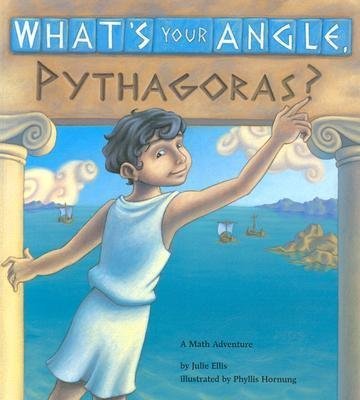
    What’s Your Angle Pythagoras?
    written by Julie Ellis and illustrated by Phyllis Hornung

    Pythagoras always seems to be in trouble, but it’s only because he’s so curious. You never know where you’ll find him. He could be up in a tree with the birds, spying on workmen, or messing about with maps. He is deep into his latest adventure, and trouble, when he discovers a pattern that gets him on everyone’s good side.

    Web Resources

    PBS Kids has educational online games for all of their television programs including Sagwa the Siamese Cat! Sagwa Tangrams will be fun for the students and help them practice their shape relationships! There are five easy as well as five hard puzzles to choose from!

    Cyber Chase is another great PBS Kids program dedicated to making learning fun. Their website is full of great online games and the math topics that correlate with each. In Point Out the View, each member of the Cybersquad is looking at a bunch of blocks from a different place in the room. The player must show what each person sees from their point of view. Because what you see depends on your point of view, different people looking at the same objects can see them differently!

    MATHO is similar to an interactive BINGO game. Your gameboard is a MATHO board with shapes and angles on it. A problem appears below the gameboard in yellow. Solve the problem and look for the answer on your gameboard. If you find your answer, select it and hit Enter. If you do not find your answer, click on Enter and you will be given a new problem. When you answer correctly, a marker will color your square. You have Matho when you get 5 colored squares in a row. The game is timed, so choose quickly!

    Banana Hunt!  Given a specific angle and a full circle, drag the monkey to that exact angle. If you select the correct angle given, then the monkey will find all of his bananas! For every degree off, the monkey will lose a banana. How many bananas can you find in ten searches? Angles are not labeled so this is practice for those who know their angles well!

    Protractor Measures!  Slide and rotate the protractor by degrees to match it to the given angle. Use the protractor to measure the angle and enter the degree measurement to move on to the next problem. This is a very realistic activity.

    Additional Resources

     This site offers online timed quizzes for every topic in fifth grade geometry (check out the other grades and subjects too!). These quizzes are relevant, kid-friendly, and record a score for teacher use once completed. If a wrong answer is chosen, an explanation of the correct answer is provided! The students may also stop at any time by choosing “submit and finish.”

    This site offers amazing interactive lessons! Working With Angles(16) and Slides and Flips(17) are most relevant to fifth grade geometry. The lessons start off with real-world examples and continue with narrated visual diagrams. Although it moves at a brisk pace, the student has the option of pausing or going back. During the lesson students are engaged with labeling, sorting, and shifting insturments. Students will have a lot of fun using a virtual protractor to measure angles. If one of my students were to miss a vital lesson, this would be my go-to place to give him/her a good foundation of knowledge.

    Teach the students a few songs to help them remember their geometry terms! For only $2.99 you can order the CD of all 14 songs!


  • Bolivia ‘people’s conference’ calls for system change, not climate change

    by Tina Gerhardt

    Photo: The City Project via FlickrCOCHABAMBA, Bolivia—A fundamental critique of capitalism
    as the source of climate change pervaded the People’s
    World Conference on Climate Change
    , from the opening
    speech of Bolivian President Evo Morales
    on Tuesday to the final
    declaration agreed upon Thursday.

    On the first day, as 15,000 people from 125 countries
    gathered for the summit, Morales laid out his view bluntly: “Either capitalism
    lives or Mother Earth lives.”

    “The main cause of climate change is capitalism,”
    he continued. “As people who inhabit Mother Earth, we have the right to
    say that the cause is capitalism, to protest limitless growth. … More than
    800 million people live on less than $2 per day. Until we change the capitalist
    system, our measures to address climate change are limited.”

    Bolivia’s lead climate negotiator, Angelica Navarro, echoed
    Morales’ points: “You cannot create a climate market to solve climate change.
    You have to address the structural causes. These causes are not only to be
    measured in terms of greenhouse gases. They are trade, finances, and economy.”

    The conference ended on Thursday—Earth Day—in
    Cochabamba’s downtown stadium, with world leaders and delegates presenting a
    final declaration that broadly outlined a path forward for addressing both the
    impacts of climate change and the economic and political structures that have
    brought it about.  That statement
    will now be taken to the U.N. ahead of the next big international climate
    conference, COP16, to be held in Cancun, Mexico, at the end of the year. 

    The Bolivian government laid the groundwork for the
    declaration with a set
    of four demands
    : climate reparations from developed countries to developing
    countries; an International Climate Justice Tribunal; a Universal Declaration
    for the Rights of Mother Earth; and development and transfer of clean
    technologies.  The final statement
    called for creating a multilateral organization to fight climate change and
    protect climate migrants; ensuring that knowledge related to technology
    transfer not be privatized; and acknowledging and protecting the rights of
    indigenous peoples.

    The conference sought to avoid the backroom deals and lack
    of transparency that plagued the U.N. talks in Copenhagen in December. “That is
    not democracy. That is not the U.N.,” Navarro said of the Copenhagen
    process. “For months, we were discussing our proposals with other
    countries. They did not listen. What we want in Bolivia is a true and
    participatory democracy. If the governments do not come up with a plan for
    climate change, the people have to lead with a plan.”

    The “people’s conference” invited civil society
    into the process, creating a bottoms-up rather than a top-down approach.
    Seventeen working groups met over the course of the three days, and dozens of
    panels and countless informal strategy sessions were held too.  The working groups had varying degrees
    of success.  Some reached
    agreements that supporters can organize around and push for at future U.N.
    climate meetings.

    The forest working group rejected the U.N. REDD program
    (Reducing Emissions from Deforestation and Forest Degradation), arguing that by
    using market mechanisms to offset carbon emissions, it allows companies to
    speculate and get around actual carbon reductions.

    The working group on climate refugees drafted a statement
    that was included in the final declaration, calling for protections for the
    hundreds of millions of people expected to be displaced by rising sea levels,
    droughts, floods, and dwindling water supplies. In his opening address on
    Tuesday, Morales had called for borders to be opened to climate refugees.

    The conference also provided a boost to the climate-justice
    movement, giving advocates an opportunity to network, organize, and share
    stories about local and regional environmental and indigenous struggles.

    But there was also dissent at the conference. Various
    organizations and an unofficial 18th working group focused on the discrepancy
    between Morales’ rhetoric on behalf of Mother Earth and his policy of resource
    extraction, emphasizing the environmental degradation brought about by mining
    and oil and gas drilling. Revenues from natural gas help to keep Bolivia, the
    poorest country in South America, afloat. Eduardo Gudynas has referred to this
    policy as the “new
    extractivism
    ” of Latin America. 

    Oscar Olivera, who was active in organizing the “water
    wars
    ” against privatization in Bolivia 10 years ago, argued that there
    are currently two kinds of movements: those on the inside of the government and
    those on the outside. He said, “Social movements in Bolivia are fragmented not
    because of ideological reasons but because of cooptation by the government. One
    of the characteristics of this government is that there is not room left for
    autonomous spaces, for grassroots organizing. Until 2004, the people of society
    in Bolivia were very strong and organizing horizontally. The issue of land
    distribution is not solved. Despite the rhetoric, oil and gas have not been
    nationalized.”

    Still, most conference attendees rallied together around the
    main anti-capitalist message: to solve climate change, we must stop the push
    for unlimited growth that capitalism is based on.  This is well summed-up by a slogan that got attention in
    Copenhagen and even more traction in Bolivia: “System change, not climate change.”

    Related Links:

    Obama climate agenda in turmoil after Republican pulls out of compromise

    The good news about the very bad news (about climate change)

    More lessons from Wales for moving beyond coal


  • Peugeot Citroën e Mitsubishi iniciam a produção em sua fábrica conjunta em Kaluga, na Rússia

    Logo Peugeot Citroen
    Philippe Varin, Presidente Mundial da PSA Peugeot Citroën, e Takashi Nishioka, Presidente da Mitsubishi Motors Corporation, iniciaram oficialmente a produção de veículos da PCMA Rus, a fábrica conjunta dos dois grupos na Rússia. A fábrica, na qual a PSA Peugeot Citroën tem uma participação de 70% e a Mitsubishi Motors Corporation de 30%, está situada em Kaluga, localizada a 180 km ao sudoeste de Moscou.

    A fábrica, que teve um investimento inicial de 470 milhões de euros, fará com que a PSA Peugeot Citroën e a Mitsubishi Motors Corporation se posicionem entre os principais atores do mercado automotivo da Rússia, cujo potencial de crescimento é muito promissor.

    A partir de abril de 2010, a fábrica de Kaluga produzirá o Peugeot 308, seguido do Citroën C4 e dos utilitários esportivos (SUV) Citroën C-Crosser, Peugeot 4007 e Mitsubishi Outlander. Esses modelos destinam-se ao segmento de veículos médios do mercado automotivo russo.

    A fábrica estará totalmente operacional em 2012, quando a capacidade de produção anual será de 125.000 unidades, sendo 85.000 unidades de carros médios da Peugeot e da Citroën e 40.000 unidades de SUV’s das marcas Peugeot, Citroën e Mitsubishi.

    A PCMA Rus será uma fábrica compacta com espaços de trabalho otimizados repartidos entre dois edifícios: a oficina de pintura e a oficina de chaparia e montagem. Para reduzir os impactos ambientais, a fábrica empregará as melhores práticas ecológicas de ambos os grupos em termos de economia de energia, de redução das emissões de CO2 e de redução dos resíduos (pintura hidrossolúvel, embalagens recicláveis para o transporte).

    A fábrica empregará cerca de 3.000 funcionários que serão formados no centro de formação local construído em cooperação com o Governo da Região de Kaluga.

    O essencial sobre a fábrica de Kaluga:

    Centro de produção: Kaluga, Rússia
    Localização:180 km ao sudoeste de Moscou
    Administração: Didier Aleton, Diretor Geral / Masayuki Imada, Diretor Geral
    Adjunto
    Superfície:Cerca de 145 hectares e um parque de fornecedores de 30 hectares
    Vocação da fábrica:Fabricação de veículos (chaparia, pintura e montagem)
    Capacidade de produção:125.000 veículos por ano (em 3 turnos)
    Veículos produzidos:Carros médios para Peugeot e Citroën / SUVs médios para
    Mitsubishi, Peugeot e Citroën
    Investimento inicial:470 milhões de euros
    Início da produção:2010
    Colaboradores (contratação):Cerca de 3.000 funcionários

    Fonte: Peugeot Citroën


  • How Sharing Increases Innovation

    Robin Chase wrote:

    [Editor’s note: This post first appeared on Robin’s blog, Network Musings.]

    I believe there is a strong tie between sharing and the ability to innovate. This post will walk you through the logic.

    Innovation is built on these things:

    1. The existence of problems and the desire to solve them

    2. The ability to apply new ways of thinking to these problems

    3. The cost of the inputs needed to solve the problem (skills, data, resources, devices, networks)

    4. The ability to iterate, adapt, evolve and scale.

    1. PROBLEMS: Frankly, there is no dearth of problems and some kinds of people really like to think about how to solve them if they have the time. So problem-solving people who have at least some time on their hands try to problem-solve and people who don’t have time, can’t. (Why are there so many fewer historical examples of women doing remarkable innovative things? Well, duh…)

    2. NEW THINKING: The ability to apply NEW ways of thinking, with an emphasis on the word “new.” Problems that are kept hidden in discipline silos don’t get any new thinking applied to them. See all the great work done by Innocentive, that gets problems out of silos and opens them up to a diverse group of solvers.

    3. THE COST OF INPUTS. Here is where I want to linger for a bit. There is a whole world of inputs that could come at much lower cost—wherever there is excess capacity, an underused resource that has already been paid for and which therefore has lots more value locked up in it! If only we could get people, companies, governments to “share” more—to make sure that their unused unneeded excess capacity was made available to others to make use of.

    Exactly when are we NOT willing to share?

    • When we believe that abundance only comes from hoarding and we perceive that everything is rivalrous (see this earlier post).

    • When we have just witnessed a communal sharing debacle (Chinese cultural revolution) or when goods really are rivalrous.

    • When things really are scarce, there is just simply not enough to go around and so we hoard to protect our closest family.

    • When things are abundant, why bother?

    If we look at these reasons for not sharing excess capacity (and thus facilitating a whole lot more innovation), I see lots of room for improvement. We have to stop our …Next Page »

    UNDERWRITERS AND PARTNERS


  • Awesome Foundation, Spreading Awesomeness Across the Universe, Expands to West Coast

    The Awesome Foundation
    Wade Roush wrote:

    For Boston-area Web developers, the place to be last Friday night was the Barron Building at 614 Massachusetts Avenue in Central Square. Home to Conduit Labs, Oneforty, Shareaholic, and several other Web startups, it’s become the newest pin in Boston’s entrepreneurship map. On Friday, it was the scene of a rollicking joint housewarming party for Conduit and Oneforty.

    The party doubled as the award gathering for the winner of the March 2010 grant from the Awesome Foundation for the Arts and Sciences, the Cambridge-born “microtrust” that hands out $1,000 grants to projects that “promote awesomeness.” The March awardee was Charles Fracchia, an undergraduate studying biology at Imperial College in London who’s spending a year in Boston doing an internship at Ginkgo Bioworks. Fracchia’s project is to create special cultures of microorganisms engineered to excrete “conditional inks” that change color at different temperatures.

    But in addition to the bio-ink award, the Awesome Foundation had some more big news last week—the opening of a San Francisco chapter of the organization. It’s the third chapter outside Boston for the organization, which was created just last summer by Berkman Center researcher Tim Hwang and Betahouse founder Jon Pierce.

    Here in Boston, the Awesome Foundation counts people like former Microsoft Startup Labs manager Reed Sturtevant as “trustees,” who contribute $100 per month toward the informal grants. The money occasionally goes to technology projects, but just as often are awarded to people with ideas for nifty or unusual stunts or temporary installations. Previous awardees have included Hansy Better Barraza, a Rhode Island School of Design architecture professor who planned to build a giant hammock on Boston Common, and Lauren McCarthy, whose wearable devices train people to have more effective social interactions.

    Jon PierceChapters in Providence, RI, New York, and now San Francisco operate autonomously, according to Pierce, but with the same charge: “funding awesomeness.” I interviewed Pierce about the organization’s rapid growth last week, and have written up our talk below.

    Xconomy: What attracts people to start new chapters of the Awesome Foundation?

    Jon Pierce: I think it’s the fact that it celebrates awesomeness over more traditional values. Awesomeness is a quality that is very impactful. It’s sort of that sense of wonder that you experience when you first hear about it. It’s “Wow, I didn’t think that was possible.” As a foundation, that’s novel, and the fact that it’s purely individually funded, with no real organizational structure, is also appealing to people.

    The fact that we’re funding people on the basis of a really short, couple-hundred-word proposal, and we don’t have a strict vetting process or layers of bureaucracy that you have to go through at a traditional grant-making organization, enables us to get some more interesting ideas, because we aren’t necessarily concerned with whether [applicants] have corporate or academic credentials. We don’t even require that the projects be “successful” in a traditional way. We do fund projects that we hope will be …Next Page »


  • Rhapsody’s Streaming Music iPhone App Now Works Offline, Too [IPhone Apps]

    All-you-can-eat music services are an intoxicating prospect, but the limitations can be dealbreakers—specifically, that fact that a lot of them don’t let you take your music with you, or limit the devices in or on which you can play it back. It’s not just annoying; it drives home the fact that you don’t actually own your music. So! Onward to the news nugget: As of the incoming version 2.0, Rhapsody’s iPhone app lets you slurp and save playlists from their servers, onto your device: More »


  • 2011 Ford Fiesta Sedan and Hatchback U.S. Spec – First Drive Review


    The U.S.-market Fiesta is as good as its European counterpart. Hallelujah!

    For years, we in the U.S. have had to watch with jealousy as the Europeans drove Ford vehicles that were faster, fancier, better than what was available here. We constantly begged for the products, but the hands of Ford’s American product planners were tied by cost concerns and misaligned product cycles. No more. The automaker announced its ONE Ford plan a couple of years ago, the thrust of which was to design and market vehicles for worldwide consumption, and the first fruit of that plan, the 2011 Ford Fiesta, has ripened.

    Keep Reading: 2011 Ford Fiesta Sedan and Hatchback U.S. Spec – First Drive Review

    Related posts:

    1. 2010 Ford Fiesta Sedan and Hatchback Will be Made in Mexico
    2. 2011 Ford Fiesta – Short Take Road Test
    3. 2009 Nissan Versa Sedan and Hatchback – Review
  • HTC HD Mini: Location based searching

    This is a demonstration of a new feature of HTC Sense on the HD Mini.

    Location based services are quite a big thing now, and HTC have built location based searches in to HTC Sense.

    It uses Google as a back end, so has most things you’d hope for.

    The only thing I feel this could do with, is the ability to get directions to somewhere via Google Maps on device, rather than having to use the web based maps.

    Thanks to appelflap for making me aware of this!


  • On Shelves This Week: April 25 – May 1, 2010

    We’ve got a much better line-up of video game releases this week of April 25, 2010 till the first day of May. Thank goodness the drough of last week’s picks did not carry over to this week.