Category: News

  • Now Newspapers Can Count Their Mobile Audiences, Too


    newspapers on table

    One of the world’s leading newspaper auditors has added mobile phones to the list of mediums that it tracks, providing validation to the wireless industry, while also potentially giving publications a shot of new readers as traditional print audiences decline.

    To do so, the interactive unit of the Audit Bureau of Circulations has partnered with Verve Wireless, which works with more than 600 newspaper publishers in the U.S., Canada, and Europe. Together, the two will be able to audit mobile applications, mobile browsers and even e-readers, like the iPad. Although the service will be limited to Verve’s clients, it marks the first official time the ABC (NYSE: DIS) has tracked mobile usage.

    The audience size is not trivial. Verve said more than nine million readers accessed news from mobile devices using its publishing platform in March, jumping 243 percent compared to the prior year. In 2010, it expects to serve more than 2.2 billion mobile news pages. Separately, ABC said it found in a survey of member publications, that more than 80 percent said consumers would rely more heavily on mobile devices as a primary information source over the next three years.

    A spokesperson for ABC said up until now it has not been tracking mobile, but some papers have been able to extract data from companies like Omniture (NSDQ: OMTR).

    “With all the buzz around the iPad and with use of mobile browsers exploding, newspapers and their advertisers are increasingly interested in seeing mobile metrics detailed in ABC reports,” said Michael Lavery, ABC president and managing director, in a release.


  • Ford Launches 1.0-liter Three-Cylinder EcoBoost, Says It Will Come to the U.S.

    At the Beijing auto show, Ford announced another EcoBoost turbocharged engine. The new engine displaces just 1.0 liters and has only three cylinders, slotting it under the Blue Oval’s four-cylinder EcoBoost units.

    Ford says the gasoline engine will produce equivalent power to a naturally-aspirated 1.6-liter engine while keeping carbon-dioxide emissions under 100 g/km. Unfortunately, exact power and fuel economy figures aren’t yet available.

    The engine uses a cast-iron block and aluminum head, and has a 10:1 compression ratio. As with all EcoBoost powerplants, it’s direct-injected. Ford has yet to say which vehicles will receive the diminutive powerplant, but company officials told us that the global engine will definitely come to the U.S. at some point. We can’t see it serving solitary duty in anything beyond the small Fiesta in the U.S. market, although we wouldn’t be surprised to see it teamed with an electric motor in future hybrids.

    Related posts:

    1. Ford Confirms 230-hp Four-Cylinder EcoBoost is On the Way
    2. Ford Debuts Four-Cylinder EcoBoost Engine Family in Frankfurt
    3. Ford Confirms EcoBoost F-150, Ups Expected EcoBoost Production
  • Picking the best mobile package

    Picking the Best Mobile Package

    If you’re looking for a mobile phone package, then the chances are you won’t know everything about getting the best deal. There are adverts, special deals, sales calls and peer recommendations to such an extent that it’s not easy to find the package that’s right for you. If you’re looking to get a good mobile phone package, then have a read of this article for some useful tips.

    Getting the Right Provider
    It’s all very well getting a superb deal for nothing, but it wouldn’t be worth very much if you struggle to access your network in the local area. Not all network connections are equal, so it’s a good idea to talk to friends to see if their network works well in the local area.

    You should also remember that there are only five network providers; these are: 02, T-Mobile, 3, Vodafone and Orange. The rest are virtual networks that will use a main network’s infrastructure. For example, Vodafone provides the infrastructure for BT Mobile, British Gas, One-Tel and ASDA. Make sure you read the small print of your particular deal so you know which network you will be using.

    Working Out Your Usage
    The amount you pay per month will depend on a variety of factors, but it’s important to consider them before you search for a calling plan. You should certainly think about the following:

    How many calls do you make?
    Are they peak or off-peak calls?
    What proportion of calls is to other mobiles?
    How many texts do you use?

    Pay as You Go or Contract?
    With pay as you go you use electronic top up or vouchers to maintain your balance, while on a contract you pay a monthly fee.

    If you’re a frequent user (over 100 texts and 150 minutes of calls per month) then it’s worth considering a contract. Not only will your phone bill be cheaper, but networks often offer free handsets to entice you. The downside is that if you go over your limit, then you could find yourself with a hefty monthly bill.

    You should really weigh up both options though, as on some networks it’s possible to have pay-as-you-go packages with cheap ‘bolt on’ options that can suit you better than a contract. Visit the Vodafone website to check out their latest mobile phones.

    © 2007 Freakitude dot Com.

  • Watch: Red Dead Redemption "Multiplayer Competitive Modes" trailer

    Rockstar Games continues to impress as they release another gameplay trailer for the highly anticipated western epic shooter, Red Dead Redemption. In the latest offering, the Grand Theft Auto developer’s gives us a sneak peak at the

  • How to Train for Better Sex: Exercises and Workout Tips

    Filed under: , , , ,

    Personal trainer Greg Peterson has a new book, Sexual Fitness: The Workout Guide to Better Sex, and here he explains why focusing on certain exercises and areas of the body can heat things up in the bedroom. (And help you to not lose your balance … Read more


    Permalink | Email this | Linking Blogs | Comments

  • Illegal Day Of Prayer, A Costly Taxi Ride And Schwarzenegger Wants Money

    *Judge outlaws National Day of Prayer. It was bound to happen sooner or later. Last week, U.S. District Judge Barbara Crabb declared that the National Day of Prayer—something the nation has honored since it was first proclaimed by President Harry Truman back in 1952—is unconstitutional. She was responding to a lawsuit filed by something called the Freedom from Religion Foundation. Despite the ruling, the White House says the president still intends to recognize a National Day of Prayer. Maybe we should all pray that judges read the Constitution again (if they ever have).

    *No silly walk for this guy. Tens of thousands of people have had their travel plans disrupted thanks to ash clouds from a volcano in Iceland that spread over much of Europe. One of them was my favorite English funnyman, John Cleese, of the “Ministry of Silly Walks” fame. Cleese was stranded in Oslo, Norway, after a TV appearance there. When he couldn’t find any other way to get home he hired a cab to drive him to Brussels, where he caught a train to London. Total cost of the trip: a hefty $5,140.

    *“Bring your money, buddy.” I’ve written before about the flight of capital from California. Something like 25 percent of the state’s millionaires have fled to less taxing states. But here’s a twist: A multimillionaire I know is moving to Newport Beach from an eastern city. A few weeks ago he received a personal phone call welcoming him to the state from embattled governor Arnold Schwarzenegger. Near the end of the call the governor said, “And please bring your money with you.”

    —Chip Wood

  • Barack Obama’s Dishonest Census Form

    The White House couldn’t wait to trumpet the news: When President Barack Obama completed his official form for this year’s census he declared that he was… are you ready for this?… black.

    For the next 24 hours, the announcement led the news in the national media. It was the top story on CNN.com, the network news shows, cable television and just about everywhere else I looked. For nearly a week, you couldn’t escape it: “The President of the United States says that he is black!”

    Give me a break, please. Obama has been trumpeting his blackness for decades. Appearing on Late Show with David Letterman back in 2009, Obama brought the house down when he said, “First of all, I think it’s important to realize that I was actually black before the election.” Harty-har-har. When the laughter died down, Letterman played the perfect stooge by asking, “How long have you been a black man?”

    Lost in all the chortling are two very important points. First of all, Obama isn’t really black; he is a person of mixed race. In the olden days, he would have been called a mulatto.

    Second, the president had every opportunity to recognize this on the census form. It is no longer necessary to select between black and white (or Asian or American Indian, for that matter). If it is more accurate to say so, you can check two or three or even four boxes.

    To the best of my knowledge, Tiger Woods has not disclosed what he said on his census form. But in the past he has identified himself as a “Cablinasian”—that is, a combination of Caucasian, black, Indian and Asian. It’s not only a more honest declaration than our president made; it also suggests that Tiger doesn’t take the matter of race as seriously as Obama does.

    Then again, it’s his talent at golf, not his color that has made Tiger Woods one of the wealthiest and most famous athletes in history. While Obama obviously believes that it is his blackness that enabled him to become our president—not to mention a multimillionaire—thanks to the sales of his best-selling book, Dreams of My Father, which chronicled his search for his black identity.

    His fixation with his black identity also helps explain why he and his wife Michelle could be members of Rev. Jeremiah Wright’s Trinity Church for so many years, without uttering a word of protest over his preacher’s overt racism. Obama remained a member in good standing of the church (which described itself as “an instrument of Black self-determination”) until it began to cost him votes.

    But what about Obama’s white heritage? In declaring on the census form that he was black, the president in effect disowned his own mother; not to mention her parents—his maternal grandparents—who raised him for most of his childhood. All three were unquestionably white. The only black in the family was the father who abandoned him in childhood. I can appreciate how traumatic that abandonment must have been. But does that justify ignoring the white half of your heritage? Doesn’t that strike you as a tiny bit ungrateful?

    By the way, there’s an interesting footnote here. While the changes to the census form were being debated 10 years ago, the National Association for the Advancement of Colored People (NAACP) and other civil-rights groups fiercely opposed allowing people to select multiple races to designate their heritage. At the time, they were concerned that too many “blacks” would check other boxes as well, with the result that “black” numbers would drop dramatically—thus reducing how much aid and other federal favoritism would continue to be bestowed on them.

    It turns out that there was no basis for this concern: To the relief of everyone campaigning for more government benefits, any person who identified himself or herself as even partially black is included in the “black” total.

    Does anyone besides me detect something incredibly racist in this whole issue? I keep thinking of the plot of “Show Boat,” one of the greatest musicals in the history of U.S. theatre. I’m sure most of you remember the 1951 movie starring Kathryn Grayson and Howard Keel. If you don’t, rent it sometime soon. It is absolutely enchanting.

    In case you’ve forgotten, the plot turns on a bitterly racist fact of the times. Pete, the thuggish engineer on board the Cotton Blossom show boat, makes a play for Julie La Verne, the leading lady. Julie’s husband Steve, the leading man, beats him off. Swearing revenge, Pete tells the local sheriff that Julie is a mulatto and that she and Steve are guilty of miscegenation, which was a crime in Natchez, Miss., at the time.

    Before the sheriff arrives, Steve takes a knife, cuts Julie’s hand, and swallows some of her blood. He then tells the law and the crew that he, too, is black—because he has “one drop of Negro blood in him.” Witnesses confirm that this is, in fact, true, and the sheriff drops the charges. Of course Steve and Julie have to leave the show and the ship.

    In much of America at the time (the story takes place in the 1880s, when the scars of the Civil War still ran deep), one drop of Negro blood was all it took to be considered black.

    I would like to believe that we in this country have come much further since then. I’d like to believe that the majestic words spoken by Obama at the 2004 Democratic National Convention are true, when he proclaimed, “There is not a black America and a white America and Latino America and Asian America.”

    I’d like to believe it. But by his racist response to the U.S. Census, Obama has shown he doesn’t. In fact, his actions have delayed the day when they will be true. Shame on him for what he did… for denying his heritage and for helping make old wounds bleed anew.

    Until next time, keep some powder dry.

    —Chip Wood

  • Awesome Existing Home Sales Charts From Calculated Risk

    The NAR reports: Existing-Home Sales Rise

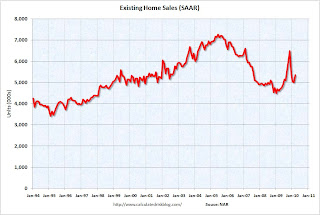
    Existing-home sales, which are completed transactions that include single-family, townhomes, condominiums and co-ops, rose 6.8 percent to a seasonally adjusted annual rate of 5.35 million units in March from 5.01 million in February, and are 16.1 percent above the 4.61 million-unit level in March 2009.

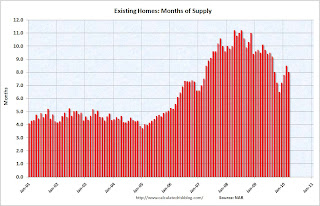
    …Total housing inventory at the end of March rose 1.5 percent to 3.58 million existing homes available for sale, which represents an 8.0-month supply at the current sales pace, down from an 8.5-month supply in February.

    Existing Home Sales Click on graph for larger image in new window.

    This graph shows existing home sales, on a Seasonally Adjusted Annual Rate (SAAR) basis since 1993.

    Sales in March 2010 (5.35 million SAAR) were 6.8% higher than last month, and were 16.1% higher than March 2009 (4.61 million SAAR).

    Sales surged last November when many first-time homebuyers rushed to beat the initial expiration of the tax credit. There will probably be another increase in May and June this year, although that will be probably be smaller than the November increase. Note: existing home sales are counted at closing, so even though contracts must be signed in April to qualify for the tax credit, buyers have until June 30th to close.

    Existing Home InventoryThe second graph shows nationwide inventory for existing homes.

    According to the NAR, inventory increased to 3.58 million in March from 3.53 million in February. The all time record high was 4.57 million homes for sale in July 2008.

    Inventory is not seasonally adjusted and there is a clear seasonal pattern – inventory should increase further in the spring. This was the 20th consecutive month of reported year-over-year decline in inventory, but the decline was only 1.8% from March 2009.

    Existing Home Sales Months of SupplyThe last graph shows the ‘months of supply’ metric.

    Months of supply decreased to 8.0 months in March.

    A normal market has under 6 months of supply, so this is high – and probably excludes some substantial shadow inventory.

    Earlier the NAR released the existing home sales data for March; here are a couple more graphs …

    The first graph shows the year-over-year change in reported existing home inventory and months-of-supply.

    Year-over-year Inventory Click on graph for larger image in new window.

    There was a rapid increase in inventory in the 2nd half of 2005 (that helped me call the peak of the bubble). Then the increase in inventory steadily slowed.

    The YoY inventory has been decreasing for the last 20 months. However the YoY decline is getting smaller – only 1.8% in March.

    This slow decline in the inventory is especially concerning with the large reported inventory and 8.0 months of supply in March – well above normal. Of course months of supply will decline over the next few months because of the increase in sales due to the tax credit, but this will be something to watch this summer and later this year.

    Existing Home Sales NSA The second graph shows NSA monthly existing home sales for 2005 through 2010 (see Red columns for 2010).

    Sales (NSA) in March 2010 were 19.6% higher than in March 2009, and also higher than in March 2008.

    We will probably see an increase in sales in May and June – perhaps to the levels of 2006 or 2007 – because of the tax credit, however I expect to see existing home sales below last year in the 2nd half of this year.


    This post is reprinted from Calculated Risk, a leading finance and economics blog.


    Join the conversation about this story »

  • Pregnancy Planning, Crash Diet Dangers, Detoxes and More…

    Filed under:

    Each morning, we dish out a few links we love.

    It’s not all picking names and nursery colours — here are some things you need to get done before getting pregnant, including booking an appointment with the dentist.

    Trying to lose a few before … Read more


    Permalink | Email this | Linking Blogs | Comments

  • A Woman In Cables [Art]

    This is Connected, a self-portrait sculpture by artist Kasey McMahon. It’s made entirely of Cat 5 cables and other wires, wrapped around a steel frame. It’s absolutely stunning. More »


  • Evening Crunch Crumbs: Bruce Springsteen Gets Ellis Island Award; Archie Comics Introduces First Gay Character; 7-Eleven Beer?


    -The Tribeca Film Festival opened in Manhattan on Wednesday night with the world premiere of Shrek Forever Ever, the fourth and final film in the Shrek film franchise…..

    -A new Hitler Parody….

    -Ellis Island awarded “The Boss” Bruce Springsteen” with a Heritage Award on Thursday…..

    -Rebbie Jackson – AKA “The Normal Jackson” — is going on tour!

    -Madonna shoots scenes for the next D&G campaign….

    -Brandy and Ray J’s mom thinks Kim Kardashian leaked her 2007 sex tape with the singer/reality star. Well thank you, Captain Obvious!

    -Do you bare a startling resemblance to a giant blue avatar? Blockbuster is holding a Na’vi character look-alike contest…..

    -Super Bowl champ Drew Brees is the cover model for this year’s edition of Madden NFL (Apparently, this is a big deal)….

    -Maura Tierney has given her first interview about her battle against cancer….

    -Apple’s unveiled a new, free MacGruber App for iTunes. A new site has just launched that allows users to train at the “Macgruber: Training Academy.” Mark your calendars, MacGruber opens in theaters May 21….

    -ABC denies banning Lane Bryant’s cleavege ad….

    -Do you like Heidi Klum’s new haircut….

    -7-Eleven is launching its own line of beer?

    -Steelers QB Big Ben Roethlisberger has been suspended for six games after being linked to two alleged sexual assaults in the past year….

    -The Cartoon Network is reviving Looney Tunes and launching its first awards show….

    -Macy Gray “tried” to pay her publicist and she “stumbled….”

    -Archie Comics is introducing its first openly gay character….

    -Is it a wrap for TheWrap.com?

    -Amanda Peet welcomes baby girl….

    -Here are a few tips for breaking free of a toxic relationship…..


  • Lest we forget

    The annual anniversary of the landing of Australian and New Zealand soldiers at Gallipoli challenges us all. The stories of that event together with various myths and legends that grew in the hearts of the youth of nationhood have meant that Australians have a special place in the heart on that Turkish peninsula. Like many others of the latter generation, I wondered what it was all about. I studied the history, read the diaries, went to the war memorials and I wrote down material.

    But it was while I was watching Peter Weir’s acclaimed film Gallipoli on an aircraft in 1982 that I realised that Australian soldiers were being shot on wide sweeping sand beaches. I remember thinking, “Why are they not digging in? Why are they not making trenches and barricades?” In the film’s credits I saw that this Australian film was made on the wide sandy beaches of South Australia.

    But Gallipoli is not like that. I knew that from my school geography lessons. Its beaches were rocky, even flinty, solid clay and stone: it took a lot of effort to dig rock trenches to give soldiers shelter. Every fresh brigade on landing was mown down by machine guns on the cliff. As I stood in Gallipoli looking at a pile of freshly uncovered skulls, Turkish men who worked in the Commonwealth war grave cemetery identified for me the skulls of Turkish soldiers s and those of Allied soldiers. When I asked how they could tell which one was Turkish and which one was Allied, I was told, “Very simple. ” They pointed to the tops of each skull and said, “All allies have bullet hole top of skull,” because the machine guns fired down upon them from the cliffs as they landed.

    I felt that, so bad was the film in its misrepresentation of the hardships that Australian and other troops faced, a film should be made at Gallipoli. I put together the Wesley Film Productions film crew and went to Gallipoli to film inside the trenches. Incidentally, that was the first time anyone had made a film at Gallipoli since 1923 when C. E. W. Bean arrived with a burial party. I make the point that bodies were not buried before 1922. As Charles Bean came in towards shore, he thought he saw snow on the cliffs, but they were the bleached bones of dead soldiers who had not been buried.

    I convinced some people to put up some money. Some Sydney people put up over a million dollars to cover the costs of the film crew that I led. The trenches, which are still there, were cut into the solid shale, rocks and clay. Everywhere I went in 1982, pieces of bone and metal buckles were uncovered every time the wind blew. I picked up shovels that had the British war insignia on the back of them. I researched the history, wrote the script, raised the money and took the 34-member crew with me to Anzac Cove.

    Ironically, when we visited in 1982 not one of the Turkish guides or the bus drivers knew how to get from Çanakkale to Anzac Cove. The road was almost impassable. What a difference there is these days, since the new road has been cut into the hills and completed, as tens of thousands of people go to Anzac Day commemorations at the beach.

    In the early morning air, at dawn in 1982, I am filmed as the only person on the beach. As I walked the beaches, climbed into the trenches, read the tombstones and thought of the piles of contorted flesh of young Australian manhood, I realised that, in that foreign country, there will always be a part of Australia. Colonel Mustafa Kemal, who led the Turkish resistance so brilliantly in defending his own country, later became Atatürk, the President of Turkey, and the man who brought Turkey into the twentieth century. In 1934, he spoke of the Australian war dead in some of the most moving words I have ever read:

    Those heroes that shed their blood
    and lost their lives
    You are now lying in the soil of a friendly country.
    Therefore you rest in peace.
    There is no difference Between the Johnnies
    and the Mehmets to us where they lie side by side
    here in this country of ours.
    You, the mothers,
    who sent their sons from far away countries
    wipe your tears
    your sons are now lying in our bosom
    and they are in peace
    after having lost their lives on this land
    they have become our sons as well.

    I stood in tears reading those words and reading the names of the young men who had fallen and who lie buried in the cemetery that will be known forever as Lone Pine. I realised that there on the west coast of Turkey, part of the heart of Australia lies buried. In later wars, far greater numbers of Australians would be killed and wounded at Passchendaele and the Somme and other war cemeteries would be built in Europe, the Middle East, South-East Asia, the Pacific Islands, Papua New Guinea, Malaysia, Korea, Vietnam—but Gallipoli holds part of the heart of Australia.

    Long before it was popular I made the film, Our Magnificent Defeat, and led Martin Johnston, our producer, and Robert Draper, our cinematographer from New York, as well as an international crew from Australia, the United Kingdom, Europe and America. For 15 years the film that I made was screened every Anzac Day across Australia and it has been screened by all of the major networks in Australia. It has played some part in the renewal of interest in people going to Gallipoli ever since. Thousands of copies on video were sold mainly to schools and RSL clubs.

    While I was at Gallipoli, in my imagination I thought of all those who had fought in Australia’s name: he who crouched in a shallow trench on that hell of exposed beaches, the steeply rising foothills bare of cover, a landscape pockmarked with war’s inevitable little piles of stores, equipment and ammunition, and the weird contortions of death sculptured in Australian flesh.

    From the going down of the sun on that first Anzac Day—the chaotic maelstrom of Australia’s blooding—to the desert and heat of Afghanistan and Iraq, to the frozen mud of the Somme, the blazing destroyer exploding on the North Sea, to those fighting in the desert and the ratholes of Tobruk, to the crashing, flaming wreckage of a fighter in New Guinea and all those who lived with the damned in the places cursed with the name of Burma Railway, Sandakan and Changi, he was there.

    He was there in Europe, France, Germany, Spain, Crete, Greece, Syria, Korea, Malaya, Africa, Vietnam Afghanistan and Iraq. He was your mate, the kid across the street, the medical student at graduation, the mechanic from the corner garage, the baker who brought your bread, the gardener who cut your lawn, the nurse, the telephonist, the land-army driver, the clerk in the office. He was an Army private, a Naval commander, an Air Force bombardier. No man knows him. No name marks his tomb because he is every Australian service man and woman. He died for a cause that he held to be in the service of our land so that you and I might say in freedom, “I am proud to be an Australian.”

  • CBC hosts SkillsUSA state conference

    NEWS RELEASE
    April 22, 2010                                                             Contact: Frank Murray, 542-4835

    Some 70 participants from the state’s community and technical colleges will assemble at Columbia Basin College this weekend for the annual SkillsUSA state conference.

    The conference features competitions in both leadership and skills in vocational areas of study. Winners and high placers will advance to the National SkillsUSA competition in Kansas City, Missouri in June.

    The competition gets underway with a welcome at Gjerde Center at 8 a.m. Following the welcome, students will divide into breakout sessions to discuss various topics. The leadership competition begins at noon.

    Competitions will be held in prepared speech, extemporaneous speaking, job interview, customer service, and job demonstration. The Skills competition will be held all day Saturday at CBC in Pasco and Tri-Tech in Kennewick in automotive, machine technology, nursing, and welding.

  • To Barack Obama with my deepest respect

    Ankara, April 16, 2010

    His Excellency
    Barack Obama
    President of the United States of America
    Washington D.C.
    USA

    Dear Mr. President,

    It wouldn’t be an exaggerated statement if I say that your exceptionally impressive speech to the Turkish Grand National Assembly on April 6, 2009, captured the hearts and the minds of the Turkish people. This speech and the other statements you made during your visit left a deep imprint on the Turkish public opinion conveying the belief that you look at the world and Turkey with good will and without adverse prejudices.

    Unfortunately, the subsequent statement that you made on April 24th regarding the events of 1915 in Eastern Anatolia seriously disappointed the Turkish people and cast a shadow on the positive impression formed during your visit for the following reason: Although your statement omitted the highly charged word “genocide”, you twice employed the expression “metz yeghern” which is the exact translation of “genocide” in the Armenian language. Furthermore, the statement said, “Each year, we pause to remember the 1.5 million Armenians who were subsequently massacred or marched to death in the final days of the Ottoman Empire”, and thereby, in effect, reprised the expression “Armenian genocide” that you used frequently during your election campaign.

    Mr. President,

    In addition to being a world statesman of the first rank, you are also justifiably regarded as a distinguished scholar of law, having graduated from the world renown Harvard Law School and having instructed law as a senior lecturer at a prominent university. In light of these qualifications, we are particularly perplexed by your characterizations of historically controversial events that took place 95 years ago in terms that are incompatible with the universal principles of law as well as provisions of the U.S. Constitution and U.S. national law.

    “Genocide” is an international crime codified in an international legal instrument, the “Convention for the Prevention and Punishment of the Crime of Genocide”. This was adopted by unanimity by the United Nations General Assembly in 1948 and subsequently became the supreme law of the U.S., as stipulated by Article VI of the Constitution pursuant to its ratification by the U.S. Senate. Article II of the Genocide Convention delineates the crime of “genocide” and prescribes the objective/material and subjective/mental elements which should be proven for the existence of the crime. To incriminate a person with the crime of “genocide” or for state responsibility to arise, together with the existence of these two elements of the crime, the fact that the crime has been committed with specific intent must be proven and a competent court must ascertain that the crime has been perpetrated. The Convention’s Article VI specifies that the competent judicial authority is the competent court of the state in the territory of which the alleged act was committed, or an international penal tribunal, the jurisdiction of which has been accepted by the parties. Article IX of the Convention provides that the states can take disputes on matters relating to “genocide” which arise between them to the International Court of Justice.

    Mr. President,

    Consequently, unless the existence of the material and mental elements of the crime as well as its execution with the specific intent have been proven, and unless the perpetration of the crime has been determined by a competent court, a charge of “genocide” leveled against a person or a state has no legal value and only constitutes a defamation.

    Until today no accused has ever been incriminated with the crime of “genocide” or with the “crime against humanity”, which is a crime as odious as “genocide”, without a decision of a competent international criminal court. Indeed, the Nuremberg International Penal Military Tribunal, after a long trial process, found guilty the leaders of the German Nazis accused of “crimes against humanity” and sentenced 22 of them to death. Furthermore, those incriminated of “genocide” for the events which occurred during the Rwanda and Yugoslavia conflicts have been tried and convicted by the Rwanda and Yugoslavia international penal tribunals. As is known, both tribunals are ad hoc courts which had been set up by decisions of the UN Security Council. Saddam Hussein, who was charged with crimes against humanity, was tried and convicted in an Iraqi Special Court which was established in line with the principle of due process of law. Recently, the legal action brought by Bosnia-Herzegovina against Serbia was heard by the International Court of Justice. In its decision in February 2007 the Court has reaffirmed that at Srebrenica genocide was committed, but has not convicted the state of Serbia of having committed genocide.

    Mr. President,

    I am certain that you hold dear the concept of the presumption of innocence whose roots go back to Magna Carta. Article 11 of the Universal Declaration of Human Rights which was adopted in 1948 by the United Nations General Assembly by unanimity, describes the principle of presumption of innocence as follows:

    “(1) Everyone charged with a penal offence has the right to be presumed innocent until proven guilty according to law in a public trial at which he has had all the guarantees necessary for his defence.

    “(2) No one shall be held guilty of any penal offence on account of any act or omission which did not constitute a penal offence, under national or international law, at the time when it was committed. Nor shall a heavier penalty be imposed than the one that was applicable at the time the penal offence was committed.”

    This principle is set forth in the European Human Rights Convention, Article 6 paragraph 2:

    “Everyone charged with a criminal offence shall be presumed innocent until proven guilty according to law.”

    The principle of presumption of innocence is also guaranteed by the Fifth Amendment of the U.S. Constitution which prescribes that “No person shall be held to answer for a capital, or otherwise infamous crime” unless tried fairly and indicted by a court.

    Therefore, Mr. President, wouldn’t it be a gross injustice and a grave violation of the principle of the presumption of innocence to heap accusations on Turkey for disputed events of the past?

    Mr. President,

    As you would agree, the principle of legality, which is as old as the concept of law itself, is a basic concept in both international and national justice. According to this principle, an act is not recognized as a crime unless it is legally defined before the act was committed. “Genocide”, as a word, as a concept, and as a codified international crime, did not exist in 1915. After being defined for the first time by the U.N. General Assembly document 96 (I) on 11 December 1946, it was codified by the U.N. Genocide Convention on December 9, 1948.

    Consequently Mr. President, by leveling accusations of the crime of “genocide” (directly during your campaign speeches and indirectly in your 2009 remembrance day statement) haven’t you contravened the two dimensions of this principle expressed by the maxims: nullum crimen sine lege, and nulla poena sine lege – there is no crime without a law, and no punishment without a law?

    Mr. President,

    The judgments made in your statement appear to us to violate the spirit of the U.S. Constitution which espouses the principle of legality in its Article I, Section 9 by forbidding the passage of ex post facto criminal laws and bans retrospective criminal sanction. We also must note that President Thomas Jefferson, in his August 13, 1821, letter to Isaac McPherson, asserted that “ex post facto laws are against natural right”. This shows that an abhorrence of retroactive application of laws in criminal justice has a deep-rooted legal history in the U.S.

    Moreover, the principle of legality is equally prescribed by Article 28 of the 1969 Vienna Convention of the Law of Treaties under the heading, “Non Retroactivity of the Treaties”.

    Mr. President,

    In light of the foregoing irrefutable points, certain concerns and questions inescapably arise.

    What are we to infer from the statement you might make this year regarding the disputed events of 1915, if this statement includes the word “genocide” or, echoing your 2009 statement, employs the word’s exact Armenian translation “metz yeghern” and alleges the massacre of the 1.5 million Armenians?

    Wouldn’t such a statement flagrantly violate and flout universal principles of law, international law and the U.S. Constitution? And, to what possible worthy end?

    Wouldn’t it constitute for the Turkish people and their forebears a judgment without trial?

    Wouldn’t the Turkish people consider this gross injustice inflicted on them as the outcome of narrow domestic political calculus, heedless of basic fairness and shared U.S. – Turkish interests ?

    Wouldn’t the imputation of historical guilt upon the people of Turkey and upon their forebears, who themselves suffered enormous losses and were exposed to unbearable pains during those tragic times, be at utter odds with your stated proposal before our Parliament to build a model partnership between the United States and Turkey?

    Mr. President,

    Historian Arthur Ponsonby penetratingly discusses the terrible and enduring effects of war propaganda that persist for generations in “Falsehood in Wartime”:

    “The injection of the poison of hatred into men’s minds by means of falsehood is a greater evil in wartime than the actual loss of life. The defilement of the human soul is worse than the destruction of the human body.”

    I think that Arthur Ponsonby’s cogent words are valid now and will remain valid in the future. What we need today, more than ever, is an international environment that we can hand over to our children and future generations – a world where peace, security, tolerance, friendship and good will reign, instead of prejudices, hatred and passions for revenge.

    For this reason, Mr. President, I must urge you to avoid being influenced by superficial stereotypes regarding the events of 1915 that are rooted in large part in the deliberate wartime propaganda efforts of the World War I Allies. I ask that you foster impartiality and avoid contributing to a deepening of the wounds suffered by the Turkish and Armenian nations in this enormous human tragedy.

    In this context, the best course for the U.S. should be, in line with an ethical and evenhanded approach, to encourage the parties to bring to light and to clarify the obscure and ambiguous aspects of the conflict between the Ottoman State and the Armenians. This would best be accomplished by employing a common, scientifically disciplined research effort by Turks and Armenians regarding their mutual history and by completely opening their archives to examination.

    I am submitting these views to your consideration trusting that you will examine them with objectivity and fairness.

    With my deepest respect,

    Dr. Şükrü M. Elekdağ
    Member the Grand National Assembly of the Republic of Turkey
    Peoples Republican Party
    Deputy from Istanbul
    (Former Ambassador to the USA)

  • My New Car Decal | The Intersection

    For those not already familiar with the original ‘mud flap girl,’ compare here. In my opinion, this one’s far more attractive.


  • Fiat divulga primeiras fotos e informações do novo Fiat Uno 2011

    Novo Fiat Uno 2011

    Depois das primeiras imagens extra-oficiais da provável versão aventureira Way do novo Fiat Uno 2011 serem divulgadas pela internet, a Fiat enfim divulgou oficialmente as primeiras imagens da versão normal do hatch, além de novas informações referentes as versões e motorizações disponiveis para o modelo.

    A companhia italiana confirmou a nova gama de motores Fire Evo Flex de 1.0 e 1.4 litros que de acordo com a companhia, vem acompanhados das últimas tecnologias e consequentemente trabalhando de forma mais eficiente, apresentando reduzidos niveis de consumo e de emissão de poluentes.

    Além disso, o Uno Vivace 1.0 Flex, Uno Way 1.0 Flex, Uno Attractive 1.4 Flex e Uno Way 1.4 Flex será ofereceido nas versões Uno Vivace 1.0 Flex, Uno Way 1.0 Flex, Uno Attractive 1.4 Flex e Uno Way 1.4 Flex todas com a carroceria de quatro portas. No entanto as informações no momento param por ai e o grande mistério que é seu preço, ainda não foi revelado dessa vez.

    Novo Fiat Uno 2011
    Novo Fiat Uno 2011Novo Fiat Uno 2011

    Fonte: CarPlace


  • Six-Pack Abs for Women: A Good Idea?

    Filed under: , , , ,

    Earlier this week I wrote about the male six-pack and how difficult (and possibly unrealistic) it is to achieve for most men. Well, for women it’s even harder, and not as coveted, and not even all that healthy. And to make the whole thing even less … Read more


    Permalink | Email this | Linking Blogs | Comments

  • Improve Your Posture With Mountain Pose

    Filed under: , , ,

    Bad posture can decrease height by as much as two to three inches. And it can affect your breathing, digestion, back health and overall quality of life. If you’re someone who suffers from poor posture, here’s a yoga move you should get to know: … Read more


    Read | Permalink | Email this | Linking Blogs | Comments

  • How to Name a Volcano [Humor]

    It’s not easy to come up with a volcano name that forces people to sound like they’ve got something jammed down their throats, but someone’s gotta do it. Here’s the trick to doing it properly. More »


  • Qwest, CenturyLink Merge, Create Even Bigger Marginally-Relevant USF Money Pit

    Qwest was founded in 1996 by Philip Anschutz, who at the time owned the Southern Pacific Railroad and used the opportunity to deploy fiber lines along railroad tracks. It seems like only yesterday that Qwest paid $45 billion to acquire US West in 2000, one of seven baby bells created by the antitrust breakup of AT&T in 1983. Since then, Qwest has stumbled through accounting scandals and watched its stock plummet as the carrier struggled with traditional voice defections without a wireless division to buoy revenues. Meanwhile, it almost was yesterday that CenturyTel merged with Embarq to create "CenturyLink." This morning Qwest and CenturyLink announced they in turn would be merging in a deal worth $22.4 billion (including $11.8 billion in Qwest debt).

    At first glimpse it’s not entirely clear what the point of the merger is, unless the two companies were simply interested in losing landline and last-generation DSL customers to cable competitors even faster. Neither company has exactly been lighting it up on the network upgrade front — and Qwest has spent most of the last few years trying to trim debt for an acquisition instead of investing back into the network. The result is a company with aging last-mile infrastructure who (in the markets where it actually sees competition) pits slower DSL against faster alternatives like cable DOCSIS 3.0 technology or community fiber (which they have spent millions suing and fighting in Utah and Washington State).

    Creating a larger company doesn’t magically spawn a wireless division, and the company is still going to need substantially more cash to upgrade all of that outdated copper if they want to stay relevant. They may be thinking that by merging they can create a "too big to fail" super-rural telco with a better shot of getting USF and stimulus funds. As we’ve long noted, the USF is a very, very broken program that funnels money to carriers with historically little to no oversight into how that money is spent (and $25 billion has been dumped into e-Rate alone since 1998). Qwest recently applied for $350 million in federal stimulus funds, and lobbyists have been pushing the FCC to expand the USF to cover residential broadband and give more of that money to bigger carriers.

    So the result will be a new, massive phone company primarily serving uncompetitive, rural markets using outdated last mile connections, with consumers helped through this transition via a support infrastructure that just grew incredibly fast. All of this will be propped up by the historically-broken (but soon to be supposedly "reformed") USF system and taxpayer subsidy, guided by Qwest lobbyists and an FCC with no real interest in improving competition in the sector. Surely this will turn out well for everybody involved, right?

    Permalink | Comments | Email This Story