Volkswagen ha anunciado hoy que la presentación oficial de su buque insignia, el Volkswagen Phaeton, tendrá lugar en el salón del automóvil Auto China 2010, que se celebrará en Pekín del 27 de abril al 2 de mayo de 2010. Una primera vista al exterior, nos permite ver que el nuevo Phaeton presenta un frontal completamente nuevo así como también un ensanchamiento en su carrocería y ligeras modificaciones en la silueta y en la parte trasera.
Tecnológicamente, el nuevo Phaeton es un modelo de los más avanzados de su gama, gracias a una cámara frontal, el Phaeton reconoce las señales del tráfico, las indicaciones de velocidad y como característica única, las señales de prohibición de adelantamiento se visualizan en los instrumentos y en la pantalla táctil principal de la consola central.
En una visión más profunda, en el diseño actual del Phaeton 2011 predominan las líneas horizontales, que junto a sus dos anchuras, entre 5,06 y 5,18 metros dependiendo de la distancia entre ejes, acentúan su robustez, además, y tal como se indicó anteriormente, presenta un frontal completamente nuevo, el cual contiene elementos cromados que remarcan el carácter exclusivo del Phaeton.
Completando el frontal se exponen dos faros Bi-Xenón de serie, de nuevo diseño, que incorporan iluminación dinámica en curva y luz de giro integrada. Tanto los intermitentes como la luz de giro están formados por LED extremadamente visibles de un estilo marcado.
El parachoques ha sido rediseñado para que encaje perfectamente con la parrilla y los faros, en este nuevo diseño también predominan la líneas horizontales, incluso los faros antiniebla se han diseñado como bandas estrechas horizontales con tecnología LED.
La parte trasera del Phaeton mantiene el estilo de su predecesor, lo único que se ha rediseñado son los faros traseros LED y el parachoques. Estos nuevos faros cuentan con una banda LED en forma de M, que dotan de un aspecto inconfundible tanto de día como de noche a la parte trasera del phaeton. En cuanto al parachoques trasero, incorpora una nueva moldura cromada de tres piezas. El equipamiento exterior lo completa unas nuevas llantas de 18 pulgadas.
El interior destaca por ser uno de los más elegantes y confortables de su gama, como elementos únicos incorpora el climatizador de 4 zonas, absolutamente libre de corrientes de aire, y los asientos de 18 puntos, premiados por su ergonomía. Se pueden adquirir dos tipos de modelo, una versión de cinco plazas, con tres asientos traseros o una versión de cuatro plazas con dos asientos individuales regulables en la parte trasera.
Gracias a la infinidad de revestimientos de cuero y Alcántara, las aplicaciones de madera y los detalles de equipamiento como la nevera o los sistemas multimedia de la parte trasera, es posible individualizar la berlina de forma ilimitada.
Tecnológicamente la nueva berlina de Volkswagen es sobresaliente, incorpora entre otras cosas una cámara integrada en el retrovisor interior que permite reconocer a otros conductores y regula automáticamente la iluminación de la calzada. La cámara frontal permite el reconocimiento de las señales de tráfico y el innovador sistema Dynamic Light Assist permite aumentar la seguridad pasiva del vehículo con una luz de carretera permanente basada en cámaras de vigilancia.
En cuanto a las diferentes variantes a elegir por el cliente, el Phaeton se puede adquirir con dos batallas, dos versiones traseras (tres asientos / dos asientos individuales) y cuatro motores (un turbodiésel y tres motores de gasolina). Los motores de 6, 8 ó 12 cilindros ofrecen potencias de 240 CV a 450 CV. La motorización básica del Phaeton es un motor de gasolina V6 de 280 CV. Para los umbrales de potencia superiores al V6 FSI se ofrecen los motores de gasolina V8 y W12 de 335 CV y 450 CV respectivamente.
En el ámbito de los diésel, Volkswagen ofrece un motor extremadamente ahorrador y confortable, el V6 TDI. En Europa es el propulsor más extendido entre las berlinas. El motor sobrealimentado con inyección Common-Rail cuenta con una potencia de 240 CV, acelerando de 0 a 100 km/h en tan sólo 8,6 segundos y alcanzando una velocidad máxima de 237 km/h. Esto contrasta con un consumo medio que se ha reducido nuevamente hasta 8,5 l/100 km y una baja tasa de emisiones de 224 g/km CO2.
Yesterday at Facebook’s f8 conference, the company launched tools for any web site to add a social layer by bringing over Facebook friend connections. These social plugins are available to any web developer and use a simple piece of code to add a Facebook frame onto a page and instantly make that page social. So, for example, if you visit CNN.com, you could see what news stories your friends liked and shared there.
CNN doesn’t actually see that happening — to them it’s just a box they leave open on their site for Facebook to populate — but it’s presumably happy because users get a more personal experience and stick around longer. And users don’t get identified for simply visiting a site; they have to login to Facebook through a dialog box for their presence and activities to be shared with their Facebook friends.
Ta-da! It’s personal
Facebook also introduced a way for certain sites to push this further than everyone else. Three carefully chosen launch partners — Microsoft’s Docs.com, Yelp and Pandora — have access to what Facebook is calling “instant personalization.” This is a powerful, inventive and creepy tool that the company hopes to extend to other partners but is testing the waters with these three first.
Instant personalization means that if you show up to the Internet radio site Pandora for the first time, it will now be able to look directly at your Facebook profile and use public information — name, profile picture, gender and connections, plus anything else you’ve made public — to give you a personalized experience. So if I have already publicly stated through my Facebook interests page that I like a musical artist — say, The Talking Heads — the first song I hear when I go to Pandora will be a Talking Heads song or something that Pandora thinks is similar.
The idea is that Pandora is a somewhat hard concept to explain to new users — before it existed, people didn’t have their own personalized radio stations based on similarities between artists and song. Now, new users will derive value from Pandora before they even sign up. The first time they load the page it will be to their favorite music.
This new sign-up customization has the biggest privacy implications of everything Facebook did yesterday. Until now, when you browsed the web, it was safe to assume you were anonymous until you actively logged into a site. But in recent years, behavioral advertisers have started following us around as we browse, using cookies about where we’ve been to customize ad on new pages we visit. (So if I’ve been shopping on Kayak for an upcoming trip, I might get ads about similar flights and travel destinations showing up on a page I visit later that day.) In the post-f8 world, when you show up to Yelp having never been there before, the page will now show a feed of restaurants and stores that your Facebook friends have liked and reviewed using Yelp before you go there.
I spoke with Facebook platform engineering lead Mike Vernal at f8 yesterday about instant personalization after having trouble grokking the concept when CEO Mark Zuckerberg threw it in as a “one last thing” during his f8 keynote. Vernal described the goal as to create a “magical” experience for users. However, he said Facebook is well-aware that these privileges could be abused. “We’ve very cognizant of balancing building great user experiences and respecting privacy,” was how Vernal put it.
Vernal said Facebook has not finalized any plans for allowing additional sites into the instant personalization program. Users are also able to opt out entirely with a new option at the bottom of the list on their privacy settings page. And further, if they want to prevent their friends from sharing their information with an instant personalization partner, users must block that specific application individually. Multiple Facebook employees told me the company was unsure about how to label the sensitive product and which partners were launching on it until the last minute.
I made this just for you
The problem is, users aren’t accustomed to instantly personal services, and we have no idea where that personal information is coming from. Going back to the relatively benign social plugins from the beginning of this story, it probably won’t be obvious to the casual visitor to CNN.com that CNN doesn’t know anything about the story recommendations Facebook is providing. To most of us, it will look like CNN knows who we are. And further, arriving on a brand-new web site that instantly knows who you are might be ultimately useful, but the first time it happens you’re going to freak out.
Facebook’s way of addressing that is by placing an icon in every social plugin that leads back to an explanation on Facebook, and layering a big blue bar on top of the three sites — again, Microsoft’s Docs.com, Pandora and Yelp — that are getting the special treatment. So when I go to Yelp today I’m greeted right up front with: “Hi Liz. Yelp is using Facebook to personalize your experience. Learn More – No Thanks.” That’s fine, but the fact is, this tool is designed to help users become acquainted with sites they’ve never been to before. So the experience is necessarily going to be foreign.
I recently signed up for a new web photo service giving an email address and password. When I went to fill out my profile, there was already a picture of me staring back. Whoa. That’s useful, I guess — I didn’t have to find a headshot to upload yet again — but it weirded me out. It turned out the site was probably using Automattic’s Gravatar, to match my email with my profile pic. Clearly, Facebook’s not the only platform that wants to enable shortcuts to make my new web experiences better — expect this instant personalization to catch on, if users and privacy advocates don’t revolt and drive the company to drop the feature. We saw that happen with a cousin of this product, Facebook Beacon, three years ago.
But if my Facebook stream is any indication, some users have already caught onto this latest privacy tweak. Here’s one message making the rounds:
“Do NOT forget to OPT OUT of the new FB Instant Personalization sillyness. Under your Privacy Settings so 3rd parties cannot collect your personal data. Account–>Privacy Settings–>Applications & Websites–>@bottom is the Instant Personalization thing–>Uncheck Allow.”
But then, lots of people just hate change; every Facebook redesign, ever, has been protested. And so, like Facebook, we’ll have to wait to see how much instant personalization freaks people out.
Victor wants to warn Consumerist readers: no matter how much you love your TiVo, do not jump in and let yourself be an early adopter of the company’s new product, the Premiere (or series 4) box. He and other Premiere users have shared their tales of heartbreak and bugs with the Internet.
I’ve been a huge fan of TiVo, going all the way back to the Series 1 launch in 1999 when Prince was partying and no one understood the concept of a DVR-thingie. So when TiVo released the Series 4 (aka Premiere) earlier this month, I dutifully upgraded three of our four TiVos on the spot. Big mistake. The series 4 is, without a doubt, the buggiest, not-ready-for-primetime experience in the company’s history. The new high-def user interface is a sluggish, lockup-prone mess. Lockups are not something you want from your DVR appliance. It’s always a treat to find out your favorite show won’t be taped in its entirety because you had the nerve to navigate menus or see what else was on the box while it was recording, leading to a random lockup. There’s a TON of complaints about this in the TiVo community forums (www.tivocommunity.com). The solution seems to be just to turn the HD interface off and use the Series 4 with the SD menus only. Unfortunately that doesn’t guarantee a bug-free experience as the SD user interface still has lockups as well. TiVo pushed out an update last night, but in 12 hours of testing, the interface is still buggy and lockup-prone. This box should NOT have been released in this condition. It’s obvious that TiVo needed at LEAST 6 more months to give this the polish TiVo was formerly known for. In my experience with TiVo series 1-3 I’ve never had a box so unstable. Caveat Emptor.
Finally, the agonizing wait is over for Motorola Milestone users on Telus. The long overdue Android 2.1 update has arrived, but in a distasteful manner. Unfortunately, Telus users don’t get an OTA update option, but a multi-step process using the nearest PC will have you boasting your multi-touch within Google Maps in no time.
What’s new with Android 2.1:
Animated wallpapers and multiple home screens
You can choose between 3, 5, 7, and 9 homescreens.
Live wallpapers are now available, others can now be installed from Market.
Facebook App and Widget
Names, profile pictures, and status will can be implemented into your Contacts.
A widget can be placed on one of your homescreens.
Google Maps Updates
Personalized suggestions: Autocompletes locations based on personal search history.
Syncs with desktop: Synchronizes starred items between Google Maps application and maps.google.com.
Multi-touch is now enabled within Google Maps.
Other Enhancements
Help: A new Help Center application is included for mobile access to user guide, video tour of key features, tips and tricks, and FAQs.
Bluetooth support: Support for Bluetooth headset multi-function for initiating voice calls.
Security: Prevents unauthorized pattern lock bypass, allows for PIN security and local device wipe following PIN error input.
Music Player: Album art 3D gallery view supported in landscape orientation.
Battery life: Ongoing battery life optimization.
Email account removal: Improvements to manual removal of email accounts.
What are you waiting for? Update your Milestone from your PC by clicking here and following the provided 4-step instructions. An OTA update would have been nice, but I think justifying four simple instructions should be easy after you’re reaping the benefits of 2.1. If you’ve already updated your Milestone to 2.1, tell us what you think!
A 70-year-old Greenwich construction executive was sentenced Thursday to probation and home confinement in the corruption probe of former Waterbury Mayor Philip Giordano.
Giordano served in the state legislature and lost by a huge margin in the 2000 U.S. Senate race against Joseph I. Lieberman before being arrested by the FBI in a sex scandal involving minors in Waterbury. He is serving a 37-year sentence in federal prison.
2011 Volkswagen Phaeton – Click above for high-res image gallery
If at first you don’t succeed, try, try again. And then again. That could very well sum up Volkswagen‘s strategy with its quizzical Phaeton. The flagship sedan – which took “the people’s car” up-market into Mercedes S-Class territory – was introduced in 2003, then underwent a facelift in 2009 and has now undergone yet another.
The most immediately evident change is the new front end, bearing LED running lights and the brand’s ubiquitous new grille. But that’s not the end of the changes to the Phaeton for MY2011. As befits a car in this category, the Phaeton comes packed with tech, including Google Maps-enabled sat-nav, variable headlights, road sign recognition and a four-zone climate control system, all interconnected by some two miles worth of cable.
Buyers can choose from standard wheelbase or long, four (adjustable) seats or five, four engines (diesel six and gasoline six, eight or twelve)… the list goes on, but they’re all driven through VW’s 4Motion all-wheel drive system. Most pertinently, the new Phaeton is anticipated to mark the model’s return to the North American market to take on another humble-badged full-size luxury sedan in the Hyundai Equus, never mind the Mercedes S-Class, BMW 7 Series, Audi A8, Jaguar XJ, Lexus LS…well, you get the point. Read all about it in the press release after the jump and check out the images in the gallery below.
Three young men who are suing trouble-ridden actress Lindsay Lohan are planning to ask a judge to order the Mean Girls star to appear for a deposition after she blew off the legal hearing twice in the past week.
LiLo was called to give testimony regarding a lawsuit filed by a group of Hollywood revellers, who accuse the star of holding them hostage during a drunken high speed chase through Malibu in 2007. The anything-but-joyous ride ended with Lindsay behind bars for DUI and cocaine possession.
She was due to attend a deposition in Venice on April 14, but showed up 90 minutes late, forcing the meeting to be cancelled. The deposition was rescheduled for yesterday morning, but Lohan — who is reportedly almost bankrupt — failed to show again because she reportedly couldn’t get to court on time.
A Collaborative Effort Between Two Firms: Web Analytics Demystified and Altimeter Group
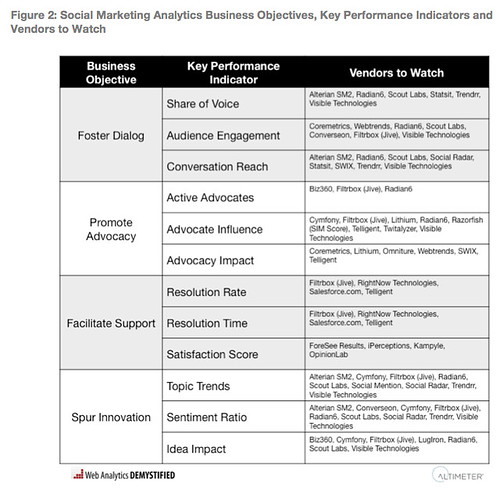
It’s just been over a month since we published the Social CRM Research paper (over 36k views on slideshare) and we’re continuing our cadence here at Altimeter Group of publishing widely available reports under the spirit of Open Research. This time, it’s different, we’ve aligned with who I feel are the smartest team of web analytics minds in the space, John Lovett (ex-Forrester analyst) and Eric Peterson (ex-Jupiter analyst) both of the Web Analytics Demystified firm. Stemming from Altimeter founder Charlene Li’s (ex-Forrester Analyst) framework, we co-developed this framework, and put our collective minds to work on measuring the rapidly changing social media marketing space. This self-funded research effort resulted in a thorough methodology as we interviewed over 40 ecosystem influencers.
Industry Challenge: ”I can’t measure social media ROI”
Marketers around the globe are ranging from toe dipping to jumping all the way into the social marketing space –yet most lack a measurement yardstick. While experiments can fly under the radar for a short term, without having a measurement strategy, you run the risk of not improving what you’re doing, justifying investments, and the appearance of being aloof to upper management. To be successful, all programs (even new media) must have a measurement strategy, and we’ve done just that.
Finally, A Measurement Framework Based on Business Objectives
If you’re familiar with the Altimeter frameworks of developing a social strategy based on business objectives, then you’re in good shape, as this research report is the natural extension of the business objectives we put forth:
Dialog: involves starting a conversation and offering your audience something to talk about while allowing that conversation to take on a life of its own
Advocacy: activation of evangelism, word of mouth, and the spread of information through social technologies
Supporting: customers may self support each other, or companies may directly assist them using social technologies.
Innovation: The business objective of innovation is an extraordinary byproduct of engaging in social marketing activity.
Our framework is a common denominator, yet if you’re already measuring converted leads, or actual sales from social media, great! Yet In this meaty report, which we hope you share with your marketing and analytics team, has actual KPI formulas which you should start to use as the start of your own cookbook.
A Nod To the Community Spirit
We’re putting a big stake out there, in order to further the industry to come together around a common set of KPIs and metrics, but we realize we don’t know all the answers. In the spirit of Open Research, we want this to be an open framework (we’ve even licensed this under Creative Commons) to customize it and make your own for non-commercial reasons with attribution. If you’ve ideas on how to improve it such as new KPIs, vendors, or approaches, we’re listening, and will incorporate and improve this community body of knowledge for all to benefit.
Related Links
I’ll link to others that extend the conversation, feel free to embed the slideshare on your own site.
Meet the 2011 Volkswagen Phaeton – but wait, it doesn’t look so much like a redesign – well, that’s because it’s not. For 2011, Volkswagen focused its attention on giving the Phaeton a much needed facelift and with that in mind, the German automaker won’t bring this model to the United States.
Volkswagen probably won’t attempt to re-introduce the Phaeton to the U.S., which it had a lot of trouble selling here, until after it gets a full redesign in 2013 or 2014.
Overall, the 2011 Volkswagen Phaeton gets some minor exterior restyling touches to the front that give it a more luxurious feel. There are also a lot of new technical features including Dynamic Light Assist (camera-based dynamic main beam regulation) and a navigation system that can integrate online data from Google into the map display. There is also an optional front camera can ‘read’ road signs, with speed limit signs displayed on the instrument panel and center console’s touchscreen. The system can recognize ‘no overtaking’ signs – the first in the world to do so.
The 2011 Volkswagen Phaeton comes standard with a 3.0L FSI V6 making 276-hp and offers all the way up to a 6.0L W12 making 444-hp.
Hit the jump for the press release and high-res image gallery.
2011 Volkswagen Phaeton:
Press Release:
Initial Facts: World Premiere at Auto China 2010:
– Phaeton debuts with new design and new technologies
– Flagship of the Volkswagen brand with fundamentally new front design
– Online services and dynamic main beam control arrive in the Phaeton
Wolfsburg / Beijing, 22 April 2010 – At the Transparent Factory in Dresden Volkswagen produces one of the finest automobiles in the world: the Phaeton. The limousine’s quality and comfort (four-wheel drive and air suspension as standard) set a unique benchmark. Volkswagen, the most successful carmaker in Europe and China, has now made the Phaeton even more perfect. The company’s new flagship is being unveiled for the first time at Auto China 2010 (27th April to 2nd May) in Beijing.
Its contours are defined by the Volkswagen design DNA developed by Walter de Silva, the group’s Italian chief designer. Around the completely new front section in particular the design team has further refined the model’s very own stylistic aplomb. In the process the timelessly elegant Phaeton has gained a broader and more powerful appearance. The new model is also characterised by modifications to its rear section and silhouette.
At the same time, new technical features have been added. These include Dynamic Light Assist (camera-based dynamic main beam regulation) and a navigation system that, if desired, can integrate online data from Google into the map display. In addition to this, the Phaeton’s optional front camera enables it to ‘see’ road signs, with speed limit signs visualised on the instrument panel and centre console’s touchscreen. The system will also be able to recognise and depict ‘no overtaking’ signs – the first in the world to do so!
The Phaeton will be available with a choice of two wheelbase options, two back seat versions (three seats / two individual seats) and four engines (a turbo diesel and three petrol engines). The six, eight and twelve-cylinder engines range in capacity from 176 kW / 240 PS to 331 kW / 450 PS. The standard drive unit used in the Phaeton is a V6 petrol engine producing 206 kW / 280 PS. At the capacities above the V6 FSI the choices available are a V8 and a W12 petrol engine, delivering 246 kW / 335 PS and 331 kW / 450 PS respectively. On the diesel front Volkswagen is offering an extremely frugal and smooth-running V6 TDI. In Europe it is the most frequently selected engine for this car. The turbocharged common rail direct injection engine delivers 176 kW / 240 PS and accelerates the Phaeton V6 (top speed in this case 237 km/h) from 0 to 100 km/h in just 8.6 seconds. This is accompanied by average fuel consumption that has now been reduced still further to just 8.5 litres per 100 km (equating to 224 g/km CO2).
Phaeton exterior
Depending on wheelbase, the 2011 model Phaeton is between 5.06 and 5.18 metres long. As mentioned above, a completely new front section has been developed for this flagship of the Volkswagen brand. In keeping with the current Volkswagen design DNA, its form is dominated by horizontal lines. Unlike all other Volkswagens created to date on the basis of this new DNA, the Phaeton does not have a shiny black radiator grille cover, but instead a completely new chrome element. Along with the likewise restyled headlights, this radiator trim is a major influence in the new Phaeton’s design and underlines its uncompromisingly independent character. In detail the new grille is more upright, while its stricter lines and impressive alternation of materials between polished and matt chrome make it even more striking. The horizontal linking of grille and headlights follows the Volkswagen design criteria and impressively emphasises the vehicle’s width. As a sign of its class specific to this model the Phaeton also features three-dimensional moulding of the grille and bonnet, with precise edges that carry the grille’s heightened expression of quality on into the sculptured contours of the vehicle body. Once again in the centre of the grille is the classic VW badge, which now – despite integrating the ACC (automatic distance control) system’s radar sensors – has a new-look surface design.
To the left and right of the grille are new Bi-Xenon headlamps, which are standard across the range. Integrated within them are cornering and adaptive lights. Not just in visual terms, but from a technical perspective too, this is a whole new generation of headlamps. Firstly, the indicator and adaptive cornering lights are highly visible and stylistically striking LEDs. Secondly, as with the new Touareg, the Phaeton will also be available with optional Dynamic Light Assist. Using a camera integrated into the rear-view mirror, this complex technology ‘detects’ other road users and regulates illumination of the carriageway accordingly (see separate section on Dynamic Light Assist).
The bumper has also been redesigned in keeping with the radiator grille and headlamps. Here too horizontal lines form the guiding principles of the new design. Even the fog lamps have been designed as narrow, horizontal LED strips. Last but not least, the bottom final section of the bumper is now also colour-coordinated with the car body. Compared to the previous model the new generation Phaeton thus looks even sportier and more imposing on the road.
Also modified, the back of the car underlines this impression. The design team decided here not to change the classic, clear and powerful basic style that this area has always had, but instead to develop new LED rear light clusters. Each cluster features dotted lights and an M-shaped LED strip. The result is an unmistakable, elegant look both in daylight and at night. Also new is the VW badge – now likewise in 3D format – on the boot lid.
As at the front, the rear bumper has also been redesigned. It now has a new, three-piece chrome bar and the section of the bumper trim near the road is now also colour-coordinated with the car body. The same goes for the bottom section of the side skirts. Also noticeable in silhouette view are modified side trim strips, narrower LED indicators in the wing mirrors and new 18-inch (‘Experience’) alloy wheels.
Phaeton interior
The Phaeton’s interior ranks as one of the most elegant, high quality and comfortable in the entire premium class. The 4-zone air-conditioning system, for example, that works totally free of any draughts, and the award-winning ergonomic 18-way seats are unsurpassed. All of the Phaeton interior’s functions are also intuitive to use. In addition to the version with three rear seats (5-seater), the limousine can be optionally ordered with two electrically adjustable individual seats (4-seater). Furthermore a version of the Phaeton is also available that is twelve centimetres longer. Meanwhile, the limousine can be almost infinitely personalised with a wide range of leather, alcantara and wood trim, plus optional equipment such as a fridge or multimedia systems from Volkswagen Exclusive. This also applies to the completely redesigned multifunction steering wheel. It can be ordered either in leather or in a wood/leather combination matching the relevant wood trim features.
Information and entertainment systems
The intuitive nature of the Phaeton’s controls has been fully transferred to the new generation of radio and navigation systems (RCD 810 and RNS 810). Equipped with an 8-inch touchscreen, the systems form a functional unit with the air-conditioning and multimedia controls.
Use of online services: Volkswagen is for the first time offering an Internet-based Google function in the new Phaeton as a map display add-on for the RNS 810 radio navigation system with 30-gigabyte hard drive. The relevant data gets loaded onto the system over the Internet via mobile telephone and a proxy server specially set up for the purpose. The visualisation on the touchscreen’s display is the same as the Google Maps ‘Satellite’ view familiar from the conventional Internet and equivalent to the iPhone’s ‘Hybrid’ view. In the Phaeton the satellite images naturally get supplemented by the navigation system’s appropriately highlighted route recommendation.
Particularly interesting in this feature are the POIs (points of interest) that can be accessed. Addresses, tourist sights, businesses, sports venues, doctors’ surgeries and restaurants integrated within Google can be selected in seconds and transferred directly into the route navigation. In perfect conditions the system loads the data via UMTS connection. The telephone itself gets completely integrated into the system via remote SIM access profiles (rSAP). Alternatively, anyone who wants to use a mobile phone with hands-free profiles (HFPs) can also do this linked up with the new Phaeton (in this case Google is disabled). In HFP mode phones that are ‘Phaeton compatible’ include, for example, Apple’s iPhone.
Road sign recognition: However the latest generation Phaeton’s information and entertainment system can do even more! By virtue of the camera integrated in the rear-view mirror the Phaeton now detects road signs and shows the relevant information on the system’s touchscreen and/or the multifunction display (between speedometer and rev counter). It displays not only the maximum permitted speed but also any important additional information (e.g. ‘10pm – 6am’ or ‘When wet’). The system will also be able to alert drivers to overtaking restrictions – the first vehicle in the world to do so!
For the RNS 810 radio/navigation system further add-on options are also available. These include a rear-seat multimedia entertainment system (the High End) and a 1,000-watt sound system with digital 12-channel amplifier from hi-fi specialists Dynaudio.
Electronic assistance systems
The Phaeton’s electronic assistance systems include Dynamic Light Assist (dynamic main beam control), ACC (automatic distance regulation), Front Assist (surroundings monitoring) and Side Assist (lane change assistance). A tyre pressure control system also provides standards of safety.
Dynamic Light Assist in detail: Volkswagen is introducing for the Phaeton a new optional camera-based main beam control system called Dynamic Light Assist, which represents a major technical innovation in passive safety. Linked in with a camera integrated behind the windscreen the system keeps the main beam modules of the standard Bi-Xenon headlamps permanently on. It merely masks the areas of each beam that it calculates could potentially disturb other road users. For the driver this means appreciably more light, clearly enhanced safety and a more relaxing drive. The function is achieved by an additional aperture between the reflector holding the Xenon bulb and the lens. Combined with an intelligent, lateral tilting of the complete module (via the cornering light function) and individual control of the left and right headlights, this additional aperture arrangement enables the light source to be masked only in those areas that could otherwise cause other motorists to be dazzled.
Thanks to the front camera the cornering light control system detects the exact position of the vehicle in front and at speeds of 60 km/h or more ‘pushes’ the cone of light up to the rear of the vehicle or even to its side and on past it – without dazzling the driver. The increase in safety and driver convenience provided by Dynamic Light Assist is considerable and can be ranked on a par with that achieved at the time by the introduction of Xenon technology.
ACC and Front Assist in detail: Automatic distance regulation (ACC) relieves the driver of the burden of active braking and acceleration. ACC significantly improves driving comfort and passive safety, especially on longer motorway journeys. At the same time the system (when activated) ensures adherence to the legally prescribed minimum distance from the vehicle in front.
An integral component of ACC is Front Assist. This ACC extension is designed to help prevent rear-end collisions. Using a radar sensor, the system monitors the distance to the vehicles in front of the Phaeton. If this is becoming too short, the system alerts the driver in two stages. At the same time the vehicle is prepared for possible emergency braking by the driver. Even before certain situations arise, Front Assist takes preventative action by putting the brakes into a preconditioned status that otherwise only gets activated when the brake pedal is pushed. The system thus acts as a means of reducing the car’s stopping distance.
Automatic distance regulation is operated via relevant buttons on the redesigned multifunction steering wheel. It is operated in many aspects in the same way as the cruise control system. With ACC enabled the car automatically slows down (if necessary to a stop) and speeds up within a speed range set in advance by the driver. ACC can be switched on at speeds of between 30 and 200 km/h. The system then uses radar to detect any traffic within an angle of 12 degrees travelling up to 200 metres in front of the Phaeton. ACC is enabled and disabled via an ON/OFF button on the left of the multifunction steering wheel. All of the driver assistance systems, including ACC, can also be switched on or off simultaneously by pressing a button in the centre of the indicator stalk for more than a second. The ACC also gets disabled as soon as the driver pushes the brake pedal. The system can be switched back on via the ‘Resume’ button on the steering wheel. It then continues to use the desired speed set prior to it being disabled.
The key information about the automatic distance regulation system can be seen quickly and clearly laid out on the multifunction display.
Side Assist in detail: Another assistance system in the Phaeton is the lane change assistant (Side Assist). At speeds of 60 km/h or more this system monitors the area behind and to the side of the Phaeton via radar sensors in the rear bumper (one sensor each for the area to left and right) and indicates via a warning light in the wing mirror frame any risk of potential collision. The area monitored by the sensors covers a distance of around 50 metres to the rear and 3.6 metres to the side of the car.
If Side Assist detects a critical situation to the left or right of the Phaeton and the driver has not switched on the blinker to indicate a change of lane, the warning light in the wing mirror frame comes on to draw attention to the special traffic situation. If, however, the driver turns on the indicator while there is traffic in the adjacent lane, the light flashes four times to warn of the potential danger. The brightness of the warning lights can be adjusted to one of five levels via the multifunction display. In an interesting interlinking of the car’s systems the ambient brightness detected at any given time by the rain and light detection sensor gets automatically taken into account in determining the brightness level.
Tim’s latest piece deals with Obama’s speech to Wall Street earlier today:
This is vintage Obama, combining his “scourge-of-the-special-interests” rhetoric with his “can’t-we-all-get-along” talk. First let me point out a couple of problems with the Reformers-vs-Lobbyists frame.
Goldman is on Obama’s side
Not on the SEC-civil-suit issue, but on the issue of regulation. Obama today will lay out five principles that need to be in the bill for him to sign it: (1) “transparency” on derivatives, (2) the “Volcker rule,” (3) “consumer financial protection,” (4) pay reforms, and (5) some mechanism to prevent future bailouts.
Goldman endorsed (1), calling in its annual report for federally requiring derivate clearinghouses. Goldman signaled confidence it could handle (2) the Volcker Rule, because basically all of its trading could be classified as being related to client service. Politico has reported that the big banks are not longer fighting (3) a Consumer Financial Protection Agency, because “Big banks that have been vocal opponents of the agency have decided they have the legal resources to deal with a consumer agency.” Goldman CEO Lloyd Blankfein has been calling for (4) pay restrictions since last summer. And number (5), ending too-big-to-fail is a pretty loaded topic, but remember what Paul Volcker said last year: simply labeling certain banks as Tier 1 sends a signal to the market that they are too big to fail….
Everyone is getting some Android 2.1 love these days. The SmartQ V5 and V7 MIDs from SmartDevices will receive an update to Android 2.1. This updated will bring live wallpapers, 3D acceleration, a new UI and improved Bluetooth capabilities. The only thing missing will be multi-touch, their resistive screens is the reason for the omission of this feature.
If you’re not familiar with these devices, they make great media player and is also good for web browsing. They are similar to devices like the Android Archos series. V5 comes with a 4.3 inch screen and V7 has a 7 inch. Both are resistive and also has 600MHz ARM11 processors, hardware acceleration for 3D graphics and video, 256MB RAM, 2GB local storage, support for SD cards, Wi-Fi, Bluetooth, support for the major audio and video codec’s, 1080p HD video playback, HDMI/AV outputs, and USB 2.0 OTG. Another great feature of these devices is the fact that they come preloaded with Android, Ubuntu, and Windows CE. This is one of the most versatile products of any kind available.
In a shallow 2008 New York Times style-section article,
Benjamin Shute was portrayed as a hipster farmer. But growing food is no trendy
pastime for him and his business partner, Miriam Latzer, 35. Since 2004,
they’ve run Hearty Roots Community Farm, which is
tackling two big challenges facing sustainable agriculture: 1) the scarcity of
affordable land for new farmers; and 2) the need to broaden access to
sustainably grown local food. They’ve already had to move their operation once
because they couldn’t afford the multi-million-dollar sales price of the land
they’d been renting near New York City, but they got up and running again on a
new rented 23-acre farm. Their crew of nine people produces food for 400 New
York City families through a CSA program, and they work with
city agencies and NGOs to get 1,000 pounds of produce each week to five food
pantries in Flatbush, Brooklyn—bringing fresh, top-quality food to people who
otherwise wouldn’t have access to it. Shute is also working to organize the National Young Farmers’ Coalition, a new
nonprofit that provides support for beginning farm entrepreneurs. Read a Grist
article about Shute and other young farmers.
“We definitely inviting the Comcasts, the AT&T service providers to work with us on our network, and to provide their service offering on top of our pipe – we’re definitely planning on doing that,” said Minnie Ingersoll, Google’s product manager and co-lead for alternative access. “Our general attitude has been that there’s plenty of room for innovation right now in the broadband space, and it’s great what the cable companies are doing, upgrading to DOCSIS 3.0, but no one company has a monopoly on innovation.”
Although I can’t imagine any of the larger ISPs taking Ingersoll up on the offer, it deos represent a chance for them to get away from being dumb pipes by truly proving the value of the services they offer to their users. And in the process, they could try to overload Google’s network with their content, as they accuse Google of doing to their own networks. Except that Google’s small network would be fiber-to-the-home, rather than a a more easily-congested cable or copper pipe.
While Ingersoll didn’t share when Google might announce which of the 1,100 municipalities that applied for the fiber network to be built in their town, she did say she was evaluating them based on “the efficiency with which such networks could be rolled out, and how the targeted communities could benefit from the roll-out of such a network,” according to BroadbandBreakfast.com. As much as I’d like to see that fiber installed in my city, I’m even more excited to see how the whole project plays out in terms of costs and what it can show us about the economics of delivering fiber to the home.
Clarity Consulting seems to be making a business of showing how good applications can look on Windows Phone 7. Their latest concept design is a client for Microsoft’s Hohm web service. The service is Microsoft’s new venture to make it easy to monitor your home energy usage.
The concept app works by monitoring home consumption in real time and with yearly projections users can pinpoint vampire devices, times of high or low consumption, and wasteful patterns of energy use. Energy usage meters indicate total current consumption as well as individual device consumption. Users can then use the information to take action, make adjustments, and change their consumption behaviours. The app can be used to automate certain systems like lighting, temperature, or alarms. Other features can be turned on an off at the touch of a toggle switch on your phone, away from home.
Through settings you can enable and disable features of the phone that apply to your home making it a completely customized and convenient experience.
To commemorate today's 40th anniversary of Earth Day, my friend David Bornstein over at dowser.org asked me two good questions about environmental achievements past and future, and I think they’re worth sharing.
What's been the major achievement in the environmental field since Earth Day 1970?
The decision by Europe to reduce its greenhouse gas emissions through a cap-and-trade system. Europe is today the only major geopolitical region that has plateau'd its greenhouse gas emissions and is now on a downward slope. That is where we all have to go. And they have helped to show us the way.
What do you see as the next major step for the field?
The next, and essential, critical step is for the U.S. to pass similar legislation this spring. Earth Day may well coincide this year with the release by three U.S. senators of a draft bipartisan bill to curb U.S. greenhouse gas emissions. As I write this, we do not know what the key provisions of this bill will be, and whether it will represent a reasonable compromise between the urgent need to move forward and some of the countervailing political trends it will be necessary to accommodate to get 60 votes. But passing a serious carbon bill and establishing a large global carbon market is the next major threshold for all of us.
See responses of environmental leaders Gillian Caldwell of 1Sky and Majora Carter of the Majora Carter Group at Dowser’s Earth Day Exclusive.
Through magnetic nanodots. As the article covers, this advancement is in RAM.
From the link:
Using magnetic nanodots in the vortex state, researchers have designed a new kind of non-volatile memory that could offer increased speed and density for next-generation non-volatile random access memories (RAM). The new design takes advantage of magnetic vortices’ ability to store binary information as positive or negative core polarities, which can be controlled by simply changing the frequency of the rotating vortex cores of the nanodots.
The new technique, called frequency-controlled magnetic vortex memory, was developed by a team of researchers, B. Pigeau, et al., from France, Germany, and the US. Their study is published in a recent issue ofApplied Physics Letters.
As the researchers explain, the concept of using magnetic nano-objects to store binary information for magnetic RAM has previously been investigated, but it’s been difficult to find a mechanism to reverse the magnetization inside individual nano-objects. Here, the researchers achieve this reversal by using microwave pulses in combination with a static magnetic field. In this scheme, large and small rotating core frequencies are associated with positive and negative core polarities, respectively. In a positive core polarity, the core is parallel to the applied magnetic field, while in a negative core polarity, the core is antiparallel to the applied magnetic field. An extremely sensitive magnetic resonance force microscope (MRFM) is used to address the resonant frequency of magnetic nanodots’ vortex core rotations, allowing the researchers to control the polarity states of individual nanodots.
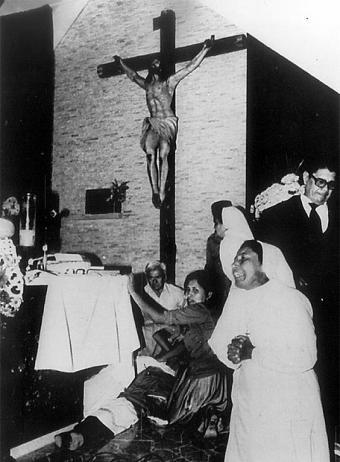
Archbishop Romero surrounded by nuns, shortly after being gunned down at Mass, El Salvador, March 24, 1980 (Eulalio Pérez)
I was in Managua, Nicaragua, thirty years ago, recovering from dengue fever, when my editor at The Guardian called from London to say that I should get on the next plane to San Salvador: the Archbishop of El Salvador had been gunned down while saying Mass. I remember laughing at the impossibility of this too literary story—Murder in the Cathedral; of course it wasn’t true!—and then feeling sick. Óscar Arnulfo Romero, a self-effacing, not particularly articulate, stubborn man, who insisted every day on decrying the violence and terror that ruled his country, was, after all, the hierarch of the Catholic Church in El Salvador. He had all the weight of the Vatican behind him, and the natural respect of even the most right-wing zealot for such a holy office. And then there was the act itself: murder at the most sacred moment of the Catholic Mass. Who, in such a Catholic country, would dare to violate the transubstantiation of Christ’s body?
But of course the story was true. At around 6:30 PM on Monday, March 24, 1980, a red VW Passat drove up to the small, graceful chapel of the Divina Providencia Hospital, a center run by Carmelite nuns where Romero lived. It was, as it almost always is in San Salvador, a hot day, and the wing-shaped chapel’s doors were open. As Romero, standing at the altar, prepared to raise the host for consecration, a tall, thin bearded man in the passenger seat of the VW raised an assault rifle and fired a single .22 bullet into the archbishop’s heart. Then, in no particular hurry, the car drove away. A grainy black-and-white photograph from that day shows the victim on the floor. As Romero’s heart pumps out the last of its blood, the white-coiffed nuns gather around him like the points of a star, or like the figures at the feet of the Christ in Rennaissance murals, which were intended simultaneously as representations and as prayers.
Historical turning points are so often the result of stupidity. The Sandinista Revolution, which had triumphed in Nicaragua barely eight months before, had set the dream of revolution flaring across Central America. But Romero’s murder, and the mayhem and bloodshed set off by a sharpshooter at his funeral the following Saturday, were perhaps the immediate sparks for the bloody twelve-year civil war that started just months later, with the US providing financial and military backing to the government side. It is hard to overstate how fervently the campesinos of El Salvador believed in Romero. When he was gone, entire villages placed themselves at the disposal of the now united guerrilla factions.
Archbishop Romero made a long journey to arrive at his death. Hardworking and conscientious, he rose through the ranks and eventually became bishop of the rural province of San Miguel, maintaining all the while a strict distance from Liberation Theology and what he called the left’s “mysticism of violence.” By then, however, the insistent defense of human rights by the new generation of radicalized priests and nuns, and the murderous government’s determination to violate those rights, particularly in the case of the landless peasantry, had created a small army of conscripts for the guerrilla organizations, which promised an equal and just world order born of socialist revolution.
During the presidency of General Arturo Molina (1972–1977), the army and security forces were essentially transformed into death squads: Romero watched in horror as campesinos in his parish were displaced, threatened, terrorized, and, increasingly, shot, stabbed, or hacked to death by underfed, underage soldiers wielding machetes against their own kind. He began speaking out against these atrocities and received his first death threat (from General Molina himself, who wagged a finger at him and warned that cassocks were not bullet-proof). And then, in 1977, just weeks after Romero had been ordained archbishop, the Jesuit priest Rutilio Grande, a close friend of Romero’s who had been organizing landless peasants, was shot down on a country road along with two of his parishoners.
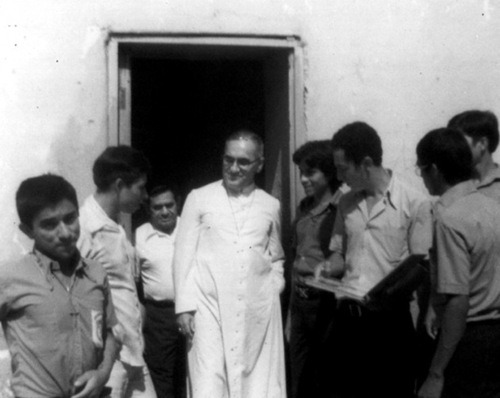
Romero with seminarians, undated (Photography Center
of El Salvador)
All Romero’s contradictory feelings about Church and duty, repression and human dignity, his native distrust of radicalism and politics, his caution and, no doubt, his fear, appear to have resolved themselves at that moment. With the same methodical determination that seems to have characterized his rise to the archbishopry, he spent the next three years organizing human rights watchdog groups, asking President Jimmy Carter to suspend military aid to the murderous junta, and speaking out—plainly, but never unreasonably—against the government. “It is sad to read that in El Salvador the two main causes of death are: first diarrhea, and second murder,” he would say. “Therefore, right after the result of malnourishment; diarrhea, we have the result of crime; murder. These are the two epidemics that are killing off our people.”
Around this time, I made many trips to the countryside. But it was only two years later, after Romero’s funeral had dissolved into grim chaos, that I had my first real understanding of the feudal ignorance in which Salvadoran campesinos were kept. As red-robed cardinals from abroad milled around the vast unfinished cathedral together with humble worshipers who had lost their shoes, their false-teeth, their satchels or their eyeglasses in the stampede to escape from a sniper’s bullets, everyone trying to understand what had happened, and why, a tiny, trembling man approached my friend, the photographer Pedro Valtierra. “Please, my daughter’s lost.” he said, and then he repeated several times, until we understood: “Please use your loudspeaker to call out her name.” He was pointing to Valtierra’s camera.
Those were the days before the Internet or even faxes, and the lone opposition newspaper, El Independiente, was more or less gagged. The murders and disappearances carried out by death squads, army officers, and a notorious security force called, for inexplicable reasons, the Treasury Police were unreported, but Romero took to reading a detailed account of the week’s brutalities. The sermons were broadcast over the Catholic radio station, and campesinos all over the country gathered around a radio to listen to them. So did the military.
The once conservative archbishop, who had been trained and nurtured not in his homeland but in Rome, became the government’s most visible opponent. Later he would say that when he stood on the dirt road where Father Rutilio Grande had been murdered and contemplated his friend’s corpse, he thought, “If they have killed him for doing what he did, then I too have to walk the same path.”
Thanks to an extraordinary reportage posted last month on the Salvadoran online newspaper El Faro we know that the tall, skinny shooter who killed Romero was contracted by General Arturo Molina’s son, while the weapon and the getaway car were provided by the drinking buddies and death squad associates of a former Army major called Roberto D’Aubuisson. Not that anyone doubted from the moment it happened that the murder was D’Aubuisson’s work. He died of cancer of the esophagus at the age of forty-seven, in 1992, but while he lived, this slender, charismatic psychopath was king. Although he was briefly arrested, he was never tried for murder, and soon rose to become the head of the Constituent Assembly; he was defeated only narrowly when he ran for President in 1984. Until last year, the party he founded, which had its origins in the death squad he also put together, governed El Salvador.
Over a two-year period El Faro’s director, Carlos Dada, hunted down and twice interviewed one of the surviving participants in D’Aubuisson’s conspiracy against the Archbishop, a former Air Force pilot by the name of Álvaro Saravia. Four other alleged co-conspirators named by Saravia have been killed, another committed suicide. Some, like, Mario Molina, son of former President Arturo Molina, are enjoying the good life, but Saravia, pursued by his own demons, is living in abject poverty in another Latin American country not disclosed in the newspaper’s report. Perhaps out of sheer loneliness, he told his story to El Faro.
Saravia recounts the details about the hit man and Mario Molina’s role in hiring him. He also reveals that an announcement placed in La Prensa Grafica by Jorge Pinto, the owner of the independent newspaper El Independiente, inadvertently sealed Romero’s fate. Published on the morning of March 24, it informed readers that the archbishop would celebrate a Mass in memory of Pinto’s mother at 6 PM that afternoon, in the Divina Providencia chapel. Hung over after a party with other members of D’Aubuisson’s group, Saravia woke to the news that the boss had ordered Romero’s murder at this conveniently secluded location.
Karol Wojtyla had just been annointed pope at the time of Romero’s murder, and with the assistance of then-Cardinal Joseph Ratzinger he was busy dismantling the progressive church of Latin America. Pope John Paul II’s response to the crime—he called it “a tragedy”—was hardly as emphatic as his attacks on the pro-Sandinista clergy when he visited Nicaragua four years later. A spontaneous movement in favor of Romero’s canonization has been stalled for years now in Rome.
But for the Church rank-and-file Romero has become an extraordinarily meaningful figure, as a quick Internet search of his name can attest. We can find evidence of this in yet another work intended to commemorate the thirtieth anniversary of his death: a documentary film, Monseñor: The Last Journey of Óscar Romero, directed by Ana Carrigan and Juliet Weber, and produced by the Kellogg Institute at Notre Dame, a Jesuit university. The film is, unintentionally perhaps, or at least effortlessly, a hagiography, a record of a saintly life. It is an astonishing compilation of footage from the last three years of Romero’s life, not only of the archbishop himself but of army patrols and mothers of the disappeared and guerrillas on the move—and above all of those unforgettable Masses in which the small, unprepossessing archbishop read out loud the record of the government’s atrocities while hundreds of ragged, persecuted campesinos listened in gratitude, their existence and suffering recognized at last.
I interviewed Romero two or three times before he died, and although I cannot locate any of my notebooks from those dreadful years, I have the distinct recollection that he did not say anything particularly scintillating or inspirational or visionary: he was deeply distrustful of rhetoric and purposefully self-effacing. Instead of words I have the memory of a peculiar ducking gesture he used to make with his head when, after Sunday Mass, he stood outside the Cathedral doors shaking hands with every single one of the knobby-jointed, malnourished campesinos who came from miles away to hear him, a few coins knotted into their handkerchiefs for the journey back. They would clasp his hand and stare into his face and try to say something about what he meant to them, and he would duck his head and look away: not me, not me.
Nuns leaving the cathedral after the funeral of Romero, El Salvador, March 30, 1980 (Harry Mattison)
The day before his murder, on Sunday March 23, after the long dreadful months in which four American churchwomen had been killed, and a cropduster had sprayed insecticide on a protest demonstration, and we reporters had gone nearly mad from the obligation to hunt every morning for the mutilated corpses that D’Aubuisson’s people had left at street corners the night before, and distraught mothers lined up every day outside the archbishopry’s legal aid office asking for help in finding their disappeared children, and the waking nightmare of El Salvador clamored to the very heavens for justice, Óscar Arnulfo Romero for the first time spoke in exclamation points during his Sunday homily.
I want to make a special request to the men in the armed forces: brothers, we are from the same country, yet you continually kill your peasant brothers. Before any order given by a man, the law of God must prevail: “You shall not kill!”… In the name of God I pray you, I beseech you, I order you! Let this repression cease!
The next day he was shot.
Monseñor: The Last Journey of Óscar Romero, a film directed by Ana Carrigan and Juliet Weber.
Europe is at the center of a debt storm, and the PIIGS on the periphery are more than just those made famous by the acronym. It seems the UK and France are also eating at the trough, with a few tiny specs of fiscal stability scattered round the continent.
Hollywood insiders tell E! News gossips that The Twilight Saga’s Kristen Stewart is in talks to replace Oscar winner Angelina Jolie in the upcoming sequel to the 2008 action flick Wanted. If producers with Universal get their way, the 19-year-old brunette could land a role as the female lead alongside actor James McAvoy.