Category: News

  • Facing Off on ENDA

    Allyson Robinson, Foundation Associate Director of Diversity at the Human Rights Campaign, faced off yesterday against Andrea Lafferty, Executive Director of the Traditional Values Coalition, on CBS News about civil rights in the workplace. Their focus, in particular, was H.R. 3017, the Employment Non-Discrimination Act, which the House Education and Labor Committee is expected to vote on soon; the bill, more commonly known as ENDA, is expected to go to the House floor for a vote in May or June.

    Currently, it’s legal is 29 states to discriminate on the basis of sexual orientation; in 38, it’s legal to do so on the basis of gender identity. ENDA would make it illegal for employers to discriminate in the workplace on the basis of sexual orientation or gender identity.

    Perhaps I’m biased, both because the Reform Movement has long supported ENDA and equal rights for the LGBT community, or because I consider Allyson Robinson something of a friend, but I really thought she held her own yesterday against Lafferty’s offensive comments labeling transgender people as being mentally ill and unfit to be around children. As a prominent activist, an ordained minister, and a mother of four, Allyson is proof of the opposite – that transgender individuals are not “the other.” Rather, they’re everyday people doing the same things the rest of us do: working to make a living, parenting their kids, going to church or synagogue, and standing up for what they believe in. Her dedication and passion to fighting for equality are an inspiration to me as an ally, and after watching this, perhaps you’ll feel the same.

    You can also show your support for LGBT equality in the workplace by writing to Congress now and asking your lawmakers to support H.R. 3017, the Employment Non-Discrimination Act.


  • Euro could fall to US$1.27 later this summer

    The struggling euro could fall as low as US$1.27 sometime later this summer, Ashraf Laidi, chief market strategist at CMC Markets says.

    Should it do so, it would represent a total drop of 16% to the greenback since November. While not the worst decline in the the European Union currency, it may be the most troubling given the circumstances behind the fall.

    "Never since its inception has the single currency faced serious doubts about the default of its members or its legal framework regarding bailouts," Mr. Laidi said in a note to clients. 

    "Keeping aside the potential headwinds emerging from commodities, the
    single currency suffers from a fundamental and technical decline."

    Mr. Laidi noted that the euro fell 31% between 1999 and 2002, as the result of an excessively high starting price of the currency and prolonged headwinds on Germany and Eurozone from the Asian crisis. The US dollar was also benefiting from robust growth and record high capital flows chasing US technology stocks, he said. 

    Meanwhile, in 2005 the 14% euro decline in 2005 was mainly due to U.S. Federal Reserve tightening and the 2005 Homeland Investment Act, which encouraged US multinationals to repatriate profits at slashed tax rates. 

    More recently, he said the 24% drop in 2008-09 was from plunging risk appetite and plummeting commodities, to the benefit of the US dollar.

    "The current slide in the euro shows more fundamental similarities to the sell-off of 1999-2000 in that it is largely Eurozone-centric, rather than US or global -centric (as was the case in 2005 and 2008)," Mr. Laidi said.

    But unlike the case one decade ago, the need for austerity policies in Greece, Portugal and Spain may not be offset by higher demand in Germany and France.

    David Pett

  • Pay Your Doctor In Chickens

    Sue Lowden, a senate candidate in Nevada, says if you want to combat health care costs you should consider bartering with your doctor. In an appearance on a local political talk show yesterday, she clarified her proposal:

    Let’s change the system and talk about what the possibilities are. I’m telling you that this works. You know, before we all started having health care, in the olden days, our grandparents, they would bring a chicken to the doctor. They would say, “I’ll paint your house.” That’s the old days of what people would do to get health care from their doctors. Doctors are very sympathetic people. I’m not backing down from that system.


    You can watch the entire segment over at the Nevada Newsmakers website.

    The Economist blog notes that bartering might be a solution to financial-sector reform as well:

    It would be virtually impossible to structure a chicken-based CDO; sure, you could find buyers for the breast tranche easily enough, but who would take all those necks and feet? Leverage rules become much less necessary when you can only hedge with items that actually exist; it’s hard to imagine the notional value of chicken-based hedges greatly exceeding the number of actual chickens on the planet. And all this could be accomplished without any new taxes.

    At any rate, I think doctors might be more open to this idea if they can then use the chickens to pay off their student loans.

    “Paying with chickens” [Economist]

  • Taxpayer protection and the nuclear loan guarantee program

    The huge cost of nuclear power means that taxpayers will have to provide nuclear loan guarantees to finance new projects if the president and Congress are serious about building new reactors. The terms of these guarantees must include adequate protections for taxpayers.

    That’s from the testimony of CAP Action’s Richard Caperton before the House Committee on Oversight and Government Reform.  Below is a summary, and the full testimony is here.

    Nuclear power currently generates about one-fifth of American electricity. At the Center for American Progress Action Fund, we strongly believe that nuclear power will continue as a low-carbon baseload power source that will play an important role in America’s clean energy future. It’s vitally important that we explore all potential energy sources and encourage the development of sources that reduce our carbon emissions. At the same time, we must keep in mind that every dollar that supports one fuel source is a dollar that can’t be used somewhere else. In an era of tight budgets and limited government resources, it’s important that every dollar be spent in a way that cost-effectively transitions America toward a clean energy economy.

    Perhaps nowhere is this challenge of balancing carbon reductions with low spending more apparent than with nuclear power. Building a nuclear reactor today will involve dealing with tremendous financial uncertainty. Cost projections for nuclear plants keep rising because of variability in material costs, complex new technology, limited suppliers for key parts, and inevitable delays in construction projects. The projected cost for two new reactors in Canada shot from $7 billion to $26 billion in just two years. A new reactor built by Areva in Finland has run into widely publicized challenges, with construction costs going up at least 50 percent since construction began three years ago. And costs for two new reactors at the South Texas Project in the United States have ballooned from $5.4 billion to an estimated $18.2 billion since 2007. Neither of these reactors has been built, so there’s no way to predict what the final cost will be. But cost overruns are virtually certain in nuclear construction, which greatly increases the risk that the nuclear companies will default on their loans. Private lenders are well aware of the risks involved in building new reactors, which is why they’re unwilling to finance the projects without significant government support.

    The huge cost of nuclear power means that taxpayers will have to provide nuclear loan guarantees to finance new projects if the president and Congress are serious about building new reactors. The terms of these guarantees must include adequate protections for taxpayers.

    Related Post:

  • Will iPad cannibalize Mac sales?

    By Joe Wilcox, Betanews

    Clearly Apple is preparing for such a circumstance, or that’s my interpretation of last night’s fiscal 2010 second quarter earnings call. The question isn’t if iPad will cannibalize Mac sales but when. If the cannibals are coming, they’ll first strike during back-to-school buying season.

    Apple CFO Peter Oppenheimer tipped off the company’s thinking early in the conference call: “We expect gross margins to be about 36 percent down from 41.7 percent in the March quarter and reflecting approximately $36 million related to stock based compensation expense. We expect about 25 percent of the sequential gross margin decline to be driven by the first quarter of iPad sales.” Whoa, one-quarter?

    “As we said in January when we announced the iPad we have been very aggressive with pricing and are delivering tremendous value to customers,” Oppenheimer asserted. “We think the market for the iPad will be large, and we want to capitalize on our first-mover advantage.”

    There are two intertwined issues related to Oppenheimer’s statements: Mac cannibalization and margins. I’ll start with margins. Whenever Apple launches a new product, the company absorbs additional upfront costs. Apple secrecy means that CEO Steve Jobs announces his “one more thing” product on Day X but availability is Weeks Y or Months Z later. Manufacturing ramps up in earnest after the product announcement, which is atypical of most industries. To get the product from Asia to Western retail, Apple typically absorbs higher upfront airfreight costs.

    This dynamic is one reason why purchasers of new “one more thing” products pay more upfront. Their privilege of being among the first buyers helps to soften the blow Apple’s cockeyed manufacturing and distribution system places on margins. This process is underway now in the United States, and Apple will repeat it in nine additional countries next month.

    Margins Teardown

    Based on various iPad teardowns, the tablet’s base hardware cost ranges from $230 to $300. The teardown by iSuppli puts the $499 iPad product cost around $260 and $348.10 for the $699 model (both are WiFi; 3G models ship next week in the United States). By comparison, Apple makes oodles more on iPhone. Right after iPhone 3GS launched, iSuppli put component cost at around $179. While consumers pay $199 for the smartphone, carrier AT&T subsidizes what Apple charges, which is in the $500-$600 range (ASP is $600, according to Apple, which includes 32GB model). Additionally, falling component prices and economies of scale should put Apple’s iPhone 3GS margins much higher today than June 2009.

    Like iPhone and Mac products, Apple’s base profit for iPad is pretty good. However, the aforementioned higher initial manufacturing and distribution costs sap profits by as much as half (based on my guesstimates). Assuming Oppenheimer is right about iPad demand, greater upfront sales volume would further sap margins, since Apple would pay more to get the product to market before achieving benefits from economies of scale. Higher sales volume would mean lower margins and a lowering of broder Apple margins.

    During yesterday’s Apple conference call, Sanford Bernstein analyst Toni Sacconaghi put startling perspective on Apple’s falling margin guidance and iPad’s contribution to it:

    Let me just switch to one other topic if I may and Peter I think this is probably for you. Bear with me, I’m gonna, I’m gonna just plug through some numbers. You said gross margin is going to decline 600 basis points sequentially in the quarter that would be due to the iPad. So that is 150 basis point negative impact from the iPad.

    If you assume the iPad is 10 points lower gross margin than the company average which is way, way lower than most, you know, third-party tear-down services which it would suggest it basically means for that contribution to be true for your guidance iPad would need to be 15 percent of your revenue or $2 billion. So either iPad is gonna be more than $2 billion in terms of revenue per your guidance for next quarter and have a gross margin that is less than 10 points less than the company average or the gross margins of the iPad are more than 10 points lower than the company average.

    Apple COO Timothy Cook partly dodged, party answered the question, nearly repeating what Oppenheimer said earlier in the call:

    I would point out that when we priced iPad we priced it very aggressively in order to deliver tremendous value to our customers. We think the market size for the iPad is very large, and we want to capitalize on our first mover advantage. So, as we have done in other products, although I am not forecasting it, you can see that we have a good track record of writing down the cost curves with value engineering and volume manufacturing or at least that’s certainly been our experience with other products.

    For iPad to reach 15 percent of revenue, Apple would have to ship 3.3 million units at an average selling price of $600 or 4 million at $500 ASP. The impact on margins would be colossal. But the margin pulldown could be just as strong if Apple shipped 1-2 million iPads, in process cannibalizing some Mac sales.

    Wading the Price Gap

    Until iPad, Apple computer selling prices were quite high, with the $999 white Macbook being entry point for most people to join the elite — some might say elitist — Mac club. In February, I reported that “Nine out of 10 premium PCs sold at retail is a Mac.” Apple sells high and also reaps some of the highest margins in the tech industry. The Mac tablet changes the dynamic. Now, suddenly, the cheapest, functional Mac you can buy is $499, filling a hole between $399 and $999.

    As I explained in a separate late-January post, “iPad fills a gaping hole in the Mac product line between the aforementioned $399 and $999.” Various iPad models sell between $429 and $829.  “Apple now offers portable computers — and that’s how I classify iPhone, iPod touch and iPad along with Macs — ranging from $99 to $2,499. From a pricing strategy perspective, iPad is a brilliant product, because it fills the gap between iPhone/iPod touch and Macbook without price cuts or risk to the Mac’s premium brand status.”

    But there is risk to Mac sales, which would be greater during back-to-school buying season than any other time of year. Suddenly the cheapest Mac that schools can buy costs $499, too. Particularly for K-12 institutions, iPad could be a viable alternative to MacBook, particularly with budgets crimped by the lingering effects of recession on the tax base. Back-to-school buying season would also be the test of iPad’s sales mettle, whether or not the product can succeed or will be doomed to ruin like the Power Mac G4 Cube. Low back-to-school iPad sales would perhaps be worse than many.

    There are positive benefits to consider, as well — schools that: might not buy any Apple product this year, otherwise would purchase Windows PCs or would swap out Macs for Windows computers; because of price. Now they could buy iPad. By whatever measure of increasing sales — higher in general or cannibalizing Mac sales — iPad would crimp Apple margins.

    Yesterday, RBC Capital Markets analyst Mike Abramsky asked the obvious question: “Just wondering why you didn’t see, or whether you expect any touch cannibalization from the iPad and what is your sense or do you think iPad is cannibalizing maybe competitive netbooks?”

    Cook responded:

    I can only tell you in the quarter we finished, Q2 that we finished in March. Although we announced the iPad in January there was nothing obvious in the iPod numbers or the Mac numbers to suggest cannibalization. There is an obvious difference announcing and people know it is coming and it is starting to sell. So that part of the equation we don’t know yet. We will find out. We are thrilled with how the iPad is selling and the enormous response that we have received. We also announced new MacBook Pros that you probably saw last week and the whole line change. So we are also happy about how the Mac business is positioned and the level of product innovation in those notebooks. It is enormous. It is taking battery life up to 10 hours. That is absolutely amazing.

    That’s executive-speak for: “Yeah, we think so but aren’t sure and so don’t want to say for fear of causing a run on Apple shares.” On the one hand, Cook lets be the possibility of cannibalization, while at the same time emphasizing newly upgraded MacBook Pros. The response is oh-so media-trained executive deflection. Media professionals teach executives at companies like Apple to deflect tough questions by ignoring them and shifting focus to strengths.

    Of course, Apple executives expect at least some cannibalization of Macs by iPad. Apple’s iPad pricing tells the story — the aforementioned filling the pricing gap between $399 and $999. Then there is the guidance about margins declines to consider. Cannibalization is inevitable. The questions are: “When?” and “By how much?” Will there be a big surge of iPad orders during back-to-school season or will the lower pricing release pent-up sales among consumers pining for a Mac but unwilling or unable to spend $999? Or both?

    [Editor’s Note: I initially used quotes provided courtesy of Seeking Alpha but corrected them after re-listening to Apple’s FY 2010 Q2 conference call.]

    Copyright Betanews, Inc. 2010


    Add to digg
    Add to Google
    Add to Slashdot
    Add to Twitter
    Add to del.icio.us
    Add to Facebook
    Add to Technorati


  • Manga and skepticism | Bad Astronomy

    My friend Sara Mayhew is pretty cool. I am reminded of this by her interview on Skepticality this week, and I’ve been meaning to write about her again anyway.

    How do I know she’s so cool? I mean, besides this being my blog which makes me the final arbiter of cool? And also that she linked to me in a fabulous cartoon she drew?

    She’s cool because she’s a skeptic and she draws manga and she’s a TED fellow. And she’s also pretty frakkin’ smart. And she spreads the joy of science and skepticism through her art. Behold:

    That, me droogs, is a very cool ad. And how can you not love someone who asks, “Do we have the courage to let go of our beliefs, to grab on to what is true?”

    If you want more of her, then check out the talk she gave at CfI LA in March, and you too will see why I like her so much.


  • Airlines Stocks Are Getting Crushed (CAL, DAL, AMR, UAUA)

    Pompeii Volcano

    News that a World Airways flight has been grounded in Europe — possibly due to ash — seems to be whacking the industry.

    Look how airline stocks are doing.

    • Continental (CAL) down 4.3%
    • Delta (DAL) down 5%
    • American (AMR) down 7%.
    • UAL (UAUA) down 3%.

    Oof.

    See here for the latest on the World Airways jet that’s been grounded.

    Join the conversation about this story »

  • Skip Pesky Trailers And Ads On DVDs With Not-So-Secret Codes

    Sometimes the ads and trailers at the beginning of a DVD give you interesting information about upcoming releases you otherwise wouldn’t have heard of. Most of the time, though, they’re just annoying as all heck. Here are some not-so-secret remote control codes that can help you skip the ads and get right to the movie.

    These should get you started:

    Trick One – For DVD Players

    When the first trailer on the DVD starts playing on your screen, press the STOP button of your DVD remote twice followed by the PLAY button. That’s STOP -> STOP -> PLAY and it should take you directly to the movie skipping all the trailers and ads.

    Trick Two – For DVD Players

    If the above trick doesn’t work for your DVD, try this sequence suggested by Richard Rider. Instead of pressing the STOP button on your DVD remote twice, press it three times followed by PLAY and it should skip all the trailers and previews. To repeat, the sequence becomes STOP -> STOP -> STOP -> PLAY.

    These won’t work 100% of the time, but will keep you slightly more entertained while the computer beams ads at you.

    Skip the DVD Trailers & Go Straight to the Movie [Digital Inspiration] (via Lifehacker)

  • Nexus One + Centrifuge = Geeky Fun

    An enterprising soul wanted to know if a Lava lamp would function on Jupiter given it’s different gravity, so he created a homemade centrifuge using a Nexus One as a g-force meter.  Check out the video to see a mildly entertaining science experiment. Lava lamp lovers can rejoice, it seems that they indeed will work in Jupiter’s atmosphere.

    Click here to view the embedded video.

    The maker of the video does point out that the accelerometer in the N1 are badly calibrated as they gave false readings the faster the unit went.  This seems to be a documented bug, but I don’t think the fix is coming quickly since using the phone at those speeds is not a typical application.

    Either way, now we know that we can take our hot pink Lava lamps with us on our next trip to Jupiter!

    Might We Suggest…

    • Nexus One Dock Details Emerge
      We just received an email from one of our readers who had a chance to play with the forthcoming Nexus One docks.  Based on his description, we’re in for a pretty nifty little device.  We’d previousl…


  • Zagato Alfa Romeo TZ3 Corsa Racer Teaser Image

    Zagato has been a premium name, famous for building coaches for Alfa Romeo. But believe it or not, Zagato unveils one-off or limited edition models from time to time. The next offering from the Zagato atelier is a racer dubbed the Alfa Romeo TZ3 Corsa — check out the teaser image below.

    Zagato Alfa Romeo TZ3 Corsa race car

    The upcoming racer draws its inspiration from Alfa Romeo TZ and TZ2 and this particular model was commissioned by a German racer whose identity hasn’t been disclosed. The racer is directly based on the 8C Competizione and its tubular chassis is a mono shell carved out of carbon fiber and later grazed with aluminum. Concorso d’Eleganza Villa d’Este in Italy will be the event where the TZ3 will be unveiled for the first time.

    Looks sooo sleek, don’t you think?

  • Chrysler posts financial results, loses $197 million in first quarter

    Filed under: ,

    Chrysler just released its first financial report since emerging from bankruptcy last year. The company announced that while it’s still operating at a net loss of around $197 million, it somehow managed to create $1.5 billion in cash during the first three months of 2010. That cash, along with an additional $7.4 billion from past cash reserves, went toward putting a dent in the company’s remaining debt.

    The smallest of the Big Three also managed to increase its market share one percent compared to the last three months of 2009. What’s more, it produced a whopping 56 percent more vehicles in North America from January to March than it did during the same period last year, despite seeing sales decline by 5.3 percent. That bump in production is largely thanks to the fact that Chrysler idled many of its plants through 2009.

    The company says that despite the loss, it’s still on track to meet its goals and return to profitability by the end of this year. That’s due to the fact that revenue increased by around $300 million from the fourth quarter of 2009 to the first quarter of 2010 and that the company is continuing to reduce its debt. At the same time, a rash of new models, including the long awaited 2011 Jeep Grand Cherokee will be hitting the market soon. Follow the jump for the official word.

    [Source: Chrysler via Freep | Image: Bill Pugliano/Getty]

    Continue reading Chrysler posts financial results, loses $197 million in first quarter

    Chrysler posts financial results, loses $197 million in first quarter originally appeared on Autoblog on Wed, 21 Apr 2010 13:00:00 EST. Please see our terms for use of feeds.

    Permalink | Email this | Comments

  • Want to create amazing UI on Windows Mobile? Check out SlideUI .NET CF Mobile Controls

    slidenetMobile application development differs significantly from desktop development. Specialized developer tools are required to create a successful and professional looking application. With usability as a crucial factor, each control in the SlideUI Mobile Controls library has been developed specifically for the user to be able to easily operate each control via touch without a stylus.

    Product Features:

    All Controls Available in Design-time
    Simply drop a SlideUI control to your form and set its properties. Please note that design-time appearance of the control will be simplier for some controls (such as button, progress bar or textbox).

    Optimized for Fingers
    SlideUI comes with UICanvas control which adds animated sliding to your forms and lists. The control supports accelerated fallback and both vertical / horizontal scrolling. In addition to this each control is easy to click without stylus.

    Perfectly Designed With Color Themes In Mind
    SlideUI Mobile Controls supports 5 basic color themes for all controls which would let you adjust them to color scheme of your application.

    Designed to Work in Any Screen Resolution
    SlideUI Controls designed to work in all screen resolutions (QVGA, QWVGA, VGA & WVGA).

    .NET Compact Framework 2.0 & 3.5
    SlideUI Mobile Controls can be used in projects which utilizes .NET Compact Framework 2.0 and 3.5 so that you can be sure your application won’t require any additional software to be installed on user’s device starting from WM 6.0.

    A single developer license and one year of software support starts at $499.00.

    Checkout the DEMO or Buy this from the developers website: www.devslide.com/products/slideui

    This post was submitted by devslide.


  • I know what you’re thinking Doctor…

    I just found a completely charming study from 1977 that tested whether psychiatric patients with mind-reading delusions were really telepathic.
    Telepathy in mental illness: deluge or delusion?

    J Nerv Ment Dis. 1977 Sep;165(3):184-200.

    Greyson B.

    The belief that one can read others’ minds has long been considered a symptom of psychosis, despite reports in the parapsychological literature of veridical telepathy. All patients admitted to an inpatient psychiatric unit were screened for paranormal beliefs, and those claiming telepathic abilities were tested in a free-response ESP task. Eighteen per cent of the inpatient population claimed telepathic abilities; of the nine patients who completed the task, none performed above chance expectations. Higher frequencies of paranormal experiences than those reported previously in the psychiatric literature were attributed to the context of the study. Schneider’s first rank symptoms and a belief in telepathy discriminated schizophrenics more reliably than other paranormal experiences. Possible psychodynamics of delusions of telepathy were discussed in view of the predominance of women and younger men reporting them, as were the possible effects of such research on patients’ delusions.

    Link to PubMed entry for study.

  • No Surprise: MPAA Wouldn’t Reveal Data On How It Came Up With Bogus ‘Piracy’ Numbers

    Starting last year, I started receiving reports from folks at the GAO that they were getting massive resistance from the entertainment industry when it came to their attempt to look more deeply into the actual economic impact of unauthorized file sharing. Some even told me that industry pressure had resulted in the GAO never releasing a particular report. However, last week, as everyone knows, the GAO came out with its extremely damning report, showing that industry figures on the impact of unauthorized file trading were totally bunk. The numbers — which were regularly used by politicians in pushing for entertainment industry-supported legislation — had little basis in fact, greatly overstated the issue and totally ignored the benefits of file sharing.

    As people dig deeper into the report, more and more details are coming out — including the fact that the MPAA wouldn’t provide the data on how it came up with some of its more questionable “piracy” claims. Of particular concern was a report from 2005, which the MPAA used to push for regulations requiring universities to set up filters. The MPAA used its own research to claim that 44% of unauthorized file sharing came from universities — and the MPAA’s main lawyer made the statement that the primary purpose of internet access on campus was for students to share unauthorized materials. Congress never bothered to question these stats — though, after all the debate, the MPAA finally admitted that it had made a math error that showed the “real” number (according to itself) was 15%, rather than 44%.

    The GAO was apparently interested in digging into this report to understand where these numbers came from, but the MPAA decided it would rather not share:


    The GAO never got all of the information it requested from the Motion Picture Association of America, according to GAO administrators, including Loren Yager, the author of the summary report that ensued and director of the GAO’s International Affairs and Trade efforts. The agency said as much in the report: “It is difficult based on the information provided in the study to determine how the authors handled key assumptions.” Without the materials, government analysts couldn’t properly evaluate the MPAA’s 2005 survey…

    At this point, I think it’s fair to ask why the gov’t should ever be allowed to rely on the stats put forth by the entertainment industry in passing legislation again.

    Permalink | Comments | Email This Story


  • White Sox Manager Ozzie Guillen: Comcast Sucks

    For anyone who has ever thought that they were being singled out by Comcast’s cruddy customer service, or that wealthy and famous people somehow managed to get non-cruddy service from the Kabletown folks, World Series-winning manager of the Chicago White Sox wants you to know that just isn’t so.

    According to his Tweets, the outspoken baseballer spent all day waiting for a Comcast tech to show up at his house.

    “Waiting for comcast people to show up in my house godddddd please take a little longer is not free,” he Tweeted this morning, followed by, “Its amazing to me how u have to wait for cable. As if I was getting it for free. 8 am they said wow.”

    Unfortunately, Ozzie’s wait ended in a way that will seem familiar to many Comcast subscribers:
    “Comcast is now saying they came to my house. They suck. Its not free they r not the only cable company.”

    Guess we know who Ozzie will be voting for in tomorrow’s Worst Company In America showdown.

    Ozzie Guillen’s Official Twitter

    Thanks to Coe-Stanza for the tip!

  • Recap: PhoneDog’s Noah Kravitz talks iPad on CNBC and at event

    Yesterday was a busy day for PhoneDog’s Noah Kravitz!  Between CNBC and the event at PariSoMa Innovations Loft, the talk of the town was the Apple iPad.  In case you missed it, the two video clips are below:

    In an appearance on CNBC, Noah talks about the iPad getting expelled from universities across the United States due to security concerns.

    Later that evening, Kravitz hosted “iPads, Tablets, and Mobile Computing: What it Means to You” at PariSoMa Innovations Loft in San Francisco.  Complete with a panel, the discussion centered around the future of the iPad, and on a larger scale, computing and internet advertising as a whole.

    Check out the videos, and be sure to send some love to Noah via Twitter!  (I hear he’s giving away some prizes due to reaching 10,000 followers.  Might want to get in on that!)


  • iPad Etching Contest Results Will Be Up on Friday [Announcements]

    Sorry for the delay, everyone. If you didn’t notice, we’ve been a bit busy. But the results are close, and you’ll get em all on Friday, scout’s honor. More »


  • This oughta be interesting

    There’s a panel discussion in New York today entitled The State of Gadget Media. Panelists include the dudes from Gakwer/Gizmodo behind the iPhone 4 stories earlier this week, a Senior Editor from one of the big media outlets that those Gawker/Giz guys claim get unfair access, and the head of PR for Samsung Mobile. Amongst others.

    Originally slated to be on the panel but no longer attending is the Editor-in-Chief of Engadget, who also published photos of the lost iPhone but apparently turned down an opportunity to buy the actual device.

    This will either wind up being an incredibly lame, frustrating, tight-lipped “discussion,” or a VERY interesting peek into what the heck is actually going on in this business. What constitutes “Technology Journalism” these days, anyway?

    Check out the event page. I really wish I was in NYC today. 

    Meantime, any thoughts on the whole iPhone 4 “outing”? Sound off … 


  • Resolved: Democrats, Republicans Both Take Huge Donations from Wall St

    Republicans accuse Democrats of being neck deep in the pockets of Wall Street. Democrats accuse Republicans of being neck deep in the pockets of Wall Street. Who’s right? Everybody.

    Politicians often do this thing where they take a lot of money from people with a lot of money, and bankers do have a lot of money.* A cynic might call this practice “endemic.” It would seem more with the times to call it “bipartisan.” Let’s agree to drop the issue of who’s deeper in Wall Street’s pockets by clicking the graph below and moving on with the merits of reform.


    secinvestdonations.jpg

    (graph via Klein)

    ______

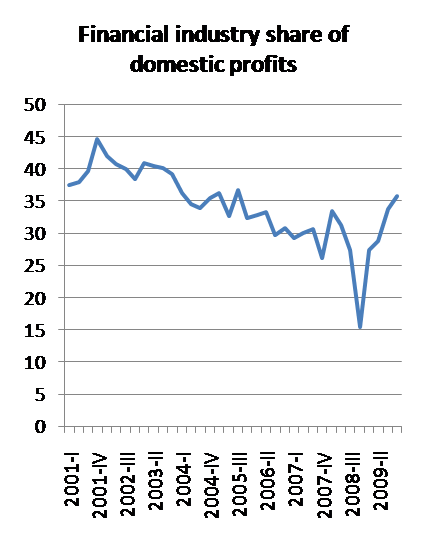
    *Financial industry profits, via Krugman:

    :
    DESCRIPTION


    Email this Article
    Add to digg
    Add to Reddit
    Add to Twitter
    Add to del.icio.us
    Add to StumbleUpon
    Add to Facebook