Category: News

  • Congratulations Samsung— the Galaxy S 4 is set to be featured on BBC’s Watchdog

    Samsung_Galaxy_S_4_Main_TA


    There have more more than a few of us who have complained about Samsung’s habit of loading up crap unnecessary extra apps on its flagship devices, but it looks like the BBC has had enough of Sammy’s shenanigans. The famed British network will air a special episode of its Watchdog series pointing out some very serious issues that identified on the 16GB variant of the Galaxy S 4 smartphone. In fact, Host Anne Robinson poses this simple question best: “Samsung… claims that its brand new Galaxy phone has an extra-large memory, but what did it forget to mention“? Well– while the smartphone no doubt introduces some well… “unique” apps, much of the apps take up an extraordinary space on the device, resulting in roughly only half of the total storage capacity being available to brand-new owners.

    Naturally, Samsung will probably want to rebuke the bold Watchdog claim by highlighting its 16GB Galaxy S 4 certainly has a microSD slot for users to take advantage of, but remember— regular apps can only be installed onto the phone’s internal memory, so there is the potential for owners to simply run out of room. Moreover, owners can always buy the larger capacity variants of the device as well because well— bigger is better anyways.

    Hit the break to check out the teaser video for yourself.  


    Click here to view the embedded video.


    source: Clove
    via: SlashGear


    Come comment on this article: Congratulations Samsung— the Galaxy S 4 is set to be featured on BBC’s Watchdog

  • Google Drive document lists go down, then come back up

    Google Drive had some issues midday Friday, as users took to Twitter to report that they were finding their Drive file containers empty.

    Google acknowledged that issues were afoot by indicating a “service disruption on its Apps Status Dashboard.

    Google Drive service disruption reported on Google's App Status Dashboard

    Google Drive service disruption reported on Google’s App Status Dashboard

    “We’re investigating reports of an issue with Google Drive. We will provide more information shortly,” Google reported.

    Google PR had no further information to share.

    According to the dashboard, the last time Drive service was disrupted was on April 17, for around three hours. Gmail, Talk, Groups, Contacts and other Google products were also affected. The day before that, there had been “a misconfiguration of (the) user authentication system,” which prompted login requests to ping fewer servers than what is normal. The problem turned out to be a capacity issue, as opposed to a heavy influx of traffic.

    Before the April 17 incident, there were “disruptions” to Google Drive on March 18, 19 and 21.

    Despite Friday’s disruption, files did show up back on the main drive at around noon Pacific time, though, so the disruption did not last long.

    Nevertheless, this sort of event doesn’t help Google’s efforts to bring enterprises on board with Google Apps. It might also hurt Google prospects at gaining customers on Google Compute Engine and the Google Cloud Platform, as more enterprises flock to and expand their use of Amazon Web Services and other public clouds.

    Related research and analysis from GigaOM Pro:
    Subscriber content. Sign up for a free trial.


  • Equinix Unveils New ‘Crown Jewel’ for Ashburn Campus

    equinix-dc11-exterior

    The new Equinix DC11 data center is the largest facility yet on the company’s six-building primary campus in Ashburn, Virginia. (Photo: Equinix)

    Equinix keeps growing in northern Virginia, expanding the largest Internet exchange in North America with the largest facility yet on an already immense campus. The new DC11 facility will support growing network traffic in Ashburn, which shows no signs of slowing as the integral East Coast network hub.

    DC11 the company’s eighth facility in northern Virginia, and physically sits next to DC6 on the Equinix Ashburn campus. The 230,000 square foot facility has room for 120,000 square feet of colocation space, with the initial phase adding more than 42,000 square feet of space, enough for 1,200 cabinets. In terms of power, there’s 15 megawatts of critical potential.

    DC11 is one of eight fiber-connected buildings on a single campus with more than 500,000 square feet of data center space. The DC11 project represents about $79 million in capital investment, another indication of the growing demand for data center space in northern Virginia.

    New Crown Jewel for Ashburn Campus

    Equinix is known for a distinctive look to their facilities, but data center design is evolving on a regular basis. The facility also includes flex space for business continuity and disaster recovery, as well as several amenities. The data center isn’t a cold, faceless entity anymore. It’s a community, and DC11 is the crown jewel in an already impressive cluster of buildings.

    The facility employs overhead ducting rather than raised floor, as is the long-time practice at Equinix. It has state-of-the-art security meeting the most stringent requirements, including perimeter fencing around the entire campus, guard house with controlled parking entry, mantrap entry, biometric hand-reader access, 24×7 guards and recorded CCTV monitors throughout the facilities.

    Equinix continues to see strong demand across a number of verticals, including cloud and IT content media and retail. As it is Ashburn, government is also a big vertical, and DC11 meets Federal Data Center Consolidation Initiative mandates for efficiency, as well as industry compliance frameworks such as HIPAA and PCI. DC11 offers access to the five leading providers of the GSA Networx Telecom services contract: AT&T, CenturyLink, Level 3 Communications, Sprint and Verizon.

    Retail Also Solid in Ashburn

    Ashburn is the key East Coast data center market (along with New York Metro) and continues to see a flurry of activity. Ashburn is a key communications hub for heavily populated U.S. East Cost and European markets, with a high concentration of IT, telecommunications, biotech, federal government, and international organizations setting up shop in the area.

    While many of the facilities being built are more focused on the wholesale sector of the data center market, Equinix is leading the pack in terms of retail colocation. That can be partially attributed to its connectivity story. The campus in Ashburn features more than 10,000 cross connects, over 900 networks and direct access to 90% of internet routes. Connections are available to more than 300 network carriers, 140 clout and IT service providers, and 100 content and digital media companies.

    Equinix also has a thriving ecosystem of over 4,000 businesses in the Equinix marketplace. Equinix has over 95 data centers and over 7 million square feet of space worldwide.

  • Google Drive Experiences Service Disruption

    Update: Google has now updated the Apps Status dashboard indicating that the issue is resolved:

    The problem with Google Drive should be resolved. We apologize for the inconvenience and thank you for your patience and continued support. Please rest assured that system reliability is a top priority at Google, and we are making continuous improvements to make our systems better.

    Google Drive is experiencing a service disruption. Numerous people are complaining about issues like not being able to access certain documents they have saved.

    The issue has been reported by a few outlets, and Google has updated its Apps Status Dashboard acknowledging the problem.

    It was last updated at 3:00, and it says:

    We’re investigating reports of an issue with Google Drive. We will provide more information shortly.

    Here’s what people are saying on Twitter:

  • Bing and Facebook up in a tree, k-i-s-s-i-n-g

    Way back in 2007, Microsoft purchased a fraction of Facebook. The social network returned the favor in February by buying Atlas. The two tech goliaths are still smitten with one another, and today we learn that Microsoft search engine Bing gets closer to your friends.

    Now the search engine is integrating Facebook comments directly into the sidebar that appears to the right side of search results. “Starting today, you will see comments on a relevant Facebook post within sidebar, as well as the ability add your own, all without having to leave Bing. You can also Like a post directly from Bing. Now you can see what your friends might know about what you’re searching for and engage with them directly without leaving the search page”, Nektarios Ioannides, program manager for Bing, explains.

    What does this mean? Say you are searching for an artist’s ticket information. If your friend has posted this data in a Facebook post or comment, it will now be visible within those search results. “I comment directly to her post letting her know that I’d love to join her for the concert. I’ve gone from simply browsing to attending a concert in just a few easy steps – all thanks to Bing”, Ioannides says.

    To make this work for yourself, simply go to www.bing.com and in the top, right corner of the page connect your Facebook account to Bing. Microsoft promises to honor your account security settings, at least until the next security vulnerability is discovered.

    Photo Credit: DL Pohl/Shutterstock

  • X marks the spot: This week’s TEDx Talks all about education

    A view of the stage before TEDxDelft. Photo: Roy Borghouts

    A view of the stage before TEDxDelft. Photo: Roy Borghouts

    From dancing math to teaching in languages other than English – this week’s X marks the spot is a selection of TEDx Talks about rethinking education. Each week, TEDx chooses four of our favorite talkshighlighting just a few of the enlightening speakers from the TEDx community, and its diverse constellation of ideas worth spreading. Below, find this week’s edition on education.

    Teaching math through movement: Erik Stern and Karl Schaffer at TEDxManhattanBeach
    Erik Stern and Karl Schaffer took their love of dance into the classroom. Now, they promote the teaching of complicated mathematics concepts to kids using the power of movement, as they demonstrate. (Filmed at TEDxManhattanBeach.)

    Teach for tomorrow’s world: David Garner at TEDxIndianapolis
    With new technology, rapid changes in the global economy, and an evolving workforce, we have an urgent need to improve the way we teach, says David Garner. He explains why we should leave behind outdated models like specialization and standardization and move to a more multidisciplinary approach. (Filmed at TEDxIndianapolis.)

    Language and the wealth gap: Phiwayinkosi Mbuyazi at TEDxSoweto
    In a passionate talk, Phiwayinkosi Mbuyazi takes issue with the convention of teaching international students in English, suggesting that this practice often hurts much more than it helps. (Filmed at TEDxSoweto.)

    Teach both 007 and MacGyver: Marc Chun at TEDxDenverTeachers
    “Why am I learning this?” It’s a question familiar to parents and teachers alike. Marc Chun and other researchers set out to discover how students actually use general knowledge — and he now recommends curriculums that focus on creativity in solving problems. (TEDxDenverTeachers.)

    Below, find some highlights from the TEDx blog this week:

  • For smartphone buyers, bigger is increasingly better

    Smartphone Size Preference Survey
    The days when smartphone buyers valued devices that fit neatly into their hands appear to be over — nowadays it’s all about the big, beautiful display. A new survey from Strategy Analytics has found that consumers are increasingly attracted to smartphones with larger screens, indicating that the trend Samsung started with its Galaxy Note line of phablets has taken hold. Overall, the survey found that consumers preferred an average smartphone size of around 4.5 inches in the second half of 2012, or right in the middle of Apple’s 4-inch iPhone 5 and Samsung’s 5-inch Galaxy S4. What’s more, the survey also found that many smartphone owners have a case of “phablet envy” since “the majority of consumers surveyed indicated that they preferred prototypes that have a larger screen than their current phone.”

  • Struggling Google Wallet reportedly abandons the idea of plastic cards

    It’s been two years since Google launched its mobile payments platform, Google Wallet, but the initiative has been slow to take off. The company had reportedly planned to launch a plastic card that could be used at merchants who don’t accept tap-and-go NFC payments. On Friday, though, AllThingsD reported that Google has abandoned the idea.

    AllThingsD said the change of plan was included in a memo that also announced the departure of Google Wallet head Osama Bedier. The report cited sources who said that “Google CEO Larry Page abruptly killed the card launch plan after he was displeased with a glitchy run-through last week. He had long been skeptical of a physical card solution, with several sources saying he felt it did not press forward innovation as payments startups like Square have done.”

    Google Wallet has also been hampered by its lack of partnerships with mobile carriers and platforms. It is available through Sprint, Virgin Mobile and some other carriers on select Samsung and LG phones but is not supported by Verizon, AT&T or T-Mobile, and does not work on the iPhone.

    Related research and analysis from GigaOM Pro:
    Subscriber content. Sign up for a free trial.


  • Financial Times comes to Flipboard [Q&A]

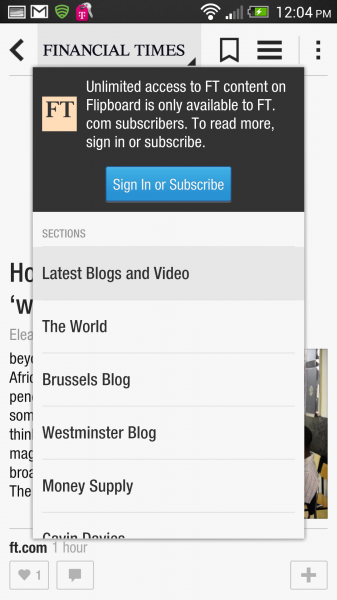
    May 9 was a big day for Flipboard. The personal news app launched a new version on Android, bringing feature parity with iOS, and the Financial Times debuted as a content provider. FT is unique among magazine news publications, by making people pay. Free rides are short lived; the newspaper lets registered users view a limited number of stories per month. More than that, requires a subscription.

    Many people look at Flipboard as a pretty news aggregator — a smorgasbord of valuable content served up for free; eat as much as you like. Financial Times brings the pay model with it. You still need a FT account. Registered users are limited to blogs and video, while subscribers get access to everything. I wonder if personal paper apps like Flipboard aren’t the future news, with some — even more — content behind the paywall.

    Charl Porter, group product manager, graciously took time to answer questions about the Financial Times’ business model and how Flipboard fits into the overall strategy. Remember, FT is among the rare publications for which people pay.

    BN: As a journalist, I am rather mortified by what the Google economy does to news. Free content supported by advertising, particularly when there is too much ad space to fill, isn’t tenable. How is it Financial Times succeeds by making people pay?

    CP: The FT’s business is based on dual revenue streams (content and advertising), and more people than ever in our 125-year history are readers and subscribers of FT content.

    We provide premium and essential news, commentary and analysis to an audience of over 600,000 paid subscribers (print and digital), who believe that FT content is worth paying for. Our successful channel-neutral strategy offers readers flexibility in how they choose to receive our content, and at its core is the metered access model we pioneered in 2007. Thanks to our digital access model, we now have deep knowledge of our audience and can apply data analytics for smarter marketing.

    BN: Why Flipboard?

    CP: We recognized early on that the continued success of our business depends on our ability to adapt to changing reader habits, and launching on a leading mobile app like Flipboard is a natural development for the Financial Times.

    Mobile continues to drive growth and now accounts for a third of all FT.com page views, driving 15 percent of digital subscriptions.

    Social media has changed the way people interact with brands, consume content and connect with each other. This is particularly true of the media industry and the way consumers discover and share news. At the FT, this deeper engagement with our audiences helps drive growth, and in 2012 the volume of visits to FT.com driven by social media grew by 35 percent.

    BN: Why Flipboard now — and not sooner?

    CP: We have been in discussions with Fliboard for a couple of years now to make sure that our proposition would work for both parties and across platforms, given we want to offer readers a multi-channel subscription with a single login. This launch has combined the FT’s award-winning journalism with a personalized reading experience on Flipboard. It also strengthens our presence on Android.

    BN: How do you see apps like Flipboard, or even Google Currents, changing how people consume news?

    CP: I see it as an opportunity for publishers like the FT to engage readers across multiple channels and devices. Our partnership with Flipboard allows reader to consume FT content in a new format using the same login as they would on FT.com or the FT web app. It’s a great way to get our brand out there without compromising our business model. We are still able to retain a direct relationship with our readers, which is key to our strategy.

    BN: To be honest, I used to be a Financial Times subscriber but the Android tablet app just couldn’t satisfy. How would you compare the Flipboard experience?

    CP: Flipboard provides an engaging leanback experience, and the app has successfully replicated the ‘browsability’ of a magazine. Our partnership with Flipboard does extend our presence on Android but we are working on enhancing the overall FT experience on Android. Our award-winning HTML5 FT web app now has more than 3.8 million users and was recently redesigned. The app is currently available on iOS now cleaner and easier to use, with more personalization and a choice of a static morning edition or a dynamically updating version.

    BN: Flipboard lets users create custom magazines, of sorts. How does Financial Times sees this, and other mechanisms like it, fitting into broader editorial content and revenue-generating strategies?

    CP: The social aspect of Flipboard’s custom magazines is exciting and we hope to play a part in that by allowing readers to use FT content within custom magazines while also experimenting with FT branded magazines.

    We also have a dedicated iPad app for our award-winning How To Spend It magazine, which aesthetically matches its printed counterpart whilst offering the dynamism and immediacy of the web. The revenue on our HTSI platforms (tablet and desktop) more than doubled year on year.

  • Games for the weekend: Gravity Hook HD

    Games for the Weekend is a weekly feature aimed at helping you avoid doing something constructive with your downtime. Each Friday we’ll be recommending a game for Mac, iPhone or iPad that we think is awesome. Here is one cool enough to keep you busy during this weekend.

    Gravity Hook HDGravity Hook HD ($0.99, Universal) is a high scoring arcade-style game that is more challenging than it may first appear. If there were such a genre for side-scrolling puzzle games, this game would define that genre. Except for one minor detail: it’s vertical.

    In Gravity Hook, your robot shoots out a grappling hook towards an orb that you believe is stable enough to propel the robot upward. The problem is that the orb is not attached to anything. As the robot is pulled closer to the orb, the orb is getting pulled closer to the robot.  Gameplay is simple enough to get the hang of — just tap on the orb you want to attach the hook to and the robot shoots its hook at that orb. As the robot moves upward, more orbs become visible for you to grab on to. When you select a new orb, the robot releases the hook from the orb it is currently attached to and fires the hook to the new orb.

    Gravity Hook HD

    Sounds simple enough, but there is one slight catch. The closer the robot is to an orb when it gets attached, the faster the robot moves toward it. So fast, in fact, that the robot can use the momentum to fling itself up even higher. The opposite has its ill effects as well: the farther away the robot is from an orb when it gets attached, the slower the robot moves toward it. If the robot happens to be too far away at the time it gets attached, it will fall further away from the orb rather than get closer. You can, however, attempt to recover from choosing an object that was too far away by targeting a closer object. The problem is that your downward momentum is often times too much for the cable to handle. Extending the cable between the robot and the orb too much will cause it to snap. With no cable to cast out, the robot will fall, crashing downward and ending the game.

    Gravity Hook HD

    The orbs themselves have different properties as well. The farther up you go, the more complex the choices get. Toward the bottom of the game, the green orbs you grapple on to are quite benign and easy enough to get the hang of. The blue orbs on the other hand turn into mines as soon as you attach to them. When attached, a timer starts counting down. Detaching from the blue orbs stops the timer. If you stay attached too long and end up bumping into the blue orbs as you get pulled closer to them, the blue orb will explode and destroy the robot in the process.

    Gravity Hook HD

    The gray orbs are chained to one another and will quickly break free. Once free from the other gray orbs, they begin to plummet toward the ground. Staying attached to them for too long and the robot will be pulled to the ground with them. And the red orbs, lets just say you need to avoid those at all costs. With all of the objects the idea is basically the same, don’t stay too attached to any one object for too long.  Use your momentum to propel the robot upward to the next collection of orbs.

    Gravity Hook HD

    There is a classic play mode as well. I found the classic mode to be much more challenging than the normal play mode. So you might want to get the hang of things in the HD version before you try out the classic eight-bit version. The first rendition of the game was originally inspired by a program that was use to teach students how to type if you can imagine that.  Whichever version you feel more comfortable playing, this is the weekend to grab hold of Gravity Hook.

    Related research and analysis from GigaOM Pro:
    Subscriber content. Sign up for a free trial.


  • RGIII to Marry Rebecca Liddicoat This Summer

    Robert Griffin III is well-known for his skill as the Washington Redskins’ quarterback and for winning the 2011 Heisman Trophy. Now, though, RGII (as he’s sometimes known) is about to experience a great milestone in his personal life.

    RGIII’s mother, Jackie Griffin, sat down with DC TV news station Fox 5 this week and revealed that Griffin will be getting married this summer. He will be marrying his long-time girlfriend Rebecca Liddicoat, though no specific date was revealed.

    The couple are reported to have met while they were still students at Baylor. Griffin proposed in October 2011 after a game against Kansas State.

    Griffin was born in Okinawa, Japan and grew up in a military family, moving throughout the U.S. during his childhood. He attended Baylor University, where he racked up 110 touchdowns and over 10,000 passing yards as the Bears’ quarterback. In addition to winning the Heisman, he was the second draft pick in the 2012 NFL Draft and the cover athlete for EA’s NCAA Football 13 video game.

    DC Breaking Local News Weather Sports FOX 5 WTTG

  • With Cloud Drive Photos, Amazon makes a play to be the cloud app for iOS photos

    Not happy with PhotoStream on your iOS device? Amazon now has its own cloud-based offering for iOS: Amazon Cloud Drive Photos. It was released on the iOS App Store on Thursday.

    Apple’s issues with mobile photos and cloud storage were brought to light this week with a great post from an app developer, Peter Nixey. In a widely circulated personal blog post, he expressed his frustration with Apple’s current approach to managing photos on the desktop and on mobile. He presciently noted there would be a time when competitors — he named Google or Dropbox — would come along with better cloud-storage options for mobile photos.

    Well, here comes Amazon with one such solution. Cloud Drive Photos, already available on Android, is a place to store all your photos (“thousands,” according to the company). Images taken with an iPhone or iPod touch get uploaded automatically to Cloud Drive when the app is opened. And you can also see any of your photos stored in the cloud on the device with the app. It’s free, and available on the iOS App Store now.

    Just like Google with Maps, Search and Mail and Facebook with social things, Apple’s biggest and most important competitors are repeatedly besting Apple on its own platform when it comes to producing well designed, popular basic apps that are core to the mobile experience.

    This Amazon app is different than, say, Yahoo being better at making a weather app than Apple. Or Kindle being a better ereader app than iBooks — sort of embarrassing, but not really areas Apple considers its core mission.

    But the secret behind Amazon’s cloud-based photo storage is something at which Amazon is verifiably awesome, and something at which Apple is not: the cloud. Even with its billion-dollar data center and more on the way, Apple repeatedly struggles with keeping its cloud-based services reliable for users. And even when things are added to iCloud, like photos, some users still run into problems, as outlined in the link above, with multiple copies or confusing organization.

    The more troubling part of it all is that Apple’s cloud services aren’t just supposed to be something added on to its hardware offerings. Linking users’ data, whether it’s photos, music, videos, documents, email or messages, and making it accessible regardless of device, is part of Apple’s plan for growth.  As CEO Tim Cook has said, it’s at the centerpiece of its strategy for the next decade.

    Apple’s going to have to start offering far better core mobile apps that connect with its cloud if it doesn’t want Amazon and others to peel users off to their own services.

    Related research and analysis from GigaOM Pro:
    Subscriber content. Sign up for a free trial.


  • Open source flight, from the Drone Lab to Twitter: Q&A with Dave Lester

    I recently had the chance to catch up with Dave Lester, a soon-to-be graduate of UC Berkeley’s School of Information and a web developer who has been involved in a number of open source initiatives. Dave has been working on bringing technology together with the humanities and education through an un-conference he co-founded, and in his former role as assistant director of the Maryland Institute for Technology in the Humanities. We talked about his drone hacking project, the importance of code integration, and his upcoming foray into open source at Twitter in an email interview.

    How did you become interested in open source and community building?

    I was contributing to an open source web publishing system for digital archives called Omeka. The primary goal of Omeka is to make publishing digital archives of historical photographs and stories as easy as publishing a blog. We patterned our community strategy around Mozilla and WordPress, trying to create a ladder of contributions where people of varying skill levels could get involved, and I was helping coordinate developer community growth. Shortly after launching our first public beta, we realized that the community of interested users was more diverse than we imagined, not only from museums and archives but also libraries.

    For me, community building began mostly as a way of understanding and negotiating the differences and needs of these institutions. You need direct, personal connections with your users in order to understand their needs; in the process, you start to draw connections between the work of others and play a role of matchmaker.

    My interest in community building led me to help co-found THATCamp, The Humanities and Technology Camp, an un-conference. THATCamp is a BarCamp-style event, bringing together technologists and humanists to create sessions related to digital humanities. Sessions vary from event to event, but my favorites have always been ones that focus on building. And since 2008, there have been over 100 THATCamp events around the world.

    You’re involved in open web projects through the Mozilla Foundation, right?

    mozilla-open-badgesI’ve been working as an Integration Engineer Contractor with the Open Badges team at Mozilla, mostly helping third-party developers integrate with APIs to create and display badges. Open Badges is a standard to recognize learning online through the open sharing of digital badges, It’s an exciting approach to informal learning and using badges as a way to capture achievements that are otherwise not visible on a resume.

    One of my contributions to the project has been creating several WordPress plugins to make it easier to issue and display badges; it’s important that a variety of platforms adopt the standard to give the community a variety of ways to hook into our infrastructure.

    You’re also interested in hacking hardware, such as drones. What has this taught you about coding?

    This semester I helped organize a group of fellow graduate students at UC Berkeley to form what we’ve called “Drone Lab”, an informal group that has met weekly to hack, discuss, and investigate creative and problem-solving uses of consumer-grade quadcopters. These are hobbyist toys that you can buy at your local shopping mall, but the ability to control them using software that you script unleashes the potential to tap into their cameras and sensors from heights and hard-to-reach places that are new and exciting. What we ended up focusing our hacking on were new ways to control the quadcopters, including voice and tracking head movements.

    parrot-ar-drone

    What I found fascinating the last several months was introducing several of my classmates to Node.JS through programming these drones. Learning to program can often be a frustrating and unrewarding experience, but with just a proper development environment and a few lines of Javascript, you can fly a copter. Programming shouldn’t be limited to terminal windows, and the feedback of seeing the drone fly can be very rewarding. This also fosters creativity and unexpected things – sometimes you’ll see the drone do something in flight that seems odd, which prompts new questions about your code and experimentation that can be less common in programming.

    So were you part of last year’s TacoCopter stunt?

    TacoCopter is a project that I’m not involved with; I believe it’s meant to be more of a joke than a real thing. Still, there’s something intriguing and futuristic about a flying robot delivering Mexican food that gets people’s attention. We joke a lot about delivering tacos via drones.

    What do you see on the horizon for programming and the open source movement?

    In the age of GitHub where it’s easy for anyone to share code online and gain a following, the proliferation of projects both big and small can come at the expense of a clear way to integrate various codebases together. In my experience, it’s often the “glue code” and examples that are most valuable to users who want to use your software; the last 10 percent, so to speak. To be effective in open source community building, understanding those needs of integration is crucial and something I’ll be spending a lot of time working on.

    In general, I’m excited to see more companies using and releasing open source software, not for the goal of selling it but in an effort to develop better services and give back to communities that they benefit from. The precise model for how this software will be supported, grown, managed, and sustained is still to be defined; these are often projects without a software foundation. I hope to see more coordination and partnerships among companies regarding open source contributions.

    Finally, what’s next after you finish your Master’s?

    I’ll be joining Twitter as an Open Source Advocate in June. I’ll be responsible for building relationships with communities to drive adoption of our open source projects and APIs. Twitter has over 100 open source projects, and as an organization has made a big investment in using and releasing open source software.

    Images via OpenBadges.org, UC Berkeley School of Information

    Related research and analysis from GigaOM Pro:
    Subscriber content. Sign up for a free trial.


  • New ad shows that HTC is literally fighting dirty [video]

    HTC One Dirt Ad
    When we advised HTC to start fighting dirty a while ago, we didn’t expect them to take us quite so literally. In a new ad for its flagship HTC One smartphone, HTC shows off its new Blink Feed interface that the company bills as a single live stream that’s constantly showing the latest updates on all your apps, thus making it easier for you to find new data without switching through all your apps individually. In the new ad, HTC shows users of rival devices “digging” on their phones for all their apps as piles of dirt start to appear around their feet. HTC One owners, on the other hand, have a much cleaner experience and are shown getting everything they need through Blink Feed. The full advertisement is posted below.

    Continue reading…

  • Kidnap Victim Shuns Family For Not Looking For Her

    Kidnap victim Michelle Knight has requested that her family members not visit her in the hospital as she recovers from what has been an 11-year ordeal, apparently because those closest to her didn’t look for her after she disappeared.

    32-year old Knight vanished in 2002 after a custody dispute involving her then-young son, and her family thought she had run away. When kidnapper and rapist Ariel Castro allowed Knight and the two other women he held captive–Amanda Berry, 27, and Gina DeJesus, 23–to watch television, he taunted them with footage of candlelight vigils held in their honor. Knight’s family held no vigil, in part because they believed she’d left of her own will.

    “They took him and she went out and took off and never came back,” said her grandmother. The family did file a missing persons report, however.

    Knight, who was held the longest of the three women, reportedly suffered five miscarriages at the hands of Castro, who allegedly beat her in the stomach and starved her while she was pregnant. She remains in the hospital’s care, though the other two women have been released. Ohio prosecutors say they are pursuing a charge of aggravated murder on Knight’s behalf, which carries a possible death sentence.

    The three women were rescued earlier this week after Amanda Berry saw her chance to escape with her 6-year old daughter and took it, banging on the outer door of the home to get the attention of anyone nearby. Neighbor Charles Ramsey was just finishing dinner when he heard the noise.

    “I’m eating my McDonald’s; I come outside; I see this girl going nuts,” he said. “I knew something was wrong when a little pretty white girl ran into a black man’s arms. Something is wrong here. Dead giveaway!”

    Investigators said today that they’ve confirmed that Berry’s daughter belongs to Castro.

  • UCLA stem cell researchers move toward treatment for rare genetic nerve disease

    Led by Dr. Peiyee Lee and Dr. Richard Gatti, researchers at the Eli and Edythe Broad Center of Regenerative Medicine and Stem Cell Research at UCLA have used induced pluripotent stem (iPS) cells to advance disease-in-a-dish modeling of a rare genetic disorder, ataxia telangiectasia (A-T).
     
    Their discovery shows the positive effects of drugs that may lead to effective new treatments for the neurodegenerative disease. iPS cells are made from patients’ skin cells, rather than from embryos, and they can become any type of cells, including brain cells, in the laboratory. The study appears online ahead of print in the journal Nature Communications.
     
    People with A-T begin life with neurological deficits that become devastating through progressive loss of function in a part of the brain called the cerebellum, which leads to severe difficulty with movement and coordination. A-T patients also suffer frequent infections due to their weakened immune systems and have an increased risk for cancer. The disease is caused by lost function in a gene, ATM, that normally repairs damaged DNA in the cells and preserves normal function.
     
    Developing a human neural cell model to understand A-T’s neurodegenerative process — and create a platform for testing new treatments — was critical because the disease presents differently in humans and laboratory animals. Scientists commonly use mouse models to study A-T, but mice with the disease do not experience the more debilitating effects that humans do. In mice with A-T, the cerebellum appears normal and they do not exhibit the obvious degeneration seen in the human brain.
    Lee and colleagues used iPS cell–derived neural cells developed from skin cells of A-T patients with a specific type of genetic mutation to create a disease-in-a-dish model. In the laboratory, researchers were able to model the characteristics of A-T, such as the cell’s lack of ATM protein and its inability to repair DNA damage. The model also allowed the researchers to identify potential new therapeutic drugs, called small molecule read-through (SMRT) compounds, that increase ATM protein activity and improve the model cells’ ability to repair damaged DNA.
     
    “A-T patients with no ATM activity have severe disease but patients with some ATM activity do much better,” Lee said. “This makes our discovery promising, because even a small increase in the ATM activity induced by the SMRT drug can potentially translate to positive effects for patients, slowing disease progression and hopefully improving their quality of life.”
     
    These studies suggest that SMRT compounds may have positive effects on all other cell types in the body, potentially improving A-T patients’ immune function and decreasing their susceptibility to cancer.
    Additionally, the patient-specific iPS cell–derived neural cells in this study combined with the SMRT compounds can be an invaluable tool for understanding the development and progression of A-T. This iPS cell–neural cell A-T disease model also can be a platform to identify more potent SMRT drugs. The SMRT drugs identified using this model can potentially be applied to most other genetic diseases with the same type of mutations.
     
    This research was supported by training and research grants from the California Institute of Regenerative Medicine, the National Institutes of Health, APRAT, A-T Ease and Scott Richards Foundation.
     
    The Eli and Edythe Broad Center of Regenerative Medicine and Stem Cell Research: UCLA’s stem cell center was launched in 2005 with a UCLA commitment of $20 million over five years. A $20 million gift from the Eli and Edythe Broad Foundation in 2007 resulted in the renaming of the center. With more than 200 members, the Broad Stem Cell Research Center is committed to a multidisciplinary, integrated collaboration among scientific, academic and medical disciplines for the purpose of understanding adult and human embryonic stem cells. The center supports innovation, excellence and the highest ethical standards focused on stem cell research with the intent of facilitating basic scientific inquiry directed toward future clinical applications to treat disease. The center is a collaboration of the David Geffen School of Medicine at UCLA, UCLA’s Jonsson Cancer Center, the UCLA Henry Samueli School of Engineering and Applied Science and the UCLA College of Letters and Science.
     
    For more news, visit the UCLA Newsroom and follow us on Twitter.

  • Living with Windows Phone: Microsoft’s lack of key apps is still a big drag

    Lumia 920 Windows Phone review
    Microsoft believes it can be a viable competitor with Android and Apple, and is making a strong push with its Windows Phone operating system. The company has launched numerous campaigns to inform smartphone buyers of their mobile options, but despite a large advertising budget, Windows Phone remains a mystery to most consumers. The question remains, can Microsoft’s mobile platform really compete with Google and Apple?

    Continue reading…

  • The guerilla astrogardener: Fellows Friday with Louisa Preston

    LouisaPreston_TEDFellow_Blog

    Astrobiologist and geologist Louisa Preston looks for analogues to possible life on Mars in the most extreme environments on Earth. Now she’s also considering how humans might someday make a home on the red planet, and is raising funds on Kickstarter in support of AstroGardening – an educational exhibit designed to explore how we might someday grow food on Mars.

    Tell us about your Kickstarter campaign for the AstroGardening project.

    It’s based around the idea of Mars gardening. If humans want to go to Mars, how would we live when we got there? What would we need, and what would it look like? With the advancement of space exploration, we’re finding that ideas like this are actually becoming a lot more real – not quite science fiction.

    The exhibit, which will be hosted in a number of planetariums and museums in the UK, will be inside a plastic geodesic dome, within which is a beautiful, peaceful garden full of different types of plants, fruits, vegetables and flowers. The soil will be red, just like Mars. There will be signs and information everywhere where people can learn about the different plants, how they might grow on Mars, and the various ways we need to develop tools so we can garden on Mars. Mars is frozen, so we need to be able to extract water and keep plants warm, for instance.

    And there will be a rover — the first-ever rover designed solely for gardening. It will be automated to be planting a garden at the end of the exhibit, so people can see it in action.

    My project partner, installation designer, maker and guerilla gardener Vanessa Harden, and I are designing and building the rover right now. The Kickstarter funds will be used to build the rover, the exhibit itself — plants, soil, the dome — and so on. Most of the venues have agreed to house the exhibit out of kind, for education purposes, so we’re not paying a fee, and it’ll be free for anyone to come and visit it.

    Video above: Introducing the AstroGardening project — and the automated gardening rover.

    Does this mean that plants that grow on Earth could be transplanted directly to such an environment?

    Yes, absolutely. There have been a number of studies that show that if you plant things like asparagus or potato or sweet potato or different types of grains in soil that’s exactly the same as on Mars, they will grow as long as they have water and sunlight and things that plants need. I think one experiment actually showed that you could grow marigolds in ground-up meteorites, and meteorites from Mars. So we know the planet’s soil will allow it. We just need to create the environment.

    The exhibit will explain this to people. It will also teach about the conditions on Mars, how plants grow, what they need, why it’s hard for life to grow on Mars, what therefore makes the Earth so special — and from there why it’s so important for us to protect the environment.

    I wasn’t going to lead it on to terraforming, but actually I was speaking to my 10-year-old cousin about it, and he asked, “Well what about if we could change Mars to be like Earth?” Terraforming is a really interesting topic, and sounds very much like science fiction, but there are people looking into it. So hopefully the exhibit will address that point and allow people to ask questions, and we’ll be able to provide the answers about how it might be done, and what the ethics are around whether we should be allowed to change another planet to suit us.

    The whole thing came out of a desire to get the public involved in understanding that we’re not very far away from gardening in space becoming a reality — actually being able to garden and set up colonies and civilizations on other worlds — and how it might happen. So we came up with an exhibit that the public can be involved in and not only looks beautiful, but is scientifically relevant and accurate.

    How does this dovetail with your work looking for analogue Mars environments on Earth?

    It works brilliantly. I look for environments on the Earth that mimic Mars, and I study how life can grow there. In the past, I’ve studied how microorganisms survive in these environments. Are these places really hot, really cold, really acidic, really dry? So it’s a natural step for me to then start thinking about how you might grow plants or how we as humans might survive in these areas, too.

    I grew up watching TV shows and films about humans and aliens living on other worlds and I kept thinking, Well how would we live there? These worlds look completely different from ours; how would we survive? And now I’m finally in a position to actually be able to think about this question and use science to answer it.

    Rio Tinto Acidophiles

    Rio Tinto in southwestern Spain is a wonderful natural laboratory where we can study acidophiles (acid-loving bacteria) living in the iron-rich waters today (above), and study fossils of their ancestors that have been preserved for up to 2 million years within iron-rich rocks along the river bank (below).

    Rio Tinto in southwestern Spain is a wonderful natural laboratory where we can study acidophiles (acid-loving bacteria) living in the iron-rich waters today (above), and study fossils of their ancestors that have been preserved for up to 2 million years within iron-rich rocks along the river bank (below).

    How did you get into the field of astrobiology?

    I was following along a geology career, studying mining, looking at all the different types of minerals that the Earth produces and how we might utilize those as a society, and I met a PhD student who was working on life preserved within rocks in Antarctica. Up until that point I didn’t completely realize or understand that you could actually look for life on other planets as a job — that it was actually a facet of what I was doing. So I did my PhD on a combination of looking at mineral deposits like I’d been studying before, but trying to incorporate the idea of life around these rocks and then life on Mars — to try and merge the two. And I was hooked. I knew that all the rest of the work that I would do from then on would all be geared towards trying to identify and find life on other planets.

    Now my main work is looking at environments on Earth that mimic those on Mars. I look at places such as Antarctica, which is the coldest, driest desert on the Earth and is actually the most Mars-like environment we have on Earth. I look at areas in Spain such as Rio Tinto, and I work at impact craters. I’m going to Iceland this summer to do more work on volcanoes and hot springs. What all these environments have in common is that they are places where life lives at very extreme limits. It’s either very, very hot or very cold — places where humans couldn’t survive without lots of help, but some organisms can live perfectly happily.

    I try and figure out how they’re able to survive there, what adaptations they have that allow them to survive there. And I study nearby rocks as well, because as these are forming they trap the organisms in them. When I open up these rocks, I can see fossilized life, similar to the type of life we think we might find on Mars. We won’t necessarily see life scuttling around on the surface of Mars, but we might be able to break into a rock, open it, and see fossilized life inside. I look for DNA and proteins, and try to understand how these fossils are formed and identify organic molecules that indicate this fossil was once definitely an organism, not just, say, a wiggly pattern.

    You’re working with Senior Fellow Angelo Vermeulen on the HI-SEAS Mars simulation project, where they are investigating how humans might be able to cook their own food on Mars, and his own research on this mission about growing food on Mars is very similar to yours. Did you arrange this together?

    Actually, I didn’t get involved in HI-SEAS through Angelo. I do a lot of analogue mission work myself — I was a flight director for a Canadian Space Agency analogue mission. So when the call came out that they were asking for people to be involved in HI-SEAS and to support the mission, I got contacted just through my prior experience.

    Angelo didn’t even find out I was supporting the mission until he was actually in the simulation. It was a wonderful moment: we had a kick-off meeting on Skype for all the mission crew to meet the astronauts, including Angelo. When we went around and introduced ourselves, I just said, “Hi. My name is Louisa Preston. I’m an astrobiologist based in London.” All I heard in the other room was, “Louisa??” Now we’re communicating, him on Mars and myself here — and I’m trying to help him with his research as he goes through the mission. It’s really good fun. Every so often he’ll send us a call asking if anyone’s seen any good papers recently or research we might be able to incorporate.

    At the moment, I’m studying something that’s a little bit different from what he’s doing. He’s looking at plants that basically don’t need any kind of pollination. They don’t need bees; they don’t need anything to help them reproduce. They just naturally do it. I’m asking, “How would we actually get bees — or use something like bees — on Mars to pollinate plants, and how would we breed them?” So we’re removed at the moment in those areas, but we’re looking to try and join our studies eventually, so it could be interesting. Angelo and I had already been looking for a reason and a way to work together, and this was a perfect opportunity.

    Testing the temperature and acidity of hot springs in Iceland, looking for life thriving within this extreme environment.

    Testing the temperature and acidity of hot springs in Iceland, looking for life thriving within this extreme environment.

    What does it mean to be a flight director on an analogue mission, and why would a astrobiologist need to have such an experience? You’re not actually flying anywhere…

    Our analogue mission was based in Canada, and it was to send a team to the Canadian high arctic where they were going to study an impact crater. When you have a mission, whether on Mars or on Earth, you have a team that goes into the field, or to Mars, and a mission control. Leading mission control is the flight director who basically manages the team. And that was my job.

    There are a number of things you get from these scenarios. The first one is management experience, which doesn’t sound particularly exciting. But in these teams you have engineers, scientists, computational experts, field specialists, medics, psychologists, and a number of different people working together. In our field, if you’re going to stay in space science and you want to work in missions and help extend our knowledge of the solar system, you need to be able to work in a very dynamic team full of extremely different people from disparate backgrounds, and who therefore all think very differently.

    There’s a very common clash between scientists and engineers, for example. The scientists want to go to this rock, say, to look at a cool bug. The engineer says, “Well I don’t know how to get you there.” And the scientist says, “Well I want to go there.” There’s always this clash, but it’s a friendly clash with a joint goal. You need the skills to be able to negotiate through this. So to be part the larger picture and to work in these situations and planning missions to other planets it’s an invaluable experience. It’s really good fun as well.

    What has your TED experience been like so far?

    The one thing about the TED conference is I think everyone spends an entire week with imposter syndrome, because you go there very confident in what you do and very excited to tell everybody about it — then you speak to even one single person and hear what they do and think, “Oh, that’s so much cooler and more interesting than what i do.” The Fellows community is very active; I’m talking with and potentially working with three Fellows at the moment on a number of different projects, which will be really exciting. And a lot of really great publicity has come from being associated with TED, even in the UK where it might not be as well known as it is in America.

    I’m also now one of the directors of TEDxLondon, which is happening in July. Its theme is visions of the future, which is not at all in my area, but that means I’ve actually spent a number of weeks speaking with architects and designers and science-fiction writers about their visions of the future, which is absolutely fascinating.

  • Dell Responds to Ichan, Southeastern Offer

    Dell Inc. responded Friday to a proposed alternative – submitted by Carl Icahn and Southeastern Asset Management – to a $24.4 billion buyout deal led by founder Michael Dell. In a letter to Dell’s board on Thursday night, Icahn and Southeastern proposed that current owners keep their equity position. Additionally, they would have the option of receiving a distribution of $12 a share in cash or $12 a share in stock valued at $1.65 a share, Reuters reported. Dell said in a statement Friday that it was “carefully reviewing the potential transaction to assess the potential risks and rewards to the public shareholders.”

    PRESS RELEASE
    The Special Committee of the Board of Dell Inc. (NASDAQ: DELL) today issued the following statement regarding a non-binding proposal it has received from Carl Icahn and Southeastern Asset Management:

    “Mr. Icahn and Southeastern have outlined a potential leveraged recapitalization transaction that they want the Dell Board either to recommend at this time or to consider if the existing going-private transaction is rejected by Dell shareholders. They have also proposed replacing the Board with a slate of new directors who they say would approve such a transaction. Consistent with the Special Committee`s goal of achieving the best possible outcome for all shareholders, we and our advisors are carefully reviewing the potential transaction to assess the potential risks and rewards to the public shareholders.”

    Forward-looking Statements
    Any statements in these materials about prospective performance and plans for the Company, the expected timing of the completion of the proposed merger and the ability to complete the proposed merger, and other statements containing the words “estimates,” “believes,” “anticipates,” “plans,” “expects,” “will,” and similar expressions, other than historical facts, constitute forward-looking statements within the meaning of the safe harbor provisions of the Private Securities Litigation Reform Act of 1995. Factors or risks that could cause our actual results to differ materially from the results we anticipate include, but are not limited to: (1) the occurrence of any event, change or other circumstances that could give rise to the termination of the merger agreement; (2) the inability to complete the proposed merger due to the failure to obtain stockholder approval for the proposed merger or the failure to satisfy other conditions to completion of the proposed merger, including that a governmental entity may prohibit, delay or refuse to grant approval for the consummation of the transaction; (3) the failure to obtain the necessary financing arrangements set forth in the debt and equity commitment letters delivered pursuant to the merger agreement; (4) risks related to disruption of management`s attention from the Company`s ongoing business operations due to the transaction; and (5) the effect of the announcement of the proposed merger on the Company`s relationships with its customers, operating results and business generally.

    Actual results may differ materially from those indicated by such forward-looking statements. In addition, the forward-looking statements included in the materials represent our views as of the date hereof. We anticipate that subsequent events and developments will cause our views to change. However, while we may elect to update these forward-looking statements at some point in the future, we specifically disclaim any obligation to do so. These forward-looking statements should not be relied upon as representing our views as of any date subsequent to the date hereof. Additional factors that may cause results to differ materially from those described in the forward-looking statements are set forth in the Company`s Annual Report on Form 10-K for the fiscal year ended February 1, 2013, which was filed with the SEC on March 12, 2013, under the heading “Item 1A-Risk Factors,” and in subsequent reports on Forms 10-Q and 8-K filed with the SEC by the Company.

    Additional Information and Where to Find It
    In connection with the proposed merger transaction, the Company filed with the SEC a preliminary proxy statement and other documents relating to the proposed merger on May 2, 2013. When completed, a definitive proxy statement and a form of proxy will be filed with the SEC and mailed to the Company`s stockholders. Stockholders are urged to read the definitive proxy statement when it becomes available and any other documents to be filed with the SEC in connection with the proposed merger or incorporated by reference in the proxy statement because they will contain important information about the proposed merger.

    Investors will be able to obtain a free copy of documents filed with the SEC at the SEC`s website at http://www.sec.gov. In addition, investors may obtain a free copy of the Company`s filings with the SEC from the Company`s website at http://content.dell.com/us/en/corp/investor-financial-reporting.aspx or by directing a request to: Dell Inc. One Dell Way, Round Rock, Texas 78682, Attn: Investor Relations, (512) 728-7800, [email protected].

    The Company and its directors, executive officers and certain other members of management and employees of the Company may be deemed “participants” in the solicitation of proxies from stockholders of the Company in favor of the proposed merger. Information regarding the persons who may, under the rules of the SEC, be considered participants in the solicitation of the stockholders of the Company in connection with the proposed merger, and their direct or indirect interests, by security holdings or otherwise, which may be different from those of the Company`s stockholders generally, will be set forth in the proxy statement and the other relevant documents to be filed with the SEC. You can find information about the Company`s executive officers and directors in its Annual Report on Form 10-K for the fiscal year ended February 1, 2013 and in its definitive proxy statement filed with the SEC on Schedule 14A on May 24, 2012.

    About Dell
    Dell Inc. (NASDAQ: DELL) listens to customers and delivers worldwide innovative technology, business solutions and services they trust and value.

    The post Dell Responds to Ichan, Southeastern Offer appeared first on peHUB.

  • Tim Tebow Blackballed: Is Media Killing His Career?

    Tim Tebow had a spectacularly bad season last year, but it wasn’t for lack of trying. The young quarterback, who has just as many detractors as he does fans, was expected to do great things once he was traded from the Broncos to the Jets. But there was one major problem: the team already had a star quarterback, Mark Sanchez, and Tebow hardly got any time on the field to strut his stuff. Despite coach Rex Ryan’s glowing reviews of Tebow and his ability, it seemed his career with the Jets stalled at the gate. Now, he’s been released, and rumors are floating around the web that he’s being blackballed because of all the media hype surrounding him.

    “He seems like a great guy to have on a team, and I’d be tempted to bring him in as our backup,” one NFC head coach reportedly said. “But it’s just not worth dealing with all the stuff that comes with it.”

    Because of Tebow’s innate likability, his handsome visage, and the Christian values that include running an organization to help children, he’s garnered a media following like nothing anyone in the NFL has ever seen. His fans are almost in cult status. Yet it’s hard to figure out whether they love him so much because of his talent, or because of everything else.

    “The only place that Tebow hasn’t succeeded is in New York, where he couldn’t get off the bench. He may have seen the field more, if, dressed in a cheerleading outfit, he starred as the caveman in a GEICO commercial. The contempt toward all things Tebow was so over the top that it even had Alec Baldwin showing pity – “the only thing more imaginary than Manti Te’o’s girlfriend is the Jets offensive package for Tebow,” says writer John Kirkwood.

    For now, it’s hard to say what his immediate future holds. While the media circus isn’t his fault, it’s not going to help him gain a foothold with another team anytime soon.