Category: News

  • Does Your Company Need an Instagram Storefront?

    As the internet continues to make it easier to connect with potential customers, some entrepreneurs have decided that Instagram isn’t just for “selfies,” but for marketing. Blogger Jason Kottke reported last month on Kuwait’s “booming Instagram economy,” where anyone with an Instagram account is simply putting a price tag on an item, taking a photograph, and selling it via the photo sharing online social network.

    Everything from Manga to make-up, and more is being sold in this very simple and direct platform, leveraging additional free technology like WhatsApp (customer service), PayPal, and Square (transactions) to make the business infrastructure as simple as possible.

    Not unlike eBay and the power-sellers it spawned, Instagram has the scale, stability, and user trust to create a viable marketplace. Once upon a time, if you wanted to sell online you needed a sturdy e-commerce site with analytics, a robust hosting facility, and a web team to create, design, merchandise, market, and more. Today, you need a couple of free accounts on some of the major online channels along with the persistence to keep at it. Is this the digital equivalent of a garage sale, or the next generation of business?

    The answer is likely somewhere in between. It’s doubtful that those in the upper echelons of the massive consumer packaged goods companies are going to care about this, or that Sephora and Walmart see this as a competitive threat, but the barriers to entry for someone to start and market a new business continue to be lowered.

    These Instagram businesses may not be the next big thing, but they could well be the nascent stages of what is the next big, small thing in business today. On April 23rd and 24th of this year, the American University of Kuwait hosted a two day conference, featuring case studies, how-to’s and networking for those wondering what it takes to build a business on Instagram. The Insta Business Expo, featured a slew of new entrepreneurs who built and grew their respective businesses through Instagram.

    While this may seem inconsequential in the grander scheme of global economics and business, consider the global reach of Instagram, the burgeoning ability to use 3-D printing to create or augment existing products, and the desire from consumers for more unique products and services. There is also potential here for more traditional brands to try moments of commerce; an Instagram storefront could help validate a new product line or market ancillary products.

    Instagram should not be underrated as an engine of marketing, considering the engagement beautiful images can generate. Today’s Instagram entrepreneurs have uncovered an easy way for brands to quickly share new inventory, and a very simple way to conduct business from a smartphone. If your brand has the goods, you might want try out an Instagram store of your own.

  • How Quirky Startup Names Became an Internet Aesthetic

    There are 102 startups whose names end in “ify,” many of them probably in imitation of Spotify, says the Wall Street Journal, quoting branding consultant Christopher Johnson. Newcomer businesses include notifications system Xtify, as well as Stackify, an information-technology service provider. Quirky names for startups surfaced about 20 years ago in Silicon Valley, with the birth of search engines such as Yahoo, —which originally stood for Yet Another Hierarchical Officious Oracle. The mania for odd names was fueled by a lack of available short, punchy URLs, but it soon developed into an internet aesthetic.

  • How a Virtuous Housing Circle Turned Vicious

    As we near the fifth anniversary of the 2008 financial crisis, we should now have the critical distance to distinguish the real causes from the stereotypical villains, namely, Wall Street greed and unfettered competition. The latter culprits are officially blamed in the 2010 Dodd-Frank Act putatively designed to prevent another crisis: it’s called the Wall Street Reform and Consumer Protection Act. The act is unequivocal: Wall Street caused the problem, consumers were harmed, and the federal government is here to help.

    But in a free market — fettered by a reliable rule of law but little political micromanaging — would you expect “NINJA” loans to exist? These notorious loans were available to some borrowers with “no income, no job or assets” as late as 2007. Even if we assume that lenders are fueled by avarice, is it likely they would give out loans that they have little reason to believe will be repaid? Surely not. Something clearly had scrambled the normal market incentives in the mortgage bazaar. That something was a wide range of mandated “affordable housing goals,” enacted over a couple of decades across many government departments, all designed to increase homeownership among lower income Americans.

    The whole story is a long one, but the basic facts are simple. Thanks to the work of Edward Pinto and Peter Wallison of the American Enterprise Institute, and later to the SEC, we now know that as a result of these efforts to expand homeownership, by 2008 about 27 million mortgages were “nontraditional” and relatively risky loans. That was half the mortgages in the United States.

    The numbers alone suggest Washington’s visible hand. The government-sponsored (and now government-owned) enterprises Fannie Mae and Freddie Mac held 12 million of those loans — which they bought on the secondary market under stiff federal quota requirements. FHA and other federal agencies (such as the Veterans Administration and Federal Home Loan Banks) held 5 million, and Community Reinvestment Act and HUD programs had another 2.2 million. That’s a total of 19.2 million risky loans held by entities controlled by or within the federal government, leaving 7.8 million for Countrywide, Wall Street, and so forth.

    Let that fact sink in, because this is the one that shatters the mythology surrounding the financial crisis. Two-thirds of all risky loans in the system, we’ve since learned, “were held by the government or entities acting under government control,” and they existed largely because of aggressive government housing policy.

    The large-scale effect — a meltdown in the financial sectors involved in mortgages and mortgage securities — is known to all. The effect on private financial virtues has been largely ignored.

    All things being equal, homeownership correlates with many good things. On average, people who own rather than rent their homes commit less crime, perform better in their jobs, vote, take more interest in their community, and keep up better with house maintenance. Homeownership is also a perennial element in the American Dream. So it’s easy to understand why legislators and presidents would want to encourage homeownership among lower-income earners. But beneficial government policy attends not merely to good intentions but to tangible consequences. That requires careful economic reasoning. Affordable housing policies failed that test.

    In housing policy, politicians left, right, and center made the classic mistake of confusing correlation with causation. There’s a difference between merely having property you’ve gotten easily and disciplining yourself so that you can acquire and keep it, just as there’s a difference between earning a million dollars from hard work and winning a million dollars in the lottery.

    Since homeownership had correlated with fiscally virtuous behavior, policymakers imagined that they could boost such behavior by boosting homeownership. But mere ownership doesn’t magically make people financially wise, capable, or virtuous. Instead, in a country with property and other basic rights, wise and virtuous behavior makes it possible for people to accumulate enough capital and credibility to be able to get a home loan. This incentive has spurred a virtuous circle among countless American immigrants. The dream of buying a house encouraged good financial practices, hard work, and thrift. Once people owned their homes, they valued them all the more because of what they’d had to do to get them in the first place. The equity they put into the loan spurred them to stay on the straight and narrow.

    In a healthy housing market, people get a mortgage loan because of what they have already done — they’ve worked hard, kept their jobs, paid their debts, delayed gratification, and saved for a down payment. In this virtuous circle, wise behavior makes it possible to acquire a home, and acquisition of a home reinforces wise behavior.

    When government short-circuited that loop of incentives, a vicious circle of bad financial decisions was the result. A meltdown was inevitable.

  • How To Teach A Weimaraner

    I compiled this record by seeking for the pastime retailers listed on a selection of research engines and rating them by the selection of world wide web web pages, discussion discussion boards, photos, movies, etc that are readily available on the net.

    garden scale trains

    Twenty-two months afterwards, Amtrak revived the procedure with a tri-weekly assistance, now called the Automobile Teach (no hyphen). Be excess careful when generating a order so that you can purchase the appropriate products and solutions.

    If you want to find out more info in regards to empower network take a look at http://mi.cx/ft6 Your working day to working day responsibilities may possibly change with the dimensions of the library you perform in. The huge selection of design teach scales can be confusing and can make the best decision for you tricky. One more factor to look at for realism is the peak of the layout.

    Permit me make clear the idea powering this. Travellers on the northbound educate describe the horrific sight of viewing kids in tears and pointing below the educate. But the kids often managed to persuade the mom and dad to purchase a sandwich from the pantry.

    The critical is to study as considerably as you can about the different product educate choices and come to a decision which model suits you most effective. A model train with steel wheels typically keeps the observe cleaner and doesn’t involve cleansing as typically as plastic wheel-sets. Are you a single of individuals persons who appreciate to view the large locomotives press and pull all those rail vehicles together the tracks or anyone who just loves riding trains in general?

    This usually means “” front and “” rear even so, the 6 drive axles make up for the missing fronts and rears. Obtaining a particular spot in thoughts will enable you afterwards on how to recreate the scene and it can also make your project a lot more astounding if the observer can genuinely see how you manufactured these kinds of scene into a miniature one. From Manchester, British Airways has daily flights to Milan and Rome.

    Kudos to the Indian Railways for a services that is worth all the time, revenue and initiatives! You could make your mind up to operate a certain train line. Gradually it arrived in the achieve of the substantial middle course, and folks started traveling from countryside to cities and from towns to countryside.

    The HO scales are normally bought with the observe only and do not consist of a electrical power supply for the prepare. Lots of grown ups have to help and help their children with putting jointly prepare products. All schools hire librarians who select and order guides ideal for their school’s student system and their latest collection.

  • 5 African artists who are “learning from the past” in their work

    At TED2013, graphic designer Saki Mafundikwa highlights the beauty of traditional African written languages, urging designers to draw inspiration from them. Photo: James Duncan Davidson

    At TED2013, graphic designer Saki Mafundikwa highlights the beauty of traditional African written languages, urging designers to draw inspiration from them. Photo: James Duncan Davidson

    Zimbabwean designer Saki Mafundikwa has a powerful vision for the future of African art. As the founder of the Zimbabwe Institute of Vigital Arts (ZIWA), Mafundikwa is working to bring African art back to its roots. ZIWA, the first school of graphic design in Zimbabwe, and one of the first schools to emphasize the use of digital technology to teach the visual arts, places the continent’s rich artistic history at the center of its curriculum.

    Saki Mafundikwa: Ingenuity and elegance in ancient African alphabetsSaki Mafundikwa: Ingenuity and elegance in ancient African alphabetsThis idea sits at the heart of today’s talk, in which Mafundikwa encourages African artists  to take a look at their own cultural heritage for artistic inspiration, rather than looking to the outside world.  He sums up the concept with the Ghanaian glyph Sankofa, which means literally “return and get it” — or “learn from the past.” Says Mafundikwa, ”We must go to the past so as to inform our present and build on a future.”

    In his talk, Saki Mafundikwa celebrates Africa’s creative heritage by surveying the continent’s history of written language. Jumping across nations, Mafundikwa describes the fascinating writing systems of societies from the Akan to the Bantu to the Yoruba. He points out that, contrary to popular belief, African writing may date back hundreds of years earlier than the scripts of Mesopotamia.

    In the spirit of Mafundikwa’s call to action, here is a look at a few African artists who are incorporating their heritage and traditions into their work. These artists offer diverse perspectives, putting Mafundikwa’s ideas into conversation as they contest and corroborate them.

    “Glance towards the unknown” by Fathi Hassan. Source: FathiHassan.com

    Born to Sudanese and Egyptian parents, artist Fathi Hassan explores his Nubian heritage through the written word. He imagines scripts inspired by his ancestors’ calligraphy, creating beautiful but illegible text. In doing so, he emphasizes the language loss that occurred under imperial domination and recalls his upbringing in a primarily verbal, illiterate society. Hassan was the first artist to represent Africa in the emerging artists category of the Venice Biennale. [Fathi Hassan]

    “Ibiebe ABC III” by Bruce Onobrakpeya. Source: National Museum of African Art

    “Ibiebe ABC III” by Bruce Onobrakpeya. Source: National Museum of African Art

    Nigerian printmaker Bruce Onobrakpeya also places the alphabet at the center of his work. He invented the Ibiebe script, a fusion of Chinese and Japanese calligraphy with the writing found in the Urhobo groups of Southern Nigeria. Onobrakpeya was educated by the Zaria Rebels, a school of Nigerian artists who emphasized the decolonization of African art from Western influences. Onobrakpeya cites his education as a powerful influence in his use of traditional aesthetics. Onobrakpeya’s art received an honorable mention at the Venice Biennale, and he was honored with UNESCO’s Living Human Treasure Award in 2006. [Wikipedia]

    Beyond the scope of the aestheticized written word, cultural heritage manifests itself in different ways in different mediums. Ladysmith Black Mambazo, the internationally acclaimed male choral group from South Africa, celebrates its Zulu heritage by keeping isicathamiya and mbube singing styles alive. Half a century and three Grammys later, the group has evolved to create the Ladysmith Black Mambazo Foundation, which opened in 1999 to teach children of Zulu heritage about traditional isicathamiya music. [Mambazo]

    “Histology of the Different Classes of Uterine Tumors” by Wangechi Mutu. Source: Flickr/Cea

    “Histology of the Different Classes of Uterine Tumors” by Wangechi Mutu. Source: Flickr/Cea

    Nairobi-born painter and sculptor Wangechi Mutu explores the landscape of post-imperial Africa in the face of globalization. She blends the aesthetics of traditional African art with images of the female body, giving her work a uniquely feminist and African feel. Blending the modern and the traditional, “her works document the contemporary myth-making of endangered cultural heritage.” Mutu’s work has been displayed at the MoMA, the Tate Modern and the Pompidou Center, among others.  She now lives and works in Brooklyn. [Saatchi Gallery]

    “Boy on a Globe,” by Yinka Shonibare. Source: yinkashonibare.com

    British-Nigerian sculptor Yinka Shonibare offers an opposing artistic vision. Counter to Saki Mafundikwa’s desire for African artists to return to their roots, Shonibare blurs the lines of social categories as he explores his transnational heritage.  Shonibare emphasizes the hybridity of his identity as he incorporates vivid African-style textiles with Victorian attire to create a unique fusion of cultural crossbreeds. He considers culture to be an artificial construct, and in incorporating the different facets of his own identity, he aims to stretch and erase preconceived notions of social groups. His work focuses on individuality, rejecting traditional groups in favor of modern fluidity. Shonibare’s work has been exhibited at the Venice Biennale, and he won the Turner Prize in 2004.

  • News story: Prime Minister announces £500 million to relieve pressures on A&E

    With over 1 million more people visiting A&E compared to 3 years ago, last year’s harsh winter put exceptional pressure on urgent and emergency wards.

    The new funding will go to A&E departments identified as being under the most pressure and be targeted at ‘pinch points’ in local services.

    The aim is for patients to be treated promptly, with fewer delays in A&E, and for other patients to get the care, prescriptions or advice they need without going to A&E.

    Local initiatives: how extra A&E funding could be spent

    Hospitals have put forward proposals aimed at improving how their services work. These include improvements to both A&E and improvements to other services away from A&E so there are less unnecessary visits or longer stays in urgent and emergency wards.

    Some of the local initiatives could include:

    • minimising A&E attendances and hospital admissions from care homes by appointing hospital specialists in charge of joining up services for the elderly
    • 7-day social work, increased hours at walk-in centres, increased intermediate care beds and extension to pharmacy services to ease pressures on A&E departments
    • consultant reviews of all ambulance arrivals in A&E so that a senior level decision is taken on what care is needed at the earliest opportunity

    Helping A&E departments prepare for winter

    Currently, A&E departments are performing at their usual level for the summer period with over 95% of patients seen within 4 hours since the end of April. It is hoped that providing the additional funding at this stage will ensure the NHS is better prepared for the busier winter period.

    Prime Minister David Cameron said:

    With over a million more people visiting A&E in the last 3 years, services and staff can find themselves under pressure during the busier winter period.

    While A&E departments are performing well this summer and at a level we would expect for this time of year, I want the NHS to take action now to prepare for the coming winter.

    The additional funding will go to hospitals where the pressure will be greatest, with a focus on practical measures that relieve pinch points in local services.

    By acting now, we can ensure doctors, nurses and NHS staff have the support they need and patients are not left facing excessive waits for treatment.

    Jeremy Hunt, Health Secretary said:

    This £500 million will help A&E departments to prepare for winter and give patients confidence that they can quickly access safe and reliable emergency care.

    We will do whatever it takes to make sure the best A&E care is there for every patient when they need it, and we’re backing our hard-working NHS staff with the resources they need to deliver this.

    Further initiatives to relieve pressure on A&E

    The Department of Health and NHS England are working to relieve pressure on A&E in the longer term. A £3.8 billion fund has been agreed which will focus on joining up services, so that health and care services work more closely together, keeping people healthier and treating them closer to home. Professor Sir Bruce Keogh is leading a review into the demands on urgent and emergency care and how the NHS should respond. Sir Bruce is expected to report in the autumn.

    NHS England, Monitor and the NHS Trust Development Authority (NTDA) are working closely with the local NHS to identify those A&E departments that will benefit most from this extra funding boost.

    In addition, patients across the country will benefit from a £15 million cash injection to NHS 111 to prepare the service for potential winter pressures.

    Sign up for regular email updates from the Prime Minister’s Office.

  • Why Weight Watchers Can’t Ignore the Call to Go "Free"

    “Free” product competition strikes again and the latest casualty is Weight Watchers, whose CEO recently left the company in the midst of the onslaught of free weight loss and fitness applications. Finding a killer strategy under these circumstances can be an elusive quest, as Weight Watchers has clearly discovered. In response, most companies hunker down and do more of the same — throw in a price cut, tweak a product feature, launch more advertising — and hope for the best. Yet, they often ignore the one obvious strategy that could give them a serious break: Meeting “free” with “free.”

    Using “free” as a first response to free product competition makes sense because it immediately creates a direct rival to the free entrants’ products. This pushes back the assault and, with the right customer targeting, can protect the more valuable segments of the business. At the very least, it can buy time while management sorts out the right comprehensive response. And it just may permanently stall the new entrant.

    Too often, established companies fail to marshal their many advantages to mount effective responses of this type. Advantages typically include an established customer base, brand equity, market knowledge, and financial resources. Nevertheless, our look at the reactions of 34 incumbent firms to “free” entrants across 26 product markets showed that launching a “free” strategy is too often a last resort, if undertaken at all (See my article, “Competing Against Free,” with co-authors Jeff Dyer and Nile Hatch, in the June 2011 issue of Harvard Business Review).

    Think about a classic case. Digital encyclopedias such as Microsoft’s Encarta and later, Wikipedia, virtually destroyed the market for the venerable print edition of the Encyclopedia Britannica. Had the owners of those assets reacted immediately with a free or deeply discounted version of their encyclopedia (in digital form) to the segments adopting the digital versions, they may have been able to buy time for a successful transition to a new business model. Instead, the company was finally sold at a deep discount under financial distress. One of the first acts of the new owner was to finally launch free digital versions of the encyclopedia.

    Or consider another recent battle, the one that free Internet radio company Pandora waged against satellite radio company SiriusXM’s online and mobile offerings. While Pandora’s user base soared to nearly 100 million users, SiriusXM posted only a tepid, quasi-free response (a 30-day free Internet trial). But if in reaction to Pandora, SiriusXM would instead have launched a free, advertising-supported version of their content for online and mobile, they might have permanently delayed Pandora’s IPO by denying them the ability to grow users. Pandora’s future success is anything but assured, but they’ve managed to carve out significant share in a space that SiriusXM should have owned.

    The story is the same with Weight Watchers. Facing competition from free smartphone applications such as MyFitnessPal and activity trackers like Fitbit, Weight Watchers might have launched a similar set of free offerings, making them accessible on-line and through smartphone apps, and used the presumed growth in the user base to drive more volume toward key revenue products and services. Instead, MyFitnessPal’s user based has climbed to over 30 million users and Weight Watchers is scrambling.

    Meanwhile, Quicken did the right thing when they bought Mint.com, a free threat to their personal finance software. They neutralized the threat and entered the market with “free” all in one move.

    A big obstacle to launching a free product, of course, is the worry that it will hurt revenues at best, and possibly destroy the business at worst. Yet, entrants are making “free” work in the same markets that incumbents are in by up-selling, cross-selling, bundling, or advertising to earn revenue. If it’s working for one company, it can work for another. By launching “free,” established companies create a perimeter that can protect core revenue products from the onslaught of a free product competitor. Is it the right move for every company dealing with the threat? Of course not. But for many companies, and for Weight Watchers too, it may be the best chance to stake a claim on the unfolding future of their market.

  • News story: Eid 2013: David Cameron wishes Muslims around the world Eid Mubarak

    Prime Minister David Cameron said:

    I send my warmest wishes to Muslims in the UK and overseas as they celebrate the festival of Eid-al-Fitr. After a month of longer summer days fasting, praying and putting aside many of the things that we can take for granted, Muslims will come together with friends and family to celebrate this joyous occasion. I wish you all Eid Mubarak.

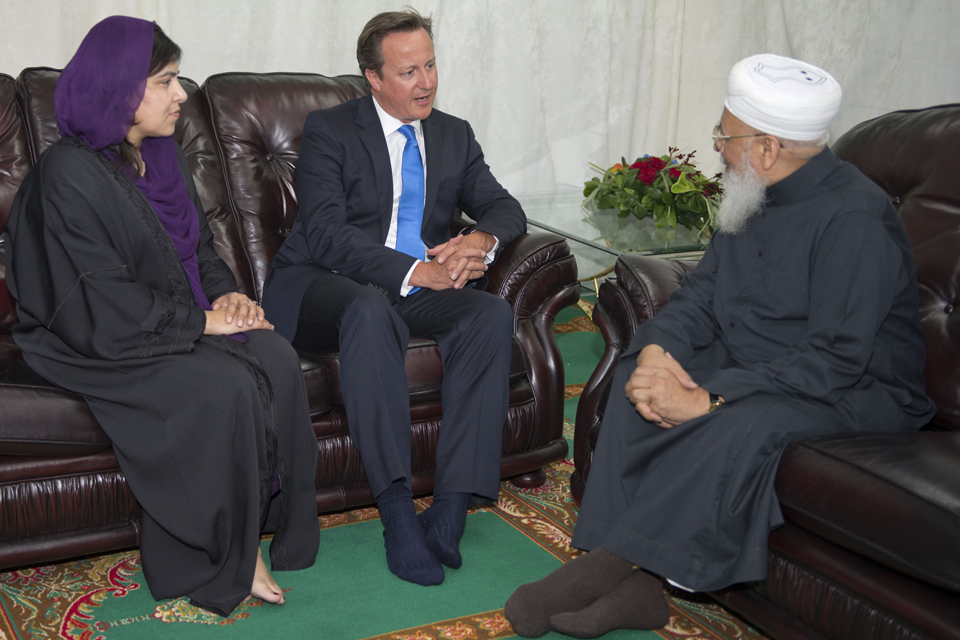
    The Prime Minister today (7 August 2013) visited the Jamia Mosque in Manchester as Muslims in the UK prepare for Eid 2013.

    David Cameron visits North Manchester Jamia Mosque ahead of Eid 2013

    The Prime Minister met senior members of the mosque, as well as members of the local community who use it.

    David Cameron visits North Manchester Jamia Mosque ahead of Eid 2013

    He wished ‘Eid Mubarak’ to them and the wider UK Muslim community, heard views on a range of issues and discussed the challenges and opportunities ahead.

    It was also an opportunity to recognise the positive response by the overwhelming majority of the Muslim community to the tragic death of Drummer Lee Rigby.

    David Cameron visits North Manchester Jamia Mosque ahead of Eid 2013
  • Click Your Fortune: TED-Ed’s choose-your-own-adventure look at career options

    By Logan Smalley

    Many of today’s top jobs didn’t exist ten years ago. According to this study from the U.S. Department of Labor, 65% of school-aged students will work in jobs and industries that haven’t been invented yet. Preparing students for their future careers is certainly not the sole purpose of education, but teachers and guidance counselors do strive every day to empower students in understanding and anticipating their post-graduation-options. But how? How can teachers help prepare students for careers that don’t exist yet? How do guidance counselors help students understand the jobs that are already available? And how do students, educators or counselors find out what jobs might be options in the future?

    There are many answers to these questions, and schools and education organizations have become increasingly resourceful in developing methods to set students up for 21st century success. However, according to many teachers and students in the TED-Ed community, there’s still work to be done to bridge the knowledge gap between what happens in school and what happens in the modern workplace.

    With this challenge in mind, TED-Ed set out to design an interactive, open-ended series that helps young learners find out more about careers they’re potentially interested in … and careers they simply never knew existed.

    The series is called “Click Your Fortune,” Above, check out the introduction….

    Click Your Fortune was created in the style of “choose-your-own-adventure.” Each video features four professionals (selected from among the awesome attendees of TEDGlobal 2013, as well as some TED speakers) reading career-related questions submitted directly by students. Once all four questions are read, the viewer can click the path that most relates to their interests.

    Students can also suggest questions, participants and careers to be featured in future videos. Yes, this series is a work in progress — because we believe it has to be. Career options change fast, and we want to ensure that the series is serving the actual, and always evolving, curiosities of young learners.

    The TED-Ed team is excited to get feedback from teachers and guidance counselors regarding the usefulness of this series’ approach. We’re also extremely excited to see some brave students already suggesting content for the next batch of Click Your Fortune Videos!

  • Since the TED Talk: Giles Duley launches “100 Portraits Before I Die”

    SinceTheTalk-GilesDuley

    “The thing about the intensive care unit is that the lights never go off and the noise is constant,” says photographer Giles Duley. He should know. After he stepped on an IED while on assignment in Afghanistan in 2011, he spent 46 days in intensive care in a hospital in his native United Kingdom. Forty-six days! That’s a horrifying amount of time. The usual ICU stint is a few days at most. Add to that the fact that Duley, who lost both legs and one arm in the blast, could only communicate by blinking his eyelids, and you have something of a real-life nightmare scenario. “During that whole time, they thought I wouldn’t make it, so my family would come in to say good-bye and I had no way of communicating with them. Obviously it was pretty scary,” he says. Gulp.

    To stop himself from being driven insane by the light, the noise and the fear while he lay in bed, Duley began a thought experiment. He’d photographed a bunch of celebrities in his time, and he’d also documented “the stories of the forgotten,” as he described in this TEDxObserver talk in 2012. Now he got to wondering who he’d shoot if he ever had the chance to pick up a camera again. “I made this fantasy list of 100 people,” he remembered in a recent telephone conversation. “Each time I came back to consciousness, I’d play one of those memory games. I’d try to remember the people on my list, and I’d imagine the shoot. And I always resolved if I did make it and found some way of taking pictures again, I would contact everyone on the list and see if I could take their portrait.”

    gino strada 14

    That time is now. Two years, 30 operations and a long rehabilitation later, his project, 100 Portraits Before I Die, is officially under way, and he has published the first two portraits — of Sudanese surgeon Gino Strada (above) and author Ben Okri. He’s not revealing his full wish list just yet, but he does share that future subjects include musician PJ Harvey and fellow war photographer Don McCullin.

    Most important to Duley is that this isn’t simply a list of random personalities. Instead, it’s a nuanced list of people who have had an influence on his life. That’s why actor Henry Winkler is there. “I was addicted to Happy Days as a kid; I watched it religiously,” Duley says with a laugh. “That might be cheesy, but this is a journey back through my life, a mosaic of people.” This combination of image and story makes the portraits both intensely personal and hugely powerful, a genuine collaboration between photographer and subject. Look at the expression on Strada’s face in the image above. The connection between the two is clear; this is a rare glimpse of pure intimacy.

    “They’re not doing it because they’re publicizing something they’re doing, or they’re trying to get something out of it. It’s a gift,” says Duley, who despite (or perhaps because of) his fashion and music magazine heritage shows robust disdain for a celebrity-driven culture in which someone is only deemed interesting because they have something to promote. “I don’t like the phrase ‘to take a photograph.’ A photograph is something that’s given to you. It’s a conversation between two people.”

    So far, everyone Duley has contacted has agreed to take part … all but one: the Beat poet Gary Snyder turned him down. “But the reason his agent gave was brilliant,” Duley recalls. “‘Gary is far too old and he lives far too out in the woods.’ That’s quite a lovely thing, isn’t it? ‘He lives far too out in the woods.’ I love that. That’s how I want to end up.”


  • To Move Ahead You Have to Know What to Leave Behind

    Decisions are the most fundamental building blocks of successful change in our organizations, our teams, and our careers. The faster and more strategically we stack those blocks, the faster and more successfully we achieve change. Yet, change efforts often stall precisely because those decisions don’t happen.

    The question is why?

    Avoid Changing By Addition. The Latin root of the word “decide” is caidere which means “to kill or to cut.” (Think homicide, suicide, genocide.) Technically, deciding to do something new without killing something old is not a decision at all. It is merely an addition.

    When an executive announces that her business will change to become a luxury service provider, technically it is not a decision until she also states that they will not provide low cost services to price-sensitive customers anymore.

    When a sales manager declares that his strategy this quarter will require his salespeople to spend more time strengthening existing customer relationships, he has only made an addition until he also declares that they should spend less time on something else like hunting for new prospects.

    Your palms might be sweating at the mere thought of telling your team to ignore some group of paying customers or to not spend time hunting for new business, even if you really want to see the change happen. Research has shown that making tradeoffs is so mentally exhausting that most people try to avoid them whenever possible. That’s why a manager who is no stranger to long hours and hard work will escape the discomfort simply by piling on new change objectives without killing any of the current priorities.

    But this change-by-addition approach can be a death blow.

    Avoid Trickle-Down Tradeoffs. When team leaders fail to decide which old directions are going to be sacrificed in service of the new direction, the tradeoff doesn’t magically disappear. It simply slides down the ladder. Instead of the team leader leaning into the discomfort and deciding once that the team is going to spend this quarter strengthening existing customer relationships, and not actively hunting for new prospects, each team member now has to decide for themselves whether to call on an existing customer or go find a new one every time they pick up the phone, open their email, or hop in the car.

    Trickle-down tradeoffs create two major problems for change efforts. First, they undermine team alignment toward the change. It is highly unlikely that each team member will independently arrive at the same conclusion about what to do and what not to do. Part of the team will choose to move in one direction while the other part moves in another direction — the very definition of misaligned.

    Second, psychologists have shown that making tradeoffs depletes our overall mental capacity and causes us to make poorer judgments in completely unrelated situations. This phenomenon is why otherwise healthy eaters end a long afternoon at the mall of choosing between stylish shoes and comfortable shoes by feasting on a hearty dinner of French fries and Cinnabons. They have no mental energy left to make good dieting decisions.

    Similarly, when your team has to spend a long morning making tradeoffs it leads to long afternoons of either staring at the wall and web-surfing, or making poor choices for their customers, their workloads, and their budgets.

    To Lead Is To Decide. Making change decisions is a cognitively and emotionally taxing activity that the average person will go to great lengths to avoid. While I have discovered some techniques for increasing the consistency and reliability of our decisions, there is no proven way of completely eliminating the discomfort of making tradeoffs. That might be a key element of what makes great leaders great. Great leaders and change agents have come in all shapes, sizes, colors, genders, and personality types.

    But the one thing they all seem to have in common — the one thing that distinguishes them from ordinary people — is their willingness to decide when others could not.

  • Phil Hansen channels your stories of limitations into art

    In this 16-minute documentary, artist Phil Hansen stands in front of a giant blank canvas with a Sharpie in one hand and his cell phone in the other. Soon, using just these tools, a detailed image emerges — one of three birds maintaining in choppy water.

    Phil Hansen: Embrace the shakePhil Hansen: Embrace the shakeWhen Hansen’s TED Talk, Embrace the Shake, was posted in May, he launched a Kickstarter campaign to fund a video about a new crowdsourced project. But he didn’t just ask people to contribute money — he asked them to contribute their personal stories. Hansen posted his phone number and asked people to call him and tell him a story of how they’ve faced a limitation. Hansen then took each story and converted it into sentence form — some letters spaced out, some clustered on top of each other. The dark and light of the letters of these stories is what forms this image.

    In total, 482 backers chipped in funds. But so many more called Hansen to tell him their story. In this documentary, we hear from several of them — a teenaged girl who was diagnosed with impulse control disorder at 10, a man whose father killed himself, a woman who married at age 17 and has felt isolated ever since. “Facing limitations is really a fundamental human experience,” says Hansen in the doc. “What came out of this project is that we all share similar struggles … There is beauty that emerges out of the turmoil.”

    So, why the image of the birds in water? The image Hansen created out of these stories is based on a photo he took years ago, shortly after he developed a tremor in his hand that led to him leaving art school.

    “This photo represents to me this ambiguous time in my life where I didn’t know where I was going or what I was doing,” Hansen explains. “When you’re far away from the picture, you see all these stories and fragments come together as part of a greater whole. And when then when you get close to it, the picture disappears and you’re able to read the stories and experience someone’s life.”

  • Strategic Humor: Cartoons from the September 2013 Issue

    Enjoy these cartoons from the September issue of HBR, and test your management wit in the HBR Cartoon Caption Contest at the bottom of this post. If we choose your caption as the winner, you will be featured in next month’s magazine and win a free Harvard Business Review Press book.

    PC Vey 1

    “Ann, you can see by the number of books behind me that I know what I’m talking about.”

    P.C. Vey

    Untitled2_grayscale.jpg

    Aaron Bacall

    Aaron Bacall

    Untitled2_grayscale.jpg

    Crowden Satz

    “Although our quarterly earnings dropped by twenty five percent, I feel compelled to point out that our Facebook likes have doubled.”

    Crowden Satz

    Untitled2_grayscale.jpg

    PC Vey

    “The kazoo isn’t the only instrument I play.”

    P.C. Vey

    Untitled2_grayscale.jpg

    Teresa Burns Parkhurst

    “Smithers, your input is vital here — it’s what we make fun of.”

    Teresa Burns Parkhurst

    Untitled2_grayscale.jpg

    And congratulations to our July-August caption contest winner, Gretchen Newby of Chevy Chase, Maryland. Here’s her winning caption:

    Susan Camilleri Konar

    “Owing to recent cutbacks, I can offer you only 2 1/3 wishes.”

    Cartoonist: Susan Camilleri Konar

    Untitled2_grayscale.jpg

    NEW CAPTION CONTEST
    Enter your own caption for this cartoon in the comments field below — you could be featured in next month’s magazine and win a free book. To be considered for the prize, please submit your caption by Monday, August 12, 2013.

    Paula Pratt

    Cartoonist: Paula Pratt

  • Positioning Synthetic Biology to Meet the Challenges of the 21st Century: Summary Report of a Six Academies Symposium Series

    Final Book Now Available

    The turn of the millennium brought a new research landscape in which the biological sciences are prominent and where technical possibilities once impossible are now attainable. Many disciplines, ranging from engineering to chemistry to social science, have all played important roles in shaping the biology of the 21st century. Biology is also now a global endeavor, with networking technologies enabling new sources of collaboration amongst multidisciplinary teams internationally. But the new century also carried with it new challenges, such as the ever-increasing world population. In the face of climate change, increasing food and energy needs, the dispersion of existing and emerging disease and more, lays a host of unanswered questions about how human and natural systems might offer solutions. Thus, scientists and engineers have looked to a young and potentially transformative field, synthetic biology, which seeks to accelerate improvements on how humans partner with nature to meet needs.

    Synthetic biology is an emerging discipline that combines both scientific and engineering approaches to the study and manipulation of biology. By asking different questions, synthetic biologists hope to improve our collective capacity to engineer customized biological systems designed to meet specific human needs and yield a deeper understanding of natural living systems. Although synthetic biology is young, the collective vision for the field is ambitious. As a better understanding of the global synthetic biology landscape could lead to tremendous benefits, six academies—the United Kingdom’s Royal Society (RS) and Royal Academy of Engineering (RAE), the United States’ National Academy of Sciences (NAS) and National Academy of Engineering (NAE), and the Chinese Academy of Science (CAS) and Chinese Academy of engineering (CAE)— organized a series of international symposia on the scientific, technical, and policy issues associated with synthetic biology.

    Positioning Synthetic Biology to Meet the Challenges of the 21st Century: Summary Report of a Six Academies Symposium Series offers an overview of the major topics addressed during the symposia, which included the development and potential of synthetic biology; an explanation of synthetic biology; and the agenda for each symposium.

    [Read the full report]

    Topics: Biology and Life Sciences | Engineering and Technology

  • Adapting to climate change in Pakistan

    Community led climate change adaptation

    Climate change has already created many issues for communities around the world, perhaps no more so than in Pakistan. Productivity of crops is at risk of decline due to increasing land desertification, increasing temperatures and loss of soil fertility. This sort of vulnerability makes adaptation to climate change a priority for the farmers in Pakistan. The country has a national climate change policy that was developed taking into account increasing incidence of floods especially during the monsoon season period. However, progress has been slow. Meanwhile, communities at the local level across Pakistan are continuing to be put under pressure and  affected by  climatic events, including monsoon rains and droughts. Action at the local level can help deal with the short-term effects of climate change.

    Farm destroyed by flood. Picture: LEAD Pakistan

    Local Adaptation Plan of Action

    A Local Adaptation Plan of Action (LAPA) is the community planning and action tool which aims to look at implementation of practical solutions to specific climate-related impacts affecting the communities for whom they are developed. LEAD Pakistan, in partnership with LEAD International and 45 partner organisations across the provinces of Sindh and Punjab in Pakistan, are pioneering the use of this social yet scientific approach in 12 districts to develop LAPAs, most recently for Shaheed Benazirabad district in Sindh during a workshop in Karachi.

    30 participants (10 women, 20 men) worked through 8 tools designed by LEAD Pakistan to arrive at a practical  solution with impact to a relevant climate change problem in their local area around the town of Nawabshah. Before arriving at the workshop, local organisations had conducted a vulnerability assessment of the area and focused group discussions with residents to ascertain the most pressing issues. For example, there has been concern about the spread of waterborne cattle diseases increasing with flooding. These issues were analysed through the first sessions of the workshop in terms of their priority, intensity, support and reasoning to arrive at the one most appropriate for local action. In this case the irregular pattern of monsoon rains causing disruption to production of rice and cotton, either by flooding the fields or by heavy uneven rains, was identified as the top priority.

    Picture: LEAD Pakistan

    After the discussion on this issue, 3 potential solutions were proposed: 1) alternative crops; 2) better field drainage; or 3) early warning weather forecasting system. These were then analysed using similar techniques to the issues according to their positive and negative aspects, available resources, risks, and socio-economic benefits. The most effective solution identified after this process was to introduce alternative crops replacing rice and cotton in the local farming system.

    Finally, the participants evolved a project plan for this purpose involving the selection and training of beneficiaries and also consulting with other stakeholders like local government. This  plan was then presented to the local government officials. Encouragingly, after a slow start, the officials became animatedly involved. They were convinced of the benefits of such a project and proposed which type of alternative crops would be best suited to the local situation (an area where the LAPA development group were unsure).

    Micro-project

    LAPAs, therefore form the basis for relatively low cost projects with high impacts at local level. With government buy-in, the success of such a project could have a significant impact on the livelihoods of an entire district.

    Villagers who have been displaced by floods wade through floodwaters as they return to their flooded town of Khairpur Nathan Shah. Picture: LEAD Pakistan

    A LAPA developed earlier in the year by Muzaffargarh district in Punjab has now completed the first phase of its implementation with the construction and cleanliness of salinity drains to deal with increased soil salinity. This is a serious issue in the district where unpredictable rainfall, coupled with insufficient drainage, means that the natural salt stays in the soil and affects crop yields. Despite some initial delays due to harvest season and  elections in Pakistan, LEAD Pakistan’s partner organisations have moved forward selecting their beneficiaries and running preliminary awareness sessions. They have even drawn the interest and subsequent involvement of the local forestry department to increase the impact of their work by planting trees near the project sites. They hope that this example of additional and unforeseen benefits will be the good trend with such projects, leading to a more resilient Pakistan.

    LEAD International is the world’s largest NGO focusing on leadership for sustainable development with programmes in 12 countries/regions. Together with LEAD International, LEAD Pakistan has delivered this project since 2011, concluding in 2015. This project is funded by the UK Department for International Development (DFID) as part of the Civil Society Challenge Fund. For more information about the project, please contact Haseeb Kiani or Nosherwan Shahid Sheikh, at LEAD Pakistan ([email protected], [email protected]).

    Over the next few weeks we’ll be highlighting our development support to Pakistan and how we’re helping to push for change. We’ll be linking up with partners from across the British Pakistani community who are making a huge contribution to Pakistan’s development and promoting the positive voices for progress in country.

    To get the latest Pakistan development news straight to your inbox sign up for our quarterly newsletter.

    —————————————————————————

    Please note, this is a guest blog. Views expressed here do not necessarily represent the views of DFID or have the support of the British government.


  • Twenty-second Interim Report of the Committee on Acute Exposure Guideline Levels

    Final Book Now Available

    In 1991, the Environmental Protection Agency (EPA) and the Agency for Toxic Substances and Disease Registry (ATSDR) asked the National Research Council (NRC) to provide technical guidance for establishing community emergency exposure levels for extremely hazardous substances (EHSs) pursuant to the Superfund Amendments and Reauthorization Act of 1986. As a result the NRC published Guidelines for Developing Community Emergency Exposure Levels for Hazardous Substances in 1993 and Standing Operating Procedures for Developing Acute Exposure Guideline Levels for Hazardous Substances in 2001; providing updated procedures, methods, and other guidelines used by the National Advisory Committee (NAC) on Acute Exposure Guideline Levels (AEGLs) for hazardous substances for assessing acute adverse health effects. Stemming from this report the NAC has developed AEGLs for at least 270 EHSs.

    There are currently three AEGLs: AEGL-1, AEGL-2, and AEGL-3. AEGL-1 is the airborne concentration of a substance above which it is predicted that the general population could experience notable discomfort, irritation, or certain asymptomatic nonsensory effects. These effects are not disabling and are transient and reversible once exposure is stopped. AEGL-2 is the airborne concentration (of a substance above which it is predicted that the general population could experience irreversible, long-lasting adverse health effects or an impaired ability to escape. AEGL-3 is the airborne concentration of a substance above which it is predicted that the general population could experience life threatening health effects or death.

    On April 22-24 2013, the NRC-established Committee on Acute Exposure Guideline Levels 2013 met to review AEGL documents approved by the NAC. The committee members were selected for their expertise in toxicology, medicine, industrial hygiene, biostatistics, and risk assessment. Twenty-second Interim Report of the Committee on Acute Exposure Guideline Levels presents a review of AEGLs for various chemicals including acrylonitrile, halogen fluorides, tellurium hexafluoride, and thionyl chloride.

    [Read the full report]

    Topics: Environment and Environmental Studies | Health and Medicine

  • TED News in Brief: Jeff Bezos buys The Washington Post, Alex Odundo plans a makerspace in Kenya

    Over the past week, we’ve noticed a lot of fascinating TED-related news items. Here, some highlights.

    Jeff Bezos, the co-founder of Amazon (watch his TED Talk), made waves on Monday when it was announced that he will buy The Washington Post for $250 million. “The paper’s duty will remain to its readers and not to the private interests of its owners. We will continue to follow the truth wherever it leads,” he writes to the staff of the paper in an open letter. “Journalism plays a critical role in a free society, and The Washington Post — as the hometown paper of the capital city of the United States — is especially important.”

    Yves Rossy, aka “The Jetman” (watch his talk), made his first flight in the US last week, zooming through the skies alongside a B-17 bomber during the Experimental Aircraft Association’s AirVenture show in Wisconsin. Good Morning America aired a clip of the daredevil in action.

    Steven Johnson (watch one of his three talks) is making a new television show. How We Got to Now with Steven Johnson will air on PBS in fall 2014. As he writes, “Each hour-long episode takes one facet of modern life that we mostly take for granted — artificial cold, clean drinking water, the lenses in your spectacles — and tells the 500-year story of how that innovation came into being.”

    A TED Talk published last week showed how the high tech of Formula 1 race cars is being used to save babies. Today, in The Guardian, read how the technology that helped find Osama bin Laden is now being used to prolong the shelf life of cakes.

    TED Fellow Alex Odundo has started an Indiegogo campaign to create a makerspace in Kisumu, Kenya. He tells the TED Blog, “The makerspace [will] help innovators, engineers and designers who have good ideas to walk in and be offered the tools to do their work … and to test and produce products.”

    Mathematician Steven Strogatz (watch his talk) is the Very Important Puzzler in the newest “Ask Me Another” radio quiz show on NPR — which also features our contributing editor, Ben Lillie, in his role as curator of the Story Collider.

    During the 2009 G20 summit protests in London, a man named Ian Tomlinson was killed by the Metropolitan police. His death was at first claimed to be by natural causes — until The Guardian sourced and published amateur footage with evidence to the contrary. After a four-year battle led by his family, the police have finally acknowledged for the first time that an officer unlawfully killed Tomlinson. This is, once again, thanks to the work of citizen journalism advocate Paul Lewis. (Watch his talk—he specifically mentions this case.)

    On PBS.org, Larry Kotlikoff gives an interesting analysis of “generational accounting” — the various ways that local governments in the US cook their books to hide the cost of future liabilities, like pensions. Bill Gates called out the problem in this TED Talk, which focused on how state governments pay their retirees and short their schools.

    Here’s what happens when Sir Ken Robinson (watch his most recent TED Talk) and Disney/ABC Television Group President Anne Sweeney get together for a porch-side conversation about education, imagination and Obi-Wan Kenobi. Read this double interview via Fast Company.

    EuroNews.com profiles TED Prize winner Sugata Mitra (watch his talk) to explore his ideas of self-organized learning.

    Caitria and Morgan O’Neill, who together created the natural disaster management system Recovers.org (watch their talk), were honored as one of seven Champions of Change at the White House. Read about it on their blog.

    Damon Lindelof, the writer of Lost and Prometheus (browse his playlist of five favorite TED Talks), speaks to Vulture.com about the race for bigger and better destruction moments in summer blockbuster movies. Is it a good thing?

    While the US’ Discovery Channel was criticized for its Megalodon special earlier this week — a piece of speculative fiction marketed as fact — there is some accurate shark information on offer during Shark Week. TED speaker Greg Stone (watch his talk), who’s been called the Indiana Jones of the Ocean, will appear twice on August 8, once at 10pm Eastern, on “Alien Sharks of the Deep,” and then at 11pm EST, on “Shark After Dark.”

  • If Your Leader Departs, Preserve the Company’s Story First

    We’ve all heard some version of this story: a brash and charismatic leader creates a runaway business success. The press can’t get enough of him. And people can’t seem to buy the products fast enough. The board and shareholders, enjoying the dizzying ride, are happy to look the other way if some of his antics sometimes seem… unconventional.

    And then disaster strikes.

    The leader dies, or gets ousted, or just gets bored, or gets old and decides to step back. After the initial shock, the company resolves to soldier on. A professional manager with an impressive resume is brought in. And the mantra is “our success is due to more than one person. This is a team effort.”

    And things actually go okay at first.

    But as time passes, it becomes clear that something is wrong. You can feel the momentum waning. Key talent gets poached, and new products don’t seem to have that old snap. The whispers begin that the company has lost its way. The press piles on. The share price plummets. The company stumbles, and is either gobbled up by a competitor or it just slowly drifts off to sleep and eventually disappears. I’m sure you have several recent examples of companies that are somewhere along this trajectory in your head right now.

    If this scenario is really as common as it seems, why don’t we know more about how to prevent it? After all, given the potential value to shareholders of solving a problem like this, you would think that corporate boards would think of almost nothing else.

    But they are focused on the wrong thing. When looking for a replacement for a charismatic leader, they look for someone with an impressive résumé instead of someone who understands the power of story. You can survive losing a leader. But if the underlying story the leader was living gets lost, you are in deep trouble.

    Charismatic leaders are charismatic because they are the living embodiment of an inspiring and universal human narrative. Branson and Kelleher are mavericks thumbing their noses at convention. Dorsey and Page are the boy geniuses inventing the future. The companies these innovators run make useful products and services to be sure. But they also make something even more important for their customers — they make meaning. These companies embody a story that everyday people can find inspiration in for their own daily lives. It is this deeper narrative that creates real loyalty and authentic evangelism. Preserving this narrative shouldn’t be an afterthought; it should be a company’s first priority.

    Some companies succeed at this, some don’t. And some, like Ford Motor Company, have managed to do both.

    When Henry Ford developed the assembly line, he ushered in the era in which middle-class Americans, not just the wealthy, could buy an automobile. In an instant, Ford’s narrative and America’s — freedom, ingenuity, self-reliance and optimism — were bound tightly together. And this powerful narrative didn’t die with Henry. In fact, it flourished under a series of leaders who understood the story and kept it alive with successive waves of innovation and improvement.

    But starting in the 1990s, and through much of the 2000s, Ford strayed from its core narrative. The professional managers in charge weren’t students of story. They were students of spreadsheets, and short-term profitability. This resulted in a series of distracting acquisitions, and products that were drab, uninspiring, and poorly made. For those with a desire to dig deeper, this book chapter is particularly illuminating.

    Blame was placed on a number of things: high pension costs, changing tastes, and a weak economy, to name a few. But the last statistic in this article from the early 90s hints at a different story: American car buyers, embarrassed and disgusted at the state of Ford and other American car companies, were turning in droves to imported cars, particularly from Japan — cars built and sold by companies that were acting more American than American car companies. Ford worked to address the quality issues but this takes time, and time was ticking away. As the crisis deepened, Ford began to hemorrhage money, posting astonishing losses by the mid-00’s. Some began to whisper about what had once seemed unthinkable: the end of the road for Ford.

    It wasn’t until 2006 that Bill Ford (Henry’s great grandson) and the board of directors found a leader that understood the Ford narrative and knew how to act Ford-like again. Alan Mullaly, an aviation engineer from Boeing was a guy with the right stuff. He and his team set about building higher quality products (a baseline necessity), and, notably, taking public responsibility for missteps.

    But the breakthrough moment came when Mulally and his team opted not to take any of the auto-bailout money that the U.S. government was offering. This excellent video summarizes the whole story. Ford under Mulally started to feel American again. Suddenly, the company was recognizable again to American consumers. It was like an old friend emerging from a coma. You could feel confidence in the company returning. And the revenue followed.

    Mulally, undoubtedly a talented leader and manager, was the instrument of Ford’s resurgence, for sure, but Ford’s success is really about something deeper — a return to that central narrative that is so inspiring to millions of Americans: “Americans innovate. Americans take responsibility for their actions. Americans don’t take handouts.” It’s not the person that inspires us, it’s the narrative.

    This core narrative is what allows us to apply that meaning to our own lives. It makes us proud (or embarrassed) to drive a Ford. That narrative doesn’t have to be lost when the leader is gone, so long as the narrative is well understood, codified and preserved, and made actionable by people at every level of a company.

    This codification takes focus and discipline. This is not about creating a mission statement by committee and carving it in a wall somewhere. It is about unearthing the authentic narrative that drove the company to its current success, and will also motivate the company’s actions moving forward. And it is about working with people throughout the enterprise to apply the story to their area of specialization: product development, HR, sales, and, yes, marketing.

    Companies that anticipate the need for a successor to a charismatic founder or leader should take the time to do this work in advance. Take the time to understand the narrative that the leader is living — what they really symbolize. Codify the narrative and share it with prospective candidates. Work with them to explore ways that the company can act upon the narrative in the future. Build a map of iconic first actions that the incoming leader will undertake that support and extend this narrative. By recruiting a leader who is truly committed to understanding and advancing this core narrative, companies will set themselves up for an easier transition and greater future success than those that do not.

  • Chewing Gum Helps You Sustain Vigilance in a Long Task

    At the beginning of a 30-minute computer-based vigilance task, the average reaction time of participants who were chewing gum was about 70 milliseconds slower than that of non-chewers, but by the end, it was about 100 milliseconds faster, suggesting that chewing gum can stem a decline of vigilance over a long task, says a team led by Kate Morgan of Cardiff University in the UK. Gum chewing has been shown to increase blood flow to the frontal-temporal region of the brain.

  • Advertising’s Big Data Dilemma

    The proposed merger of ad industry giants Omnicom and Publicis, forming the world’s largest advertising firm, promises to change the face of Madison Avenue forever.

    So long, Don Draper. Hello, Hal 9000.

    It’s understandable why two giants of traditional advertising would pursue such a consolidation — to better do battle against Google and Facebook, relative newcomers to the ad game but already upending the entire business dynamic by using Big Data analytics to create highly targeted ads.

    But an algorithm can never truly master the art of persuasion.

    Traditionally, the heart of any successful advertising agency has always been its creative department. During the heyday of Madison Avenue, in the late 1950s and into the 1960s, a wave of young art directors and writers used wit, energy, and style to usher in the era referred to as the Creative Revolution.

    Consider one of the classic examples from the period: in 1955, a minor brand of cigarette aimed at women smokers tapped the Leo Burnett agency to revamp its brand. Burnett and his team might well have turned to the data available at the time on female smokers. Instead, they recognized an opportunity to tell a new story, one that tapped into the cultural zeitgeist, a sense of confusion and loss about American masculinity. The advertising campaign featured a rugged cowboy on horseback, an uncompromised man struggling not with a demoralizing bureaucracy but with the forces of the natural world. He smoked a cigarette “designed for men that women like.” The Marlboro Man was born.

    This is the art of persuasion. Great marketing and advertising campaigns are exquisitely attuned, not to past behavior, nor to individualized needs and desires, but to the larger cultural zeitgeist. Great advertising speaks to our deepest fears and desires, it answers to our nascent yearnings. Perhaps most importantly, it acknowledges that the majority of our decisions are social: we do things within the context of our communities and we get swept away by the mood of our times. From Volkswagen’s “Think Small” print ads to Apple’s groundbreaking “1984” television commercial — directed by Oscar-award winner Ridley Scott — to Nike’s “Just Do It” slogan, persuasive advertising campaigns have left an indelible mark on our public imagination.

    Big Data analytics simply can’t address us with this kind of depth, the full context of our lived reality. Take a recent example with Boston potholes. An app called Street Bump was designed to collect smartphone data from the city’s drivers. The idea was to collect information about pothole repair at a low cost. Unfortunately, the app had difficulty distinguishing between bumps in the road, manholes, and potholes, and, as a result, the Office of New Urban Mechanics received an overwhelming amount of false positives. Even more problematic, by relying only on feedback from the app, Boston was not receiving any information from neighborhoods where the residents didn’t own smartphones. This skewed the objectivity of the data received.

    This kind of “skewing” is always happening with data. Despite what we are told, data is never objective, never free of bias. Kate Crawford, researcher at Microsoft, calls this problem “Big Data fundamentalism — the idea that with larger data sets, we get closer to objective truth.” Aggregator sites, seemingly objective, are designed with built-in assumptions. They assume that the frequency of your clicks is the same as your level of interest or the degree to which the material “moves” you. But only our fellow humans will ever really understand what we care about. Our care — our deeply felt investment in the world — is always context dependent.

    What is the role of Big Data in the future of advertising? Data analytics plays a part in informing a successful marketing strategy. According to the chief executive of one of the industry’s major data marketing companies, advertisers can determine, in milliseconds, whether someone looking for a car is a “luxury” or “used car” buyer, and based on that information, they can determine whether to even display an ad or not. If your problem frame is simple and straightforward — “I want to reach a consumer who buys luxury cars in order to entice them to buy my luxury car — these types of targeted ads could do very well for you.

    But what if your problem frame is not straightforward? What if, like Marlboro or Nike, you are trying to illicit a new emotional response from your consumers? What if, like Volkswagen, you feel that your product could thrive in an entirely different kind of market? What if, like Apple, you are trying to lead, not follow the decisions of your consumers?

    To address a more complex problem frame, you need a more complex piece of technology. In these situations, an algorithmic business model based on Big Data analytics — if this, then that — is not going to provide you with the greater insight or perspective. It certainly isn’t going to create a strategy or a campaign. For any of the above, you are going to need the human mind.