Category: News

  • Lowe’s Wins Vine with 6-Second Home Improvement Vids

    Twitter’s 6-second video app Vine is proving itself quite versatile. We’ve seen it used for promotion, politics, comedy, game teasers, short films, and even as a real-time news medium during the Boston Marathon bombings.

    But with the help of their ad agency, New York’s BBDO, Lowe’s has embraced the new 6-second video medium in a totally unique way. The home improvement chain has turned the short videos into fast-paced but informative how-to videos concerning everything from removing a stripped screw with the help of a rubber band, to cleaning your rusty knives in a lemon juice bath.

    “Historically the category can be thought of as incredibly complicated. We sell products but those products are components to a project, and a consumer needs all the information on how to complete the project,” Tom Lamb, CMO at Lowe’s told AdAge. “What consumer behavior is forcing us to do is learn to be incredibly concise. We’re making an effort to demonstrate that we know a little bit, so [consumers think] it’s worth seeing what else we know on our site and in store.”

    Not only are they well-executed and informative, but it’s a great way to not only provide an actual service, but to promote the brand and make something worth sharing too.

    Here are some of Lowe’s awesome home improvement Vines, aptly titled #lowesfixinsix:

  • The journey is its own reward: Fellows Friday with Kellee Santiago

    journey-game-screenshot-1-b

    TED Fellow Kellee Santiago has won numerous awards for the video game, “Journey.” Here, we talk to her about her craft.

    In recent months, That Game Company’s downloadable PS3 game Journey has swept up an armload of awards — the Game Developers Choice Award for Game of the Year and BAFTA Video Game Award for Best Game Design, to name just two — not to mention a Grammy nomination for Best Original Soundtrack. Company co-founder and TED Fellow Kellee Santiago tells us why she believes this remarkable game is touching so many people’s lives, what it might mean for the future of gaming. Bonus: we ask what’s next on her own horizon.

    This is a lot of awards  at once, isn’t it? How does it feel?

    It’s been totally amazing. We did have a good feeling about Journey: the responses we got last year just from our players was totally overwhelming — people really felt they were able to have personal catharsis through it.

    By December, which marks the beginning of game awards season, we’d already been getting so much good attention already — people doing costume plays of the characters, making videos, playing the music on YouTube. So we suspected Journey might get nominated as a stand-out game of the year, just as Flow and Flower, our previous titles, had. But amazingly, it also started showing up in best game of the year categories, as well as best story and best soundtrack and graphics, which put Journey in the same category as what’s known as triple-A games — the video equivalent of blockbuster movies — the high-budget disc titles like Halo 4 and Mass Effect 3, Borderlands 2 and Dishonored. Seeing Journey in along with them was amazing. Then we started winning, which was really unbelievable.

    I think it really speaks to a shift happening in the games industry around the idea of who can make a quality game, and what defines a quality game experience. The emphasis wasn’t on hours of gameplay or weapon-changing abilities, but on personal, deep experiences.

    Tell us about the game experience.

    In the game, the player is a robed figure. You wake up in the desert, and you see this giant mountain in front of you. The goal of the game is to go on this journey to the mountaintop — very much inspired by Joseph Campbell’s hero’s journey structure.

    On each level you’re exploring what appears to be a ruined civilization. You’re in this long robe, and when you encounter pieces of cloth, they can give you energy. And that energy you can use to fly, not infinitely, just for short periods. And you can build upon your ability to fly. But the idea is that cloth is really the only living thing in this desert environment. And as you move through the world, you encounter more complex life forms of cloth, and you start to learn more and understand more about this civilization and what happened there.

    It takes about 90 minutes, maybe two hours, to play. We wanted to allow people to play through in one sitting.

    journey-game-screenshot-10-b (1)

    How does the multiplayer aspect work?

    As you’re going on this journey through different environments to the mountaintop, you can encounter another robed figure like yourself, and that is another real person. We don’t have an AI system, as some people think. It is always just a one-on-one connection, to give you this feeling like you’re in this vast world. So when you happen upon another person, it’s very significant.

    One of the goals was to make an online console title that actually made you feel connected to another person, as opposed to the traditional online console gaming experience in which you start up a competitive, usually fighting or shooting game, and get yelled at by people from across the world.

    In Journey, there’s actually no language, no voice chat system, and no in-game messaging. You’re also totally anonymous — you don’t have a user ID or a name, nothing that could take you out of the world that we were creating, which also leaves it totally open to players of any age and also from anywhere in the world. Because we don’t rely on language, we can actually have a global server, so you could be playing with someone who doesn’t even speak the same language as you. Yet you share the experience.

    Then do you have to play the game together?

    You don’t have to. People have different play styles: I could be really into exploration, and they just want to go around and collect everything — then we’d naturally separate and be disconnected and left open to connect with someone else. This offers an organic way of players finding players who are similar to them.

    journey-game-screenshot-9-b

    How do the players communicate?

    The only way of communicating is through a shout or call system. When you press a button on the controller, you’ll make either a tiny shout or a large call. It can act as a way of saying “Hey, I’m over here!” if you’re in the level but can’t see each other very well. But when two people initially find each other, they “speak” in lots of short chirps. It’s amazing how much actually people can communicate this way. It gets enough across, I guess.

    Is there no way they can ever find each other in the real world?

    We’ve struggled with this, because from a game design stance, it can be very powerful to allow people to invite friends to play. But we felt the anonymity was really important, because the game is about humanity in general, not the specifics of this particular person. But if you play through the entire game, it’ll take you back to where you started again. At that moment, it will show you the other journeyers you encountered along the way, so people have connected to one another through the Playstation network messaging system afterwards.

    There’s also a Tumblr blog actually called Journey Stories, where people post their experiences of playing and try and find each other if they’ve had a particularly moving experience with someone.

    But it’s funny to think about how originally it was really just a theory when 13 of us were developing the game. We really felt that simply moving through these environments with another person would be something really compelling to share online. I guess it turned out that we weren’t alone.

    Is it meant to be played again and again?

    Yes. There are collectibles that you can go and get through multiple playthroughs. But mainly people play again because the environments are beautiful and it’s a really interesting place to be — and you can always encounter another person. That really does change your experience every time.

    So even though you know what you’re going to encounter at the end, it’s still worth exploring and making contact with somebody else.

    Yeah. A metaphor we used a lot during development was hiking — especially that feeling like we can pass each other on a busy street in an urban environment, we don’t even recognize each other. But when you’re out hiking somewhere, when you see another person, you feel a connection to them. And everyone’s pretty nice usually when you go out hiking. I’ve hiked in Griffith Park on some of the same trails many, many times now because I live right here, but it’s still a beautiful place to explore. I’ll still go back to it.

    journey-game-screenshot-18

    You’re no longer with That Game Company. What happened, and what are you up to now?

    We pretty much disbanded after Journey was shipped, about a year ago. It had been six years, and myself and co-founder Jenova Chen and the other people that had been there for a while, we had just really grown and changed. Your art imitates your life, and it was true for every single one of our games, and Journey was no exception. Jenova said in the acceptance speech that he gave at GDC that, if you played through Journey, you’d understand our own struggles as well. It reflects everything we were going through.

    So when it was over, it was time for us to hit the start-a-new-journey button, like we have in the game. I didn’t know what was next. In games, I love the practice of game development and game design, but I’m also passionate about empowering different voices in game development to be successful so that we can have a wider variety of experiences in games. I’m interested in how our business model can impact that. Because the games industry is relatively young, there’s still much room to change that and switch it up. I’ve been doing that also with an angel investment fund called Indie Fund, which I co-founded in the beginning of 2010.

    My period of exploration vacillated between both. But I thought that in order to really impact the finances and the business model of the games industry, I would ultimately have to go work for one of the large studios or large console manufacturers and work my way up to being in a position of power. I got connected with Julie Uhrman, who’s the CEO and founder of Ouya, which I joined as Head of Developer Relations a month ago. Ouya made a lot of waves last year. They ran a very successful Kickstarter campaign: making $8.5 million dollars for a new console, which is crazy. It could have only worked on Kickstarter: investors were just laughing them out of the room. No one wanted to get into hardware manufacturing.

    With Ouya, I really feel there is an opportunity to have all of the accessibility for development that mobile devices and PCs do, but in the living room — still have developers be able to develop a variety of gaming experiences, but with all the ease and openness of a platform that’s been provided through App Store and Google Play. That really excites me.

    Any regrets?

    That we lost the Grammy to Trent Reznor. But that’s OK.

  • Katherine Russell Tsarnaev: Wife Refuses to Talk About Bomber

    Ever since Boston police identified the Boston Marathon bombing suspects as Tamerlan and Dzhokhar Tsarnaev, authorities have been digging into the brothers’ pasts to learn why they wanted to hurt people at the finish line of the marathon. In addition to finding out that over $100,000 in government assistance has gone to the Tsarnaev family, authorities found female DNA on bomb parts recovered at the scene of the bombings.

    Now, The New York Times is reporting that Dzhokhar has revealed some of the bombing plot to the F.B.I. From his hospital bed, the alleged bomber told police that he and Tamerlan had originally planned to plant their bombs on the Fourth of July. Their bomb-making proceeded more quickly than planned, and the Boston Marathon was chosen as the target. Dzhokhar also reportedly stated that the bombings were partly motivated by the U.S. wars in Iraq and Afghanistan, and that he and his brother had viewed online sermons from Anwar al-Awlaki, an American cleric.

    Intense scrutiny of Tamerlan’s wife, Katherine Russell has also begun. She has retreated to her family’s home in Rhode Island since the bombings and is caring for her and her former husband’s 3-year-old daughter. Tamerlan died in a shootout with police shortly after the Tsarnaev’s pictures were released in connection with the bombings.

    The Times cites two unnamed “law enforcement officials” as saying the fingerprints found on the bomb materials were not Russell’s. Even so, authorities have stated that Russell is no longer cooperating with the investigation.

    The investigation into Russell’s relationship with her husband has uncovered that she was arrested in Warwick, Rhode Island in 2007 for stealing $67 worth of clothes from an Old Navy store. Her mugshot (seen above) has been released by Warwick police.

  • Everyone! Look! Acer!

    DSC00337

    When was the last time you talked about Acer? Never? Me too. The company, which is the fourth largest PC maker in the world by the way, announced the Acer Aspire R7 this morning. It’s a mighty morphing Windows 8 portable. Like the Lenovo Yoga, it features versatile hinges that allow the computer to take different forms.

    The Aspire R7 is not the next big thing. No one is going to buy this thing. But that’s probably just fine.

    The Acer Aspire R7 is a halo device. It’s an attention grabber. It’s advertising in the form of product. It’s Acer’s proof to the other big players and startups alike that the company can still hang. It’s designed to sit pretty in the showroom window and entice buyers to come inside to the dealership. It is, in automotive terms, the Chevy Corvette of Acer’s lineup.

    Dealerships prominently position the Corvette outside their doors. It’s not around back with the Chevy Econoboxes. It’s right out front. It draws attention. It gets buyers near the door and talking about the brand. It will never outsell the Impala. In fact it’s designed to help sell the Impala.

    Expect to see the Acer Aspire R7 on electronic store retailers’ end-caps and nowhere else. Just maybe, with this hot portable occupying prime real estate in Best Buy, more buyers will view Acer as a serious computer company rather than a list of competitive specs available at good price.

    Every company produces these high-end products to get the blood moving again. Remember the Dell Adamo XPS? That $2,200 netbook was once displayed at CES on a turntable protected by a bulletproof cube of glass. It was “technically” available for sale, but Dell didn’t expect it to sell en masse. Sony had the uber-high end Qualia line from 2003 to 2005. With prices ranging from $1,400 (MiniDisc player) to $25,000 (SXRD video projector), these products were more of a design exercise than legitimate push into the upper echelon of consumer electronics.

    Back to Acer.

    The company’s Wikipedia page says it best: Acer sells “inexpensively-targeted” computer electronics. The products are available from nearly every retailer. Acer is, in short, the Lee Jeans of computer: They’re perfectly acceptable, available at Walmart but not a brand that generates excitement.

    Now there’s the Acer Aspire R7. The Internet is excited about this computer. Gizmodo says they’re not ready for its level of crazy. But crazy is good. Crazy gets attention. And crazy sells.

    Acer is losing marketshare. The company was the second most prolific computer maker in 2009, second to only HP in global sales. It ended 2012 in fourth place, after HP, Lenovo, and Dell. Worse yet, sales and shipments are still trending down.

    The consumer marketplace has changed a lot since Acer was near the top. Like Giz said, we’re not ready for the R7′s radical design. But I for one can’t wait to see what else the firm is capable of producing. I would be totally on board with a similar Windows 8 computer albeit one that’s a touch less crazy. And now I’m looking to Acer to provide that where I wouldn’t have even considered the company before.

    Oh, and Acer did announce new lower-end notebooks today. Engadget covered them. They’re good, but nothing exciting — which is just about right for Acer.

  • How to protect your company against vanishing cloud services

    When your cloud provider closes up shop without warning — like cloud database Xeround did earlier this week — a two-hour outage suddenly doesn’t look so bad. Thankfully, the marketplace for business-focused cloud services has to date been relatively free of such sudden closures (the consumer space not so much), but one has to assume Xeround won’t be the last to fold.

    Think about how many other cloud database services, platform-as-a-service offerings and — if you can count that high — software-as-a-service applications have launched in the past few years. If the 75-percent-of-all-startups-fail statistic applies equally to cloud computing as it does to other sectors,  we’re about to see a lot more sad emails to users warning them to move their data or find a new provider within the next month.

    It sucks to think of adopting a new, presumably useful service as a significant risk, but that’s exactly what is if your data is trapped in some proprietary format or can’t be easily exported. The tide may be turning, though.

    We can’t recreate cloud services, but maybe we can extend their lives

    According to Mike Driscoll, founder and CEO of cloud-based analytics service Metamarkets (see disclosure), one of the major problems with cloud services is today is that they’re just not designed to be easily replicated. This creates problems when customers — particularly large enterprises — approach cloud providers with contractual conditions that harken back to the era of actual on-premises software. Essentially, they want the cloud version of a software escrow account that would place the service’s source code with a trusted third party and, should the company cease operations, would allow the customer to keep running the service on its own infrastructure.

    For now, the response has been to push back on those requests because it wouldn’t really be possible to run the service anywhere other than where it’s currently running. Driscoll said many SaaS applications today — his own included — are “fairly monolithic in the way they’re architected,” which means there’s a strong dependency between the applications and the cloud operating system on which they’re running. He thinks it’s possible that hybrid cloud deployments could help solve the problem (e.g., what OpenStack, Cloud Foundry and Amazon-Eucalyptus theoretically would allow for), but that a feasible hybrid model is probably a few years out.

    However, services like Metamarkets, also require a centralized data model (a la Bloomberg terminals) so much of the value is lost if customers all run their own versions on their own servers. For situations like this, he’s heard it proposed that service providers could put cash rather than software into an escrow account, and the cash would pay for a skeleton crew to manage the service for a year, let’s say, so customers would have ample time to find an alternative.

    A screenshot of the Metamarkets service

    A screenshot of the Metamarkets service

    Until things some of these mitigation strategies get figured out, it’s probably more of the status quo for cloud adoption. Small businesses will likely assume more risk and rely heavily on cloud services, while larger companies will use them for non-mission-critical applications or when they’ve received adequate assurances of security and stability. “When you’re GE or JPMorgan,” Driscoll said, “you’re never going to create a dependency on any application that can just get unplugged.”

    How insurable are you and your cloud provider?

    Maybe the answer is to adopt but protect. I used Xeround’s closure as a reason to catch up with CloudInsure, a cloud-ratings firm that I first covered as it was just starting in 2011. The idea behind the company is to serve as an actuary for insurance providers that want to get into the business of insuring cloud computing customers like they previously have with managed hosting customers and general purchasers of IT equipment.

    The way it works is by analyzing some 140 factors about both the user and the cloud provider(s) in order to assign a risk score. So, a high-risk user (e.g., one with highly regulated, very valuable data) might cost more to insure even though its cloud provider is rated as a very low risk. The inverse could be true, too, where a low-risk user could choose to deploy on a high-risk cloud service. Founder Drew Bartkiewicz said CloudInsure covers IaaS, PaaS and SaaS providers, and the financial stability of the provider is among the variables its models consider.

    Depending on the insurance policy, insured companies would receive monetary remunerations to mitigate against an outage, breach or closure that required them to pay penalties to customers or regulators, or to move to another cloud provider. Insurance broker Lockton is already offering a cloud insurance product through the International Association of Cloud and Managed Service Providers, and has a partnership in place with CloudInsure, as well.

    CloudInsure has solidified quite a bit since we last spoke, established some significant partnerships and, Bartkiewicz told me on Thursday, is about ready to make its service a lot more public.

    The insurance model could prove to be a really big deal, especially if it helps smaller cloud providers gain a foothold that will allow them to flourish. Right now, a prudent CIO might decide to opt only for services from companies he assumes aren’t going anywhere — Amazon Web Services, Microsoft, IBM and the like — when insurance might make it a little easier to take a risk on something that might pay bigger dividends.

    Besides, it’s not as if being part of a large vendor is always a sign of stability: VMware bought and then sold an app-development technology called WaveMaker in a two-year timeframe, but it just as easily could have killed the business rather than try to sell it. I have reached out to Amazon Web Services to discuss the circumstances under which it would ever consider terminating a service, but have not received a response.

    The internet never* forgets

    When you look at the topic of web service closures beyond business applications, you actually see just how perplexing and possibly problematic it is. Screenshots might exist of services such as Google Reader and Posterous, but myriad dependencies on other services might make them impossible to recreate even if you had the source code. Unique file formats and other development decisions could present problems for digital archivists trying to preserve the web in a way that’s accessible by future generations.

    “This is a case where the internet is more forgetful than the things that came before it,” Driscoll quipped. “The internet never forgets, until it does — and then it forgets everything.”

    Disclosure: Metamarkets is a portfolio company of True Ventures, which is also an investor in GigaOM. Om Malik is also a venture partner at True.

    Feature image courtesy of Shutterstock user Tom Baker.

    Related research and analysis from GigaOM Pro:
    Subscriber content. Sign up for a free trial.


  • Shadow Of The Eternals Wants To Drag Players Back Into Eternal Darkness

    Before Silicon Knights became the butt end of a very sad joke, the developer made one of the most critically acclaimed games on the Gamecube. Enteral Darkness: Sanity’s Requiem is still remembered to this day as one of the best games for the console, and one of the best horror games ever made. Talk of a sequel has been floating around for years, but now it seems like it may actually happen.

    IGN posted a teaser trailer today for a game called Shadow of the Eternals. If the title wasn’t enough of a hint, the teaser outright says that the game is being made by the team behind Eternal Darkness. The studio attached to the project is called Precursor Games though, perhaps as way to distance itself from the bad reputation Silicon Knights has built up for itself over the past few years.

    According to Kotaku, Silicon Knights president Denis Dyack is on board with the spiritual sequel. There’s some cause for alarm as Dyack does not have the best reputation in the industry anymore either, but it might be worth it to give this new game the benefit of the doubt.

    Besides, the folks at Silicon Knights Precursor Games know that this is likely their last shot at actually being relevant in the industry again. Now it has to convince everybody to support the game when it launches a crowdfunding campaign, presumably via Kickstarter, on Monday.

  • Kelly Ripa: 1996 Photo Of Wedding Goes Viral

    Kelly Ripa, who has long been the darling of daytime TV, shared a photo of herself and husband Mark Consuelos at their 1996 Vegas wedding recently, and the pic has gone viral.

    The image shows a much younger Ripa in a pink spaghetti-strap dress, hugging her new hubby in front of a sparkly backdrop. The “Live With Kelly And Michael” co-host tweeted the pic to celebrate her 17th wedding anniversary.

    Ripa and Consuelos met during their days as soap opera actors and have been together ever since, making them one of the cutest and most endearing couples in Hollywood.

    “He is the person I was meant to be with forever, and I think he feels the same way,” she said.

  • Microsoft reportedly prepping Surface tablet with 7.5-inch display

    Microsoft Surface 2 Specs
    If at first you dont’t succeed… Microsoft is reportedly developing a new Surface tablet with a 7.5-inch display. NPD DisplaySearch analyst Richard Shim told CNET on Thursday that an upcoming Microsoft slate will feature a 7.5-inch screen with 1,400 x 1,050 resolution, which works out to 223 pixels per inch. His supply chain sources say mass production schedules are currently being discussed, but the new Surface won’t launch this year.

    Continue reading…

  • How a helmet-mounted sensor could make youth sports safer

    Like plenty of parents, Nathalie King, a mother in Annapolis, Md., was worried about her 13-year-old son playing football because of the risk of concussions.  As if the statistics aren’t alarming enough — it’s estimated that high school football players sustain between 43,000 and 67,000 concussions a year — a stream of lawsuits against the National Football League has placed the issue even more front and center before the sports and parenting worlds.

    But, now, when her son takes the field in his maroon and gold uniform, King breathes a little easier — and it’s all because of a two-inch by one-inch sensor mounted to the back of his helmet.

    “That was a big part of why we wouldn’t let him play football in his younger years — because of concussions,” King said. “We’re definitely more likely to let him continue playing [because of] the sensors.”

    Created by Bethesda, Md.-based Brain Sentry, the sensor uses an accelerometer that detects the force of a hit. Because the physics of the helmet is different from the physics of the head, the company said, the accelerometer floats in a viscous material similar to how the brain floats inside the skull. And to make things easy for busy parents and their teenage sons, the $60 devices (which are under $50 when ordered in bulk by teams) require no maintenance — players can activate the sensor at the beginning of the season and never worry about charging or changing the battery.

    Sensor warns coaches when to pull players to the sidelines

    If a player is hit hard enough, the device flashes a red light indicating that there’s a 25 percent chance of a concussion. It can’t detect brain injury or diagnose a concussion, but it gives coaches an objective way of knowing when to pull a player to the sidelines and administer a concussion assessment.

    Brain SentryThe device is only being tested by five teams in the country now, but after it launches in July, it will make its way to the helmets for about 100 youth sports teams (mostly football and some lacrosse) nationwide.

    “[Our hope is] to revolutionize brain safety in sports [and] eliminate catastrophic brain injuries caused when kids play with undiagnosed concussions,” said Brain Sentry CEO Greg Merrill.

    Part of the problem, he said, is that players don’t report symptoms of concussions out of fear that they’ll be pulled from the game. A survey of high school players last year, for example, found that more than half of those who felt common concussion symptoms never told anyone.

    Establishing a ‘hit count’ for youth football

    Brain Sentry’s device not only takes the decision to report potentially harmful blows out of the player’s hands, its newest version counts the number of hits so that coaches know when players might be approaching a danger zone.

    brain sentry 2The company’s technology comes amid growing concern that smaller, successive hits to the head could be as damaging to a developing brain as a single, acute blow.  For example, a 2011 study from the University of Rochester indicated that routine head hits in school sports could lead to long-term brain damage in young athletes. And, last year, the Boston-based Sports Legacy Institute proposed a “hit count” for young athletes to reduce the risk of concussion and brain damage. They estimate that youth football players may receive an average of 1,000 hits to the head per season, with a mean force of about 20 Gs.

    Much like a “pitch count” in youth baseball intended to mitigate damage to the arms of young pitchers, the SLI proposes that no athlete under 18 years old should sustain more than 1,000 hits the head exceeding 10 Gs of force in a season, and no more than 2,000 times a year.

    Concussions take center stage in 2012-2013 football season

    Brain Sentry’s launch also comes on the heels of a football season packed with concussion-centric headlines. According to reports, more than 160 NFL players suffered a head injury and the league is currently embroiled in a landmark lawsuit involving more than 4,000 players arguing that the league withheld information about the long-term risks of playing football.

    Earlier this year, the NFL and GE announced a $40 million research project to uncover new technologies for preventing and treating traumatic brain injuries. But, already, companies in addition to Brain Sentry are developing devices meant to tackle concussions.

    Helmet company Riddell offers expensive sensor-equipped helmets for college and professional football teams. But newer devices are trying to come in at prices more affordable for younger athletes. Reebok and MC10 are developing Checklight, a skullcap-light head impact monitor that uses flexible sensors to warn coaches and players about severe blows. X2 Biosystems, which has a deal with the NFL for its concussion-detecting software, has created sensor-equipped mouthguards and patches that monitor head impacts. And Impakt Protective’s Shockbox sensors attach to helmets to monitor impacts from youth hockey, football, snow sports and lacrosse.

    Ray Megill, a coach and league founder of Performance Lacrosse in Rockville, Md., will be one of the first to bring Brain Sentry’s device to his team this summer. Given its affordability, ease of use and ability to improve safety, he hopes that in the near future, sensors become a standard part of all kinds of youth sports.

    He said there may be pushback from coaches that don’t want to face pressure to remove their star players from games. But, he added, “at that point, you have to look at the coach and ask ‘are you more concerned about winning or the child’s safety?”

    Related research and analysis from GigaOM Pro:
    Subscriber content. Sign up for a free trial.


  • B&N Nook HD devices getting big shot of Google starting today

    barnes_&_noble_nook-hd

    Barnes & Noble announced today they have entered into a new partnership with Google to bring several new apps to their Nook HD and Nook HD+ products. Foremost among the additions is the Google Play Store, which will increase the number of available apps for Nook HD owners from about 10,000 to well over 700,000. B&N CEO William Lynch indicated the new partnership is a result of research and sales data from the recently completed holiday shopping season that indicated users are shifting to more general purpose tablets instead of e-readers. To be successful in the tablet market, “the breadth of applications available is really critical.”

    No terms of the deal were released, but other Google apps that will now be available to Nook HD device owners include the Chrome Browser, Gmail, YouTube and Google Maps. Through the Google Play store, users will also be able to access Music. The newest line of Nook HD devices were released last September. B&N is trying to compete with top tablet manufacturers like Samsung, Amazon, Apple and Asus. Unfortunately for B&N, after weak holiday sales, they have slipped out of the top five tablet manufacturers, replaced by Microsoft during the first quarter of 2013 according to IDC.

    The Nook HD is B&N’s version of a 7-inch tablet and sells for $199. The 9-inch version of the device is the Nook HD+ and sells for $269. The hardware is comparable to some of the more popular tablets on the market and the addition of access to the Google Play Store should position B&N to be much more competitive in the tablet market.

    source: WSJ

    Come comment on this article: B&N Nook HD devices getting big shot of Google starting today

  • High School Runner Points At God, Gets Team Disqualified

    A high school track team from Columbus, Texas was disqualified when a runner pointed to the sky after crossing the finish line. The issue is being discussed as possible religious discrimination, though the reason given for disqualification was not based on religion, but because the gesture was deemed “an unsporting act”.

    I’m not sure that Tim Tebow has even been penalized for this before, despite doing it all the time (though he has drawn taunting flags in the past).

    FOX 26 has a report on the outrage that has ensued (via caintv):

    Houston weather, traffic, news | FOX 26 | MyFoxHouston

    The University Interscholastic League, responsible for handing out the penalty, has issued a statement on the matter, saying:

    The UIL is composed of four geographic regions across the state of Texas, each of which are divided into six conferences in UIL track and field. A total of 24 regional track meets are held statewide and conducted by local meet officials, selected by regional sites.

    At the Region IV Conference 3A Track & Field regional meet held on Saturday, April 27 at Texas A&M Kingsville, a relay team from Columbus High School was disqualified by local meet officials for an unsporting act at the conclusion of the boys 4 x100 meter relay.

    The meet official indicated the athlete crossed the finish line and gestured upward with his arm and finger and behaved disrespectfully toward meet officials, in their opinion. In the judgment of the official, this was a violation of NFHS track & field rule 4-6-1. The regional meet referee concurred with this decision and the student was subsequently disqualified. There is no indication that the decision was made because of any religious expression. This was a judgment call, as are many decisions of meet officials in all activities.

    According to NFHS rules, once the meet is concluded, the results become final. Neither the UIL nor NFHS have rules that prohibit religious expression.

    The UIL takes situations such as these very seriously, and is continuing to investigate the matter fully.

  • History repeats, as Android does to iPad what it did to iPhone

    This week IDC released tablet market estimates and the figures are quite a bit off from my original Q1 estimate, but eerily similar to my revised estimate based on NPD’s figures. Android tablets are poised to permanently steal the tablet market crown from the iPad, while Windows tablets continue to struggle. Let’s take a deeper look at the figures.

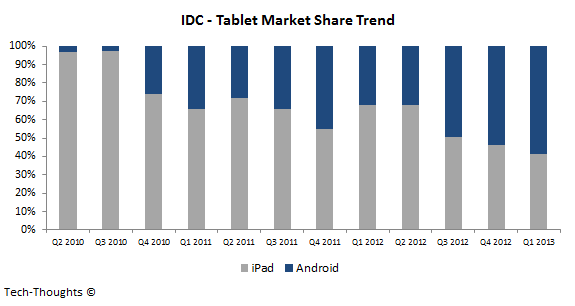
    Android now leads the tablet market, with a share of 56.5 percent, while the iPad’s share falls below 40 percent. Windows tablets are still struggling, with a share below 4 percent and with struggling shipment figures, sell-through is always questionable.

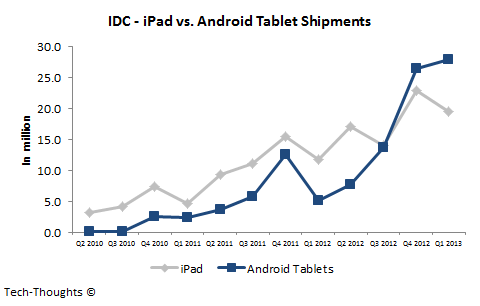
    As the first chart below shows, Android tablets made convincing gains over iPad in the last couple of quarters. This growth is really impressive considering the fact that it occurred in the midst of Apple’s hyped iPad Mini launch. This leadership shift is not unlike the one we saw in the smartphone market, which occurred around the timeframe of Apple’s iPhone 4 launch.

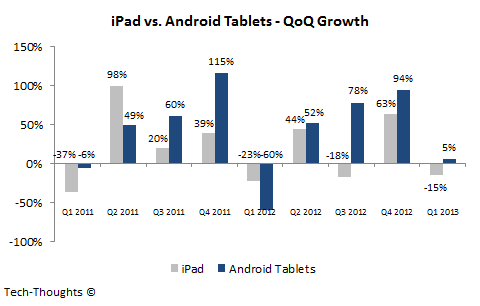
    Apart from the leadership change, the most important takeaway from the chart is that Android tablets did not see a sequential decline in Q1. I had earlier stated that seasonality in tablet demand (especially for Android tablets) would reduce as emerging-market demand grows.

    Based on the figures, I would say that demand for tablets in emerging markets has seen an explosion. This is very good news for low-cost tablet vendors, but not necessarily good news for Apple, Microsoft and the PC industry.

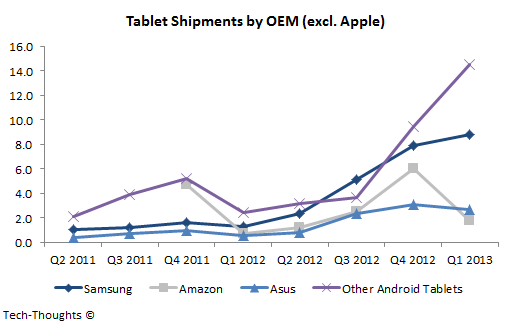
    As I had previously showed, the growth of Android tablets in Q4 2012 was far more broad-based than in Q4 2011. Among leading Android OEMs, Samsung sees strong sequential gains, Asus maintains its position and Amazon’s tablet shipments take a sharp seasonal fall (sharper than I expected).

    But the big story here is the performance of “Other Android Tablets”. These mid-range to low-end tablet vendors are mostly regional players, but will make more of a mark as we move forward. The Android platform enables these vendors to come out with products “good enough” for the masses at very low price points.

    This will be a major factor in slowing shipments of PCs and Windows 8/RT tablets over the next few years.

    Looking at the chart above, iPad shipments normally see strong growth in calendar Q2. However, this is always driven by a new product launch. CEO Tim Cook’s comments during Apple’s earnings call suggest that any new products will only launch in the fall, making Q4 the first full quarter after a new iPad/iPad Mini launch. This means that iPad shipments should see another sequential decline in Q2 (to ~17-18 million).

    This dynamic, combined with exploding emerging-market demand for Android tablets, is likely to push Android’s market share above 60 percent (with shipments above 30 million).  This would essentially be a repeat of the iPhone vs. Android battle we saw in the smartphone market, over the past couple of years.

    Reprinted with permission from Tech-Thoughts

    Sameer Singh is an M&A professional and business strategy consultant focusing on the mobile technology sector. He is founder and editor of Tech-Thoughts.

  • New QTS Lab Will Advance High-Security Federal Clouds

    QTS-Richmond-LEED

    A look at some of the data center space inside the QTS Richmond campus (Photo: QTS)

    QTS (Quality Technology Services) wants to help federal agencies get comfortable with cloud computing, and is dedicating some of its data center space toward this goal. The company, in conjunction with i2 Sentinel Associates, has set up a testbed inside its massive data center campus in Richmond, Virginia that will focus on creating highly secure cloud computing capabilities based on the needs of the U.S. Department of Defense, federal agencies and the U.S. intelligence community.

    QTS sees the continuous transformational environment (CTE) lab at its Richmond data center as an exciting development in the federal sector’s adoption of cloud computing.

    “The Richmond CTE lab contains some of the most advanced technologies in cloud computing today,” said Scott Shinberg, executive vice president, federal systems group – QTS. ”Its technology paired with the unbiased and secure environment will provide a gateway to enhancing the performance and interoperability of critical government applications. Today’s ribbon cutting marks the start to speeding the development and deployment of tomorrow’s cloud computing services.”

    CTE is housed within QTS’ 1 million square foot Richmond Data Center campus, where a grand opening was held today. The lab provides a stable environment for critical testing and analysis of off-the- shelf software and hardware for commercial and government users. The lab will be used to evaluate and improve the development of secure cloud computing technologies.

    The goal is to develop production-ready software and hardware for high performance computing, cloud computing, cross-community partnerships and shared knowledge transfer, which is an important priority for the intelligence communities within the U.S. government.

    “With industry and more federal players looking to cloud computing, physical and logical security in this area will continue to be a critical element,” said i2Sentinel CEO Thomas Preston. “QTS has long played a role in this space with the presence of its Richmond facility, and the addition of this lab solidifies the company as a major player in the federal market for cloud computing.””

    Attendees at the CTE lab’s grand opening include John A. Marshall, Deputy Director of the NGA National System for Geospatial Intelligence Program Management Office, Brigadier General Brian D. Beaudreault, USMC, Deputy Director, Future Joint Force Development, Joint Staff J7, and , among others. Attendees were given technology demonstrations anda  tour of the CTE lab.

  • Google Fiber continues expansion, coming to Shawnee, Kansas

    google-fiber-blue

    Google announced an additional location to its growing Fiber network, and this time it is Shawnee, Kansas.  This makes sense because of it’s proximity to Kansas City, which has already been selected to receive Google Fiber service.

    Google says that they selected Shawnee as a Fiber candidate due to the city’s vision of keeping their citizens informed and involved using the internet.  This is awesome news for the people of Shawnee, whose city council announced the news after voting on bringing Fiber to town.  There is no expected date for Fiber’s arrival in Shawnee, but engineers will be working hard to get the service up and running as soon as possible.

    Source: Google Fiber Blog

    Come comment on this article: Google Fiber continues expansion, coming to Shawnee, Kansas

  • What LeBron James Knows About Analytics that You Should Too

    The most useful question I’ve learned to ask people about analytics is, “What do you plan to do with them?” By far the most interesting answer I’ve gotten comes from basketball superstar LeBron James: Hire Hakeem Olajuwon.

    Until his championship 2011-2012 season, NBA cognoscenti viewed James as a phenomenally gifted loser. He could do everything but win when it mattered most. No one doubted his desire or ability, but they demonstrably weren’t enough. You don’t have to care about sports to realize that exceptional talent, dedication, discipline, teamwork, and hard work assure neither improvement nor victory. You also need self-awareness and smarts.

    What do you need to know and emulate about LeBron James’ journey to championship level?

    No, you can’t hire Hakeem Olajuwon. But you can look at “The Evolution of King James.”

    Kirk Goldsberry brilliantly describes the open secret to James’ success: Nothing makes serious competitors more open to analytics than losing. A basketball genius frustrated with his professional failings decided he wasn’t as good or as smart as he needed to be. James took a good hard look at the analytics (which Goldsberry brilliantly and visually illustrates) and an even better and harder look at himself. Then he hired retired NBA legend Olajuwon — the only player in NBA history to win the MVP, Finals MVP, and Defensive Player of the Year awards in the same season — to help remedy the analytically undeniable flaws and shortcomings of his game. He explicitly linked analytics to his personal/professional transformation.

    “I wanted to get better,” James said of his decision to work with Olajuwon. “I wanted to improve and I sought out someone who I thought was one of the greatest low-post players to ever play this game. I was grateful and happy that he welcomed me with open arms; I was able to go down to Houston for four and a half days; I worked out twice a day; he taught me a lot about the low post and being able to gain an advantage on your opponent. I used that the rest of the off-season, when I went back to my hometown. Every day in the gym I worked on one thing or I worked on two things and tried to improve each and every day.”

    And there’s more to the story. The workouts were scheduled to begin each day at 9 a.m. While Olajuwon did show up regularly on time, James always was already there, sometimes having arrived by 8:20.

    “He would be there stretched and ready to go,” Olajuwon said. “That says a lot about him and his determination. I was impressed that he couldn’t wait to get started.”

    “I went there to put in work,” James said. “That’s what it’s all about. I didn’t want to do anything else but to get better.”

    Not incidentally, James brought his own videographer to record the sessions for later study and review. The Olajuwon sessions were not just “classes” or “workshops” or “training sessions” — they were the continuation of a transformation process rooted in the analytics. The true test of analytics isn’t just on how good they are but in how committed you are to using them to improve. Of course, James didn’t just make a commitment; he got one from Olajuwon. Those commitments unambiguously paid off last year.

    The results thus far speak for themselves this year, as well. Self-improvement in teams requires teams.

    Most people reading Harvard Business Review aren’t as talented in their field as James is in his. But how many of us have committed to measurable self-improvement based on analytic insight? How many of us have hired the right coach for the right reason?

    Many readers were irritated by an earlier post describing how predictive analytics would increasingly determine who companies would hire, fire, and promote. Data-driven decision-making about people and their potential seem to be the digital destiny of human capital management. But this argument leaves out a crucial variable.

    The surest way to disrupt the quantitative tyranny of predictive analytics is demonstrable self-improvement. Individuals and organizations alike have to move away from the notion of analytics as the key to insight and towards the belief that they’re the GPS of transformation. Self-improvement, not self-knowledge, is the goal.

    Have you had an analytic epiphany? Good. Now ask yourself: Who is your Hakeem Olajuwon?

  • BlackBerry Q10 early sales reportedly strong in Canada

    BlackBerry Q10 Sales Canada
    It looks like BlackBerry fans really do love their physical keyboards. Barron’s points us to a new note from Jefferies analyst Peter Misek, who claims that several “store checks” of outlets in Toronto show that the “BlackBerry Q10 has been selling extremely well and has been sold out or seeing limited availability” in the city. Misek’s note on Canadian Q10 sales follows a similarly optimistic note he wrote earlier in the week about strong early Q10 sales in the U.K., so it seems that the Q10 has some solid momentum on its side during its first week of availability. The Q10, which is designed to look more like iconic pre-touchscreen BlackBerry phones, includes 3.5-inch display, a 1.5GHz dual-core processor, an 8-megapixel rear-facing camera, a 2-megapixel front-facing camera, 2GB RAM, 16GB of internal storage and a 2,100 mAh battery.

  • “SHIFT IT” – Amazing Transmission Commercial

    Transmission Shop "SHIFT IT"

    What you are about to witness can only be described as internet gold. It’s a commercial made for a transmission repair facility in Los Angeles, and although it’s a bit on the creepy side, that doesn’t stop it from being completely outstanding. Was it done like this intentionally? Honestly, I have no idea. What I do know however is that this man just solidified himself as a full-on internet legend.

    Source: Youtube.com

  • The teachers who inspired us, and even changed the trajectories of our lives

    Rita-Pierson-at-TED-Talks-Education

    Rita Pierson leads off TED Talks Education, our first televised event, which will air on PBS on May 7. Photo: Ryan Lash

    Rita Pierson is the kind of teacher you wish you had. An educator for 40 years, she is funny, sharp and simply has a way with words — so much so that today’s talk feels a bit like a sermon.

    Rita Pierson: Every kid needs a championRita Pierson: Every kid needs a championIn this talk, Pierson shares the secret to teaching students, especially those from disadvantaged backgrounds — make personal connections with them.

    “I have had classes so low, so academically deficient that I cried. I wondered, ‘How am I going to take this group in nine months from where they are to where they need to be?” says Pierson, in this amazing talk. “I came up with a bright idea … I gave them a saying: ‘I am somebody. I was somebody when I came and I’ll be a better somebody when I leave. I am powerful and I am strong. I deserve the education that I get here’ … You say it long enough, it starts to be a part of you.”

    Pierson’s talk will open our first-ever television special, TED Talks Education, which airs Tuesday, May 7 at 10/9c on PBS. It will be an exhilarating night, featuring talks from educators and innovators with bold ideas, plus performances from host John Legend. Set your DVRs and read lots more here »

    In honor of Rita Pierson and TED Talks Education, I asked the TED staff: who is that one teacher who just really, truly influenced you?

    “The teacher who changed my life was, serendipitously, my English teacher for kindergarten, 7th grade and senior year of high school. Ms. Barbato taught me how to write eloquently (I hope!), and she had this unexplained faith in me that really galvanized me as a student. What she taught me stuck with me through college and beyond.” —Olivier Sherman, Distribution Coordinator

    “Mr. Eric Yang was only in his mid-twenties when I had him as my AP government teacher, but he was unforgettable. He was the first teacher I had who made keeping up with current events mandatory, forcing us to read news sources on our own time and not just from the textbook. He exuded discipline, and that was contagious.” —Thu-Huong Ha, Editorial Projects Specialist

    “Mrs. Bailey was my English teacher. I loved her. I was the younger sister of an already very successful big sister, and that was a cloud over my head too. She held my hand and brought me into the sun with her love of the English language. She recommended books just to me, she made me feel special and I just couldn’t get enough of her. I went on a school trip to Amsterdam with her and she brought her husband, who was an artist. She changed my life.” —Juliet Blake, TED TV (who executive produced TED Talks Education)

    “Mrs. Mendelson, my 8th-grade English teacher. This was my first year living in the U.S. I think she set the stage for future learning and she’s the main reason I have such good English right now, both written and spoken. So, thank you, Mrs. Mendelson.”  —Ruben Marcos, intern

    “I still recall how awesome my 6th-grade teacher, Mr. Fawess, was. Middle school in general is basically Hades. I was extremely small, super nerdy, and had a unibrow, asthma and glasses — plus I left school once a week to take classes at the local high school. I got picked on a lot. Mr. Fawess came up with all these ways to take my mind off that — he talked to me about bullying and how to let things roll off your shoulder and gave me books I could read outside of class. He got me thinking about college early and what kinds of subjects I was most interested in. I consider myself lucky to have had such an inspiring teacher. If only he had discouraged me from dressing up as the skunk in our annual school play.” —Amanda Ellis, TEDx Projects Coordinator

    “Robert Baldwin’s class ‘Essay and Inquiry.’ Every day: Walk into class. Sit down. Look at the handout on every desk. Read it. Start writing. Class ends — stop writing. Every day. Except Wednesday, when we’d put the desks in a circle and everyone would read something they’d written. The prompts were everything from simple questions like, “What’s your favorite memory of trees?” to readings from Rachel Carson or W.B. Yeats or Orson Welles. It was a whirlwind of ideas, and the constant writing forced us to wrestle with them, and (tritely but correctly) ourselves. It was like a boot camp in thinking. People I know who took, and loved, that class went on to some of the most amazing careers. Every time we get together, we gush about the quiet, unassuming, force of nature that was Mr. Baldwin. He would have hated that last sentence, because the metaphor is strained. But he also taught us to ignore authority, so I’m writing it anyway.” —Ben Lillie, Writer/Editor

    “Mrs. Lewis, my 5th-grade teacher, read to us every week. She made us put our heads on the desk and close our eyes and then read wonderful stories to us: The Golden Pine Cone, The Diamond Feather ... It made our imaginations come alive.” Janet McCartney, Director of Events

    “My junior high school science teacher, Dr. Ernie Roy, with his outsized laugh and booming voice, was one of my very favorite teachers. He demonstrated to us how important we were to him by making what were obviously personal sacrifices on our behalf: when the lab needed equipment, we knew he had purchased some of it on his own; when we couldn’t get a bus for a field trip, he took a few of us in his own car (something which could have gotten him into quite a bit of trouble); and when a big science fair deadline loomed large, he opened the lab every weekend to help us with our experiments. At a point in my life when I didn’t have a lot of guidance or positive role models, he taught me a lot more than science; he taught me, by example, the power of sacrifice, discipline and self-respect.” —Michael McWatters, UX Architect

    “Dr. Heller, my 10th-grade social studies teacher, taught me that passion is the key to learning. I had never met anyone from kindergarten to 10th grade that matched his raw passion for the meaning behind historical events, and it was so contagious.” —Deron Triff, Director of Distribution

    “Rene Arcilla, a professor of Educational Philosophy at NYU, changed the way I think.  Prior to that class, I hadn’t truly been challenged about what *I* actually thought — much of my educational life was about regurgitating answers. Rene was the first teacher who asked me questions that he/we didn’t know the answers to. Realizing that I had to actually provide the answers from within myself, and not look to an outside source, was very difficult at first. It was a muscle I had to build. I owe a lot of who I am today — and even this job — to the introspective, critical and philosophical thinking I learned from Rene’s classes.” —Susan Zimmerman, Executive Assistant to the Curator

    “Mr. Downey — 7th- and 8th-grade Humanities. Still the hardest class I’ve ever taken!  I’d credit Mr. Downey with helping me think more expansively about the world. Right before 8th-grade graduation, he showed us Dead Poets Society, and on the final day of class we all agreed to stand on our desks and recite ‘O Captain, my captain.’ It was all very dramatic and I think there were tears.” —Jennifer Gilhooley, Partnership Development

    “I took my first painting class my sophomore year of high school and fell in love with it. My teacher, Ms. Bowen, told me I could use the art studio whenever I wanted to, and gave me access to all kinds of new paints and canvasses. I spent almost every lunch period there for a few years, and regularly stayed in the studio after school ended. One day, Ms. Bowen told me that a parent of a student I had painted expressed interest in buying the painting of her daughter. After that first sale, I painted portraits of kids in my school on a commission basis, and continued to do so for the remainder of my high school experience. Thanks to Ms. Bowen’s mentorship, I felt empowered to try to make money from something I was passionate about and loved to do. Here is one of the paintings.” —Cloe Shasha, TED Projects Coordinator

    “I had a chemistry teacher, Mr. Sampson, who used to meet me at school an hour before it started to tutor me when the material wasn’t clicking. That was the first class I had ever really struggled with, and he made this investment to help me get through the material — but more importantly learn that I could teach myself anything.” —Stephanie Kent, Special Projects

    “On the first day of my Elementary Italian Immersion class, I asked to be excused to use the restroom in English. Professor Agostini kept speaking rapidly in Italian as I squirmed in my seat. Since she seemed unclear about my request, I asked her again to no avail. Finally, I flipped through my brand-new Italian-English dictionary and discovered the words, ‘Posso usare il bagno per favore.’ Suddenly, she flashed me a smile, handed me the key, told me where to go in Italian, and pointed to my dictionary so I could learn how to follow her directions. Even though I only studied with her for one semester, I will never forget that I emerged from her class knowing intermediate-level Italian.” —Jamia Wilson, TED Prize Storyteller

    “My history teacher in high school, Mr. Cook, challenged us to think hard about what happened in the past and directly related it to what was happening around us. He gave us ways to try and predict what could happen in the future. He was the first person to make me take ownership of what it meant to be a citizen and the social responsibility that came with that. Because he taught ‘World History’ rather than a regionally specific class, we learned extensively about other countries, and I am convinced he is the reason that I went abroad to Ghana in college and I am now still an avid traveler today.” —Samantha Kelly, Fellows Group

    “The professor who taught me Intro to Women and Gender Studies my sophomore year of college completely changed my framework for thinking about human relationships within a hierarchy. She brought coffee and tea to class for us every morning to congratulate us for being so dedicated to learning as to choose an 8:30 a.m. class. When I emailed her to say I’d be out sick, she sent me a get-well e-card. And when, in a fit of undergraduate irresponsibility, I simply failed to do an assignment, she wasn’t the least bit mad — instead, I received a phone call from her a week after the end of the semester informing me that, because I’d done such good work, she couldn’t bear to give me the B+ I numerically deserved. It was incredible to see how fully she lived the subject she taught; the philosophy of compassion and equality.” —Morton Bast, Editorial Assistant

    “My high school photography teacher, Susan Now. I’m convinced that the support I got from Susan got me through high school. Two years later, when I was freaked out about transferring colleges, I, without hesitation, called her for advice. She made me feel comfortable and challenged me to speak up and be confident with expressing myself as a student. So valuable!” — Ella Saunders-Crivello, Partnerships Coordinator

    “Cliff Simon, one of my college professors, taught me that wisdom is the greatest pursuit, our skills and passions are transferable, and that fear will only ever always hold us back.  To this day, he’s a great mentor.  We’re now great friends, and I even officiated his wedding ceremony.” —Jordan Reeves, TED-Ed Community Manager

    “My 10th-grade biology teacher spoke and interacted with me like I was a grown-up individual and not one of a batch of ‘kids.’ He made us all fascinated with the subjects he taught because he spoke to us not at us. I always worked hard to match that capacity that he saw in me. He was only in his 50s when, a few years after I graduated, he died suddenly of a heart attack. Lots of sad former students.” —Ladan Wise, Product Development Manager

    “Stephen O’Leary, my professor and mentor at the University of Southern California, showed me that the quality of my thinking could be directly traced to the quality of the authors I referenced in my bibliography. This realization motivated me to both seek and challenge everything I have read ever since. This habit likely played a part in me finding myself so passionate about being a part of TED.” —Sarah Shewey, TEDActive Program Producer

    “My high school art teacher was equal parts smart and silly, and always insightful. Mr. Miller showed a bunch of restless seniors that art class wasn’t just about memorizing which painters influenced which periods. Instead, he taught us that art was — at its core — an exciting way to touch both the head and the heart. Mr. Miller took our  class to the Met in New York one warm spring afternoon, a trip I’ll never forget. Great art, he told us, was about great ideas, and not simply the pleasing arrangement of color, shape and form. Thank you, Russ Miller.” —Jim Daly, TED Books 

    “Mrs. Presley, my 1st-grade teacher, advanced my reading skills to full-on chapter book independence … and for that I’ll be forever grateful! But the most valuable gift she gave me was self-esteem. At my school, we’d bring a brown bag lunch with our name written on the bag. I always wanted a middle name like the other kids, and this daily ritual made me feel the lack. I must have let my mom know, because she started to write middle names on my bag. At first it started: ‘Marla Ruby Mitchnick.’ Then ‘Marla Ruby Diamond Mitchnick,’ and then ‘Marla Ruby Diamond Violet Mitchnick,’ and so on. Mrs. Presley never skipped a single syllable — she just read it straight through, and I felt like a beloved and fortunate person with a beautiful name, surrounded by wonderful friends.” —Marla Mitchnick, Film + Video Editor

    “I signed up for Journalism 1 in high school having no idea what I was getting myself into. Marcie Pachino ran a rigorous course on the joys of telling other people’s stories and on the extreme responsibility that comes with reporting news that might otherwise go unheard. She was kind and inspiring, but wouldn’t hesitate to give you an edit of an article that simply read ‘Ugh’ in big red letters. The key: you always knew she was right. I went on to become a journalist professionally and, in all my years of writing, I’ve never encountered a more demanding editor.” —Kate Torgovnick, Writer (the author of this post)

    “Professor Stephen Commins completely changed my  learning experience at UCLA. He pushed the boundaries of what I thought I could accomplish as an undergrad, and having him as my research professor improved my quality of education tenfold. I’ll never forget in my last lecture with him, he left our class with this piece of advice: to work on poverty domestically before attempting to help those abroad, because you aren’t truly a development professional until you have done both.” —Chiara Baldanza, Coordinator

    “My high school English teacher Veronica Stephenson went above and beyond to allow me the opportunity to dive into theater and acting in a very underfunded arts community. She saw passion in me, and engaged it by spending a lot of her own time and effort to help me pursue something I loved. I learned so much from her and got more personalized experience than I probably would have from a more arts-focused curriculum due solely to her faith in me.” —Emilie Soffe, Office Coordinator

    Now it’s your turn. Who is the teacher who most inspired you? Please share in your comments.

  • Acer announces updated Iconia B1 with 3G and quad-core options

    Acer Iconia B1-front_hand

    The Acer Iconia B1 just became available only a couple of months ago, but Acer just announced new versions slated for June. They will now offer a 3G version that will feature a MediaTek quad-core processor. The WiFi version will still have the 1.2GHz dual-core MediaTek processor, but both versions will get bumped up to 1GB of RAM as opposed to 512MB of RAM. You will also have your choice of 8GB or 16GB for storage, but they offer a microSD slot for expandability. The display on both devices remains the same, 7-inches with a resolution of 1024 x 600. Last but not least, the materials are more of a premium feel similar to the Iconia A1, and the back will be white.

    Pricing starts at €129 for the WiFi version and €179 for the 3G version. Expect to see these mid-June in Europe, Africa, and the Middle East. Hit the break for the full presser.

    Iconia B1 with New Face and Connectivity Options

    New York, (May 3, 2013), Acer today unveiled the second generation Acer Iconia B1 with a new pure and simple design, increased performance and additional 3G
    data connection option, setting a new standard for a tablet targeted at young or new users or families looking for an additional tablet for their children. The Iconia B1 is also ideal for busy individuals seeking a convenient mobile companion.

    At 17.8 cm (7”) – the same size as standard book page – the display is comfortable for ereading, web browsing, playing games and watching videos. The Iconia B1 joins forces today with the launch of the Iconia A1 to offer a uniformed look and feel when searching for a tablet solution for all members of the family.

    The Acer Iconia B1 was introduced today with other new products, including the Acer Aspire R7, Aspire P3 Ultrabook, Aspire V Series touch notebooks and Iconia A1. The new line of Acer mobile products highlights the company’s focus on redefining the computing experience through progressive design. #AcerTouch.

    Highly Responsive Fun

    To take your experience to the next level, this tablet combines a 1.2GHz dual-core or quad-core processor and 1GB of memory for fast and smooth gaming, web browsing and video watching with Android’s Jelly Bean operating system to get quickly precise answers to your search queries and seamless browsing. For many search queries performed through VoiceSearch, you can now hear a spoken answer quickly.

    Fast and Free Media

    Over 500 free online magazines from hundreds of publishers and top web sites are always at your fingertips thanks to Google Currents. The recently updated smart mobile app allows you to discover, read, and share your favorite new outlets, blogs and online magazine on the 17.8 cm (7”) WSVGA (1,024 x 600) capacitive display – even when offline. If you are into playing, you have more than 700,000 games and apps from the Play Store to choose from.

    Capture and Share More

    To top off the rich experience, the Iconia B1 comes with a front-facing camera to engage in live chats with your friends. The camera is on the top right corner and works also when in landscape mode, allowing your friends to get into the picture during a video chat.

    Available with WiFi or 3G(2) data connection as 8GB(4) or 16GB(4) version with the option to add 32GB(4) via via microSD™, the Iconia B1 is the ideal easy companion for tablet newbies or children while adults use their own.

    Pricing and Availability

    The Iconia B1-710 (WiFi) version will be available in Europe, Middle East and Africa mid-June at a starting price of €129.

    The Iconia B1-711 (3G) version will be available in Europe, Middle East and Africa end of July at a starting price of €179.

    Come comment on this article: Acer announces updated Iconia B1 with 3G and quad-core options

  • Adobe plans to fix Reader flaw, just not now

    When you produce two wildly popular platforms like Flash and Reader then you can expect to be targeted by those who wish to exploit them for gain. Such is the case for Adobe, the developer behind both applications. The company is a constant target for security exploits and malware, with the vast majority of “update Flash” pop-ups on the web being fakes that lead unsuspecting customers to a bad end.

    The most recent is a flaw in Reader, discovered by McAfee researcher Haifei Li. To be fair to Adobe, this one is much less of a problem than some previously discovered. Li writes that “we successfully identified that the [PDF] samples are exploiting an unpatched security issue in every version of Adobe Reader including the latest ‘sandboxed’ Reader XI (11.0.2)”.

    In concept, when a specific PDF JavaScript API is called with the first parameter set as a UNC-located resource, Adobe Reader can access that UNC resource. However, this action is normally blocked and creates a warning dialogue which is asks for permission. No problem. However, as Li explains, “the danger is that if the second parameter is provided with a special value, it changes the API’s behavior. In this situation, if the UNC resource exists, we see the warning dialog. However, if the UNC resource does not exist, the warning dialog will not appear even though the TCP traffic has already gone”.

    McAfee, while saying that it does not consider this to be a major issue, does consider it a security vulnerability. The company has detected some PDF samples in the wild that are exploiting this issue. “Our investigation shows that the samples were made and delivered by an ’email tracking service’ provider”, Li writes.

    And what about the Adobe response? The company briefly acknowledges this latest flaw, telling us “Adobe is aware of reports of a low severity information leakage issue described in a recent advisory. A user’s IP address and timestamp could be exposed when opening a specially crafted PDF. This issue will be resolved in the next scheduled releases (May 14) of Adobe Reader and Acrobat”.

    The problem is, indeed, not a major threat, but the word is now out there, which can potentially compound the problem. Common sense should tell customers to not click on email attachments from unknown sources, or even from friends, if the file in unexpected. A better solution is to use a different PDF app — both Foxit and Nitro are free, and much less targeted.

    Photo Credit: Cartoonresource/Shutterstock