Category: News

  • Margot B. Gives Acoustic Performance At Google NYC

    As part of the “Musicans At Google” series, singer/songwriter Margot B. recently stopped by Google NYC to give an acoustic performance, including songs from her current CD “Live At The Hazlett”. Google has now made it available on YouTube.

    She performs the songs “Cool” and “Complete”. She also gives a short interview, discussing Rent, volunteer work, Black History Month, and the indie music scene.

  • Electric car maker Coda files for bankruptcy

    Electric car maker Coda Automotive said on Wednesday that it has filed for Chapter 11 bankruptcy in the District of Delaware and will seek to restructure the company around selling batteries instead of electric cars. Coda plans to seek a sale of the business within the next 45 days.

    Coda electric sedan

    Coda said that an affiliate of Fortress Investment Group will provide enough financing to keep its energy storage business operating and will also act as the stalking horse bidder in the sale process. Coda CEO Phil Murtaugh said in a statement that:

    “We believe the restructuring process that we have entered into today will enable the Company to complete a sale and confirm a Plan that maximizes the value of its assets, serving the best interests of our stakeholders.”

    Bloomberg reported that Coda listed assets of as much as $50 million and debt of as much as $100 million in the Chapter 11 filing. The company raised $320 million over the years from investors including Aeris Capital, Angeleno Group, New World Strategic Investment, Indus Capital and Och-Ziff Capital Management Group, Falcone’s Harbinger Capital Partners and Riverstone Holdings.

    Coda electric sedan wheel

    Coda shipped its first electric sedans in the spring of 2012, after many months of delays. Coda first aimed to launch the car back in late 2010, but then pushed that back to late 2011, and then early 2012. It’s not an uncommon story for an electric car startup. Fisker Automotive also took much longer than it had expected to deliver the first Karmas, and Tesla also faced delays over its first car the Roadster.

    But sales of the Coda electric sedan never took off, and the company reportedly shipped less than 100 cars. The car cost $37,000 before the $7,500 U.S. tax credit, and had an official 88 mile range (the distance its batteries can go on a single charge) with a fuel mileage equivalent of 73 miles per gallon. Critics said the car’s design was dated, and the price too high to compete effectively with the Nissan LEAF.

    Coda Chairman Mac Heller at the launch

    Coda launched its energy storage business last year and through that unit has been selling batteries and battery management systems to act as energy storage for the power grid. Coda’s battery technology is based around lithium iron phosphate batteries, and a good chunk of its intellectual property is around the cooling management system and software. The batteries are similar to the ones that it was using in its cars, and the main difference is that while the car batteries are flat, the grid batteries are organized in a tower, and 25 batteries grouped together creates 1 MWh worth of storage.

    As I reported yesterday, Coda was starting to be buried in lawsuits. The company had a half dozen filed as of yesterday, including suits over unpaid bills and a class action lawsuit by a former employee.

    Related research and analysis from GigaOM Pro:
    Subscriber content. Sign up for a free trial.


  • LinkedIn Lets You Add Photos, Videos to Profiles to Better Showcase Your Talents

    LinkedIn is giving users a new way to showcase their work by allowing them to add photos, videos, and presentations to their profiles.

    Let’s say you’re a photographer, and in your LinkedIn “experience” section you want to add some samples of your work – now you can do that. Let’s say you worked incredibly hard on a big presentation and wish to showcase that to everyone who views your profile – now you can do that.

    “For the first time, you will now have the ability to showcase your unique professional story using rich, visual content on your LinkedIn profile. This means you can illustrate your greatest achievements in the form of stunning images, compelling videos, innovative presentations and more. From the analyst who makes annual predictions on tech trends to the 3D animator who is looking to fund a new short film, the opportunities are limitless for how professionals can now use the LinkedIn profile to help showcase these unique stories in a visual way,” says LinkedIn’s Udi Milo.

    In short, LinkedIn is letting users create a more visual resume.

    To get started, just edit your profile and look for areas to add visual content in your “summary,” “experience,” and “education” sections. LinkedIn says that they rollout of this new feature begins today with English-speaking users.

  • T-Mobile/MetroPCS merger is complete, new company now known as T-Mobile US

    T-Mobile MetroPCS Merger


    At last, the T-Mobile/MetroPCS marriage is officially complete. After seeing a few signs that the merger was closer to being finalized, Deutsche Telekom AG and T-Mobile US, Inc. announced the newly-formed T-Mobile USA entity— which officially began public trading under the NYSE ticker TMUS as of today. With the new company fully established, Deutsche Telekom AG will effectively hold a majority stake in the company (at 74%), while the combined subscriber base grows to over 40 million. Additionally, the completed merger also expands the total 4G footprint as 228 million are currently served with 4G, with an additional 200 million expected to be covered with 4G LTE by the end of 2013.

    You’ll find more details once you hit the break and check out the full presser.


    T-Mobile and MetroPCS Combination Complete-Wireless Revolution Just Beginning

    T-Mobile US to Ring NYSE Opening Bell as Trading Begins Today Under Ticker “TMUS”

    BONN, Germany & BELLEVUE, Wash.–(BUSINESS WIRE)–May. 1, 2013– Deutsche Telekom AG (XETRA: DTE; “Deutsche Telekom”) and T-Mobile US, Inc. today announced the completion of the combination of T-Mobile USA, Inc. and MetroPCS Communications, Inc., uniting two wireless innovators with one common vision: to bring wireless consumers exciting new choices while delivering an exceptional experience. The combined company, T-Mobile US, Inc., will begin trading on the New York Stock Exchange today under the ticker “TMUS.”
    “The combination of T-Mobile and MetroPCS creates an even stronger disruptive force in the U.S. wireless market,” said John Legere, President & Chief Executive Officer of T-Mobile US, Inc. “Together, as America’s Un-carrier, we’ll continue our legacy of marketplace innovation by tearing up the old playbook and rewriting the rules of wireless to benefit consumers.”

    As previously announced, the Board of Directors of the combined company will have 11 members, including two directors of MetroPCS who will continue with the combined company. Tim Höttges, currently Deputy Chief

    Come comment on this article: T-Mobile/MetroPCS merger is complete, new company now known as T-Mobile US

  • Guess who went public? T-Mobile completes MetroPCS deal

    T-Mobile USA began trading on the New York Stock Exchange Wednesday under the ticker TMUS, as its deal of more than $1.5 billion to combine with MetroPCS has closed. The newly combined company opened at $16.25.

    Based on 2012 results, the combined company would have $24.8 billion of revenue and $2.7 billion of free cash flow. As of March of this year it has approximately 43 million subscribers. The deal terms were complicated including a 1 for 2 reverse stock split by MetroPCS, a cash payment of $1.5 billion to its MetroPCS stockholders and the proposed NewCo made up of T-Mo and MetroPCS acquiring all of T-Mobile’s capital stock from Deutsche Telekom in exchange for approximately 74 percent of MetroPCS’ common stock.

    While the deal was approved by shareholders and regulators, the combined company still is trying to fight it out in a highly competitive and saturated mobile market. As my colleague Kevin Fitchard wrote when the deal was announced, this is a deal about beefing up T-Mobile’s spectrum so it can keep fighting Verizon and AT&T. Meanwhile Sprint, the nation’s third-largest carrier is in a deal of its own trying to buy Clearwire with cash provided by new partial owner Softbank.

    It’s like a soap opera where everyone’s fighting for the airwaves. However, those fights are in the future, and today we just have to watch the stock and ponder what this means for the customer. Luckily, Fitchard already explained how this deal affects customers, so read that while you watch the stock.

    Related research and analysis from GigaOM Pro:
    Subscriber content. Sign up for a free trial.


  • Charge Your Phone While You Ride Your Bike With The Siva Cycle Atom

    siva

    While you are riding into work on your daily bike commute, why not charge your phone? There’s a bit more to it than that, but ultimately that is exactly what the Siva Cycle Atom does. A brilliant idea.

    Reaching their KickStarter goal of $85,000 after only a week, the newly funded Atom is on display on the floor of Hardware Alley at TechCrunch Disrupt NY 2013.

    The Atom is a generator, complete with a detachable battery, that is fixed to the rear of your bicycle. As you pedal away, the generator is charging the attached battery. However it can also directly charge your phone too, using a smart switching system that goes back and forth between the device and the battery.

    For example, if your phone is hooked up to the device it will directly charge your phone while you are pedaling, however when you come to a stop, your phone will automatically draw from the battery to keep you topped off.

    Once you reach your destination, you simply detach the 1300mAh battery and take it with you for extra juice for your smartphone.

  • The Value of Big Data Isn’t the Data

    It is clear that a new age is upon us. Evidence-based decision-making (aka Big Data) is not just the latest fad, it’s the future of how we are going to guide and grow business. But let’s be very clear: There is a huge distinction to be made between “evidence” and “data.” The former is the end game for understanding where your business has been and where it needs to go. The latter is the instrument that lets us get to that end game. Data itself isn’t the solution. It’s just part of the path to that solution.

    The confusion here is understandable. In an effort to move from the Wild West world of shoot-from-the-hip decision making to a more evidence-based model, companies realized that they would need data. As a result, organizations started metering and monitoring every aspect of their businesses. Sales, manufacturing, shipping, costs and whatever else could be captured were all tracked and turned into well-controlled (or not so well-controlled) data.

    I would argue that what you want and what you need is to turn that data into a story. A story explains the data rather than just exposing it or displaying it. A narrative that gives you context to today’s numbers by exploring the trends and comparisons that you need in order to make sense of it all. The belief that Artificial Intelligence can support the generation of natural language reporting from data is what drove me to help found our company, Narrative Science. I fundamentally believe that a machine can tackle and succeed at freeing insight from data to provide the last mile in making big data useful, and this belief was the driver in building out a technology platform that makes it real.

    It may well be the case that you already have someone who looks at the data, builds the queries, interprets the results and writes up the report. But this is time-consuming and labor-intensive. It doesn’t scale. And, given all of the time and money that was put into gathering and managing that data, why stick with non-scalable and expensive ways to perform data interpretation and craft communications?

    If we’re going to really capitalize on Big Data, we need get to human insight at machine scale. We will need systems that not only perform data analysis, but then also communicate the results that they find in a clear, concise narrative form.

    For the most part, we know what we want out of the data. We know what analysis needs to be run, what correlations need to be found and what comparisons need to be made. By taking what we know and putting it into the hands of an automated system that can do all of this and then explain it to us in human terms, or natural language, we can achieve the effectiveness and scale of insight from our data that was always its promise but, until now, has not been delivered. By embracing the power of the machine, we can automatically generate stories from the data that bridge the gap between numbers and knowing.

    In order to do this, your starting point has to be the story (or the communication) itself. It defines your information needs. In turn this defines the kinds of analysis that need to be performed on the facts at hand. Finally, the required facts define how you are going to derive these elements of information from the data you have. It is important to note that the starting point for how to think about this problem is the story and it communication goals, not the data. The data is purely instrumental to the communication you want to support. Of course, once configured, the system actually runs in the other direction, from the bottom up against new data as it arrives.

    The overall flow goes from data to fact to angle to story to language. The language is the only applied after the system actually figures out what it is going to say.

    generatingnarrative.gif

    Here’s an example. Imagine, for a moment, that you run an organization with multiple restaurant outlets and you have amassed point-of-sale data for each of your franchisees, but none of them are using that data because they just don’t get what they need from it. They need insight as to how their stores are doing and what they should do next. You need to give each of them a report that actually explains how they are doing in comparison to themselves over time, how they might compare to other restaurants, and where there might be shortfalls. This defines the communication that then defines that flow of analysis back to the data level. Graphically, this becomes:

    sortsofdata.gif

    My favorite piece is the last element that our system (called Quill) generates: the advisory. Quill looks for high margin items that have sales shortfalls (in comparison to regional cohorts) that are fixable in the near term. The fact that other stores in a cohort are selling an item is evidence that there is not a regional issue at play. And the fact that the gap is not huge means that bridging it is achievable. All of this comes together to let the system says things like this:

    Foot Long Hot Dogs were this week’s weakest menu item with average daily sales of fewer than 140 units. Bringing the store’s daily sales of Hot Dogs up to the same level as the co-op’s would add about $566 more profit each month. Over a year, that’s an extra $6,828. The store only needs to sell six more units per day to accomplish this.

    Of course, each restaurant needs to get the advice that is relevant to it. Which means that Quill needs to generate at scale (once a week for over 12 thousand restaurants) while also remembering what is said the week before so that it doesn’t repeat itself. This provides the franchise owners with ability to make decisions driven by the stories and insight that explain their businesses rather by the data alone.

    To get scale from data interpretation, we have to embrace the power of the machine to extract and explain the data that it and it alone is in a unique position to analyze and then communicate. With guidance from business, the machine can provide us with the human link between the world of big data and the actual end game we want: a world of evidence-based insight and decision-making. Because the value of big data isn’t the data. It’s the narrative.

  • With hundreds of customers, Asana now seeks enterprise adoption

    Facebook co-founder Dustin Moskovitz and Google and Facebook veteran Justin Rosenstein founded the collaboration- and productivity-focused Asana in 2009. It released a free version for teams of up to 30 in 2011, and premium versions followed in April 2012. Now the company is adding features to appeal to larger businesses and groups — specifically those with more than 100 users. The software’s new capabilities amount to the next logical step in Moskovitz and Rosenstein’s plan to increase productivity for people the world over.

    The new features are together referred to under the Organizations rubric. They include a way to organize employees into teams; visibility for a high-level executive to see what members of all teams are up to; the ability to hide certain teams from the rest of the company; unified inboxes and task lists for people on multiple teams, and roles for IT and other administrators to monitor use and set security and access policies.

    The Asana office in San Francisco.

    The Asana office in San Francisco.

    Asana itself is small, with 40 employees. Perched on the ninth floor of a high-rise building outside of San Francisco’s busy South of Market neighborhood, it’s removed from the hustle and bustle. Working at Asana comes with perks, including yoga and skills coaching. Moskovitz and Rosenstein carry no titles other than founders.

    If Asana succeeds in penetrating the enterprise, case studies might look back on the company’s way of doing things and suggest that other ambitious startups follow its lead (and, of course, use the Asana software, as Asana does internally). For now, though, the difference between the Asana setting and the corporate world is stark.

    Moskovitz and Rosenstein, as usual, declined to disclose revenue, so it’s hard to assess how well the company is actually doing. To date the company has taken on $38.5 million in venture funding from Andreessen Horowitz, the Founders Fund and others. Tens of thousands of “teams” — companies or business units — use Asana, including Airbnb, Disqus, Foursquare, Pinterest, and Uber. Fewer than 1,000 pay for it.

    As a freemium product, Rosenstein said, you “always prioritize gaining more users and growing the company. It (Asana’s profit-and-loss statement) looks a lot like other big freemium companies — same business model. … We want to instead take the market and have everyone use (Asana) as fast as possible. Revenue will help with that, but growth is our number-one priority.”

    Everything is going according to plan for Asana, then. But as for getting boatloads of companies to pay for the service and making the company profitable, it’s unclear just how long that will take.

    Related research and analysis from GigaOM Pro:
    Subscriber content. Sign up for a free trial.


  • Google brings its Web Fonts to the desktop

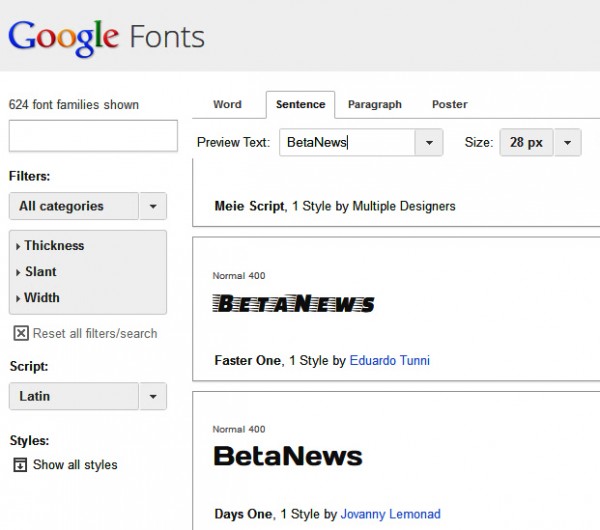
    Google Fonts is a collection of open-source typefaces designed to make websites look more appealing. The set includes fonts with names like Caesar Dressing, Faster One, and Oleo Script Swash Caps.

    Starting from today the web giant is making these fonts available for use on the desktop (Windows and Mac). You can use them in your own creations, but just as importantly by having them stored locally on your system, your browser won’t have to download them, which will save a little time. And we all know how important speeding up the web is to Google.

    You’ll be able to install and sync all of the typefaces from the directory through SkyFonts, a Monotype tool which automatically updates installed fonts, ensuring you always have the latest versions at hand.

    However, if you’d rather download the source files to edit the font data directly, you can do so at the Google Code project.

  • Suspended 50 Games: Minor Leaguer Tests Positive For Steroids

    With an entire decade of Major League Baseball scandals, Olympic athletes losing medals, and Lance Armstrong having his life’s work erased, Americans couldn’t be blamed for assuming that up-and-coming athletes have learned from the mistakes of others. Unfortunately, they would be wrong.

    The Associated Press today has reported that a minor league player has been suspended 50 games for using steroids.

    According to the report, Brandon Brown tested positive for Stanozolol, a synthetic anabolic steroid. Brown is currently a free agent, and his 50-game ban will begin when (and if) he signs with a new team. He is one of 18 minor league athletes who have been suspended just this year following drug tests.

    Brown had most recently played third and second base for the Class A minor league Savannah Sand Gnats, a team which is affiliated with the New York Mets. According to Baseball Reference, Brown hit .222 with 34 RBIs in his last season with the Sand Gnats.

  • VMware garage sale continues as it offloads WaveMaker to Pramati

    VMware wasn’t kidding early this year when it said it would divest itself of non-core businesses. In March Clearslide bought Sliderocket from VMware. Now Pramati, a technology incubator, is acquiring the assets of WaveMaker, another acquisition that VMware apparently reconsidered. Terms were not disclosed.

    Two years ago, VMware purchased WaveMaker and its technology for simplifying the construction of enterprise Java applications and made it part of its SpringSource business unit. As GigaOM’s Derrick Harris wrote at the time, Rod Johnson, who was then head of that business, said Wavemaker made sense because:

    ” … applications developed with it actually are Spring applications. That means VMware can tightly align WaveMaker and Spring developments to make WaveMaker an even more fulfilling experience, and after simple applications are built using WaveMaker, an organization’s Spring developers can go in and code away to make it work even better. When it comes to developing Java applications, VMware now has something for almost everybody, and it all works together at some level.”

    The mystery here is that SpringSource and associated technologies were spun off to the VMware-EMC-founded Pivotal startup. Why WaveMaker was not included is unclear to me. I’ve pinged Pivotal for comment and will update with a response.

    Pramati co-founder and president Vijay Pullur said former Wavemaker exec Michael Harper is with his company, which is expanding into cloud infrastructure. WaveMaker technologies could play a roll in an upcoming cloud venture, he said. We’ll be talking about projects like this and what’s new in cloud computing at Structure 2013 in San Francisco in June.

    According to the press release announcing the news:

     ”WaveMaker applications are cloud-ready, highly scalable, multi-device, and backed by a strong developer community that has doubled to 35,000 active monthly users over the last two years. With its long heritage of mission-critical Java application development, Pramati expects to accelerate this growth going forward.”

    In other words: stay tuned.

    Related research and analysis from GigaOM Pro:
    Subscriber content. Sign up for a free trial.


  • The language of photography: Q&A with Sebastião Salgado

    SebastiaoSalgado_QABy Ryan Lash

    I’ll never forget the first images of Sebastião Salgado’s that I ever saw. At the time, I was just getting into photography, and his images of the mines of Serra Pelada struck me as otherworldly, possessing a power that I had never seen in a photo before (or, if I’m honest, since). Sebastião Salgado: The silent drama of photographySebastião Salgado: The silent drama of photographyIn the twenty years that I’ve been photographing, his work has remained the benchmark of excellence. So it was with great trepidation that I sat down with him at TED2013, where he gave the talk “The silent drama of photography,” for a short interview. After all, what does one ask of the master?

    I have so many questions — I’m a great admirer of your work. But let me begin with: why photography?

    Photography came into my life when I was 29 — very late. When I finally began to take photographs, I discovered that photography is an incredible language. It was possible to move with my camera and capture with my camera, and to communicate with images. It was a language that didn’t need any translation because photography can be read in many languages. I can write in photography — and you can read it in China, in Canada, in Brazil, anywhere.

    Photography allowed me to see anything that I wished to see on this planet. Anything that hurts my heart, I want to see it and to photograph it. Anything that makes me happy, I want to see it and to photograph it. Anything that I think is beautiful enough to show, I show it. Photography became my life.

    You started as a social activist before you were a photographer. Is that how you think of yourself still — as an activist?

    No, I don’t believe that I’m an activist photographer. I was, when I was young, an activist — a leftist. I was a Marxist, very concerned for everything, and politics — activism — for me was very important. But when I started photography, it was quite a different thing. I did not make pictures just because I was an activist or because it was necessary to denounce something, I made pictures because it was my life, in the sense that it was how I expressed what was in my mind — my ideology, my ethics — through the language of photography. For me, it is much more than activism. It’s my way of life, photography.

    You do these very large, long-term projects. Can we talk a bit about your process at the beginning of a project? How do you conceive of it? How do you build it in your mind before you start?

    You know, before you do this kind of project, you must have a huge identification with the subject, because the project is going to be a very big part of your life. If you don’t have this identification, you won’t stay with it.

    When I did workers, I did workers because for me, for many years, workers were the reason that I was active politically. I did studies of Marxism, and the base of Marxism is the working class. I saw that we were arriving at the end of the first big industrial revolution, where the role of the worker inside that model was changed. And I saw in this moment that many things would be changed in the worker’s world. And I made a decision to pay homage to the working class. And the name of my body of work was Workers: An Archaeology of the Industrial Age. Because they were becoming like archaeology; it was photographs of something that was disappearing, and that for me was very motivating. So that was my identification, and it was a pleasure to do this work. But I was conscious that the majority of the things that were photographed were also ending.

    When I did another body of work, Migrations, I saw that a reorganization of all production systems was going on around the planet. We have my country, Brazil, that’s gone from an agricultural country to a huge industrial country — really huge. A few years ago, the most important export products were coffee and sugar. Today, they are cars and planes. When I was photographing the workers, I was looking at how this process of industrialization was modifying all the organizations of the human family.

    Now we have incredible migrations. In Brazil, in 40 years, we have gone from a 92% rural population to, today, more than 93% urban population. In India today, more than 50% of the population is an urban population. That was close to 5%, 30 years ago. China, Japan … For many years of my life, I was a migrant. Then after that, I became a refugee. This is a story that was my story. I had a huge identification with it and I wanted for many years to do it.

    My last project is Genesis. I started an environmental project in Brazil with my wife. We become so close to nature, we had such a huge pleasure in seeing trees growing there — to see birds coming, insects coming, mammals coming, life coming all around me. And I discovered one of the most fascinating things of our planet — nature.

    I had an idea to do this for what I think will be my last project. I’ve become old — I’m 69 years old, close to 70. I had an idea to go and have a look at the planet and try to understand through this process — through pictures — the landscapes and how alive they are. To understand the vegetation of the planet, the trees; to understand the other animals, and to photograph us from the beginning, when we lived in equilibrium with nature. I organized a project, an eight-year project, to photograph Genesis. I talked about how you have to have identification for a project — you cannot hold on for eight years if you are not in love with the things that you are doing. That’s my life in photography.

    When you do these large projects, how do you know when it is finished?

    Well, I organize these projects like a guideline for a film — I write a project. For the start of Genesis, I did two years of research. When this project started to come into my mind, I started to look around more and more and, in a month, I knew 80% of the places that I’d be going and the way that we’d be organizing it. We needed to have organization for this kind of thing, so I organized a kind of unified structure. I organized a big group of magazines, foundations, companies, that all put money in this project. And that’s because it’s an expensive project — I was spending more than $1.5 million per year to photograph these things, to organize expeditions and many different things. And then I started the project. I changed a few things in between, but the base of the project was there.

    Given the changes in digital media, if you were to start a new project now, do you think you’d still go through photography? Or would you try something different?

    I would go to photography. One thing that is important is that you don’t just go to photography because you like photography. If you believe that you are a photographer, you must have some tools — without them it would be very complicated — and those tools are anthropology, sociology, economics, politics. These things you must learn a little bit and situate yourself inside the society that you live in, in order for your photography to become a real language of your society. This is the story that you are living. This is the most important thing.

    In my moment, I live my moment. I’m older now, but young photographers must live their moment — this moment here — and stand in this society and look deeply at the striking points of this society. These pictures will become important because it’s not just pictures that are important — it’s important that you are in the moment of your society that your pictures show. If you understand this, there is no limit for you. I believe that is the point. As easy as this, and as complicated as this.

  • More details emerge for Sony’s ‘Honami’ handset, includes Snapdragon 800 and 20MP Cybershot G lens

    Sony-Honami-camera

    As we at Talk Android have reported before, Sony has two flagship devices set for release in 2013 including a new phone and a 6.44″ phablet. The phone, codenamed “Honami”, is rumored to be a proper follow-up to the popular Xperia Z that was released in February, and today we have an almost complete rundown of what to expect in the Honami.

    With a focus on photographs, the Honami’s 20-megapixel camera with feature a Sony Cybershot G Lens along with an Exmor RS 1/1.6″ sensor that is larger than most available smartphones, promising excellent photos even in low-light situations (a rumored dual-LED flash won’t hurt matters either). Sony apparently plans to improve their camera’s software algorithms and interface, hinting at a photo-taking experience previously only dreamed about in smartphones. Hit the break for even more details on this exciting device.

    If thats not enough, the Honami will also reportedly sport a dedicated Sony Walkman chip, 2.3GHz Snapdragon 800 processor, 2GB of RAM, a 5-inch full HD display, and an integrated battery ranging somewhere from 2,700 to 3,000mAh. Housed in a glass/metal fusion body with some carbon fiber added to its rumored 10mm design, Sony’s newest offering is looking to be a combination of beauty and function.

    With a possible Japanese release sometime in July, this high-powered device could be available Stateside sometime in the Fall. No price has been set yet, but Sony is expected to unveil the device officially at IFA 2013, and when they do, be sure to check back here for a full recap.

    Source: VR-Zone

    Come comment on this article: More details emerge for Sony’s ‘Honami’ handset, includes Snapdragon 800 and 20MP Cybershot G lens

  • Here’s Everything You Need To Know About 4D Printing

    Back in February, Skylar Tibbits revealed that he was working on a project called 4D printing. In essence, the technology would allow for 3D printed parts to assemble themselves into usable objects. It’s a concept straight out of futurism fiction, but various research facilities are making it into a reality.

    Now the TED presentation Tibbits made is online for everybody to watch and enjoy. In the presentation, he talks about his vision for 4D printing and how it has the potential to change everything. He even shows some examples of his early work with the technology:

    Stratasys says that it’s heavily invested in the future of 4D printing. It’s currently researching a new type of material for 3D printers that can self assemble after being printed. Here are the details from the Stratasys blog:

    What makes the transformation and self-assembly possible is the breakthrough development of a new material used in multi-material 3D printing by Stratasys Objet Connex 3D Printers. The self-folding material is actually composed of two base materials – one that is water expandable and the second that is not water expandable. The water expandable material, which is still in the R&D phase, is able to absorb water and to be programmed to behave and transform in a specific way. It is a highly hydrophilic material that absorbs water molecules when immersed and can change its volume by more than 150% relative to its dry state. When this material is coupled with the static material it can drive predictable shape transformation of the multi-material 3D printed object. Both materials are printed simultaneously on a Stratasys Objet Connex 3D Printer.

    Research into 4D printing is only just getting started, but Tibbits already has some ideas on how 4D printing can benefit certain industries in the short term. The big one is space exploration as self-assembly could help NASA and other space agencies reduce costs by simply sending the parts into space, and then those parts self-assemble into an object at the desired location.

    4D printing is certainly exciting, but there’s still plenty of potential in 3D printing as well. For instance, we’re going to see 3D printed buildings far before we see self-assembled 4D printed buildings. Still, the two technologies will work hand-in-hand to create some undoubtedly amazing things in the future.

  • Google Celebrates Labour Day With Homepage Doodle

    Google is celebrating Labour Day with a homepage doodle in countries where the day is celebrated on May 1. This includes a number of countries across Europe and Asia.

    Many of these countries, including India, China, Nepal, and Pakistan consider the 1st of May a public holiday. Most offices, banks, schools, etc. remain closed.

    Here in the U.S., Labor Day is not celebrated until September. It will be interesting to see if Google reuses this doodle when the time comes in a few months.

    Wikipedia has a great breakdown of when Labor Day is celebrated in different countries around the world.

    France gets a different doodle today for Fête du Travail:

    Here’s a look at the doodles Google ran around the world last week.

  • Demi Moore Reunited With Estranged Daughter

    Demi Moore and her daughters haven’t been on the best of terms since her split from Ashton Kutcher back in 2011; she has subsequently taken a trip to rehab and shared a few odd moments with the public, and her family, which once seemed so tightly-knit, has come unraveled.

    But Moore and daughter Rumer were spotted leaving a yoga class together recently, and it looks like things may be getting back to normal. The pair were with Rumer’s boyfriend, Jayson Blair, in Hollywood last week for a 90-minute workout and left looking like a happy family.

    “They all did the class together, and after 90 minutes they walked out as a group,” a source said. “Demi and Rumer seemed very close, like they had been in the past. There didn’t seem to be any tension or hard feelings between them.”

    The 50-year old actress and her brood made headlines for most of 2012 after Moore hit up rehab, fought off rumors of an eating disorder, and dealt with her daughters’ private lives suddenly going very public. There was even talk of the girls getting a restraining order against their mother after her behavior became erratic following her split from Kutcher. However, a source says that’s just not true.

    “It’s true they’re not all hunky dory, getting along like they used to, but they’re not about to go to those extremes. They love their mom at the end of the day, and they’re never going to completely abandon her.”

    Image: Fame Flynet

    .

  • AT&T and LG make the Optimus G Pro official, pre-orders start May 3

    AT&T_LG_Optimus_G_Pro

    We already knew that tonight’s LG party was all about the Optimus G Pro for AT&T so they decided to just go ahead and make it official. The Optimus G Pro will finally land in the U.S. with AT&T on May 10. It will be priced at $199 and pre-orders start this Friday, May 3. This is the same phone that has already been available internationally and features a 5.5-inch 1080p IPS display, a 1.7 GHz quad-core Snapdragon 600, 2 GB of RAM, 32GB of internal memory, microSD slot for expanded memory, 13MP rear camera, 2.1MP front facing camera, 3,140mAh battery, and IR blaster. Let’s not forget the Value Pack update as well.

    One thing I will say is kudos to AT&T as they now offer the three best phones on the market, the Galaxy S 4, the HTC One, and now the Optimus G Pro. On the other hand, Verizon Wireless will only offer the Galaxy S 4, and that won’t be out until the end of May. Full presser and video after the break.

    Click here to view the embedded video.

    AT&T and LG Unveil Powerful, Full HD Optimus G Pro

    LG Optimus G Pro(TM) Enables Users to Connect and Share Like a Pro; Suite of Sharing, Multitasking Capabilities Enrich Users’ Demanding Lives

    New York, New York, May 01, 2013

    AT&T* and LG Electronics USA announced today the LG Optimus G Pro, available exclusively from AT&T, for $199.99 with a two-year service agreement beginning May 10. LG Optimus G Pro is a powerful smartphone offering innovative solutions designed to help users creatively and more deeply connect, express and share their lives while providing the superior power and performance required to manage life on-the-go. Customers excited to reserve their Optimus G Pro can pre-order the device beginning May 3 at www.att.com/optimusgpro. While supplies last, anyone who pre-orders will receive a free Quick Cover black folio case.

    The LG Optimus G Pro comes packed with a host of high-performance features that refine mobile communication and help users better organize their lives. Backed by the powerful Qualcomm® Snapdragon™ 1.7GHz quad-core processor with 2 GB of RAM, users can access content and complete tasks faster than ever:

    The brilliant 5.5-inch, 1920 X 1080 Full HD IPS display (400ppi) gives users more pixels and screen real estate to view and show off content.
    The 13 MP Full HD rear-facing camera and 2.1 MP Full HD front-facing camera let users zoom in on even the most intricate of details and its unique Dual Recording feature allows simultaneous recording with both cameras for an amazing dimensional perspective.
    The LG Optimus G Pro runs on AT&T 4G LTE, which currently covers nearly 200 million people; with plans to expand to cover 300 million people by the end of 2014. In a report**** by independent testing organization RootMetrics, AT&T’s 4G LTE network was called “blazing fast.” The report found AT&T’s 4G LTE network delivered the fastest pure LTE speeds in markets where AT&T provided 4G LTE.

    “From engagements to weddings, to newborns to family gatherings and work to vacation, active and involved people require robust mobile technology designed specifically to support and enrich their lives,” said James Fishler, senior vice president, marketing, LG Electronics USA. “LG Optimus G Pro is the ultimate device for creating, viewing and sharing media content, whether it be HD video in full 1080p or high-resolution photos. This device offers a vast collection of features and capabilities for those who want and need the best multitasking functionality.”

    “The LG Optimus G Pro gives AT&T customers the ability to create and share rich content easily,” said Jeff Bradley, senior vice president – Devices, AT&T. “There’s no better place to experience that content than exclusively on our 4G LTE network, the nation’s fastest.”

    Whether users are multitasking industry professionals who require powerful recording and viewing capabilities or just want great mobile technology, LG Optimus G Pro provides the tools to capture important moments and share them with family, friends and co-workers.

    With Dual Recording, users capture special and productive moments from both sides of life, all simultaneously on a single screen. The combination of a powerful quad-core processor and 13 MP video camera lets you zoom in tight on the finest of details when viewing your recordings and helps maintain video playback quality and image resolution.

    LG Optimus G Pro features a stylish ergonomic design with a narrow screen bezel delivering a more comfortable in-hand experience and great “pocketability.” Hardware features enhance productivity while providing fun, entertaining moments. QuickRemote is a universal remote application that utilizes the built-in Infrared (IR) sensor, turns the device into a Universal Remote Control for use with compatible TVs, Blu-Ray players, cable provider set-top boxes and more.

    The LG Optimus G Pro also comes packed with features designed to enhance and simplify your experience. With VuTalk™, users can draw and share fun and productive notes in real time*** between compatible devices, creating new ways for to express your creativity beyond traditional text-based communication*****. Using QSlide 2.0, you can also overlay up to two application windows on an existing open application, adjusting size and transparency as needed, for advanced yet convenient multitasking. For spur-of-the-moment thoughts or just to add some fun commentary to photos or screenshots, QuickMemo™ lets you take screenshots and add personalized notes, drawings and messages, then share them via social media, text or email.

    Key Features

    – Powerful Qualcomm Snapdragon 1.7 GHz Quad-Core Processor with 2 GB RAM

    – Expansive 5.5″ 1080p Full HD IPS Screen (400 ppi resolution)

    – Long-Lasting 3,140 mAh Battery

    – Android 4.1.2 (Jelly Bean)

    – Advanced 13 MP Full HD Camera with Dual Recording

    – 2.1 MP Full HD Front-Facing Camera for Dual Recording and Video Conferencing

    – Visually and Audibly Collaborate in Real Time with VuTalk

    – QSlide 2.0 for Advanced and Convenient Multitasking

    – Audio Zoom to enhance audio quality during video capture by focusing audio mics on the video target

    – QuickRemote for Universal Remote Control

    – Pocketable Ergonomic Design with Narrow Bezel

    – Internal Storage: 32 GB on-board, support for up to 64 GB of expandable memory for a total of 96 GB

    – Bluetooth® Version 4.0

    Pricing and Availability

    LG Optimus G Pro will be available for preorder online May 3 at www.att.com/optimusgpro and in AT&T retail stores May 10 for $199.99 with a two-year service agreement.

    Come comment on this article: AT&T and LG make the Optimus G Pro official, pre-orders start May 3

  • AT&T gets another exclusive: LG Optimus G Pro for $199 with contract

    On Wednesday, AT&T scored another smartphone exclusive. This time it’s the LG Optimus G Pro, an Android 4.1.2 handset boasting a large 5.5-inch, full high-definition screen. Pre-orders for the phone, which is $199 with contract, begin on May 3 and AT&T will sweeten the deal with a free Quick Cover folio case for the handset.

    LG Optimus G Pro angled

    LG’s Optimus G Pro is the follow-up to the company’s Optimus G from last year. That phone was also very similar to the Nexus 4 that Google partnered with LG to design and build. As good as the Optimus G was — it has been one of LG’s best sellers to date — the new Optimus G Pro offers substantial upgrades including:

    • Qualcomm’s 1.7 GHz quad-core processor and 2 GB of RAM
    • Full 1080p resolution on the 5.5-inch display, which is 400 pixels per inch
    • A huge 3140 mAh battery, which should easily last a full day
    • Rear camera with 13 megapixel sensor and front-facing 2.1 megapixel camera
    • Internal storage of 32 GB with a micro SD expansion slot

    Of course, the phone uses AT&T’s LTE network where coverage allows and falls back to HSPA+ service as needed. I’m not a fan of smartphone exclusives — here’s why — but this is another solid smartphone offering from AT&T that should rival its other flagship phones ranging from the Apple iPhone to Galaxy S 4 and HTC One.

    Related research and analysis from GigaOM Pro:
    Subscriber content. Sign up for a free trial.


  • UltimatePoker.com Launched As First Legal Online Poker Site In Nevada

    The state of Nevada now has its first legal online poker site since its legalization in February. Online residents of the state (21 and over) may partake.

    The site is UltimatePoker.com, and is run by “online poker specialists” with over 30 years of combined experience. It’s also backed by Vegas gaming leaders, but perhaps most importantly, it has the government’s seal of approval.

    UltimatePoker’s team includes: Co-founder and Chairman Tom Breitling, CEO Tobin Prior, CTO Chris DeRossi, and CMO Joe Versaci. The company is a subsidiay of Station Casinos.

    “Ultimate Gaming represents the next generation: A new breed of real money online gaming company backed by regulation and driven to create authentic entertainment experiences across online and social casino platforms,” the site says. “Ultimate Poker is a licensed online poker room, leading the way through extraordinary service, best-in-class rewards, and a true-to-its-roots poker experience.”

    According to Reuters, the site will operate under a 30-day license while it “works out the kinks”. It will then most likely be granted a formal license.

    “Ultimate Poker is a licensed online poker room in the state of Nevada, leading the way through extraordinary service, best-in-class rewards, and a true-to-its-roots poker experience. Created by online poker specialists and backed by Las Vegas gaming leaders, Ultimate Poker brings fun back to the online felt by merging entertainment, competition, and the gaming lifestyle. Ultimate Poker is the exclusive online gaming partner of the Ultimate Fighting Championship (UFC), the fastest growing sports organization in the world, and is the online poker product of Station Casinos, the preferred gaming destination for Las Vegas locals.”

    Expect many more sites to follow Ultimate Poker’s lead. Delaware and New Jersey have also legalized online gambling, and will no doubt be keeping an eye on how UltimatePoker.com pans out for the state of Nevada.

  • Your Facebook Likes Won’t Save Lives Says Powerful New UNICEF Campaign

    According to UNICEF, 19,000 children die every day from preventable causes. And your Facebook like isn’t going to save a one of them.

    The United Nations Children’s Fund Sweden division is calling people out with a powerful new ad campaign: we need money for polio vaccines and your slacktivism isn’t helping.

    “Like is on Facebook, and we will vaccinate zero children against polio,” reads a press ad developed pro bono by ad agency Forsman & Bodenfors. “We have nothing against likes, but vaccines cost money. Please buy a polio vaccine at unicef.se. It will only cost you 4 euros, but will save the lives of 12 children.”

    The campaign, which is running in print, television, radio, and online, also has a powerful video ad featuring a 10-year-old boy named Rahim.

    “My name is Rahim. I’m 10 years old and I live here with my brother,” says the boy as the camera zooms in on a ragged apartment. “Sometimes I worry that I will get sick, like mom got sick. Then who will look after my brother?”

    “But I think everything will be alright. Today, UNICEF Sweden has 177,000 likes on Facebook. Maybe they will reach 200,000 by summer. Then we should be alright.”

    With the rise of social media, we’ve also seen a rise in “armchair activism” or “slacktivism,” the terms used to describe lazy attempts to support a cause via social media. One prime example was last year’s Kony 2012 campaign, which saw millions of Facebook and Twitter users share viral video about the atrocities of Ugandan LRA leader Joseph Kony.

    But you can see fragmented slacktivist campaigns every day on Facebook. “Like this photo and this baby gets the transplant it needs” and so on. Sure, clicking like or sharing a status may make you feel good, but it doesn’t accomplish much more than that.

    [Images via UNICEF Sweden]