Category: News

  • Yahoo Won’t Be Acquiring Dailymotion [Report]

    Back in March, the Wall Street Journal reported that Yahoo was about to buy a controlling stake in French video site Dailymotion. The company was in said to be in for as much as 75% of the company.

    The Journal is now reporting that this is not happening, though the companies were evidently in talks. Sam Schechner and Amir Efrati report:

    At an April 12 meeting in Mr. Montebourg’s Paris office, the minister told Yahoo’s chief operating officer, Henrique de Castro, and France Télécom’s chief financial officer, Gervais Pellissier, that he didn’t want 75% of a rare French Internet success story to be sold to an American Web giant, according to people briefed on the meeting.

    “I won’t let you sell one of France’s best startups,” Mr. Montebourg told Mr. Pelissier, his voice raised, according to people briefed on the meeting. “You don’t know what you’re doing.”

    Both Yahoo and Dailymotion are keeping quiet on the whole thing.

    This could have been a major acquisition for Yahoo, which has not been shy about acquiring companies since Marissa Mayer took over. Perhaps the most important acquisition so far has been that of Summly, which Yahoo quickly integrated into its new apps for iOS and Android.

    Image: Google Talks Archive (YouTube)

  • Ridelust Review: 2013 Infiniti M56 Sport

    2013 Infiniti M56 S

    PRO’s: Beautifully styled, comfortable and sporty interior that’s loaded with tech. Strong V8 offers great performance.

    CON’s: Vague steering, high price tag.

    FINAL THOUGHT: A nicely appointed sports-sedan that offers plenty of performance and luxury with a image that’s a big departure from its German rivals.

    When you think of a mid-sized performance sedan, the odds of a BMW 5-series popping into your head would probably be pretty good. However there is another vehicle out there that’s trying to encroach on the 5-series dominance. It’s imported from Japan and comes in the form of this – the 2013 Infiniti M56. On paper you’ll notice that all the correct bells and whistles are in place. It’s got a big V8, rear-wheel drive performance and thanks to the optional technology package, has just about every option you’d ever want. However, does all of this power and tech make for a good and sporty automobile? Click through to find out.

    2013 Infiniti M56 S

    The M56 has remained virtually unchanged since its last redesign in 2011. One look will tell you that it’s decidedly Japanese. It’s lines are free flowing and possess a very organic feel, which is something that continues all the way through the cars interior. Under the hood lies a 5.6-liter V8 that produces 420 hp and 417 lb-ft of torque that’s put down through a smooth shifting 7-speed automatic transmission. This particular M56 was also fitted with the optional Sport Package. A $5,650.00 option that gets you things like 20-inch aluminum wheels, active 4-wheel steering, a sport-tuned suspension, better seats and a kick-ass 16-speaker BOSE audio system.

    2013 Infiniti M56 S

    On the road the 2013 Infiniti M56 is almost as good as you’d expect from a $70,000 sports sedan. However it’s not great, which is really what I was hoping for. The suspension comes with two settings, STANDARD and SPORT. STANDARD does an “okay” job of soaking up road imperfections, however those 20-inch rims and low 40-series tires unfortunately still let a few bumps sneak through.

    2013 Infiniti M56 S

    SPORT mode stiffens up everything from the steering to the suspension, however there was still a pretty noticeable disconnect and vagueness through the steering wheel. Throwing the car hard into bends meant putting your trust into the engineers as opposed to the car itself, something that is a bit hard to do when driving at the upper limits. Now don’t get me wrong, this thing does handle quite well, so take that comment with a grain of salt.

    2013 Infiniti M56 S

    Acceleration from the 5.6-liter V8 is brisk and launches you to 60 mph in just a tick over 5-seconds. Very respectable considering the M56 weighs in at over 4,000 lbs. The brakes are equally impressive and bring the M56 down from speed with very little drama or nose dive.

    2013 Infiniti M56 S

    Once inside you’ll see why the M56 has such a dedicated audience. Fit and finish is spot-on and all the materials used are of high quality. The center stack for instance looks as though it came directly from the bridge of the Starship Enterprise. Sitting dead-center is a nicely sized touch screen that can be activated manually through use of the control knob or via a simple touch. It’s not as intuitive as other systems out there, but it won’t take you a decade to figure out either.

    2013 Infiniti M56 S

    The optional 10-speaker BOSE audio system sounds outstanding and will cut audio instantly in the event you receive a call via the hands-free Bluetooth system. Combine that with the fact that you can control all of the vehicles audio, navigation and communication options through the steering wheel and via voice activation, and the system becomes one that you’ll find yourself relying on constantly.

    2013 Infiniti M56 S

    Other notable options like the heated and ventilated seats, heated steering wheel and paddle shifted transmission are also nice touches and things that you’ll become used to very quickly.

    2013 Infiniti M56 S

    When it comes to comfort the M56 doesn’t disappoint. Driver and passenger are treated to wonderfully supportive seats, as are the passengers in the rear. Even the door panels are nicely sculpted and visually, help to truly enhance the overall feel of the M56.

    2013 Infiniti M56 S

    And now for the answer to the question of: Is the 2013 Infiniti a true sports sedan, or simply a nicely appointed luxury sedan with sporty features?

    2013 Infiniti M56 S

    Answer: The 2013 Infiniti M56 is a true sports sedan. It’s not as crisp or engaging as some other models out there, but all the right pieces of the puzzle are there and they do work well together. Therefore, if a new sports sedan is in your future, the 2013 Infiniti M56 is definitely a car you should check out.

  • Major changes to iOS 7 coming — what will it mean for OS X 10.9?

    Jony Ive’s effort to overhaul the design of the next version of iOS — which is said to include fewer real-life textures throughout, along with new email and calendar apps — may be more than the iOS team can handle on its own. According to Bloomberg’s account, Apple’s rush to finish iOS 7 for a September launch has meant bringing in members from the Mac software group.

    Ive is said to be making the first major design changes to iOS since its introduction in 2007. 9to5Mac reported earlier that the next version will have “very, very flat” design, which means more like Microsoft’s Windows Metro UI than Apple’s current preference for more realistic representations of objects, with 3D, shadowing and textured effects.

    As part of his new duties, Bloomberg says Ive is looking over everything, including some of the software’s core applications — Mail and Calendar — as well as “methodically reviewing new designs.”

    Designers and developers on Apple’s platform have begun to move ahead with flatter designs of their own over the past year, in some cases making iOS’s preference for overly stylized apps look more dated. And competitors large and small, from Google and Facebook, down to tiny two-person development shops, have innovated on the most basic apps of the iPhone and iPad. So it’s really no surprise that Apple feels the need to rethink its design approach in 2013.

    But all this has meant Mac team members have “been roped in to help the mobile software group finish the job,” Bloomberg reports.

    It’s not clear what will this mean for the next version of OS X: it is also expected to at least be introduced at WWDC along with iOS 7, and if it follows the pattern of the last few years, it would be on track for a mid-to-late summer launch. The last time Apple had to bring Mac team members over to help finish a version of iOS before its introduction it resulted in a delayed introduction to OS X 10.5 Leopard — the same year the original version of iOS debuted.

    Related research and analysis from GigaOM Pro:
    Subscriber content. Sign up for a free trial.


  • Insiders fear Apple may not debut iOS 7 on time

    Apple iOS 7 Delay
    Apple is expected to announce the next version of its iOS operating system at its Worldwide Developers Conference later next month. According to a report from Bloomberg, design chief Jonathan Ive is “shunning realistic images” and bringing more “dramatic changes” to the email and calendar applications in iOS 7. The executive is reportedly encouraging collaboration between the software and hardware divisions, which is a different approach than his predecessors Steve Jobs and Scott Forstall. He is said to be “methodically reviewing” new designs in an attempt to avoid another controversial launch, as was the case with last year’s release of Apple Maps. There are some concerns, however, that iOS 7 may not be ready to be previewed at WWDC in June. The company is said to be so far behind schedule that it has members of its Mac team helping out in the mobile software division.

    Continue reading…

  • AT&T bumping up LTE coverage in 9 regions, adding 17 new regions

    ATT_LTE_Just_Got_Faster_Larger_Version

    AT&T is about to ramp up the competition to become the most widely-covered LTE network in the country.  The company recently announced that it has added 17 new regions for LTE coverage and is expanding coverage in 9 regions. AT&T’s stated goal of having 300 million LTE points of presence by the end of the year is certainly getting closer to becoming very doable and its new coverage additions clearly help their case.

    AT&T currently features 207 regions with their LTE coverage.  The 17 added regions include: Cullman, AL, Decatur, AL, Huntsville, AL; Mountain Home, AR; Lake City, FL, Ocala, FL; Shreveport-Bossier City, LA; Lansing, MI; Biloxi-Gulfport, MS; Henderson, NC; Chattanooga, TN; Athens, TX, Corsicana, TX, Huntsville, TX, Lufkin-Nacogdoches, TX, Paris, TX; and Centralia, WA.

    The 9 regions that AT&T is expanding upon include: Little Rock, AR, Ouachita/Monticello, AR; Phoenix, AZ, Tucson, AZ; Kansas City, MO/KS; Nashua, NH; Harrisburg, PA; Florence, SC; and Jackson, TN.

    A solid job done here by AT&T, but they certainly have their work cut out for them.  Check back for more LTE coverage news in the future.


    Come comment on this article: AT&T bumping up LTE coverage in 9 regions, adding 17 new regions

  • 2,000 Netflix Movies to Disappear Today

    Netflix users may find their Instant Watch queues a bit lighter today. Nearly 2,000 movie titles on the popular streaming video service are set to expire today.

    Originally, Slate had reported that the movies set to disappear were from MGM and United Artists, and are set to move over to the new Warner Archive Instant streaming service. Warner Bros has since denied this, and a Netflix spokesperson has stated that the movies were part of a contract the company had with Epix.

    Regardless of where they are going, Netflix users today will not be able to stream movies such as Adaptation, and Big Daddy.

    In other Netflix news, the company is pushing forward with its original programming initiatives. The release date of the next Netflix original series has just been announced.

    Orange is the New Black will premiere on July 11, with thirteen one-hour episodes being released all at once. Starring Jason Biggs and Laura Prepon, the comedy series follows a “Brooklynite” sent to women’s prison who must deal with her new eccentric inmates.

  • T-Mobile MetroPCS Merger Has Been Completed

    Last week, shareholders approved the MetroPCS T-Mobile merger, and today, T-Mobile announced that the deal (the combination of T-Mobile USA and MetroPCS Communications) has been completed.

    The combined company will be known as simply T-Mobile USA, and will begin trading on the New York Stock Exchange today under the ticker “TMUS.”

    John Legere will serve as President and CEO, with former MetroPCS Vice Chairman and CFO, J. Braxton Carter, serving as CFO of the combined company. T-Mobile and MetroPCS will continue to operate as separate brands.

    “By uniting T-Mobile and MetroPCS, we have created a dynamic new player in the wireless industry that has the right strategy and management team in place to compete successfully in today’s marketplace,” said Tim Höttges, currently Deputy CEO and CFO of Deutsche Telekom, who will serve as Chairman of the Board. “We look forward to realizing the tremendous potential of the new T-Mobile.”

    Under the deal’s terms, MetroPCS effected a 1 for 2 reverse stock split, made a cash payment of $1.5 billion to its stockholders (approximately $4.05 per share prior to the reverse stock split), and acquired all of T-Mobile’s capital stock from Deutsche Telekom in exchange for about 74% of MetroPCS’ common stock on a pro forma basis.

    The combined company is headquartered in Bellevue, Washington. It also maintains a “significant” presence in Richardson, Texas.

  • EFF: Twitter Has Your Back, Apple Not So Much When It Comes to Protecting User Data

    The Electronic Frontier Foundation, champions of the public interest in matters related to free speech and digital privacy, has just released their latest report on which companies actively help protect your data from the government. It’s called the “Who has your back” report and this is the third year that EFF has published it.

    The methodology is simple enough. The EFF looks at 18 prominent tech companies including Facebook, Twitter, Google, Yahoo, Apple, and Amazon, and judges them based on 6 different categories (up from 4 last year). It then awards stars to the companies if their actions in those categories are on the side of protecting user rights.

    This year, Twitter and ISP Sonic.net were the only two companies to receive full 6-star ratings from the EFF. Last year, they were the top two performers in the report, scoring a 3.5 and 4 star rating, respectively.

    Here are the 6 categories that the EFF looks at for their report:

    1. Does the company require a warrant for content of communications?
    2. Does the company tell users about government data requests?
    3. Does the company publish transparency reports?
    4. Does the company publish law enforcement guidelines?
    5. Does the company fight for users’ privacy rights in court?
    6. Does the company fight for users’ privacy in Congress?

    Verizon and Myspace received zero stars, while Apple, AT&T, and Yahoo received 1 star. On the flip side, Dropbox, Google, LinkedIn, and Spideroak got nearly perfect marks, coming in with 5 stars out of 6.

    Readers of this year’s annual privacy and transparency report should be heartened, as we are, by the improvements major online service providers made over the last year. While there remains room for improvement in areas such as the policies of location service providers and cellphone providers like AT&T and Verizon, certain practices – like publishing law enforcement guidelines and regular transparency reports – are becoming standard industry practice for Internet companies.

    And we are seeing a growing, powerful movement that comprises civil liberties groups as well as major online service providers to clarify outdated privacy laws so that there is no question government agents need a court-ordered warrant before accessing sensitive location data, email content, and documents stored in the cloud.

    Remember: you entrust most of these companies with almost everything in your digital life – photos, personal info, location, financial info. It’s important to know exactly where each stands in terms of protecting that info against prying eyes. The EFF warns that the absence of a star doesn’t necessarily mean that the company is thwarting user rights in that category – it simply may mean that they haven’t been given the chance to defend user rights in that arena. Here’s the EFF’s full star report:

  • The Atlantic launches a new ebook division; will sell e-singles and curated collections

    The Atlantic is launching a new line of ebooks, “The Atlantic Books,” which will include both “original long-form pieces between 10,000 and 30,000 words, and curated archival collections that span the magazine’s 155-year history and feature some of the best-loved voices in American letters.”

    The Atlantic Books is the first in a number of planned paid initiatives, the company said, and “details about the next product will be announced in coming weeks.”

    The Atlantic Books’ focus on nonfiction e-singles puts it in competition with companies like Byliner and The Atavist, which publish similar works. The Atlantic’s first ebook, a memoir called Denial by Jonathan Rauch, is available today for $1.99 exclusively through Amazon’s Kindle Singles store, though The Atlantic says it will “soon” also be sold by Nook, the iBookstore and Kobo.

    “The launch of The Atlantic Books reflects our commitment to innovation in publishing in the service of great journalism and storytelling,” The Atlantic president M. Scott Havens said in a statement. The Atlantic senior editor Geoffrey Gagnon is overseeing the initiative.

    In other evidence of The Atlantic’s focus on long-form journalism, the company recently partnered with Longreads to feature Longreads content across its sites.

    Related research and analysis from GigaOM Pro:
    Subscriber content. Sign up for a free trial.


  • Japan’s big-money investors still sitting tight

    More on the subject of Japanese overseas investment.

    As we said here and here, Japanese cash outflows to world markets have so far been limited to a trickle, almost all from retail mom-and-pop investors who like higher yields and are estimated to have 1500 trillion yen ($15.40 trillion) in savings. As for Japan’s huge institutional investors — the $730 billion mutual fund industry and $3.4 trillion life insurance sectors — they are sitting tight.

    If some are to be believed, the hype over outflows is misguided. Morgan Stanley for one reckons Japanese insurers’ foreign bond buying may rise by just 2-3 percent in the next two years, amounting to $60-100 billion. Pension funds are even less likely to re-balance their portfolios given large cash flow needs, the bank said.

    But a Reuters survey last week revealed several insurance companies are indeed considering boosting unhedged foreign bond holdings.  Insurers currently hold almost half their assets in Japanese government bonds and risk being crowded out of the JGB market as the central bank ramps up purchases.  A recent survey by Barclays also showed Japanese investors keen on overseas debt.

    Barclays analyst Bill Diviney offers the following explanation as to why institutional investors haven’t ventured out so far:

    From the life insurer investment plans released last week the basic takeaway was that in terms of current levels in currency and given the rally in emerging and developed bonds of late they seem to be uncomfortable with the current price levels and the sense I get is that they are waiting fro a dip in the market. So the markets have risen in anticipation of Japanese flows but the investors themselves want to wait until there is more value and better buying levels.

    He adds:

    Judging from what they are saying they will be shifting allocations away from JGBs. That will have implications for fixed income market. But… their main interest is in developed markets, they are cautious and not really interested in chasing high yields. 

    A survey by Barclays  (see graphic above) revealed that U.S. and German debt were Japanese investors’ preferred choices while only 20 percent of respondents thought emerging market bonds would see an increase in Japanese investment. Unsurprising, given how risk-averse these investors are. (Italy and Spain get even fewer votes) But Diviney reckons  emerging bonds will benefit from Japanese  outflows indirectly, via so-called displacement flows — if Japanese cash drives down yields on Treasuries and Bunds, some other investors might be pushed to seek returns in emerging markets, he says.

  • How to Get Customers to Value Your Product More

    A Columbia undergraduate travels deep into the bowels of Schermerhorn Hall, home of the Motivation Science Center’s underground laboratories. (We would actually prefer to have windows, but what can you do?) He comes here to fill out a few questionnaires in exchange for $5. When he is finished, he’s told that in addition to his $5, he can choose a parting gift — an attractive, logo-embossed Columbia mug, or a disposable Bic pen. He is asked to make that choice in one of these two ways:

    1. Think about what you would gain by choosing the mug, and what you would gain by choosing the pen.

    Or:

    2. Think about what you would lose by not choosing the mug, and what you would lose by not choosing the pen.

    He chooses the mug. (They pretty much all choose the mug, because the pen is deliberately lame.) And then the experimenter asks, “What do you think is the price of the mug?” Here’s where it get’s interesting.

    In that packet of questionnaires our Columbia undergrad filled out was one that measured his motivational focus — whether he tends to view his goals as ideals and opportunities to advance (what researchers call “promotion focus”), or as opportunities to stay safe and keep things running smoothly (“prevention focus“). While everyone has a mix of both to some extent, most of us tend to have a dominant focus. (To find out yours, try this free online assessment).

    And as it turns out, if the way you ask him to make his choice fits with his motivational focus — thinking about gains for a promotion-focused person, or thinking about avoiding losses for a prevention-focused person — he thinks the mug is worth more. About 50% more, to be precise.

    mugworth.gif

    You might be saying to yourself, “But what if he actually had to spend his own money to buy it? Would he really be willing to pay more? Would motivational fit have such a big effect… or any effect at all?” The researchers wondered that, too.

    So they brought in more undergrads, and ran the experiment again: gave each of them $5 just for showing up, and then asked them whether they would prefer the mug or the pen by thinking either about what they would gain or lose with each. Once again, everybody preferred the mug.

    Then the researcher did something different. They showed the subjects an envelope containing a fair price for the mug. The researcher explained that the subject could now buy the mug if he wished to, but only if he offered an amount that was equal to or higher than the price in the envelope. (The idea is similar to a silent auction — you make your best bid and see what happens.) If he offered an amount less than the price, he would not get the mug. If he offered an amount equal to or higher than the price in the envelope, then he would get the mug for the price that they offered. The table below shows how much of their own $5 they were willing to pay to get the mug in each condition.

    paymug.gif

    So the answer is yes: Even when people are spending their own money, they perceive an object to be worth much more — this time, roughly 70% more — when they make their decision in a way that creates motivational fit. It’s an experience that creates real, honest-to-goodness cash value.

    Findings like these have emerged with many other kinds of products, too, as Tory Higgins and I found while researching our book (Focus: Use Different Ways of Seeing The World For Success and Influence). For instance, when consumers were allowed to evaluate bike helmets in a way that created motivational fit, they were willing to pay about 20% more for one. In another study, consumers offered to pay more than 40% more for the same reading booklight if the way they made their choice created motivational fit.

    Here’s the best part: Study after study shows that consumers who choose products while experiencing motivational fit are later significantly more satisfied with their selections. So you aren’t just tricking people into paying more — by taking into account your audience’s promotion or prevention focus, you are giving them the opportunity to experience of a genuinely better product. It just all depends on how you ask.

  • Following pilot, Hachette will make all of its ebooks available to libraries nationwide

    A year after it launched a pilot program making new ebooks available to some libraries, Big 6 publisher Hachette announced Wednesday that it will make its entire catalog of over 5,000 ebooks available to libraries nationwide as of May 8.

    New ebooks will be available to libraries at the same time as the print edition. For new ebooks, Hachette is charging libraries three times the price of the “primary” print book. One year after publication, the price of an ebook will drop to 1.5 times the price of the print book. Hachette defines “primary” book price as “the highest-price edition then in print. The ebooks can be checked out an unlimited number of times (with each ebook only available to one patron at a time), and the library does not have to buy a new copy after a year. The publisher says it will review its pricing policy annually.

    Hachette is working with all three major library distributors: Overdrive, Baker & Taylor and 3M. Because Hachette is working with Overdrive, this means that the ebooks will be available for Kindle.

    The last couple of months have brought many changes to Big 6 publishers’ ebook lending policies, with Penguin and Simon & Schuster both announcing changes to their programs. Penguin announced in March that it would begin making new ebooks available to libraries again, a year after it had pulled them, though it is still only working with a limited number of libraries in a pilot program. Simon & Schuster is making its ebooks available to New York City public libraries in a trial.Random House makes all of its ebooks available to libraries, but at prices as much as three times higher than the retail price. HarperCollins allows its ebooks to be checked out 26 times before the library has to buy a new copy. Macmillan is running a two-year trial that makes 1,200 older ebooks available to libraries.

    Related research and analysis from GigaOM Pro:
    Subscriber content. Sign up for a free trial.


  • Android is now dominated by messaging apps

    Android Messaging Apps
    Perhaps the most fascinating trend in App Annie’s new March statistics is the transformation of the Google Play Android app store into a messaging app distributor. No fewer than three out of four biggest revenue generators in the non-game app chart are now messaging apps; LINE at No.1, WhatsApp at No.3 and KakaoTalk at No.4. The iPhone’s non-game revenue chart is a bit lighter on messaging app but still features LINE at No.1 and WhatsApp at No.8.

    Continue reading…

  • Cloud Crosswinds Ahead as Behemoths Battle on Price

    Ted Chamberlin is vice president, market development, cloud for Coresite.

    ted-chamberlin-coresiteTED CHAMBERLIN
    Coresite

    With the recent announcement from the Microsoft Azure camp stating “ its commitment to price match Amazon Web Services prices for commodity services like compute, storage and bandwidth, aligned with the general availability of Windows Azure infrastructure services,” the official race to zero begins in the Infrastructure as a Service market. This shot across the bow of AWS will most definitely bother AWS, but it should scare the stuffing out of the rest of the IaaS market. Particularly the providers who the traditional businesses trust a bit more for more enterprise-ish workloads should be concerned.

    Providers like GoGrid, Tata, Savvis, Terremark, Rackspace Cloud and others just entering the market will face the heavier crosswinds as these behemoths engage battles. The stark reality is that hyper scale providers like Amazon use their operational acumen and scale to drive pricing down on IaaS services on a regular basis. This will create an exceedingly tougher environment for the rest of the cloud providers to compete. How is an IaaS provider to thrive, yet alone, survive?

    The Power of Community

    Many of these market entrants have the solution already teed up in the data centers. Many companies will choose their colocation, hosting or cloud providers based upon the current occupants in those facilities so that they can trade traffic, conduct commerce or just inhabit a robust ecosystem.

    The next step in this evolution is to develop these neighbors into a fully-fledged community where users can vote/nominate who enters the community and freely conduct business in these exchanges. The community clouds truly contain elements that represent the best of both worlds in cloud adoption, scalability and exclusivity.

    According to my alma mater Gartner, “Private Cloud Computing is among the highest interest areas across all cloud computing according to Gartner, with 75% of respondents in Gartner polls saying they plan to pursue a strategy in this area by 2014.” Many enterprises understand cerebrally that public cloud scale is a key enabler tor growth, but many still are uncomfortable moving critical, compliant and sensitive workloads to public.

    Community clouds, although still nascent in the landscape will start to provide the benefits or interconnect and limited participation that will help companies move of those workloads to a community cloud. These communities of like-minded organizations also represent a departure from commodity, low cost, low value services. They value of the community rises as the participants -albeit the correct ones-join the community.

    Operators and enablers of cloud communities also have value-based roles to play such as providing the interconnect services, advertising the services of the community as well as developing and managing of those hardware and software stacks. The U.S. government’s Fed RAMP initiatives has test driven the community cloud for government agencies and partners, and despite the less then atomic pace that the Federal government exhibits, growth is starting to show in Federal cloud initiatives.

    Next up? Potentially digital media clouds, expansion of financial services low latency communities and healthcare exchanges. All of this potential commerce and transaction in these communities represent a way for differentiated, value based IaaS services that will help to slow down the race to zero so that everyone carve out their own revenue opportunity in the new world order of cloud series.

    Industry Perspectives is a content channel at Data Center Knowledge highlighting thought leadership in the data center arena. See our guidelines and submission process for information on participating. View previously published Industry Perspectives in our Knowledge Library.

  • Keep your system safe with Panda Global Protection 2014 Beta

    Panda Security has announced the availability of the first public beta for its do-everything home user suite, Panda Global Protection 2014. The package includes an antivirus engine, firewall, identity protection, spam filter, parental controls, virtual keyboard, local and online backup modules, file encryption and shredding, and remote PC access.

    New features this time include boot analysis of your system for better detection of even the stealthiest of malware. There will also now be protection for Mac, iOS and Android devices (the latter component isn’t available yet, but clicking “Multi-device protection” within the program will tell you more).

    And this is all packaged in a very Windows 8-like interface, with colorful tiles giving an appealing front end to the suite.

    What’s the program like? We found it installed easily, without requiring other security packages to be removed first. (You may still want to do so to reduce the chance of conflicts, but it’s not necessary).

    The interface looks good and is generally easy to use. The Windows 8 style of interface isn’t applied consistently just yet, and occasionally you’re left to explore some fairly complex dialogs, but for the most part it works very well.

    Performance, however, did prove to be an issue for us. Scans took an age, and other programs were considerably slower once Panda Global Protection 2014 was installed. This is of course exactly the kind of thing you expect from a beta, though, so we wouldn’t draw any conclusions from it just yet.

    On balance, the suite has an extensive list of features, looks good and is (for the most part) easy to use. If you’re also affected by the performance problems then you won’t want to run it for long, but otherwise Panda Global Protection 2014 looks promising, and we’ll be interested to see how it progresses.

  • IBM makes “world’s smallest” movie by filming atoms

    Those wacky IBM scientists are at it again.

    Researchers at the IT giant’s Almaden Lab in San Jose, Calif.  worked for ten days moving 10,000  individual atoms around on a microscopic surface to build the images of a boy and his interactions. It takes some massive gear to move 10,000 tiny atoms around and IBM’s lab had just the thing, a 2-ton scanning tunnelling microscope (STM).

    One goal, according IBM, is to inspire kids to study and pursue careers in science and technology.  And, the work could lead to breakthroughs in storage and other technology fields.

    According to an IBM blog post on the project:

    “The ability to move single atoms, one of the smallest particles of any element in the universe, is crucial to IBM’s research in the field of atomic-scale memory. In 2012, IBM scientists announced the creation of the world’s smallest magnetic memory bit, made of just 12 atoms. This breakthrough could transform computing by providing the world with devices that have access to unprecedented levels of data storage. But even nanophysicists need to have a little fun. In that spirit, the scientists moved atoms by using their scanning tunneling microscope to make … a movie, which has been verified by Guinness World Records™ as The World’s Smallest Stop-Motion Film.”

    Enough chit chat though, check out the film for yourself:


    Related research and analysis from GigaOM Pro:
    Subscriber content. Sign up for a free trial.


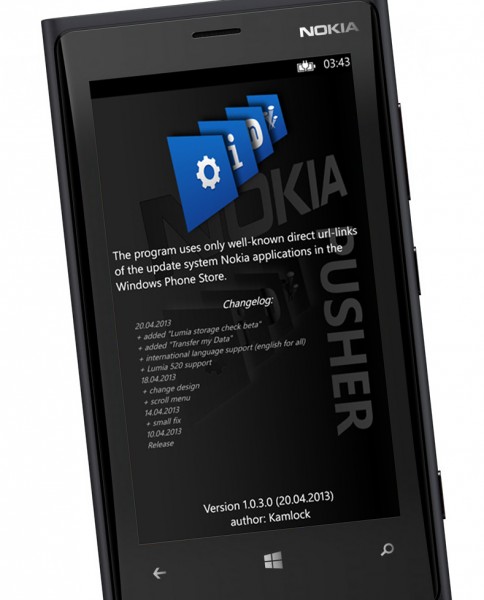
  • Update hidden Nokia Windows Phone apps with LUMIA pusher

    With the purpose of further improving the user experience on Lumia smartphones, Nokia adds its own apps atop of Windows Phone 8. Most of the extra software is available to download directly from the Nokia collection inside the app store, but the remaining few are hidden from prying eyes.

    When an update arrives, Lumia users can only wait for the Store app to display a counter and afterwards allow them to install the latest update. And, as Windows Phone users know, that can take some time — a day or even longer sometimes. So what are your options? Well, you can look up QR codes and scan them or just use the LUMIA pusher app, which allows you to update every single extra right from your Lumia smartphone.

    The Nokia account, extras+info, accessories, network+, feedback to Nokia, access point, display+touch and audio apps, which are all available to use through the Windows Phone Settings menu, can be updated to the latest version using LUMIA pusher.

    The user only has to tap on the item’s name and LUMIA pusher will display the app’s page inside the Windows Phone app store. From there, the user can check for reviews and write a new one, share the app via social networks, email or message, read the description, report the app, view the necessary permissions, and so on.

    LUMIA pusher can also be used to install and update a couple of other exclusive apps such as Transfer my Data and Lumia Storage Check Beta and update the Yandex search engine for Russian Lumia users. That’s just the bonus. The developers should add other software as well, especially from Nokia Beta Labs.

    I like the ease of use that LUMIA pusher delivers, but there is one major caveat. If you have a light background enabled on Windows Phone 8 the app will not take it into account as it normally would.

    The background is dark, which shouldn’t normally be a problem, but instead of keeping the white text with the light background (as it does with the dark one), the app instead uses black for the text. Needless to say, you can’t see much.

    LUMIA pusher is available to download from the Windows Phone Store.

  • GigaOM Chrome Show: New hardware hints and a Skype on the web letdown

    This week’s Chrome podcast kicks off with news that Google is testing Chrome OS on Intel’s fourth-generation chips, which aren’t due out until June. That opens the possibility for more high-end Chromebooks that will have much better battery life. Chris shares his experiences with Chrome OS so far and we answer a few listener questions including one about rolling back to prior software versions.

    We have three tips for Chrome OS users while this week’s showcase extension is for the Chrome browser on Windows and Mac computers. Plus: more about that Skype version for the web you might have heard about.

    Show notes

    Hosts: Chris Albrecht and Kevin C. Tofel

    Got questions, tips or tricks for an upcoming GigaOM Chrome Show? Find Kevin on Google+, Twitter (@kevinctofel) or via e-mail ([email protected])

    (download this episode)

    Subscribe to RSS

    iTunes

    Stitcher Radio

    Related research and analysis from GigaOM Pro:
    Subscriber content. Sign up for a free trial.


  • Should You Share a Room on a Business Trip?

    Years ago, when I worked at Holt, Rhinehart & Winston Educational and Professional Publishing, my female superior and I attended a national teacher’s conference in San Antonio, and were forced to share a hotel room because of a late booking. What could have been a profoundly awkward experience — my boss! in her pajamas! — turned out to be one that strengthened our relationship, allowing us to get to know each other in a way that can rarely be found in the frenzy of daily work. The kind of bonding that I inadvertently experienced may be more frequent these days as the byproduct of a corporate mindset reshaped by Great Recession-driven austerity practices — among them requiring employees to share rooms. Major corporations such as Pfiizer, Bristol Meyers-Squibb and Microsoft have experimented with the practice. Nimbleness and frugality, after all, remain critical to growth, and it’s been interesting to see that even as the economy slowly recovers, plenty of business travelers voluntarily and even eagerly share hotel rooms with colleagues. An Embassy Suites survey of 700 business travelers discovered that “17 percent said they try to share a room with a colleague.”

    Fostering an Entrepreneurial Mindset

    Seth Goldman, the co-founder and CEO of Coca-Cola-acquired Honest Tea, thinks a policy of sharing rooms during business travel helps preserve the entrepreneurial mindset that infused the founding of his company. “Every manager has a P&L that he or she is responsible for,” he says, “and while we don’t make sharing rooms a hard and fast rule, it’s our sense that when people have their own budgets and ownership for their profits, they’ll continue to operate that way.”

    It Can Be Good for Business

    In addition to furthering a sense of entrepreneurialism, Goldman notes that “we spend half as much on hotel rooms as we would if we didn’t share rooms on the road. It makes people think twice about how we spend our money.” But in particular, Goldman says that sharing rooms “allows Honest Tea to save money everywhere that the consumer doesn’t see it, allowing us to invest more in the business.” Rita McGrath, an associate professor at Columbia Business School, echoes Goldman’s findings and estimates that companies “can save as much as 50% in reduced overhead and administrative costs through a room-sharing policy.”

    Danica Kombol, founder of the Atlanta-based social media agency, Everywhere, has even shared hotel rooms at conferences with complete strangers. Before a recent conference, Kombol, who spends at least two weeks every month on the road, had tweeted that she was looking for a “roomie” and another conference attendee named Christine Young responded. For Young, “the best thing about attending conferences is connecting with other like-minded women.” She says the friendships that have been forged have been nothing short of business- and life-changing. “Some of my greatest business contacts,” says Young, “have come from these shared experiences.” Kombol, who once roomed at a conference with a Wal-mart employee she’d never met before, recalls that particular roommate saying that she chose to bunk with a stranger because it “reminded her to be a good steward of the company’s dollars.”

    Kombol and her Everywhere team also often share rooms when the client is paying. It just makes business sense to her, and her clients reward her company for its attention to value. “I would never have dreamed of suggesting that Danica and the Everywhere team bunk up,” says Francis Heid, the Vice President of Media Operations for Advanstar Communications, “but the truth is they do a lot of traveling for us and have visited every Advanstar office around the country, multiple times. The money we’ve saved on hotels is money we can devote to her social media agency, which frankly gets us more bang for both our bucks.”

    Companies Need to Have Across-the-Board Consistent and Transparent Policies

    Like so many programs, how a room-sharing policy is managed will make the difference between success and resentment. Adelma Stanford, a social media engagement manager, responded poorly to a room-sharing policy her former employer, Promethean (a global education company), instituted for junior employees during the recession. Stanford said that the majority of the employees resented the tiered policy and thought, “‘I don’t know these people and shouldn’t have to room with them.’ Many employees chose to pay the difference out of their own pocket so they wouldn’t have to share a room.”

    A former senior associate at Price Waterhouse Coopers, who insisted on anonymity, was okay with bunking with someone, particularly when the economy was in the dumps, but it irked her that more senior management wasn’t asked to make a similar sacrifice. As the associate put it, “at PwC the turnover is high. It’s a demanding job where you regularly feel undervalued and a lot of senior associates were not very happy with this decision because if it was about cutting costs, then every level should have had to bunk.”

    Rita McGrath confirms that a practice of sharing rooms will backfire for management if not uniformly executed. “Where it is particularly demoralizing,” she says, “is when executives insist on penny pinching for their employees but exempt themselves from cost-cutting measures, whether that be sharing hotel spaces or air allowances or whatever. Then people just feel they are being pushed around.”

    When senior management walks the talk, a room-sharing policy is more palatable. McGrath described how for “one of my clients, for instance, the emphasis is on keeping costs low, but the tradeoff is a very generous bonus program so that people feel that when the company saves money they get to share in the benefits. Also, everybody does it, from the “C-suite on down.” Goldman, from Honest Tea, says at his company secretaries and SVPs share rooms, and laughed recalling the time, the night before a big presentation that he shared a room with a VP of sales who “had to sleep with the TV on.” Rather than forcing his employee to turn off the television, Goldman erred on the side of being a good roommate and made do with three hours of sleep. (Granted, many experts — such as HBR blogger Tony Schwartz — would argue that you simply can’t do your job if you don’t sleep.)

    Companies Need To Be Sensitive

    While there are no laws against employees sharing hotel rooms, companies could minimize the potential for unhappiness — or worse — by making the arrangements elective and giving employees a choice over their roommates. A male and female manager at Honest Tea once shared a suite, but “it was sufficiently uncomfortable,” says Goldman, “that we only did that once.” And it’s important for management to know what they are asking of their employees and to acknowledge the sacrifice. Many of those I interviewed said they need private time on the road to “reflect and recharge” and felt the cost of losing precious down time would be greater than the corporate benefit. And Goldman admits that as his business has grown and people from more established companies have joined the company, it’s become more difficult to maintain a culture where “five guys would share a suite.” In fact, he’s made a pledge to the staff that if they meet their profitability goals this year, “everyone will get their own room.”

    Companies need to carefully calibrate their travel policies according to their organization’s culture. Bunking up policies can make employees feel both uncomfortable and undervalued if handled the wrong way. But for many, room-sharing — if respectfully and equitably administered — has the potential to foster not just major cost savings, but also deeper, unanticipated connections that can change the course of a business or a career.

  • BYOD is Not the Enemy: Using Consumer Tech to Manage the Data Center

    clouds-mobile

    LAS VEGAS – BYOD is not the enemy. Instead, the Bring Your Own Device movement of adopting consumer technology can be of great benefit for an It organization, according to Joseph Furmanski, Associate Director Data Center Facilities and Technology at the University of Pittsburgh Medical Center (UPMC).

    In a presentation Tuesday at the AFCOM Data Center Word Spring 2013 conference, Furmanski outlined how consumer tech such as iPhones and tablets were embraced at UPMC and have become valuable tools for the huge health care provider. Workers bringing their own devices to the workplace are inevitable, he noted, so why not embrace it?

    For UPMC, consumer tech offered a way to do more with less manpower. ”There’s 3 people, we stretch them a lot and want to minimize that,” said Furmanski.

    Furmanski believes adopting consumer tech is important in addressing long-term staffing challenges facing the data center industry. Many in the data center field are no longer spring chickens, and the industry will need younger workers who are accustomed to using iPhones and tablets rather than Blackberries and PCs.

    Attracting A New Generation of Staffers

    “We have to train a new generation and get them excited, and the key is using the tools they use,” said Furmanski, who said his thinking was influenced by discussions at AFCOM and other industry groups on attracting and retaining Millenials. “The people we’re hiring now grew up with this stuff.”

    UPMC operates more than 20 hospitals, with 3,200 physicians and more than 55,000 employees at400 clinical locations, which include hospitals as well as long-term care and senior living facilities. UPMC also operate s a health plan with nearly 1.8-million members.

    With the objective of improving data center management and IOC support, the company began looking at consumer tech, with the stipulations that it would be low or no cost, and must be used in a way that required little to no custom programming. The effort initially focused on the most popular applications: Facebook, Twitter, Dropbox, Evernote, and QR code to perform various functions and communications.

    Quick Deliverables, Quick Wins

    “We had to convince management that we weren’t doing it just to have fun,” said Furmanski. The initial stages were about quick deliverables and quick wins.

    The UPMC’s main data center is in Forbes Tower, a 10,750 square foot facility with limited staff. The hardware is leased on 3-4 year cycles, and they’re heavily virtualized with over 5,000 virtual machines in use. It’s not a large data center, and they are constantly looking at how they can improve efficiencies. This is where consumer tech came into play.

    The first phase of the plan cost under $2,000 in equipment. The staff would use QR codes and code scanners for things like the FM 200 manual, making it easier to access documentation. The staff took video for information purposes, and used Skype to call subject matter experts to solve problems.

    UPMC was able to more effectively use limited staff, save on paper and organize documentation through use of consumer tech.  As time passed, using tablets improved quality and processes and saved the company a lot of paper.

    It wasn’t all smooth. “Integration was the beast that stopped the project,” said Furmanski. Security integration was a particular pain point with devices like iPads and iPhones. “There were a lot of good vertical applications, but we hated logging in over and over,” he said. “There was little to no integration. We talked to a lot of vendors about this.”

    The Surface to the Rescue?

    The company then looks to Microsoft’s Surface tablet, and believes the new Surface Pro will make many of those headaches go away. “Security and content worked really well with it,” said Furmanski. “We found we can run any web or windows based app.” Working with these devices are now a DCIM requirement.

    The company uses these devices to access data on the overall health of the data center. The wealth of applications emerging from app stores for consumer devices is proving useful to UPMC. Staff can view real-time PUE and the environmental control system, all from a tablet. Furmanski says Sharepoint is a key knowledge repository, and Windows 8 and Active directory passes context through, so the silos between apps are breaking down.

    The bottom line for UPMC is that a small staff, with limited investment in consumer tech devices, was able to do more and virtually eliminate the heavy paper usage that plagued the company, Furmanski said. Information is at their fingertips, a limited staff can do more and can access documentation quickly and easily. UPMC will continue to look into how consumer tech can improve its everyday operations.

    By implementing proper usage of BYOD and consumer tech, the data center can greatly improve processes and drive valuable insight, even with limited manpower. There are a wealth of applications from data center management providers coming out every day that increase the value of these devices, so it’s worth looking into the consumerization of data center management.