Category: News

  • LG Optimus G Pro arrives in Asia

    After launching the smartphone in its home market, on Thursday, South Korean manufacturer LG announces that the Optimus G Pro, the company’s Android flagship, will finally be available in remaining Asian markets starting next month.

    “Asian customers are leading many of today’s technology trends and we’re confident Optimus G Pro will find a large following in this region”, says LG’ Jong-seok Park. The handset, labeled indirectly as a phablet by the company, will be launched in Hong Kong first, followed by other local markets like Taiwan, Singapore, Thailand, India, Indonesia, Philippine, Vietnam and Malaysia throughout June.

    The highlights of the Optimus G Pro include 5.5-inch display with a resolution of 1080 by 1920 and a 440 ppi (pixels per inch) density; 1.7 GHz quad-core Qualcomm Snapdragon 600 processor; Adreno 320 GPU (Graphics Processing Unit); 2 GB of RAM; 3,140 mAh battery; 13 MP back-facing camera; 2.1 MP shooter on the front; 16 GB of internal storage; microSD card slot and Android 4.1.2 Jelly Bean.

    The Optimus G Pro is already available in the US and other markets like Japan and South Korea, but has yet to make a global appearance. The fragmented launch strategy adopted by LG can only harm its handset sales and, therefore, the chance to better compete against rival makers Samsung and Apple. The South Korean company is currently the third-largest smartphone manufacturer.

  • Car goes airborne after blowing shock!

    Car Crash

    If you’ve ever witnessed a car accident, and I mean a REALLY bad accident then you know that it can be both a terrifying and traumatizing experience. Seeing people get hurt, or worse, makes one think twice about a few things. In this case, it’s simple automotive maintenance. The video you are about to see is frightening, as it shows what happens when a car blows a shock, loses control and goes airborne. Kinda’ makes you think twice about doing a regular service to your car doesn’t it?

    Source: Youtube.com

  • BlackBerry Live 2013 Panel Recap: Built for Mobile in Emerging Markets

    Lseries_SA_121211-604_BG_Q-w600

    The fastest adopters of mobile innovation are not just infrastructure-rich markets. It’s in regions like Africa and Asia where peoples’ first experience of the Internet is mobile. Smartphone uptake is exploding in emerging markets due to rising wealth, brand desire, access to education and need for key services in health, welfare, education and finance. In many ways, they are further advanced in mobile service innovation, as many businesses are built first from a mobile perspective.

    Across emerging markets, mobile is consistently an engine of growth, but as technology evolves, the mobile industry will need to play an active part in helping governments address socio-economic challenges, enable progress and build sustainable mobile ecosystems for the future. To discuss some of these challenges, we held a panel at BlackBerry Live 2013 with industry leaders, analysts, and developers to exchange insights on BlackBerry innovation in emerging markets around the world.

    Participants in the panel included: Robert Bose and Wes Nicol, BlackBerry’s Regional Marketing Directors for Europe, Middle East and Africa (EMEA) and Latin America (LATAM) respectively; Leandro Melo de Sales, Professor at Institute of Computing (IC) at Federal University of Alagoas (UFAL) and Principal at BlackBerry Tech Center, Brazil; Alexander Rusli, CEO of Indosat, one of Indonesia’s largest telecommunication networks and service providers; Leon van Dyk, BlackBerry apps lab manager in South Africa; and Victor Dibia, developer and founder of denvycom in Nigeria.

    Read more at the Inside BlackBerry Biz blog »

  • Can the Moto X compete with Apple’s iPhone 5S and Samsung’s Galaxy Note III?

    Moto X Release Date
    Motorola boss Dennis Woodside on Thursday finally confirmed the existence of the Moto X, the first Motorola smartphone that will launch with heavy influence from Google. Few details were shared by the executive while on stage at the D11 conference, but the tidbits he did offer were very intriguing. Woodside said the phone will be manufactured in the United States in a Fort Worth, Texas facility that used to build Nokia handsets. He also said the Moto X will feature two processors and numerous sensors that help the handset respond to context. For example, it will know when the user is driving a car, or when the phone is taken out of a pocket. Finally, he said the Moto X will launch by October and will be available across several carriers. As great as all this sounds, will any of it matter?

    Continue reading…

  • Waze Update Adds Facebook Event Integration & More as Acquisition Rumors Swirl

    With 49 million daily users, Waze has been the topic of some acquisition rumor drama over the past couple of weeks. Rumors that Facebook was in serious talks to buy the Israel-based navigation company have swirled since early May – but recent reports indicate that those have fallen apart. It appears that Google and a few other unspecified companies are also in the mix, however.

    Acquisition rumors aside, Waze is still working on making their app better. Today, they’ve released v3.7 which brings a bunch of new features including Facebook event integration and more.

    Now, if you have Facebook connected to Waze, your Facebook events will automatically appear in your Waze navigation lists in the hours before the event is supposed to begin. That way, you can just tap the event when you’re ready to go and get to navigating – no hassle.

    “Our vision is to create a completely seamless experience when meeting colleagues, family or friends,” said Yael Elish, VP of Product & Marketing, Waze. “Waze frees you from the hassle of dealing with addresses or coordinating meeting places. One-tap navigation to Facebook Events is only the start…drivers will enjoy much more in upcoming versions soon.”

    Waze also added a feature that will show you when your friends are on the way to the same destination that you are. They’ll appear on a new bar on the right-hand side of the map, one which will show you who’s going to get there first.

    Here’s Waze’s full list of updates to 3.7:

    • Real time and offline “beep beeps” at friends.
    • Exclusive moods for map editors – T. Rex, robot and 8-bit.
    • Redesigned, sleeker pop-up alerts.
    • Inbox has moved to the main menu.
    • New 3-state mute button in the main menu (mute, alerts only & on).
    • Foursquare check in available from report menu.
    • Lock up north added to settings.
    • Support for JVC App Link Mode” for compatible in-dash car audio receivers.
    • Multiple fixes and optimization and more!

  • Digital Realty Trust Acquires Six Austin Data Centers

    Digital Realty Trust acquired a six-building portfolio in Austin, Texas for $31.9 million. The portfolio is located at the MetCenter Business Park and consists of 337,000 square feet of operating data centers and flex space.

    The overall portfolio is 90 percent leased to a variety of companies, with two of the six buildings total approximately 100,000 net rentable square feet fully leased to three tenants.

    This move continues Digital’s recent streak of acquiring fully leased properties for income, plus adds some new development space for upside.

    “The acquisition of this portfolio achieves several key objectives for us,” said Scott Peterson, Chief Acquisitions Officer at Digital Realty. “It expands our existing data center footprint in the Austin market, while providing stable cash flow immediately at an attractive going-in cap rate. Second, it provides near-term opportunity to add value by lease existing vacant space. And third, it offers the option to convert a portion of the property to data center space over the longer term as leases expire.”

    The six buildings are located adjacent to Digital Realty’s data center at 7500 Metro Center Drive, approximately five miles southeast of the Austin central business district, and nearby Austin-Bergstrom International Airport.

    “This acquisition adds inventory to a market where we have already seen substantial absorption at our existing facilities, as well as strong demand from enterprise customers,” said Michael Foust, Chief Executive Officer at Digital Realty. “It is a continuation of our strategy of growing a world class data center portfolio in markets where our customers want to be located.”

    Where are the customers wanting to be located? Just this year, the company has acquired facilities in Dallas, Phoenix , Minnesota, Toronto, Paris,  and Sydney. All of these acquisitions were in markets where the company says it saw very positive demand, and most of these properties were fully leased at time of acquisition. It also launched its own DCIM, announced it was seeking out tier certification for 20 facilities, and is building dark fiber connecting its key internet gateways. It upgraded its POD infrastructure to offer up to 1.2 megawatts in each data hall, up from 1.125. The company has kept busy.

  • Keep your passwords secure with Dashlane for Windows, Mac and Android

    Dashlane, Inc has launched Dashlane 2.0 for desktop and Dashlane for Android 2.0.1, major new updates of its secure password management tool that allows users to securely store sensitive personal details such as online passwords and credit card information via free desktop and mobile apps.

    Both builds gain a complete new user interface, the promise of a “massive jump” in product quality and support for two-factor authentication via Google Authenticator. In addition the desktop build gains a new Security Dashboard feature, while the Android version expands support for tablets and adds in-app browsing.

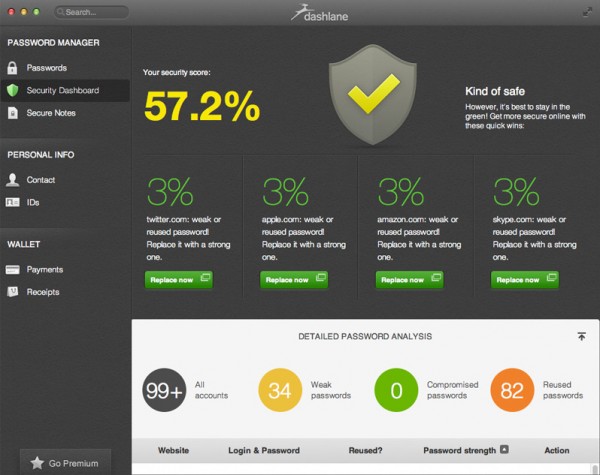
    The Dashlane 2.0 app for Windows and Mac opens with a brand new redesign with new color schemes and contrast levels designed to improve readability as well as the app’s overall look. It also comes with a brand new Security Dashboard feature offering a Security Score, which rates the user’s overall security based on the strength and variety of passwords used. Users also gain a simple list of steps to follow in order to improve the quality of their passwords to boost this Security Score.

    Version 2.0 also promises much more intuitive use through support for two-step and three-field login screens as well as improving the overall auto-login and autofill process. In addition to these features, the desktop also adds another optional layer of security with support for Google Authenticator, allowing users to add two-factor authentication when logging into Dashlane to retrieve sensitive personal information.

    Sadly there are still issues with version 2.0, most notably when attempting to import passwords from other sources, such as browser password managers and competing services such as LastPass and KeePass. These issues have been long a source of frustration for users, and in our experience have yet to be properly resolved as we struggled to migrate our LastPass passwords into Dashlane, eventually succeeding only by using Firefox as an intermediary using the Mac desktop app.

    In the meantime, Dashlane for Android 2.0.1 introduces a number of major improvements and new features. It includes an in-app browser for the first time, allowing users to benefit from the same auto-login and autofill feature set found when using Dashlane on the desktop platform.

    The app also adds full support for tablets and all screen sizes from a single universal app, while the UI has been completely overhauled using the Android Holo Interface. Support for two-factor authentication via Google Authenticator has also been implemented, which requires setting up via the desktop version before it can be used in the Android app.

    All product features are completely free to use, but additional benefits, including support for auto-synchronization between devices, web access to logins and passwords, plus unlimited backup of encrypted data, can be purchased via a Premium license, which costs $19.99 annually.

    Dashlane 2.0 is available as a freeware download for Windows and Mac, while Dashlane for Android 2.0.1 is also available free for phones and tablets running Android 2.3.3 or later. Also available is Dashlane 2.3.1 for iPhone.

  • Samsung Galaxy Tab 3 8.0 and 10.1 tablets unofficially outed

    Samsung_Galaxy_Tab_3


    Those of you Sammy stans out there will be excited at the fact that the newest additions to the Galaxy Tab family have been outed for your viewing pleasure. Thanks to the studs at Moveplayer, we now know what the Galaxy Tab 3 8.0 and Galaxy Tab 3 10.1 will look like, as well as some additional details regarding the specs of each device. According to the site, the Galaxy Tab 3 8.0 will come with an 8-inch WXGA (1280 x 800) TFT-LCD display and dual-core 1.5Ghz processor, 1.5GB of RAM and Android 4.2.2 on-board; the Galaxy Tab 3 10.1 on the other hand, will likely feature a similar spec sheet— while also addition the expectation of coming in no less than 3 variants and will measure in at 243.1 x 176.1 x 7.95 mm.

    Samsung hasn’t come out and addressed the latest leak just yet, but all indications point to for formal unveiling and launch of the tablets at a June 20th event.

    source: Moveplayer
    via: SamMobile 

    Come comment on this article: Samsung Galaxy Tab 3 8.0 and 10.1 tablets unofficially outed

  • Woman Killed by Police at Virginia Costco

    A Virginia woman was shot and killed this week after threatening police with a knife at a Costco in a Washington D.C.-area suburb.

    According to a statement from the Loudoun County Sheriff’s Office, officers responded to a report of a disorderly woman at a Costco in Sterling, Virginia. The woman, later identified as 38-year-old Mhai Scott, was reportedly threatening store employees with a knife and scissors.

    Two deputies arrived at the store and attempted to subdue the woman with a Taser. According to the Sheriff’s office statement, the Taser was “ineffective” at stopping the woman. The deputy who was not using the Taser then fired multiple shots at the woman.

    The woman died in the Costco and one deputy was taken to a nearby hospital for unnamed injuries sustained during the incident. The deputy is now in good condition.

    According to an NBC 4 report, Scott was working at the Costco at the time of her death, handing out pizza samples to customers. Witnesses described Scott as making strange comments about the pizza.

    View more videos at: http://nbcwashington.com.

  • Woman Killed At Costco After Waving Knife At Customers

    A Virginia woman was shot and killed on Wednesday after she stopped handing out samples and began waving a knife around in a threatening manner.

    The woman, identified as 38-year old Mhai Scott, reportedly began acting strangely and was saying odd things as she neared the end of her shift. Her supervisor became frightened and called police. When they got there, they found Scott erratically waving a knife and a pair of scissors around in a threatening way, so they tried to subdue her with a stun gun. When that didn’t work–and she came at a deputy with the weapons–they opened fire.

    “Everyone was running out of the building not knowing what was going on,” customer Robert Krause said. ”I was a little scared so I got out of there pretty quick.”

    One of the officers was wounded after a bullet ricocheted and hit him in the leg, but he is expected to recover. Police say they have no clues as to why the woman suddenly became agitated.

    “It’s a tragic situation,” Sheriff Michael Chapman said. “I feel for everybody involved.”

    Scott reportedly worked for Club Demonstration Services and was in charge of food prep and sampling at the store.

  • Don’t Let Mobile Apps Get Pushy

    Americans are addicted to their smartphones. A recent report by Flurry Analytics revealed that Americans spend about 2 hours and 38 minutes a day glued to their mobile devices, with 80% of that time spent in/on mobile apps. With over 700,000 apps available for download in both Google Play and the Apple App Store, it is safe to say that apps have reached critical mass.

    With this intense competition, brands and mobile app developers are forced to reevaluate tactics for growing user retention and engagement rates, which is increasingly difficult. Some brands — like ESPN and Yahoo — are embracing the philosophy of “less is more” by consolidating their overall portfolios of mobile apps and redesigning their “everyday” apps to appeal to overloaded users. But many other are embracing push notifications, which are proven to quadruple mobile engagement rates and double retention rates compared to apps without them.

    The New York Times and the Wall Street Journal leverage push notifications as tools to break important news. Retailers like Sephora and Gilt use them to support time-sensitive flash deals. Airlines like United use them to keep travelers up-to-date with flight statuses.

    While push notifications can be incredibly useful, many mobile app developers and brands have resorted to using them as a cheat to achieve coveted retention and engagement. In some cases, it’s starting to backfire. We’re beginning to see a tidal wave of push notifications from mobile apps that alert users of every mundane activity, irrelevant sales promotion, or social network update. Essentially, these push notifications just add more digital noise and drive users to tune out or even delete certain mobile apps from their devices. Just yesterday, I received a last-minute Ticketmaster alert to purchase concert tickets for a band that I don’t like for a concert in a city that I don’t live in. On other days, the activity in my Facebook life causes my phone to constantly buzz. But then again, Facebook’s aggressive use of push notifications is well documented.

    Evaluating the value of push notifications against the noise that they create is a slippery slope. Given the proven success of these alerts and with strong retention and engagement rates viewed as the Holy Grail, we need to find a palatable solution for future app development.

    Here are some guidelines that brands and mobile app developers need to consider:

    1. First decide if the mobile app is brand appropriate. Does your brand have a proper mobile channel strategy in place that fits into your brand’s overall business objectives? How does this mobile app fit into that strategy?

    2. Does the mobile app legitimately create value for your consumers? If not, then don’t build it.

    3. Focus your mobile app — don’t water it down. What are the one or two features that will help drive mobile app engagement and retention?

    4. Create social engagement layers for your mobile app that encourage users to come back. Why would they care and what would move them to share your mobile app?

    5. Use push notifications only when necessary and make sure the content in your push notification is relevant and personalized. Create a push strategy the same you would create an email strategy. Push notifications should not equal SPAM.

    6. Deliver the notification at the right time to the right audience in the right context. Segment. Push content to specific groups based on their individual profiles and behaviors. Push notifications should be geo-targeted, audience targeted, and time-sensitive.

    7. Use analytics and social listening to continuously improve your app by tracking what consumers care about. Your app is a work in progress. Analytic services like Parse are helping brands and agencies best determine if push notifications are working.

    Average users have 41 apps on their mobile devices — and that number continues to rise. Utilize push notifications appropriately to help bring attention of your mobile app. Don’t let your mobile app’s greatest asset for driving retention and engagement become it`s greatest nuisance as well.

  • Samsung Galaxy S4 Mini A Reality, Launches Later This Year

    Before the Galaxy S 4 tore up the sales charts, it was rumored that Samsung would be releasing a mini-version of the device for the more cost conscious consumer market. Those rumors were right on the money as Samsung announced such a device today.

    The Galaxy S4 Mini is indeed real, and it’s said to bring “the sleek design of the Galaxy S4 in a portable chic and compact design.” Of course, it’s not only the reduced size, but the reduced cost as well that will make the S4 Mini an attractive option for consumers not interested in 5-inch smartphones that cost hundreds of dollars.

    The S4 Mini is equipped with a 4.3-inch qHD Super AMOLED display, a 1.7GHz processor, 8MP back camera, 1.9MP front camera, 1.5GB of RAM and 8GB of internal memory. As expected, it will ship with Android 4.2 and supports LTE bands. It also supports many of the same software features that shipped with the Galaxy S4, like S Translator and S Health.

    “Demand for the Galaxy S4 has been phenomenal since it launched in April and we hope to build on this success with the Galaxy S4 Mini,” said Simon Stanford, Vice President of IT & Mobile Division, Samsung Electronics UK & Ireland. “This new handset is the ideal smartphone companion for anyone who wants a compact device packed with innovation.”

    So, when will you be able to get your hands on the S4 Mini? Samsung isn’t saying at the moment. A separate press release out of UK-based Phones 4U says the device will be out in the UK this July. There’s been nothing said regarding a U.S. release, but I wouldn’t be surprised if it launched around the same time as it does in the UK.

  • Spotify Discover Now Available to All Via Web Player

    Last December, Spotify announced a brand new “discovery” feature that harnessed the streaming music company’s data on your past streaming habits and various recommendation engines to give users suggestions on what to listen to next. Today, Spotify is making the Discover tab available to all users via the web player.

    “With the Discover page, we’re making good on our promise of helping you choose what to listen to when faced with millions of songs,” says Gustav Söderström, Chief Product Officer, at Spotify. “We’ve made your listening experience more personal, more social and more current.”

    The Discover tab features a bunch of different ways to find new music as well as more information on music you currently love. Personalized recommendations suggest artists and tracks based on what you’ve listened to and who you’ve followed. You’ll also see the music and playlists shared by your Spotify friends. And a related music feature also gives you suggestions on what to play next, based on the song you’re currently listening to.

    Spotify harnesses the power of Pitchfork, Songkick, and Tunigo (which they just purchased) for these recommendations. According to the company, it’s now available for everyone on the web and will continue to roll out to Spotify’s desktop and mobile apps in the coming weeks.

    Check it out today over at play.spotify.com/discover.

  • Details on Additional Connect America Fund subsidies: $485 Million to Expand Broadband Access Across Underserved Rural Areas

    Connected Nation recently put out a  press release on the additional round of Phase I Connect America Fund subsidies for larger (“price cap”) local telephone companies. Here are some highlights…

    2013 Connect America Fund Phase I Program

    Largely speaking, this funding opportunity is structured similarly to the Connect American Fund Phase I program of 2012, but there are several important changes in its implementation. Specific program details include:

    Areas Eligible for Phase I Subsidies – For the 2013 round of Phase I subsidies, eligible areas now include areas traditionally served by these 13 price cap carriers that do not have access to fixed broadband service of at least 3 Mbps download/768 Kbps upload speeds, according to the National Broadband Map. Last year, eligible areas included only those unserved by fixed broadband service at speeds of only 768 Kbps download/200 Kbps upload. This new definition nearly triples the number of areas eligible for Phase I subsidies in 2013 than were eligible in 2012.

    BTOP and BIP Areas Excluded – The FCC will not award Phase I subsidies in areas where the federal government has already allocated subsidies for broadband build-out through the BTOP or BIP programs.

    Build-Out Requirements – A provider that accepts the one-time Phase I funding for a census block will have 3 years to build-out broadband at speeds of at least 4 Mbps down/1 Mbps up in that census block.

    Use of the National Broadband Map – The FCC will be using the National Broadband Map to identify eligible areas for these subsidies. It will use the version of the Map currently online based on broadband inventory estimates for June 2012.

    Subsidy Amounts per Location Served – Under this program the FCC is offering subsidies on a per-location-passed basis with two separate benchmarks. For areas that do not have access to fixed broadband at 768 kbps download/200 kbps upload, the FCC is offering a one-time subsidy of $775 per location passed to fund the upgrade. To upgrade areas that have access 768 kbps/200 kbps fixed broadband but which do not have access to the FCC’s benchmark of 3 Mbps download/768 Kbps upload, the FCC will provide a one-time subsidy of $550 per location.

    Allocation of Subsidies Across Price Cap Carriers – The FCC will make up to $485 million available in this program, allocated among the 13 price cap providers. In this Order it sets an initial allocation of $300 million as follows:

    ntia

    These amounts are not, however, a cap for funding available under this program for each provider. Recognizing that the subsidies offered to each provider may not be accepted (as was the case in 2012 Phase I program), the FCC is introducing a mechanism by which the providers can request funds beyond this allocated amount. In particular, each provider can submit subsidy requests for 2013 up to $300 million. If the program is oversubscribed, the FCC will allocate up to $485 million in subsidies based on the proportions of the allocation above.

    The allocation, then, is perhaps best thought of as a guarantee for a minimum amount of subsidies if the subsidy recipients agree to make the associated build-out commitments. Providers like PRTC and Cincinnati Bell that do not have an initial allocation may identify areas to which it would make a build-out commitment in exchange for Phase I funds, and those requests may be accepted if all $485 million is not claimed by all other providers.

    Process and Mapping Challenges – The FCC is establishing a 60-day challenge process to resolve disputes as to whether the National Broadband Map accurately reflects the availability of broadband in areas eligible for Phase I funding. After price cap providers make their build-out commitments, the FCC will make those areas public and invite comment from the public within 30 days, with another 30 days reserved for rebuttal. In this way, parties will be able to challenge eligibility of the subsidy if, for example, they can prove that a given area is already served. By insisting that these disputes be raised publicly and in a targeted manner, this process represents a significant improvement over prior efforts by the FCC to resolve this category of disputes.

  • Apple unveils new 16GB iPod touch

    Before Apple rolls out a new product the company usually announces it with much fan-fare at special events and issues bombastic press releases before the big launch. But that’s no longer the case with the 16GB iPod touch which arrives quietly with its tail between its legs. It’s almost like the Cupertino, Calif.-based corporation doesn’t want folks to rush into ordering one.

    The 16 GB model bears an uncanny resemblance to the current iPod touch lineup, featuring the same elongated design (first seen on Apple’s iPhone 5) and low physical footprint. But there are some differences.

    The latest model ditches the 5 MP iSight back-facing camera and iPod touch loop (lanyard hook), has a lower price and is only available in a single color trim with less internal storage. Unsurprisingly, Apple lists it as an individual product, separated from the company’s current iPod touch lineup.

    The 16 GB iPod touch runs for $229, $70 cheaper than the 32 GB model (available for $299) which comes with a back-facing camera and, obviously, twice the storage capacity. Battery life is the same, with Apple touting 40 hours and eight hours of audio and video playback, respectively.

    Specifications for the 16 GB iPod touch include: 4-inch multitouch Retina display with a resolution of 640 by 1136 and a 326 ppi (pixels per inch) density; dual-core A5 processor; 1.2 MP FaceTime HD camera capable of 720p video recording; Wi-Fi 802.11 a/b/g/n and Bluetooth 4.0. The device comes in at 123.4 x 58.6 x 6.1 mm and 86 grams.

  • Samsung builds on Galaxy S4′s momentum with new Galaxy S4 mini

    Samsung Galaxy S4 Mini Specs
    Samsung on Thursday announced preliminary details surrounding an upcoming new version of its popular Galaxy S4 smartphone, the Galaxy S4 mini. The S4 mini is a mid-range variant of the wildly successful flagship phone, and it features much more manageable sizing. Key specs include a 4.3-inch qHD Super AMOLED display, a 1.7GHz dual-core processor, an 8-megapixel rear camera, available 4G LTE and Android Jelly Bean. No launch details or pricing have been announced, but Samsung will reveal additional information during a press conference on June 20th. Samsung’s press release follows below.

    Continue reading…

  • Software-Defined Power: The Path to Ultimate Reliability

    Clemens Pfeiffer is the CTO of Power Assure and is a 25-year veteran of the software industry, where he has held leadership roles in process modeling and automation, software architecture and database design, and data center management and optimization technologies.

    Clemens Pfeiffer Power AssureCLEMENS PFEIFFER
    Power Assure

    About half of all service outages in data centers today are caused by power problems, and that percentage is expected to increase as the electric grid struggles to meet a growing demand on an aging infrastructure. Part of the reason for this shift is that hardware has become remarkably reliable, and the virtualization of servers, storage and network components, or the so called “Software-Defined Data Center,” has made applications immune to single points of failure. Power problems, by contrast, are only partially addressed by the uninterruptible power supply (UPS) and backup generator.

    To enhance their business continuity and disaster recovery strategies, most organizations now operate multiple, geographically-dispersed data centers. While this investment is made primarily to protect against catastrophic events caused by major natural disasters, the arrangement can also afford greater immunity from power problems, whether caused by weather or disruptions on the grid.

    What is Software-Defined Power?

    Software-Defined Power is emerging as the solution to application-level reliability issues being caused by power problems. Software-Defined Power, like the broader Software-Defined Data Center (SDDC), is about creating a layer of abstraction that makes it easier to continuously match resources with changing needs. For SDDC, the resources are the servers, storage and networking equipment, and the need is application service levels. For Software-Defined Power, the resource is the electricity required to power (and cool) all of that equipment, but the need is exactly the same: application service levels.

    With Software-Defined Power, overall reliability is improved by shifting the applications to the data center with the most dependable, available and cost-efficient power at any given time. Software-Defined Power is implemented using a software system capable of combining IT and facility/building management systems, and automating standard operating procedures, resulting in the holistic allocation of power within and across data centers, as required by the ongoing changes in application load.

    It’s About the Applications

    Once configured with the service level and other requirements for all applications, the Software-Defined Power solution continuously and automatically optimizes the resource allocations as it shifts loads between or among data centers. Adding power to the already existing software-defined computing, storage and network components of an application environment makes it possible to abstract applications fully from an individual data center and its power dependency. This is what enables the shifting and shedding of application capacity across multiple data centers by adjusting the IT equipment and critical facility infrastructure required at each, resulting in the maximum possible application-level reliability at the lowest operating cost.

    Not only does shifting loads between data centers help increase reliability by affording greater immunity from power problems that cause unplanned downtime, it also creates wider windows for the planned downtime required for routine maintenance and upgrades within in each data center. This makes it easier to operate applications 24×7 with no adverse impact on either availability or performance from power-related issues.

    Follow-the-Moon Strategies

    In addition to the increased reliability, Software-Defined Power also pays for itself by minimizing energy spend and enabling participation in lucrative demand response programs. Power is the most dependable and available at night, which is also when rates for electricity are normally the lowest. So shifting the load to “follow the moon” can afford considerable savings.

    Shifting load to a distant data center also enables shedding that load locally. A best practice in Software-Defined Power, therefore, is to power down the servers until they are needed again. This same ability to de- and re-active servers can also be used to dynamically match capacity to load within a single data center on a regular schedule or in response to changing application demand.

    Because utilities pay exorbitant rates for wholesale energy during periods of peak demand, they are willing to pay commercial and industrial customers handsomely to reduce usage during these peaks. Software-Defined Power enables data centers to participate in these demand response programs without adversely impacting on application service levels. Organizations can even go one step further: By knowing about potential grid issues, IT and facility managers can take preventive action to shift applications to another data center in advance of any power problems.

    The combination of paying less for energy and wasting less to power (and cool) idle servers (including during demand response events) can result in savings of over 50 percent. And considering that the operational expenditure for energy alone exceeds the capital expenditure for the average server today, the electric bill for a full rack of servers can be cut by as much as $25,000 every year.

    Industry Perspectives is a content channel at Data Center Knowledge highlighting thought leadership in the data center arena. See our guidelines and submission process for information on participating. View previously published Industry Perspectives in our Knowledge Library.

  • Why the U.S. Poor Have the Same Length Workday as the Rich

    In 1890, the poorest 10% of male U.S. workers labored an average of 10.99 hours per day, while the richest worked 8.95 hours. A century later, the poorest’s hours had dropped to 8.83 hours a day, while the richest’s hours had barely budged, say Diego Restuccia of the University of Toronto and Guillaume Vandenbroucke of the University of Southern California. Over the course of 100 years, the poorest’s productivity rose dramatically, and their resulting higher hourly earnings allowed them to spend less time working and more time going to school, the researchers say.

  • Toyota Tundra Improved MPG, HP – G-Tek Fab SABM Kit Available

    If you are in the market to crank a little more HP while picking up some MPG gains, check out this custom stock air box modification from G-Tek Fab over at TundraGeeks.com. It just might be the solution you are looking for.

    Toyota Tundra Improved MPG, HP - G-Tek Fab SABM Kit Available

    A new stock air box modification kit is now available from G-Tek Fab. This kit could improve your truck’s HP and MPG.

    Dez, master fabricator, has developed a new stock air box mod (SABM) kit that improves HP and increases fuel economy. The kit especially works great for those truck owners who have lifted and/or added bigger tires to their truck yet feel they have lost power. In fact, that is the inspiration for the kit’s creation. Dez says, “For those that are not sure what the SABM is well its a Stock Air Box Mod that was developed back in 2007 when I first got my truck lifted. I loved the power when I first drove it but after lifting it and adding 37″ tires it lost its punch. I wanted to add a little power so the first thing I looked at was a possible modification to the stock intake.”

    The kit works with your stock air box and with a few simple steps you can add the power back. It is designed for the 2007/2013 Tundra 5.7, 4.7, 4.6 stock and TRD intakes.

    The kit includes:

    • Two 3″ 6063 aluminum flange pieces one with a foam gasket attached.
    • Two 4″x3″ aluminum flange rings one with a foam gasket attached.
    • One 5″ length of foam seal for the outside of the air box base.
    • One 7″ length of foam seal for the inside of the air box base.
    • One 4 ply silicone intake tube in black, red, or blue.
    • Two stainless steel 3-1/2″ hose clamps.
    • Complete set of step by step instructions.
    • One G-Tek Fab and one Tundra Geeks sticker.

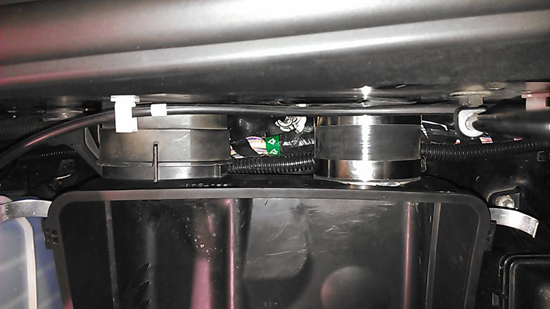
    The kit comes with a flange and flange ring for the motor compartment wall side with foam seal attached to them. The air box flange and ring has nothing on them but there are two strips of foam seal included to add to the steps on the inside and outside of the air box shown below. The air box flange has a flat spot to account for the small radius at the bottom of the air box.

    Toyota Tundra Improved MPG, HP - G-Tek Fab SABM Kit Available Install

    The kit (on the right) is clean and really blends into your engine compartment.

    The Install

    There are plenty of install threads on TundraGeeks to check out. Here is the basic install process from Dez:

    The install is very simple. All you need is a 3″od hole saw and a flat screwdriver to tighten the clamps. One flange inserts from inside the fender well and the other from the inside the stock air box. Slip the boot over the fender side flange and tighten the clamp. With the air box in place slip the other flange through the air box into the rubber boot and tighten the other clamp.

    I would have to think with some double-sided tape on the flanges, installation would be easier too. Remove the bottom half of the air box (you’ll need to for drilling anyways), then run the flange through the factory hole, and just stick it into place in the new hole you just drilled Simple enough.

    DYNO Testing

    Of course with any product like this, there has to be proof that it does indeed do what it claims. TundraGeeks member, and pretty mechanically handy guy I might add, MPToy07 took his single cab, super-charged Tundra in for a dynamometer test. Here is what he found:

    Toyota Tundra Improved MPG, HP - G-Tek Fab SABM Kit Available Dyno Testing

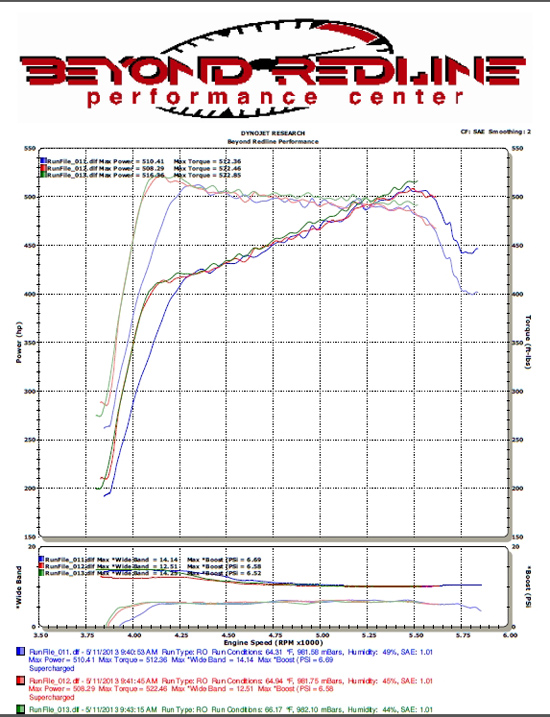
    The first run in blue showed 510.41 HP / 512.36 TQ, and had the highest boost pressure of 6.69 PSI.

    Second run in red was 508.29 HP / 522.46 TQ at 6.58 PSI boost, and a slightly higher ambient temperature (truck warming the surrounding area)

    Last run was in green with the SABM kit opened up, and showed 516.36 HP / 522.85 TQ at 6.52 PSI boost, and a slightly higher yet ambient temperature.

    So technically, total gain between the first run and last was only 6HP, BUT you can see the HP numbers going down as everything started warming up, then a decent size jump when the SABM kit was opened up and the truck allowed to breathe. It definitely helped in my case.

    MPG and HP Gains

    Scanning through the forums, it looks like the majority of truck owners are seeing single digit HP gains (8 or so) and 2-3 MPG increases. This is quite impressive for such a simple modification to the stock air box.

    Why does it work?

    Dez explains, “After the modification the first thing I noticed was tad bit of performance then I realized I was getting a little better gas mileage! This modification seems to allow the motor to run a little more efficient at the same time allowing it to gulp more air when you step on it.”

    Price

    The kit is being offered at an introductory level at $65 per kit plus shipping.

    The reality is that if this kit gives more bang for the buck then cold air intakes. Check out the kits here at TundraGeeks and let us know below what you think.

    Related Posts:

    The post Toyota Tundra Improved MPG, HP – G-Tek Fab SABM Kit Available appeared first on Tundra Headquarters Blog.

  • Who Should Actually Have Say on Pay?

    It’s say-on-pay season at American corporations. What shareholders have been saying, in overwhelming numbers, is yes! At 74% of the 1,471 companies that have voted so far in 2013, according to Equilar’s say-on-pay tracker, the “yes” percentage exceeded 90%. That’s up from 69% in 2012 and 2011. Only 31 companies (2%) have gotten sub-50% no-confidence votes in 2013.

    One key reason for shareholders’ positive tone is that the stock market has been doing well. Since say-on-pay hit the U.S. in 2011 (it was part of the Dodd-Frank Act), academic researchers have found that the chief determinants of how shareholders vote appear to be (a) stock performance, and (b) the voting recommendations of proxy-voting advisors ISS and Glass-Lewis, which are based in part on returns to shareholders over the previous three years. To a large extent, say-on-pay — which was introduced in the UK in 2002 and has spread to several other countries, most recently Switzerland — is a simple exercise in bandwagon-following.

    That’s not all it is, though. The size, growth, and design of paychecks do play into both the voting recommendations from ISS and Glass Lewis and the votes of shareholders. There is evidence that say-on-pay votes have led British companies to make executive paychecks more sensitive to poor performance. Say-on-pay votes do have an impact. The question is, what kind of impact?

    Say-on-pay is part of a big shift in recent years toward giving professional money managers more tools to affect the governance of (and in some cases discipline the managers of) corporations. Most of these theoretically increase the power of individual investors, too, but for the most part individuals aren’t a factor in corporate elections. Professionals appear to control somewhere around 60% of the shares of American corporations, and have an even higher percentage of the vote in corporate elections. (Individual investors tend not to vote, and while brokerage firms used to vote the shares of customers who didn’t get around to voting themselves — almost invariably siding with management — the SEC stopped allowing that practice three years ago.)

    Driving these changes is a widespread belief that more needs to be done to hold CEOs and boards accountable. That’s understandable. But it’s far from clear that professional money managers have what it takes to play the role of effective watchdog. When it comes to executive pay in particular, these people are a deeply compromised bunch.

    In the latest issue of the Journal of Economic Perspectives, economist Burton J. Malkiel argues that most of the gigantic growth in asset-management-industry profits since 1980 “is likely to represent a deadweight loss for investors.” His reasoning, as I discussed in an earlier post, is that active money managers as a group underperform the market indices and that, while active management does play a key role in setting stock market prices, there’s no evidence that today’s gigantic active management industry is doing that job any better than its much smaller precursor of three decades ago. American corporations outside the financial sector may have many flaws, but I’m pretty sure their increase in profits over the past few decades hasn’t been a “deadweight loss” to the economy.

    What’s more, the asset management industry — in particular the alternative-asset subset of hedge funds and private equity — has exported many of its pay practices into the corporate sector. The idea was to get away from paying CEOs “like bureaucrats,” as Michael C. Jensen and Kevin J. Murphy urged in a famous 1990 HBR article. It was a successful campaign: CEO paychecks came to consist mostly of stock options.

    This shift to financial-markets-based compensation had some of the promised impact — CEOs did become less risk-averse (bureaucrat-like) in their decision-making. But it also inflated what Mihir Desai has dubbed a “giant financial incentive bubble”. In Desai’s telling:

    Financial markets cannot be relied upon in simple ways to evaluate and compensate individuals because they can’t easily disentangle skill from luck. Widespread outsourcing of those functions to markets has skewed incentives and provided huge windfalls for individuals who now consider themselves entitled to such rewards. Until the financial-incentive bubble is popped, we can expect misallocations of financial, real, and human capital to continue.

    Say-on-pay has done nothing to deflate this bubble; executive pay has kept going up in the U.S. and UK. Which makes sense — most asset managers have a shared interest with CEOs in keeping top-of-the-scale paychecks high. If we wanted to have a real impact on executive pay levels, we should probably have employees vote.

    While highly paid hedge fund and mutual fund managers set the tone for the CEO-pay discussion, though, they do not as a rule get involved in the details of pay packages and say-on-pay votes. Instead, they mostly outsource the decision-making to Glass Lewis and ISS. The people who set the compensation policy guidelines at these two firms are not paid like CEOs or hedge fund managers, and lots of thought and empirical research go into their recommendations.

    They have, however, bought into the argument that the main metric of executive performance should be shareholder returns and that most executive pay should be in the form of stock. They’re supposed to represent shareholder interests, so this seems logical. But beyond the compensation bubble that stock-based pay has helped create, its incentive effects are also potentially perverse. As Roger Martin argued in his book Fixing the Game, stock prices are all about (often incorrect) expectations of future earnings. Linking top executives’ pay to stock prices thus rewards them more for creating high expectations than for running their company well. With banks there’s an even bigger problem: shareholders provide only a tiny percentage of their funding, and are thus motivated to encourage risk-taking that endangers depositors and taxpayers. So paying bank CEOs mostly in stock is a recipe for a financial crisis.

    The proxy advisers do attempt to counteract these forces somewhat, by frowning upon stock and option grants that aren’t linked to other performance metrics. But it’s not clear that their approach yields better results. One recent study by David F. Larcker, Allan L. McCall, and Gaizka Ormazabal found that the stock market reacts negatively when companies adjust their compensation policies to adhere to the proxy advisory firms’ recommendations. I’m not convinced that really proves anything one way or the other, but I do think the current state of knowledge about the impact of executive pay on corporate performance is muddled enough that standardizing pay practices to conform with what ISS and Glass Lewis think is best is probably a bad idea. Sometimes a board of directors will have a better sense than the stock market or a proxy advisory firm of how well a CEO is performing. Do we really want to make it impossible for boards to exercise discretion?

    It’s not that say-on-pay is necessarily a disaster. Unlike some other corporate-governance reforms, it hasn’t imposed major regulatory burdens on anybody (public corporations were already holding annual shareholder votes), and for the vast majority of companies it has been a nonissue. The votes are non-binding, and there’s at least a chance that they’re changing pay practices for the better.

    But it’s worth remembering that the explosion in American executive pay over the past three decades coincided with and was in part driven by an increase in shareholder clout. It may be that shareholders just had the wrong tools in the past, and say-on-pay will allow for a more surgical approach to governing CEO compensation. It’s also at least possible, though, that the shareholders have been the problem all along.