 |
In one of the more bizarre developments surrounding the Boston Marathon bombings, it appears as though federal and state taxpayers subsidized the attack. According to the Boston Herald newspaper, Tamerlan Tsarnaev, the accused “mastermind” behind the attacks who was… |
Category: News
-
Accused Boston marathon bomber was collecting welfare benefits
-
Police stake out hydroponics shops, harass customers who grow their own food

Apparently Americans who employ hydroponics are the newest targets in an insane “drug war” that has gone from bad to ludicrous since it was first “declared” in the early 1980s. Consider this case in point: A couple of years ago, narcotics officers knocked on the door… -
Needle-less vaccine trial on the way – Soon you can get a toxic chemical infusion without getting jabbed

An Australian professor has developed a new vaccine delivery technology that could make it easier than ever for people to quickly and painlessly receive infusions of chemicals and live viruses directly into their bodies – and it does not even involve the use of a needle… -
Majority of Southern California’s airspace to be declared test range for drones

Don’t look now, Southern Californians, but the remaining shreds of your privacy rights – and they are threadbare already, to be sure – are about to vanish into the dustbin of history, if the “see everything all of the time” crowd gets its way. ”Business and military… -
Fracking: A silent death sweeps across the nation

Farmland is tainted. Drinking water turns flammable. And humans along with animals are sick. The cause? Fracking. It’s terrorizing the environment, destroying the health of those who live close to the sites and contaminating the food supply. With more than 600,000 fracking… -
Cancer, the avoidable epidemic

Cancer strikes every other man and every third woman in the United States, and roughly 50 percent survive it. The cure, we are told by the mainstream media and doctors, is under way, but prevention is already nearly 100 percent proofed. Who knew? How could you take certain… -
Prostate cancer linked to high intake of protein and calcium from dairy

The European Prospective Investigation into Cancer and Nutrition (EPICN) is a multicenter meta-epidemiological (broad statistical survey) study designed to assess cancer risks by investigating past and current relationships between diet, lifestyle, environmental factors… -
Here is what I wrote about iTunes Music Store’s opening 10 years ago
A decade ago yesterday, Apple launched the iTunes Music Store and changed how we buy music. For those of you too young to remember or so old to have forgotten, Microsoft and Apple engaged in an epic struggle to dominate the fledgling legal digital music market — all while trading in ripped files soared, despite Napster’s closure. You remember it, right?
I was all too glad to pay for music, if only given the opportunity, as clearly were others. iTunes Music Store launched with 200,000 tracks — a gigantic number at the time — from five labels: BMG, EMI, Sony Music Entertainment, Universal and Warner. Singles priced at 99 cents, albums at $9.99, hit the sweet spot for what consumers would pay, while undercutting physical media prices. Of course, the real competition was free, pirated stuff.
Apple sold 1 million songs the first week, and that with limited distribution (see last paragraph for more on that), showing that at least some people would pay rather than steal. Nine more days (May 14, 2003) and the number was 2 million.
In commemorating the 10-year anniversary, I look back to the commentary posted to my personal blog the day before the grand opening. I corrected one spelling error, otherwise it’s verbatim. My objective is to give a sense of how I saw the service as it launched and to provide some historical context.
I remember being in one of my moods when penning this ditty, in the evening during non-work hours (there’s no such thing in this decade). So there’s a bit more edge than even my more cutting posts for BetaNews. With that introduction, here is post “One Bad Apple” in its entirety:
Apple is expected to launch a new online music service on April 28, 2003, that will work with a new version of the company’s iTunes digital music software. Rumors are buzzing louder than a ruptured hornet’s nest about the service. Most people believe Apple will make the new service available for Macs only. But I can’t imagine Apple CEO Steve Jobs is that dumb. If he’s smart, he’ll release an iTunes version for Windows and make a bold move into the digital media market.
No other company on the planet has executed a better digital media strategy than Apple. Doing digital media on a Mac is much easier and more satisfying than on a Windows XP PC. Apple’s iLife digital media suite is the best thing going for working with digital photos, music, movies or DVD burning. Too bad you need a Mac to get it. But a music service available for both platforms through iTunes would extend Apple’s reach and give AOL Time Warner and Microsoft executives catastrophic heart failure. How many ways can you say, “Pushing up daisies?”
The executives over at AOL Time Warner sneeze and the company loses $50 billion. (Show me any successful AOL Tme Warner digital media product? You can’t!) Microsoft’s idea of digital media marketing is getting every hardware manufacturer on the planet to support Windows Media formats. Most computers come with a floppy drive or cars a cigarette lighter, but that doesn’t mean most people use the gear. Get real, Microsoft.
Mr. Jobs has the right Hollywood connections, he’s successfully courted record labels for his new service and rumor has it his company is even negotiating deals directly with music artists. Apple has the right relationships, right strategy and right technology to pull off a successful music service. Don’t forget that Apple’s iPod music player is the retail market share leader as measured in revenue, according to NPDTechworld.
If Apple executes as well on the music service as it has on Macs, the service should turn out to offer great music selections, reasonable prices, unsurpassed ease of use, delivery through one of the best digital music software packages available and portability on a great music player. The combination would be great for Apple, its shareholders, consumers and, more importantly, competition.
That’s because Microsoft’s idea of digital media is controlling file formats the way it uses them in Office to dominate productivity suites. (You knew there had to be a reason why your waffle maker supports Windows Media formats, right?) In Microsoft parlance, competition is a market where all the products are made by Bill Gates & Co. (Hey, you can choose from six different versions of Windows XP. Woo Hoo!) Microsoft is trying to establish its digital media format as the defacto standard through the aforementioned hardware partnership and also by creating what arguably is great digital rights management technology. Too bad, but the DRM only works with Windows Media file formats, folks.
Microsoft has given music labels a free tool kit (What’s $500 million in unrecovered research and development costs between friends?) so they can make CDs with some content protected by Microsoft’s DRM. It’s a good Windows Media format proliferation technique, but music labels haven’t been biting. The labels, which are uncertain about how to deal with online music file trading, appear frightened of a devil’s deal with Microsoft. At the same time, Microsoft hasn’t had a lot of luck with music downloads of copy-protected Windows Media Audio files.
Apple would like nothing better than to steer digital media toward open standards, such as MPEG-4. The consumer electronics industry, Hollywood and music labels generally have favored that approach. Apple’s music service could be instrumental in providing a viable and attractive alternative to making a Windows Media format devil’s deal. That would also ensure that Microsoft could not in the future choke the Mac out of being able to access or use digital media, which is driving new computer sales.
As for AOL Time Warner: I’ll be the first person to admit I could use to knock off about 40 pounds. But AOL Time Warner is really huge! That company can’t get off its fat ass to compete with lettuce. Until AOL Time Warner trims down some, that company is just going to continue sitting there picking its teeth and talking about digital media and online entertainment. But the company never does anything but add more weight, as in buying more digital media technologies, and staying sitting down on its even fatter ass doing nothing.
Now comes along svelte Apple, Hollywood ties, great technology, legendary stylishness and ease of use in tow. Would you buy music from Microsoft? Hey, don’t yell at me for asking! But Apple’s cool, right? You might buy music from Apple rather than searching for it on file trading sites, right?
Maybe the next Apple Records won’t be the Beatles’ label. If not, than I was wrong, Mr. Jobs isn’t as smart as I thought and there will be no iTunes for Windows. But I’m never wrong, am I?
Apple did not launch with a Windows Store as I surmised. Mac-only was the price Steve Jobs paid to secure licensing deals to sell any music at all. Windows users didn’t wait long, though, just until October 2003. What a difference they made. Five weeks before the launch, iTunes sales reached 9 million. Three months later (Dec. 15, 2003): 25 million.
Photo Credit: Joe Wilcox
-
SpiderOak 5.0.1 improves cloud sync
 Cloud-based storage provider SpiderOak has released SpiderOak 5.0.1, a brand new version of its desktop client for Windows, Mac and Linux. The chief highlight of version 5 is a new feature called SpiderOak Hive, a new centralized folder for quick and easy sync between devices.
Version 5.0.1 also implements integration in Windows Explorer, support for passwords in ShareRooms and remote diagnostic tools to help SpiderOak’s support teams resolve issues with end users.
The new SpiderOak Hive feature is not innovative in itself — it simply apes the centralized folder syncing implemented by rivals such as Dropbox and SkyDrive by placing a folder in a non-transferrable location: the user folder in OS X, the user’s Documents folder in Windows or the Home folder in Linux. This folder is a convenient one-stop shop for copying and retrieving data, but doesn’t supersede SpiderOak’s existing sync capabilities, whereby users can specify two or more folders on different devices for keeping in sync.
Version 5.0.1 also adds Windows Explorer integration, allowing users to right-click files and folders for backing up, sharing and, if stored online, for retrieving earlier versions of files. OS X and Linux implementation is promised in a future update.
Improvements have been made to the ShareRoom feature, whereby users can share content with others. It’s now possible to specify passwords for ShareRooms, adding a much-needed extra layer of security to the whole sharing process. The ShareRoom creation wizard has also been tweaked to make it easier to follow.
When troubleshooting problems with customer support, users are now able to switch on remote diagnostics, allowing customer support teams to view metadata about the user’s setup. This metadata does not contain sensitive information such as backup data, passwords or encryption information, and is disabled by default — users must explicitly allow it by ticking “Allow Remote Diagnostics?” under the General tab under Preferences.
Another security tweak requires users to change their password upon setting up their first device when an automatic password was generated due to disabling JavaScript during the signup process.
A number of bug fixes have also been implemented: users are better able to recover from certain error conditions during LAN sync, for example, while a bug preventing downloads from automatically resuming after a network outage has also been fixed.
SpiderOak 5.0.1 is available now as a free download for Windows, Mac and Linux. Free 2GB user accounts are available, with paid-for plans starting from $10 per month for 100GB of storage.
-
Smartphones evolving from flat to flex with new shapeshifting prototypes
The mobile devices of tomorrow will be shapeshifters, and experimentation in the design space will make them a reality, according to Anne Roudaut. She’s a computer scientist at the University of Bristol who, along with U.K. and German colleagues, is unveiling flexible touchscreen prototypes at CHI2013 on Monday. The devices they’ve built incorporate smart materials and can morph into different shapes, hence the name “Morphees.”
Static touchscreens can be compared on dimensions like pixel density, screen size, or refresh rate, but no such vocabulary exists for shape-changing devices, Roudaut said. One of the goals of the Morphees project was to create metrics to describe flexible devices and their ability to change shape. Having these “shape resolution” descriptors will help the construction of devices to fit the services they are designed to support. Roudaut cites the example of a stress ball: downloading the app would cause the device to collapse into a sphere that the user could squeeze.
Right now, the Morphee prototypes need external help to change shape, like wires, springs, and actuators, but in the future, the flexible material, touch sensor, and actuator will be merged. “All the layers will be made of flexible material,” says Roudaut. “My work is to make that happen faster, with new prototypes, and pushing the vision so companies [become] interested in making higher fidelity devices.”

Roudaut and colleagues experimented with six different Morphees — made of materials like wood, dielectric electroactive polymers, and smart memory alloys — and measured their shape resolution along dimensions like speed (how fast can it deform) and ability to curve. They wanted to get a sense of what kinds of materials are functional — and safe. “The electroactive polymer requires a huge voltage. We had to figure out how to use it without electrocuting ourselves,” says Roudaut.
A tiled touchscreen made of wood and smart memory alloy wires (above) seemed the most promising of the prototypes. It was able to hold its shape and could quickly curve. Another prototype using a two millimeter-thick E-ink display could roll into a cylinder, but could achieve greater flexibility if it was even thinner, according to Roudaut.
These concepts are already being brought to life by companies like Fremont, Calif.-based Tactus. Its shape-changing display layer takes the place of the front glass on a smartphone and creates a physical keyboard with inflatable buttons that can appear and recede. The challenges in this space, according to Roudaut, remain finding suitably heat-resistant materials that can create sufficient force – after all, having your stress ball phone crumble when you squeeze it would be decidedly stress-inducing.

Related research and analysis from GigaOM Pro:
Subscriber content. Sign up for a free trial.- Siri: Say hello to the coming “invisible interface”
- The future of mobile: a segment analysis by GigaOM Pro
- What the Google-Motorola deal means for Android, Microsoft and the mobile industry


-
Nexus 7 dock review
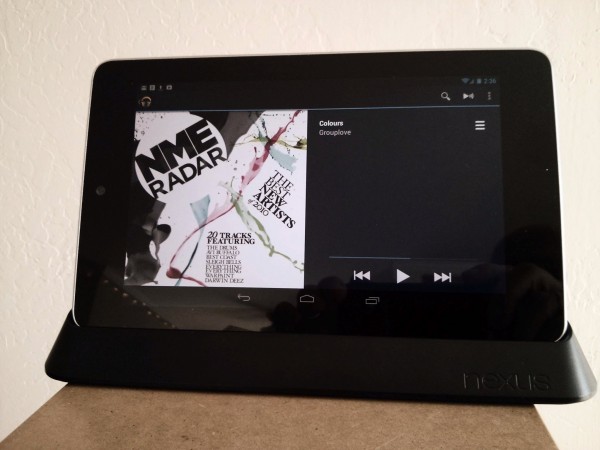
Accessories can make a portable device better. If you own the ASUS-manufactured, Google-branded Nexus 7 tablet, surely there is a case protecting it; sometimes, anyway. Some can prop the tablet, but there’s another option. Can a dock improve the user experience and even extend the utility? That’s what this quickie review seeks to answer.
The Nexus 7 dock is the official issue, made by ASUS, and sold from Google Play for $29.99. I ordered mine in late January, for $39.99, from B&H Photo, back when only third parties carried the accessory. Since then, the retailer dropped the price by five bucks. B&H took my order when the dock was out of stock, but shipped 8 days later. If you want this thing, don’t be deterred by availability elsewhere but forget Google Play, which isn’t taking orders as I write. Expect to spend more elsewhere. By the way, I would have waited and paid less, had I known better.
Unlike Nexus 10, Google’s smaller tablet is meant to be used more-often in portrait mode (there’s a reason why most product shots show the orientation). The dock flips things around, and as such should be seen as entertainment extension, particularly for music and videos — even displaying photo slideshows. The accessory also makes placing Nexus 7 convenient in a kitchen area for, say, looking at recipes while cooking. There is potentially good utility here, depending on needs.
The dock feels fairly hefty, weighing 280 grams and measuring 220 x 65 x 30 mm. The thing is sturdy, quite solidly-built. There’s quality here. The dock comes with standard audio jack, Micro-USB connector and built-in speakers. The speakers are functional, but produce tinny sound. You’ll want to plug in your own. But, strangely, on my device, there is no through-sound unpowered, which surprises me. I have the Bose Companion 3, which only work when the dock is plugged into electricity.
The tablet snuggly fits horizontally into the dock, but there is too much movement otherwise. Extended lip supports Nexus 7 firmly in the back, but frontways is rocky. You could easily knock over the tablet onto the glass front. Additionally, I find that when touching music controls, the tablet’s pins sometimes lose contact with the connectors on the dock. This can interrupt playback or, worse, if charging, stop the activity. I am surprised by how easily even slight jostling of the surface the dock sits on can break the connection and stop charging.
While I use the dock several ways, the most common is work-day companion. I set the peripheral and Nexus 7 behind my computer plugged into power and speakers to play music. I generally stream from my own library stored in the Google Music cloud. On the PC, Chrome sometimes closes down tabs, stopping playback. Nexus 7 is great alternative, providing continuous play, and there is a graphic equalizer.
But I don’t need the dock to do this. I can just as easily lay down the tablet, or use a case with built-in prop, connected directly to the speakers. From this perspective, the add-on is more convenience than necessity.
Something else: Google I/O starts in mid-May, and there is massive speculation (and quite reasonable, I should say) across the InterWebs about a new model with higher-resolution display. If ASUS and Google modify the design, the current dock becomes obsolete for use with next-generation Nexus 7. Of course, the enclosure might stay the same, which is better for dock dalliers.
Bottom line: I/O is good reason to wait, and anything over $30 is too much (right, I overpaid). The accessory doesn’t add enough value for the price. Nexus 7 already has headphone and power jacks. The case you might already own can prop the tablet.
Don’t get me wrong. I personally like the dock and find it both functional and useful. But I don’t need it and certainly wouldn’t have spent $40 if knowing then what I do now. Nexus 7 dock is great kit, but in many ways redundant.
Photo Credit: Joe Wilcox
-
Watch: President Obama at the 2013 White House Correspondents’ Dinner

President Barack Obama delivers remarks during the White House Correspondents’ Association Dinner at the Washington Hilton Hotel in Washington, D.C., April 27, 2013. First Lady Michelle Obama attended the dinner with the President.
(Official White House Photo by Chuck Kennedy)
President Obama last night joined Conan O'Brien onstage at the Washington Hilton for the annual White House Correspondents' Association Dinner, and gave his fifth address to the organization of journalists who cover the White House, and the President himself. In his remarks, the President poked at himself, as well as some of the news organizations and politicians in the room. He also showed a spoof promo for Steven Spielberg's followup to "LIncoln," a biopic called "Obama."
But while everyone had a good laugh during the speech, President Obama closed his speech on a more serious note, reminding the audience of the important role the media plays in American society, especially during times of crisis like the Boston Marathon bombings and the explosion that killed so many first responders in West, Texas.
You can watch the entire speech below or on YouTube:
-
If we don’t create some standards for app discovery and promotion, users are going to lose faith
The recent hype around the removal of Appgratis from the iOS App Store has ignited a debate about app discovery and promotion and its importance to both users and developers. There are simply way too many apps for our little minds to process (and fingers to digest) and consumers need a better way to find them. (Disclosure: I co-founded a non-paid app discovery service called Appsfire.) But better app discovery depends completely on the trust of users. This can be achieved only if the players involved – namely ad networks and developers – can agree on higher standards for transparently promoting apps and preventing abuse and misleading practices.
App discovery is hard, but shortcuts aren’t the solution
App discovery is a hard thing for developers and most still rely on the holy grail of app discovery – an app store’s “top ranks” lists. Getting there means an app will be further downloaded in massive volume quickly – often the hundreds of thousands – because this popular section, for lack of better discovery experience in the app store, is consulted daily by millions of users worldwide. This has led many companies to build exclusive, paid discovery and promotion services that exist solely to drive apps to those sections, and thus create clear distortions in the landscape of app discovery. The number of abusive – and lucrative – practices for manipulating top rank lists are well known in the space: farm bots, paid user schemes, misleading ads and so on. To be sure, paid promotion for apps is in and itself a perfectly fine practice. But such practices becomes an issue when they degrade the value of what remains the sacred section of a store – the top charts – and in the process jeopardize user trust.
A need for industry standards
Mobile advertising and discovery is still young and very much unregulated. Until recently you could still find ads that did not look like ads or full screen ad formats that forced user to “artificially” click on an ad:
 Here are some suggestions that will benefit both users and the app discovery and promotions industries as a whole:
Transparency measures to protect the user
1. Disclose obviously and clearly to your users you are an ad network (as iAd and Admob do), and whether you are a paid or unpaid discovery service. Users need to understand your primary motivation. 2. Clearly separate ads from content, and if you can’t make it clear to the user visually then just state it! 3. Disclose advertising when/where used. Paid promotion and unpaid discovery are different: users need to know which is which. 4. An app deal (bonus or price discount) is a real gift, not an artificial trick. Don’t game deals. 5. Make it easy to ignore or remove ads via an obvious dismiss button. Use an in-app purchase option if necessary. 6. Don’t use misleading ads just to drive installs. Often ads are designed to look like an extension of an app to trick users into clicking on them by mistake. It may be clever, but it’s certainly not ethical.
Transparency to protect app developers and publishers
1. Have a consistent pricing policy for paid and unpaid discovery, and charge the same price to all developers – after all, the developer community is small and talks a lot! Some ad networks have solved this with a bidding system, such as Facebook or Google (and notably their bidding mechanism works the same for all developers). 2. Provide transparent reporting, with attribution. Developers deserve to know what they’re paying for, and so have the right to ask for transparent tracking (that respects privacy concerns) to learn, at a granular level, where traffic comes from. 3. Do not force an app description modification. Developers are paying to promote their apps, so they shouldn’t be asked or required to include a mention of the promotion service. (This practice is common when a developer decides to drop its price.) It can be useful to remind the user that such a promotion actually takes place. But it should not be mandatory.
 4. Do not guarantee top ranks. Apple (and probably Google soon) have made it clear: Developers should not work with networks that guarantee top spots or even a given number of downloads — and if they do, they risk being banned from the App Store. They create distortion and friction in a market that needs to be fluid and organic. Facebook, iAd, Millennial – none of them guarantee a top ranking. And of course professional organizations like the MMA or IAB, as well as app stores, have to play a part in the debate of trust and transparency, which is another discussion worth having. Ouriel Ohyan is co-founder of app discovery service Appsfire. Follow him on Twitter @OurielOhayon. Have an idea for a post you’d like to contribute to GigaOm? Click here for our guidelines and contact info.
Related research and analysis from GigaOM Pro:
Subscriber content. Sign up for a free trial.- Podcast: Mobile winners and losers in 2012 and what to expect in 2013
- Analyzing the wearable computing market
- How do developers ride the Siri wave?

-
The growing importance of timing in data centers
Editor’s note: This is the second of a two-part series on the importance of timing in today’s distributed infrastructures. The first ran on Saturday.
Like a bad episode of Hoarders, people love to store all things digital, most of which will never be accessed again. And, like a bad episode of Storage Wars, our love of storing crap means we need more places to store it. Today’s content has outgrown even the hydro-electric dam powered Mega Data Centers built just yesteryear. Increasingly, operators are turning to distributing their information across multiple geographically dispersed data centers. As the number, size, and distances between the data centers have steadily grown, timing distribution and accuracy has likewise grown in importance in keeping the data centers in sync.
In a previous article I discussed new standards being developed to increase the accuracy of timing for the internet and other IP-based networks. Current systems and protocols offer milliseconds of accuracy. But that just isn’t enough as we depend more on real-time information and compute, storage and communications networks become more distributed. While people often cite the importance of timing on mobile backhaul networks in the next-genration LTE-Advanced networks,there has been less publicity around the need for these new timing technologies in the continued growth of data centers.
The rise of Hadoop in an age of digital garbage

Massive storage of data appears to occur in periods, very analogous to dinosaur evolution. A database architecture will rise to the forefront, based upon its advantages, until it scales to the breaking point and is completely superseded by a new architecture. At first, databases were simply serial listed values with row/column arrangements. Database technology leapt forward and became a self-sufficient business with the advent of relational databases. It appeared for a while relational databases would be the end word in information storage, but then came Web 2.0, social media, and the cloud. Enter Hadoop.A centralized database works, as the name suggests, by having all the data located in a single indexed repository with massive computational power to run operations on it. But a centralized database cannot hope to scale to the size needed by today’s cloud apps. Even if it could, the time needed to perform a single lookup would be unbearable to an end user at a browser window.
Hadoop de-centralizes the storage and lookup, as well as computational power. There is no index, per se. Content is distributed across a wide array of servers, each with their own storage and CPU’s, and the location and relation of each piece of data mapped. When a lookup occurs, the map is read, and all the pieces of information are fetched and pieced together again. The main benefit of Hadoop is scalability. To grow a database (and computational power), you simply keep adding servers and growing your map.
Even Hadoop is buried under mounds of digital debris

It looked like Hadoop would reign supreme for generations to come, with extensions continuously breathing new life into the protocol. Yet, after only a decade, databases based upon Hadoop such as Facebook are at the breaking point. Global traffic is growing beyond exponential, and most of it is trash. Today’s databases look more like landfills than the great Jedi Archives. And recently hyped trends such as lifelogging suggest the problem will get much worse long before it gets better.The main limitation of Hadoop is that it works great within the walls of a single massive data center, but is less than stellar once that database outgrows the walls of a single data center and has to be run across geographically separated databases. It turns out the main strength of Hadoop is also its Achilles heel. With no index to search, every piece of data must be sorted through, a difficult proposition once databases stretch across the globe. A piece of retrieved data might be stale by the time it reaches a requester, or mirrored copies of data might conflict with one another.
Enter an idea keep widely dispersed data centers in sync — Google True Time. To grossly oversimplify the concept, True Time API adds time attributes to data being stored, not just for expiration dating, but also so that all the geographically disparate data centers’ content can be time aligned. For database aficionados, this is sacrilegious, as all leading database protocols are specifically designed to ignore time to prevent conflicts and confusion. Google True Time completely turns the concept of data storage inside out.
Introducing Spanner
In True Time, knowing the accurate “age” of each piece of information, in other words where it falls on the timeline of data, allows data centers that may be 100ms apart to synchronize not just the values stored in memory locations, but the timeline of values in memory locations. In order for this to work, Google maintains an accurate “global wall-clock time” across their entire global Spanner network.
Transactions that write are time stamped and use strict two phase locking (S2PL) to manage access. The commit order is always the timestamp order. Both commit and timestamp orders respect global wall-clock time. This simple set of rules maintains coordination between databases all over the world.
However, there is an element of uncertainty introduced into each data field, the very reason that time has been shunned in database protocols since the dawn of the data itself.

Google calls this “network-induced uncertainty”, denoted with an epsilon, and actively monitors and tracks this metric. As of summer 2012, this value was running 10ms for 99.9 percent (3 nines) certainty. Google’s long term goal is to reduce this below 1ms. Accomplishing this will require a state of the art timing distribution network, leveraging the same technologies being developed and deployed for 4G LTE backhaul networks.
A modest proposal
While True Time was most likely developed to improve geographic load balancing, now that accurate time stamping of data exists, the possibilities are profound. The problems associated with large databases go beyond simply managing the data. The growth rate itself is unsustainable. Data storage providers must do more than grow their storage, they must also come up with ways to improve efficiencies and ebb the tsunami of waste that is common in the age of relatively free storage.
It’s a dangerous notion, one simply must challenge the basic tenet that all data is forever. Our minds don’t work that way, why should computers? We only hold on to key memories, and the further the time from an event, the fewer the details are held. Perhaps data storage could work similarly. Rather than delete a picture that hasn’t been accessed in a while, a search is performed for similar photos and then only one kept. And as time passes, perhaps rather than simple deletion, a photo is continuously compressed, with less information kept, until the photo memory fades into oblivion. Like that old Polaroid hung on the refrigerator door.
Jim Theodoras is director of technical marketing at ADVA Optical Networking, working on Optical+Ethernet transport products.
Dinosaur image courtesy of Flickr user Denise Chen.

Related research and analysis from GigaOM Pro:
Subscriber content. Sign up for a free trial.- A near-term outlook for big data
- Dissecting the data: 5 issues for our digital future
- 9 Companies that Pushed the Infrastructure Discussion in 2010

-
My car: Datsun 1200

Sometimes all it takes is a little slow churned jazz to excite the senses and invigorate the soul. Add in a rare Datsun 1200, the lights of Tokyo and some outstanding cinematography and you’ve just created the recipe for internet gold. Click through and check out “MY CAR” after the jump.
Source: chromjuwelen.com
-
With UDID gone, the mobile-ad floodgates will open – straight to Apple iOS
Later this week, Apple will start rejecting any apps that collect UDID, the series of letters and numbers Apple uses that make each device individually identifiable. This is great news for advertisers and marketers. The use of UDID, while once popular with some advertisers and marketers, has rightly been under intense scrutiny by privacy advocates and their legal experts.
Now with that behind us, and iOS adopting device-level legal compliance, it is poised to become a juggernaut of mobile advertiser revenue – and eventually will be second only to television in overall ad spending.
UDID inadvertently stifled advertising
The legal gray area around UDID became a serious and expensive issue for two of the biggest apps in the iOS ecosystem in May of 2011. Pandora and The Weather Channel were both named in a lawsuit because of how they used personal data, namely UDID, and combined it with location-based data or other demographic data. The lawsuit specifically called out the fact that with UDID, users were not able to opt out of ad tracking. In response to this lawsuit, both apps stopped using any ID at all for tracking. Many other apps followed suit and some platforms in the ecosystem switched to using different IDs.
This stymied advertisers and marketers, who understandably sought a legally compliant way to track downloads, and so many simply stopped advertising via mobile at all. Others opted to advertise apps without any tracking in place – they would rather market their products blindly than deal with the legal fallout from the use of UDID – drastically reducing their ability to track ROI.
The good news is this legal gray area will be cleared up on May 1. In response to critics of UDID, Apple has created a legally compliant alternative called, simply enough, IFA, or ID for Advertisers that is built directly into iOS 6. Crucially it also allows users to opt out of any advertising tracking method by changing a setting at the device level. This solution means that starting next month, anyone advertising on the iOS platform will be legally compliant. The device level solution also puts iOS somewhat ahead of the PC web, where legal compliance with ad tracking has to be handled on a site-by-site basis and is currently a messy struggle with no system-level opt out.
Why accurate conversion tracking matters
For a new medium to grow, showing clear ROI to marketers is key. Once they know the ROI, their ability to scale budgets is only limited by maintaining that ROI. Google has shown just how scalable this model is on the PC with AdWords, with massive year-over-year growth.
Facebook also clearly understands the value that conversion tracking can provide. After testing their conversion tracking system with major advertisers for almost a year, it recently opened up the program to all its advertisers. With conversion tracking in place and the ability to optimize campaigns, it claims a 40 percent lower cost per conversion. The savings per acquisition can now be applied to acquiring more users, effectively increasing the total budget.
Even Apple’s iAd, which has always had conversion tracking, has seen significant growth in this transition period away from UDID. The platform was originally marketed as a rich-media advertising option for brands, but pivoted to performance advertising. The high prices and low ROI of rich media ads sent a chill up the spine of the Madison Avenue executives who bought them.
At TapDense, we meet with agencies and customers all the time that tell us their number one barrier to spending on mobile is conversion tracking (Disclosure: the author’s company is one of many that offer mobile tracking services, among other things.) They don’t know what options they have and how it works without UDID, which means they’re not spending. Once conversion tracking is in place on iOS, marketers will be able to see beyond the download and deep into their conversion funnel.
iOS revenues will skyrocket in 2013
With the legal issues around UDID cleared up, a lot of the friction that was holding back large advertising budgets will be reduced. Additionally, the 14 percent decline in PC sales in the first quarter of 2013 confirms that consumers are quickly moving to mobile. Despite having a smaller overall mobile market share, Apple’s iOS dominates both mobile ad traffic and mobile revenue; a recent study shows overall that iOS accounts for 44.5 and 49 percent respectively, versus Android’s 31 and 26.7 percent shares. And so with the continued shift away from PCs, marketers will flock even more to iOS, where they can best reach an affluent demographic.
Gregory Kennedy is vice president of marketing at TapSense. Follow him on Twitter @tapsense.
Have an idea for a post you’d like to contribute to GigaOm? Click here for our guidelines and contact info.

Related research and analysis from GigaOM Pro:
Subscriber content. Sign up for a free trial.- Analyzing the wearable computing market
- Confused about the wireless markets? Here’s a breakdown
- Carrier IQ and the continued erosion of operator trust

-
Player FM goes native on Android with a podcast app worth checking out
When Player FM debuted its podcast listening and discovery platform on the web last May, I said that it made podcasts look cool again.
A year later, Player FM is back with a native Android app, it’s definitely worth taking a look as well: The app features a very eye-pleasing, Google-like design, complete with cards that we’ve come to know from apps like Google Now and the latest version of the Play store.
But Player FM isn’t just about looks: What sets the app apart from other podcasting applications is its emphasis on discovery. Player FM lets you not only subscribe to your favorite podcasts, but also to topics. These topics can be broad, like technology and international news, or very specific, like Pixar or Ruby on Rails. Each of these topics surfaces episodes from a number of relevant podcasts, which is great to discover new favorites and get different perspectives on a certain topic.
Your own podcast subscriptions are accessible through a separate tab, and also synced with the Player FM website, where others can use them as a starting point for their own podcast listening. Of course, there are also a bunch of features you’d expect from a podcasting app, including the ability to download episodes for offline listening, complete with options to restrict downloads to WiFi or even to times when the device is plugged in for charging.
There are some features still missing from the app, including playback status sync between different devices as well as the app and the website. You also can’t find podcasts by title through the app yet, but Player FM creator Michael Mahemoff told me that this feature is coming soon. In the meantime, users can go to the web app to fine tune their subscriptions, and then listen to them on the go.
Check out a few screenshots of the Player.fm Android app below:

Related research and analysis from GigaOM Pro:
Subscriber content. Sign up for a free trial.- Podcast: Mobile winners and losers in 2012 and what to expect in 2013
- Analyzing the wearable computing market
- LTE-Advanced: what it is and isn’t

-
Leap Motion Hack Brings A Facebook Home Experience To The Desktop

One of the hacks at Disrupt NY’s Hackathon this year employed hardware startup Leap Motion’s new 3D gesture controller, which unfortunately just ran into a delay. Leap Motion’s issues aside, this project, the combined effort of Chao Huang, Cedrich Pinson and Jorge Martinez, brings a Facebook Home-style experience to the desktop.
With “Leap in Time,” Leap Motion is used to navigate through a Facebook timeline via hand gestures that are intended to be as natural and intuitive as possible. You swipe left and right to go through photos and posts, and there’s inertia built-in to make it feel even more immersive. Then there’s a motion to pause and focus on a particular piece of content, with a palm outward gesture, and you can simply make a thumbs up to like a post.
Working with the Leap Motion was fairly simple, the team said, but does seem to experience difficulty with some environment issues like changing lighting conditions. It’s also crucial to maker sure that the Leap Motion app you’re building is cued to pay attention to certain things at certain times and to ignore specific motions in different settings. You have to cue the app to not pay attention to sideways hand waving when you want it to be able to recognize the thumbs up, for instance.
The hack was surprisingly smooth given that it was built in fewer than 24 hours, and Huang said there’s plenty more they could do given more time, but they wanted to focus on what they considered the core Facebook experience. The project is also reminiscent of a recent concept design making the rounds of a Facebook Home app for Windows 8.
Leap in Time is a simple enough implementation of Leap Motion, but it does act as a pretty solid example of how gesture control might actually work well for navigating apps and software that we use every day. I know that Leap Motion is eager to get as much software as possible into Airspace, the app store for the controller, but this team said they weren’t sure whether they’d actually pursue this any further.
-
Put your Fitbit through the washing machine again? Here’s an app that could replace it
I got a Fitbit (see disclosure) last November when it started to seem like all of my friends and co-workers were sporting tracking devices to measure their movement and exercise. I’ve grown to adore the little black device, taking a few more laps around the block on my way home to hit 10,000 steps per day, and running back inside the house if I forget to clip it to my pocket before leaving for work in the morning. I love checking the charts and graphs on the iPhone app that show my fitness progress over time. It’s fair to say I’d be bummed if I lost the device.

So what if you do lose your tracking device and don’t want to buy another one? Or maybe you’re unwilling to spend more than $100 on one in the first place, about the average price for a Fitbit or Jawbone Up? I’ve been trying out Moves, a free iPhone app released earlier this year, and have been impressed by how well the app tracks my movement throughout the day. So far, it would be a decent replacement for my Fitbit if I ever lost one, and with a pricetag of $0, it’s a pretty great deal if you’re not sure whether you want to track your steps or not.
The idea behind Moves is that most of us are carrying smartphones around during the day anyway, and the accelerometer inside the phone mimics a lot of the technology inside popular tracking devices. So CEO Sampo Karjalainen set out to create a mobile app that would approximate the experience with devices many of us already own, but at a much more affordable price, hoping the app would appeal to more casual exercisers.
“The whole idea was just to make it really effortless,” he said, noting that for a lot of people, devices like the Fitbit just aren’t as appealing. “They have this active sports image which doesn’t really fit with a lot to people, who might not see themselves as active sports people.”
The app shows you steps you’ve moved every day, minutes spent active, as well as locations you’ve been to if you enable the tracking features. Karjalainen said the app, which got $1.6 million in venture backing from Lifeline Ventures and PROfounders Capital, has been downloaded 1.5 million times since the launch, although he wouldn’t say how many of those users are actively using Moves. The company is working on building an Android version and an API.
It took some time for me to adjust to the Moves app and the simplicity of the screen compared to Fitbit — you can’t enter your weight or food intake, and it doesn’t provide you with stats on calories burned or let you adjust for your height and weight. And apps dedicated to running like Nike+ or Runkeeper might still be better answers for serious runners. However, the steps and distance tracking on Moves provided nearly identical data to my Fitbit, so if you’re just looking to hit 10,000 steps every day and stay active, it’s a great solution. And it did track my runs pretty accurately as well.
The only caveat is that you have to carry your phone with you everywhere for it to work. But chances are, if you’re the kind of person who’s interested in GPS fitness tracking, carrying your phone around probably won’t be an issue for you.
Disclosure: Fitbit is backed by True Ventures, a venture capital firm that is an investor in the parent company of this blog, Giga Omni Media. Om Malik, founder of Giga Omni Media, is also a venture partner at True.

Related research and analysis from GigaOM Pro:
Subscriber content. Sign up for a free trial.- Connected world: the consumer technology revolution
- Analyzing the wearable computing market
- CES 2012: a recap and analysis

-
Porsche Le Mans 1971

Porsche is getting ready for its return to Le Mans in 2014. And it wants to remind you all that in 1971 it thoroughly and properly kicked ass. The monstrous 240-mile-an-hour 917 took first and second places, setting multiple records along the way. Oh, and 10 of the 13 cars that finished that year were Porsches.
In 1971 Porsche built the first magnesium-framed 917. The delicate birdcage of highly flammable and ultra-lightweight metal weighed just 42 kilograms, or 92 pounds. The frame was swathed in gossamer sheets of flowing fiberglass and perspex and given menacing tail fins. Then Porsche gingerly installed their latest creation: A magnesium and titanium air-cooled flat 12 good for more than 600 horsepower. The results were positively manic. Click through to see a highlight reel from the season, featuring the tarmac-swallowing, fire-breathing, time-warping 917.
The 917/30 variant could hit 62 mph in just 2.3 seconds and 124 in 5.3. It had a top speed of more than 240 mph. The comparable Ferrari of the day, the 512, had trouble breaking 200 mph.
In testing, driver Jackie Oliver did an average 155 mph per lap, the highest average speed ever recorded. The Martini Racing team went on to win Le Mans that year. Drivers Helmut Marko and Gijs van Lennep went 3,315 miles, a distance record, at an average speed of 155 mph, a speed record. The record remained untouched for decades.
A Porsche 917 in Gulf livery also took second place. Porsche 911s and even 907s took the majority of the other positions in the race. Only two Ferraris finished.
If the video below doesn’t get you excited about Porsche’s return to Le Mans next year, you’re not human.


