Category: News

  • Snapdragon-powered Galaxy S 4 rooted on launch day

    Samsung_Galaxy_S_4_Front_Top_Samsung_Logo_TA

    Not too long ago, an unlock tool was released for some Motorola devices that used Qualcomm processors. Well, it turns out that unlocking hack still works on newer Qualcomm devices, including the variant of the Galaxy S 4 with the Snapdragon 600 chip.  So if you’re planning on picking up a new Galaxy S 4 this weekend, you won’t have to wait for a root method.

    The downside is that there are no stock images or custom recoveries available for the device yet, so if you brick the device in the root process, you’re completely out of luck. OTA updates will also likely mess up root. Fortunately, it’s a pretty safe bet that this is going to be a popular device, so it shouldn’t take long before some recoveries and ROMs start popping up. Until then, though, root at your own risk.

    The method is the same as it was for the Motorola unlocking. You’ll need to download the package at the XDA link then follow these instructions.

    1. Extract the entire contents of the zip file.
    2. If you are using Windows, ensure you have installed the latest Motorola USB drivers available for your phone.
    3. Ensure your device has been rooted and you have a working installation of “su”.
    4. Ensure USB Debugging mode is enabled on your device.
    5. If you are using Windows, navigate to the extracted directory and execute “run.bat”. If you are using Linux or OS X, navigate to the extracted directory in a terminal and execute “./run.sh”.

    source: XDA

    Come comment on this article: Snapdragon-powered Galaxy S 4 rooted on launch day

  • Enable Google Drive’s new ‘Offline’ feature

    While it did not grab a lot of attention, this week Google rolled out version 1.9 of its Drive app for both Windows and Mac users. The cloud storage service adds a number of new features that should improve the experience for its customers — and that is anyone who has a Google account, because Drive and 5 GB of free storage come along with that account.

    The latest version contains added-features in the right-click context menu available from within your file system explorer, including sharing and also the ability to view the file on drive.google.com.

    Google Drive also claims faster access speeds. According to the Release Notes, the company claims that “downloads now take about 50 percent less time. For accounts with many small files, the speed improvement is even more pronounced”. There is also the addition of smarter delete dialogs (originally introduced in version 1.8) and improvements to sync status overlay icons for Mac users.

    The most intriguing new feature is the promise of offline access to your files. However, while Google is big on telling us of this new capability, it’s short on details about how to actually access files in this way.

    Fortunately the capability is not difficult to set up, but does require that you have the Chrome web browser installed. If you do, then fire it up and head over to drive.google.com and log into your account.

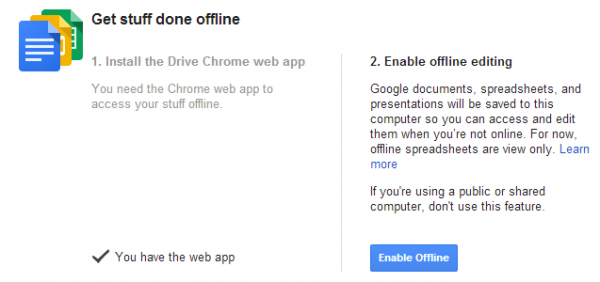
    In the left column you will spot a dropdown menu labeled “More”. Click this and then select “Offline”. If you do not yet have the Chrome plugin for Google Drive installed then you will be prompted to do so. If you have it then you can proceed to step two, which is simply clicking the “Enable Offline” button.

    You will now be able to access your most recent Google documents on drive.google.com, even when you are offline. Simply open any Google document from your local Google Drive folder and Chrome will display the file for you to edit. Any changes you make will be synced the next time you connect to the Internet.

    If you have the need, then you can also return to More”, “Offline” and disable the feature as well. The offline mode works with all compatible Google Docs and Office file types, as well as images.

  • TED Weekends shares the story of a once locked-in grafitti artist

    TEMPT-grafittiCompletely paralyzed except for his eyes, graffiti artist Tony “TEMPT” Quan could no longer create his art, let alone communicate with his family. Mick Ebeling: The invention that unlocked a locked-in artistMick Ebeling: The invention that unlocked a locked-in artistWhen entrepreneur Mick Ebeling met Quan, he was determined to help the artist accomplish both of these things. Thus, the EyeWriter was born — a pair of glasses with hardware that allows the wearer to draw and communicate … just by using their eyes. Ebeling shared this incredible invention, and the story behind its creation at TEDActive 2011.

    This week’s TED Weekends on the Huffington Post explores this talk – taking a look at the EyeWriter as well as the artform Quan loves. Below, find some selected essays to pique your interest.

    Mick Ebeling: The Incredible Power of a Single Pair of Glasses

    It all started with Date Night. My wife and I received advice long ago that Date Night was the key to a successful marriage. We had plans, but a friend came by and asked if we wanted to go to an art show instead. That was the night I was introduced to Tempt.

    When we got to the show there were posters and signs everywhere saying “TemptOne Benefit.” There was a palpable buzz about the place. I kept hearing people talking about this Tempt. Even the art on the walls by incredibly famous artists had his name worked into them. After being there a while and hearing about this Tempt, I finally asked “So where is this guy anyway?” The answer was shocking. “He lives in a hospital. On life support. He’s completely paralyzed. He has ALS.” Since that night, my life has never really been the same. Read the full essay »

    Tomes Olesen: Tagging: It’s More Than Just Scrawl

    From the outside looking inwards, graffiti must be baffling. It is easy to see why it would inspire abhorrence. Even those with a professed appreciation for the artform will invariably say something along the lines of: “I like it when it’s proper pieces but I hate tagging.”

    There’s no denying that at its worst, tagging (writing one’s chosen name on a wall) is little more than territorial pissing, but to understand it is to understand the aesthetic of graffiti in the same way that understanding the International Gothic allows one to understand the aesthetic of the Early Renaissance; it is the root from which everything else develops. Read the full essay »

    John M. Eger: The Changing Voice of Graffiti

    Artists everywhere have been using street art — some legal, some not — to express themselves for years. These are mostly artists who, in the best tradition want to see change in the world, change in public perceptions or government attitudes and actions. Street art, sometimes called graffiti, is a vehicle for people the world over to express themselves. It is also a vehicle that gives a community a sense of place and an identity.

    From the Berlin Wall separating East Germany from West Germany, to the “democracy wall” in Beijing, people have used street art to demonstrate some of their most poignant frustrations and concerns about the world.

    Even in Afghanistan, street art, stencil art specifically, has popped up on several walls across Kabul over the past few years. Under the cover of night, artists take to the streets of Kabul. Armed with stencils, spray paint and cameras. Read the full essay »

  • It’s not just Tumblr — most social networks don’t understand original content

    The recent shuttering of Tumblr’s Storyboard highlighted the discrepancy between online communities and companies’ efforts to produce valuable original content for them. The problem isn’t that “Facebook, Tumblr, and Twitter are sharing networks, not publishing companies,” as one writer suggested. The problem instead lies in substance and delivery.

    Community-inspired initiatives, much like journalism, need a sense of purpose, passion and objective urgency – the ability to look unflinchingly at a subject and capture it in a way that’s surprising and insightful. With that in mind, here’s how some of the most popular communities and social networks are experimenting with original content — and what works and doesn’t.

    Tumblr

    Storyboard sought to surface and report on interesting stories and users within the Tumblr community, applying a kind of branded journalism and marketing mix that’s becoming increasingly commonplace.

    The failure of Storyboard was in its inability to find an editorial voice that resonated in the community. Tumblr users communicate with a pidgin lexicon of reaction GIFs, memes, and blog entries, but Storyboard took a more print-oriented approach. The content (and layout) was reminiscent of an in-flight magazine, as if trying to sell the reader on a particular destination.

    Of course, Storyboard did produce a variety of laudable content in partnership with esteemed publishers, most notably its Letters from Newtown project with Mother Jones and WNYC’s look inside the New York Times morgue (and the Daily Dot syndicated a significant number of Storyboard articles). But the numbers don’t lie and Storyboard’s most popular posts hover around just 6,000 notes – surely a factor in the decision to shutter it.

    Facebook

    Like Storyboard, Facebook Stories is a branded editorial effort that relies on publishing partners and user submissions. Last month, former managing editor Dan Fletcher proclaimed the social network “doesn’t need reporters,” because there’s “no more engaging content Facebook could produce than you talking to your family and friends.” To be blunt, it’s almost as if Fletcher hasn’t seen a typical Facebook post. The most talked about pages on the social network are dominated by image spam and mindless posts about “teen swag.”

    The greater  problem with Facebook Stories has been one of approach. It publishes monthly, a bizarre strategy that utterly defies the very best characteristics of the site and is obviously in direct conflict with the online ethos. Content on Facebook is instantaneous and reactionary; it’s about celebrating small moments not just milestones, and any editorial effort should mirror that.

    Facebook Stories needs to take a cue from Upworthy – a comparable editorial effort centered on inspiring content – and focus less on presentation and more on how content should be packaged and shared. 

    YouTube

    YouTube made headlines when it invested $200 million in original channels and programming last January. Then, after cutting its losses on 70 percent of those recipients, it promptly dropped another $100 million in November. The few shows that actually succeeded – most notably, Philip DeFranco’s SourceFed, Felicia Day’s Geek and Sundry channel, and the VlogBrothers’ Crash Course – were the ones that understood how to connect specifically with a YouTube audience and what makes content succeed on the platform. Notably, none of them are TV veterans.

    The quick lesson is you can’t fake authenticity on YouTube, and celebrity status often doesn’t translate to subscriber counts. The content has to be immediate and impactful. As Hank Green of the Vlogbrothers (SciShow, CrashCourse) noted in a recent Tumblr post:  ”Online video isn’t about how good it looks, it’s about how good it is.”

    LinkedIn

    The career-oriented network is oddly the rare success story of implementing original content. Even before LinkedIn’s $90 million acquisition of popular news-reader Pulse, the professional network was making all the right moves in terms of content creation and curation with a leadership board in the form of LinkedIn Influencers and a daily news feed that distributes third-party content selected by users.

    Where the company has invested in original content, it’s done so by popular demand, tapping proven influencers like Virgin CEO Richard Branson and ex-FCC Chairman Julius Genachowski for exclusive articles that cater specifically to the network’s business-savvy audience. As Jennifer Van Grove noted for CNET, “content is quickly becoming the new connection on LinkedIn.” 

    Outliers

    The web is becoming one big imageboard, where the emphasis is placed on viral sharing. That can be seen in everything from Facebook’s redesign to LinkedIn’s revamp. A recent study of Reddit found that 86 percent of the posts on the social news site were easily disposable: image macros, photos, and videos.

    The challenge facing that site, not to mention communities like Pinterest and Instagram – whose content strategies thus far have been comprised mostly of curated tags – is to create something of permanent value for the community, to offer more than a temporary spotlight.

    Simply put, you have to add value. Social networks need to support the native content efforts of their users and accentuate it where they can. But if they are going to provide editorial content themselves, it must be in the spirit of the community, not forced from outside of it.

    Austin Powell is assistant managing editor of The Daily Dot, which calls itself the hometown newspaper of the World Wide Web.

    Have an idea for a post you’d like to contribute to GigaOm? Click here for our guidelines and contact info.


    Related research and analysis from GigaOM Pro:
    Subscriber content. Sign up for a free trial.


  • Google Glass already rooted and ready for primetime

    Larry-Page-Google-Project-Glass


    An enterprising and ambitious individual has already achieved root access for the Google Glass “eyeset” device. Cydia’s Jay Freeman recently took to Twitter and proclaimed his root success story, while also sharing a photo to the general public as proof for you non-believers out there. We’re surprised that this feat was achievable since you know… Google is pretty strict with the few developer versions that are out there and all. Then again, since the few Glass units out there are intended for the few elite individuals out there, it probably should have been expected that Google would be fairly lenient and allow for certain things to be accessible— at least for now.

    There’s no word yet on what will come next now that root is enabled, but we’re certainly excited to hear— errr see any potential possibilities.

    source: Jay Freeman Twitter
    via: Phone Arena

    Come comment on this article: Google Glass already rooted and ready for primetime

  • Sprint officially lists the black HTC One smartphone on its website

    Sprint_HTC_One_Black_Online


    It looks like AT&T isn’t going to be the only one to have the smooth HTC One smartphone in sexy black clothing. Sprint went ahead and listed that variant of the flagship device on its website as available for purchase now. The little puppy will run potential customers $550 outright— or there of course the option of taking advantage of additional savings which would bring the total cost to a hair under 100 bucks. There’s no exact word on how long it will take the black One to ship to customers’ front doors, but we’d imagine lucky recipients would receive them soon… very soon.

    Hit the source link to check out the black version for yourself. Or if black doesn’t tickle your fancy, you can always grab the original silver version for the same price too.

    source: Sprint HTC One Black | Silver

    Come comment on this article: Sprint officially lists the black HTC One smartphone on its website

  • Android this week: Galaxy S 4 reviewed; HP Slate 7 arrives; Mailbox for Android coming

    Galaxy S 4 featuredThe Samsung Galaxy S 4 reviews hit this week and it appears the consensus is that Samsung added a boatload of features to help it keep its smartphone crown. I spent several days using a review unit of the Galaxy S 4 and found it to be a high performing device that looks much like its predecessor. Along with many new Samsung-specific functions, however, the company was able to boost the screen size to 5-inches while keeping the phone at roughly the same size as the Galaxy S 3.

    That display is wonderful to look at all day. And why not when it’s a 1920 x 1080 Super AMOLED screen? The quad-core 1.9 GHz chip and 2 GB of memory keep things humming while the battery should last all day for all but the heaviest power-users. Of course, you can always remove the back cover and replace the battery with a spare if needed; most probably won’t.

    Samsung’s secret sauce is on the inside, however: It’s the software. The company’s TouchWiz interface is improved while a number of special features round out the package.

    Galaxy S 4 setting buttons

    Hovering over the screen with a finger dives deeper into more information without opening an app, for example. You can swipe through gallery images with a wave your hand. And you can pair multiple Galaxy S 4 phones to wirelessly play a single song, with each handset acting as an independent speaker.

    All of this makes for solid, but sometimes complicated experience. I don’t think it will hurt sales, however. Folks will either use the Easy Mode — which hides some of the advanced functions — or simply ignore the features they don’t want to use.

    Speaking of which: HP has largely ignored the tablet market ever since it’s $1.2 billion investment in Palm and webOS backfired in the form of the TouchPad. That changes with the HP Slate 7, a $169 Android 4.1 tablet now available in the U.S I took a look — on paper, that is — at the HP Slate 7 compared to Google’s Nexus 7 tablet, which costs $30 more. Some will surely opt for the HP, but I see a number of reasons to pay the extra money for a Nexus 7.

    HP Slate 7 in red and grayThe main one is the difference in displays: HP chose a meager 1024 x 600 resolution display while Google uses a 1280 x 800 screen. You’re going to be looking at and using the screen more than any other component on a tablet, so I think you should get the best one you can. Having said that, the HP does offer some features not found on the Nexus 7: micro SD card expansion, Beats Audio support and a rear camera.

    One of the things I use my tablet for the most is email management. I’m a Gmail app user on all Android devices, but on iOS I prefer the new Mailbox app. It’s very useful in how you can set reminders for various emails; they disappear from your inbox only to reappear at a time more appropriate for you. You can also send emails to a “to-do” list with a tap. Most every function is done with a simple swipe: Mark as read, delete, postpone, etc…. take a look:

    The good news is that the Mailbox folks have admitted on Twitter that an Android version is in the works. There’s no time-table for the software, but I hope it’s soon. I’ve been able to get through my email more effectively on iOS with Mailbox and I’d love to have the same experience on my Android phones and tablets.

    Related research and analysis from GigaOM Pro:
    Subscriber content. Sign up for a free trial.


  • /DRIVE Season 6 Promo: IT’S BACK BABY!!

    DRIVE Season 6

    So here it is ladies and gentlemen, the new promo for /DRIVE Season 6. This means more BIG MUSCLE, TUNED, Chris Harris on CARS, DRIVE CLEAN, Shakedown and more. They’ll be more tire smoke, horsepower, hooning and of course, more cars. Click through and check it out after the jump.

    Source: Youtube.com/DRIVE

  • Top 5 Data Center Stories, Week of April 27th

    fb-nc-generators-470

    The equipment yard behind Facebook’s North Carolina data center houses 16 diesel backup generators. Similar infrastructure will soon be coming to Altoona, Iowa. (Photo: Rich Miller)

    For your weekend reading, here’s a recap of five noteworthy stories that appeared on Data Center Knowledge this past week. Enjoy!

    Facebook Decloaks, Confirms Plans for Iowa Server Farm – It’s official: Facebook will build a massive data center in Altoona, Iowa. After a year of secret scouting missions, the social network today decloaked and confirmed its plans to invest $299.5 million to build the first phase of a three-building campus in Altoona, a suburb of Des Moines. Facebook says the 476,000 square foot building will be the world’s longest data center, providing the company with a digital beachhead in the middle of the U.S.

    Google’s Infrastructure Boom Continues: Expansion Ahead in Oregon – The scope and acceleration of Google’s data center construction program makes it clear that the company sees massive growth ahead in its Internet businesses. Google’s 2013 building boom represents the largest investment in data center infrastructure in the history of the Internet.

    Companies Gobbling Up Turn-Key Data Center Space – Data center users have leased more than 400,000 square feet of turn-key data center space in recent months, according to a new market survey from real estate firm Avison Young. Despite that strong activity, the market for wholesale data center space continues to face a potential oversupply, the report said, with more than 1.9 million square feet of space available.

    Digital Realty Boosts Connectivity at its Data Center Hubs – Digital Realty will build dark fiber infrastructure to connect its key Internet gateways and data center buildings, making it easier and cheaper for customers to connect with the carriers and clouds of their choice.

    T5 Plans $800 Million Campus in Colorado Springs – T5 Data Centers has unveiled plans for an $800 million data center campus in Colorado Springs, Colorado. The project marks a major step forward in Colorado Springs’ ambitions as a data center destination, and continues a steady expansion by Atlanta-based T5.>

    Stay current on Data Center Knowledge’s data center news by subscribing to our RSS feed and daily e-mail updates, or by following us on Twitter or Facebook or join our LinkedIn GroupData Center Knowledge.

  • Dear Diary: What’s the role of a personal journal in the digital age?

    On July 8, 1997, a few days after my thirteenth birthday, I sat down at the big old desktop PC in my family’s basement, opened a new Word document and started my first diary. 15 years later, I am still writing in the diary I began back in 1997.

    Of course, a few things have changed. 15 years ago, I had a dial-up AOL account, an email address, and Instant Messenger. Throughout high school, although the internet got faster and more of my friends got their own email addresses, the tools I used stayed pretty much the same. I copy-and-pasted some emails, and transcripts of AIM chats with crushes and friends into my diary, but the volume of this content was fairly light: My diary could still serve as an accurate representation of my life (at least, an accurate representation of the way I perceived my life to be at the time — which is, of course, the point of a diary), both offline and off.

    Today, it doesn’t quite fulfill that role. With the advent of Twitter, Facebook, digital photos, texting, personal blogs, message boards and apps — and the sheer volume of email that I receive — my diary today can’t come close to fully representing the content I create, because nearly all of that content is created outside Microsoft Word. But does that make a diary any less important? I tapped my contacts — people I know in real life and people on Twitter — to find a group of people who keep diaries and asked them how their diary-keeping practices have changed over the years.

    Jack Perry, the owner of book publishing consultancy 38Enso, has been keeping a personal journal for nearly 20 years. He handwrites everything (“I prefer markers and rollerballs”) and said he’s “slowed down his writing in physical journals because of Facebook, Twitter, Tumblr, etc., I find I can document events better online.” He also spends less time writing than he used to: “I probably have 100 journals that I have written in over the years. I used to use one up every two to three months. Now it’s every nine to ten months.”

    Day One appChronicle of a life, with the help of a few apps

    Many of the people I spoke with have incorporated digital tools into their diary-keeping — or are actually keeping their diaries through an app. Several people used Day One, a journaling app for Mac, iPhone and iPad that syncs with Dropbox for backup. (The Mac version is $9.99; the iOS version is $4.99.) Cameron Brister, owner of SquarePlan IT, called Day One “hands-down the best journaling app out there,” and said that because it’s installed on all his devices, “there’s no excuse not to write when an idea hits or it’s time to write.”

    Paul Capewell, another Day One user, said he’d “always loved keeping a diary digitally for the ability to search text easily.” He imported his entire diary into Day One, which means “I can open the app on my iPhone, type a keyword, like ‘London’ or ‘depressed’ or ‘amazing,’ and instantly see any posts containing that keyword, whether it’s from yesterday, or nine years ago.”

    Caroline Niziol, the digital marketing coordinator at Collinson Media & Events, also uses Day One to write most of her entries, backs them up through Dropbox and sends “important” or longer entries as PDFs to her Evernote account. And out of everybody I talked to, she had the most elaborate system for keeping track of not just her personal thoughts but also her online activity:

    “I now send my online activity into a Journal notebook in Evernote — my Facebook status entries, tweets, pictures I’m tagged in on Facebook, and Foursquare check-ins are all automatically saved via a few IFTTT recipes. It’s seamless and just another way to keep track of my days. I will also send images right into Evernote sometimes and bypass Day One entirely. I wish it had direct Evernote integration. When I scan ticket stubs or theatre programs, I’ll edit the date created so it lines up in my timeline. I’m currently expecting my first baby so I’m also saving things like ultrasounds printouts, which I wouldn’t share on Facebook or other social media.”

    And one diary writer who chose to remain anonymous told me that her diary-keeping has changed, perhaps, for the better: “I find that my entries now are much less event-focused and more emotional or analytical. There’s no longer any need to record my events, because they’re captured in my Google Calendar, and now also on social media, to a smaller extent.”

    Ultimately, private forums still matter

    Hearing about other people’s experiences keeping a diary reminded me that the practice is worth it. In 2013, a diary still fulfills the role that diaries have for hundreds of years: It’s a private account of one’s life. In my diary, I don’t have to be nice, funny or interesting; in fact, one thing that strikes me repeatedly as I read past diary entries — including those from this year — is how boring they often are. Most of the entries would make for terribly dull and self-obsessed blog posts, or would make me sound like the bitchiest person on Facebook (and thank god that wasn’t around when I was 13).

    In 2013, that completely privacy (assuming that my Dropbox doesn’t get hacked) ranges from rare to nonexistent. While I often cringe at the stuff I’ve written in my diary, it’s still a place where the only person I have to answer to is myself. And I, like others, see my diary as a reassuring reminder: I was here.

    “I doubt anyone will ever read my diaries, but I feel as if I have some ‘proof’ that I lived the life I am living,” Perry said. And the novelist John Sundman told me, “The benefit of keeping a diary is that it helps me figure out what the hell I’m doing with my time on earth.”

    “Whether anyone other than me ever reads my diaries is immaterial,” Capewell said. “They’re kept for my purposes and sanity alone. If they provide value to my offspring or academics in decades and centuries to come, that would just be a bonus.”

    Related research and analysis from GigaOM Pro:
    Subscriber content. Sign up for a free trial.


  • Weekly Address: Time to Replace the Sequester with a Balanced Approach to Deficit Reduction

    President Obama says that because Republicans in Congress allowed a series of harmful, automatic budget cuts—called the sequester—to take effect, important programs like Head Start are now forced to reduce their services. After travelers were stuck for hours in airports and on planes this past week, members of Congress passed a temporary band-aid measure to stop the cuts that impact airlines — but they must do more to stop cuts to vital services for the American people. That’s why it’s time for a balanced approach to deficit reduction that makes smarter cuts and reforms in the tax code while creating jobs and strengthening the middle class.

    Transcript | Download mp4 | Download mp3

  • Obama administration openly pushing food stamps to illegals; no citizenship required, no income status checked

    Documents obtained through the Freedom of Information Act (FOIA) reveal the Obama administration is actively marketing the federal food stamp program (SNAP) to illegal immigrants. A Spanish-language flyer obtainer by Judicial Watch says, “You need not divulge information…
  • Three unique exercises to give you powerful arms

    Bored of the same old bicep curls and dips? Sick of shoulder presses? You can sculpt your arms and shoulders with unique exercises. Exercise variety is beneficial, not just so that you don’t get bored in your workouts, but also because it keeps your muscles from adapting…
  • HHS spending millions in taxpayer money to run Obamacare PR campaign

    Every supporter of Obamacare, from the president on down, has spent hours upon hours and expended exhaustive amounts of energy telling Americans what a wonderful law it is and how fortunate we are to finally have the federal government running (sorry – “managing”) our…
  • Incredible! NYT pushing toxic cancer drugs for healthy women who have no cancer

    A taxpayer-funded government task force has issued new guidelines that literally urge healthy women to take toxic cancer drugs “preventively” in order to allegedly decrease their risk of developing breast cancer. As recently promoted by The New York Times (NYT), these…
  • Minority groups bought off in Portland as part of water fluoridation campaign

    Taking a page from national political parties and federal lawmakers, an Oregon group trying to convince Portland residents to approve adding fluoride to the city’s drinking water has taken to buying off key constituencies for their support. It seems like all aspects…
  • Dark matter research shows there could be parallel ‘dark’ universe coexisting with our own

    Our entire universe may exist alongside another universe composed of dark matter, complete with an alternate Milky Way, physicists have suggested. ”There could be a mirror world where interesting things are going on,” said dark matter researcher James Bullock of the…
  • Sugar-laced soda increases diabetes risk by 22 percent

    Drinking a can of sugar-laced soda a day will raise your risk of developing diabetes by 22 percent! According to a new study out today evidence suggests that just one 12-ounce serving of a sugar-sweetened beverage can significantly raise the risk of developing type 2…
  • CT scans not safe for humans, experts warn

    Although the use of computed tomography (CT) scans has become increasingly common, there is no reliable evidence that such scans are safe, according to a paper recently published in the journal Radiology. ”The number of CT exams in the U.S. has increased by about…
  • Kansas enacts law to nullify federal violations of Second Amendment

    The state of Kansas has enacted legislation that essentially cancels out any future federal attempt to regulate guns or impose new gun control measures and restrictions in a move seen by supporters as protecting the integrity of the Second Amendment and Kansans’ right…