Category: News

  • Job Titles Aren’t That Important

    Are companies creating their own skills gap? While much of the skills deficit in the U.S. is fueled by a sheer lack of high skill labor for in-demand occupations, a recent CareerBuilder study of more than 2,000 companies suggests that employers may unwittingly be playing a part. Half of hiring managers said that they were concerned about the expanding skills gap, and around the same amount say they limit their candidate pools by only looking at applicants with specific job titles.

    In another HBR post I discussed the need for employers to stop waiting for the perfect candidate but rather create one by training a quality applicant. To take it a step further, companies must also broaden their search to be sure they aren’t immediately writing off top candidates.

    For example, the above survey found that 55 percent of hiring managers who have job openings for which they can’t find qualified candidates reported that they typically hire people who have held the same title as the open position. Comparatively, among hiring managers who don’t have an issue with filling open positions, 42 percent restrict their hiring based on previous job titles. The difference of 13 percentage points is significant, and implies that some of a company’s hiring woes may be self-inflicted. Hiring managers who consider previous job titles when limiting the field of candidates are more likely to have difficulty filling openings. This is a needless limitation based on a piece of information that, in the context of hiring decisions, is essentially arbitrary.

    While useful internally, many job titles are very general, and don’t necessarily say much about a candidate’s experience or qualifications. Industry or company size can have major impacts on employees’ titles, and can be misleading to a prospective employer. Just as we said you should train people who are almost there, you need to increase your scope so that you can find as many almost-there candidates as possible.

    Hiring managers are understandably cautious with their hiring practices in the wake of the recession. Human resource departments are often understaffed and under a lot of pressure to find an all-star. Because of this pressure to find the perfect hire, many openings remain open for increasingly long stretches. As Catherine Rampell points out in the New York Times, job postings are remaining unfilled for much longer today than they were just a few years ago. The average number of days a spot stays open now is 23, compared to a vacancy of only 15 days in mid-2009.

    The economy’s tepid recovery has made employers hesitant to take the risks inherent in hiring a new employee. This trepidation is not only hard on the applicants, but can also take a toll on the business itself. Indeed, 38 percent of companies say that their business has been harmed by extended vacancies. Of these companies, 41 cited a loss in productivity and one-in-five pointed to a loss in revenue (21 percent) or the inability to grow their business (22 percent). In an effort to find the best-fitting candidate, many hiring managers begin by skimming through work experience, specifically looking for a particular job title. But the method of filtering applications through past job titles blinds one to a wealth of potentially ideal candidates.

    The focus should instead be on finding similarity between occupations based on the knowledge, skills and abilities they require. Economic Modeling Specialists Intl. (EMSI) recently ran a study using their compatibility index to illustrate this. For example, a company that needs to fill an open business intelligence analyst position is looking for someone comfortable producing financial and market intelligence, generating reports, and researching in data repositories. This is typically a vital position and ideally will not remain open long. By excluding candidates without business intelligence analyst listed as a past title, they rule out many individuals who have the relevant skills and experience required of the job.

    But EMSI’s index shows the company may be overlooking several nearly perfect candidates who recently held positions as market research analysts or risk management specialists and possess many of the essential skills required for the position. This extends to a wide range of professions. A tech company hiring a technical writer could also consider paralegals. A healthcare organization in need of a medical assistant could also look at pharmacy technicians. A manufacturing firm in need of a machinist could also consider an automotive body repairer.

    For those who bemoan the lack of necessary skills in their current talent pool, deemphasizing the importance of candidates’ job titles is an easy way to expand. For those who fear the costs of training new employees to fill skilled positions, this can help reduce the amount of re-skilling and training that goes into a new hire. In fact, re-skilling is already a very common practice, with 7 in 10 employers saying they cross-train employees within their firm. Why not do the same to mold that candidate with 5 years of experience as a database administrator into a web developer for your company?

    If you can only get a job by having had that job, how can you move forward? It’s a paradox that companies can help fix.

  • Apple’s tablet market share plummets in Q1 as Android gains

    Apple's tablet market share plummets in Q1 as Android gains
    Apple posted its March-quarter earnings on Tuesday afternoon, which means the flood gates are open for market research firms looking to detail the global smartphone and tablet markets in Q1 2013. Strategy Analytics was among the first to start pushing out numbers and tablets took center stage in a report released late on Tuesday. While Apple managed a great quarter where iPad sales are concerned, it wasn’t enough to stave off the growing army of low-cost Android slates and Apple saw big losses this past quarter in terms of global market share.

    Continue reading…

  • Vanilla Ice Goes Amish For New Reality Show

    Vanilla Ice hasn’t been completely off the Hollywood radar since his music career hit a lull; he’s starred in his own home renovation series, “The Vanilla Ice Project”, since 2010 and appeared in the Adam Sandler flick “That’s My Boy”.

    But the “Ice, Ice, Baby” singer is looking to change up his resume a bit with a new reality show called “Vanilla Ice Goes Amish”, which will premiere on the DIY network later this year. The show challenges Ice, real name Robert Van Winkle, to hang with an Amish community to learn craftsmanship skills from them.

    Ice isn’t the only musician heading to DIY; Daryl Hall of Hall and Oates will be doing a home renovation show there as well, as will Reverend Run from Run DMC.

  • GE to pour $105M into EMC and VMware’s Pivotal Initiative

    The Pivotal Initiative, the big cloud and big data startup backed by parents EMC and VMware, now has another big, scary backer: General Electric is ponying up $105 million for a 10 percent stake in the company.

    Bill Ruh, GE’s VP, will talk about the investment and the Pivotal One Enterprise PaaS later today on Pivotal’s coming out party at 1 p.m. Eastern Time, joining Paul Maritz, the former VMware CEO who’s heading up Pivotal.

    GE, the huge conglomerate that makes everything from household appliances to medical devices to jet engines, has been talking up the industrial internet of late.

    According to the release announcing the planned investment:

    “The companies also announced their intent to enter into a broad research and development and commercial agreement aimed at accelerating GE’s ability to create new analytic services and solutions for its customers. The investment and business agreement are each expected to be finalized in the second quarter of 2013 and are subject to standard regulatory approval and other closing conditions.”

    When EMC and VMware formally announced the effort last month, VMware owned 69 percent to EMC’s 31 percent. The nascent effort — which took on assets from both companies — had 1,250 employees and represented about $300 million in revenue, according to EMC Chairman Joe Tucci.

    Related research and analysis from GigaOM Pro:
    Subscriber content. Sign up for a free trial.


  • Nintendo Posts A Small Profit, But Wii U Is Still Underperforming

    Nintendo posted its annual earnings release this morning as its fiscal year ended in March. The results are not pretty for the Wii U, but the 3DS is still going strong.

    Nintendo announced today that the Wii U has sold only 3.45 million units since its launch last November. The company originally had hoped to sell 5.5 million units, but it lowered its forecast to 4 million after a less than great January.

    Of course, the really bad news is that the Wii U only managed to sell 200,000 units in the first three months of this year. As Kotaku points out, the Xbox 360 sold more than that in March alone.

    Nintendo recognizes that the Wii U is underperforming and takes full responsibility for that. The company had recently delayed a number of key titles for Wii U to later in the year. Nintendo hopes that it can revitalize the Wii U when a number of certifiable hits launch later this year:

    For the “Wii U” system, launched in the fiscal year ended March 31, 2013, there were some delays in software development that resulted in intervals between new software title releases at the early stage of this year. Taking this into consideration, for the fiscal year ending March 31, 2014, we plan to concentrate on proactively releasing key Nintendo titles from the second half of this year through next year in order to regain momentum for the platform. Nintendo strives to improve the sales by communicating the compelling nature of our hardware and software to as many people as possible through our new network service called “Miiverse,” which offers an environment where people can empathize with others and share their gaming experiences. We also strive to reduce costs to improve hardware profitability.

    As for the 3DS, it’s doing much better than the Wii U. The system sold 5.7 million units in Japan alone. It also sold 4.3 million units in North America, and 4 million units in the rest of the world. Nintendo did, however, sell less 3DS units in North America and Europe this year than it did last year. The only territory to see a sales increase was Japan.

    With the release of Monster Hunter 4 later this year, Nintendo’s dominance in Japan is assured. What about the North American and European markets though? Nintendo says that it will continue cranking out key software titles while helping to bring over Japanese games, like the recently announced Bravely Default, to broaden the appeal of the 3DS in the West:

    For “Nintendo 3DS,” in order to set in the overseas markets the same trend as in the Japanese market, we will concentrate on proactively releasing key Nintendo titles. “Animal Crossing: New Leaf,” a hit title which contributed to sales growth in Japan, will be released in the U.S. and Europe in June 2013, and the latest titles from the Pokémon series, “Pokémon X Version/Pokémon Y Version,” will be released globally in October 2013. In addition, we are planning to more actively support the Japanese software developers in distributing their key titles overseas. In Japan, we continuously strive to stimulate the market by releasing new titles such as “Tomodachi Collection,” launched on April 18, 2013 as a sequel to the popular “Nintendo DS” version of “Tomodachi Collection.” Furthermore, in overseas markets, we will more actively attempt to boost the sales rate of the downloadable format of packaged software, a sales method that we started last summer, in order to increase the number of new sales opportunities and improve our profitability.

    Now this might look like gloom and doom to some, but Nintendo actually had a pretty good year. The company may have posted an operating loss of $366 million, but it made a small profit of $71 million thanks to the depreciation of the yen. The company is still not making a profit with hardware sales so the pressure will be on Nintendo to rejuvenate the Wii U this year.

    We can only wait until later this year when Nintendo starts rolling out the heavy hitters to see if the Wii U can get on its feet after such a disappointing launch period.

  • Switching from Google to Microsoft, part 4 — In with the Bing

    Fourth in a series. Before I switched to using Bing full time my view of Microsoft’s search service was that it was a slightly less reliable alternative to Google, but with some smart touches. I’ve been using it for over a month now and — spoiler alert — I actually really like it. Although it’s far from perfect.

    As a Brit I do have a gripe with Bing though, and that’s it presents me with two choices. I can set my country to UK and get results that relate more to my life, or I can set it to the United States and get an all-round better search experience. Seriously, what’s THAT all about, Bing?

    To give you some examples — the American version of Bing has a rewards program. Join up, perform some searches and you can win an Xbox 360 prize pack. UK users have no such incentive. US searchers can connect Facebook to “tap into the wisdom of friends and experts across major social networks like Facebook, Twitter, foursquare, Quora, Klout, Google+ and more”. UK users? Nope.

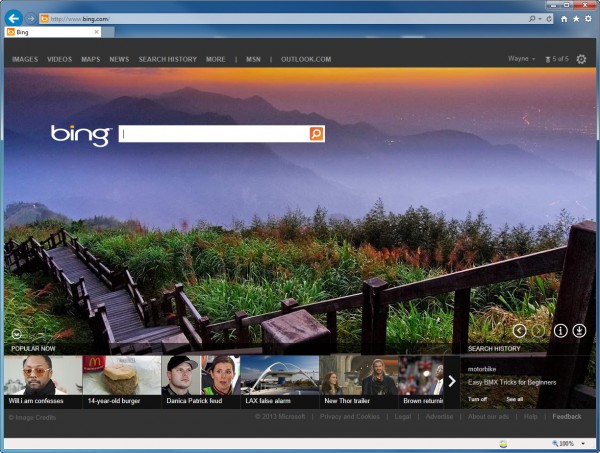
    The Popular Now bar at the bottom of the screen on the US version has a variety of stories with images. The UK version — three or four plain text links. Although we do also get a link relating to the image of the day, and a link about something to do with Britain. So yesterday, on St George’s Day (the Patron Saint of England) there was a link about him. While Google UK had a St George’s Day doodle, Bing’s image was a cool interactive shot of Antelope Canyon, Arizona.

    There are other benefits to using the US version of the site too — the US results page is full of images, useful information and links on the right. The UK version just shows text ads and related searches. So for most of my time on Bing I’ve had my country set to the United States. Although, here’s an interesting thing — the number of results you get varies wildly depending on which country you’re set to. Run a search for “Google” for example, and Bing US claims around 75,800,000 results. Bing UK 2,110,000,000, or 1,650,000,000 if you choose English Only as the language. Very strange. I didn’t check all the results to find the reason for the difference.

    When I perform a search on Google it’s usually through my browser’s search box. I only go to Google itself when there’s a doodle worth seeing (like the cool St George’s Day one). I’ve been using Bing in the same way, but I’ve been going to the home page a lot more — partly to see the photo of the day (I’m a sucker for a great image, some of which can be downloaded and used as wallpaper) and partly to see what’s popular now. It also gives me quick access to previous searches I’ve performed (you can turn this off if you don’t want your searches logged).

    For the most part, in my day to day use, I no longer even think about the fact I’m searching with Bing, not Google. The results pages look similar, and the results are as you’d expect them to be. Occasionally Bing’s top result will be a slightly odd choice (it’s almost as if the site does this to check you’re paying attention), but all the results you’ll likely to need will appear on the front page, so the “correct” top choice (which Google pretty much always nails) is never far away.

    In comparing Bing’s results with Google I’ve found the two sites often deliver the same results, just in a slightly different order. Bing has some great touches I really like. Search for an artist, like “will.i.am” for example, and Bing will provide quick links to his Twitter account and Facebook page and Klout score. You can also listen to his songs via the MySpace player.
    A feature I use all the time on Google is the ability to sort results by time — any time, past hour, past 24 hours, past week, past month, past year or custom range. Bing added a similar feature last month that lets you order results by past 24 hours, past week or past month. Needless to say this is only available on the US site (the UK site lets you sort the results by language or region).

    Beyond Search

    As for Bing’s other sections — Images is, for the most part, very good and offers a selection of choices to filter your search as well as a strip showing related topics. However, if you search for something less well known, such as Zombies Run Google’s results are far more accurate, and show a much deeper understanding of what you are likely to be searching for. Some of the connections Google makes are scarily well chosen. Some of the images Bing presents you with seem almost selected at random. Although, that said, sometimes Bing will come up with excellent images that Google doesn’t find. And if you’re a Pinterest user, Bing lets you pin images you find directly from the photo detail’s page.

    Video search is good, and you can sort results by length, resolution and source. Bing Maps is decent, but can’t quite compete with Google Maps. Its Streetside feature — while good — only covers a fraction of the places Street View does. Bing News (US) is on a par with Google News (naturally the UK version of Bing News is not as good) and other Bing services, like Shopping and Translator will suit most people’s needs perfectly. As you’d expect, the US site offers lots more additional elements — like Weather, Events, and Friends’ Photos.

    Summing Up

    So what’s my overall view of Bing? If you live in the US, it’s a very, very good search engine and you could easily use it as your primary choice for most things. If you live outside of the US, as I do, it’s sadly not as good and means compromising on your location.

    Is it better than Google? No. Is it as good as Google? No — at least not when it comes to results. It does, however, do a lot of things as well, and it does do some things better. The gap between Bing and Google has definitely closed since I last used it, and because Microsoft isn’t trying to force users to a specific social portal (as Google is with Google+) the integration with services that most people use — such as Twitter, and Facebook, gives Bing an edge I like.

    Would I recommend you switch to Bing? It depends on where you live and what you want from a search engine really. If it’s just straightforward, bang on the money results, stick with Google. If you don’t mind occasionally having to hunt a little harder, you use Windows 8 (optional) and appreciate deep integration with all the popular social networks, Bing could well be for you.

  • Nine Months After Talking Up The Carrier Deal, FreedomPop Shows Off Its First Sprint-Friendly Hotspot

    fp-overdrivepro

    FreedomPop has been promising to bring mostly free 4G internet access to the masses for over a year now, but those ambitions have been hampered by partner Clearwire’s spotty WiMax coverage — there are sizable swaths of the country where you just can’t get service. That won’t be the case for much longer though, as FreedomPop has just started taking orders its first Sprint-friendly wireless hotspot.

    Granted, it’s not exactly a new one. The $40 Overdrive Pro first hit Sprint shelves back in early 2011, but at least the dual-mode device allows FreedomPop users to tap into Sprint’s sizable nationwide 3G network when WiMAX isn’t available. As always, FreedomPop users are given 500MB of free wireless network access per month, but the company offers a slew of monthly rate plans and features in hopes of generating some additional revenue. It seems to be working well enough so far — FreedomPop CEO Stephen Stokols told FierceWireless that nearly half of the service’s existing users have made some sort of additional purchase.

    Frankly, it’s about time. FreedomPop first announced that it would migrate to Sprint’s CDMA/LTE service last July, and since then the Niklas Zennstrom-backed company has dutifully pushed out WiMAX devices while talking up the eventual switch.

    In the event that you’ve already thrown down some cash on one of FreedomPop’s earlier doodads, you can contact customer service to coordinate a swap, though you should know that the company is also hoping to roll out some devices capable of running on Sprint’s growing LTE network in the months to come. Among those forthcoming LTE devices is a nifty clip that physically attaches to tablets, and FreedomPop previously confirmed that it plans to flesh out its existing hardware lineup with a slew of wireless data cases for Android devices like Samsung’s Galaxy S III. It’s worth noting though that the iPhone sleeve that garnered plenty of early attention in the company still hasn’t seen the light of day because the FCC has qualms about its design, so these sorts of device-specific hotspots may need some more fine-tuning before FreedomPop pushes them out the door.

  • Twitter Two-Step Verification Finally on the Horizon [REPORT]

    Following Tuesday’s hack of the AP’s Twitter account that temporarily tanked the stock market and showed just how powerful a false tweet can be, Twitter is looking to slowly roll out two-step verification to some users.

    According to Wired, Twitter has such a system currently undergoing internal testing, and they will soon begin to roll it out “incrementally.”

    Two-step verification, as you probably know, is really any approach to account authentication that involves two layers. Usually, this involves the typical password layer, beefed up by a mobile alert (usually an additional code sent to an account holder’s device). Plenty of companies with online log-ins like Google and Apple have already implemented some version of this security measure.

    Back in February, a job posting on Twitter’s employment site suggested that Twitter was getting more serious about two-step verification. The posting, for a software engineer specializing in product security, listed duties to ““design and develop user-facing security features, such as multifactor authentication and fraudulent login detection.”

    Two-step verification isn’t a panacea for every product security issue, and it’s not going to prevent every hack. But it is a necessary blockade between your account and the bad guys who wish to use it for nefarious purposes. It’s about time that Twitter launched something like this, and there’s no better time than now – especially after the recent high-profile hacks.

  • 14-Year Old Burger Defies Science

    A 14-year old hamburger has refused to comply with what we know of decomposition, according to a man in Utah.

    David Whipple says he bought a burger with pickles, mustard, and ketchup from McDonald’s in July of 1999 to use as a visual aid for a presentation about enzymes and reactions. After letting it “age” for a month, he showed it to a group of students and was surprised even then at how little time had affected it.

    “At the little meeting, I showed the hamburger and the pickle, which was just starting to disintegrate,” Whipple said. “There was no decomposition to the meat or bun, nor any mold, fungus or smell. It had no bad odor at all.”

    After the presentation, Whipple says he stuffed the burger in a bag and ended up leaving it in his truck, forgotten, over the summer months. It eventually landed in a closet in his home, and when he discovered it he says he was amazed. Lately, it’s gotten some attention and was even featured on the show “TV Doctors”. A photo of the burger, along with its story, has since gone viral.

    “This just came out in the last couple of months and it’s just been crazy,” he said.

    The burger hasn’t been dehydrated or refrigerated, and Whipple says he can’t understand why it’s survived as long as it has. He is currently working on a similar experiment with burgers from different fast food chains, to see if they hold up as well as the one from McDonald’s So far, he says, they’re right on track. As for McDonald’s, they can’t offer up an explanation as to why one of their burgers would hang around this long, either.

    “McDonald’s hamburger patties in the U.S. are made with 100% USDA-inspected beef. They are cooked and prepared with salt, pepper and nothing else — no preservatives — no fillers. Our hamburger buns are made from North American-grown wheat flour. These are the same foods that people buy every day in their local grocery stores,” they said in a statement.

  • Google Taps Donald And Daisy Duck For Cybersafety Education

    Google teamed up with industry associations and public and private partners, including Disney, apparently, to produce 300,000 copies of a special edition of Donald Duck magazine in Norway.

    The issue focuses on cybersafety, and features Donald Duck, Daisy Duck, Huey, Dewey, and Louie, among other familiar Disney duck faces.

    Google ducks

    Google ducks

    Google ducks

    “Kids growing up in this digital age use the Internet for pretty much everything; entertainment, communication, education and when they get that far; new technologies will play an important role in their work,” says Martin Ruby for Google Public Policy, Copenhagen. “Never has a generation needed digital guidance as the one growing up now. And we were thinking: who would be a better digital guide for kids than Donald Duck?”

    “In the book, Donald gets himself into trouble,” explains Ruby. “He is guarding his uncle’s fortune with the help of a gigantic robot but trying as always to charm Daisy Duck – this time on the Internet. An unsuspecting Donald is lured into downloading a virus and giving away his password to Magica de Spell on ‘Duckbook’. No surprise: she takes control of the robot and the fortune.

    Good thing it’s realistically practical, acknowledging that far more ducks are using Duckbook than Duck+.

    Ruby notes that it all ends well, and Donald gets a prize for his digital skills.

    You can actually peruse the issue here (pdf).

  • Storage Player Exablox Emerges From Stealth With $22M in Funding

    The newest player on the storage scene is Exablox, which emerged from stealth mode today with $22.5 million in funding from Norwest Venture Partners (NVP), Doll Capital Management (DCM) and US Venture Partners (USVP).

    Exablox promises to provide turn-key enterprise-grade object-based storage and data protection in less than five minutes. It is targeting resource-constrained organizations with unstructured and backup/recovery storage problems with its solution sold exclusively through the channel. The company helps deliver scale-out network attached storage (NAS) built on object-based storage through an appliance called OneBlox, and its OneSystem management software.

    The Mountain View, Calif. company looks to solve businesses’ common storage pain points: complicated installation, cumbersome storage management, lack of data security and forklift upgrades.

    Exablox is also upfront with pricing; pricing begins at under $10,000 for a 32TB solution and under $40,000 for a replicated four-node 64TB disaster recovery solution. The company’s been working with beta customers, but is now open to select customers.

    Two Years in Development

    “We spent the last two years working with customers and partners to build a next-generation storage solution that addresses the pain points they’re confronting as they deal with the explosion of unstructured data,” said Douglas Brockett, CEO of Exablox. “We’re tearing down the technology barriers that have forced customers into choosing between the features they need and the solutions they can afford. At Exablox, we think every customer should feel their data storage is safe and scalable.”

    OneBlox is a scale-out object-based appliance that is expandable and uses flexible media, whether it be cost effective SATA drives or performance boosting SAS or SSD. It is accessible with Server Message Block (SMB) and Common Internet File System (CIFS) network protocols. Additional OneBlox appliances can be added automatically, enabling  dynamic scalability rather than forklift upgrades.

    The storage architecture doesn’t limit the choice of drive types or capacities, the company says, allowing organizations the ability to mix and match drive technologies and sizes. The ability to add a new drive at any time offers the potential for just-in-time storage capacity, dynamically pooled within the global file system. OneBlox includes inline deduplication for primary and disk-based backup and recovery storage, to minimize waste and maximize storage utilization.

    The OneSystem storage management offering is cloud-based, so there’s nothing to install and no command line. A drag-and-drop interface offers site-to-site replication and configuration, allowing service providers the ability to proactively manage and monitor all of the storage resources across companies and geographies.

    “If storage admins try to solve the challenges associated with managing unstructured data with the same technology they’ve been using, insanity may certainly be in their future because things just won’t get better,” said Terri McClure, Senior Analyst of Enterprise Strategy Group. “Vendors like Exablox are out there with innovative technology that is designed for the unstructured data challenges IT faces today, not the challenges faced 20 or 30 years ago.”

  • Nokia unveils the inexpensive Asha 210

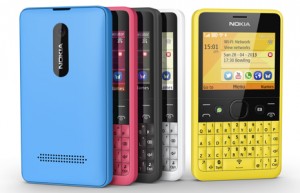
    If you were expecting Nokia to unveil a mighty new smartphone today then you will certainly be disappointed. Two days after the company released a teaser which showcased bits of a new device, the Finnish maker simply unveiled another phone in its Asha series, dubbed Asha 210.

    The highlights of the Asha 210 include a QWERTY keyboard, a 2 MP back-facing camera with a dedicated physical button, WhatsApp button, support for Facebook, Twitter and email accounts, Bluetooth and Wi-Fi, as well as support for dual-SIM in one of its two variants.

    “The Nokia Asha 210 really stands out giving super-social consumers new ways to express their personalities through design, colour and innovations like the world’s first WhatsApp button”, says Nokia’s Timo Toikkanen. “It has been designed to allow people to easily update their social networks, stay in touch with friends and share user created content”.

    “We are focused on delivering the best WhatsApp experience to as many people as possible”, says WhatsApp co-founder Brian Acton. “We are very excited about our partnership with Nokia Asha complementing our strategy of giving people around the world an easy experience when keeping in touch with their friends”.

    The device also comes with Nokia’s Xpress Browser which is designed to reduce cellular data usage by optimizing the content’s size on a website. Nokia says that the Asha 210 offers up to 46 days of standby in the single-SIM model and up to 24 days of standby in the dual-SIM model.

    Nokia says that the Asha 210 is “designed to offer consumers more social experiences at an affordable price”. The company estimates that the handset will be available for roughly $72, once it ships in Q2 2013. Available color choices include black, cyan, magenta, white and yellow.

  • Jaguar F-type vs Porsche 911 Cabriolet – Tiff Track Battle

    Porsche Jaguar Battle

    It’s not the fastest, tidiest or best way to get around a road course, but when it comes to full-on drifting excitement, there is no one better in the business than Tiff Needell. On this episode of EVOTV, Tiff grabs hold of a Porsche 911 Cabriolet and Jaguar’s new F-type for a flat-out track battle to see which machine has the goods when it comes to carving it up during weekend road course duty.

    Source: Youtube.com

  • Apple’s quarter: Something for bears and bulls alike

    Apple's March quarter: Something for bears and bulls alike
    Apple’s second quarter wasn’t nearly as bad as the bears on Wall Street thought it would be. In fact, the company actually beat estimates, even though there were some notably bearish analysts and traders on Wall Street. Despite that, Apple’s results, guidance and future are as confusing as ever, with something for both the bulls and bears alike.

    Continue reading…

  • For the beginner: How to set the Galaxy S 4 to Easy Mode

    Samsung_Galaxy_S_4_Easy_Mode

    Smartphones are filled with so many features and options that even the tech savvy person has a hard time keeping up with it all. So you can imagine what a beginner or someone who is very uncomfortable with technology must feel like. Samsung has what’s called Easy Mode and it’s one of the most underrated features the Galaxy S 4 offers. It’s for the person who really wants things to be simple. Maybe your Mom, Dad, or Grandparent would like a phone such as the GS4, but just doesn’t want to deal with all the fuss.

    This is exactly why Easy Mode was created. It’s already been available on the Galaxy S III, but Samsung has simplified it even more. Easy Mode only has three home screens. The main home screen has non removable widgets for the time, date, and weather. You will also find six apps to choose from that have much larger icons. The left home screen is dedicated to calling. You can select up to nine contacts to set as favorites and you can open the phone app, which includes the keypad, call logs, and contacts. The right home screen includes 9 apps that you can customize to whatever you want. You still have an app drawer as well, but all apps are spelled out and in alphabetical order. The settings menu is also simplified as well as the camera interface.

    We showed you in our initial setup guide how to select Easy Mode when turning on the Galaxy S 4 for the first time. but you can still get to it from your main settings. Just swipe down the notification area, select the gear icon for settings, then go to the “My device” tab and select “Home screen mode.”  You will see two options at the top: Standard Mode and Easy Mode. “Standard Mode” should already be selected so you want to tap on “Easy Mode” to change it. Now tap “Apply” at the bottom and you will get a popup telling you that whatever customizations you made in “Standard Mode” will still be there if and when you go back. Tap “OK” and you will now be in Easy Mode.

    It’s really quite simple and returning to the standard mode is just as easy. We put together a video tutorial showing you how it’s done as well as how Easy Mode works. Check it out below.

    Click here to view the embedded video.

    Come comment on this article: For the beginner: How to set the Galaxy S 4 to Easy Mode

  • HTC One receives update to improve UltraPixel camera performance

    HTC_One_Back_Slanted_Camera_Lens_HTC_Logo_TA

    Looks like that update we told you about for the HTC One is good to go. HTC just announced an update (version 1.29.401.13) for the European model that concentrates on the UltraPixel camera with many fixes. It includes improvements for sound captures with Zoe, noise reduction for slow motion movie captures, better color reproduction and dynamic range for non-HDR images in certain conditions, and corrections to EXIF information when ISO settings are manually changed. Those of you with a European model should expect to see the update this week. If you have a carrier version, expect a rather long delay especially if you’re in the U.S. Don’t forget to check out our guide on the HTC One camera as well as how to utilize Zoes and video highlights.

    source: Pocket-Lint

    Come comment on this article: HTC One receives update to improve UltraPixel camera performance

  • Looking For A Cheap Linux Board? Try The BeagleBone Black

    Linux can run on just about anything. That’s why projects like the $25 Raspberry Pi are so exciting. Just about anybody can now own a Linux PC and start writing code. Of course, some may want something a bit more sophisticated, and BeagleBoard may have just want you need.

    The BeagleBone Black is the latest Linux board from BeagleBoard. The board can run Linux or Android, and features a 1GHz ARM Cortex-A8 processor. It’s a bit faster than the 720 MHz CPU on board the original BeagleBone. The BeagleBone Black was also upgraded to 512MB of RAM and 2GB of onboard flash memory.

    The BeagleBone Black is a substantial improvement over the $89 BeagleBone so one would expect a higher price, right? Fortunately, cost cutting measures have allowed BeagleBoard to sell the BeagleBone Black for only $45. It’s even cheaper if you just buy the board as the $45 cost also includes a power supply.

    Here’s the full spec list:

  • Processor — TI Sitara AM3359 (Cortex-A8 @1GHz)
  • Memory — 512MB DDR3 RAM (606MHz); 2GB onboard eMMC flash; microSD slot
  • Networking — 10/100 Ethernet
  • Other I/O:

  • Micro-HDMI
  • USB 2.0 host
  • Mini-USB 2.0 client
  • 20-pin CTI JTAG interface (optional)
  • Expansion connector I/O:

  • 3x serial
  • McASP0, SPI1, I2C
  • 65x GPIO
  • CAN
  • LCD
  • GPMC, MMC1, MMC2
  • EHRPWM
  • 7x AIN (1.8V max.)
  • 4x timers; XDMA interrupt
  • Other features — reset, boot, power buttons
  • Power:

  • Mini-USB, DC jack, or 5VDC external (via header) source
  • PMIC regulator
  • Approximately 2.3 Watts max power consumption
  • Dimensions — 3.4 x 2.1 inches
  • Weight — 39.7 g (1.4 oz)
  • If you prefer video tours, here’s a quick rundown of the BeagleBone Black:

    For more info, including where to buy it, check out the BeagleBone Black product page. You’ll even find links to Android and Ubuntu builds that are certifiably stable on BeagleBoard hardware.

    [LinuxGizmos via Slashdot]

  • Apple’s WWDC Kicks Off June 10th, To Focus on ‘Future of iOS and OS X’

    Apple has just announced that it’s annual Worldwide Developers Conference will begin this year on June 10th and run through June 14th. It’ll take place at San francisco’s Moscone West.

    Tickets go on sale tomorrow, April 25th, at 10 am PT. You can find information about that here. It’s important to note that to buy a ticket, you have to be a member of iOS Developer Program, iOS Developer Enterprise Program, or the Mac Developer Program as of the time of today’s announcement. The tickets start at $1,599.

    “We look forward to gathering at WWDC 2013 with the incredible community of iOS and OS X developers,” said Apple’s SVP of Worldwide Marketing Philip Schiller. “Our developers have had the most prolific and profitable year ever, and we’re excited to show them the latest advances in software technologies and developer tools to help them create innovative new apps. We can’t wait to get new versions of iOS and OS X into their hands at WWDC.”

    WWDC will feature over 100 technical sessions from over 1,000 Apple engineers.

    Here’s what’s on the schedule for the event so far:

    • More than 100 technical sessions presented by Apple engineers on a wide range of topics for developing, deploying and integrating the latest iOS and OS X technologies;
    • more than 1,000 Apple engineers supporting over 100 hands-on labs and events to provide developers with code-level assistance, insight into optimal development techniques and guidance on how they can make the most of iOS and OS X technologies in their apps;
    • the latest innovations, features and capabilities of iOS and OS X, and how to enhance an app’s functionality, performance, quality and design;
    • the opportunity to connect with thousands of fellow iOS and OS X developers from around the world—last year more than 60 countries were represented;
    • engaging and inspirational lunchtime sessions with leading minds and influencers from the worlds of technology, science and entertainment; and
    • Apple Design Awards which recognize iPhone®, iPad® and Mac apps that demonstrate technical excellence, innovation and outstanding design.

    At last year’s WWDC, Apple pulled the lid off OS X Mountain Lion and iOS 6.

  • Joyent says Chef support will make cloud workloads mobile

    Opscode is having a pretty good run. the devops-focused toolset. In February, Amazon launched application life cycle management console based on Opscode Chef. On Wednesday, Joyent said it’s add full support and integration of Chef into the Joyent Cloud.

    Expect more pledges of support and woo to come out of Opscode’s annual conference kicking off tomorrow in San Francisco. Tools like Chef, and Puppet Labs’ Puppet (see disclosure) ease the creation and management of system configurations. One key benefit is that once the associated scripts of a deployment are created, they can be deployed regardless of the underlying operating system or, in this case, cloud. At least in theory.

    In Opscode parlance, Chef configurations are deployed and managed via a “cookbook.” Joyent’s support of Chef means it will be easier, going forward, for customer to move cloud deployments to and from any cloud, said Joyent CTO Jason Hoffman in a recent interview.

    “Chef, rather than the bare APIs, thus becomes the abstraction layer,” Hoffman told me. “By supporting Chef we make workloads more mobile. If Amazon calls an instance M1 why don’t we have one?” If that nomenclature is standard across clouds, the various scripts will work more easily anywhere.

    That means, in Hoffman’s view, that folks who’ve deployed workloads in AWS but want better and more explicit service level agreements or other contractual terms that AWS may not grant, they can move the whole kit-and-kaboodle over to Joyent or, truth be told, vice versa.

    As to why Chef appears to be gaining so much traction over CF Engine and Puppet? Hoffman thinks it’s because Opscode is more aligned with developers whereas Puppet targets admins, or the “ops” constituency of devops. In January, Puppet received an additional $30 million investment from VMware, funding which leads some to see Puppet falling into the VMware camp — a contention that Puppet CEO Luke Kanies denied at the time of the deal, pledging to continue support for heterogeneous hypervisors and environments.

    Joyent, along with the various OpenStack-allied vendors are all hoping to take business from Amazon which, to be fair, isn’t taking that potential threat lying down. AWS has been adding more enterprise-friendly features and services while its competitors add more services. Later on Wednesday, we’ll hear about how the EMC and VMware-backed Pivotal Initiative plans to take on AWS and other cloud competitors. And, to further muddy the waters, VMware said on its earnings call Tuesday night that it will launch its public-cloud take — which it calles VMware Hybrid Cloud Service on May 21. We’re going to need a score card.

    No doubt we’ll hear more about Hoffman’s vision of mobile cloud workloads and the increasingly competitive cloudscapewhen he takes the stage at Structure 2103 in San Francisco on June 19

    DisclosurePuppet Labs is backed by True Ventures, a venture capital firm that is an investor in the parent company of this blog, Giga Omni Media. Om Malik, founder of Giga Omni Media, is also a venture partner at True.

    Related research and analysis from GigaOM Pro:
    Subscriber content. Sign up for a free trial.


  • 13 Officers Indicted In Prison Drug Gang Scheme

    13 female state prison guards have been indicted on charges of federal racketeering after it was discovered that they were all aiding prisoners in drug trafficking and money laundering in Baltimore.

    The guards used their position of power to help members of the Black Guerilla Family smuggle in contraband such as pills and cell phones, which they hid in their hair and underwear. But they didn’t just aid the gang in their illegal operations; some of them were carrying on relationships with the members. Reportedly, one inmate got four women pregnant.

    “The inmates literally took over ‘the asylum,’ and the detention centers became safe havens for BGF,” said FBI Special Agent in Charge Stephen E. Vogt.

    Prosecutors say that the conditions and staff of the prison system in Maryland is severely lacking and are blaming these incidents on a lack of control by those in charge, saying that procedures were not in place to prevent smuggling.

    As of now, all 13 officers have been suspended and are facing termination, but many are wondering if these indictments will preclude a major–and much needed–change in the prison systems.

    This isn’t the first time a female prison guard has been caught abusing her position; a woman in Brooklyn was recently brought up on charges after admitting she was pregnant by an alleged cop killer who was under her watch.