Category: News

  • CryEngine 3 Displays Its Next-Gen Muscle In New Tech Demo

    Epic Games made one heck of a splash with Unreal Engine 4. The next-generation engine has already proven its worth with two amazing tech demos that make the wait for the next-generation that much harder to bear.

    Of course, it’s easy to forget that the next generation is already here with CryEngine 3. Crysis 3, at least on the PC, is a technical marvel. Now one company has taken CyEngine 3 and crafted one of the prettiest tech demos you’ll ever see.

    From Enodo, a firm that designs “virtual realities for real life business applications,” comes this real-time demo that simulates multiple environments from the African plains to a busy urban center. Check it out:

    Regardless of the engine, the future of next-gen games looks bright, and very pretty. Let’s just hope game designers start to use a bit more color in their games from now on though. Unreal Engine has already proven that it can do browns, but a little blue or green never hurt anyone.

  • Apple Q2 2013 by the numbers: $43.6B revenue, $10.06 EPS

    Today’s closing bell brings answer to a question oft-asked over the past two weeks: “Will Apple profits fall for the first time in about a decade?” Not since 2003, when the fruit-logo company recovered from economic woes that sapped global PC shipments everywhere, has profit receded. Now we know.

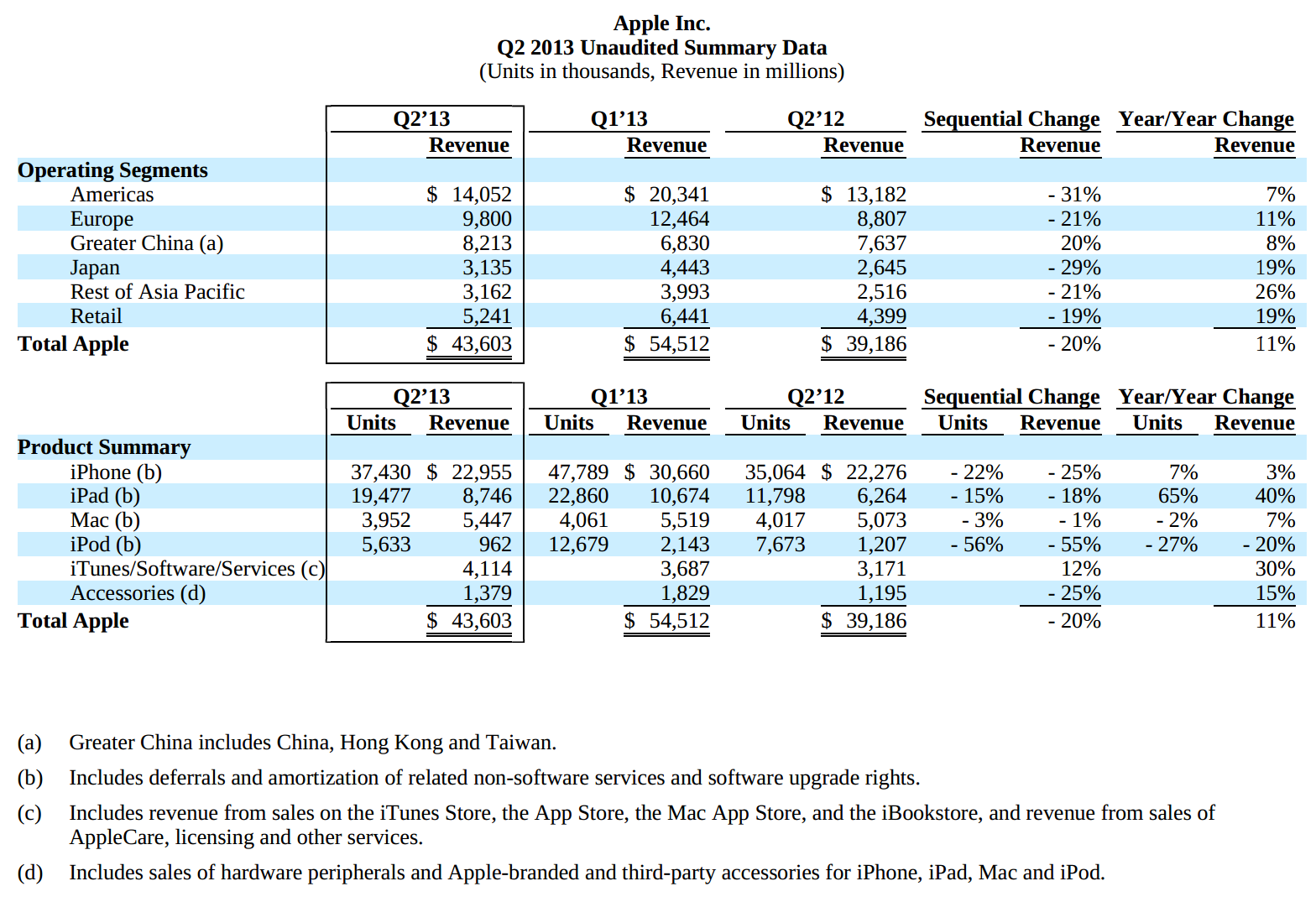
    For fiscal Q2, Apple reported $43.6 billion revenue and net profits of $9.5 billion, or $10.06 a share. Gross margin: 37.5 percent. A year earlier, the company reported revenue of $39.2 billion and $11.6 billion net quarterly profit, or $12.30 per share.

    Analyst consensus for the quarter was $42.49 billion, up 8.4 percent year over year, and EPS of $10.07. Revenue estimates ranged from $41.06 billion to $44.18 billion and $9.23 to $12 earnings per share.

    Apple shipped 3.9 million Macs, 19.5 million iPads and 37.4 million iPhones during the quarter. Analyst consensus was around 4 million, 18 million and 36 million, respectively.

    Apple ended the quarter with $144.7 billion in cash, up from 137.1 billion the previous quarter; $102 billion is offshore.

    For fiscal third quarter, Apple expects revenue to be between $33.5 billion and $35.5 billion and operating margins between 36 percent and 37 percent.

    In an unusual turn, Apple CEO Tim Cook began today’s earnings conference call. He observes that during the first half of fiscal 2013, Apple generated $98 billion in revenue and $22 billion in profits. The company shipped 85 million iPhones and 42 million iPads during same time period.

    “We know they didn’t everyone’s meet expectations”, Cook says of the quarter. He acknowledges that Apple’s growth is slowing and margins declining. But 2012 was a hugely successful year, and “That’s making comparisons very difficult this year”.

    Profits and Profits

    Apple is partly responsible for the recent profit furor, by changing forecast guidance metrics. Three months ago, the company told Wall Street to expect between $41 billion and $43 billion in revenue for fiscal 2013 second quarter, with gross margin between 37.5 percent and 38.5 percent. But in a radical departure, Apple didn’t provide EPS guidance.

    Apple’s super secrecy and past practice of massaging news for most favorable public perception easily fed conspiracy theories about profits in decline. Otherwise, why would the company suddenly stop giving guidance? Then there are analyst numbers showing tablets, mainly iPad, sapping personal computer shipments, including Macs, and Apple’s smaller mini also taking sales from the larger one. Gross margins were 47.4 percent in the year ago quarter. In context of Apple’s guidance, and analyst data about PCs and tablets, Wall Street rightly worried about falling profits.

    But how low really is too low. Apple is a massive money machine. For fiscal 2012, which closed end-of-September, Apple revenue reached $156.51 billion, up 140 percent from fiscal 2010. During the same time period, Apple’s net income rose to $41.733 billion from $14.01 billion. No tech company comes close.  Google and Microsoft combined generated less revenue for calendar Q1 (same as Apple fiscal second quarter)  — $34.46 billion.

    Perception is the problem. Apple’s stock price is in state of collapse. At market close today, shares were down about 42 percent from September’s $705.07 all-time high. Today, Cook says that the recent stock decline “has been very frustrating to all of us”.

    The sell-off comes in part because of misguided perceptions that because the company hasn’t recently released something dramatically new CEO Tim Cook somehow isn’t as competent a leader as cofounder Steve Jobs. For irrational reasons that make no sense to me, analysts and investors are hung up on the something new, while ignoring key fundamentals. First: Apple’s real, spectacular performance. Second: How the company historically launches products. The latter is crucial.

    Apple typically announces category-creating or reinventing products then takes them to maturity over many years. Examples are everywhere. Among them:

    • OS X (January 2001-present), there’s still no OS XI
    • Apple Store (May 2001-present)
    • iPod (October 2001-present)
    • iTunes Store (April 2003-present)
    • iPhone (June 2007-present)
    • App Store (July 2008-present)
    • iPad (April 2010-present)

    Few companies create more than one industry-changing product. None as many as Apple. So the market’s expectations are unrealistic and ignore the fundamental stewardship inherited by current leadership.

    Right now, Cook’s charge is managing two relatively new product lines, which make up the bulk of profits. During fiscal Q1, iOS devices represented close to three-quarters of all revenue. His first responsibility is to manage these maturing businesses before committing Apple to some new or redefining category. But investors want the feel-good thing that creates allusions, perhaps illusions, about Apple as sitting-at-the-right-hand-of-God innovator. Some people may think that’s a position where Jobs is today. Perhaps they should lower such esteem about him and raise that of Cook, whose task is harder, for how much bigger is the Apple crop today than three years ago.

    Results by Category

    As a journalist, I dislike how Apple releases results. Google and Microsoft report minutes after the market closes. The fruit-logo company waits, and particularly long time today. Now for the numbers breakdown.

    iPhone. Increased demand for lower-cost models — iPhone 4 (free), 4S ($99) — is a concern. Average selling price declined about $20 sequentially — “driven primarily by mix”, mainly iPhone 4, Apple CFO Peter Oppenheimer says.

    Apple shipped 37.4 million iPhones worldwide during fiscal first quarter, up from 35.07 million a year earlier. That’s a 7 percent increase, year over year. However, shipments fell 22 percent sequentially.

    Revenue reached $22.96 billion, up 3 percent year over year from $22.3 billion. Sales slumped 25 percent from third quarter.

    During today’s conference call, Oppenheimer says 30,000 businesses are developing iOS apps.

    Apple ended the quarter with 4-to-6 weeks of iPhone inventory, which is typical level.

    With competitors shipping smartphones with larger displays, it’s unsurprising someone asks what Apple will do. Cook claims that the smaller screen offers better everything, such as viewability and longevity, for example, while competitors make sacrifices. “We would not ship a larger display iPhone while these trade-offs exist”, Cook says.
    iPad. Apple tablets are cause for consternation coming to today’s earnings report. Last month, NPD DisplaySearch followed up a January tablet forecast that shifts the market from 9.7-inch and 10.1-inch display models to those with 7-7.9 inches this year.  Small tabs are predicted to make up 45 percent of shipments, while iPad’s size drops to 17 percent. The change potentially means a big shift downward in Apple tablet margins.

    “Apple had planned to sell 40 million iPad minis (7.9 inches) and 60 million iPads (9.7 inches) in 2013”, David Hsieh, NPD vice president, says. “However, the reality seems to be the reverse, as the iPad mini has been more popular than the iPad. We now understand that Apple may be planning to sell 55 million iPad minis and 33 million iPads in 2013”. DisplaySearch predicts global tablet shipments will reach 240 million this year. Assuming Apple does 88 million, that’s 36.7 percent. But most of the growth is iPad mini.

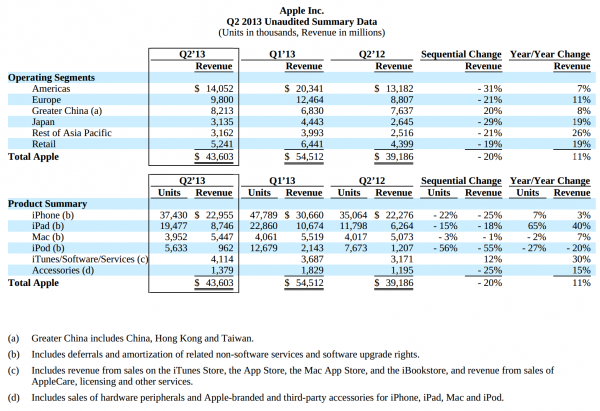
    Apple shipped 19.5 million iPads globally during the quarter, that’s up from 11.8 million — a 65 percent increase — a year earlier. Revenue rose 40 percent to $8.75 billion. Sequentially, units fell by 15 percent and sales by 18 percent.

    Oppenheimer says that all the growth came from iPad mini. He acknowledges that tablets contributed to margins coming in at the “low end of the range”. However, the margin pull wasn’t disastrous. ASP was $449, down from $467 a quarter earlier.

    Apple ended the quarter with 4-to-6 weeks of inventory.

    Macs. Computers is a category closely watched coming into today’s results — that’s because globally shipments collapsed during calendar first quarter to historical lows. IDC says the decline, 13.9 percent, is the worst ever. Gartner: Down 11.2 percent. For the United States, respectively: -12.7 percent and -9.6 percent.

    The analysts couldn’t agree on Macs. IDC reports U.S. shipments falling 7.5 percent year over year, while Gartner sees them increasing by 7.4 percent. As such, market share estimates don’t jive either — 11.6 percent (Gartner) and 10 percent (IDC). Fifteen points separate growth estimates, which is huge.

    Apple shipped 3.95 million Macs, down 2 percent from 4 million a year earlier. However revenue climbed 7 percent to $5.07 billion.

    “The market for PCs is incredibly weak”, Cook says. “Some of those iPads cannibalized some of those Macs”. He believes the PC market “has a lot of life left in it”. Ultimately, the chief executive sees iPad benefitting Mac sales, and at expense of Windows machines.

    There were 4-to-5 weeks of inventory at end of the quarter.

    iPod. Apple shipped 5.6 million iPods during fiscal second quarter, down from 7.7 million a year earlier, or 27 percent. Revenue fell 20 percent, from $1.21 billion to $962 million.

    Software/Services. Music, apps and services revenue exceeded $4 billion, up 30 percent year over year. About $2.4 billion came from iTunes.

    Around the world, there are now 155 Apple App Stores and 110 iTunes Stores. Payments to developers for their apps now runs $1 billion per quarter.

    Retail. Revenue from Apple Store rose 19 percent year over year to $5.2 billion, from $4.4 billion, with an average 401 stores open. Average revenue per store was $13.1 million, up from $12.2 million a year earlier. Number of visitors rose to 91 million from 85 million, annually, or 17,500 per store.

    There are now 402 stores, 151 outside the United States.

    Geographies. Greater China revenue rose 8 percent year over year to $8.2 billion. iPad grew by 137 percent, in the country. Revenues from the Americas climbed less, 7 percent, to $14.05 billion. Europe; $9.8 billion, up 11 percent. Japan: $3.14 billion, up 19 percent. Sales for the rest of Asia rose 26 percent, to $3.16 billion.

    Photo Credit: Lucia Pitter/Shutterstock

  • Apple reports shrinking profits with 37.5M iPhones, 19.5M iPads sold

    Apple’s profits took a dip for the first time in a very long time on Tuesday when it reported second fiscal quarter earnings results of $43.9 billion in revenue, profits of $9.5 billion and earnings per share of $10.09. Revenue was up slightly from the $39.2 billion earned a year ago, but profits were down from the $11.6 billion and earnings of $12.30 per share in its 2012 second quarter. The results did ever-so-slightly beat Wall Street’s expectations: on average, Wall Street analysts were looking for earnings per share of $10.07 and revenue of $42.59 billion.

    In terms of device sales, the numbers are:

    • 37.4 million iPhones, up from the 35.1 million sold a year ago.
    • 19.5 million iPads, up from 11.8 million a year go.
    • 4 million Macs, the exact same number as the same quarter a year ago.
    • For the first time, Apple did not break out iPod unit sales.

    Another big number that Apple watchers are focused on is the company’s gross margins. Last quarter, Apple forecast its gross margin would fall somewhere between 37.5 percent and 38.5 percent. In actuality it was 37.5 percent, compared to 47.4 percent in the year-ago quarter.

    CEO Tim Cook said in a statement, “We are pleased to report record March quarter revenue thanks to continued strong performance of iPhone and iPad. Our teams are hard at work on some amazing new hardware, software and services, and we are very excited about the products in our pipeline.”

    Between January and March, Apple added $12.5 billion to its cash pile, bringing to total to $145 billion. The company also elected to return more of that to shareholders.

    Apple said it will be increasing its dividend payment to 15 percent; each shareholder will now received a dividend of $3.05 per share each quarter, starting May 16. In addition, it plans to spend $60 billion on stock buybacks before the end of 2015. That’s a significant increase from the $10 billion buyback program announced a year ago. In total, Apple plans to spend $100 billion of its cash.

    Looking ahead to next quarter, the company is projecting more revenue between $33.5 billion and $35.5 billion, which is on the lower end of its revenue reported for that same quarter in 2012, $35 billion.

    The news didn’t do much to the company’s stock either way: it was down just 0.03 percent in after-hours trading to $406 Tuesday afternoon.

    This post was updated several times, the last at 1:48 p.m. PT.

    Related research and analysis from GigaOM Pro:
    Subscriber content. Sign up for a free trial.


  • Apple Sells 37.4M iPhones And 19.5M iPads In Q2, Tablet Business Shows 65% YOY Growth

    iphone5

    Apple has just released its Q2 2013 earnings report, announcing sales of 37.4 million iPhones in the quarter ending March. Apple also reported 19.5 million iPad units sold, which shows incredibly strong growth for Apple’s tablet business.

    This is a slight decrease from last quarter, which included a holiday sales spike and being the first full quarter in which the iPhone 5 was available.

    In terms of iPhones, this quarter’s 37.4 million represents 7 percent YOY growth; however it’s down 22 percent from last quarter. Where iPads are concerned, we’re seeing an 18 percent decline from last quarter, yet the segment remains strong. It’s grown 65 percent from last year’s 11.8 million from the same quarter.

    Moreover, this is the iPad’s second-best quarter ever, losing out only to last quarter. It’s also the best non-holiday quarter the iPad has ever seen.

    The iPhone numbers here aren’t all that surprising. Tim Cook has said before (and Steve Jobs before him) that expectations for the next-gen iPhone always tend to slow sales of the current model ahead of launch. Since we expect to see the next iPhone in June, it would make sense for sales to slow a bit.

    Last quarter, Apple sold a whopping 47.8 million iPhones and 22.9 million iPads, both of which broke previous records. In other words, this latest report shows continued growth for the iDevice segment.

    Apple doesn’t break out specific device numbers, so it’s hard to tell which models perform best. However, it seems that the introduction of the iPad mini has most certainly boosted sales for Apple’s tablet division, as many have been holding out for a smaller tablet from Apple since the iPad first launched.

  • Cops: 2-Pound Joint Confiscated At 4/20 Party

    Cops say a 2-pound joint was confiscated at a 4/20 party on campus at University of California, Santa Cruz, nearly 32 times the legal limit for possession.

    The joint, which was about two feet long, was rolled in celebration of the universal day to get high and will be sorely missed by the students, who booed police officers as they removed it from campus, then promptly forgot what they were booing for and headed to Taco Bell. Probably.

    But seriously, guys, what did you expect?

  • Apple posts Q2 earnings: $9.5B profit on $43.6B in revenue; boosts stock buyback by $50 billion

    Apple posts Q2 earnings: $9.5B profit on $43.6B in revenue; boosts stock buyback by $50 billion
    What a difference a year can make. This time last year, Apple’s stock was dancing in the mid-$500 range about to make an explosive run to a record high in late September. Then it all came tumbling down. Apple shares have lost more than 40% of their value since topping $705 last fall, and there are still no signs of a rebound in sight. Things took a sharper turn south in the new year and the stock is down about 23% year-to-date, recently dropping below $400 for the first time since December 2011. Shares rose on Tuesday as investors geared up for Apple to report its fiscal second-quarter earnings, and the numbers are now in.

    Continue reading…

  • President Obama Honors the 2013 National Teacher of the Year

    President Barack Obama, with Education Secretary Arne Duncan, honors 2013 National Teacher of the Year Jeff Charbonneau

    President Barack Obama, with Education Secretary Arne Duncan, honors 2013 National Teacher of the Year Jeff Charbonneau, State Teachers of the Year, and Principals of the Year, in the Rose Garden of the White House, April 23, 2013.

    (Official White House Photo by Pete Souza)

    Twelve years ago, Zillah High School in Washington state had no engineering classes. The science curriculum was lagging behind, and students had to go off campus to take technology classes.

    Jeff Charbonneau, who returned to his hometown 11 years ago to teach at Zillah High, was determined to change that. And he did. Science enrollment is way up. Kids are graduating with college-level science credits. The school expects to have to hire more teachers now to meet the demand. 

    And today, President Obama honored Jeff as the 2013 National Teacher of the Year.

    Jeff teaches chemistry, physics, and engineering, and works to create accessible, interactive lessons that help convince kids that the science classes most students consider hardest are worth diving in to, not running away from. But President Obama said that it’s not just his work in the classroom that distinguishes Jeff.

    “He started an outdoors club,” President Obama said. “He brought his passion to the drama program. He’s even helping out other schools.” Because of Jeff, hundreds of students all over Washington are now participating in high-skills robotics competitions and gaining valuable engineering experience.

    read more

  • Get ready for TED Talks Education, airing May 7 at 10pm


    TED is coming to a TV screen near you. On Tuesday, May 7, our first-ever television special will air on PBS at 10pm. Called TED Talks Education, the special is a deep dive on ideas to make our education system stronger – with talks from teachers, learning experts, education researchers and more. The speaker roster includes: host John Legend, educator Rita F. Pierson, technologist Bill Gates, grit expert Angela Lee Duckworth, education reform advocate Geoffrey Canada, chemistry teacher Ramsey Musallam, poet Malcolm London and the most-watched TED speaker ever, Sir Ken Robinson.

    Set your DVR or mark your calendar now: May 7, 10pm, PBS. Above, watch a 30-second trailer for this special, a collaboration between TED, the Corporation for Public Broadcasting’s American Graduate Program, and PBS.

    And stay tuned for much, much more, as TED will be kicking off Education Week on our site on May 6. Bonus: the day after the special airs, it will be available as a webcast — and we’ll be posting extended versions of the talks from it on TED.com.

  • Facebook Decloaks, Confirms Plans for Iowa Server Farm

    facebook-altoona-illustrati

    An artist’s conception of the future Facebook data center in Altoona, Iowa (Image: Facebook)

    It’s official: Facebook will build a massive data center in Altoona, Iowa. After a year of secret scouting missions, the social network today decloaked and confirmed its plans to invest $299.5 million to build the first phase of a three-building campus in Altoona, a suburb of Des Moines. Facebook says the 476,000 square foot building will be the world’s longest data center, providing the company with a digital beachhead in the middle of the U.S.

    “When complete, Altoona will be among the most advanced and energy efficient facilities of its kind,” said Jay Parikh, VP of Infrastructure Engineering at Facebook, who announced the project in a blog post. “We’re excited to have found a new home in Iowa, which has an abundance of wind-generated power and is home to a great talent pool that will help build and operate the facility. We plan to break ground this summer and expect to begin serving user traffic in 2014.”

    The Facebook facility gives Iowa a trifecta of the world’s largest server farms, joining a Google facility in Council Bluffs and a Microsoft data center in West Des Moines. Sweetening the data center giddiness in iowa, Google earlier today announced an additional $400 million in investment in Council Bluffs, bringing its total spending to $1.5 billion.

    Media reports have placed the value of the stealthy “Project Catapult” at $1.5 billion. Facebook isn’t yet committing to that level of investment. But it plans to build a total of three data centers on its Altoona campus, which is nestled alongside Route 80 and has access to significant supplies of fiber and power.

    Fiber, Power and Shovel-Ready

    “We’ve got 200 acres, so it’s enough property to scale into three buildings if we need to,” said Tom Furlong, Vice President of Site Operations at Facebook. “We have data centers on the West Coast in Oregon and on the East Coast in North Carolina, so this gives us something in the geographic center of the country. This location had fiber, power and a shovel-ready site. Iowa has really been actively looking for data centers.”

    “Today’s announcement further solidifies Iowa’s position as a destination for tech companies – from major data center operations like Facebook’s to the innovative start-ups we continue to see popping up around our state,” said Iowa Gov. Terry Branstad.

    The data center would be Facebook’s fourth company-built project, with the others located in OregonNorth Carolina and Sweden. The facility will feature servers and storage using designs from the Open Compute Project, the open source hardware initiative organized by Facebook to share and improve its server and data center designs. Furlong said there will be some refinements of the data center designs, based upon efficiency data accumulated in monitoring operations at the facilities in Prineville and Forest City.

    “Each of our projects is somewhat of an evolution,” said Furlong. The Altoona campus will feature slightly larger data center buildings, which will accommodate different arrangements of some infrastructure components to improve the facility’s overall efficiency, Furlong said.

    Wind Power in the Mix

    One new wrinkle in Iowa will be inclusion of wind power in the utility mix. Facebook isn’t yet ready to announce details of its plans to tap wind power, but appears ready to make its first major foray into renewable energy (although the company has a 100 kilowatt solar array at its Prineville data center).

    The environmental group Greenpeace, which rarely misses a chance to comment on a major data center project, chimed in on the importance of adding renewables to Facebook’s energy sourcing.

    “In Iowa, Facebook has chosen a location where it has great potential to power its newest data center with the wind energy that is booming there, but to do so it must show a willingness to work with Iowa’s major utility, MidAmerican Energy, to provide more clean energy to the grid,” Greenpeace International Senior IT Analyst Gary Cook. “MidAmerican is still powering its grid with a mix of mostly dirty energy sources like coal and gas. We expect Facebook to meet the ambition it has expressed in its renewable energy goals by following the example Google has set in Oklahoma and North Carolina and demanding that MidAmerican provide significant new renewable energy to Iowa’s grid to meet the expected large electricity demand of Facebook’s data center.”

    Wind energy accounted for 25% of all the electricity generated in Iowa in 2012, leading the nation in percentage of total generation from wind energy.

  • Underwood Tweet Rage: Feud Boils Over Law

    Carrie Underwood took to Twitter recently to vent her frustration over a new law called the “ag-gag” bill–which involves admission of secret videotaping of factory farms into animal abuse claims–and her posts quickly drew the attention of Tennessee lawmakers.

    Underwood, a big proponent for animal rights, says she doesn’t agree with the law, which requires anyone submitting video footage of animal abuse to do so within 48 hours. Activists say two days just isn’t long enough and scares some people away from turning in the perpetrators.

    “Shame on TN lawmakers for passing the Ag Gag bill,” the singer tweeted. “If Gov. Bill Haslam signs this, he needs to expect me at his front door. Who’s with me?”

    That post, which reached her nearly 1.5 million followers, also drew the attention of Tennessee Rep. Andy Holt, who responded by saying, “I would say that if Carrie Underwood will stick to singing, I’ll stick to lawmaking.”

    Underwood didn’t let that one slide by, and instead responded with a new tweet:

    However, Holt says the intention of the bill is to bring animal abuse to light as quickly as possible.

    “I think what we need to do is make sure and recognize that if animals are being abused it needs to come to justice, and it needs to come to justice quickly,” Holt said. “No matter what anybody tells you. That’s the intention of this legislation.”

  • ‘Tipping Sacred Cows’ Author Jake Breeden Talks At Google

    Jake Breeden, author of “Tipping Sacred Cows: Kick the Bad Work Habits that Masquerade as Virtues,” recently participated in an “At Google” talk, which Google has now made available for viewing on YouTube.

    More recent At Google talks here.

  • Data center rivals Facebook and Google pump $700M in new construction into Iowa

    Data center nerds got two big announcements today with both Google and Facebook announcing big projects. Facebook’s new data center construction in Iowa is the fourth data center for the search giant, while Google’s Iowa expansion carriers a higher price tag. But the dueling news releases also highlight a growing infrastructure rivalry between these web giants.

    Facebook formally announced the construction of a new data center in Altoona, Iowa. Construction on the first phase will begin this summer and your Facebook likes and photos will start traveling over the data center in late 2014 according to Tom Furlong, vice president of site operations at Facebook.

    He said that while newspaper reports placed the value of the center at $1 billion to $1.5 billion, he’s unsure where those figures came from. This first phase will cost $300 million and result in a 476,000 square-foot data center. That square footage includes both offices and floor space. Like Facebook’s data center in Lulea, Sweden the hardware inside will be built for Facebook to its Open Compute standards.

    Facebook's data center in Prineville, Ore.

    Facebook’s data center in Prineville, Ore.

    When I asked Furlong if the Altoona data center would be built for disaster recovery purposes — as some of my sources had suggested — he told me, “we’re in the N+1 mode,” meaning he was building out capacity beyond what he needs to serve customers. While Furlong was clear that the data center would be more than just a failover site for Facebook’s Prineville, Ore.; Forest City, N.C.; Lulea, Sweden or leased data center space, it would represent excess capacity that could still support traffic from other sites if a region failed.

    He also alluded to mechanical, electrical and networking improvements, but other than saying that servers handling similar products would be grouped together he declined to get specific. But I’m hoping his boss, Jay Parikh, the VP of infrastructure engineering at Facebook who is speaking at Structure in June will share the details.

    On the capital investment side, Facebook said in its 10-K filing that it planned to spend $1.8 billion in capital expenditures in 2013. When asked if this data represented a large chunk of that, Furlong said it didn’t. AND at $300 million it probably wouldn’t, especially if servers and gear wouldn’t make it into the data center until 2014 as Furlong suggested.

    But wait, there’s more!

    But in a curious bit of timing, Google today said it would expand its Iowa data center operations in (relatively) nearby Council Bluff, Iowa. The search giant will spend $400 million building out its existing data center operations, bringing its total spent in the area to $1.5 billion. The data center houses computer systems and associated components that support services such as Google Search, Gmail, Google Maps and Google+.

    In the data center world, the growing rivalry between Google and Facebook is common — if quietly addresses –knowledge, which is why the timing of Google’s announcement seems designed to steal Facebook’s thunder. However, Google’s spokeswoman attributed the timing to an Iowa Economic Development Board meeting held this morning, where the board approved incentives for both Facebook and Google.

    However, it’s no secret that Facebook has been stealing pages from Google’s book and is also pushing for more openness than it’s famously “open” rival. Facebook’s Open Compute project announced in April 2011 clearly found inspiration in Google’s own efforts to build its own hardware to maximize efficiency. With Open Compute, Facebook took Google’s basic idea and opened it up to masses after putting considerable engineering talent behind it.

    That’s only one example. Facebook has also been open about how it builds and operates its data centers, which has led to many of those in the industry to start releasing their own data. For example, after Google published a blog post last year noting the power usage effectiveness ratio for its data centers, Facebook countered with an email indicating the differences between its calculations and Google’s. Microsoft also was quick to respond with details on its own PUE calculations.

    Facebook's Forest City, North Carolina data center.

    Facebook’s Forest City, North Carolina data center.

    That type of data has now become a PR battleground for many of these companies. And while it’s a game Google seems reluctant to play, it’s one that it has resigned itself to. Industry insiders note that Google is opening up as Facebook pushes the envelope on transparency.

    The search giant’s appearance and presentation last November at an industry conference that shared seven years of knowledge gained at Google, plus its invitation of a CBS news crew to tour its data center in North Carolina (where Apple and Facebook both have data centers and our own Katie Fehrenbacher was yelled at for snapping a picture) are a few examples.

    These steps are unheard of for the search giant, which is famous for holding its infrastructure details close to the vest. In the CBS video, Google’s infrastructure czar Urs Hölzle said that the tour granted to the CBS crew is the only time he’ll allow cameras into the data center. Google once asked me to avoid using a picture of a slide I had taken at a conference that showed a switch it had designed. I didn’t run the picture, but that was because it was blurry.

    So as Facebook pushes Google, perhaps Google is now pushing back a bit today with its own Iowa news. Google’s is a bigger project announcement, coming the same day after Facebook’s might just be a coincidence enabled by incentive packages, or it might be an attempt to steal Facebook’s thunder.

    Regardless, two web giants striving to make computing faster, more efficient and in Facebook’s case, more open, is a good thing: both for Iowa and for the rest of us.

    Related research and analysis from GigaOM Pro:
    Subscriber content. Sign up for a free trial.


  • French Embassy Bombed in Tripoli

    Just over one week after bombers detonated two explosives near the finish line of the Boston Marathon, the French Embassy in Tripoli has now been bombed.

    According to a Reuters report, a car bomb parked outside the French embassy exploded. The blast reportedly injured two French guards. No deaths have been reported.

    The last terror attack against a foreign entity in Libya was the September 2012 attack against the U.S. diplomatic mission in Benghazi. Four people were killed during that assault, including U.S. Ambassador to Libya J. Christopher Stevens.

    Since the ousting of Mummar Gaddafi in 2011 and the ensuing civil war, Libya has experienced military, economic, and political turmoil. France was the first country to recognize Libya’s National Transitional Council as legitimate and was a major player in the NATO-led military intervention during the civil war. Though no organizations have taken responsibility for the bombing, the French military has recently been conducting operations in Mali against Islamic rebels and terrorist organizations have vowed retaliation for French efforts in the country.

    According to the Reuters report, Libya’s government has condemned the bombing as a “terrorist act.” French President Francois Hollande called on the Libyan government to quickly capture those responsible for the bombing.

    (Image courtesy Bryn Jones/Wikimedia Commons)

  • AT&T posts in-line Q1 earnings results as growth slows

    AT&T posts in-line Q1 earnings results as growth slows
    AT&T on Tuesday posted first quarter earnings of $0.64 per share on revenues of $31.40 billion, thus matching Wall Street expectations of $0.64 EPS on revenues of $31.75 billion. The carrier posted a net addition of 291,000 subscribers on the quarter, bringing its total subscriber number to 107.3 million. What’s more, the company also reported that its churn rate is down year-over-year-, going from 1.46% in the first quarter of 2012 to 1.38% in Q1 2013. AT&T also reported selling 4.8 million iPhones on the quarter, thus helping the carrier maintain its spot as the top iPhone carrier in the United States. AT&T shares were down by around 1.25% in after hours trading on news of its Q1 earnings.

  • 5G doesn’t exist yet. Let’s stop abusing the term

    I’m a bit concerned that we in tech blogging community are doing the mobile industry’s marketing for them. This week a few tech sites published posts that attached the term “5G” to T-Mobile’s forthcoming rollout of LTE-Advanced technologies.

    It’s not my intention here to to attack my peers, but I think it’s necessary to point out we’re descending a slippery slope if we start tossing around the term 5G loosely. 5G doesn’t exist except as the barest concept. It hasn’t been defined by any standards body. The mobile industry only recently began addressing what constitutes 5G, assigning its biggest brains to investigate the technologies that might make up 5G networks in the future.

    mobile phone and telecommunication towersI understand the frustration of my fellow tech bloggers. Presented with a bunch of byzantine acronyms, how do you explain to the average reader the differences between an HSPA network and HSPA+ network, or between an LTE and an LTE-Advanced network, in a single sentence? When dealing in headlines of limited length and Twitter posts of 140 characters, it’s easy to fall into the comfortable trap of using terms like 4G and 5G to explain the differences in technologies (I’m guilty of falling into that same trap as well).

    But I think we owe it to our readers to spell out those nuances. Otherwise we’re not truly explaining mobile technology. Instead, we’re just repeating the marketing messages of carriers and vendors that have every interest in exaggerating the capabilities of their networks.

    To my knowledge, T-Mobile isn’t publicly labeling its forthcoming network as 5G, but the operator has a reputation for this kind of technology-inflation. In 2010, T-Mobile relabeled its HSPA+ service as 4G out of the blue. I had some sympathy for T-Mobile at the time, because it was presented with a quandary: Sprint had long used the term 4G to describe its WiMAX network, but T-Mobile’s ostensible 3G network was routinely beating Sprint in raw speed tests.

    Instead of trying to explain the differences to its customers – which admittedly would have been quite difficult — T-Mobile took the easy way out and simply claimed 4G as its own. Of course, that led AT&T to do the same for its even slower 14.4 Mbps HSPA+ network. Eventually, the standards body responsible for defining the various ‘G’s, the International Telecommunication Union, caved to industry pressure and retroactively defined 4G as pretty much whatever carriers wanted it be.

    ATT-4G-LTE-Logo4G became a meaningless term, and we tech journalists reinforced its meaninglessness by swallowing the terminology carriers fed us. If carriers gets hooks into the acronym 5G, you can bet the exact same thing will happen. Once one carrier succumbs, others will race to redefine their perfectly serviceable 4G networks as 5G networks. An the next operator to gain the slightest technical edge will start bandying about the term 6G.

    I’m not dissing T-Mobile’s technical accomplishments. As I’ve written before, T-Mobile’s new LTE network, by virtue of its newness, has definite advantages over other carriers’ networks. T-Mobile will be able to upgrade to new LTE-Advanced technologies faster and cheaper than its competitors. But T-Mobile certainly doesn’t have an LTE-Advanced network today, it won’t have one in the near future and it will be years before it can legitimately make the claim to owning one. LTE-Advanced is an incremental technology, and many of its key techniques aren’t even commercially available to carriers yet.

    In my opinion, carriers are already abusing the term LTE-Advanced. They haven’t started compounding that abuse by advertising their current or forthcoming LTE networks as 5G, but it’s only a matter of time. Let’s not help them along by doing their marketing for them.

    Related research and analysis from GigaOM Pro:
    Subscriber content. Sign up for a free trial.


  • Global Internet Speeds Have Increased Yet Again

    Every quarter, Akamai releases a report called “The State of the Internet.” In the previous report, Akamai found that broadband speeds had fallen on a global level. Thankfully, the latest report indicates that speeds are rising yet again.

    Akamai reports that average global connection speeds rose 5 percent to 2.9 Mbps in Q4 2012. That may not seem like much, but many countries in Africa and Southeast Asia are still seeing average speeds of 500-800 Kbps. Those countries are only seeing less than one percent increase in speeds each quarter, but recent initiatives may help bring them up to speed sooner rather than later.

    On a country-by-country basis, South Korea is still king with an average speed of 14 Mbps. Japan is second with 10.8 Mbps and Hong Kong is in third with 10.8 Mbps. The United States was ranked in eighth place with an average speed of 7.4 Mbps.

    Every country in the top 10, except for South Korea, saw average broadband speeds increase. Japan saw a year-over-year increase of 19 percent, Hong Kong saw a year-over-year increase of 5.4 percent, and the U.S. saw a year-over-year increase of 28 percent.

    The top 10 positions are largely the same when it comes to countries with high broadband (speeds over 10Mbps) connections. South Korea is in first place with 49 percent of the country with high broadband internet followed by Japan and Hong Kong with 39 percent and 28 percent respectively. The United States is in eighth place again with only 19 percent of the country having high broadband.

    When looking specifically at the United States, the Northeast largely remains the place to be if you want consistently high Internet speeds. Vermont takes the number one spot with average speeds of 10.8 Mbps followed by Delaware and the District of Columbia with 10.6 Mbps and 10.2 Mbps respectively.

    It’s largely the same when looking at the states with the highest amount of the population with access to high broadband. In this case, New Hampshire comes in at the top spot with 34 percent of its residents having access to speeds higher than 10 Mbps followed by the District of Columbia and New Jersey with both at 33 percent.

    As for Internet penetration, Akamai says that nearly 700 million unique IPv4 addresses connected to its platform in the last quarter. That’s a 4.2 percent jump from Q3 2012 and a 13 percent jump from Q4 2011. With a single IP address potentially representing numerous users, Akamai estimates that there are over one billion unique Web users on the Internet today.

    It should be noted that not every Internet user connects to Akamai, but a great deal of them do. Akamai’s numbers are about the closest we’ll get to the actual number of people who are now connected to the Internet.

    On a final note, Akamai says that global attack traffic (i.e. DDoS attacks) increased by 200 percent in 2012. Unsurprisingly, 41 percent of that attack traffic originated from China in Q4 with the United States coming in second with 10 percent of all attack traffic.

    Despite the worrying increases in attack traffic over the last year, Akamai’s report is incredibly encouraging. We like to complain about our ISPs, and for good reason, but these reports always help to put things into perspective. Our Internet speeds are slowly rising, and they’re rising faster than in other parts of the world. With the spread of Google Fiber and Gigabit Squared, we might start to see the U.S. rise up the ranks in forthcoming quarterly reports.

    You can get a copy of Akamai’s State of the Internet Report here. If you don’t want to read 45 pages of analysis and charts, you can read the two-page executive summary here.

  • Taming the HetNet with Wi-Fi traffic cops

    Interference and clogs over wireless networks — the result of Wi-Fi, Bluetooth devices, and even baby monitors competing for bandwidth — could be reduced with software that acts like a wireless traffic light.

    GapSense, developed by University of Michigan computer scientists, allows heterogeneous devices to talk to each other, allowing them to coordinate the start and stop of their packets and make them wait their turn to use the airwaves. UM hopes to develop the technology into a commercial product.

    CTIA, the wireless industry trade group, has estimated there are more than 320 million wireless-enabled devices in the U.S. With protocols using different spectrum widths and placing varying levels of demand on the network, data collisions that cause interference between these devices are bound to happen. Using a coordinated sequence of pauses and pulses, GapSense reduces these collisions.

    In one test, interference between ZigBee (a protocol that can be used e.g. for automating home lighting and temperature control) and Wi-Fi was reduced by 88 percent. Because these devices operate at different clock speeds, GapSense’s modulation of data transfer can also lower power consumption by 44 percent for Wi-Fi devices, according to the researchers.

    Related research and analysis from GigaOM Pro:
    Subscriber content. Sign up for a free trial.


  • Google Buys Wavii, According To Report

    Google has bought mobile news startup Wavii for over $30 million, according to a report from TechCrunch, who says the news comes from “a legitimate source”. Nothing official has been announced yet.

    According to TechCrunch’s Alexia Tsotsis, Google was in competition with Apple for the startup, which has drawn comparisons to Summly, which Yahoo acquired last month, and has already implemented in its new iPhone app.

    Here’s an interview we did with Wavii CEO Adrian Aoun last year, in which he describes the product.

    Rumors were going around last week that Google was close to acquiring the company, though Business Insider said the price would be less than $30 million.

  • BlackBerry Q10 will launch in Canada on May 1st for $199.99

    BlackBerry Q10 will launch in Canada on May 1st for $199
    BlackBerry on Monday announced that its second BlackBerry 10 smartphone will be available in Canada early next month. The BlackBerry Q10 will arrive on Rogers, Bell and TELUS on May 1st starting at $199 with a three-year service agreement. The smartphone is equipped with a full QWERTY keyboard along with a 3.1-inch 720p touchscreen, a 1.5GHz dual-core TI OMAP 4470 processor, 2GB of RAM, NFC, a microSD slot and an 8-megapixel rear camera. BlackBerry also announced that the Q10 will be available on smaller carriers such as Virgin Mobile, Fido, Koodo Mobile and Sasktel. The company’s full press release follows below.

    Continue reading…

  • Edtech Incubator Imagine K12 Announces New Start Fund

    Imagine K12, a Palo Alto, Calif.-based incubator focused on education tech startups, announced today it will fund participating startups in its program with up to $100,000. The funding includes $80,000 in debt and $20,000 in equity. Support for the funding of the Imagine K12 Start Fund comes from various investors, including Y Combinator founder Paul Graham, Yahoo co-founder David Filo and LinkedIn CEO Jeff Weiner, among others. Imagine K12, founded in 2011, says it has helped launch 39 edtech startups in nearly two years and they have gone on to raise about $30 million in further rounds of funding.

    PRESS RELEASE

    IMAGINE K12 LAUNCHES FIRST EVER START FUND FOR EDUCATIONAL TECHNOLOGY STARTUPS

    INITIAL FUNDING INCREASED TO $100K FOR STARTUPS ACCEPTED TO PROGRAM

    In just 2 years, Imagine K12 Helps 39 Startups Intent on Revolutionizing K-12 Education Raise More than $30 Million and help millions of kids in hundreds of thousands of classrooms.

    PALO ALTO, CA – April 23, 2013 – Imagine K12, the leading startup accelerator exclusively investing in educational technology that improves learning in kindergarten through high school, today announced changes that include increasing to $100,000 the funding each startup will receive upon acceptance to the Imagine K12 program.

    This funding comes compliments of the Imagine K12 Start Fund, a new fund that is supported by tech luminaries including Y Combinator founder Paul Graham, Yahoo! co-founder David Filo, Angela Filo, LinkedIn CEO Jeff Weiner, NewSchools Venture Fund, and GSV Asset Management.  Every company accepted to the Imagine K12 accelerator program will receive up to $20,000 from Imagine K12 and a convertible note for $80,000 from the Start Fund.  This large increase of funding available to Imagine K12 companies is a testament to the early success of Imagine K12 graduates.  These companies are providing innovative solutions to America’s schools, are gaining significant traction, and are raising significant funds from the venture community.

    “Imagine K12 companies have invented products that are now used by over 10% of US teachers and thousands more worldwide,” said Tim Brady, an Imagine K12 founder. “With the Start Fund, many more Imagine K12 companies will be launched and have a transformative impact on kids everywhere.”

    The additional funds granted to these startups will give program companies more time to build their products and work with parents, teachers, and schools in order to get the traction necessary to raise seed and venture investment.

    “A lot of attention has been focused on investments in higher education, but so many real problems exist in K-12 education. Geoff and Tim have a proven track record of success with Imagine K12, and investing in their Start Fund allows us to support innovation in a sector that is ripe for disruption, ” said Michael Moe, CEO and Chief Investment Officer for GSV Asset Management. “

    The Imagine K12 program changes will give startups the best chance to receive funding and long-term success. The program now offers rolling admissions. Companies accepted in the program will immediately receive up to $20,000 in funding and as well as mentorship. The official program, consisting of in-depth seminars, weekly dinners with tech and education luminaries, and weekly office hours with Imagine K12 founders, will begin in September in Palo Alto and run through December, culminating in an investor Demo Day in early January. The Start Fund financing will be available once the program begins in September. The application for the 2013 program is now open.

    About Imagine K12
    Launched in Palo Alto in early 2011, by Silicon Valley veterans Tim Brady, Alan Louie, and Geoff Ralston, Imagine K12 funded its first group of companies in Summer 2011. To date, Imagine K12 has funded 39 startups that have raised over $30 million in outside venture capital.  Notable Imagine K12 graduates include ClassDojo, Hapara, Educreations, TapToLearn, Remind101, Bloomboard, NoRedInk, and LearnSprout.

    The post Edtech Incubator Imagine K12 Announces New Start Fund appeared first on peHUB.