Category: News

  • Chaz Bono: 60 Lb. Weight Loss Due To Change In Diet

    Chaz Bono has dropped sixty pounds with the help of a doctor and says he had to make a conscious effort to change the way he was eating.

    Bono, who was born Chastity to Cher and Sonny Bono, has undergone a dramatic transformation in recent years due to a decision to undergo female-to-male gender reassignment. With the help of hormones, Chastity slowly became Chaz. But the stress of such a huge life change began to take a toll on his diet, and his doctor warned him of the dangers of becoming obese.

    Bono claims that diets don’t work for him, so he went another route: having prepared, healthy meals delivered to him by Freshology. Delivered meal plans aren’t the most cost effective way to lose weight, but for some it’s a better option than trying to come up with a meal plan on their own and stick to it.

    “Diets don’t work. You just have to change what you eat, and I have,” Bono said.

    But that doesn’t mean he’s not exercising; the former “Dancing With The Stars” contestant still dances, and he says now he’s learned how to cook for himself in a healthy way.

    “I really avoid grains and starches, so meats and vegetables and fruits are my diet. I make them all different ways to keep it interesting.”

    Bono has dropped from 250 pounds to a slim 190, and says he’s still losing.

    Image: Courtesy CBS

  • ITC rules iPhone doesn’t infringe Google’s patents

    iPhone doesn't infringe Google's patents
    The United States International Trade Commission on Monday evening ruled that Apple’s iPhone does not infringe on technology Google gained when it acquired Motorola Mobility in 2011. The company had been seeking an import ban against the iPhone 4 because it allegedly uses Motorola’s protected technology. A panel of judges upheld an earlier decision, however, that found the proximity sensor patent Motorola was asserting is invalid. A Google spokesperson told Reuters that the company was “disappointed with this outcome and are evaluating our options.” The decision can now be appealed the to the U.S. Court of Appeals for the Federal Circuit.

  • USGS Measures Record Flooding in Illinois

    Reporters: Do you want to accompany a USGS field crew as they measure flooding? Please contact Ayla Ault at 815-756-9207.

    U.S. Geological Survey field crews are measuring record flooding on rivers and streams across most of Illinois.  

    At least ten USGS streamgages in Illinois that have more than 20 years of record, have measured the highest flood levels ever recorded. More record levels are expected as flooding moves downstream. USGS crews are expected to track the movement of the floodwaters down the Illinois River, the Rock Rivers, and major tributaries over the next few days.  Many of the Illinois River floodwaters are expected to exceed records and may result in major flooding that overtop levees. There are 53 USGS streamgages currently at or above flood levels as a result of the rains that began on Tuesday, April 16.

    USGS scientists are collecting critical streamflow data that are vital for protection of life, property and the environment. These data are used by the National Weather Service to develop flood forecasts, the U.S. Army Corps of Engineers to manage flood control, the Illinois Department of Natural Resources, and local agencies in their flood response activities. More information is available on the USGS Illinois Water Science Center website.

    “These measurements are made using state-of-the-art equipment, including hydroacoustic meters, which gives the USGS the ability to make accurate and reliable streamflow measurements under extreme flow conditions,” said USGS hydrologist Gary Johnson. “Accurate streamflow measurements are critical for emergency managers to make important decisions on how to protect life and property.”

    There are about 250 USGS-operated streamgages in Illinois that measure water levels, streamflow, and rainfall. When flooding occurs, USGS crews make numerous discharge measurements to verify the data USGS provides to federal, state, and local agencies, as well as to the public.

    For more than 125 years, the USGS has monitored flow in selected streams and rivers across the U.S. The information is routinely used for water supply and management, monitoring floods and droughts, bridge and road design, determination of flood risk, and for many recreational activities.

    Access current flood and high flow conditions across the country by visiting the USGS WaterWatch website. Receive instant, customized updates about water conditions in your area via text message or email by signing up for USGS WaterAlert.

  • Verizon To Offer Nokia Lumia 928 From Next Month, Reports Bloomberg

    nokia-lumia-928

    Nokia looks like it’s hoping to turn up the volume of its Windows Phone-based Lumia smartphones in the U.S. by signing another carrier to its cause. Bloomberg is reporting that Nokia and Verizon have struck a deal that will see the carrier offer a forthcoming flagship, the Lumia 928, starting from next month. Neither the deal nor the device have been made public by Nokia or Verizon but Bloomberg said two people familiar with the situation have confirmed the impending launch.

    Bloomberg’s report follows previous leaks in which the Lumia 928 was spotted in the FCC’s and Verizon’s systems. An apparent image of the handset was also leaked earlier this month. When approached for comment a Nokia spokesman told TechCrunch it does not comment on rumour and speculation.

    If the Verizon deal is true, the Lumia 928 will be the first high end Lumia the carrier has ranged (it does already carry the mid-range Nokia Lumia 822). In the U.S. Lumia devices such as the flagship Lumia 920 have been exclusively carried by AT&T to date. Getting another major carrier — Verizon has some 100 million subscribers – on board with a flagship is vital for the once Mighty Finn to try to capture more cachet, as well as marketshare.

    According to Bloomberg’s sources, the Lumia device that will launch on Verizon will have a metal body, a 4.5-inch touch screen, an 8-megapixel camera and wireless charging. Earlier rumours have suggested it will have a polycarbonate body, however, while the internals have generally been expected to remain the same as the Lumia 920.

    North America has traditionally been a weak market for Nokia — historically, back in the Symbian days, but also since Nokia’s Windows Phone reboot. But in its Q1 results last week, the region was the only market in which Nokia saw a small increase in sales (up by 9%) compared to last year. Nokia reported selling a total of 5.6 million Lumias globally in the quarter.

    Kantar stats we covered earlier this month indicate that Windows Phone as a whole — so not just Nokia devices but also HTC, Samsung etc — has moved up into a distant third place in the US smartphone market, behind the two leaders: Android and iOS, suggesting the platform is slowly building some regional momentum. That momentum may have helped convinced Verizon to take a punt on a Lumia flagship.

  • Mobile Payments Startup ZooZ Cashes $2M Series A

    ZooZ, a provider of a mobile payments platform, has raised $2 million in Series A funding from XSeed Capital and existing investers lool ventures and Rhodium. The San Francisco-based startup has now raised $3.5 million in total funding. The company, founded in 2010, previously raised $1.5 million in late 2011 from lool, Rhodium and several other seed investors.

    PRESS RELEASE

    ZOOZ SECURES SERIES A FUNDING

    Mobile and Online Payments Trailblazer Closes $2M Round, Pushes Ahead with Product, Customer and Partner Roadmap

    San Francisco, CA, April 23, 2013 – ZooZ, an innovative startup that offers a consumer-driven payment platform, announced today that it has closed a Series A funding round in the amount of $2 million.  The funding round was led by Portola Valley, CA-based XSeed Capital, with participation from existing investors lool ventures and Rhodium, both of which also contributed to ZooZ’s seed round.  This brings ZooZ’s total funding to date to $3.5 million.  The company will use this latest round of funding to add new product functionality, increase traction with retailers, solidify new partnerships, and otherwise build its presence in the rapidly expanding global payments market.

    “ZooZ has already established an impressive track record with its market-leading mobile functionality in ways that are incredibly easy for customers to implement,” stated Robert Siegel, the General Partner of XSeed Capital.  “Our investment in ZooZ highlights the confidence we have in Oren and his team and their vision to optimize and transform the entire checkout experience.”

    Oren Levy, Co-founder and CEO of ZooZ, commented, “Our ability to close a robust Series A round in an increasingly crowded payments market underscores the strength and market potential of our approach.  By focusing on creating a superior consumer checkout experience that ultimately leads to better conversion for retailers and developers, we’ve been able to clearly differentiate ourselves from the competition while attracting investors, partners and customers alike.”

    In the U.S. alone, the mobile payments market is exploding.  In a recently issued report, Forrester Research predicts that spending in the U.S. mobile payments market will reach approximately $90 billion in 2017, a 48% compounded annual growth rate over the $12.8 billion that was spent in 2012.  Whereas existing, in-app mobile payment providers have focused heavily on developer needs and backend transactions, ZooZ aims to capitalize on the massive market opportunity by offering a consumer-driven checkout platform that puts users’ needs front and center throughout the entire checkout experience.  As a consequence, ZooZ’s unique checkout platform helps retailers reduce shopping cart abandonment and grow their business based on smart consumer insights, leading to better conversion rates for both retailers and developers.

    ZooZ’s Series A funding is the latest in a series of developments reflecting the company’s brisk, multichannel expansion in the payments space, as evidenced by its exponential,  month-over-month growth rate.  Last May, ZooZ added an HTML5 mobile web and desktop version to its iOS and Android-compatible offering, giving developers in over 150 countries a fast, secure, and easy-to-use solution for integrating payment functionality into their mobile apps and sites, and enabling retailers to reach their consumers across all platforms.

    About XSeed Capital
    Based in Portola Valley, CA, XSeed Capital was founded in 2006 as one of the pioneers of the new venture industry. XSeed Capital works with entrepreneurs to build differentiated technology startups that dramatically change markets.  The firm consists of serial entrepreneurs who appreciate the dedication, passion, anxiety and sleepless nights it takes to build something valuable from scratch.  For more information, please visit www.xseedcap.com.

    About ZooZ
    Through its unique checkout platform, ZooZ offers a complete, secure, and easy-to-use payment solution for e-commerce websites and mobile apps.  ZooZ provides retailers with a set of tools that enables them to increase shopping conversion rates, reduce shopping cart abandonment, and grow their business based on smart consumer insights generated by its platform.  By focusing on users’ behaviors and needs, ZooZ provides a standardized, branded, fast-and-easy checkout experience. Founded in 2010 by a team that includes a former executive leading VeriSign’s Fraud Detection group, the privately-held company has partnered with leading payment gateways, processors, and e-wallets worldwide to ensure that both users and retailers enjoy full flexibility and the broadest of payment options.  The company’s patent-pending, bank-grade security technology also keeps user information secure in PCI-compliant servers.  For more information, please visit www.zooz.com.

    The post Mobile Payments Startup ZooZ Cashes $2M Series A appeared first on peHUB.

  • Google Street View hits 50 country milestone

    Google Street View, which started with a few major cities in the United States back in 2007, has now expanded to 50 nations. Ulf Spitzer, Program Manager for Google Street View, announces today the latest round of updates which brings the service to two more countries, rounding up the new total to half a century.

    The latest additions are Hungary and Lesotho. Spitzer also tells us that, in addition to the new countries, the mapping service is also expanding coverage in other locations. “We’re also refreshing and expanding existing Street View coverage in France, Italy, Poland, Romania, Russia, Singapore and Thailand. And, we’ve added new special collections of a host of picturesque spots — using our Street View Trike technology — that include Portugal’s Pena National Palace, or the Sha Tin Che Kung Temple in Hong Kong or the Kilkenny Castle in Ireland,” Spitzer says.

    This is the largest single update of Street View imagery that Google has ever pushed, and it includes new and updated views for nearly 350,000 miles of roads across 14 different countries.

    The company has gone to such far-flung locations as the Great Barrier Reef, Mount Everest and Antarctica. Users can now navigate more than 5 million miles of the world, without ever leaving their computers.

  • Migrate quickly, simply and securely to a new PC with these three great programs

    The time has come to move on to a new PC, but before jettisoning your old computer, you need to make sure you’re ready for the big move. That means two key things: getting your data, programs and settings migrated across to your new computer, and making sure there’s nothing sensitive or incriminating left on your old PC before you dispose of it.

    Thankfully, both tasks can be made simple with the help of two or three superb tools, all of which are heavily discounted in the Downloadcrew Software Store this month. Step forward Laplink PCmover Professional 8, O&O SafeErase Professional 6 and for those looking to migrate to Windows 8, O&O Migration Kit for Windows 8.

    The first thing to worry about is getting everything across from your old PC to new. You might be thinking that Windows’ own Easy Transfer Tool is the best choice here, but it’s lacking in key areas, including the ability to migrate entire programs and settings across to your new computer.

    This is where Laplink PCmover Professional 8 comes in. Whether you want it standalone or as part of the O&O Migration Kit, this is the go-to app for ensuring your migration is smooth, simple and comprehensive, so you don’t have to waste time digging out program installers and CDs, product keys and praying your settings get transferred across. Instead, simply choose what to migrate, and let Laplink PCmover do the rest.

    If you’re simply upgrading your computer to Windows 8 — or purchasing a new computer with Windows 8 installed — then the O&O Migration Kit for Windows 8 is worth considering. In addition to Laplink PCmover you also get O&O DiskImage 6.8, which allows you to take a fail-safe drive image of your old setup before migrating to Windows 8. If you forget anything, or want to roll back, DiskImage makes it easy to do so.

    Protect your data

    Once you’ve successfully migrated, checked everything’s in place and settled into your new environment, it’s time to take steps to make sure any sensitive data — whether state secrets, private financial information or a letter you never meant to send — is thoroughly removed from your old PC before you pass it on. Even if you’re simply upgrading Windows on an existing PC it still pays to have the tools to hand to ensure personal and private data is securely wiped from your computer.

    This is where O&O SafeErase Professional 6 comes in: not only can you use it to wipe entire hard drives and partitions — perfect when disposing of old hard drives or PCs — you can also use it to securely delete individual files and folders and wipe all your free drive space too, so previously deleted files get scrubbed from existence too. Everything’s handled from a friendly wizard — you don’t need to create bootable media even when scrubbing entire computers — and is an essential step in your migration process.

    You’ll find all three tools available on sale for generous discounts at our Downloadcrew Software Store. There’s a generous 67 percent off a single-migration version of Laplink PCmover Professional 8, which now costs just $19.99, or you can purchase a three-migration license of the program for just $29.99, saving you 65 percent.

    The O&O Migration Kit for Windows 8, which includes a single-migration license for Laplink PCmover Pro 8 as well as O&O DiskImage 6.8, is even better value at $19.95: an amazing saving of 67 percent on the MSRP. If you need to move more than one PC, then you can pick up the 3-migration license version of the O&O Migration Kit for just $24.95, saving you 50 percent on the MSRP.

    Last, but not least, you can pick up a single-PC license for O&O SafeErase 6 Professional for just $12.95, a massive saving of 57 percent on its MSRP.

    If you’re about to migrate to a new version of Windows or upgrade to a new PC, you owe it to yourself to at least check out these great deals: function-limited trial versions of Laplink PC Mover 8 Professional, O&O DiskImage 6.8.1 and O&O SafeErase 6 Professional are all available for you to try out before you purchase.

    Photo credit: dny3d/Shutterstock

  • New Salesforce.com features meld social media, marketing and CRM

    Salesforce.com is connecting its widely used system for tracking leads in the sales process with social-listening and social-media marketing tools, enabling users to tailor their social-marketing dollars to core customers and observe the resulting comments.

    Starting this summer, customers paying to use the Salesforce customer-relationship-management (CRM) system and the Social.com publishing and monitoring tools will be able to combine both with the new functions. Gordon Evans, vice president of product marketing for the Salesforce Marketing Cloud, said he expects customers to be primarily advertising and marketing agencies, big companies with in-house marketing and advertising operations, and gaming companies that run lots of advertising campaigns.

    Once the new features are in place, if an ad agency wants to run a targeted Facebook or Twitter ad, it will be possible to aim the ad at people in the client’s lead pipeline. Those people are already documented in the CRM, waiting to be contacted or otherwise encouraged to close on a deal; it’s just a matter of using the existing intelligence in conjunction with social-ad publication tools to try to reach them in new ways. If more potential leads get thrown into the CRM, the ad will be able to target them, too. Users will be able to view tweets emerging in real time and perhaps uncover new leads. They can also manage multiple campaigns and compare them all to figure out which ones generate the highest click-through rates and cost per click.

    Salesforce.com is adding customer-relationship management tailoring to social publishing tools.

    Salesforce.com is adding customer-relationship management tailoring to social publishing tools.

    The combined capability relies on pieces of software resulting from Salesforce’s acquisitions of Radian6 and Buddy Media, which together cost Salesforce more than $1.01 billion. More new features are surely on the way. Salesforce CEO Marc Benioff said in February that he wants to make more acquisitions this year, particularly in marketing — and adding more mobile functionalities is a focus this year, too.

    Related research and analysis from GigaOM Pro:
    Subscriber content. Sign up for a free trial.


  • Air-Powered Hybrid Cars Coming

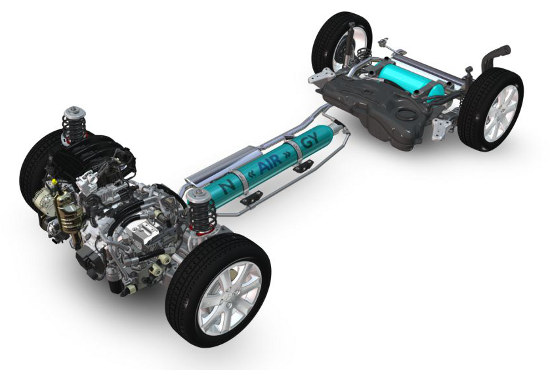
    Jokes about “being full of hot air” aside, a pnuematic hybrid car is very close to production. While it’s not going to be seen in the USA (at least not right away) PSA – that’s Puegeot Citroen – has officially begun developing a car that will be partially powered by compressed air.

    PSA compressed air hybrid car.

    The compressed air car is a pipe dream, but a compressed air HYBRID is very feasible. So feasible that PSA is getting ready to build them.

    Why Use Compressed Air Hybrids?

    There are a few good reasons to use compressed air in a hybrid, especially if you compare it to a battery-electric hybrid.

    1. Compressed air is efficient. Storing energy as compressed air is surprisingly energy efficient…it’s one of the reasons that air tools are still very common in industry (that and the fact that compressed air tools are smaller and safer than comparable electric tools).
    2. Compressed air storage systems are cheap compared to batteries. If you compare the cost of buying a battery pack for a hybrid to the cost of buying an air tank, it’s not even close. Ditto for the components needed to turn compressed air into forward motion.
    3. Compressed air is safer than chemistry. Hybrid batteries come in two basic flavors – nickel metal hydride (NmH) and lithium ion (LiON). These battery packs are full of corrosive chemicals, operate at relatively high voltage, and lithium ion batteries can even “run away” and catch fire without careful computer control.

    So, as you can see, lots of good reasons to use compressed air.

    NOTE: Battery chemistry is immensely complicated…the explanation above oversimplified things quite a bit. The current Prius, for example, uses a battery with nickel, cobalt, and manganese, which Toyota calls a “tri-metal” battery rather than a nickel metal hydride…but you get the idea.

    The trouble with compressed air is capacity. A relatively huge air tank isn’t going to take your vehicle nearly as far as a comparably sized battery pack.

    Still, if a good sized tank were paired with a fuel efficient engine and used on a tiny little car the size of a Scion iQ, you could see substantial performance at minimal expense. Peugeot is saying that they can develop an affordable car using this technology that will get more than 100mpg. That’s awesome.

    Scion iQ

    According to Peugeot, a car the size of a Scion iQ could get over 100mpg with a compressed air hybrid system, at a lower cost than a comparable battery-electric hybrid.

    Here’s to hoping someone figures out a way to make this system work on cars of all sizes…nothing would please me more than to drive a truck that runs (at least partially) on air.

    The post Air-Powered Hybrid Cars Coming appeared first on Tundra Headquarters Blog.

  • Hadoop startup Qubole raises $7M for Hive as a Service

    Qubole, the startup from former Facebook engineers Ashish Thusoo and Joydeep Sen Sarma,  just closed a Series A investment round for its service, which lets users run Hive jobs in the Amazon Web Services cloud. Hive is the data warehouse system and SQL-like language for Hadoop that Thusoo and Sen Sarma helped create while at the social-networking company. Charles River Ventures and Lightspeed Ventures led the round, which brings the company’s total venture capital investment to $7 million, including its seed round in late 2012.

    Qubole launched in June 2012 and opened its platform for public consumption in December, Thusoo told me, and has processed about half a petabyte of customer data since then. Thus far, the platform’s biggest users have been in the advertising technology, e-commerce and application-development spaces. A common use case (and one detailed in a blog post by Qubole customer MediaMath) is to create pipelines that use Hive to process unstructured data before pushing it into relational databases such as MySQL, Vertica or Infobright for more-traditional business-intelligence applications.

    Structure Data 2013 Ashish Thusoo Quobole

    Ashish Thusoo at Structure: Data 2013, (c) Albert Chau, itsmebert.com

    However, Thusoo added, Qubole also has connectors for getting data out of certain other data stores, such as MongoDB, and is working on letting customers import data via API from services such as Omniture and Google analytics.

    Being in the cloud — especially Amazon’s cloud — could actually pay big dividends, too, and not just because it lets Qubole scale clusters automatically and lets users avoid the operational headaches of maintaining a Hadoop cluster. Companies are already using Amazon S3 to store a lot of data — more than 2 trillion objects at this point — and that’s Qubole’s choice for a storage system, as well. As companies move more of their big data workloads to the cloud, S3 serves as a cheap, easy and generic storage platform to which they can connect various services and applications.

    In January, for example, Netflix detailed its cloud-based Hadoop platform that consists of numerous services but relies on Amazon S3 as the source-of-truth data store.

    Netflix's Hadoop architecture.

    Netflix’s Hadoop architecture.

    If there’s one big question about Qubole, though, it has to be the emergence of a rather-large SQL-on-Hadoop market since the company launched. Although Hive has been an important part of the Hadoop stack over the past few years, its MapReduce foundation is beginning to show its age in terms of query speed, and the new breed of database startups pushing SQL analytics atop Hadoop are quick to point this out.

    Thusoo has certainly noticed this activity, but he stills sees Qubole as being in a good position. For starters, he said, the company is looking at interactive analytics projects such as Impala and Shark to see how they might integrate with the Qubole platform, and Hadoop startup Hortonworks is leading the Stinger project to drastically boost the speed of Hive itself.

    Further, there’s the fact that Qubole itself has already optimized its platform to run, on average, about five times faster than Hive would normally run on Amazon Elastic MapReduce alone.

    “We’re also keeping a close tab on other projects in our space,” Thusoo said. “We have a lot of options … to play with.”

    Related research and analysis from GigaOM Pro:
    Subscriber content. Sign up for a free trial.


  • Is the Drone’s Potential Being Shot Down Too Fast?

    If you had a fleet of drones to call your own, what would you do with them? What problem would you use them to solve in whole new way? What existing solution-provider, in so doing, might you manage to obliterate?

    The question is not just a flight of fancy. While military-grade Predator drones can cost as much as $4 million, it’s already possible to buy one of a new generation of hobbyist aircraft — unmanned aircraft systems complete with cameras, GPS, infrared sensors, and microphones, all under the control of a smartphone or tablet — for less than $300. Not surprisingly, people are lining up to buy them. The Federal Aviation Administration estimates that, within a decade, private drones will constitute a $90 billion industry.

    There is another reason, too, that the drone market is set to take off. Currently, according to FAA rules, noncommercial uses of drones are permitted only so long as they stay below 400 feet (the official designation of U.S. airspace) and are flown away from populated areas. Above 400 feet, only the government and specially-permitted drones are allowed. But that is about to change. In February, as part of an FAA spending bill, Congress ordered the agency to develop rules by 2015 that would allow military, commercial, and privately-owned drones to operate in U.S. airspace.

    Thus, mass-market drones clearly hold potential for what Paul Nunes and I call “big bang disruption.” This is a kind of innovation that, thanks to fast-evolving technology, arrives in the marketplace simultaneously better, cheaper, and more capable of improving than the existing alternatives. Just what current products and services will be disrupted by drone technology remains to be seen, although a few applications are easily predicted. In the realm of law enforcement, drones could offer better performance in search-and-rescue operations, riot suppression, traffic control, surveillance of suspects or fugitives, and in cases of emergencies, natural disasters, or kidnappings.

    As George Mason University’s Jerry Brito pointed out in a thoughtful essay last month, “Small drones are made from many of the same components as smartphones, and the economies of scale of that industry have driven the cost of gyroscopes, accelerometers, GPS chips, and CPUs to the ground. As a result,” Brito writes, “the widespread use of drones in commerce is imminent — unless politicians overreact to the bad press.”

    That last phrase, of course, is a big “unless.” The FAA’s impending deadline has created panic among state and local governments, who are falling over each other to legislate who gets to use drones and for what purposes before the FAA rules are issued. According to the American Civil Liberties Union, thirty states have already passed or are considering restrictions on drones, if not outright bans.

    Local authorities are getting in on the pre-regulation act as well. Recently, the town of Rancho Mirage, CA joined Charlottesville, VA, St. Bonifaciuis, MN, and Seattle, WA in considering or adopting local rules restricting or prohibiting drones in their respective communities. In Alameda County, near where I live, a public hearing on a plan by the sheriff to deploy drones for law enforcement quickly turned ugly. “We oppose the use of public resources to buy machines to surveil its citizens,” one resident was quoted as saying. Another rejected just the potential use of drones by the police as “an assault on my community.”

    It’s not surprising that potential private and law enforcement use of drones invokes intense emotional responses, including fears of an expanded police state with an “eye in the sky” and the further erosion of personal privacy. The Rancho Mirage ordinance, for example, had its origins when a private citizen saw a model drone flying over his backyard. He asked the operators to relocate their activities, and they did. But he wrote to his mayor the next day anyway.

    The visceral objection we’re seeing to drones is a great example of the “creepy response” I wrote about in a previous post. Novel uses of information technology often trigger deeply negative emotions, particularly among Americans. The truth is that we usually adjust to the new technology by coming to recognize that its benefits outweigh the costs. In the interim, however, the temptation to regulate it out of existence is hard to resist.

    And of course, the use of the term “drone” doesn’t help. Drones, like many of the most valuable innovations of the past century, began life as military technology, and have notably been used for targeted killings as part of the so-called “war on terror.” Hobbyists have made a serious tactical error in adopting the same term for unmanned aircraft that, at least so far, have no weapons attached to them.

    As understandable as the psychological response may be, however, there is a serious problem with the rush to regulate. Overreacting to fears of the unknown could prove disastrous to the development of technology with tremendous potential to benefit society. Drones could make safer and cheaper a number of essential activities that today require human pilots, and also make other activities possible that are today simply unfeasible. These include emergency transportation of supplies to remote areas, agricultural monitoring and maintenance, aerial photography and mapping, protection of wildlife from poachers, pipeline inspection — perhaps even local delivery.

    As with any emerging, potentially revolutionary new technology, it is impossible to anticipate all the uses to which unmanned aircraft might be put once they reach mass markets. And therefore, it is hard to know whether existing laws are adequate to limit or ban the potentially destructive uses. Indeed, many of the local authorities considering drone legislation believe the FAA’s current restrictions give them a rare opportunity to regulate before a dangerous new technology gets a chance to become mainstream. “We certainly want to get ahead of that curve before there are some abuses of that information,” one Virginia legislator said.

    As drones continue to become better, cheaper, and more useful, the legal debate is sure to heat up. But until and unless we get more evidence of what “abuses” will actually appear, drafting appropriate laws will be impossible. The mishmash of laws, restrictions, and bans add up to a response that is inefficient, imprecise, bound to cause collateral damage — and certainly not worthy of a drone.

  • Apple’s Q1 smartphone market share reportedly sinks as Samsung dominates

    Apple's Q1 market share reportedly sinks as Samsung gains
    While most market research firms will want to wait for Apple to post iPhone numbers on Tuesday before releasing their Q1 smartphone market share estimates, China-based firm TrendForce is confident enough in its sources that it went live with its numbers on Monday morning. While some analysts think iPhone sales during the March quarter came in as low as 33-34 million units, TrendForce’s chip division DRAMeXchange suggests Apple shipped 37.5 million iPhones in the first quarter this year. The figure would represent only modest growth compared to the 35.1 million iPhones Apple sold in the same quarter last year, but investors might be happy with any growth from Apple in light of the ridiculous estimates we’ve seen leading up to the company’s earnings report.

    Continue reading…

  • Firefox OS Developer Phones Sold Out After First Few Hours On Sale, But More Are On The Way

    firefox-os

    Geeksphone, the smartphone OEM startup based out of Madrid, put the first Firefox OS developer phones on sale early this morning, offering the Keon for $119 and the more powerful Peak for $194. Both devices are the first hardware to be offered with Firefox OS on board, and both devices are now listed as “Out of stock,” just a few hours after first going on sale.

    The Keon and Peak devices are essentially preview devices, designed to give developers the opportunity to test out what they can do with the new Linux-based open-source mobile operating system before it sees its general public launch this June in five initial countries, including Spain, Brazil, Portugal and Venezuela. The Geeksphone devices are modest in terms of their hardware specifications, but Firefox OS will likely be positioned as more of a mid-market play.

    The $119 Keon (yes, that’s unlocked pricing) has a 1GHz Qualcomm Snapdragon processor, offers 3G and EDGE cellular connections, has a 3.5-inch HVGA screen and a 3 megapixel camera. It’s got just 4GB of onboard storage and 512MB of RAM, but it offers a MicroSD slot for capacity expansion. The $194 Peak has a 1.2GHz dual core Snapdragon S4, a 4.3-inch qHD IPS display, an 8 megapixel rear and 2 megapixel front camera, and otherwise looks pretty similar to the Keon in terms of tech specs.

    Both devices are currently sold out, but TheNextWeb reported in a profile posted yesterday that Geeksphone was aiming to be able to fulfill orders at a rate of about 5,000 per day, and a call I made to Geeksphone’s offices revealed that the company is working hard on getting more phones back in stock, and hopes to have them on sale again this week, hopefully by Friday. Demand has been has been tremendous so far, a company rep told me.

    It’s hard to make any kind of predictions about Firefox OS’s potential success based on these very early results of two developer handsets, likely produced in small batches and aimed at an enthusiast crowd, but it’s definitely not a bad thing that they’re already flying off the shelves.


  • GroundMetrics Closes $1.5 Mln Round

    GroundMetrics has closed a second round of financing at $1.5 million led by the Tech Coast Angels. GroundMetrics said its “other Southern California syndicates” consisted of the Rady Venture Fund, La Costa Investment Group, Crescent Ridge Partners Ventures, and Rancho Santa Fe Partners. San Diego-based GroundMetrics was founded in 2010 to commercialize a new class of electromagnetic sensing technologies for geophysical applications.

    PRESS RELEASE

    GroundMetrics, Inc. (GMI) has successfully raised its second round of financing, following a successful proof-of-concept test conducted on an operating oilfield undergoing enhanced oil recovery (EOR) in the United States. Despite the fact GMI raised the ceiling by 50% near the end of the round due to greater than expected participation, the round was still oversubscribed at final closing.

    Since its previous round of financing closed in December of 2011, GroundMetrics has exceeded goals and built tremendous value based on innovation, intellectual property, and industry collaboration. The investors recognized this increase in value with a 2.5x growth in valuation.

    This second round of financing was led by the Tech Coast Angels (TCA), as was the first. The TCA ACE Fund “focuses on companies with early exit potential providing investors with early liquidity” and participated heavily alongside many individual TCA members. Other Southern California syndicates consisted of the Rady Venture Fund, La Costa Investment Group, Crescent Ridge Partners Ventures, and Rancho Santa Fe Partners. This round of financing also attracted international interest with investors coming from Cyprus, Dubai, Great Britain, and India.

    Investor and TCA deal lead Jonathan Moss said, “A disruptive technology in the oil and gas space attracted me to GroundMetrics. Combining solid management, excellent IP, and a good business plan, the conclusion after due diligence was a definite ‘buy.’” “GroundMetrics is a great example of what we look for, a fantastic team taking a disruptive technology to market,” said Navid Alipour, Principal of La Costa Investment Group and Managing Partner at Analytics Ventures.

    The purpose of this second round of financing is to enable GroundMetrics to complete product engineering and initiate commercialization. GroundMetrics management reports that a number of energy firms are asking the company to bid jobs even though GroundMetrics’ technology is still at the prototype stage and additional engineering is necessary before it can provide commercial surveys.

    GroundMetrics CEO George Eiskamp said, “I’m pleased but not surprised by the success of this round because real pull-through demand drove the formation of GroundMetrics. Our technology was not a solution in search of a problem. It was created in response to the world’s largest oil and mining companies paying us to develop and demonstrate prototypes.”

    An investment arm of a major oil company wants to participate as part of a larger syndicate, to be led by a credible financial institution that is or has been active in this space. The company’s business plan includes putting a $5M deal together in approximately a year from now via these types of institutions or a boutique investment bank.

    Eiskamp continued, “We are in a special place in that we have a unique technology, an outstanding team, good financial backing, and strong interest from the market as well as the financial community. GroundMetrics is in the enviable position to select which investors to partner with in the future in order to maximize success. I’m looking forward to finding the right financial partner to enable us to scale up and quickly saturate the market with outstanding services powered by proprietary technology.”

    About GroundMetrics

    GroundMetrics (www.GroundMetrics.com) was founded in 2010 to commercialize a new class of electromagnetic sensing technologies for geophysical applications and to provide advanced survey and monitoring services directly to oil, gas, mining, geothermal, and environmental companies. Our sensor systems can provide high quality data while operating in challenging environments such as the desert, frozen tundra, and solid rock in addition to extremely hot and cold temperatures. Our low power transmitter can penetrate reservoirs at depth and enable imaging between and beyond oil wells without deploying instrumentation in the oil well, which decreases costs and increases safety and survey speed. Together these technologies expand existing markets and unlock new applications.

    About Tech Coast Angels

    The Tech Coast Angels is the largest angel investment organization in the U.S., with over 300 members in 5 regional Networks covering all of Southern California. TCA members have invested over $120 million in more than 200 companies, and these companies have gone on to attract over $1 billion in additional investment capital. More information at www.techcoastangels.com.

    About the ACE Fund

    The ACE Fund is managed by the Tech Coast Angels. ACE has invested in twenty-one early stage companies in the medical and technology arenas since its inception in 2010. Information is available at www.techcoastangels.com/ace-fund.

    About Rady Venture Fund

    The Rady Venture Fund is a student-assisted VC investment fund at The Rady School of Management at UC San Diego. Rady is a business school at the confluence of business, science, and technology. Our MBA program encourages students to be visionaries who pursue the extraordinary, incubate new ideas, reinvent existing businesses, and establish new companies. To find out more about the Rady School visit www.rady.ucsd.edu.

    About Crescent Ridge Partners Ventures

    Crescent Ridge Partners Ventures (CRP Ventures) is a venture fund that provides seed capital to early stage start-ups. CRP Ventures actively invests in entrepreneurs developing disruptive technologies across all industries who have the passion, vision, and experience to build successful and sustainable companies, visit www.crpartnerinc.com.

    About La Costa Investment Group

    La Costa Investment Group looks to bridge the gap between angel investors and big venture capital funds. They provide capital and support to disruptive, emerging-growth companies looking to challenge the status quo in their respective industries. The firm has headquarters in San Diego, CA. For more information, visit www.lacostainvestmentgroup.com.

    About Rancho Santa Fe Partners

    Rancho Santa Fe Partners is a strategic advisory firm that supports emerging growth companies through investments and advisory services and provides capital raising, business formation, and strategic planning advisory services. RSFP has advised companies in industry verticals that include Internet commerce, mobile marketing, life sciences/biotech, medical devices, payment solutions, entertainment distribution, aerospace and defense, airport security, and consumer/retail. www.ranchosantafepartners.com

    The post GroundMetrics Closes $1.5 Mln Round appeared first on peHUB.

  • Infer takes $10M to find the sales leads most likely to pay off

    On a good day, a sales executive can direct a salesperson to hone in on the best lead in the customer-relationship-management system such as Salesforce.com, and a deal might or might not come through. But getting the most out of sales and marketing staffers every day is the sweet spot. A startup named Infer is emerging from stealth mode with $10 million in venture funding to help more companies get to that sweet spot with a tool for identifying the most promising leads based on a user’s historical deal-making tendencies and external data about potential leads.

    Redpoint Ventures led the Series A round, and Andreessen Horowitz, the Social+Capital Partnership, Sutter Hill Ventures and others also contributed.

    Based in Palo Alto, Calif., the company focuses on sales operations that keep their leads in Salesforce and other cloud-based tools such as Eloqua and Marketo, although Infer Co-founder and CEO Vik Singh said it’s also possible for the software to hook in to on-premise appliances.

    Once signed up with Infer — Box, Jive Software, Tableau Software, Yammer, Zendesk and other companies are already paying customers — the system inspects historical sales information to check which deals have been sealed and which fell apart. That becomes training data for a model that scans “hundreds of signals of external data” to get a sense of which potential leads the company stands a chance of closing. Inputs include news articles, social-media accounts, website-traffic data, industry data, financial data, legal data, trademark data — “anything we can get that can give us more of a complete picture on who the customer is,” Singh said. Users can determine the weight of certain types of information.

    Users also set priorities for the scoring of leads. “Do you want a model where the higher the score, the more likely (you are) to win (a deal), or do you care more about conversion, or do you care more about lifetime revenue, or deal size? We build the model based on that,” Singh said. It’s not just a neat way to prioritize leads; Singh said many Infer customers have boosted conversion rates with the tool.

    Infer data integrated in Salesforce.com

    Infer data integrated in Salesforce.com

    Before starting Infer, Singh spent some time at Google, where he focused on machine-learning methods for automatically providing answers to questions users type into the search box. Another former Googler, one-time chief information officer Douglas Merrill, co-founded a different company that uses lots of external data to make determinations: ZestFinance, formerly known as ZestCash, extracts information from 70,000 sources to figure out if a lender should make a loan.

    The broader strategy the two companies have in common — making predictions based on data — has become more popular in recent years, as companies merge and grow data sets to create more than the sum of their parts. In this case, it seems that the approach could garner wide adoption as a few companies optimize the time of their sales and marketing employees and pull ahead of their competitors, and other companies might want to do the same thing to catch up.

    Of course, if Salesforce or Oracle acquires Infer, then adoption could come even faster.

    Related research and analysis from GigaOM Pro:
    Subscriber content. Sign up for a free trial.


  • Infer Raises $10M From Redpoint, Andreessen, Sutter Hill, Others

    Infer Inc. said it raised $10 million in Series A funding in a deal led by Redpoint Ventures and joined by Andreessen Horowitz, Social+Capital Partnership, Sutter Hill Ventures, and angel investors. Infer helps businesses accurately predict and act on their highest potential customers. Infer is developing software that helps companies identify high potential customers.

    PRESS RELEASE

    Infer Raises $10 Million; Helps Companies Use Data to Win More Customers

    Redpoint Ventures Leads Series A Funding Round

    PALO ALTO, CALIFORNIA – April 23, 2013 – Infer Inc., a company that delivers data-powered business applications inspired by the consumer web, today announced it has closed $10 million in Series A funding led by Redpoint Ventures, with Andreessen Horowitz, Social+Capital Partnership, Sutter Hill Ventures, and influential angel investors also participating in the round. Infer helps businesses accurately predict and act on their highest potential customers.

    Infer’s solutions mine the historical customer won/lost records sitting in companies’ sales and marketing databases, pull in hundreds of valuable signals from untapped web sources, and build statistical models that accurately identify customers with the highest propensity to buy. This approach leverages advanced information retrieval and machine learning algorithms to model customer data, along with company financials, social media presence, job listings, legal filings and other external information. As a result, Infer unearths actionable revenue-driving insights that businesses can leverage to prioritize their flow of leads, focus on their best prospects, and ultimately win more customers in less time.

    “Infer’s predictive solution has helped our sales force deal with lead overload by prioritizing those with the highest likelihood to
    engage and close,” said Jim Herbold, executive vice president of sales at Box. “The application integrates quickly, and delivers real lift – in our case, more than doubling the conversion rate from our highest volume lead sources.”

    Infer has closed several multi-year customer agreements, attaining early profitability. Its models have consistently achieved significant lifts in conversion rates for customers across the board, including several Fortune 1000 companies and some of the hottest emerging technology companies in the market, like Box, Jive, Tableau, Yammer and Zendesk.

    “While the sales and marketing automation markets have been strong over the last several years, automation is not enough,” said Satish Dharmaraj, partner at Redpoint Ventures. “The much larger opportunity is to bring enterprises deep data science wrapped up in simple application services that anyone can use. Infer’s world class team is bringing web search, machine learning and personalization smarts from places like Google, using it to harness enterprises’ untapped big data for the first time, and gleaning amazing topline value for its customers. This is a rocketship.”

    Infer’s founding team is led by Vik Singh, who was listed in MIT’s Top 35 under 35 list for helping to create the popular open search platform Yahoo! BOSS. The company’s technology leadership includes co-founders Yang Zhang, an ex-Google, Microsoft, Yahoo! and MIT researcher, and Chung Wu, who was formerly the front-end tech lead of Google’s Public Data project.

    “When my co-founders and I set out to create Infer, we were shocked by how poorly even the biggest, most innovative companies manage and act on their own internal data – especially given the amazing advances we’ve seen in the data science used for the consumer web,” said Vik Singh, co-founder and CEO of Infer. “For example, there’s way more intelligence being applied in Facebook’s newsfeed telling you that your friends are getting drinks across the street than there is in helping companies make critical decisions that could have serious consequences like massive layoffs. It’s time for a change. We intend to bring the product thinking and data intelligence of the consumer space to the enterprise, and deliver data science applications that solve real problems and ‘just work’ seamlessly in existing workflows.”

    Infer will use its Series A funding to grow its team of engineers and scientists, as well as to deliver and apply its solution to more companies and customer intelligence problems. In addition, Satish Dharmaraj of Redpoint Ventures will join the company’s board of directors.

    About Infer
    Founded in 2010, Infer delivers data-powered business applications that help companies win more customers.  Its cloud-based applications leverage proven data science to rapidly model the untapped data sitting in enterprises, along with hundreds of external signals from the web. Inspired by the simplicity of the consumer web, Infer delivers seamless, data-driven applications that anyone can  get up and running in just days.  Customers include several of the Fortune 1000 and numerous high growth companies.   Headquartered in Palo Alto, California, Infer is funded by leading investors, including Redpoint Ventures, Andreessen Horowitz, Social+Capital Partnership and Sutter Hill Ventures. For more information, visit
    www.infer.com.

    The post Infer Raises $10M From Redpoint, Andreessen, Sutter Hill, Others appeared first on peHUB.

  • Kilgallon Joins Polaris Partners

    Tim Kilgallon has joined Polaris Partners‘ West Coast office as CEO-in-Residence. He will explore healthcare services and technology, including consumer-directed digital health opportunities. Kilgallon serves as director of Polaris-backed Athletes’ Performance; he previously led Free & Clear.

    PRESS RELEASE


    Polaris Partners, a venture capital firm supporting successful Technology, Healthcare and Consumer companies, announced today that veteran company CEO Tim Kilgallon has joined the firm’s West Coast office as CEO-in-Residence. Mr. Kilgallon will explore healthcare services and technology, including consumer-directed digital health opportunities.

    “Having led several successful companies working in and across healthcare, consumer and technology sectors, Tim has a rare depth of knowledge that will be tremendously valuable as we invest in and help build important companies,” said Partner Brian Chee, who manages Polaris Partners’ West Coast office. “We are delighted to have Tim—the former CEO of Polaris-backed Free & Clear—join our community of repeat entrepreneurs and CEOs.”

    “Polaris has a rich history of supporting pioneering companies that offer meaningful impact to individuals and businesses,” said Tim Kilgallon, CEO-in-Residence, Polaris Partners. “I look forward to working with the firm’s partners and portfolio company CEOs as they work to achieve their goals.”

    Mr. Kilgallon currently serves as director of Polaris-backed Athletes’ Performance. Previously he led Free & Clear, now owned by Alere, which specializes in web-based learning and phone-based cognitive behavioral coaching to help employers, health plans, and state governments improve the overall health and productivity of their covered populations.

    Prior to Free & Clear, Kilgallon was president of Applied Discovery, a leader in providing business services to the legal industry, until its acquisition by LexisNexis. Before Applied Discovery, Tim was CEO of Pointshare Corporation, a provider of online services to the health care industry, until its acquisition by Siemens Medical Solutions.

    Prior to Pointshare, Kilgallon served successively as general counsel, chief financial officer, and division president at Medaphis, a leader in providing receivables management services to the healthcare industry.

    Before Medaphis, Mr. Kilgallon practiced law at King & Spalding in Atlanta, Ga. Kilgallon holds a Juris Doctor from Washington and Lee University, and a Bachelor of Arts in Economics and Philosophy from Boston College.

    About Polaris Partners

    Polaris Partners invests in and helps build successful Technology, Healthcare and Consumer companies. The firm has $3.5 billion under management and makes investments across all company lifecycle stages. Polaris Partners operates from offices in Boston, San Francisco, and Dublin, Ireland. www.polarispartners.com

    The post Kilgallon Joins Polaris Partners appeared first on peHUB.

  • Reuters – Kallista Acquires Wind Farms

    Kallista has acquired two wind farms, writes Reuters. Axa Private Equity has backed the transaction.

    Reuters – Kallista acquires two wind farms with the support of Axa private equity.

    The post Reuters – Kallista Acquires Wind Farms appeared first on peHUB.

  • Why I love Raspberry Pi

    Sixth in a series. I’ve always admired the concept, execution and possibilities of Raspberry Pi, the British designed and built world-conquering credit card-sized ARM GNU/Linux computer. But despite following the Raspberry Foundation’s every move closely, and frequently promising that I’d buy myself a Pi soon, for some reason I never did.

    A year came and went, and although a million Pis were sold in that time, I wasn’t one of the proud purchasers. But after my chat with the lovely Liz Upton, Head of Communications at Raspberry Pi Foundation (and wife of executive director Eben), I realized I had to rectify that mistake. Three weeks ago I finally ordered a Model B Pi, and minutes after powering it up, I knew I was in trouble.

    Setting up the Pi was easy as. I took a gamble that I’d have all the required peripherals and cables I’d need sitting around in boxes somewhere, and fortunately the risk paid off. I had a HDMI/DVI cable I’d never used, a new SD card that I’d yet to put in a camera (the card is used as the system drive), a spare USB keyboard and mouse, and a microUSB cable for powering the device. I could have connected the Pi to my HDTV, but instead I chose to use the second screen from my PC’s multi-monitor set up instead. That way I could easily use my PC and Pi at the same time.

    Once the OS (Raspbian “wheezy”, a Debian Linux port) was copied on to the SD card, and everything was connected up, I powered up the Pi, tapped in a few commands and loaded the desktop.

    Raspberry Pi uses LXDE (Lightweight X11 Desktop Environment) and comes preloaded with a selection of applications including the Midori web browser, a game and animation creator called Scratch, and IDLE/IDLE 3 (Integrated DeveLopment Environment), a Python programming tool.

    I explored the delights of the different bundled applications, launched the Pi store and downloaded some additional games and applications (OpenTTD, Freeciv, LibreOffice, BarracudaDrive, and Unreal Speccy Portable) and before I knew it three hours and a deadline had passed. Uh-oh.

    I logged off, yanked out the power (that’s the beauty of the Pi, turning it off just involves unplugging it) and went back to working.

    An hour later, I’d downloaded Minecraft — Pi edition, and was playing it on my new seductive little computer. I sought out some guides for programming Minecraft and gave that a try too.

    My programming skills, I’ve discovered, are so rusty they’ve pretty much seized up, but the Pi has been encouraging me to get things up to speed again. I downloaded the RISC OS (Reduced Instruction Set Computing), so I could relive my youth, tapping in BBC Basic commands long forgotten since my school days.

    Then, inevitably, I downloaded ChameleonPi and started emulating old computers on my new one.

    I’ve had my Raspberry Pi for three weeks now, and I don’t think a day has passed when I haven’t powered it up and played around with it for at least half an hour — and it’s usually a lot longer than that. I’m currently experimenting with turning my Pi into a media center using XBMC.

    I doubt I’ll actually create any great projects on my own, or become a proficient Python programmer, but that doesn’t matter. Raspberry Pi has helped me rediscover my inner coder and tinkerer, for which I’m grateful, and I’m looking forward to spending many more hours playing around with my new favorite piece of technology.

    Photo credit: Wayne Williams