Category: News

  • The dramatic decline of the Philadelphia Inquirer newsroom captured in photos

    Newspapers were very much in the news this week, in the wake of the Boston bombings and the manhunt for the escaped suspect: many cheered the news coverage of the Boston Globe, in part because of the paper’s shrunken newsroom and the fact that it is up for sale. There are many other newspapers suffering the same fate, including the Philadelphia Inquirer, which went bankrupt in 2009 and was sold last year for $55 million — or about 50 percent less than it sold for in 2010 and more than 85 percent below what it sold for in 2006.

    Photographer Will Steacy has released a somewhat painful photo essay that shows the paper’s dramatic decline. As Wired magazine describes, Steacy’s father worked at the Inquirer for almost 30 years until he and many others were downsized. The shrinking of the Inquirer‘s staff was just a microcosm of the much larger decline of the U.S. newspaper industry as a whole, with the number of full-time media employees now at its lowest level since 1978.

    Inquirer newsroom

    After its bankruptcy, The Inquirer moved its newsroom from the massive, 87-year-old, 526,000-square-foot headquarters known as the “Tower of Truth” in downtown Philadelphia to a single floor of a former department store near Chinatown. Steacy took photos of both the old newsroom and the new — and of everything in between, including most of the remaining staff, the paper’s old printers and the cluttered desks of various editors and reporters.

    Inquirer newsroom1

    The new Inquirer newsroom looks like somewhere a high-school paper would be produced, not a newspaper that serves a city of 1.5 million. And Steacy tells Wired that when his father was laid off in 2011, he actually had to put the project on hold because it became too emotional for him. He believes — as many do — that the future of journalism is a question mark as great newspapers like the Inquirer continue to be downsized or even go bankrupt. As he puts it:

    “The internet, for lack of a better metaphor, makes up the branches of the tree. But newspapers have centuries-long traditions of being the roots of the tree. If the roots of tree rot and crumble the rest of the tree will fall with it.”

    Inquirer newsroom2

    Photos courtesy of Will Steacy

    Related research and analysis from GigaOM Pro:
    Subscriber content. Sign up for a free trial.


    • eLearning Summit – July 29-30 in St Paul

      It’s a way off yet, but it looks like an interesting conference…

      A Summit with Substance!  60+ Summit Sessions and Workshops and Nationally Recognized Keynote Speakers!

      Register now for the MN eLearning Summit – July 29 and 30

      The Summit connects you with K-12 and higher education practitioners to engage in further discovery and learning through effective and innovative uses of technology.                         Here is a “snapshot” of topics from the Summit program:

      • · Adaptive technology/accessibility · Blended/Hybrid learning models
      • · Digital content design/engagement of students · Digital inclusion
      • · E-books/Flexbooks/interactive textbooks · eProctoring
      • · Flipped learning · Game design for education · GPS Lifeplan
      • · Individual learning plans/personal learning communities · iSeek
      • · Mobile device tools · MOOCs · NROC/OER · Online digital resources for learning and curriculum support
      • · Portfolios/eFolio · Quality Matters

      The Summit Program Committee is very pleased with the great response from presenters to address a wide variety of topics! Thank you!

      eSynergy: Bringing it All Together connects you with national leaders in education delivering keynote messages, interactive breakout sessions, extended hands-on workshops, showcase sessions featuring innovative technologies, and lots of opportunities to network with colleagues!

      If you have questions about submitting a proposal, please feel free to contact a program committee co-chair: Mary Mehsikomer (Twitter: marytmm) or Deborah W. Proctor, Ph.D.

      The Minnesota eLearning Summit 2013, July 29-30, 2013 on  the beautiful Northwestern College campus in St. Paul, has a fantastic line-up of keynote speakers:  Cable Green, Jeff Young and Gary Lopez.

      This affordable conference in the upper Midwest is focused on all things digital when it comes to learning: online learning, electronic portfolios, digital resources, you name it! Registration for this conference includes access to all Summit events, materials, meals, and parking. Inexpensive on-campus lodging is also available to attendees on the host-college campus.  Register today!

      More information on the 2013 Summit is posted at MNeLearningSummit.org. Share information on the Summit with others. Contact us if you need additional information on the conference.

    • Apple sells unlocked T-Mobile iPhones

      Eight days ago, iPhone 5 debuted at T-Mobile. I should have watched more carefully. The carrier also has iPhone 4 and 4S, and that surprises me. I wondered if Apple Store would carry Pink’s variants, too, given the comparatively low starting price. Yes is the answer, and cleverly.

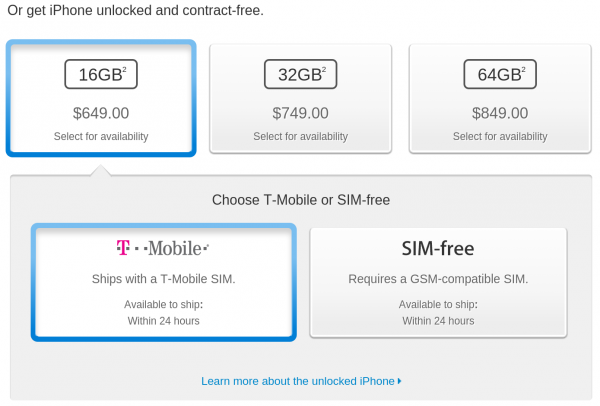
      From AT&T, Sprint and Verizon, the 16GB iPhone 5 is $199 upfront with 2-year contractual commitment. T-Mobile’s handset sells for $99.99 down plus 24 $20-month payments, no contract required. Surely, the three big carriers would gripe if Apple listed their phones alongside T-Mobile’s for twice the upfront price. Solution: The fruit-logo company sells Pink unlocked for full price and T-Mobile SIM. But typical of Apple, expect no bargain. T-Mobile sells the phone for $579.99. Apple asks $640.

      Price for unlocked 16GB iPhone 4S from the manufacturer is $450, 99 cents more from the carrier. The phone is $99 with 2-year commitment from the big three. Pink is $69.99 upfront plus 24 $20 payments. iPhone 4 is $549.99 from T-Mobile, Apple is 99 cents less. On contract, the big three charge nothing upfront. T-Mobile takes $18 plus 24 $18 payments. Hell, I’d pay $30 more for iPhone 5 and two bucks extra per month instead.

      Here’s reason to check with T-Mobile first. According to the company’s website, neither iPhone 4 or 4S is available for my area (San Diego), but Apple Store will sell me either handset. That’s no assurance the network supports them.

      Perhaps this is all old news to you, but it’s not to me, which is why I punched out the quickie post. Surely someone else would want to know, too.

    • Social shopping pioneer Modcloth plots mobile strategy for digital fashion

      I’ve talked with a lot of companies recently about the challenges in making traditional shopping and e-commerce more social, and there’s one name that everyone mentions as the de-facto success in social shopping: Modcloth.

      Modcloth iPhone appWhat started as a hobby around vintage clothing turned into a business led by husband and wife team Susan Gregg Koger and Eric Koger in 2006, and it has now become a dominant online fashion retailer known for its distinct style and vintage appeal. But what makes Modcloth unique is the way it’s continually married technology with fashion to build a strong social community around the brand, experimenting with everything from crowdsourced fashion to video hangouts with stylists to build the kind of user passion you see with companies like Lululemon or Nastygal.

      Modcloth just launched its first native iPhone app on Thursday, and I sat down with CEO Eric Koger to talk about the company’s strategy when it comes to building a mobile audience and using social platforms to build its notoriously passionate audience. The company had just finished recording a Google Hangout in the office with Lumineers singer Neyla Pekarek, who wears Modcloth onstage, and Koger sat at the conference table with the company pug Winston on his lap.

      “We’re very experimental in basically all that we do,” he said. “We put our customer first in the merchandise we’re bringing from the very beginning of the site, placing small bets on a wide assortment of things, and then figuring out what she really loved, and wherever possible bringing those items back in production.”

      Modcloth CEO Eric Koger with the company's mascot Winston the pug on his lap.

      Modcloth CEO Eric Koger with the company’s mascot Winston the pug on his lap.

      And the experimental approach applies to how the company uses technology as well. Modcloth started out with a website that was optimized for mobile, and said that still makes a lot of sense since the site sees so much referral traffic from Facebook (its top referring site) and Pinterest (its second-highest referrer). When a user finds an item through Pinterest, re-directing them to a native app was tough. So the company started on HTML, and just launched an iPad app in February. Now, the company is finally going native on iPhone.

      Koger said it’s always a challenge to figure out how to serve up high-quality images of the different products on mobile while taking into account a user’s connection speed. But figuring out mobile is obviously important: the company has seen a 129 percent increase in mobile traffic over last year, and 178 percent growth in mobile revenue.

      And one of the tricks to keeping sales strong? Modcloth is famous for its “Be The Buyer” program, which takes a sample from a designer and puts the photos online, then allowing users to vote on whether the company should produce the item — sort of like the original Kickstarter, but for dresses. And despite concerns from the fashion industry about putting samples out for the world to see (and potentially be copied), Modcloth has turned the program into a success. The company said sales are twice as high on the crowdsourced items as the regular ones.

      “It’s a variety of things,” Koger said. “The invested community that helps to get it produced becomes sort of an advocate for the product, having that logo on the dress serves as a form of social proof, and it’s usually just a really cute product.”

      Related research and analysis from GigaOM Pro:
      Subscriber content. Sign up for a free trial.


    • Sense 5: All the changes you need to know

      HTC_One_Sense_5

      HTC announced Sense 5 when they introduced the HTC One, which is based on Android 4.1.2. It will eventually land on most of the major HTC phones, but for now it’s only on the One. HTC continues to make changes with each version, which is one of my chief complaints. Whether you love or hate Sense, most people thought that Sense 4 / Sense 4+ was on the money, but HTC continues to tweak it, which does nothing more than confuse consumers. Whether you’re about to purchase your HTC one, or maybe you already bought one and feel a little lost, this video should help you get more familiarized. Hit the break to check it out.

      This video is more about the actual user interface, not the newer software features. Be sure to check out our separate guides for BlinkFeed, Camera/Zoe/Video Highlights (coming soon), and HTC TV (coming soon).

      Click here to view the embedded video.

      Come comment on this article: Sense 5: All the changes you need to know

    • Information technology has revolutionalized financial services. So why is healthcare so far behind?

      The U.S. leads the world in healthcare expenditures – an astounding $2.7 trillion in 2012 and rising every year. Yet in one recent study of medical outcomes in the world’s most highly developed countries we ranked last. By any measure we are experiencing a healthcare crisis. If we hope to change this – to improve the quality of care and make it available to more people, while still reducing costs – it is imperative that our health system embraces new and disruptive technologies.

      Healthcare IT in infancy

      In 1969, just six weeks after NASA landed the first men on the moon, the first $20 bill was dispensed from an automated teller machine. IT systems have since revolutionized financial services, and as a result banks have since saved billions of dollars as consumers first used ATMs for deposits and withdrawals, and then started to pay their bills and make purchases online. According to a Bain & Co. brief, transaction costs have dropped from $4 at the teller window to just 8 cents when paying a bill via a smartphone.

      From my perspective, healthcare IT is still just a few paces beyond where the financial services industry was in 1969.

      Electronic health records (EHR), the backbone of health IT systems, are a perfect example of the health system effectively using technology to both improve care and reduce costs. For those healthcare systems that have proactively decided to digitize, EHRs are already proving to save lives and costs, from identifying redundant tests and dangerous drug interactions to revealing trends in treatment outcomes.

      For example, we have used EHRs at Kaiser Permanente to analyze a database of 1.4 million members, and that led to the discovery that the widely used COX-2 pain reliever Vioxx was dangerous; the drug was eventually taken off the market. It took a large data set and the right tools to find this lifesaving information.

      IT costs growing faster than healthcare

      The following market research indicates that spending on health care IT will grow at an even faster rate than overall healthcare spending:

      • According to Insight Research, health care IT spending will grow 9.7 percent annually between 2012 and 2017. That compares to an annual 6.4 percent growth rate in overall healthcare spending.
      • Neal Patterson, founder and CEO of Cerner, the world’s largest stand-alone developer of healthcare IT systems, told Forbes magazine in May 2012 that he expects HIT (THAT MEANS HEALTH IT?) sales in the U.S. to double or even quadruple by 2020 – growing from $5 billion to $10 billion annually.

      Opportunities for entrepreneurs

      Investing in innovative health IT is a winning strategy for entrepreneurs. Here are three opportunities that I find particularly compelling:

      Cloud computing 

      Cloud computing is one disruptive technology that makes setting up and running an electronic health record faster, simpler and more affordable. Bain & Co. suggests that the move to cloud computing could cut costs from 30 percent to 40 percent compared to legacy IT systems. That’s a big selling point. The smartest new EHR vendors go the extra mile to guarantee, as Athena Health does, that their systems will allow a practice to qualify for Medicare Meaningful Use payments (a government incentive program for health care professionals).  This is a smart strategy for vendors, as it gives healthcare providers an income stream that will help defray the cost of adopting the technology.

      Big data analytics

      Here at Kaiser Permanente, the 1-2 terabytes of data we’ve collected every day since 2003 have resulted in a patient database that’s larger than the Library of Congress. Our system can analyze and leverage this massive dataset with a variety of tools: Predictive analytics, clinical decision support, data mining, and natural language processing, among them. What we have learned has changed the way we, and doctors around the world, practice medicine. Big data has already attracted the attention of major players like Dell, Intel, and Oracle.

      But storage also offers fertile ground for exploration: Providers now dump nearly 90 percent of data they generate due to storage issues – literally trashing valuable information that could save lives.

      Mobile health

      Mobile capabilities offer incredible opportunities to advance the way healthcare is administered, chiefly through telemedicine (the delivery of care via telecommunication technologies like video) and telehealth (remotely provided preventive health services, such as patient education and e-mail consultation). It’s all about high-tech tracking and high-touch connection. Existing innovations include portable pulse oximeters that can send data on pulse and blood oxygen rate from a patient sitting at home to his doctor, in real time. According to BCC Research, these technologies were a $3.5 billion global market in 2011, and are expected to reach $9.7 billion by 2016.

      No one can deny the stakes in health IT are high, but the rewards we stand to gain are even higher. Some rewards are financial. Reducing our overall healthcare expenditures would strengthen our economy and ease the financial burden of healthcare on individuals and family. But the biggest rewards are intangible: higher quality care enabled by health IT will provide better health outcomes, and a healthier population.

      Phil Fasano is executive vice president and chief information officer of Kaiser Permanente, the nation’s largest not-for-profit health plan and health care provider. 

      Have an idea for a post you’d like to contribute to GigaOm? Click here for our guidelines and contact info.

      Photo courtesy of Nonnakrit/Shutterstock.com.


      Related research and analysis from GigaOM Pro:
      Subscriber content. Sign up for a free trial.


    • Morning Ritual: Petrolicious

      Ferrari 250 GT Lusso

      Every petrol-head worth his salt has a ritual when it comes to how they operate and care for their vehicle. Some enthusiasts only drive on Sundays and others, only at night. Whatever the case though one thing is always certain – we all live to drive. James Chen is one such enthusiast and his car of choice is this amazing Ferrari 250 GT Lusso. Chen drives this rare beast throughout the streets and canyons of Los Angeles county when the roads are dark and free of traffic. For him, these early morning drives are his ritual and something that we here at RL.com are totally envious of. Check it out after the jump.

      Source: Petrolicous.com

    • How you know when your company is being disrupted

      Reinvention and resilience are key to the success of any business. Look no further than the implosions of Borders Books, BlockBuster, Kodak, or any of dozens of other once seemingly impregnable or too-big-to-fail companies that have tanked in the past decade, to remind us that companies that fail to notice and adjust to change – and to see opportunities to innovate – are effectively digging their own graves.

      So, amid today’s accelerating technological change and the resulting hyper-connectedness, how do we recognize when our own company is vulnerable – when we’re facing our own Kodak moment? I’ve pulled together  the seven major disruptive forces that have overturned and redefined the way business is done today.

      The Google Effect: The separation of humans and information

      The last time you Googled something, did you stop and think, “Hmmm, I wonder if these results came from a database in Oregon, Georgia or Virginia, or maybe from The Netherlands or Australia?” Of course not. Through the Google Effect, information and physical location in our personal lives have been fully virtualized and dematerialized.

      So why in many organizations are the two (often very expensively) still forced to be co-located?

      The Skype Effect: Free communications, death of distance

      Remember yesteryear, when the physical distance of a long-distance phone call really mattered? When a call of 10 miles was significantly cheaper than a call of 1,000 miles, and an overseas call was a true luxury? Today, internet -based communication platforms have cost and usage bases that are completely disconnected to distance; speaking to someone around the world via the internet is the same as calling across the street.

      So why mandate that employees travel to their knowledge work, when instead the work can go to employees?

      The Facebook Effect: The virtualization of human relationships

      Fundamental to Facebook’s immense popularity is that it allows you to maintain and enhance personal relationships even without regular physical presence.

      The same intimacy is available to corporations, where working relationships based on capability and mutual trust no longer need to be physically proximate. So why stick to the high-maintenance, time-consuming and costly methods of the past?

      The LinkedIn Effect: The virtualization of specialized knowledge

      LinkedIn allows us to map our professional networks, and then to quickly locate trusted expertise. Why can’t organizations work in the same manner? The LinkedIn Effect provides a map of our personal networks; when brought to business, this capability enables the virtualization of expertise, allowing the right person to be brought to the right task at the right time.

      The Amazon Effect: The virtualization of customer experience

      Amazon knows you better than the manager at your corner store. Yet, when was the last time you met anybody from Amazon? This virtualization of customer intimacy is led by (but not the sole domain of)  new market leaders like Amazon, Netflix and Apple. Yet it is a viable option available to all organizations.

      The Pandora Effect: Algorithms building customized products

      “How did they know that?” If you’re a Pandora customer, you’ve probably asked that question. You provide Pandora with your favorite artist, or a few songs you like, and suddenly hours of music you truly enjoy is produced. It’s not magic; it’s Pandora’s algorithm at work.

      This algorithm, finely honed by reviewing massive amounts of data, creates remarkably accurate musical taste profiles. In knowing just a few things about you – the first few dots if you will – the algorithm connects the rest of the dots to create customized play lists.

      From such experiences, consumers are beginning to consider all their other business relationships: “If Pandora figured this out about me so quickly, why is my bank still so clueless? After going to the same ATM for 10 years, it still asks me what language I speak!”

      iPhone Effect: The experience is more valuable than the physical product

      Customer value is no longer confined to the physical manifestation of a product. Instead, it’s often found in the software. This was central to the recent transition in the mobile phone industry. Ten years ago mobile phone providers competed on hardware attributes – remember the famous Nokia ringtones, or the form factor of the Motorola flip-phone? That was the basis of competition.

      Today, winning iPhone and Android models differentiate on the experience delivered chiefly by software. Most of the physical attributes of a mobile phone are now commodity. The experience has usurped the widget.

      These seven effects are working together to alter the competitive fundamentals of many industries. With game changers like these, the cost of adhering to an industrial business model is significantly greater than moving to something new.

      Malcolm Frank is Executive Vice President of Strategy and Marketing at Cognizant Technology Solutions, a global provider of IT, consulting and business process services based in Teaneck, N.J. 

      Have an idea for a post you’d like to contribute to GigaOm? Click here for our guidelines and contact info.

      Photo courtesy justin maresch/Shutterstock.com.


      Related research and analysis from GigaOM Pro:
      Subscriber content. Sign up for a free trial.


    • Watch Live: 2013 White House Science Fair

      Ed. note: Watch the Science Fair live in this blog post (wh.gov/sciencefair), or at wh.gov/live, beginning at 11:30 am EDT on Monday, April 22, 2013.

      Watch Live April 22, 2013

      On Monday, April 22, President Obama will host the 3rd Annual White House Science Fair and celebrate the student winners of a broad range of science, technology, engineering and math (STEM) competitions from across the country.

      This year’s Science Fair will showcase students projects such as economically-viable algae biofuel, a robot that paints with watercolor, a computer program that improves cancer detection and many more.

      To learn more about the White House science fair, check out the video above, and be sure to tune in Monday, April 22 starting at 11:30 am EDT, right here at wh.gov/sciencefair, to watch the event live.

      read more

    • Finding Google fiber in your own back yard

      A country ballad that ushered in the 80s decried looking for love in all the wrong places. As the buzz machine ramps up after back-to-back announcements from Google letting the world know it is bestowing its gigabit largess upon Austin, Texas and Provo, Utah, gigabit envy is running rampant across the U.S.

      Google last week at the Broadband Communities Magazine’s Summit in Dallas told attendees “don’t wait for us” or even the Federal government to bring broadband to communities. “You have to take action, make changes, be creative,” said Milo Medin, Google Vice President for Access Services.  “Your community can have a gigabit future if you want it badly enough”

      So rather than Mountain View, Calif., maybe communities should be looking closer to home for broadband love from mini-Googles.

      The mini-Google model for community broadband

      mudpie_fiber_chalk_signPeople often ask what Google gets out of building these networks. They forget that Google is in the online ad business as well as several other ventures that collectively generate more revenue as gigabit Web surfing increases. It’s likely a safe bet that Google is driven more by these businesses’ needs than the desire to be a national service provider. For now.

      Rather than “What does Google get?” smart communities need to ask, “Are there other companies whose businesses would benefit from faster, better broadband? Companies that benefit to the point where investing in community networks make sound business sense? Maybe some of these potential “mini-Googles” are local.

      San Leandro, Calif. has its hometown Google, OSIsoft. Similar to Google, OSIsoft is a tech company that is building fiber infrastructure to bring gigabit service to a town that definitely wants and needs broadband. Broadband service is not OSIsoft’s core business. Yet, as a San Leandro-based company, OSIsoft benefits tremendously from delivering a gigabit to its neighbors as well as itself.

      A couple of years ago OSIsoft was in a bind. The $250 million company had been a member of the San Leandro community for over 30 years. Dr. Patrick Kennedy, OSIsoft’s founder and CEO, as well as many of his 800 employees live in the city. But the company needed a few hundred megabits faster broadband than the incumbents were willing to deliver to the town, and without it OSIsoft would have to move.

      OSIsoft and city government officials formed a public private partnership and got creative. As the result of an earlier transportation project, the city had available conduit around the town that it offered to the initiative. Bay Area Rapid Transit (BART), which has two stations in town, had extra dark fiber that it made available. Kennedy hired a contractor to pull 288 strands of fiber through the conduit, 28 of which were given to the City for its use.

      The end result of this effort was an 11-mile fiber ring around San Leandro that OSIsoft and other local businesses are using. San Leandro Dark Fiber LLC is the company Dr. Kennedy created to build out the infrastructure. Lit San Leandro is another company created to install the switch and routing facilities that light up the network for business subscribers. Cross Links System is a local ISP selected to provide Internet access and other services to businesses. The City currently is formulating plans for leveraging its share of the fiber to impact local economic development. Residential constituents currently are not served, but they likely will be considered during the economic development planning.

      Find your hometown Google

      fiber_featured
      What San Leandro has achieved is replicable in other communities. One good example is in upstate New York where Corning invested $10 million in a 235-mile fiber ring covering three counties. Corning’s business operations based in this area and its workers benefit directly from much needed broadband capacity, and indirectly by boosting the economic development of the communities around them. Since Corning produces fiber, this project delivers marketing value as a showcase for the power of the gigabit.

      Joe Crookham is a successful business owner in Muscatine County, Iowa whose Musca Lighting financed fiber buildouts for his and several surrounding communities. These services are sold to businesses and residences. Informally, Crookham has waved the community broadband flag at the state legislature.

      The key is to find a business or a group of businesses that are feeling the pain of not having sufficient broadband. According to Dr. Kennedy in a Gigabit Nation interview, “many urban areas are ‘copper towns,’ meaning the incumbents have built DSL or T1 lines that cover these communities’ residential users. But businesses and industrial parks need much more capacity than this as we see an explosion of data applications and cloud services. Incumbents generally see little value in serving these commercial operations.” Companies in technology, science and healthcare represent low-hanging fruit in alternative-funding partner searches.

      However, along with the promise of these mini-Googles, there is a significant caveat for communities. Even though many local governments and local economies are struggling for money, they must resist the urge to close a deal at any cost. Stakeholders must maintain control of the business of broadband, that process by which communities use the technology as a tool to improve economic development, transform education and expedite healthcare delivery. Owning this process, whether or not they own the physical infrastructure or services, is how communities reap significant broadband benefits.

      As the surging wave of gigabit initiative builds, we should expect to see a corresponding increase in creative public private partnerships. But the bottom line is that all negotiators of these deals should keep in mind that “private companies have to make money, and reinvesting in the public interest is always going to be a secondary concern,” states Forbes blogger McQuaid. Smart negotiating and planning, though, is how everyone wins.

      Craig Settles is a consultant who helps organizations develop broadband strategies, host of radio talk show Gigabit Nation and a broadband industry analyst. Follow him on Twitter (@cjsettles) or via his blog.

      Related research and analysis from GigaOM Pro:
      Subscriber content. Sign up for a free trial.


    • Google Chrome 26 – Review

      From square one, Google built the Chrome browser around strong concepts that would ensure the product’s success among all types of users. They designed it to be simple, more stable and faster than what the competition had to offer and secure.

      Although in the eyes of the regular user Chrome does not seem to have changed much over time, its functionality an… (read more)

    • TED Weekends explores the catharsis of revealing secrets

      Photo: James Duncan Davidson

      Photo: James Duncan Davidson

      In 2004, Frank Warren began a massive undertaking: he distributed 3,000 blank postcards and invited strangers to share their secrets with him. This project grew into PostSecret.com – which now holds more than half a million secrets. Warren found that this initiative reveals our common fears, hopes, loves and desires – which are otherwise invisible. With Post Secret, he gives people the opportunity to anonymously relieve their silent burdens.

      Frank Warren: Half a million secretsFrank Warren: Half a million secretsAt TED2012, Warren shared some of these secrets, showing the impact that the revealing of a secret can have. Today’s edition of TED Weekends on the Huffington Post explores his talk. Below, find two essays all about the power of secrets. Plus, make sure to check out HuffPo’s slideshow of 10 particularly poignant secrets that people have revealed to the site.

      Frank Warren: We want to tell our secrets… Anonymously

      Secrets can be transformative: Sharing a secret with another person, or just with ourselves, can change who we are.

      Two questions I often hear are: Do you think these anonymous secrets are true? And what happens if you get a secret about a serious crime?

      I think of each postcard as a work of art, and as self-revelatory art. Secrets can have different layers of truth. Some can be both true and false; others can become true over time depending on our choices.

      Sometimes a secret we keep from ourselves only becomes true after we read it on a stranger’s postcard. Early in the project I received this email:

      “Dear Frank, Do you know that I left my boyfriend of a year and a half because of the postcard that read, ‘His temper is so scary, I’ve lost all my opinions.’ It hadn’t even occurred to me what was happening, and it took a total stranger writing it down to make me realize what the hell was going on in my life.” Read the full essay »

      Pepper Schwartz: The Secrets We Keep From Our Partners

      I recently did a study that, among other things, looked at the secrets and lies that people keep from their spouse or committed partner. You know, the person who we share vows with, the person who we say “I love you” to, the person we share a bed and a life with — that person. The national and international study of 80,000 people, part of which appears in The Normal Bar (with Chrisanna Northrup and Jim Witte) indicates that secrets and lies are commonplace in relationships, not only in the United States, but in the world. 43 percent of men and 33 percent of women say they keep major secrets from each other — in fact, 27 percent of people who said they were in an “extremely happy relationship” also admitted to having major secrets from their partner.

      In France and Italy , big secrets seem to be a way of life; approximately 75 percent of men and women there said they had them. As for lies, 75 percent of our men, and 71 percent of the women said they occasionally lie to their partner-and that was even true for 69 percent of the happiest couples. Read the full essay »

    • In Boston bombing lock-down, the best and worst of social media emerges

      I’m a fan of Twitter but not blind to its abuses. And Friday’s Boston Marathon bomber manhunt, which  had my hometown locked down for more than 12 hours on Friday, brought out the best and worst of the social media network — or more accurately — its users. I would argue here though, as bad as those abuses were, the thought of no access to the network would have made this whole ordeal, as bad as it is, much worse.

      Getty Images

      Getty Images

      As is usually the case when a terrorist act occurs, racist assumptions surfaced on Twitter and so did near-immediate blowback.

      There were fake Twitter accounts of the suspects and perhaps even a real account. But not to be lost in all that was that actual useful information was brought to the fore.

      The local TV and radio outlets put out as much or possibly more misinformation than the Twitterati, although I’m not sure how such a thing could be measured. The beauty of Twitter is the near immediate feedback loop it provides.  If you tweet something egregiously wrong, you’ll be called on it.  Very publicly. When the N.Y. Post reported incorrect information after the Boston Marathon bombings, it let its story stand.

      Twitter as escape valve

      Getty Images

      Getty Images

      When you’re told not to leave your house, sooner or later you’re going to want to leave your house. The fact that there is an interactive online communications channel helped keep isolated folks engaged in what was happening and prevented the onset of complete cabin fever. If you rely on social media networks, you have to consider the source. But having said that, Twitter at least allows crowd-sourced rebuttals of falsehoods and correction of mistakes.

      And, not to state the obvious, it provides a lifeline connecting the shut-ins  with the rest of humanity — for better or worse.

      Feature photo courtesy of Flickr user  The Paperclip

      Related research and analysis from GigaOM Pro:
      Subscriber content. Sign up for a free trial.


    • Top 5 Data Center Stories, Week of April 20

      cyrusone-vending1

      A vending machine for cables and adaptors? That’s what you’ll find at the new CyrusOne data center in Dallas. It’s part of a focus on worker-friendly design. (Photo: Rich Miller)

      For your weekend reading, here’s a recap of five noteworthy stories that appeared on Data Center Knowledge this past week. Enjoy!

      The Rise of the Worker-Friendly Data Center – Spiral slides, climbing walls and fitness machines? Data centers are designed primarily to house thousands of servers, but the nondescript concrete bunker of the past is giving way to campuses optimized for humans, complete with comfortable offices, conference rooms, theaters and gaming areas.

      Google Expands in North Carolina, Will Boost Renewables – Google today announced a major expansion of its data center campus in Lenoir, North Carolina, saying it will spend $600 million to build new server farms and populate them with IT equipment. The search giant also said it will use its purchasing power to jump-start a renewable energy program for Duke Energy, the utility that provides electricity to the Lenoir facility.

      Facebook Unveils Live Dashboard for PUE, Water Use – The era of real-time data has arrived for the data center industry’s leading energy efficiency metric. Facebook has launched a public dashboard that provides up to the minute data on the Power Usage Effectiveness (PUE) of its first two company-built data centers in Oregon and North Carolina. The social network is also providing data on its use of water, a topic of growing interest in data center design and operations.

      DataBank Grows Beyond its Dallas Digital Fortress – After filling 130,000 square feet of data center space in the former Federal Reserve building in downtown Dallas, DataBank is extending its model – first in the Dallas metroplex, and then in other second-tier markets around the U.S.

      IT Woes Ground American Airlines Flights – An outage in a key reservations system grounded all flights at American Airlines on Tuesday. The technology problems, which left passengers and gate agents unable to manage bookings or print boarding passes, caused backups at airports in many areas of the country.

      Stay current on Data Center Knowledge’s data center news by subscribing to our RSS feed and daily e-mail updates, or by following us on Twitter or Facebook or join our LinkedIn Group – Data Center Knowledge.

    • Track Guys – Be Careful Out There!

      Thunder Hill Crash April 2013

      Attending track events can be one of the most exhilarating and exciting things you can do with your car. From novice drivers to experts, nothing says “fun” like wringing out your ride at speed. With speed however comes the chance for danger and in a race track environment there is usually “zero” warning when things are about to go south. The following video was recently shot at Northern California’s Thunderhill Raceway and shows just how unpredictable things can get even when there are experienced drivers behind the wheel.

      Source: Vimeo.com

    • Android this week: HTC One arrives; TweetDeck gone soon; Galaxy Note 8.0 impresses

      The big HTC One launch date came and went this week, with two carriers selling the phone in stores on Friday. The Android handset is HTC’s flagship phone that has much riding on its success: HTC is hoping this hero can turn the tide of falling sales and revenue over the past 18 months. Early HTC One reviews are mostly favorable and having used a review unit for a little while, I generally concur: This is probably the best Android phone on the market you can buy today.

      HTC OneI’ll have a full review forthcoming but there’s little not to like. HTC has designed and built one of the most appealing smartphones in recent memory; even when compared to Apple’s iPhone 5. The One performs admirably in all use cases and works particularly well when shooting images in low light. Those pictures look fantastic on the full-HD screen as well. But not everyone is getting a chance to experience the HTC One.

      Enthusiasts that pre-ordered an unlocked, 64 GB Developer Edition of the phone for $649 were expected to have the phone in hand on April 19. Instead, all they received was an email explaining that their phones were delayed. People that pay full price for a smartphone are typically the most passionate and vocal; getting these phones to this group of people could have helped HTC in the word-of-mouth marketing department. For the moment, it’s a missed opportunity for the company.

      Also missing — or soon to missing, that is — is Twitter’s TweetDeck application. Last month, Twitter said it would be retiring the TweetDeck mobile app so it could concentrate on a solid web app experience. This week, the TweetDeck blog was updated with more detail:

      TweetDeck AIR, TweetDeck for Android and TweetDeck for iPhone will be removed from their respective app stores and will stop functioning on May 7.

      It might be handy to find an .apk of the current TweetDeck Android app sometime before May 7. If you already have the app installed, it should keep working as far as I know. But if you switch phones or buy a new phone and want to use the TweetDeck app, you’ll want to keep a copy of the .apk handy.

      Last weekend, I bought a Galaxy Note 8.0 even though I was unsure if I’d keep it. I like tablets in this size and thought that the included S-Pen would make the experience even better. It does and overall, I like the Note 8.0 — see my detailed first impressions here — but I’m still not sold on the device.

      Galaxy Note 8.0 in hand

      Galaxy Note 8.0 in hand

      It’s not because the Note 8.0 doesn’t deliver; it’s a solid Android tablet. I don’t even mind the $70 premium over a comparable iPad mini: The Note 8.0 offers functions and hardware that simply aren’t possible with the iPad mini. The issue seems to be one of timing.

      It’s a reasonable expectation that the next iPad mini will have a higher resolution display and yet the Note 8.0 only has a 1280 x 800 screen. That’s the same resolution on the Galaxy Tab 7.7 (which has a better Super AMOLED screen) that I bought more than a year ago and — likely because of my daily Chromebook Pixel use — my eyes now crave higher resolution screens.

      While I get digital ink support and the ability to run two apps at one time on the Note 8.0, my Galaxy Tab 7.7 might suffice for now. I also suspect that we’ll see other high-resolution Android tablets from Samsung and its competitors in the second half of 2013. As a result, I’m leaning towards returning the Galaxy Note 8.0. Had it come out 6 months ago, perhaps I’d feel differently. Regardless, if you’re looking for an 8-inch Android tablet with stylus support now, you won’t likely be disappointed by the Note 8.0.

      Related research and analysis from GigaOM Pro:
      Subscriber content. Sign up for a free trial.


    • In Boston, a Week of Amateurs Ends in a Day to Thank Professionals

      “They may be amateurs, but they’re lethal amateurs,” Tom Ridge, former secretary of Homeland Security, told Andrea Mitchell of the Boston Marathon bombers, hours after one suspect had been killed and hours before another would be captured.

      In a way, this whole crazy episode was about amateurs. Amateur bombers, amateur sleuths, amateur reporters. But it was also a day for professionals: doctors, law enforcement, journalists. And despite making a few mistakes, there’s no doubt that in this case, the professionals came out looking much better.

      In an apologia for Reddit on Techcrunch, Mike Masnick points out that both the amateur sleuths and the professional journalists made errors. And that’s true, especially on CNN (and others who claimed a suspect had been arrested on Thursday) and the New York Post (which published photos of innocent people Redditors had mistakenly identified as being suspects). But this is a false equivalency: media professionals also reported plenty of facts that were true. At places like the Boston Globe, NPR, NBC, and heck, even the Watertown Patch, professional journalists were getting it right. And as far as I can tell (and someone who followed the subchannel more closely can correct me if I am wrong) all Reddit really figured out was the logo on the black golf hat worn by one of the suspects. Hardly a coup. Worse, in some cases, crowdsourcing came dangerously close to — maybe even became — mobsourcing, accusing many innocent people of simply “being brown by a bomb,” as one critic succinctly put it.

      It would be easy to make condescending remarks about the crowdsourced sleuthing in this case, and a lot of people have. To which I say: of course! They’re amateurs! Professionals, whether in law enforcement or in journalism, have training, experience, and expertise. Not that the public didn’t play a role; they played a very important one. Of course journalists rely on witnesses, and many witnesses relayed their first reports through social media, where anyone could read them. And law enforcement has relied on the public’s help since the days of the wanted poster.

      Last night was no different: a huge break in the case came after a Watertown resident noticed something amiss in his boat. Seeing blood and that the shrinkwrap over the boat had been torn he did what was either the bravest or the stupidest — perhaps both — thing he’s ever done, and lifted the cover to discover the suspect. He promptly called in the professionals. They arrived with the sorts of tools only professionals have access to: helicopters, thermal imaging cameras, and robots.

      Of course, the immediate aftermath of the bombing was an essential collaboration between the pros and the amateurs: citizens and trained first-responders alike rushed to help those wounded by the blasts. The difference there is that any of us may be able to stanch bleeding, at least a little, or keep someone conscious, or comfort someone wounded. But not any of us can amputate a leg, administer a blood transfusion, or surgically remove shrapnel. We don’t blame the amateur providing CPR for not being able to to perform surgery, and we should not blame the crowd for being unable to perform the job of the FBI. But we can blame them for spreading misinformation that causes innocent people to be hurt, spreads panic, or interferes with the ability of the professionals to do their jobs.Yesterday, for instance, many on twitter were listening to the police scanner and reporting what they heard as fact. As professional police-beat reporters know, there’s a lot of stuff on the scanner that turns out to be wrong. And while for a lot of truly sensitive information, the FBI uses an encrypted channel, there are risks to relaying the movements of police in real time. You could watch, in real-time, as one by one people on twitter listening to the scanner realized that they weren’t adding to the flow of information, they were actually muddying the waters with misinformation. They were learning, rapidly, a little of what it’s like to be a professional.

      In a 2008 HBR article, Rakesh Khurana and Nitin Nohria define a profession thus:

      True professions have codes of conduct, and the meaning and consequences of those codes are taught as part of the formal education of their members. A governing body, composed of respected members of the profession, oversees members’ compliance. Through these codes, professional institutions forge an implicit social contract with other members of society: Trust us to control and exercise jurisdiction over this important occupational category. In return, the profession promises, we will ensure that our members are worthy of your trust — that they will not only be competent to perform the tasks they have been entrusted with, but they will conduct themselves with high standards and integrity. On balance we believe that a profession, with well-functioning institutions of discipline, will curb misconduct because moral behavior is an integral part of the identity of professionals — a self-image most are motivated to maintain.

      In an emergency, when so many of us are feeling like if we just had something to do, some role to play, some way to help, we’d feel so much better, it’s very tempting to jump into action. With so much information is freely available, it can even feel a little like we know what we’re doing. That can be dangerous.

      Still, Masnick, in the TechCrunch piece, was right about one thing: the amateur-sleuthing, amateur-reporting genie is not going back in the bottle. But maybe next time we can be a little better at accepting that sometimes, the best way to help professionals is to simply get out of their way.

    • Report: Facebook is Iowa’s Mystery Data Center Prospect

      fb-nc-470

      Will a huge data center like this one rise in Altoona, Iowa? Local sources say Facebook is the company behind Altoona’s Project Catapult. This is a look at the Facebook data center in Forest City, North Carolina. (Photo: Rich Miller)

      One of the longest-running mysteries in the data center industry appears to be solved. Facebook is the company behind a $1.5 billion data center project bound for Altoona, Iowa, according to the Des Moines Register. The paper cited “legislative sources” in the report, which follows more than a year in which state and local officials described the company only with the codename Project Catapult.

      The data center would be Facebook’s fourth company-built project, with the others located in Oregon, North Carolina and Sweden. It would also be the third major Internet data center project in Iowa, joining a Google facility in Council Bluffs and a Microsoft data center in West Des Moines.

      The company behind Catapult has an option on land in Altoona and has submitted site plans to local officials showing phased construction of three data centers, each 466,000 square feet in size. The site plan was originally approved last June, but there were few signs of activity over the summer. The mystery company made site visits to Altoona in both September and October, and by November officials in Altoona were working on “fine details” to finalize a deal.

      The company also scouted sites in Nebraska, where officials are using a codename of Project Edge. Nebraska’s leading candidate had appeared to be Kearney, Nebraska, where local officials were confident enough about their chances that in late March the city council approved spending $1.7 million to acquire land for the project.

      Much of the speculation in Altoona has focused on Facebook, as the multi-building site plan submitted in Altoona is similar to the site plans for Facebook’s project in Oregon and North Carolina. The potential use of solar arrays and fuel cells in Altoona moved Apple up the list of suspect companies.

      The Des Moines Register reported that the project includes a request for wind energy production tax credits that would require legislative action.

      At the local level, Altoona officials are considering a new water rate that appears to have been developed for the data center project. The city is establishing a new water rate for customers that use more than 9 million gallons of water within a 30-day billing cycle, in which the customer would pay 6 cents per 1,000 gallons for the first 9 million gallons and 3 cents per 1,000 gallons after that.

    • Weekly Address: America Stands with the City of Boston

      President Obama speaks to the American people about the act of terror at the Boston Marathon that wounded dozens and killed three innocent people on Monday, and says that through it all, Boston’s spirit remains undaunted and Americans have proven they refuse to be terrorized. 

      Transcript | Download mp4 | Download mp3

      Learn more:

    • YoWindow for iOS: a User-Friendly, Animated Weather App

      Keeping an eye on the meteorological conditions for your location or for a place where you want to go is always useful, as it can help you avoid unpleasant surprises, and can also prove fun to do, especially if you have the right app for that.

      On the iPhone, one such application already exists; it’s called YoWindow and has been p… (read more)