Category: News

  • Levine Caught Saying, ‘I Hate This Country’ on ‘The Voice’

    NBC’s The Voice is the network’s answer to Fox’s ultra-popular network TV karaoke competition American Idol. Just like American Idol, fans of the show get some input on the outcome, voting on who they want to stay or go in any given week. This can be frustrating for judges on The Voice, who also serve as a coach for a team of contestants.

    This week, judge and Maroon 5 singer Adam Levine got frustrated with fans’ choices, and was caught saying, “I hate this country” live on TV. The comment came just after Levine realized that either Judith Hill or Sarah Simmons (or both) would be eliminated from the competition. The comment can be heard at around the 1:14 mark in the video below:

    As it turns out, both Hill and Simmons – early favorites – were eliminated. Levine had been coaching both of the contestants for weeks. Only one contestant that Levine coached, Amber Carrington, moved on to the top 6.

    Levine, through his Twitter account, has indicated that he was merely joking about hating his home country. He posted definitions for the words joke, humorless, lighthearted, and misunderstand:

  • Republican Court Unpacking Plan Takes Judicial Manipulation to a New Level

    Republicans in the Senate have made no secret of their efforts to block the President’s constitutional responsibility to appoint federal judges. They have filibustered unquestionably qualified nominees, like Caitlin Halligan. And their obstruction of the confirmation process kept several nominees waiting more than a year for a vote.  In fact, on average, our judicial nominees wait more than three times as long as those of President Bush after being approved by the Senate Judiciary Committee.  And for no good reason.  Earlier this year, four Circuit Court judges were confirmed by the Senate after waiting at least 250 days – even though each one was confirmed with overwhelming bipartisan support.            

    But now, Republicans are taking their attempts to manipulate the federal judiciary to an entirely new level. Right as our D.C. Circuit Court nominee Sri Srinivasan was confirmed unanimously, Republicans started pushing a proposal to reduce the number of judges on the D.C. Circuit from 11 to 8, a blatant attempt to shrink President Obama’s constitutional authority to fill this court. As President Franklin Delano Roosevelt learned when he tried to pack the Supreme Court, the three branches of government are coequal for a reason. Neither the executive branch or the legislative branch should use the third branch to a pursue a partisan agenda.

    And on the merits, Senator Grassley’s “court unpacking proposal” fails to make any sense. In fact, in 2005, the Senate – including Senator Grassley – voted to confirm Judge Janice Rogers Brown to the D.C. Circuit as the tenth active judge and Judge Thomas Griffith as the eleventh active judge.  In 2006, the Senate – again, including Senator Grassley – voted to confirm Judge Brett Kavanaugh as the tenth active judge. Voting for judicial nominees for court seats under one president while proposing to eliminate those same seats under the president of a different political party smacks of partisan politics.

    read more

  • Why Men Work So Many Hours

    How many employed American mothers work more than 50 hours a week? Go on, guess. I’ve been asking lots of people that question lately. Most guess around 50 percent.

    The truth is 9 percent.

    hoursgap2.gifNine percent of working moms clock more than 50 hours a week during the key years of career advancement: ages 25 to 44. If we limit the sample to mothers with at least a college degree, the number rises only slightly, to 13.9 percent. (These statistics came from special tabulations of data from the US Census Bureau’s 2011 American Community Survey.)

    This “long hours problem,” analyzed so insightfully by Robin Ely and Irene Padavic, is a key reason why the percentage of women in top jobs has stalled at about 14 percent, a number that has barely budged in the past decade. We can’t expect progress when the fast track that leads to top jobs requires a time commitment that excludes most mothers — and by extension, most women. A recent study by Joni Hersch of Vanderbilt Law School found that the mothers most likely to enter the fast track — graduates of elite universities — are less likely to be working full time than mothers with less prestigious degrees. Only 45.3 percent of mothers who graduated from top-tier institutions — and only 34.8 percent of MBAs — have full-time jobs. Most aren’t full-time homemakers: in addition to parenting, they typically have part-time jobs or community service roles. But you can bet your boots it’s under-valued work that rarely, if ever, leads to positions of power.

    Despite the obvious importance of the hours problem, progress has been limited. An increasingly common response is to declare victory.

    “What flexibility means today is not part time,” the head of work-life at one large organization told me recently. “What people want is the ability to work anytime, anywhere.” That’s true if your target labor pool is twenty-somethings and men married to homemakers. The head of HR at another large organization asked, when I described the hours problem, “What do you mean, how can we get women to work more hours?”

    We can’t get mothers to work more hours. We’ve tried, and failed, for forty years. Mothers won’t bite for a simple reason: if they work 55 hours a week, they will leave home at, say, 8:30 and return at 8:30 every day of the workweek, assuming an average commute time. Most moms have this one little hang-up: they want to see their children awake. Increasingly, many fathers do, too.

    And yet, after forty years of intensive effort, the work-life frontier looks grim. Recent events confirm this. In late 2012, Bank of America announced that it was preparing to add more restrictions to its work-from-home program, reportedly to increase efficiency. Early this year, Best Buy CEO Hubert Joly ended the company’s “results only work environment” (ROWE) program that judged corporate employees only on (gasp!) performance, and not where or how long they worked. And, of course, Marissa Mayer eliminated telecommuting at Yahoo! (Why have we only heard about that one? Because women CEOs are held to higher standards, that’s why.)

    Why are workplace flexibility programs so hard to sustain? The business case for such programs’ benefits is well known. The elimination of ROWE is particularly striking because the path-breaking work of Erin Kelly, Phyllis Moen, and their colleagues, has produced rigorous regressions that ROWE reduced turnover and turnover intentions, reduced employees’ interruptions at work, reduced time employees’ engaged in work of little value to the company, and increased employee’s sense of job involvement, using rigorous social science methodology.

    But the issue here is not money. At issue are manliness and morality.

    For upper-middle class men, notes sociologist Michèle Lamont, ambition and a strong work ethic are “doubly sacred. . . as signals of both moral and socioeconomic purity. Elite men’s jobs revolve around the work devotion schema, which communicates that high-level professionals should “demonstrate commitment by making work the central focus of their lives” and “manifest singular ‘devotion to work,’ unencumbered with family responsibilities,” to quote sociologist Mary Blair-Loy. This ideal has roots in the 17th century Protestant work ethic, in which work was viewed as a “calling” to serve God and society. The religious connection has vanished….or has it?

    Blair-Loy draws parallels between the words bankers used to describe their work — “complete euphoria” or “being totally consumed” — and Emile Durkheim’s classic account of a religion ceremony among Australian natives. “I worshipped my mentor,” said one woman. Work becomes a totalizing experience. “Holidays are a nuisance because you have to stop working,” said one banker interviewed by Blair-Loy. “I remember being really annoyed when it was Thanksgiving. Damn, why did I have to stop working to go eat a turkey? I missed my favorite uncle’s funeral, because I had a deposition scheduled that was too important.”

    hoursprivilege2.gifWork devotion marries moral purity with elite status. Way back when I was a visiting professor at Harvard Law School, I used to call it the cult of busy smartness. How do the elite signal to each other how important they are? “I am slammed” is a socially acceptable way of saying “I am important.” Fifty years ago, Americans signaled class by displaying their leisure: think banker’s hours (9 to 3). Today, the elite — journalist Chrystia Freeland calls them “the working rich” — display their extreme schedules.

    Not only is work devotion a “class act” – a way of enacting class status–it’s also a certain way of being a “real” man. Working long hours is seen as a “heroic activity,” noted Cynthia Fuchs Epstein and her co-authors in their 1999 study of lawyers. Marianne Cooper’s study of engineers in Silicon Valley closely observes how working long hours turns pencil pushing or computer keyboarding into a manly test of physical endurance. “There’s a kind of machismo culture that you don’t sleep,” one father told her. “Successful enactment of this masculinity,” Cooper concludes, “involves displaying one’s exhaustion, physically and verbally, in order to convey the depth of one’s commitment, stamina, and virility.”

    Workplace norms cement felt truths that link long hours with manliness, moral stature, and elite status. If work-family advocates think they can dislodge these “truths” with documentation of business benefits, they are sorely mistaken. The coverage of Marissa Mayer’s decision to eliminate telecommuting highlights how even hard data get lost in the shuffle.

    The press coverage acknowledged the robust evidence that telecommuting boosts productivity — and then dismissed it as if productivity were a silly little side-issue. “Okay, okay, it might boost productivity,” was the argument, “but it inhibits innovation.” Okay, but after you spark those great ideas in the lunchroom, you need quiet time to work them through–for which telecommuting is perfect. No mention of that, though.

    So here’s where we stand. If institutions are serious about advancing women, they’ll have to address the hours problem — that’s the only way to get a critical mass of women poised for leadership. But we’ll never address the hours problem until we open up a conversation about what drives it.

    It’s not productivity. It’s not innovation. It’s identity. If you’ve lived a life where holidays are a nuisance, where you’ve missed your favorite uncle’s funeral and your children’s childhoods, in a culture that conflates manly heroism with long hours, it’s going to take more than a few regressions to convince you it wasn’t really necessary, after all, for your work to devour you.

  • Beaver Kills Fisherman By Biting Him To Death

    A man in Belarus–which is located between Russia and Poland–has died after a beaver literally bit him to death.

    The man, who was on his way to a fishing trip with friends, spotted the large animal on the side of the road as they made their way towards the lake and stopped to have his picture taken with it. But when he picked it up, the beaver attacked and began biting him, eventually slicing open a large artery in his leg. The 60-year old man bled to death before his friends could get help.

    “The character of the wound was totally shocking,” said the village doctor Leonty Sulim. “We had never run into anything like this before.”

    Beaver attacks are not uncommon in Belarus, though the latest victim is the only person known to have died from one. Locals say the animals are growing exponentially in population–up to 80,000 in Belarus alone–and are fiercely protective of their young, which makes them vicious.

    Wildlife experts say they’ve seen a rash of beaver-related incidents involving humans because the animals are moving further away from wooded areas as their numbers grow.

    Below is a separate beaver attack, filmed in Russia.

  • Excited About Plans to Bring BBM to iOS and Android? Help Spread the Word with New Avatars

    BBM for All!

    A few weeks ago we had some really exciting news for BlackBerry Messenger (BBM). You’ve responded about how excited you are for BBM Channels, and a large number of you are using the BBM Channels beta, which is great. I’ve also been happy to read your feedback on the news that BlackBerry plans to bring BBM to iOS and Android platforms later this year.

    Now we’ve made it easy for you to share the news with your friends who might not have heard. Check out these avatars that you can save, download and set as your BBM or social network avatar to help spread the word. Simply follow the instructions below to add these images as your BBM display picture.

    BBM-GIF-1 BBM-GIF-2


    To change your BBM Display Picture:

    1. Right-click on the avatar of your choice and select “Save picture as” to save it to your computer.
    2. Email the file to the email address associated with your BlackBerry smartphone.
    3. Open the image on your BlackBerry smartphone.
    4. Press the menu button to “Download Attachment”.
    5. In BBM, set the new file as your profile picture.

    Go forth, #TeamBlackBerry — spread the word about BBM and share your thoughts with us in the comments below.

  • Sponsored post: Looking for more IT efficiency? Try driving a hybrid

    As IT pros aim to make the most efficient use of their budgets, there is a rapidly increasing range of infrastructure options at their disposal.

    While public cloud services in particular have exploded in popularity, especially for organizations without the resources to operate their own data centers, a “one-size-fits-all” myth has also emerged, suggesting that this is the most efficient and cost-effective option for all scenarios.

    In reality, the public cloud may be the sexy new sports car — coveted for its horsepower and handling — but sometimes a hybrid model can be the more sensible approach, burning less gas and still getting you where you need to go.

    It all depends on what kind of trip you’re taking. Or, put in data center terminology, the most effective approach depends on the type of application or workload and is often a combination of infrastructure services — ranging from public, private and “bare-metal” cloud to colocation and managed hosting, as well as in-house IT resources.

    In our new ebook “Looking for More IT Efficiency? Take a Drive with a Hybrid,” we examine why it will be critical for organizations to go beyond the industry’s cloud hype and instead build flexible, centrally managed architectures that take a workload-centric approach. The ebook includes chapters on:

    • Debunking the fuel economy myth
    • Combining the handling of cloud with the safety of a hybrid
    • Joining the “cloudy colo” carpool
    • Driving toward flexibility

    Download the complimentary ebook here.

  • GigaOM Chrome Show 7: Playing Skee ball with a Chromebook and an iPhone: score!

    On this week’s podcast, we spend a bit more time talking about the Chromebook Pixel as Chris has traded up from an old Samsung to the newest Chromebook. And the experience starts out with a Chrome experiment that you can try on any computer and phone that have the Chrome browser installed.

    We also share some Pixel tips — including how to control the lightbar through a command line — and, of course, provide our extension of the week. A quick recap of what features are in the latest Chrome OS Beta software update round out this week’s audio episode.

    Show notes

    Hosts: Chris Albrecht and Kevin C. Tofel

    • Chrome OS Beta gets up an update: what’s inside?
    • Chris upgraded to the Pixel with LTE.
    • Impressions of the latest Chrome Experiment: Rollit.
    • New command in the terminal: ectool – provides battery info and much more!
    • Extension of week: Turn off the lights

    Got questions, tips or tricks for an upcoming GigaOM Chrome Show? Find Kevin on Google+, Twitter (@kevinctofel) or via e-mail ([email protected])

    (download this episode)

    Subscribe to RSS

    iTunes

    Stitcher Radio

    Related research and analysis from GigaOM Pro:
    Subscriber content. Sign up for a free trial.

  • Xbox One to cost £600 in the UK — says Amazon

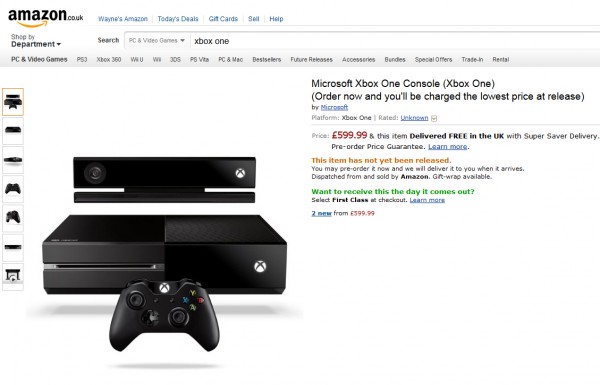
    Although Microsoft has yet to officially reveal the price of its next generation games console, Amazon has decided to set the figure at £599.99 on its pre-order page.

    This is considerably higher than most people would have expected — closer to £400 would have been a reasonable guess — and dwarfs the launch price of the Xbox 360 which cost gamers £209.99 for the core system back in December 2005.

    Of course just because Amazon says it will cost £600, with free postage, doesn’t mean that’s how much interested shoppers will need to pay for the next generation device.

    It’s likely to have been priced this high just so Amazon can send good news to pre-orderers when the real, much lower, figure is announced. The pre-order page does say “Order now and you’ll be charged the lowest price at release”, which is a good indicator that the figure Amazon has on its site is just a guestimate.

    Amazon.com has yet to put up a pre-order page, but expect it to appear shortly.

    How much would you be prepared to pay for the Xbox One? Will you be buying it at launch?

  • Video: Tim Cook talks iOS 7, Android apps from Apple, TV and more in 81-minute interview

    Tim Cook Interview Video
    Apple CEO Tim Cook on Tuesday kicked off what is sure to be an action-packed show at the eleventh annual D: All Things Digital conference with an 81-minute interview on stage with AllThingsD’s Kara Swisher and Walt Mossberg. It was a very safe bet that Cook would stick to script and no surprises would be in store during his interview, and this was definitely the case. The Apple boss still covered plenty of hot topics though, including taxes, TV, the idea of Apple making Android apps, Google Glass and wearable technology in general, Apple’s nine recent acquisitions, upcoming new iOS APIs and more. The full 81-minute interview follows below.

    Continue reading…

  • Resident Evil: Revelations Review (PC)

    After the title came out on the Nintendo 3DS last year, Capcom has brought Resident Evil: Revelations onto high-definition platforms like the PC, PS3, Xbox 360, or Wii U, in order to give owners of these devices a chance to experience the survival horror game.

    After the lackluster Resident Evil 6, which didn’t really have a balance between action an… (read more)

  • Are You Suffering from PUE Envy?

    Tom Roberts is President of AFCOM, the leading association supporting the educational and professional development needs of data center professionals around the globe.

    Tom_Roberts_tnTOM ROBERTS
    AFCOM

    It’s kind of become an “our PUE is less than your PUE” world as companies battle it out for green data center efficiency bragging rights.

    Of course, data centers with the most resources—financial, natural and manpower—have an advantage.

    Here’s recent examples:

    Yahoo! spent close to $200 million on its 1.07 PUE-boasting data center in Lockport, NY. Carbon-free hydroelectric power generated from Niagara Falls feeds its servers.

    Google, with an average PUE of 1.12 for its data centers, just purchased a $200 million stake in a wind farm in west Texas to add to an already impressive green portfolio that includes offshore wind power and solar. This brings the Internet giant’s total investments in alternative energy to more than $1 billion.

    Apple spent about $1 billion to build iDataCenter, its first data center facility in Maiden, North Carolina. With two massive solar arrays and a nearby fuel cell farm it also manages a 1.1 (or so) PUE.

    You are not alone if you’re experiencing a touch of PUE or budget envy from the previous examples. Slashdot.org recently reported “green fatigue” among data center managers who were tiring of the constant PUE chase.

    Let’s Get Real

    For most of us, building data centers next to magnificent rivers or buying huge chunks of real estate to place solar arrays is just pie-in-the-sky thinking. Our solutions must be much more grounded.

    In fact, Data Center World keynote speaker Brian Janous from Microsoft addressed this very real-world frustration. At the end of his talk, someone asked him: “It is great that (Microsoft) can experiment in using other sources of fuel to power its centers, but how do we (smaller data centers) benefit from that?”

    Well, because the Microsofts of the world can experiment with new ideas and renewable fuel sources, it takes the pressure off us to determine what is viable and what is not. If they find their experiment did not work as planned, they learn from it and try something new. Their experimentation turns into our future implementations.

    Practical Lessons from the Megascale Projects

    While we may not be able to match the scope of what these corporate giants achieve, we certainly can apply the lessons that make practical sense in our data centers. For example, you can thank the larger data centers for “discovering” the use of outside air and evaporative cooling to lower temperatures as well as establishing a safe threshold for raising them. Just choose the projects that make the most sense now, for your specific situation and budget.

    Research firm Gartner suggests keeping these guidelines in mind:

    • More exotic projects, like alternative energy and green building design, may take a decade or longer.
    • Five-year paybacks are probable for projects that attempt to change employee behavior, and for lifecycle management programs and green legislative initiatives.
    • Two-year paybacks are possible for efficient facility designs, advanced cooling, processor and server designs, and heating and power issues.

    Try the below five methods (from AFCOM’s Communique newsletter) to make quick, cost-efficient differences in your energy usage:

    1. Place Power Distribution Units (PDUs) in wider, warmer aisles in chimney-ducted rooms. Since they don’t need the low temperatures that cold aisles offer, PDUs shouldn’t be using up the colder air that other equipment requires.

    2. Don’t use doors on the cold aisle sides of cabinets. Fans can produce both kinetic and radiant heat during regular operation. The easier time these fans have aspirating air through cabinet door perforations, the less heat they will produce, saving on required cooling.

    3. Humidify using a combination of partial extraction of the warm return air, an atomizing spray of water, and a supply of 10-degree cooler air in back, overhead, and directly into the cross aisles. The natural vapor pressure will keep the area humidified.

    4. Align cabinets with hot sides on the other side of a demising wall that forms the perimeter of the data center. Use a second concentric demising perimeter external to the first demising wall to form a security barrier and a warm air collection point for drawing heat in winter to warm office spaces. Finally, supply cooled air directly below exterior windows in an office area back to the interior of the computer room or NOC to assure a complete airflow/air replenishment circuit.

    5. Use custom, break away ductwork in a chimney-ducted room. Affix the ductwork to the back door of cabinets that only vent horizontally, allowing hot air to redirect up and into a chimney when the back door is closed. The result is that the warm aisle stays cooler with less chance of mixing the warm air with the cold air within the data room.

    Follow the Leaders

    The challenges of lowering energy costs are here to stay. Whether you’re in a position to take on massive projects or nip away at smaller ones, be sure to keep your eyes open and ears peeled for the next great PUE-lowering strategy from the leaders in this arena. You—and the next generation of data centers—are bound to get something out of it.

    Industry Perspectives is a content channel at Data Center Knowledge highlighting thought leadership in the data center arena. See our guidelines and submission process for information on participating. View previously published Industry Perspectives in our Knowledge Library.

  • "Nonsmoking" Hotel Rooms Aren’t Really Free of Smoke

    “Nonsmoking” rooms In hotels that allow smoking elsewhere had up to nearly 5 times the tobacco-related air pollutants as accommodations in smoke-free hotels, according to a study of 40 hotels led by Georg E. Matt of San Diego State University. In some cases, traces of nicotine in nonsmokers’ urine was more than twice as high for those who had stayed in nonsmoking rooms, as opposed to smoke-free hotels, The New York Times says in a report in the study.

  • Amazon spreads net wider by federating Facebook and Google (and AWS) identities

    Good news for developers who use Amazon Web Services and want to make those apps available to millions of Facebook and Google users: Amazon Web Services Identity Access Management (IAM) can now “federate” Google and Facebook user identities. Oh, and it also supports AWS new Login With Amazon feature which promises that companies can “securely connect your websites and apps with millions of Amazon.com customers.”

    awslogojpegAmazon announced identity federation for enterprise users two years ago. That let businesses grant their own employees access to AWS resources based on the users’ current corporate identity management systems. But this new federation capability spreads the net wider.  This federation will let developers authenticate a user with her existing Amazon, Google or Facebook credentials, which then give her access to specific AWS resources using her existing IAM roles.

    In his AWS blog post announcing the news, Jeff Wierer, IAM principal product manager, explained a basic use case:

    “Imagine you’re developing a mobile app that uses the new Login with Amazon service for authentication, and part of the app’s functionality allows end users to upload an image file as their personal avatar. Behind the scenes, you want to store those images as objects in one of your S3 buckets. To enable this, you need to configure a role that is used to delegate access to users of your app. Roles are configured in two parts:

    1. A trust policy that specifies a trusted entity (principal)—that is, who can assume the role. In this case, the trusted entity is any authenticated Amazon.com user.
    2. An access policy with permissions that specify what the user can do.”

    With services like this one, Amazon continues to push its cloud services as the platform of choice for developers at startups and big companies alike as more public competitors come online.

    Photo courtesy of Flickr user jaaro

    Related research and analysis from GigaOM Pro:
    Subscriber content. Sign up for a free trial.

  • Monster 256GB Microsoft Surface Pro surfaces in Japan

    On Wednesday, Microsoft’s Japanese arm revealed that on June 6 the Surface Pro tablet will finally be available in the land of the rising sun. The fondleslab is set to arrive in two different trims with 128 GB and 256 GB of internal storage, the latter of which is offered for the first time on the Surface Pro.

    The 64 GB Surface Pro will not be available in the local market, likely due to the fact that users can access just 23 GB of storage (practically less than half of the advertised capacity). Microsoft took heavy fire for this caveat, which it appears to avoid in Japan. Prospective buyers can also grab Touch Covers with different design themes, a move that the company carried over from other supported markets.

    The Surface Pro sold in the land of the rising sun also comes with Office Home and Business 2013, which includes Word, Excel, PowerPoint, OneNote and Outlook. This provides a significant differentiating factor over similar offerings which either come with less-capable third-party office suites or none at all.

    The rest of the specifications are carried over from the international version.

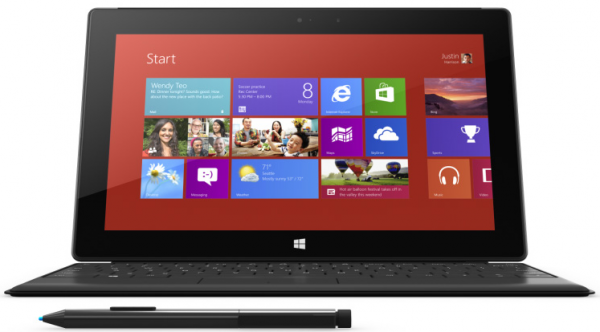
    The Surface Pro comes with the 64-bit Windows 8 Pro; 10.6-inch ClearType multitouch display with a resolution of 1920 by 1080; third generation Intel Core i5 processor; Intel HD Graphics 4000 GPU (Graphics Processing Unit); 4 GB of RAM; 42 Wh battery; 720p cameras on the front and rear; USB 3.0 port; microSDXC card slot; Wi-Fi 802.11 a/b/n; Bluetooth 4.0 and pressure-sensitive stylus. The fondleslab comes in at 275 x 173 x 14 mm and 907 grams.

    In Japan, the 128 GB Surface Pro runs for JPY99,800, which equates to roughly $985. That’s less than what Microsoft charges for the 128 GB version in the US (available for $999). The software giant has yet to announce pricing for the 256 GB model in the local Asian market.

  • Microsoft’s Surface Pro Gets A 256GB Storage Option When It Hits The Japanese Market In June

    surfaceproright

    Microsoft’s Surface Pro, the tablet/laptop amalgam device designed to perfectly showcase Windows 8, is getting a 256 SSD internal storage option, the biggest yet for the device. Previously, Microsoft has shipped the Surface Pro with either a 64GB or 128GB internal drive, but when it arrives in Japan June 7, it’ll come in 128GB and for the first time, 256GB flavors (via Engadget).

    The 128GB model will retail for just about $1,175 U.S. in Japan, or just under $200 more than the 128GB version’s current retail price. The beefier version should help address some of the criticism levied at the Surface Pro for actually reserving a big chunk of on-board storage for OS components, which was particularly harmful in the 64GB capacity.

    A 256GB option not only makes the Surface Pro more generally useful, it also gives Microsoft another way to compete with devices that consumers might look to instead, like the iPad, which introduced a high-capacity 128GB version shortly after the Surface Pro’s launch, and the MacBook Air, which offers up to 512GB of storage through customization options.

    The Surface Pro spec bump will likely make its way to the U.S. and other markets eventually, as it seems like something that Microsoft could use to boost interest in its Windows 8 flagship slate. But there are also rumors of an entirely new Surface to ship in June, with a possible introduction at Build. I’d say it’s more likely we’ll see this spec bump touted at that conference, as the first-gen Surface is barely out of the oven as it is.

    The Surface Pro reportedly hasn’t been selling at that well, with figures from March showing it hadn’t even broken 500,000 devices shipped at that point, based on sources close to Microsoft’s supply chain. That’s obviously not good by really any relative measure, so it wasn’t entirely clear that Microsoft would do much with the line in the future. This new storage option is proof that for now at least, Microsoft is still investing resources in the Surface Pro, even if it isn’t on the verge of releasing all-new hardware under the brand.

  • HTC One, BlackBerry Q10 said to launch June 5th on T-Mobile

    HTC One BlackBerry Q10 Release Date
    T-Mobile finally began carrying Apple’s iPhone lineup last month after more than five years of waiting, but the nation’s No.4 carrier is hardly done building out its smartphone lineup. According to TmoNews, T-Mobile plans to launch two more leading smartphones next week. First up is the HTC One, which BGR recently reviewed and called the closest thing the world has ever seen to a no-compromise smartphone. BlackBerry’s first next-generation QWERTY phone, the BlackBerry Q10, is also said to be launching next week. Both phones will reportedly debut on June 5th and the Q10 is expected to cost $99.99 up front followed by 24 monthly payments of $20. Pricing for the HTC One is unknown for the time being, but it should be in line with other flagship phones offered by T-Mobile.

  • MURPHY: Assessing the “Five Circles of Carbon Tax Hell”

    The George C. Marshall Institute has released a new study from James DeLong outlining what it refers to as “the five circles of Carbon Tax Hell.” The study is very readable and concise (only 34 pages of main text), yet …

  • 2011 Toyota Tundra SEMA Show Truck, For Sale – Featured Truck

    Every year, the SEMA (Specialty Equipment Market Association) show in Las Vegas, NV has a large collection of seriously modified and cool trucks. What if you had a chance to buy one? Now you do!

    2011 Toyota Tundra SEMA Show Truck, For Sale - Featured Truck Sun

    This baby is one sweet Toyota Tundra. It was built for the SEMA show and now you can own it. Check it out!

    Truck_Guru (as he is known on several places like Tundrageeks.com) is selling his 2011 Toyota Tundra 5.7L V8 4×4 SEMA show truck. It is one cool truck with lots of modifications and a Camo wrap that can be removed (white underneath).

    He says the truck has been to SEMA twice and featured in magazines. The truck has just “18,500 miles, always serviced, clean title, no accidents, never used to tow, (and has) never been off-roaded in mud.”

    This isn’t your typical truck though as it is a “show truck, not a daily driver.”

    Here is Truck_Guru’s sales pitch:

    Suggest retail stock is $38000 with leather and tire upgraded, PAID 45,000$ new (what a new tundra costs for this model). If your in the market for a new tundra why spend 45K for a bone stock truck when you can buy a basically new tundra from me with multiple upgrades and the $$$ already spent. Well worth an offer!

    He says he wants $55,000 OBO.

    This truck is well taken care off and has a new oil change, fresh LineX liner, new battery, tires balanced/rotated and alignment. It also has a warranty that expires on Dec. 29, 2016 (Platinum 7 year, 75,000 miles)

    2011 Toyota Tundra SEMA Show Truck, For Sale - Featured Truck Camo

    This isn’t your typical Toyota Tundra, it is a SEMA Show truck and it’s For Sale! Note: the Camo wrap can be removed.

    Here are the specs:

    Suspension, wheels, tires:

    • Bulletproof 12″
    • 19″ sway away coils with resis
    • 14″ sway away shocks with resis
    • Coil springs
    • Resi mounts
    • Atlas leaf springs
    • 20X12 fuel wheels
    • 38×15.50 interco ssr tires

    Exterior:

    • Tow mirrors
    • Bushwacker pocket style flares-colormatched
    • RBP-Rx3 grille colormatched
    • SMP Fabworks- roof rack
    • Westin brush guard bumper
    • Westin steps
    • Wade shields
    • TMAX winch and mounts
    • undercover bed cover
    • Stubby carbon fiber antenna
    • N-FAB Rear runner
    • N-FAB LED bar mounts
    • T.B. Customz Gat tip
    • T.B. Customz Gat hitch step
    • Police Pa speaker
    • Horn blasters Train horn
    • Onboard air compressor

    Lighting:

    • 48″ Procomp LED bar
    • 38″ Procomp LED bar
    • 2-8″ Procomp LED bar
    • 4-6″ Westin halogen lights
    • Plain an simple halo/hid/ LED projector headlights
    • Spyder auto LED taillights
    • 6-2″ white and amber LEDs

    Interior:

    • Custom shift knob
    • Suede pillars
    • Suede panels
    • Custom console cover
    • Custom toggles
    • Blue sea wiring components
    • Westin floor mats
    • Katzkin two tone leather
    • Window tint
    • Custom decals
    • Police Siren
    • Pa/cb system
    • Bedrug carpet kit
    • Undercover swing boxes

    Stereo:

    • Sirius sat radio
    • Alpine 7″ touchscreen in dash
    • Custom door panels
    • Kicker Qs components-tweets, mids, highs
    • 4-Kicker solobaric L7 subs
    • Custom sub enclosure
    • 2-2000 watt kicker amps
    • 1-1250 watt kicker amp

    Performance:

    • K&N CAI
    • Magnaflow exhaust
    • Just differentials 4:88 Gears

    Extras:

    • Procomp shovels
    • Rotopax Gas and water tanks
    • Straps
    • Custom snow camo wrap
    • Air compressor
    • Offroad accessories

    If you are interested, let us know or find Truck_Guru here on Tundra Geeks and on Facebook. Tell him you saw it on Tundraheadquarters.com.

    What do you think? Would you be interested in buying it? Is it worth the money?

    Related Posts:

    The post 2011 Toyota Tundra SEMA Show Truck, For Sale – Featured Truck appeared first on Tundra Headquarters Blog.

  • Data Center Jobs: BYTEGRID

    At the Data Center Jobs Board, we have a new job listing  from BYTEGRID, which is seeking a Facility Manager in Silver Spring, Maryland.

    The Facility Manager is responsible for directing and overseeing maintenance programs relating to the interior and exterior condition and appearance consistent with BYTEGRID objectives, communicating with staff to obtain input and recommendations that ensure operational and quality standards are maintained, supervising 30+ direct and outsourced staff to ensure effective implementation of services in accordance with contractual, performance and quality expectations of the Company, preparing and conducting the performance reviews and make salary recommendations for all direct reports, and as appropriate, reviewing and approving staff performance reports. To view full details and apply, see job listing details.

    Are you hiring for your data center? You can list your company’s job openings on the Data Center Jobs Board, and also track new openings via our jobs RSS feed.

  • Online video will be more popular than Facebook and Twitter by 2017

    Online video isn’t just growing fast, it’s growing faster than any other type of consumer service offering – and soon it’s going to be even more popular than Facebook, Twitter and Co, according to Cisco’s new Visual Networking Index forecast.

    The newest edition of Cisco’s data-heavy report on how we all spend our time and bandwidth points to social networking as the world’s most popular type of consumer service, with 1.2 billion users worldwide tweeting, Facebooking and more around the world in 2012. That’s 66 percent of residential internet users, if you need to know. Cisco estimates that this number will grow to 1.73 billion users by 2017, which will then represent around 70 percent of the also-growing internet population.

    Online video services on the other hand had just around 1 billion users worldwide in 2012, according to Cisco. The company estimates that this number will almost double by 2017, reaching close to 2 billion users worldwide. That means that in four years, 81 percent of the world’s internet users will also use online video services. In 2012, that number was still at around 58 percent.

    cisco service adoption forecast

    Source: Cisco.

    All of those video streams will also have a major impact on bandwidth consumption: Cisco estimates that we are going to see 1.4 zettabytes of global end-user IP traffic in 2017. And here’s the kicker: That’s more IP traffic than the internet has seen in the last 18 years together. Here are a few more of Cisco’s observations and estimates with regards to online video:

    • Online video will account for 69 percent of consumer internet traffic by 2017 (up from 57 percent in 2012).
    • Mobile video will grow 16-fold from 2012 to 2017, and account for 66 percent of all mobile data traffic during that year.
    • Internet-to-TV streaming will grow from 1.3 exabytes per month in 2012 to 6.5 exabytes per month in 2017.
    • The number of web-enabled TVs in consumer’s homes will grow from close to 180 million in 2012 to 827 million in 2017.
    • Game consoles will become slightly less important as a way to bring internet video to the TV screen, while dedicated streaming boxes will see the biggest growth:

    cisco tv streaming devices forecast

    Image courtesy of Shutterstock / Angela Waye.

    Related research and analysis from GigaOM Pro:
    Subscriber content. Sign up for a free trial.