Category: News

  • BlackBerry Achievement Awards Public Voting Now Open

    The BlackBerry Achievement Awards is an annual award covering several categories that recognize excellence in BlackBerry App Development. The semi finalists have been chosen and now it comes down to the public vote to decide the winners.

    Formerly the Wireless Achievement Awards, the BlackBerry Achievement Awards will feature the following categories:

    • App of the Year
    • Putting Customers First
    • Mobile Innovator of the Year
    • Making the World a Better Place
    • Entrepreneur of the Year

    Winners will be announced at this year’s BlackBerry Live conference in Orlando Florida. The first place prize is Travel, accommodation and a conference pass.

    Click here to cast your vote.


  • Injustice: Gods Among Us Should Get An Animated Film

    Up until this point, I’ve always thought that Injustice: Gods Among Us looked like a great game. After the reveal of the opening cinematic, I’m convinced that DC needs to make an animated film.

    If you’re unfamiliar with the events leading up to hero vs. hero fights in Injustice, let’s just say that Metropolis is no more and Superman is very angry. You should avoid the video below if you don’t want the opening moments of the game’s story spoiled, but there’s some quality storytelling and acting here. The Joker in particular stands out even though it’s a little sad that Mark Hamill didn’t reprise his role this time around.

    If you don’t like spoilers and just want to watch super heroes beat each other up, you should check out the launch trailer for the game. There’s plenty of combat to go around.

    Injustice: Gods Among Us will launch on April 16 for the PS3, Xbox 360 and Wii U.

  • Pebble Watchface SDK Now Available, Let’s See What This Smart Watch Can Do

    pebble4

    Pebble has officially released its SDK, after promising to deliver it during the second week of April. This qualifies, if only just, and arrives alongside firmware update version 1.1 for PebbleOS. The new software update for the hardware brings support for custom watch faces built using the SDK, as well as new options for disabling backlighting and vibrations, as well as fixes for iOS bugs.

    The SDK itself is currently just for creating watch faces, not for building apps with other functionality, although we could see some creative software made even with those restrictions. Pebble says its Sports app SDK is coming soon, which should help developers mirror the sorts of functions introduced by RunKeeper.

    This is the first time third-party developers have had public access to developer tools for the Pebble platform, so it should give us a hint of what’s to come. And the firmware update fixes for iOS include one that makes the “Allow Pebble to communicate…” dialog appear far less often, which is great news since that’s a majorly annoying bug for people using iPhones with the device.

    Thanks Terrance!

  • ReelSurfer targets media with newest take on video clipping

    Some of the best ideas come from people who don’t work for you: That’s a lesson startups learn time and again. Take ReelSurfer, for example. The Menlo Park, California-based video startup has been offering users an easy way to clip and share highlights of videos ever since it launched last summer, but is now courting media companies as well.

    A big part of that idea has been to target folks who don’t actually shoot their own videos. “The majority of people just consume content online,” ReelSurfer founder and CEO Neil Jogeklar said during an interview this week. ReelSurfer wanted to give these people tools to become creative and mash up their favorite videos to construct highlight reels or share their favorite moments.

    Reuters Play PageBut then something interesting happened: Reuters started using it to recut its own clips — and the team over at ReelSurfer felt like they were onto something. The startup started talking to the news organization, and learned that Reuters was just trying to find ways to optimize its footage for social sharing via Twitter and Facebook. “They’re competing for people with a short attention span for a short amount of time,” Jogeklar explained.

    ReelSurfer quizzed the folks over at Reuters about the challenges the news organization is facing and quickly learned that one of the biggest concerns was referral traffic. Fore example, when Reuters was sharing a YouTube video, people who click through were ending up on YouTube, not its own site.

    That’s why ReelSurfer gave Reuters the ability to easily add a destination URL to their clips. That sounds simple, but actually worked remarkably well: Videos shared by Reuters saw a click-trhough-rate of 13 percent, according to ReelSurfer. The company also added some extra SEO optimization, and shared video analytics with the news organization.

    After a few months of testing, ReelSurfer is now making some of these extra features available to other media organizations as well. The company just started its ReelSurfer for journalists program, which basically makes the functionality that Reuters has been using available to bloggers and other online journalists.

    ReelSurfer for journalists is currently still in private beta, and the company is working on building out a full-featured analytics dashboard for media organizations. There are definitely other options for this kind of use case out there as well — but ReelSurfer is definitely one of the easier solutions. Editing a clip with ReelSurfer just takes a minute or two. It’s hard to beat that, especially when you’re on a deadline.

    Check out this really short highlight I cut from one of our review videos, which will point you to the original review story:

    Photo courtesy of Flickr user transp.

    Related research and analysis from GigaOM Pro:
    Subscriber content. Sign up for a free trial.


  • Verizon Details Changes to Their Upgrade Plan

    verizon-wireless

    It looks as though Verizon has made some changes to their upgrade service. Even though Verizon customers sign two-year contracts when the purchase a subsidized phone, they were always able to get an upgrade after 20 months. Unfortunately, Verizon is no longer allowing that and customers will have to wait until the full 2 years (24 months) is up in order to upgrade. Here is what Verizon has to say on the matter.

    As the wireless business has evolved, Verizon Wireless has continued to expand its device portfolio, providing customers with more options than ever before. It is not uncommon for customers to have multiple devices such as a smartphone, tablet and Jetpack. In that context, Verizon Wireless is making the following changes to its upgrade practices:

    • In alignment with the terms of the contract, customers on a two-year agreement will be eligible for an upgrade at 24 months vs. today’s early upgrade eligibility at 20 months. This change aligns the upgrade date with the contract end date and is consistent with how the majority of customers purchase new phones today. The first customers impacted by this change are customers whose contracts expire in January 2014. As always, customers may purchase a new phone at the full retail price at any time.
    • The New Every Two program ended in January of 2011. Verizon Wireless has continued to allow customers to utilize these expired credits. However, as of April 15, these credits will no longer be available.
    • Customers may continue to share an upgrade with another person on an account if that customer is upgrading to a device within the same equipment category. Customers can utilize a phone upgrade to purchase a new phone; however, the option to transfer upgrades from non-phone devices (such as a Jetpack or tablet) will no longer be available.

    Source: Verizon Wireless

    Come comment on this article: Verizon Details Changes to Their Upgrade Plan

  • TED Radio Hour asks the question: Why are some people violent while others aren’t?

    Radio-Hour-Violence

    Photo: Sascha Burkard/iStockphoto.

    Are people born violent, or is violence something learned? And what can be done to keep human beings from harming one another? These are questions on our minds as Congress debates gun control measures. Today’s episode of TED Radio dives into this dark end of human nature.

    In this episode – the fifth in season two —  psychologist Philip Zimbardo tells us the story of his classic Stanford Prison Experiment and how easy it is for people to turn violent. Neuroscientist Jim Fallon uncovers the wiring of a psychopathic killer. Writer Leslie Morgan Steiner tells her personal story of being in an abusive relationship and shares why victims of domestic violence don’t leave. And finally, linguist Steven Pinker charts the whole of human history and says that, believe it or not, we are living in the most peaceful time in our species’ existence.

    Check out your local NPR schedule to find out when the show airs today, or listen to it via NPR’s website »

    Or head to iTunes, where the podcast is available now »

  • Knight Foundation-backed mobile startup Behav.io’s team is joining Google

    Behav.io, a mobile sensor startup with backing from the Knight Foundation, announced Friday morning that the company is joining Google, where its CEO used to work before starting the company.

    The company received a $335,000 grant from the Knight Foundation in June 2012 to improve communities by making better use of data collected on mobile phones. At the time, the startup explained its goals and what it would do with that funding:

    “Behavio wants to open access to, and help make sense of, the data routinely collected by mobile phones. Their open source Android platform turns phones into smart sensors of people’s real world behaviors and surroundings: how people use their phones, how they communicate with others, and environmental factors like sound, light and motion. As a result, Behavio can understand trends and behavior changes in individuals as well as entire communities, and help them understand and make use of this information.”

    The startup’s CEO and co-founder Nadav Aharony was formerly with MIT Media Lab and then a product manager for Android from 2011 to 2012 before he left to start Behav.io in the summer of 2012.

    The company noted the change on its website, explaining that it would be shutting down the closed alpha version of its product but maintaining the full open source project:

    “We are very excited to announce that the Behavio team is now a part of Google! At Behavio, we have always been passionate about helping people better understand the world around them. We believe that our digital experiences should be better connected with the way we experience the world, and we couldn’t be happier to be able to continue building out our vision within Google.”

    Google did not immediately respond to a request for comment but I’ll update this post if they do.

    Update at 11:40 AM: Google confirmed the Behav.io team would be joining the company but politely objected to the term “acquisition,” since the product is being shut down.

    Related research and analysis from GigaOM Pro:
    Subscriber content. Sign up for a free trial.


  • Facebook Home now available for select Android smartphones

    Facebook Home Download Available Now
    Facebook (FB) on Friday was true to its word and released Facebook Home for some Android devices. The application, which was announced last week, is only available on select smartphones in the U.S. running Android 4.0 Ice Cream Sandwich or higher. Compatible devices include the HTC One, HTC One X, HTC One X+, Galaxy S4, Galaxy SIII, Galaxy Note II and of course HTC’s (2498) First. Facebook Home gives Android smartphones a complete overhaul with a constant feed of pictures and status updates from users’ Facebook friends. The company also updated its Android Messenger application to include the new Chat Heads feature, which allows users to interact with friends even when another application is open. Facebook Home is available now as a free download on the Google Play store.

  • Facebook Home Now Available to Download in the Google Play Store

    Facebook Home, Facebook’s attempt to make your Android homescreen all about Facebook, is now live in the Google Play Store.

    As of right now, you can only download Facebook Home if you have one of these four Android devices: HTC One X, HTC One X+, the Samsung Galaxy S III or the Samsung Galaxy Note II. In the future, the HTC One and the Samsung Galaxy S4 will also allow for Facebook Home.

    And then, of course, there’s the HTC First – the first phone to launch with Facebook Home ready to go. Don’t want to call it a “Facebook Phone” – then don’t. But it’s definitely the first Facebook centric phone on the market. It also hits the shelves today.

    “Facebook Home is the mobile experience that puts your friends at the heart of your phone. From the moment you turn it on, you see a steady stream of friends’ posts and photos on your home screen. Upfront notifications and quick access to your essentials mean you’ll never miss a moment. And when you download Facebook Messenger, you can keep chatting with friends when you’re using other apps,” says Facebook.

    And about those chat heads that let you “keep chatting with friends when you’re using other apps.” If you have an Android phone, want to download Facebook Home, but alas, your Android phone isn’t supported – all is not lost. Today, ahead of the Facebook Home launch, Facebook added chat heads as a part of the Facebook Messenger app for Android. Now you can make use of/be incredibly annoyed by chat heads no matter which Android device you own, depending on how you look at it.

  • BBC’s Casualty shows female genital mutilation for what it is – violence against girls and women

    In 2010, two British survivors of female genital mutilation (FGM) and I started a charity called Daughters of Eve in order to mainstream the issue and change how it is addressed.  FGM has been a criminal offence in the UK since 1985, but it took another 20 years for it to be illegal to take girls abroad to undergo FGM in the 2003 Act. Countless young girls were taken out of the country – and some to London – to undergo FGM. However, as children, we had little power to do anything, while those that were charged with safeguarding us ignored the issue. The suffering of so many young women and girls that I saw growing up – and still do – is the basis of why I left the civil service in order to join the campaign against FGM. Growing up in the UK and travelling to Africa every year, where the largest population of women and girls affected by FGM live, I have had a unique insight into the campaign against it.

    The recent episode of BBC’s Casualty which featured a strong FGM storyline was developed with the assistance of Daughters of Eve and three young people from Integrate Bristol. In this two-part story we follow a young woman dealing with the dangers of FGM. (Watch this Saturday’s episode on BBC 1 at 9.10pm).

    FGM is child abuse and it is vital that front-line professionals who meet girls on a regular basis know exactly what the danger signs are and how to react accordingly. Children aren’t able to use legislation like an adult and can face misconceptions of FGM being carried out because their families ‘love them’ from the professionals they seek to protect them – the FGM legislation is not effective by itself.

    It may seem that FGM is currently being talked about everywhere but the current media coverage has been years in the making and has taken countless meetings and doors being closed in our faces for us to get here. As a British survivor of FGM, I have witnessed the conversations about FGM over the years come and go, but what they all had in common was a focus on speaking to those either historically affected by the practice – or those that upheld and enabled it to happen.

    For the most part, people have been discussing FGM as a cultural issue that happens in ‘lands far away’ and that we should educate those carrying it out. My view is that we need to step away completely from the terms ‘culture’ and ‘community’ and stop trying to make ourselves feel better about not doing anything by suggesting that FGM is based on ‘love’. This is one of the biggest misconceptions – and an extremely dangerous one too. FGM is not a loving act. It is violence against women and girls and any strategy for its elimination needs to be based in this framework.

    Daughters of Eve is delighted to see £35 million made available by the UK government to tackle this issue in Africa and elsewhere, but we must make sure that experts on this issue are being listened to.  We should be learning from holistic models such as in Burkina Faso and Kenya, where recent Demographic and Health Surveys have shown prevalence rates to have fallen more than elsewhere (up to 30%). These models consider FGM to be violence against women and girls and are effective because they combine child protection and legislation, as well as educational measures, to empower those at risk or affected.

    As a form of violence against women, FGM takes place because of structural inequalities in society – particularly gender inequality.  We need to empower and protect those at risk to make sure that it is eliminated. Any approach to end FGM which does not address these inequalities will only leave a vacuum for another form of violence against women – or for those who carry out FGM to say that it does not exist.

    Progress is definitely being made. In Bristol, we have hundreds of young people who are not only standing up and speaking out about FGM, but questioning the role of women within their communities. They are being empowered with language that has not just changed their lives, but also those of their mothers. Women from a highly FGM-affected population are also calling it violence against women and girls and linking FGM to all the other forms of abuse they have experienced.  As one woman said: ‘If it is ok to cut a girl because she is a girl, then what you will do to her as a woman will be worse’. This change has not come easily for those of us that have stood up against FGM. We face death threats on a regular basis, we have been attacked on the street and lost people we once believed to be friends.

    My personal aim is to afford young women the same privileges that I had and for them to understand that within them there is great potential.  I was freely educated and given the space and support to develop my identity. I was allowed to be me and not have a predefined culture projected on to me, which is sadly happening to girls today.

    We need to all stand together and empower the girls who are seeking our support. As Tamasha says on Casualty, quoting a young women we have worked with: ‘It never stops hurting. It is always painful’. Let us not deepen that pain by undermining the bravery of those women and girls that come forward not only to tell their stories, but also to live a life of their choosing.

    If I could wish for one thing to change as a result of the Casualty episodes, it would be for everyone to see the child in front of us as a girl asking for help and not part of an ‘other’ culture. As we say at Daughters of Eve, ‘If you save one girl you save a generation’.

    ————————————————————————————————–

    Please note, this is a guest blog. Views expressed here do not necessarily represent the views of DFID or have the support of the British government.

    Find out what the British government is doing to eliminate female genital mutilation.

  • Eyevensys Receives Investment From Boehringer Ingelheim

    Eyevensys said it received an equity investment from the Boehringer Ingelheim Venture Fund. Further details were not available. The company raised about $2.1 million in its first round of funding in January 2012. It said early investors – Innobio, managed by CDC Entreprises; Inserm Transfert Initiative; and CapDecisif Management – plan to participate in the second round.

    PRESS RELEASE

    Eyevensys announces an equity investment by Boehringer Ingelheim Venture Fund

    Dr Michel Pairet, Boehringer Ingelheim’s head of non-clinical research and development, joins Eyevensys’ board of directors

    Paris, 11 April 2013 – Eyevensys, a developer of a new process for non-viral gene therapy using electrotransfer that enables prolonged production of therapeutic proteins for the treatment of ocular disease, today announces an equity investment by the Boehringer Ingelheim Venture Fund (BIVF). It also announces that Dr Michel Pairet, Boehringer Ingelheim’s head of non-clinical research and development, has been appointed to its board of directors.

    This equity investment by BIVF marks the start of Eyevensys’ next round of funding, which is planned to take place before the end of the second quarter of 2013 and aims to fund the business through to completion of Phase IIa clinical trials. The Eyevensys investment is BIVF’s sixth since its launch in 2010 and its first investment in a French company. BIVF had previously taken a stake in Inserm Transfert Initiative, an investment company specializing in seed capital for start-ups coming out of academic research and a past investor in Eyevensys.

    The company’s past investors (Innobio, managed by CDC Entreprises, Inserm Transfert Initiative and CapDecisif Management) also intend to participate in this second round of funding. Eyevensys raised EUR 1.6 million from its first round of funding in January 2012.

    “Boehringer Ingelheim Venture Fund’s equity investment brings us credibility, further raises our profile and gives us access to their wealth of experience in pharmaceutical and biotechnology R&D. This sends a strong signal to our target market,” said Dr Ivan Cohen-Tanugi, chairman of Eyevensys. “Dr Michel Pairet is well known in our industry. His experience, combined with the experience of the BIVF team, will undoubtedly help us to strengthen our development. We plan to complete a new round of funding between now and June. Discussions are already underway with potential new investors.”

    The aim of this second round is to allow the company to finalize its preclinical trials, proceed to clinical trials within 18 months and complete Phase IIa. Eyevensys is currently focusing on two ophthalmological indications with significant unmet medical needs. These are: uveitis, a rare disease, and age-related macular degeneration, a pathology which occurs more frequently than uveitis and is becoming more prevalent as a result of population aging.

    Eyevensys is the only company to have reached this advanced stage of investigation of novel treatment approaches for non-viral gene therapy. The technology developed by Eyevensys involves the electrotransfer of plasmids into the ciliary muscle resulting in a stable, sustained expression of therapeutic proteins. This new therapeutic approach will be less invasive than current therapies, as the frequency of injections can be greatly reduced from fortnightly or monthly to every six months potentially improving the quality of life of patients. Alongside higher efficacy it is hoped that the reduced doses of medication and proteins could also reduce side-effects. The first preclinical results in animal models have shown the expression of therapeutic proteins for up to nine months.

    “Eyevensys’ novel approach, which targets pathologies where few therapies are available and offers potential advantages in terms of effectiveness, administration and tolerability, makes it a perfect fit with the Boehringer Ingelheim fund’s criteria for investment,” explains Dr Michel Pairet, head of non-clinical research and development at Boehringer Ingelheim. “In the future, medicine will increasingly rely on a combination of technologies, as we see here with the combination of gene therapy with a medical device.”

    Michel Pairet has been with Boehringer Ingelheim since 1992. Before heading up the German company’s worldwide non-clinical research and development division, he was responsible for its worldwide research, and its corporate investment fund. Michel Pairet is a doctor of veterinary medicine and has a PhD in physiology and pharmacology.

    About Eyevensys – http//:www.eyevensys.com

    Eyevensys is a developer of a new non-viral gene therapy process to treat ocular illnesses that enables prolonged production of all therapeutic proteins through electrotransfer. On the basis of work conducted by professor Francine Behar-Cohen (Inserm Unit, U872, Centre de Recherche des Cordeliers), Eyevensys has filed 11 patents, of which they retain exclusivity. The single-use device is designed to treat various ocular illnesses.

    The scientific team intends to make this technology a first-line treatment for uveitis, an orphan illness and for AMD. In stage two, Eyevensys will focus on much more common conditions such as diabetic retinopathy, for which repeated intraocular protein injections remain very restrictive. It is based on proofs of concept, backed by laboratory testing on animal subjects.

    Eyevensys, founded in 2009, is based in Paris and employs five people. It raised EUR 1.6 million in January 2012 from Cap Decisif Management, InnoBio, managed by CDC Entreprises and Inserm-Transfert. Eyevensys was founded by Francine Behar-Cohen, professor of medicine at Paris Descartes University, head of ophthalmology at l’Hotel Dieu and director of team 17 at Inserm UMRS872.

    About Boehringer Ingelheim Venture Fund – http://www.boehringer-ingelheim-venture.com

    The Boehringer Ingelheim Venture Fund was formed in March 2010 to invest in biotechnology and start-up companies to help drive innovation in medical science. These may include – but are not limited to – novel technologies to address so far undruggable targets, new generation vaccines and new biological entities, such as antibody-dependent oncolysis. Additional focuses are novel therapeutic targets and disease-related biomarkers, as well as new approaches in regenerative medicine,.

    The post Eyevensys Receives Investment From Boehringer Ingelheim appeared first on peHUB.

  • Apollo Prices €325 million European CLO

    Apollo Global Management said Friday it priced ALME Loan Funding 2013-1, a €325 million (US$426 million) Collateralized Loan Obligation. ALME-1 is Apollo’s first European CLO and it will invest in corporate leverage loans.

    PRESS RELEASE

    Apollo Global Management, LLC (NYSE: APO) and its subsidiaries (collectively “Apollo”) today announced the pricing of ALME Loan Funding 2013-1 (“ALME-1”), a €325 million Collateralized Loan Obligation (CLO). ALME-1 is Apollo’s first European CLO, and will invest primarily in corporate leveraged loans.

    Apollo is among the largest CLO managers in the world and is the largest CLO manager in the United States1, with 28 CLOs totaling nearly $15 billion in assets under management.2 Since the beginning of 2012, Apollo has priced four CLOs, raising approximately $2 billion in aggregate. Apollo’s CLO strategy is a core part of the firm’s credit business, which had total assets under management of more than $64 billion as of December 31, 2012. ALME-1 further expands Apollo’s sizeable presence in the European credit markets, which have been a key source of growth for Apollo over the past several years.

    This is not an offer to sell or a solicitation of any offer to buy any securities. Offers will be made only by a prospectus or other offering materials.

    Any securities issued by the issuer (the Securities) can not be offered or sold in the United States unless registered under the U.S. Securities Act of 1933, as amended (the Securities Act), or offered and sold pursuant to an exemption from registration under the Securities Act. Any offer of the Securities registered under the Securities Act will be made by means of a prospectus that may be obtained from the issuer or selling security holder and that will contain detailed information about the issuer and management, as well as financial statements.

    About Apollo Global Management

    Apollo is a leading global alternative asset manager with offices in New York, Los Angeles, Houston, London, Frankfurt, Luxembourg, Singapore, Mumbai and Hong Kong. Apollo had assets under management of more than $113 billion as of December 31, 2012, in private equity, credit and real estate funds invested across a core group of nine industries where Apollo has considerable knowledge and resources. For more information about Apollo, please visit www.agm.com.

    1 Based on CLO assets under management as of December 31, 2012 per Standard & Poor’s.

    2 Apollo CLO statistics pro-forma for ALME-I.

    The post Apollo Prices €325 million European CLO appeared first on peHUB.

  • Everything.me launcher dynamically adapts to what you’re doing right now

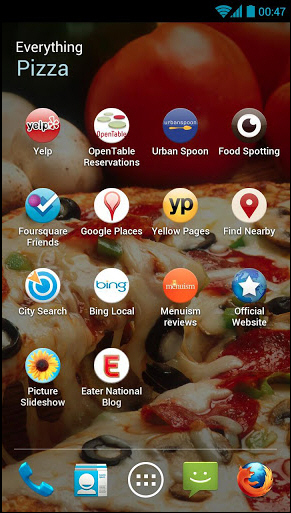
    Unlike iOS, Android devices can be very easily customized without the need to jailbreak or root them. This means that there is an ever-growing market in third-party launchers that enable phone and tablet users to try out a variety of new ways to access the apps they have installed on their device. While cosmetically different and packed out with a range of extra features, most launcher are generally fairly similar, but this same cannot be said of Everything.me which adapts itself according to what you are doing and where you are.

    The idea is simple. Launching apps and accessing information is now seen as being the same thing. Looking for a recipe you have stored in an app you use? Type ‘recipe’ and a list of corresponding apps will show up. In addition to this, you’ll also be shown a list of related websites so you can check out other recipes online. Breaking down, or at least blurring, the barriers between local apps and online services is an interesting approach.

    There’s also scope for tailoring search results to your current location. Look for restaurants and you’ll be able to find out what is nearby. As well as ensuring that you have easy access to the information you’re looking for, Everything.me also changes the appearance of your phone according to what you’re doing. Perform a search for ‘football’ and your background will change to the NFL logo.

    A launcher that dynamically adapts to what you’re doing can take a little getting used to; it feel strangely unintuitive to start with, but it doesn’t take long to become second nature. It’s really just a matter of retraining that memory muscle.

    But there is another option available in the form of smart folders, and these act as a sort of hallway house between dynamic homescreens and a more traditional folder-based launcher. Select a category — such as a shopping — and any apps that you have that fall into this category will be automatically added to the folder along with a list of associated online resources. Create a ‘social’ folder and you’ll find that Fourquare, Twitter, Facebook etc are all automatically grouped together for you.

    Everything.me is currently in beta but can still be downloaded from Google Play.

  • President Obama and Vice President Biden’s 2012 Tax Returns

    Today, the President released his 2012 federal income tax returns. He and the First Lady filed their income tax returns jointly and reported adjusted gross income of $608,611. The Obamas paid $112,214 in total tax. 

    The President and First Lady also reported donating $150,034 – or about 24.6 percent of their adjusted gross income – to 33 different charities. The largest reported gift to charity was $103,871 to the Fisher House Foundation.

    The President’s effective federal income tax rate is 18.4 percent. The President believes we must reform our tax system which is why he has proposed policies like the Buffett Rule that would ask the wealthiest Americans to pay their fair share while protecting families making under $250,000 from seeing their taxes go up. Under the President’s own tax proposals, including limitations on the value of tax preferences for high-income households, he would pay more in taxes while ensuring we cut taxes for the middle class and those trying to get in it.

    read more

  • The Modular Data Center Market

    This is the forth article in the Data Center Knowledge Guide to Modular Data Centers series. 

    With the modular market developing in the industry, there has been some tremendous innovation and engineering design efforts put into solutions. The modular market is maturing with even more large enterprises actively deploying the modular data center platform. To further illustrate the traction in the modular industry, a recent Uptime Institute 3 survey showed that 41% of their respondents are already considering modular, pre-fab data centers or their components.

    Modular Data Center v3

    Modular Products
    Many of the major server vendors have modular data center products and while they are optimized to work with their hardware, will typically support anything a standard rack supports. Vendors worldwide have engineered their own version of a container or module and incorporated a variety of unique capabilities into their solution. Having one vendor supply all components for and within the rack for a module enables them to engineer it as a complete solution that can then have modular power and cooling products complement the IT module. Modular data center products, including containers, are available from: IO, HP, IBM, SGI, Dell, Cisco, Cirrascale, Google, Elliptical Mobile Solutions, IPSIP, Toshiba, Bull, AST, Schneider Electric, PDI (acquired by Smiths Interconnect), Emerson Network Power, Silver Linings, Telenetix and Active Power.

    Modular Providers
    Within the everything-as-a-Service model, a modular provider is able to offer the entire data center as a service, by quickly adding a module of IT with all supporting power and cooling infrastructure. The idea is to deliver a data center-in-a-box solution. Quickly built-out and provisioned, the data center can be made operational far faster than a standard bricks-and-mortar solution.

    The entire module is available as a package, integrating all aspects of the IT within and subsystems through DCIM or other management tools, such as DCOS (data center operating systems). Modular data center Providers include: IO, NxGen Modular, mSun Modular Data centers, IBM, COLT, Toshiba, Cannon, Pacific Voice and Data, BladeRoom, Pelio & Associates, Dock IT, Lee Technologies (acquired by Schneider Electric), Datapod and Turbine Air Systems (TAS)/ Celestica (CLS). 

    The complete Data Center Knowledge Guide to Modular Data Centers is available for download in a PDF format and brought to you by IO. Click here to download the DCK Guide to Modular Data Centers.

  • Drive Thru Headless Prank

    Headless Prank

    It’s one thing to pull up to the drive-thru at your favorite fast food joint in a car with no driver. But pulling up in a car that contains a driver without a head? Now that’s just crazy. Shot by “The Magic of Rahat”, the same joker who brought you the driver-less car prank, comes the headless driver. The cashiers reactions are understandably pretty priceless with a combined sense of shock and awe. However what impresses me the most is how are headless driver keeps his cool throughout the entire ordeal. Check it out after the jump.

    Source: Youtube.com

  • Facebook Messenger adds chat heads to Android app

    facebook_messenger_chat_heads

    When Facebook announced their new Facebook Home, one feature that actually received a fairly warm reception was the “chat heads” function. The chat heads were floating message notifications that could be opened independently of whatever else a user may be doing in the background on their smartphone. The chat heads show up as a small circle on your screen filled with a user’s profile pic and a number indicator. The chat heads can be moved around, but they stay docked to an edge of the screen. Tapping on them will open a window where you can reply or open the message in the full Messenger app. When you are ready to get rid of the chat head, just drag it down to the bottom of the screen.

    You do not need to install Facebook Home to take advantage of the chat heads. Just install or update Facebook Messenger on Android 2.2 and up using one of the Google Play download links below.

    QR Code generator

    Google Play Download Link

    Come comment on this article: Facebook Messenger adds chat heads to Android app

  • Verizon to abandon early upgrades

    Verizon Upgrade Policy
    Many wireless providers in the U.S. require customers to sign a two-year service agreement when purchasing a new smartphone, though some still allow subscribers to upgrade to a new device with a full subsidy once every 20 months. This may soon become a thing of the past, however. Verizon (VZ) on Friday announced that it will no longer be offering early upgrades to its customers. The carrier will allow subscribers who are set to receive an upgrade prior to September 1st, meaning their contract was going to expire on or before January 1st, 2014, to upgrade early. Customers who won’t be eligible for an upgrade until after September 1st will have to wait until the end of their 24-month agreements to buy a new smartphone, unless they wish to do so at full retail price. Verizon has also announced that it will remove all unused credits from its retired New Every 2 program on April 15th.

  • VirtualBox 4.2.12 kills bugs dead

    Oracle has released VirtualBox 4.2.12, a maintenance update for its cross-platform, open-source virtualisation tool. A large number of fixes and updates have been applied, including dynamic support for multi-monitor setups via the Windows Additions.

    There are also a notable number of GUI fixes concentrating on improving multi-screen support, including one that stops a crash when changing visual mode, and another that ensures OS X hosts display the correct menu bar in each machine window.

    Further multi-screen related fixes ensure better handling of host/guest screen plugging and unplugging in different visual modes, plus fix a bug when empty seamless screens were represented by full-screen windows.

    The VM Manager’s GUI has also been improved, with vertical scrollbars automatically updated when the content or window is resized. An event crash on changing the machine state has also been fixed, while warnings about the state (enabled or disabled) of mouse integration will no longer appear after VMs are restored from a saved state.

    Other notable bug fixes should prevent disk size changes occurring when using snapshots thanks to incorrect alignment of VDI images. Linux hosts suffering from broken audio with ALSA or PulseAudio should also find this issue resolved.

    The VBoxManage tool has also been tweaked for better stability, and Linux Additions now handle a fall-back to the standard VESA driver on RedHat-based guests if vboxvideo can’t be loaded. There are also compile fixes for RHEL/OEL/CentOS 6.4 and Debian Linux kernel 3.2.0-4.

    VirtualBox 4.2.12 is available now as a free, open-source download for Windows, Mac and Linux. Also available is VirtualBox Extension Pack 4.2.12, a free-for-personal-use download that adds support for USB 2.0, VirtualBox Remote Desktop Protocol and more.

    Photo Credit: ARENA Creative/Shutterstock

  • HTC Teams Up With Funny Or Die To Promote The One

    HTC

    The HTC One is just a week away from launching in the U.S., and to help promote it, HTC has teamed up with Funny Or Die to create a Bachelorette parody. Titled “The One with James Van Der Beek”, a contestant has to choose between five different phones as her “one true love”. You’ve probably guessed where this is going. The HTC One comes out on top, and the video is full of cheesy lines and people dressed up as outdated phones. HTC has a lot betting on the One. With declining profits, they need their groove back to effectively compete against the likes of Samsung. If you’re into cheesy parodies, you can watch the video below.


    Come comment on this article: HTC Teams Up With Funny Or Die To Promote The One