Hidden amidst the winding pathways of Llewelyn Park, New Jersey, America’s oldest gated community, steampunk designer Will Rockwell is building a future that never was. He began his career as a TV producer but he always loved to tinker with metals, leather, and wood – the three components of good steampunk. After building a set of Rocketeer-style USB keys, friends turned him on to Etsy. He opened a shop and almost immediately was flooded with orders.
These designs are a labor of love for Rockwell who scours the junkyards of New Jersey for cool odds and ends. He has two workshops, one in Pennsylvania and one in the basement of his 1912 home.
Rockwell doen’t expect to get rich with his hobby but he’s doing well, nonetheless. His unique style, nautical-themed designs, and electronic additions to his devices meld the modern and the mysterious in a quirky way. My favorite project? His electric guitar outfitted with wild effects and knife switches, although his handmade USB keys are still amazing.
Will is definitely following the maker spirit and is even making a little money. His world is one of the imagination, full of undersea starships and steaming hard drives run by pistons. It’s enough to make you think you’ve stumbled upon the world of Captain Nemo via the Jersey Turnpike.
TechCrunch Makers is a video series featuring people who make cool stuff. If you’d like to be featured, email us!.
HTP is not only one of the only antidepressants which encourages bodyweight reduction, but it really is also related with much much less aspect effects than its prescription counterparts. In addition to regularly creating bodyweight acquire and making obtained bodyweight harder to lose, SSRIs and tricyclics are also related with nausea and vomiting, lack of ability to orgasm, dry mouth, diarrhea, sleeplessness, heart palpitations, tremors, and agitation. 5HTP, nevertheless, is remarkably totally free of aspect effects. Minor gastrointestinal issues have been reported by these starting remedy with the complement, but this normally subsides right after a few days.
Pine nuts nuts stimulate CCK and GLP-one. Sounds like gibbberish, but Dr. Oz phone calls these “potent hormones that inform the brain that the abdomen is total.” Enjoy a shot glass complete daily.
Grapeseed oil is a “excellent body fat.” It helps you minimize weight by controlling your starvation and lowering physique excess fat. In addition, grapeseed oil encourages insulin resistance. Keep full longer by having it prior to lunch everyday.
. This subsequent stage is vitally essential as without having it, it will be virtually impossible to shed excess weight and preserve it off. That is make certain you get typical exercise. It isn’t going to issue what form this requires – strolling, running, driving a bicycle, just get out there and do something. Commence gradual, say take a 10 minute brisk walk today, and then progressively construct this up to 30 minutes each day. This will enhance your metabolism so that it becomes less difficult to shed bodyweight, improve your health, and give you a better sense of well-becoming.
five-htp can assist you drop weight. Indeed, it really is true. Analysis research have shown that chubby folks getting five-htp health supplements are most likely to be significantly less interested in foods, less probably to binge-eat, and are a lot more likely to drop lbs. Why is this? Researchers have mentioned that folks with higher serotonin ranges are a lot more likely to exercise portion handle and have a tendency to preserve healthier weights than folks with minimal serotonin amounts. If acquiring control of binge ingesting, psychological consuming, or basic overeating are priorities for you, taking 5-htp can really give you an edge. When you are getting 5-htp to assist you lose excess weight, start with no more than a fifty mg dose, and get it with a total glass of drinking water 50 percent an hour before a food.
Eat slowly, and chew your foods correctly. This will aid you feel fuller much more swiftly, and the very act of chewing will leave you sensation more satisfied.
A fine rest is a manifestation of bodily and psychological ease and comfort. Snooze dispossession can have an effect on your typical efficiency and may even have an effect on your general character and it is a all-natural condition of rest that the body wants to reside wholesome and survive.
This week’s Industry Perspectives represented an intersection of top-of-mind topics for data center professionals and executives. Three columns considered different aspects of the cloud, including building a model for Return on Investment, planning for cloud downtime, and making the cloud more resilient. The other columns this week gave excellent advice on planning and executing a data center relocation and aspects of your network to consider during peak usage, such as during the NCAA games. If you missed any, here they are in a neat package. Enjoy!
March Madness: Lessons for Networks: According to a Harris Interactive poll, 64 percent of Americans watch online video while at work. As employees flocked to watch March Madness, network administrators are focusing on new ways to withstand the increase in demand and keep business applications responsive. writes David White of Ipanema Technologies.
Five Essential Keys to Success When Relocating a Data Center: A data center relocation (DCR) is not just about moving servers and plugging them in at their new locale. In reality, DCR can be one of a company’s most complex and challenging endeavors, writes Bruce Cardos of Datalink.
Microsoft’s Journey: Solving Cloud Reliability With Software: Cloud service providers need to move beyond traditional reliance on complex hardware redundancy schemes and instead focus on developing more intelligent software that can monitor, anticipate, and efficiently manage the failure of physical infrastructures, writes David Gautier of Microsoft. When service availability is engineered in more resilient software, there is greater opportunity to materially rethink how the physical data center is engineered.
Downtime & Cloud: What’s The Role of the Cloud in RTO and RPO Planning? Spanning from basic file backup to a total restore, the lower costs and higher resiliency of cloud infrastructure have re-framed disaster recovery discussions by providing greater options, writes Cortney Thompson of Green House Data.
Building A Cloud-Savvy Model for TCO and ROI: You might be surprised to learn that many large organizations commit to cloud computing without really knowing their Total Cost of Ownership (TCO) and projected Return on Investment (ROI), writes Ravi Rajagopal of CA Technologies. It’s not that they’re irresponsible and ignoring this requirement. It’s that the tools most IT teams use to evaluate TCO and ROI are inadequate for application to the cloud.
Industry Perspectives is a content channel at Data Center Knowledge highlighting thought leadership in the data center arena. See our guidelines and submission process for information on participating. View previously published Industry Perspectives in our Knowledge Library.
The democratization of data is a real phenomenon, but building a sustainable data democracy means truly giving power to the people. The alternative is just a shift of power from traditional data analysts within IT departments to a new generation of data scientists and app developers. And this seems a lot more like a dictatorship than a democracy — a benevolent dictatorship, but a dictatorship nonetheless.
The problem, however, comes when we’re forced to rely on these people, features and applications to decide how data can affect our lives or jobs, or what questions we can answer using the troves of data now available to us. In a true data democracy, citizens must be empowered to make use of their own data as they see fit and they must only have to rely apps and experts by choice or when the task really requires an expert hand. At any rate, citizens must be informed enough to have a meaningful voice in bigger decisions about data.
The democratic revolution is underway
The good news is that there’s a whole breed of startups trying to empower the data citizenry, whatever their role. There are companies such as 0xdata, Precog and BigML trying to make data science more accessible to everyday business users. There are next-generation business intelligence startups such as SiSense, Platfora and ClearStory rethinking how business analytics are done in an area of HTML5 and big data. And then there are companies such as Statwing, Infogram and Datahero (which will be in beta mode soon, by the way) trying to bring data analysis to the unwashed non-data-savvy masses.
Combined with a growing number of publicly available data sets and data marketplaces, and more and more ways of collecting every possible kind of data — personal fitness, web analytics, energy consumption, you name it — these self-service tools can provide an invaluable service. In January, I highlighted how a number of them can work by using my own dietary and activity data, as well as publicly available gun-ownership data and even web-page text. But as I explained then, they’re still not always easy for laypeople to use, much less perfect.
Statwing spells out statistics for laypeople.
Can Tableau be data’s George Washington?
This is why I’m so excited about Tableau’s forthcoming IPO. There are few companies that have helped spur the democratization of data over the past few years more than Tableau has. It has become the face of the next-generation business intelligence software thanks to its ease of use and focus on appealing visualization, and its free public software has found avid users even among relative data novices like myself. Tableau’s success and vision no doubt inspired a number of the companies I’ve already referenced.
Assuming it begins its publicly traded life flush with capital, Tableau will not just be in a financially sound position — it will also be in a position to help the burgeoning data democracy evolve into something that can last. More money means being able to develop more features that Tableau can use to bolster sales (and further empower business users with data analysis), which should mean the company can afford to also continually improve its free service and perhaps put premium versions in the hands of more types of more non-corporate professionals for free.
Tableau is already easy (I made this) — but not easy enough.
The bottom-up approach has already proven very effective in the worlds of cloud computing, software as a service and open source software, and I have to assume it’s a win-win situation in analytics, too. Today’s free users will be tomorrow’s paying users once they get skilled enough to want to move onto bigger data sets and better features. But the base products have to be easy enough and useful enough to get started with, or companies will only have a lot of registrations and downloads but very few avid users.
And if Tableau steps ups its game around data democratization, I have to assume it will up the ante for the company’s fellow large analytics vendors and even startups. A race to empower the lower classes on the data ladder would certainly be in stark contrast to the historical strategy of building ever-bigger, ever-more-advanced products targeting only the already-powerful data elite. That’s the kind of revolution I think we all can get behind.
With thanks to Barry Kemp and Anna Stevens for the latest Amarna update. Apologies that the images at then end are not in the right order but you will find that the figure numbers correspond to the captions.
The first part of the 2013 season ended on Wednesday, March 27th, with the formal return of the site to the SCA inspectorate. The March results mainly reinforced the observations made in the February report, and should be visible from the accompanying photographs.
On the very last day, our team of builders put the finishing touches to the outlines of the small stone palace that had stood there in Akhenaten’s time, on its distinctive gypsum foundation platform. They had responded well to the challenge of laying larger and more carefully cut limestone blocks. The result displays the plan of the building in a simple way.
By this time also, the large Pendlebury dump over the northern pylon and ground outside had completely gone, fully exposing the brickwork of the pylon. This now needs to be repaired and built up with new bricks to a slightly greater height. Beside it, on the south, comes the outer temple ramp, of brick retaining walls and sand fill, 9.15 m wide.
Already we have the makings of a viewing platform, easily accessible from the asphalt road. What might be the view in a few years’ time? The viewing area will run for twice the present length, to include the southern pylon as well, so that the access ramp stands in the centre. Beyond comes a broad flat surface of compacted mud that runs up to the monumental front to the stone temple, 30 m behind the brick pylons. The recently completed outline of the small limestone palace faces on to this on the left.
This open space had brought people in – members of the public? – to perform offering-ceremonies on the mud bases surrounded by gypsum-lined troughs, a practice that had begun when the temple site was first laid out. Unfortunately, these are too fragile to leave exposed but it should be possible to devise a way of marking their locations. They seem to represent regular participation in a more modest style of worship, separate from the grand setting created by the stone architecture. The small stone palace, if such it really is, belongs within this zone and seems to lack the kind of separation of the king from modest cult surroundings that one might have expected.
The monumental front to the stone temple comprised a pair of pylons made from limestone blocks, fronted on either side of the wide entrance path by a deep colonnade composed of two rows of four gigantic columns. Their size and design were similar to those at the Small Aten Temple. The current plan is to rebuild the pylon foundations to a height of two courses of stone blocks above the ground level, and to mark the positions of the columns with circular pads of white cement, 3 m across. Behind the stone pylons the visitor will then see the progression of open courts, defined by fresh stonework, but only to the height of one or two courses, and filled with the ranks of stone offering tables that define the unique character of Akhenaten’s cult of the Aten.
An interesting question arises here: how tall were the offering tables? The tomb pictures show them standing to around waist height. This year’s re-excavation of the area of the temple axis, as it had stood in the very first phase of use, brought to light two rectangles of limestone blocks that remained undamaged (they are visible in pictures 01 and 02). They might be supports for pieces of sculpture, although they held no trace of mortar to anchor something like that. Or they could be offering-tables (perhaps originally covered with a large mat, which would explain the rough surface). What is to be noted is that they were made to lie at the same level as the surrounding ground. Might this have applied to the main mass of stone offering-tables, that they were more or less at ground level? It might have made them easier of access.
We all know that, after Amarna had finished, the original building blocks – tens of thousands of them – were methodically removed for re-use at other construction sites. Many fragments broke off during demolition, and these provide clues to the original decorative schemes. We collect them, often from Pendlebury’s dumps, and from them a sketchy outline is starting to appear of the appearance of the temple front. It is summarised by Kristin Thompson in her season’s report:
“The fragments of hard stone being generated by the current excavations make it vividly clear that the front of the Great Aten Temple was decorated in a colorful and lavish fashion using many varieties of beautiful hard stones. Though the destruction of the temple was thorough, and many of the pieces that have come to light are small and difficult to interpret, some yield important clues that permit us to guess at the decoration of this crucial building.”
Some of these hard stone pieces are not from blocks. They are fragments of inserts (rather than inlays), laboriously worked to fit into a gap in backing stonework where damage had occurred or there was a flaw in the stone. The practice is visible still at Amarna at some of the Boundary Stelae, for example. Some of the inserts, and some of the fragments broken from the main surfaces, imply that areas of the temple were made from hard stones – especially the marble-like indurated limestone – and were decorated with scenes in addition to the usual range of Aten formulae. Such hard stone blocks might have been much larger than the modest, standardized size of the common limestone blocks.
The work at the front of the Great Aten Temple is only the first part of the 2013 schedule of work. On March 29th, the excavating team for the South Tombs Cemetery, of nine archaeologists led by Anna Stevens, arrived at the expedition house for a month’s work, that will be accompanied by continuation of the conservation of the wooden coffins that are such important discoveries.
It remains, once again, to offer wholehearted thanks our supporters, who make the work at Amarna possible.
7 April 2013
Barry Kemp/Anna Stevens
Figure 3
Figure 1
Figure 2
Figure 4
Figure 7
Figure 6
Figure 5
Figure 8
Picture captions:
01. Waiting to be given shape again: the foundations of the Great Aten Temple recede eastwards, as far as the extension to the modern cemetery. Photo by G. Owen (shortly before the completion of the stone walls in the foreground).
02. The stone building that lay behind the northern brick pylon, its walls and column locations recreated in stone and cement. Photo, looking to the north, by G. Owen (shortly before the completion of the stone walls).
03. Final cleaning of the tops of the newly laid stone blocks, the brick pylon and wide entrance ramp in the foreground. View to the north-east.
04. Final view of the stone building, after the last blocks had been laid. View to the north, by G. Owen. 05. Detail of the entrance to the stone building, after the last blocks had been laid. View to the south-west, by G. Owen.
06. The two sets of gypsum-lined troughs surrounding a rectangular pedestal of mud. The pair in the foreground belong to the final phase of the temple; the pair in the background belong to an earlier layout that was subsequently buried. View to the south, by G. Owen.
07. Carved stone fragment S-8207, representing the clothing of a human figure in a scene carved in indurated limestone. Photo by G. Owen.
08. Carved stone fragment S-7863, part of an insert made from indurated limestone and intended as a patch for an area of damage in the original blocks.
Yes, practically any gasoline burning vehicle can do this! (Diesel homeowners can operate their diesel engines on fuel produced from vegetable oil, so they have options also!). You can acquire expensive kits to do this, or you can purchase manuals that show you components you can choose up at any residence improvement store and transform your automobile your self!
There are also some simple characteristics you will discover in people who are productive. As they will tell you, determination and perserverance are vital to achievement in any undertaking. Other characteristics of prosperous people that make them so successful are their motivation to the main values in their life.
There was a minute although people got to purchase a couple of or extra sorts of intense activity to help generate revenue. Will be situation equivalent to this working day? Undoubtedly not. The web is truly one thing provides you the actual portal to the best way to easy. Today there are a lot of millionaires on the web which chosen some excellent tips to make money on-line and.
If you perform online from residence, you can take your perform with you if you want to. Waiting around in airports, waiting around for clinic appointments, visiting family – you can catch up with your function at any unfilled second. Though I dont advise functioning when youre supposed to be on getaway, even this is achievable!
Fiverr is an online website that is one of the biggest on the internet marketplace locations for services that are tiny. Fiverr has a selection of various show or work putting up lessons for you to select from. Even bucks can be produced five by the oddest services at Fiverr. You can only cost 5 bucks for your services, but if you consider on a quantity of tasks you could finish up producing a considerable quantity of cash in the lengthy run. Fiverr does consider one greenback of each and every finished gig.
The most successful point about the World wide web is the actuality that you can effortlessly rest at home and make adequate cash to provide oneself in addition to your loved ones. There are a selection of internet work web sites on the internet. Such web sites link people that are trying to locate jobs alongside with individuals who want to get one thing carried out. For that reason, if you want to learn ways to earn cash from residence, the really greatest point that you can do is to go on the internet and start to do some evaluation.
Amongst numerous such opportunities, people are captivated in the direction of the creating possibilities. The volume of these opportunities is growing quite fast as these compose-ups are incredibly necessary for the software of search motor optimization. There are many websites accessible on the Internet these days, which supply loads of writing assignments to the individuals who are excellent at composing and have a commendable information of English language. These writing specialists can compose a amount of texts including content articles, blogs, Press releases, and many such items that are used seriously by the research engine optimization experts.
If you are you looking for more info regarding make money from home look at makingmoneyblog.net
We had another busy week at TalkAndroid so here’s a recap of all the top stories. The week started off with some of the best April Fools jokes Google has ever done. Then later in the week, Facebook and HTC made a splash with the HTC First and the Facebook Home launcher app that will be available for select Android phones. It’s time to get caught up and get ready for another exciting week.
When Flipboard recently announced it was opening up its platform to enable users to create their own magazines, I was surprised by the low-key reaction by the publishing industry. It wasn’t a particularly busy news day but still there was a fairly neutral vibe throughout the coverage – as if it was of no particular consequence. Yet after I plowed through what little there was, visions of icebergs began forming in my brain. The publishing industry should have no doubts that big trouble is lurking directly in its path.
In case you missed it, here’s Flipboard’s explanation and demonstration of its new capabilities:
It’s not if, but when
Now don’t get me wrong, Flipboard is no Facebook. Its 50 million-ish user base isn’t particularly active (though I estimate only around 4 million are active, based on ratios from previous public statements). Not yet, anyway. And thank God, or the media/publishing industry would likely have a significant crisis on its hands, as opposed to one that’s somewhat in the distance still.
The reality the publishing needs to understand, though, is that Flipboard has (smartly) maneuvered itself into a powerful position. With the flick of a switch, it could deal a serious blow not only to the traditional old media but also to a variety of digital platforms – Tumblr, Flickr, WordPress, among others – as it pivots from purely curation-based interaction to one that offers users full-blown creation abilities. Indeed, this is likely its only future, since without the agreement of the major content creators, Flipboard would be little more than a collection of Tweets and blog posts.
It’s about money
Currently the ad model Flipboard is using is fine, but it’s fair to say it’s not setting anyone’s world on fire. That could change in a heartbeat, though, if the magazines Regular Joes create take off and real readerships are built. Could the next powerhouse of media come from a bedroom in Delaware?
It’s safe to assume then that the company is actively exploring revenue paths behind closed doors right now: micropayments, revenue-share or even subscriptions. Imagine consumers subscribing to read other consumer-curated magazines, or locking down content only to be opened like mag apps are now, or as in-app purchases per gaming, or even geo-location apps (Grindr). At the end of the day, though, it’s crucial to note that Flipboard has what no other publisher does: love from Apple, and quite possibly the credit card numbers that go with that love.
It’s about attention
Bless anyone in the media for not believing that this move hasn’t just made their job far harder. A reminder: You’ve just received yet another huge set of competitors vying for the same eyeballs you covet. If history is anything to go by, most people already feel quite satisfied parsing news (á la Google News) so this shift should be sending chills of terror through professional curators like editors and writers. After all, going big is likely only a creative ad campaign away for Flipboard.
Another major feature that news reports of Flipboard’s update typically neglected to mention is the bookmarklet capability. The idea is that readers don’t even have to be on Flipboard to still add content, from anywhere on the web. Awesome for users, existentially terrifying (and awesome) for the media.
Content creation is coming
So what to do? True, full-featured content creation capabilities are doubtless coming to Flipboard. How aggressive Flipboard moves in that area will be interesting, as the company obviously has to be careful about biting the hand that feeds it. (In fact several publishers have already pulled back from the partnerships, choosing instead to focus on their own apps). The only way for publishers and the media to fight back then will be to remove articles from the system, or cut a deal. However, I have said it before and I’ll say it again: No paywall will ever be truly successful unless all the competition is paywalled, too.
Either way, we have a glimpse of a possible future and it’s both beautiful and terrifying. For those unconvinced of the power and implications of what I’m talking about, take a minute to check out the custom @themediaisdying magazine that I cobbled together in precisely 33 seconds and you’ll see what I mean. Now imagine what happens when tens of millions of people start doing the same.
As a car enthusiast it’s hard when I see cars that are weighed down by technology. From in-dash navigation units and parking assist, to adaptive cruise control and pedestrian warnings, I worry that this tech takes away from the driving experience. Case in point – the Renault Clio RRS 200 that’s feature on this weeks Chris Harris on Cars. It’s a great little car no doubt, but Renault has unfortunately done away with the manual transmission in favor of one that utilizes flappy-paddles. It’s not terrible mind you, just different. As a fan of standard transmissions, I’m just finding it hard to get into this when so much of driving a car is the connection you feel with it. Who knows… Maybe I’m just old and jaded, but as long as they’re available, a manual will always live in my garage.
The FCC has just cleared a Samsung device, the SPH-L500, and it looks like the device is heading to Sprint. It’s packing radios for Sprint’s 3G network, as well as Band 25 LTE and SVLTE (simultaneous voice and data) capabilities. Oddly enough, the device’s measurements are just a bit smaller than the Galaxy S 4, coming in at about 5.2 inches tall and 2.6 inches wide.
There’s not many details in the filing, aside from the standard WiFi and Bluetooth radios and NFC, so we don’t know specs, screen size, or if this will even be an Android device. Whatever the case may be, we’ll be sure to let you know as soon as we hear anything else.
The incumbent public cloud champ and its wanna-be rival took turns cutting prices again last week.
Amazon Web Services sliced the price on Windows on-demand EC2 instances by 26 percent – although as the price still depends on region. That move came within hours of Google cutting prices of most of its GCE instances by an average of 4 percent — that little tidbit was buried in larger news that Google is opening up access to Google Compute Engine to any customer willing to pay $400 a month for Google Gold Support. But because the AWS price cuts were for Windows, that move may have been directed at Microsoft Windows Azure more than Google, but why quibble? NetworkWorldhas more as does the Motley Fool.
“By offering variable instance sizes, which now tip the scales at 62 cores and 240GB of RAM, ProfitBricks continues to define Cloud Computing 2.0. ProfitBricks customers can now run massive computational processes at a lower cost while taking advantage of better speed and performance. It also enables users of databases and big data software to scale their virtual servers vertically rather than horizontally.
When is Amazon cloud not the cheapest option? Hint it’s more often than you think
Over the past week several conversations with tech vendors have come around ot the fac tthat, when it comes to actual production workloads, the most cost-effective deployment model — repeated price cuts notwithstanding — is not AWS at all.
For example, the venerable analytics company SAS Institute, when it was testing out its new visual analytics tool, did so on AWS because it couldn’t deploy its own hardware fast enough. But that lasted about a month. “Amazon was way too expensive, so we brought it in-house,” SAS CEO and founder Jim Goodnight told me in a recent interview. “Amazon doesnt’ give it away for free,” he said.
Once companies start deploying higher end services and run advanced analytics, other options are cheaper, Goodnight and his CMO and SVP Jim Davis told me.The two execs were on a nationwide road show to show off the company’s new visual analytics service which will be widely available within months. and will eventually be available from SAS’s own data centers or via private clouds, as the New York Times reported.
If a company uses the vendor’s new visual analytics applications for six months or more, it’s cheaper to run on SAS infrastructure rather than AWS, they said.
I was talking about this conversation last week with Buzzient CEO Timothy Jones, and he agreed wholeheartedly with that assessment that AWS if fine to get going, but less than price optimal for actual production use. AWS is a “honey pot,” he noted. “You can get in cheap but pretty soon it’s not very cheap at all.”
I would love to hear from readers in the comment field about specific scenarios when the AWS public cloud goes from being a great cradle for new applications to a less-than-optimal site to run them.
As Lew Tucker, VP of cloud computing for Cisco told InformationWeek, Grizzly’s updated Quantum componentlets networking companies create applications that will programmatically control the underlying network based on rules and policies.
Allen Stern, an early blogger as well as an entrepreneur and an all-around great human being, passed away last week, according to an update posted on his Facebook page by his sister Sari Rosenberger. The cause of death was not clear, but his loss triggered an outpouring of condolences from those who had known him — both in person and through his blog, Twitter and other social networks.
Before blogging became a big business, Stern created a tech blog called Center Networks, which became a go-to destination for many in the early Web 2.0 movement. Later, he sold that business and shifted focus to a new startup called CloudContacts — and more recently, he moved from his home town of New York to Austin, Texas to start a company called Let’s Talk Fitness.
My good friend @allenstern has passed. Founder of @centernetworks back in the day. The original blogger king, and a heart of gold. 🙁
Having struggled with his weight for much of his life, Stern poured his energy into becoming more healthy, and had lost more than 125 pounds in the past year or so, according to his friend Louis Gray. His most recent business was aimed at helping others achieve similar results with the use of fruit and vegetable smoothies and other products, and he had built a large following for his newsletter.
Here’s what Om had to say about Allen:
“He was a stand-up guy and always spoke his mind. He never took to fools and as a result always found himself defending those who couldn’t defend themselves. I met him once, briefly at a Techcrunch 50 event, but we were internet friends and often exchanged Facebook and Twitter messages. He was always in good cheer, ready to share a moment of sadness and spread the happiness. As a fellow Yankees fan, he and I would often talk baseball during our exchanges.”
Tech and health blogging innovator Allen Stern has died. He was a kind man with a lot of integrity & hustle. facebook.com/allenstern/pos…
Louis Gray, a startup advisor who now works at Google and wrote a remembrance of his friend on his blog, had this to say:
“I’ll miss Allen. I missed it when he stopped posting as regularly to CenterNetworks as he once did. But more, I’ll miss the fun email threads and fun phone cals that always left me laughing and feeling better. Death sucks and tonight, I’m sad. Bye, Allen.”
Others have also posted their memories of Stern, including Dan Lewis — who founded the site ArmchairGM and is now the director of new media for Sesame Workshop — and another early blogger named Duncan Riley, who said Allen would be sorely missed by friends who “came to appreciate a big guy with a huge heart who spoke as we all should: honestly and from the heart.” Author and entrepreneur Jesse Stay posted on his Google+ page:
“This is devastating news – even though we never met in person (but I sincerely hoped to, and have had numerous remote video conversations with him), I considered Allen Stern a dear friend of mine. He always knew how to lift people up and make them laugh. I sincerely enjoyed his health posts as of recent, and am very sad to hear of his death. This was way too soon, and many, I’m sure are mourning with me.”
Oh my. My friend @allenstern has passed. A big loss to our community. Very sad.
As tech blogging became more and more of a cut-throat business, Allen remained a personal friend to most, and was always sincere in his openness to others. As Om put it: “The world just got a lot less nicer because of this one subtraction. Give heaven a taste of your heaven, Allen — you will be missed by me and thousands of others whose lives you touched.”
Post and thumbnail images courtesy of Flickr user Chris Tingom
TED playlists are collections of talks around a topic, built for you in a thoughtful sequence to illuminate ideas in context. This weekend, a new playlist is available: Everything you thought … was wrong.
You think you know how to tie your shoes, but you’re wrong. You think you understand how non-profits should work, but you’re wrong. You think more choices are better, but you’re wrong. This week’s new playlist looks at 8 problems and offers unconventional, counter-intuitive solutions that’ll flip your thinking.
Why can’t the government be more like Silicon Valley? It’s a common complaint by those who contrast the fast, innovative tech sector against the plodding ways of Washington. It’s also unfair.
The Securities and Exchange Commission, for instance, just announced it is updating its rules for social media. The rules may “fall short” but, overall, the SEC’s initiative is a welcome effort to adapt policies to emerging technologies. In other words, the government gets it. And not just for financial reporting — regulators are also updating rules to account for the impact of new technologies on everything from crowd-funding to video rentals to the Patent Office.
In light of such progress, why then is the government so often reviled by the tech community? To see what I mean, look at recent stories (and related comments) involving issues like online privacy, file-sharing or the sad death of internet activist Aaron Swartz. These situations, which may reflect poor choices by individual prosecutors or bureaucrats, have served to reinforce an article of faith for many tech enthusiasts: that the government is populated by people who are malicious and intellectually inferior to those who read sites like Reddit or Hacker News.
While the press and tech readers are right to be vigilant, the larger caricature of bungling government fools is neither fair nor responsible. For starters, the people who work at places like the SEC or the Justice Department are not schleps off the street who can barely use a computer; instead, they are often top-of-the-class graduates who accepted less money in favor of more fulfilling work. The agencies they work in can be dysfunctional — like many big corporations — but the people themselves are not.
There is an even larger problem of looking at the government through the fast-moving prism of the tech community. Namely, the government is not supposed to resemble the tech sector in the first place — pivoting, rapid adaptation and “move fast and break things” are fine qualities for a start-up, but they’re ill-suited as a method of governing a democracy.
Don’t forget that the country as a whole looks nothing like the tech sector. America is not disproportionately composed of affluent white and Asian males, but instead contains a far more diverse population with a multitude of interests and incomes. This is the lens through which policy choices should be viewed — not through cliches that pit tech geniuses against bungling bureaucrats.
A month ago I made a major change in my living room, moving from HTPC running Windows 7 to Vizio Co-Star Google TV box. While the move saved a lot of shelf space, that was not the goal. My living room computer was old and slow, Windows Media Center no longer received real investment from Microsoft and developers had largely come to ignore the platform — I only got Hulu on it via a hack.
Your first question may be how I can watch and record TV now, but that is not an issue. I never used WMC for that because I have DirecTV, which does not support input to WMC, although the company had once planned to do so before scrapping the idea. So, my HTPC was simply used for viewing our collection of ripped DVDs and digital photos, as well as listening to our large music collection through the living room home theater speakers and those on the outdoor patio. In other words, I never used WMC to its full potential.
WMC also does not have a web browser, meaning it needed to exited or minimized whenever we wanted to visit a site like YouTube, Pandora or a network TV site.
But, how do you get all of that home media onto Google TV?
Plex Media Server and App
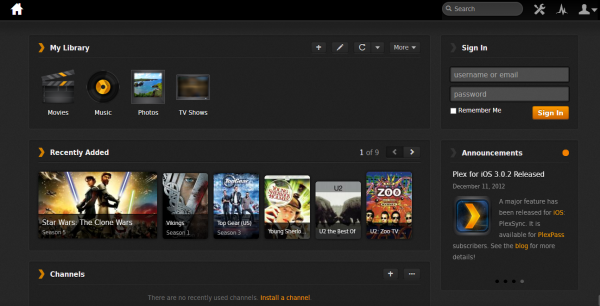
Plex is incredibly simple to set up. You will need to add the media server portion to a home computer, preferably a PC that is always on — never goes to sleep. Once installed the app is controlled through a dashboard in whatever web browser you have set as your default — simply click the icon in your system tray to launch it.
The media server easily allows you to add Movies, home videos, TV shows, music and pictures. Those are pre-set categories, but you can also create your own.
Plex also provides an Android app that is specifically made for Google TV. Simply access the app and you get a clean simple menu for all of the above mentioned categories, along with any you have created.
Both the server and app are free.
Watch and Record TV with PlayOn
If you do wish to watch and record shows through Google TV then PlayOn will fill that need. The service is not free, but very reasonably priced and provides a number of channels such as the basic networks, ESPN, Cartoon Network, CNN, Discovery and many others. It also supports HBO GO, Netflix and Amazon. For an additional annual fee you can record shows to the cloud DVR for later viewing.
PlayOn is compatible with many devices — pretty much any that support DLNA. In fact, for a good price you can purchase a Roku with PlayOn pre-installed, along with a subscription included.
More Apps
Both Amazon and Netflix, depending of which you prefer, work on Google TV. Version 3 of the operating system brings a native Amazon Prime app, which is a huge deal for those of us who use Prime as our movie and TV show platform of choice.
Pandora also makes a native app for the operating system. Like other apps, you need only sign in one time. If your audio is output through a receiver with external speakers then this is especially nice.
There are launchers, like Open Launcher for Google TV, if you prefer to change the look of your set top box. There are also other video sources like Redux TV and more.
What apps do you prefer on your Google TV? I am always on the lookout now for cool new ones, so let me know in the comments below.
If you were to ask any professional racing driver if they were afraid of any car, the probability of them saying “Yes” would be very small. Alexander Rossi, the reserve driver for the Caterham F1 Team is no exception. At 22-years old he’s one of the youngest in the sport and looks to have a long, fruitful career ahead of him. However just for shits and giggles Rossi was recently given the opportunity to climb behind the wheel of a machine that was 24 years his senior. The car was Jim Clark’s 1967 Lotus 49, and while new to Rossi, he wasted no time in flogging it around the new Circuit of the America’s in Austin, TX. Check out Road & Track’s video below.
It was a busy week for our startup, social, and mobile readers — all eyes were on Palo Alto on Thursday, as the Zuck took to the stage to announce Facebook Home launcher for Android devices, dispelling earlier rumors that the social network would release its own phone – at least, for now. Meanwhile, over on GigaOM Pro, our analysts have been getting smart: this week’s featured research includes a flash analysis on the future of the smart watch, a deep dive into big data and smart grid technologies, and more.
Note: GigaOM Pro is a subscription-based research service offering in-depth, timely analysis of developing trends and technologies. Visit pro.gigaom.com to learn more about it.
“The time has come for software development to tackle the smart grid,” declares Analyst Adam Lesser in his latest research report. Now that we’re collecting petabytes of energy-use data from millions of connected devices, companies working in home energy management, building energy management, and utilities must leverage new, affordable big data tools to monitor and impact energy usage. As solar has given cleantech investment a bad name, software (and, to a lesser extent) hardware startups are offering a new range of products meant to increase efficiency of a fossil fuel source, as opposed to advancing renewable energy options. Lesser analyzes the risks and opportunities for these companies and highlights the major trends and takeaways from the companies already working in the space, such as Nest, Opower and ENBALA.
With the success of projects like the Pebble watch on Kickstarter, followed by rumors that Apple might release its own device, the smart watch is no longer a gimmicky sci-fi gadget. Instead, early offerings from startup companies (or recipients of crowd sourced funding) have proven that there is interest and excitement from consumers, investors, and larger consumer products companies. Analyst Michael Wolf looks at the results of a reader survey conducted last month across GigaOM and GigaOM Pro, summarizing responses about smart watch price points, feature requests, and use cases and adoption rates, among other data points. The report also goes on to look at the Pebble’s market position in relation to potential offerings by giants like Apple and Samsung, as well as the company’s prospects in the near term future.
In his latest weekly update, Analyst Stowe Boyd looks at the changing nature of work in the American economy. Looking at recently-released data from the New York Federal Reserve, Boyd notes that since 1975, major shifts in labor — from manual, routine jobs towards nonroutine, knowledge-based work – has increased by about 20 percent. Boyd looks at how this shift is affecting operations, culture, and structure in the workplace at large.
There’s no one way for a film to get made, or a filmmaker to be discovered — but proving that you know how to direct something, even a short film, seems like a good way to start.
The latest example of a short film evolving into a feature length project is The Raven, which began life as a 2010 online video directed by Ricardo de Montreuil, and is now in development as a feature film for Universal. The premise: A telekinetic rebel with some sweet parkour skills goes on the run from a futuristic LAPD.
While the film was originally being developed as a vehicle for producer Mark Wahlberg, Deadline reported this week that The Raven is looking to sign Hunger Games star Liam Helmsworth for the lead — bringing the dystopian sci-fi action project that much closer to multiplexes.
Here are some key takeaways from The Raven‘s success:
You never know what will get you some attention
De Montreuil is an established director on the festival circuit, having already directed three feature films, including the 2008 Mancora, which was screened at both the Sundance and SXSW film festivals. But it’s this $5,000 short, shot in 48 hours, that pushed him towards directing his first big studio picture.
While a Portal feature remains elusive, the buzz that resulted lead Trachtenberg to another project — directing the adaptation of Y The Last Man, an award-winning graphic novel series that has equal fanboy appeal.
The Raven is more likely on the Blomkamp track than the Trachtenberg track, but even if a feature version is never produced, De Montreuil has gotten his foot inside the door.
But the deal with Universal didn’t come through until July 2010, and between then and now there have been few updates. Even for projects that could technically be considered success stories, the pace of the studio system requires no shortage of patience.
Put it all out there
The Raven was released simultaneously on both YouTube and Vimeo, and across both sites the description is simple and to the point — it lays out the project’s logline, the cast and crew, the tools used to create the short, and a contact email for the creator.
And the most important fact laid out is the budget for the project: $5,000, which is impressive given the level of digital effects involved.
In addition to the short film, the official Facebook page contains news updates and concept art for the future tech featured in the project, and a short behind the scenes video showcases some of the stunt work that gives the project a human edge.
All of this leads to a concept of the short film as more than a short film — as a prototype for a much larger project. Which, for filmmakers interested in this approach, is the most valuable takeaway of all.