Category: News

  • The Chilling World of Goosebumps and Frisson [VIDEO]

    We know why we get goosebumps – scientifically speaking. But there are a lot of different external causes for our internal response. Everyone has experienced goosebumps from being cold, for instance. And most of us have experienced another oddly-enjoyable sensation associated with the response:

    Frisson. Or, those chills you get when you’re listening to a music. Is it because the music is so beautiful? Is it because you recognize it from childhood? AsapSCIENCE looks at another theory that has to do with fear. Fear, you say? Yes.

    [AsapSCIENCE]

  • Microsoft may merge Windows RT into Windows Blue

    Windows Blue Details Windows RT
    Microsoft (MSFT) and its manufacturing partners have aggressively pushed the ARM-based Windows RT platform to consumers, however sales have remained flat. According to a report from Digitimes, the company may no longer offer devices under the Windows RT line and will instead merge the operating system into the next version of Windows, code-named Windows Blue. Although Windows RT devices include the same Metro interface as Windows 8, the operating system does not support legacy Windows applications, and also suffers from compatibility issues and a poor selection of apps. These features, or lack thereof, have resulted in confusion among new computer buyers. The latest rumors suggest that Microsoft will announce Windows Blue at its Build developers conference on June 26th in San Francisco.

  • Fay Kanin Dies; Screenwriter Was 95

    Famed Hollywood screenwriter and producer Fay Kanin has died. She was 95.

    Kanin gained fame along with her husband, Michael Kanin, in the 1940s and 1950s while writing screenplays for classic movies such as Sunday Punch, My Pal Gus, and The Opposite Sex. She and her husband were nominated for a best original screenplay Academy Award for the 1958 movie Teacher’s Pet, which starred Clark Gable and Doris Day.

    Kanin went on to produce movies and stage productions, including a 1959 adaptation of Akira Kurasawa’s Rashomon. In 1979 she became the president of the Academy of Motion Picture Arts and Sciences, a title she held until 1983.

    Though the details of her death have not been released, the Academy has released a statement regarding Kanin’s death:

    The Academy is deeply saddened by the passing of our beloved former president and Oscar-nominated screenwriter Fay Kanin.

    She was committed to the Academy’s preservation work and instrumental in expanding our public programming. A tireless mentor and inspiration to countless filmmakers, Fay’s passion for film continues to inspire us daily.

    Our prayers and condolences go out to her loved ones.

    (Image courtesy the Academy of Motion Picture Arts and Sciences)

  • Google Pledges Not To Sue Open Source Distributors Over Patents

    Google announced the ‘Open Patent Non-Assertion’ Pledge today, saying that it pledges not to sue any user, distributor or developer of open-source software on specified patents, unless first attacked.

    “We’ve begun by identifying 10 patents relating to MapReduce, a computing model for processing large data sets first developed at Google—open-source versions of which are now widely used,” says Senior Patent Counsel Duane Valz (pictured). “Over time, we intend to expand the set of Google’s patents covered by the pledge to other technologies.”

    On the pledge site, Google maintains a list of pledged patents, which include: System and method for analyzing data records, Large-scale data processing in a distributed and parallel processing environment, System and method for efficient large-scale data processing, System and method for analyzing data records, Joining tables in a MapReduce procedure, Processing data in a MapReduce framework, System and method for analyzing data records (another one), System and method for large-scale data processing using an application-independent framework, Joining tables in a MapReduce procedure (another one), and Processing data in a MapReduce environment.

    Google says it hopes the pledge will serve as a model for the industry. We’ll see.

    As far as Google is concerned, the benefits of the pledge are: transparency, breadth, defensive protection and durability.

    “Our pledge builds on past efforts by companies like IBM and Red Hat and the work of the Open Invention Network (of which Google is a member),” says Valz. “It also complements our efforts on cooperative licensing, where we’re working with like-minded companies to develop patent agreements that would cut down on lawsuits.”

    Google notes that it will also continue to support patent reforms to improve patent quality and reduce “excessive” litigation.

  • An In-Depth Guide for Data Center Transformation

    The modern data center consists of numerous various vital components all working together to facilitate the delivery of information. Now, more than ever before, the data center has truly become the heart of any organization. Big or small – the current growing reliance on data center environments is evident. During this growth, many administrators began to adopt technologies which directly revolved around efficiency. In some cases it was better cooling systems and power capabilities – in other cases is efficiency revolved around high-density computing platforms.

    Now, many data centers are being tasked with new types of technological requirements. This can range from hosting a virtual desktop infrastructure to running a cloud platform. Many organizations are now adopting some type of cloud model. Whether it’s public, private, hybrid or community – businesses are seeing benefits in a cloud computing platform. The bottom line is this: To truly transform your data center you will need a holistic framework.

    cisco2

    In Cisco’s comprehensive guide, we are able to see the roadmap for a successful transition so that your organization can identify and achieve business goals. The conversation revolves around Cisco Domain Ten. Domain Ten can be applied to a diverse range of data center projects — from cloud and desktop virtualization to application migration and is equally applicable whether your data center is in enterprise businesses, public sector organizations or service providers.

    Download this guide to better understand the data center transformation process and all of the key steps along the way. Cisco’s comprehensive framework allows the administrator to ensure key aspects are considered and where appropriate, action can be taken as you plan, build and manage your data center project.

  • Liberty Global buys minority stake in Dutch ISP Ziggo for $810M

    Liberty Global, which became the largest ISP outside China when it bought Virgin Media in February, has made another investment in Europe, this time by buying a stake in Dutch cable operator Ziggo.

    Ziggo is the largest cable provider in the Netherlands. Liberty announced on Thursday that it had picked up 25.3 million shares in the ISP at a total value of €632.5 million ($810.2 million), giving it a 12.65 percent stake.

    This is not Liberty’s first Dutch investment. Indeed, it is also the owner of UPC — founded in the Netherlands — which provides broadband services across 10 European countries, namely the Netherlands, Austria, Ireland, Belgium, Germany, the Czech Republic, Poland, Slovakia, Switzerland and Romania. In the Netherlands, UPC is the second-largest cable provider. Liberty also holds a majority stake in Belgium’s Telenet and maintains a European content division called Chellomedia.

    According to Thursday’s statement:

    “Liberty Global considers the acquisition of this minority stake in Ziggo as an attractive opportunity to make a strategic investment in a market where it already enjoys a sizeable presence through its UPC Netherlands subsidiary. The Purchase Price is also financially attractive given the stock’s approximate 7.4 percent dividend yield, which is implied by Ziggo’s expectation that it will pay €370 million of dividends during 2013.”

    Related research and analysis from GigaOM Pro:
    Subscriber content. Sign up for a free trial.

  • Students Speak: The Power of STEM

    Earlier this month, President Obama met with 40 of the nation’s top scientists and engineers—discoverers of new drug candidates to treat common cancers; inventors of tools to help surgeons in the operating room; developers of complex algorithms that can help robots navigate; and more. All of these innovators were finalists in the 2013 Intel Science Talent Search competition, and all of them are still in high school.

    These students are living proof that with the right skills, tools, and opportunities, innovation and discovery can happen at any age. That’s why the Obama Administration is placing a stronger emphasis than ever on equipping the next generation of American innovators in science, technology, engineering, and math—the “STEM” fields.

    read more

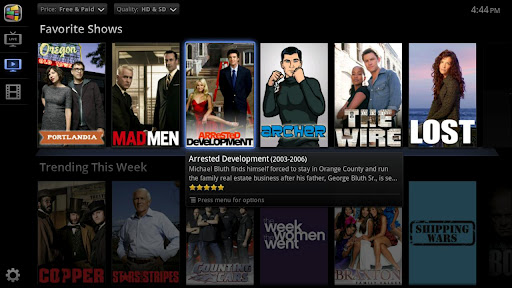
  • Google TV PrimeTime adds Amazon Prime, HBO GO and Netflix subscriptions

    I love Amazon Prime. If I had a Kindle I would probably love it even more, if that were possible. Over the past two weeks I have also come to love my new Google TV, which has taken over our living room, with control of the DirecTV DVR and apps thrown in to boot. One of those apps is Amazon and I use it quite often, keeping a string of movies and TV shows in my watch list.

    Now the Google PrimeTime app for Google TV has been updated to version 1.4.3-43-79424. This innocuous little name actually comes with a huge feature update. Not only has Amazon Prime content been rolled into the service, but you can control it and Netflix and HBO GO subscriptions from within the app as well.

    With this update, Google PrimeTime is now a truly one-stop shop for pretty much all of your content. With Netflix, HBO GO, Amazon Prime, YouTube, cable or satellite box shows and a bunch of other services.

    Google also added an update to its Play movies and TV app that mimics Amazon’s X-Ray. Ben Serridge, the Product Manager for Google Play, says “when you’re watching a film on your tablet, simply press pause and cards will pop up with information about actors on screen. You can tap on an actor’s face to learn more about him, like his age, place of birth, his character in the movie, and his recent work, or scroll through the info cards to learn more about the movie or soundtrack. When you resume the movie, the cards will disappear”.

    While that update is currently only for mobile it seems a logical next step is to add it to Google TV as well. Google’s foray into the living room started rather slowly as the Logitech Revue offering fell flat on its face, but remember that Android thing got off to a rather slow start as well.

  • Colt McCoy Rumor Has Him On Trading Block

    The Cleveland Browns have not historically had a lot of luck at the quarterback position. It seems as though finding the right leader for their offense is a never-ending struggle. They just signed Jason Campbell, who is said to be in competition for the starting job with Brandon Weeden. Campbell, who has played with the Raiders and Redskins, seems like a longshot for the franchise QB the team is looking for as far as many fans are concerned. The Browns went 5-11 in 2012 under Weeden.

    Colt McCoy is another quarterback the Browns drafted not all that long ago, and fans are wondering what’s next for him now that the team has Campbell. Rumor has it that McCoy is on the trading block, but it’s hard to say what the market is like for him He had success as a college player, but not so much in the NFL.

    NFL.com reported on Wednesday that McCoy won’t be cut, for now, but a trade is possible. “It sounds like the Browns will exhaust all opportunities to get something in return for McCoy before letting him go,” wrote Gregg Rosenthal.

    Here’s how the conversation is looking on Twitter:

  • AT&T Opens Galaxy S 4 Preorders On April 16, Will Cost $250 Under Contract

    The Samsung Galaxy S 4 is one of the most anticipated smartphone launches of the year, and AT&T wants consumers to know that it will be the first carrier to start offering the device. In fact, consumers can start preordering it next month.

    AT&T announced today that Galaxy S 4 preorders will start on April 16. If you go for a two-year contract, the price will come in at $250. There’s no mention of the off contract price, but expect it to be expensive.

    There’s no word on when the phone will actually launch, but you can probably expect to see it in May. That’s at least what T-Mobile thinks as the company’s CEO said the device would be launching on its network on May 1. If true, we could see a late April launch on AT&T.

    There has been nothing but radio silence from the other carriers in regards to their Galaxy S 4 plans. You can probably expect to see a Verizon launch not soon after the AT&T launch though. The price should remain pretty consistent across all carriers as well.

    If you’re dead set on getting the Galaxy S 4 with AT&T, you can set up shop at the carrier’s landing page. You can also give ‘em your email address so you know exactly when preorders open for the new device.

    [h/t: Engadget]

  • In Texas, A Stampede of Petaflops

    stampede-1-470

    The Stampede supercomputer is housed in nearly 200 cabinets in a new data center at the Texas Advanced Computing center in Austin. (Photo: TACC)

    In its first days of operation, the new Stampede system at the University of Texas at Austin’s Texas Advanced Computing Center (TACC) debuted as the world’s seventh-fastest supercomputer. But there’s plenty more power in the pipeline.

    For its first outing on the prestigious Top500 list, Stampede harnessed 6,400 nodes with two Intel Xeon E5 processors each, recording a speed of 2.6 petaflops. The pending addition of 6,880 Xeon Phi coprocessors, which currently in user evaluation mode, would add more than seven additional petaflops of performance to Stampede. With a theoretical peak performance of nearly 10 petaflops (10 quadrillion mathematical calculations per second) Stampede would sit comfortably in the top four supercomputers in the world.

    Stampede is a massive Dell/Intel cluster, and is a centerpiece of the National Science Foundation’s investment in an integrated advanced cyberinfrastructure. The system also features NVIDIA GPUs for remote visualization, a Lustre file system, Mellanox InfiniBand networking, 270 terabytes of memory, and 14 petabytes of storage. The data center housing Stampede is 11,000 square feet and consumes an average 3 megawatts of power.

    Coprocessors like Intel’s Xeon Phi supplement the performance of the primary processor, and have become a common feature in the fastest supercomputers.  Phi is the new brand for products using Intel’s Many Integrated Core (MIC) architecture for highly parallel workloads.

    Yesterday Stampede was formally introduced to the public at a dedication ceremony at TACC. The system, which began operating on January 7, has successfully executed more than 450,000 computational jobs to date.

    Powering New Scientific Research

    The supercomputer has enabled research teams to predict where and when earthquakes may strike, how much sea levels could rise, and how fast brain tumors grow. It allows scientists and engineers to interactively share advanced computational resources, data and expertise to further research across scientific disciplines. Some of the early research examples Stampede has completed includes seismic hazard mapping, ice sheet modeling to study climate change, improving the imaging quality of brain tumors, and carbon dioxide capture and conversion.

    “Stampede has been designed to support a large, diverse research community,” said TACC Director Jay Boisseau. “We’re as excited about Stampede’s comprehensive capabilities and its high usability as we are of its tremendous performance. Stampede will lead the way to major advances in all fields of science and engineering. It’s an honor to be at this intersection of advanced computing technologies and world-class science, and we thank NSF, Dell, and Intel for their roles in helping TACC design, deploy, and operate Stampede.”

    NSF Directorate for Computer and Information Science and Engineering Farnam Jahanian helped dedicate Stampede, with help from U.S. House Science, Space, and Technology Committee Chairman Lamar Smith and representatives from Dell, Intel, UT Austin and TACC.

    “Stampede is an important part of NSF’s portfolio for advanced computing infrastructure enabling cutting-edge foundational research for computational and data-intensive science and engineering,” said Jahanian. ”Society’s ability to address today’s global challenges depends on advancing cyberinfrastructure.”The base Stampede system has been accepted by NSF, and has successfully executed more than 450,000 computational jobs to date. The supercomputer has enabled research teams to predict where and when earthquakes may strike, how much sea levels could rise, and how fast brain tumors grow. It allows scientists and engineers to interactively share advanced computational resources, data and expertise to further research across scientific disciplines. “

  • BlackBerry subscriber bleed turns into an arterial gush

    BlackBerry Subscriber Loss
    BlackBerry’s (BBRY) fourth-quarter earnings were a bundle of such extreme opposites that they literally stunned Wall Street. Many expected huge price swings, but as of 10:27 a.m. on Thursday, the share price is up 1.8%. Investors are having trouble figuring out whether to giggle with glee over the big Z10 shipment number or shriek with horror over the massive subscriber loss.

    Continue reading…

  • Compelled To Forever Wander, The Nomad Is An Espresso Machine That Gathers No Moss

    8c82e1_cc49b4e77c0767d47a8024266fbdac32.jpg_srz_445_415_75_22_0.50_1.20_0

    It’s not as compact as an Aeropress, but the Nomad looks like a solid way to get an espresso shot from a small device. The tiny machine, which is currently on Kickstarter, boasts the same principles used in full-sized espresso machines. The Nomad is just a lot smaller, more efficient, and doesn’t require any power making it rather portable — hence the name.

    The company is looking for $100,000 on Kickstarter. Pledge $165 to pre-order a Nomad. It’s available in black and green. I’m in for one.

    As the videos show here, the shots seem smooth and proper. By using pressure from dual micro chambers, the Nomad can apparently achieve the same results as a full-size lever espresso machine.

    To me the Nomad doesn’t seem all the portable but rather movable. I doubt I would throw this in a backpack like I do with my Aeropress, but it seems perfect for a roadtrip. If the small Nomad can make a fine shot of espresso, which it seemingly can, it could quickly become a must-have for small kitchens and the like.

    [Darrell “Wordslinger” Etherington contributed to this post]

  • Although 98% Know It’s Dangerous, Adults Are Texting & Driving More Than Teens

    If you think that teens are the most distracted drivers out there on the road, think again. It appears that adults are not only on par with but are actually worse when it comes to one particular high-risk highway activity.

    AT&T has a new survey out as part of its “It Can Wait” anti-texting while driving campaign. This one looked at the text while driving problem with commuters – adults going to and from work.

    And the results may surprise you. The survey, which looked at over 1,000 commuters, showed that 49% admit to texting while driving. That’s more than teens, who are texting and driving at a rate of 43%, according to a previous AT&T study.

    In that study, 77% of teens said that although adults warn them of the dangers, most of them “do it themselves all the time,” so we probably should’ve seen these results coming.

    According to the survey, the texting and driving problem is actually getting worse in adult commuters. 60% said that they never texted while driving three years ago. And a whopping 98% said that they knew it was dangerous to text while driving, but do it anyway. 95% acknowledged that just reading an incoming text while driving was also wrong.

    “Businesses can help keep their employees and others on the road safe by encouraging responsible behavior behind the wheel, including obeying all laws related to the use of electronic devices,” said U.S. Chamber of Commerce President and CEO Thomas J. Donohue. “We also encourage all businesses to consider joining the ‘It Can Wait’ movement to end texting while driving. Together we can help turn the tide on this serious issue.”

    As of today, 39 states ban texting while driving for all drivers, and another 6 ban the practice for novice drivers. Still, these surveys make one thing clear – awareness campaigns are fighting an uphill battle. Nearly everyone (98%!) knows that it’s dangerous to text and drive, but nearly 50% do it anyway. Sure, knowing is half the battle. But people know – and it seems, at least for now, that they don’t care.

  • Social Media App Updates for BlackBerry 10: Facebook and Twitter

    I’ve got some awesome news for those of you who just picked up your new BlackBerry Z10 in the US and for you old pros around the globe. Facebook and Twitter have been updated for BlackBerry 10. What I love, is that with each update, we’ve added some new features that make it easier for you to stay connected and do more with social media on your BlackBerry 10 smartphone. Check out each section below for a summary of new features and improvements and be sure to swing by the BlackBerry World storefront where each of these updates are available as a free download.

    Facebook version 10.0.1 New Features

    • Friends Nearby – Now, Facebook for BlackBerry 10 allows you to discover if your Facebook friends are nearby. You’ll be able to see when they’ve checked in on Facebook to a location that’s close to where you are.
    • Photo Updates – There are new ways of interacting with your Facebook photos. Now you can now easily add photo tags to a photo you’re uploading within the Facebook application. Plus if you like that photo or funny picture your friend just shared on Facebook, you now have the ability save Facebook photos locally on your BlackBerry 10 smartphone.
    • Events – This improvement is designed to make it even easier to plan and keep track of your events. You can now view and respond to events, invite your friends to attend, create and view posts on the event wall, post photos, and even tag guests.
    • Sharing – Sharing information is at the core of BlackBerry 10 and now it easier than ever to share what matters to you with all of your contacts. Using the BlackBerry 10 share framework, you can now easily share links from your Facebook newsfeed to BBM, email, SMS, Facebook Twitter, and others.

    Twitter version 10.0.2 New Features

    • Your Connect Tab – View all interactions in one place, including new follows, favorites and mentions.
    • Enjoy More Content – Take a look at photos, article summaries and other updates within your Tweets.
    • Added Perspective – See the number of times a Tweet has been favorited.

    Check out these updates now and get tweeting, liking and sharing on your BlackBerry Z10.

    Download Facebook for BlackBerry 10

    Download Twitter for BlackBerry 10

    Please note the app may take up to 24 hours to appear in the BlackBerry World Storefront.

  • Escape the Moore’s-Law Traffic Jam

    When it comes to microchips — the miniature machines that run so much of our lives — innovation has driven us farther than we ever thought possible. The rate of semiconductor innovation is slowing, however, the way traffic on a freeway bottlenecks as lanes diminish.

    When Gordon Moore, the cofounder of Intel, asserted nearly 50 years ago that the number of transistors on integrated circuits would double roughly every two years, he was charting a path for the company that would dominate the industry — and dictate the direction of technology — for decades. Lately, much ado has been made of the coming end of Moore’s Law, although the law was never an inflexible law of physics but more like a rule, a likely way forward.

    Intel’s superior manufacturing prowess in the early years of computing technology allowed the company to move the goal posts for everyone: Every 18 to 24 months, Intel would double something — performance, storage — and the rest of the industry would scramble to keep up, locking in Intel’s dominance. Essentially, Moore created the conditions for his law to hold true — until today, as the laws of physics limit engineers’ ability to keep squeezing more circuits onto a chip.

    There, however, is a possible “off-ramp” to Moore’s Law that offers new hope — not just of continued improvement in semiconductors but of an open, competitive playing field unlike the Intel-dominated landscape of the past half century.

    To understand where the industry is today and where innovation is headed, it’s helpful to think of the microchip as a metropolitan area and its components as buildings.

    Decades of innovation have made the components of a microchip smaller and smaller. Yet chips have grown larger as more and more components are packed onto them to meet increased computing needs — making the interconnections between each minuscule part more spread out.

    That “sprawl” is like the suburbs around a city. The same problems that apply to a sprawling metropolitan area apply to the microchip: getting from point A to point B requires increasing time and energy just like driving a congested freeway from a suburban home to a job downtown does. Information travels across bigger microchips with less efficiency at slower speeds, while consuming more power.

    We can’t increase the surface area of microchips much more without running into those problems, and we’re getting closer every day to the limits of how small we can make components. So what next?

    The trend in urban development today is to build up, bringing people back into city centers and transforming suburbs into functioning city units where jobs, shopping, and homes are as closely connected as possible. That idea applies to microchips in the form of three-dimensional interconnect. It’s the off-ramp to Moore’s Law: In 3D interconnect, engineers stack wafers like the floors of a skyscraper in extreme miniature, with vertical connections (think elevators communicating between floors) in addition to traditional horizontal links.

    What’s especially compelling about this off-ramp, this technological detour, is that it provides an opportunity for companies besides the two usual suspects — Intel and AMD — to compete. Intel has lost its once singular ability to move the goal posts on innovation.

    Although both companies are working towards 3D interconnect, neither has figured out how to volume-manufacture the technology. Two other players to watch closely are Samsung and TSMC. It’s anybody’s race to win.

    There are still technical challenges to resolve, but commercial-scale manufacturing could come as soon as three to five years from now, speeding the pace of innovation again and enabling new ways for the technology industry to be creative.

  • SoftLayer Infrastructure Supports 100 Million Gamers

    softlayer-singapore

    SoftLayer’s Singapore data center (pictured above) provides an international footprint that it key to some of the company’s game developer customers. SoftLayer says its infrastructure now supports more than 100 million gamers. (Photo: SoftLayer)

    SoftLayer now supports more than 100 million active game players online worldwide, and has added 60 new gaming companies to its customer list in the last two quarters alone, the company said this week.

    What’s SoftLayer’s secret sauce with gaming companies? In a world in which a couple of milliseconds of lag can be the difference between virtual life and death, and the inability to scale up with demand can kill a new game title, there is little room for failure on the part of the hosting provider. In the game hosting arena, success breeds success, allowing SoftLayer to build organic growth atop its track record.

    The company has built a solid reputation via gaming conferences and word of mouth. “It’s kind of a tight knit space, and they all talk,” said Marc Jones, VP of Product Innovation at SoftLayer. Notable game developers among SoftLayer’s customers include Hothead Games, Geewa, Grinding Gear Games, Peak Games and Rumble Entertainment.

    “Game developers don’t have the time or resources to manage their own complex infrastructure because they need to focus on their core business – developing great games, launching on time and keeping players engaged,” said Jones. “Because we understand the high stakes of their operations, we’ve tailored our cloud platform to meet gaming companies’ demands – from initial game release and explosive, overnight growth, to the performance and availability demands that come with everyday play.”

    SoftLayer provides these companies with the infrastructure to test, deploy, manage, play, and grow their games. SoftLayer’s global infrastructure platform spans more than 100,000 servers in 13 data centers across the U.S. Europe and Asia. The company’s ability to provide bare metal (dedicated servers) combined with a low latency network is key to its its appeal.

    Bare Metal vs. Public Cloud

    “The ability to have hybrid solutions from a bare metal standpoint is perfect for a gaming world with a lot of real time interactions, multi-player and social aspects,” said Jones, “There’s constant communication. A lot of the companies are capturing interaction points to understand how people are engaging, and using this info to help them tailor the experience. Bare metal gives you much better performance than public cloud, and they have the ability to use public to scale when needed during spikes.”

    In most of those cases, gaming companies are running a database on the backend, and that a lot of companies are leveraging NoSQL database options in particular, according to SoftLayer. One example of this is Hothead Games, which has released six games that have hit the Top 10 in both the Apple and Google Play app stores, including the BIG WIN Sports series of games and the recently launched Rivals at War. The company runs their back-end database, Cloudant, on the SoftLayer platform, enabling Hothead Games to scale massively and economically, handling billions of database transactions per-day while delivering a superior experience to gamers.

    “From a compute standpoint, (bare metal cloud) is definitely what we see as an advantage,” said Jones. “On equal footing is our network. Maintaining a private network that interconnects all our data centers is appealing.” The company has its own private network, which allows it to deliver a predictable, low latency experience.

    The company’s international presence is also a selling point. “A lot of our bigger gaming customers have a lot of servers deployed in multiple data centers,” said Jones. “A few customers are active in Amsterdam, Singapore and the US.”

    Gaming Trends

    By all accounts the online gaming vertical continues to grow at a rapid pace. “We definitely see a lot of online games – Facebook style games, social games and mobile applications,” said Jones. “Those are the ones we’ve seen the most in the last six months to a year. We have hundreds of gaming customers, and the size of those customers is usually pretty substantial. They’ll build out that infrastructure, as they get popular.”

    The company can’t disclose its largest customers, but provided examples of mobile, first person shooters (FPS), and MMO (massively multiplayer online) all of which have unique needs.

    The Social Gaming Customer: Peak Games

    Peak Games is the largest and fastest growing company in Turkey, the Middle East and North Africa. With over 200 employees and 45 million gamers, it is one of the largest global social gaming providers. “The ability to add tens of thousands users overnight is the value of working with SoftLayer,” said Safa Sofuoglu, CTO of Peak Games. “SoftLayer understands the needs of game developers. We can very quickly double our infrastructure requirements when one of our games take off, and easily manage and support new users without compromising on performance while not incurring massive costs. SoftLayer gives us the flexibility to utilize what we need without being locked in.”

    THE FPS: Ballistic

    Rumble Entertainment has a first person shooter named Ballistic. With an FPS, low latency is of the utmost importance, with players obsessing down to the millisecond. These are games of accuracy and precision. “We’re expanding our first-person shooter game Ballistic into Asian markets, and we wanted to partner with a cloud service provider that could deliver not only raw computing power but also high-quality network service,” said Jim Tso, senior producer for Rumble Entertainment. “SoftLayer’s data center in Singapore and global network footprint help us overcome any network latency issues, giving our users a great online experience.”

    THE MMO: Path of Exile

    Path of Exile is unique among online action RPGs (role playing games) because players play on one large international realm,” said Chris Wilson, managing director for Grinding Gear Games. ”SoftLayer’s data centers on multiple continents, and the free bandwidth between them, let us run servers local to the individual players while still allowing them to play with their international friends if they choose to,” said Chris Wilson, managing director for Grinding Gear Games. SoftLayer’s ability to provision new servers quickly allowed us to deal with the immense demand we faced when we launched Path of Exile’s Open Beta. We’re extremely pleased with SoftLayer and the server reliability that it allows us to offer our customers.”

  • Kendall Jenner: “Skinny” is an Insult, Too

    Kardashian women are known to have generous hips, but not every member of the family is as voluptuous as Kim. Kendall Jenner, the half-sister of Kim, Kourtney, and Khloé, this week graced the cover of Harper’s Bazaar Arabia, showing off the athletic body she inherited from her father, Olympic decathlete and gold medal-winner Bruce Jenner.

    According to a Daily Mail report, the young model and reality TV star told the magazine that she is “constantly criticized for being too skinny.” She goes as far as to say that she is “trying to gain weight,” but that her body “won’t let it happen.”

    “What people don’t understand is that calling someone too skinny is the same as calling someone too fat,” said Jenner.

    Jenner began appearing on the reality TV show Keeping Up With the Kardashians in 2007 and began her modeling career at age 14. She just celebrated her 17th birthday back in November 2012.

    Jenner has not directly addressed her comments through her social media accounts, though she did post the following cryptic message the day after the Bazaar story was published:

  • New Facebook Games Section For Timeline Goes Live

    At GDC yesterday, Facebook unveiled the Games Developer Center. The hub promises to contain all the information a game developer needs to make games for Facebook or Facebook integrated games for mobile devices. That wasn’t the only announcement, however, as Facebook is also bringing games to the newly redesigned timeline.

    Facebook announced that it will begin rolling out the new Games section to timeline and users’ About pages. The section will only appear for those who have played one or more social games in the past 30 days, or those who have liked at least one game on Facebook.

    New Games Section For Timeline Goes Live Today

    It should be noted that the Games section contains the same privacy controls as other sections on timeline. A user can mark a game’s app privacy to “close friends” and only those designated as such will be able to see the game on their timeline.

    If you want your game to be a little more special, developers can use Open Graph to create a stand-alone app section for their game. Players can then place the game in its own section of timeline for all to see. You can learn more about that here.

    As for the weekly bug report, Facebook says that 33 bugs were fixed while 60 were assigned for further review. You can check out the full bug fix list at the blog post.

  • Standardizing Data Center Education Can Work Wonders

    Tom Roberts is President of AFCOM, the leading association supporting the educational and professional development needs of data center professionals around the globe.

    Tom_Roberts_tnTOM ROBERTS
    AFCOM

    If you’re struggling to fill a job in the data center, you are not alone. With approximately 4 million IT jobs available just in the United States, to say a shortage of qualified people exists today is an understatement. It has created a worker’s market with only 4 percent unemployment in the technology sector—about half the overall jobless rate.

    This shortage exists for any number of reasons:

    • Graduates from universities and two-year tech schools entering the workforce are greener than a solar-powered data center and require far too much on-the-job training.
    • Those currently employed in IT seem to be staying put because they like what they’re doing and companies are no longer in layoff mode.
    • Others have reached or are rapidly approaching retirement and taking their decades of experience with them.
    • High-profile companies like Facebook, Google and Apple seem far more “sexy” than traditional corporations and directly compete with attracting the best and brightest from the younger generation.

    I believe the best way to conquer all of the above challenges is to standardize the education path for data center professionals. Treat those in the industry just like the architects, engineers, school administrators, mental health professionals and social workers who must adhere to rigorous CEU requirements to move up the ladder or stay qualified.

    The source of education is secondary; it can be gained through tech schools, conferences or corporate America. This will help boost standardization with respect to career paths, job descriptions, and skillsets.

    Here’s what I would like to see happen. In addition to being president of AFCOM, I’m chairman of Data Center World, a conference and trade show for data center professionals. For the first time we are offering attendance certification for those who attend our educational sessions. Then, in the near future, these records of attendance can be used as CEUs to supplement their current certification(s) obtained from the leading data center education companies (EPI, ICOR, C-Net Training, IDCP, etc.).

    As an association with a goal of advancing data center and facilities management professionals, AFCOM’s role is to provide ongoing education like it has for more than 30 years. I think it makes a lot of sense to work hand-in-hand with these companies so that education gained from conferences also count toward specific career goals/paths.

    If we can cross-track and document education from all different sources and provide an easy way for data center professionals to access a composite list, it would be a win-win for those recruiting and looking for work.

    Right now, inconsistencies are far too common. Two companies may be recruiting for a person to fill the same position, i.e. facilities manager, but the actual responsibilities and needed skills don’t match up. No two IT job descriptions are the same. You may attract a person with a mechanical engineering degree and some who fixes furnaces with the same advertisement. I read that the typical time-to-hire process for an individual IT resource is 55 days. Who has that kind of time?

    Change never stops in this industry, and now more than ever, you must keep your data center current or fall behind. The fact that so many companies can’t seem to find the right people with the right skills is a disaster waiting to happen.

    Let’s all work together to make sure it doesn’t.

    Industry Perspectives is a content channel at Data Center Knowledge highlighting thought leadership in the data center arena. See our guidelines and submission process for information on participating. View previously published Industry Perspectives in our Knowledge Library.