Category: News

  • Why Apple doesn’t need a cheap iPhone if T-Mobile does it for them

    Does Apple need a cheaper iPhone to attract entry-level smartphone buyers? T-Mobile may have just found a way to do it for them here in the U.S.

    The idea that Apple needs to produce a phone that attracts buyers that can’t or won’t lay down $200 up front for a smartphone in addition to a monthly carrier contract has been touted as a way for Apple to regain its momentum in smartphones. The thinking is that Apple has nearly saturated the upper end of the market in established markets, causing its yearly iPhone sales growth to slow somewhat. The real growth, some say, will come when Apple convinces people who’d otherwise opt for the cheapest phone that comes with their plan to buy an iPhone instead.

    T-Mobile’s headline-grabbing $99 unlocked iPhone 5 may be one way of getting there. When you do the math – the $99 upfront payment T-Mobile requires plus 24 months of monthly payments at $20 – the total adds up to $580. That’s less than the $650 Apple charges for an iPhone that’s not locked to a specific carrier. And in addition to those savings, T-Mobile is also offering cheaper monthly plans, as my colleague Kevin Fitchard has detailed.

    For some people these prices will put the iPhone in their grasp. But it’s still not exactly cheap: what T-Mobile is offering is still probably a couple hundred dollars more than what analysts have suggested would count as a true “low-cost” iPhone.

    It is actually possible to pay even less for an iPhone from a major U.S. carrier: the nearly 3-year-old iPhone 4 is free on contract in the U.S. and the iPhone 4S is $99 on contract. But T-Mobile is actually making the latest-model iPhone cheaper.

    T-Mobile’s plan may stand out from the likes of Verizon, Sprint and AT&T, but if you look outside of the U.S., what it’s doing is not all that novel: it’s just a payment plan. It shifts the cost of the device over two years in place of a higher upfront cost or a subsidized, locked device. If you look at what Apple does in some developing markets like China and India, it looks very similar. Apple has used no-interest or low-interest payment plans as a way of helping give customers, who might not otherwise be able to swing an expensive smartphone, a way in.

    At surface level, this plan is about T-Mobile finding a way to attract new customers. But there’s also potentially interesting benefits for Apple too. It doesn’t just get yet another iPhone carrier partner, it might also be getting a new look from U.S. customers from that coveted “lower end of the market” that formerly wouldn’t have considered an iPhone because of the pricier subsidized, locked carrier models.

    Apple executives have been careful to say that “cheap” smartphones will never be “the future of Apple’s business.” But maybe, if T-Mobile’s experiment works, more creative pricing plans will be.

    Related research and analysis from GigaOM Pro:
    Subscriber content. Sign up for a free trial.

  • IER Study Could Point Way for Policymakers in Transportation Bill

    WASHINGTON D.C. — As lawmakers prepare for coming discussions about the best way to fund the federal government’s behemoth transportation and infrastructure legislation, a recent study by the Institute for Energy Research could provide a significant negotiating point for congressional …

  • Reaching Across Cultures Without Losing Yourself


    Andy Molinsky, author of Global Dexterity, explains why it’s important to customize your behavior in a new cultural setting.

  • Don’t Expect The Next Windows To Actually Be Called Blue

    For the past few months, it’s been rumored that the next operating system from Microsoft would be called WIndows Blue. It sounds like a code name, and Microsoft suggests that will remain the case.

    In an update on the Official Microsoft Blog, Frank X. Shaw, Corporate Vice President of Corporate Communications, updated us on what the company has planned for this year. He pretty much confirmed that Windows Blue would be part of those plans even if he wasn’t exactly forthcoming:

    With a remarkable foundation of products in market and a clear view of how we will evolve the company, product leaders across Microsoft are working together on plans to advance our devices and services, a set of plans referred to internally as “Blue.” – N.B. chances of products being named thusly are slim to none. And don’t start with the “so you’re telling me there’s a chance” bit.

    The most interesting takeaway from this is that Shaw says “Blue” refers to “devices and services.” The services would obviously be stuff like Windows Blue for desktops and phones, but what about devices? Is Microsoft readying all new Surface tablets, or could it be the oft-rumored Surface phone?

    Shaw also hinted that the rumor of Windows Blue taking the operating system into an annual release cycle is more than just fantasy:

    Our customers have already experienced the ongoing rhythm of updates and innovations over the past six months including new devices, new apps and services, better performance and new capabilities. This continuous development cycle is the new normal across Microsoft – we’ll tune everyday experiences as well as introduce bold, connected and exciting new scenarios.

    So, when we will start hearing more about Windows Blue? Shaw hints that developers may see some of the stuff Microsoft has planned at Build 2013, Microsoft’s annual developer conference that’s set to take place on June 26.

    [h/t: PCMAG]

  • Introducing new solar gear that could change the game

    Inverters are the silent workhorses that convert power from devices like solar panels and batteries into usable power. There’s been considerable innovation around solar panel inverters in recent years, as some solar roofs have started moving from a single large central inverter to smaller “microinverters” embedded on each panel. But now year-and-a-half-old chip startup Empower Micro Systems has been pushing that solar inverter innovation even farther and has developed a new low voltage solar microinverter based on its new chip designs that it said costs less and is more reliable and efficient than the current ones on the market.

    Empower Micro Systems CEO Jon Bonnano told me that the company’s inverter tech “is a quantum change in how solar is done.” It can be attached to a solar panel system, on the rack or the frame, or embedded at the individual solar module level. Bonnano says the inverter is five times more reliable, five percent more efficient and costs 20 percent less than traditional “string” inverters, which have been used for decades. The potential of a lower inverter cost, is that the entire cost of the solar system could be lower, in addition to the recent dramatic drop in solar module prices.

    Empower Micro Systems doesn’t plan to manufacture the inverter box itself. The company is a fabless chip firm and it sells its integrated circuits and architecture design to manufacturers like inverter makers and solar module producers. In that respect it’s adopting Intel’s mode, churning out the chips inside the inverter devices.

    Bonnano is pretty confident of the disruptive power of the inverter tech, called the “Universal Micro Power Inverter.” He thinks it can “replace all solar inversion options, hands down.” The key technologies of the inverter are how the system on a chip synchronizes and controls the power flow at a low voltage, as well as the design of the inverter box itself.

    Enphase Energy's tech

    Enphase Energy’s tech

    Microinverters use energy storage tech to temporarily store the DC power from the solar panel and decouple it from the AC grid power. The Empower Micro System’s inverter uses a next-gen solid state capacitor for this energy storage tech, while other systems more commonly use more traditional liquid-filled electrolytic capacitors.

    The next steps for any startup are bringing this hardware to market. Bonnano says the company has already signed one agreement with a “top-three” module maker, and is in discussions with many more module makers and power supply vendors. Just this Sunday, Bonnano said the company’s field trials went live with solar installers. This year the inverter will be certified and could be produced in pilot production by the third quarter of 2013.

    The technology has attracted a list of angel investors including Jurgen Krenkhe, recent President & General Manager of SMA Americas, Ken Lawler, General Partner at Battery Ventures and Silicon Ventures, Kiki Tidwell, Kauffman Fellow and cleantech investor, and Eugene Zhang, Managing Director at Tsinghua University Executive Entrepreneur Club. Chinese module manufacturers will be key for the company’s market strategy. Empower Micro Systems is currently in the process of raising a $5.5 million series A round.

    There’s a lot of competition in the solar inverter space. Not only are there the new microinverters companies like Enphase Energy, and power optimizer tech from the likes of Solar Edge and Tigo Energy, but also the traditional inverter giants like SMA dominate the market. The company will need to launch and scale to prove a competitive edge.

    But Empower Micro Systems plans are actually even more audacious than just replacing solar inverters. The technology can be applied to energy storage and electric vehicles, and Bonnano says one day down the road they hope to move into those markets, too.

    Related research and analysis from GigaOM Pro:
    Subscriber content. Sign up for a free trial.

  • T-Mobile’s ‘UNcarrier’ initiative is gimmicky but still an improvement from the status quo

    T-Mobile UNcarrier Initiative
    Just as you should always be especially wary of politicians who run for office by claiming that they aren’t politicians, so too should you be wary of profit-seeking companies who claim that they’re not only after your wallet. I mention this particular public relations technique because it happens to be the same strategy that T-Mobile is employing with its “UNcarrier” initiative, a clever attempt to rebrand the company as a consumer-friendly alternative to the twin evil empires of Verizon (VZ) and AT&T (T).

    Continue reading…

  • Samsung Galaxy S 4 ringtones now available for download

    Samsung_Galaxy_S_IV_TA_Hands_On-630x3541


    Hot on the heels of the wallpaper and its beefed up S Voice being leaked for the masses, we now have the Galaxy S 4′s ringtones available. Our friends at SamMobile have obtained the complete ringtone files that are found in the smartphone and comes in at a not too shabby 11 megs in total size. Best of all, the ringtones— much like the wallpaper— are all inspired by Nature.

    We know you’re excited, so hit the link below to grab the files for yourself. Go on— you know you want to.

    Galaxy S 4 Ringtones

    source: SamMobile

    Come comment on this article: Samsung Galaxy S 4 ringtones now available for download

  • Google’s Cutts Talks About Blocking JavaScript

    For the second day in a row, Matt Cutts answers a question from a fellow Googler in a Webmaster Help video. This one comes from Webmaster Trends analyst John Mueller:

    “Googlebot keeps crawling my JavaScript and thinking that text in my scripts refers to URLs. Can I just disallow crawling of my JavaScript files to fix that.”

    Long story short, he wouldn’t advise it. If there’s one individual JavaScript file that’s the source of the problem, you could disallow that, he says.

    Also, don’t block CSS.

    He says, “It turns out, as we’re executing JavaScript, we do look at the attributes, so you can actually use JavaScript, and put like a nofollow attribute on individual URLs, and so it is the sort of thing where you can do link level granularity there. And you can block, for example, and individual JavaScript file, but in general, I would not recommend blocking all of your JavaScript files.”

    Cutts has talked about blocking Google from crawling JavaScript, and how it can hurt your rankings, in the past. Watch that video here.

  • View Instagram Photos on Twitter with This Chrome Extension

    As you may remember, Instagram had a little spat with Twitter that resulted in Instagram disabling all photo integration with Twitter. What that means for Twitter users is that they are no longer able to view Instagram photos when they click to “expand” tweets.

    Instead, users have to click the link inside the tweet to be taken to Instagram.com to view the photos. At the time, Instagram said that it was “the correct thing for our business to do at this time,” and it may have been. But in the end, it’s the users of both services that ended up suffering.

    Anyway, there’s a new Chrome extension you may be interested in if you want to bring back Instagram photos (or at least thumbnail previews) to Twitter.

    It’s called Previeweet, and it’s a simple extension that adds thumbnail preview images to nearly every tweet containing photos.

    Apart from photo previews from Instagram, you’ll also see them from a bunch of other image services like Dribbble, Twitter (pic.twitter.com), Photobucket, Facebook, Apple, Yfrog, Twitpic, Twitvid, Flickr, Imgur.

    With all of the other services (that still have Twitter Card support), clicking on the image itself will open up the image, larger, in an expanded tweet – just like it would if you clicked “expand” instead. But for the Instagram photos, clicking on the thumbnail will take you to the photo’s home on Instagram.com, the same way it would if you clicked the Instagram link instead. So, it’s not perfect, but it does give you a small preview of the photo so you will get a better idea of whether or not you want to click out to Instagram’s site to view it full size.

    All you have to do is install the Chrome extension and fire up Twitter. Previeweet warns that due to the twitter cache, you may need to clear the browser cache to get the preview to appear.

    [via AllTwitter]

  • YC winter demo day: Five startups to watch (morning edition)

    Whether you think the hype around its startups is justified or not, Y Combinator is still one of the most notable Silicon Valley startup incubators to watch. Its bi-annual demo days are important events for both startups and investors in the tech community, with everyone looking to get in on the next Dropbox or Airbnb to come from the group’s ranks.

    This spring marks YC’s 16th demo day, and compared to the first one I covered in August that featured more than 80 companies, today’s smaller batch of 47 looks is presenting at a slower pace that’s certainly easier for investors and the press to digest. But as YC co-founder Paul Graham noted, even if investors can focus a little more because the initial process was more selective, it won’t be that much easier for them to pick winners:

    “It’s going to be just as hard to tell who’s good,” he said. “It’s not because of the format of demo day that it’s hard to tell who’s good. It’s because it’s actually hard to tell who’s good,” he said. “I mean, even we can’t tell who’s good,” he joked.

    About one-third of the startups presenting on Tuesday were presented off the record, which means they’re still in stealth mode and the press agreed not to write about them. The rest of the companies are divided into two batches, one in the morning and one in the afternoon. Here are my five picks from the morning batch that you should take a look at:

    Airware

    Airware is a building a platform for drone software that allows customers to to manage cost-effective, small aircraft. The company allows drone manufacturers to use its hardware and APIs and then focus on the software that’s specific to the industry that requires a drone. The company explains the idea on its website: “Our os-Series Autopilots integrate hardware, tailored to specific needs, with an open architecture. This combination gives our autopilots the flexibility to be used on both development and production aircraft platforms, enabling UAS manufacturers to rapidly develop diverse and innovative UAS for commercial and military applications, while creating and maintaining intellectual property.”

    SimplyInsured

    SimplyInsured aims to provide a Kayak-like service for small business owners who are looking to compare the cost of picking different insurance plans for employees. The company is looking to cut out the traditional insurance brokers who relied on paper, fax, and estimates, and replace that business with a digital process that would immediately provide business owners with quotes. The company is hoping to take advantage of new Obamacare regulations that limit the effect of health insurance brokers, and target businesses that are still in the under-50 employee size.

    Bitnami

    Bitnami describes itself as the “app store for server software,” letting IT buyers have an app store-like experience when purchasing software to run either on the desktop, on company servers, or in the cloud. The company lists employees from companies like MasterCard, General Electric, and Boeing as customers, and said the company is already bringing in “millions” in profit.

    Microryza

    Microryza wants to “turn everyone with a credit card into a modern day patron of science,” as co-founder Cindy Wu explained. The company has created a crowdsourcing platform that allows individuals to contribute money toward scientific research, bypassing the traditional pathways for funding tenured professors at universities, and instead opening it up to a wider audience of donors. Bill Gates wrote on his blog about the company’s efforts to support scientific research that would benefit developing countries. Wu highlighted several projects that have been funded through Microryza, including a paleontologist who will be doing an excavation and sharing his findings with backers along the way.

    Watsi

    Watsi is a particularly notable startup for Y Combinator because it’s the first (intentional, Graham noted) nonprofit startup to come through YC’s ranks. The company has built a platform where individuals can crowdfund medical treatment and surgeries for individuals, starting with a medical clinic in Nepal but quickly growing to other locations. So far, the site is now funding treatments for up to 17 patients per week.

    Related research and analysis from GigaOM Pro:
    Subscriber content. Sign up for a free trial.

  • Spell Check Improvements Come To Chrome Stable

    A month ago, Google announced Chrome 26 Beta with improved spell check capabilities as it refreshed the dictionaries the browser’s default spell check uses, and started supporting proper nouns. It also started supporting Korean, Tamil and Albanian.

    Spell Check

    Google announced the improvements to the stable release today.

    “In addition, users who add custom words to the dictionary can now sync their settings to bring those changes to all the devices where they use Chrome,” says Google software engineer Rachel Petterson.

    The ‘Ask Google for suggestions’ spell checking feature, powered by the same technologies used by Google search, now supports grammar checking, proper nouns, homonyms, and context-sensitive spell checking in English,” she adds.

    Windows, Linux and Chrome OS users will get the enhancements in the coming weeks, as Google continues to work on Mac support.

  • Samsung Galaxy S 4 hits T-Mobile around May 1 for $99 plus monthly payments

    Although Apple’s iPhone 5 was a spotlight hero at T-Mobile’s “UnCarrier” press event on Tuesday, a rival phone was also announced. On May 1, T-Mobile will begin selling the Samsung Galaxy S 4, which will support the carrier’s brand new LTE network, falling back to HSPA+ 42 speeds when required. With other carriers widely expected to debut their Galaxy S 4 for at least $199 with contract, might T-Mobile’s contract-free approach along with a $99 up-front payment be more appealing?

    Indeed, T-Mobile is using a similar pricing model for the iPhone 5: Customers pay $99 for the handset and tack on $20 per month to their bill to pay off the handset over 24 months. Even if the T-Mobile consumers opt for the most expensive Simple Choice plan — $70 for unlimited talk, text and mobile web — the interest-free hardware payment plan keeps the bill to a manageable $90 or so per month.

    I suspect customers in the first seven official T-Mobile LTE service areas will initially be more apt to choose the T-Mobile version of the Galaxy S 4 or iPhone 5 going forward. But the company plans to have 200 million covered by LTE by year-end, so an aggressive LTE rollout schedule could increase potential customers for either of these phones.

    And depending on the amount of the monthly payment — I anticipate it to be $20, just like for the iPhone 5 — T-Mobile’s Galaxy S 4 could cost less than the same phone model from its peers, pending their official pricing, of course. In the case of the iPhone 5, that price is $579, which is $70 cheaper than buying a full-priced iPhone 5 from another carrier.

    Related research and analysis from GigaOM Pro:
    Subscriber content. Sign up for a free trial.

  • Kanye West ‘I Am God’ Rumor Not True, Says Report

    Kanye West certainly has a way with titles and names, or at least with attracting rumors about them.

    Last week West and his girlfriend, reality TV actress and amateur porn star Kim Kardashian, made headlines over a tabloid report that stated West wants to name their forthcoming child “North” (get it?). Now, a separate claim made by The Sun has now gained traction in more respectable media outlets.

    The claim is that West is preparing to name his next album I Am God. BBC News reported the rumor again this week, repeating the claim that the name is “half tongue-in-cheek.” Now, E! News is debunking the blasphemous rumor with an anonymous source of its own. The entertainment news outlet states that an unnamed source claims the rumor “is not true.”

    As for the baby name claim, that might not be so true either. During an Extra interview this week Kardashian deftly side-stepped the rumor, stating that around half of the couple’s chosen names don’t begin with a ‘k’ and that they “still have time” to decide on a name. She did say, though, that West “wants something that’s unique.”

  • Bonanza Just Registered Its Millionth User

    Online marketplace Bonanza announced today that it celebrated its one millionth registered user this week. To celebrate, sellers organized a give-away contest to promote their stores, with over a hudred sellers offering gifts for the one millionth member.

    The company, formerly Bonanzle, says it has seen steady growth in membership, traffic and revenue since launching in 2008. It attributes this mainly to its fee structure.

    “We’re happy to let Amazon and eBay argue over whose pricing scheme is ‘best for sellers,’” said CEO Bill Harding. “Meanwhile, our fees average 70% lower than theirs. We aim to make selling online simple enough for my grandma to do it, and yes,
    that ‘one million’ number includes Grandma Harding.”

    eBay announced last week that it is launching free listings for all sellers.

    In 2010, Bonanzle acquired artisan merchandise site 1000 Markets and changed its name to Bonanza. The combined company would take aim more at Etsy than eBay, specializing in “unique and non-mass-produced items”.

    Etsy had 1,025,124 new members join in February alone. The site saw 1.49 billion page views during the month.

  • T-Mobile’s new LTE network is fast, but it’s going to get a lot faster

    T-Mobile is off to a good start with its nationwide 4G LTE rollout, launching the new mobile broadband service on Tuesday in seven cities And judging by all the network testing activities we’ve been seeing lately we’re sure to see several more markets go live in the coming months. CEO John Legere called the network “smoking fast,” but the question now is how T-Mobile’s LTE stacks up against the competition in this increasingly crowded 4G market?

    Since the network just went online and it doesn’t have an established user base, it will be several months before we start seeing reliable figures from testing companies like RootMetrics or OpenSignal, but we can get idea of how T-Mobile’s network will perform based on what we know about the spectrum and the technology its using. As I’ve detailed before, no two LTE networks are created equal, and T-Mobile has some advantages that will help its 4G service outpace its competitors.

    A work in progress

    Let’s tackle the spectrum first. T-Mobile is launching in the Advanced Wireless Services (AWS) band, using spectrum it has culled from the ongoing reconfiguration of its networks as well as the licenses it won from Ma Bell after the AT&T-Mo merger failed. That gives it enough to deploy a 20 MHz (that’s 10 MHz upstream and 10 MHz downstream) network in some markets, but only 10 MHz in others.

    To put that in perspective, Verizon Wireless has launched a 20 MHz network nationwide, as has AT&T with a few notable exceptions in certain cities. Sprint is building a 10 MHz network nationwide. As we’ve seen from Root’s most recent report, AT&T’s and Verizon’s now fully loaded LTE networks are averaging between 14 and 18 Mbps on the downlink and between 8 and 9 Mbps on the uplink. Sprint’s half-sized — though relatively new — network is still managing an impressive 10 Mbps down and 4 Mbps up.

    We can expect to see some correlation between those speeds and T-Mobile’s after it loads its new 4G network up with subscribers. But T-Mobile isn’t stopping there.

    Mobilize 2012 Neville Ray T-Mobile

    Neville Ray, CTO, T-Mobile (c) 2012 Pinar Ozger [email protected]

    As T-Mobile CTO Neville Ray refarms more 3G spectrum for LTE, he will be able to boost many of its 10 MHz systems  to a full 20 MHz, but the real prize comes after it closes its acquisition of MetroPCS (which at this point seems almost a given). Surgically adding Metro’s AWS spectrum to the current network will give it 40 MHz of LTE in some key markets. That’s twice the capacity of the systems currently run by Verizon and AT&T.

    Sometimes it pays to wait

    As for technology, let’s just say there are some advantages from being late to market.

    By virtue of its dallying, T-Mobile is deploying the latest-generation Ericsson and Nokia Siemens base station gear. T-Mobile is fond of calling its network “LTE-Advanced ready,” and though the term really is just a marketing conceit, there’s a bit of truth in those words. LTE is an iterative technology that improves over time. Because of its relative newness, T-Mobile’s infrastructure will be able to take new LTE upgrades more easily and more cheaply, and as device technology improves, T-Mobile will be able to support next-generation radio chipsets sooner.

    Technically even T-Mobile’s most modest 10 MHz network could today support a theoretical downlink of 37.5 Mbps (though real-world network speeds would be much less) when connecting to the latest and greatest devices. Once it gets to the 40 MHz networks, however, T-Mobile’s 4G service would be truly awe-inspiring, boasting a theoretical ceiling of 150 Mbps.

    Of course, 150 Mbps may seem a bit ridiculous for your typical smartphone user, but the justification for those speeds isn’t to create individual super connections, but to produce more capacity that can be shared by more users. The more data T-Mobile can deliver to a large subset of user, the cheaper it can make data pricing. And making data cheaper is one of the main ways T-Mobile is setting itself apart from the competition.

    Feature photo courtesy of Shutterstock user Villiers Steyn

    Related research and analysis from GigaOM Pro:
    Subscriber content. Sign up for a free trial.

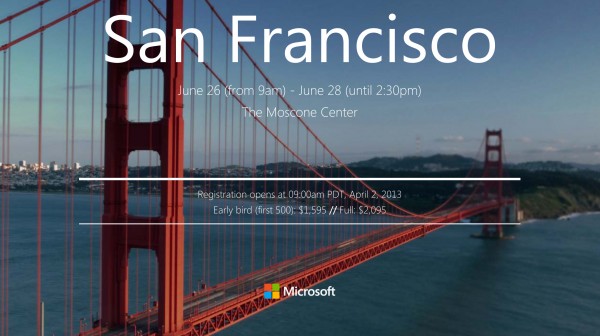
  • Microsoft BUILD 2013: ‘If you’re going to San Francisco…’

    Suddenly San Francisco is the hot developer ticket of the year. Say, can I just rent a room in your house for May and June? Today, Microsoft announced that BUILD 2013 will take place from June 26-28 at the Moscone Center in the city on the bay. Google will be there, same city and venue, with I/O from May 15-17. Apple usually holds its developer conference there in early June but hasn’t announced. Big Three trio would be a helluva travel schedule for anyone flying in from anywhere else, particularly outside North America. Choose your event(s) wisely.

    I just have to ask: Did Microsoft bump Google? Last year, I/O moved from its more typical May schedule to late June — 27th-29th. Did Steve Ballmer and Company book early and lock in the dates? I don’t really care, and it’s not news, but speculation is delicious given the rivalry between these two companies.

    As for BUILD 2013, there is little doubt now that Windows Blue is coming really soon. The question is this year or next? Microsoft generally aligns its developer conference with new platform releases, and we all know about the weekend’s Blue leak. The OS is out of the bag, all over the Internet and presumably humming on millions of PCs. My colleagues Alan Buckingham, Mihaita Bamburic and Wayne Williams all are true Blue.

    End-of-June BUILD doesn’t bode well for Windows Blue this year, but Microsoft is picking up the pace with regards to updates. So throw out any past measure. We all could still be BUILD and Blue in 2013.

    Steve Guggenheimer, Microsoft chief platform evangelist, offers some context: “We saw more than 100 million downloads from the Windows Store in the first two months after GA, we crossed the 1 billion downloads mark in the Windows Phone Store, we saw a doubling of Windows Azure compute usage in just the last six months and much more”.

    Registration opens April 2 at Noon EDT. The first 500 people pay $1,595 and everyone else $2,095. Microsoft could really show up Google by handling the load. I/O registration crapped out for the majority of people trying to register 13 days ago.

    By the way, Google charges less ($900 for developers, $300 students) and gives away more (media streaming device, smartphone and tablet last year). Microsoft doesn’t generally share developer swag with news media attendees, unlike Google. Following BUILD 2011, I really wanted to test Windows 8 Developer Preview, which Microsoft only provided on Samsung tablets. I’m not asking for handouts, just opportunity to use the stuff before writing about it. I strongly suspect Blue will be available to download, which, if so, makes the whole issue moot.

    BUILD is much bigger than Windows, which Microsoft teases on the site home page: Azure, Internet Explorer, Office 365, Visual Studio, Windows Phone, Windows Server and Xbox. New game console arrives this year (or so we all believe), and there Microsoft looks to increase development synergy with PC, smartphone and tablet operating systems. But Windows Blue and Windows Phone 9 (hey, even 8.5) will be top of many peoples’ minds.

    What I’m thinking about: Apple, Google and Microsoft possibly all converging on the same venue within weeks of each other. The old Mamas and the Papas lyric “If you’re going to San Francisco, be sure to wear some flowers in your hair” needs some kind of gadgety update for this generation. Wear smartphone on your belt? Carry laptop in your sack? Bring Surface Pro in your bag? Or Chromebook Pixel? Or MacBook Air?

    I wasn’t serious about that room rental, but do offer someone coming from out of town.

  • AT&T issues one-word response to T-Mobile attacks: ‘Whatever’

    ATT Sprint Respond
    T-Mobile formally declared war on rival carriers with the announcement of its new “UNcarrier” initiative at a press event in New York City on Tuesday. John Legere, the company’s president and CEO, called out every major player in the mobile industry but spent extra time bashing AT&T (T). The executive repeatedly pointed out the carrier’s “misleading pricing model” and network quality, claiming customers will save more than $1,000 over the course of two years on T-Mobile, which he also said could handle 50% more bandwidth than AT&T’s network. The carrier was not phased, however.

    Continue reading…

  • GDC 2013: See Through The Eyes Of The City In Watch Dogs

    Up until now, trailers for Watch Dogs have focused on Aiden Pearce and his ability to hack into the city of Chicago to control its surveillance, gather intel on its citizens, and more or less become a high-tech anti-hero. What about those who run the city though? What are they doing while Pearce hacks them blind? The latest trailer for Watch Dogs seeks to answer some of those questions.

    It will be interesting to see how the asymmetrical gameplay of Watch Dogs works with the introduction of this new element. The game promises to give control of rival hackers to other players as they try to take down (or perhaps help) Pearce. This latest trailer makes it appear that some players may also be put into the role of those running the city as they try to make sense of those who are hacking into its system. Either way, the game shows a lot of promise for something that we still know next to nothing about.

    Watch Dogs is slated to launch later this year for all current and next-gen consoles, and PC.

  • Wal-Mart to try out locker system to let customers buy online, pick up offline

    Wal-Mart Stores Inc. executives know that more people want to buy stuff outside of stores. As part of its multi-pronged Wal-Mart eCommerce strategy, the retailer with 4,000 stores in the United States and 10,000 worldwide has been taking orders online and letting customers pick up their purchases in store for the past few years. Now it’s adding another option that other large online retailers have been working on, too: pick it up from a locker at the store, with no Wal-Mart employee to go through.

    The locker method will debut this summer at fewer than a dozen stores, probably in one geographic region in the United States. “Really, it’s to test and learn,” said Jeff McAllister, senior vice president of Wal-Mart U.S. Innovations, during a media day at the company’s Wal-Mart eCommerce facility in San Bruno, Calif., on Tuesday. It’s also a way that retailer can match its online rival, Amazon.com. Amazon has been offering customers lockers in several cities, to serve customers who order goods but might not have doormen or a front porch where they can receive packages.

    With this program, Wal-Mart will box up the items a customer purchases and squeeze the box into a locker that fits just right, McAllister said. Then Wal-Mart will send the customer a message with a code that will allow the customer to open the locker. The customer will initially have a couple of weeks to pick up the purchased items.

    This is clearly a bid to burnish its online experience, because most people are close enough to visit a physical Wal-Mart store if they wanted to. Two thirds of people in the United States are within five miles of a Wal-Mart store.

    Like other Wal-Mart eCommerce initiatives, if it works, it will expand. If it doesn’t, it won’t. Like similar locker experiments from Amazon, Overstock and others, it’s worth watching as a shot at making retail fit the digital age.

    Related research and analysis from GigaOM Pro:
    Subscriber content. Sign up for a free trial.

  • Google Analytics Gets New Social Reports

    Google announced today that it has redesigned Google Analytics social reports, adding two new ones for Data Hub Activity and Trackbacks. Activity in social reports comes from Google’s Social Data Hub partners.

    “The activity stream was previously available via drill down from the Network Referrals or Landing Pages reports,” says Google Analytics product manager Linus Chou. “We have now made it a standalone report. By navigating to the Data Hub Activity report you’ll see a timeline of the number of activities that have occurred in the Social Data Hub and the raw activities in a list below. You can also filter this list by any specific networks you choose.”

    “We’re also excited to announce that Trackbacks are now available in a standalone report,” adds Chou. “Trackbacks are all of your inbound links across the web, so you’ll be informed if anyone from a small to blog to the New York Times posts a link to your site. Additionally, we are providing context for the significance of each of these trackbacks by displaying the number of visits that were driven by each endorsing URL during the reporting period. You’ll see this number presented alongside the trackback.”

    Social Reports

    Social Data Hub partners include: Allvoices, Badoo, Blogger, Delicious, Digg, Diigo, Disqus, Echo, Gigya, Google+, Google Groups, Hatena, Livefyre, Meetup, Read it Later, Reddit, Screen Rant, SodaHead, TypePad, VKontakte, and Yaplog.

    More on Social Data Hub here.