Category: News

  • Dell acknowledges two more bids

    Dell’s board acknowledged Monday morning that it received two more buyout bids and vowed to consider them in the best interest of shareholders. As has been reported over the past week or so, The Blackstone Group and Carl Icahn prepped their own bids to counter a $24.4 billion (or $13.65 per share) offer put together by company founder and CEO Michael Dell and Silver Lake Partners to take the company private.

    Image 1 for post GigaOM interviews Michael Dell( 2008-07-28 11:05:22) Icahn, who owns what is thought to be about 6 percent of Dell shares,  is offering up to $15 per share for a $2 billion piece of the company. the Blackstone-led group is offering $14.25 per share. All Things Digital has more here.

    Both Icahn and Blackstone offers are for a controlling stake in the company, not the whole thing. They would leave some shares to trade publicly.

    The gist of Dell’s statement linked here is:

    “The Special Committee, consisting of four independent and disinterested directors, has determined, after consultation with its independent financial and legal advisors, that both proposals could reasonably be expected to result in superior proposals, as defined under the terms of the existing merger agreement. Therefore, each of the Blackstone and Icahn groups is an “excluded party” and the Special Committee intends to continue negotiations with both.”

    Michael Dell founded the company nearly 30 years ago and built it into what was at one point the world’s biggest PC maker and a huge power in servers as well. He stepped down as CEO in 2004 but  re-assumed that role three years later.

    The company’s problem is that, like rival Hewlett-Packard, it missed the boat in tablets and smartphones at a time when those devices started to outsell laptop and desktop PCs. Over the past few years, though the company has added a lot of software, storage and cloud computing expertise via acquisitions of companies like Quest Software, Boomi, EqualLogic and Compellent. It also bought more services expertise by acquiring Perot Systems.

    Michael Dell himself owns an estimated 16 percent of the company.

    The bidding war signals that at least two parties see the Dell offer undervaluing the company.  Whether the rival buyers would keep the company intact or sell off the piece parts down the road remains an open question.

    The Wall Street Journal blog outlines several scenarios that could play out.

    Related research and analysis from GigaOM Pro:
    Subscriber content. Sign up for a free trial.

  • Telltale’s The Walking Dead Is Coming To The Vita Later This Year

    After the disappointment that was The Walking Dead: Survival Instinct, series fans will have to place their hopes on the second season of Telltale’s excellent adventure series. While fans wait, Telltale will be bringing the first season to a new platform.

    IGN is reporting that The Walking Dead will be on the PlayStation Vita before season two of the acclaimed adventure series hits consoles and PC. This isn’t the first portable version of the title as the adventure series came to the iPad last year, but this is the first time we’ve seen the series on a dedicated gaming handheld.

    Speaking to IGN, PlayStation’s Director of Product Planning and Platform Software Innovation Don Mesa says that The Walking Dead is a perfect fit for the Vita:

    “Again, a good example is with The Walking Dead. We think that the emotion and the immersive experiences you’re going to get there, wherever you’re sitting, if you’re in your living room and playing on your Vita or sitting at a café or at the bus stop and playing this, you get that shock or fright. I think that’s going to be important. That’s what we want to deliver as you’re playing.”

    It’s not known what changes will be made to the Vita version of the title, but it’s probably safe to assume that it will feature many of the same touch controls found in the iPad version.

  • Google Kills Blocked Sites Feature

    About two years ago, when Google was in the early stages of the Panda update, it launched another means of helping users get more quality results in front of them. This one, unlike the Panda update, left it more up to the users, giving them more control of their own. That was the domain blocking feature.

    The feature has now been killed. Late last year, people were noticing that the feature wasn’t working. Now, Google has officially acknowledged its demise.Google says in a message on its Inside Search site (via Search Engine Roundtable):

    The Blocked Sites feature is no longer available. To block particular sites from your search results, we recommend the Personal Blocklist Chrome extension from Google. You may also download your existing blocked sites list as a text file.

    Google doesn’t offer much in the way of explanation as to why they killed the feature. Most likely, it wasn’t being used a whole lot, and really, isn’t the feature kind of an admission that Google is not getting results right?

    At least for those who want to continue blocking sites, Google provides an alternative. That’s more that Google Reader users got.

  • National Patterns of R&D Resources: Future Directions for Content and Methods: Summary of a Workshop

    Prepublication Now Available

    Statistics on research and development (R&D) are important indicators of innovation, the transfer of ideas and knowledge, which in turn are key drivers of economic growth and R&D expenditures are one indicator of the generation and diffusion of knowledge. A key aspect of the role of research and development in the process of economic growth is that it generates spillover benefits. Given the contribution of R&D to economic growth and, consequently, its role in policy decisions, NSF began to measure it in the 1950s. Although the idea of measuring R&D seems straightforward, there are complexities to carrying it out. To its credit, for more than 60 years NCSES (and its predecessors) has collected and produced consistent statistical tables and graphs on domestic R&D expenditures, producing the statistics in a timely fashion. Underlying the publication process are the efforts undertaken by the agency to overcome the complexities of definitions and various efforts to address issues such as missing data and international comparability. National Patterns of Research and Development Resources is a compendium of five annual surveys. Each publication in the series integrates and synthesizes the data from these periodic surveys of R&D expenditures by U.S. R&D performers in order to analyze current patterns of R&D activity in United States in relation to the historical record and to the reported R&D levels of other industrialized countries.

    The steering committee identified seven topics for presentations and subsequent
    discussions at the workshop:
    (1) the purposes and uses of National Patterns;
    (2) advances in international comparability of the statistical outputs in National
    Patterns;
    (3) the nature and estimation of R&D expenditure data for nonprofit organizations;
    (4) the benefits of collecting and reporting on additional variables relevant to R&D
    funds;
    (5) improving communication in National Patterns;
    (6) potential methodological uses of administrative records for R&D estimation; and
    (7) the use of small-area estimation techniques for estimating R&D amounts for small
    domains such as states crossed with industrial categories.

    [Read the full report]

    Topics: Behavioral and Social Sciences | Policy for Science and Technology

  • Pauley Perrette Ex-Husband Faces Jail Time For Restraining Order Violation

    Network TV star Pauley Perrette was officially divorced from her first husband in 2006, but her marital troubles have only seemed to continue.

    TMZ is reporting that Perrette’s ex-husband, Coyote Shivers, has violated his restraining order. The musician has been charged with violating a court order and violating his probation, which he was placed on for sending “harassing” emails to Perrette’s lawyer.

    The violations stem from an altercation between Shivers and Perrette at a sushi restaurant in L.A. last month. The two argued, though Shivers has stated the run-in was an accident. Shivers could face up to 18 months in jail if convicted.

    Perrette has landed roles in numerous TV shows and movies, such as The Ring and Almost Famous, throughout the 90s and 00s. She currently stars in the hit CBS Show NCIS, on which she plays Abby Sciuto, a forensic scientist.

    Shivers is a musician who has played with bands such as Sharkskin and The Dave Rave Conspiracy. He is also an actor, and is best known for his roles in the movies Empire Records and Jonny Mnemonic.

    (Image Courtesy Angela George/Wikimedia Commons)

  • Nintendo Amazingly Gets Worse At Marketing Just In Time For Plummeting Wii U Sales

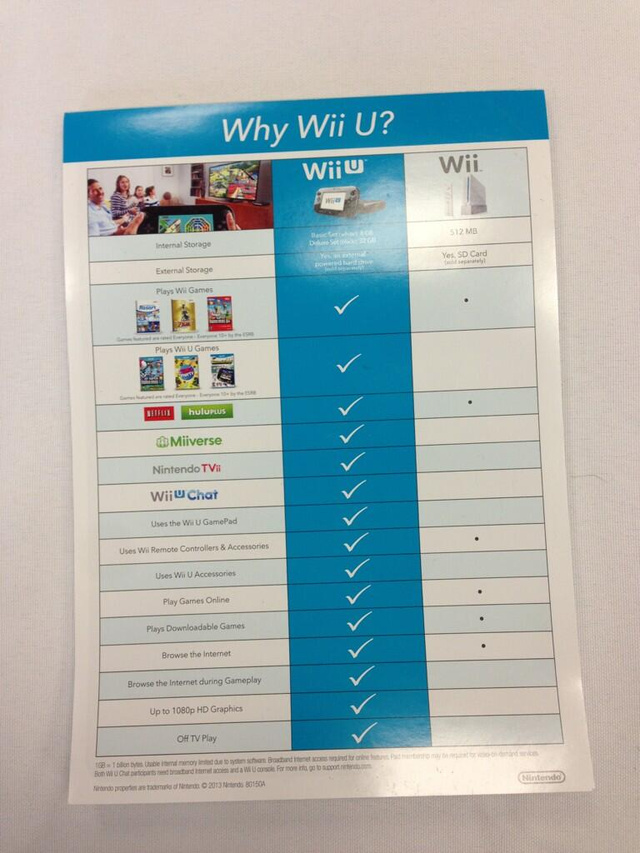
    wiiuvswii

    Perhaps poor marketing is holding back Wii U sales for Nintendo. As Spike TV’s GTTV host Geoff Keighley noted on Twitter, a new campaign from Nintendo is using flyers to show just how awesome the Wii U is.

    Except, instead of going after console rivals Nintendo decided to aim its attack at its own, older-generation console the Wii. To be fair, the Wii is probably the strongest competitor to the Wii U, yet the consoles treat gaming very differently. The Wii is a family, group console, bringing people together, while the Wii U essentially lets you take your single-player game where ever you want, even if a family member wants to watch a movie with you.

    To display the Wii U’s strengths against the many shortcomings of the Wii, Nintendo’s flyer shows a side-by-side comparison. Though the two consoles do share a few features, the Wii’s dots are clearly less awesome than the Wii U’s check marks. As we all learned in elementary school, dots < check marks. Obvi.

    Luckily, Nintendo has made it so you can rip one of these flyers right off the wall and take it home with you. Maybe you can post it up in your bedroom, just over your Wii, to remind yourself that you should probably (not*) upgrade. Perhaps you can just store it away in your desk for later reference when someone asks, “What the fuck is a Wii U?”

    Because, to be honest, not many people know about the dual-screened Wii U console, despite the fact that it was announced at E3 last year. Again, Nintendo marketing hasn’t really been killing it.

    For instance, let’s take a look at this Wii U commercial.

    To start, I’ve never actually seen this commercial air on TV. Secondly, a good deal of this ad is dedicated to non-gaming activities, such as drawing, watching TV, weighing yourself, browsing the web, and video chatting. Because, you know, that’s why people buy gaming consoles. It has nothing to do with Netflix, Hulu+ and a complete gaming experience.

    But let’s not forget, Nintendo’s awful marketing isn’t a new thing. Remember the Nintendo 3DS commercials, with that girl from Glee and Selena Gomez, I think? If you haven’t seen it, it’s essentially a famous blonde girl sitting in a diner like a hipster trying to draw a piece of pie. Again, Nintendo clearly knows its market: girls who draw pie.

    Again, if you find yourself forgetting that the Wii U is better than the Wii, or if you find yourself forgetting that the Wii U exists, march on over to your nearest airport or mall and grab yourself a flyer.

    *Here’s our review of the Wii U.

    [via Kotaku]

  • Network News: Zayo Partners With Internet2

    Here’s our review of some of today’s noteworthy links for the networking sector of the data center industry:

    Zayo and Internet2 bring 100G to the north. Zayo Group announced its partnership with Internet2 to add substantial new capacity on Zayo’s fiber route from Chicago to Seattle. The system will have greater than 4 terabits of overall capacity to support Internet2’s new 100G network. Set to be completed in the spring, the infrastructure will extend the capability to reach the nation’s leading research and education network’s 100G services to universities and research centers in Idaho, Montana, North Dakota, Minnesota, Washington, and Wisconsin. The project will provide new 100G national backbone paths between Internet2’s core routers in Seattle and Chicago, reduce latency for time-sensitive applications and increase capacity for global innovation with partners throughout the west and Asia that connect through Seattle. “This project demonstrates Zayo’s commitment to building strong strategic alliances with the research and education community and our investment into our extensive fiber footprint,” says Zach Nebergall, vice president of Wavelength Product Group at Zayo. “Internet2 is helping to bring substantial amounts of additional capacity to the research and education community via its partnerships.”

    CenturyLink Deploys Ciena 100G.  Ciena (CIEN) announced that CenturyLink (CTL) recently utilized its converged packet optical platform with WaveLogic coherent optical technology to modernize and upgrade its network that spans more than 50 metropolitan locations across the United States. With the upgrade CenturyLink can offer 1GE, 10GE, 100GE and equivalent wavelengths, utilizing Ciena’s 6500 Packet-Optical Platform. The 6500 platform will also offer integrated packet switching which gives CenturyLink agility in the delivery of groomed Ethernet services to its enterprise customers. “CenturyLink understands the increasing need for scalability, capacity and high-speed network services for today’s business requirements,” said Pieter Poll, senior vice president of national and international network planning, engineering and construction, CenturyLink. ”Ciena’s converged packet and coherent optical technology allows us to provide speed and capacity improvements to our international and domestic regional networks, creating a true, end-to-end 100G network to deliver today’s bandwidth-intensive services and applications.”

    Level 3 to build data center in Bogota Columbia. Level 3 Communications (LVLT)  announced the construction of its newest data center in Bogota, Colombia, as a result of increased demand for IT services among its customers. This new, 500 square-meter Premier Elite data center, designed to support managed services, will provide onsite technical staff, high levels of availability, enhanced security and high power density cabinets and suites. ”The Colombian market shows a growing demand for colocation, housing, hosting and value-added services,” said Luis Carlos Guerrero, sales vice president for Level 3′s Andean region. “The trend to outsource these services to a trusted business partner – one that will support the customer in its expansion strategy – is crucial for companies today so they can focus on their core business.”

    Extreme Networks solutions tested by EANTC. Extreme Networks (EXTR)  announced that its high performance cloud and Mobile Backhaul Ethernet switching solutions were among the first to be tested by European Advance Network Test Center (EANTC) for Carrier-focused Software Defined Networking (SDN), MPLS and Hybrid Timing combining Synchronous Ethernet (Sync E) and IEEE-1588 Precision Time Protocol (PTP). EANTC’s final test plan for the SDN/MPLS and IPv6 testing was rigorous and included 51 test outcomes with 19 of them making fresh paths to SDN testing. The SDN OpenFlow tests highlighted Layer 2 & 3 forwarding, OpenFlow topology discovery, failure recovery in OpenFlow, and policy based routing. ”Extreme Networks continues to deliver first to market and high performance SDN and Mobile Backhaul Ethernet solutions for sophisticated multi-tenant data centers and mobile 4G networks,” said David Ginsburg, CMO for Extreme Networks. ”Our successful completion of the EANTC organized testing in Berlin in 2013 further validates our ability to support the network architectures required by new carrier service offerings.”

  • A Funny Look at Getting Verified on Twitter [VIDEO]

    For those of you who love Twitter and wish to have influence on the network, the sad fact is that you’ll probably never be verified. No matter how hard you try, Twitter isn’t likely to contact you directly, expressing their wish to add that little blue check mark next to your name. Sorry man, it’s just not going to happen (for most of you).

    The best you can do is to live vicariously through Anil Dash, who sat down with the Kondabolu brothers to discuss the process, and it’s a pretty entertaining watch.

    [Hari Kondabolu via The Next Web]

  • Sweet Crude Alabama: Another U.S. State Benefits From Energy Boom

    Alabama has lower energy prices than the national average. Its gasoline price is the 12th lowest among the states and 5 percent below the national average. The state’s lower gasoline prices are due in large measure to the state’s …

  • T-Mobile’s UNcarrier Simple Choice no-contract plans now live

    T-Mobile_Simple_Choice_Plans

    The T-Mobile UNcarrier plans that were outed last week and over the weekend are now live, although it won’t be formerly announced until tomorrow. It appears they are calling it Simple Choice, and it gives consumers the choice of buying a phone at full retail and paying a lower monthly rate for service. Full retail generally costs $500 to $700, but T-Mobile will let you make a down payment of around $99 and pay off the remaining portion as part of a monthly payment of between $15 and $25. Isn’t this a reverse way of  subsidizing a phone?

    The best bang for the buck appears to be the unlimited talk, text, and 500MB of data for $50 per month. This one will be for those that aren’t data hungry as you will get throttled after 500MB, but tethering is included as well. If you need more data, you can just buy it in increments of 2GB (up to 12GB) for $10 extra per month. Things get a little complicated with the unlimited no throttling plan in that you can get unlimited talk, text, and data (no throttling) for $70. Sounds like a deal, but only 500MB of tethering data is included. If you need more data for tethering, you can buy the same 2GB increments for $10 per month.

    It seems a little complicated, but I guess it comes down to if you really need tethering or not and if you really need unlimited. One one hand, you can get unlimited, talk, and 2.5GB of data (and tethering) for $60 or you can get unlimited, talk, data, and 2.5GB of tethering for $80. If you think you can live with 6.5GB, but you really need to utilize tethering, you could get the throttled plan for the same $80. You will be capped at 6.5GB, but you will get more data for tethering. Carriers just love giving you choices and complicating things at the same time don’t they?


    Come comment on this article: T-Mobile’s UNcarrier Simple Choice no-contract plans now live

  • Shrinking gross margins projected to take big bite out of Apple’s income

    Apple Quarterly Earnings
    Apple (AAPL) is certainly a long way from being doomed but that doesn’t mean the company is still firing on all cylinders like it’s done for most of the last decade. Case in point: Fortune has surveyed several Apple analysts and all of them expect the company’s next quarterly earnings report to show a decline in income compared to the same quarter last year. Granted, Apple’s second-quarter earnings last year delivered a hard-to-match $12.30 earnings per share, but the projected decline to the $10 range would still mark the first time since 2003 that the company has posted a year-over-year decline in earnings.

    Continue reading…

  • Thermodo Reveals New Stretch Goals, Outside Developer Support And Backer Reward Levels

    thermodo_red

    Tiny smartphone thermometer accessory Thermodo is on a funding roll, and it hopes to keep things going with new backer levels that it has shared exclusively with TechCrunch. Two new colorways are in development for funding milestones, as well as Windows Phone app support, and now third-party developer are revealing that they will be working with some specific third-party apps.

    Thermodo will debut new stretch rewards at the $250,000, $300,000 and $400,000 funding levels, including a limited edition red and green version of the Thermodo itself, as well as a commitment to Windows Phone support. Robocat, the startup behind Thermodo, also announced three new backer levels today, which include a variety of different combinations of existing rewards, all of which is clearly designed to further propel backer interest and help it continue to raise its total funds ahead of the project end date, which is 15 days away now.

    Developer interest is the most important piece of the puzzle from the perspective of making Thermodo a device with wide appeal. It has an admittedly limited feature set after all: it tells the temperature, and that’s it. But with broad developer and platform support, it starts to become much more than just a simple weather app accessory, since it can be used with apps that incorporate a wide set of data to serve different kinds of purposes.

    Thermodo is working on partnerships with a number of developers are a result of the Kickstarter success they’ve had so far, Robocat founder and lead developer Willi Wu explained via email. “Many developers have expressed great interests in integrating Thermodo in their existing apps or make new apps, including Jake Marsh of Conditions app, David Smith of Check the Weather app and Moshen Chan of Living Clock app,” he said. “We are also looking into collaborations with developers on Android and Windows Phone.”

    Robocat is trying to rack up the big bucks for Thermodo, and doing a good job so far. That’ll mean it will face a bigger challenge when it comes time to ship, but the company seems confident in its ability to do so.

  • Developer training company Pluralsight releases online coding courses for kids

    Developer training company Pluralsight, which has long helped professional programmers improve their technical chops, is turning a bit of its attention to kids.

    As momentum builds behind bringing computer science to younger students, Pluralsight CEO Aaron Skonnard said his company wants to do its part for the cause. And, on Monday, the Salt Lake City-based company released a couple of free online courses teaching elementary, middle and high school kids how to code.

    “We feel that the world needs to raise awareness of the importance of being more technical with computer science at an earlier age,” he said.

    As a star-studded video released last month by Code.org emphasized, the country needs more technical talent. Less than two percent of students study computer programming — and 90 percent of U.S. schools don’t offer programming. Meanwhile, programming jobs are growing at double the pace of other jobs, according to the non-profit.

    More startups, including Kuato Studios, Tynker and Hopscotch are beginning to take on this problem directly with games and kid-friendly programs that teach the basics of coding.

    But for Pluralsight, which is a subscription-based business, the new kids’ courses represent more of a goodwill- and loyalty-building effort than a new revenue source, Skonnard said. Its first courses focus on MIT’s programming learning environment Scratch and the programming language C#, but Skonnard said it plans to grow its library of kids’ courses, and expand outreach to schools, over time.

    Pluralsight partnered with the non-profit Teaching Kids Programming, led by developers Lynn Langit and Llewellyn Falco, to create the C# course and Skonnard said both new courses were designed to be more interactive and attention-based.

    The company, which launched in 2004, claims more than 200,000 subscribers and, earlier this year, raised $27.5 million from Insight Venture Partners.

    Related research and analysis from GigaOM Pro:
    Subscriber content. Sign up for a free trial.

  • BuzzFeed courts Brits with new UK homepage, London launch

    BuzzFeed hopes its viral cat fare can go toe-to-toe with Britain’s own raucous tabloid culture. On Monday, the fast-growing American news site formally launched a customized, UK-version of its homepage, which will feature content like “43 things British people know to be true” alongside sponsored stories that promote UK brands and events.

    Never one for understatement, BuzzFeed is promoting the launch with a London event and an animated flyer that shows Queen Elizabeth II riding a tweaked-out corgi dog against a Doctor Who style background:

    BuzzFeed UK ad screenshot

    This is BuzzFeed’s first international expansion and comes after it received nearly $20 million in new funding early this year. According to editorial director, Scott Lamb, the UK site will start by offering “great pop culture content” that represents BuzzFeed’s roots. He explained the strategic goal this way:

    “Social is global. We already had a solid audience in the UK, a place that embraces Twitter and Facebook in a huge way, so it made sense for it to be BuzzFeed’s first foray into international waters.” A report from the Next Web says the UK content will come from a four-person team based in London. Meanwhile, a BuzzFeed spokesperson told us that the largest proportion of BuzzFeed’s overall traffic was coming from the UK early Monday morning.

    BuzzFeed’s expansion comes at a time when UK and US press outlets are increasingly entering each other’s markets; Britain’s the Daily Mail and the Guardian, for instance, are making a concerted effort for American readers.

    BuzzFeed also appears to have brought its trademark native advertising across the pond in the form of “stories” like “15 Kinds of People You Will See at Ultra,” a photo-feature produced by an energy drink maker. BuzzFeed founder Jonah Peretti has long argued that this form of advertising, which can be distributed across social media, is more effective than traditional internet display advertising.

    As it dips its toe into Britain, BuzzFeed is also expanding aggressively at home with more long-form content and plans for a business vertical.

    Related research and analysis from GigaOM Pro:
    Subscriber content. Sign up for a free trial.

  • Mirantis open-sources its OpenStack cloud management tools

    Mirantis CEO Adrian Ionel

    Mirantis CEO Adrian Ionel

    Mirantis, a startup which has made a name for itself by mixing and matching the best OpenStack components from multiple vendors into cloud solutions for customers, is now making its own library of configuration and deployment tools available to the masses, under the Apache 2.0 license.

    “We are releasing the secret sauce — the automation library — that we used to set up some of the largest OpenStack adopters — Paypal, Webex, The Gap and others,” Mirantis CEO Adrian Lionel said in an interview.

    According to Mirantis VP Boris Renski, the big automated payment provider has massive infrastructure of about 15,000 physical nodes and another 65,000 or so physical nodes for parent company Ebay.

    “They have a very large VMware vSphere footprint but, at this, point they want to go beyond just vSphere virtualization and implement orchestration – [they want] agile, cloud infrastructure to accelerate their time-to-production cycle on new apps and website features and they want to standardize across the board,” Renski said.

    PayPal, like other companies in the same boat, can go in one of two directions, he said. It can invest more in VMware and standardize on it — by buying vCloud Director — or it can go the open-source, open-standards route.

    “With the project we are involved in, they are making giant strides towards the latter. The work is not 100 percent done and there is still a chance that it won’t succeed. They have several thousand instances running on OpenStack and several production workloads today. The plan is to go to 10K physical nodes by summer time.”

    If everything continues to track well, he said, they’ll roll OpenStack across all of Paypal and possibly eBay infrastructure and do away with VMware, he said.

    Paypal itself was more circumspect on its plans. Asked about its OpenStack plans, Saran Mandair, senior director of platform engineering and operations, said via email that the company is committed to collaborating with the open-source community to drive innovation:

    “It is working with Mirantis to leverage OpenStack to help transform our global infrastructure into an agile and open cloud platform … Our OpenStack project uses the Fuel library by Mirantis, which has dramatically accelerated our OpenStack deployment with robust, production-grade architecture while giving us the flexibility to tailor OpenStack to our needs.”

    But a spokeswoman, unsurprisingly, said the company will continue to use VMware as well.

    VMware, which is actually now a member of the OpenStack Foundation, will, of course, also continue to plug the vSphere- and-vCloud-Director tandem to companies with existing workloads. And, earlier this month, it also said it will host its own public cloud infrastructure, which is also based on its existing vSphere code.  The company said it is committed to customer choice.

    Most onlookers, however, still see VMware vCloud Director as a closed and expensive ecosystem that OpenStack itself was set up to depose.

    Related research and analysis from GigaOM Pro:
    Subscriber content. Sign up for a free trial.

  • In-App Purchasing Coming Soon To Nook HD Devices

    Despite having a less than stellar holiday season, Nook is still soldiering on in its attempts to combat Amazon’s Kindle dynasty. It’s latest move may just help bring more developers to its side.

    Nook announced today that in-app purchasing will soon be a reality on Kindle HD and HD+ apps. The Barnes & Noble subsidiary will be working with Fortumo to provide developers with all the tools needed to implement in-app purchasing in apps while also providing developers with real-time insights on revenue.

    “We are thrilled to bring in-app purchasing to Nook with Fortumo for our community of developers so they can foster a profitable relationship with their customers, while also providing our Nook customers with a more in-depth app experience and an even wider selection of popular apps,” said Claudia Romanini, VP of Nook Apps, Nook Media, LLC. “We look forward to adding thousands of more apps that feature in-app purchasing over the coming weeks and months to expand Nook’s already wide array of digital content offerings.”

    This latest addition to the Nook development environment brings the Nook HD up to par with Amazon’s Kindle Fire and other Android tablets that have offered in-app purchasing for the past year. It’s also an important addition to the Nook development environment as it encourages more developers to bring apps to the platform. As we all know, any hardware is only as good as its apps, and the Nook definitely needs more apps, especially revenue heavy games, to survive in the highly competitive tablet market.

    In-app purchasing will be available to developers starting in the first half of April. For more details on how to start offering in-app purchasing in Nook apps, check out the Nook developer portal.

  • Sony brings Xperia ZL smartphone to US but it’s costly at $719

    Hoping to grow its share of the of smartphone market, Sony is now taking pre-orders for its Xperia XL handset. Dubbed the “world’s most compact smartphone with a 5″ display,” the Xperia ZL ships on or around April 8. And on paper, it’s arguably the best smartphone Sony has created yet. But without a carrier partner in the U.S. to subsidize the cost, consumers will pay Sony outright for the phone, to the tune of $719.99.

    What do you get for that kind of cash? In terms of hardware, the Xperia ZL rivals the flagship phones from any other handset maker these days. Sony’s Reality Display offers 5-inches of full high-definition resolution and uses the company’s Mobile BRAVIA Engine 2, bringing Sony’s television technology to the small screen. Even with the large display, Sony kept the phone dimensions relatively small at 5.18 x 2.7 x 0.39 inches.

    White Xperia ZLThe main camera is 13 megapixel camera with Exmor RS sensor and f/2.4 aperture. A range of photo modes, 1080p video support and HDR capture for both stills and videos are included.

    Sony includes 2 GB of memory to run Google Android 4.1 — not Android 4.2, sadly — on Qualcomm’s 1.5 GHz quad-core Snapdragon S4 Pro chipset. Internal storage tops out at 16 GB, but can be expanded by up to another 32 GB through removable storage. At this price, the handset only supports HSPA+ networks on down. An Xperia ZL model with LTE support is available for $759.99.

    While the phone may be worth the price, I wouldn’t expect Sony to sell too many units here. The U.S. is only now just flirting with full price phones as consumers have been addicted to hardware subsidies for years. T-Mobile is the first of the big four to be making any headway towards a BYOD model, and as the smallest of the four, won’t have big traction to help Sony move the Xperia ZL.

    Related research and analysis from GigaOM Pro:
    Subscriber content. Sign up for a free trial.

  • Great Leaders Use Honesty to Help Their Successors

    Jack Ma, the founder and long-time CEO of Chinese web company, Alibaba, recently announced that he is stepping down as CEO, and now we have learned that Jonathan Lu Zhaoxi will become chief executive of the company in May. Alibaba is an incredible success story. The company began in 1999 and last year had estimated revenues of $40 billion. By comparison, after its first 13 years, Apple had revenues of $8.9 billion.

    I admire Ma and believe that he is an amazing leader. Those who have worked with him are lucky — but the man or woman that follows him faces a challenge ahead. How do you succeed someone so revered?

    CEO transition has become a routinized activity — companies bring in a well-known consulting firm and follow a checklist to identify and onboard a new leader. And, overall, I’d say that most transitions done this way — with good people and due diligence — deserve a “B” grade. But what’s much more complicated, and harder to get right, is a transition when the CEO has grown to be larger-than-life. Like Ma. In these cases, it is up to the departing leader to help, in a way that only he (or she) can.

    Ma knows this very well, and predicted his own quandary. He has written in an email to his employees: “Succeeding a founder CEO is a difficult job, especially taking over from a CEO with such a distinct personality….” Some might interpret this as the arrogance of a very successful man. Others might read it as the disarming honesty of a great leader (since the statement is, factually, 100% true). I’ve observed Ma and from what I know of him, I suspect the latter assessment is accurate: frank and open honesty, not chest pounding arrogance. And that brings us to a very important point.

    We want the truth from our leaders. But we have become cynics, accustomed to twisted messages from politicians and company marketing communications so wordsmithed that they lack meaning. These things do not inspire us, or pull us toward someone in a leadership position, with an attitude of wanting to help. They do the opposite. Great leaders have the ability to surprise and reassure people with their direct and honest communication. This is an essential part of what makes them great. And it is especially important in times of big change and uncertainty — such as CEO transitions — where it can smooth the way for the incoming leader.

    Will this be the case with Alibaba? I hope so. Ma has put reality on the table, stating clearly what the challenges are and what he wants, with the real authority that comes from his venerated position.

    With Ma’s endorsement, I expect Alibaba employees will rally around Lu Zhaoxi. They’ll be less likely to sit back and wait for the new guy to prove himself, or to gossip continually about their new CEO as inferior. They will be more inclined to actively help, with some sense of urgency, around a huge challenge for the firm. And if they do — Alibaba competitors had better look out for them.

  • Evernote for Android gets big update: Shortcuts, photo features and doc search

    On Monday, the same day that it announced a strategic partnership with Germany’s Deutsche Telekom, Evernote rolled out a big update for its Android version, including enhanced photo features, shortcuts and document search for premium users.

    evernote camera modeAmong the new features, outlined in a blog post:

    • Multi-shot camera mode “lets you take multiple photos in one sitting, then save them all into the note. If a particular photo didn’t turn out the way you like, then delete it before saving.”
    • Page Camera mode is a scanning feature: Take a photo of a document or paper, and “the app will then find the edges of the page, remove any shadows and improve the contrast, so you’ll have the perfect photo in Evernote.”
    • Shortcuts: Shortcuts, which let users “quickly jump to notes, notebooks and tags that you access frequently,” were already available on Evernote for Mac and are now on mobile for the first time.
    • Enhanced document search for premium users: Search now includes documents, presentations and spreadsheets attached to notes, including “files created in Microsoft Office, iWork and Open Office.” (This feature is available for all versions of Evernote, not just Android.)
    • The Android app now works with the Evernote Smart Notebook by Moleskine, which was introduced for iOS in August.

    Related research and analysis from GigaOM Pro:
    Subscriber content. Sign up for a free trial.

  • Father Kills Son, Self in Pennsylvania Murder-Suicide

    As Lamar Odom can attest, child custody arrangements are often contentious and exhausting. The stress involved is enough to engender harsh feelings, but one Pennsylvania man has taken his hatred much further.

    The Altoona Mirror is reporting that Kenneth Ayers of Petersburg, Pennsylvania shot and killed his two-year-old son before killing himself on Saturday, March 23. The shooting took place during a child custody visit and the boy’s mother, Hollie Ayers, was shot as well, but is expected to survive.

    Kenneth arrived at his mother’s house on Saturday, where his supervised visit with his son was to have taken place. He allegedly shot Hollie in her leg and arm, then shot his son, Michael, before taking the boy’s body to his car. Hollie is reported by the Mirror to have followed and attempted to retrieve Michael before being shot once more in the face.

    Kenneth drove off, switched vehicles, and was later found in the cab of his truck, dead from apparent suicide. The newspaper reported that the man was under a protection from abuse order, a type of domestic violence protection issued in Pennsylvania. Police stated that Kenneth may have planned the shooting.