Category: News

  • ‘Zombieland’ Pilot Gets Official Nod from Amazon

    We’ve known this was coming since reports emerged that Amazon had snatched up the rights back in January, but today the company officially announced that the new Zombieland TV series will land on Prime Instant Video.

    Zombieland is the 7th comedy pilot greenlit by Amazon Studios. Eventually, all will make it to Prime Instant Video and LOVEFILM UK, at which point user feedback will determine which ones make the cut. Zombieland was originally rumored to be coming to CBS, but it will find its home on the subscription streaming service.

    Zombieland the series is a continuation of the film of the same name, and it has some of the film’s original creative team working on it, including writers Rhett Reese and Paul Wernick. The pilot is being directed by Eli Craig, who wrote and directed Tucker and Dale vs Evil.

    Zombieland will strive to break the rules—action, adventure, thrills, chills and laughs and all packed into a half hour format,” said creator Paul Wernick. “This is not your average show but Amazon is not your average network.”

    The pilot stars Tyler Ross at Columbus, Izabela Vidovic and Little Rock, and Kirk Ward and Tallahassee.

    Zombieland is a fan favorite and we can’t wait to see where this story line goes in a serialized format,” said Roy Price, Director of Amazon Studios. “We’ve been announcing a lot of exciting exclusive content for Prime Instant Video, like Downton Abbey, Under the Dome, and Justified, and we think adding original shows to that lineup is going to make Prime even more enticing for customers.”

  • Yahoo Acquires Summly To Integrate Into Its Own Mobile Offerings

    Yahoo announced on Monday that it is acquiring mobile product company Summly, which has an app (or had, at least) billed as “pocket sized news for iPhone”.

    Summly Founder Nick D’Aloisio and his team will join Yahoo in the coming weeks, and the Summly app will close. Yahoo is acquiring the technology, and will use it in its own mobile experiences soon, a Yahoo spokesperson tells WebProNews.

    Here’s a look at Summly:

    Summly Launch from Summly on Vimeo.

    Yahoo SVP, Mobile and Emerging Products, Adam Cahan, writes in a blog post:

    At the age of 15, Nick D’Aloisio created the Summly app at his home in London. It started with an insight — that we live in a world of constant information and need new ways to simplify how we find the stories that are important to us, at a glance. Mobile devices are shifting our daily routines, and users have changed not only what, but how much information they consume. Yet most articles and web pages were formatted for browsing with mouse clicks. The ability to skim them on a phone or a tablet can be a real challenge — we want easier ways to identify what’s important to us.

    Summly solves this by delivering snapshots of stories, giving you a simple and elegant way to find the news you want, faster than ever before. For publishers, the Summly technology provides a new approach to drive interest in stories and reach a generation of mobile users that want information on the go.

    “Our vision is to simplify how we get information and we are thrilled to continue this mission with Yahoo!’s global scale and expertise,” says D’Aloisio. “After spending some time on campus, I discovered that Yahoo! has an inspirational goal to make people’s daily routines entertaining and meaningful, and mobile will be a central part of that vision. For us, it’s the perfect fit.”

    “With over 90 million summaries read in just a few short months, this is just the beginning for our technology,” he says. “As we move towards a more refined, liberated and intelligent mobile web, summaries will continue to help navigate through our ever expanding information universe.”

    The acquisition is expected to close in the second quarter. Terms of the deal are not being disclosed.

  • SF Chronicle puts premium content, including columnists, behind a paywall

    The San Francisco Chronicle announced over the weekend that it’s launched a new subscription site, SFChronicle.com. Much of the newspaper’s premium content — including columnists, editorials and op-eds, and arts and leisure coverage — will now only be available to paying subscribers. SFGate.com, which focuses on “what’s happening today,” will remain free.

    Subscribers to the print edition of the Chronicle will get access to SFChronicle.com for free. Otherwise, an “Ultimate Access” digital subscription — which also includes access to the Chronicle iPad app and Kindle edition — is $12 per month. SFChronicle.com is built using responsive design, meaning it can be read on any device.

    Chronicle president Mark Adkins listed the content going behind the paywall:

    Subscribers also will have full access to The Chronicle’s most enduring legacy – its columnists. The list of premium content goes on, including The Chronicle’s award-winning coverage of sports and the outdoors, arts and cultural events, pop music and entertainment, architecture and urban design, the environment and climate change, business and technology, food and wine, health and fitness, politics and government, and editorials and opinion pieces.

    The announcement of the paywall itself was originally behind the paywall, Jim Romenesko noted, but it can now be read for free.

    The Chronicle is owned by Hearst. Last November, the Houston Chronicle became the first Hearst-owned paper to enact a paywall.

    Related research and analysis from GigaOM Pro:
    Subscriber content. Sign up for a free trial.

  • Multi-County Initiative Get Local Attention

    It was nice to see the recent broadband meeting held in Hinckley get attention from the local press. I wrote about the meeting earlier – it was a great gather of several counties: Pine, Kanabec, Mille Lacs, Carlton and Aitkin. All came to make a plan to expand broadband in their area.

    The Kanabec County Times picked up on the economic development opportunities that broadband could bring…

    From an economic development perspective, [Bernadine] Joselyn said research shows that economic growth follows telecommunications investment.

    “Companies seeking new locations quickly bypass communities without world-class broadband,” she pointed out. “Many of Minnesota’s highest earners, including retired or semi-retired professionals, would prefer to live next to a lake or on a hobby farm. Unconnected communities stand little chance of attracting or retaining these potential taxpayers, not to mention recent college graduates.”

    Bill Coleman, president of Community Technology Advisors, serves as a catalyst to bring people together in support of regional broadband goals. “The future is already here,” Coleman observed. “It’s just not evenly distributed.” Coleman and Connect Minnesota’s Bill Hoffman encouraged people to visit the Connect Minnesota website to view an interactive map identifying broadband providers and connection speeds.

  • Yahoo Building a Bigger Computing Coop

    The exterior of the Yahoo Computing Coop buildings in Lockport, New York. The data center opened for business today.

    The exterior of the Yahoo Computing Coop buildings in Lockport, New York. The company is planning to expand its campus in Lockport. (Photo: Yahoo)

    Yahoo’s ultra-efficient “chicken coop” data center in upstate New York is getting bigger. The Internet company has announced plans to invest an additional $168 million in the campus for its hydro-powered, wind-cooled server farm in Lockport, N.Y. The expansion will include an additional 7.2 megawatts of data center space, along with a call center. The projects are expected to create 115 jobs between them.

    The expansion was expected, as Yahoo indicated last year that it would buy additional land at its property in Lockport. The company is seeking breaks on property taxes and sales taxes on servers and equipment for the project, according to the Buffalo News. The New York Power Authority will expand the site’s power capacity to support the new construction.

    “We are happy to be a part of the Western New York community and are excited about our expansion plans,” said David Dibble, executive vice president of central technology for Yahoo. “We are appreciative of our close partnerships with local municipalities and are grateful to our outstanding workforce in Lockport. Yahoo is committed to being an environmentally responsible company, and we thank New York state and local authorities for working with us to ensure we continue to power our data center with clean energy.”

    The Yahoo Lockport facility, which is optimized for air-cooling, is one of the world’s most efficient data centers, operating with a Power Usage Effectiveness (PUE) of 1.08. The data center, which is supported by hydro-electric power from the NYPA, requires mechanical cooling for a handful of hours each year.

    The first two phases of the Lockport project, built in 2010 and 2011, featured multiple 120-by-60 foot prefabricated metal structures using the Yahoo Computing Coop data center design. The coops -modeled on the thermal design of chicken coops- have louvers built into the side to allow cool air to pass through the computing area. The air then flows through two rows of cabinets and into a contained center hot aisle, which has a chimney on top. The chimney directs the waste heat into the top of the facility, where it can either be recirculated or vented through the cupola. See A Closer Look at Yahoo’s New Data Center for more photos and video.

    This approach to heat management allows the Lockport data center to operate without chillers, which provide refrigerated water for cooling systems and are among the most energy-intensive components of a data center. The facility uses an evaporative cooling system during those 9 days a year when it is too warm to use fresh air. The buildings were positioned on the Lockport property to allow Yahoo to bring in cool air from either side of the coop, based on the prevailing winds.

  • Say no to Google Glass while driving says West Virginia lawmaker

    Google_Glass_Puppy

    CNET’s early hands on with Google Glass prompted Republican Gary G. Howell to sponsor a bill banning such devices while driving in his state of West Virginia. I would expect to see more of these bills introduced in other areas since Google Glass and similar devices are likely to be a distraction for drivers. Howell stated the following:

    “I actually like the idea of the product and I believe it is the future, but last legislature we worked long and hard on a no-texting-and-driving law. It is mostly the young that are the tech-savvy that try new things. They are also our most vulnerable and underskilled drivers. We heard of many crashes caused by texting and driving, most involving our youngest drivers. I see the Google Glass as an extension.”

    The interesting thing is Google already has a solution to this…self driving cars. Unfortunately those won’t be around for another 5 years, while Glass should be available by the end of this year. So Google Glass might not be as emasculating as smartphones, but it doesn’t appear to be any less distracting. Do you agree with this bill?

    source: TechCrunch

    Come comment on this article: Say no to Google Glass while driving says West Virginia lawmaker

  • This Robot Snake Will Wrap Around Your Neck With A Deathlike Grip

    Snakes, and their total absence of limbs, make them some of the most terrifying creatures on the planet. Not to mention the variety of ways snakes can kill us. Why then must science create a robotic version of Satan’s avatar?

    The Biorobotics Lab at Carnegie Mellon University has been hard at work on what they call a modular snake robot. Why would they create such a thing? Here’s how they explain it:

    Snake robots can use their many internal degrees of freedom to thread through tightly packed volumes accessing locations that people and machinery otherwise cannot use. Moreover, these highly articulated devices can coordinate their internal degrees of freedom to perform a variety of locomotion capabilities that go beyond the capabilities of conventional wheeled and the recently developed legged robots. The true power of these devices is that they are versatile, achieving behaviors not limited to crawling, climbing, and swimming.

    That actually sounds pretty useful. I’m sure a number of industries, including defense, could do some pretty amazing things with a robot that can move in and out of tight spaces. So why is this particularly robot so terrifying? Just watch this:

    As you can see, our robot snake friend here can immediately constrict around a object after being thrown at it. Sure, it looks cool at first, until you realize that somebody (or some robot) may one day throw this thing at your neck. It’s hard enough already to fight off a Boa Constrictor. Just imagine how hard it would be to fight off a robot snake whose sole directive is snuffing out the life you hold dear.

    [h/t: Wired]

  • First look: Windows Blue build 9364

    When I was growing up one of my parents’ favorite expressions was “do as I say, not as I do”. The old adage likely rings true in this case as well. You see, as a rule I don’t recommend downloading files from BitTorrent, as you are just as likely to get a virus as a legitimate program, movie or song. That applies to leaked files especially.

    But, there are legitimate reasons for the sharing service — upcoming artists share music, Linux shares distros, even producers have distributed movies in this way.

    However, when a new build of Windows leaks out then I consider all bets off. That was the case over the weekend as Windows “Blue” build 9364 hit the interwebs with a major splash. I am a tech geek…how could I resist? I will not link to the torrent file here, but I am pretty sure that one of our faithful commenters may do exactly that. If you look around the web carefully enough, you can find it.

    Setup
    The download is 2.64 GB and the file comes as an ISO — ready for you to burn straight to a blank DVD and install (I actually used a USB thumb drive, but to each his own). Do not install this as your main operating system. It’s an early test build and just as likely to crash as it is to run. If you have a test machine then use that. If not, then use something like Virtual Box.

    In my case, I opted for the virtual machine. I prefer VirtualBox from Oracle, though I prefer it mostly because it is free. With that said though, it works as well as any other I have tried. I used version 4.2.10.

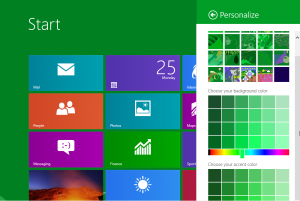
    Setup takes about 30 minutes. Once Windows Blue begins you will receive the usual prompts to login to your Microsoft account, pick a screen color and more. Screen color options have been expanded in this new build.

    Yes, you will get the usual email and text messages prompting you to approve the computer that has just been added to your Microsoft account. As the install is preparing the colors change on the screen in a rather psychedelic fashion.

    Internet Explorer 11

    Microsoft seems to be going all Firefox/Chrome on us lately by updating its web browser at a faster pace. The latest iteration of Internet Explorer is version 11.

    This build of the web browser is not tremendously different from 10, which is built into Windows 8 and now can be installed on Windows 7 as well. I found nothing particularly different here, but there are likely changes in the backend.

    SkyDrive
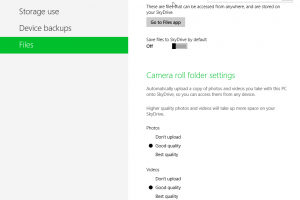
    SkyDrive is now a part of the basic Control Panel in the Metro Modern UI interface. When you open the Modern UI version of the Control panel, you will find SkyDrive integration built right in.

    There are options for Storage Use, Device Backups and Files.

    Snap to It!

    Are you bored with the old Snap feature? Only two apps? Now you can snap more programs into place. The next version of Windows allows for 4 apps to be “snapped” into position.

    These are, of course, long and thin across your monitor. However, it is a much better way to switch around between multiple apps. Users can navigate back and forth between all without need of the old-fashioned alt-tab option that we have all grown rather accustomed to.

    There is More

    Windows Blue build 9364 just leaked yesterday morning. I’ve only mentioned some of the main changes, but in the coming days we will get down into the more in-depth stuff — the real nuts and bolts of what is included in this release that we all knew was coming later this year, but were taken unexpectedly by over the weekend.

    I plan to delve more into this build in the coming days and add to the knowledge base as my understanding of Blue grows. For now, I suspect that this is enough to make most heads spin, including my own.

    While Windows Blue is not technically the next version of Windows, it is also not exactly a service pack either. The reality lays somewhere in between the two.

  • Colocation Communities Are a Match for Cloud

    Kevin Dean is Chief Marketing Officer at Interxion

    Kevin-Dean-tnKEVIN DEAN
    Interxion

    The number of data centers may be shrinking, but their capacity is growing. Current market calculations show disruptive technologies like server virtualization and cloud computing are effectively consolidating servers enough to actually shrink the United States’ vast data center footprint. In fact, IDC predicts that the total number of U.S. data centers will fall from 2.94 million in 2012 to 2.89 million in 2016. However, while new data center facilities themselves may be on the decline, the data they house certainly isn’t, given that 2.5 quintillion bytes of data are created every day.

    With fewer facilities, but more data than ever, what can companies do?

    While the shift to more virtualized and cloud-based environments means that companies will build fewer data centers overall, it also means many will look to specialized, third-party data centers to support their data-intensive needs. Further predictions from IDC reveal that data center capacity will grow from 611.4 million square feet in 2012 to more than 700 million square feet in 2016, so colocation facilities that have the capacity to handle cloud and virtualization requirements are well suited to support this data boom.

    Statistics aside, today’s information explosion is proof enough that data is the lifeblood of any business and, therefore, how it’s contained is a top concern. As more enterprises put their internal servers under scrutiny, they are noticing that legacy enterprise data centers are becoming increasingly ineffective, no longer able to provide the space, power and security requirements necessary to support a company’s transition to the cloud. As a result, companies are optimizing their data through outsourcing options, such as data center colocation facilities. By choosing to colocate, enterprises benefit from a wide range of power connections with full backup, multi-layer security to protect data, lower maintenance expenses and more cost-effective cooling.

    Beyond these colocation benefits, however, one big advantage remains: communities of interest. These communities located within such colocation facilities are one of the biggest draws for companies to choose colocation in the first place. For instance, cloud communities offered by carrier-neutral colocation providers allow service providers across cloud markets to scale their resources and match fluctuating customer requests. Similarly, businesses that are part of communities of interest within finance and digital media content hubs benefit from colocation facilities’ interconnection with leading cloud platforms, which enable community members to take advantage of cloud computing and its cost efficiencies.

    Cloud Communities Make Gains

    Cloud service providers in particular benefit from multi-tenant colocation facilities’ communities, which enable members to connect with each other and with partners over near-instantaneous connections. The traditional selection criteria for data center facilities such as power, space, security and cooling capacity are now topped by the requirements of close proximity to end users with unbeatable connectivity and performance speeds – speeds that are achieved in such highly-connected industry hubs. Since these hubs host a variety of service providers, CDNs, carriers and ISPs and Internet exchanges under one roof, enterprises and cloud service providers have access to a marketplace of a variety of cloud-based services at their fingertips.

    Additionally, cloud hub participants benefit from partnership opportunities and additional revenue streams made possible through member interaction.  Furthermore, as the market shifts to more dynamic, hybrid cloud environments, the connectivity between private infrastructure and public cloud servers is more essential now than ever before. To ensure that these connections are performing as fast as possible for their customers, many colocation participants have the ability to establish private connectivity between a public cloud platform and their existing dedicated IT infrastructure. This interconnectivity allows members to take control over their hybrid environment while reducing network costs, increasing bandwidth and providing a more consistent network experience than Internet-based connections.

  • eBay Deal of the Week: 2001 Lamborghini Diablo 6.0 VT

    LamborghiniDiablo_1

    9 times out 10, when we see a Lamborghini Diablo on the street, we’re looking at some cobbled together kit-car that’s based off of a Pontiac Fiero. This one however is the real deal. A 2001 Lamborghini Diablo 6.0 VT that’s currently on eBay and, according to the ad is a one owner car. VT stands for viscous traction (seriously, it does) as the Diablo used a version of the 4WD system that was found in their LM002 SUV. Power comes from a 6.0-liter V12 that makes 575 hp and 457 lb·ft of torque. Outstanding numbers even by today’s standards. Located in Columbus, OH and with only 23,825 miles on the clock, this Diablo has liberal carbon fiber and an interior that looks to be in fabulous condition. You can check out more images after the jump or go directly to the eBay ad below.

    Source: eBayMotors.com

    LamborghiniDiablo_7

    LamborghiniDiablo_2

    LamborghiniDiablo_3

    LamborghiniDiablo_4

    LamborghiniDiablo_5

    LamborghiniDiablo_6

  • Yahoo acquires news reading iPhone app Summly

    Yahoo is the new owner of news-reading iPhone app Summly, the companies announced Monday. Founder Nick D’Aloisio and his team will join Yahoo, and the company will close the app.

    In its official announcement of the acquisition, Yahoo says that ”Nick and the Summly team are joining Yahoo! in the coming weeks. While the Summly app will close, you will see the technology come to life throughout Yahoo!’s mobile experiences soon.”

    Summly, which was founded by D’Aloisio at the age of 15 (he’s now 17), was an iOS app that offered up short summaries of news stories for reading on the go. Reviewing the app last year, Om Malik wrote that it was “simple, initiative, fast, clean and extremely well designed” — though he wasn’t sure it provided enough “constant craving and gratification” to entice him to return to it several times a day.

    In an announcement posted at Summly, D’Aloisio writes, “We will be removing Summly from the App Store today but expect our summarization technology will soon return to multiple Yahoo! products — see this as a ‘power nap’ so to speak. With over 90 million summaries read in just a few short months, this is just the beginning for our technology.”

    Related research and analysis from GigaOM Pro:
    Subscriber content. Sign up for a free trial.

  • You Can Get Keyword Data From Facebook Graph Search in Google Analytics

    Will Facebook’s Graph Search become a major piece of successful online marketing strategies? It’s still in its infancy, and does only a small fraction of what it promises to do at this point, but just given the fact that it’s the search feature of Facebook (over a billion users), it seems like something that should play a significant part.

    Not only does Graph Search not currently have all the functionality that Facebook has planned for it, but it’s also still in the process of slowly rolling out. And I do mean slowly. Any notions you have about Graph Search thus far are simply incomplete. What’s available now is nothing compared to what will be available.

    Even still, some have big hope for Facebook’s revamped search and its potential effects on small businesses. Consider this infographic from Advantage Capital Funds:

    Infographic: Can Facebook Graph Make You Money?

    Infographic by Advantage Capital Funds

    That’s all fine and good, but online marketers need data. When it comes to search marketing, keyword data is obviously of the utmost importance (though it’s getting harder to come by thanks to the whole “not provided” ordeal), but this isn’t something that’s readily available from Facebook. You can’t just look at your search data in Google Analytics and see the Graph Search referrals, because Graph Search is part of Facebook, which Google considers social rather than search, even though Graph Search sends users to Bing results in cases where Facebook’s own data doesn’t match the query.

    It’s entirely possible that the situation will get better for webmasters and marketers in the future, but for now, there is a workaround, which Glenn Gabe discusses in a blog post (via Search Engine Land).

    Facebook does have keyword data available via referral strings. As Gabe noticed, the keyword is being passed along int he referrer. He shows this example:

    Graph Search keyword

    “As you can guess, I jumped into Google Analytics to see how this was being picked up,” Gabe writes. “Since Facebook isn’t an official search engine in GA, it was still showing up as a referring site (without the keyword showing up). But, since the q= querystring parameter was being passed in the referrer, I knew I could surface those keywords via advanced filters. So, I quickly set up a new profile and added a filter that would capture graph searches from Facebook. And it works.”

    Gabe goes on to provide step-by-step instructions for doing this, so check out the post if this is something you want to do.

    Tracking this data is bound to make Graph Search a lot more helpful to your business. And wait until the product really gets into full swing.

  • Buying the new Blackberry Z10 in Manhattan was a chilling experience

    BlackBerry Z10 Launch
    To get a sense of demand for the BlackBerry (BBRY) Z10 on its launch weekend, I visited three AT&T (T) stores on Saturday afternoon between 52nd Street and 96th Street. Some of the standard questions I sprinkled between small talk were: “Do you have the new BlackBerry Z10? How is it doing, have you sold many units? What are the best features of the Z10?”

    Continue reading…

  • Google Glass While Driving Ban Already Being Considered in One State

    When you think about upcoming Google technologies that state legislatures may be looking to regulate on their roadways, the first thing that pops into your head is likely self-driving cars.

    But it’s another upcoming Google product that you may want to use in your car that one U.S. state is trying to ban.

    H.B. 3057, introduced in the West Virginia legislature a few days ago, looks to add language to existing rules on traffic safety to include a ban on “using a wearable computer with head mounted display,” described as “a computing device which is worn on the head and projects visual information into the field of vision of the wearer.”

    Sound like anything that Google is preparing to launch?

    Although the bill doesn’t actually mention Google Glass by name, it’s fairly obvious what the lawmakers are referring to in their language.

    Plus, one of the bill’s authors explicitly told CNET that it was a response to Google Glass. But it appears that at least one the bill’s authors, Gary Howell (R), doesn’t hate the technology – he simply sees it in the same way he sees texting.

    “I actually like the idea of the product and I believe it is the future, but last legislature we worked long and hard on a no-texting-and-driving law. It is mostly the young that are the tech-savvy that try new things. They are also our most vulnerable and underskilled drivers. We heard of many crashes caused by texting and driving, most involving our youngest drivers. I see the Google Glass as an extension,” he says.

    Fair point, but Google Glass’ possible applications while driving have already been tested – by Sergey Brin nonetheless. Last summer, Brin tested a new feature of Glass while driving. The feature automatically snaps a photo every 10 or so seconds, documenting your life (or more specifically, road trip) as you go. Here’s a picture from that test:

    If the legislature is serious about passing this bill, they’ll have to do it sooner rather than later. Google Glass should be popping up on the market later this year. Although, if the bill’s authors are concerned about teenagers hitting the road with Google Glass strapped to their faces, they may want to reconsider their motivations. When Google Glass launches, it’s likely to cost nearly $1,500.

  • What Moleskine’s Market Position Really Looks Like

    The editors managing the Visualizing Data Insight Center have asked us to submit visualizations that we find compelling or effective. Mine won’t win any design awards, but I was so struck by it that I passed it along.

    A Quartz article on the IPO of hipster journal company Moleskine included this chart that comes from the company’s prospectus.

    92DAF53C-EF2E-40A4-A05E-8D2A4AE4A643.png

    Now, if I had read a paragraph of text Moleskine marketers had written that said, “Moleskine is not a stationery company — in fact it’s the opposite of a stationery company!” I likely would have rolled my eyes and glossed over the rest of the positioning.

    This simple 2×2 chart, though, conveys that idea better than any text ever could, without any marketing jargon, and in a way that leaves an impression with me. There is some craft here as well, despite the artless design. For example, the two axes could be positioned any other way, with Identity on the right, or bottom, or left, but by positioning the axes as they have, Moleskine ends up by itself in the top right — the classic position for success on charts.

    I’m not saying I’m going to run out and buy share, but this example struck me immediately when I saw it.

  • Zuckerberg Leads Push to Form New Super PAC [REPORT]

    Some Silicon Valley leaders, led by Facebook CEO Mark Zuckerberg, are looking to form their own SuperPAC to tackle a variety of issues in Washington.

    According to sources quotes by the San Francisco Chronicle, Zuckerberg has already pledged as much as $20 million into the new group – and has already gotten others to pledge a few million dollars of their own.

    The group looks to be leaning heavy to the right (at least in its initial leadership), according to the reports. The group will include a well-known Republican strategist, Jon Lerner, who is tied to Grover Norquist (of the no tax pledge) as well as Rob Jesmer, who previously worked with Republican Senator John Cornyn. Apparently, the whole thing was set into motion by Zuckerberg’s old Harvard roommate Joe Green (co-founder of Causes and NationBuilder).

    As you may remember, Zuckerberg was among 100 tech presidents, CEOs, and chairmen who penned a letter to President Obama and Congressional leadership earlier this month asking for them to move on comprehensive immigration reform. They argued that immigrant entrepreneurs have founded thousands of companies, and that our outdated system is forcing out highly-skilled, great minds. Basically, better immigration policy is good for business.

    The letter was also signed by Google Chairman Eric Schmidt, HP CEO Meg Whitman, and Yahoo CEO Marissa Mayer.

    This new SuperPAC won’t be an immigration-minded entity, however. Sources say that the group’s focus will be “more far-ranging and deal with an agenda of topics related to economic growth and vitality.”

    Zuckerberg, who up until recently had not made huge waves in the political arena, hosted a big fundraiser for Republican Governor of New Jersey Chris Christie as his Palo Alto home.

  • Sponsored post: “Getting Mobility Right”: Box and Centrify webinar

    On March 28 Box and Centrify will be hosting a webinar where we will cover how to approach enterprise mobile management. Topics will include mobile identity and authentication, enterprise app management, enabling single sign-on to apps, as well as policy and architectural considerations for managing mobility projects across a myriad of platforms, use cases and enterprise boundaries. Learn how you can give employees the application experience and privacy they expect, while obtaining the visibility and control IT requires.

    In this webinar you’ll learn how to:

    • Implement container technology for increased security and to separate employee work spaces from personal spaces
    • Develop a mobile security strategy for your enterprise apps 
    • Understand the crucial role that centralized identity services plays to ensure both end-user productivity and IT efficiency

    This session is designed for IT managers, architects and IT security professionals responsible for implementing mobile initiatives or mobile and security operations. A “day-in-the-life” demonstration will show you how your employees should experience their personal and work mobile spaces and how you will administer it. Join this session for presentations from Jamie Perlman, Box Senior Director of Business Development, Mobile, and David McNeely, Centrify Senior Director of Product Management, Mobile.

    Click here to register today for this webinar on March 28 at 10 a.m. PST!

  • American Internet Lands $43.5 Million Credit Facility

    American Internet Services has refinanced at a great time, lowering its cost of capital due to historically low interest rates, as well as providing some capital for continued growth. Fortress Credit Corp, an affiliate of Fortress Investment Group, has provided the company a $43.5 million senior secured credit facility. Terms of the transaction were not disclosed.

    AIS was founded way back in 1989. It provides tailored data center and cloud service solutions to companies with an emphasis on security, compliance, connectivity, and customer service. AIS operates SSAE 16-compliant, SOC 1-, 2-, and 3-audited, redundant facilities in San Diego, Los Angeles and Phoenix. It has more than 600 enterprise customers worldwide, and is backed by private equity firms Seaport Capital, Viridian Investments, and DuPont Capital Management,

    “Refinancing AIS’ debt enables us to take advantage of historically low interest rates while providing resources for additional investment in new products and services, continuing our market expansion, and meeting the developing needs of our customers,” said Tim Caulfield, Chief Executive Officer at AIS. “We look forward to working with Fortress, a knowledgeable and experienced lender to the internet infrastructure sector.”

    Fortress Investment Group LLC is a global investment firm with over $53 billion in assets under management as of December 31, 2012. Founded in 1998, Fortress manages assets on behalf of over 1,400 institutional clients and private investors worldwide across a range of investment strategies – private equity, credit, liquid hedge funds and traditional fixed income.

    “This financing illustrates Fortress’s continuing support for middle market companies in the data center and cloud service sector,” said Ken Sands, a Managing Director of the Credit Funds, Fortress Investment Group. “AIS is a recognized regional leader in tailored data center and cloud service solutions and we are pleased to have arranged this financing that will support their future growth.”

    DH Capital served as advisor to AIS on the financing. DH Capital is a private investment banking partnership specializing in Internet infrastructure, telecommunications, and SaaS with a focus on M&A and capital placements.

  • GPU News: Cray Awarded $32 Million Contract

    Surrounding the GPU Technical Conference this week in San Jose – Cray, Cirrascale and Penguin Computing have GPU announcements:

    Cray awarded $32 million Swiss contract.  Cray announced that it has signed a contract with the Swiss National Supercomputing Centre (CSCS) to upgrade and expand its Cray XC30 supercomputer. When the upgrade is completed, the system nicknamed “Piz Daint” will be the first petascale supercomputer in Switzerland. Currently a 750 teraflop Cray XC30, it will be transformed to include NVIDIA K20X GPU accelerators. CSCS is the first customer to order a Cray XC supercomputer with NVIDIA GPUs. ”Piz Daint will help advance the research projects of our diverse user community by leaps and bounds,” said Thomas Schulthess, director of CSCS. “With GPU acceleration integrated into Cray’s latest generation supercomputer, the application performance and the energy efficiency of our simulations will improve significantly. We are very excited about the collaborative development of a truly general-purpose, hybrid multi-core system with Cray.” The contract is valued at more than $32 million, and the upgraded system is expected to be operational in 2014.

    Cirrascale launches GB5400 GPGPU blade server.  Cirrascale  announced the next generation of its GB5400 blade server supporting up to eight GPU cards. Utilizing a pair of the company’s proprietary 80-lane PCIe switch-enabled risers, the GB5400 supports up to eight discrete GPGPU (General-Purpose Graphics Processing Unit) cards in a single blade. ”We have redesigned the GB5400 to handle the latest cards from leading GPU providers, including NVIDIA and their wide assortment of high-end GPU cards,” said David Driggers, CEO, Cirrascale Corporation. “Our customers and licensed partners in cloud and High Performance Computing are asking for this increased density and performance, while maintaining the ability to scale the solutions they choose. We’re confident that the GB5400 meets these needs, and in fact, surpasses them.” The Cirrascale GB5400 blade server, including the entire GB series line of GPGPU solutions, as well as the Cirrascale proprietary PCIe switch-enabled riser, are immediately available to order and are shipping to customers now.

    Penguin Computing unveils Relion 2808GT. Penguin Computing announced the availability of the Relion 2808GT. The Relion 2808GT supports eight GPUs or coprocessors in two rack units and provides a higher compute density that any other server on the market. The GPUs are supported by a dual socket platform based on Intel’s Xeon E5-2600 product family. The Relion 2808GT also features an on board Dual 10GbE BASE-T controller and up to 512GB of ECC memory. “Penguin has been delivering integrated GPU computing clusters since the version 1.0 of this technology,” said CEO Charles Wuischpard. “The new Relion 2808GT platform in conjunction with the latest GPU and coprocessor technology delivers unprecedented levels of performance. The Relion 2808GT enables our HPC customers to further accelerate their research by shortening the time to result for their simulations.”

  • Minimally Invasive Devices Raises $9M

    Minimally Invasive Devices Inc. has raised $9 million in Series B financing. Canaan Partners led the round, with participation from Charter Life Science, an existing backer. As part of the round, Brent Ahrens, general partner at Canaan Partners has been appointed to the board. The company also announced that it added Jim Bobbitt as vice president of sales.

    PRESS RELEASE
    Minimally Invasive Devices,
    Inc. (MID), today announced it has completed a $9 million Series B financing
    led by Canaan Partners. Charter Life Science, an existing investor, also
    participated in the financing. Coinciding with the close of the Series B, Brent
    Ahrens, general partner at Canaan Partners has been appointed to the board of
    directors and Jim Bobbitt has been appointed vice president of sales.

    Funds from the Series B will be utilized to establish a direct sales force,
    expand manufacturing operations, develop complimentary products and generate
    additional data to support the efficacy of the FDA-approved FloShield
    laparoscopic vision system, the first device that prevents loss of vision during
    laparoscopic surgery due to obscuration of the optics.

    “Modern high definition video systems give surgeons a crystal clear view of a
    patient’s organs during laparoscopic surgery, but only when the optics are
    clean,” noted Wayne Poll, M.D., founder and CEO of MID. “Obscuration of images
    due to contaminants on the optics is a real problem that surgeons have long
    taken for granted. It’s rather like purchasing a high-end digital camera and
    being satisfied with photos taken through a dirty lens.”

    The performance of laparoscopic surgery is significantly enhanced by modern high
    definition (HD) video systems, yet fat, smoke or other contaminants can settle
    on the optics and obscure the images. Surgeons may be forced to stop their
    procedures, remove the camera from the patient, and clean the optics up to ten
    times an hour.

    MID’s FloShield laparoscopic vision system attaches to the HD camera system and
    uses an air curtain to form an invisible protective barrier over the lens. This
    system is augmented by the Flo-X lens wash, a biocompatible surfactant that will
    flush the lens inside the body if needed, so that surgeons may operate without
    loss of vision and without lens removal.

    “The problem of dirty lenses in laparoscopic surgery is taken for granted as a
    cost of using the minimally invasive procedure,” noted Brent Ahrens, General
    Partner at Canaan Partners. “FloShield is an elegant solution to this very real
    problem and has the potential to be expanded to other endoscopy platforms. MID
    is a natural investment for Canaan.”

    Jim Bobbitt brings decades of experience in medical device sales to MID. Most
    recently, he served as vice president of sales and marketing for Neomend, Inc.,
    a medical device start-up focusing on surgical sealants that was acquired by C.
    R. Bard. Prior to that, he was vice president of sales and corporate services
    for USHIFU, a privately held company developing a device to treat prostate
    cancer.

    About Minimally Invasive Devices, Inc.

    Minimally Invasive Devices, Inc. (MID) has developed and manufactures the
    FloShield laparoscopic vision system, the first device that prevents loss of
    vision during laparoscopic surgery due to obscuration of the optics.

    The post Minimally Invasive Devices Raises $9M appeared first on peHUB.