Category: News

  • A tweeting fool, Rosholt on the comeback trail

    Jake Rosholt was blindsided in November when he was released by the UFC after a loss at UFC 106 to Kendall Grove. A three-time NCAA wrestling champ at Oklahoma State is short on experience and suffered two losses with the promotion via submission. With six weeks to think, Rosholt is cool with the demotion and has things in perspective. He knows he needs to work on all facets of his game and wants to get in four fights this year. Rosholt is still part of Team Takedown at Cobra Kai in Las Vegas along with fellow Oklahoma State wrestling legends Johny Hendricks and Shane Roller. He’s getting to work on his jiu-jitsu against black belt Vinny Magalhaes and for striking and grappling 6-foot-3, 240-lb. Forrest Griffin isn’t a bad choice.

    Rosholt has also become a prolific tweeter. And little of the dialogue has to do with his diet or training. Cagewriter touched on all topics @jakerosholt.

    • keyboard warriors
    • dead bobcats
    • candles
    • the need for a gps
    • getting scammed on Ebay
  • Peru (South America) New development within top performing economy

    Peruvian government is privatizing a former military base. It has more than 68,000 square metres in the finest Lima urban land and is zoned for office, hospitality and conference venue uses. This virgin market promises a unique value-adding opportunity for someone with the ability to foresee upcoming global real estate scenarios.
  • The Scott Brown Selloff Gets Worse, Dow Down Nearly 160 Points

    jan20 finviz AM

    Stocks are way down this morning. Blame China, Coakley, or your morning coffee man if you must.

    Currently, the Dow is down 161 points, the NASDAQ down 40 and the S&P down 16. It’s looking like a bloodbath so far.

    And it’s not just equities. Oil is down 2.35% to $77.16 a barrel.

    Metals are taking a hit too, with silver down 3% to $18.23/ounce and gold down 2.4% at $1112.50/ounce.

    Join the conversation about this story »

    See Also:

  • Dainese Moves Production from Italy to Africa

    Italian motorcycle clothing specialist Dainese recently announced it is planning to move production to North Africa by closing down its plant in Italy, resulting in a loss of 200 jobs. The decision came after Dainese reported its sales were down over 25 per cent in 2009.

    The company, who also owns Mavet and AGV helmets, is moving their plant in Molvena, Italy across the Mediterranean Sea in Tunisia, where the company already has two production plants.

    According to visordowne.com, the exist… (read more)

  • New York Times Confirms Pay Model for 2011

    The New York Times confirmed today that beginning in early 2011 the company will adopt a paid model for its Web site, NYTimes.com. The move comes at a time when much of the newspaper industry is searching for a way to stop the bleeding brought on by the Internet and the accompanying smaller revenue streams that online advertising produces.

    Many fear that putting content behind a paywall will just drive readers to other sources, but perhaps the Times’ approach will help to combat that issue.

    Sponsor

    The company will adopt a different approach from the most famous example of a paywall, the Wall Street Journal, which offers just a paragraph or two for free while hiding the rest of the content for subscribers only. The Times will use what it is calling a “metered model”, which will allow users to gain free access to a yet undetermined number of articles per month before a subscription is required.

    The announcement is light on details of the actual plan, such as the number of free articles, how much the subscription will cost or precisely how it will work, but one thing is for sure – New York Times readers are going to have to pay to play. The company’s press release does tell us, however, that subscribers to the print edition will continue have access to the online edition.

    Notably, the Times’ model intends to “provide the necessary flexibility to keep an appropriate ratio between free and paid content and stay connected to a search-driven Web,” according to the release. Acknowledging the nature of the Web, while trying to retain a profit, and hopefully keep paying hard-working journalists, sounds like a good method to us.

    The move is something we’ve all seen coming, as more and more newspapers have shut down in recent years. By mid-2009, more than 100 newspapers had been shuttered with a number stopping the presses and going online-only in an attempt to remain in production.

    As with most things of this nature, only time will tell if this new model will work. What do you think?

    To read more ReadWriteWeb coverage of newspapers’ struggle in the 21st century, check out our Newspapers and Journalism archive.

    Disclosure: ReadWriteWeb is a syndication partner of the New York Times.

    Discuss


  • FINANCIAL TIMES: Buffett hits at Kraft’s ‘bad’ Cadbury deal

    By FT Reporters

    Published: January 20 2010 15:32 | Last updated: January 20 2010 15:32

    CNBC VIDEO: Becky Quick One-On-One with Warren Buffett -21/01/10

    Warren Buffett, the billionaire investor who is the largest shareholder in Kraft, on Wednesday criticised the US food group’s £11.6bn agreement to buy Cadbury as “a bad deal”.

    Mr Buffett told CNBC, the US business television network, that he had “a lot of doubts” over the Cadbury purchase. He said he would have voted against the deal had Kraft sought shareholder approval.

    Kraft investors will not have the chance to vote on the deal, which involves the US group issuing 265m new shares, equivalent to about 18 per cent of its existing share capital, because that is below the 20 per cent level at which shareholder approval is required.

    Mr Buffett, who holds more than 9 per cent of Kraft, said the company was worth more than its current stock price – down 2 per cent at $28.72 in early Wall Street trading on Wednesday – and that its use of stock in the Cadbury deal was “very expensive currency”.

    However, the legendary investor – known as the Sage of Omaha – dismissed a suggestion that he sell his Kraft stake to show his unhappiness with the Cadbury deal. He described Irene Rosenfeld, Kraft chief executive, as a ”good operator” and a ”good person”, adding that has ”cordial relations” with her despite their ”difference of opinion”.

    Mr Buffett had earlier this month called on Kraft investors to oppose Kraft’s plan to issue as many as 370m shares to fund its hostile takeover of Cadbury.

    In the event, Kraft avoided such a large share issue by agreeing to sell its pizza business to Nestlé of Switzerland for $3.7bn to help fund its cash-and-stock bid for Cadbury. But Mr Buffett also questioned that deal, saying it had been done in “an enormously tax-inefficient way”.

    Ms Rosenfeld on Tuesday said the Cadbury deal would “transform our portfolio and accelerate long-term growth from 4 per cent to 5 per cent.” It would also help Kraft increase its long-term earnings per share growth from the 7-9 per cent range to the 9-11 per cent range, she said.

    The US food group finally secured Cadbury’s backing for its hostile approach on Tuesday after raising its offer to 850p a share, ending five months of hostile relations after Kraft made an unsolicited bid in late August. The combined company would rank alongside privately-held Mars as one of the world’s biggest confectionery groups.

    Separately, Fitch, the credit ratings agency, on Wednesday downgraded Kraft by one notch to BBB minus, the lowest investment grade, citing “the anticipated increase in financial leverage of the combined Kraft/Cadbury”.

    Rival agency Standard & Poor’s had earlier said it was maintaining Kraft’s rating at A-minus but was keeping it on on Creditwatch Negative, holding out the possibility of a cut. Moody’s said it was likely to keep Kraft at investment grade, but the rating was under review for possible downgrade.

    The Cadbury deal will push Kraft’s debt pile from $20bn to more than $30bn once it has taken on $9.5bn of debt to fund the cash portion of the offer and assumed more than $3bn in Cadbury debt.

    Ms Rosenfeld said on Tuesday that she did not expect Kraft to be downgraded, given that the expected strong cash flow from the combined businesses would lower its leverage ratio to three times within 18-24 months.

    Share Investor Links

    Share Investor Blog – Stockmarket & Business commentary
    Share Investor New Zealand Business News– Get more business news
    Discuss this topic @ Share Investor ForumRegister free
    Share Investor’s Daily Forex Updates

    Recommended Amazon Reading

    The Snowball: Warren Buffett and the Business of Life The Snowball: Warren Buffett and the Business of Life by Alice Schroeder
    Buy new: $13.60 / Used from: $11.85
    Usually ships in 24 hours
    The Intelligent Investor: The Definitive Book on Value Investing. A Book of Practical Counsel (Revised Edition) The Intelligent Investor: The Definitive Book on Value Investing. A Book of Practical Counsel (Revised Edition) by Benjamin Graham
    Buy new: $14.95 / Used from: $10.44
    Usually ships in 24 hours


    Bookmark and Share


  • Seeking UK/Europe Sales and Customer Supt Exec

    We’re looking to hire a sales and support executive. Must be UK- or Europe-based (with native English).  You can read more and apply here. If you know someone who would make a good match, we’d be grateful if you could forward this along.


  • 2011 BMW ActiveHybrid 5 could surprise with performance, fuel-economy

    In two months, BMW will show a concept version of its hybrid 5-Series at the 2010 Geneva Motor Show. The production version, which will be known as the BMW ActiveHybrid 5, could surprise many when it comes to performance and fuel-economy.

    When it hits markets at the end of this year or early next year, the ActiveHybrid 5 will use the ActiveHybrid 7’s mild hybrid system with an electric motor sandwiched between a 4.4L twin-turbo V8 and an 8-speed automatic transmission. A lithium-ion battery pack will sit in the trunk.

    No performance figures are really known yet, but to give you a slight idea – the ActiveHybrid 7 goes from 0-60 mph in 4.8 seconds – faster than the 750i. It also manages to boost fuel-efficiency by 15 percent over the 750i.

    No word on pricing either but sources say that a ActiveHybrid model could cost an extra $7,500.

    2011 BMW 5-Series:

    2011 BMW 5-Series 2011 BMW 5-Series 2011 BMW 5-Series 2011 BMW 5-Series

    – By: Omar Rana


  • FLORENCIA | Megaproyecto Hacienda El Puerto

    El objetivo de este thread es publicar información e imágenes relacionadas con el macroproyecto de vivienda que se empezó a ejecutar en los predios de la antigua Hacienda El Puerto, que pretende dar solución al déficit de vivienda identificado en Florencia, ciudad capital del Departamento de Caquetá y Puerta de Oro de la Amazonia Colombiana.

    El proyecto también incluye la construcción de un megacolegio cuya operación será entregada en concesión a un operador privado. Adicionalmente se contempla la adecuación de la casa de la hacienda como un centro recreacional para el disfrute de los funcionarios municipales.

    Ubicación aproximada de la Hacienda El Puerto

    En esta imagen se puede observar la forma en que la urbanización de la Hacienda El Puerto permite a la ciudad de Florencia tener unidad y continuación urbana hacia el occidente, potenciando la comunicación de la Ciudadela Habitacional Siglo XXI (noroccidente) con el centro de la ciudad.


    Plano urbano de Florencia – El área resaltada corresponde a la Hacienda El Puerto

    Vías de acceso proyectadas

    Según este plano, las principales vías de acceso serán las Av. Cll 16 que empalmará con la Av. Cll 14 y a través de un nuevo puente conectará el proyecto con el centro; la Cra 26 que se desprende de la Av. Cll 21 (vía a Morelia) a la altura de las casas fiscales del ejército y de la sede del INCODER; y finalmente la misma vía a Morelia a su paso por la entrada actual de la Hacienda.
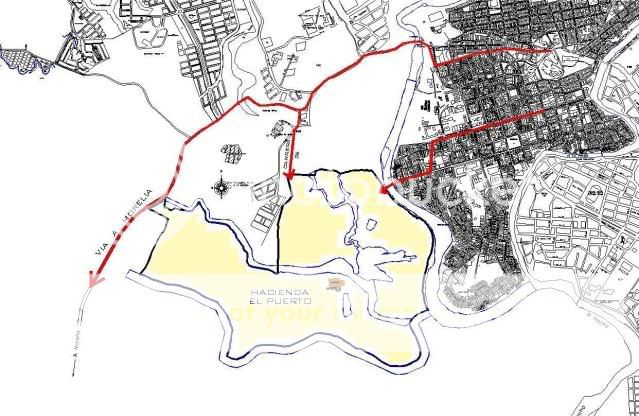

    Vías de acceso a la Hacienda El Puerto

    Imagen aérea actual de la zona que se urbanizará

    *****

    ALCALDESA RECIBIÓ TITULOS DE HACIENDA EL PUERTO PARA MACRO PROYECTO DE VIVIENDA

    Viernes, 29 de Mayo de 2009

    La tarde anterior le fue entregada a la alcaldesa Gloria Patricia Farfán Gutiérrez por parte de Rodolfo Campos Soto, gerente general del Instituto Colombiano de Desarrollo Rural (Incoder), copia de la Resolución número 686 de mayo 27 del 2009 a través de la cual se le oficializa la entrega del terreno de mayor extensión conocido como la Hacienda El Puerto, lote número uno, destinado al proyecto de construcción de vivienda de interés social en esta ciudad.

    Al tema hizo referencia el gerente del Banco Inmobiliario Carlos Fernando Duque Márquez, quien dijo también que en el mencionado documento público, el Incoder le transfirió a título gratuito las 146 hectáreas 9 mil 458 metros cuadrados que comprenden la conocida extensión Hacienda El Puerto, lote número uno, en donde el compromiso de la administración es el de adelantar en firme el macro proyecto de construcción de mas de 3.300 viviendas donde se reubicará a familias residentes en zonas de alto riesgo por inundación, deslizamiento o en condiciones de desplazamiento y que a la fecha no hayan contado con apoyos del Gobierno Nacional ni territorial en cuanto a vivienda dónde ubicarse con el núcleo familiar.

    Duque Márquez, subrayó que esta era la única situación que hacía falta para continuar con el desarrollo del macro proyecto, cosa que quedó superada ayer con la notificación que le hiciera a la alcaldesa el gerente general del Incoder.

    Fuente: Editorial Amazónico

    *****

    RECURSOS PARA MACROPROYECTO DE VIVIENDA GESTIONA ALCALDESA DE FLORENCIA

    3 de septiembre de 2009

    Reunión con el asesor presidencial Juan Carlos Caixa encargado del tema de vivienda de interés social en el país, sostendrán la alcaldesa Gloria Patricia Farfán Gutiérrez y el director del Banco Inmobiliario Carlos Fernando Duque Márquez, este jueves en la Capital de la República.

    El propósito es presentarle al Gobierno representado en el consejero y en funcionarios del Ministerio de Vivienda y Desarrollo Territorial, el macro proyecto de expansión urbanística de la ciudad capital del Caquetá en los terrenos de la denominada Hacienda El Puerto, donde se iniciaron los trabajos de construcción de las primeras 200 viviendas con destino a familias en situación de desplazamiento, y para lo cual se coordina con entidades que tienen en su misión el solucionar el tema de déficit de vivienda en esta seccion del país, reveló Duque Márquez.

    Se busca la asignación de recursos del Gobierno Nacional para el avance del macro proyecto del que se tienen ya gestiones adelantadas para cumplir con la construcción por etapas de estas soluciones de vivienda de interés social no solo para desplazados, sino también para familias vulnerables ubicadas en zona de alto riesgo, añadió la fuente, al tiempo que subrayó que entre los presupuestos por gestiones realizadas se puede contar con un monto aproximado a los 9 mil millones de pesos.

    Fuente: Editorial Amazónico

    *****

    REUNIÓN EN MINISTERIO DE HACIENDA SOBRE IMPORTANTES PROYECTOS

    8 de septiembre de 2009

    La Alcaldesa Gloria Patricia Farfán Gutiérrez, manifestó que viajará a Bogotá a tratar con el Ministro de Hacienda y Crédito Público Oscar Iván Zuluaga, lo relacionado con los proyectos de vivienda de interés social de la Hacienda el Puerto y el de la Villa Amazónica, proyectos que están dentro del Plan de Desarrollo y son prioridad para la administración municipal.

    (…)

    Fuente: Alcaldía de Florencia

    *****

    SIN PROBLEMAS POR TÍTULOS LOS TERRENOS PARA EXPANSIÓN URBANÍSTICA DE FLORENCIA

    22 de Septiembre de 2009

    En las ultimas horas quedaron despejadas todas las dudas que pudieran existir frente a los terrenos de la denominada Hacienda El Puerto, luego de que un juez fallara en derecho lo relacionado con una tutela impetrada ante el despacho por la familia que ocupó la residencia principal de esa propiedad, a donde pretendía regresar.

    En efecto, el Director del Banco Inmobiliario Carlos Fernando Duque Márquez, informó que mediante fallo proferido por el Juzgado Segundo Civil del Circuito, en relación con una tutela instaurada por la señora Sandra Maribel Salguero Castaño y otros, quienes exigían volver a los predios de la Hacienda El Puerto amparados en un fallo de tutela, el mencionado Juzgado les negó tales pretensiones.

    Esa es la razón por la cual este predio quedó totalmente libre de impases jurídicos, con lo cual se procede sin ningún problema a trabajar en el proyecto macro de vivienda de interés social, que adelanta el gobierno de la mandataria, Farfán Gutiérrez.

    Fuente: Editorial Amazónico

    *****

    LUZ VERDE A PROYECTO DE MEGA COLEGIO EN FLORENCIA

    13 de octubre de 2009

    Tras el llamado a sesiones extras del Concejo hecho por la administración Municipal de Florencia, llevadas a cabo el pasado fin de semana, fueron aprobados los cuatro proyectos presentados por el Ejecutivo local.

    (…) y la Autorización a comprometer vigencias futuras mediante un contrato, el cual entregará en concesión por parte del municipio, una infraestructura educativa para que el concesionario organice, opere y preste en ella el servicio público de educación formal.

    (…)

    De otra parte la señora Penna Chavarro (Secretaria de Educación Municipal) manifestó que “la construcción del mega colegio beneficiará a por lo menos 1.400 alumnos, los cuales se ubicarán en los terrenos de la otrora Hacienda el Puerto. Esto no solo beneficiara a los futuros habitantes del sector, sino a los alumnos de otras entidades educativas, porque los cupos que quedarán libres por la reubicación de los educandos se repartirán en otros colegios de la ciudad. En cuanto al tema de la licitación para adjudicar este proyecto, la misma se hará directamente por el MEN, esto dará garantías suficientes de cero corrupción”, finalizó diciendo la funcionaria.

    Fuente: Florencianos.com

    *****

    INICIÓ LA CONSTRUCCIÓN DE PRIMERAS VIVENDAS EN HACIENDA EL PUERTO

    Octubre 19 de 2009

    Con la presencia de alrededor de 2.000 madres cabeza de familia, la Alcaldesa Gloria Patricia Farfán Gutiérrez, instaló ayer en el Polideportivo del Instituto Técnico Industrial, la asamblea del programa Familias en Acción, correspondiente a la comuna Occidental.

    En su discurso la mandataria recordó que esta es una actividad que se viene realizando en las cuatro comunas de Florencia y anunció que ya se están construyendo las primeras 200 viviendas para desplazados, en los terrenos de la antigua hacienda El Puerto, en donde quedará la nueva urbanización “La Gloria”.

    La mandataria anunció que ya estaban aprobadas las primeras 600 viviendas para esa urbanización y que se tiene planificado construir un total de 1.600 entre lo que resta de este año y el 2010.

    La viviendas serán para desplazados, artistas, personas con discapacidad, familias en zonas de alto riesgo, familias del Sisben grado I y en general, población vulnerable de Florencia que carece de vivienda.

    (…)

    Fuente: Alcaldía de Florencia

    *****

    RECURSOS PARA VIVIENDA DE INTERÉS SOCIAL GESTIONA ANTE ALTO GOBIERNO ADMINISTRACIÓN DE FLORENCIA

    24 de noviembre de 2009

    En busca de recursos para continuar el proceso de construcción de vivienda de interés social en la otrora denominada Hacienda El Puerto, viajan hoy a la capital del país la alcaldesa Gloria Patricia Farfán Gutiérrez y el Director del Banco Inmobiliario, Carlos Fernando Duque Márquez.

    Se trata de asistir a una audiencia concedida a la administración del municipio capital del Caquetá, por el Viceministro de Ambiente, Vivienda y Desarrollo Rural, Luis Felipe Henao y con Juan Carlos Caixa, Asesor de la Presidencia de la República para el tema de vivienda en las regiones colombianas, dijo Duque Márquez.

    Reiteró el alto funcionario que se visitará el Ministerio de Hacienda y Crédito Público para conocer del Ministro Óscar Iván Zuluaga, las posibilidades de lograr del presupuesto nacional de la actual vigencia o del rubro de regalías, una asignación mínima de 10 mil millones de pesos que le prometiera el Presidente Álvaro Uribe a la alcaldesa Farfán Gutiérrez, en audiencias anteriores.

    Los recursos que se gestionan son para continuar el proyecto de construcción de viviendas de interés social para las familias que de acuerdo al Plan de Ordenamiento Territorial se ubican en sectores de alto riesgo por inundación o deslizamientos, aseguró Duque Márquez.

    Antes de culminar el mes de noviembre se conocería el resultado de las gestiones en Bogotá, dijo la fuente.

    Fuente: Editorial Amazónico

    *****

    ENTREGARÁN CASAS A DESPLAZADOS EN FLORENCIA

    6 de enero de 2010

    El Banco Inmobiliario entregará en febrero las primeras 200 viviendas para familias en condiciones de desplazamiento en la urbanización ‘La Gloria’, antigua hacienda ‘El Puerto’. Así lo anunció su director, Carlos Duque, quien confirmó que las obras ya arrancaron y se están haciendo las excavaciones y la cimentación. “Estamos satisfechos con los resultados porque la corporación Sinaí comenzó la construcción de las primeras 200 viviendas que podrían entregarse en el próximo mes”, expresó.

    Según Duque, el proyecto estará vigilado por el Comité de Pacto por la Transparencia, por decisión de la propia comunidad que se asoció en veedurías y estará atenta a que todo se cumpla como está planeado. “Nos reunimos con el Comité de Pacto por la Transparencia que tomó el proyecto para hacerle seguimiento. Será un proyecto visible, las residencias tendrán 39 metros cuadrados, con dos habitaciones, sala, comedor, cocina y baño con enchape en las zonas húmedas”, agregó.

    El funcionario confirmó que se firmó el convenio para la construcción de otras 400 viviendas para quienes tengan carta de asignación, especialmente familias de estratos bajos, desplazadas o que viven en zonas inundables. Dijo que se espera que en junio se puedan estar entregando otras 400, es decir serían 600 viviendas en el primer semestre del año.

    (…)

    Fuente: Diario La Nación

  • Organizations Call for Design Professionals to Aid in Haiti Reconstruction


    Last week, a 7.0-magnitude earthquake, Haiti’s worst in two centuries, struck 15 miles south of Port-au-Prince, Haiti’s capital. The Red Cross says 40-50,000 are feared dead, and more than three million residents have been affected. Tens of thousands of buildings have been destroyed. While immediate rescue efforts are a priority, Haiti’s government will require short-term relief housing and long-term building reconstruction aid for Haiti’s buildings, playgrounds, and public spaces.

    The New York Times recently reported that collapsing buildings have caused much of the loss of life. “Engineers and architects who have worked in or visited Haiti say that substandard design, inadequate materials and shoddy construction practices likely contributed to the collapse of many buildings.” Cameron Sinclair, executive director of Architecture for Humanity, was quoted: “In Haiti, most if not all of the buildings have major engineering flaws.”

    Alan Dooley, a Nashville architect who designed a local medical clinic, said most houses and other structures were built out of poured concrete or block mixed with sand, which “resulted in a structurally weaker material.” Many local builders “cut corners” due to the high cost of materials. Additionally, timber isn’t widely available for housing construction due to deforestation. Haiti has among the lowest per-capita incomes in the world.

    A few organizations are calling for landscape architects, architects, and urban planners to support redevelopment efforts:

    Architecture for Humanity: “We will soon start exploring specific opportunities for rebuilding projects in cooperation with our partners on the ground. In the meantime, we have launched a fundraising appeal to support this long term reconstruction effort. In the first four days we’ve raised over $45,000 in individual giving and have pledges from a number of companies. However, more resources are still necessary for us to have a strong and lasting impact.” Learn more and donate.

    Additionally, dedicated, French-speaking volunteers interested in volunteering on the ground are encouraged to sign-up now. Architecture for Humanity is creating a ”comprehensive, two- to four-year plan (including transitional, temporary shelter, as well as permanent construction) for the devastated nation that begins with a site visit in approximately three week’s time,” writes Interior Design

    Article 25: “With much of the death caused by the collapse of buildings, the recovery process is an opportunity to build back better: built environment skills should play a crucial role in safe guarding lives by designing seismically resistant buildings that reduce the risk of death in future disasters. Carefully designed and executed reconstruction of safer structures will offer some security to those that have lost loved ones, homes and livelihoods in the latest tragedy to befall Haiti.” Learn more and donate.

    American Institute of Architects (AIA): “We’ve been in contact with our colleagues at the U.S. Green Building Council and will be sending a joint letter to United Nations Envoy to Haiti Former President Bill Clinton offering our profession’s technical and professional expertise when the initiative begins focusing on rebuilding. Additionally, we are discussing ideas with Architecture for Humanity on how architects can provide on-the-ground design guidance in Haiti so local citizens can seek qualified counsel as they rebuild their homes, businesses, and lives.” AIA is encouraging donations through a range of organizations, including Architecture for Humanity.

    Emergency Architects (Australia): “The needs are enormous and very urgent.  We appeal for your donations for this emergency to a total of AUD 300 000 to help the thousands of victims without shelter.” Learn more and donate.

    U.S. Green Building Council (USGBC): “USGBC and its members are uniquely positioned to help in the rebuilding of the homes, schools, hospitals and infrastructure demolished in the devastating earthquake in Haiti. USGBC CEO Rick Fedrizzi traveled to Haiti last spring with UN Special Envoy to Haiti President Bill Clinton and a small UN working group, and they have begun developing plans that will jumpstart the rebuilding effort. We’ve also offered to work with our members to develop solutions informed by our work in New Orleans and Greensburg in the wake of the natural disasters that devastated those communities.” USGBC is encouraging donations through the Clinton Foundation Haiti Relief Fund.

    The New York Times writes about a range of smaller organizations that are developing building reconstruction services and plans as well. Developing new earthquake-resistant housing is a focus area.  

    Google has aggregated a list of organizations, including UNICEF, CARE, and Doctors without Borders, that are seeking immediate donations for on-going relief.

    Image credit: The New York Times

  • The Mahru-Z Maid Robot Ain’t Exactly the Jetsons [Robots]

    In the 1960’s, Man imagined maid robots like Rosie efficiently coasting around the house in a menopausal whir. In 2010, we get Mahru-Z—the world’s most advanced autonomous butler. And you wonder why we watch so much television.

    Now, I don’t want to say that the world’s robotocists have let me down, but it shouldn’t take 10 minutes and 2 bipeds to make me a piece of toast. Get me the creative team behind Pee Wee’s Playhouse—he had a breakfast contraption that, in hindsight, may have been a better use for our R&D budget. [KoreaTimes via Robots via CrunchGear]


  • Training Divers to Fight Undersea Perils (Feb, 1929)

    Training Divers to Fight Undersea Perils

    USING a special dry-land pressure tank, Navy officials have perfected a method of training deep-sea divers to combat perils hundreds of feet beneath the surface of the sea.

    YOUNG men who wish to become deep-sea divers can learn the fine points of the profession without getting any closer to the ocean than Washington, D. C, thanks to scientists who have developed a system of pressure-tank training which enables divers to stand on the bottom of a tank twelve feet deep and experience exactly the same pressure and temperature conditions that obtain in the ocean at depths of 200 to 300 feet. Deep-sea diving is a profession which demands a sturdy body, a steady nerve and clear judgment, but for young men who wish to choose a life work which holds forth promise of adventure, diving offers thrills second to none.

    At Washington navy yard, a diving school whose personnel includes 25 enlisted men and 6 officers is now in session. Tyros are converted into skilled divers in the short period of six months. Furthermore, these newly trained divers understand thoroughly the perils that they must encounter under the surface sooner or later, and they are taught just how to protect themselves when danger threatens.

    The green divers of the U. S. Navy descend to depths of 150 to 200 feet or more in a tank only 12 feet high and 8 feet in diameter, containing some 8,000 gallons of water. By the use of compressed air, underwater conditions are simulated in this tank. Beginners master diving secrets in the tank without danger to life and limb such as they would experience if “learning their trade” in salt water. Such menaces as the octopus, deep-sea monsters and other marine menaces are eliminated from this training school program.

    One former impediment was the extreme difficulty of breathing satisfactorily for long intervals at points far below the surface. Experiments with the diving chamber have resulted in the perfection of new combinations of synthetic atmosphere. Helium gas has been introduced most successfully in these mixtures. As a result, Chief Gunner W. F. Loughman has made a successful descent to a point 306 feet below the ocean surface—and remained there 20 minutes. In another test, this same diver performed important salvage work on a sunken ship at a depth of 265 feet.

    In the experimental tank at Washington, one expert diver working under simulated sea conditions has attained a depth of 355 feet and has remained there for one-half a minute. This is the deepest dive ever made. The pressure to which this daring diver was exposed was stupendous—sufficient to crush to atoms some of the strongest buildings built by man.

    An additional atmosphere of pressure equivalent to 14.7 pounds per square inch developed in the diving tank by compressed air control exerts similar pressure on the diver as though he had descended another 33 feet. In raising the trainees to the surface of the tank after their experimental dives, care is exercised in gradually decreasing the pressure as where this is done hurriedly, caisson sickness is liable to develop.

    If you are familiar with the precarious occupation of the professional diver, you have, unquestionably, heard about men who have suffered from “bends” or caisson sickness. The extreme pressures of deep sea diving, if reduced abruptly, leave bubbles of nitrogen in the blood vessels, tissues and body fluids. If these bubbles penetrate to the spinal cord or brain, death or paralysis generally results. The associates of the deep sea divers are extremely cautious in raising their mates from the vicinity of the ocean floor after deep descents.

    However, when the sea is rough and the waves are “bumpy,” there is a liability that the diver may suffer severe ear injury or total loss of hearing. Helium gas is particularly important in such “decompression” for it is inert and absorbs the nitrogen bubbles readily.

    Science has perfected the efficient decompression chamber known popularly as the “iron doctor” among the diving fraternity. This is a large cylinder of iron and steel with two compartments and various control doors and gauges in which the divers who suffer caisson sickness are treated in order to eliminate the nitrogen bubbles from their systems. Pressure is artificially applied within the tank to simulate the gradually diminishing pressure of a slow ascent to the surface.

    During the era not so long ago when 200 foot dives were championship feats, the mill-run of divers customarily suffered nausea attacks in one dive out of ten. The provision of better equipment, the use of helium gas in the airlines and similar precautions have reduced this record to one case of illness in 50 dives. The experimental research and standardized training for naval divers fostered by Uncle Sam promises to further curtail this form of diving illness. Potentially, it may even be stamped permanently from the deep sea diving picture.

    The U. S. Navy will train 62 men and officers annually for deep diving and subsequently will station them at strategic points along the coast. They will be ready constantly for emergency calls—to aid in the salvage of sunken ships and submarines and the succor of those endangered in such wrecks. They will also be available for routine underwater service at naval stations and in the repair and maintenance of our national fleet. Special boats used by these divers will be equipped with the all-important decompression chambers and other demonstrated accessories of comparable utility. The use of synthetic atmosphere in this decompression chamber reduces the treatment period from one-fourth to one-third over the time required where ordinary air is used. Furthermore, the use of helium gas in the diving airlines has practically doubled the time in which the divers can remain at work in the salt sea at perilous depths.

    Whenever a group of naval divers are commissioned to aid in the salvage of a sunken ship, each man aspires to find and bring to the surface the signal bell of the waterlogged craft. It is the badge of honor —the coveted prize which proves the superiority of its discoverer over his mates. The rivalry is friendly and results in submarine sport and byplay which lends spice to arduous and hazardous labor at the bottom of the sea.

    The diver must be expert in various repair activities such as the adjustment of marine machinery, electric torch work and related tasks. Even though skilled highly in such work, his efforts are hampered when buried under a blanket of salt water 150 to 200 feet deep so that his efficiency is only one-sixth of what it would be on land. The U. S. Navy through its remarkable instruction courses seeks to make the average diver more proficient than formerly and to educate him so that he will be qualified to make good in every emergency.

    Five compressors whose individual capacity ranges from 50 to 75 cubic feet of air per minute are installed at the Washington Navy Yard.


  • Midget Dirigible Tests Novel AIRSHIP GIRDERS (Jan, 1929)

    Midget Dirigible Tests Novel AIRSHIP GIRDERS

    BUILT as a test ship to try out new features of airship design, the baby blimp Puritan embodies many new ideas in construction which will be used on giant Zeppelins of the future. The Puritan, photographs of which are shown above, is the first dirigible constructed by the Goodyear-Zeppelin Corporation of Akron, Ohio.

    Duraluminum girders with circular openings instead of the usual triangular ones are used in the Puritan. The new design gives great strength with extreme lightness. A vertical rudder on top of the bag, and oppositely geared propellers, give the midget airship greater stability than is usually found in craft of this type.


  • Pullman Cars Go Modernistic (Jan, 1937)

    Pullman Cars Go Modernistic

    COMFORTABLE modernistic furniture and indirect lighting for night reading purposes are features of the new steel and aluminum alloy Pullman observation cars. A buffet containing a broiler, coffee urn, and a refrigerator is also featured.

    An observation parlor seating six persons is located at the rear round-end of the car, and a lounge seating 20 persons on sofas and seats occupies the remaining car space.


  • Lessons in Stealth Communications: V-Vehicle Tries to Keep Technology Details Under Wraps

    Bruce V. Bigelow wrote:

    One problem with being a stealthy company is the difficulty in setting the record straight.

    The News-Star of Monroe, LA, reported yesterday that V-Vehicle, the San Diego-based startup automaker building a factory in Northeastern Louisiana, is “apparently testing prototypes of its mystery car,” but that may be overstating the matter.

    The newspaper quotes David Hitchcock, V-Vehicle’s director of Louisiana assembly operations, as saying, “Our product has entered the testing and validation stage. A lot of the testing and validation conducted so far has been in a virtual environment, but we’ve moved on to the physical testing phase.”

    V-Vehicle has disclosed few details since June, when the startup founded by former Oracle executive Frank Verasano announced plans to a develop and build a “high-quality, environmentally friendly, and fuel-efficient car” in Monroe. The announcement attracted attention in part because V-Vehicle has raised at least $75 million in venture capital from investors that include Kleiner Perkins Caufield & Byers, Google Ventures, and maverick investor T. Boone Pickens.

    But as I reported at the time, V-Vehicle provided no details about the car itself, such as what type of fuel it will use or why the startup describes it environmentally friendly. Verasano told reporters V-Vehicle is trying to be protective of many details because of potential competition. I contacted V-Vehicle spokesman Joe Fisher to confirm details of the news report, and we got into the verbal dance (one-two, sidestep, one-two) that often occurs between reporters and their sparring partners in public relations.

    The bottom line is that Fisher would not confirm certain details of the Star-News report. For example, when I asked if V-Vehicle is testing multiple prototypes, or just one prototype, Fisher told me, “We haven’t commented yet on prototypes.” He added that “entering the testing and validation stage” does not refer to prototypes. When asked what it does refer to, Fisher said it means the startup has begun engineering on test vehicles. But he declined to define the meaning of a test vehicle, saying, “I’m not sure that we’re going to go beyond” what V-Vehicle has said in its official statements.

    I also asked Fisher if he could confirm another detail from the News-Star story, that V-Vehicle’s car will be “a gasoline-powered vehicle that will get 40-plus miles per gallon and costs about $10,000.”

    Fisher responded, “We don’t talk about the price of the car or the fuel system. That’s just not something we have commented on.”

    Fisher was willing to discuss aspects of its pending application for $320 million in government loans under the Advanced Technology Vehicles Manufacturing program, which is administered by the U.S. Department of Energy. He confirmed that V-Vehicle has asked the DOE for a $70 million loan for engineering and a $250 manufacturing loan.

    The state of Louisiana has pledged another $87 million through a state incentive package—providing V-Vehicle raises at least $350 million through other sources. Because V-Vehicle has raised about $75 million from its venture investors, Fisher says the federal loans (if approved) should carry the company over that threshold. Fisher says the company wants to provide more details, but intends to withhold additional information until the DOE acts on V-Vehicle’s federal loan application.

    Until then, the only online source of information about V-Vehicle is on the Louisiana Economic Development website.


  • Microsoft Sues Tivo to Help Out AT&T [TiVo]

    Part of TiVo’s survival strategy, with miserable subscriber numbers, is to make everybody pay for DVR patents—winning Echostar was just the beginning. Microsoft, whose Mediaroom software powers AT&T’s U-Verse, said eff that, and just sued Tivo.

    TiVo sued AT&T, alleging that its U-Verse IPTV service violates three of their DVR patents. Since it’s Microsoft’s software TiVo’s talking about, Microsoft asked to jump into the case on Jan. 15, and is now suing TiVo over two patents relating to a system that programmable info, and a secure method for buying video content. Basically, what’ll happen here is that Microsoft will agree to drop their suit if TiVo drops theirs, and maybe a few coins will change hands, but everybody will go home mostly unscathed. Well, probably, anyway. [Bloomberg, ZatzNotFunny]


  • ZAMBIA: Scarcely Room for Women in Male-dominated Politics

    By Zarina Geloo LUSAKA, Jan 20 (IPS) Charity Mwansa, a former minister and member of parliament, knows just exactly what being one of the very few female politicians in Zambia means. When she left politics it had nothing to with not being able to do the work and instead had everything to do with the mad world of male-dominated politics.

    "It was too hectic, tiring and one needs a lot of stamina to be in the rough and tumble of politics. You do not deal with normality, there is a bit of madness."

    Mwansa, who cites the adage "if you can’t stand the heat, get out of the kitchen", is just another woman who has declined to participate in the country’s next elections. She says that having to constantly watch her back; putting out fires where other people created problems for her; and just having to be alert of plotting against her 24/7 became a bit too much.

    "It’s what politics is about, it’s not for the faint hearted. That’s why I want to rest for now."

    A lawyer, Mwansa says that the political terrain in Zambia is still uneven for women.

    While the rest of the SADC region increases the number of women in governance, Zambia, which goes to the polls in 2011, is likely to see a further reduction of the number of females in decision making. This, women in politics say, is because the male dominated political terrain has not changed.

    Currently, there are 24 members of parliament (MPs) out of a total 150. In cabinet there are five female ministers out of a total of 21. There are only six are women deputy ministers out of a total of 20.

    Ironically, women constitute half of the voting population, and yet, they accounted for less than 15 percent as candidates and elected officials in Parliament and Local Government institutions, according to the Zambia National Women’s Lobby (ZNWL) analysis of the last elections in 2006.

    ZNWL is working to get more women to contest the next elections in 2011. But the party’s board secretary, Tamala Kambikambi, told IPS she would be very surprised if there was an increase in women making it into parliament and local government in the next elections.

    "There are fewer and fewer women getting elected and even contesting positions at each election."

    Kambikambi said while patriarchal attitudes, negative traditions and customs that did not recognise women as equal partners with men were responsible for the low participation of women in governance.

    Political party structures did not promote women’s participation as leadership positions were usually reserved for men. None of the parties had changed their processes on how candidates got chosen to run for a constituency to make it accessible for women. It was still the male dominated national executive committees that choose candidates.

    "Despite their pronouncements about promoting women’s participation at all levels of decision making, none of the political parties come close to achieving the minimum SADC recommendation threshold of 30 percent women in decision making positions," Kambikambi said.

    She recommends the adoption of a clear national policy that would be backed by a legal framework to guide political parties on adoption of candidates to ensure women are not disadvantaged and only used as foot soldiers whenever political parties feel like doing so.

    However, Given Lubinda an MP and senior member of the UPND says complaints about how parties adopt candidates are ‘nonsense’. "Everyone, men and women vote for people to serve committees including the adoption committees. The women are there voting with us, so how can someone complain about male domination?"

    Zambia has four main political parties, the ruling Movement for Multi Party Democracy (MMD) and three opposition parties, the Forum for Democracy and Development (FDD) the only party to have an elected female president, the Patriotic Front (PF) and the United Party for National Development (UPND).

    Elizabeth Chitika, an MP who has served as a cabinet minister in government, argues that the problems for women begin at the very level Lubinda describes.

    "Everything is run by men who hold meetings and caucuses amongst themselves about who gets elected to which committees. It’s not true to say women are not visible, they are just ignored."

    She warns that she will stand as an independent candidate if her party does not adopt her in the 2011 elections.

    "Parties say they chose the best candidate, but we see situations where a woman is the better candidate but a man is chosen, sometimes at the last minute, after the woman has done all the ground work for the party to be accepted in that area," says Chitika.

    Edith Nawakwi president of FDD knows all about gender discrimination. She won a hard fight against powerful men to become president of the party.

    She agrees that it is difficult for women to get adopted as candidates especially since Zambia still practices the first past the post system of voting. But rather than harp on the challenges, women should knuckle down and get to work.

    "Women should go to their parties with something on the table. They must give evidence of their popularity which means they must canvass amongst their constituency and get their buy-in. If they create a name for themselves; no party can afford to ignore them."

    Nawakwi is now weathering criticism from some of her party members who say she cannot win them the presidency and are calling for her to step down. Her critics say she spends more time "being a wife" to her polygamous husband than being a leader of a political party that wants to form the next government.

    Nawakwi shrugs this off saying it is the ‘usual nonsense’ of bringing in gender whenever unenlightened men feel threatened by a woman.

    "I am accustomed to breaking gender barriers. I was elected by the party at a convention that was dominated by men so my gender cannot be an issue now. It’s a new phenomenon to have a female presidential candidate, so it’s not surprising that there is some nervousness. But I have told them to keep calm and watch me."

    Where the ZNWL has identified low education levels and poor economic status as some of the barriers for women’s election campaigns, Nawakwi told IPS she does not suffer those handicaps.

    Of all the presidential candidates, she is the most educated (her Economics and Energy degrees are from the Imperial college of London) she is also the most experienced politician having spent over 15 years in various government portfolios, being the first female finance minister in Zambia and in the SADC region. She is also wealthy in her own right.

    "If you want to do a check list, you will find I am the most qualified candidate around."

    But others do not have the same confidence. Business woman Angelica Rumsey has been courted by the ZNWL to stand in her home village in the northern part of Zambia. She has declined saying her experience in politics were disillusioning.

    "There were lies being peddled about me. While I was discussing issues of development my opponents were attacking my personal character. I saw so much corruption and dirty games during the campaigns that left me disgusted. I would have had to stoop to the level of my opponents if I wanted to win a seat and I could not do that, Rumsey says of her campaign for a parliamentary seat in the 2006 elections.

    Another reason she is reluctant to run for elections is that campaigns are expensive. Men are able to take risks and borrow from banks and other lending institutions, women are reluctant to undertake such risky ventures and in any case, they are not giving that opportunity, Rumsy told IPS.

    "For women who have been in parliament before it is a little easier for them to retain their seats because they will have gotten their gratuities and other monies, that they can use, but for us that are trying to get in, we have to find money for campaigns and that is not easy."

    Zambia has signed and ratified a number of agreements that promote women’s rights. However, there has been a lack of political will to implement and adhere to these agreements and have them domesticated into national laws, Mwawnsa says.

    Mwansa hopes that the 2011 elections will provide a fresh break from the discriminatory election system, and more women will participate, but like Kambikambi she is not hopeful that this will happen.

  • Climate Panel Admits Glacier Blunder, Scrambles to Save Face | 80beats

    HimalayasJust when the whole “ClimateGate” affair had retreated from the headlines, other climate scientists have stepped in to shoot themselves in the foot in the public spotlight. In a new slow-simmering controversy that reached major news outlets this week, Intergovernmental Panel on Climate Change (IPCC) chief Rajendra Pachauri admitted that one of the details in the 2007 report was a mistake. Though the goof is a minor one (in that it doesn’t change the conclusion of the report), the backlash probably won’t be, given what happened the last time around.

    Specifically, one part of the report states that the Himalayan glaciers are retreating faster than anywhere else in the world, and that there’s a good chance they could totally disappear by 2035. But while it’s true that the glaciers are retreating, the date given is a gross overstatement. “You just can’t accomplish it,” says Jeffrey Kargel from the University of Arizona. “If you think about the thicknesses of the ice – 200-300m thicknesses, in some cases up to 400m thick – and if you’re losing ice at the rate of a metre a year, or let’s say double it to two metres a year, you’re not going to get rid of 200m of ice in a quarter of a century” [BBC News].

    So what happened? A misunderstanding of second-hand information. The report cited a 2005 study by the World Wildlife Fund, an environmental advocacy group. That study cited a 1999 article in New Scientist magazine that quoted Indian glacier expert Syed Hasnain as saying Himalayan glaciers could disappear “within forty years” [The Wall Street Journal]. Hasnain has since said that comment wasn’t based on good science, and IPCC co-chair Chris Field has said the information looks like it came more from news reports than from scientifically-reviewed literature, which is improper for report like the IPCC’s.

    While the “2035″ story hit the major media outlets this week, it wasn’t exactly brand new. This round of verbal barbs began last month in India, but glaciologist Georg Kaser said he raised doubts several years ago, and that others pointed to the Himalayan date as goof: “All the responsible people are aware of this weakness in the fourth assessment. All are aware of the mistakes made,” he said. “If it had not been the focus of so much public opinion, we would have said ‘we will do better next time’. It is clear now that working group II has to be restructured” [The Guardian].

    IPCC chief Pachauri tried to stress that one bad detail doesn’t invalidate 3,000 pages of research—indeed, the glaciers are retreating, but at a speed not even close to that implied by the bad date in the report. He at least acknowledged the political ramifications of the IPCC’s goof and tried to spin them in his favor: “Some people will attempt to use it to damage the credibility of the IPCC; but if we can uncover it, and explain it and change it, it should strengthen the IPCC’s credibility, showing that we are ready to learn from our mistakes” [The Times]. But though it might be inevitable that a few errors sneak into such a mammoth report (and science relies on finding one’s mistakes and learning from them), the laxness that allowed an error on an order of magnitude like this makes for a public embarrassment the IPCC can little afford in an already polarized political climate.

    Related Content:
    80beats: Tiny Soot Particles May Be Melting Mighty Himalayan Glaciers
    80beats: The Snows of Kilimanjaro Could Be Gone By 2022
    80beats: The New Murder Mystery Game: Who Killed Copenhagen?
    80beats: Climatologist Steps Down as “ClimateGate” Furor Continues
    The Intersection: IPCC Leak: Warming of the Climate System is “Unequivocal”
    DISCOVER: The State of the Climate—and of Climate Science

    Image: Wikimedia Commons / little byte of luck


  • Stage Challenges Movies with Revolving Settings (Sep, 1931)

    Stage Challenges Movies with Revolving Settings

    FOR the first time in all its history, the legitimate stage is able to rival and even to outstrip the motion picture in its ability to present swift changes of scene to the eyes of an audience. In the past it has been the movie alone which could shift instantly from a desert setting to a polar scene, but now the legitimate theater is not only able to duplicate such a performance, if it wishes, but it can also present as many as four different scenes to the eyes of the audience simultaneously—a feat which the movies have not yet found practical.

    Revolving stages and ingenious mechanical devices have given the “legit” its latest advantage in eternal competition with the talkies to win the favor of audiences attuned to the speeded-up tempo of modern life. The revolving stage idea is not new, but its development as worked out in productions by J. J. Shubert and A. H. Woods is far above anything ever before attempted.

    In Mr. Woods’ production of “Five Star Final” three revolving stages are used, in addition to a setting above one of the stages showing a telephone operator’s booth—four scenes, all presented at the same instant. In the Shubert production of the operettas ‘Three Little Girls” and “A Wonderful Night,” only one revolving stage is used, but it is so huge that it is turned by electric power, and can be disassembled for shipment—the only portable stage of its type ever built.

    Simple as the idea of a revolving stage appears, countless obstacles had to be overcome. P. Dodd Ackerman designed the stages for “Five Star Final.” He found that he could use three stages, a center one of 23-foot diameter, and two side stages of 13 feet. But the usual method of stage lighting, in which cables for electric current are laid on the stage floor, would not suffice, since the revolving of the stages would wind up the cables. This complication was solved by running the lines through a hollow pivot at the center of each stage. Dimensions of the theater had to be carefully checked up to make sure that the stages did not conceal the action from any part of the audience. Silent tracks were devised to make the revolving of the settings absolutely soundproof.

    Each of the three stages was provided with a separate curtain, and each was divided into three sections, like a pie cut into three equal parts. While one section is presented to the audience, stage hands change the settings on the two sections which are backstage. The curtain is dropped; strong arms pull the revolving stage around—and presto! The section which a moment before was presented to the audience is backstage and is being converted from an apartment room to a beer garden, while the action of the play is being carried on in one of the other segments of the stage.

    With three separate stages, each divided into three sections, and an additional setting on top of one of them—viewed through a screen—the rapid-fire changes of action which can be presented are numberless. Usually only one or two stages are in use at the same moment, but when the action calls for it they can all be brought into service.

    The “Five Star Final” revolving stages rest on the floor of the main stage, and are turned around on wheeled tracks. The Shubert portable revolving stage is mechanically more complicated. It can be likened in its operation to a huge phonograph disk, revolving on an axis which extends downward through the regular theater stage floor, connecting with a huge motor in the cellar. One man controls the turntable in response to buzzer signals from the stage manager.

    In the second act of “A Wonderful Night” the entire seven scenes are set on the turntable ‘ at one time. The scenery used is double; that is, painted on both sides. When the scene is shifted the curtain is not lowered, but assumes something of the aspect of a motion picture screen, in which the characters walk from one room to another in full view of the audience. In one act the audience sees a group of characters step from a room, reappear in a street, continue down a moonlit lane and enter a cafe, in natural movement and in correct elapsed time. James H. Surridge, chief of the Shubert mechanical forces, supervised the construction of this remarkable stage.

    Other ingenious stages have been used by theaters to overcome the limitations of the usual opera house. The Boston Opera has hydraulic stage worked somewhat like an elevator.


  • World News is Up 4% Among Total Viewers and Up 6% in The Demo for the Week Compared to its Season to Date Average

    In Sawyer’s First 4 Weeks as Anchor, World News is Up 8% in Total Viewers and 6% in the Demo Over its Season to Date Average


    For the week of January 11th “ABC World News with Diane Sawyer” averaged 8.53 million Total Viewers and a 2.0/7 among Adults 25-54 according to Nielsen Media Research.


    For the week, “World News” was up 4% (+350,000) among Total Viewers and up 6% (+150,000) among Adults 25-54 compared to its season-to-date average.


    In Diane Sawyer’s first four weeks as anchor, “World News” has averaged 8,800,000 Total Viewers and 2,460,000 Adults 25-54.  That is up 8% (+620,000) above World News’ season-to-date average among Total Viewers and up 6% (+130,000) in the demo.


    Compared to a year ago, “World News’” total viewing advantage over CBS Evening News (1,790,000) grew 16%.


    Last week’s “World News” featured Diane Sawyer and Bill Weir reporting “Afghanistan: Where Things Stand” as well as extensive coverage of the Haiti earthquake from Sawyer, Robin Roberts, Dan Harris, Kate Snow, Martha Raddatz and Dr. Richard Besser.


    Jon Banner is the executive producer of “ABC World News with Diane Sawyer.”


    EVENING NEWS (Week of January 11, 2010)


      Total Viewers     Adults 25-54 Households

    ABC   8,530,000     2.0/7; 2,480,000 5.7/11

    NBC  10,300,000     2.5/9; 3,160,000 6.7/12

    CBS   6,740,000 1.7/6; 2,110,000     4.5/8


    Source: Nielsen, NTI (Total Viewers and Adults 25-54 Live + SD weeks of 1/11/10, 1/4/10, and 1/12/09). Season-to-date: Live +7 (where available) & Live +SD for 9/21/09-1/15/10.