Category: News

  • Do Virtual Pets Breed Irresponsibility?

    Many years ago, virtual little hand-held “pets” called Tamagotchis hit the toy store scene, and parents and kids alike went nuts trying to get their hands on one. Around that time, I got into a conversation with an online friend about the little electronic toys, which you fed, washed and took care of via tiny little buttons on the egg-sized electronic.

    zhu_zhu_pets

    What made them so cool and exciting (and different from say, a stuffed animal), was that you were getting feedback from the “pet,” and could respond accordingly. However, my friend said that she didn’t like the thought of virtual pets because she didn’t think they taught kids the right things about pet care and responsibility, that because there were no real consequences kids wouldn’t give a second thought to tossing the toy, and eventually a real pet, away when they were tired with it.

    With this Christmas’s toy of choice being something similar – a furry, mechanical hamster that can run through tubes (am I the only one tired of hearing about Zhu Zhu Pets?) – I remembered my friend’s take on the toys, and it’s got me thinking about it again.

    As a parent now, I can see her point, but I’ve also seen first hand that my kids do know the difference between their real pets that require feeding, grooming and care, as opposed to the virtual pet toys they’ve had (including the aforementioned Tamagotchi).

    What do you think? Do you think these virtual toy pets make it too easy for kids to think real pets are just as disposable?

    [image: amazon]

    Post from: Blisstree

    Do Virtual Pets Breed Irresponsibility?

  • The Difference Between Innovation And Invention… In Two Minutes With A Whiteboard

    It’s time for our third UPS-sponsored whiteboard video, explaining some of the topics we discuss around here in two minutes or less. As you might remember, the first explained the economics of abundance and the second discussed the innovator’s dilemma. This third one is about the difference between invention and innovation, and the process of getting from the first to the second, using one particular product as an example:


    Once again, these videos were sponsored by UPS, though we had free rein in creating the actual presentation, and it’s quite obviously based on topics that we discuss here on a regular basis.

    Permalink | Comments | Email This Story


  • diet advice

    I am a 1.5 and have been on insulin for a year now. I’ve finally got everything worked out as far as insulin doses etc. and now I actually have started to gain weight, first time in 3 years of knowing I was diabetic. I run or bike 6 days a week but still am gaining some unwanted weight. I’m wondering what others use for snacks to get you through the day that are low in calories and fat but have the few carbs to pick you up. Any ideas would be great. I do not have a fridge at work though.
  • Privacy is a Basic Human Need

    Bruce Schneier effectively refutes Google CEO Eric Schmidt’s assertion that we should all accept that Big Brother is watching us, and it’s OK.

    Privacy protects us from abuses by those in power, even if we’re doing nothing wrong at the time of surveillance.

    We do nothing wrong when we make love or go to the bathroom. We are not deliberately hiding anything when we seek out private places for reflection or conversation. We keep private journals, sing in the privacy of the shower, and write letters to secret lovers and then burn them. Privacy is a basic human need.

    […]

    For if we are observed in all matters, we are constantly under threat of correction, judgment, criticism, even plagiarism of our own uniqueness. We become children, fettered under watchful eyes, constantly fearful that — either now or in the uncertain future — patterns we leave behind will be brought back to implicate us, by whatever authority has now become focused upon our once-private and innocent acts. We lose our individuality, because everything we do is observable and recordable.

  • Albert Edwards: The Leading Indicators Foretell The Next Leg Down

    SocGen’s uber-bear Albert Edwards has new, fascinating report on about the next leg down in stocks. What makes it particularly interesting is his allusion to trading patterns in Japan.

    ZeroHedge has the report:

    The secret to making money in Japan was to remember to exit just as most investors had become convinced of a self-sustaining recovery. Investors should have sold as the leading indicators began to turn down (see chart below). They needed to sell despite protestations from economists that we were set for a mid-cycle pause and strategists telling us that the market was much cheaper than had been seen in recent years. In each case the sanguine voices were proved appallingly wrong. Even moderate fiscal tightening would pitch Japan’s economy back into recession and the Nikkei made new lows. At the stock level, my Quant colleague, Andrew Lapthorne, has demonstrated that in Japan value/momentum strategies needed to be replaced by reversal strategies (buying the losers/selling the winners) ? link. The buy and hold era was crushed by the reality of economic and market volatility.

    albert edwards japan

    For Japanese investors, it took some time to learn the new metrics of investing. Today, investors have no such excuse. After all, Ben Bernanke tells us we should learn the lessons of Japan and so we must. Though many commentators want to complicate the investment business, we try and keep our advice as simple as possible. The leading indicators have begun to turn down in the US (see charts below) and so risk assets are therefore dangerous. Almost no-one will be willing to predict renewed global recession and no-one will predict new lows in equities. And with the market so bullish (cover chart) a cyclical failure will come as a crushing blow to sentiment. It is time for caution. It is time to sell.

    albert edwards japan

    Read more at Zero Hedge >>

    Join the conversation about this story »

    See Also:

  • How do you get there from here … ?

    From:

    Low-Fat versus Low-Carbohydrate Weight Reduction Diets: Effects on Weight Loss, Insulin Resistance and Cardiovascular Risk A Randomised Control Trial ? Diabetes

    ie, "The difference in augmentation index may imply a negative effect of low-carbohydrate diets on vascular risk."

    TO:
    High-fat Low-carb Diets Could Mean Significant Heart Risk

    "High-fat Low-carb Diets Could Mean Significant Heart Risk"

    and Low carb diet “increases heart disease risk“

    "Low carb diet ”increases heart disease risk”

    Thanks to the internet, in LESS than 24 hours!

  • Swype swiped from the Samsung Omnia 2

    swype

    Swype is a truly novel method of text entry, and up till now you had to have a Samsung Omnia 2 to experience it.  Wait no longer however, as the good people over at Modaco have liberated it from the clutches of the device.

    The cab for QVGA and WQVGA devices can be downloaded from this Modaco thread, where one can also go to read about the various issues with the purloined software.

    Via Pocketnow.com

    Share/Bookmark

  • General Mills Cuts Sugar In Cereals, Ostensibly For Health Reasons, But Not Really

    Surely General Mills will cite public outcry on the unhealthiness of its cereals for the move, considering how sugary Trix and Lucky Charms are:

    AP: General Mills — the maker of Lucky Charms, Trix and Cocoa Puffs — plans to reduce the amount of sugar in its cereals marketed to children.

    General Mills said it will cut the sugar in 10 of its cereals to single-digit grams of sugar per serving. It did not provide a timeline for reaching this goal, but it builds on reductions the company rolled out two years ago.

    The health reasons are great, but here’s the real reason (via Mongabay):

    World Sugar Prices 2009

    Join the conversation about this story »

    See Also:

  • Scan: Hotel Dusk’s Kyle Hyde returns in Last Window

    Famitsu has given us our first look at Last Window, Cing’s follow-up to the awesomely wonderful Hotel Dusk: Room 215. Seems nothing has changed drastically, which should be great news for those who loved the first game’s

  • Donkervoort tweaks the D8 GT for 24-hour race debut in Dubai

    Filed under: , , , , , , ,


    2010 Donkervoort D8 GT(4) endurance racer – Click above for high-res image gallery

    While fanatics around the world debate the supremacy of one sportscar over another based on numbers alone, here at Autoblog we postulate that such exotic machinery is only as good as its capacity to transport you to another place, if not in body then in your mind. So bear with us and imagine the following scenario: You’re based in Holland. You’ve created what could be the ultimate neo-Lotus 7, and with it you’ve already placed in a major racing series. So where do you go next? Why, to Dubai, of course!

    We’re talking about the Donkervoort D8 GT, undoubtedly one of the most futuristically phallic retro road rockets on the street or track today. We got our first glimpse three years ago, and took a closer look in Geneva back in 2007, before production began last year. The 1400-pound cab-rearward track tool packs an Audi-sourced 1.8-liter turbo four driving 270 horsepower to the rear wheels. That’s enough power to sixty in less than four seconds.

    With the D8 GT, the Dutch manufacturer has already taken second place in the FIA GT4 European Cup, and it is now heading to its first 24-hour race at the Dubai Autodrome on the shores of the Persian Gulf. To prepare for the event, Donkervoort has tweaked the fuel system, the brakes, the aerodynamics, the carbon-fiber sandwich panels and aluminum chassis to create the D8 GT(4). The results ought to be interesting as the 24 Hours of Dubai kicks off in mid-January, but you can check it out now in the gallery below and the press release after the jump.

    [Source: Donkervoort]

    Continue reading Donkervoort tweaks the D8 GT for 24-hour race debut in Dubai

    Donkervoort tweaks the D8 GT for 24-hour race debut in Dubai originally appeared on Autoblog on Wed, 09 Dec 2009 13:28:00 EST. Please see our terms for use of feeds.

    Permalink | Email this | Comments

  • Home Decor Color Trends for 2010

    You want to redecorate your home, but is red still in? What about blue? If you go with that dark teal color, will you be able to find accessories on the shelf? The folks at Pantone do a pretty good job of predicting hot color trends in home decor and have created 9 different palettes of trendsetting color groups for 2010. (They say there are 8 groups. I guess they don’t count their Tinged Neutral palette as a color group.)

    2010 color trends

    You’ll be happy to know that blue and red are in, but they come in different shades than in past years. I saw an orangey red tomato and a peacock blue design on their 2010 home interior guide cover.

    The color groups are:

    • Greenmarket – Literally draws inspiration from markets, which explains the tomato. You can see the palette colors for this group, Gatherings and Galaxy at Apartment Therapy. This is my favorite palette, which is odd, because I don’t use very much red in my home.
    • Resourceful – Sort of the “Mother Earth” palette with a bit of sky thrown in. You can read in depth descriptions at Home Intel.
    • Transformations – Reminds me of Victoria magazine or Easter. Includes pink and lavender.
    • Ambiance – Pretty modern palette – lots of grays and silver pink.
    • Gatherings – The inspiration for this palette comes from Africa.
    • Galaxy – The sky, the earth and the sun all provided the inspiration for this palette. I think it would be perfect for anyone living on the waterfront who is in need of a home decor palette.
    • High Definition – This one starts with basic black and white and then throws in some very bright colors.
    • Pastiche – Hmm. How to describe this palette? Maybe like someone had an ice cream sherbet fight and when it was over, your house was super colorful. I could see this one in a kids’ room if you use restraint.
    • Tinged Neutrals – Tans and grays. Tans and grays. Nice and restful. I can see this one in a lot of model homes.

    Photo: SXC

    Post from: Blisstree

    Home Decor Color Trends for 2010

  • Facebook’s New Privacy Changes: The Good, The Bad, and The Ugly

    Five months after it first announced coming privacy changes this past summer, Facebook is finally rolling out a new set of revamped privacy settings for its 350 million users. The social networking site has rightly been criticized for its confusing privacy settings, most notably in a must-read report by the Canadian Privacy Commissioner issued in July and most recently by a Norwegian consumer protection agency. We’re glad to see Facebook is attempting to respond to those privacy criticisms with these changes, which are going live this evening. Unfortunately, several of the claimed privacy “improvements” have created new and serious privacy problems for users of the popular social network service.

    The new changes are intended to simplify Facebook’s notoriously complex privacy settings and, in the words of today’s privacy announcement to all Facebook users, “give you more control of your information.” But do all of the changes really give Facebook users more control over their information? EFF took a close look at the changes to figure out which ones are for the better — and which ones are for the worse.

    Our conclusion? These new “privacy” changes are clearly intended to push Facebook users to publicly share even more information than before. Even worse, the changes will actually reduce the amount of control that users have over some of their personal data.

    Not to say that many of the changes aren’t good for privacy. But other changes are bad, while a few are just plain ugly.

    The Good: Simpler Privacy Settings and Per-Post Privacy Options

    The new changes have definitely simplified Facebook’s privacy settings, reducing the overall number of settings while making them clearer and easier for users to find and understand. The simplification of Facebook’s privacy settings includes the elimination of regional networks, which sometimes would lead people to unwittingly share their Facebook profile with an entire city, or, as Facebook’s founder Mark Zuckerberg explained in a recent open letter, an entire country.

    Perhaps most importantly, Facebook has added a feature that we and many others have long advocated for: the ability to define the privacy of your Facebook content on a per-post basis. So, for example, if you only want your close friends to see a particular photo, or only your business colleagues to see a particular status update, you can do that — using a simple drop-down menu that lets you define who will see that piece of content.

    Most important, however, is the simple fact that as part of this transition, Facebook is forcing all of its users to actually pay attention to the specifics of their privacy settings. Considering that many if not most users have previously simply adopted the defaults offered by Facebook rather than customizing their privacy settings, this is an especially good thing.

    No question, these are positive developments that hopefully will lead more people to carefully review and customize their level of privacy on Facebook. Unfortunately, the new flexibility offered by per-post privacy settings, a definite “good,” is being used to justify the “bad”…

    The Bad: EFF Doesn’t Recommend Facebook’s “Recommended” Privacy Settings

    Although sold as a “privacy” revamp, Facebook’s new changes are obviously intended to get people to open up even more of their Facebook data to the public. The privacy “transition tool” that guides users through the configuration will “recommend” — preselect by default — the setting to share the content they post to Facebook, such as status messages and wall posts, with everyone on the Internet, even though the default privacy level that those users had accepted previously was limited to “Your Networks and Friends” on Facebook (for more details, we highly recommend the Facebook privacy resource page and blog post from our friends at the ACLU, carefully comparing the old settings to the new settings). As the folks at TechCrunch explained last week before the changes debuted:

    The way Facebook makes its recommendations will have a huge impact on the site’s future. Right now, most people don’t share their content using the ‘everyone’ option that Facebook introduced last summer. If Facebook pushes users to start using that, it could have a better stream of content to go against Twitter in the real-time search race. But Facebook has something to lose by promoting ‘everyone’ updates: given the long-standing private nature of Facebook, they could lead to a massive privacy fiasco as users inadvertently share more than they mean to.

    At this point there’s no “if” about it: the Facebook privacy transition tool is clearly designed to push users to share much more of their Facebook info with everyone, a worrisome development that will likely cause a major shift in privacy level for most of Facebook’s users, whether intentionally or inadvertently. As Valleywag rightly warns in its story “Facebook’s New ‘Privacy’ Scheme Smells Like an Anti-Privacy Plot”:

    [S]miley-face posturing aside, users should never forget that Facebook remains, at heart, not a community but a Silicon Valley startup, always hungry for exponential growth and new revenue streams. So be sure to review those new privacy “options,” and take Facebook’s recommendations with a huge grain of salt.

    Being a free speech organization, EFF is supportive of internet users who consciously choose to share more on Facebook after weighing the privacy risks; more online speech is a good thing. But to ensure that users don’t accidentally share more than they intend to, we do not recommend Facebook’s “recommended” settings. Facebook will justify the new push for more sharing with everyone by pointing to the new per-post privacy options — if you don’t want to share a particular piece of content with everyone, Facebook will argue, then just set the privacy level for that piece of content to something else. But we think the much safer option is to do the reverse: set your general privacy default to a more restrictive level, like “Only Friends,” and then set the per-post privacy to “Everyone” for those particular things that you’re sure you want to share with the world.

    The Ugly: Information That You Used to Control Is Now Treated as “Publicly Available,” and You Can’t Opt Out of The “Sharing” of Your Information with Facebook Apps

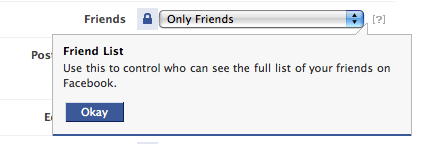
    Looking even closer at the new Facebook privacy changes, things get downright ugly when it comes to controlling who gets to see personal information such as your list of friends. Under the new regime, Facebook treats that information — along with your name, profile picture, current city, gender, networks, and the pages that you are a “fan” of — as “publicly available information” or “PAI.” Before, users were allowed to restrict access to much of that information. Now, however, those privacy options have been eliminated. For example, although you used to have the ability to prevent everyone but your friends from seeing your friends list, that old privacy setting — shown below — has now been removed completely from the privacy settings page.
    Facebook counters that some of this “publicly available information” was previously available to the public to some degree (while admitting that some of it definitely was not, such as your gender and your current city, which you used to be able to hide). For example, Facebook points to the fact that although you could restrict who could see what pages you are a fan of when they look at your profile, your fan status was still reflected on the page that you were a fan of. But that’s no justification for eliminating your control over what people see on your profile. For example, you might want to join the fan page of a controversial issue (like a page that supports or condemns the legalization of gay marriage), and let all your personal friends see this on your profile, but hide it from your officemates, relatives or the public at large. While it’s true that someone could potentially look through all the thousands upon thousands of possible fan pages to find out which ones you’ve joined, few people would actually do this.

    Facebook also counters that users can still control whether non-friends can see your Friends List by going into the hard-to-find profile editing settings on your profile page and changing the number of friends displayed on the public version of your profile to “0” unchecking the new check-box in your Friends setting that says “show my friends on my profile”. However, if the goal with these changes was to clarify the privacy settings and make them easier to find and use, then Facebook has completely failed when it comes to controlling who sees who you are friends with. And even if you do have some control over whether non-friends can see your friends list — if you hunt around and can find the right setting, which is no longer under “Privacy Settings” — Facebook has made the privacy situation even worse when it comes to information sharing with the developers of Facebook apps.

    The issue of privacy when it comes to Facebook apps such as those innocent-seeming quizzes has been well-publicized by our friends at the ACLU and was a major concern for the Canadian Privacy Commissioner, which concluded that app developers had far too much freedom to suck up users’ personal data, including the data of Facebook users who don’t use apps at all. Facebook previously offered a solution to users who didn’t want their info being shared with app developers over the Facebook Platform every time a one of their friends added an app: users could select a privacy option telling Facebook to “not share any information about me through the Facebook API.”

    That option has disappeared, and now apps can get all of your “publicly available information” whenever a friend of yours adds an app.

    Facebook defends this change by arguing that very few users actually ever selected that option — in the same breath that they talk about how complicated and hard to find the previous privacy settings were. Rather than eliminating the option, Facebook should have made it more prominent and done a better job of publicizing it. Instead, the company has sent a clear message: if you don’t want to share your personal data with hundreds or even thousands of nameless, faceless Facebook app developers — some of whom are obviously far from honest — then you shouldn’t use Facebook.

    These changes are especially worrisome because even something as seemingly innocuous as your list of friends can reveal a great deal about you. In September, for example, an MIT study nicknamed “Gaydar” demonstrated that researchers could accurately predict a Facebook user’s sexual orientation simply by examining the user’s friends-list. This kind of data mining of social networks is a science still in its infancy; the amount of data that can be extrapolated from “publicly available information” will only increase with time. In addition to potentially revealing intimate facts about your sexuality — or your politics, or your religion — this change also greatly reduces Facebook’s utility as a tool for political dissent. In the Iranian protests earlier this year, Facebook played a critical role in allowing dissidents to communicate and organize with relative privacy in the face of a severe government crackdown. Much of that utility and privacy has now been lost.

    The creation of this new category of “publicly available information” is made all the more ugly by Facebook’s failure to properly disclose it until today — the very day it is forcing the new change on users — when it added a new bullet point at the top of its privacy policy specifying this new category of public information that will not have any privacy settings. The previous versions of the policy, however, either didn’t disclose this fact at all, or buried it deep in the text surrounded by broad assurances of privacy.

    For example, in its previous privacy policy before it was revised in November, Facebook didn’t specify any of your data as “publicly available information,” and instead offered broad privacy assurances like this one:

    We understand you may not want everyone in the world to have the information you share on Facebook; that is why we give you control of your information. … You choose what information you put in your profile, including contact and personal information, pictures, interests and groups you join. And you control the users with whom you share that information through the privacy settings on the Privacy page.

    Meanwhile, the privacy policy as updated in November did specifically call out certain information as “publicly available” and without privacy settings nearly half-way down the page, surrounded by privacy promises such as these:

    • “You decide how much information you feel comfortable sharing on Facebook and you control how it is distributed through your privacy settings.”
    • “Facebook is about sharing information with others — friends and people in your networks — while providing you with privacy settings that you can use to restrict other users from accessing your information.”
    • “you can control who has access to [certain information you have posted to your profile], as well as who can find you in searches, through your privacy settings.”
    • “You can use your privacy settings to limit which of your information is available to ‘everyone.’”

    These statements are at best confusing and at worst simply untrue, and didn’t give sufficient notice to users of the changes that were announced today.

    In conclusion, we at EFF are worried that today’s changes will lead to Facebook users publishing to the world much more information about themselves than they ever intended. Back in 2008, Facebook told Canada’s Privacy Commissioner that “users are given extensive and precise controls that allow them to choose who sees what among their networks and friends, as well as tools that give them the choice to make a limited set of information available to search engines and other outside entities.” In its report from July, The Privacy Commissioner relied on such statements to conclude that Facebook’s default settings fell within “reasonable expectations,” specifically noting that the “privacy settings — and notably all those relating to profile fields — indicate information sharing with ‘My Networks and Friends.’”

    No longer. Major privacy settings are now set to share with everyone by default, in some cases without any user choice, and we at EFF do not think that those new defaults fall within the average Facebook user’s “reasonable expectations”. If you’re a Facebook user and you agree, we urge you to visit the Facebook Site Governance page and leave a comment telling Facebook that you want real control over all of your data. In the meantime, those users who care about control over their privacy will have to decide for themselves whether participation in the new Facebook is worth such an extreme privacy trade-off.

  • CHART OF THE DAY: This Is The Chart Warren Buffett Keeps Under His Pillow

    button more charts
    button chart prev button chart next

    This must be one of Warren Buffett’s favorite charts right now.

    The Purchasing Managers Index (PMI) is an economic indicator for the U.S. manufacturing sector, in blue below. It tends to be a leading indicator for future railroad shipments. This relationship makes sense since product orders generally lead to transportation demand via railroad and trucks.

    Due to positive signs from manufacturing, the PMI has spiked hard recently. Thus it’s a fair bet that rail carloads, in red below, should eventually spike as well. We might not be back to the good old days, but the situation is likely to be better than where we’ve just been.

    If this turns out true, it would be good news for the U.S. economy and U.S. manufacturing. It’d also make Warren Buffett look pretty smart, since he made his largest investment ever in the railroad Burlington Northern (BNI) not too long ago.

    The author owns shares in BNI.

    chart of the day, PMI vs. Next Month’s U.S. Rail Carloadings Excluding Coal and Grain*


    Get This Delivered To Your Inbox

    You can get this dropped in your inbox every afternoon as The Chart Of The Day. It’s simple. It’s convenient. It’s free. All we need is your email address (though we’d love your name and state, too, if you’re willing to share it).  Sign up below!

    Join the conversation about this story »

    See Also:

  • Humalog 75/25 question

    Thanks to a variety of things, including discontinuing Byetta in the middle of this year, my A1C rose to a whopping 9.2. My PCP recommended I go back on Lantus, which I’d been on briefly in 2007. My Endo had other ideas, deciding to up my Actos from 30 mg to 45, in a wait-and-see approach. I didn’t agree, and neither did the PCP… the PCP took over my diabetic care, and prescribed Humalog 75/25 instead of the Lantus/Novolog combo I’d used successfully before.

    I started the new regimen last night, 10 units 15 minutes before dinner. My fasting numbers were previously 160-170, this morning it was 149. I have also discontinued both Prandin and Metformin at the request of my PCP, so I expect that to be part of this equation.

    Since it’s been a while, and since I don’t remember, can anyone tell me how long it will be before I see results with this new insulin? You may as well throw in any anecdotes you may have about this fine product as well! Thanks for reading.

  • EXCLUSIVE: First shots of the Hennessey Performance Venom GT

    Filed under: , , ,

    Hennessey Venom GT – Click above for image gallery

    Hennessey Performance is on a roll. First we got a Cadillac CTS-V that accelerates so violently it sets off its OnStar system. Then we get a Chevrolet Corvette ZR1-powered pony car that handily won our Best Camaro of SEMA. Now this: The first shots of the Hennessey Venom GT, a lightweight, LS9-powered ICBM aimed directly at the world’s hypercar elite.

    Originally teased way back in November of 2007, the House That Hennessey Built has been working overtime to create this Lotus Elise-based, mid-engine masterpiece for the Geneva Motor Show this March, and judging by these first shots from the shop, things are looking downright diabolical.

    According to Hennessey, the final weight – with fuel, but no driver – should come in under 2,400 pounds, and with the “mildly tweaked” LS9 putting out between 650 and 700 horsepower, that puts the Venom in contention with the Bugatti Veyron for power-to-weight bragging rights. But naturally, Hennessey isn’t stopping there. After the bugs are worked out, the supercharger will be dispatched in favor of a duo of turbos, netting output somewhere north of 1,000 hp. 0-60 times? Less than 2.5 seconds. Top speed? An estimated 262 mph.

    Putting that grunt to the ground is a Ricardo six-speed manual gearbox – the same transmission the tuning firm used on its 1,000+ hp twin-turbocharged Ford GTs – with carbon fiber Dymag wheels fitted at all four corners, each shod in Michelin PS2 tires. Fifteen-inch carbon ceramic discs with eight piston Brembo calipers are mounted up front, while 14-inch rotors with six piston calipers reside in the rear, and although we haven’t gotten confirmation, the shot above suggests the driver sits front and center. Nope, the Venom will be available in traditional left- or right-hand drive, according to Hennessey.

    That’s all for now, but look for more details to be released in the coming weeks and get an exclusive eyeful in the gallery below.

    EXCLUSIVE: First shots of the Hennessey Performance Venom GT originally appeared on Autoblog on Wed, 09 Dec 2009 13:00:00 EST. Please see our terms for use of feeds.

    Permalink | Email this | Comments

  • Extreme Christmas Village

    What do you think? I love trains at Christmas time and there’s lots of them in this. I found it over the top and completely charming.

    YouTube – 2007 extreme christmas village

  • Jon Sohn Discusses Progress on International Finance in Copenhagen on E&E TV

    As one of the most contentious issues in the international climate negotiations, climate finance is expected to be a major focus in Copenhagen.  During today’s OnPoint, Jon Sohn explains the climate finance issue and discusses US and European pledges for international aid to developing nations. 

    To watch the interview, please visit: http://www.eenews.net/tv/2009/12/09/.

  • Southwestern College Green Team receives grant to participate in Kansas Day

    Southwestern College has announced that students in the Green Team program will be coordinating service activities as part of Kansas Day 2010. These activities are part of the inaugural Kansas Campus Compact’s Commemorate Kansas/Serve Kansas program.

    …“These creative projects are an indication that students and faculty at Kansas colleges and universities are aware of the importance of connecting their education with a civic purpose that serves all of Kansas’ citizens,” said Matthew Lindsey, executive director for Kansas Campus Compact.

    »Read the entire article at The Winfield Daily Courier.

  • Study Being Promoted As ‘Redbox Kills Jobs’ Actually Shows That Hollywood Jobs Will Grow

    We’ve already been covering Redbox’s legal fight with a few movie studios who so hate the idea that Redbox is actually giving people something they want (legally) at a reasonable price (legally), that they want to kill it. The whole thing is so ridiculous that it’s difficult to believe there’s anyone out there defending the anti-Redbox studios’ position (and, in fact, a couple of the other studios, with Paramount in the lead, have realized that it’s smarter to partner with Redbox than to try to kill it). Yet, the Los Angeles Economic Development Corporation (a non-profit with LA government connections) has put out a report claiming that Redbox kills jobs and harms the economy throughout Los Angeles (thanks to reader Valkor for sending this in). If you want, you can read the full report (pdf) — but prepare to be amazed as what the report actually says is quite different than the press release headline.

    Hidden within the report are claims that the industry will continue to grow nicely for the next decade and that alternative business models will develop that more than compensate for any loss of revenue from reduced rental prices. But that’s not what the headline of the press release says. No, it reads:


    Study says low-cost DVD rentals could lead to $1 billion, 9,280 jobs lost

    But, deep in the actual report? Why, it says the following:


    The shift to digital delivery will provide new revenue streams for the industry and new opportunities… Increased availability of all types of digital content and media have changed lifestyles and will continue to contribute to demand for video products. Indeed, SNL Kagan forecasts continuing growth in overall industry revenues as alternative streams compensate for this loss of revenue. In total, SNL Kagan projects an increase in distributor revenues from all sources worldwide from $51.3 billion in 2008 to $67.6 billion in 2017. While the composition of these revenues will clearly change, distributors will continue to experience revenue growth into the next decade.

    So how does it get from that to the headline? Well, it assumes that Redbox is decreasing revenue from traditional rental, and seems to assume that these other alternative revenue streams are not influenced by Redbox or other forms of distribution that are more convenient and cheaper and attract a new or different audience — which seems like a dubious assumption. Another way of looking at this: it’s as if the horse and buggy industry put out a report just as automobiles were coming to market that said, yes, the auto industry will be huge and will create millions of new jobs, but because a much smaller number of jobs are lost due to downsizing the carriage market, we can release a report saying that the auto industry is “killing jobs.” Logically, that’s ridiculous.

    On top of that, it makes some odd assumptions throughout the report, continually throwing out the idea that Redbox itself might increase the revenue for the industry, repeatedly suggesting that the industry is mature and if there were a way to get more revenue out of it, it would have already been discovered. Of course, considering that the market has long been dominated by a single player, not prone to innovating, and with close ties to studios that have limited some of how it could act — that assumption is highly suspect. In fact, the very reason that Redbox has been so popular (and which also explains the rise of Netflix) has been consumer dissatisfaction with the old Blockbuster model, which was designed to squeeze consumers.

    To the authors’ credit, they do try to be fair on other numbers and assumptions, recognizing that effects go in multiple directions and that there are other issues at play, but the press release headline claiming that Redbox costs the industry a billion dollars and nearly 10,000 jobs, when the actual report claims that revenue is increasing and will continue to do so, just seems hard to swallow. Unfortunately, every single press report covering this study seems to only take the PR headline from the report and repeat it, without anyone appearing to have read the part of the report that says the exact opposite of what the headline claims.

    Permalink | Comments | Email This Story