Category: News

  • Maintaining Proper Home Humidity

    You spend a lot of time in your home, even if you don’t think you do. Remember that all those sleeping hours count as well. For the most comfortable home, you may need to address humidity levels. A humidity level below 50% should be maintained in your home to prevent mold growth. However, humidity levels that are too low may also cause problems. An ideal humidity is around 45%.

    humidityLow Humidity Level Issues in the Home

    • Dry skin and throat irritation could develop
    • Nosebleeds result from a dry nose
    • Wood floors and drywall could be damaged
    • Static electricity may become an issue


    High Humidity Level Issues in the Home

    • Paint and wallpaper may peel
    • Ceilings and walls may become stained
    • Termites and roaches will love your home
    • Mold may grow

    Checking your home’s humidity is easy. Pick up a hygrometer. They’re typically inexpensive and resemble a thermometer, and they may tell you both the temperature and humidity level.

    Solutions for Home Humidity Problems

    For low humidity, invest in a humidifier. You’ll need to refill it with water, so consider how much water the humidifier holds before purchasing. Also, you’ll have to clean it regularly and change filters.

    For high humidity, purchase a dehumidifier. Instead of filling it with water, you’ll be emptying it out. Most dehumidifiers have an automatic shutoff feature to prevent overflow. They should be placed away from sources of dirt or dusts. For another option to lower humidity, install and use vent fans in areas like the bathroom or kitchen. Also, make sure your clothes dryer is properly vented to the outdoors and repair any leaky faucets. For more ideas on reducing high humidity in your home, visit Energy Star.

    Do you know your home’s humidity level?

    (Image via Honeywell)

    Post from: Blisstree

    Maintaining Proper Home Humidity

  • USF depression drug at center of $1 billion AstraZeneca, Targacept deal

    A drug to treat major depression that was created and patented by a team of University of South Florida researchers is poised to bring millions of dollars in royalties to the university. London-based AstraZeneca plc and Targacept, Inc., of Winston-Salem, NC, have entered a collaboration and license agreement for the global development and commercialization of the drug, TC-5214, as it enters final stages of testing. TC-5214 was licensed to Targacept by the USF Research Foundation, which will be paid a portion of the royalties as the drug moves to market. Although financial details of the agreement with Targacept are confidential, Valerie McDevitt, USF’s assistant vice president for research, says the drug would be USF’s most lucrative patent to date, generating revenue “in the range of millions of dollars.”

    Under the agreement, AstraZeneca will make an up-front payment of $200 million to Targacept when the drug’s effectiveness is demonstrated. Additional payments of up to $540 million would be made upon completion of specified development, regulatory, and first commercial sale milestones. Targacept also would be eligible to receive up to $500 million if specified sales-related milestones are achieved. As the patent holder, USF will receive a cut of the funds at each stage of development.

    TC-5214 is the invention of USF researchers Paul Sanberg, PhD, distinguished university professor and director of the Center of Excellence for Aging and Brain Repair, and Douglas Shytle, PhD, assistant professor of psychiatry and behavioral medicine; retired USF psychiatry professor Archie Silver; and former student Mary Newman, PhD, now a research scientist and associate professor at Rush University Medical Center. While searching for an effective treatment for children with Tourette syndrome, the researchers discovered a nearly forgotten blood pressure medicine that helped children whose Tourette syndrome also included depression. Eventually, they created a unique version of the medicine, which was patented in the U.S. and abroad.

    Sources: Tampa Bay Business Journal and St. Petersburg Times


  • Royalty rate benchmarks now available for immediate download

    Three popular royalty rate references offered by Tech Transfer E-News parent company 2Market Information Inc., in partnership with IPRA Inc., have just been made available in PDF format for purchasers who wish to access the information immediately and avoid shipping-related costs and delays due to print version delivery. The three volumes — Royalty Rates for Technology, 4th Edition; Royalty Rates for Pharmaceuticals and Biotechnology, 6th Edition; and Royalty Rates for Trademarks and Copyright, 4th Edition – are authored by royalty rate and IP valuation expert Russell Parr. Each reference includes scores of actual deal terms, put in context with descriptions of the IP assets, markets, and companies involved. These are invaluable data sets for all IP licensing and tech transfer professionals. For complete details and to order, CLICK HERE.

  • Dartz creates car to commemorate Russian SUV whale penis debacle

    Filed under: , , ,

    Dartz Whalewatch Penisguard – Click above to view high-res image gallery

    Warning: if reading the word “penis” over and over again makes you uncomfortable, you might want to avert your eyes. First of all, the real story here is that Russian super-SUV maker Dartz never wanted to use whale penis skin to cover the seats in their ultra-lux Prombron. They wanted to use whale foreskin. Why? Well, it’s been said that Aristotle Onassis had the bar stools on one of his yachts clothed in sperm whale foreskin. Why did Mr. Onassis do that? Sperm whale foreskin is supposedly the softest leather on earth. Now you know.

    Anyhow, for some reason Dartz decided not to go with whale foreskin for their Prombron SUVulger, which would have really given new meaning to the phrase “from Russia with love.” Oh, yeah! The reason was a massive international save the whales (and their penises) outcry led by none other than Pamela Anderson. And really, what better advocate could whale wienies have than Pam? For all we know she very well might be the world’s foremost expert on cetacean penis – ever seen that video from her honeymoon? Anyhow, Dartz backpedaled, cut the whale foreskin (so to speak) and then decided to build a special Volga (above) thanking Pam Anderson for helping to save the whales. And their Johnsons.

    We think. Look, at this point we’re used to babbling, incoherent ramblings from Dartz. After all, they released the world’s second most incomprehensible press release when they announced no whale members would be harmed during the construction of their gaudy, oligarchical SUV. How do we know it’s only the second most difficult to make heads or tails of? Because Dartz just released the most incomprehensible press release in the world explaining the thinking behind this here car. And you can read all of its unshaven glory after the jump. One more thing: whale penis.

    Gallery: Dartz Whalewatch

    [Source: James List]

    Continue reading Dartz creates car to commemorate Russian SUV whale penis debacle

    Dartz creates car to commemorate Russian SUV whale penis debacle originally appeared on Autoblog on Wed, 09 Dec 2009 15:29:00 EST. Please see our terms for use of feeds.

    Permalink | Email this | Comments

  • MaRS partners with Baycrest to develop brain fitness products

    Toronto-based Baycrest, a cognitive science institute affiliated with the University of Toronto, has created a company with MaRS, a nonprofit innovation center in Toronto, to develop and market brain fitness products designed to help adults extend their memory and cognitive abilities. The for-profit company, Cogniciti, will produce a suite of products, games, and training protocols grounded in 20 years of aging brain research at Baycrest. Test marketing will begin next year for the company’s first product, Memory@Work. The corporate training program will teach employees, managers, and team leaders how to use memory strategies to improve personal performance in the workplace. Other products in the test marketing pipeline include brain exercise games for mobile devices and the web. “Converting Baycrest’s outstanding cognitive science research into products and services for the important and rapidly growing brain fitness market represents a very promising opportunity,” says MaRS CEO Ilse Treurnicht, PhD. “Leading scientists at Baycrest have been working with MaRS for the past three years to assemble and shape the research assets and develop the commercialization plan for Cogniciti. The formal launch of the company is a very exciting milestone for both our organizations.”

    The company will develop products based on current knowledge of brain functioning and continually validate their efficacy in different populations, according to Donald Stuss, PhD, senior scientist at Baycrest’s Rotman Research Institute, who will provide scientific leadership in product development. The exercise and training interventions will target “strategic” cognitive functions that matter most in people’s lives, including planning and organizing, staying focused on a task, and ignoring irrelevant information. Cogniciti is using an interactive research model for product testing to identify the best cognitive training platforms for customer needs and enable fast-tracking of products from science lab to market.

    Source: The Medical News


  • U Florida, Sathguru sign MoU to facilitate commercialization in Asia

    The University of Florida has signed a Memorandum of Understanding with Sathguru Management Consultants, a Hyderabad, India, technology management services company. The agreement makes UF technologies available for development in Asia through licensing and other commercialization initiatives. Terms of the agreement were not disclosed. The oldest tech transfer firm in South Asia, Sathguru Management Consultants has expertise in strategic advisory, sector growth assessment, technology management, and information technology services to public and private enterprises. The MoU creates a partnership designed to join resources and expertise from the two organizations to commercialize sustainable technologies in agriculture, nutrition, health care, and other life sciences, environmental, and clean technologies. The agreement represents UF’s second deal in as many months with an outside party designed to accelerate commercialization. (See also here.)

    Source: India PRwire

  • Vulnerability Management from the Cloud – Overview of the services

    Vulnerability and Compliance Management as Software as a Service (SaaS) are springing up like mushrooms. The SaaS model enabled companies which focused on vulnerability management to extend their reach, and offer the services to more and more potential clients.
    Most companies in this market name their SaaS service the “on-demand solutions for security risk and compliance management”.


    The players
    Here is the list of potential vendors that you should look at, in no particular order:

    Bear in mind that this list does not include all relevant vendors, so you may want to extend your search. But it’s a representative sample that will help you to review what is the offering of the competition.

    The offering
    The services are usually delivered as a dedicated Black Box appliances that are placed within your infrastructure. They perform the scanning or IPS/IDS, but the results are then sent to the ‘cloud’ where reports are generated. Most companies are offering the usual set of services:

    • Vulnerability Scanning – the basic offer of vulnerability scanning, with more or less success but definitely comparable to your local vulnerability scanner.
    • PCI DSS Scanning – Payment Card Industry Data Security Standard (PCI DSS) was the important ‘differentiators’ of the SaaS vulnerability scanning. PCI DSS requires for a scan that is certified by the PCI group and performed by a certified company. So the SaaS Vulnerability Management companies got certified and created the PCI DSS scans. But for all everyday intents and purposes, your local vulnerability scanners have the same PCI DSS scans – all you need is to commission the scan 4 times a year for the PCI DSS audit
    • Managed Intrusion Detection/Prevention – much like the vulnerability scanning, this is more or less what your local IPS/IDS does, only the results go out and get analyzed and compared in the cloud.
    • Reporting and Fix Tracking – this element may be one of the differentiators, but local vulnerability scanners are catching up. In a SaaS solution, all results are kept as reports, and you can easily create comparative baseline reports, or even assign tasks to persons for fixing some vulnerabilities. The system will automatically send reminder e-mails to those persons and re-scan after the configured deadline for fixing.

    Vulnerability Management – Local or Managed?
    In conclusion, both the local and the managed solutions are living quite well at the moment. And function wise they are comparable. So which one to go for?

    • The local solution can easily be reconfigured and directed at different targets. It us very flexible and because it is usually installed on a laptop, very portable. It is an excellent choice for anyone that needs to perform scans from different positions in the corporate network. This would include IT security teams, penetration testers, external auditors and consultants .
    • The managed (SaaS) solution is stationary, fixed and quite cumbersome to move around. It usually lives in the data center as a black box probe, or in the manager service provider as an external scan. It can be configured with the required targets, scheduled to run at regular intervals and perform regular controls. It is a good choice for internal auditors, security officers and compliance officers – no need for maintenance, it is all handled by the managed service provider.
    • Calculate the optimal price/performance – the SaaS versions are usually as yearly subscription charged per number of IP addresses to scan. This price may be quite significant, and you are fixed to the block of IP addresses. On the other hand, the local scanners require a hardware to run on, and you still pay a subscription for the updates of vulnerabilities. So you need to calculate your optimal cost based on your requirements and expectations.

    Talkback and comments are most welcome

    Related posts
    Nessus vs Retina – Vulnerability Scanning Tools Evaluation
    NeXpose Community Edition – Our First Look
    Tutorial – Using Ratproxy for Web Site Vulnerability Analysis

  • Sanjusangendo

    Kyoto, Japan | Rites and Rituals

    The Sanjusangendo, or Hall of 33 Bays, in Kyoto is a 390 ft. long wooden building built in 1266. Officially known as Rengeo-in, this Tendai Buddhist temple houses 1001 carved statues of Kannon, the Buddhist goddess of mercy, each with a unique face. It is said that we can all find our own face in one of the Buddhas if we look hard enough.

  • Microsoft, Google, Nokia, Sony Ericsson and others join together to rate phone camera quality

    ia3logo The International Imaging Industry Association (I3A) has announced that Google and Microsoft Corporation will take part in its groundbreaking Camera Phone Image Quality Initiative.

    “I am also particularly pleased that Google and Microsoft are joining the other CPIQ members to help accomplish the important goals of the Initiative’s final critical phase, which will develop and deliver a much-needed consumer-facing system for evaluating the image quality delivered by mobile devices.”said I3A President Lisa Walker.

    Building on the accomplishments of CPIQ Phases 1 and 2, I3A members participating in CPIQ Phase 3 include Aptina Imaging, CDM Optics, Inc., DxO Labs, Eastman Kodak Company, FUJIFILM Corporation, Motorola, Inc, Nokia Corporation, OmniVision Technologies, Inc., Sony Ericsson Mobile Communications, STMicroelectronics, ST Ericsson and VistaPoint Technologies. Together, these industry leaders will create the remaining essential metrics needed to produce an accurate and repeatable testing program for camera phone image quality.

    The CPIQ group’s ultimate goal is to deliver a consumer-oriented rating system for camera phone images. The rating system will provide a tool for translating and distilling the complex set of measurements and tests into a rating that consumers can quickly and easily understand. In addition to the technical work, the initiative group will work to build awareness and encourage industry-wide adoption of the CPIQ deliverables by the mobile imaging industry.

    I3A members are drawn from all sectors of the imaging industry, and they include many household-name multi-nationals as well as small innovative technology companies.

    I3A is an accredited Standards Developing Organization, serving as Secretariat for the International Organization for Standardization Technical Committee 42 (ISO/TC42) on Photography, and as administrator for the USA Technical Advisory Group for this committee.

    Read more at I3A here.

    Via MSMobiles.com

    Share/Bookmark

  • The Shanghai Tunnels

    Portland, Oregon | Subterranean Sites

    From 1850 to 1941, Portland was considered one of the most dangerous ports in the world. It earned the moniker “Forbidden City of the West” due to the Shanghaiing trade and the white slavery that was carried out there.

    The Portland Underground, commonly referred to as the Shanghai Tunnels, was a series of bar and hotel basements linked to each other and to the Willamette River docks by an intricate system of tunnels under the city streets.

    These tunnels were used for legitimate practices, such as keeping ships’ supplies out of the rain and away from the heavy traffic above. But far more illicit deeds were carried out in the tunnels as well.

    The term “Shanghaiing” refers to the capture and sale of able-bodied men to ship-captains in need of extra crew. Victims were either drugged with opiates, kidnapped while intoxicated, or simply knocked unconscious. They were then dropped or dragged into the tunnels through trapdoors called deadfalls. Once in the tunnels, captives were locked in any number of cramped underground cells until they could be sold off to a life of slavery at sea.

    Able-bodied men weren’t the only people who ran the risk of being Shanghaied. Portland’s daughters were also told to avoid certain areas of town, where women were regularly kidnapped and sent to faraway cities to be sold into prostitution.

    A simple search will turn up any number of stories about slaves being eaten by starving crews, underground opium dens, humans trafficked under the streets of Portland, and men who returned from sea only to be captured again by clever and brutal Shanghaiers. Fantastic legends abound, but the level of truth in many of these stories remains questionable.

    The city’s network of tunnels reportedly ran from Old Town/Chinatown and into Downtown Portland, but a great majority of these subterranean spaces have been filled in during various public works projects.

    The Cascade Geographic Society conducts tours of a portion of the Portland Underground. But no tunnels that lead directly to the waterfront are known to exist today.

    Cascade offers an above-ground lecture on the history of the neighborhood, followed by a below-ground tour showing off remnants of different kinds of group cells, a former opium den, a solitary holding cell for breaking the will of young women, a trap door, and many other dusty spaces and artifacts.

    Tours are held every Friday and Saturday evening, on the first Thursday evening of each month, and often on other evening weeknights as well.

  • U Alabama-Huntsville links up with BizTech incubator

    The Huntsville, AL, nonprofit business incubator BizTech and the University of Alabama in Huntsville have formed a partnership called the Technology Innovation and Commercialization Alliance. The collaboration will “provide a continuum of care for companies, entrepreneurs, faculty, and students” and “an outlet for intellectual properties developed at UAH,” says businessman David Karabinos, who chairs the BizTech board. Located adjacent to the university, BizTech focuses on assisting start-ups and small companies in information technology, energy, biotechnology, and health care by providing office space, mentoring, access to investors, training, and business support services. The three-year agreement will complement the university’s tech transfer mission by providing an incubator for IP commercialization, a “home” for the university’s spinoff companies, and a location for UAH students to gain real-world entrepreneurial experience. “The proximity was a factor,” says Kannan Grant, director of UAH’s Office of Technology Commercialization. “Students can cross the street to be interns for the spinoffs.” At the same time, BizTech will benefit from getting a number of highly qualified client prospects with varying degrees of developed IP. “A lot of ideas fall dead on the floor because they had no way to be realized,” Karabinos says. “We developed the outlet for them.”

    Source: Alabama Live

  • Carnegie Mellon carving out solid niche with computerized language technology

    Researchers at Carnegie Mellon University have spun out nearly two dozen companies that use computer technology to convert text to synthesized speech or human speech to text, sort vast amounts of text, and even translate human speech into synthesized speech of another language. One of the newest technologies to hit the market was developed by Alex Waibel, CMU professor of computer science and language technology, who heads the International Center for Advanced Communication Technologies, or InterACT, at the university’s Language Technologies Institute. Around 1990, Waibel began writing programs to translate English spoken into a microphone into synthetic Spanish coming back through a computer speaker. Now, he has a $24.99 iPhone app that can spit back up to 40,000 words — from English to Spanish, or vice versa — within about three seconds. The program allows an English speaker with no foreign language knowledge to visit a Spanish-speaking country and converse, and a Spanish-only speaker can do the same to communicate in English. Waibel launched the technology through his start-up company Jibbigo, Inc., which stands for “the gibberish of language on the go.”

    The technology doesn’t require users to type anything or to connect to a server and ring up a big phone bill from abroad. The voice recognition, language translation, and speech synthesis capabilities are built into the cell phone. “That means you can use it in the remotest village or on a plane or in the military without the enemy detecting where you are,” says Waibel, who intends for Jibbigo to target health care workers in developing nations and government installations overseas. To use the app, the user speaks a sentence, such as, “Where is the nearest hospital?” into the iPhone. Within three seconds, the device repeats the sentence in the opposite language. To erase and rephrase the sentence, the user just shakes the iPhone. “So far, it’s English to Spanish and Spanish to English,” Waibel says. “But in the next six months, we hope to have four more languages.” A laptop version already handles seven languages.

    Source: Pittsburgh Tribune-Review


  • U Maryland’s start-up boot camp plays central role in shaping entrepreneurial culture

    When it comes to promoting an environment that’s conducive to research commercialization and innovation, some schools stand out as exemplary in taking an aggressive, active role in shaping a entire culture of entrepreneurialism. The University of Maryland (UM) is one of those schools, and its Technology Start-Up Boot Camp plays a critical role in shaping that culture — as well as fueling technology transfer efforts. “The end goal for us is to create a culture of entrepreneurship pervasive throughout campus. Everything we do is to promote the culture, and that was the idea behind our boot camp when we started 10 years ago,” says Dean Chang, PhD, director of ventures and education at the Maryland Technology Enterprise Institute (Mtech). Chang also serves as director of UM’s Technology Advancement Program.

    A decade ago, the intensive, one-day workshop and networking event was launched to promote the school’s Hinman CEOs, an experimental initiative that placed entrepreneurially minded undergraduates from all academic disciplines in a dorm together, where they could learn how to launch new ventures in a 24/7 environment that oozed entrepreneurial spirit. The Hinman CEOs community has grown and spawned numerous companies and entrepreneurs, but that original boot camp has also evolved into a premier event for UM, promoted now not only to undergraduates but also to faculty, staff and regional businesses. “When we first launched the boot camp, we had the country’s first living/learning experience for students in a high-tech dormitory,” Chang said. “The boot camp was a way of kicking off the year. But over the years, the boot camp has become a preeminent event for the entire start-up community.” A detailed article on the start-up boot camp appears in the November issue of Technology Transfer Tactics. For subscription information, CLICK HERE.


  • CBC students help hospital

    Published Dec. 8, 2009
    By Sara Schilling, Tri-City Herald staff writer


    Help

    Rehabilitation patient Cusie Bumpous is helped by physical therapy assistant Heather Bethards as she gets into a car on Monday at Kadlec Regional Medical Center. Columbia Basin College’s autobody program donated the refurbished truck to help patients who are recovering from strokes and other disabilities practice getting getting in and out of vehicles. CBC students modified the vehicle, which included removing the engine and wiring and cutting off the rear end. Photo by Richard Dickin of the Tri-City Herald

    Kadlec Regional Medical Center’s rehabilitation clinic has several stationary bicycles, a set of parallel bars used to help people relearn to walk and some large fitness balls.

    Now add an SUV to the list.

    Students in Columbia Basin College’s autobody program modified a 1991 Isuzu Rodeo so patients who have had strokes or other illnesses or traumas that affect their mobility can practice getting in and out of cars.

    The vehicle “will make a (big) difference to people in the community,” said Angela Mohondro, director of rehabilitation at the Richland hospital.

    More than 300 patients come through the clinic each year. For many of them, it’s stressful relearning to get in and out a car and to adjust the seats, Mohondro said.


    As Columbia Basin College student Gary Amidan holds the windshield, fellow student Nestor Silva, left, applies epoxy to the frame of a 1991 Isuzu Rodeo they and some other students in the autobody program donated to Kadlec Regional Medical Center Monday. Photo by Richard Dickin of the Tri-City Herald

    Patients also have to figure out how and where to store equipment like wheelchairs and walkers in their vehicle, she said.

    Patients used to have to practice on their own cars in the parking lot, Mohondro said. That was less than optimal, particularly in bad weather.

    But that changed Monday, when several second-year autobody students from CBC in Pasco brought the Rodeo to the clinic. They spent about 1 1/2 months modifying the vehicle, including taking out the engine and wiring and cutting off the rear end.

    They used bungee cords and even a foam football to create resistance so the steering wheel and pedals would feel like a working car as patients use them.

    Students also painted the Rodeo deep red and created decals for the door and hood. They also put a CBC sticker at the top of the windshield.

    The students said they’re proud of their work. The hardest part of the project, they joked, was getting the Rodeo through the door of the clinic. To do that, they had to remove the top and reassemble it inside the clinic.

    The vehicle was donated by Pasco Auto Wrecking. It was turned in under the “Cash for Clunkers” program.

    Assistant Professor Rhody Hayes said there are 17 second-year students in the autobody program, which is one of a few at the college that’s being phased out because of sweeping state budget cuts.

    CBC and Kadlec officials said the vehicle is a great addition to rehabilitation services at the hospital. Only one other hospital in the state has a similar vehicle, Mohondro said.

    “We had a lot of fun,” said student Francisco Figueroa about the project. “It feels great to help out people, to know something you worked on is going to help a lot of people in the future.”

    Additional news stories can be accessed online at the Tri-City Herald.

  • Nikon acquires Harvard STORM technology

    Harvard University has signed a licensing agreement with Nikon Corporation covering the use of Stochastic Optical Reconstruction Microscopy (STORM) technology developed in the lab of Xiaowei Zhuang, PhD, a Howard Hughes Medical Institute investigator. Under terms of the agreement, Nikon will manufacture STORM-enabled microscopy systems and market them with the N-STORM name. Optical microscopy is one of the most widely used imaging methods in biomedical research. However, the spatial resolution of optical microscopy — classically limited by the diffraction of light to several hundred nanometers — is substantially larger than typical molecular length scales in cells, leaving many biological investigations beyond the reach of light microscopy.

    The STORM technology overcomes these limitations, allowing life science researchers to observe tissues and cells more clearly. STORM uses photo-switchable fluorescent probes to temporally separate the otherwise spatially overlapping images of individual molecules, allowing the construction of two- and three-dimensional, multicolor fluorescence images of molecular complexes, cells, and tissues. The STORM fluorescence microscopy allows molecular interactions in cells and cell-cell interactions in tissues to be imaged at the nanometer scale. The N-STORM Super Resolution microscope system will be available for delivery in May 2010.

    Source: Nanowerk


  • Rockefeller U, Sanofi-aventis ink licensing agreement for Alzheimer’s therapy

    The Rockefeller University in New York City has signed an exclusive global licensing agreement with pharmaceutical giant Sanofi-aventis to develop, manufacture, and commercialize a novel monoclonal antibody that targets certain forms of the amyloid beta (a-beta) parenchymal plaque for the treatment of Alzheimer’s disease (AD). Additional terms of the license were not disclosed. The anti-a-beta antibody therapy offers a promising approach to prevent and reverse the formation of amyloid plaques between nerve cells in the brain, potentially leading to cognitive improvement in patients with AD. The technology was developed in the lab of Jeffrey V. Ravetch, MD, PhD, Theresa and Eugene M. Lang professor in Rockefeller’s Leonard Wagner laboratory of molecular genetics and immunology. Ravetch discovered the original murine monoclonal antibody targeting the a-beta peptide — a target that may have a significant impact in managing patients with AD, according to Marc Cluzel, executive vice president of R&D at Sanofi-aventis. The antibody will enter development at the end of 2009.

    Source: PipelineReview.com

  • January tech transfer audioconferences address outsourcing, de-risking technologies

    Our distance learning division is kicking off the new year with two outstanding, practical audioconferences. On January 6, Successful Outsourcing for Tech Transfer Organizations will focus on how to implement an effective outsourcing strategy to reduce your backlog of invention files, get more deals done, and boost faculty relations. A detailed case study of Texas Tech University’s outsourcing experience will provide valuable takeaways and lessons learned. CLICK HERE for full details.

    On January 27, serial inventor and innovation expert Nicholas Webb will headline “Shrink Wrap” Your University’s Technologies for Industry: Packaging Your Innovations to Minimize Corporate Risk and Extract Optimum Licensing Value. He’ll show participants how to present IP with a solid, in-depth market analysis and adopt proven analytical methods used by corporations to identify and plug any holes that could affect valuation. Attendees will gain unique insights into how to meet and exceed corporate expectations, and de-risk IP for a faster, smoother and more lucrative deal. CLICK HERE for full details.

    And don’t miss next Wednesday’s distance learning session: Post-License Monitoring and Support: Performance and Revenue Enhancement Strategies (and when all else fails, how to pull the plug and take back your IP!)

  • Tel Aviv U researcher packs dissolving dressing with infection-fighting antibiotics

    Seventy percent of individuals with severe burns die from related infections, but a wound-dressing technology from Israel’s Tel Aviv University could cut that figure dramatically. Meital Zilberman, a professor in TAU’s department of biomedical engineering, has developed soluble fibers that can be used to deliver infection-fighting antibiotics and dissolve when the job is done. Now in clinical trials on animal models, Zilberman’s material may eliminate the constant wound cleaning and redressing that leads to infection, allowing the human body to complete the work on its own. The gentamicin-eluting bioresorbable structures are composed of a polyglyconate core and a porous poly(DL-lactic-co-glycolic acid) (PDLGA) shell loaded with the antibiotic agent gentamicin, prepared using freeze drying of inverted emulsions. The fibers are designed to be used as basic elements of bioresorbable burn and ulcer dressings.

    A study published in the Journal of Biomedical Materials Research – Applied Biomaterials demonstrates that, after only two days, this dressing can eradicate infection-causing bacteria. “We’ve developed the first wound dressing that both releases antibiotic drugs and biodegrades in a controlled manner,” Zilberman says. “It solves current mechanical and physical limitations in wound-dressing techniques and gives physicians a new and more effective platform for treating burns and bedsores.” Zilberman is seeking a strategic partner to co-develop the research and take it to the commercial stage.

    Source: Biomed Middle East and EurekAlert!


  • U-Minn, Celladon invention to speed development of heart failure drugs

    University of Minnesota scientists in collaboration with Celladon Corporation of La Jolla, CA, have developed technology to rapidly identify compounds for the treatment of heart failure. The technology allows for increased screening efficiency of compounds capable of disrupting the interactions of proteins implicated in the development of heart failure. Fluorescence resonance energy transfer (FRET) is used to measure disruption of the calcium regulatory system, which has long been implicated in cardiovascular disease. Because compounds that decrease FRET are good candidates for further development, researchers now will have key information early in the screening process about the likelihood that a particular drug will succeed. The high-throughput assay developed by the university research team is based on a reconstituted membrane system composed of purified lipid and protein components. The technique is important because the interactions of integral membrane proteins are more complex than soluble proteins, making it difficult to produce a synthetic system that recapitulates the cellular interactions in a large-scale and reproducible manner. U-Minn granted Celladon an exclusive license to use the technology to develop molecular therapies for cardiovascular diseases. Celladon also provided funding for the research that allowed researchers to further refine the assay.

    Source: Science Daily


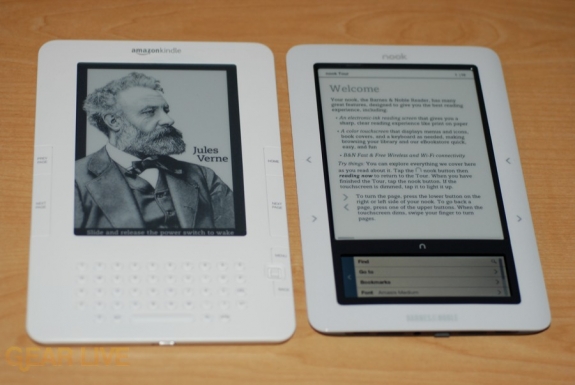
  • Barnes and Noble nook vs. Amazon Kindle: Size comparison shots

    B&N nook next to Amazon Kindle

    Hot on the heels of our Barnes & Noble nook unboxing gallery, we got a ton of requests from you guys asking us to compare the nook directly against the 2. So we put the nook right up against Amazon’s Kindle 2, and shot some photos. In a nutshell, the nook is smaller in length and width, but is a little but thicker than the Kindle 2. I personally don’t think one has an advantage over the other in terms of size, but hey, check out the nook vs Kindle size comparison gallery, and judge for yourself, mmkay?


    Gallery: Barnes and Noble nook vs. Amazon Kindle: Size comparison shots

    Tags:
    ,
    ,
    ,
    ,
    ,
    ,
    ,
    ,
    ,
    ,
    ,
    ,
    ,
    ,

    Barnes and Noble nook vs. Amazon Kindle: Size comparison shots originally appeared on Gear Live on Wed, December 09, 2009 – 11:59:49