Category: News

  • Quotient Biodiagnostics Raises a Fresh $5M

    Quotient Biodiagnostics, a transfusion diagnostics business based in Edinburgh, Scotland, has raised $5 million from Quotient CEO Paul Cowan and the healthcare venture capital firm Galen Partners based in Stamford, Conn. Over the past 18 months, Quotient has raised more than $19 million altogether.

    PRESS RELEASE:

    Quotient Biodiagnostics (“Quotient”), a global transfusion diagnostics group, is pleased to announce that its shareholders have invested a further $5.0 million in the company. Over the past 18 months Quotient has raised over $19 million of new equity.

    The company will use the new equity to continue development of its next generation automation platform for transfusion diagnostics. In connection with this, Quotient is pleased to announce the appointment of Ed Farrell as the corporate President responsible for this project. Ed joins Quotient from Siemens Healthcare Diagnostics.

    Quotient is also continuing to pursue its plans to build a new facility to facilitate the expansion of its existing liquid reagent business in Scotland.

    “Following the initial Galen investment in February 2012, the group has made significant advances. I am also pleased to welcome Ed Farrell on board at this key point in the next stage on the Company’s development” said Paul Cowan, Chief Executive and Founding Shareholder of Quotient. “Key business areas have experienced revenue growth exceeding 50% compared with the prior year. Additionally, major progress has been made towards the development of the group’s next generation automation platform for blood typing, both internally and externally. With the appointment of Ed Farrell we look forward to advancing this project to commercial launch over the next few years.”

    “We are pleased to invest further growth equity in Quotient” said David Azad, Managing Director of Galen Partners. “Paul and his team, in Scotland and the US, have achieved what they said they would achieve in delivering high quality, innovative products to transfusion professionals worldwide. We are excited about the direction of the company.”

    About Quotient Biodiagnostics

    With a proven record over the past 30 years, Quotient is a trusted leader in transfusion diagnostics. The group serves major transfusion diagnostic companies as an innovative product development and supply chain partner. Additionally Quotient serves the blood banking and transfusion medicine community through the direct provision of high quality transfusion diagnostic products. It is also developing a next generation automation platform for the transfusion diagnostics market, offering the ability to make better-informed clinical decisions whilst delivering major benefits over existing laboratory practices.

    Based in the USA, Quotient Biodiagnostics, Inc. (the group’s North American sales and marketing business) provides the US blood banking community with trusted transfusion diagnostics products manufactured over many years outside of the US. For more details about the full range of products offered by Quotient in the United States of America, please visit our website www.quotientbd.com.

    Alba Bioscience is the product development and manufacturing arm of Quotient. It has a distinguished record of developing and manufacturing innovative transfusion diagnostics for Quotient and other major transfusion diagnostics groups worldwide. For more details about the full range of products offered by Alba Bioscience and Quotient outside of the USA, please visit our website www.albabioscience.co.uk.

    About Galen Partners

    Galen Partners is a leading healthcare venture capital investment firm. The firm focuses on growth equity investments in healthcare technology and services, medical products, and specialty pharmaceutical companies. With nearly $1 billion under management, raised through five funds, Galen has helped build more than 70 companies since our founding in 1990. The firm continues a tradition of strategic collaboration and partnership with its portfolio company management teams to build healthcare market leaders. For more information, please visit Galen’s web site at www.galen.com.

    The post Quotient Biodiagnostics Raises a Fresh $5M appeared first on peHUB.

  • New NERA Study Shows Economic Dangers of a Carbon Tax

    A new study by NERA Economic Consulting, prepared for the National Association of Manufacturers (NAM), documents the economic dangers of a federal carbon tax. The study is very conservative in its assumptions (as I’ll explain below), giving the benefit of the doubt to the proponents of a carbon tax. Even so, there study reaches two conclusions: Either the US government sets a carbon tax low enough so that its economic impacts are simply bad, but not awful, in which case there are few environmental benefits, or the US government sets a carbon tax aggressive enough to meet the emission goals that its proponents want, in which case it is economically devastating.

    Either way, the average American household should be alarmed at the prospects of a U.S. carbon tax—and these numbers, to repeat, are very conservative in their estimates of its economic harms. Before implementing a carbon tax, policymakers should be very clear about what its objectives are. Up till now, proponents keep promising the moon: Extra revenues for tax cuts, deficit reduction, and “clean energy” investment, all while saving the earth from climate change! But the new NERA study shows that this is an illusion. By focusing on one or two of these goals, the carbon tax forfeits the others, and in no case does it pass any reasonable cost/benefit test.

    The NERA Study’s Two Carbon Tax Scenarios

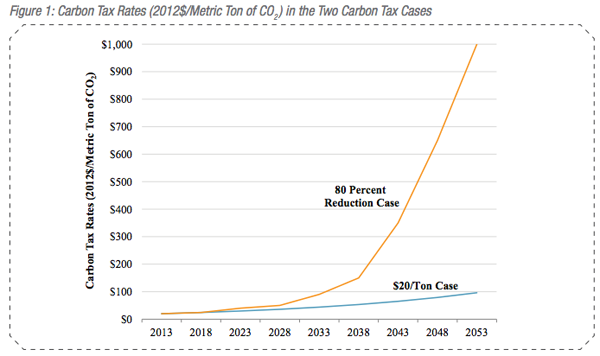
    The NERA study looks at two scenarios for assessing the economic impacts of a carbon tax imposed at the federal level in the United States. In the first scenario, it assumes a $20 initial tax levied on each metric ton of carbon dioxide (CO2) in the year 2013, which then increases in inflation-adjusted terms by 4% each year. This scenario lines up with some recent projections conducted by the Congressional Research Service and the Brookings Institution, so it’s a good ballpark of a “modest” carbon tax proposal. Notice that in this scenario, there is a gentle uptick in the carbon tax over time, with little attention being placed on emissions.

    The second scenario looks at the carbon tax trajectory that would be necessary to reduce US emissions by 80% relative to 2005 levels, by the year 2053. In other words, the second NERA scenario asks what the carbon tax rates would need to be over the next forty years, in order to achieve an 80% cut in US emissions by the end of the four-decade phase-in period. They picked this specific goal because it too is a popular discussion point, and is often used in discussions of international agreements on climate change policy. The only constraint on the carbon tax rate is a cap placed at $1,000 per metric ton.

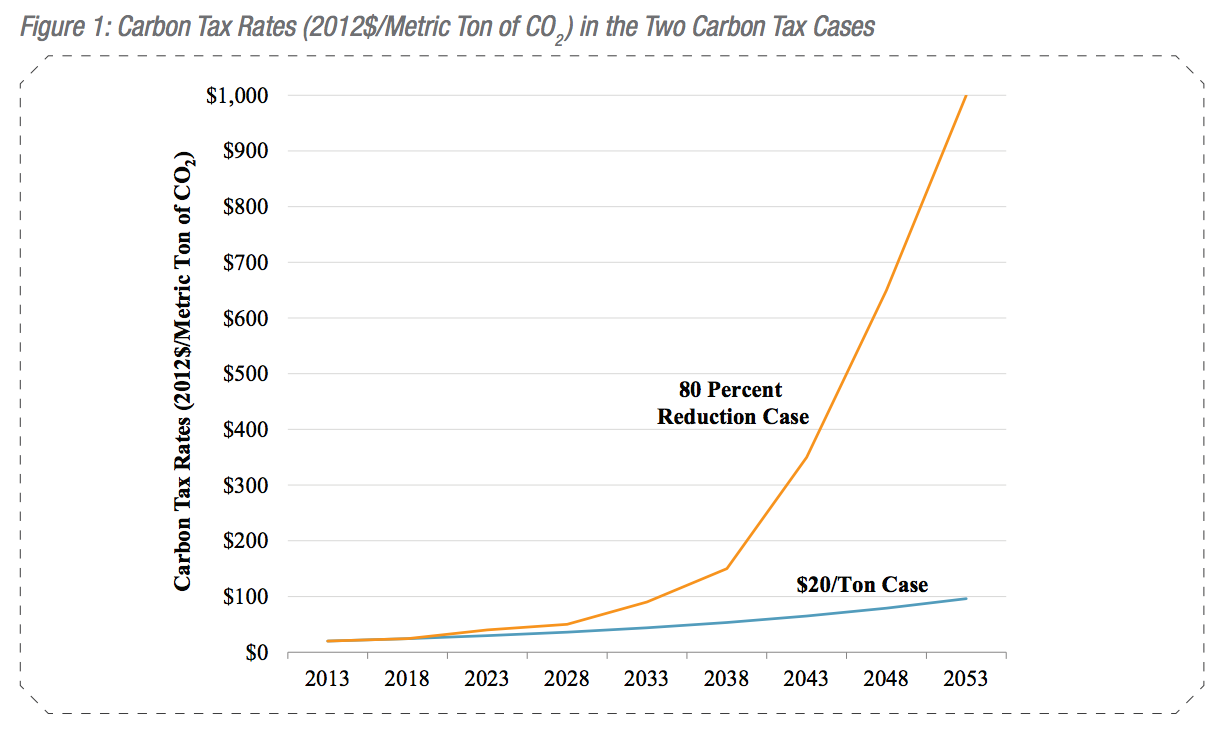
    The following diagram from the NERA study shows the trajectory of the carbon tax over time, in the two scenarios:
     NERA.Carbon.Tax.Table-1.600

    At this point, we should pause and reflect on Figure 1 above. Proponents of a carbon tax like to argue that it will have a “modest” or “negligible” impact on US households, especially in the early years. If they want to argue this way, then they must have in mind the type of carbon tax schedule depicted in the first scenario (the blue line above).

    But although the Scenario One approach will raise a lot of money for the government—and will thereby make American households that much poorer in terms of their personal finances—it is nowhere near what the carbon tax “needs” to be, in order to stave off the alleged environmental problems of unrestricted U.S. carbon emissions. The red line above shows the level necessary (in the NERA model) to achieve what the climate alarmists tell us is the barest minimum in cutbacks, to avoid catastrophe.

    Thus we see, even at this stage, the rhetorical corner into which the carbon tax proponents have painted themselves. In order to drum up support from citizens for something that will obviously raise gasoline and electricity prices, as well as just about every other price, the carbon tax proponents stress the scientific research on climate change. But then when trying to pooh pooh the negative economic effects of their proposed “solution,” the proponents will talk about a very modest carbon tax that will barely put a dent in the alleged climate problem.

    These observations thus far don’t prove whether a carbon tax is a good or a bad idea, but already we see that Americans have not been getting the full story in the standard discussions.

    Economic Effects of the Carbon Tax

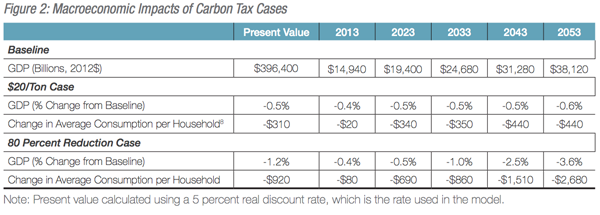
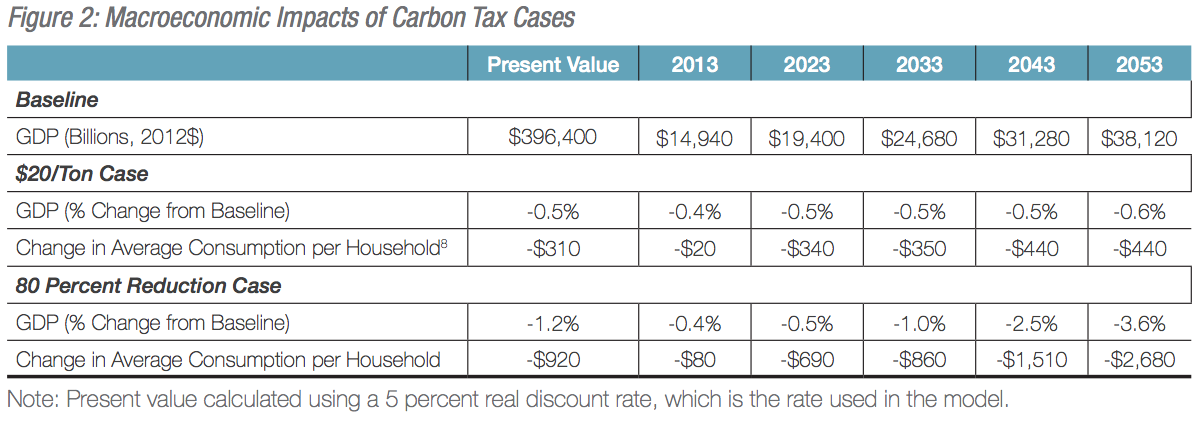
    After explaining their two cases, the NERA study summarizes its findings in the following table, where the changes are measured relative to a no-carbon-tax baseline:

    NERA.Carbon.Tax.Table-2.600

    Let’s walk through the table above to be sure we understand it. The top line shows the baseline (no carbon tax) forecast of US GDP, in billions of inflation-adjusted dollars. For example, in the year 2033 the NERA study assumes baseline GDP would be $24.68 trillion.

    As you move down the table, we see the impact of first the $20 Tax Case, and then the 80% Emission Reduction Tax Case. Since the latter is so much more punitive, it has bigger impacts.

    Yet in both cases, we see that the annual impact rises drastically as we move forward in time. For example, the $20 tax case shows only a very modest $20 change in average household consumption in the first year, but this annual impact rises to $350 per household by the year 2033 (i.e. 20 years into the policy). Remember that the NERA study assumes—as do other studies and proposals—that the initially modest $20/metric ton CO2 tax rises steadily over time, which is why the damages increase over time.

    In contrast, the 80% Reduction case shows a far more devastating impact. By the final year of implementation (2053), when the carbon tax has hit the ceiling of $1,000 per metric ton, the annual impact on the average household will be a reduction of $2,680—in that year alone. Overall US GDP will be a full 3.6% below what it otherwise would have been, in the absence of a carbon tax.

    This is an incredible hit to economic growth. Consider that since the official “recovery” began, there have only been two quarters where US real GDP has grown at more than a 3.6% rate. Thus, NERA’s projected impacts in the second scenario eventually have the carbon tax lopping off more than an entire year’s worth of what would otherwise be considered great economic growth.

    Because the impacts ramp up over time, the way to summarize in a “snapshot” the full long-term effects is to compute the “present discounted value.” This involves summing up near-term and long-term outcomes, but discounting future values at a 5% annualized rate. (It’s the same procedure used to calculate the current market value of a bond offering a stream of payments over the years, for example.) With this approach, the NERA study summarizes the $20 Tax Scenario as reducing average household consumption by $310 per year, while the 80% Emission Reduction scenario involves a near-tripling of the damages to $920 per household in an “average” year under the tax.

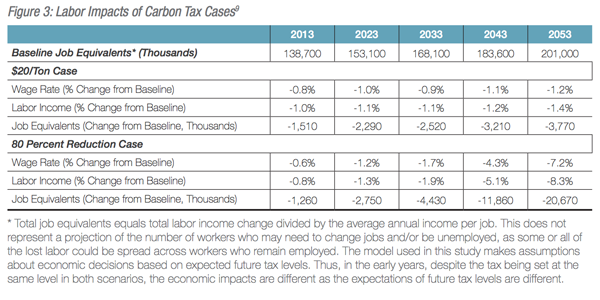
    In a similar vein, the NERA study forecasts the carbon tax scenarios on the labor market:

    NERA.Carbon.Tax.Table-3.600

    Thus we see, for example, that the more aggressive carbon tax scenario implies a long-run average worker income loss of the equivalent of 1.26 million full-time jobs, while in year 2053 (when the carbon tax reaches its peak) the impact is a staggering hit to worker income of 20.67 million jobs.

    It is careful to note that the carbon tax will not permanently “destroy jobs” in the sense that these people will be unable to find work. So long as the government doesn’t tinker with price controls (as President Obama wants to do with low-skill workers with his minimum wage proposals), then after the dust settles from a new carbon tax, workers can find niches in the economy. But the point is, the carbon tax imposes artificial constraints and makes workers less productive. Therefore, even though they can eventually find jobs, they will earn a lower wage or salary than they would have, in the baseline (no carbon tax) case. The “job equivalent” numbers in the table above are quantifying this reduction in total labor income, in terms of how much a full-time worker earns.

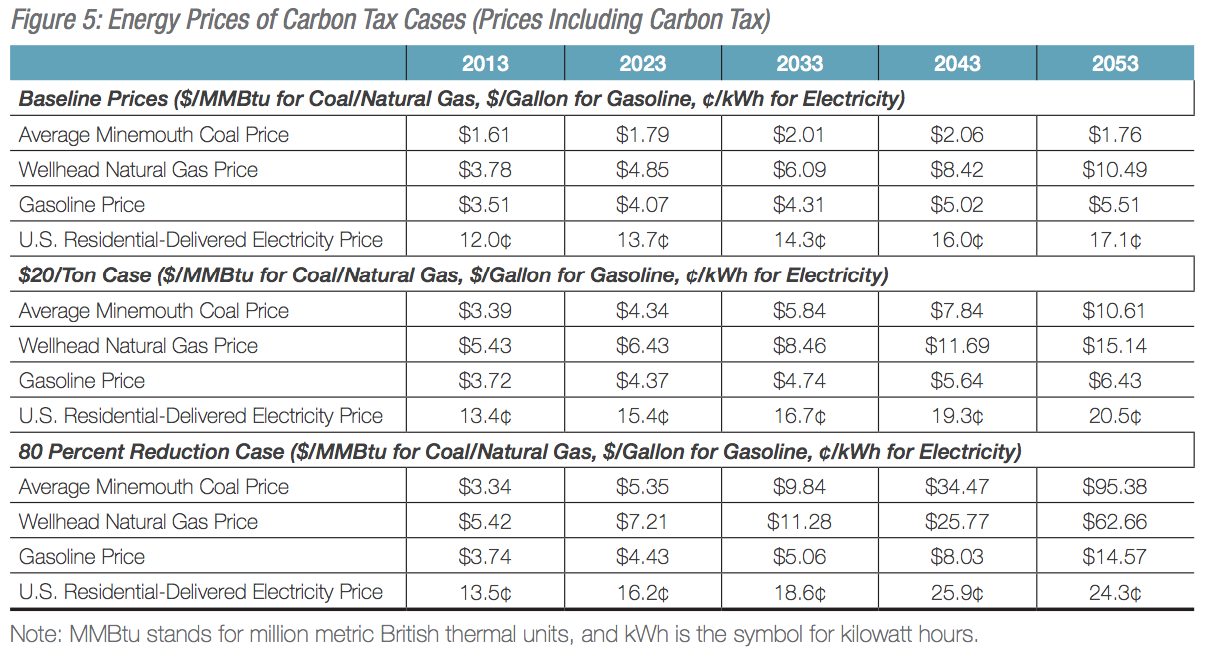
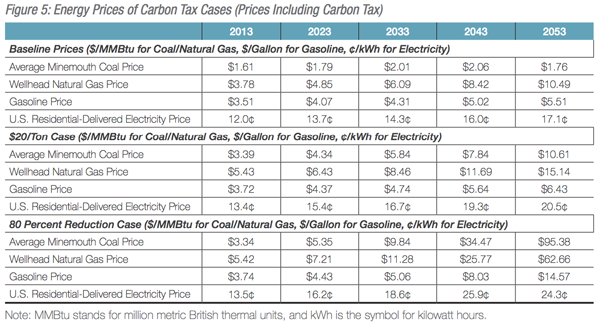
    Finally, consider the effect of the two carbon tax scenarios on various energy prices:

    NERA.Carbon.Tax.Table-5.600

    In particular, the 80% reduction case shows drastic increases in electricity and gasoline prices in the coming decades, should the US government seriously try to meet the emission reduction targets that many groups are proposing as “sensible climate policy.” By 2053, the NERA study anticipates residential electricity prices having risen 42 percent relative to the baseline, and gasoline pries at a whopping $14.57 per gallon (compared with $5.51 in the no-tax baseline, because of rising crude market prices).

    And of course, if someone is interested in the coal industry—forget about it. The price of coal in the high-tax scenario eventually ends up being 54 times higher than it would be without the carbon tax. Such a punitive tax rate will obviously destroy the coal industry, which after all is one of the stated objectives for those who want to drastically reduce US emissions.

    The NERA Study Is Very Conservative In Its Projections

    The NERA study is very precise and clearly lays out its assumptions; its authors are good economists. However, I would argue that its results are too conservative in their projections of the harms of a carbon tax.

    The most obvious reason is that the NERA study assumes the carbon tax receipts will be used to either (a) reduce the federal deficit from what it otherwise would have been, holding spending constant and/or (b) reduce other taxes. In terms of supply-side economic analysis, given that there is going to be a new carbon tax, then the very best things one could do with the revenues is use them to cut other tax rates and/or to make the deficit smaller, so that the government doesn’t siphon off as much from the capital markets away from private investment.

    In other words, NERA’s projections of economic outcomes under the two carbon tax scenarios has the government behaving very responsibly, doing just what a free-market economist would want, given that it was imposing a carbon tax.

    In reality, of course, the government won’t keep its spending trajectory the same, (for reasons I explain here) in the presence of hundreds of billions of new annual revenue in the modest scenario, and even trillions of dollars in new revenue in the aggressive case. Specifically, the NERA projections show that the 80% Emission Reduction scenario has the federal government taking in $1.8 trillion in inflation-adjusted revenues by the year 2053 from its carbon tax.

    Does anybody seriously believe this flood of new revenue won’t lead to higher federal spending than would otherwise be the case? Note that such spending would include any “transition payments” to help poorer households or certain industries adjust to the new carbon tax, which will surely be part of any politically feasible deal.

    Conclusion

    The new NERA study is a precise work of solid economics that carefully spells out its assumptions and offers nuanced conclusions. It outlines two plausible carbon tax scenarios—one involving “modest” tax rates that won’t significantly alter U.S. carbon dioxide emissions, the other involving very large tax rates that will impose crippling impacts on economic growth, worker income, and energy prices. Yet as ominous as the NERA numbers are, they vastly understate the true economic damage from a carbon tax, because they assume the government will use trillions of dollars (over the years) in new revenue in the most efficient manner possible, which is hardly a plausible assumption.
  • Instagram hits major milestone of 100 million monthly active users

    Instagram wants to be clear: it’s not losing users. The company announced Tuesday that it’s hit 100 million monthly active users, a figure intended to rebut claims it was harmed by a terms of service kerfluffle in December, and to show the app is still growing and building traction.

    100 million monthly active users is a decent statistic that puts Instgram’s traffic at about half that of Twitter, which most recently announced 200 million monthly actives, and close to Google+ with 135 million (although neither comes close to Facebook’s behemoth 1 billion .)

    Instagram wrote in a blog post Tuesday about the milestone, noting how far the company has come:

    “For the first time, we understood why Instagram was going to be different. We understood the power of images to connect people to what was happening in the world around them. And, although Instagram had a fraction of the user base it does today, that night we saw a preview of what Instagram would enable at a much larger scale down the road.

    Now, nearly two and a half years later, over 100 million people use Instagram every month. It’s easy to see this as an accomplishment for a company, but I think the truth is that it’s an accomplishment for our community. Now, more than ever, people are capturing the world in real-time using Instagram—sharing images from the farthest corners of the globe. What we see as a result is a world more connected and understood through photographs.”

    Co-founder Kevin Systrom explained Instagram’s growth at GigaOM’s Roadmap event in November, saying its focus on speed and reliability let the company continually refine one product rather than spread itself too thin. The company launched in October 2010 and sold to Facebook in May 2012. In November Systrom said he wasn’t worried about challenges from Twitter’s photo filters product or a video product, since Instagram was built to be something different:

    “Instagram is a community, not a filters app,” he said at the event.

    Related research and analysis from GigaOM Pro:
    Subscriber content. Sign up for a free trial.

  • Instagram Tops 100 Million Monthly Active Users

    Instagram has just announced a major milestone: 100 million monthly active users.

    It comes just five weeks after the photo-sharing network announced 90 million MAUs and a little of ten months after being acquired by Facebook.

    “Now, nearly two and a half years later, over 100 million people use Instagram every month. It’s easy to see this as an accomplishment for a company, but I think the truth is that it’s an accomplishment for our community. Now, more than ever, people are capturing the world in real-time using Instagram—sharing images from the farthest corners of the globe. What we see as a result is a world more connected and understood through photographs,” says Instagram co-founder Kevin Systrom.

    When Instagram announced 90 million MAUs back in January, it was the first time that they had ever reported official active users numbers. Some speculated that the timing had something to do with reports (however misleading) that Instagram was leaking users.

    “Images have the ability to connect people from all backgrounds, languages and cultures. They connect us to aid workers halfway across the world in Sudan, to entrepreneurs in San Francisco and even to events in our own backyards. Instagram, as a tool to inspire and connect, is only as powerful as the community it is made of. For this reason, we feel extremely lucky to have the chance to build this with all of you. So from our team to the hundred million people who call Instagram home, we say thank you. Thank you for sharing your world and inspiring us all to do the same,” says Systrom.

    Instagram says that they are processing 40 million photos per day, plus 8,500 likes and 1,000 comments per second. Earlier this month, the company launched a new web feed and for the first time a true web experience.

  • Amazon could see huge boost from long-form video consumption trend on tablets

    Tablet Video Consumption Study
    The new Ooyala study on video consumption patterns highlights just how much tablets are now outperforming the PC, smartphone and video game console platforms when it comes to long-form video watching. The long-form video category is the lucrative Holy Grail of content delivery. Videos longer than 60 minutes tend to be feature-length movies, the product category that commands a stiff premium compared to network TV shows or online comedy clips. Apple (AAPL), Samsung (005930), Microsoft (MSFT), Nintendo (NTDOY), Sony (SNE), Netflix (NFLX), Amazon (AMZN)… who isn’t trying to hit the jackpot in the digital movie distribution competition?

    Continue reading…

  • Mega Branching Out Into Encrypted Email Soon

    One of the major advantages of using Mega, at least according to Kim Dotcom, is that it has world class encryption that blocks anybody from snooping on the files you’re downloading. Now Dotcom wants to apply that same encryption to the world of email.

    The Guardian reports that Dotcom plans to launch “an end-to-end encrypted email service” in the future. He says the email client would be fully secure so users “won’t have to worry that a government or Internet service provider will be looking at [their] email.”

    A fully private email client would be welcome as more people are starting to look for more ways to secure their privacy. Microsoft may think that it’s a privacy warrior in its new Scroogled campaign, but the real threat comes from the Electronic Communications Privacy Act, or ECPA.

    A pro-privacy email client could be very popular around the world, especially in developed nations where fears of email surveillance are high. The demand might be high enough for people who don’t use the Mega file storage service to at least use the email service.

    So, when will this Mega email service become available? Dotcom’s talk at London, where he announced the service, didn’t go into details. He did, however, post this wonderful picture of his disembodied head on a projector screen:

  • Matt Cutts Says You Should Use Autocompletetype On Web Forms

    In the latest Webmaster Help video, Google’s Matt Cutts answers his own question:

    Can you explain a little bit about the proposed “autocompletetype” attribute? Is this something I should add on my web forms?

    “The basic idea is lots of websites have forms,” says Cutts. “You type in your name – your first name, your last name, your address, your street address, your postal code – all this sort of stuff. And it’s a real pain to fill out those forms. If you’re a business owner or a publisher, the easier you can make it to fill out those forms, the more likely it is that people will do purchases or sign up for your newsletter, or whatever it is that you’re interested in. So it’s highly recommended that you make it easy for people to fill out those forms.”

    “You take your existing web form, and Google Chrome (hopefully other browsers will pick this up as well) has proposed a standard called ‘autocompletetype,’ so you can say, ‘autocomplete type is street address’,” he adds. “It doesn’t change your form elements. Your variables are still the same, so you’re only adding. It’s not as if any of your forms are going to break. But by annotating your forms with the correct type of thing that you expect people to fill in with the browser’s autocomplete, Chrome will know exactly how to fill out your forms.”

    He says it’s a “tiny” amount of work, and as a result, users will “whisk” right through your form. There’s no down side, he says.

    Also, for some reason, there’s a clip from a Who song at the end of the video.

  • Tweeting with My TV On

    Sports, drama, reality shows or political events – you name it, someone is tweeting about it. A UK-based blog revealed that 40 percent of evening traffic on Twitter is TV-related, and a video on the official Twitter blog says many TV-related conversations happen through #hashtags, @replies to the program or other users, or through “curated tweets” that get pulled into chats moderated by news networks and blogs.

    When I see a program being talked about on Twitter, I’m more likely to watch it, or at least check it out. And when I’m watching TV, I typically have the Twitter app open on my BlackBerry Z10 or Blaq for my BlackBerry PlayBook tablet so I can watch the online conversations happening in real time. It’s fun reading the trash-talk during sporting events and it’s a great way to track the score while on the go. I also love reading and commenting about plot twists and character mishaps during primetime – just no #spoilers please!

    Do you tweet with your TV on? Let us know what programs you watch in the comments below!

  • To Develop Talent, You Need a System


    Alison Mowbray, Olympic rower, explains why managers need to be methodical about their talent pipeline.

  • Etsy Redesigns Activity Feed

    Etsy announced today that is has redesigned the Activity Feed with what it calls “improvements in function and design”. It will be interesting to see if users agree with that sentiment.

    The site has put greater emphasis on items, shops, and treasuries with bigger images and more items per page. There is also now one feed that combines the user’s activity and their followers’ activity.

    Additionally, there is a designated shop feed for sellers, so you can see shop activity all in one place. This includes a notification number for new activity in the “Your Shop” tab.

    New Etsy Feed

    New Etsy feed

    Earlier this week, Etsy announced some new coupon codes.

  • GetGlue Content Comes to Expanded Tweets

    Social TV and movie-watching app GetGlue has joined the growing lists of apps and sites that have enabled Twitter Cards, meaning that GetGlue content will show up in Twitter’s Expanded Tweets.

    “Now, when you share and see GetGlue links in Tweets, you can get an enhanced visual experience. When users click ‘expand’ on a Tweet with a link to GetGlue, the shared content, such as a show description or movie information, is seen directly within the Tweet,” says GetGlue in a blog post.

    The Expanded Tweets not only feature a short description of the media in question, but also contain a thumbnail as well as a link to GetGlue’s Twitter account.

    Clicking on the Expanded Tweets takes you to the show or movie’s official GetGlue page, where you can browse the current conversation.

    GetGlue joins apps like Foursquare and sites like CNN and The New York Times in enabling Expanded Tweets content. Back in December, Instagram famously disabled its Twitter Cards integration, forcing users to click links and visit the Instagram site to view photos cross-posted to Twitter. Just a few days after that, Pinterest added support for Twitter Cards.

  • President Obama Calls for a Responsible Approach to Deficit Reduction

    President Barack Obama at Newport News Shipbuilding in Newport News, Va., Feb. 26, 2013

    President Barack Obama delivers remarks to highlight the devastating impact the sequester will have on jobs and middle class families, at Newport News Shipbuilding in Newport News, Va., Feb. 26, 2013.

    (Official White House Photo by Chuck Kennedy)

    Unless Congress takes action, over the next few weeks our economy will be hit with harmful automatic cuts that threaten hundreds of thousands of middle class jobs. These cuts will slash vital services for children, seniors, people with mental illness and health care for our troops and military families

    President Obama strongly believes we need to replace these arbitrary cuts with balanced deficit reduction, and today he was at a shipyard in Newport News, VA to talk about what these cuts — which are known as the sequester — will mean for middle class families. 

    While the full damage of these cuts will spread to nearly every corner of our economy over the next few months, some workers will receive layoff or furlough notices within days. Many of the 5,000 companies and small businesses from across the country that supply Newport News Shipbuilding with parts and equipment will be impacted, which will affect the firm's productivity. And down the road at the Norfolk Naval Station, the threat of these cuts has already forced the Navy to cancel the deployment and delay the repair of certain aircraft carriers, and postpone building on additional vessels. If the cuts are implemented, about 90,000 Virginians who work for the Department of Defense will be forced to take unpaid leave from their jobs, creating a ripple effect on thousands of other jobs, businesses, and services throughout the Commonwealth – and not just in the defense industry. 

    read more

  • BlackBerry takes another hit as Pentagon opens network to iPhone, Android phones

    Pentagon Android iOS
    BlackBerry’s (BBRY) struggling platform will remain a part of the Department of Defense’s mobile strategy for the time being, however it will begin to see increased competition from the iPhone and Android devices. The Pentagon plans to implement a more “platform agnostic” mobile policy starting by February 2014 when it opens its network to smartphones and tablets from Apple and Android vendors.

    Continue reading…

  • Mars Rover Curiosity Analyzes Rock Powder

    NASA this week announced that Mars rover Curiosity has successfully placed two small samples of rock powder into its “compact laboratories” for analysis.

    “Data from the instruments have confirmed the deliveries,” said Jennifer Trosper, Curiosity Mission Manager oat NASA’s Jet Propulsion Laboratory (JPL).

    The rock powder comes from the inside of a rock on Mars – the first sample of its kind to be collected. The powder was taken from a small hole that Curiosity drilled in a rock earlier this month. Last week NASA researchers were able to confirm that the rover had actually collected the powder.

    The powder had now been placed into Curiosity’s Chemistry and Mineralogy (CheMin) and Sample Analysis at Mars (SAM) instruments. The CheMin instrument will examine the sample’s mineral composition, while the SAM instrument will determine its chemical composition. The analyses will take place over “the coming days and weeks.”

    Both instruments were tested in late 2012 as Curiosity took several scoops of Martian soil while exploring the sandy “Rocknest” area.

    The testing of the rover‘s hammering drill the successful rock powder sample gathering were described at the time to be “the biggest milestone accomplishment for the Curiosity team since the sky-crane landing last August.” Mars Science Laboratory (MSL) researchers at JPL have now declared Curiosity to be “fully operational.”

    (Image courtesy NASA/JPL-Caltech/MSSS)

  • Hadoop vs. EDWs: trends in enterprise adoption

    There is an interesting clash of perspectives occurring in the enterprise market between the Hadoop newcomers and the old-school data-warehousing providers. The latter are attempting to paint Hadoop into a corner, narrowing its usefulness to a limited set of functionality, while at the other end, the Hadoop providers are expanding the functionality of Hadoop to broaden its applicability and usefulness. In the middle are enterprises that are trying to figure out how Hadoop fits into their existing environment alongside data warehouses and other legacy systems. They are typically conservative and pragmatic and are primarily interested in reducing the cost of their environment while squeezing more value out of their data.

    In fact, many organizations have found that by using Hadoop to complement their data warehouses, they can improve performance, reduce costs and accelerate new insights.

    Our panel of experts will discuss these topics:

    • Understanding Hadoop’s role with respect to the data warehouse
    • Economic considerations for Hadoop
    • How customers can prepare for SDN, given that the technology and marketplace is rapidly evolving
    • The key industry standards efforts and how they differ (IETF, ONF, NFV)

    Our speakers include:

    Register here to join GigaOM Research and our sponsor Cloudera for “Hadoop vs. EDWs: trends in enterprise adoption,” a free analyst webinar on Wednesday, March 13, 2013, at 10 a.m. PT.

  • Lindsey Vonn Vow: To Be Olympics-Ready

    Lindsey Vonn has vowed that she will be ready for the 2014 Olympics despite sustaining a horrifying injury earlier this month in Austria.

    The 28-year old skier broke her right leg and tore both her ACL and MCL in a crash that required her to be airlifted from the mountain on the first day of the world championships; at first, there was concern that the injuries would keep her out of the Winter Olympics for sure, but Vonn says that even if she has to cram in months worth of training the week before the event, she’ll do it.

    “I have no doubt I will be ready for Sochi,” Vonn said. “Honestly, in a worst-case scenario, if I trained a week before the Games, I’d be fine.”

    Of course, it’s only been two weeks since the injury, so only time will tell how long it will take her to get rehabilitated. The athlete commented on the crash, saying why she thought it ended up being so bad.

    “Basically what happened was I came into that jump going a little bit faster, or I don’t know if I just hit the jump wrong, but I feel like I flew a lot further than the other girls,” Vonn said. “When I landed, the snow was just different. The snow was soft. It was not slick, basically, and my right ski just stopped and my knee buckled. I feel that loose snow was 100% the reason why I crashed. I initially thought it was going to be worse. There was just so much pain that I couldn’t quite tell where exactly it was coming from.”

    Vonn declined to comment on the rumors that she and golf pro Tiger Woods are dating, saying she’s not prepared to talk about her personal life with so much going on in her professional one.

  • Ubuntu Touch — interesting concept that needs work (preview)

    The concept of Canonical taking a stab at the mobile market eludes me. Unless we want to split hairs, which I know will happen, Android already is the Linux ambassador across the globe, so why would the world need Ubuntu Touch? Furthermore, any new player starts out with a clean slate, which means many consumers will be skeptical at purchasing devices running the new operating system and therefore developer interest does not surpass a low threshold.
    The PC market is not what it used to be a couple of years ago when people rushed out to buy new computers, rather than tablets or smartphones first. In some ways Canonical right now is Microsoft before Windows Phone and Windows 8 — an important player further heading into obscurity down the road unless the boat steers in the right direction. Ubuntu Touch is supposed to give the world a breath of fresh air, the X factor that would sway enough people into switching from Android, iOS, Windows Phone or a feature phone, even.

    Truth be told Canonical’s preview for Ubuntu Touch is one of the most basic I have ever laid my eyes upon. Nothing really works in the sense that it only paints (literally I should say) the bigger picture without allowing users to run most of the preinstalled or listed apps. Basically Canonical delivers a cool new gadget that cannot be used for anything except a paperweight.

    Normally when you buy a new mobile device, the operating system comes preinstalled. Most people don’t want to install Android, iOS, Windows Phone or Windows 8 on their smartphone or tablet anyway. Canonical’s product, however, cannot be added to the same list, at the moment, as there are no devices running Ubuntu Touch out-of-the-box; instead one has to download the operating system manually and install it on a Google Galaxy Nexus, Nexus 4, Nexus 7 or Nexus 10. Needless to say any of the four must sport an unlocked bootloader and, to make it easy, a custom recovery such as ClockworkMod or TWRP.

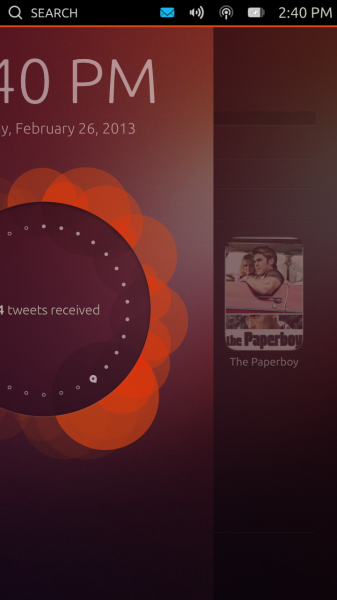
    Fast forward to the boot process, Ubuntu Touch Developer Preview starts quite fast even on my aging Galaxy Nexus and, shortly after, it displays the lockscreen, which sports the usual suspects — date and time, status bar with notifications, Wi-Fi and volume, battery indicator and the time. On top of the aforementioned items, Ubuntu Touch also adds search on the left side of the status bar and a round disc in the middle of the lockscreen, which right now only displays “14 tweets received”. I can only speculate that in the final version users will be able to rotate the disc (like on an old telephone) and it will display other statuses.

    There are no buttons to speak of whatsoever. For someone first using a smartphone running Ubuntu Touch, there is going to be a learning curve involved straight from unlocking the device. It’s done by swiping left from the right edge of the screen — it’s one of the reasons why Canonical must have a pretty explanatory guide on how to use the interface. So it’s unlocked, now what?

    Well, Ubuntu Touch now displays the main homescreen, one of the five available, called Home. No surprises there. The other available ones are, from left to right, Music, People, Apps and Videos with Home bang on in the middle. Switching between them can be done by swiping horizontally. It has to be noted that Ubuntu Touch Developer Preview comes similar to a snapshot of the operating system after it was used, so everything is in a frozen state with contacts, apps, etc.

    The Homescreens

    Let’s take them one by one.

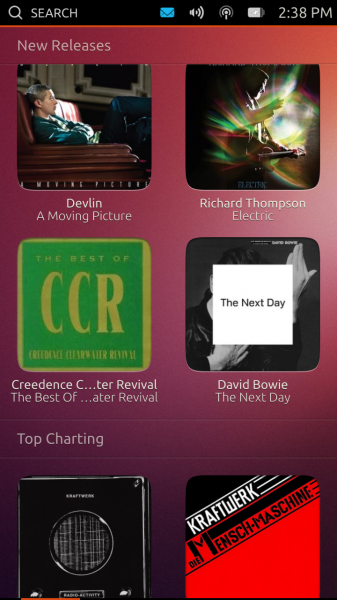
    Music, as the name suggests, focuses on music content and, judging by the pictured items on the homescreen, acts as a store similar to iTunes, for instance. Right now it displays Featured, Recent, New Releases and Top Charting categories, all of which contain albums. Users can swipe left and right in the first one to view all the featured content, whereas in the following four Ubuntu Touch only lists four items per each category inside a grid. Needless to say tapping on any album in Music leads nowhere at the moment. There is, however, a basic animation when tapping on an item. It’s just a preview, but I expected more out of it, to be honest.

    People is similar to the People hub in Windows Phone and currently displays Favorites, Recently in touch, New Contacts and the A-Z category, the last of which is a list of all the contacts. The names are pretty self-explanatory. Favorites, like the Featured category in Music, shows a horizontal list of contacts which can be navigated by swiping. Tapping on a contact displays the contact’s picture and, if exists, last status on Facebook, home number, email address and home address. Other fields may also be available. Not all fields are active, but I managed to power up the Phone app after tapping on a contact’s phone number.

    Recently in touch shows recent interactions, although it is not yet clear on which social network without tapping on the listed item, which will power up the contact’s info. Also, it is unclear as to whether the Recently in touch category displays a list of the most recent interactions between the user and his contacts or the latest social network status from most recently-interacted contacts. It’s a nice concept, but I am not certain if it works all that well in real-life because so many of us have hundreds of contacts across various social networks and we do chat with many people each day so I can only imagine how lengthy the Recently in touch category will become. It might be just too much swiping involved without other tabs on top.

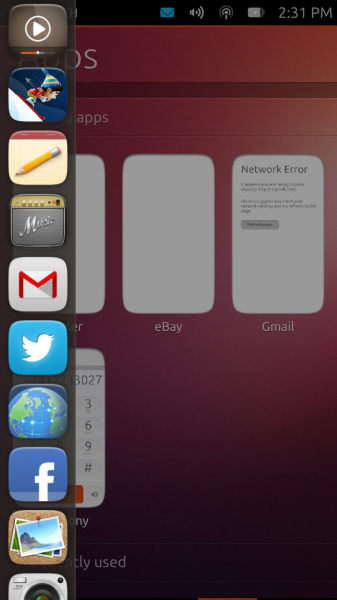
    Apps displays the Running Apps, Frequently used, Installed and Available for download categories. There are some interesting items listed, both as installed and available, including Amazon, eBay, Evernote, Pinterest, SoundCloud, Twitter, Wikipedia and YouTube. Obviously listed does not really imply available as well, so the situation might change over time before Ubuntu Touch is released.

    Videos embodies the same philosophy as the other homescreens and displays Featured, Recent, New Releases and Popular Online categories. Featured displays a horizontal list with movie posters, while Recent and New Releases revert to a grid of movie posters. Users can tap on a title and either buy or rent the item from Amazon or Ubuntu One, respectively. Popular Online displays a grid of videos, likely only from YouTube.

    Home is where people will revert to after navigating the operating system. The homescreen displays Frequent Apps, Favorite People, People Recently in Touch, Recent Music and Videos Popular Online. Basically Ubuntu Touch wants to provide users with the most important features that they use on the device straight from the default homescreen. If there are also plenty of cat videos in the last category Canonical will hit a home-run with Ubuntu Touch for most YouTube aficionados.

    The Same Idea, Just Differently Implemented

    The homescreens display a bunch of condensed information that we have grown accustomed to get from various apps individually. Truth be told, Canonical does not revolutionize operating systems, at least not right now. Ubuntu Touch merely gathers relevant pieces and joins them together in four major categories. It’s a very neat way of dealing with information overload and having what matters nearby at a couple of swipes. This is just a glimpse of what’s to come, indeed, but I can only wish that what’s to come will be improved in a number of areas.

    I like the concept of Ubuntu Touch, I really do, but I can’t get past its looks. All app icons have rounded corners, which I can live with, but the edges appear to be rounded as well giving them a cartoonish feel. The colors are typical Ubuntu as well and, generally speaking, the overall design of the icons is dated or too kitsch. The background looks like it was ported straight from Ubuntu as well, which is to be expected, but it does not look all that great either and neither do the fonts. Canonical should really consider polishing up the interface.

    Then there is the status bar, which is a great concept but difficult to work with nicely on the go. I use my smartphone most of the time when I’m out of the house and then I find it difficult to nail the right swipe to see the battery or volume panel (accessible via status bar). Don’t get me wrong, it’s nice to have different panels for each icon in the status bar but not so great in real-life. I see this as a problem even when stationary for elderly people and people with big thumbs.

    Big thumbs don’t help either when typing on the keyboard, which more than often does not register a press unless slightly tapping on the key. I don’t have a similar issue with Android, iOS or Windows Phone and I don’t like to pinpoint such problems for mobile operating systems in 2013. Hopefully Canonical will fix this issue in upcoming, and more stable, builds of Ubuntu Touch.

    Switching between apps is done by swiping left from the right edge of the screen. Ubuntu Touch switches between them in a certain order and does not currently display a list of running apps without going straight to the Apps homescreen. Another downside of the Developer Preview is that Ubuntu Touch does not deal well with multiple running apps, becoming overly sluggish. Normally the lag exists but it’s made worse in the aforementioned scenario.

    Powering up a menu inside the app is done by swiping up from the bottom edge of the screen. Depending on the app it may display a navigation bar (like in the Browser) or a keyboard or absolutely nothing at all because Ubuntu Touch freezes. But when you want to minimize the app, by swiping right from the left edge of the screen there’s another menu, which weirdly enough shows up as well. I can assume that it can be customized to include only a certain number of apps that users want quick access to, but the Developer Preview build leaves that to our imagination at the moment.

    Refreshing but Needs Work

    Ubuntu Touch is an interesting concept that needs work. That’s the bottom line. Navigating the interface works well through swiping and after using it for a couple of days I have no problem in the lack of on-screen buttons (because this is still a Nexus device that I’m running it on). But when compared to Android, iOS or Windows Phone, Ubuntu Touch lacks polish and, obviously, apps that make smartphones and tablets the mobile devices we know and love. That said…

    I was skeptical and, likely, for all the wrong reasons. The Ubuntu Touch Developer Preview is enlightening as to how Canonical envisions yet another smartphone or tablet operating system. And, to be honest, I quite like that vision as it delivers something new and exciting which, unless you view a mobile device solely and solely as a simple tool that doesn’t have a soul, is what we should get more and more. Needless to say there’s an overdose of early adopter syndrome happening, and I love that feeling.

  • Should you be worried about the new “six strikes” anti-piracy rules? Yes and no

    A new system designed to combat copyright infringement was launched in the U.S. on Monday, a joint venture between content companies and internet service providers known as the Copyright Alert System. The name sounds harmless enough, and its supporters argue that it is an appropriate balance between copyright and an open internet — but critics argue that the so-called “six strikes” process is the thin edge of an increasingly broad wedge that copyright holders are trying to drive between consumers and digital content.

    The new rules, which have been in the works for over a year and have been repeatedly delayed, are being administered by the Center For Copyright Information — a non-profit entity made up of theoretically independent representatives from agencies like the Internet Education Foundation and the Future of Privacy Forum, and includes Jerry Berman, a former director of the Electronic Frontier Foundation, as well as Gigi Sohn of Public Knowledge. They have partnered with five of the largest ISPs, including Verizon and Comcast.

    Part of what makes this new strategy difficult to understand is that each service provider’s method for implementing the rules is different. Verizon says that after several warnings via email and popup message, users who are downloading or sharing copyrighted content will be given several options, including a temporary reduction in their internet speed. AT&T’s policy apparently says that after several warnings a user’s ability to access popular websites will be blocked until they complete a course in understanding piracy and copyright infringement.

    So should you be afraid of these new rules? That depends. Are you are only worried about how they might affect you directly, or are you concerned about the ways in which private corporations are seeking to snoop on and limit your behavior? Let’s break these two viewpoints down:

    Why you shouldn’t be worried:

    It doesn’t affect all internet service providers: Although providers like Comcast and Verizon are huge, they don’t cover all internet users in the United States, so it’s possible that you might not even be affected by the new restrictions even if you do download a lot of copyrighted content.

    You get six strikes, which is probably more than you need: Copyright owners and the Center for Copyright Information say that the intent of these new rules is to go after the most egregious downloaders and sharers of content, not the person who occasionally downloads a new song or a movie. So if you don’t do a lot of peer-to-peer file-sharing, you probably won’t be affected.

    You won’t get cut off, just lectured and irritated: Even if you do get flagged for something, the worst that most of the ISPs say they will do is limit your download speeds, show you popup warnings or send annoying emails. And some have said even if you ignore them, nothing will happen (although they could always change their minds about that later).

    There are lots of ways around these restrictions: One of the criticisms of such rules isn’t that they are too invasive, but that they don’t work against the really hard-core file-sharers that are allegedly the target of this strategy — since virtual private networks, proxy addresses, cloaking software and other tools can make it almost impossible to detect infringing downloads.

    Why you should be worried:

    Your ISP is going to be doing some heavy snooping: One of the broader risks that groups like the EFF point to in their criticism of these new restrictions is that they rely on ISPs snooping on their users to an almost unprecedented degree — and this raises the same issues about privacy that debates around technology like “deep packet inspection” have. The potential downside is fairly significant.

    The new rules don’t take into account fair use: Much of the material produced by the Center for Copyright Information makes it sound as though anyone downloading or sharing any copyrighted content is breaking the law — but that’s not the case at all. There are many instances in which the principle of fair use applies, and these rules don’t take that into account.

    Copyright holders are unlikely to stop here: One fear about the six-strikes process is that it is just the latest move in an ongoing attempt by copyright holders and content companies to exert more and more control over what users can do, and that allowing it to proceed only encourages them to pursue even harsher measures such as SOPA and PIPA.

    This puts commercial entities in place of laws: One of the biggest criticisms from free speech and open-web advocates is that the six-strikes rules essentially allow private corporations — movie studios, music labels and large telecom providers — to set up a quasi-legal process for pursuing their copyright claims, when the legal system is the appropriate place for those arguments.

    The bottom line: There’s reason for concern

    In the end, while this move may not affect you directly — or may only be a minor irritation in your daily life — the fact remains that it marks another attempt by content owners to exert their influence in areas that should belong to the courts and should in principle be protected by things like the First Amendment and the principle of fair use, neither of which are even mentioned by the promoters of this process.

    Not only that, but as my colleague Jeff Roberts notes, focusing on these kinds of efforts feels a lot like what the music industry did while it was trying hard not to innovate as the web grew bigger and bigger. The risk for copyright owners is that they rely too much on these kinds of measures, instead of working to create a market and a digital ecosystem that fosters the creation, sale and distribution of content in a way that works with the web instead of against it.

    Post and thumbnail images courtesy of Shutterstock / Cienpies and Flickr user Pew Center

    Related research and analysis from GigaOM Pro:
    Subscriber content. Sign up for a free trial.

  • Facebook Suggests You Give a Gift When a Friend Posts a Celebratory Status

    Facebook is looking to further promote their new Gifts feature by giving it a more prominent placement – in the news feed.

    Some users have spotted a “Give a Gift” button attached to certain posts by friends – mainly when they’re sharing good news such as landing a new job.

    Facebook has already incorporated gifts into live events that are part of the official profile structure – we’re talking birthdays, engagements, and marriages. Those kind of announcements will appear on the top right-hand of your news feed (on desktop) and inside the news feed (on mobile). Clicking on those life events prompts users to “Give a Gift.”

    But this is something entirely different. Facebook looks to be testing a system that would identify major life accomplishments (like getting a new job) when spoken about in status updates, and prompt users to give gifts in celebration.

    When Facebook first launched Gifts way back in September of last year, I joked that it was the end of the simple “like” or comment being an acceptable form of congratulations – for anything. By working Gifts into more and more situations, Facebook is pushing for Gifting to become the normal way to celebrate a friend’s life achievement.

    Of course, this seems to be a limited test as it’s not wide to all users. Facebook runs dozens and dozens of tests every month, many of which never see primetime. But since Facebook is looking for more ways to generate real revenue from Gifts, I suspect that this is a type of test that we’ll be seeing more and more of in the coming months.

    [via Inside Facebook]

  • This Robot Bat Wing Now Exists

    Researchers at Brown University have built a robotic bat wing, which they believe can serve as as stepping stone toward some interesting new flying vehicles. Hopefully it won’t serve as a stepping stone to some giant bat-like Terminator.

    Brown University explains:

    The robot, which mimics the wing shape and motion of the lesser dog-faced fruit bat, is designed to flap while attached to a force transducer in a wind tunnel. As the lifelike wing flaps, the force transducer records the aerodynamic forces generated by the moving wing. By measuring the power output of the three servo motors that control the robot’s seven movable joints, researchers can evaluate the energy required to execute wing movements.

    Testing showed the robot can match the basic flight parameters of bats, producing enough thrust to overcome drag and enough lift to carry the weight of the model species.

    Hat tip to LiveScience