Category: News

  • Policy Statement for Countering Improvised Explosive Devices Announced

    Twenty years ago today, an improvised explosive contained in a truck was detonated in the public parking garage below the North Tower of the World Trade Center.  Improvised explosive devices (IED) continue to pose an ongoing threat, both here at home and abroad.  Our capability to identify and disrupt them before they occur, as well as to respond after an attack, has improved greatly. We have come a long way in twenty years. 

    Today, with the publication of the policy statement on Countering Improvised Explosive Devices, we both recognize the progress we have made, and rededicate ourselves to the next phase in our efforts to implement measures to discover, prevent, protect against, respond to, recover from, and mitigate IED attacks and their consequences.

    We will seek to develop even smarter solutions, and make the most efficient use of our resources, by enhancing our capability to share information regarding these threats, synchronizing standards and procedures, prioritizing and aligning activities according to risk management principles, and leveraging the expertise and resources of industry and foreign partners in pursuit of our shared interests.

    The threat from IED use is likely to remain high in the near future, and will continue to evolve in response to our abilities to counter them. A whole-of-government approach that integrates Federal, state, local, tribal, territorial, private sector, and global participation in counter-IED activities will best position the United States to discover plots to use IEDs in the United States, or against U.S. persons abroad, before those threats become imminent.

    read more

  • Learn How To Design Android Notifications

    There’s a time and place for every notification in Android. Consumers won’t be happy if you constantly spam them, but smart notification design is key to enhanced engagement. Learn more about it in this week’s Android Design in Action.

    This week’s video tackles not only notification design, but the design process behind Google Now:

    Join Nick Butcher, Adam Koch and Roman Nurik as they discuss various elements of Android Design. This week, Alex Faaborg from the Android UX team at Google stops by to talk about the when and the why of notifications and walks through a design process case study for Google Now.

  • Apple will reportedly announce stock split at tomorrow’s shareholder meeting

    Apple Stock Split 2013
    Apple (AAPL) shares got a boost Tuesday afternoon on rumors that the company may announce a split on Wednesday during its annual shareholder meeting. The rumor comes from former money manager and current TheStreet.com contributor Douglas Kass, who did not disclose his source. “High above the Alps my Gnome is hearing a rumor that Apple will announce a stock split at tomorrow’s shareholder meeting,” Kass wrote in a post on Twitter, providing no further details. Apple shares rose more than 1.4% on the rumor after nearing a new closing low.

  • Tesla CEO Elon Musk says Tesla will repay its loan to the DOE in half the time

    The CEO of electric car maker Tesla, Elon Musk, said Tuesday that Tesla plans to cut in half the time it will take to pay back its loan to the Department of Energy. Musk made the remarks at the Department of Energy’s ARPA-E Summit in a discussion with DOE Secretary Steven Chu.

    Musk said Tesla has ten years to pay back the $465 million loan, which it won back in the summer of 2009, and Tesla plans to reduce that time in half and get it repaid in under five years. Tesla already started paying back its loan, and made its first payment of $12.7 million to the DOE in the fourth quarter of 2012. It plans to make its second payment by March 2013.

    Tesla Model S

    During the discussion at ARPA-E, Musk said that if the DOE got so much attention for failures like Solyndra, it should get praise for its successes like Tesla.

    Tesla has successfully been transforming from a small-scale electric car maker, into a company that’s producing its second electric car the Model S at a scale of 20,000 cars per year at a factory in Fremont, Calif. During the company’s earnings call last week, Tesla said it would turn its first profit ever (on a non-GAAP basis) in the first quarter of 2013. Musk said he was confident that Tesla could also be profitable for other quarters this year, too.

    Related research and analysis from GigaOM Pro:
    Subscriber content. Sign up for a free trial.

  • Asus Fonepad preview: Decent tablet, terrible phone

    Asus Fonepad Hands-on
    Why? Seriously, Asus (2357). Why? This question bears asking, as going hands-on with Asus’ new Fonepad truly requires some big hands. Single-handed operation is a thing of the past. Remember when diminutive phones were the latest trend? When iPod grew smaller and smaller and RAZRs got thinner and thinner? Wave goodbye, dear friends. That age is long gone.

    Continue reading…

  • Does Your Company Have the Right Number of Salespeople?

    For sales managers, this is not an easy question to answer. The number of salespeople affects profitably by impacting both revenues and costs. It’s easy to estimate costs by looking at historical compensation, benefits, field support, and travel costs per salesperson. But it’s much more difficult to predict revenues, as it requires understanding how complexities such as customer needs, the economy, and the effectiveness of your and your competitor’s salespeople, influence a sales force’s ability to generate sales.

    Most companies use financial decision rules to determine how large their sales forces should be, but regrettably, these rules often lead to poor decisions. Consider three commonly-used rules.

    Add a Salesperson when there are Enough Sales to Pay for that Person

    This “wait and see” approach to adding salespeople views the sales force as a cost item justified by sales, rather than as an investment that drives sales. An “earn-your-way” strategy is sometimes necessary in markets with high uncertainty or when a company is cash-strapped. But when leaders take this conservative growth approach even when there is reasonable certainty of success and available financing, they undersize their sales forces and forfeit opportunity. One pharmaceutical company’s overly-cautious sales force expansion strategy resulted in too little support for a new product launch and cost the company 17% of profits over three years.

    Split a Territory as Soon as Its Sales Hit a Threshold Level

    At one company, when a territory hits $3 million in sales, sales leaders split the territory and give a portion of it to a new salesperson. The current salesperson’s “reward” for working hard to build business is to have his territory reduced. Over time too many salespeople are placed in geographies where salespeople were successful initially and too few are placed in other geographies where considerable market potential remains untapped. Another downside is that salespeople in territories with sales approaching $3 million have incentive to stop selling in order to keep their territories intact.

    Keep Sales Force Costs at a Constant Percentage of Sales

    A sales force stays affordable by keeping costs in line with industry or company benchmarks for a sales force cost-to-sales ratio. But this is not the same as maximizing profits. Although it’s counterintuitive, when a sales force is undersized, adding salespeople increases the cost-to-sales ratio and also increases profitability. You can always reduce the cost-to-sales ratio by cutting headcount, but the impact on profitability is positive only if the sales force is already too large. Maintaining an industry average cost-to-sales ratio is especially harmful to small-share companies that want a competitive share-of-voice. Sustaining a historical ratio is also dangerous during a business downturn; it may result in excessive downsizing that amplifies the impact of the downturn and leaves the company poorly positioned for a turnaround.

    A Better Approach

    Financial decision rules alone are not enough for figuring out the right size number of salespeople. A better approach requires three steps.

    Step 1. Look at four sources for signs that the sales force is under- or over-sized. If customers complain about inadequate service, if salespeople protest about too much work and travel, if sales activity focuses mostly on order taking instead of prospecting, and if competitors are expanding their sales forces, it’s likely that your sales force is smaller than it should be. On the other hand, if customers avoid returning your salespeople’s calls, if salespeople feel they don’t have enough opportunities, if sales activity emphasizes too many non-critical tasks and low-value customers, and if competitors are downsizing their sales forces, it’s likely your own sales force is too large.

    Step 2. Do analysis that focuses on customers, not financial constraints. This requires understanding and segmenting customers according to their needs and potential, and determining what sales process and how much sales force time is required to meet those needs and realize the potential. By aggregating time required across customer segments, you can estimate the number of salespeople required to effectively cover your customer base.

    Step 3. Look at financial ratios (such as sales force cost-to-sales) as a final check. Adjust as needed to ensure affordability. Often, by shifting coverage of lower-value customer segments to more efficient channels such as telesales, it’s possible to improve financial ratios while giving up minimal coverage of market potential.

    Finally, keep in mind that changes in sales force size have both short-term and long-term impact. The cost impact is immediate, but the revenue impact accrues slowly and accelerates with time. When expanding the sales force, it takes new salespeople time to get acclimated and make sales, and for the new customers they acquire to make repeat purchases. Alternatively, when downsizing a sales force, loyal customers may continue to buy for a while despite reduced sales force coverage. But eventually, repeat business dwindles away. The best sales force sizing decisions look at profitability over at least a three-year time horizon. If leaders under pressure to deliver short-term results focus only on the first-year impact, they will under-size the sales force – our research indicates by 18% on average. As a result, they sacrifice long-term profitability.

  • It’s time for TED!: The stage revealed

    DSC04129
    The TED2013 stage might make you want to climb. Inspired by a treehouse, the spectacular stage brings together huge, winding tree limbs and structures that evoke the Swiss Family Robinson. The stage features multiple levels which speakers can utilize for their talk. We’ve given up the red carpet this year, yes, but added a new detail we love: the waving TED flag. To sum it up: it’s our most playful stage yet.

    Get ready for session 1, “Progress Enigma,” starting at 11am PST. Follow along here on the TED Blog, where we’ll be writing a recap of each speaker’s talk, in real time.

  • After Strong Quarter, Internap Preps Cloudy Colo

    internap-exterior

    The exterior of an Internap data center. The company’s shares have gained in recent days on the strength of fourth-quarter earnings. (Photo: Internap)

    Shares of Internap have surged after the company recorded a strong quarter, indicating it is striking the right chords with its diverse portfolio of colocation, managed services and cloud. The company has also been touting what it calls “Cloudy Colo,” a true hybrid solution available through a single portal. The strong finish to the year and the cloudy colo concept are signs that Internap has found its identity.

    In two trading sessions since the release of its fourth quarter earnings, shares of Internap have gained 11.5 percent, rising from $7.91 at Thursday to a close of $8.81 on Monday. The fourth quarter saw the highest quarterly revenue, segment profit and adjusted EBITDA in company history.

    Revenue for 2012 was $273.6 million, with fourth quarter revenue of $69.7 million. Internap’ revenue was up 2 percent from the previous quarter. The high growth was attributed to its data center services segment, which includes Voxel which Internap acquired in 2011. Data center services revenue hit $43.7 million, up 24 percent compared to same time last year, and up four percent from the third quarter. For the full year, data center services generated revenue of $167.3 million, up 25 percent over last year. IP services was flat, but slightly down year over year. Customer churn was down. The company counted 3,700 customers as of December 31, 2012.

    Strong Finish to 2012

    “We are pleased with the strong finish to 2012,” said Eric Cooney, President and Chief Executive Officer of Internap. “The continued execution of our growth strategy is reflected in full year revenue and Adjusted EBITDA growth of 12 percent and 20 percent, respectively. Successful integration of the Voxel business and focus on our organic colocation, hosting and cloud infrastructure businesses have delivered full-year growth in data center services revenue of 25 percent.

    “As we look forward to 2013, the priority is simple – focus on continued execution of the strategy to deliver a platform of high-performance, hybridized IT Infrastructure services,” Cooney continued. “We remain confident that the opportunity for long-term profitable growth and stockholder value creation is significant in the market for outsourced IT Infrastructure services.”

    Internap has shifted its focus over the years. The company was founded in 1996 on its expertise in IP services and route optimization. It later added colocation and content delivery services, but has had its stumbles, most notably the 2006 acquisition of VitalStream, which led to a $99 million write-off amid customer support problems. Cooney became CEO in 2009, and immediately focused on the company’s colocation business. Since Internap was realizing higher margins on its company-owned data centers, and began phasing out its use of third-party space and building data center space. The company rolled out 26,000 square feet of company-controlled data center space in 2012.

    Sneak Peak: Cloudy Colo

    The company is working on what it informally calls “Cloudy Colo.” It is an extension of its core data center OS platform, with some customers using the beta version.

    “Our whole goal is to redefine what the limitations around colo are,” said Raj Dutt, Senior VP of Technology at Internap and former CEO of Voxel. “We’re going to start giving visibility and control into the obvious things that people don’t get from colo – reboot, bandwidth, inventory management asset management, the ability to hybridize managed cloud in the same portal.

    “Through software – DCIM-like software – customers can focus at stuff in the rack rather than outside of the rack,” said Dutt. “DCIM has barely started in terms of inside the rack. The roles of machines are changing, and DCIM falls short on this. This is where it starts to get interesting.”

    Offering up a variety of services through one portal from colo to cloud, as well as giving DCIM-like insight into total infrastructure, will aide Internap in cross-selling its services.

    “This makes colo great for colo customers,” said Dutt. “It also makes colo within reach for cloud guys. As cloud customers need colo, it’s an easier way to go about that. From an infrastructure standpoint, we don’t think the cloud is the be-end and end-all,” he said. “If you’re deploying any application, the best solution is a hybrid situation.”

    Dutt noted that Internap offers everything from colocation to dedicated servers to cloud. “Very few people offering all of these product sets as one infrastructure fabric,” he noted.

    Dutt believes the economics of cloud are often misinterpreted, and cloud is not always the most cost-effective approach for the customer. ”I’d rather sell 100 racks of cloud than 100 racks of colo any day,” said Dutt, stating that the margins for providers are simply better for cloud within the same footprint.

    Dutt atttributes Internap’s success with its diverse portfolio to one thing. “The market certainly got more educated,” he said. “More and more people are treating infrastructure as a competitive weapon more than cost center.”

    It’s still early, so there’s no formal “cloudy colo” product yet. The company is evaluating different models. However, all indications are that Internap is working on giving customers deeper control and analytics across the portfolio, from colo to cloud, with deeper DCIM-like functionality. A formal announcement is most likely coming within the next quarter.

  • Cablevision sues Viacom to break up the bundle — or get a better deal

    Cablevision has filed a federal antitrust lawsuit against Viacom in New York Tuesday in an attempt to break up the bundle of channels that Viacom is selling the cable operator. Cablevision’s lawsuit alleges that Viacom is forcing the operator to carry 14 networks it and its customers don’t want, including MTV Hits and VH1 Classic.

    The operator now wants to invalidate a deal the two parties struck just two months ago, and instead just get the good stuff. You know, Comedy Central, Nickelodeon, and maybe a little bit of MTV proper.

    Cablevision sent out the following statement about the lawsuit:

    “The manner in which Viacom sells its programming is illegal, anti-consumer, and wrong. Viacom effectively forces Cablevision’s customers to pay for and receive little-watched channels in order to get the channels they actually want. Viacom’s abuse of its market power is not only illegal, but also prevents Cablevision from delivering the programming that its customers want and that competes with Viacom’s less popular channels.”

    A Viacom spokesperson sent us the following statement in response:

    “At the request of distributors, Viacom and other programmers have long offered discounts to those who agree to provide additional network distribution. Many distributors take advantage of these win-win and pro-consumer arrangements. Reflecting the highly competitive cable programming business, these arrangements have been upheld by a number of federal courts and on appeal. Viacom will vigorously defend this transparent attempt by Cablevision to use the courts to renegotiate our existing two month old agreement.”

    The lawsuit also alleges that Viacom threatened “massive financial penalties” if Cablevision refused to carry the 14 lesser-watched channels in question. The operator is asking for a permanent injunction that would bar Viacom from bundling its lesser-watched channels with its more popular core offerings.

    On paper, this lawsuit is an interesting challenge to the cable bundle, which has been largely dictated by the broadcasters. Operators have long said that they would like to sell their customers smaller and more flexible bundles. Broadcasters have made this impossible by either directly bundling all their channels into one big package, or by other conditions that make sure operators can’t sell bundles without certain channels.

    However, it’s unlikely that this lawsuit will be fought out until the bitter end. Because at the core, this is about something else: Broadcasters have in recent years significantly increased the carriage fees for their fares, leading to a number of nasty fights that left consumers without their favorite channels for weeks. In the end, content owners always won, and carriers caved in, agreeing to pay more before their customers have yet another reason to cut the cord.

    Cablevision and Viacom negotiated a last-minute carriage agreement in late December. Details of that deal were not made public, but it’s obvious that Cablevision wasn’t happy with the outcome. Now it wants to get a better deal, and threatening the bundle is the biggest asset it has in this fight.

    Image courtesy of Flickr user  nyghtowl.

    Related research and analysis from GigaOM Pro:
    Subscriber content. Sign up for a free trial.

    • EssentialPIM 5.5 adds support for Dropbox and iCloud

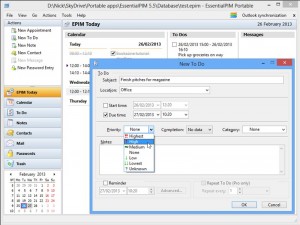
      Astonsoft Ltd has released EssentialPIM Free 5.5 and EssentialPIM Pro 5.5, major new versions of its Windows personal information manager. Highlights in this new release include support for iCloud synchronization, native Dropbox support and improved CardDAV tools.

      Also updated are EssentialPIM for iOS 2.6 and EssentialPIM for Android 1.8.2, mobile apps designed to give users access to their EssentialPIM data while on the move. While iOS users only see minor bug fixes in this update, Android users will enjoy major improvements to the Calendar and Contacts modules.

      The most eye-catching new feature in EssentialPIM 5.5 is native Dropbox support — users can now easily access their EssentialPIM data from multiple PCs by storing their database in the Dropbox cloud folder. EssentialPIM can automatically download, upload and pack the database from this location, and the effect is seamless.

      Also added in version 5.5 is full support for Apple’s iCloud and the CardDAV synchronization service, the former being of most benefit to EssentialPIM for iOS users. As with other supported cloud services, including Google, CalDAV and Yahoo!, however, the feature is restricted to EssentialPIM Pro 5.5 users.

      Enhancements in version 5.5 include better CalDAV support, plus improved synchronization with both Android and iOS apps. The update also promises to have fixed all known issues since the last release.

      EssentialPIM for Android users also gain new features with the 1.8.2 release. These include a new Calendar module, which now syncs with EssentialPIM’s own Calendar module in Android as opposed to the native Calendar app. At the present time, Agenda and Day views are available, with more to follow.

      There are also improvements to EssentialPIM’s Contacts support, with all contact fields now being synchronized with the native Contacts app along with photo synchronization support.

      EssentialPIM Free 5.5 and EssentialPIM Free Portable 5.5 are both free-for-personal-use downloads for PCs running Windows XP or later. EssentialPIM Pro 5.5 is available as a free trial download, with full licenses starting from $39.95. Both EssentialPIM for iOS 2.6 and EssentialPIM for Android 1.8.2 are free downloads.

      Photo credit: tele52/Shutterstock

    • Cloudera who? Intel announces its own Hadoop distribution

      Intel on Tuesday said it was getting into the software business with its own Hadoop distribution. The move is a potential blow for startups such as Cloudera, Hortonworks and MapR that are offering their own distributions of Hadoop, but it’s also an admission by the chip vendor that the opportunity in big data isn’t only to be found in selling hardware.

      In a conference held in San Francisco, VP and General Manager of Intel’s Datacenter Software Division Boyd Davis explained Intel’s history in Hadoop that stretches back to 2009 and stressed that Intel is going to share some aspects of its Hadoop distribution, but not all. Intel has a distribution of Hadoop it has released in China, but today it’s bringing it to the United States Intel’s version of the Hadoop distribution uses Hadoop 2.0 and YARN, which is a cutting-edge version of  platform compared with what most Hadoop users have deployed thus far.

      Why Intel wants to push its own version of Hadoop

      intelhadoophistory

      Boyd introduced partners such as and Cisco, which has tuned the Intel Hadoop distribution for its own servers. Intel also hosted a panel that included executives from SAP, Red Hat and Savvis to discuss the challenges of big data and the promise of Hadoop and big data.

      Davis was up front about Intel’s rationale for releasing its own distribution, namely that it was worried about the fragmentation and possible uncertainty associated with current Hadoop distributions. That could be read as a dig against the many startups already offering Hadoop distributions, all of which are slightly different (of course, Intel’s will be slightly different, too). Like all of the existing players such as Cloudera and MapR, Intel will open source certain aspects of its distribution, but will also keep software to itself.

      Inside the data center, it’s no longer just web servers that matter

      For example, Davis stressed that Intel will not share its management and monitoring software, which could be highly valuable for enterprise customers. The Intel software could coordinate with Intel’s data center management software and make managing a variety of workloads easier. And hidden in that coordination might be one Intel’s aims in pushing its own version of Hadoop — the threat of ARM chips used in Hadoop clusters.

      Dell, Calxeda and others are evaluating the use of lower-performance, lower-power chips in Hadoop clusters, a market Intel would hate to cede in the data center as data grows and analytics becomes more important. To that end, Intel has also optimized its Hadoop distribution for solid-state drives, something that other Hadoop companies haven’t done so far.

      When asked about Atom and the use of lower-performance processors for Hadoop, Davis noted that while people are using lower-end processors for Hadoop , but that those uses tend to have slower networking. Davis says that when you combine high-end processors with 10 gigabit Ethernet and Hadoop, customers get the performance that they want.

      intelhadoop

      So while Intel may tout stability and consistency as the reason for it’s decision to become a major player in the software market for big data, it’s also driven by the changes in the data center that threaten the grip Intel has on the hardware inside the data center. The cloud and big data has changed the workloads and hardware requirements for the data center and Intel is playing the long game in trying to release software that can be tuned to its chips.

      The Hadoop drama isn’t over yet

      Intel isn’t the only big vendor touting its own homegrown version of Hadoop. On Monday, EMC’s Greenplum division announced an entirely revamped version of its Hadoop distribution that’s merged with it’s flagship analytic SQL database. These big companies have big existing businesses to protect and lots of resources to put into doing it. As my colleague Derrick Harris wrote on the EMC news:

      Looking past his competitive boasting, though, it’s easy to see [Greenplum’s Scott] Yara’s greater point when you ask him what all this Hadoop talks means for the data warehouse business on which Greenplum was built. He points to the mainframe business that fell from its high perch decades ago but still drives billions a year in revenue. A single MPP database system is still faster on certain workloads than SQL on Hadoop, but that gap will close over time and “I do think the center of gravity will move toward HDFS,” he said.

      Hadoop is a juggernaut when it comes to big data. Intel is a juggernaut when it comes to data center infrastructure. Its decision to enter into the open source software market is a big one for the chip company, for the Hadoop ecosystem and for the myriad startups playing in this space. It’s a topic we’ll explore more during our Structure Data conference in New York on March 20 and 21.

      Related research and analysis from GigaOM Pro:
      Subscriber content. Sign up for a free trial.

    • The Ego! Smartmouse Combines Hardware Authentication With A Mouse That Doubles As A Motion Controller

      0ef3c9a38744c8d57563e4d0380707e4_large


      A new Kickstarter project called the Ego! Smartmouse blends together some recent trends in computing, including hardware identity authentication and 3D motion control to come up with a unique input device that wears many hats. The Ego! is a mouse in the traditional sense, allowing you to control your desktop or laptop computer, and it also has on-board file storage, can work as an authentication device for various services, and features built-in acceleration and motion detection to work like a Wiimote for controlling games.

      The Smartmouse packs its own Linux-based OS into its compact design, with a 400 MHz ARM9 processor and up to 8GB of onboard flash storage. It connects via Bluetooth, has a gyroscope, compass and optical mouse sensor in addition to its accelerometer, and also includes a built-in VGA camera, touch-sensitive surface, vibration motor and notification LEDs. It charges via micro USB, and the project creators say it’ll get a decent amount of battery life thanks to the use of low-power tech.


      Created by UK-based design firm Laura Sapiens, the Ego! Smartmouse is the product of a team with strong engineering and interaction design backgrounds. CEO Matteo Modè comes from an industrial and automotive engineering background, and the founding team also includes expertise in embedded security, consumer electronics, computer vision and embedded systems.

      As you can see in the demo, the Ego! looks to be equally at home on the desktop, controlling media center PCs from the couch, or working with gaming applications to provide 3D controls. It can also automate routine tasks like opening a browser and logging into an email account, and be used as a presentation tool in combination with a projector. The on-board camera makes syncing the Ego! as easy as pointing the mouse at a QR code displayed on-screen (eliminating messy discovery and pairing procedures), and in an office setting it can be used to quickly and easily transfer files between workstations.

      The team is looking for £20,000 in funding, with early pre-orders starting at just £70 for a 2GB black or white version of the Ego!, including international shipping. Higher storage is available for £110 (4GB) and £120 (8GB), both of which also offer up new color options as well.

    • 3 alternatives to Chrome OS on Google’s Chromebook Pixel

      The more I use Google’s new Chromebook Pixel, the more I consider buying one; I have to return the loaner laptop next week. To many, that sounds insane: “Pay $1,299 for a browser?” is the common comment theme I’m seeing. And it’s a fair point if you do more than just work on the web. Even me, a Chromebook owner since last June, occasionally strays outside the Internet for some activity. Can that actually be done on a Chromebook Pixel? Actually, yes it can, because because you can use other operating systems on this hardware.

      After researching over the weekend and asking some Googlers themselves, I found out that unlike prior Chromebooks, there is a BIOS option that is writable: meaning the Pixel’s startup software isn’t locked down as much as prior Chrome OS devices. Google included a copy of SeaBIOS with the Pixel, currently allowing for the installation of Linux distributions. Here’s an instruction page on how to do this and the following explanation from Bill Richardson, who works at Google:

      “Chrome OS firmware normally consists of three distinct BIOS images. First, there is the read-only BIOS, which is (duh) read-only. It can’t be modified without disassembly. Then there are two read-write BIOS images, called RW A and RW B. The read-only BIOS is what runs when the machine is first powered on. It checks the two read-write BIOSes (A, then B), looking for one that is correctly signed by Google. If it finds one, it jumps to that image, which then looks for a valid kernel, and so forth. If there is no valid RW firmware (or some other fault has occurred), the execution stays in the RO BIOS and enters Recovery mode.

      With the Pixel, we’d added an extra (unverified) BIOS slot. It only works in developer mode, and you have to explicitly enable it, but we’ve put a copy of Seabios in the Pixel firmware.”

      linux-mint

      The second option for running an alternative platform on the Pixel is a tool created by David Schneider, another Googler. Called crouton — standing for ChRomium Os UbunTu chrOot enviroNment — the downloadable tool supports running Ubuntu in a virtual instance within Chrome OS.

      This means you can run the standard Chrome OS environment and a fully usable Ubuntu build at the same time. To toggle between the two environments, you simply press Ctrl-Alt-Refresh (F3) for Ubuntu or press Ctrl-Alt-Back (F1) for Chrome OS according to Richardson, who shared this picture of the end result.

      Ubuntu on Pixel

      Of course, if you want to run Mac OS X or Microsoft Windows, you’re out of luck on a Chromebook Pixel, but as a Googler reminded me in this thread, you can always use Chrome Remote Desktop to connect to another system. Bensen Leung, a Linux Kernel engineer on the Chrome OS team, told me he uses that method — in addition to the above Linux approaches — to connect to desktops on other platforms.

      Are these ideal solutions for a laptop that costs $1,299 or more? Probably not for most folks, but they do provide options outside of just using a web browser.

      Related research and analysis from GigaOM Pro:
      Subscriber content. Sign up for a free trial.

    • Mark Cuban-backed start-up launches “HootSuite for YouTube”

      VidIQ has spent the last year quietly working with companies like AOL to help them manage and monitor their growing catalogue of YouTube videos. On Tuesday, backed by some prominent investors including Mark Cuban, the company opened shop to the general public.

      According to VidIQ CEO Robert Sandie, big companies have learned the power of Twitter and Facebook as marketing tools but are overlooking YouTube, which he describes as the world’s “second biggest social network.”

      To fill this gap, VidIQ is offering tools that let companies monitor and manage their videos and apply some SEO zest to help their videos rise in search rankings. He explained that most companies are failing to apply even basic search strategies to their YouTube content, meaning it’s still relatively easy to achieve big improvements in YouTube visibility.

      “It means an organic boost in video traffic,” said Sandie in a phone interview. “Like the early days of the web, when you could get a headstart on Google or Yahoo or Alta Vista, it’s still early on in YouTube.”

      VidIQ’s primary SEO tool is a box that prompts users to add more keywords to their videos. It also provides guidance about the optimal time to publish new videos.

      The company also offers analytics tools that Sandie says can deliver important demographic information such as the ratio of male to female viewers. And, like HootSuite does for Twitter and other social media, VidIQ lets users monitor comments and buzz about their YouTube videos.  Other broader social media management companies, like Unified Social, also offer some social marketing services for YouTube but Sandie says VidIQ offers a unique YouTube listening platform to monitor and engage influencers.

      To start, VidIQ is offering two versions of its products: a free one that small users can apply to manage single YouTube channel and a more sophisticated enterprise package for a fee.

      VidIQ says it has so far raised more than $800,000 from Mark Cuban, Scott Banister, David Cohen, and others.

      Related research and analysis from GigaOM Pro:
      Subscriber content. Sign up for a free trial.

    • Want to Change the World? Be Resilient.

      What’s the difference between someone with a good idea and a person who can transform their ideas into real impact? To tackle the world’s biggest problems, we need to be able to identify and support the people who are capable of creating lasting change. At Acumen Fund, we spend a lot of time trying to find and train aspiring and established leaders from around the world who have the right mix of talent, ideas, and passion.

      And what we’ve found time and again is: Resilience matters most.

      Resilient leaders have three key characteristics:

      1. Grit: Short-term focus on tasks at hand, a willingness to slog through broken systems with limited resources, and pragmatic problem-solving skills.
      2. Courage: Action in the face of fear and embracing the unknown.
      3. Commitment: Long-term optimism and focus on big-picture goals.

      I see these qualities in the Global Fellows who are selected to work with Acumen’s investee companies across Africa and South Asia during a 12-month fellowship. These individuals bring exceptional skills and business expertise to their work. But that is not enough. It’s their ability to dig deep, roll up their sleeves and immerse themselves in the unglamorous trenches of seemingly intractable problems while remaining focused on long-term goals that allows them to buck the status quo and deliver meaningful change.

      Grit: Natalie Grillon, a former Peace Corps volunteer and recent MBA graduate, embodies grit. She’s working in a remote area of war-torn Northern Uganda to develop an organic sesame business as part of Gulu Agricultural Development Company, which provides more than 40,000 smallholder farmers with access to international markets.

      Overseeing a staff of 35 and a network of 50 buyers, Natalie wakes up each day determined to grow the business by training more farmers and improving their product quality. Some days she’s holed up analyzing financials and others she’s loading trucks for shipment. She has to be both an empathetic listener and stern director, often at the cost of not always being “liked” — a tradeoff she’s accepted. She works 12-14 hours seven days a week and pushes through daily challenges and physical fatigue.
      The sesame business is new to this part of Uganda and is already increasing the yields of more than 10,000 farmers, providing them with new income that can go to school fees or production tools. Farmers, who until recently lived in IDP-camps, now live lives of freedom, dignity and choice. For Natalie, the unrelenting pace of work and many headaches are worth it.

      Courage: I recently visited with current fellow Jay Jaboneta, a social entrepreneur from the Philippines who is embracing the unknown in Pakistan. He’s working with Pharmagen Healthcare Limited, a water-supply company that provides up to two million liters of clean, affordable water each month to low-income customers through water purification shops in Lahore.

      By design, fellows are often pushed out of their comfort zone — required to live and work in regions or sectors that are unfamiliar. This was the case with Jay and, prior to his arrival in Pakistan, he was admittedly anxious about his safety as a foreigner in Lahore, his ability to integrate into a new culture without speaking the language, and stepping into a role that required him to learn how to market water products to BOP customers.

      Jay has been able to excel in an environment filled with unknowns. He’s currently launching a rebranding and marketing campaign to make clean water more accessible to low income consumers. Now part of the community, he’s also learning Urdu one phrase at a time and speaks of dear friends and the doodh pati chai he’s learned to make with them.

      Commitment: Abbas Akhtar, an entrepreneur and software engineer originally from Pakistan, is fulfilling a promise he made to himself long ago: to return to Pakistan, after years in the US, and contribute to the country’s long-term development. Abbas now works at Ansaar Management Company (AMC), a low-cost housing and management company that provides affordable housing to more than 30,000 people outside of Lahore.

      Equipped with several years work experience at Apple, Google and an advanced degree from Johns Hopkins, Abbas could choose from any number of developed markets in which to live and work. But he chose his country of origin to fulfill his personal commitment. He readily admits it hasn’t been easy to adjust to the frequent power outages, cold days and nights without reliable heat, and long road trips between projects, but he’s more committed than ever to apply all that he can to AMC this year and Pakistan for years to come. And his commitment is already contributing to the growth and sustainability of AMC with the potential launch of two new community sites, which could provide 200 new homes to 1,000 BOP-customers.

      While still early in their careers, Natalie, Jay, and Abbas exemplify the resilience it takes to drive lasting change on the ground. Above all, their experiences highlight not only what’s needed to build new systems, but also, what’s needed most to be a social impact leader.

      And resilience can be trained. At Acumen, we focus on building not only the fellows’ financial and operational skills, but also what we call “moral imagination”, which requires balancing opposing values — humility and audacity — to see the world as it is and to imagine the world for what it could be. During their two-month training in New York, fellows spend time in the shoes of low-income customers accessing goods and services, honing their empathy skills; they prototype human-centered design projects with IDEO.org and create business model canvases, building strong listening skills to understand customers’ needs. They develop deep self-awareness by challenging their perceptions about leadership and authority by using Cambridge Leadership Associates’ Adaptive Leadership framework. Fellows draw on these experiential exercises to strengthen their resolve when facing challenges on the ground.

      Too often we confuse management skills with leadership. We need to remain focused on building leaders who have the resilience to face stubborn problems head on for lasting social impact. The more we collectively define what it takes, the better we’ll be able to identify and train this next generation.

      Follow the Scaling Social Impact insight center on Twitter @ScalingSocial and register to stay informed and give us feedback.

    • Star Wars Pinball DLC Coming to PlayStation Network

      It’s not quite Star Wars: Battlefront III, but today Sony will be releasing the Star Wars Pinball downloadable content (DLC) for Zen Pinball 2.

      The add-on will cost $10 and includes three different tables: “Star Wars Episode V – The Empire Strikes Back,” “Boba Fett,” and “Star Wars: The Clone Wars.” The content is available as “Cross-Buy,” which means it can be bought once and played on both the PlayStation 3 and PlayStation Vita. Zen Pinball 2 can be downloaded for free via the PlayStation Network.

      It seems that Sony really is getting serious about cultivating free-to-play experiences on PlayStation platforms. The company today released the multiplayer portion of Uncharted 3: Drake’s Deception for free as well.

      A preview for the “Star Wars: The Clone Wars” table has been posted by Sony. It shows Anakin Skywalker and Ahsoka Tano battling their way through the clone wars. 3-D animated sequences, or “main missions,” are activated by progressing through the game (in this case, lighting the “council” lamps in the table’s center).

    • USGS Estimates 162 Billion Short Tons of Recoverable Coal in the Powder River Basin

      New basin-wide assessment of recoverable resources and reserves

      The Powder River Basin of Wyoming and Montana contains about 162 billion short tons (BST) of recoverable coal from a total of 1.07 trillion short tons of in-place resources according to a new USGS assessment. This assessment also estimates that 25 BST of those resources are currently economical to recover, the first such estimate released by the USGS for coal for an entire basin.

      The Powder River Basin—a large geologic feature located in northeastern Wyoming and southeastern Montana—contains the largest deposits of low-sulfur subbituminous coal in the world. This study is significant because it illustrates that only a relatively small percentage of in-place coal resources are technically and economically recoverable.

      Powder River Basin Assessment Map
      Powder River Basin Assessment Map — A map showing the four assessment units for the 2013 USGS Powder River Basin coal assessment.

      “The United States is well-known for its rich endowment of coal resources and our in-place estimates bear that out,” said USGS Acting Director Suzette Kimball. “It’s important to note, however, the substantial difference between what is in-place and what is technically recoverable, let alone economic. This new basin-wide assessment provides that critical link for government and private managers to make informed decisions.”

      In 2011, the 16 mines in the PRB produced 462 million short tons (MST), about 42 percent of the Nation’s total coal production that year.  Subbituminous coal is typically used in electric power generation.

      The key to this study was taking advantage of the wealth of recently available geologic data from the interpretation of thousands of new drill logs from coalbed methane development in the PRB.  More than 8,000 new drill holes were added to the original Gillette coal field database alone. About 30,000 total data points were used in the entire PRB assessment. This geologic information interpreted from well information of the recent drilling provided an unprecedented level of data about the coal resources for the basin.

      The USGS developed the geologic information that formed the basis of this assessment in cooperation with the Wyoming State Geological Survey and the Montana Bureau of Mines and Geology.

      The Basin was divided into four areas for assessment: the Montana Powder River Basin, the Northern Wyoming Powder River Basin, the Gillette coal field, and the Southwestern Wyoming Powder River Basin.

      Within these four areas, the USGS assessed coal resources for 47 coal beds. The three largest beds by resource are the Canyon coal bed, the Anderson coal bed, and the Smith coal bed. These three coal beds together represent about 38 percent of the total coal resources for the Powder River Basin.

      To arrive at the estimate of recoverable coal and 25 BST of reserves, USGS scientists selected portions of those coal beds from the total in-place resources that were deemed both shallow and thick enough to be recoverable using current surface mining technology. Ten conceptual mine models were developed to account for the differences in coal bed geology using proven mining techniques for each the four assessment areas of the PRB. Then, estimated mining costs were calculated for all of the modeled coal resources.  Finally, those resources that could be produced at or below the current sales price for PRB coal were designated reserves.

      The current 25 BST of reserves does not mean that is all that remains mineable. The size of reserves change because mining costs and coal sales prices are subject to fluctuation  based on market conditions – recoverable resources become reserves with favorable changes in costs, demand, and prices.

      The USGS Energy Resources Program research efforts yield modern, digital assessments of the quantity, quality, location, and accessibility of the Nation’s coal resources.

      To learn more about this or other geologic assessments, please visit the USGS Energy Resources Program website. Stay up to date with USGS energy science by subscribing to our newsletter or by following us on Twitter.

    • Google Shuts Down Notion That It Will Open Retail Stores, Source Of Rumor Sticks To Story

      At Mobile World Congress, Andy Rubin, SVP of Mobile and Digital Content at Google (and co-founder of Android), shut down rumors that Google will be opening up retail stores.

      Last week, 9to5Google put out a report indicating that Google would be opening its own retail stores by the end of the year. The report cited “an extremely reliable source”. According to Rubin, however, Google has no need to open stores, despite other indications that Google Glass will be widely available by the year’s end.

      Ina Fried at All Things D shares some words from him:

      “They don’t have to go in the store and feel it anymore,” Rubin said, during a roundtable with reporters on Tuesday. Plus, he said, the Google hardware effort is still in its infancy. “For Nexus, I don’t think the program is far enough along to think about the necessity of having these things in a retail store.”

      As for whether Google as a whole might nonetheless be considering retail stores. “Google has no plans and we have nothing to announce,” he said.

      Okay, the “nothing to announce” part is pretty commonplace regardless of whether or not the company actually has something in the works. The “Google has no plans” part seems a little bit more definitive.

      Still, it doesn’t sound like the idea is totally ruled out for the future. Perhaps 9to5Google’s “extremely reliable source” is just off on the timeframe.

      Despite Rubin’s comments, Google clearly has a number of items it could easily get into a retail store, and the company already has a presence in some Best Buys and PCWorld/Dixon’s stores.

      Plus, as Google Retail Industry Director Todd Pollak recently said, “The lines between online and offline shopping experiences are blurring.”

      Update: 9to5Google’s Seth Weintraub now has this to say:

      I reported last week that Google had plans to open retail stores within the year, which according to a quick ping of that same source, is still on. When asked about Rubin’s comments, I was told that Rubin wasn’t being forthcoming or AllThingsD misquoted him.

      It should be noted that the retail program is being born (we’re told) out of Google’s (X) labs under Sergey Brin and not out of the Android group and the two groups aren’t always in full cooperation

      The rumor continues…

    • Why Will.i.am and Chris Bosh want to create a new generation of wannabe coders

      Bill Gates, Mark Zuckerberg, Jack Dorsey – it’s little surprise that those titans of tech want to encourage more wannabe coders. But in a short film released Tuesday by the nonprofit Code.org, it’s not just the usual suspects talking up all the reasons why the U.S. needs more computer scientists.

      Code.org filmSure, Silicon Valley luminaries share the stories of their humble beginnings (Gates says his first program was for tic-tac-toe). But NBA all-star Chris Bosh talks about coding in college before joining the Miami Heat and the Black-Eyed Peas’ Will.i.am says “great coders are today’s rockstars.”

      The message of the film – just like the over-arching theme of the nonprofit: the country needs more coders and, really, it’s not as hard as you think.

      Code.org, which launched last month, was founded by brothers Ali and Hadi Partovi to bring more attention to the need for more coders and increase computer programming education opportunities at schools around the country. As evidence of the problem, it says:

      • Less than two percent of students study computer programming – tripling that could close the gap between students and jobs
      • In 41 states, computer science doesn’t count toward high school graduation requirements
      • Programming jobs are growing at double the pace of other jobs but programming is not offered at 90 percent of U.S. schools

      Code.org’s site offers learn-to-code tools supplied by Khan Academy, Codecademy and Scratch. And it’s enlisted big-name supporters from different industries to help with its campaign. Other tech leaders include Marc Andreesen, Ron Conway and Sheryl Sandberg, but it’s also recruited politicians Al Gore and New York Mayor Michael Bloomberg, the presidents or deans of Stanford and Harvard, celebrities like Ashton Kutcher and Bono and top scientists and doctors.

      The short film, which was directed by Lesley Chilcott (producer of An Inconvenient Truth and Waiting for Superman), will be distributed to teachers and classrooms across the country. And, according to The Seattle Times, Microsoft is paying to have the movie shown as a trailer in select theaters.

      In the past year or so, we’ve seen several startups — including Codecademy, Udacity, LearnStreet and others – rush in to fill the skills gap between what our digital economy needs and what students are learning. (Earlier today we covered the Peter Thiel-backed Thinkful, one of the newer startups in the learn-to-code space.) We’ve also seen the rise of technology high schools — like Brooklyn’s Pathways in Technology Early College High School recently endorsed by President Obama — that put programming and STEM skills at the center of the curriculum. But by featuring voices from industry, pop culture and politics Code.org stands to bring awareness to a wider group of people.

      Below, check out the video:

      Related research and analysis from GigaOM Pro:
      Subscriber content. Sign up for a free trial.

    • Meet OneAPI, the technology that could make carriers relevant in mobile apps

      Carriers have devised a new way to insert themselves into the mobile apps value chain. They want to become the identity managers for mobile services that require user registration or authentication. Just as many apps today allow you to log in using your Facebook, LinkedIn or Twitter credentials, carriers are hoping customers will start registering for services with their phone numbers.

      To accomplish this the GSM Association launched a new initiative called the OneAPI Exchange at Mobile World Congress in Barcelona. The idea is to create an application programming interface (API) that any mobile app developer can use to authenticate new users against a carrier’s subscriber identity data. So far AT&T, Orange, Deutsche Telekom, Telefónica and Vodafone have all signed on to the program, and together they represent a healthy chunk of the world’s mobile subscribers.

      At first glance, the initiative seems like a nifty idea. If there is one thing every mobile subscriber in the world has it’s a phone number, making it ideal as a universal credential. But operators are also hoping to be more than just a username replacement. In a demo at Mobile World Congress, the GSMA showed off a bike rental app, in which carrier data was used not only to identify the user, but verify location and charge the rental to the customer’s mobile bill.

      Obviously carriers are looking to make themselves relevant once again in the applications market and take a cut from any mobile transaction. This time they actually stand a chance of succeeding. Unlike previous API initiatives, the GSMA has actually figured out a way to make OneAPI near universal. Instead of tapping into separate APIs and crafting separate business agreements with every operator, developers just have to build to one API and strike one carrier deal, but the identity feature will work across all carriers’ networks.

      The development house that built the OneAPI Exchange, Apigee, wasn’t able to eliminate the widespread fragmentation among carriers’ API platforms, but it rather ingeniously found a way around it. Apigee’s head of marketing, Dave Jordan, explained that the exchange acts as universal bridge between the operators’ disparate network interfaces.

      A developer just picks a single operator to deal with and then builds to that operator’s API, Jordan said. If the app is downloaded on a different operator’s network the exchange will automatically map that carrier’s API onto the app, he said. For instance, if a developer were to pick AT&T’s API, any Orange or Telefónica customer could log in to the app using his carrier’s credentials, but AT&T would federate all of the transactions across those networks.

      Related research and analysis from GigaOM Pro:
      Subscriber content. Sign up for a free trial.