Last week, Shakira announced that she had decided to launch her latest video using Ustream and Facebook called ‘Give It Up To Me,’ probably in an attempt to gain more fans on the social network and to part with the tradition of having used MTV for several whole years. It seems that the move was as innovative as it was inspired, since more than 95,000 visitors watched the new video when it was initially broadcast, while the following 24 hours brought around 500,000 viewers. In other words, Shakira’s fans all over the world have definitely appreciated her initiative, so they are likely to see more videos or singles released this way.
Ustream is gradually gaining more and more popularity as a live streaming website, and the audience is also increasing. This could also be due to the fact that the service broadcasts more than just recent music videos, including the memorial service for Michael Jackson, which gained about 4.6 million views, but also the inauguration of Barack Obama as President of United States, which was seen by 3.8 million users. On the other hand, these videos have lasted for hours, as opposed to Shakira’s ‘Give It Up To Me’ that has a length of only ten minutes.
Regarding Shakira’s choice to integrate Ustream into her Facebook page, it is probably motivated by the fact… (read more)
Snow season is upon us, and often neighbors are envious of each others gas-powered, polluting snow blowers that ease the burden of shoveling sidewalks and driveways. An eco-friendly version is now available that will be the envy of those competing to be the greenest on their street: the Sno Wovel Wheeled Snow Shovel.
The Sno Wovel™ is the only non-combustion alternative snow removal device performing equal to or better than a snow blower…Shoveling and snow blower injuries result in approximately 100,000 serious emergency room visits annually in North America. Cumulative injuries affect millions, resulting in lost time and productivity for recovery – all of which are now preventable without sacrificing performance. The University of Massachusetts, one of the top U.S. ergonomic research centers, has released the results of an independent study verifying that use of the patented Sno Wovel wheel-based shovel results in a 3-4 times reduction in lower back stress and cardio exertion. The innovative wheeled design allows for effortless snow clearing on all types of surfaces while avoiding twisting, bending and post snowstorm muscle aches.
I do not personally own a Sno Wovel, nor have I tried one, but I think this is an ingenious invention. According to Eco Cycle, snow blowers “send 30 percent of the unburned fuel out with the exhaust.” From noise pollution to greenhouse gas emission, traditional snow blowers are not good for the earth.
Smartphones in the U.S. provide voice service using either CDMA (Verizon & Sprint) or GSM (AT&T & T-Mobile). Wireless data is provided by a variety of 3G protocol types as well as slower network protocols like EDGE and GPRS. This rumored Google Phone apparently eliminates the traditional voice service (CDMA or GSM) entirely and, like the Amazon Kindle or netbook/notebooks, only have a 3G radio. You could somewhat simulate this situation today if you have, for example, a MiFi (3G/WiFi router) and an iPod touch (2nd or 3rd generation) with some voice over IP app installed.
Can even Google pull off a phone that doesn’t work over conventional cell services? It just might be able to if the phone were very inexpensive with cheap service to match (data only, no voice).
The Blandin Broadband conference started today. It started with a walking tour of Duluth. The weather could not have been better. We got a mini-walking tour of Duluth. It was fun to see the new places –and some of the old places. We ended up at Teatro Zuccone, a new spot in town with a couple of theaters and a bar. It looks like a great place to see a show or just hang out. Apparently it just opened this fall and has been very successful.
We saw the following presentation from Drew Digby of Minnesota Department of Employment and Economic Development (DEED) and heard from some of the locals. It was interesting to hear about what brought (or kept people in) people to Duluth. While many people enjoyed the outdoors, the arts, the size of the town, the colleges, – it was really the business opportunities that brought both people and businesses to the area.
I know when I’ve hurt a man’s feelings. In a segment of the technology business that has recently become fiercely competitive, it’s difficult to report bad news about a team that tries very hard to build a good Web browser. It was very apparent from our interview today at PDC 2009 in Los Angeles that Microsoft Internet Explorer General Manager Dean Hachamovitch has an emotional and personal investment in the product he’s building.
“If I had a script engine that was twice as fast as the one before, the Web should be twice as fast,” said Hatchamovitch today. “But if JavaScript is 10 percent of my site, at most, I’ll shave 5 percent off; and if the site was 1.8 seconds, yea, I’m not going to be able to tell…Yes, we understand that there’s a microscope on JavaScript performance. We’ve made progress on JavaScript performance — we’re all in the same neighborhood now.”
He was referring to the first news of development of Internet Explorer 9, which he confirmed only began weeks ago, but whose early builds — according to both Hatchamovitch and Windows Division President Steven Sinofsky today — were producing JavaScript performance numbers that were comparable to its competition for the first time since Mozilla released Firefox 3.5.
“That’s just going to re-emphasize that it’s the systems that come together. Because as all the JavaScript engines converge on their performance, people are going to notice the other 90 percent [of Web components] a lot more significantly.”
Betanews’ reporting on Internet Explorer in the past few months has not been kind. The October Patch Tuesday round of fixes included one for all versions of Internet Explorer that addressed a very serious, possibly exploitable issue. While we feel addressing this issue is absolutely necessary, we also noticed that applying the patch resulted in a noticeable slowdown in IE performance. At least, noticeable to us.
The most vocal reader response to our reporting could be grouped into three categories: One group vocalized that it did not care about Internet Explorer performance as a factor in computing, since it’s mainly a way to read news articles anyway, and voiced their opinion that we shouldn’t care either. Another group of readers took Microsoft to task for, in their opinion, not caring about IE performance, but added that it shouldn’t be expected to care because nobody else does (or at least, nobody of importance) and that we should drop the subject for that reason. A third group applauded our efforts to, in their opinion, expose Microsoft for not caring about browser performance.
None of these are groups that anyone at Microsoft would want to appear publicly aligned with. So perhaps part of Dean Hachamovitch was interested in speaking with me today, and another part — for absolutely understandable reasons — was dreading the thought.
But bravely, he made his company’s case, a valiant effort to split the difference: JavaScript isn’t the Web, he asserted, but just one of many subsystems. A multitude of other factors will contribute to users’ decisions.
“There’s performance, there’s interoperable standards, and there’s graphics,” said Hatchamovitch. Each component strikes a different chord with different groups of users, he said. Since the Day 2 keynote’s conclusion, he and his press handler had opportunities to ask individuals what they thought of the presentation — or more specifically, what did they remember from it?
“I asked some folks what they heard, and some just said, ‘Yea, you guys are doing a lot of compliance and interop.’ ‘Did you hear anything else?’ ‘No, not really.’ Talked to someone else, ‘So what did you hear?’ ‘You guys are doing some stuff around making the script engine faster.’ ‘Huh. Anything else?’ ‘No, not really.’ So what I’m finding is that this is the classic game of Telephone.”
What resonates with various attendees is essentially aligned with what they want to hear, Hatchamovitch went on…perhaps to illustrate the point that when he asked me the very same question at the start of our interview, I dove right into the performance aspect.
Rendering is another critical aspect, and we saw demonstrations of the changes IE9 will make in the rendering department. Specifically, the next edition of Microsoft’s browser will move away from GDI, the graphics library favored by Windows during the late 1980s, and toward the new Direct2D library which takes fuller advantages of the capabilities of the underlying hardware, including the GPU. In response to my request for a video that showed this performance, Microsoft asked us to include in our story the video you see embedded above, which is as close as the Web can come to approximating the speed and fluidity improvements attainable through Direct2D.
There is absolutely no question that, if IE9’s rendering improvements were to simply stay on the same level as they appear from these early demonstrations, through to the end of the product’s development, the result will be a perceptible qualitative difference that could be the deciding factor in whether Firefox or Chrome or Safari users switch back to IE — as important a factor as computational performance.
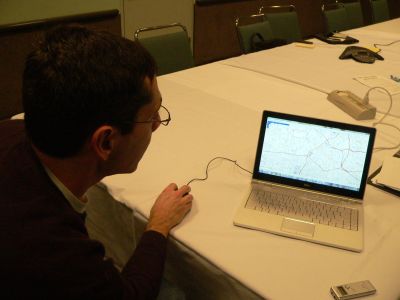
Hachamovitch showed us up close the map rendering demonstration seen from a distance during the Day 2 keynote. Shifting the same road map across the screen on a small Dell XPS laptop produced typical, perceptible jitters using IE8’s GDI graphics methodology, compared to a smooth, even flow using IE9’s Direct2D.
Some folks were confused by the meaning of the number in the demo, and why the slower, jittery-er graphic produced the higher value. This represented the number of milliseconds between frames — a number that plummeted from 130.2 ms as in this photo, or even much higher on occasion, to as low as 8 ms for Direct2D. Actual frames per second rises from around 7 (or lower) for GDI, to about 60 for Direct2D on the same machine.
“Now, that kind of difference — somebody said, ‘Oh, it’s like game-level animation!’ Yea, you can call it like it’s a Pixar movie or an Xbox game. But then they said, ‘But what does that have to do with the Web?’ It has everything to do with the Web. When you’re using Web mail or this mapping site, or you’re previewing photos — imagine going to a photo site, and you want to have 1,000 thumbnails up on the screen. Now we’re using the graphics card, so you’re not waiting on every piece of graphics that way. That’s a huge gain for performance, that’s a huge gain for developers because they can use all their old patterns — they didn’t have to rewrite their sites.”
So graphics does strike the performance chord with users and developers after all.
During the Day 2 keynote, Sinofsky said the IE9 team has been working for all of three weeks, and we were skeptical. Didn’t IE9 development really start after IE8 was released to general availability in March? What was going on all these months?
“There’s a lot of work that went into IE8 for sure,” Hachamovitch responded. “But realize, on March 19 we released IE8 in a few dozen languages. After March 19, we had several waves of languages for IE8 to get out, because it’s worldwide. There’s more than a few dozen languages of IE8. Then we had to finish Windows 7, and all the languages of Windows 7. So we’re three weeks past the general availability of Windows 7. In some ways, we’ve all been on call, ready, working through…well, several Patch Tuesdays since March 19.”
As Microsoft tries for a valiant comeback attempt for IE in the realm of qualitative measures, expect the company to demonstrate any number of various other aspects where the browser makes gains, and say this, too, is the Web.
And if those gains in one or two departments aren’t as significant, expect the message to be, “But that’s not all of the Web.”
We’ve asked Dean Hatchamovitch to join us in responding to your comments to this article.
Next: A word about Dean’s comments about our performance measurements…
A word about Dean’s comments about our performance measurements
It is no secret to the dozens of you who have followed my work over the past few decades that I am a speed fanatic. I give a damn about the performance of my automobile, my coffee maker, my wristwatch, and my Web browser, and my wife knows it doesn’t stop there. It might have something to do with why I edit a publication called Betanews.
The other reason I care is that I’m in the business of improvement, and you can’t improve until you’re ready to accept your own shortcomings. That goes for myself as well as everyone else. It is never fun to be on the losing side of a fair and competitive battle. It may even seem unfair when the reasons have to do with a legitimate effort to address a serious concern.
But as a high school journalism teacher I knew used to tell her students in the sports department covering one of the worst teams ever to take the field, if you can’t do the simplest job in the world — reporting the score — then you shouldn’t be a journalist but a cheerleader. Your heart may want you to change the score; but if you then do it, you’ve lost more than a game.
Dean Hachamovitch raised a few concerns about Betanews’ testing methodology, and I think they’re fair concerns that are worth discussing. First, he contended that it may be confusing to him and others, for us to use Internet Explorer 7 on Windows Vista as a relativity index. I told him I did not want to do as some readers suggested I do — use IE8 as the index browser — because that would be unfair to IE8, disabling its ability to be measured for performance at all. I also could not use any older series of browsers (for example, IE6 or Firefox 2) because they could not even run the tests in our performance battery. I know, I’ve tried.
He also suggested something else: that we go back to using clean installs of operating systems on virtual machines for our test systems, so long as those VMs were running on the same hardware. I explained to him why I changed to testing on physical platforms, mainly in response to reader requests. But I also explained that during our test of IE8 performance after the October Patch Tuesday fix, to validate the numbers I was seeing, I uninstalled the patch and tested again, and reinstalled it and tested again, to verify the values — they were spot on after the validation.
Hatchamovitch winced at this. He said that by uninstalling and reapplying the patch, I may have reduced the “signal-to-noise ratio,” to use his phrase, for IE7 and IE8 on Vista. In other words, I may have polluted the platform and hindered performance. The test results did not suggest that; but my methodology, he argued, could still produce doubt as to the authenticity of my results. This is a fair argument which I will put to the test myself.
Hatchamovitch also suggested we introduce the factor of variability into the test, a plus-or-minus factor, which is often seen in many other scientific measurements of performance. Of course, that’s not a bad idea either; on the other hand, I only want to report numbers that make sense to readers. If I’m “fuzzifying” the meaning of a result, I may not be giving readers data that they can use. It would be like putting a plus-or-minus estimate on the Dow Jones Industrial Average.
I stand behind my current methodology, but as you’ve already seen, I’m open to suggestions for improvement, and I have made improvements based on suggestions. But as I told BASIC interpreter vendors during the 1980s, who for years had seen their performance numbers in my tests slammed again and again and again by Microsoft — which dominated the interpreter market for as long as it was important — winning is not a relative state. Ask anyone who’s improved and come back to win the next round.
The moment IE9 marks a comeback for Microsoft’s Web browser in performance, you’ll read about it here. Yes, performance isn’t the entire Web just as the drivetrain isn’t the entire car. Maybe you don’t think much about the drivetrain every day, but that doesn’t mean it doesn’t exist. Just try riding in a car without one.
…the N97 may not be the very last of the high-end Nokia N-series S60 phones. But, it does apparently mark the beginning of the end. So, with the exception of RIM (BlackBerry) and Microsoft (Windows Mobile), all of the major smartphone platforms are Linux/UNIX based (Android, iPhone, Maemo, webOS).
Many books and articles support the view that an organization must choose between creating value through innovation and creating value by building scale and wringing out cost. The thinking styles and capabilities required for success appear to be diametrically opposed. Innovators are right-brained people who rely heavily on their intuition, whereas the leaders of large, efficiency-oriented organizations achieve results through rigorous, continuously repeated analytical processes and reject decisions based on instinct and judgment. In The Design of Business, Roger Martin contends that organizations can balance intuitive originality and analytic mastery in a dynamic interplay that he calls design thinking. This approach is necessary, according to Martin, to maintain long-term competitive advantage. As the dean of the Rotman School of Management at the University of Toronto and an advisor to many CEOs, Martin has worked with and studied a wide range of organizations. He has come to embrace the design thinking approach after seeing its powerful impact in a diverse array of companies. The vivid articulation of these company stories, paired with some very useful conceptual frameworks, makes The Design of Business both compelling and actionable. Martin anchors many of his concepts in a framework depicting the way knowledge advances. He…
If you’re a born and bred American and you’ve lived in any non-Anglophone country, you may have realized after a time that the local people you met didn’t just speak a different language—they were really weird. They acted in all sorts of ways that struck you as irrational, frustrating, and eventually annoying. They stood too close to you, or too far away. Their voices were too loud, or too soft. They were vague about such basics as time, distance, and probabilities. And after months of this disorienting behavior all around you, you may have wondered whether you were going mad. In a sense, you were. You were suffering from what has come to be called “culture shock”—a sometimes-traumatic condition that results from the removal of familiar cultural cues. In its worst manifestations, culture shock can make you feel as though you’ve been detached from reality. This concept was brought home to Americans by returning Peace Corps volunteers in the 1960s and 1970s. Because volunteers had been immersed by design in local cultures, they brought culture shock to light for many Americans. Fortunately, even before the first Peace Corps volunteers were posted overseas, a cultural anthropologist named Edward T. Hall had…
Stewart Brand, author of Whole Earth Discipline, is described on the book cover as an icon of the environmental movement. He actually isn’t and doesn’t want to be. Brand (who, in full disclosure, is a friend) has always been much more of an iconoclast than an icon. In Whole Earth Discipline, he combines his deep concern for the environment, his pugnacious search for windmills to tilt at, and his technological optimism to produce an intriguing, confounding, utterly Brand-type book. By that, I mean a full-throated assault on conventional wisdom, laced with enough ironic riffs and personal confessions of his own past errors to disarm most critics. Brand came to public attention 41 years ago by publishing the wildly successful Whole Earth Catalog, a practical guide for back-to-the-land refugees from suburbia. The catalog questioned virtually every attribute of 1960s middle-class suburban America and offered a telephone directory-sized, annotated compilation of equipment for rural self-reliance. Ultimately, the back-to-the-land movement proved to be vanishingly small, over-fond of drugs, and stuck in a historical cul-de-sac. In Whole Earth Discipline, Brand examines and embraces the scientific basis of some of the principal problems that scare the hell out of environmentalists. Indeed, his bottom line on…
Matthew Cruse alerts us to the news that the Netherlands is the latest in a long line of governments that are considering a “mileage tax” that would require drivers to have GPS devices that track how far they drive, and then tax you for every mile driven. Various US states, including Oregon, California and Massachussetts have toyed with such ideas, and while some in Congress have pushed for it on a national scale, the Obama administration has come out against the idea.
There are lots of problems with the idea, including the privacy implications of the government collecting data on your driving habits. Plus, the massive expense of equipping cars with such devices should not be underestimated. But, the biggest question of all is why such a thing is needed at all. We already have taxes on fuel, which approximates the same thing (the more you drive, the more you pay) which doesn’t have the same expense or privacy implications and has the added benefit that it helps encourage more fuel efficient driving. The idea to do a GPS-based mileage tax seems like one of those things that politicians come up with because they want more money, and they get infatuated with some new technology, without thinking through the implications (at all).
Starcraft2.com updated today. and damn, does Raynor look badass in the flash header.
In case you haven’t been to the site recently, here’s the list of changes Blizzard did to the Starctaft 2 website
We’ve just uploaded new intel to the StarCraft II website. This latest transmission sheds new light on the goings-on in the Koprulu sector […]
Few questions, more praise, for Siddiqui at confirmation hearing
Monday November 09 2009
Volume: 51 Issue: 36
Food Chemical News
No fewer than 80 chiefly environmental advocacy groups have issued a statement painting Islam Siddiqui as too pro-pesticide and biotech to be chief agricultural negotiator for the U.S. Trade Representative. Regardless, most of the Senate Finance Committee members at Wednesday’s confirmation hearing can’t wait to see him in the job.
Senators took turns, during the two hour event, telling Siddiqui and two other prospective appointments to the USTR how eager they are to work together to address the numerous trade concerns facing the U.S. The focus with regard to Siddiqui was on his four years of service at USDA during the Clinton administration (1997-2001), and in California, where he served in the state’s department of food and agriculture for 28 years (1969-1997).
Only Sen. Ron Wyden (D-Ore.) raised the issue surrounding Siddiqui’s eight years (2001-present) as both vice president of science and regulatory affairs and vice president for agricultural biotechnology and trade for CropLife America, a group that includes such members as Monsanto, Syngenta, Dow Chemical and DuPont, all companies known for producing both pesticides and genetically modified crops.
Wyden asked Siddiqui if he would like to address the concerns raised by some 80 organizations, including the National Family Farm Coalition, Pesticide Action Network, Friends of the Earth and theOrganic Consumers Organization, in a statement issued Nov. 2.
CropLife has lobbied the U.S. government to “weaken and thwart international treaties” regarding the use of pesticides and toxic chemicals like PCBs, DDT and dioxins, the groups charge. When First Lady Michelle Obama announced her plan to develop an organic garden at the White House, one of CropLife’s partners “shuddered” at thethought, and CropLife sent her a letter in March encouraging the use of chemical pesticides in the garden instead, the groups say.
The groups assert that Siddiqui demonstrated “a disturbing disregard for allowing countries to exercise the ‘precautionary principle’ in regulating genetically modified crops” while working for CropLife.
Additionally, while he was at USDA, the groups say Siddiqui “oversaw the controversial release of the first proposed organic standards that would have allowed toxic sludge, genetically modified and irradiated foods to be labeled ‘organic.’”
In addition to the letter signed by the 80 groups, a “parallel groundswell” of 38,000 “concerned individuals” signed a petition asking President Obama to rescind Siddiqui’s nomination, the Nov. 2 press release indicates.
Siddiqui responded that his record speaks for itself. “There is no evidence of any discrepancy or recommendations against sustainable agriculture,” he said.
Siddiqui said he watched the Green Revolution growing up in India, which has made him a “true believer in all processes and systems. I will do my best to represent all interests.”
Siddiqui pledged to work hard, if confirmed, to promote U.S. agricultural interests around the world, with a specific focus on the World Trade Organization.
“The United States has the most sustainable [agricultural] system in the world, whether you use a sustainable or an organic process,” Siddiqui told the committee. “If confirmed, I will work with all stakeholders to promote U.S. exports.”
Confirmation appears imminent
Regardless, Wyden’s questioning seemed to have little impact on the other committee members, many of which took turns sharing their enthusiasm for Siddiqui’s long career in agriculture and his “unique qualifications” that they say make him a “strong” nominee for the position.
“I have received two letters in support of your nomination, both from [former Agriculture Secretary] Dan Glickman and another from 46 groups representing farmers and other producers, who have advocated their respect for your position embodied by the majority of people around the world” in support of sustainable, organic and conventional agricultural methods, said Sen. Blanche Lincoln (D-Ark.), chair of the Senate Committee on Agriculture, Nutrition and Forestry. She read from a recently released letter from Bill Gates, who called on a combination of sustainable and organic agriculture to feed a growing world.
“There is no doubt in my mind Mr. Siddiqui is qualified for this position,” she said.
Also discussed at the hearing were nominations for Michael Punke to be deputy U.S. trade representative in Geneva, and Michael Mundaca, to be assistant secretary of the treasury for tax policy.
The only thing I could easily find in the whole place — with a “Made in the USA” label — was underwear.What I didn’t expect to find, was a mall heated by the sun (and body heat).
Forget the “conservative right” or “liberal left.”If America has a religion, it’s that of the consumption culture that has become the centerpiece for our economy.Now 70 percent of our GNP is based on its citizens purchasing stuff, on credit cards or otherwise.
This religion of consumption has its Mecca, too, called the Mall of America.A concept designed and constructed by the Triple Five Group — a privately held corporation owned by the Ghermezian brothers of Canada — Mall of America attracts more than 42 million visitors a year with their retail stores, restaurants, Nickelodeon Universe amusement park and Underwater Adventures Aquarium.While Mall of America is the most visited mall in the world, Triple Five Group also owns the biggest shopping mall in North America, the West Edmonton Mall.
Just for fun, I set out to find something that was made in America (and, ideally, without negatively impacting the environment).No, I didn’t think this was an insane goose chase.After all, more and more ecopreneurs I write about in ECOpreneuring are seeking to sell their “green products” through more conventional retail outlets – even big box stores and chains. That’s why Seventh Generation toilet paper can be now found at your local supermarket and nearly everyone, it seems, sells compact fluorescent bulbs these days. Perhaps one or two products might be here, in America’s megamall composed of 520 stores and 50 restaurants – housed under 4.2 million square feet of enclosed roof space.My odds should be good.
Slashdot alerts us to the news that Spain will be following Finland’s lead in declaring broadband as a basic legal right. I’m still not convinced that declaring it as a full legal right makes sense, but it does show how important broadband is becoming to society. It will be interesting to see how this growing trend matches up with the efforts from the entertainment industry to have countries pass laws to kick people off the internet for file sharing. It would certainly appear that the two positions are not compatible.
Get your wallet ready; OCZ’s Colossus line has finally hit the shelves. We were expecting them back in August, but it seems that there must have been some difficulties.
Available in 120GB, 250GB, and 500GB and 1TB capacities, the Colossus marks the first time that SSD drives have reached the storage sizes that users have come to expect these days. The bad news is you can expect to spend a small fortune for these drives. The 1TB sells for $3397, the 500GB for $1530, the 250GB is $820, and the 120GB will set you back $438. Ouch!
Even though we’re inching ever-closer towards consumption-based broadband, not all ISPs are implementing metered or tiered plans as a way to punish users who clog their pipes. For example, Verizon plans to may one day move to a consumption-based model as a way to generate additional revenue, not because of any network constraint. Brian Whitton, executive director of access technologies at Verizon, spoke with me earlier this week about that company’s fiber network — and why he believes every other ISP is going to have to embrace a fiber to-the-home strategy, too:
Personalized Video: As video moves from broadcast to a time- and place-shifted model that lets consumers watch what they want, when they want, sending televisions shows out on demand in a unicast model will overwhelm cable networks.
3-D TV: Depending on the technology consumers adopt (GigaOM Pro, subscription required), sending 3-D video content for games and television could consume up to 1.8 times a normal video stream for autostereoscopic delivery, while true holographic TV, which is the eventual goal, would require 100 Mbps per channel.
Upstream Video: “I think in this whole marketplace of video that oligopoly [of content creation] is deteriorating and HD camcorders and codec tools will lead to different TV programming coming from the masses,” Whitton said. Thanks to YouTube, anyone can create their own content and send it up, so personalized channels are not unrealistic. Whitton said the result will be a burden on the uplink that cable companies can’t current handle.
Despite the trash talk directed at cable companies by Whitton, the companies with the most to fear right now are those relying on copper networks such as Qwest and AT&T, both of which have put their money behind a fiber-to-the-node strategy, which takes fiber out to the existing node and then relies on existing copper wire to get to the home. The cable providers are able to bundle their channels together to provide faster up and downstream access using DOCSIS 3.0, but extracting more performance and speeds from copper is difficult.
That’s not stopping the telcos with copper still in the ground, which is why ASSIA received $10 million in funding recently for its software that helps tweak DSL networks, and why folks are still funneling money into research that boosts copper performance. At some point the telcos are going to have to take a hard look at their aging infrastructure and decide how much longer they should poor money into copper, much like you or I might do when evaluating whether or not to fix or junk a 12-year-old car. In the meantime, I have to agree with Whitton — eventually everyone will need a fiber to their home.
 Last week, Shakira announced that she had decided to launch her latest video using Ustream and Facebook called ‘Give It Up To Me,’ probably in an attempt to gain more fans on the social network and to part with the tradition of having used MTV for several whole years. It seems that the move was as innovative as it was inspired, since more than 95,000 visitors watched the new video when it was initially broadcast, while the following 24 hours brought around 500,000 viewers. In other words, Shakira’s fans all over the world have definitely appreciated her initiative, so they are likely to see more videos or singles released this way.


 Hachamovitch showed us up close the map rendering demonstration seen from a distance during the Day 2 keynote. Shifting the same road map across the screen on a small Dell XPS laptop produced typical, perceptible jitters using IE8’s GDI graphics methodology, compared to a smooth, even flow using IE9’s Direct2D.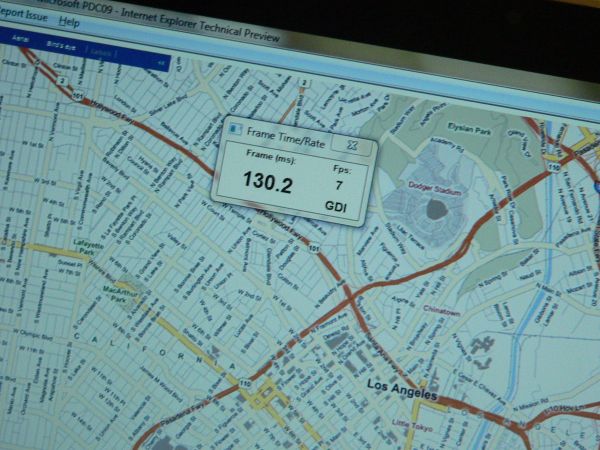


 Get your wallet ready; OCZ’s Colossus line has finally hit the shelves. We were expecting them
  Even though we’re inching
