Category: News

  • Colbert Better Knows California’s 12th District

    Anyone who knows anything about politics knows the true measure of a legislator isn't his or her voting record, it's how well he or she can gleam the cube (ask your parents). So last night, after grilling California Congresswoman Jackie Speier about her district's plans to cure gayness, Stephen Colbert took to the halls of Congress armed with his board and a hunger for shredding.


    The Colbert Report airs Monday through Thursday at 11:30pm / 10:30c.

  • Senator John Benoit Honored with Civil Justice Leadership Award

    SACRAMENTO – Senator John Benoit (37th District) will be honored on Thursday, November 19, by the Civil Justice Association of California (CJAC) for his leadership during the 2009-10 legislative session.

    “Having first-hand experience with many aspects of the legal system through my career in public safety, I have always had immense respect for the law and its important role in our society,” said Senator Benoit. “I am incredibly grateful for this prestigious honor. An effective and fair justice system requires the dedication and vigilance of all Californians.”

    During this past legislative session, Benoit authored several bills that would improve California’s legal climate and help businesses, consumers, and taxpayers.

    Senate Bill 39 was written in response to a California Supreme Court decision that stripped traditional liability protections from non-medical “Good Samaritans” and such volunteers providing non-medical help. The bill, which went into effect immediately, extended liability protections to any person providing help in good faith at the scene of an emergency.

    Senator Benoit authored Senate Bill 187, which would have allowed employees to work four 10-hour days without being paid for overtime. This would have provided employees with flexibility and helped reduce the number of employment-related lawsuits. He also authored Senate Bill 807, which would have clarified the law on meal and rest break periods, benefitting employers and employees by reducing litigation in their area.

    “Senator Benoit will receive our Civil Justice Leadership Award for his work and dedication in trying to bring fairness and balance to California’s civil justice system,” said CJAC President John H. Sullivan.

    Kim Stone, CJAC’s vice president-legislation, added: “Senator Benoit’s constituents and all Californians are lucky to have him working in Sacramento to support the interests of consumers, businesses, and Good Samaritans, and to ease the burdens on our courts.”

    Senator Benoit’s district is located entirely within Riverside County, encompassing more than 4,800 square miles and including more than 846,000 residents. On November 4, he was appointed by Governor Arnold Schwarzenegger to fill the 4th District Riverside County Supervisor seat and will be sworn into that position on December 1.

    The Civil Justice Association of California annually recognizes lawmakers whose commitment to balance and fairness in California’s civil justice system benefits consumers, taxpayers, and businesses of all kinds.

    Contact: John H. Sullivan, President
    Cynthia Lambert, Director of Communications and Research
    916-443-4900

  • Theme Review: GreenTech, Winter Wonderland, Liquid Chrome

    Over the weekend I had a big choice to make. As I mentioned Monday, I got a BlackBerry Tour on Saturday. After I set up all the technical aspects, I was left with a decision over which theme to choose. I went through a bunch of our theme reviews, and eventually cape upon something interesting. Apparently, I said that I’d load up the Aliencology theme once I got a Tour. So, true to my word, that’s what I picked. It’s just as awesome as I remembered. But, I still want to find alternatives. It’s not perfect, at least for me. I think there’s a perfect BlackBerry theme for everyone, and that’s part of the purpose of this feature. Let’s see if you find yours this week.

    (more…)

  • What are the odds the Sony Daily e-book reader will be available before Christmas?

    sonyyy

    I’m in charge of writing the e-book gift guide, but it’s sorta hard to recommend items that haven’t been released yet. That IREX reader, the nook, and the Sony Daily Edition Reader are all missing in action. Thanks, guys. Today we take a minute to ask, “Where’s the Sony Daily?”

    It goes on sale (well, for pre-order) today on Sony’s Web site, but Sony says it won’t actually be shipping till sometime between December 18 and January. It won’t actually be in stores till January.

    So it’s safe to say that Sony is cutting it pretty close if it wants it to be a big Christmas seller.

    Things that should eventually help Sony: it’s partnered with Best Buy and Wal-Mart to sell the device there when(ever) it comes out. My elitist New York quick-take: is Wal-Mart really the place to sell a $399 e-book reader? I understand Wal-Mart is a fantastic retail partner, but I don’t really associate the Wal-Mart crowd with reading (more like affordable clothes and groceries), and with reading new-fangled e-books at that.

    So, in summary, don’t be surprised if you can’t get your hands on a Sony Daily in time for Santa Claus this year. I understand waiting a few more weeks doesn’t really make a difference to you and I, but it’s the world for Sony.


  • Anachronistic Twitter Client Released for Classic Macs

    If you’re still running an old Mac PowerBook 550c or something similar, it must be really annoying to not be able to use Twitter via a native client. That’s probably your No. 1 concern, in fact, on your OS 8.1-running machine. You could always use the web interface, but that’s not really a fair solution, is it?

    Now, thanks to Grackle68k, Mac users who are still running Macintosh System 6, 7, 8 and 9 can have a dedicated Twitter client of their very own. Personally, I think the release of this app was just timed to steal the spotlight away from Seesmic for Windows. Obviously this is much bigger news!

    Twitter is available to pretty much any platform, and that’s no accident. The technology behind it is relatively lightweight, with clients only really needing the ability to make API calls to be completely functional. The memory footprint of clients differs depending on what developers choose to add on the client side of things, but little is needed to make one actually functional.

    That’s the idea behind Grackle68k, a labor of love for a small group of programmers who realize that there’s still quite the classic Mac enthusiast crowd out there who actually use their well-aged machines for some basic tasks in addition to just keeping them running (myself included). The program lets you tweet, but if you want it to remember who you are on each startup, you’ll have to break out the ResEdit and make a change to a resource by adding your login information. It’s an added step, true, but a fun one that should bring back memories, so hey, I’m not gonna complain.


  • Nokia’s N900 arrives in U.S., bodes the death of Symbian on N-series phones

    By Tim Conneally, Betanews

    Nokia N900 Maemo

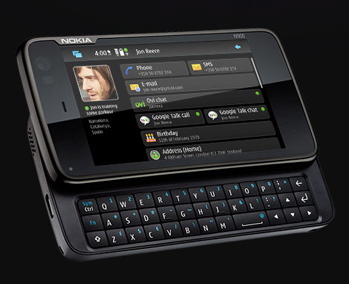
    Nokia’s intriguing N900 “pocket computer” has officially launched in the United States. The device, a smartphone that evolved out of Nokia’s Mobile Internet Device (MID) family, signifies a new era for the Finnish mobile tech leader.

    Vice President of Nokia retail sales, Alessandro Lamanna summed it up in a prepared statement today: “Consumers from every segment of the population are looking for more out of their mobile device – more power, more ability, more connectivity.” So in order to deliver these results, Nokia paired the 600MHz TI OMAP 3430 chipset with the Linux-based Maemo platform, and locked it up inside a 3G phone with a 3.5″ touchscreen and QWERTY keyboard.

    According to one report, Nokia said that by 2012, Maemo will have fully replaced Symbian as the operating system powering its top-end N-series devices. The N900, according to this report, marks the beginning of this transition because it is targeted at the enthusiast and developer crowd who will grow the Maemo ecosystem before it starts being marketed to the mainstream consumer. By then, Symbian will then be relegated to the mass market E- and X-Series devices.

    We’ve sent an inquiry to Nokia to find out how true this report actually is, because it could have a significant impact on the smartphone market in the long term as Linux-based platforms are poised to dominate the mobile sector.

    And if there was any doubt as to whom the N900 and Maemo appeals to, check out this video:

    The Nokia N900 is available for $649 through Nokia’s flagship stores in New York and Chicago, and on the Web at nokiausa.com and Amazon.com. It is compatible with AT&T’s and T-Mobile’s networks in the United States.

    Copyright Betanews, Inc. 2009


    Add to digg
    Add to Google
    Add to Slashdot
    Add to Twitter
    Add to del.icio.us
    Add to Facebook
    Add to Technorati


  • Guard civil support team shows off for Homeland Security secretary

    The District of Columbia National Guard’s 33rd Weapons of Mass Destruction-Civil
    Support Team showcased their equipment for the secretary of the Department of
    Homeland Security and other senior DHS officials here today…

  • For new 1AF commander, duty is a family affair

    To say family is important to Garry Dean, is to understate his level of
    devotion…

  • Louisiana Guardsmen return home after Iraq deployment

    After a year-long deployment in support of Operation Iraqi Freedom, about 120
    Soldiers from the Louisiana Army National Guard’s 225th Engineer Brigade were
    welcomed home during a special reception here at Camp Beauregard Nov.
    15…

  • Four governors visit Guard troops in Iraq

    Governors from Georgia, Mississippi, Oregon and Wyoming visited Soldiers and
    Airmen Nov. 11 here at the Morale, Welfare and Recreation Center…

  • Army leaders struggle with Soldier suicide rate

    The rate of soldier suicides continues to concern Army leadership, with 211
    active-duty and reserve-component suicides confirmed this year, the Army’s No. 2
    officer told Pentagon reporters today…

  • Following The Blissful Brick Road

    While I'm out of town for a few days, I have Evita Ochel here sharing some of her beautiful writing.  Evita is very wonderful friend and the author of three blogs, including:

    Evolving Beings
    Evolving Wellness
    Evolving Scenes

    I've known Evita since early on when I started this site.  In that time, I've come to love and appreciate her deeply thoughtful and introspective soul.  And she's about the kindest and most caring person I know – her heart is filled with a deep and caring compassion.   Much of what she writes about is about getting to our own truths, and connecting with that core within us.  And she does this in a way that feels right and okay, no matter what path our life is on. 

    Really, I see this as a special gift she has, in how she can draw upon her experiences, and have her readers take something from that which is deeply meaningful to them.  Evita has a beautiful way of helping us to connect more personally with our own souls.  And that is a great place to visit!

    You can keep up with Evita by subscribing to her blog, and following her on Twitter.

    Please enjoy the wonderful writing Evita shares in…

    Following The Blissful Brick Road


    California Wildflowers
    Creative Commons License photo credit: Rennett Stowe

    “Follow your bliss and the universe will open doors where there were only walls. “ ~ Joseph Campbell
    It is not uncommon for any of us to know someone who is doing something that they are not happy doing. In fact, often that someone is us.
     
    Millions of people today around the world are doing things that they do not enjoy whether it be job related, relationship related, material related or other.
     
    But why do we do it?
     
    Why do we do things, and so often, and for so long, that do not bring us joy?
     
    Most of us I imagine would say because “we have to” or because “we have no choice”.
     
    But think about this for a moment do you really?
     
    Do you really think that this magnificent being that you are, who was gifted with free will has no choice?
     
    If we step back for a moment and think of ourselves as the physical beings we are right now, and think for a moment what we “really” have to do, it only includes a very small number of things. You have to drink water and eat. You don't even have to breathe, as your system automatically does that for you.
     
    Eventually you may want to move, you may want to create. However, if we really dissect life and what we have to do, one can even argue that unlike popular belief, we don't even have to make money. There are numerous people in this world that dedicate themselves to a completely non-materialistic life. Mother Theresa was only one example.
     
    So we come back to our question – why do so many of us, do so many things throughout life that do not bring us happiness?
     
    Numerous spiritual teachers, such as Neale Donald Walsch or Abraham Hicks over and over tell us that life is supposed to be based on joy, and if it doesn't feel good, don't do it. Yet we do.
     
    Could it be that most of us have somehow convinced ourselves that there are things we must do?
     
    Could it be that somehow, collectively all of us have spun an illusory web of “musts” that now we hold each other to in society?
     
    And could it be that perhaps the things that we most wanted, somehow down the road we end up turning into unpleasant chores?
     
    Let's think about it:
     
    Your job – you chose it. No matter your education or your financial situation – when you signed that contract, that was you exercising your free will and saying yes. If it stopped bringing you happiness, choose again. There is a sea of choices out there, just allow yourself to look and see them. For those who really feel that they “can't leave” – you still can choose to change your perspective and create your own happiness.
     
    Your Mate – you chose them. Unless perhaps you had a pre-arranged marriage, which even then someone can argue there is still choice, you chose your mate. If things changed over the moths or years, you still have choices at every step of the way in how you want to proceed. No one has to be stuck in a relationship that does not bring them happiness, not for money, not for family, not for anything.
     
    Your Kids – you chose to have them. Even if they were unplanned, you chose to engage in behavior where the result could have been them. Many of us say we have to do this or that for our kids, but is it really a “have to” or a “want to”? Aren't kids, no matter the age, the most precious gifts we ever chose to give to ourselves? If you stopped seeing that for whatever reason, look at your children again.
     
    No matter what, at every step of the way, and every single day we have our free will to choose joy, happiness and bliss, or not.
     
    It starts with how you look at things, how you choose to see things, how you communicate, how much love you have for yourself, for your life, others and so much more!
     
    I know many of us have fears that hold us back from doing or being what we love, but when we overcome those fears, not even the sky is the limit. In other words your happiness is limitless.
     
    I can tell you from personal experience, that the Universe truly does open doors, where we thought there were only walls, when we follow our bliss, trust and learn to let go. I see this in my life on almost a daily basis. Do what you love.
     
    There is not a moment to waste. Look at your life today, examine your choices, what are you doing that doesn't bring you happiness? Ask yourself, why are you doing it? How can you change it? How can you start to see it differently?
     
    Life is precious. Some would even say “life is short”. Live it with no regrets. The people around you are precious. Don't wait any longer to live a life of bliss.
     
    Any situation, even the most grim can be turned around to be a positive one. There are numerous examples of people around us to show us that there is another way – a way to choose bliss no matter what. Take Dan Caro as an example. At the age of 2, Dan was pretty much burned alive. Today with no hands, he is an exceptional drum player who is a triumphant example of how excuses do not have to hold us back from anything and we can choose bliss no matter what!
     
    Every day when you wake up, you can choose to step on the road of bliss, live it and spread more to others as you go!
     
    What do you choose?

  • Matrix: The Four Social Support Strategies

    At the Altimeter Group, I cover Customer Strategy, which encompasses not only marketing, but also support, expect our discussion to grow as social technologies impact the whole enterprise.

    The Social Support movement is afoot (see opportunities), and more companies will be connecting existing marketing and support systems with the social web. Many companies, like Comcast, Wells Fargo, Intel, BestBuy, JetBLue are responding to customers and in some cases, supporting them in near real time.

    The challenge is that these teams are unable to scale, even a support team of ten full time folks at Comcast will have a hard time responding to all customers in all social channels. As a result, expect companies to resort to scalable ways to respond to customers, such as:

    The Four Social Support Strategies

    1) Do Nothing: Use Legacy Support Channels
    Some companies will not respond to customers, it’s not in their culture, exposes them to risk, have specific legal or federal restrictions in place, or simply don’t get this space. In this case, these companies may only choose to support customers in their formal forms of support in 1800 numbers or on the official company websites

    2) Employee Based Support:  Employees Respond to Customers
    Many companies are assigning people in their support or product teams to respond to customers in the social web. The more conservative the company, the less people are officially able to support. Take for example financial services company Wells Fargo has a handful of “Social Concierges” that tweet on the @Ask_WellsFargo account, they set expectations around hours of service (insert banker’s hours joke here) and not to disclose account information. On the flip side, Best Buy encourages their thousands and thousands of “Blue Shirt” employees to respond using a Twitter CMS system that response from the official @Twelpforce account.

    3) Peer Based Support: Customer to Customer Other companies will approach this by encouraging their top customers to respond on their behalf. By creating online communities where customers can self-support each other using Q&A features like Salesforce “Answers”, or my Lithium’s unique Twitter alerting system that encourages advocates to respond to prospects.  (Lithium is an Altimeter Group client).  It’s not just on branded communities, many companies encourage support from third party sites such as Get Satisfaction, who centralizes support for all products.

    4) Automated Social Support: Computer Generated Tweets
    Social CRM systems are going to be intelligent, in fact, they’ll start to incorporate bot-like features you can find in web-based chat support, or the logic from interactive voice systems (IVR), and respond to customers. Support and product teams can already tweet from some CRM interfaces, so attaching an intelligence module will be the next step –it could even come from existing employee Twitter handles.

    Web Strategy Matrix:  The Four Social Support Strategies

    Benefit Downside
    Rely on Legacy Systems This keeps customers in the right process and funnel that the company is used to. Secondly, it doesn’t reinforce that customers should yell at their friends to get help from a company Missed opportunities: Angry customers could revolt starting a Groundswell, or leave an opportunity for competitors to swoop in and take dissatisfied customers.
    Employee to Customer Provides a personal touch to help and assist customers, builds relations and trust For large companies, this is not scalable, and will result in companies prioritizing responses to the most authoritative or most urgent. If rolled out to support in all social avenues, it can be costly.  Lastly, it teaches customers to yell at their friends to get support.
    Peer Based Support Companies can reduce costs by having customers self-support each other. Collectively, customers may often know more about the company’s products than the actual product team. Unfortunately, not all questions may get answered in a timely way, or answered correctly by staff who may have the inside details. Also, content in knowledge bases, wikis, forums, and Q&A features are often unstructured, messy, and hard to navigate.
    Automated Social Support Companies can quickly scale by responding to customers faster, and more accurately, using automated responses. Some customers may feel cheated if they find out they are talking to a bot, and it may be more difficult to build that personal relationship.


  • Sony Pictures Having Its Best Box Office Year Ever… Still Blaming Piracy For Killing The Business

    Sony Pictures’ CEO is Michael Lynton, the guy who recently claimed that “nothing good” has come from the internet, and that piracy is killing the movie business. He made that statement less than a month ago. And yet, as Dave Title points out, Sony Pictures just announced that its international box office results have already set a new record for the year, hitting $1.63 billion. The company is bragging about this new record — as it should. But it does seem a bit disingenuous to brag about revenue records just weeks after claiming that piracy was destroying your business and asking for government help to protect the business model. Someone might notice that these two things do not seem to agree.

    Permalink | Comments | Email This Story


  • Subsidized Mobile Internet Devices a Not-so-Nuts Proposition for Carriers?

    Subsidies for high-end smartphones can be a Faustian bargain for mobile operators, but there are riches in the coming wave of connected devices, according to figures released today from In-Stat. More than 60 percent of all netbooks and other Internet-enabled mobile devices will be sold through operators and their partners by 2013 as more services are bundled for multiple gadgets, the market research firm predicts.

    Those devices are increasingly likely to be sold with 3G and 4G data contracts, In-Stat said, resulting in recurring monthly revenues for carriers. The percentage of netbooks and smartbooks sold with a mobile contract will increase to 49.5 percent in 2013 from 31.5 percent this year. And while subsidies for superphones like the iPhone can exceed $300, the business model for subsidized mobile Internet devices can be a very attractive one for carriers, according to In-Stat analyst Jim McGregor:

    “In the U.S., carriers are charging up to $60 per month for a two-year contract with the subsidized purchase of a netbook,” McGregor said in a statement. “While the subsidy costs the carrier $50–$100, it generates $1,440 or more in service fees over the life of the contract.”

    Success with netbooks is encouraging U.S. carriers to venture into the notebook space, In-Stat said, following the lead of some Asian operators. Providing connectivity to all those gadgets is likely to be a crucial way to shore up the bottom line as voice revenues continue to decline.


  • Yahoo Go Is A No Go

    Before there was an iPhone, Android and App Store, there was Yahoo! Go. Launched in 2006, Yahoo! Go was an application offered news, mail, weather, traffic, and Yahoo! search from a mobile device. Today, Yahoo is announcing that Yahoo! Go will be shutdown on January 12, 2010.

    The app seemed to be ahead of it’s time when it launched but now is useless thanks to Yahoo creating prettier, more powerful, personal content-focused apps that specialize in products, such as Flickr, Yahoo Finance and Yahoo Messenger. Yahoo released three versions of Yahoo! Go but hasn’t released a new version in the past year. The last iteration of the app included a mobile widget platform and was available on select Nokia and Windows Mobile devices


  • Frutas Exóticas – Pindaueua – Duguetia marcgraviana

    Seu nome em tupi-guarani significa “arvore dos caniços”, e habita as florestas da mata atlântica que vai de Minas ao Rio Grande do Sul.

    Da família das anonaceas, a Pindaueua ou Pindaúva (Duguetia marcgraviana Mart.), é uma árvore que pode atingir até 25 metros de altura, sendo muito popular nos estados do Norte do país, particularmente o Pará.  “As folhas são simples, perenes, com perfume característico e o ápice da folha tem ponta longa como o próprio nome cientifico indica. As flores tem três sépalas verdes e 5 pétalas rosadas.”[1]

    O fruto é amarelo-acastanhado, com cerca de 10 cm de diâmetro. Sua polpa tem um gosto muito agradável, sendo consumida ao natural ou como refresco. Também conhecida como Biribá-de-pernambuco, Biribá-verdadeiro, Jaca-de-pobre. Suas folhas e as raízes são usadas na medicina popular para combater a verminose.
    Fonte: [1]- http://frutasraras.sites.uol.com.br/duguetialanceolata.htm; crédito da foto http://mudascoelho.com.br/frutiferas/pindaiva.jpg


  • Scarborough: Most Americans Still Read Newspapers

    By Erik Sass
    mediapost.com

    Newspaper publishers hoping to staunch the flow of ad dollars out of the medium got some help this week from a Scarborough Research study, which found that 74% of American adults either read the newspaper or visit a newspaper Web site at least once a week.

    These data indicate newspapers still enjoy considerable reach; whether advertisers will be impressed by these figures is another story.

    Scarborough’s latest Integrated Newspaper Audience study revealed that 171 million American adults read a newspaper’s print or online version at least once a week.

    What’s more, well-heeled and well-educated consumers index even higher in newspaper readership, with 79% of white-collar workers, 82% of adults with household incomes over $100,000 per year, and 84% of college graduates reading print or online newspaper content at least once a week.

    Of course, newspapers are still faced with a long-term decline in print readership, but the print versions still reach tens of millions of American adults. Commenting on the findings, Gary Meo, Scarborough’s vice president of print and digital media services, stated: “While our data does show that print newspaper readership is slowly declining… given the fragmentation of media choices, printed newspapers are holding onto their audiences relatively well.”

    Impressive online figures show that at least in terms of audience — newspapers have successfully transitioned to digital media.

    According to a separate study by Nielsen Online for the Newspaper Association of America, between the first half of 2004 and the first half of 2009, newspaper Web sites’ total unique audience almost doubled from a monthly average of 41,147,206 to 71,831,867.

    In terms of active reach, altogether, newspaper Web sites jumped from 27.1% of all U.S. Internet users in the first six months of 2004 to 41.8% of all Internet users in the first six months of 2009. . . READ FULL STORY

  • BlackBerry App World Available in South Africa

    scoremobile.jpg

    The second most important announcement for South Africa after FIFA World Cup 2010

    In the rest of the world (outside Canada and the U.S.), soccer seems to be an incredibly popular sport.  As a North American, I don’t understand any game played without a large amount of protective gear and cheerleaders, so you’ll have to excuse me for my ignorance. David Beckham?  He plays soccer, right?  He’s married to Posh Spice.  That’s about all I know.  

    ANYWAY – South Africa is hosting the FIFA World Cup 2010 in 9 host cities, and one great way to keep track of how your team is doing is by using ScoreMobile – available today in BlackBerry App World™!

    “But Alex, BlackBerry App World isn’t available in South Africa.”  SURPRISE – it is available now!  Visit http://worldwide.blackberry.com/za/appworld today to download BlackBerry App World to your BlackBerry® smartphone.   

    We’re really happy to announce another launch and we’ll continue to bring BlackBerry App World to every country where BlackBerry smartphones are available.  

  • PDC 2009: Live from the Day 2 keynote

    By Scott M. Fulton, III, Betanews

    Microsoft’s Windows division president Steven Sinofsky is the headliner for today’s Day 2 keynote at PDC 2009, and Betanews has its usual front-row seat.

    11:04am PT: Promise of discussion on Windows Mobile at MIX ’10 next March 15-17 in Las Vegas — notice once again that the number “7” is omitted from the reference to this product. Keynote ends 35 minutes over schedule.

    11:00am PT: Outlook Social Connector — a plug-in involving Microsoft and partners including LinkedIn, enabling information from individuals’ social organizations and networks to be displayed in a meaningful context in Outlook. “This is a general SDK,” meaning developers will be expected to deploy it.

    10:37am PT: Office Mobile Clients for Windows Mobile 6.5 betas available today in Windows Mobile Marketplace.

    10:37am PT: Office 2010, SharePoint 2010 public betas go live now…today was apparently the original release date to begin with.

    10:23am PT: SharePoint now taking the stage, this is where we’ll see the only real Office 2010 information. A lot of talk first about what Microsoft is focused on, which is a little bit of a downer coming off of some very impressive Silverlight 4 demos.

    10:18am PT: Final release of S4 shipped first half of next year.

    10:17am PT: Sinofsky: How S4 will be shipped: Public beta will include all features demonstrated today, tooling support for VS 2010. Now available for download.

    10:15am PT: Multitouch features with basic features, zoom in, zoom out.

    10:14am PT: Photos dragged-and-dropped from the outside can be loaded into the application live, then tagged, prior to being sent to Facebook.

    Photo of the audience, plugged into the system, app will ask whether to upload the photo to Facebook — all within about 10 seconds.

    10:10am PT: Brian Goldfarb is showing an S4 application that utilizes Facebook, but which uses its own chrome to develop a real, custom app on top of custom Facebook apps. Can also take advantage of COM automation to right-click data from Facebook, then add to the Outlook calendar. Access to the Outlook inbox, with virtual wall on the right “to contextualize who I’m talking to.”

    10:07am PT: Google Chrome being added to S4’s list of supported browsers.

    10:05am PT: Window “chrome” of the application can be customized with out-of-sandbox support, cross-site networking, keyboard support in full-screen mode, more hardware device access. Access to any COM automation object installed on the system, using the _dynamic_ keyword in C# to call new methods found on system. For example, Office 2010 calendar can be queried, PivotCharts brought up from Excel.

    10:04am PT: S4: Ability to build trusted applications that run outside the sandbox on Windows and the Mac, user consent dialog is provided automatically.

    9:48am PT: UDP multicast support enables P2P networking, improvements to support for WCF, including RIA services. Transfer data 600% faster using internal transfer protocols instead of HTTP.

    9:47am PT: Brush demo can be used with live video — a YouTube video can be jigsawed live, while video and sound are playing.

    Juggling live YouTube video using Silverlight 4, playing back a "rick roll" video.

    Sinofsky’s been rick-rolled…but he gets his revenge! A “rick-roll” video from YouTube is sliced and diced into live jigsaw pieces using Silverlight 4.

    Compile in assemblies once, run in both Silverlight and .NET 4 — compile once, run in both places.

    9:45am PT: Text can be dragged and dropped from a browser to the application. Print Preview works, including with custom Print Preview dialogs. S4 will now write directly to the printer, has a print API.

    HTML control is hosted within Silverlight app. HTML image can be converted into a brush — the entire HTML page can be used as a brush, so that the page can be converted into, say, a jigsaw puzzle, the pieces of which can be juggled around the screen.

    9:43am PT: “And _now_ the iPhone works,” says Sinofsky.

    Rich text control that ships in S4: Arabic, Hebrew, Kanji character sets all within the text editor. Custom context menu after right-click. Can paste and insert text, pictures, and DDE-like controls into a Silverlight app, such as a Data Grid control from Excel. Can cut and paste from Data Grid control back into Excel.

    9:41am PT: HTML hosting support is coming, model/view development.

    9:40am PT: IIS media tool, new version will enable streaming of media directly to Apple iPhone. Yes, you read that right. Video can be encoded once using smooth streaming, target clients using the iPhone.
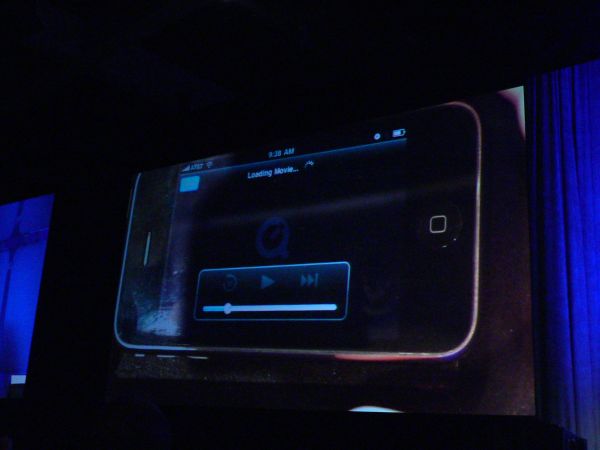
    That demo with Silverlight on the iPhone looked like this for quite some time...that could have gone better.

    Well, that could have gone a lot better. Brian Goldfarb rushed to the stage to give Steven a fourth iPhone. That one would link to the network, but once it accessed the Silverlight-based Vancouver Olympics site, the video would not load.

    Demo tried using four different iPhones, the first three of which could not pull up the network using the router. The fourth did pull up the network, but the video from the Olympics Web site would not pull up in the Safari browser. Took several minutes, but Sinofsky refrained from making any silly Apple comment.

    “We believe you, Scott!” yelled one attendee.

    Printing / rich text / Clipboard access / right-click support for context menus / mouse wheel support are all coming to Silverlight 4.

    9:34am PT: Demo of Vancouver Olympics site with Silverlight player, with instant seek.

    9:33am PT: Open-source library for barcode reading, can immediately look up the prices of any object scanned from the barcode scanner, pulls up distributors or retail sellers.

    9:32am PT: New Silverlight 4 will allow access to webcams and microphones on the user’s machine. Demo now: Webcam application that captures live video, can do live effects with bulge, distortion. Integration with Twitter enables the result to be live-integrated into Twitter profile, so a picture just taken becomes the user’s Twitter icon.
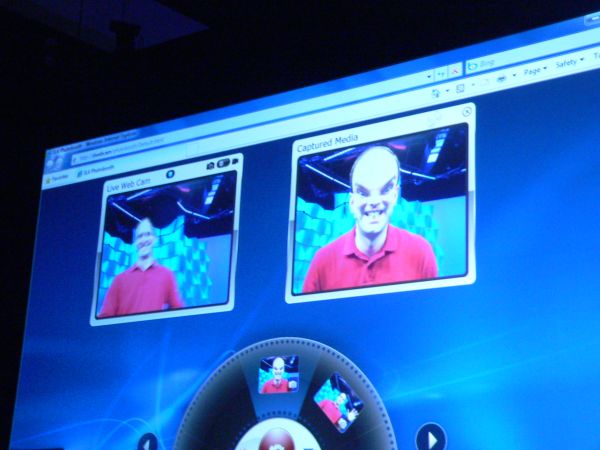
    Live Silverlight video editing, here seen revealing the 'true face' of Steven Sinofsky.

    9:28am PT: Silverlight now installed on an estimated 45% of the world’s Internet-connected devices. PDC is about Silverlight 4, first news.

    9:25am PT: Corp. VP Scott Guthrie now takes the stage to talk Silverlight, now showing the video of Sketchflow feature in Expression Blend (not a particularly new video for many).
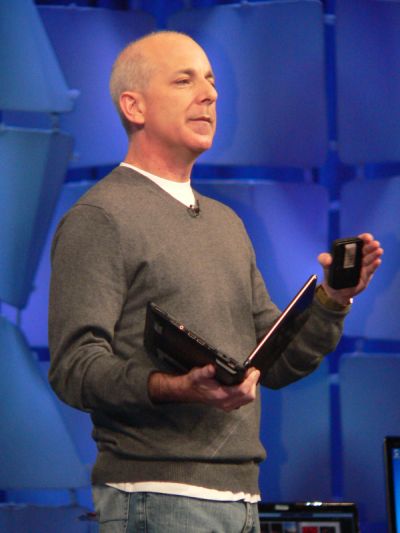
    Steven Sinofsky demonstrates the Microsoft PDC '09 laptop -- a test build, in cooperation with Acer, to see what laptop builders go through.9:22am PT: The test distributions of “Microsoft PDC laptops” will likely come with promises that the users will be communicating telemetry with the company.

    9:21am PT: Lot of new APIs in Windows 7, and IE will take advantage of these APIs. Videos of demos will soon be available on Microsoft Channel 9.

    9:19am PT: Maps re-rendering will use 60 fps rather than 2 or 3, by moving to Direct2D from GDI.

    9:18am PT: CSS selectors test, using CSS3.info — passed 572 out of 578 (a variation of the SlickSpeed test) for CSS selectors used in rendering.

    IE rendering engine will support rounded borders in CSS.

    Rendering engine will use hardware-acceleration in DX9 mode (not DX10), using Direct2D. Highly resolved text with much resolved clarity.

    Sub-pixel positioned text using DirectWrite. Zooms used to be jittery in GDI, nice and smooth as we move to Direct2D. Smooth realignments — “changes without you having to do anything different with your site.”

    9:14am PT: Different Web sites have tremendous differences in how they handle JavaScript, CSS, and HTML parsing. Their profiles make everything different.

    IE9 is getting close to Firefox 3.6 performance, not overtaken just yet. “It’s getting really close to being a wash.”

    9:13am PT:

    9:13am PT: JavaScript performance. IE9 is up to 32 on the Acid3 test, from 20. Audible groan from the audience.

    9:12am PT: We continue to want to be responsible about building Internet Explorer.

    First IE9 news: Three weeks into the project, we’re focused on these areas:
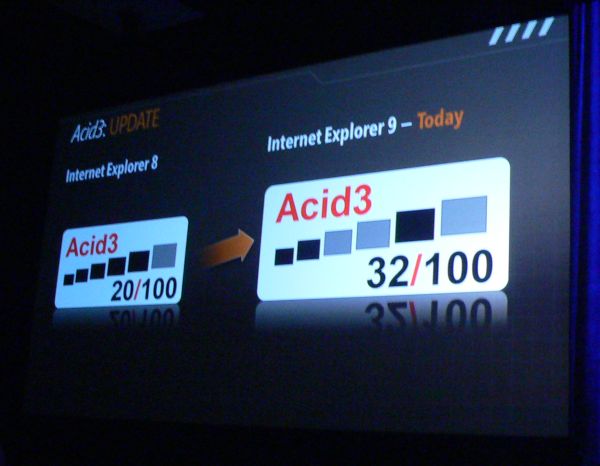
    Internet Explorer 9 posts slightly better scores on the Acid3 test.

    Standards: Acid3, we’re not ahead of that, we need to do a better job. There are new and emerging standards like HTML5, and we want to be responsible about how we support that, we don’t want to generate a hype cycle among developers.
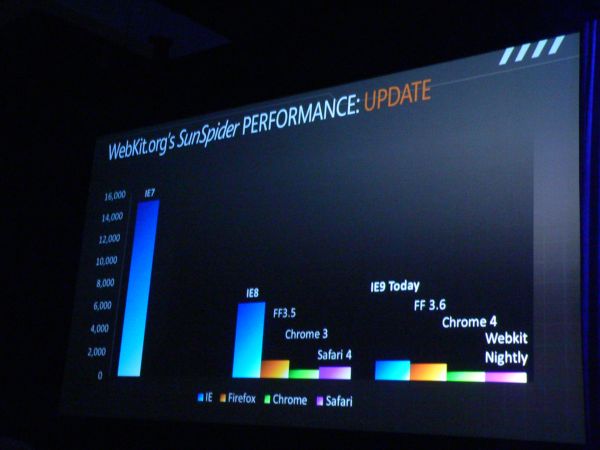
    Internet Explorer 9 posts much better scores on the SunSpider test.

    9:10am PT: Biggest applause of the day comes from this:

    Sinofsky is now talking about a partnership project with Acer where it puts its own team through the process of actually building a laptop computer, just to see how one is built — what laptop engineers actually go through. In learning the system that Acer goes through, Microsoft built its own limited run of PDC’09 laptops.

    They will be giveaways to PDC attendees. About a minute of applause from that. “But please hang around for the rest of the talk,” said Sinofsky. “We had a little problem, something like that, about four years ago, so please stay seated.”
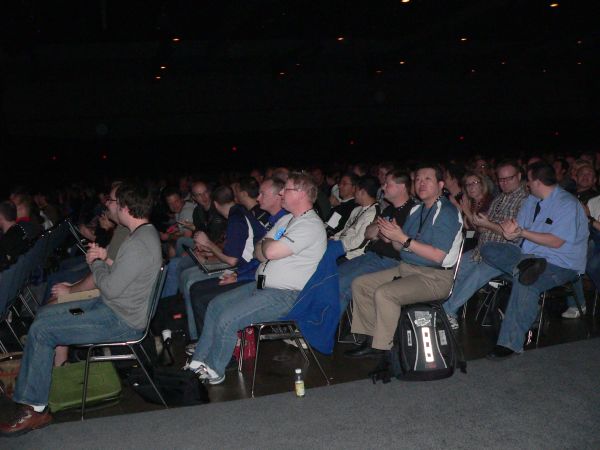
    Applause from folks being told they're getting a computer, wondering what's the catch?

    Folks realize they’re being given free laptop computers. Yay. Applause, then what’s the catch. No catch so far, so more applause. Then more. One of the longest stretches of applause in PDC keynote history.

    9:04am PT: Everybody’s jumping on the taskbar bandwagon, says Angiulo, and here again Microsoft gives credit to Mozilla for being quick to integrate previewing features into Firefox 3.6 (Beta 3 was just made available, by the way).

    9:03am PT: Dell netbook uses an infrared data center to detect body heat, then powers itself back up when someone walks by.

    Earlier, Angiulo demonstrated the differences between DirectX 11 processing power and DX10, mainly by means of offloading much of the computing power from the CPU to the GPU. Demos of moving thousands of “star” objects simultaneously in a simulated galaxy formation, with gravity and physical forces between them, all in a 40+ Gflops operation running on a $400 graphics card rather than a $15,000 computer.
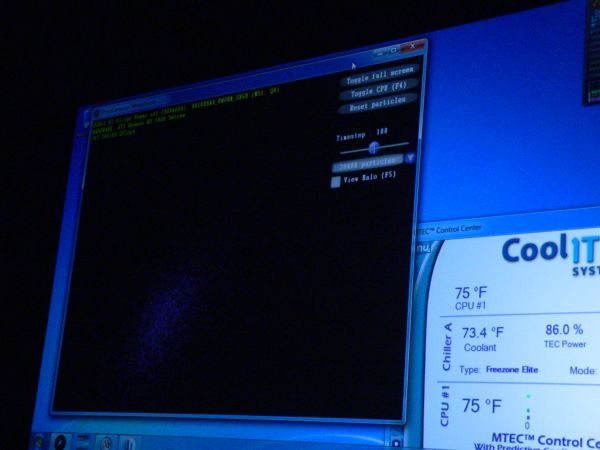
    A demo of live physics using GPU processing techniques in DirectX 11.

    8:58am PT: Windows engineer Michael Angiulo demonstrates how engineers of new small computers, such as netbooks, can do their part to accelerate Windows 7. After reminding everyone of the first generation UMPC (gagh!), he pulls out a pair of Windows 7 netbooks. But one has a bunch of branded background software loaded, and the other (by Sony) does not. The Sony model runs 30% faster, boots faster, and has 50% better battery life, simply by getting all that bloatware junk software out of the boot path.

    8:53am PT: Moving now to examples of people trying to align their windows, one user talks about side-by-siding his windows, looking for where the window tiling feature is located…no, it’s not that one…

    Then another user snaps a window to the side using Aero Snap in Windows 7. “That is _way_ easier.”

    Aero Peek: “Hey, get all that!” says the user. “I can dig that! Good job, people.”

    8:50am PT: Discussion now about the UAC usability studies. We saw videos of some of these studies last year, but users are talking about not wanting things popping up in their faces constantly.

    User is asked during an Adobe Flash installation what he just clicked on, and he made up a response about where the program is going on the drive. Another user is asked what the UAC prompt that he just received meant, and he answered, “It means that people…are happy with it now.” [?]

    8:43am PT: Video about how Microsoft programmers are held directly responsible for the errors of their ways, by way of a kind of “agony chair” that shocks, stuns, or stabs the individual developers discovered using the Watson logs to have been responsible for a specific problem.

    Uh-huh.

    8:40am PT: Anecdote about how Microsoft used to handle reliability problems in the Windows 3.x era using Dr. Watson (hands up if you remember that?), and how engineers pre-Internet developed the Watson system for “testosterone-based bug fixing” — folks watching the Watson logs coming in over the BBS and responding to the most interesting and serious problems.
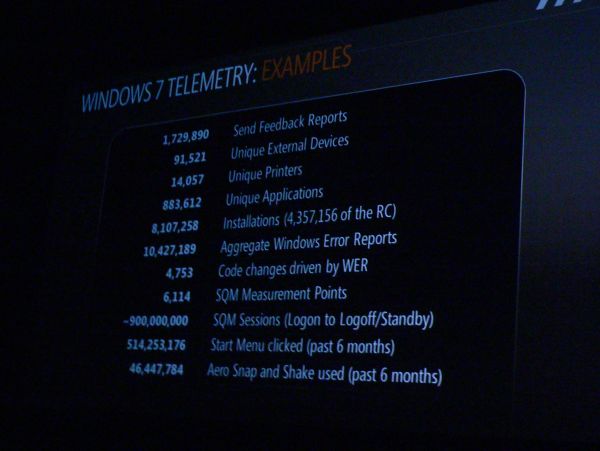
    Statistics garnered using telemetry on Windows 7.

    The sheer number of telemetry items returned from Windows 7 testers during the beta process.

    8:38am PT: The value of the “Send Feedback” button, learning from clients what drivers were loaded, whether the installation of drivers and services were successful.

    Software Quality Monitor (“squim”) is designed to be opt-in for customers, but Sinofsky admits customers were “opted in automatically” during the preview and beta processes.
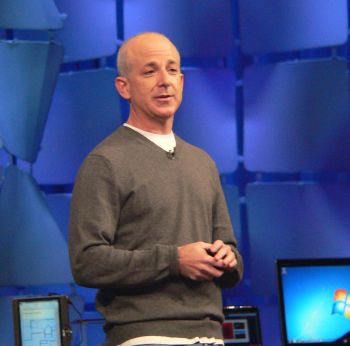
    Microsoft Windows Division President Steven Sinofsky during the Day 2 keynote at PDC 2009.8:35am PT: At the moment, Sinofsky is going through a history of the Windows 7 launch, and lessons learned at Microsoft about being responsible about how to disclose information about the product. “You should expect us to have learned that lesson about responsible disclosure, and to continue as we move forward.”

    Copyright Betanews, Inc. 2009


    Add to digg
    Add to Google
    Add to Slashdot
    Add to Twitter
    Add to del.icio.us
    Add to Facebook
    Add to Technorati