Category: News

  • Chicago IP firm affiliates with Purdue Research Park

    Chicago-based IPXtract, an IP development firm, has affiliated with the Purdue Research Park in West Lafayette. The university-affiliated business incubation complex is owned and managed by the Purdue Research Foundation and houses more than 157 companies. IPXtract’s business model provides entrepreneurs with marketing, promotion, and other support in exchange for an interest in the companies that are formed, according to Chris Haigh, IPXtract’s president and an alumnus of Purdue University’s College of Engineering. “If we become excited about the venture, the clients don’t have to pay for our hourly work and everyone benefits from the success of the newly formed company,” Haigh says. Because they don’t pay hourly fees, entrepreneurs who work with IPXtract can save money during the invention development and IP protection process. The IPXtract team also is allied with firms that can protect patents should litigation occur.

    “IPXtract can help solicit funding that can be used to determine how to make the client’s product and take it to the market while the patent process is progressing,” Haigh says. “Because IPXtract does not make money until our client’s company makes money, we are as motivated as our clients to get products up and running.” Affiliating with the Purdue Research Park enables IPXtract and its clients to interface with Purdue’s engineering department and to tap in-house services for marketing, promotion, and event planning.

    Source: Inside Indiana Business


  • Surveillance: New Online Get A Mac Ad

    Today, on CNN.com I noticed a new online Get A Mac ad that I’ve lovingly named “Surveillance.”

    Apple has done these sort of multi-banner ads on large news sites like CNN and NY Times before where the two ads cleverly interact with one another.

    In this ad, Mac and PC are talking about Windows 7 and above them a number of surveillance cameras are showing people going in and out of Apple stores presumably switching from PC to Mac. PC can’t stand the thought so he runs to one of the stores and is observed on one of the surveillance cameras stopping people form going in to the Apple store.


  • Get your TTO ready for ‘tech transfer 2.0’

    A number of TTOs in the U.S. have gotten their feet wet in the world of social networking, but what Brian McCaul, ICT, director of commercialization & exploitation in the Enterprise & Innovation Office at the University of Leeds (UK), proposed recently is well beyond what any have attempted and perhaps what many have imagined: A new world of tech transfer — or knowledge transfer in common European parlance — in which social networking forms the foundation for a revolution in the way innovation makes its way into the marketplace. McCaul recently set out six propositions to distinguish today’s tech transfer and knowledge transfer (KT) from what he is calling ‘KT 2.0.’ The propositions don’t focus on social networking per se, but rather describe the key differences he sees between the ‘old school’ tech transfer operating style and the TTO/KTO as it should be operated in today’s environment — and in the future:

    1. KT used to be about assembling and employing the most able team. KT 2.0 is about assembling the right network.
    2. KT used to be primarily about ‘Tech-Push.’ KT 2.0 is about maximizing Market Pull.
    3. KT was about driving as much resource into a project as possible, to maximize its likelihood of success. KT 2.0 is about learning to ‘fail early’ and cheaply.
    4. KT was primarily about legal, technical/regulatory and commercial matters – in that order. KT 2.0 understands that there are continually new innovation drivers emerging, be that the need for ‘business model innovation’ or ‘design innovation’ or the need to engage ‘user innovation,’ or some other emerging factor.
    5. KT was about research excellence in groups or individuals. KT 2.0 is premised on the notion that innovation is a social process, and that the most interesting opportunities are likely to arise from cross-disciplinary collaborations.
    6. KT was, primarily, focused on the large VC deal, and avoidance of the ‘living dead’ spinout or ‘small’ license deals. KT 2.0 understands that the funding environment is very different, and even if the ‘IPO model’ and VC investment comes back to full vigor, alternative funding/exit strategies will become an increasingly important part of the mix. (The complete weblog can be found here).

    A detailed article on the proposals and the practical aspects of implementing them in TTOs appears in the October issue of Technology Transfer Tactics. For subscription information, CLICK HERE.

  • Why LTE Patent Pools Are Sunk

    Qualcomm holds about a quarter of the patents required to make the Long Term Evolution wireless standard happen on mobile devices and networks, according to an ABI Research report published earlier this week. Other big holders include Interdigital, with 18 percent; Huawei, with 10 percent; Nokia and LG, with 9 percent each; and Samsung, with 7 percent. Which basically means Qualcomm may not be the patent shark that it could be with the CDMA 3G standard, but it’s still going to make some serious money with LTE. In fact, Len Lauer, COO of Qualcomm, confirmed that the company’s royalty rate for LTE would be about 1 percent lower than the royalty it charges for 3G.

    So Qualcomm’s sitting pretty with regard to 4G (this includes WiMAX, thanks to its 2005 Flarion buy). However, at least three different entities are attempting to get companies and people to create an LTE patent pool. I’ve covered efforts by Via Licensing, which operates the Near Field Communications patent pool, and MPEG LA, which controls the patents for MPEG-2 video codec. There’s also an attempt to pool patents by Sisvel, unveiled Monday. I’ve been skeptical of these from the beginning, however. As I noted in my Via story:

    Via can’t force patent holders to play, and without a majority of solid patents with which to negotiate, its attempts will fail. There’s little reason for a larger company to join a patent pool, unless it wants to help push through a standard, which isn’t the case with LTE (for the skinny on patent pools, check out this article I wrote back in 2007).

    Now that we know the leverage Qualcomm has — and the fact that Qualcomm doesn’t swim in patent pools (it has a dedicated staff to handle licensing and as such, no need to do so) — I’m pretty confident that these myriad efforts to get an LTE patent pool going are already sunk.


  • Beta of Opera 10 for Windows Mobile available now

    By Tim Conneally, Betanews

    Today, Opera Software has released the beta version of Opera Mobile 10 for Windows Phones, with support for touchscreen- and keypad-driven Windows Mobile 5 (PPC), 6.0, 6.1, and 6.5 devices.

    The keywords with this release are: speed, simplicity, and compatibility.

    Speed: With the current generation of Opera products, speed has been one of the central talking points. Though we at Betanews have found that Opera’s claims of speed boosts tend to be a little hyperbolical in the desktop versions, the company’s mobile products tend to be a different story. Using Opera Turbo compression, the company claims this version will be 50% faster than the previous version of Opera Mobile.

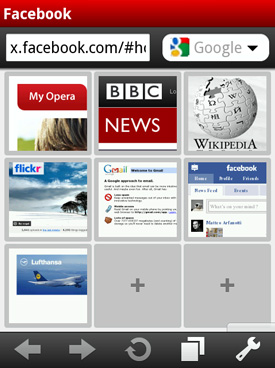
    Opera Mobile 10 Speed Dial screen

    Simplicity: Though navigation in each may vary, all of Opera’s current browsers share some essential design elements: the “Speed Dial” home screen, browser tabs, and the multi-search engine bar. The navigation buttons in Opera Mobile 10 have gotten a bit simpler than they were in 9.7 and now simply represent Back, Forward, Reload, Tabs, and Tools. Tabs have been turned into easily scrollable thumbnails, and the Tools menu accesses in-page search, bookmarks, browsing history, saved pages, and settings as large, easy-to-identify icons.

    Compatibility: “Opera Mobile is the most standards-compliant mobile browser available,” the company says. And while all browsers have at least some degree of compatibility trouble, mobile browsers are still extremely limited in the content they can display. Opera Mobile 10, however, uses the same Presto browser engine that desktop Opera 10 uses, so rich applications are more likely to be compatible with your phone. Furthermore, Opera Mobile 10 offers “Mobile View” mode, where Web pages are reformatted into a single column for easier consumption.

    Copyright Betanews, Inc. 2009


    Add to digg
    Add to Google
    Add to Slashdot
    Add to Twitter
    Add to del.icio.us
    Add to Facebook
    Add to Technorati


  • Sony’s Daily Edition Reader Available for Pre-Orders


    3GReader

    Yay! First Sony’s 3G enabled reader (PRS-900BC) is finally unlocked for readership to open up their wallets and pre-order 7″ Touch enabled reader. First shipments should start in the middle of next month, get your order in, so you could get your mittens on one soon. Pricewise this Reader is a little bit “immoderate” however since you are getting 3G access for free, we will let it slip…

    P.S. As of right now, Notify button is there instead of Pre-Order…I am sure it will be changed soon.

    Check out the full press release below:

    SAN DIEGO – November 18, 2009 Delivering on its promise to give consumers a variety of choices, Sony today announced its newest addition to the Sony Reader Family — the Reader Daily Edition™ — is now available for pre-order on SonyStyle.com. The Reader Daily Edition, a highly-anticipated wireless model with 3G connectivity, will ship next month.

    The Reader Daily Edition joins the Reader Pocket Edition™ and Reader Touch Edition™ to round out Sony’s complete family of digital readers. The Reader Daily Edition gives consumers wireless access to Sony’s eBookstore from most of the U.S., via a 3G mobile broadband network. Book lovers will be able to browse, purchase and download books as well as select newspapers and magazines on the go. There are no monthly fees or transaction charges for the basic wireless connectivity and users still have the option to side load personal documents or content from other compatible sites via USB. Sony will announce newspaper and magazine content providers within the next month.

    The Reader Daily Edition features a responsive, menu-driven, seven-inch touch screen panel that enables quick, intuitive navigation, page turning, highlighting and note taking with the swipe of a finger or by using the included stylus pen. Users can take handwritten notes with the stylus pen or type with the virtual keyboard. All notes can be exported and printed out for easy reference. The Reader Touch Edition includes an onboard Oxford American English Dictionary that allows you to look up a word by simply tapping on it.

  • Yahoo Search Share Drops While Bing Picks Up the Pace

    The search landscape is still evolving even if at its usual slow pace. Not too much has changed in October, Google still clearly dominates and has actually picked up a little market share in the last month, but the other two players are bit more dynamic. Yahoo took quite a significant dive, dropping almost 1 percent point, while Microsoft’s Bing continues its upwards crawl gaining a bit more market share.

    ComScore released the October numbers for the US “core search” market which takes into account just the five biggest search engines, Google, Yahoo, Bing, Ask, and AOL. The big winner last month, if you can call it that at 9.9 percent market share, was Bing, which proves to be a real success for Microsoft, taking into account the low expectations with which it launched. Microsoft’s search engine got just 8 percent of the searches the month before Bing launched and 9.4 percent in September.

    An almost 2 percent rise in market share in five months doesn’t look that impressive, but Microsoft has been trying to make inroads into the search market for years to little success until now. There’s just one downside to the numbers, Bing gained market share at the expense of Yahoo, while Google continues to look unfazed. Yahoo actually saw quite a big drop losing 0.8 percent points in just one mon… (read more)

  • Dilbert Evaluates Cloud Computing

    It seems everyone is talking about cloud computing. Even Dilbert, who discusses cloud computing with the Pointy-Haired Boss in today’s strip (link via Emil Sayegh). Click through for a larger version at Dilbert.com.

    Dilbert.com

  • Tony Hawk: RIDE now available in North America

    tony-hawk

    Dust off your old pair of Vans and get ready to party like it’s 1995, because Tony Hawk: RIDE has finally been released in North America. Available for the Nintendo Wii, Playstation 3 and Xbox 360, the game’s main attraction lies in its wireless skateboard controller that’s chockful of motion sensors and allows players to more or less feel that they themselves are on a real skateboard and part of the game. The game and skateboard are bundled together for $119.99, a far cry cheaper than your hospital bill will be after playing this game drunk at your office Christmas party.

    Read

  • The Bigfoot of Ereaders surfaces

    downsized_1116092247
    An anonymous tipster send us in this image of an e-reader running Android OS and explained that it came from a company that has never been in the tablet/e-reader business. Interesting…

    I suspect this is some sort of music device for composers/performers because of all the musical notes on the top of the screen and some things we saw in the background of the image. Any guesses as to what this could be?

    My suspicion is that someone like Yamaha is creating a control system for their MIDI devices, allowing folks to make music away from the PC.


  • Win $10,000 of audio related things from Sennheiser

    hookup_headphoneHey everybody! Let’s play the “What would you do if you had a million dollars?” game! Unfortunately, due to recent changes in corporation policy and budget cuts, you’ll only have 10,000 USD to play with. And it will have to go towards something music / audio related. Wait, that’s still totally awesome. But don’t tell me what you would do with the cash. Go and tell the guys over at Sennheiser. Their Sound Tour Hookup Challenge can give you and five friends the chance to spend ten thousand bucks on whatever crazy audio scheme you can think of.

    Entries so far range from flying to a festival in Europe, having your favorite band play a private party, building a recording studio, etc. But there’s no limit on what you can ask for. The entry mediums are pretty open-ended too. YouTube videos, essays, photo journals. You have until December 23rd to get yours in.

    The winner will be picked sometime in January 2010 by a panel of Sennheiser executives based on the following criteria.

    • Sennheiser product integration – 40%
    • The ability to show appreciation of sound – 25%
    • Creativity and overall appeal – 25%
    • Entry must show the integration of 5 friends – 10%

    But wait! There’s more! You can go and vote for other submissions that you like, entering you in a weekly drawing for a pair of Sennheiser headphones.

    As for me, I’d probably buy an analog Neve 88R console. Ten grand should be enough to buy maybe one channel strip.


  • UCSF funding program encourages risk-taking in biomedical research

    Scientists at the University of California, San Francisco (UCSF) have begun to benefit from federal grants supporting high-risk research. But long before such opportunities existed, UCSF formed its own program to encourage faculty and postdoctoral fellows to think boldly. The Program for Breakthrough Biomedical Research (PBBR) currently awards about $6 million every year to projects of potentially high impact that are substantially more creative or risky than projects supported by the National Institutes of Health (NIH) and other traditional funding mechanisms. Despite its relatively small size, the 13-year-old PBBR, formerly known as the Sandler Program in Basic Science, has generated more than $300 million in subsequent grant funding.

    Among recipients is Wendell Lim, PhD, professor of cellular and molecular pharmacology, who is engineering “smart cells” that are programmed to carry out novel therapeutic functions in cancer and regenerative medicine. His lab’s PBBR grant enabled him to advance his research to the point where the NIH started to take notice. The PBBR also opened doors for Allison Doupe, MD, PhD, whose pioneering and somewhat quirky research into songbird learning has revealed clues that may improve the scientific community’s understanding of human brain development and disorders such as autism, schizophrenia, and Parkinson’s disease. Doupe, a professor of psychiatry and physiology and a member of UCSF’s Keck Center for Integrative Neuroscience, found that songbirds — like humans — have specialized areas of the brain devoted to learning. By altering the part of the brain known as the basal ganglia, Doupe and her colleagues effectively eliminated variability in the birds’ songs, which interfered with their ability to learn. Since receiving her PBBR grant, Doupe has also obtained funding from the NIH and several research foundations. Says Keith Yamamoto, PhD, PBBR director and executive vice dean of the UCSF School of Medicine: “The message to our researchers is: We so value the kind of thinking you do, and we want to support it and promote it.”

    Source: Science Cafe


  • AmEx to Buy Revolution Money for $300 Million

    American Express, the company well known for overpriced charge cards, is buying Ted Leonsis and Steve Case’s Revolution Money for $300 million. Leonsis shared this information on his blog. Amex wants to use Revolution Money to build a next-generation offering. Revolution Money has some kind of a next-generation payments technology that brings together offline and online worlds; it’s part of the Revolution group of companies floated by Steve Case. No one I know has either seen it or actually uses it. If there is one company that is going to do offline-online payments, that will be PayPal.


  • S.C. start-up commercializing MUSC innovation to prevent scarring

    Using peptide-based IP licensed from the Medical University of South Carolina, Charleston-based biotech start-up FirstString Research is developing and commercializing therapeutics for scar prevention and tissue regeneration. Initially aimed at preventing or reducing scars from surgical wounds, the technology may have wide-ranging applications. The company’s proprietary therapies modulate intercellular communication to significantly reduce the development of scar tissue while improving the body’s ability to produce healthy, functional cells. Its lead compound, ACT I, has shown efficacy in many tissue types, including the skin, spinal cord, and internal organs. The platform technology has numerous potential applications, according to Gautam Ghatnekar, PhD, the company’s president and CEO. The first application as a topical gel to prevent or reduce scarring from surgical wounds is “low hanging fruit,” he says. Based on consistent and positive early results, FirstString has already received regulatory approval in Europe to enter clinical phase testing of the gel. The company also has seen good preclinical data in spinal cord injury and cardiac applications, and its next focus is in the area of macular degeneration. Since its founding in 2005, the four-employee company has raised $4 million in equity funding, according to Ghatnekar.

    Source: TechJournal South

  • Affordable IP valuation analysis in new software

    Most existing IP valuation methods are either inexpensive but yield very coarse results, or so expensive they’re beyond the reach of cash-strapped TTOs. A new software-based method, the Competitive Advantage Valuation (CAV) system, was specifically developed to provide the precision you need at a price you can afford. No other valuation method yields its level of precision at such a low price — now even lower under a collaboration with 2Market Information Inc., parent company of Tech Transfer E-News. The CAV method was developed over many years to value IP assets and formulate technology commercialization strategies on behalf of corporate, university and federal laboratory clients of the Technology Commercialization Research Center at Syracuse University. The CAV method provides accurate, affordable and objective valuation results that are:

    • Specific for dollar amounts and percentages
    • Repeatable for testing and comparing valuation results
    • Affordable in terms of information, analysis and time costs
    • Flexible for usage in multiple valuation contexts
    • Scalable for performing simple and complex valuations

    The CAV Software gives inventors, licensors, and licensees a single, straightforward method for determining IP value. Created by nationally recognized IP law expert Ted Hagelin, the software yields clear and logical valuation results through a single program platform for effective negotiation, planning and reporting. The easy-to-use CAV system includes detailed explanations and instructions for each step of the process, and over 75 research resources to obtain the information needed for valuation. For a limited time this unique tool is available for only $380 (regularly $630). For complete details and to order, CLICK HERE.

  • EJI Challenges Homelessness and Permanent Punishment Caused by Alabama’s Community Notification Act

    EJI is working to assist people who have been forced into homelessness, denied critical medical care, and subjected to permanent imprisonment as a result of Alabama’s Community Notification Act.

    read more

  • Transparent insulating nanocoating could enable energy-efficient displays

    Materials scientists at Johns Hopkins University in Baltimore have found a new use for a chemical compound that traditionally has been viewed as an electrical conductor. By orienting the compound in a different way, the researchers have transformed it into a thin film insulator, which blocks rather than enhances the flow of electricity while inducing large electric currents elsewhere. The material, called solution-deposited beta-alumina, could have applications in transistor technology and in devices such as electronic books. The discovery is described in Nature Materials. “This form of sodium beta-alumina has some very useful characteristics,” says Howard E. Katz, PhD, chair and professor of materials science and engineering, who supervised the Johns Hopkins team. “The material is produced in a liquid state, which means it can easily be deposited onto a surface in a precise pattern for the formation of printed circuits,” he explains. “But when it’s heated, it forms a solid, thin transparent film. In addition, it allows us to operate at low voltages, meaning it requires less power to induce useful current.” Thus, applications could operate with batteries instead of a wall outlet. The transparency and thinness of the material make it ideal for use in the increasingly popular e-book readers, which rely on see-through screens and portable power sources, Katz said. Potential transportation applications include instrument readouts that can be displayed in the windshield of an aircraft or a ground vehicle.

    Source: Nanowerk

  • Tel Aviv U drug may slow central nervous system disorders

    Working like an architect, Hagit Eldar-Finkelman, a professor in the department of human molecular genetics and biochemistry at Tel Aviv (Israel) University’s Sackler School of Medicine, is “building” a new drug — L803-MTS — to treat central nervous system (CNS) diseases such as Alzheimer’s. In preclinical studies, the compound also shows promise against Parkinson’s, Huntington’s, and diabetes. L803-MTS is based on the physical structure of the GSK3 protein, which plays a causative role in insulin resistance and type II diabetes. Working with chemists, biotechnologists, and 3-D modelists, Eldar-Finkelman and colleagues built — like engineers constructing a building — a drug that locks onto the GSK3 protein, rendering it harmless and unable to wreak havoc inside the body. Research findings on the L803-MTS drug have been published in the Journal of Molecular Biology and Biochimica et Biophysica Acta (BBA) – Proteins and Proteomics.

    Since Eldar-Finkelman linked GSK3 to insulin resistance in diabetes more than 10 years ago, a race has been on among drug manufacturers to find a drug that can potentially turn off the harmful effects of the protein. Rather than build on existing drugs, Eldar-Finkelman and her colleagues worked from the ground up. “I decided to take a completely different approach from all the big drug companies rushing to find the ultimate drug,” Eldar-Finkelman says. “I designed my own.” Preclinical results have been positive, and the new drug does not exhibit dangerous toxic side effects — a problem with existing formulations. While L803-MTS cannot reverse the onset of a CNS disease, Eldar-Finkelman believes it can slow devastating effects such as memory impairment, depression, and insulin-resistance. With seed money from Ramot, the university’s TTO, she’s taken her basic research to the next step and is seeking a strategic partner to guide the research through the clinical process and eventual commercialization.

    Source: Science Daily


  • The HourTime Podcast talks about the Golden Hand watch awards


    Here’s another episode of my little side project, the HourTime Podcast. This time we talk about a $500K sports watch and the history of timekeeping and some of your favorite brands. Hope you’re enjoying this and we’d love some feedback.

    Download MP#
    Subscribe in iTunes


  • Advancing USPTO’s Work Sharing Efforts

    Today the USPTO is hosting a roundtable on international work sharing.  This forum will bring together distinguished panelists from interested stakeholder groups to have an open discussion on the issues and implications around work sharing. Work sharing is an important tool for speeding the processing of applications filed in multiple jurisdictions by enabling patent offices to avail themselves of work done by another patent office.
     
    Of course, work sharing does not substitute for decisions on patentability—which are and will continue to be made solely by USPTO examiners as to applications pending in the USPTO.  But work sharing is a powerful tool, like other tools, enabling our employees to extract value from the efforts of other similarly skilled examiners in other patent offices, including prior art found in the course of searching, and office actions applying patentability criteria that are in many cases very similar across patent systems.

    The amount of repetitious work involved in examining patent filings first filed in other patent offices represents a significant impact on the USPTO’s workload and the workload of other offices, and contributes to our backlog and long pendency periods.  Thus, I see work sharing as one of our most important tools to speed patent examination and enhance quality. We’re eager for today’s discussion and look forward to hearing the insights and perspectives of the participants. 

    Just last week, I attended the Trilateral Conference and Industry Trilateral meetings in Kyoto, Japan, where the USPTO, the EPO, and the JPO entered into a series of bilateral agreements to expand the existing Patent Prosecution Highway (PPH) work share program.  These new PPH agreements between the Trilateral Offices will enable us to use international search reports, written opinions, and international preliminary examination reports developed within the framework of the international Patent Cooperation Treaty (PCT), in examining patent applications filed at the USPTO.

     These new agreements greatly expand the potential of the PPH program.  By permitting a Trilateral Office to draw upon the positive examination result from the PCT work product of another Trilateral Office, the PPH will now be available to a larger number of applicants.  This will make it possible to obtain patent protection in multiple countries more quickly and easily, and less expensively.

     In addition, the Trilateral Offices are developing new information systems and a new generation of information products and services.  For example, we are undertaking efforts to move toward use of a more efficient means of processing data through use of an Extensible Markup Language (XML) data format, and to develop tools to encourage XML filing by applicants.

    These are some of our work sharing initiatives both at home through the multilateral fora.  By further expanding our work sharing efforts the USPTO will be better-positioned  to meet the needs of the constantly evolving global intellectual property landscape.

     Please stay tuned as we advance in embracing work sharing, and please do send along your comments.