NEC subsidiary NEC System Technologies has developed a power strip [JP] with a built-in processor, sensor (the device pictured on the right) and remote control that can cut power consumption by as much as 15% and more. The company says the so-called Green Tap, which sports four outlets, can be used by both offices and private homes.
The device can be used for all kinds of electric appliances. The sensor monitors various data such as the luminosity, temperature, humidity or human heat around it. If you’re out of the room in which you placed your TV, for example, the sensor makes the power strip send an infrared signal to the remote control, which then makes the TV go into standby mode or turn it off completely. If you return, the TV will be turned on again.
The Green Tap works similarly for air conditioners or heaters, automatically setting the temperature in a room, for example. It will even cut off power supply in case of an earthquake (the sensor has a built-in accelerometer).
NEC System Technologies plans to start commercializing its technology in 2011 but hasn’t decided about pricing and other details yet.
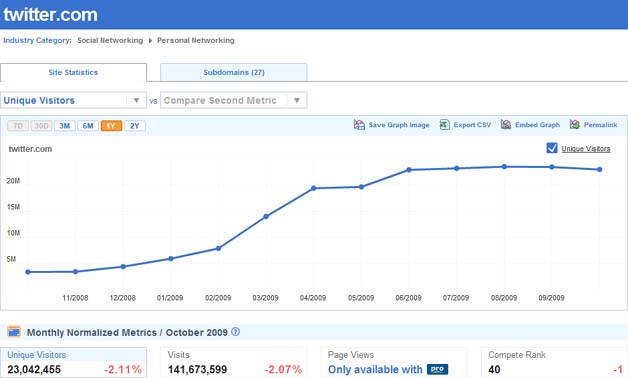
According to the latest stats from Compete, Twitter didn’t fare too well in October. In fact, rather than pull in more unique visitors compared to the previous month, Twitter may have lost some and turned a one-time anomaly into a two-time streak.
As the below graph shows, Twitter’s growth rate slowed quite a bit starting in June. Compete then recorded that its unique visitor count peaked in August. September didn’t play out at all in the site’s favor, and in October, both visits and unique visitors dropped by about 2.1 percent.
This left Twitter only slight ahead of where it stood in June.
Meanwhile, Compete stats show that Facebook saw a month-to-month surge of 3.50 percent in terms of unique visitors. LinkedIn saw a bump of 3.29 percent, too. Even MySpace, which suffered a hit, only experienced a small drop of 0.65 percent. So Twitter seems to be on its own here.
Nonetheless, after writing up a similar report from Hitwise late last month, a quote from Evan Williams seemed appropriate, and it may fit here, too. Williams told Adam Lashinsky, "It’s grown a little bit slower lately, but we have some things in the works that we think will change that."
Almost buried in a deluge of shovelware and games with “Imagine” in the title, Cing’s Hotel Dusk: Room 215 was a surprisingly well-written and well-ex…
Boxee, the freeware multimedia management software based on the XBMC framework will soon be getting its own set top box.
Boxee’s Avner Ronen today announced that the startup has signed its first partnership with a consumer electronics hardware company, and that the mockups of the upcoming set-top box will be shown off on December 7.
“This will be the first connected device running Boxee, but the idea is to provide consumers with a way to get Boxee in their living rooms, no matter whether it’s on a Connected TV, game console, set-top box, BluRay player, computer, etc,” Ronen said today. “Our goal is to be on every Connected device in the living room.”
Last week, we saw the first shots of the upcoming Myka ION “nettop box,” which is already running both Boxee and XBMC. We’ve sent out inquiries to find out if the two products are related in any way.
Conflict might have been the 20th century norm, but collaboration is the nature of
21st century relationships between the National Guard and other components of the
armed forces, the chief of the National Guard Bureau said here
Monday…
In February 2009, Secretary of the Air Force Michael Donley said, ‘I am proud to
report that the total force team of regular, Reserve, Guard and civilians, along
with our joint partners, continues to provide world-class air, space and cyber
capabilities for our combatant commanders.’…
As the nation honors its past and present servicemembers on this Veterans Day,
many who have worn the uniform of their country will reflect on their service’s
creed and what it means to them…
California Air National Guardsmen based here successfully demonstrated coalition
personnel recovery operations using net enabled data link capabilities for the
first time ever during the U.S. Joint Forces Command exercise, Bold Quest 2009,
held Oct. 27 to Nov. 5…
Facebook for the iPhone is one of my most used applications, and I’m not alone as it’s amongst the most popular iPhone applications ever. This success is due to the size of Facebook itself, that the application is free, and that it is very well done. That last is due mainly to Joe Hewitt, who has been the main developer for Facebook’s iPhone application. Unfortunately that’s about to change, as Hewitt tweeted that he is moving “…onto a new project.”
At face value this may not be of any importance beyond a certain sadness to see a great developer leave a platform and an application so many love. In a conversation with TechCrunch, however, Hewitt made clear that the principal reason behind his departure from this project is his unhappiness with Apple’s management of the iPhone app store. Hewitt specifically mentions his philosophical opposition to the review process, indicating that it puts an unnecessary middleman between developers and users. He also fears that it sets a dangerous precedent for other platforms. Hewitt will be moving onto a web project at Facebook, which offers the opportunity to work on an open platform.
Hewitt is not the first developer to abandon the iPhone due to Apple’s perceived mismanagement of the app store, but he may be the highest profile. His departure from iPhone development highlights a critical danger that Apple faces with the app store. For a variety of reasons, ranging from an inability to get your application noticed, the danger of having your application rejected for unforeseen reasons and the very low prices charged on the app store, many developers are growing disillusioned with the iPhone as a platform.
If this trend reaches a critical level it could deal a blow to the iPhone, which has touted the wide variety of high quality applications in its marketing. Even more dangerous is the possibility that developers will move in large numbers to other platforms, with Android being the most likely option. Of course Android has its own problems related to app development, and there are still plenty of developers who are focusing on the iPhone as their principal mobile platform.
It may be, however, that Apple is offering its competitors an opening to create a much more developer-friendly environment and steal one of its key advantages: the quality, not the quantity, of applications available. If Android, BlackBerry or Symbian can attract top developers to produce 1,000 high quality applications for its platform, that will probably be enough to erase the huge lead Apple has today. Who cares if you can’t choose between 500 tip calculators, or 30 different versions of the same public domain book as long as you can get high quality versions of the apps you actually want?
It’s clear that Apple realizes there are problems with the way it is currently managing the app store. The question is whether it can make the necessary adjustments to attract and keep the best developers for the iPhone, or if the Joe Hewitt’s of the world decide it’s just not worth their time.
Earlier this week, we reported that the first iPhone worm had been created. It was called “ikee,” and all it did was change the default wallpaper on devices to an image of Rick Astley with “ikee is never going to give you up” printed across the top. It was relatively harmless, if annoying, and the hacker responsible claimed that it was more of a warning than anything else.
Hopefully many heeded that warning, since now a new virus has surfaced that uses the same M.O. as ikee, but that has a much more malicious intent and effect. Specifically, the new malware mines personal data from your device, using the very same exploit ikee revealed earlier in the week.
The new worm, dubbed “iPhone/Privacy.A” by digital security firm Intego, affects only jailbroken iPhones, and grabs things from your device like address book contacts, text messages, photos, music, video, calendar entries and email messages. Basically, almost anywhere it can look for sensitive data, it will. The virus doesn’t seem to be able to access information stored by other applications on your iPhone, like password managers, but if you’re affected, the only safe course of action is a full wipe and restore.
Theoretically, according to iPhone security researcher Charlie Miller speaking to Computerworld, attacks based on the same exploit could do more than just mine data. Running up your phone bill, sending out bulk text messages and spamming your contacts are all well within the realm of possibility. Miller goes on to describe how easy it would be for a hacker to infect a device:
This could easily be installed on a computer on display in a retail store, which could then scan all iPhones that pass within the reach of its network. Or a hacker could sit in an Internet café and let his computer scan all iPhones that come within the range of the Wi-Fi network in search of data.
In order to secure your device against this kind of attack, there are a few options. First, change the default SSH password if you haven’t already. So far, that appears to be the easiest way to foil attempts to infiltrate your jailbroken device. The best way to prevent this and any kind of future attack along the same lines, however, is to not jailbreak your device in the first place, or to restore it to factory settings if you’ve already jailbroken. Of course, for many who use their devices with carriers who don’t officially offer the iPhone, that isn’t an option.
Miller suggested that Apple may want to consider re-engineering its security measures to account for jailbroken devices, but as that would mean tacitly acknowledging and even accepting a practice it stridently disapproves of, I think the best bet for jailbreakers is just to shut down all SSH access, if possible.
The race to bring the flexibility and variety of online video delivery to the comfort of your couch was taken to a whole new level in 2009 — soon, the content you want to watch will be accessible wherever and whenever you want. With that in mind, the theme of our third annual NewTeeVee Live event is TV Everywhere. Join us today here at the Mission Bay Conference Center in San Francisco as we talk to some of the industry’s key players to learn about the future of this increasingly exciting industry. Our livestream — which includes a chat feature — will start at 9 am PT, and we will be live-blogging the onstage sessions throughout the day. You can watch it on your iPhone as well. The Twitter hashtag is #ntvl. Enjoy!
Qualcomm has just released a new chip family focused on smartphones, including one that breaks the gigahertz barrier. The chips’ capabilities make clear that the line between phones and low-end notebooks are blurring. They’re based on the Scorpion CPU that is at the heart of Snapdragon chipsets and uses an 800 MHz to 1 GHz custom ARM-based CPU.
This new chip family, the horribly named MSM7×30, can do 720p HD video (encode/decode), 2-D and 3-D graphics, and has surround sound, integrated GPS and a 12-Megapixel camera as well as all the usual trimmings like Bluetooth and Wi-fi and FM Radio 3G (both flavors). On the multimedia front, Qualcomm is playing catch-up Texas Instruments and Nvidia. The new chips work with all smartphone operating systems except Apple’s iPhone OS. They will be launched sometime next year and are optimized for the web experience.
Fox News held a fair and balanced debate over Modern Warfare 2, the popular new FPS that lets you play a CIA operative tasked with helping Russian agents clear terrorists out of an airport. In the game, it turns out that the Russian had turned on you and forced you to kill innocents in the airport. It’s a depiction of USA-funded terrorism. It is not a murder simulator.
The debate here, if it can be called that, seems to rotate around the correlation between video game violence and real violence. The old man in this debate mentioned an American Association of Pediatrics statement. Here it is:
VIOLENT VIDEO GAME CONTENT MORE ATTRACTIVE TO YOUTH
Restrictive age and violent-content labels increased the attractiveness of video games for boys and girls of all age groups, according to a new study. In “Age and Violent-Content Labels Make Video Games Forbidden Fruits for Youth,” researchers tested 310 Dutch children in three groups: 7 to 8, 12 to 13 and 16 to 17 years of age. Participants read fictitious video game descriptions and rated how much or how little they wanted to play each game. An important finding for parents, pediatricians and policy-makers is that age and violent-content labels do not prevent young children from playing games with objectionable content. In fact, they have the opposite effect. Study authors suggest that video games should not be forbidden in Europe or the United States because that will only make the games more attractive, and parents should help in selecting appropriate games for their children to play.
This amazing bit of news – kids like stuff they can’t have – is an obvious by-product of our neophilic instincts and does very little to correlate events like the shooting at Fort Hood and 9/11 to violent video games.
Violence stems from a lack of human interaction in a nurturing and mental health context. To ascribe any sort of behavior to media is a cop out for the pundits and for the aggressor. That said, I would recommend children not watch Fox News because it encourages damn fools to come to presidential speeches wearing guns, but that’s neither here nor there.
Sadly, Jon Cristensen at SlashGamer was too tongue-tied to respond to this criticism and it’s rarely the gamer that comes out ahead in these sorts of ambushes. The bottom line: violent games are not for young kids just as pornography, beer, cigarettes, handguns, lighters, spray paint, and knives are not for kids. There is a time and a context for each of those things and to rail against them shows a lack of judgment and clarity.
Clearly this is either an old patent or a Macguffin because whatever this thing is it’s not the iPad. Basically you’ve got some sort of tablet app for recognizing pen input in phrases instead of in “chunks.”
Intel and AMD today settled all of their various patent and antitrust disputes, with the top chipmaker paying out $1.25 billion to settle more than two decades of litigation. The two companies will also cross-license their technology over the next five years. The move helps Intel far more than AMD, as Intel is likely to retain its dominant position in the chip market. But Intel will continue to face government antitrust investigations over its pricing practices, and there’s still an intellectual property suit with Nvidia to deal with.
However, Intel can’t really afford to let AMD die because it then becomes a monopoly, and governments love to interfere with monopolies. So in a sense, Intel is propping AMD up only to knock it down again in the competitive market.
Apple apparently isn’t exclusively devoted to the idea of finger-based multi-touch input on all its devices, a recent patent applications shows. The patent application, found by Apple Insider, describes the use of a pen-like stylus to operate an “ink information” input system, and references tablet computing applications for the new tech by name.
“Ink information” refers to handwriting technology, specifically. The patent describes that previous attempts in this field, including in Apple’s own Newton device, have been insufficient to the task in the past. It suggests that the addition of an “ink manager,” a kind of go-between interpretive process, might reduce the occurrence of mistaken or misplaced ink detection.
Here’s the exact wording of Apple’s description of both the problem of ink detection and its proposed solution:
Even systems that attempt to improve this situation by using each stroke to determine the input field anew, such as the Apple Newton from Apple Computer Inc. of Cupertino, Calif., can suffer from failure modes that make the situation difficult for both end users and for application developers. For example, a word that accidentally spans two input fields even a tiny amount (due, for instance, to a stray ascender, descender, crossbar, or dot) may be broken up into multiple sessions, causing misrecognition and invalid data entries that must be manually corrected.
The ink manager interfaces between a pen-based input device, one or more applications (pen-aware or not) and one or more handwriting recognition engines executing on the computer system. The ink manager acquires ink information, such as ink strokes, entered at the pen-based input device, and organizes that information into ink phrases.
Along with the patent description, Apple included an image of the proposed system in the application. The graphic is very reminiscent of prototypes and concepts of the as-yet unannounced tablet computer that has the Apple community bubbling over with excitement. Note the bar at the bottom, which resembles the dock on the home screen of the iPhone. I’d also like to point out that the device looks a lot like a reader, given the scroll buttons at the bottom. Maybe Apple is planning to change the game by making sure its reader doubles as a writer, too.
Ideally, the digital ink and stylus input tech described in the patent would operate alongside touch input. This application will no doubt bring a lot of hope for digital artists hoping to work with the device, for whom pen input is infinitely preferable to touch control. Hopefully, we won’t have to wait long to find out if a pen system makes it into a production device, since the tablet is rumored to be unveiled in the first quarter of 2010.
It’s no secret that institutions of all stripes focus their communications on certain messages day to day. We thought it would all be a little more open and transparent if we went ahead and published what our focus will be for the day, along with any related articles, documents, or reports.
Talking Points: Business Roundtable Hewitt Report "Health Care Reform: Creating a Sustainable Market"
The BRT report confirms that the status quo is unsustainable. The BRT report finds that without health reform, costs will continue to rise at the same trend they have for the last ten years. The report concludes that without reform, by 2019, employment-based spending on health care for large employers will be 166% higher than today on a per-employee basis.
The BRT report confirms that Congress is moving in the right direction on both fiscal responsibility and cost containment. The BRT-Hewitt report finds that many of the delivery system reform policies that are currently in health reform legislation will make important contributions to cost reduction, when implemented effectively. As the report explains, "[a] number of the proposed reforms offer real promise, not only to save federal dollars, but also to reduce the rate of increase in private sector spending if adopted and implemented appropriately."
These policies include: value-based purchasing, a new CMS Innovation Center, "accountable care organizations" and reducing preventable hospital re-admissions. The BRT report also notes that with additional steps such as administrative simplification, electronic medical records, and increased information transparency for better decision-making, even more savings could be reached. Some of these additional policies were included in ARRA and many others are included in health reform legislation currently pending in Congress.
With health reform, as much as $3,000 could be saved by 2019. The BRT-Hewitt study finds that with many of the legislative reforms currently in the health reform bills, costs could be reduced by as much as $3,000 per employee.
Palm’s bet on webOS isn’t paying many dividends, according to a research note issued by Northeast Securities analyst Ashok Kumar this morning. Domestic sell-through checks point to a “substantial decline” in recent sales of the Pre, Kumar said, and slashing the price to $99 hasn’t helped much. Nor is the upcoming launch of the Pixi likely to reverse the trend.
Those slowing sales are whittling away at the prospects for webOS, which Palm had positioned as a worthy competitor to the iPhone, Android and BlackBerry platforms. From the note:
“As a fading brand, carriers are likely to see better returns on their promotional and advertising dollars with other vendors…WebOS has negligible smartphone OS share, 0.2 percent per Gartner estimates, and is unlikely to attract any meaningful third-party application support. Palm has bet the farm on webOS and there is a real possibility that they may not achieve critical mass.”
It works out to 4.7 million units sold across the two countries. These are Activison’s own numbers, by the way, not some wacky Wall Street analyst or anything like that. (Official worldwide numbers aren’t available yet.)
That said, an anylsyt for the Cowen Group said that he expects to see the final worldwide number to clock in at around 7 million.
That really is ridiculous when you think about it: 7 million copies (maybe) of that game sold within 24 hours. That’s just under 300,000 copies sold per hour.
In other words, it’s a good time to be an Activision stockholder right now.



 Earlier this week,


 The race to bring the flexibility and variety of online video delivery to the comfort of your couch was taken to a whole new level in 2009 — soon, the content you want to watch will be accessible wherever and whenever you want. With that in mind, the theme of our

 Clearly this is either an old patent or a Macguffin because whatever this thing is it’s not the iPad. Basically you’ve got some sort of tablet app for recognizing pen input in phrases instead of in “chunks.”

 Apple apparently isn’t exclusively devoted to the idea of finger-based multi-touch input on all its devices, a recent patent applications shows. The patent application, found by


 Palm’s bet on webOS isn’t paying many dividends, according to a research note issued by Northeast Securities analyst Ashok Kumar this morning. Domestic sell-through checks point to a “substantial decline” in recent sales of the Pre, Kumar said, and
