Category: News

  • AMD 890GX con 80 shaders processors

    amd-chipset

    Como es sabido, AMD tiene siempre muy buenas soluciones en lo que a gráficos integrados se refiere, y esta vez el 890GX no es la excepción.

    El Chipset 890GX viene a remplazar a los exitosos 785G y 790GX que integraban la 4200 y 3300, duplicando los shaders processors de 40 a 80, colocándose al nivel de las 4300 y 4500.

    Tendrá soporte DirectX 10.1 con una frecuencia de 700mhz al igual que los anteriores. En cuanto a reproducción de video, incorporaría UVD2 y su TDP seguiría en 22W al igual que los anteriores chipsets, lo que hace pensar que reducirán el proceso de fabricación unos nanómetros.

    Esperamos con ansias la llegadas de estos chips que sin duda se colocaran como referencia a la hora de armar una buena plataforma para los usuarios no muy exigentes.

    Fuente | fudzilla, vía N3d

  • Safari 4.0.4 Update Released

    SafariSafari version 4.0.4 is now available, the 30MB update promising improvements to “performance, stability, and security.”

    Regarding security, the update addresses several potential “maliciously crafted” attacks–are there such things as benevolently crafted attacks? One uses a color profile, which is inventive, if evil. Others use XML, shortcut menus, or the user’s desire to visit web pages or FTP sites of questionable virtue.

    Sadly, as the Mac gains greater popularity, the mantra of “security through obscurity” becomes less and less reassuring. This is one area where Microsoft Windows and Internet Explorer may end up having an actual advantage over OS X and Safari, Windows having been forced to exist in a state of siege for so long.

    As for improvements to stability and performance, it’s not just the usual boilerplate text included with the update this time. Besides supposed stability improvements for third-party plug-ins, the search field, and Yahoo! Mail, Safari 4.0.4  has “improved full history search performance for users with a large number of history items.” I’m one of those users, and I would cringe when going to “Show All History” and using the realtime search box. The first few letters would stall Safari every time, not so much now.

    Safari 4.0.4 also improves JavaScript performance. Running the SunSpider JavaScript Benchmark, Safari 4.0.4 is 1.08 times as fast version 4.0.3 overall, with “significant” increases in many tests.

    Finally and most importantly, Safari 4.0.4 does not break ClickToFlash. Upgrade (and restart) away.


  • Google Makes Improvements to Movie Showtime Searches

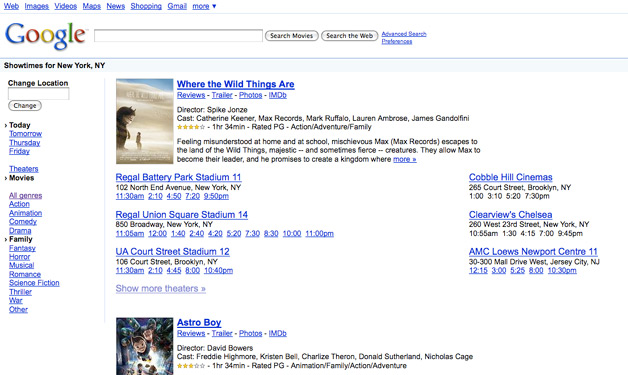
    Google has launched some new improvements to its movie showtimes search feature. These include more movie pages, genre filters, and a new map view.

    If you search for a movie and click the "more theaters" link in the showtimes listing, you will be taken to a more thorough page about that movie, including more showtimes, reviews, trailers, photos, etc. You can also see a list of new genre filters to search by on the left-hand side of the screen.

    Wild Things Are movie page

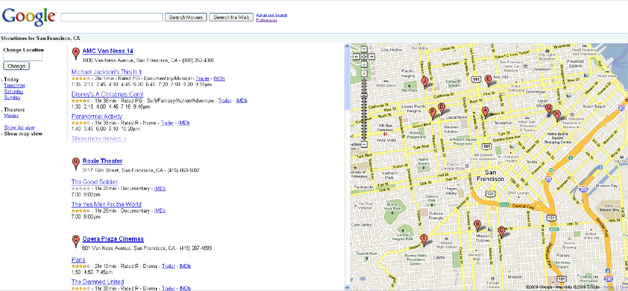
    If you go to google.com/movies, you can find a list of all the theaters and showtimes in your area. The map view feature lets you see nearby theaters playing specific films.

    Movies map View

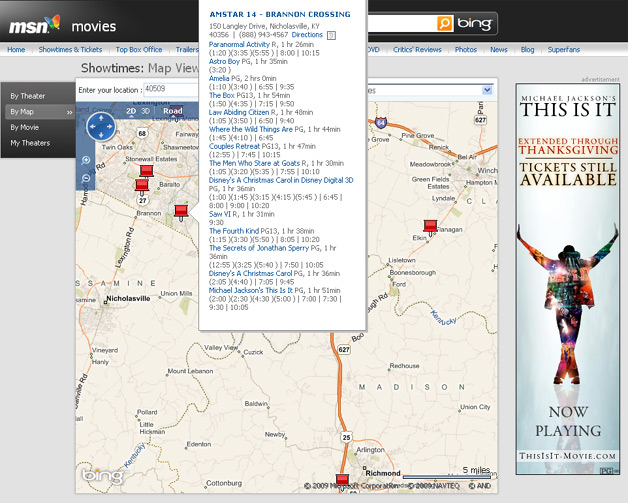
    It is worth noting that Microsoft’s Bing search engine already has very similar features when you search for movies on there. It utilizes MSN movies, and has movie pages with trailers, reviews, photos, etc. It also has a map view feature. Google appears to have it beat on the genre listings feature, however.

    Bing Movie map

    Do you use Google (or Bing) to find movie showtimes when you go out? Do you find the new features helpful? Comment here.

    Related Articles:

    > Bing Maps Gets an Upgrade

    > YouTube Scopes Out Concept Of Movie Rentals

    > Bing Gets a Bunch of New Search Features

  • Never-before-seen Final Fantasy XIII video airing at Home on November 13th

    It’s not the November 13 announcement we’ve been waiting for (and it’d be a big disappointment if it was), but it appears that’s not the only thing …

  • Breakthrough: AMD and Intel settle antitrust dispute, reach new cross-license agreement

    By Scott M. Fulton, III, Betanews

    Banner: Breaking News

    Intel has made a statement to Betanews this morning that it and Advanced Micro Devices are settling their long, outstanding legal disputes, including pending antitrust litigation in Delaware court, with Intel agreeing to pay AMD $1.25 billion.

    Intel will also agree to abide by a new set of business practices, which may be announced in a matter of minutes. It’s over.

    “While the relationship between the two companies has been difficult in the past, this agreement ends the legal disputes and enables the companies to focus all of our efforts on product innovation and development,” reads Intel’s statement this morning.

    Update ribbon (small)

    10:55 am EST November 12, 2009 · “The agreement to us signals a new era. It’s a pivot from war to peace,” announced AMD Executive Vice President for Legal Affairs Tom McCoy, in a statement that could entitle the opening of a new chapter in the x86 computing era.

    With poignant and historic language, AMD executives this afternoon announced the end of the intellectual property and business practices dispute with Intel that at one time, from a marketing perspective, defined AMD as a company. Intel’s executives’ statements remain forthcoming at this time. But AMD CEO Dirk Meyer explained today’s agreement has three categories:

    1. Intel will agree to new ground rules for corporate business practices.

    2. A new, five-year patent cross-license agreement between AMD and Intel will give both companies broad access to each other’s technologies.

    3. GlobalFoundries, the manufacturing arm of AMD that was spun off as a subsidiary, may now be completely separated from AMD and operate independently. Under the previous cross-license agreement with Intel, GF had to operate as an AMD subsidiary in order for AMD to share Intel intellectual property with it — the old agreement prohibited AMD sharing Intel trade secrets with another company. The new agreement permits such sharing specifically with GF.

    However, we learned this morning, not all business practices to which AMD and certain other governments had been objecting, will be covered by Category 1 of the agreement. Specifically, from AMD’s point of view, it appears only Intel conduct with regard to limiting end users’ choices between AMD and Intel technology, will be curbed. But business practices such as volume rebates to OEMs may (perhaps) be allowed, so long as they are not exclusionary — specifically, as long as they are not structured in such a way that OEMs promise not to purchase AMD parts, or to hold AMD purchases to specified caps.

    We’ll learn more from Intel’s point of view in a few minutes. In advance of Intel’s statement, that company has already released an update to its financial guidance, increasing its business expenditures to account for the one-time charge of $1.25 billion to be paid to AMD.

    Update ribbon (small)

    12:25 pm EST · Intel’s business conduct agreement, we learned from Intel this morning, will not extend to the practice of volume rebates with OEMs such as HP and Dell. Without acknowledging any wrongdoing — in fact, while continuing to defend its prior business practices with all OEMs, including Dell and HP — Intel executives today stated they now openly promise not to do in the future any of the exclusionary tactics which AMD accused it of doing, while saying it never did so anyway.

    Or maybe not. When directly asked by a Financial Times reporter this morning whether Intel’s take on the agreement means it’s not changing anything with regard to its business conduct, Intel Chief Administrative Officer Andy Bryant heaved a great, audible sigh, and responded emphatically, “No changes at all. Again, I’m just gonna say the same thing over again, so bear with me: AMD believes we have conducted business in some fashion that they believe is inappropriate. We have said we don’t do what they actually accuse us of doing. We are confident that — in fact, it’s in the contract, we wrote down exactly what those provisions are, what we will and mostly what we won’t do, and then those can be monitored at any time.”

    Then after what sounded like a pause for Intel CEO Paul Otellini to pick up where he left off, suddenly Bryant decided he needed to correct a little something: “I don’t want to say there’s absolutely no change to what we’re doing. We have met with the EU, we have changed some business practices because of that. There are issues around pricing, which we think that the regulators may want to talk to us about — we’ll talk about those things. So I don’t want to say we’re not changing any of our business practices. The things that AMD was concerned about in the contract are things that we don’t do, and we readily agreed to not do, because we don’t.”

    The patent cross-license agreement reached today is a five-year extension of the existing agreement — an extension that had been threatened by Intel’s concern over AMD’s restructuring. Specifically, if GlobalFoundries were to split completely from AMD ownership to become independent, AMD’s sharing of x86 technology necessary for GF to produce chips would violate the previous licensing agreement.

    That’s important, because GF plans to do business with other companies; and GF’s other current co-owner — Abu Dhabi government-run investment firm ATIC — reached an agreement last month to acquire Chartered Semiconductor. That makes GF, which was once just a manufacturing company, into a full-scale CPU innovator and manufacturer on the order of what AMD was in 2007. Chartered doesn’t exactly expect its IP to be shared with Intel; and Intel would not want the reverse.

    But borrowing the term “peace” from his AMD counterpart this morning, Intel’s Andy Bryant told reporters that Intel was usually at peace with foundries, so striking an independent deal with GF wasn’t too much of a problem. Intel isn’t worried about losing its x86 IP, and is trusting GF just like it previously trusted AMD. This enables AMD to complete the last part of its restructuring: separating GF completely as an AMD subsidiary, into a firm that is majority-owned by ATIC, and minority-owned by AMD. That resolution also officially took place this morning.

    Both Intel and AMD are expected to file paperwork with the Securities and Exchange Commission today, either or both versions of which should detail the complete agreement between the two companies. Betanews will continue reporting on today’s breakthrough as we learn more.

    Copyright Betanews, Inc. 2009


    Add to digg
    Add to Google
    Add to Slashdot
    Add to Twitter
    Add to del.icio.us
    Add to Facebook
    Add to Technorati


  • Microsoft damage control after marketer claims Win7 inspired by Mac

    By Scott M. Fulton, III, Betanews

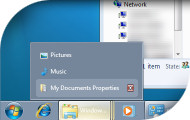
    Windows 7 taskbar top story badgeIt’s not like this sort of thing has never happened to someone at Microsoft before: a moment of clarity and candidness which may actually be close to, if not exactly, the truth, but which is nevertheless “off message.” During a recent reseller’s conference, a Microsoft marketing manager named Simon Aldous representing the Worldwide Partner Group gave credit to Apple for creating an operating system that folks in a Microsoft study appreciated. But then, according to PCR Online, a publication for computer and software resellers, Aldous went one step further and said Microsoft took that inspiration and, then with Windows 7, “create a Mac look and feel in terms of graphics.”

    It was exactly the phraseology that blogs throughout the Internet were looking for, and Aldous’ comment became the latest water cooler conversation topic…even though the publication was incorrect in one very important respect: Aldous was not a “Microsoft exec,” and therefore was not speaking on behalf of the company. The fact that the publication got Aldous’ position wrong created suspicion in at least one person residing on planet Earth that perhaps it had gotten the quote wrong as well. Nonetheless, the headline “Windows 7 was inspired by Apple OS” rocketed throughout the Web.

    The entire incident might have ended there, except for the fact that one of Microsoft’s chief online evangelists, Brandon LeBlanc, publicly excoriated Aldous for having made the comment…rather than cast doubt on its authenticity.
    “Unfortunately this came from a Microsoft employee who was not involved in any aspect of designing Windows 7,” LeBlanc wrote this morning. “I hate to say this about one of our own, but his comments were inaccurate and uninformed.”

    There is indeed one element of Windows 7 whose differences from Vista were probably inspired by Mac OS: the revised taskbar. When it was unveiled last year at PDC, Microsoft representatives were extremely careful not to characterize it as Mac-inspired. Staying on-message at the time, Microsoft design manager Samuel Moreau coined the term “delighter” to refer to visual elements derived from extensive examination of test results obtained from the opinions of people using Vista while being videotaped. The new taskbar was designed to be a staging area, he said, for several of these delighters.

    But neither Moreau nor anyone at Microsoft at that time steered completely clear of the other “M” word, acknowledging the design impetus of Mac OS even when folks in the audience asked questions to the effect of, “You realize this is more like the Mac Dock, right?” No one said, however, that the taskbar had a “Mac look and feel.”

    Copyright Betanews, Inc. 2009


    Add to digg
    Add to Google
    Add to Slashdot
    Add to Twitter
    Add to del.icio.us
    Add to Facebook
    Add to Technorati


  • Congressional Democrats Seek To Maintain Health Overhaul Momentum

    The Senate could begin debate next week on a health care reform bill while House Democratic leadership is telling members to prepare to work deep into December.

    CQ Politics reports that House Majority Leader Steny Hoyer “said he hopes the Senate will pass a health care overhaul bill and send the measure to a House-Senate conference committee in time to allow a final vote in both chambers this year.”  He has “told members that votes are possible the week of Christmas, on Monday, Dec. 21 and Tuesday, Dec. 22” (11/11).

    Meanwhile, Democrats in the Senate are trying to maintain momentum by putting the overhaul bill on the Senate calendar, The Hill reports. “Such a schedule is intended to show the bill is moving forward — avoiding a repeat of the August recess, when the health care reform movement stalled amid boisterous town hall forums.” But, with the Thanksgiving and Christmas holidays approaching, keeping the timeline could prove a large task for the Senate especially. “Once the (Congressional Budget Office) releases its cost analysis of (Majority Leader Harry) Reid’s bill within a few days, for example, the Nevada Democrat plans to file the first procedural motion to bring the Senate bill to the floor next week” (Rushing, 11/12).

    Fox News reports that Reid still has a hill to climb to get even Democrats to agree to begin debate on the bill. Three “Democrats — Sens. Ben Nelson of Nebraska, Blanche Lincoln of Arkansas and Mary Landrieu of Louisiana — and independent Sen. Joe Lieberman of Connecticut have told Reid they want the legislative text of the bill and a final CBO score available online for 72 hours before beginning a debate” (11/11).

    Time reports that when debate starts “Reid will have little margin for error along the way. Between those two votes (one to begin debate on the bill and one to pass the bill) will be weeks of deliberations over scores of amendments, many of which will be designed more to produce 30-second attack ads than to influence the actual shape of the legislation” (Tumulty, 11/11).

    And The Wall Street Journal reports on political strategies that will be implemented during a short break to mark Veterans Day. Conservative groups “are using the recess — one week for the House and three days for the Senate — to press lawmakers to vote no on the health-care overhaul plans.” Democrats are also trying to be as proactive with their message after “getting caught flat-footed this summer when groups opposing the plans packed town-hall meetings” (Bendavid and Radnofsky, 11/12). 

    USA Today reports that Republicans are using the votes of one Democrat in the House to make the case that liberals who voted for the House’s health care bill will lose their seats in the midterm elections next year. “One prime target: Rep. Tom Perriello, a first-term Democrat who represents Virginia’s 5th District, a cluster of small communities and farms centered around the university town of Charlottesville.” A Republican spokesman for the National Republican Congressional Committee said right after Perriello’s vote on health care reform that “‘It’s not often that a member of Congress manages to lose his re-election one year in advance, but that’s what Tom Perriello did tonight’” (Raasch, 11/11).

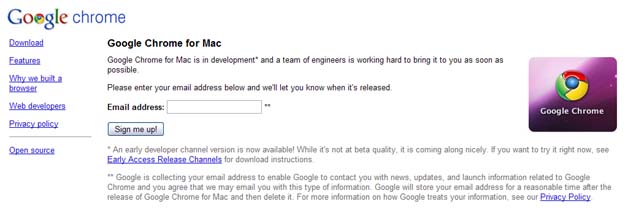
  • Google Chrome For Mac May Hit Beta In December

    Mac users who’ve been feeling left out since the introduction of Google Chrome (which occurred way back in September of 2008) may finally be set to receive a sort of nod of inclusion.  A Mountain View-based product manager has indicated that a beta version of Chrome for Mac will launch in December.

    Nick Baum wrote yesterday in a Google Groups post, "The extensions team has been working hard to get BrowserActions ready, and they’re already working great on Windows and Linux.  We’ve noticed that many of you have updated your extensions to take advantage of the new UI.  We’d like to encourage the rest of you to do so as well!"

    Then Baum got to the Mac-related heart of the matter, continuing, "Why make the switch now?  The earlier you switch, the more time you will have to polish your experience for our Beta launch in early December.  We realize this means dropping Mac support for a couple of weeks, but we already have people working on that.  If you prioritize the Windows and Linux versions, we’ll bring you cross-platform parity as soon as we can!"

    And since it took Google about three months to remove the beta tag from the first version of Chrome, that may mean that a finalized Chrome for Mac will available before February.

    This isn’t a firm timeline, of course, but it at least looks almost certain that Google is going to ramp up its efforts.  Hat tip goes to Stephen Shankland.

    Related Articles:

    > New Google Chrome Release Includes Bookmark Sync

    > Google Releases Latest Version Of Chrome

    > Google Celebrates A Year Of Chrome

  • News Flash: Psystar is not a faceless corporation, it’s two dudes in Miami

    4089760.47
    For some reason I always imagined Psystar differently. The company has been making Hackintoshes – against Apple’s wishes – for nigh on a year and their various lawsuits and machinations have given lazy Hackintoshers everywhere the opportunity to buy OS X hardware for a fraction of the cost of a new Mac and, more recently, the ability to Hackintosh almost anything.

    Well, it turns out this hive of industry is actually just two dudes, Robert Pedraza and his brother Rudy. Yes, the company that has been making Apple cry for the past year consists of the kids you knew down the street who were really good at computers.

    The Miami New Times did a great piece on the pair proving that local media is still the best way to tell a story. The brothers, it seems, spend hundreds of thousands of dollars on legal fees and dealt with what the New Times calls:

    mega-abuse from hostile Mac bloggers who have called them hucksters, frauds, and credit card thieves. As a kind of threat, street-level photos of their homes were posted on some blogs.

    Now, interestingly, this sort of grassroots vigilantism – and this article – is a sort of cleansing agent for Psystar. Whereas before we were convinced that Psystar was a shady Asian cabal intent on tearing down the fabrics of our freedom now we know that the company is a couple of dudes.

    Their wild-eyed hubris is charming in this era of snark. For example, they’re willing to take on Apple until their dying breath and Rudy exclaims: “We’re all in, baby. Go big or get the hell out.” That’s right: Ayn Rand via Swingers.

    The rest of the story is a bit sadder and fits the standard arc of the relentless businessman. They were hard workers and helped their dad run his boat-maintenance business. Robert took apart a remote control, a common trope in this sort of story, and then their dad was arrested for coke dealing. Then you’ve got the early precociousness:

    Odio remembers Rudy hanging out with a group of smart kids, doing well in class, and even volunteering to design Coral Park’s website for free. He also worked long hours after school designing computer systems for businesses around Miami. Rudy declines to name them, but Odio confirms he pulled in serious cash even as a 16-year-old. “He was making tons of money in high school as a computer consultant, probably more than I do today,” she says, laughing.

    While I’m sure Psystar’s battle won’t end well, it’s nice to see a little humanity behind Pystar’s Sherman-esque tactics. These guys just wanted to make computers and someone stopped them because they wanted to do something differently. No matter how convoluted a web they weave, there’s something to be said for that kind of bluster.


  • Senators Won’t Grow Deficit Without A Cost-Cutting Commission

    Congress may outsource its tough budgetary decisions, if moderate, deficit-anxious lawmakers get their way. “Several U.S. senators said on Tuesday they probably could force Congress to cede some control to a bipartisan commission that would tackle the United States’ looming budget crisis,” Reuters reports.

    A group of 15 Democratic senators say they will not vote for deficit-boosting legislation unless the commission is created. The commission would come up with budget-control plans that Congress would have to approve, and could give lawmakers some political cover. The country faced record deficits in 2009 because of the recession, and “(b)udget experts project that deficits will remain stubbornly high over the next 10 years even as the economy improves, due to ballooning spending on retirement and healthcare programs” (Sullivan, 11/10).

    “Among (the commission’s) chief responsibilities would be closing the gap between tax revenue coming in and the larger cost of paying for Social Security, Medicare and Medicaid benefits,” The Hill reports. House Speaker Nancy Pelosi, D-Calif., is meanwhile pushing on the other side of the Capitol to raise the debt ceiling. “If the debt ceiling is not raised above its current $12.1 trillion mark by (next month), the government will exceed its borrowing limits and will be forced to default on the debt” (Allen and Alarkon, 11/10).

    (Related KHN story: On Hill, Bipartisan Support Emerging For Commission To Control Costs, Pianin, 11/11).

  • Will The Health Bill Bend Costs?

    One cause for health reform anxiety is that no one is sure whether the legislation would achieve one of its most critical goals: lowering health care costs. Politico reports: “For all the ink spilled on the effects of health care reform, no independent group has taken a comprehensive look at how the legislation would impact premiums for the 170 million Americans who receive insurance through their employers – a population that would receive little direct financial assistance under the various congressional proposals.”

    The dearth of reliable data has led Senator Evan Bayh, D-Ind., to ask the Congressional Budget Office for a report on the bill’s impact on employer-sponsored insurance premiums. If it comes with bad news for Democrats, it could lead to last-minute changes to the bill. Many economists are skeptical. Jonathan Gruber, of MIT, who Politico calls “the favorite economist of the White House,” said the legislation “really doesn’t bend the cost curve,” though it takes steps in that direction (Brown, 11/11).

    One step towards cost-bending “does not figure in current U.S. healthcare reform legislation,” Reuters reports. “One of the best ways to control U.S. healthcare spending is to pay doctors, hospitals and other health providers a single set fee for treating all aspects of a surgical procedure or a chronic disease such as diabetes, researchers said on Wednesday.” The study – by Rand researchers, and published in the New England Journal of Medicine – found combining payment for care for six chronic diseases, such as heart disease, cancer and diabetes would mean “health care spending can be slowed substantially,” but would also run into opposition from providers (Beech, 11/11).

    Related KHN story: On Hill, Bipartisan Support Emerging For Commission To Control Health Costs

  • Abortion Rights Groups Unite In Fight Against Coverage Restrictions

    Politico reports that abortion-rights “advocates are calling in the cavalry to help fight off an anti-abortion provision House Democratic leaders swallowed in order to win passage of their health care reform bill.” Planned Parenthood on Tuesday brought 80 groups together to brainstorm about how to keep an abortion amendment out of a final health care reform bill. “If that doesn’t work, Plan B is to rely on progressives in the House to vote against a bill containing the language” (Allen, 11/11).

    A National Organization of Women official told ABC News that they were shocked by the amendment’s inclusion in the House bill. The official added that the group was “extremely disappointed” in House Speaker Nancy Pelosi for including it and that they will track a final vote on the measure to see who votes for it or against it (Klein, 11/11).

    The Hill reports that some abortion-rights groups are threatening to withhold money from lawmakers who voted for the House amendment. Democratic “Reps. Ciro Rodriguez (of Texas) and Harry Teague (of New Mexico) — stood out as members of Congress who received NARAL’s and Planned Parenthood’s money last cycle and proceeded to vote for the (Rep. Bart) Stupak Amendment on Saturday” (Blake, 11/12).

    The Associated Press reports that 90 abortion-rights supporting lawmakers are pressing to meet with President Obama next week on the provision in the House bill. “Leaders of the Congressional Pro-Choice Caucus have written to Obama calling the provisions an unprecedented restriction of women’s access to health insurance coverage for abortion services” (11/11).

    And on the Senate side, CQ Politics reports that Majority Leader Harry Reid “probably will not include restrictions stringent enough to satisfy abortion opponents” in the overhaul measure he brings to the Senate floor. Though it’s unclear if moderate Democrats will offer an abortion amendment, they expect a precursor of the Stupak Amendment — the Hyde Amendment that restricts federal dollars from being used to fund abortions — to be “replicated in the bill” (11/11).

    Finally, USA Today has a Q&A on abortion’s treatment in the House health care reform bill and answers what exactly it does and if the Senate bill will contain a similar provision. It also explains some of the history behind the ban (Hall, 11/12).

    (Related KHN story: How The House Abortion Restrictions Would Work, Appleby, 11/10)

  • Woot! Refurbished Gateway 11.6-inch netbook with AMD CPU for $280

    woot

    Woot.com has a pretty good deal on the refurbished 11.6-inch Gateway LT3103 for $280. This machine opts for an AMD processor over an Intel Atom, so you’ll get a little extra oomph while giving up a couple hours of battery life.

    Features:

    • AMD Athlon 64 L110 CPU at 1.2GHz
    • 11.6-inch LED-backlit screen at 1366×768
    • ATI Radeon X1270 graphics
    • Windows Vista Home Basic
    • 2GB DDR2 SDRAM
    • 250GB SATA hard drive
    • Six-cell battery (up to 5 hours), three USB ports, VGA out
    • Dimensions: 11.26” x 7.99” x 1.03” and 3.04 pounds

    Since this is a refurbished machine, you’ll unfortunately lose out on the free Vista to Windows 7 upgrade. There’s a 90-day Gateway warranty included.

    Gateway 11.6-inch Netbook [Woot.com]


  • Once Again, You Don’t Compete With Innovative New Services By Being Lame

    A couple years back we pointed out how the entertainment industry kept trying to “compete” with new (legal and not-so-legal) online services, but always seemed to do so by being incredibly lame. And, you don’t compete by being lame. It appears that this message still hasn’t quite gotten through to some yet. With the movie industry facing new challenges concerning online distribution and innovative services like Redbox, here are two stories of old school players trying to “compete” but missing out on the part where they make their offering compelling.

    The first comes from Josh in CharlotteNC, who points out that Blockbuster is trying to compete with Redbox and its widely available kiosks (and Netflix with its larger library of downloadable movies) by setting up kiosks in its stores where you can download movies. But… you can only download them to proprietary SD cards, and then it can only play on special proprietary hardware that participants in this program need to have. How is that a better experience then, well, anything? If you want a movie that can be downloaded, why not just let people download it at home? Why have people go out to download it?

    Then we have a story sent in by Loydster, about how Sony Pictures is offering owners of new Sony/Bravia HDTV’s the chance to download and watch the movie Cloudy With a Chance of Meatballs before the DVD release. While that is actually a nice tie-in between Sony’s content business and its consumer electronics business, Sony (of course) has to screw it up. That’s because the company thinks it can charge $25 to download the movie. The company seems to admit that it’s charging this much because it doesn’t want to piss off its retail partners (like WalMart), but it’s difficult to see why it’s worth doing the project at all if the pricing is going to be so ridiculous.

    Experimenting with ways to compete is good… but being so obviously lame is not.

    Permalink | Comments | Email This Story


  • The 5 best uses for the $229 Dell Zino HD

    dell-zino-hd

    Dell just went official with the Inspiron Zino HD price and spces. There have been a few unboxing and previews popping up around the blogs the last few days and I’ve fallen in love with the little computer. It’s slightly larger than the Mac Mini, but I believe infinitely more versatile.

    HTPC – It’s a given. The $229 Dell Zino HD would feel right at home on a A/V rack. The Athlon CPUs and optional ATI Radeon HD 4330 512MB GPU has more than enough juice to output 1080p to your HDTV. Check the box for the optional Blu-ray drive and TV tuner to create a bonafide HTPCIB – Home Theater PC In a Box, that is.

    WHS – There are about a dozen and a half already built Windows Home Server options available. HP makes the media-centric MediaSmart line, Acer has the Atom-packing easyStore, Lenovo has options and the list goes on. They are competent boxes, but none of them have the processing power that the AMD options offer in the Zino HD, which is somewhat important if you want to turn the server into a torrent downloading monster. Choose the integrated graphics but select at least 2GB of RAM along with the option 1TB hard drive. The 2 eSATA ports ensure that you’ll never run out of storage capacity too.

    Trendy office computer – It doesn’t take much to run Microsoft Office apps anymore. Why live with a boring gray tower these days when the playful Zino HD can get the job done too? Even the base model should be fine for most office tasks.

    In-car computer – The Mac Mini might score you nerd points with the geeks posing in the car tuning crowd, but there are a lot of PC-only in-car apps, which makes the Zino HD a perfect solution. It has a small footprint and more than enough power to run GPS and music software. But most importantly is that the computer comes in enough color options that you should be able to find one to match your ride.

    Old folks computer – What do old people do on a computer these days? Play on Facebook? That’s about it and the Zino HD, along with countless other options, has more than enough power to be a reliable computer for them. The Athlon cores should be able to handle at least five Internet Explorer toolbars and several spyware programs posing as card games. Try that with an Atom CPU.

    The Zino HD product page is currently up, but you can’t customize or order one yet. That will probably change sometime today.

    Press release,

    ROUND ROCK, Texas, Nov. 12, 2009 – Dell today introduced the mini-sized Inspiron Zino HD, which is versatile enough to handle tasks from basic computing chores to driving a big-screen, High-Definition TV media center. With a choice of colors, the Inspiron Zino HD can be easily personalized to add flare to any room in the home.

    The News:

    Starting at $229, the Inspiron Zino HD includes standard HD-capable integrated graphics, HDMI output and built-in networking that make it smart for typical home and student computing activities such as word processing, e-mail, organizing photos and music, and surfing the Internet.

    The economical Inspiron Zino HD with optional additional memory, hard drive storage, combo Blu-ray disc player, HDTV tuner, wireless remote control and Windows 7 Media Player and turns into a powerful home media center computer. In that capacity the Inspiron Zino HD can record and play your favorite TV shows, display high-definition content from the Internet, and store and deliver music, video and photos very well.

    The Inspiron Zino HD is also ideal as an additional household PC that can fit in tight spaces and make home networking a cinch. It measures about 7.75 inches square and 3.5 inches tall. While small in size, the Inspiron Zino HD is a big performer with:

    • Ultra-small form factor designed to fit almost anywhere.
    • Easy personalization with nine color choices for Inspiron Zino HD.
    • Choice of AMD processors or dual core Athlon Neo X2 6850e.
    • Up to 8GB dual channel DDR 2 memory.
    • Up to 1TB internal hard disk storage.
    • Combo DVD/CD RW drive with optional Blu-ray Disc combo.
    • Integrated 10/100/1000 networking with wireless option.
    • Optional TV tuner, wireless keyboard and mouse.
    • Built in 2.1 high-definition audio and 4-in-one media card reader.
    • Integrated ATI graphics adapter with standard HDMI and VGA video connections, and optional 512MB discrete graphics adapter.
    • Four USB ports (2 front/2 rear); two eSATA ports (rear).
    • Energy-Star 5.0 compliant.

    A basic Inspiron Zino without High-Definition capability or upgrade options will be offered in some regions.


  • Humana CEO: No Regrets About Sending Warning Letters To Medicare Beneficiaries

    Humana’s CEO says he does not regret sending Medicare customers a letter warning that health care reform could hurt their benefits. The letters caused government officials to probe whether the insurer violated federal regulations in September. Reuters reports: “Humana Chief Executive Mike McCallister, speaking at the Reuters Health Summit in New York, said it was important to inform seniors about proposals that could affect Medicare and he had “no regrets” about sending the letter. Humana’s letter “told customers that bills from congressional Democrats could hurt ‘millions of seniors and disabled individuals (who) could lose many of the important benefits and services that make Medicare Advantage health plans so valuable,’ CMS said in a letter to Humana informing the company of the probe. … Lawmakers are weighing cuts to government Medicare Advantage payments to companies as part of an effort to help fund wider insurance coverage. Insurers say they will be forced to raise costs and reduce benefits for people in the plans” (Lisa Richwine, 11/11).

  • Google Announces Details of New Product Listing Ads

    Google product listing ads have been spotted every now and then for a while now. The company has been testing them, but now the they have announced that US users will start seeing them more frequently on shopping related queries.

    "Each day we see many users come to Google.com to research products and find where to buy them," says Google’s Dan Friedman. "To better serve these users, we’ve been testing a new feature of AdWords called Product Listing Ads. Product Listing Ads works with an advertiser’s Google Merchant Center account to serve highly targeted ads that include richer product information directly in the ad itself – including product image, price, and merchant name."

    Product Listing Ads

    Friedman highlights the following features of Product Listing Ads:

    Pay only for results: Product Listing Ads are charged on a cost-per-action (CPA) basis, which means that you only pay when a user clicks on your ad and completes a purchase on your site. Because Product Listing Ads is charged on a CPA basis, it offers a risk-free way for you to reach a larger audience on Google.com.
     
    List your entire inventory: Product Listing Ads requires no keywords or additional ad text. Whenever a user enters a search query relevant to an item in your Google Merchant Center account, Google will automatically show the most relevant products along with the associated image, price and product name. Product Listing Ads makes it easy for you to promote your entire product inventory on Google.com.

    These ads could go a long way for increasing interest in using Google’s Merchant Center. When they show up for any given product-related search, they are going to be highly coveted spots for anyone selling those products online.

    Currently, the ads are still considered a beta feature, and are only available to a limited number of retail advertisers. In time, however, they will be opened up to more merchants, and the number of Google users who will see the ads will be increased.

    Related Articles:

    > Google Gives AdWords Advertisers New Comparison Option

    > AdWords Opportunities Expanded to More Advertisers

    > Google Splits Up Google Base

  • AARP Leader Provides Powerful Voice For Seniors And Health Care

    John Rother tries to dispel myths and quell fears that seniors may have about health care reform as a leader at the powerful lobby and senior group AARP. The Washington Post reports: “As the policy director for AARP, the world’s largest organization for people over 50, Rother has been on the front lines of the health-care-reform wars — often under siege by Republicans and by some of his group’s 40 million members. The attacks stepped up last week when AARP endorsed the House version of the reform bill” that includes a reduction in Medicare spending and cuts to Medicare Advantage, the private plans in the program. To dispel misinformation, the AARP has used a “blitz of e-mails, publications, ads and 150 tele-town hall meetings that have reached 6 million people, as well as another 135 live town hall meetings” (Romano, 11/12).

  • Making End-Of-Life Wishes Known Is Rare; More Hospice Care Could Save Medicare Money

    The Associated Press reports on hospice care. “Lillian Landry always said she wasn’t afraid to die. So when death came last week, the 99-year-old was lying peacefully in a hospice with no needles or tubes. Her final days saw her closest friend at her side and included occasional shots of her favorite whiskey, Canadian Mist. Landry is an exception. Unlike most Americans, she made her end-of-life decisions years ago: no heroic measures to save her … The health overhaul bill that narrowly passed the House on Saturday includes a provision to nudge more people to confront such choices: It would pay for end-of-life counseling for Medicare patients.”

    Because Medicare beneficiaries account “for the vast majority of U.S. deaths” the treatment people receive “in the last year of life accounts for roughly a quarter of Medicare’s budget.” Dr. Joel Policzer, a medical director for a hospice, says that often “a dying elderly patient may have wanted less invasive care. But it doesn’t happen. ‘It doesn’t happen because people are never asked. If they were, people would tell you they want to die at home in bed, surrounded by their family, their friends and their pets,’ he said” (Sedensky, 11/11).

  • Microsoft’s Project Natal gets detailed and tests our patience with launch date

    When we first heard of Microsoft’s Project Natal, our immediate thoughts were about public availability. Sadly, it looks like this hot new hardware is going to marinate for another year before it becomes available to the public in November 2010. Microsoft’s plan is to release the camera unit, which registers body movement so that you are the controller, along with 14 games ready to go. The camera is rumored to cost somewhere between $50 to $80 (and it might actually include those 14 games for that price), which isn’t bad for what Microsoft is trying to accomplish — impulse buys. Why is it going to take so long to release a product that has already been demoed at E3? Well, the 14 compatible games are still being developed and Microsoft is trying to crank out 5 million camera units for launch. And just like refreshing gadgets with new color options, additional hardware and new ways to interface with games will keep the Xbox 360 from becoming outdated any time soon. Hit the jump for a demo ad.

    Read