Mereja
Tiburon, a Gores Group portfolio company focused on automated public safety and security solutions, has acquired the data applications business of Positron Public Safety System. No financial terms were disclosed.
PRESS RELEASE
The Gores Group has announced its acquisition of the Positron Data Applications business through an affiliate of its portfolio company Tiburon, Inc. This acquisition strengthens Tiburon’s dedication to increasing and improving next generation technology solutions for public safety agencies, both expanding the breadth of product offerings to clients as well as increasing Tiburon’s ability to serve additional markets, including international markets. The newly acquired business is renamed as Positron Front Line. Terms of the transaction were not disclosed. The transaction does not include the Positron Call Handling business.
Positron Front Line intends to make significant investments in next generation integrated 9-1-1 solutions, including computer aided dispatch (CAD), records management and mobile solutions.
“Tiburon’s commitment to providing industry leading solutions for public safety remains paramount to us,” said Jeffrey P. Stone, president and CEO of Tiburon. “Tiburon continues to build on our core competencies in dispatch, records management, mobile and corrections solutions. We continue to invest in our current product line, organic growth in Tier 2 and with this acquisition – smaller public safety agencies, international opportunities and next generation 9-1-1.”
“This acquisition offers a great opportunity for Tiburon, but also provides stability, investment and focus to the Positron Front Line business. It is a significant boost for existing and potential clients and Tiburon will be a welcome partner to over 220 additional agencies that will now be served by Gores and Tiburon,” said Ian Archbell, general manager of Positron Front Line.
More than 60 million citizens across the U.S. rely on the services of public safety organizations that Tiburon serves and more than 375 agencies have chosen the company due to the performance, scalability, reliability and interoperability of its technology solutions. Tiburon and Positron Front Line together now serve more than 500 agencies worldwide.
About Tiburon
Established in 1980, Tiburon is the industry-leading provider of automated public safety and security solutions to meet the demanding and complex needs of law enforcement, fire and rescue and corrections agencies. Tiburon offers fully integrated solutions including computer aided dispatch, records management, mobile data and communications, field reporting and corrections management solutions. From mission-critical conditions to daily operations, across complex multi-agency and multi-jurisdictional environments, Tiburon’s integrated solutions have set the industry standard for capability, scalability and reliability for more than 29 years. For more information, visit www.tiburoninc.com or call 800-428-5534.
About The Gores Group, LLC
Founded in 1987, The Gores Group, LLC is a private equity firm focused on acquiring controlling interests in mature and growing businesses which can benefit from the firm’s operating experience and flexible capital base. The firm combines the operational expertise and detailed due diligence capabilities of a strategic buyer with the seasoned M&A team of a traditional financial buyer. The Gores Group, LLC has become a leading investor having demonstrated over time a reliable track record of creating substantial value in its portfolio companies alongside management. The firm’s current private equity fund has committed equity capital of $1.7 billion. Headquartered in Los Angeles, California, The Gores Group, LLC maintains offices in Boulder, Colorado and London. For more information, please visit www.gores.com
ShareThis
James Collins has joined Roark Capital Group as a vice president focused on franchise investments. He previously was a principal with Stone Tower Equity Partners.
After closing three deals in the past two months, Roark Capital Group, an Atlanta-based private equity firm specializing in the franchise sector, announced today that it has hired a new vice president to support their franchise investment team. Vice President James L. Collins will be primarily responsible for sourcing, evaluating and executing franchise investments at Roark.
“James joins us at an ideal time as our pipeline of potential franchise opportunities continues to grow,” said Neal Aronson, founder and managing partner at Roark Capital Group. “His extensive experience in multi unit, consumer and retail industries, along with his professional character and leadership skills, makes him a valuable asset to our team.”
In September 2009, Roark announced it acquired its 15th franchise brand, Pet Valu, Canada’s leading small-format specialty retailer and distributor of pet food and supplies. A few weeks later, Roark closed on a $100 million investment in Waste Pro, one of the Southeast’s leading non-hazardous solid waste management companies. In October 2009, Roark announced that it increased its investment in its portfolio company PSC Info Group to support PSC’s acquisition of outsourced data management services company North Shore Agency, Inc.
Prior to joining Roark, Collins was a Principal at Stone Tower Equity Partners, a $2.5 billion private equity firm. Previously, Collins was a Director at Parish Capital Advisors, as well as a Principal at Bruckmann, Rosser, Sherrill & Co. Collins started his career at Bain & Company before joining Bowles Hollowell Conner & Co.
“Joining Roark provided me with a tremendous opportunity to work alongside a talented team of professionals who are held in high regard throughout the franchise industry,” Collins said. “I have a great deal of respect for Roark’s strong core values, best practices and investment philosophies.”
Collins graduated magna cum laude from Howard University in Washington D.C. with a BBA in Accounting and received his MBA from the Harvard Business School in Boston, MA. He currently serves on the board of directors of Children for Children, a non-profit organization dedicated to teaching the value of civic engagement and demonstrating that, no matter how young, everyone has something to give.
Earlier this year, Roark announced the addition of former Cinnabon President Geoff Hill, also as a Vice President, to build on its team of professionals with more than 100 collective years of operating and investment experience in the franchise industry.
About Roark Capital Group Roark Capital Group is an Atlanta-based private equity firm that specializes in business and consumer service companies with attractive growth prospects and revenues ranging from $20 million to $1.0 billion. Roark focuses on middle-market investment opportunities through familyowned business transfers, management/corporate buyouts, recapitalizations, going-private transactions, and corporate divestitures. Roark has acquired 15 franchise/multi-unit brands that collectively have more than 45,000 points of distribution, 2,600 franchisees, and $3.7 billion in system-wide revenues across 50 states and 36 countries. Its current franchise portfolio includes such well known brands as Carvel, Cinnabon, Schlotzky’s, Moe’s Southwest Grill, Seattle’s Best Coffee International, McAlister’s Deli, Money Mailer, Fast Signs, Batteries Plus, Primrose Schools and Pet Valu. The firm has more than $1.5 billion of equity capital under management.
For more information, visit www.roarkcapital.com.
Cavium Networks (Nsdaq: CAVM) has agreed to acquire MontaVista Software Inc., a Santa Clara, Calif.-based provider of Linux operating systems and development tools. The deal is valued at $50 million, including $16 million in cash and around $34 million in Cavium stock. MontaVista has raised over $90 million in VC funding since 1999, from firms like Alloy Ventures, Aplix, NEC, US Venture Partners and Siemens Venture Capital.
Cavium Networks (NASDAQ: CAVM), a leading provider of highly integrated semiconductor products that enable intelligent processing for networking, wireless, storage and video applications, today announced that it is has signed a definitive agreement to acquire MontaVista Software for $50 million, comprised of approximately $16 million in cash and approximately $34 million in Cavium Networks common stock. The deal is expected to close in December 2009. This acquisition will significantly increase Cavium’s software and services revenue, and is expected to be gross margin and non-GAAP earnings accretive in 2010 and beyond.
Today embedded Linux is fast becoming the operating system of choice for hundreds of millions of devices ranging from very large carrier grade equipment to consumer electronics. Traditionally embedded devices used a proprietary OS or commercial real-time operating system. However, there is a major trend towards using embedded Linux. This rapid adoption of Linux in embedded networking, wireless, consumer electronics, mobile devices and storage is driving the demand for a high quality, commercial grade embedded Linux along with support for multi-core processors and embedded virtualization.
MontaVista Software is a leader in multi-core embedded Linux operating systems, virtualization, development tools and professional services with a broad array of Tier-1 customers. As the first commercial embedded Linux vendor, MontaVista provides the industry’s leading Carrier Grade Linux that has been widely adopted by industry leading companies that include Alcatel-Lucent, Cisco, Ericsson, Fujitsu, NEC, Nokia-Siemens, NTT, Motorola, Samsung and many other Tier-1 vendors. MontaVista is also the innovation leader in the embedded Linux market segment with deployments in Tier-1 Consumer Electronics manufacturers such as Sony, Samsung and Philips; MID and Mobile vendors such as NEC and Garmin; Industrial Automation vendors such as HP, Kyocera-Mita and Fuji Xerox and leading Automotive infotainment suppliers. One of MontaVista’s signature, high profile deployments includes Dell’s latest innovative enterprise notebook the Dell Latitude ON™ that uses MontaVista’s Montabello software platform.
“Software is becoming an increasingly important part of the total solution with the rapidly increasing adoption of multi-core processors,” said Syed Ali, President and CEO of Cavium Networks. “This acquisition will complement Cavium’s market leading processor portfolio with world-class software expertise and will enable us to deliver highly compelling and differentiated solutions to the market.”
“Embedded Linux is poised for rapid growth,” said Rusty Harris, President and CEO, MontaVista Software. “By becoming part of Cavium Networks, MontaVista can confidently continue to offer industry leading commercial grade embedded Linux, support and services to our customers and partners.”
After the acquisition, MontaVista Software will run as a separate operating unit and will retain the MontaVista brand name. In addition, Cavium Networks will continue the MontaVista business model and support embedded Linux on multiple architectures from multiple processor vendors. MontaVista will maintain its own dedicated and focused engineering, sales and product management staff. MontaVista’s customers and partners will see no change in customer facing field operations and the web-based support and product download sites will be maintained.
“MontaVista is a leader in embedded Linux support and is a key software partner in the ARM® ecosystem,” said Warren East, CEO, ARM. “We believe as part of Cavium Networks, an existing ARM Partner, MontaVista will continue to deliver innovative Linux solutions optimized for current and future energy-efficient ARM processors and the range of silicon platforms which are based on them. This strategy is closely aligned with ARM’s approach of enabling a broad ecosystem with the flexibility and choice needed to fuel differentiated market solutions across a range of application areas.”
“MontaVista and MIPS have been close partners since 2001,” said John Bourgoin, President and CEO of MIPS Technologies. “The combination of Cavium Networks and MontaVista is extremely promising for the continued availability of commercial and carrier grade Linux on the industry leading MIPS-based processors. We look forward to working together to enable the availability of MontaVista Linux on all licensed MIPS cores.”
Conference Call
Cavium Networks will broadcast a conference call today, November 10, at 2:00 p.m. Pacific time (5:00 p.m. Eastern time) to discuss more details regarding this acquisition. The conference call will be available via a live web cast on the investor relations section of the Cavium Networks website at http://www.caviumnetworks.com. Please access the website at least a few minutes prior to the start of the call in order to download and install any necessary audio software. An archived web cast replay of the call will be available on the web site for a limited period of time.
About Cavium Networks
Cavium Networks is a leading provider of highly integrated semiconductor products that enable intelligent processing in networking, communications, storage and security applications. Cavium Networks offers a broad portfolio of integrated, software compatible processors ranging in performance from 10 Mbps to 20 Gbps that enable secure, intelligent functionality in enterprise, data-center, broadband/consumer and access & service provider equipment. Cavium Networks processors are supported by ecosystem partners that provide operating systems, tool support, reference designs and other services. Cavium Networks principal offices are in Mountain View, CA with design team locations in California, Massachusetts and India. For more information, please visit: http://www.caviumnetworks.com.
About MontaVista Software
MontaVista Software, Inc. is a leader in embedded Linux commercialization,helping embedded developers get the most out of open source by adding commercial quality, integration, hardware enablement, expert support, and the resources of the MontaVista development community. Because MontaVista customers enjoy faster time to market, more competitive device functionality, and lower total cost, more devices have been deployed with MontaVista than with any other Linux. To learn more, please visit www.mvista.com
[Placeholder post for my review of this game.]
This DotA clone is from Steve “Guinsoo” Feak, one of the creators of DotA All-Stars.
Download links after the jump.
The installer installs the latest DirectX components and Adobe AIR. After installation, the game automatically searches for updates. Cool.
>>>Get the downloadable PC full version freeware real-time strategy (RTS) game here (UK version)
>>>Get the downloadable PC full version freeware real-time strategy (RTS) game here (US version)>>>Get the gameplay walkthrough movie from here
Ingenix has agreed to acquire CareMedic, a St. Petersburg, Fla.-based provider of healthcare revenue management software. No financial terms were disclosed. CareMedic has raised over $25 million in VC funding, from firms like Wellmark, CB Health Ventures, Oak Investment Partners, Pappajohn Capital and Iowa Seed Capital Corp.
TripleTree is pleased to announce that its client, CareMedic, an industry leader in revenue cycle management (RCM) solutions, will be acquired by Ingenix, a leading health information, technology and consulting company, in a cash transaction.
TripleTree acted as the exclusive financial advisor to CareMedic.
With the acquisition of CareMedic, Ingenix will offer solutions that address each major component of the hospital revenue cycle: patient registration, eligibility verification, financial clearance, coding and compliance, bill submission, denials management, and remittance processing. Ingenix and CareMedic’s combined products and services will create a comprehensive suite of solutions for hospitals to manage the revenue cycle and improve financial performance – from the time a patient begins the registration process with a health care provider to the time payment for that care is received. This will be the industry’s only enterprise-wide solution that identifies inefficiencies as they occur, so clients can take practical actions to receive appropriate reimbursements and reduce costs throughout the process.
CareMedic provides hospitals with an enterprise platform of enabling technologies and services that optimize revenue cycle efficiency and improve cash flow, margins and productivity. The Company’s products and services include the Electronic Financial Record (eFR®) platform, which makes nearly real-time patient financial information accessible across departments within a hospital, helping clients take the right actions at every step of the revenue cycle to receive payments faster and more efficiently. With the eFR platform, CareMedic provides the industry’s most complete, historical view of a patient’s consolidated financial record with a provider organization. CareMedic’s capabilities will complement Ingenix’s coding and compliance expertise and automated credit balance resolution provided by its INTELLIJET® platform.
Sheila Schweitzer, CEO of CareMedic, said, “With Ingenix’s expertise in reimbursement, health information management and consulting, and our expertise in enterprise-wide RCM, we will create a unified solution that makes hospitals more efficient at managing cash flow and enhances our commitment to helping clients get paid. As part of Ingenix, we will be able to provide clients with additional services and continued innovations that help them use capital more effectively and improve operational efficiency.”
Andy Slavitt, CEO of Ingenix, said, “Innovation and talent are key to solving health care’s biggest challenges. We’re combining the great teams at CareMedic and Ingenix to deliver innovation with the common vision of simplifying the system, reducing waste and centering health care around the patient.”
“Caremedic is the only company in the industry with a true-end-to-end RCM data and process integration capability that leverages a patient-centric data model. In combination with the coding, content, and transformational services of Ingenix, the combined company will be a significant competitor in the provider RCM sector,” said Scott Tudor, TripleTree Managing Partner.
The CareMedic transaction has been announced on the heels of TripleTree’s representation of Anodyne Health Partners in its sale to athenahealth. TripleTree has now closed over $1.5 billion in RCM, HIT, and HC BPO transactions over the last four years.
About TripleTree, LLC
TripleTree, LLC is an independent investment banking firm focused on mergers and acquisitions, financial restructuring, principal investing, and strategic advisory services for healthcare and technology companies. The firm specializes in growth businesses, vertical industry specialization, and disruptive technology delivery models. For more information, go to www.triple-tree.com
Bristol-Myers Squibb Co. (NYSE:BMY) has signed an agreement with Bothell, Wash.-based Alder Biopharmaceuticals Inc., for the development and commercialization of a novel biologic that has completed Phase IIa development for the treatment of rheumatoid arthritis. The deal includes an $85 million up-front cash payment, and up to $764 million in additional milestone payments.
Alder Biopharmaceuticals has raised around $67 million in VC funding from firms like Delphi Ventures and TPG Biotech co-led the round, and were joined by return backers Sevin Rosen Funds, Ventures West, H.I.G. Ventures and WRF Capital.
PRESS RELEASE Bristol-Myers Squibb Company (NYSE:BMY) and Alder Biopharmaceuticals, Inc.,today announced a global agreement for the development and commercialization of ALD518, a novel biologic that has completed Phase IIa development for the treatment of rheumatoid arthritis.
Under the terms of the collaboration agreement, Alder will grant to Bristol-Myers Squibb worldwide exclusive rights to develop and commercialize ALD518 for all potential indications except cancer, for which Alder will retain rights and grant Bristol-Myers Squibb an option to co-develop and commercialize outside the United States. An upfront cash payment of $85 million, potential development-based and regulatory-based milestone payments of up to $764 million across a range of indications, potential sales-based milestones which, under certain circumstances, may exceed $200 million, and royalties on net sales are payable to Alder by Bristol-Myers Squibb. Alder has an option to require Bristol-Myers Squibb to make an equity investment of up to $20 million in Alder during an initial public offering. “With its novel mechanism of action, ALD518 has the potential to offer an exciting new option for patients with rheumatoid arthritis,” said Brian Daniels, M.D., senior vice president, Global Development & Medical Affairs, Bristol-Myers Squibb. “We are pleased to have the opportunity to develop this novel monoclonal antibody. As part of our String of Pearls strategy, this transaction provides Bristol-Myers Squibb with the opportunity to strengthen our immunoscience pipeline, and leverage our company’s experience in developing and delivering novel biologics to help patients prevail over rheumatoid arthritis and, potentially, other autoimmune diseases.”
“Bristol-Myers Squibb and Alder share the vision that ALD518 could become an important part of treating patients with rheumatoid arthritis,” said Randall C. Schatzman, Ph.D., president and chief executive officer of Alder Biopharmaceuticals. “Bristol-Myers Squibb’s extensive development and commercial experience in immunology translate into an exceptionally good fit for Alder, especially at this stage of our corporate development.”
The effectiveness of the collaboration agreement is subject to antitrust clearance by the United States Federal Trade Commission and Department of Justice, under the provisions of the Hart-Scott-Rodino Antitrust Improvements Act of 1976, and other customary regulatory approvals.
About ALD518
ALD518 is a humanized, monoclonal antibody, designed to block a pro-inflammatory molecule called interleukin-6 (IL-6), which plays a key role in the inflammatory cascade leading to the inflammation, swelling, pain, and destruction of large and small joints associated with rheumatoid arthritis. Based on the strong association of IL-6 with inflammatory disease, inhibition of IL-6 with ALD518 represents a promising new anti-inflammatory mechanism that could result in bone and joint preservation. ALD518 has completed Phase IIa development for rheumatoid arthritis. ALD518 is also being studied by Alder for the treatment of cancer and in cancer supportive care.
About Rheumatoid Arthritis
Rheumatoid arthritis (RA) is a systemic,(1) chronic, autoimmune disease characterized by inflammation in the lining of joints (or synovium), causing joint damage with chronic pain, stiffness, swelling and fatigue.(2) RA causes limited range of motion and decreased function as a result of affected joints losing their shape and alignment.(3)
RA affects about one percent of the world’s population,(4) including more than one million people in the United States.(1 )The condition is more common in women than in men, who account for 75 percent of patients diagnosed with RA.(2)
About Bristol-Myers Squibb
Bristol-Myers Squibb is a global biopharmaceutical company committed to discovering, developing and delivering innovative medicines that help patients prevail over serious diseases. For more information, please visit www.bms.com.
About Alder
Alder Biopharmaceuticals, Inc. uniquely identifies, develops, and manufactures novel antibody therapeutics to alleviate human suffering in the autoimmune and inflammatory disease areas. Alder’s management team combines decades of industry experience with a proven track record for identifying and developing novel antibody therapeutics and enabling partners through the out-licensing of its technologies. In addition to Bristol-Myers Squibb, partners include Schering-Plough, Seattle Genetics, Genmab, and two non-disclosed large pharmaceutical companies. For more information, visit www.alderbio.com.
Perhaps it would be better to rename it the iPhone 3G$? Do you see what we did just there? Today, Reuters is reporting Apple overtook Nokia as the handset company with the highest total operating profit in the September quarter; the last time Nokia did not hold this title was Q3 of 2007. What does this mean? The iPhone generates a lot of revenue for the Cupertino computer maker. Apple sold 7.4 million iPhones in the July to September quarter to generate sales of $4.5 billion, Nokia on the other hand sold 108.5 million handsets and generated sales of $10.36 billion. Apple nudged out Nokia in revenue mainly due to other financial obligations and the economic downturn. You don’t need an abacus to figure out the iPhone is a huge part of Apple’s earnings. No panic out of the Nokia camp however, with the release of the N900 they’re confident in their ability to take back the top spot on the podium. One thing is for certain, we’ll be purchasing several of these Linux powered, A8 processor havin’, numbers. How about you?
Read
“The European Union and its Member States should take a global lead and serve as a good example on CSR when building markets, combating corruption, safeguarding the environment and ensuring human dignity and human rights in the workplace”. This is the opening statement of the joint declaration the Swedish EU presidency and the Spanish upcoming one have made public today (November 11th) in Stockholm.
The declaration comes a result of a 2 day conference organised by the EU Swedish presidency and the European Commission with the objective to move forward on the operationalisation of the “Protect, Respect and Remedy” UN framework on the issue of Business and Human Rights at the EU level.
The declaration can be found here and also attached below.
Participants in the conference have discussed at length the implications of the “Protect, Respect and Remedy” framework in the EU context.
The European Coalition for Corporate Justice has welcomed the Swedish initiative and has actively participated in the conference by speaking in the panel dedicated to “The state as a regulator”.
Find ECCJ’s intervention below.
More information about the conference, the opening speeches by keynote speakers such as John Ruggie, Mary Robinson or the Swedish Trade minister Ewa Björling can be found here.
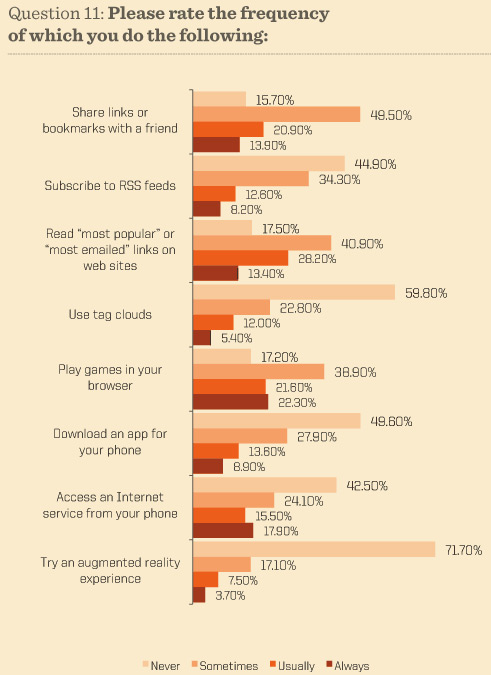
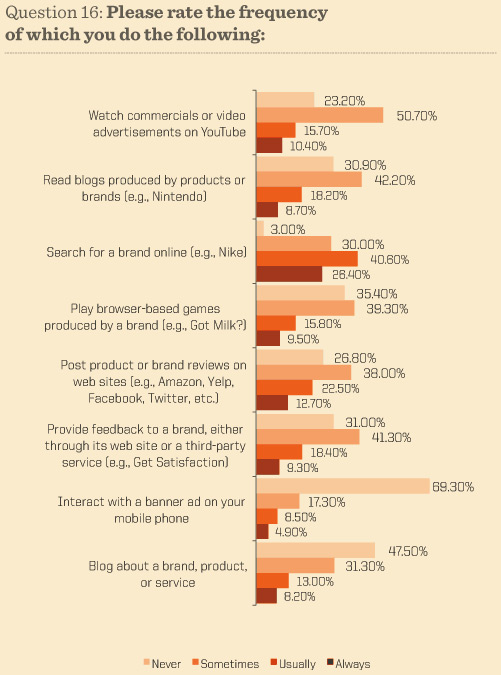
Razorfish has released a wealth of interesting data about consumer online behavior, and a good deal has to do with social media and brand interaction. For those struggling to find the right use of social networks for their business, the data is worth paying attention to.
The data is based on a survey of 1,000 consumers in the US, about half male and half female. They cover four major age groups and 10 major cities.
"To avoid duplicating the more broad-based work of Pew, Forrester, and other research firms, our goal was to survey what we call "connected consumers,’" Razorfish explains. These connected consumers have broadband access, have spent at least $150 online in the past six months, have visited a "community site" (MySpace, YouTube, Facebook, Yelp, etc.), and have consumed or created some form of digital media like photos, videos, music, or news.
"Based on previous Razorfish consumer research, we have found that these ‘connected consumers’ roughly mirror the U.S. population with broadband access. According to the Pew Internet & American Life Project, about 63% of all Americans today have a high-speed Internet connection, up from only 55% in 2008. This translates to roughly 200 million people, based on a July 2009 population estimate from the CIA World Factbook (total population 307,212,123, July 2009 estimate)."
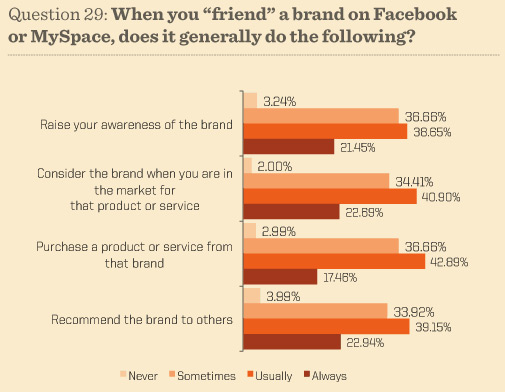
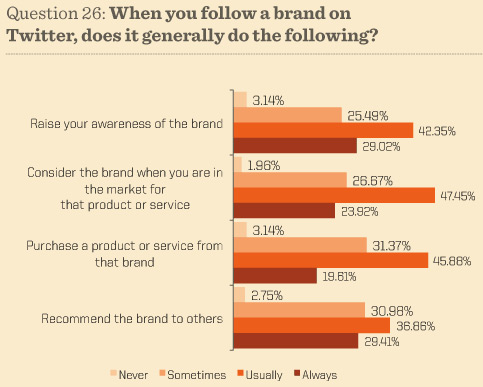
In other words, pay attention to the results. You can find them all here. I wanted to highlight a few of the particularly interesting ones here, which pertain to social media use. They paint a pretty good picture of what consumers are looking for from brands on social networks (although these are certainly not the limits of what companies can do with them).
Beyond the data in the above graphs, another point worth mentioning derived from the research is that for Facebook, MySpace, and Twitter, those who follow brands are mostly looking for exclusive deals or offers. This mentality will likely increase moving forward as deals get more personalized as well.
Like Jeremiah Owyang recently discussed with WebProNews, sites can connect with existing networks like Facebook, Twitter, etc. (think Facebook Connect and similar services), and in the future, people may be able to log-in to corporate sites with their Facebook (or whatever) account, which will bring up their profile information for companies to serve personalized content (or perhaps personalized deals).
The point is, consumers are clearly more than willing to interact with brands through social media, and this will likely become increasingly true as social networks themselves gain more users. It’s not only about pushing your offers out there and hoping people bite. People are becoming friends/fans of brands hoping you do give them special offers.
Interesting new marketing opportunities are going to continue to present themselves moving forward as networks get more advanced and more brands figure out new ways to use them.
Related Articles:
> How Big Brands Use Social Media
> Some Brands Have Good Ideas For Social Media. Do You?
> Forums Are Relevant in Social Media Marketing
> Using Facebook Traffic to Drive Brand Loyalty
I’ve been covering IBM‘s search technology (for our Search and Information Access Research) for two years now, and I confess that I’ve never quite totally understood the strategy (if there is one) behind IBM OmniFind Yahoo! Edition (OYE).
OYE is the free, Apache Lucene-based search application that IBM has offered since 2006. IBM does have customers who pay for commercial support for OYE, and according to Big Blue there have been over 50,000 downloads of OYE to date. But OYE isn’t something IBM pushes heavily, and Google’s search appliance business hasn’t suffered appreciably in the face of competition by OYE.
One wonders, then: Why bother offering something like OYE at all? What’s the point in putting the "IBM OmniFind" moniker on a technology that is really mostly Lucene on the back end and Yahoo on the front end? It seems (on the surface) like rather a quick-and-easy way to try to get some of the "cool factor" from Lucene to rub off on OYE — a kind of coolness by association.
It now seems likely that OYE was (among other things) an IBM testbed project for Lucene development, ahead of the eventual, inevitable Lucenization of the entire OmniFind family of products. And in fact an IBM rep told me that Big Blue will indeed be moving OmniFind Enterprise Edition to a Lucene-based core architecture eventually. This is big news from a number of standpoints. It’s a huge endorsement (if Lucene needed any, at this point) of the open-source search engine’s maturity and soundness; and it can only solidify Lucene’s position of dominance in the open-source search firmament. It also brings Lucene and UIMA (Unstructured Information Management Architecture) closer together, hinting at the emergence (though not right away) of an industry-standard text analytics architecture.
A lot is at stake for IBM, too: The key pieces of IBM’s information-access strategy — including InfoSphere Content Assessment (ICA), InfoSphere Content Collector (ICC), and InfoSphere Classification Module (ICM) — all employ the OmniFind Enterprise Edition search infrastructure in various ways. With Lucene and UIMA occupying center stage, IBM is betting a lot on this technology.
What does it mean to you, the technology buyer? First, expect to see further significant investment in Lucene by the IT world — and further blossoming of the technology ecosphere around Lucene — as Lucene becomes the key enabling technology underneath a variety of content-analytics applications. A year from now, Lucene won’t simply mean "search" — it could become the enabling technology for content-analytics apps of various kinds (including some kinds that haven’t even been envisioned yet).
Secondly, it may prompt the much-prophesied (but never realized) advent of a broad secondary ecosystem around UIMA: an ecosystem of parsers, annotators, and pluggable business rules.
Thirdly, we may see the emergence of a new wave of prospective standards around things like index formats, relevance, and tokenization.
And finally? Expect to see interesting arguments from the likes of Microsoft and Autonomy as to why their proprietary search solutions are better for you in the long run than more open architectures. It should make for an interesting discussion. Subscribers, stay tuned.
With all of the spam out there and the increasing amount of malice that comes with it, it’s easy to look at the situation and think that email must be dying. Combine the overwhelming amounts of inbox spam and the ever-increasing popularity of communication tools like Twitter and Facebook, and you may ask yourself why you even need email. Well, I’ve got ten answers for you here.
Don’t get me wrong. Email will evolve. In fact, it’s already begun to. But email as a utility is currently in no danger of going away. This is a view that Pro Blogger Darren Rowse appears to have in common with me, as he implied in a recent interview with WebProNews.
For all of the unwanted marketing messages and spam out there flooding inboxes, email is still the preferred channel of communication by consumers for receiving marketing messages, according to a different survey.
Spam is going to flood every channel that achieves the usage of the masses. It’s been going on longer than we’ve had a name for it. As long as I’ve been alive, I’ve been forced to sit through commercials I had no interest in seeing, while trying to watch television. Granted, they couldn’t give my television a virus, but they have always been intrusive to some extent.
Now that social networks are rising to popularity, the spam is sure following there. It’s unavoidable. People will spam you no matter what you’re using. But you’ll still use it.
> Spam is Getting More Malicious
> 10 Reasons Social Media isn’t Replacing Email
> People 18-24 Would Rather Give Up Social Networks Than Email
Barley flour is quite a new addition in my kitchen pantry. This cookie recipe is my first experiment with barley flour and I’m happy to tell that it’s a huge success. Unlike whole wheat, barley flour did not impart a raw smell and taste in the cookies. It’s finely ground so there is no grittiness too. I found Bob’s Red Mill Whole Barley flour in the organic aisle of the grocery store. Like any other whole grain flour, barley flour too should be stored in the freezer. Be sure to bring it to room temperature before baking. Barley flour is less glutenous, so if you want to experiment with it start with cookie recipes first. Since cookies need very less or no rising at all, substituting upto half the quantity of all purpose flour in a cookie recipe should be fine.
The following cookie recipe uses only barley flour and we couldn’t tell it at all. Be sure to use whole grain barley flour. Some grocery stores carry a pure white color flour under the name barley flour but it’s not whole grain. It’s made from pearled barley.
Yield: 20 cookies
2 In a large mixing bowl add peanut butter, margarine and sugars. Beat together well until smooth and creamy.
3 In a blender (I used the small jar of my Magic Bullet), blend together the egg replacer and warm water until it’s frothy.
4 To the creamed sugar mixture add the egg replacer liquid and vanilla. Beat once again until it’s combined well.
5 To this add the barley flour, baking soda and salt and stir well.
6 Add remaining ingredients and mix well.
7 Spoon the batter onto a cookie sheet and bake for 10 to 12 minutes. I took mine out after 11 minutes.
8 Leave the cookies on the sheet for 5 minutes. Then transfer it to a cooling rack for the cookies to cool completely. Transfer the cooled cookies to an airtight container.
I’m not a peanut butter fan, but I used it to just finish it off. So I was very happy because the presence of peanut butter was not at all felt from the 2nd day onwards.
I bought very little amount of carob chips and used it in this recipe instead of chocolate chips to make it completely vegan. When tasted it by itself, I found that there was a slight difference in taste when compared to chocolate chips. I didn’t like it that much. But I literally couldn’t feel any difference (maybe a little or it was just psychological) when I tasted the cookies and my son didn’t find it. The original recipe had called for 1/2 cup of chocolate chips, since I was using carob chips I used only 1/4 cup of it and I used 1/4 cup of dried cranberries. However I’m not sure if I would substitute carob chips for chocolate chips in a chocolate chip cookie recipe. Maybe it would be too much. I think the better bet is to try other dairy free vegan chocolate chips instead.
2 The original recipe mentions to use cornflakes. I used Rice Krispies because I had only that in hand.
3 Similarly you could use all nuts, or all chocolate chips or any dried fruits etc. Just be sure to keep the measurements same though.
4 At first I thought the quantity of sugar was more in the recipe with 1/3 cup each of brown sugar and granulated sugar, but it was perfect when we tasted the cookies. Maybe it would have been even sweeter, had I used 1/2 cup of chocolate chips and raisins instead of cranberries.
5 The cookies don’t spread like the usual chocolate chip cookies. So I think if you flatten it with a fork you may get crispier cookies but you would have to adjust the baking time. Also I overlooked the 1 teaspoon of water in the recipe. Maybe if I had added that the cookies would have spread a little bit.
6 I have mentioned this a couple of times, but writing it once again. If using a dark coated non stick pan, stay alert and take the sheet out of the oven 2-3 minutes earlier because the bottoms burn quite quickly. The same thing happened in this recipe too. Even after being careful and lining the cookie sheet with parchment paper the bottom of the cookies went black. Maybe double lining the sheet would help. I’m going to try it the next time.
Last night on "30 Rock," Alec Baldwin’s character got lost within New York’s subway system, and due to being covered in bedbugs, received no help from his fellow passengers. But if the same thing happened to him (or a non-fictional person) today, Google Maps could have come to the rescue.
A post on the LatLong Blog announced this afternoon, "[Y]ou can now see New York’s subway lines drawn out directly on Google Maps as part of the transit layer. To turn it on, just point Google Maps to somewhere in New York, click on the ‘More…’ button at top-right, and select ‘Transit.’"
Then, "When you click on any station name, a bubble pops up with the names of the line that service the station, and all the other lines on the screen fade out."
And the transit layer is accessible through Google Maps for BlackBerry, Windows Mobile, and Symbian S60, by the way, so people should be able to take advantage of it while they’re on the go.
Lots of New York tourists – and/or GE execs who have been barred from using company cars – are likely to wind up being quite grateful for this offering.
> Google Maps Takes Another Crack At Real Estate
> Google Launches Analytics For Mobile Apps
> Google Search By Voice Learns Chinese (In Limited Fashion)
There have been many articles written about why to use Twitter, and we’ve certainly published our fair share of them. However, the landscape is constantly changing. New trends, ideas, applications, and features come out, and they further emphasize Twitter’s place in said landscape. Following are some reasons why it is becoming increasingly important to marketers.
1. Twitter Lists
Twitter Lists are changing the game. We recently looked at several reasons why, but also consider that with the Lists gadget, your tweets may appear all over the web if you can get onto lists. They will appear on sites and blogs, which are more than likely going to be related to the niche you are in anyway if you have the right audience on Twitter. 2. The Openness of Twitter
The openness of Twitter, social media and the web in general, pretty much means that your messages on Twitter won’t be limited to your Twitter audience. Facebook and other social networks will bring tweets in. People will share them, screenshot them, link to them on blogs, etc. Twitter is a means of getting your message out to more people, but it’s not necessarily only the people on Twitter that will see those messages.
3. Building Valuable Relationships Laura Fitton, the author of Twitter for Dummies, chalks up success on Twitter to four basic concepts: listen, learn, care, and serve. Basically, if you listen to the community, you will learn, and if you show that you care, you are more likely to get more out of your efforts. Serving means providing something of use to the community. If you what you’re not doing that, you may be setting yourself up to fail, as Fitton talked about in this interview with WebProNews.
4. Traffic That Cares
Twitter can bring you not only random traffic, but traffic from people who are actually passionate about the niche that you are a part of. Retweets are huge in this regard. Guy Kawasaki calls retweeting the sincerest form of flattery. He has a point. He notes that people are willing to risk their reputations by retweeting your content.
6. Connecting with Local Customers
There are a variety of ways you can connect with local consumers and customers using Twitter and Twitter-related tools. There are tools like our own TwellowHood, which let you find Twitterers in your area, for example. Another thing to keep an eye on is Google’s new Social Search. It’s currently just a lab experiment, but could become more. It certainly has potential.
A recent Search Engine Land article made some good points about the potential of local marketing with this tool, which delivers Google search results based on the communities you are a part of. It draws from Google profiles, which include the networks that people are connected to (based on what any person includes in that profile). If you’re not familiar with this feature, watch the following clip, and you’ll understand.
7. Going International and Multi-lingual
Twitter is expanding into more languages. If you thought Twitter was important to marketing already, consider that for most of its existence, it has only been available in a couple of languages. Now it’s in Spanish, and many more languages will follow. That’s not only going to be huge for international and multi-lingual marketing efforts, it’s going to be huge for Twitter’s growth, and the more Twitter grows, the more potential customers are out there.
8. It’s Still Young
Consider that Twitter is just getting started in the grand scheme of things. It’s still young. There are no doubt going to be a lot more features added in the future. And don’t forget about the thousands of Twitter apps that are already out there that can make Twitter useful in different ways to different people and businesses. Take some time and explore them. Fitton’s site OneForty.com, which is like Yelp for Twitter apps, is pretty good for that. It has reviews, and people tell why certain helps have helped their businesses. Did we leave some reasons out? Please share with the rest of us.
> 6 Ways Twitter Lists Are Changing the Game
> By Tweeting, You Could Appear All Over the Web
> Twitter Expands the "Lists" Feature
> Microsoft and Google Score Deals with Twitter
Dan alerts us to the news that the free muni-WiFi system used around the Coshocton’s County Courthouse in Northern Ohio was shut down over a complaint by the MPAA over a single unauthorized movie download. Amazingly, rather than admit that perhaps that was going a bit too far in punishing everyone in that town over a single individual’s usage, the MPAA couldn’t resist the opportunity to complain about the evils of movie piracy again. The MPAA doesn’t seem concerned at all about the collateral damage, and just thinks that it’s a good opportunity to push ahead with its misguided complaint against file sharing.
Permalink | Comments | Email This Story
Toyota produced two special edition Tundras for the 2009 SEMA show last week. The first was the “Tailgater” – a fancy tribute to country music duo Brooks and Dunn that doubles as a tricked-out mobile BBQ platform. The second was a call-back to the hot rod days of the 50’s, a regular cab short box Tundra with a flame job, moon hub caps, and a 50’s era Toyota logo.
Toyota's custom Tundras shown during the 2009 SEMA show.
While they’re both cool, neither truck demonstrated a new concept or an attempt to establish the Tundra as a great canvas to work from. Still, there were a couple of neat ideas, and you have to give Toyota for trying in a down market:
The Tailgater
The Brooks & Dunn Tailgater edition of the Tundra
This was the show-piece – the truck that Toyota really sunk some time, effort, and energy into. The stand-out features are the engraved silver door handles, the pull-out grill assembly attached to the tailgate, and the various hand-tooled leather elements in the interior.
The pull-out BBQ grill on the tailgater.
That's real silver engraving – very sharp.
What’s missing? Well how about the fact this truck has a 3″ lift with tires and wheels that are too big for such a small lift. What about the fact that this “show” truck doesn’t even have a TRD exhaust (that’s a stock pipe sticking out).
The Hot Rod
The retro call-back Hot Rod Tundra
Wood paneling in a truck bed? It's been done…many, many, many times before.
This truck almost seems like an after-thought. A flame job, some retro hub caps, and a wood-paneled bed are cool, but all these features can be found on a classic show truck at any good-sized car show. Frankly, what’s the point of tapping into a history that Toyota had absolutely no presence in?
No disrespect to the creators and artisans who built this truck , but the bottom line is ‘meh.’ This truck doesn’t even sport a TRD lowering kit, despite the fact hot-rodders were cutting springs and removing leafs to get lower back in the day.
The retro Toyota logo is cool, and the interior has some cool aspects…but if the words “slapped together” don’t apply to this interior, when do they apply?
Retro 50's Toyota logo.
The problem with SEMA trucks is that auto manufacturers have nearly unlimited resources…taking a stock truck and doing it up is always cool, but we expect a lot more from an auto manufacturer. Either demonstrate a new accessory concept or package that could make it into production, show a potential styling cue, or use all your resources to make something awesome. Last year, Toyota recycled the diesel dually concept they showed in 2007. This year, they made a couple of rather tame trucks. Next year, how about one of the following:
Whatever you do, do it right. No more “show trucks” with fewer accessories than your customers are installing on their own vehicles with their own limited resources.
Read user reviews of Tundra Accessories.
Today’s headlines indicate that all eyes yesterday were on the Senate, where former President Bill Clinton urged Democrats to take action on health overhaul legislation and Majority Leader Harry Reid says work on the measure could be done by Christmas.
On Hill, Bipartisan Support Emerging For Commission To Control Health Costs Kaiser Health News staff writer Eric Pianin reports on growing interest for a bipartisan entitlement commission. “The drive on Capitol Hill to create a bipartisan entitlement and tax reform commission to help ‘bend the cost curve’ of health spending and address mounting deficits picked up momentum yesterday, as Senate Minority Leader Mitch McConnell and a handful of moderate Democrats and Republicans voiced support for the effort (11/11).
How The House Abortion Restrictions Would Work Kaiser Health News staff writer Julie Appleby reports on the particulars of the abortion language in the House-passed health bill. The measure “bars insurers from selling policies that cover abortion to anyone who gets a federal subsidy. But it does allow insurers to offer optional abortion coverage that consumers could purchase with their own money. Based on some states’ experiences, it’s unlikely insurers would sell such coverage” (11/10).
Health Vote Shatters Abortion Ceasefire The sudden spasm of intense debate over abortion on Capitol Hill this week threatens not only to stall the passage of health care legislation, but also to shatter the delicate ceasefire that has governed the abortion issue during the Obama era (Politico).
President Clinton Urges Senate Action On Healthcare With Senate leaders navigating a tricky path to move healthcare legislation forward, Democrats on Tuesday received a blunt warning from the president who tried in vain to provide universal coverage 15 years ago — and who suffered the political consequences of failure (Los Angeles Times).
On Hill, Clinton Gives A Health-Care Pep Talk Former president Bill Clinton urged Senate Democrats on Tuesday to resolve their differences with a health-care bill and pass an overhaul as soon as possible. Summoning the lessons of his own history with health-care reform, Clinton warned, “The worst thing to do is nothing” (The Washington Post).
Bill Clinton Presses Senators To Pass Health Bill Former President Bill Clinton came to Capitol Hill Tuesday to underline for Democrats the political consequences of failing to pass a health overhaul, saying doing nothing was the worst outcome (The Wall Street Journal).
Reid Says Health Bill Will Be Done By Christmas The Senate majority leader, Harry Reid of Nevada, said Tuesday that he expected to bring major health care legislation to the floor next week and to complete work on the bill before Christmas. But other Democratic leaders said it was unlikely that a bill could reach President Obama’s desk by year’s end (The New York Times).
GOP Tries To Recapture Town Hall Anger Senate Republican Conference Chairman Lamar Alexander said Republicans are “quietly” planning some 50 in-person and telephone town hall gatherings over the next three weeks to drum up opposition to Democratic health care bills. Republicans believe this effort will pick up new urgency once Senate Majority Leader Harry Reid (D-Nev.) releases his long-awaited bill — possibly next week (Politico).
‘Opt-Out’ Proposal Puts State Leaders To The Test In the two weeks since the Senate majority leader, Harry Reid, embraced a proposal that would allow states to opt out of a new government health insurance plan, state leaders have begun debating whether to take part, and the question has emerged as a litmus test in some campaigns for governor (The New York Times).
Health Vote Pits Democrat Vs. Democrat Democrats who thought a vote against the sweeping health care package would inoculate them from political attack are facing serious blowback from angry constituents and interest groups on the left—fierce opposition that could prove as consequential as anything Republicans could have thrown at them (Politico).
Are Democrats Nearing Civil War Over Healthcare Reform? Three days after the House’s historic passage of comprehensive healthcare reform, Democrats are grappling with the downside of being a “big tent” party: Their coalition is diverse, and internal tensions rise to the boiling point when major legislation is on the line (The Christian Science Monitor).
Congress Has History Of Reversing Cuts In 1997, Congress passed a budget law that mandated tough curbs on Medicare spending, setting up formulas to reduce doctor payments if broad spending targets were exceeded. But when the formula began taking a serious bite out of doctor reimbursements in 2002, Congress acted to reverse the cuts — a step it has repeated five times since then (The Wall Street Journal).
Falling Far Short Of Reform Reduce the growth of health care costs. Bend the curve. Find the game changers. Reform the delivery system. Yawn. Health care reform has always had two main goals. The first — insuring the uninsured — carries grand overtones of social justice. The second — making the health care system more efficient — can seem abstract, technocratic and a bit nerdy (The New York Times).
Gay-Rights Groups See Gains In House Health Bill Gay-civil-rights groups have sought certain changes in health care policy for years without success. Now they’ve got a chance because of several provisions included in the House health care bill passed Saturday (NPR).
The Influence Game: Bishops Shape Health Care Bill Catholic bishops have emerged as a formidable force in the health care overhaul fight, using their clout with millions of Catholics and working behind the scenes in Congress to get strong abortion restrictions into the House bill (The Associated Press).
Maine Finds A Health Care Fix Elusive When his car repair shop’s health insurance premiums doubled between 2000 and 2002, David White saw the problem as akin to a sputtering engine. So he got under the hood of the state’s health system and tried to fix it (The New York Times).
Mass. Keeps Eye On Bill’s Abortion Funding Ban Massachusetts officials are closely monitoring an abortion funding ban in the sweeping health care legislation before Congress to make sure that it does not restrict women’s access to abortion coverage in the state. Abortion is a covered service for low-income Massachusetts women enrolled in subsidized insurance plans available since 2006 through the state’s landmark health care law (The Boston Globe).
Lawmakers Call For Emergency Sick-Leave Requirement Against the backdrop of the H1N1 flu pandemic, congressional Democrats are pushing for emergency sick-leave legislation and using the crisis to garner support for a wider-ranging bill — both of which, they say, would help prevent a more rapid spread of the virus by mandating that employers provide workers with paid time off (Los Angeles Times).
Sign up to receive this list of First Edition headlines via email. Check out all of Kaiser Health News’ email options including First Edition and Breaking News alerts on our Subscriptions page.
Prosper, a San Francisco-based operator of a peer-to-peer lending marketplace, has raised an undisclosed amount of funding from QED Investors. QED managing partner Nigel Morris, co-founder of Capital One, will join the Prosper board of directors. Prosper previously raised around $40 million, from firms like Accel Partners, Benchmark Capital, Fidelity Ventures, DAG Ventures, Meritech Capital Partners and Omidyar Network.
Prosper, the largest peer-to-peer lending marketplace in the U.S. with over $180 million in loans and 870,000 members, today announced that Nigel W. Morris, Co-Founder of Capital One, has joined its Board of Directors and his venture capital firm, QED Investors, has invested in the company.
“The future of consumer and small business finance is changing rapidly, and Prosper is at the forefront of this transformation,” said Nigel Morris, Managing Partner of QED Investors. “By disintermediating banks, Prosper’s model allows consumers to directly benefit, both on the lending and borrowing sides. We are excited to be part of a company that will play a pivotal role in the future of lending.”
“To maximize and fast track our growth and revenue potential, we’re honing our strategy to holistically approach marketing and risk modeling,” said Chris Larsen, Chief Executive Officer and Co-founder of Prosper. “Bringing in Nigel Morris and his team of operationally-oriented investors will immediately enhance our own team’s analytical capability. And just as Nigel and his team were able to deploy such a capability at Capital One to revolutionize the consumer lending industry, we expect our team at Prosper to revolutionize the P2P lending space.”
Nigel Morris co-founded Capital One in 1994, and during his ten-year tenure, Capital One’s customer base grew to an extraordinary 45 million, managed loans increased to more than $70 billion and the company emerged as one of the top seven issuers of MasterCard and Visa credit cards in the world.
Nigel Morris is currently the managing partner of QED Investors, a direct investment fund focused on high-growth companies that leverage the power of data strategies. In addition, he works in an advisory capacity with General Atlantic Partners, Columbia Capital, and Oliver Wyman. He also serves on the board of The Economist Group, London Business School, and Venture Philanthropy Partners.
About Prosper
Prosper is America’s largest peer-to-peer lending marketplace with over 870,000 and $184 million in loans. It pioneered peer-to-peer lending, which allows people to invest in each other in a way that is socially and financially rewarding. Prosper’s auction model provides an open and transparent way to get a personal loan or invest in loans on terms that are favorable to everyone involved in the transaction.
People and institutions list and bid on loans using Prosper’s online auction platform. Borrowers can list loan requests between $1,000 and $25,000 on Prosper and set the maximum rate they are willing to pay an investor for the loan, and tell their story. People and institutional investors register on Prosper as lenders, then set their minimum interest rates, and bid in increments of $25 to $25,000 on loan listings they select. In addition to criteria commonly used by institutional lenders, such as credit scores and histories, Prosper lenders can consider borrowers’ personal stories, endorsements from friends, and community affiliations.
Once the auction ends, Prosper takes the bids with the lowest rates and combines them to facilitate the funding of one simple loan to the borrower, and then issues what are called “Notes” to all the winning bidders. Prosper handles all on-going loan administration tasks including loan repayment and collections on behalf of the matched borrowers and investors. Prosper members are then able to trade Notes with other members on the Folio Investing Note Trader platform, provided by Foliofn Investments, Inc. Follow Prosper on twitter @prosperloans
TAIPEI (Reuters) – Fubon Financial, parent of Taiwan’s No.2 insurer, and China’s State Development & Investment Corp will set up a 3 billion Chinese yuan ($440 million) private equity fund, the Commercial Times reported on Wednesday, citing a Fubon executive.
The private equity fund, aiming to tap industries in Fujian province, will be the first such fund to operate across the Taiwan strait, the paper said.
Fubon (2881.TW) will take a 30 percent stake in the fund, State Development & Investment Corp will hold 40 percent and an investment firm controlled by Fujian province will hold the remainder, the paper said, citing Fubon president Victor Kung.
Trade ties between Taiwan and China have warmed since Taiwan President Ma Ying-jeou took office last year. Both sides have agreed to sign a financial service pact soon, paving the way for banks to invest in each other’s economy.
(Reporting by Faith Hung; Editing by Ken Wills)