Category: News

  • AIDS Vaccine Not As Effective As First Thought, Scientists Say

    A vaccine to protect against HIV may not be as effective as first thought, scientists said Tuesday.

    The Wall Street Journal: “When first publicly disclosing the outcome of the vaccine trial in September, researchers said the vaccine had lowered the risk of infection by about 31%. That result was modest but statistically significant.” Two other analyses of the data have found, however, that the significance of the trials could be attributed to statistical chance. “Still, many scientists say the Thai experiment was useful because it was the first large-scale HIV-vaccine trial to yield a positive result” (Naik, 10/21).

    The Los Angeles Times: “The key difference between the two types of analyses is that the original one excluded seven patients who were found to have HIV infections at the time the study began. The new analysis, based on what is called an intention-to-treat analysis, included all patients who were originally enrolled in the trial, producing the weaker results. Vaccine trials are typically analyzed both ways, and researchers expect to see statistically significant results from each analysis” (Maugh, 10/20).

    The Washington Post reports that the results of the initial test were not statistically significant enough as defined by most medical research (Brown, 10/21).

    The New York Times reports that the two analyses found the vaccine to be only 26 percent effective, lower than the 31 percent the initial trial had found— and that there was also a 16 percent probability that the results were due to chance. The clinical trial limit for the percentage that a result is due to chance is 5 percent (McNeil, 10/20).

    Finally, The Senate passed a Ryan White CARE Act extension Monday that would allow more funding for a program that cares for people with HIV/AIDS, CQ reports (Ethridge and Nylen, 10/20). Open Congress has a summary of the bill.

  • Small Businesses Could Benefit From Insurance Exchanges

    Supporters of health reform legislation told a Senate subcommittee Tuesday that the insurance exchanges are critical for small businesses, which pay more than large companies to cover their employees and are cutting jobs and insurance coverage to control costs. The San Francisco Chronicle reports: “Legislation approved by the Senate Finance Committee last week would create insurance exchanges that supporters say would aid small businesses by spreading risk among a greater number of participants. The result, they said, would be lower premiums. … Small businesses could compare the price, quality and services of a number of plans offered through the exchanges, said Karen Mills, the administrator of the U.S. Small Business Administration.”

    In the Senate Finance proposal, “businesses with up to 100 employees could enter into an insurance exchange.” The bill “also includes a $23 billion small-business tax credit to encourage small businesses to participate in the exchange.” Meanwhile, Sen. Olympia Snowe, R.-Maine, the only Republican on the Finance Committee to vote for the bill, “challenged the piece of the bill that would fine employers with more than 50 full-time employees who do not offer health coverage” (Joseph, 10/21).

    The Boston Globe/The Associated Press reports on the struggles of one small business owner and another subcommittee hearing on a bill to create an exception for people whose medical bills principally caused their financial distress: “A Rhode Island woman urged senators yesterday to ease bankruptcy rules for people devastated by medical debt, as she described the pain of losing a child and going broke from his health care bills. The frightful experience of Kerry Burns, of Coventry, R.I., raised a crucial question of bankruptcy law: should people going broke due to high medical bills get a break over those bankrupted by divorce or credit card bills?” (Margasak, 10/21).

  • Independent Panel To Rein In Health Costs Gaining Support

    “As Congress grapples with how to rein in the high cost of healthcare in America, the option of outsourcing hard decisions to a new, independent commission is gaining momentum,” the Christian Science Monitor reports. “Backers say a commission with a mandate to improve America’s healthcare delivery system and rein in unsustainable costs could be a game-changer. At a time when lawmakers are getting hammered by interest groups, it’s also a nod to the goal of fiscal discipline without having to specify where those cuts will come. Critics say it’s the latest sign that Congress can’t muster the political will to cut unsustainable costs.”

    The Committee for a Responsible Budget released a report Monday that found none of the current bills do enough to control costs. “The Senate Finance Committee’s healthcare bill proposes a 15-member, independent Medicare Commission to present Congress with comprehensive reform proposals. In years when Medicare costs are projected to be unsustainable, these proposals take effect, unless Congress intervenes with an alternative that achieves the same level of savings. … The Congressional Budget Office estimates that such a commission would reduce Medicare spending by $22 billion from 2015 to 2019, when its recommendations would begin to be implemented” (Chaddock, 10/20).

    Meanwhile, Congress Daily reports on a new push for keeping consumers’ health costs down. “Patient, consumer and labor groups are crafting a proposal they plan to shop to key senators to make health coverage more affordable than it would be under legislation approved by the Senate Finance Committee, hoping to influence a final Senate version of healthcare overhaul. Eleven groups, including AARP, The American Cancer Society Cancer Action Network and the Service Employees International Union, are working on the pitch, which has not been signed off on by every group. A draft outline pushes further expanding Medicaid to those earning 150 percent of the federal poverty level and decreasing out-of-pocket costs for certain wage earners. The changes would cost $103 billion, according to the outline. It does not suggest a specific offset, but it said the groups might ask leaders to designate any additional cost savings identified in the final bill to be allocated toward affordability measures” (Edney, 10/20).

  • Enrollment In Medical School Rises Slightly As Physician Demand Also Increases

    New figures show that enrollment in medical school continues to rise as schools try to increase the number of graduates to meet the increasing physician need. But doctors cautioned that more residency positions are needed and urged federal officials to fund them.

    Physicians News Digest reports: “Enrollment in both new and existing U.S. medical schools continues to expand to meet the nation’s need for more doctors, according to data released today by the AAMC (Association of American Medical Colleges). First-year enrollment in the nation’s medical schools rose this year by 2 percent over 2008 to nearly 18,400 students.”

    “Expansion in medical school enrollment as well as graduate medical education, or ‘residency’ training positions is needed to avert an expected shortage of 124,000 to 159,000 physicians by 2025. As a result, the AAMC supports the ‘Resident Physician Shortage Reduction Act’ (S.973/H.R.2251), which increases the number of Medicare-supported training positions for medical residents by 15 percent (approximately 15,000 slots). None of the reform bills currently before Congress includes more Medicare funding for graduate medical education positions. Instead, both the House and Senate legislation would redistribute about 1,000 unused residency training slots among a small group of targeted states. This year’s AAMC data also indicated that the pool of medical school applicants remained stable at 42,269, a slight increase over 2008’s total of 42,231 applicants” (10/20).

    MedPage Today reports: “And this year four new medical schools — FIU Herbert Wertheim College of Medicine in Miami, Commonwealth Medical College in Scranton, Pa., Texas Tech University Health Sciences Center Paul L. Foster School of Medicine in El Paso, and the University of Central Florida College of Medicine in Orlando — accepted their first students, adding 189 to the entering class tally.”

    A early signs, such as the number of people taking the Medical College Admission Test, indicate that “next year’s medical school applicant pool will continue to edge upward. From January to August of this year, more than 67,000 individuals took the MCAT exam, a nearly 3% increase over 2008.”

    Dr. Darrell G. Kirch, president of AAMC, said “medical school enrollment now appears to outstrip postgraduate training capacity. … The medical schools are working to meet that need, he said, but more residency training positions are needed” (Peck, 10/20).

    U.S. News & World Report/HealthDay News reports on a different study that analyzed data in the American Medical Association Physician Masterfile and the U.S. Census Bureau Current Population Survey (CPS) to project the supply of doctors through 2040: “The future physician workforce in the United States may be younger but fewer in number than previously projected, a new study claims. … In an average year, the CPS estimated 67,000 (10 percent) fewer active physicians than Masterfile. Estimates from both databases were similar for physicians aged 35 to 54, but showed marked differences for the numbers of active younger and older physicians. On average, the CPS estimated 22,000 (20 percent) fewer active physicians per year aged 55 to 64, and 35,000 (51 percent) fewer active physicians per year aged 65 and older than the Masterfile. The CPS estimated more young physicians (ages 25 to 34) than the Masterfile, with the difference increasing to an average of 17,000 (12 percent) during the final 15 years (2025 to 2040).” The study was published in the Journal of the American Medical Association (10/20).

    WSJ Blog reports: “For all the tumult in health care over the past decade, the picture for medical school applicants hasn’t changed all that much. The number of first-year slots and the number of applicants have both grown a bit. But the ratio of applicants to slots — a key number for those who want to go to medical school — has remained essentially flat, at just over two applicants for every spot” (Goldstein, 10/20).

  • World Of Goo Tries A Donation Model, Publishes Results

    We’ve mentioned the video game World of Goo a couple times in the past. First, when its creators got upset about silly regional restrictions that were put on the sale of the game, and later when they noted that releasing a game without DRM showed no change in the piracy rate. Yes, the game was widely shared, but at no different a rate than when they’d offered games with DRM. Recently, they decided to try a name your own price experiment to see what would happen. While I’m still not enamored by such pure “give it away and pray” type models, we do keep hearing success stories of people who have used them, combined with a strong and loyal fanbase.

    Now they’ve released some preliminary data, showing that they got about 57,000 new sales, with an average price of about $2 (so, over $100,000 sales in a week — though, that’s the gross number, the net is less, due to Paypal transaction fees). They also added a survey, and found a key point:


    Few people chose their price based on the perceived value of the game. How much the person feels they can afford seems to play a much larger role in the decision than how much the game is worth.

    This is another good point that highlights the separation between price and value — which too many falsely assume are the same thing. There were also a significant number of people who said they paid because they liked the “pay what you want model, and wanted to support it.” So they were paying to support the model, rather than the game itself, which is interesting. I wonder if that component would fade over time as these sorts of models become more popular.

    Either way, another case study in business model experimentation.

    Permalink | Comments | Email This Story


  • Dell’s 5-inch Android MID leaks out

    dell2

    It looks like Dell’s rumored slightly-larger-than-an-iPod-touch Android MID that we heard about back in late June has finally seen the light of day.

    Apparently called the Dell Streak (I hope that’s not the final product name), it’s a 5-inch mobile internet device similar to the recently-released Archos 5 Internet Tablet with the added functionality of 3G wireless data connectivity.

    The actual hardware is labeled as an “engineering sample” with a US-based model number, so it could still be a while until we actually see the finished product here. That being said, early specs include a 5-inch touchscreen with 800×480 resolution, Android 2.0 (Donut), Wi-Fi/Bluetooth/3G (it has a SIM card slot), 5-megapixel camera with LED flash, microSD expansion slot, and a 1300mAh-capacity battery.

    Here’s a hands-on video from Tinhte.com:

    And a few photos:

    dell

    dell3

    dell4

    [Tinhte.com via SlashGear]


  • Google said to be launching Google Audio soon

    google-logo

    From Gmail to YouTube and from Voice to Maps, it seems there is hardly a service that Google isn’t in the business of providing. So we hope you can understand our somewhat lack of shock when we learned of the rumor that Google is on the cusp of releasing its own music service to be known as Google Audio. At the moment very little is know, but the big question seems to be focused on whether or not Google Audio — if it is indeed real — will provide streaming or downloadable music as it currently offers in China. Can we get an Amen for both?

    Read

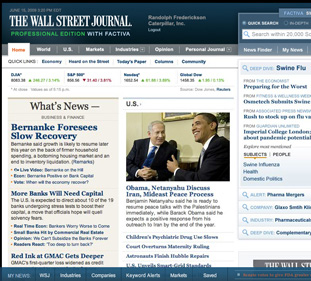
  • The Wall Street Journal Launching Professional Edition

    Dow Jones & Company said today it would launch "The Wall Street Journal Professional Edition," aimed at providing business readers with more in-depth information.

    Wall Street Journal Professional Edition

    The Wall Street Journal Professional Edition will be available to businesses in November with a wider availability in January for $49 a month or just under $600 a year. The new offering combines news from Dow Jones and The Wall Street Journal along with information from Factiva, the news archive owned by Dow Jones.

    "This really is a new model for the delivery of high-quality business news for a sophisticated audience," said Robert Thomson, editor-in-chief of Dow Jones & Company and managing editor of The Wall Street Journal.

    "We are not imprisoned by a terminal and are thus able to produce a more contemporary Web-based news feed tailored to a sector, a company or an asset class. Readers will be able to create a virtual newswire and alert system that suits their specific business needs."

    • Key offerings of The Wall Street Journal Professional Edition include:
    • News and information from more than 17,000 global sources, some of which is not available to the public
    • A one-year archive of Factiva and a two-year archive of wsj.com content
    • More than 30 industry pages managed by Dow Jones editors
    • Six key industry sections managed by Wall Street Journal editors who select news and information about pharmaceuticals, healthcare, energy, media & marketing, telecommunications and technology
    • Personalized homepage with breaking news alerts

  • Yahoo Undergoes Another Exec Shuffle

    It looks like Yahoo’s revolving door recently spun around yet again.  A senior vice president of communications and community properties has left the company, and another man’s joined it and been given the title "Vice President of Corporate Development."

    Scott DietzenScott Dietzen is the (former) SVP who found the exit.  Before getting picked up by Yahoo, he was the president and CTO of Zimbra.  Dietzen also received his Ph.D., M.S., and B.S. from Carnegie Mellon University, so his departure is far from insignificant.

    The one bright spot from Yahoo’s perspective is that, rather than immediately join Google or Microsoft, Dietzen said during an rPath interview that he’s just taking an open-ended sabbatical.

    As for the new hire, his name is Andrew Siegel.  Kara Swisher reports that he’ll be in charge of mergers and acquisitions.  Siegel used to work for General Electric, and also spent some time at Merrill Lynch.  He attended Syracuse University and the New York University School of Law.

    It’s reasonable to assume that Yahoo has a lot of confidence in Siegel’s abilities, considering how many properties the company is reportedly trying to sell.  There’s the pending deal with Microsoft to consider, too.

  • Nook news roundup

    nook11 (1)
    Forget the new Apple products from yesterday, the big news of the day was the Barnes & Noble Nook reader that might just shake up the stale e-book reader image the Kindle has in-part created. The Nook really seems like the device to beat now with the two screens, 10 day battery life, WiFi and AT&T 3G, native PDF support, and is the same price as the Kindle at $260. Yesterday’s coverage has been condensed below for your viewing pleasure just in case you missed something.

    Rumor: The Barnes & Noble Nook reader to be revealed and available tomorrow for $259

    The Barnes & Noble Nook reader name wasn’t vetted well

    The $259, dual-screen Barnes & Noble Nook reader gets official

    Almost live from Barnes and Noble’s Nook event

    Nook.com is live for your viewing pleasure

    Chart: How the Nook stacks up in the e-reader race


  • Summit Partners Selling Heald College

    Corinthian Colleges Inc. (Nasdaq: COCO) has agreed to buy career college operator Heald College for $395 million in cash. Heald is minority-owned by Summit Partners, and operates nine campuses in Northern California, Hawaii and Oregon.

    PRESS RELEASE

    Corinthian Colleges, Inc. (Nasdaq: COCO) has signed a definitive agreement to acquire Heald Capital LLC, the parent company of Heald College. Heald is a regionally accredited institution that has been delivering quality career-focused academic programs since 1863 and has created a strong brand in its markets. Heald prepares students for careers in healthcare, business, legal, information technology and other growing fields, primarily through associate degree programs. Headquartered in San Francisco, California, Heald operates 11 campuses and had approximately 12,300 students at September 30, 2009.

    Heald has nine campuses in Northern California, one campus in Honolulu, Hawaii and one campus in Portland, Oregon. In addition, Heald recently received approval from its accreditation agency, The Accrediting Commission for Community and Junior Colleges of the Western Association of Schools and Colleges, to offer fully online degrees. The College expects to begin enrolling exclusively online students in early 2010. Corinthian currently has five nationally accredited schools in Northern California which primarily offer short-term diploma programs in healthcare, automotive technology and the trades.

    “The acquisition of Heald is consistent with Corinthian’s strategy of increasing its presence in markets with high growth potential and expanding its ability to offer regionally accredited programs,” said Peter Waller, Corinthian’s chief executive officer. “Upon completion, the Heald acquisition will give Corinthian an increased presence in Northern California, Oregon and Hawaii; a growth platform for campus-based and online regionally accredited programs; and a third strong brand. In addition, both organizations are dedicated to the mission of changing students’ lives through quality, career-oriented education. We look forward to welcoming Heald’s chief executive Nolan Miura and his capable team as a new and separate division at Corinthian.”

    “We fully support this proposed transaction, as Corinthian and Heald are both committed to preparing students for academic, personal and professional success,” said Nolan Miura, Heald’s president and chief executive officer. “I am proud of the strong culture and team that we have built at Heald and believe that our passion for student achievement has fueled the institution’s substantial progress over the past few years. We believe the transaction will allow us to build on past success by giving Heald access to greater resources and through the sharing of best practices. Having spent eight years at Corinthian as a senior executive, I know personally that both organizations strive to put students first and to provide a positive culture for faculty and staff. We look forward to joining Corinthian and to the opportunities it will create for Heald.”

    Heald Capital’s controlling shareholder is Brad Palmer, Founder and Managing Partner of Palm Ventures, LLC, who organized Heald Capital to acquire the majority interest in Heald College in 2007. Mr. Palmer recruited the current Heald Trustee Board, which includes a number of nationally recognized education and business leaders, and he has worked cooperatively with Mr. Miura and management to provide the resources essential for the development of the college. In March 2009, Mr. Palmer sold a minority equity interest in Heald to funds affiliated with Summit Partners.

    Transaction Terms

    Under the terms of the definitive agreement, Corinthian will pay the purchase price of $395 million in cash at closing in exchange for all outstanding membership interests of Heald Capital LLC, the parent company of Heald College, subject to certain working capital items. The purchase price also includes the repayment or assumption of Heald’s debt and other closing payments.

    By virtue of Heald’s limited liability ownership structure, Corinthian will receive a tax “step up” in the assets of Heald Capital LLC and its subsidiaries that is expected to provide substantial future tax benefits to Corinthian. Assuming a discount rate of 8% and an effective tax rate of 40%, these benefits have a net present value to Corinthian of approximately $70 million, implying an effective net purchase price of $325 million, or 8.4 times Heald’s projected fiscal 2009 adjusted EBITDA.

    Corinthian plans to finance the acquisition through a combination of cash and debt, using its recently announced $280 million credit facility and available cash. The transaction is subject to regulatory approvals and customary closing conditions and is expected to close in the third quarter ended March 31, 2010.

    BofA Merrill Lynch acted as financial advisor to Corinthian, and O’Melveny & Myers LLP served as Corinthian’s legal counsel. Kirkland & Ellis served as legal counsel to Heald and to the sellers.

    Financial Impact

    Heald is expected to generate revenues of approximately $180 – $185 million and adjusted EBITDA of approximately $38.5 million for the fiscal year ending December 31, 2009. Heald’s student population is expected to grow by approximately 30% in its fiscal year ending December 31, 2009, compared to its fiscal year ended December 31, 2008.

    Excluding transaction-related expenses, we expect the acquisition to be slightly accretive to earnings in the second half of fiscal 2010, and to add approximately $0.15 – $0.20 to diluted earnings per share in fiscal 2011. These projections are based upon preliminary estimates of the allocation of purchase price intangible assets. The final allocation will be determined after closing.

    Conference Call Today

    We will host a conference call today at 12:00 p.m. Eastern Time (9:00 a.m. Pacific Time), for the purpose of discussing the definitive agreement with Heald. The call will be open to all interested investors by dialing (866) 383-8009 (domestic) or (617) 597-5342, pass code 61656578 or through a live audio web cast at www.cci.edu (Investor Relations/Webcasts & Presentations) and www.streetevents.com. The call will be archived on www.cci.edu after the call. A telephonic playback of the conference call will also be available through 5:00 p.m. ET, Tuesday, October 27, 2009. To hear the replay, dial (888) 286-8010 (domestic) or (617) 801-6888 (international), pass code 96241011.

    About Corinthian Colleges

    Corinthian Colleges is one of the largest post-secondary education companies in North America, with annual revenues of $1.3 billion and a student population of over 86,000 students. The company’s mission is to prepare students for careers in demand or for advancement in their chosen field. Corinthian offers diploma programs and associate, bachelor, and master’s degrees in a variety of high-demand occupational areas, including healthcare, business, criminal justice, transportation technology and maintenance, construction trades and information technology. More information can be found on Corinthian’s website at www.cci.edu.

    About Heald

    Founded in 1863, Heald is a regionally accredited private career college with 11 campuses located in Northern California; Portland, Oregon; and Honolulu, Hawaii. Heald offers Associate in Applied Science degrees, Associate of Arts degrees, diplomas and certificates in healthcare, business, legal, information technology and other growing fields.

    About Palm Ventures

    Palm Ventures (www.palmventures.com), based in Greenwich, CT, was founded by Brad Palmer and is focused on investing Palmer family capital in companies which have a positive and transformative impact on society. Current industry focus is in education, health care, human resources, business services, financial services and renewable energy. Palm Ventures takes a strong value-added approach to the development of its portfolio companies, leveraging a broad network of strategic investors, retired executives and operating professionals who provide strategic advice and oversight to companies and management. In addition to Heald, Palm Ventures has made investments in six other successful education companies.

    About Summit Partners

    Summit Partners (www.summitpartners.com) is a growth equity investor that provides private equity and venture capital to rapidly growing companies. Founded in 1984, Summit has raised more than $11 billion in capital and has provided growth equity, recapitalization and management buyout financing to more than 300 growing companies across a range of industries and geographies. Summit Partners seeks outstanding management teams that have self-financed their companies to profitability and market leadership.

    ShareThis


  • HealthPort Sets IPO Terms

    HealthPort Inc., an Alpharetta, Ga.-based provider of healthcare IT solutions to hospitals and health systems, has set its IPO terms to six million common shares being offered at between $14 and $16 per share. It would have an initial market cap of approximately $360 million, were it to price at the high end of its range. HealthPort is owned by ABRY Partners. www.healthport.com

    ShareThis


  • Generac Holdings Files for $300 Million IPO

    Generac Holdings Inc., a Waukesha, Wis.-based maker of standby and portable generators, has filed for a $300 million IPO. It plans to trade on the NYSE under ticker symbol GNRC, with J.P. Morgan and Goldman Sachs serving as co-lead underwriters. CCMP Capital and Unitas Capital bought Generac for approximately $2 billion in late 2006. www.generac.com

    ShareThis


  • Health Reform Triggers Analysis Of The Lobbying ‘Revolving Door,’ Spending Reports

    A joint ProPublica/CBS News investigation found that at least two dozen current lobbyists used to be federal officials who helped design the last major change to American health care.

    “Four years ago, a group of lawmakers and aides crafted Medicare Part D, the prescription drug program for seniors that has produced billions of dollars of profits for pharmaceutical companies,” ProPublica reports. “Today, at least 25 of those key players are back, but this time they’re lobbyists, trying to persuade their former colleagues to protect the lucrative system during the health care reform negotiations.” Those “foot soldiers” include former Chairman of the House Energy and Commerce Committee Rep. Billy Tauzin, R-La., Former Sen. John Breaux, D-La., Former Sen. Don Nickles, R-Okla., and former Medicare chief Thomas Scully.

    “Industry’s interests prevailed when Part D was created in 2003,” and “the prices the government pays for drugs through Part D are about 30 percent higher on average than the prices it pays for drugs for Medicaid recipients, according to a 2008 report by the House Committee on Oversight.” The pharmaceutical industry is now trying to preserve those benefits and “fighting for its bottom line again. Its lobbyists are working against the House version of the health care reform bill, which would require drug companies to give up some of the windfall they gained as low-income seniors were transferred from Medicaid to Medicare during the Part D launch.” During such negotiations, “[t]he skills of government workers turned lobbyists are invaluable to the pharmaceutical industry” (Pierce, 10/20).

    CBS News reports that “[t]he so-called ‘revolving door’ is perfectly legal,” but it “leads critics to ask whether some who are supposed to be watching out for taxpayers have other interests… One Congressional staffer who made the leap to the pharmaceutical industry after Medicare Part D told CBS News: ‘every time a major bill passes, there is an exodus of Hill staffers. … As long as … ethics laws and rules are followed, why shouldn’t they have that opportunity?’” The arrangement has benefited the pharmaceutical industry, which has “spent at least $18 million lobbying Congress on health care reform and, so far, has fought off two proposals that would cost it billions: allowing cheaper drugs to be imported from Canada, and lowering drug prices for some Medicare patients” (Attkisson, 10/20).

    Meanwhile, The Washington Post reports: “The August recess did little to slow the Washington lobbying frenzy over health-care reform, as insurers, drugmakers and hospitals continued to spend millions to attempt to sway the emerging legislation, according to new disclosure reports filed with Congress. The Pharmaceutical Research and Manufacturers of America, the drugmakers’ main trade group, shattered records again by spending nearly $7 million on lobbying from July through September, the quarterly disclosure records show. The outlay brings PhRMA’s total so far this year to nearly $20 million, just shy of the group’s entire lobbying budget for 2008” (Eggen, 10/21).

    Roll Call: “America’s Health Insurance Plans disclosed Tuesday that it spent $2.4 million in the third quarter of this year, up from $1.9 million in the second quarter and $2 million in the first quarter. In total, AHIP has spent $6.3 million in federal lobbying this year, according to its Lobbying Disclosure Act filings” (Ackley, 10/21).

    In a second story, Roll Call reports that “despite the weak economy and President Barack Obama’s barring of lobbyists from working in the executive branch, many of the nation’s key industries and other interests continue to open their wallets in an effort to shape major and minor legislation. Driving much of the activity is the ambitious Congressional agenda that includes potential reforms of the health care system, proposed regulation of financial companies, union organizing and climate change legislation as well as traditional fights over lucrative defense projects” (Roth, 10/21).

  • Freedom Group Files for IPO

    (Reuters) – Gun maker Freedom Group Inc, controlled by private equity firm Cerberus Capital Management, filed with U.S. regulators on Wednesday to raise up to $200 million in an initial public offering of common stock.

    The Madison, North Carolina-based company told the U.S Securities and Exchange Commission in a preliminary prospectus that its predecessor company was formed by Cerberus to acquire Bushmaster Firearms.

    Firearms and ammunitions makers including Remington Arms, DPMS Firearms and Marlin Firearms were later acquired to form Freedom Group. The company posted net sales of $427.3 million for the six months ended June 30.

    The filing did not reveal how many shares the company planned to sell or under which symbol the company plans to list its stock.

    Freedom Group designs, manufactures and markets firearms under brands including Remington, Marlin, Bushmaster, Parker and Nesika. (Reporting by Sayantani Ghosh in Bangalore; Editing by Anne Pallivathuckal)

    ShareThis


  • HealthGuru Media Raises $3.2 Million

    HealthGuru Media, a New York-based health website for 18-40 year-olds, has raised $3.2 million in Series C funding. Castile Ventures led the round, and was joined by return backer Village Ventures.

    PRESS RELEASE

    HealthGuru Media, the leading health website for 18 to 40 year olds and the largest provider of health videos online, announced that Castile Ventures led a $3.2 million Series C financing with participation from existing investor Village Ventures. In conjunction with the funding, HealthGuru announced the appointment of Skip Besthoff, General Partner at Castile Ventures, to the Board of Directors.

    “HealthGuru.com provides differentiated health information for an underserved but highly active demographic,” stated CEO Joshua Silberstein. “We do this by focusing on conditions like pregnancy, sexual health, and college health that are of interest to our audience, and by offering genuinely engaging content – which is critical if you want to be able to communicate complex health information effectively.”

    The company’s innovative approach and breadth of information provide users with a unique experience when it comes to learning about themselves and their health. Building on its current base of two million unique visitors per month, the funding will help the company expand its channels for traffic acquisition and ramp its revenue generating capabilities.

    “The online health category remains one of the most attractive segments with respect to advertising on the web and the company has done a great job of identifying how to address this large and emerging segment. They have several unique capabilities in regards to content development and traffic generation” stated Skip Besthoff. “We are very impressed with Josh’s leadership and ability to achieve critical milestones in a very capital efficient manner.”

    “An important gauge of success is the monthly comScore rankings that compare the traffic of every substantial site in each vertical,” stated Bo Peabody, Village Ventures partner, Board Chairman and HealthGuru co-founder. “HealthGuru has improved its comScore rankings each month since its founding 16 months ago and is now ranked fifteenth among all sites in the Health Information vertical. This dramatic growth demonstrates that HealthGuru is providing valued content to its users which is the critical driver of its business model.”

    About HealthGuru Media

    HealthGuru Media (http://www.HealthGuru.com) is the leading health website for 18 to 40 year olds and the largest provider of health video online. The Health Guru content library has over 1,000 videos covering 75+ health conditions, and is the most watched health content on both YouTube and MySpace TV.

    About Castile Ventures

    Castile Ventures is a top-performing early-stage venture capital firm that provides financial backing and strategic guidance to help exceptional entrepreneurs build successful businesses. Distinguished by the deep business and technology experience of its partners, Castile brings a unique blend of sector expertise, investment know-how, operational insights, and connections to IT decision makers. Since our founding in 1998, the companies we have invested in have brought to market a broad range of products and services to serve the technology needs for enterprises, service providers and the mass market. These have ranged from disruptive enabling technologies through next-generation service infrastructure and delivery platforms to leading edge security solutions and innovation-enabled Internet services. More information is available at www.castileventures.com.

    About Village Ventures

    Village Ventures is an early stage venture capital firm investing in exceptional entrepreneurs building information technology and life sciences companies in emerging domestic geographies. Village Ventures identifies promising investment opportunities in partnership with its nationwide network of 13 early stage venture capital funds that are focused on these emerging domestic geographic markets. By combining local Partner Fund capital and hands-on investment practices with Village Ventures’ centralized services and national network, Village Ventures helps create compelling and innovative companies. More information at www.villageventures.com.

    ShareThis


  • Health Reform Bills Maintain Some Type of Insurance ‘Age Rating’

    Insurance company “age rating” is likely to continue under proposed health care legislation.

    “The older you are, the more you usually pay for health coverage, and that’s a difference likely to persist under the sweeping health care legislation that Congress is now considering,” McClatchy reports. “The House of Representatives would permit insurers to charge older Americans twice what younger people pay. The bill that passed the Senate Finance Committee would allow premiums four times as high.”

    The major House and Senate measures, however, “would end what many consider another long-standing, discriminatory practice: basing rates on gender, which is now allowed in most states.” Sen. John Kerry, D-Mass., says “[a]llowing insurers to charge older Americans vastly higher premiums simply because of their age is discrimination, pure and simple.” Some wonder why gender rating is being eliminated while age rating is not. “Senate staffers explained one reason for the difference this way: Age-based premiums can be justified by consumers’ experience, while gender-based differentials relying somewhat on potential pregnancy has the look of being blatantly discriminatory” (Lightman, 10/20).

    NPR reports that “small companies’ rates are dictated by the demographics of their work force — and when the work force is small, it can spell complications, higher prices or both.” A reporter from NPR member-station KQED takes a look at her own unusually high premiums and determines that the rates are largely caused by the older age of employees at the station (Varney, 10/21).

    Related KHN story: Health Insurance: How Much More Should Older People Pay? (Appleby, 8/31)

  • German man sells turnkey condom manufacturing factories

    rubber

    56 year old German entrepreneur Klaus Richter is selling ready-for-use condom factories, meaning you can order a complete manufacturing facility from him, and he ships practically everywhere. What may sound as a joke at first is serious business: Richter has so far sold over 100 factories worldwide.

    The factories are being put together and shipped from Penang, a port city in Malaysia. Richter says he already sold his product through his own firm, “Richter Rubber”, to places like India, Mexico and Thailand. Two containers with 26sqm. of space are enough. Once the containers are at the hands of the new owners, it takes another 10 days of work to get the factory ready to roll out the first condoms.

    One factory costs about $500,000, but for that money, Richter Rubber staff will set up the factories themselves, grant various warranties and instruct the new owners on all standard operating procedures.

    Richter says he produces the factories in Malaysia since labor costs are low, and high-quality natural rubber is virtually around the corner.

    Via Technology Review – German Edition [GER]


  • Chango Raises Series A

    Chango, a Toronto-based online advertising solution, has raised C$750,000 in Series A funding. iNovia Capital led the round, and was joined by Extreme Venture Partners.

    PRESS RELEASE

    Chango, the web’s most powerful search targeted ad solution has completed a $750,000 series A financing round. The investment was led by iNovia Capital with participation from Extreme Venture Partners, both leading venture capital fund managers.

    Chango has developed an innovative advertising solution that provides a valuable service to website visitors arriving from search engines by displaying ads that are highly relevant to their past search queries. In contrast to other solutions, loyal readers arriving at the website directly are shown only the high quality content they have come to expect from the publisher. The financing was timed to support an expansion of publisher reach and further development of the Chango platform.

    “Chango has a fresh approach to the “behavioral advertising” space that is publisher friendly while at the same time leveraging unique technology to provide better results for advertisers.” said John Elton, partner with iNovia Capital. “We are excited to work with Chris Sukornyk, Chango’s CEO, a dynamic and successful repeat entrepreneur.”

    With website revenues under pressure and the challenge of engaging readers, publishers need help growing their business. Chango worked with dozens of web publishers during the development of the service, ensuring it meets publisher revenue goals with relevant advertising.

    “Advertising works best when it provides a service to the reader”, said Chris Sukornyk, founder and CEO of Chango. “If a reader is searching for something, we help them find it and make money for the publisher.”

    Currently in limited production, Chango is working with select publishers to increase their revenue without risk to reader loyalty. Publishers can contact the Company and apply directly at http://chango.com. Chango is planning a full launch in November, 2009.

    About Chango

    Chango is the web’s most reader-friendly advertising solution. Chango’s innovative solution ensures the right ads are shown to the right visitors at the right time. The result is significant incremental revenue for web-publishers without imposing on loyal readers. For more information, visit http://chango.com and follow Chango at http://twitter.com/changoinc.

    About iNovia Capital

    iNovia provides venture capital to entrepreneurs who transform innovations into successful companies. The team is comprised of sector experts in information technology, life sciences, and clean tech. In addition, iNovia’s extensive network of industry and academic partners provides portfolio companies with unique access to intellectual property. iNovia has $165M under management across two seed and early stage funds. For more information, visit www.inoviacapital.com or follow iNovia on Twitter at http://twitter.com/iNovia

    About Extreme Venture Partners

    Extreme Venture Partners (EVP) is focused on providing early stage venture capital and management expertise to help propel start-ups into the big-leagues. We work with smart people who have great ideas for disruptive businesses, and the energy and ability to deliver. For more information, visit www.extremevp.com.

    ShareThis


  • GlycoMimetics Raises $38 Million

    GlycoMimetics, a Gaithersburg, Md.-based developer of glycobiology-based therapies, has raised $38 million in third-round funding. Genzyme Ventures was joined by return backers New Enterprise Associates, The Novartis Venture Fund, Anthem Capital and Alliance Technology Ventures. The company previously raised around $25 million.

    PRESS RELEASE

    GlycoMimetics, Inc., a clinical-stage biotechnology company developing a new class of glycobiology-based therapies for a broad range of indications, today announced the company has raised $38 million in its latest round of venture financing. New investor Genzyme Ventures joined returning investors New Enterprise Associates, The Novartis Venture Fund, Anthem Capital and Alliance Technology Ventures in the round.

    “We’re delighted to add Genzyme Ventures to our top-tier syndicate of returning investors,” said Rachel King, CEO of GlycoMimetics. “Genzyme’s participation represents a strong vote of confidence in our pipeline of novel therapeutics, and we stand to benefit from their expertise in orphan and hematologic drug development as we advance our sickle cell program.”

    The new investment will be used to fund a Phase 2 trial of GlycoMimetics’ lead drug candidate GMI-1070 in vaso-occlusive crisis of sickle cell disease. The company also intends to use proceeds to fund a Phase 2 study of GMI-1070 in a second clinical indication.

    “GlycoMimetics has made excellent progress in the discovery and development of new glycobiology-based medicines. We’re very excited about GlycoMimetics’ sickle cell program, as well as other pipeline opportunities, and we’re pleased to be participating in this financing,” said Alan Walts, Managing Director of Genzyme Ventures.

    “GlycoMimetics is a lean, focused company, and we’re very encouraged by their progress,” said Jim Barrett, General Partner of New Enterprise Associates, which has led each of the Company’s investment rounds. “We remain confident in both the management team and the scientific programs.”

    About GMI-1070
    Glycomimetics’ lead compound, GMI-1070, is a rationally-designed glycomimetic inhibitor of E-, P- and L-selectins, and inhibits a key early step in the inflammatory process leading to leukocyte adhesion and recruitment to inflamed tissue. GMI-1070 has been shown to be active in several models of diseases in which leukocyte adhesion and activation play a key role, including vaso-occlusive crisis of sickle cell disease. By inhibiting selectin interactions, GMI-1070 may be able to decrease the enhanced cell adhesion that results in vaso-occlusive crisis. In preclinical studies, GMI-1070 restored blood flow to affected vessels of sickle cell animals experiencing vaso-occlusive crisis. GMI-1070 is also being evaluated in preclinical studies for the treatment of certain hematologic cancers, where selectin-mediated cell adhesion and migration is known to play a key role in the disease process. Initiation of Phase 2 clinical trials of GMI-1070 in sickle cell disease is planned in early 2010.

    About Sickle Cell Disease and Vaso-Occlusive Crisis
    Vaso-occlusive crisis is the main clinical feature of sickle cell disease, often resulting in significant patient complications, and sometimes death. Currently, there are no mechanism-based therapies for treatment of vaso-occlusive crisis. Treatment consists primarily of supportive therapy in the form of hydration and pain control, typically requiring hospitalization for five to six days. There are over 75,000 hospitalizations per year associated with vaso-occlusive crisis in the U.S.

    About GlycoMimetics, Inc.
    GlycoMimetics is a privately held biotechnology company that capitalizes on advances in the field of glycobiology. The company uses rational design of small molecule drugs that mimic the functions of bioactive carbohydrates to develop new drug candidates. The company’s initial focus is on therapeutics to treat inflammation, cancer, and infectious diseases. For additional information, please visit the company’s web site: http://www.glycomimetics.com.

    ShareThis