Category: News

  • The Perils Of Extrapolation: Who Knows What The Next Disruptive Innovation Will Be

    There are all sorts of “lessons” that you hear concerning entrepreneurship, but the one that has always struck me as being the most reasonable and valuable is:


    Be adaptable

    People who haven’t built a company think that it’s “the plan” or “the idea” that matters. That’s almost never the case. Look at nearly every successful startup, and their business has little (if anything) to do with their initial plan. Google was going to sell search appliances as the core of its business. YouTube was supposed to be a dating service. Things change — and the only thing that matters is how well your company adapts and executes. That’s why it’s silly to be too protective of a plan or idea or to focus on things like patents or NDAs. Most of that doesn’t matter. Separately, projecting out more than a year may be a fun exercise, but is generally meaningless.

    Clay Shirky had a great Twitter message this past weekend that puts that point into perspective nicely:


    Why I ignore all “5 year plans”: 5 years ago, YouTube and Twitter didn’t exist, and Facebook was only for college kids

    If you go back and look at plans or predictions from 2005, of where web content would be in 2010, it’s unlikely that “micromessaging” like Twitter or online video like YouTube was considered quite as central. Certainly some folks thought video was on the cusp back then, but they expected it to come from professional offerings like BrightCove, rather than a user-generated setup like YouTube. It’s always difficult to predict which innovation is actually going to hit — and plenty of companies, especially in the media space, have had to change and adjust their strategies due to things like Twitter, YouTube and Facebook — just like how a decade ago, companies quickly started adjusting their strategy to deal with Google. Five years from now, plenty of startups will be adjusting their strategy for some other service as well… And the only way you can do that is by being adaptable.

    Permalink | Comments | Email This Story


  • Standard Offer Docket No. 7533 – Update


    Several important updates are provided below on the Vermont Standard Offer program.

    On October 16th, the PSB issued an Order resolving numerous questions pertaining to how the Standard Offer program will be implemented. One of the key issues ruled upon covers how the SPEED Facilitator is to handle it if applications for projects exceed the limits by energy source provided in the PSB’s September 30th Order. The PSB ruled that a lottery system would be used to select projects that submit a timely application.

    The queue opened for applications on October 19th. Yesterday, the SPEED Facilitator filed a report on the first day of the program. The totals appear at the top of this post and are contained in a story on VPR.

    Solar and biomass project applications exceed their allocations of the 50 MW available under the Standard Offer program, and a lottery to select projects will occur at the PSB on Thursday (10/22) at 10am. You must request permission from the PSB to observe the lottery.

    In the VPR story, Representative Tony Klein, who sponsored the legislation creating the program, reacted to the first day’s results by stating: “This is what the economy desperately needs at this moment. What’s so exciting to me as a legislator is to see and realize that in May we create this legislation and here we are in the middle of October we almost have boots on the ground ready to get this technology deployed.”

    We agree with Representative Klein that Monday’s results are a good signal, but would offer that the real measure of success of the program should be based on projects actually built and generating electricity.

  • RIM makes the BlackBerry Bold 9700 official, hitting in November

    bb-bold-9700-press

    It’s always a lot of fun for us — and hopefully for you, the readers — any time we can run wild with pictures, news, and even reviews of an unannounced handset. Today, however, RIM spoiled our fun and formally announced the BlackBerry Bold 9700. Things like carriers, release dates and pricing have been withheld for the time being, but RIM has made a statement saying that we should all expect to see the BlackBerry 9700 go on sale “around the world beginning in November.” Spec wise, nothing has changed since our pre-release review, but just in case some of you forgot or weren’t paying a whole lot of attention, here’s a quick refresher on the critical specs:

    • BlackBerry OS 5.0
    • 624MHz CPU
    • 256MB flash memory and support for microSD cards up to 32GB
    • Quad-band UMTS/HSDPA (800/850/1900/2100 MHz) or tri-band UMTS/HSDPA (900/1700/2100 MHz)
    • Quad-band GSM/GPRS/EDGE
    • Wi-Fi 802.11 b/g with UMA support (carrier dependent)
    • A-GPS
    • 2.44″ HVGA+ display
    • 3.2 megapixel camera with autofocus and LED flash
    • Optical trackpad
    • Bluetooth 2.1 with A2DP/AVCRP
    • 1500 mAh battery
    • 6 hours of talk time and 17 days of standby (3G)
    • 109mm x 60mm x 14.1mm, 122g

    In short, this is the BlackBerry device of your dreams. We’re expecting pretty much every single major GSM carrier on the planet to pick up the 9700 sooner or later, so we’ll be sure to keep the updates coming. As always, high res pics and a few other odds and ends are available after the jump.

    UPDATE: AT&T, Rogers and T-Mobile have announced they will be carrying the Bold 9700 in the weeks ahead. AT&T and T-Mobile’s 9700 will go for $199.99 after a $100 MIR on 2-year deals while Rogers will be asking for $299.99 on a 3-year contract with a monthly minimum voice and data plan of $45. Bell and TELUS have yet to come forward with pricing but have confirmed they will be carrying the device.

    bb-bold-9700-press-2

    bb-bold-9700-press-3

    bold-9700-pamphlet

    bold-9700-pamphlet-2

    Read

  • Easily Split and Merge Your PDF Files

    PDF files… can’t live with them, can’t live without them. The PDF file format is, in my opinion, one of the best there are on the market. You can scan books or other materials and save them as PDF, it allows you to insert pictures, drawings, etc. and can also contain customized display settings, including page display layout and zoom level.

    However, all these features have a price and that is the size of the output file and the loading time. But we already know that quality does not come for free, and for those who want to split very large PDF files in individual pages or merge them into a bigger file, there is a simple solution designed to do just that.

    Gios PDF Splitter And Merger is a small application that allows you to split your PDF files into single page ones or merge multiple PDF files. The software is released under the LGPL license, which means you can use it for free for as long as you want, without any limitations, and it is also portable, meaning you don’t have to install it and you can take it wherever you go on a flash drive.

    The graphical user interface of the app is as simple as it gets, though it looks a little oldish, but we have to focus on the functionality of the application and not on its looks, since here you can find all the options and features without surfing through bulky … (read more)

  • First Edition: October 21, 2009

    As Senate Democrats wrestle with a doctor payment bill separate from sweeping health care reform proposals, the public plan, public opinion and health care costs continue to be a Capitol Hill focus.

    Dr. John Kitzhaber’s Unorthodox Ideas On Reforming Health Care
    When Dr. John Kitzhaber was president of the Oregon Senate, the state’s languishing economy was tightening the screws on Medicaid outlays. But Kitzhaber, a Democrat, and others wanted to find a way to avoid having to drop residents from the federal-state health program for the poor and disabled, and they came up with a radical idea (Kaiser Health News).

    White House Relies On Core Healthcare Team
    Peter R. Orszag, the White House official steeped in budget detail, is now so at home in the Capitol that he freely grabs Coke Zeros from the Senate Finance Committee’s private stash when he talks healthcare costs with aides (Los Angeles Times).

    Advocates Urge Action Now To ‘fix’ Medicare Doctor Payments
    Legislation to “fix” Medicare’s physician payment formula has stalled in the Senate, just days after Majority Leader Harry Reid, D-Nev., announced his intent to fast-track the measure (Kaiser Health News).

    Senate Democrats Hit Snag With Doctor Payment Bill
    In the face of solid Republican opposition, Senate Democrats on Tuesday backed down from their effort to increase Medicare payments to doctors without offsetting any of the cost over the next 10 years. It was the first skirmish in a larger partisan battle over President Obama’s effort to remake the health care system in a fiscally responsible way (The New York Times).

    Who Will Rein In Healthcare Costs? Don’t Look To Congress.
    As Congress grapples with how to rein in the high cost of healthcare in America, the option of outsourcing hard decisions to a new, independent commission is gaining momentum. Backers say a commission with a mandate to improve America’s healthcare delivery system and rein in unsustainable costs could be a game-changer (The Christian Science Monitor).

    Fight Over Medicare Cuts Plays Into Larger Debate
    Senators battled Tuesday over legislation to forestall a cut in Medicare payments to doctors, trying to seize the advantage in the larger health debate (The Wall Street Journal).

    Dem Thumbs Down To Reid Doctors Deal
    A group of Senate Democrats is threatening to derail a deal Majority Leader Harry Reid offered to doctors in exchange for their support of President Barack Obama’s healthcare initiative (The Hill).

    Liberals Increase Pressure For Public Insurance Plan In Health Bill
    Senate Majority Leader Harry M. Reid is facing intensifying pressure from liberal lawmakers to revive a proposed government insurance plan before health-care reform legislation reaches the Senate floor, amid signs that moderate Democrats may be warming to the idea (The Washington Post).

    Pelosi To Stick With Liberals On Public Health Insurance Option
    House Speaker Nancy Pelosi is sticking with the liberal wing of her party on healthcare by choosing to go to the House floor with a public option based on Medicare, according to Democratic sources (The Hill).

    Pelosi Pushes Strong Public Option
    Speaker Nancy Pelosi told Democrats Tuesday night that she wants to move forward with the more liberal version of a House health reform bill that would peg government-run coverage to Medicare – setting up a clash with moderates in her caucus who oppose the plan (Politico).

    Watching Washington: Who Care What The Public Says About Public Option?
    The Washington Post has headlined a story about a poll it took with ABC News showing that the “public option” feature of the health care debate is supported by a clear majority of Americans. But does that mean the public option will be in the final bill? Don’t bet on it (NPR).

    Poll: Americans Skittish Over Health Changes
    Americans are increasingly worried about the cost and quality of medical care that could result from President Obama’s effort to revamp health care, but a majority still trust him more than Republicans to change the system, a USA TODAY/Gallup Poll shows (USA Today).

    Medicare For Everyone
    Say hello to “Medicare Part E” — as in, “Medicare for Everyone.” House Democrats are looking at re-branding the public health insurance option as Medicare, an established government healthcare program that is better known than the public option (The Hill).

    AP Source: House Dems Trim Health Bill To $871B
    House Democrats are aiming to scale back the cost of their health care bill to well below President Barack Obama’s preferred price tag by giving the government a strong hand in selling insurance in competition with the private market (The Associated Press).

    Dems Eye Insurance Industry’s Antitrust Protection
    Top Senate Democrats intend to try to strip the health insurance industry of its exemption from federal antitrust laws as part of the debate over health care, according to congressional officials, the latest evidence of a deepening struggle over President Barack Obama’s top domestic priority (The Associated Press).

    Drug Coupons Hide True Costs From Consumers
    As he makes his case for overhauling the American health care system, President Obama has used the analogy of patients getting a choice between a blue pill and a red pill. The blue pill is just as effective as the red pill, but costs half as much. If everyone would just choose the blue pill, the analogy goes, we could save our health care system a lot of money (NPR).

    Medicare Drug Planners Now Lobbyists, With Billions At Stake
    Four years ago, a group of lawmakers and aides crafted Medicare Part D, the prescription drug program for seniors that has produced billions of dollars of profits for pharmaceutical companies. Today, at least 25 of those key players are back, but this time they’re lobbyists, trying to persuade their former colleagues to protect the lucrative system during the health care reform negotiations (ProPublica and CBS News).

    Health Insurer Tries To Avoid Owning Up To Error
    Who should pay when a health insurer screws up? Not the insurer, apparently (Los Angeles Times).

    Sign up to receive this list of First Edition headlines via email. Check out all of Kaiser Health News’ email options including First Edition and Breaking News alerts on our Subscriptions page. 

  • Google Analytics Gets a Bunch of New Features

    Google announced a number of new and upcoming features for Google Analytics today. The features, Google says, focus on three things: power, flexibility, and intelligence.

    It is the intelligence aspect, which Google places the most prominence on, and this comes in the form of a feature called "Analytics Intelligence," which will provide users with automatic alerts of significant changes in the data patterns of their site metrics and dimensions over daily, weekly, and monthly periods. Users can be notified by email or right within the Google Analytics user interface.

    Google has also added goals for "time on site" and "pages per visit," as well as the ability to define up to 20 goals per profile. Here’s some more on that:

    Google Analytics now tracks mobile websites and mobile apps so you can better measure your mobile marketing efforts. They will be adding a code snippet for users to add to their mobile sites. PHP, Perl, JSP, and ASPX sites will be supported.

    "iPhone and Android mobile application developers can now also track how users engage with apps, just as with tracking engagement on a website," says Dai Pham of the Google Analytics Team. "What’s more, for apps on Android devices, usage can be tied back to ad campaigns: from ad to marketplace to download to engagement."

    They have also added Advanced Table Filtering, which allows you to filter the rows in a table based on different metric conditions. Here’s more on that feature:

    Now when you create a Custom Report, you can select Unique Visitors as a metric against any dimensions in Google Analytics, and they are also adding multiple custom variables to the tracking API and making it easy to share Custom Reports and Advanced Segments.

    Google says that it will be going into more detail on the new features in the coming days on the Google Analytics Blog. The features will be appearing in Google Analytics accounts gradually over the coming weeks.

  • Swine flu vaccinations begin

    Man sneezing; PA copyrightThe Chief Medical Officer for England is urging all swine flu priority groups to take up the offer of vaccination against the virus.

    A mass immunisation programme against swine flu began today with NHS hospitals vaccinating frontline healthcare workers, and patients who fall into ‘at risk’ categories.

    The vaccination programme will be rolled out around the country over the next few weeks with GP surgeries receiving deliveries from Monday. GPs will contact patients if they fall into one of the at-risk categories, the Department of Health said.

    The department added that at-risk groups will be given priority in the following order:

    • People aged over six months and under 65 years in current seasonal flu vaccine clinical at-risk groups
    • All pregnant women
    • Household contacts of people with compromised immune systems
    • People aged 65 and over, in the current seasonal flu vaccine clinical at-risk groups

    The Department of Health said this did not include over-65s that are otherwise healthy, since they already seem to have some natural immunity to the virus.

    During PMQ’s on Wednesday the Prime Minister said:

    “For both those who are at risk and health service workers we are starting the process of vaccination immediately… We have been ahead of the world in purchasing the vaccines that are necessary and in making sure that those people who need treatment with antivirals have it available at the earliest opportunity.”

    The Government estimates that around two million frontline health and social care workers will be offered the vaccine. More than 11 million people in England will be offered it in first instance in priority groups.

  • Report: Online Video the Top Priority in Marketing

    TurnHere has shared the results of an interesting survey on current and future trends in online video among brands and marketing agencies. The survey found that online video has and will continue to have a prominent place in the arsenal of marketers. It should be noted that TurnHere is an online video company.

    "This survey clearly demonstrates that businesses of all sizes consider online video to be an integral part of their marketing mix," said Bud Rosenthal, CEO of TurnHere. "Online video is the number one priority among all online marketing tools for 2010, and that finding directly ties into the high satisfaction levels for video implementation and its return on investment (ROI)."

    TurnHere Report on Online Video

    Noteworthy findings include:


    – Online video is the top marketing priority for 2010, edging out both email and search marketing

    – Companies are experimenting across a wide range of video marketing: 57% have created branded video; 40% have used video for product or service demos, and 37% for customer or employee testimonials

    – Branded content is the preferred online video type with the highest use among all video formats, the highest overall satisfaction levels and the highest likelihood of future use

    – The top reasons for video include: branding (60%), exposure on sites like YouTube (54.7%), and viral content (48%)

    – Professionally produced content was overwhelmingly favored over user generated

    – 83.5% of respondents are already using online video in their marketing efforts in one form or another

    – 90.7% of respondents are likely or highly likely to use online video in their marketing efforts in the next 12 months

    The survey was conducted throughout the third quarter of 2009, and included respondents from Fortune 500 companies, as well as regional brands, PR and traditional agencies. Surveyed companies had annual marketing budgets ranging from $100,000 to $5 million.TurnHere’s report is available here.

  • UK Newspapers Threatening Aggregator: Like Donkeys Suing The Inventor Of The Wheel

    Mathew Ingram points us to the news that some UK newspapers are apparently threatening UK-based news aggregator NewsNow. I’ve used NewsNow in the past, and I can’t see what the complaint is — at all. NewsNow provides headlines and links. That’s it. At least when I was using it, it didn’t even provide summary text. I actually discovered a lot of useful new sources when I used it, and that’s because NewsNow always struck me as one of the best aggregators out there. It found a lot more than most of the others. To be honest, my big complaint with NewsNow is that they limit their free feeds significantly — and there’s no RSS or anything. After a while, I just gave up on using it, because without RSS, it just didn’t fit into my daily method of following the news, no matter how useful the site is. However, it’s really difficult to see what sort of complaint any newspaper could have with such a service whose sole purpose is to drive more traffic. It is, as the link above so colorfully describes:


    the equivalent of a herd of donkeys filing a class action suit against the inventor of the wheel….

    Unless there’s something more to these legal threats — and, admittedly, only one side is weighing in on what happened here, the whole thing just seems like a stretch by at least some UK newspapers to try to intimidate online sites into paying them.

    Permalink | Comments | Email This Story


  • DS homebrew – DSMZX v2.1

    Homebrew coder kvance has released a new update for DSMZX, a homebrew port of MegaZeux to the Nintendo DS. The latest build adds fixes for EZFlash har…

  • Ronald Reagan UCLA Medical Center receives award for excellence in heart care

    Ronald Reagan UCLA Medical Center has been honored by the American College of Cardiology and the American Heart Association for its commitment to and success in implementing a higher standard of care for heart attack patients. 
     
    The medical center was one of only 121 hospitals nationwide to be recognized for achieving the aggressive goal of treating acute myocardial infarction patients with high compliance to levels of care outlined by these two leading national organizations dedicated to promoting quality cardiovascular care and reducing mortality from heart disease.
     
    The honor, known as the American College of Cardiology Foundation’s NCDR ACTION Registry–GWTG Gold Performance Achievement Award, was created through the merger of the American College of Cardiology Foundation’s registry and the American Heart Association’s Get With the Guidelines–Coronary Artery Disease program.
     
    “The time is right for us to be focused on improving the quality of cardiovascular care,” said Dr. Gregg C. Fonarow, director of the Ahmanson–UCLA Cardiomyopathy Center at Ronald Reagan UCLA Medical Center. “The number of acute myocardial infarction patients eligible for treatment is expected to grow over the next decade due to increasing incidence of heart disease and a large aging population.”
     
    To receive the award, the hospital consistently followed the treatment guidelines in the ACTION Registry–GWTG for 24 consecutive months. These included aggressive in-hospital use of medications like cholesterol-lowering drugs, beta-blockers, ACE inhibitors, aspirin and anticoagulants.
     
    “We are dedicated to providing the highest level of care for our patients, including coronary care after a heart attack,” said Dr. J. Thomas Rosenthal, chief medical officer and associate vice chancellor of the UCLA Health System. “We are pleased to receive this prestigious recognition.”
     
    “The American College of Cardiology Foundation and the American Heart Association commend the Ronald Reagan UCLA Medical Center for its success in implementing standards of care and protocols,” said ACTION Registry–GWTG steering committee chair Dr. Christopher Cannon, an associate professor of medicine at Harvard Medical School and an associate physician in the cardiovascular division of Brigham and Women’s Hospital in Boston.
     
    Fonarow, who is vice chair of the ACTION Registry–GWTG steering committee, noted that the full implementation of guideline-recommended acute and secondary prevention therapy is a critical step in saving the lives and improving outcomes of heart attack patients.
     
    The merger of the ACTION Registry and the Get With the Guidelines–Coronary Artery Disease program combines the best of both in a single, unified national registry, bringing together the robust data collection and quality reporting features of the registry with the collaborative models, unique tools and quality improvement techniques of the GWTG program.
     
    With the collective strengths of these two programs, the ACTION Registry–GWTG empowers health-care provider teams to consistently treat heart attack patients according to the most current science-based guidelines and establishes a national standard for understanding and improving the quality, safety and outcomes of care provided for patients with coronary artery disease, specifically high-risk STEMI and NSTEMI myocardial infarction patients.
     
    The UCLA Health System has been a leader in patient care, medical research and teaching for more than 50 years. Today, our physicians provide an array of cutting-edge and research-based primary and specialty services in four hospitals on two campuses, and in numerous outpatient clinic locations. Composed of the UCLA Hospital System and the UCLA Medical Group and its affiliates, the UCLA Health System has provided the best in health care and the most advanced treatment options to the people of Southern California, the U.S. and the world. UCLA’s preeminence in health care — a strength that comes from the union of research, teaching and excellence in patient care — continues to be recognized nationally and internationally. The clinical programs of Ronald Reagan UCLA Medical Center, Santa Monica–UCLA Medical Center and Orthopaedic Hospital, the Resnick Neuropsychiatric Hospital at UCLA, and Mattel Children’s Hospital UCLA constitute a system of hospital care that has been ranked among the best in the nation. UCLA physicians and hospitals continue to be world leaders in the full range of care, from maintaining the health of families to the diagnosis and treatment of complex illnesses.
     
    For more news, visit the UCLA Newsroom or follow us on Twitter.

  • Feelings of stigmatization may discourage HIV patients from proper care, study finds

    The feeling of stigmatization that people living with HIV often experience doesn’t only exact a psychological toll — new UCLA research suggests it can also lead to quantifiably negative health outcomes.
     
    In a study published in the October issue of the Journal of General Internal Medicine, researchers from the division of general internal medicine and health services research at the David Geffen School of Medicine at UCLA found that a large number of HIV-positive individuals who reported feeling stigmatized also reported poor access to care or suboptimal adherence to antiretroviral therapy (ART).
     
    In fact, individuals who experienced high levels of internalized stigma were four times as likely as those who didn’t to report poor access to medical care; they were three times as likely to report suboptimal adherence to HIV medications.
     
    These findings were due, at least in part, to the poor mental health found among many of the participants. Researchers found that HIV stigma was one of the strongest predictors of poor access to medical care and that both HIV stigma and poor mental health predicted suboptimal adherence to medication. Adherence to HIV medications is already known to lead to better health outcomes, including survival, among people living with HIV.
     
    “We were surprised to find that in our models, experiencing high levels of internalized HIV stigma was one of the strongest predictors of poor access to medical care, even after controlling for sociodemographics such as gender, race and ethnicity, income, insurance status, and clinical variables such as T-cell count and years since HIV diagnosis,” said the study’s lead investigator, Dr. Jennifer Sayles, an assistant professor of medicine at the David Geffen School of Medicine at UCLA and medical director of the Los Angeles County Department of Public Health’s Office of AIDS Programs and Policy.
     
    The study — one of the first to quantify how internalized feelings of stigmatization among people living with HIV negatively influence health outcomes — is available online at www.springerlink.com/content/71h5331844161x75/fulltext.pdf.
     
    The findings demonstrate the urgent need for more community dialogue, education and awareness about HIV and the stigma that surrounds the disease, according to Sayles.
     
    “It also highlights the need to address some of the social and contextual aspects of HIV for those living with the disease and to develop interventions that reduce internalized HIV stigma as a barrier to care and treatment,” Sayles said.
     
    The two-year study focused on 202 HIV-positive men and women in Los Angeles County, many of them minorities and many with limited incomes and limited education. Study participants completed anonymous surveys assessing internalized HIV stigma, self-reported access to medical care, their regular source of HIV care and ART adherence.
     
    Overall, one-third of the participants reported experiencing high levels of stigma, and, on average, participants described experiencing or perceiving stigma slightly less frequently than “some of the time.” Additionally, 77 percent of participants said they had poor access to care, 42.5 percent reported suboptimal adherence to ART and 10.5 percent reported having no regular source of HIV care.
     
    The researchers point to some limitations in the study. They could not establish causality between internalized HIV stigma and negative outcomes — only a strong association between them. Also, the study did not directly measure social inequality, social support, self-efficacy and other similar covariates that may be related to HIV stigma. The study may also have missed people who do not access care or HIV services at all, given that study participants were recruited from community organizations providing outreach and social services to people living with HIV and from HIV clinical care sites. Finally, non-English speakers such as Latinos and Asian Americans were underrepresented in the sample.
     
    Study co-authors include Mitchell D. Wong, Janni J. Kinsler and William Cunningham, all of UCLA, and David Martins of Charles R. Drew University of Medicine and Science.
     
    Grants from the American Foundation for AIDS Research, the California HIV Research Program Network for AIDS Research in Los Angeles, the National Institute of Mental Health, the National Center on Minority Health and Health Disparities, and the National Institute on Aging supported this research.
     

    The General Internal Medicine and Health Services Research Division in the department of medicine at the David Geffen School of Medicine at UCLA provides a unique interactive environment for collaborative efforts between health services researchers and clinical experts with experience in evidence-based work. The division’s 100-plus clinicians and researchers are engaged in a wide variety of projects that examine issues related to access to care, quality of care, health measurement, physician education, clinical ethics and doctor-patient communication. Researchers in the division have close working relationships with economists, statisticians, social scientists and other specialists throughout UCLA and frequently collaborate with their counterparts at the RAND Corp. and the Charles Drew University of Medicine and Science.
     
    For more news, visit the UCLA Newsroom or follow us on Twitter.

  • Judge Keeps Gag Order In Place On ISP Boss Over Feds Demand For Info On Customer

    The government has the ability to issue “national security letters” that let them demand information without a court warrant and at the same time gag those who are forced to reveal the info. Given such power, it’s no surprise that the Justice Department abused it widely and conveniently forgot to report many of the uses when some oversight was attempted. The whole setup of NSLs seems highly questionable. What’s wrong with actually getting a warrant? Adding a gag order to it is especially troubling — so it was great to see an anonymous ISP owner pushback on such a use of NSLs. Last year, an appeals court limited when such NSLs could be used, tightening the standard. However, the lower court has said that, even with these tighter restrictions, the government’s use of NSLs against this ISP was proper. Of course, it’s difficult to determine if this actually makes sense, because the gov’t revealed secret info to the judge that even those on the other side of the case were unable to see. The problem, obviously, is that there’s simply no way to know if this is legit or not — but any opportunity you give the government to say “just trust us” on being able to get otherwise private info with no oversight seems like an area ripe for abuse.

    Permalink | Comments | Email This Story


  • Apparently Even VCs Get Confused Over Ratio Ownership Compared To Total Value

    Venture capitalist Fred Wilson recently had a great post where he calls out a bunch of his colleagues in the venture capital business (not by name) for insisting on owning a certain percentage of a company in order to invest. Fred notes, correctly, that it’s not the percentage that matters, but the actual value (and the appreciation of it) of the equity that one holds. In simplest terms: owning 10% of a $1 billion company is always going to be a hell of a lot better than owning 40% of a $1 million company.

    But, what I find amusing — and what Wilson doesn’t mention — is that this very argument is quite commonly presented to entrepreneurs from VCs. That is, when an entrepreneur frets about giving up a portion of his or her company, a VC will often make the point that “with our investment, we can take your company’s valuation way up — so even if you own a smaller percentage, your absolute value will increase.” And it’s a true argument (if the value increase happens). And, in many cases, it’s the very same VCs who will use a line like this that then insist on owning a certain percentage. It makes you wonder if they believe what they’re saying themselves, or if they’re just using all of it as a negotiating tactic to take a larger cut of the deal.

    Permalink | Comments | Email This Story


  • Mega Man Drum Kit = Awesome

    Picture 3

    What are you doing reading the text?! Look at the picture! It’s a frakkin’ Mega Man drum kit! Those rings light up and everything!

    This thing is almost as cool as those Star Wars guitars back in 2002.

    [VIDEO]


  • Bloomington Hospital implements visitor restriction policy

    Policy put in place for patient safety

    Bloomington, Ind. (October 20, 2009) – Beginning Thursday (10/22), Bloomington Hospital will implement a temporary visitor restriction policy due to the increasing number of flu-like illnesses in the community.

    Bloomington Hospital will restrict patients to having two healthy adult (18 years or older) visitors at a time.  Healthy adult means those not experiencing any flu-like symptoms, such as fever, cough, sore throat, runny or stuffy nose, headache, tiredness, body aches, diarrhea or vomiting, and those who have not been exposed to the flu virus in the last week.

    This policy is temporary, but will be in place throughout flu season.

    “The health and safety of our patients, employees, providers and volunteers is of highest priority.  Because of the increasing number of flu cases we’re seeing in the community, we believe now is the right time to begin restricting visitors to proactively help stop the spread of the virus,” says Amanda Roach, spokesperson at Bloomington Hospital.

    While the number of hospitalizations for the flu have been low in Monroe County compared to other locations in Indiana, the time to act is before the situation becomes a crisis.  Since the beginning of September, Bloomington Hospital has admitted seven patients with a diagnosis of flu.  In addition, its Emergency Department is seeing more and more patients each day with flu symptoms.

    “The weeks of September 20 and September 27, about 12 percent of the patients coming into our Emergency Department were there because of flu-like symptoms,” says Roach.  “The week of October 4, this jumped to 19 percent, and last week (the week of October 11), the number was 21 percent.”

    Roach asks for the cooperation of the community following the visitor restriction policy and in screening yourself for the flu before visiting the hospital.

    “If you have flu symptoms, please stay home.  You can keep your loved one in the hospital safe and not spread the flu virus to others by isolating yourself at home if you’re sick,” says Roach.  “You can keep in touch with your hospitalized loved one in ways other than seeing them in person.  Telephone calls, texting, e-mail, social networking sites and sending cards all show you care and are thinking about the person.”

    The flu virus is spread when droplets from coughs or sneezes come into contact with another person’s eyes, mouth or nose.  For mild flu, it is best to stay home and treat symptoms with rest and a fever-reducing medication like Tylenol.  The Centers for Disease Control and Prevention (CDC) recommends people ill with the flu stay home and stay away from others until they are fever-free for 24 hours without taking a fever-reducing medication.

    If you’re at high risk for flu complications, see your primary care physician.  Emergency medical help may be needed if you have the flu and experience additional symptoms such as difficulty breathing or shortness of breath; pain or pressure in the chest or abdomen; sudden dizziness; confusion; severe or persistent vomiting; or flu-like symptoms that improve but then return with fever and worse cough.

    For more information about the flu, please visit bloomingtonhospital.org/flu.

    ###

    Bloomington Hospital has been innovative in providing quality care to south central Indiana communities for more than a century. Offering a comprehensive continuum of care, Bloomington Hospital is a not-for-profit organization and has a patient base of 413,000 in 10 counties (Brown, Daviess, Greene, Jackson, Lawrence, Martin, Monroe, Morgan, Orange and Owen.) Bloomington Hospital currently operates two hospital campuses (Bloomington and Orange County) with regional specialty offerings for Heart and Vascular, Behavioral Health, Cancer, Women and Children, Neurology and Orthopedic services.  As a leading hospital in Indiana, Bloomington Hospital enhances health by advancing the art and science of medicine through the use of new technologies, procedures and care.


  • What Twitterers Want: News

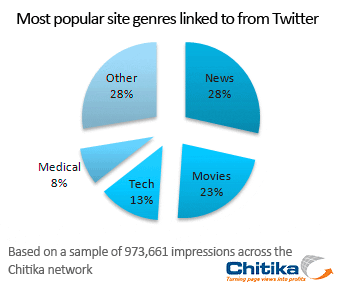
    Twitter can be a lot of things for a lot of different people. However, according to online ad network Chitika, more of them want news than anything else. Chitika released results from a study of its users, looking at what Twitter users want.

    Chitika categorized the sites that get the most links from Twitter. Here’s how it shakes out by genre according to the ad network:

    Most Popular Genres for Twitter

    "Given Twitter’s unique ability to bring information instantly to large numbers of people, it’s not surprising that news leads the way," says Chitika. "From being the first to publish pictures of a Turkish Airlines plane crash to the social network’s breaking of US Airways Flight 1549’s dramatic crash into the Hudson River earlier this year, Twitter’s instantaneous and collaborative nature has made it out to be the bleeding edge of all news."

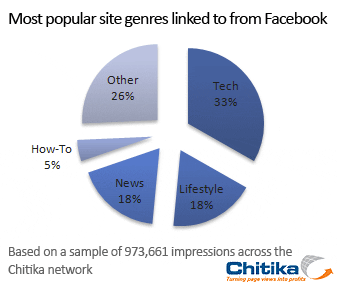
    "Compare Twitter’s results, though, with older, more established social network Facebook, and the value and perception of Twitter’s speed become more obvious," the network adds. "While news sites do receive a good deal of Facebook’s referrals, they lag behind tech and lifestyle sites – tech sites dominate Facebook’s traffic with over 33% of the network’s referrals going there."

    Here’s how Chitika’s numbers for Facebook traffic look:

    Most Popular Genres for Facebook

    On a semi-related note, a new real-time news discovery site called Thoora just launched. Thoora was a finalist of the TechCrunch50, and describes itself as a way to help people discover news attracting the most attention within social and traditional media by exploring the entire blogosphere, Twitter, and thousands of traditional media sources. Twitterers who are after the news may find such a service useful.

  • Steamboat Leads Sometrics Round

    Sometrics, a Los Angeles-based moetization platofrm for online game developers, has raised an undisclosed amount of Series B funding. Steamboat Ventures led the round, and was joined by return backers Greycroft Partners and the Mail Room Fund.

    PRESS RELEASE

    Sometrics (http://www.sometrics.com) today announced the closing of a Series B round of financing led by Steamboat Ventures (http://www.steamboatvc.com). Concurrent with the investment, Beau Laskey, a managing director at Steamboat Ventures, has joined Sometrics’ Board of Directors. Original investors, including the Mail Room Fund (http://www.mailroomfund.com) and Greycroft Partners (http://www.greycroftpartners.com), also participated in the round.

    “Sometrics’ market-leading monetization platform is transforming the way consumers use virtual currency and opening new doors for online publishers and developers to increase their revenue through the virtual economy,” said Laskey. “Sometrics has experienced significant growth over the past year and is well positioned to capitalize on the tremendous market opportunities that are being created through the popularity of social gaming. We look forward to working with the management team to help the company fulfill its potential.”

    “We gain a wealth of expertise and opportunities through this partnership with Steamboat Ventures,” said Ian Swanson, Sometrics co-founder and CEO. “Our solutions for optimizing virtual currency have been embraced by a range of companies that specialize in social gaming, free-to-play MMOs, virtual worlds and casual gaming. This latest infusion of resources will help us continue to expand the ways we can help our clients maximize revenue and customer engagement.”

    The new funds will enable the company to grow its market presence through strategic hires and by boosting its investment in marketing.

    Social gaming is the fastest growing segment of the video game market. Worldwide sales of virtual goods within games and virtual worlds are expected to exceed $2.2 billion this year, according to research firm Piper Jaffray. Sometrics’ innovative technology enables publishers, developers and advertisers to more effectively analyze user data and better target their audience, and provides consumers with a trusted solution to manage their virtual currency across a number of gaming platforms.

    Sometrics launched the industry’s first virtual currency platform last December, to help publishers manage all virtual currency monetization from multiple offer providers. Today, the company’s Offer Solution and Payment Manager have a global reach with more than 4,000 ads across the network.

    Using Sometrics’ solutions, game developers and publishers are able to see what’s going on across all offers and networks, see which audience demographics are responding to which offers, and direct traffic accordingly to optimize conversions and increase revenue.

    On average, Sometrics partners have seen a 15 percent lift through optimizing third-party virtual currency offer providers and ad networks. The Sometrics solutions have achieved an average eCPM of more than $700.

    For product demos, contact Jennifer or Mickey at [email protected].

    About Sometrics

    Sometrics (www.sometrics.com) pioneered social intelligence – combining deep, relevant social analytics with precision-targeted ad serving capabilities to help developers and brands monetize the social web. The company has adapted its advanced targeting and optimization expertise to give online game developers the first-ever full-service offer and payment management solution. Sometrics provides one place to manage everything – all the ads, all the offers, and all the offer networks – coupled with powerful analytics capabilities that help publishers/developers analyze all activity, down to detailed demographics. Sometrics is the first recipient of capital from The Mail Room Fund, an investment consortium that combines big Hollywood (the William Morris Talent Agency) with Silicon Valley (Accel and Venrock). Its first funding round also included AT&T and Greycroft Partners. Sometrics is based in Los Angeles.

    About Steamboat Ventures

    With offices in Los Angeles, Shanghai and Hong Kong, Steamboat Ventures is a global venture capital fund that invests in digital media, consumer and technology companies in the U.S. and Asia. Steamboat Ventures pursues a distinctive investment strategy, cultivating investment opportunities that are simultaneously financially promising and also possess the potential to have significant strategic interest to The Walt Disney Company. Founded in 2000, Steamboat Ventures has invested in a range of leading digital media and consumer technology companies, including: Fastclick (acquired by VCLK), Iridigm Display Corporation (acquired by QCOM), Pure Digital Technologies (acquired by CSCO), Quigo Technologies (acquired by TWX), Move Networks, Netmovie, and UUSee. For more information, please visit www.steamboatvc.com.

    ShareThis