Category: News

  • NASA’s Kepler Finds Extra-Solar Planets Smaller Than Earth

    Over the past year, NASA’s Kepler mission has found hundreds of possible planets outside of our solar system, and even a few candidates for Earth-like planets.

    This week, astronomers revealed that a new system has been found that contains planets smaller than Earth. The new data has been presented in a paper published recently in the journal Nature.

    The planets orbit around a star called Kepler-37, located around 210 light-years from our solar system. The smallest of the planest found, known as Kepler-37b, is only one-third the size of Earth – smaller than the planet Mercury and just slightly larger than Earth’s moon. The planet is not presumed to have an atmosphere, and scientists predict that life on the planet isn’t likely.

    “Even Kepler can only detect such a tiny world around the brightest stars it observes,” said Jack Lissauer, planetary scientist at NASA‘s Ames Research Center. “The fact we’ve discovered tiny Kepler-37b suggests such little planets are common, and more planetary wonders await as we continue to gather and analyze additional data.”

    Two other planets were found in the Kepler-37 system. Kepler-37c orbits further out and is slightly smaller than Venus, or around three-quarters the size of Earth. Kepler-37d is the furthest planet out, and is around twice the size of Earth. Kepler-37 itself is slightly smaller and cooler than the sun.

    All three of the planets orbit Kepler-37 at less than than the distance between the sun and Mercury. They each also orbit their star in 40 days or less. The surface temperature of Kepler-37b is estimated to be higher than 800 degrees Fahrenheit.

    “We uncovered a planet smaller than any in our solar system orbiting one of the few stars that is both bright and quiet, where signal detection was possible,” said Thomas Barclay, lead author of the paper and a Kepler scientist at the Bay Area Environmental Research Institute. “This discovery shows close-in planets can be smaller, as well as much larger, than planets orbiting our sun.”

    (Image courtesy NASA/Ames/JPL-Caltech

  • FCC Votes To Free Up Spectrum For Wi-Fi Devices

    The spectrum freed up for Wi-Fi is a finite resource. Too many devices can congest the networks and slow down service for everybody. The FCC wants to prevent that from happening, and have taken steps to relieve congestion with its latest proposal.

    The FCC announced today that it has unanimously voted to free up 195 MHz of additional spectrum in the 5 GHz band. This new spectrum will be available to unlicensed devices. The Commission also proposed to relax regulations on wireless devices and to streamline existing rules.

    FCC Chairman Julius Genachowski said the Commission is taking “a big step to ease congestion on traditional Wi-Fi networks, which will mean faster speeds and fewer headaches from U.S. consumers.”

    The FCC notes that the freed up spectrum will not only help decrease congestion in public spaces, but it will help increase speeds of personal wireless networks in the home. That’s great news for those of who have multiple devices running on a single Wi-Fi network in the home.

    Before you start lining up more devices on your personal network, know that the FCC has only voted on a proposal to free up the spectrum. The Commission now has to take public comments before making its final decision. The plan will probably not face any real opposition, however, as industry groups are already praising it.

    The National Cable and Telecommunications Association said that the FCC’s bid to free up more spectrum will help meet increasing consumer demand:

    “…existing Wi-Fi spectrum is growing increasingly congested and more must be found to meet skyrocketing consumer demand and enable increased speeds of next-generation Wi-Fi. More extensive use of the 5 GHz band, along with additional unlicensed spectrum in other bands, will permit cable companies and other innovators to continue to provide Americans with new benefits, businesses with new opportunities, and those in need with life-saving connections.”

    The FCC’s proposal fits snugly into its National Broadband Plan that aims to increase access to broadband across the nation. Freeing up more Wi-Fi can help accomplish that, but let’s hope the Commission can get to work on setting up Gigabit networks across the nation as well.

    [h/t: The Hill]

  • New York Times is selling the Boston Globe

    The New York Times Company has been slimming down rapidly in the last year, shedding non-core assets and amassing a cash hoard to take it through a trying time of low ad sales.

    Now, the Times is putting its last remaining outside asset on the block. In a release issued on Wednesday afternoon, the company announced it is selling the Boston Globe and its sister paper, the Worcester Telegram & Gazette.

    “Our plan to sell the New England Media Group demonstrates our commitment to concentrate our strategic focus and investment on The New York Times brand and its journalism,” said Times CEO Mark Thompson. Politico has an internal memo to Times staff which says “this was not an easy decision.”

    As reported by Boston.com, the Times acquired the Globe for $1.1 billion in 1993 and tried unsuccessfully to sell it in 2009.

    In recent years, the Globe has incurred the same struggles as other metropolitan newspapers; its ad revenue is falling fast and its digital prospects are limited by its regional coverage. As we reported this morning, the paper has only 28,000 digital only subscribers after putting in a digital paywall almost a year and a half ago.

    In light of all this, the sale isn’t surprising. The Times’ brand power has allowed it to tap into national and international markets where it competes with the Wall Street Journal and the Financial Times. Selling the Globe will permit the Times to focus on its global strategy and also to amass more cash to weather a current rough patch in which circulation revenue is not coming in fast enough to offset declining ad sales.

    In coming months, New York Times watchers will scrutinize what the Grey Lady does with its cash hoard which is likely to top $1 billion after the Globe sale. On its last earnings call, Thompson said it will use the cash for debt reduction and investment rather than reissuing the dividends which are an important source of income for the family members who control the company.


    Related research and analysis from GigaOM Pro:
    Subscriber content. Sign up for a free trial.

  • iPhone 5 outsells Galaxy S III? In your DREAMS

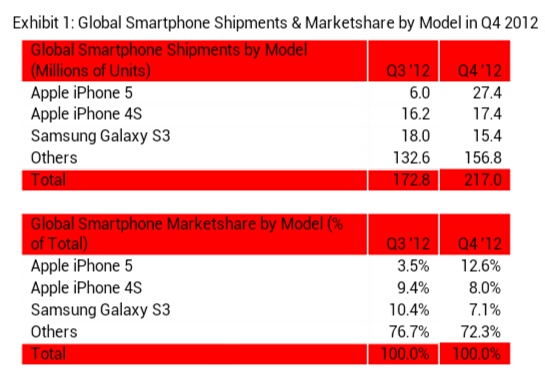
    Bloggers the globe over report today — and you can hear the snickering — that Apple’s flagship handset outsold Samsung’s during fourth quarter. That’s because Strategy Analytics director Neil Mawston told them so and they didn’t really look carefully at the data: “Apple’s iPhone 5 overtook Samsung’s Galaxy S3 to become the world’s best-selling smartphone model for the first time ever in the fourth quarter of 2012”.

    Tsk. Tsk. Strategy Analytics mixes “bestselling” with “shipments”. They are not the same thing. Shipments refer to units going into the channel (carriers and dealers), while sales refer to product purchased by users (businesses and consumers). Only Gartner measures actual phone sales, so why does Mawston use bestselling in one sentence referring to shipments in another?

    Heavy iPhone 5 shipments during the launch quarter makes loads of sense. Apple needs to stock the channel in anticipation of new sales. Samsung shipped fewer S3s, given earlier channel build up for the holidays and anticipating Apple competition.

    Third quarter tells part of the story, when Galaxy S III shipments exceeded iPhone 4S. Apple shipments declined ahead of the new release — clearing old stock for the new. Consider this: When Samsung needed to stock the channel for S3’s global rollout, shipments tripled in just one quarter.

    “Apple’s iPhone 5 smartphone model shipped an estimated 27.4 million units worldwide during the fourth quarter of 2012”, Mawston says. Emphasis: shipped. “The iPhone 5 captured an impressive 13 percent share of all smartphones shipped globally and it has become the world’s best-selling smartphone model for the first time ever”.

    Two things: The aforementioned mixing of “shipped” and “best-selling smartphone” and use of “first time ever” as exclamation, which the Apple Fanclub burst-blogged today. This isn’t the first time for iPhone to be tops, just the new model and during the global launch quarter.

    “In addition to the iPhone 5, Apple shipped an estimated 17.4 million iPhone 4S units for 8 percent smartphone share globally in Q4 2012. Apple’s iPhone 5 and iPhone 4S are currently the world’s two most popular smartphone models”, Mawston says.

    No. 1 and No. 2 is impressive, I agree, except Apple also had to restock iPhone 4S, in anticipation of increased demand, because of price cut to $99 from $199 for the 16GB model.

    “Apple’s iPhone 5 and iPhone 4S together accounted for 1 in 5 of all smartphones shipped worldwide in Q4 2012”, Mawston says. “We estimate Samsung’s Galaxy S3 was the world’s third best-selling smartphone model and it shipped 15.4 million units globally, capturing 7 percent share in the fourth quarter of 2012”. He rightly observes: “Global demand for the Galaxy S3 appears to have peaked”.

    Right. Peaked. Which is another reason for Samsung to cut back shipments rather than overstock the channel.

    During third quarter, with iPhone 4S falling off with rumors roaring about its successor, Samsung shipped 18 million S3s, claiming the top spot. Apple shipped just 22.2 million smartphones — 16.2 million of the 4S and 6 million of the 5 (seeding the channel for limited September launch). Repeating Q4 numbers: Samsung reduced shipments, for the aforementioned reasons to 15.4 million, while Apple increased them to a staggering 44.8 million iPhones 4S and 5 combined. Right, nearly three times more than S3.

    I would reasonably assume, based on Apple’s stated inventory numbers during last month’s earnings call, that both iPhones together outsold Galaxy S3 during Q4. To say either one did is a stretch without data showing how much inventory Samsung carried forward from Q3 or how much stock remained at the end of the year.

    The numbers misrepresent sales for another reason. Apple sells three base iPhone models — 4, 4S and 5. Just in the United States, Samsung offers more than a half-dozen smartphones, including Galaxy Note II. Globally, Samsung sold, not shipped, 64.5 million smartphones during fourth quarter, according to Gartner. By comparison, Apple: 43.5 million.

    I don’t believe Mawston tries to mislead anyone. Bad choice of words is the problem. Greater fault lies with bloggers and others regurgitating the data without examining the contents.

    Photo Credit: Joe Wilcox

  • News for 20th February 2012

    Copied from Twitter @egyptologynews.

    Via HistoryoftheAncient ‏@historyancient: Article: Karnak: Where the digital age meets ancient Egypt http://ow.ly/hRYnP

    Remains of a mud-brick pyramid-shaped tomb cover belonging to vizier Khay (reign of Ramesses II) found. Ahram Online http://bit.ly/XpfNVe

    Creating a pointcloud for a 3D model of houses in E13, Amara West, using a process called ‘Structure from Motion’. http://bit.ly/XpiM00

    Via @chrisnaunton. New book in German – the personal memories of the former Director General of the Egyptian Museum http://bit.ly/Wan9f7

    Durham Univ. 3–4 March 2013 2-day international conference, The Construction of Time in Antiquity. lutz.doering [at] http://durham.ac.uk

    Missed this a couple of wks ago: Campbell Price’s Texts in translation #10: The Stela of Hesysunebef (Acc. No. 4588) http://bit.ly/WfXftd

    Penn Artefact Lab: A step a-“head”: improving storage for our mummified heads http://bit.ly/YArZCt

    Curator’s Choice: Sue Giles on a toy from a child’s grave at Bristol’s King of Egypt show. Culture24 http://bit.ly/Y6J22a

    Discovery of Luxor tomb of Vizier Khay, “the First Royal Herald of the Lord of the two lands” announced. Luxor Times http://bit.ly/15uCVYY

    Avenue of the Sphinxes in Luxor, fully illuminated at night for the first time. Lots of photos. Luxor Times http://bit.ly/11UOj1m

    Amara West 2013: scarabs – for life and death. http://bit.ly/ZdA8Pw

    Via Alice Williams ‏@alicewilliams86:
    Fab new book on World Archaeology at the Pitt-Rivers, with fascinating chapters on the Egypt & Sudan collections: http://www.prm.ox.ac.uk/world.html

    Book Review – Americans in Egypt, 1770-1915 http://collectingegypt.blogspot.com/2013/02/book-review-americans-in-egypt-1770-1915.html

    Upstairs, Dowstairs: contrasting palace life and village life at excavations in Malqata http://bit.ly/Y6rumN

    New Book: Leatherwork from Qasr Ibrim (Egypt). Part I: Footwear from the Ottoman Period. André J. Veldmeijer 2013 http://bit.ly/WPfWmR

  • NTT Communications Adds Enterprise Cloud Locations

    Singapore Serangoon Data Center is located in northeastern Singapore. The tier III+ data center offers co-location, cloud services, NTT Com’s global network services and other related services.

    NTT Communications’ Singapore Serangoon Data Center is one of three facilities in which the company is adding its enterprise cloud computing service offering. (Photo: NTT Communications)

    NTT Communications launched its Enterprise Cloud last year, and is hoping its initial successes translate globally. New locations were announced today, as the company made its cloud available worldwide through data centers in Asia, the United States, and Europe.

    NTT Communications’ Software-Defined Networking (SDN)-based Enterprise Cloud was initially launched via data centers in Japan and Hong Kong in June 2012. Today’s expansion adds Enterprise Cloud locations in Singapore, Virginia and California in the US, and England. NTT anticipates opening three more data centers in Australia, Malaysia and Thailand in March 2013.

    “NTT Communications’ Enterprise Cloud is a full-layer, self-manageable virtual private cloud that is now global, and growing to incorporate virtualized networks in eight countries and nine locations by March 2013,” said Motoo Tanaka, Senior Vice President of Cloud Services at NTT Communications.

    NTT noted it is seeing strong interest from global enterprises who view Enterprise Cloud as a flexible extension of their own data centers, enabling them to connect existing private networks to the cloud and gain additional cost-optimized and secure compute capacity.

    “NTT Com understands the enterprise client, their struggles, goals and needs,” said Tanaka. “Being truly enterprise class is what makes NTT Com the leading partner of choice for client cloud transformation through comprehensive cloud lifecycle services, and is what has led us to develop this real-world cloud, built on a foundation of advisory, migration, operational and management services.”

  • Why Porn Acts Like a Drug [VIDEO]

    First off, nobody is here to bash porn. Like plenty of drugs, everything in moderation, right?

    And that’s the simple fact about porn. It is a drug. Well, at least it acts like a drug on your brain. AsapSCIENCE‘s newest three-minute video tackles the very real problem of pornography addiction. If you find yourself in a vicious porn-watching cycle where real life never seems to measure up to what you’re imagining in your head, well, this is the reason.

  • How the BlackBerry 10 Predictive Keyboard Saves Your Latte

    Whether or not you’ve gotten your hands on the BlackBerry Z10, you’ve no doubt seen the video of Vivek showing off the predictive keyboard feature of the device. When I showed a few friends how it worked, they were impressed by its functionality. I do have one friend who’s both tech-savvy and sometimes hard to impress, and he challenged my demonstration by saying, “Most people expect typos in texts; I don’t see how that can help me”. Challenge accepted.

    I explained a scenario to him in which he and I were going to meet at a coffee shop, and I have a smartphone without predictive text. While I’m walking to meet him, I remember I need something from the grocery store and begin to text him that I’ll be late. In my hurry, I accidentally type: “Quick stop to shop, I’ll be latte”. Confused, he orders me a latte and assumes I’ll still be on time. I end up with a cold latte and an upset friend who thinks I’ve ditched him.

    Now let’s consider this scenario with a predictive keyboard on the BlackBerry Z10. As soon as I begin to type the letters “L-A-T“ I see the word “late” appear within the keyboard. A quick swipe, and the word “late” is populated into the text. No angry friend, no cold latte.

    Has the predictive text feature on the BlackBerry Z10 helped make your texting easier and more accurate? Tell us about it in the comments!

  • TED Radio Hour’s new season to premiere on March 1

    ted-radio-hour_300px
    Mark your calendars, please: TED Radio Hour returns to the NPR airwaves on Friday, March 1. After a popular first season — named the Best New Audio Podcast of 2012 by iTunes — NPR and TED have expanded the series into a weekly program. And for its second season, TED Radio Hour also has a new host — Guy Raz, who you probably know as the host of Weekend All Things Considered and the creator of Three-Minute Fiction.

    Each episode of TED Radio Hour will turn an extraordinary idea inside out, using incredible speakers from the TED stage as a jumping off point. With music and lush soundscapes, each episode takes you on a journey that may well flip your perspective. (Listen to the preview below.) The first two episodes of the 30-part season will be “The Unquiet Mind,” premiering on NPR on March 1, and “Peering Into Space,” debuting on March 8. Podcasts of the show will also be available through iTunes.

    Download: 60-sec-2-0.wav

    Stay tuned to the TED Blog next week for an interview with Guy Raz, where we’ll share which episodes he’s most excited for this season … and his secret skill.

  • American Capital Gets $127 Mln from Paradigm Precision Sale

    American Capital, and its affiliated funds, have received $129 million in debt and equity proceeds, subject to post-closing adjustments, from the sale of portfolio company Paradigm Precision Holdings. Dynamic Precision Group, which is backed by the Carlyle Group, acquired Paradigm Precision on Jan. 31. American Capital said it received $127 million. American Capital invested in Paradigm Precision in 2007.

    PRESS RELEASE

    American Capital, Ltd. (Nasdaq: ACAS) (“American Capital”) announced today that its portfolio company Paradigm Precision Holdings, LLC (“Paradigm Precision”) was sold to Dynamic Precision Group, a portfolio company of The Carlyle Group (NASDAQ: CG), on January 31, 2013. American Capital and its affiliated funds have received $129 million in debt and equity proceeds, subject to post-closing adjustments, of which $127 million was received by American Capital. American Capital’s compounded annual rate of return earned on its senior debt, subordinated debt and equity investments since the first quarter of 2007 was 11%, including interest, dividends and fees earned over the life of its investment.
    “American Capital is proud of its role in building Paradigm Precision into a leader of precision machined aerospace engine parts,” said Myung Yi , Senior Vice President and Managing Director, American Capital Special Situations Group. “American Capital has been fortunate to partner with an outstanding management team, which has driven Paradigm Precision’s growth and successful expansion into global markets.”
    “Over the course of our investment, Paradigm built a strong position in all key and next-generation engine platforms,” said Yaniv Zief , Vice President, American Capital Special Situations Group. “We believe that Paradigm Precision is a great addition to Dynamic Precision Group’s business.”
    Paradigm Precision is a leading and premier global supplier of precision aerospace components for jet engine manufacturers. Based in Peabody, Massachusetts with additional facilities in Malden, Massachusetts; East Berlin, Connecticut; Tempe, Arizona; Guaymas, Mexico, and; Tunis, Tunisia; Paradigm Precision is a manufacturer of highly complex, close tolerance parts and assemblies used mainly in aircraft engine and industrial gas turbines. In addition to working with all of the major turbine engine original equipment manufacturers, the company also supplies parts used in land-based power generation and other specialty applications.
    During the first half of 2007, American Capital and an affiliate invested in Paradigm Precision for the One Stop Buyouts® of Smith West Inc. (“Smith West”), Palmer Manufacturing Co. Inc. (“Palmer”) and Eurocast S.A. (“Eurocast”), leading manufacturers of precision machined aerospace engine components. In addition, in September 2008, American Capital invested in Paradigm Precision to support the acquisition of TM Industries, Inc., a high-precision machining company that specializes in machining large size, highly technical parts for customers in the aerospace, power generation, oil and gas and defense markets. For more information on American Capital’s investment in Paradigm Precision, please go to www.americancapital.com/Pages/our_portfolio/companies/paradigm_precision_holdings.aspx.
    Since American Capital’s 1997 IPO through the fourth quarter of 2012, the company has earned a 10% compounded annual return, including interest, dividends, fees and net gains, on over 340 realizations of senior debt, subordinated debt, equity and structured products investments, totaling $18 billion of committed capital. American Capital earned a 27% compounded annual return on the exit of its equity investments, including dividends, fees and net gains.
    For a chart showing a partial listing of American Capital’s exited portfolio companies, please go to http://www.americancapital.com/Pages/our_portfolio/exited.aspx.

    ABOUT AMERICAN CAPITAL
    American Capital is a publicly traded private equity firm and global asset manager. American Capital, both directly and through its asset management business, originates, underwrites and manages investments in middle market private equity, leveraged finance, real estate and structured products. American Capital manages $18.6 billion of assets, including assets on its balance sheet and fee earning assets under management by affiliated managers, with $117 billion of total assets under management (including levered assets). American Capital, through a wholly-owned portfolio company, manages publicly traded American Capital Agency Corp. (Nasdaq: AGNC) with approximately $10 billion market capitalization and American Capital Mortgage Investment Corp. (Nasdaq: MTGE) with approximately $850 million market capitalization. From its eight offices in the U.S. and Europe, American Capital and its affiliate, European Capital, will consider investment opportunities from $10 million to $750 million. For further information, please refer to www.AmericanCapital.com.
    This press release contains forward-looking statements. The statements regarding expected results of American Capital are subject to various factors and uncertainties, including the uncertainties associated with the timing of transaction closings, changes in interest rates, availability of transactions, changes in regional, national or international economic conditions, or changes in the conditions of the industries in which American Capital has made investments.

    PR Newswire (http://s.tt/1A0iS)

    The post American Capital Gets $127 Mln from Paradigm Precision Sale appeared first on peHUB.

  • Boston Accelerator Bolt Gets Support From Autodesk, Logitech, Grishin Robotics

    The new Boston startup accelerator Bolt has raised financing from Autodesk, Logitech and Grishin Robotics, according to a press release. Other partners include Mick Mountz, founder of Kiva Systems and Brad Feld of Foundry Group. The accelerator plans to work with startups developing hardware, including robotics and consumer devices. It will accept 25 startups into its program over the next two years . Applications for batch one are now available.

    According to a filing with Securities and Exchange Commission, it has raised $3.5 million.

    PRESS RELEASE

    Grishin Robotics invests in hardware incubator Bolt

    February 20, 2013.  Grishin Robotics (http://grishinrobotics.com), the first venture capital firm in the world that is focused on consumer robotics, announces its investment into the Boston-based hardware incubator Bolt (http://www.bolt.io/), which helps hardware startups (including robotics and connected devices) with seed capital and an extensive mentorship program.

    Along with Grishin Robotics,  there are another two strategic partners – Logitech and Autodesk – that also agreed to support Bolt’s startups with capital and parts/services. Among the prominent angel investors, partnered with Bolt, are Mick Mountz (Kiva Systems, acquired by Amazon) and Brad Feld (Foundry Group, investor in companies such as MakerBot and FitBit).

    Over the course of the next two years, Bolt will accept 25 hardware startups into its program. The application process for the first batch opens today at www.bolt.io and will last for 2 months – 10-15 companies are going to be accepted for the 6-month program. Projects’ founders will receive seed capital, access to office and prototyping facilities, and extensive support from a full-time engineering/design staff and a wide array of hardware-centric mentors. Bolt’s program is focused on key aspects of ideation and development of any successful mass-market hardware products, including manufacturing and commercialization.

    “The key to the upcoming consumer robotics revolution, I believe, is in the startup ecosystem. Talented hardware entrepreneurs, dreaming about a new generation of smart devices, do not have today a supporting community around, that is as developed as software developers do. That’s why we have decided to invest in Bolt – this is an investment into the market’s future”, said Dmitry Grishin, founder of Grishin Robotics and co-founder of the Mail.Ru Group.

    «Hardware startups are typically at a major disadvantage compared to their software counterparts», said Bolt’s Managing Director Ben Einstein. “But this disadvantage means it’s ripe for disruption. We’ve built a model that changes the equation and enables startups to get capital – efficient hardware to market at unprecedented speed».

    About Grishin Robotics

    Grishin Robotics is a global investment company with a mission of advancing innovation in robotics for the mass consumer market. Grishin Robotics is focused on investing in personal robotics technologies. The firm is led by Dmitry Grishin, co-founder & CEO of Mail.Ru Group.

    For more information, or to submit your company for investment consideration, visit http://www.grishinrobotics.com.

    The post Boston Accelerator Bolt Gets Support From Autodesk, Logitech, Grishin Robotics appeared first on peHUB.

  • UCLA life scientists identify drug that could aid treatment of anxiety disorders

    The drug scopolamine has been used to treat a variety of conditions, including nausea and motion sickness. A new study by UCLA life scientists suggests that it may also be useful in treating anxiety disorders.
     
    Researchers found that the drug can help boost the effectiveness of a common treatment for anxiety disorders known as exposure therapy. In exposure therapy, a subject with a phobia or anxiety is repeatedly exposed to the object or situation they fear, in a non-threatening setting. The goal of this treatment is to ultimately lessen and eliminate the fear — in essence, make it “extinct.”
     
    However, fear-extinction memories formed during this type of therapy tend to be weak because they are tied to the non-dangerous context. Subjects have a tendency to relapse when they again encounter the source of their anxiety in a different environment.
     
    “Extinction has one Achilles heel that at present has not quite been pierced — namely, extinction learning is highly dependent on the environment or context in which it occurs,” said Michael Fanselow, a UCLA professor of psychology and the senior author of the study. “This makes memories formed during extinction highly fragile and susceptible to fear-recovery or relapse in any non-extinction environment.”
     
    In their new study, published Feb. 15 in the in the journal Biological Psychiatry, Fanselow and his colleagues attempted to overcome this challenge by administering scopolamine in conjunction with the exposure therapy.
     
    “We took an entirely novel theoretical approach by targeting extinctions’ context-dependency and attempting to unbind extinction from its contextual bond,” said Fanselow, who holds UCLA’s Eleanor Leslie Term Chair in Innovative Neuroscience. “Using a non-invasive and readily translatable pharmacological agent, scopolamine, to block cholinergic transmission and hence, contextual processing, we discovered that fear-recovery after extinction could be thwarted.”
     
    Fanselow and his team were able to disrupt contextual processing in rats during anxiety-extinction by using low doses of the drug.
     
    “This finding provides groundbreaking evidence that changing the nature of extinction learning, rather then its magnitude, can produce profound improvements in the prevention of relapse,” Fanselow said.
     
    The research, while still preliminary, suggests that scopolamine may be an effective pharmacological adjunct to exposure therapy.
     
    The lead author of the study was Moriel Zelikowsky, who conducted the research as a UCLA graduate student in Fanselow’s laboratory.
     
    The research was federally funded by the National Institute of Mental Health, part of the National Institutes of Health
     
    UCLA is California’s largest university, with an enrollment of more than 40,000 undergraduate and graduate students. The UCLA College of Letters and Science and the university’s 11 professional schools feature renowned faculty and offer 337 degree programs and majors. UCLA is a national and international leader in the breadth and quality of its academic, research, health care, cultural, continuing education and athletic programs. Six alumni and six faculty have been awarded the Nobel Prize.
     
    For more news, visit the UCLA Newsroom and follow us on Twitter.

  • Twitter seeks more, better advertising with new API

    Looking to manage more than a few promoted tweets for your company? The arrival of the Twitter advertising API could spell changes for how you go about that. The company announced the API’s arrival on Wednesday, a product that will allow brands to manage tweets across multiple platforms and on a larger scale than was previously available. The company has initially launched with a select few partners, including Adobe, Hootsuite, Salesforce, SHIFT and TBG Digital.

    Twitter explained the release and what it means for brands in a blog post:

    “What this means is that as marketers, you’ll soon have the ability to work with our initial set of Ads API partners to manage Twitter Ad campaigns — and integrate them into your existing cross-channel advertising strategies. Equally important, users will continue to see the most relevant Promoted Tweets from advertisers. With the Ads API, marketers now have more tools in their arsenal to help them deliver the right message, to the right audience, on the desktop and on mobile devices — all at scale.”

    The companies will use Twitter’s API to let brands manage Twitter advertising on a larger scale through existing analytics products from companies like Adobe or Salesforce, letting the brands manage promoted tweets and target them at specific audiences. Some of the companies that Twitter is launching with have already been experimenting with the product, and unsurprisingly appear to be satisfied so far, like Adobe, which wrote a blog post pointing to improvements in advertising coming from the API integration:

    “Our work has inte­grated Twitter’s Pro­moted Prod­uct Ads APIs into Adobe Media Opti­mizer, the only cross-channel dig­i­tal adver­tis­ing plat­form in the indus­try that manages, optimizes and accurately fore­casts the per­for­mance of ad cam­paigns across social, search and display.

    By using gran­u­lar tar­get­ing, test­ing dif­fer­ent bid lev­els and seg­ment­ing cam­paigns by regions, Media Opti­mizer was able to increase our fol­lower base by 63%. At the same time, we saw the total Cost Per Fol­low (CPF) decrease by close to 60%, or approx­i­mately $2.00. Two key com­po­nents of our CPF improve­ment were access­ing less expen­sive impres­sions as well as achiev­ing bet­ter con­ver­sion rates from those impressions.”

    Twitter has previously let companies manage promoted Tweets, but giving them the ability to target specific audiences and locations makes sense as Twitter makes it easier to advertise on its platform generating revenue as it aims for an expected IPO later this year or next year.

    Related research and analysis from GigaOM Pro:
    Subscriber content. Sign up for a free trial.

  • The Woz Laments That Apple May Be Losing Its Cool Factor

    Apple co-founder Steve Wozniak is still an evangelist for Apple products. But he thinks that Apple needs to keep its place on the cutting edge of tech in order to stay at the top of the food chain.

    In recent interview with Bloomberg, Wozniak said that Apple is “kind of losing” that “cool” factor.

    “We used to have these ads, I’m a Mac and I’m a PC, and the Mac was always the cool guy,” he said. “And ouch, it’s painful, because we kind of are losing that.”

    He does think that Apple still has a devoted user base who will jump at the chance to snatch up a new product – and Apple is good at setting standards with new devices.

    “[Other companies like Google and Amazon] have great ideas, but sometimes you need a critical mass of loyal users that will instantly buy and go this direction,” he told Bloomberg “Apple is really good at setting a standard with a new device. Apple still has its halo in that regard.”

    One thing that could help would be an Apple smartwatch, or “iWatch.” Earlier this month, report emerged that Apple has a team of over 100 designers working on such a device. It would presumably work seamlessly with other Apple iDevices, and could possibly “fill a gaping hole in the Apple ecosystem,” according to one former Apple employee.

    He also has a suggestion for Apple: Open up the ecosystem.

    Apple should consider opening up its ecosystem, for instance by allowing buyers of mobile devices running Microsoft Corp. or Google Android to use the iTunes media-management software, Wozniak said. Without features to outclass competing devices, Cupertino, California-based Apple is having to rely more on its appeal as a premium brand, he said.

    Do you think Apple is still cool? Would an standard-setting new product like an iWatch help?

  • Osman Made MD at Castle Harlan

    Castle Harlan has promoted Tariq Osman to Managing Director. Osman has been with Castle Harlan since 2008 and previously was a Vice President.

    PRESS RELEASE

    Castle Harlan, Inc., the New York private equity investment firm, announced today that it has promoted Tariq Osman to Managing Director.
    Osman’s promotion reflects his multiple contributions to CHI over the last five years, as well as his prior five years of experience at CHI’s Australian affiliate, CHAMP. Recently, Osman has been particularly active in CHI’s investment activities in energy services and equipment businesses.
    Osman has been with Castle Harlan since 2008 and previously was a Vice President. Before joining Castle Harlan, Osman spent five years with Castle Harlan’s Australian affiliate, CHAMP Private Equity, where he focused on private equity transactions across a wide range of industries. Previously, he worked at McKinsey & Co. in Sydney as a management consultant. In this role, he advised clients in the oil and gas, mining, construction and telecommunications sectors on strategy and operational improvements. Osman began his career in Australia as an engineer at Gutteridge, Haskins & Davey, working on oil and gas, mining and government infrastructure projects.
    Osman holds an M.B.A. from the Wharton Graduate School of Business, a Masters of Engineering from the University of Adelaide and a Masters of Applied Finance from Macquarie University. He is a former director of International Energy Services and of the Blue Star Group. He currently is a director of Shelf Drilling and Caribbean Restaurants.
    About Castle Harlan
    Castle Harlan, founded in 1987, invests in controlling interests in the buyout and development of middle-market companies in North America and Europe. Its team of 19 investment professionals has completed 53 acquisitions since its inception with a total transaction value in excess of $11 billion. Castle Harlan, along with its affiliates, has managed investment funds with equity commitments of over $6 billion. The firm traces its roots to the start of the institutionalized private-equity business in the late 1960s.
    Castle Harlan’s current portfolio of companies includes Shelf Drilling Holdings Ltd., a leading provider of shallow-water drilling services in Asia, Africa, India and the Middle East; Pretium Packaging LLC, one of the country’s leading manufacturers of custom-designed specialty plastic containers for the food, pharmaceutical, personal-care and household markets; Baker & Taylor, the world’s largest distributor of books and entertainment products to libraries and retailers; and Securus Technologies, a leading provider of secure inmate telecommunications for the corrections industry.

    PR Newswire (http://s.tt/1A0Wd)

    The post Osman Made MD at Castle Harlan appeared first on peHUB.

  • Jimmy Wales Can’t Shut Wikipedia Down At His Will, And He Thinks You’re Stupid For Asking

    In case you’ve ever wondered just how much power Jimmy Wales has over Wikipedia, you can rest easy knowing that he can’t just pull the plug on his own. Someone on Quora was apparently wondering about this, and decided to ask him about it, as he is quite active on the Q&A site. His response is both humorous and reassuring.

    Read Quote of Jimmy Wales’s answer to Hypothetical Questions: Can Jimmy Wales shut down Wikipedia at his will? on Quora

    Very stupid.

  • Gynesonics Closes $21 Mln Financing Round

    HBM Partners led a $21 million Series D financing round for Gynesonics. Correlation Ventures, a new investor, took part in the financing as well as existing investors Abingworth, Advanced Technology Ventures (ATV) and InterWest Partners. Redwood City, Calif.-based Gynesonics is a women’s healthcare company that develops minimally invasive solutions for symptomatic uterine fibroids.

    PRESS RELEASE

    Gynesonics, Inc., a women’s healthcare company focused on minimally invasive solutions for symptomatic uterine fibroids, announced today a Series D financing led by HBM Partners based in Switzerland. The $21 million financing included additional new investor Correlation Ventures and existing investors Abingworth, Advanced Technology Ventures (ATV) and InterWest Partners. Gynesonics will use the proceeds to continue clinical and commercial development of the VizAblate® System, a transcervical, ultrasound-guided ablation system for the treatment of uterine fibroids. VizAblate® has the CE Mark in the European Union and is currently limited to investigational use in the United States.

    “Gynesonics has developed an important product, serving a major unmet need in women’s health,” said Darrin Uecker, the company’s President and CEO. “We are pleased to bring in HBM Partners, another high-quality international investor with relevant industry expertise and a strong worldwide network to help us deliver on this exciting technology.”

    “We are delighted about the Gynesonics investment,” said Dr. Chandra P. Leo, Partner at HBM. “Women’s health is an important strategic field for a number of large healthcare companies and symptomatic uterine fibroids represent a large opportunity in this space. Based on its incision-less approach and promising clinical data, we believe that the VizAblate® System will significantly improve gynecologists’ treatment options for this common condition.” Dr. Leo has joined the Gynesonics Board of Directors.

    Gynesonics is also pleased to announce the addition of two U.S. patents, 8,088,072 and 8,262,577, to the company’s substantial and growing patent portfolio. Gynesonics has invested significantly in the development of graphical overlays to show the projected treatment region and safety boundary within the VizAblate® System user interface, and these patents relate specifically to the use of these overlays for image guided fibroid treatment.

    “Graphical overlays are very important to the VizAblate® System’s ease of use and learning curve. They enable a very intuitive approach and will be an important feature of any image guided treatment solution,” said Dr. Marlies Bongers, Ob/Gyn at Maxima Medisch Centrum in The Netherlands and a clinical investigator in the Gynesonics FAST-EU clinical study.

    As many as 3 out of 4 women will have fibroids during their reproductive life. The symptoms that fibroids may cause include heavy menstrual bleeding, pelvic pain and pressure, and urinary dysfunction. Today, the most frequent surgical treatment for symptomatic uterine fibroids is a hysterectomy, with approximately 250,000 hysterectomies being performed in the United States each year.

    About Gynesonics

    Gynesonics is a women’s healthcare company focused on minimally invasive solutions for symptomatic uterine fibroids. Gynesonics has developed the VizAblate® System, a transcervical, ultrasound-guided ablation system for the treatment of uterine fibroids. VizAblate® has the CE Mark in the European Union and is currently limited to investigational use in the United States. Gynesonics is a privately held company with headquarters in Redwood City, California.

    About HBM Partners

    HBM Partners is a globally active, healthcare-focused investment management group headquartered in Switzerland. The funds advised by HBM invest in private and public companies across North America, Europe, India and China. Since 2001, HBM has generated more than 40 trade sales and IPOs of pharma/biotech, medtech and diagnostics companies.

    More information can be found at: www.hbmpartners.com

    About Abingworth

    Abingworth is an international investment group dedicated exclusively to the life sciences and healthcare sector. The company invests at all stages of development including early and late-stage venture financing, growth equity and public companies. Founded in 1973, Abingworth has a lengthy track record of backing market leading companies. Abingworth has a specialist team of 19 professionals with a broad range of skill sets and access to an extensive network of industry contacts. Abingworth has funds under management of over $1.25 billion and offices in London, Menlo Park (California) and Boston.

    More information can be found at: www.abingworth.com

    About InterWest

    For more than 30 years, InterWest has partnered with exceptional entrepreneurs to build winning technology and life sciences companies. With more than 200 years of combined operating and investing experience, the firm’s investing team has raised $2.8B, completed more than 70 IPOs, and participated in nearly 60 upside acquisitions. As the firm invests InterWest X, a $650M fund, the InterWest team continues to believe that providing capital is just the beginning of a long-term collaboration with entrepreneurs to turn their vision into a thriving company.

    More information can be found at: www.interwest.com

    About Correlation Ventures

    Correlation Ventures, a $165 million venture capital fund, leverages world-class analytics to offer entrepreneurs and other venture capitalists a dramatically better option when they are seeking additional co-investment capital to complete a financing round. The firm makes investment decisions in two weeks or less and offers reliability and transparency about reserves and its intentions to follow in future financings. Correlation Ventures invests across all industry segments, U.S. geographies and investment stages – from seed through late stage. Current portfolio companies include AirXpanders, Aldea Pharmaceuticals, Bunchball, edo interactive, Framehawk, Getaround, MOGL, RQx Pharmaceuticals, SAY Media, Telly, and Virsto Software. Correlation Ventures has offices in Palo Alto and San Diego, CA.

    More information can be found at: www.correlationvc.com and @correlationvc

    About Advanced Technology Ventures

    Advanced Technology Ventures (ATV) is a bi-coastal venture capital firm with more than $1.8 billion in capital under management. The firm works with entrepreneurial teams in several technology markets, including IT, healthcare and cleantech, to transform emerging growth companies into market leaders. Founded in 1979, ATV has an established track record of success helping to build strong, sustainable companies.

    More information can be found at: www.atvcapital.com

    The post Gynesonics Closes $21 Mln Financing Round appeared first on peHUB.

  • Next Generation Kinect To Have Higher Resolution, Larger Viewing Field [Rumor]

    Microsoft’s Kinect was a pretty revolutionary piece of technology. It’s unfortunate that many of the games released for it have turned out to be so bad. That may not change with the rumored next generation Kinect, but the technology is definitely getting a major upgrade.

    VGLeaks, the source behind the recent next Xbox and PS4 specs leak, comes the latest round of leaks concerning Microsoft’s next generation Kinect hardware. We already know that the next Xbox may require Kinect to be plugged in at all times, but this latest rumor gets into the nitty gritty details of the hardware.

    According to the rumor, here’s what we can expect from the next generation Kinect hardware:

  • Improved field of view results in much larger play space.
  • RGB stream is higher quality and higher resolution.
  • Depth stream is much higher resolution and able to resolve much smaller objects.
  • Higher depth stream accuracy enables separating objects in close depth proximity.
  • Higher depth stream accuracy captures depth curvature around edges better.
  • Active infrared (IR) stream permits lighting independent processing and feature recognition.
  • End to end pipeline latency is improved by 33 ms.
  • The field of view for the next Kinect has been increased to 70 inches by 60 inches. That’s a pretty sizable increase from 57.5 inches by 43.5 inches. The resolution has been increased from 640×480 to 1920×1080. The latency has also been decreased from 90 ms to 60 ms.

    All in all, the next Kinect is a substantial upgrade in pretty much every respect. Games utilizing the technology will be able to detect more limited range of movements, and capture more parts of the body. The original Kinect was going to have finger tracking, and that feature may come back in the newest Kinect hardware.

    Of course, all of this is rumor for now. We won’t know anything for sure until Microsoft lifts the veil on its next generation console. The PS4 will be unveiled tonight, however, so Microsoft better show its hand sooner than later.

  • Here Comes The Next PlayStation! Join Us Live At 6pm Eastern/3pm Pacific For The Sony Event Liveblog

    6_sony_logo_w

    The war for your living room is about to heat up. While Microsoft is still keeping its own next-generation console under lock and key, rival Sony is gearing up to take the stage in New York City and show off exactly what it’s been working on for the past few years. Naturally, we’ll be liveblogging the whole thing starting at 6PM Eastern/3PM Pacific tonight.

    Like nearly every other major hardware release in recent memory, the PlayStation 4 (or whatever it’s going to be called) has been the subject of scads of questionable rumors and clandestine leaks. Curious code name? Check. Preliminary glimpses at hardware? Check. Unnerving (and hopefully unfounded) reports that the console won’t play nice with used games? Sadly, check.

    Even now, the rumor mill persists — Sony may push its next-gen console out the door as soon as November (with the ability to control it via smartphone, no less) if a new report from Kotaku holds water. Still, for while we know (or think we know) about Sony’s plans for tonight, expect the company to whip out a few surprises to keep the masses planted firmly on the edge of their seats.

    That said, at this point it seems highly unlikely that Sony will pull back the curtain on everything it’s working on, if only because of its sketchy track record with keeping promises made on stage. One need only look at the company’s original PS3 announcement to see that some of the experiences that Sony promised it would bring to the table just haven’t materialized (or at least, haven’t materialized in the way we had hoped).

    Either way, Sony’s little shindig in Gotham tonight is going to be one to worth listening in on. To stay abreast on all of Sony’s big announcements, keep your eyes on our PlayStation Meeting event tag here.

  • EPA’s Coal Purge Claims Latest Victim

    A planned 1200 megawatt, $3 billion coal-fired power plant in Corpus Christi, Texas is one of the latest casualties in the war on affordable, reliable energy. Chase Power, the company behind the Las Brisas power plant, announced last month that it is cancelling the project due to red tape and litigation spawned by the Environmental Protection Agency’s regulations on coal plants.

    Discussing the demise of the project, which would have used the petroleum coke byproduct of refineries as an electricity generating source, Chase Power CEO Dave Freysinger held the EPA responsible. “The (Las Brisas Energy Center) is a victim of EPA’s concerted effort to stifle solid-fuel energy facilities in the U.S., including EPA’s carbon-permitting requirements and EPA’s New Source Performance Standards (NSPS) for new power plants,” he said. “These costly rules exceeded the bounds of EPA authority, incur tremendous costs, and produce no real benefits related to climate change.”

    The plant—and the 3,900 jobs that would have come with it—fell victim to EPA’s concerted effort to end coal-fired power in the U.S. using rules like the ban on new coal-fired power plants and the Mercury and Air Toxics Rule (MATS, and also colloquially called Utility MACT).

    But Las Brisas is just one more example of EPA’s efforts. Barclays, the investment bank, estimates that the MATS rule alone will cause 42 gigawatts of coal plant generating capacity to close.[1]

    President Obama has said many times that we should follow the example of Europe when it comes to electricity generation. But that is a recipe for higher electricity rates. In Germany, residential electricity prices are nearly three times higher than the U.S., thanks to the country’s massive subsidies for renewables.

    Cap-and-trade legislation failed in 2009 when Obama’s allies controlled both chambers of Congress, because the American people rejected it. MATS and the ban on new coal-fired power plants are the president’s attempt to impose by regulatory fiat what he could not accomplish democratically. These are costly rules which the American people never asked for and President Obama never ran on. They are a reflection of how “the most open and transparent” administration in history has failed to live up to its billing.

    For the past few years electricity demand growth has been weak because of a sputtering economy. But there will hopefully come a time when we will need more energy. When that time comes, these coal-fired power plants will be gone and America will have substantially less affordable, reliable energy. The electricity we need to power our homes, schools, and offices will be more expensive, and our country will be worse off for it. That’s not progress, it’s perilous.

    IER Policy Intern Alex Fitzsimmons contributed to this article.


    [1] Barclays, Power & Uilities: CO2 Reductions Ahead, Jan. 28, 2013.