Category: News

  • Advocacy Groups Ask Skype To Release Transparency Report

    Skype was embroiled in a mini-controversy last year when reports came out claiming that Skype was spying on its users. The Microsoft-owned company hit back at the reports saying that it only hands over information when law enforcement “follows appropriate procedures.” That explanation, given in July of last year, was apparently not good enough for some advocacy groups.

    Reporters without Borders, The EFF, The Action Network and others have sent an open letter to Skype asking the company to clarify its position on the privacy of its users’ communications. The letter states that the service’s users “work in the face of persistently unclear and confusing statements about the confidentiality of Skype conversations, and in particular the access that governments and other third parties have to Skype user data and communications.”

    The advocacy groups pushing for more information are concerned that Skype launching on multiple platforms could have worrisome implications for more than just desktop users’ privacy. In fact, Skype will be replacing Windows Live Messenger soon, and it’s rumored to replace Xbox Live chat on the Xbox 360.

    The letter calls on Skype to release a transparency report that includes the following information:

    Quantitative data regarding the release of Skype user information to third parties, disaggregated by the country of origin of the request, including the number of requests made by governments, the type of data requested, the proportion of requests with which it complied — and the basis for rejecting those requests it does not comply with.

    Specific details of all user data Microsoft and Skype currently collects, and retention policies.

    Skype’s best understanding of what user data third-parties, including network providers or potential malicious attackers, may be able to intercept or retain.

    Documentation regarding the current operational relationship between Skype with TOM Online in China and other third-party licensed users of Skype technology, including Skype’s understanding of the surveillance and censorship capabilities that users may be subject to as a result of using these alternatives.

    Skype’s interpretation of its responsibilities under the Communications Assistance for Law Enforcement Act (CALEA), its policies related to the disclosure of call metadata in response to subpoenas and National Security Letters (NSLs), and more generally, the policies and guidelines for employees followed when Skype receives and responds to requests for user data from law enforcement and intelligence agencies in the United States and elsewhere.

    The letter’s demands aren’t that absurd. Google, Twitter and others already release frequent transparency reports that detail how much user information is requested from them by governments around the world. In fact, Google just released its latest transparency report that revealed government requests for data have increased yet again.

    It’s likely that government requests to Skype for user data have increased in the last year as well. It’s not unreasonable to ask for government requests for user data be made known. We should at least know how many requests are being made every six months. If anything, it will endear Skype to the public even more, and make Microsoft look like it cares about its users.

  • Lego Racism: Turkish Leaders Upset Over Toy

    It’s a tricky business, creating characters and surroundings that don’t resemble actual, real-life people or places. When the characters and settings in a film or television show do questionable things, it’s especially important to make it clear that everything is original, from someone’s imagination.

    But sometimes, things slip through the cracks, and a Turkish group says that the Lego company has been marketing a highly offensive toy with racist undertones.

    The toy in question–a Lego Star Wars set–is said to include a structure (well, pieces to build a structure) which closely resembles the Hagia Sophia mosque in Istanbul as well as the Jami al-Kabir mosque in Beirut. The toy is Jabba the Hutt’s Palace, and the Turkish Cultural Community of Austria says that character reinforces negative stereotypes of Middle-Eastern people.

    “The terrorist Jabba the Hutt likes to smoke a hookah and have his victims killed,” said the statement posted on the organisation’s website. “It is clear that the ugly figure of Jabba and the whole scene smacks of racial prejudice and vulgar insinuations against Asians and Orientals as people with deceitful and criminal personalities.”

    The group has contacted Lego and has asked that the toys be removed from shelves, threatening legal action. However, Lego denies any intentional resemblance between the toy and a real landmark.

    “The Lego Star Wars product Jabba´s Palace does not reflect any actually existing buildings, people, or the mentioned mosque,” a rep for the company said in a statement. “The Lego mini-figures are all modelled on characters from the movie.
    “We regret that the product has caused the members of the Turkish cultural community to come to a wrong interpretation, but point out that when designing the product only the fictional content of the Star Wars saga were referred to.”

    The Lego news comes around the same time eBay is having some difficulty of their own; the online auction site has banned the sale of “Django Unchained” dolls, due to an overwhelming response from users who say the toys are racist. However, that’s not stopping motivated sellers, who are simply taking the ban as an opportunity to jack up the price under a “rare” label.

    Image and lead image: Lego

    lego racism

    Istanbul’s great Hagia Sophia Mosque

    lego racism

  • Sony Revamps the Online PlayStation Store

    Last year, Sony revamped its storefront on the PlayStation 3. Though the interface was clean and intuitive, it also somewhat resembles the tile-based interface Microsoft had adopted for its Xbox 360 consoles. It features large images of new releases and popular games.

    This week, Sony has rolled out a revamp of the PlayStation Store on the web, tuning it to more closely resemble the store on the PlayStation 3. The interface features a similar blocky interface, along with large ads for new titles or deals at the top of most pages. Users who log into the website with their PlayStation Network or Sony Entertainment Network accounts will be able to purchase content and see it appear on the “My Downloads” section of their consoles. The service isn’t able to automatically download content remotely to a PlayStation 3 or Vita console, but Sony stated that feature and others are on the way.

    For all the inevitable complaints that Sony will get due to the change, the interface actually is an improvement. Information on titles is clearly displayed, including any PlayStation Plus discounts available. It is also easy to organize titles with the filters on the left side of the page to find a selection of games or movies that are tailored to individual tastes or needs.

    Sony released a video detailing the new interface, but it’s all pretty self-explanatory.

  • The Egg Came First, But It All Depends on Semantics [VIDEO]

    Forget Edward and Jacob – are you on team Egg or team Chicken?

    The quick answer to the question “which came first, the chicken or the egg” is the egg. There were egg-laying creatures well before there were chickens, so the egg came first. But we know that’s not the real question.

    So take a few minutes out of your day for some philosophy. Science. Scientific philosophy. Whatever.

    Check out out favorite science illustrators AsapSCIENCE take a crack at this legendary head-spinner.

    We’re all thinking about this way too hard.

    [AsapSCIENCE]

  • Brands Should Learn to Give Up Some Control

    Portlandia (Fridays, 10:00, IFC) has started its third season. Fred Armisen (Saturday Night Live) and Carrie Brownstein (Sleater-Kinney) continue to search the city for satiric targets. And because satiric targets are one of Portland’s chief exports, the comedic opportunities are many: Bed and Breakfasts, knitting, pickling — and organic deodorant:

    And feminist bookstores:

    Since the satirical targets on Portlandia are many, it’s inevitable that Fred and Carrie will write a piece on Subaru. After all, Subaru is the standard automobile choice for Portland. Portlandians bought nearly 2% of Subarus in the United States in 2008, even though they represent less that 1% of the US population.

    The Subaru is just so very Portland. It looks undressed without decals, bicycle racks, mud flaps, and a big, happy dog in the back. Radios might as well be locked on NPR. This car is earnest, unassuming, down with the counter culture — all of them. If Subaru hadn’t existed, Portland would’ve invented it.

    This connection is not lost on Subaru. They are there on Friday evenings, placing ads on the show:

    How awkward. Eventually, Fred and Carrie will have to do a comedic investigation of the Subaru. It is in a sense their job. Portlandia asks Portlandians and the rest of us to “pay attention.” As Carrie put it in a recent interview, “I’m skeptical of things that feel facile.” So it’s inevitable that Subaru is going to end up on the Portlandia firing line. But what happens then? Will Fred and Carrie bite the advertising hand that feeds them? Will Portlandia dare hold its benefactor up to ridicule?

    “But of course they must bite the hand that feeds them,” the new marketing handbook says.

    After all, we’re in the throes of a revolution in branding. The basic philosophical underpinnings of the field are changing. The old brand was as immaculate, manipulated, and humorless as anything ever produced by a Soviet politician. The new philosophy says that brands must be roomy, self-aware, happy to be part of the conversation, even if this means taking a little satirical heat.

    Brands are learning to give up control to take on vibrancy. They are learning to surrender simplicity to take on multiplicity. They are having to forgo repetition to take on nuance. And all of this allows others into the lab, the place of meaning manufacture. As long as the brand treats the marketers as the sole source of meanings and momentum, well, really good brands are impossible.

    This is perhaps the single biggest message of the new branding philosophy. Your solipsism is over. Brands cannot invent themselves by themselves. The brand must welcome the participation of anyone who wants to participate, even when this person harbors satiric intentions.

  • DeltaMaker Goes To Kickstarter To Fund A 3D Printer That’s All About Showing Off The Work

    deltamaker


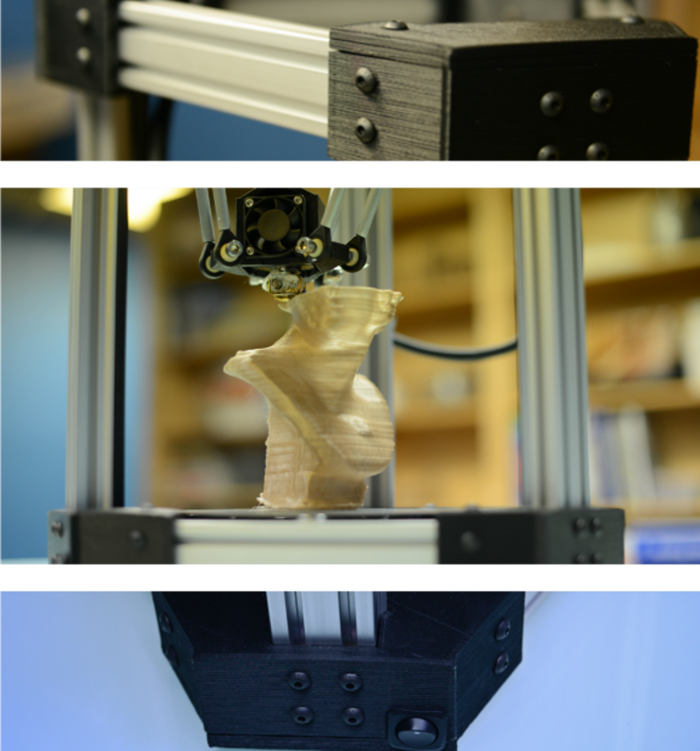
    Another day, another 3D printer on Kickstarter. But the DeltaMaker, which launched its campaign this week, is a little different from some of the others we’ve seen to date. It’s not the cheapest, and it’s not the one with the most recognizable branding, but it is relatively affordable and has a slightly different mission than most, with a design intended to shine in public spaces, rather than hidden in an industrial workshop.

    DeltaMaker’s founders believe that the process of digital printing is at least as interesting and valuable as the products it creates, and their backgrounds reflect their interest in the actual engineering that goes into printing a 3D product and the hardware required to make that happen. The Orlando-based company consists of Zach Monninger, a mechanical engineer and MBA; Craig Rettew, an electrical engineer; Robin Lopez, an aerospace engineer; and Bob Houston, a software engineer. If ever there was a group of people who were all about the process, this is it.

    DeltaMaker gets its name from the fact that it’s a so-called “delta robot,” which is a three-armed design used in industrial and manufacturing applications of all stripes, since it can precisely position the business end (or extrusion head, if you want to be technical) along X, Y, and Z axes. The delta robot design is not only functionally effective, it also makes for a visually interesting printing process, one that DeltaMaker suggests will play well in your tastefully decorated sitting room, in classrooms and in waiting rooms and gallery spaces everywhere. The idea is not just to educate, but also to entertain; the founders envision a 3D printing process captivating the attention of a group of kids waiting to see the dentist, or keeping guests entertained at a dinner party if your table conversation gets dry.

    Accordingly the DeltaMaker is relatively simple in its design, keeping things basic with a tall aluminum structure that’s only 9-inches in diameter, and a 360-degree viewing angle of the building chamber itself. That design likely won’t change too much from current prototype to shipping product – it’s already on its 4th revision and the team says they’re in the final stages of detail engineering.

    As for pricing, the early bird pledge level of $499 for a fully assembled, working unit sold out incredibly quick. Now, you can get in at a minimum of $1,099, but those are also special tiers. Even if you come very late to the game, pricing for Kickstarter backers tops out at $1,599 for a fully assembled unit, which is still not too expensive for the 3D printer category.

  • This week’s best questions, ideas and debates from TED Conversations

    TED-Conversation-generic-imageTED Conversations is a unique space where any member of this community can get feedback on an idea, ask a question that they just can’t get out of their mind, or start a respectful debate on an issue they hold near and dear to their heart. This week, dozens of new conversations were started — from “What does the average citizen need maths for?” to “How can overly empathetic people compete in this world?” Here, a sampling of the highlights from this week.

    This week, TEDx Organizer Ellen Feig posed a thought-provoking question:  Can you teach young people to be moral? She wrote:

    Currently I am working on a professional development platform focused on teaching college students ethics and morality. Young people seem to be incredibly disengaged from others, have little sense of what it means  to be moral, gracious or ethical and don’t care. How can we teach morality or is it something  that is innate?

    To which Lejan responded:

    Most of our fairytale culture is based on the idea of teaching moral concepts to young people, yet there is no guarantee that what is taught will be taken. A moral itself is no constant entity and is constantly changing and mixed with religious, political and social ‘belief systems’, it is a task on its own for each generation to do their best in trying to hand over what fells right for them in that moment in time.

    If you, as you describe, deal with young people who already ‘don’t care’, your question is without doubt a good one! When I look at myself, I got all of my ‘moral core values’ exclusively within my family and at a very young age. And this without being directly taught, like, ‘Today my dear we will teach you about ‘lyng’, ‘stealing’ and ‘envying’ .. :o) It was the overall ‘atmosphere.’ … I personally believe that a positive childhood in love and care is the most influential factor for the development of a strong moral compass and that ‘outside’ institutions like childcare, kindergarten and schools are hopelessly over-strained to compensate for that.

    With 70 comments and 12 days to go before the conversation ends, this promises to be an interesting discussion. View the full exchange » 

    Meanwhile, Genevieve Tran shared an inspiring idea: Using the online community to build a collection of personal photos to capture pre-war Afghanistan. Genevieve writes:

    In another TED conversation led by a young person from Afghanistan, he asked the community what we’d like to be able to see in the future. He himself has never seen peace in his country and wished to see this, above all.

    This country has been put on hold for 30 years. And the younger generation in and outside of it has no memory of it, really, of being anything but a warzone, a wasteland. We have such a strong digital culture and digital memory now. Why not “create” an Afghanistan that we want? I created a page that anyone can post on — do you know of anyone who remembers a peaceful Afghanistan in this lifetime? I think it would be nice for young, Internet-connected Afghans to look at 🙂

    Finally, member Domagoj Hackenberger sparked a thought-provoking debate: Is the total eradication of mosquitoes a true solution?  He pointed out:

    Mosquitoes have a massive ecological role in nature. Especially as the main food source for great number freshwater fish and birds.

    To which Kasper Mortensen responded:

    The ecological aspect would seem tricky at first glance, but it really isn’t. Even with this technology available to us, humans are in no way close to becoming the ‘Banes of Mosquitoes’. In fact, our current behavior is the best thing that has ever happened to the mosquitoes; by giving them mobility to spread across the world, we have made them one of the strongest species on this planet. Mosquitoes have no natural capabilities that would allow them to spread in this way. Most mosquitoes have no business being in the Americas at all. So if we are doing anything, we are in fact correcting our previous disturbance of nature.

    And also; since all males die within days, we can actively stop our ‘treatment’ at any given point. We have total control of the development, and can specify the exact number of mosquitoes world wide that we want.

    This technology is literally perfect. It is for these kinds of situations that the word ‘perfect’ exists.

    And check out lots more fascinating discussions and debates over at TED Conversations » 

  • Transgenomic Closes on $8.3M

    Transgenomic Inc., which is traded on the over-the-counter Bulletin Board, has raised $8.3 million in financing from new and existing investors, including entities associated with Third Security. The money will be used for working capital, the company said.

    PRESS RELEASE

    Transgenomic, Inc. (OTCBB: TBIO) announced today that it has entered into definitive agreements with a syndicate of institutional and other accredited investors to raise gross proceeds of $8.3 million in a private placement financing. The syndicate was comprised of new and existing investors, including entities associated with Third Security, LLC, a leading life sciences investment firm.

    Pursuant to the purchase agreement, Transgenomic has agreed to issue an aggregate of 16,600,000 shares of the Company’s common stock at a price per share of $0.50, as well as 5-year warrants to purchase up to an aggregate of 8,300,000 shares of common stock with an exercise price of $0.75 per share.

    Net proceeds from this offering will be used for general corporate and working capital purposes, primarily to accelerate commercialization of several of the Company’s proprietary genetic tests. The closing of the offering is expected to occur on or about January 30, 2013, subject to standard and customary closing conditions.

    Lazard Capital Markets LLC served as the lead placement agent for the offering, with Craig-Hallum Capital Group LLC acting as co-placement agent for the offering.

    The securities offered in this private placement transaction have not been registered under the Securities Act of 1933, as amended (the “Securities Act”), or applicable state securities laws. Accordingly, the securities may not be offered or sold in the United States except pursuant to an effective registration statement or an applicable exemption from the registration requirements of the Securities Act and such applicable state securities laws. Pursuant to the terms of a registration rights agreement entered into with the investors, Transgenomic has agreed to file a registration statement with the Securities and Exchange Commission registering the resale of the shares of common stock sold in the offering and issuable upon exercise of the warrants. Any offering of Transgenomic’s securities under the resale registration statement referred to above will be made only by means of a prospectus.

    This press release does not constitute an offer to sell or the solicitation of an offer to buy the securities, nor shall there be any sale of the securities in any jurisdiction in which such offer, solicitation or sale would be unlawful prior to the registration or qualification under the securities laws of such jurisdiction.

    About Transgenomic, Inc.

    Transgenomic, Inc. (www.transgenomic.com) is a global biotechnology company advancing personalized medicine in cardiology, oncology, and inherited diseases through its proprietary molecular technologies and world-class clinical and research services. The Company is a global leader in cardiac genetic testing with a family of innovative products, including its C-GAAP test, designed to detect gene mutations which indicate cardiac disorders, or which can lead to serious adverse events. Transgenomic has three complementary business divisions: Transgenomic Clinical Laboratories, which specializes in molecular diagnostics for cardiology, oncology, neurology, and mitochondrial disorders; Transgenomic Pharmacogenomic Services, a contract research laboratory that specializes in supporting all phases of pre-clinical and clinical trials for oncology drugs in development; and Transgenomic Diagnostic Tools, which produces equipment, reagents, and other consumables that empower clinical and research applications in molecular testing and cytogenetics. Transgenomic believes there is significant opportunity for continued growth across all three businesses by leveraging their synergistic capabilities, technologies, and expertise. The Company actively develops and acquires new technology and other intellectual property that strengthens its leadership in personalized medicine.

    Forward-Looking Statements

    Certain statements in this press release constitute “forward-looking statements” of Transgenomic within the meaning of the Private Securities Litigation Reform Act of 1995, which involve known and unknown risks, uncertainties and other factors that may cause actual results to be materially different from any future results, performance or achievements expressed or implied by such statements. Forward-looking statements include, but are not limited to, those with respect to the closing of the proposed offering and the expected use of proceeds from the offering. The known risks, uncertainties and other factors affecting these forward-looking statements are described from time to time in Transgenomic’s filings with the Securities and Exchange Commission. Any change in such factors, risks and uncertainties may cause the actual results, events and performance to differ materially from those referred to in such statements. Accordingly, the Company claims the protection of the safe harbor for forward-looking statements contained in the Private Securities Litigation Reform Act of 1995 with respect to all statements contained in this press release. All information in this press release is as of the date of the release and Transgenomic does not undertake any duty to update this information, including any forward-looking statements, unless required by law.

  • Samsung Reports Record Fourth-Quarter Profits

    Samsung Electronics today announced its fourth quarter earnings. As expected, the company pulled in record fourth-quarter profits, taking in 7.04 trillion won ($6.5 billion) in net profit. That’s a 7% increase over their third-quarter earnings, and an over 75% increase from its profits in the fourth quarter of 2011.

    “Despite uncertainties in Europe and concerns over the U.S. fiscal cliff creating a difficult business environment, we did our best this quarter to achieve strong earnings based on a strategic focus on differentiated and high value-added products as well as our technological competitiveness,” said Robert Yi, Head of Investor Relations at Samsung. “Heading into this year, we are expecting a slow recovery in the component business due to reduced capital expenditures, while competition in the set business will intensify further as demand slows and the mid- to low-end market expands.”

    Samsung’s fourth-quarter revenues of 56.1 trillion won ($52 billion) rose on the strength of its mobile device and mobile component sales. Sales of the company’s flagship Android phones, the Galaxy S III and the Galaxy Note, have reached tens of millions of units worldwide. Samsung did mention, however, that sales of DRAM for PCs are down – a sign of the declining PC market itself.

    Samsung expects its growth to remain stable throughout 2013, though it cites a “tepid global economy” and increased competition in the mobile device market as possible challenges. The company believes its growth will be driven by its LED TV sets, and expects the market for TVs over 60 inches to grow in 2013.

  • Reuters – Compuware Turns Down Buyout Offer

    Business software maker Compuware Corp. turned down hedge fund Elliott Management Corp‘s proposal for a $2.3 billion buyout, choosing instead to proceed with spinning off a non-core unit, Reuters reported. Paul Singer’s Elliott Management had offered in December to buy Compuware for $11 per share, raising questions about the management of the company.

    (Reuters) – Business software maker Compuware Corp. turned down hedge fund Elliott Management Corp’s proposal for a $2.3 billion buyout, choosing instead to proceed with spinning off a non-core unit.

    Paul Singer’s Elliott Management had offered in December to buy Compuware for $11 per share, raising questions about the management of the company.

    Elliott’s proposal significantly undervalues the company and is not in the best interest of shareholders, Compuware said in a statement.

    Elliott had blamed Compuware for underperforming its potential and promised to turn it around if the deal went through.

    Compuware said it would rather proceed with the IPO of its Covisint unit and cut costs.

    The company, which filed for a possible Covisint IPO last year, is expected to sell a 20 percent interest in the offering and distribute the rest among its shareholders.

    Eliott had declared an 8 percent economic interest in Compuware when it made the offer last year. According to the latest filing, it beneficially owns 14.2 million shares, or 6.6 percent of the outstanding shares.

    Compuware also approved an annual dividend of 50 cents per share starting from the first quarter of fiscal 2014, which begins in April.

    Compuware shares rose 2 percent to $11.00 before the bell on Friday.

  • Injustice: Gods Among Us Gets Even More Mysterious In Latest Trailer

    Injustice: Gods Among Us, the DC fighter coming from the Mortal Kombat team, is still shrouded in relative secrecy. We don’t know exactly why all these heroes and villains are fighting against each other. Director Ed Boon has dropped a few hints here and there, but it’s mostly still a mystery. A new cinematic trailer doesn’t help matters much.

    The latest trailer for Injustice features notable characters from the DC Universe presumably talking about the events that led up to the game. In particular, Superman laments that he couldn’t save everyone this time. It seems that Lex Luthor is also using the events of the game to rid the world of Superman once and for all.

    Beyond the aforementioned characters, we get another good look at The Flash, Wonder Woman, Batman and The Joker. Other confirmed characters for the title that don’t show up in the trailer include Bane, Catwoman, Cyborg, Deathstroke, Green Arrow, Green Lantern, Harley Quinn, Nightwing and Solomon Grundy. It’s going to be interesting to see how the writers at DC and NetherRealm Studios bring all these iconic characters together under one title. This latest trailer suggests that the story will at least be flashy and well narrated, even if it makes no sense in the end.

    Injustice: Gods Among Us will launch on the PS3, Xbox 360 and Wii U on April 16.

  • The Internet Is Essential to Life and a Civil Right, According to German Court

    In Germany, people can request compensation when they’ve been deprived of things deemed essential to life. And now, thanks to a court ruling, the internet is part of that class.

    A Federal court in Karlsruhe has made a pretty important decision with implications for the future of internet law: the internet is an “essential” part of life. German press is calling it a “landmark ruling.”

    The case that produced the ruling involves a man whose DSL service was interrupted for a period of two months in 2008-2009. He had already been compensated for having to use his mobile phone, instead of the landline/fax services provided by his DSL connection. But that wasn’t enough in his mind. He also wanted to be compensated for the inability to access the internet.

    A court agreed that he should be compensated, saying:

    “The Internet plays a very important role today and affects the private life of an individual in very decisive ways. Therefore loss of use of the Internet is comparable to the loss of use of a car.”

    They went on to say that the internet is a “civil right” and that it is fundamental to life.

    Speaking of the internet as a human right, a recent ruling in a U.S. court, although stemming from a much different type of case, also used language like this when talking about internet access. An appeals court has overturned an Indiana law barring registered sex offenders from accessing the internet, saying that it’s “unconstitutionally overbroad.” The ACLU had argued that communicating on the internet was too integral to functioning in a modern society to be restricted, as it was a First Amendment issue. The appeals court agreed.

    [ARD TV via Reuters via The Verge]

  • Stephen King Publishes “Guns” Essay As Kindle Single

    Best-selling author Stephen King has written a personal essay called “Guns,” and has published it exclusively as a Kindle Single in Amazon’s Kindle Store. Amazon made the announcement this morning.

    King said of the essay, “I think the issue of an America awash in guns is one every citizen has to think about. If this helps provoke constructive debate, I’ve done my job. Once I finished writing ‘Guns’ I wanted it published quickly, and Kindle Singles provided an excellent fit.”

    “It’s exciting to offer a way for a brilliant writer like King to publish quickly, and to reach a large audience of loyal readers and new customers,” said David Blum, editor of Kindle Singles. “King finished this essay last Friday morning, and by that night we had accepted it and scheduled for publication today.”

    The essay begins:

    Here’s how it shakes out.
    First there’s a shooting. Few of the trigger-pullers are middle-aged, and practically none are old. Some are young men; many are just boys. The Jonesboro, Arkansas, school shooters were 13 and 11.

    There is a longer preview available if you want to sample it. The essay can be found here for $.99 (along with the preview).

    While King is known best for his often epic fiction, he is certainly no stranger to non-fiction, and this is simply his latest slice of it. In addition to his works like Danse Macabre and On Writing, he has contributed numerous articles to Entertainment Weekly, to name a few.

  • Fake J.C. Penney Prices Are No More, Store Says

    It’s a rather sneaky way of doing business, but getting into the heads of customers and making them think they’ve gotten a better deal than they actually have is something retailers have been doing for decades. Rather than putting a fixed price on an item, they’ll put an original price–often jacked up to twice what they’re really selling it for–as well as a sale price. Finding a cute top for $40 is much more of a steal when you find it marked down to $15 or $20, right?

    That’s what retailers are hoping you’ll think, and the practice is called “anchoring”, meaning your perception of the item’s value is set right away. Seeing it marked down to half or less than half off means you’re more likely to buy it, even if you might not need it, and in today’s economic downturn, that’s the last thing shoppers want to do.

    Stores are catching on to what their customers want, however, and J.C. Penney is one of them. Part of a new overhaul for their entire system includes pricing items at what they actually are–”Everyday Prices”–which will not be reduced in weekly sales. Instead, the store will conduct month-long sales on certain items, and clearance sales will be on the first and third Friday of every month. Every item will have a new simplified tag to keep customers from getting confused, and that includes setting prices at a flat number instead of ending in .99.

    J.C. Penney saw a sharp decline in sales over the past several months compared to their competitors, and Ron Johnson, C.E.O., admits he knows why.

    “Our stores are tired; they haven’t been updated,” he said. “So customers ignored us 99 percent of the time. At some point, you, as a brand, look desperate if you have to market that much.”

  • Facebook Blocks Yandex’s New Wonder App (And Twitter’s Vine) From Data

    On Thursday, Russian search company Yandex launched a new social search app for the iPhone, called Wonder. The app relied on Facebook, Twitter, Instagram, Foursquare, iTunes and Last.fm data. Unfortunately for Yandex, Facebook pulled access to its data, which was kind of a key feature.

    In fact, Facebook has been putting the kibosh on a number of apps it sees as potential competitors when it comes to API access, as Josh Constine at TechCrunch reports, citing Twitter’s new Vine video app and Voxer as other casualties, as both were cut off from Facebook’s Find Friends API, which lets apps give users access to their Facebook friends.

    Facebook’s Platform policy says, “Competing social networks: (a) You may not use Facebook Platform to export user data into a competing social network without our permission; (b) Apps on Facebook may not integrate, link to, promote, distribute, or redirect to any app on any other competing social network.”

    It also says, “You must not include data obtained from us in any search engine or directory without our written permission.” Constine shares a statement it receive from Yandex before Facebook even blocked its access:

    We note that Yandex is not in violation of Facebook Platform Policies providing for restriction to use data obtained from Facebook in a search engine or directory for the reason that Wonder is not a search engine or a directory. Our application is a personal assistant that helps browse and organize information that is exclusively available to and associated with relevant account of the relevant user in various social networks and services.

    On the contrary, [a] search engine is conventionally understood as an information location tool which automatically indexes tens of thousands of publicly available websites, fetches information with unrestricted access and is freely accessible to any Internet user. In addition, we would like to note that Wonder requests [a] user for specific permission to access each portion of information available to the user through a social network or services and never accesses information or data which is beyond the consent, availability for or extent of permission expressly granted by the application user. It is further to be noted, that the application does not perform any automated operations, unless these are specifically permitted by the user.

    Clearly, Yandex saw this as a potential problem, and launched anyway, but based on the nature of the app, and how it is coinciding with the roll-out of Facebook’s own Graph Search, it’s no surprise that Facebook would view it as a competitor.

    The companies are reportedly in talks about how to proceed with the app, but if Facebook doesn’t budge, it’s not going to make Wonder nearly as attractive to users as it may have been otherwise (and the jury was still out on that anyway). Apparently, Wonder can still operate with the other aforementioned networks’ data (for now), and that even includes Facebook’s Instagram. The real social data, as we all know, however, is in Facebook itself.

  • Smartphones Will Soon Be Equipped With Their Own “Kinect”

    You may not who PrimeSense is, but you definitely know the company’s products. The Israel-based company produces the sensors used in Microsoft’s Kinect full-body motion controller. Now the company is working to bring that same technology to smartphones.

    PrimeSense recently announced that its motion sensing technology for mobile phones has shrunk enough to be able to fit comfortably into mobile devices. The hardware is called Capri 1.25, and features a number of enhancements over the past versions of the technology.

    Capri 1.25 is 3D sensing technology at its heart, and as such, will be judged by its ability to scan the environment around it. The latest hardware has the following features:

  • Field of View 57.5×45
  • Range 0.8m-3.5m
  • VGA depth map (640×480)
  • USB2.0 powered
  • Standard off the shelf components
  • OpenNI compliant
  • All of the above technical information may not mean much to you, so here’s a video that shows what PrimeSense’s technology may be capable of in the near future:

    Will the Capri 1.25 be able to do all that right now? Of course not, but PrimeSense obviously thinks that 3D motion tracking is the future. They think it will be in everything from smartphones to store displays.

    Speaking of smartphones, we may start seeing the technology appearing in mobile devices later this year. PrimeSense says the chipset will be available in mid to late 2013 for those who able to buy 100,000 chipsets annually.

    [h/t: Fast Company Design]

  • Assassin’s Creed III “King Washington” DLC Coming February 19

    Since the launch of Assassin’s Creed III, all fans have been waiting for is the provocative DLC that depicts George Washington as a power-hungry tyrant. Today, Ubisoft finally announced that “The Tyranny of King Washington” will be released on February 19 for Xbox 360 and PC. PlayStation 3 owners will be able to download the update starting February 20.

    The DLC released at that will actually be the first of a “three-part tale,” according to Ubisoft. The first installment will be titled “The Infamy,” and show that George Washington has been crowned the king of the United States of America. The other two parts of the story will be coming as their own individual DLC add-on, and will have to be purchased separately.

    “The Tyranny” will cost $10/£8 or 800 Microsoft Points via Xbox LIVE. Assassin’s Creed fans who bought the Season Pass DLC bundle will be able to download the new content as soon as it is available, and all episodes of “The Tyranny of King Washington” will be included in the Season Pass.

    Ubisoft did not set a date for any upcoming DLC for the Wii U version of Assassin’s Creed III. It did, however, promise that all Assassin’s Creed III DLC will be coming to the Wii U in the future.

  • Where Are the Ray Krocs of the Social Sector?

    If you were offered the opportunity to finance a high risk, low return investment, how eager would you be to write a check? That is exactly the premise of most impact investing opportunities today. Until the return outweighs the risk, impact investing will remain a small niche category. To solve more social challenges in a financially sustainable way, we need to create opportunities with safe, dependable social and financial returns. It’s time to bring a proven business model to the social enterprise space: the franchise.

    Franchising has a special place in our economic system. It’s not sexy, but it’s effective. For example, it’s much less risky to franchise a restaurant than to start your own. That’s what Ray Kroc did: He franchised a McDonald’s, bought the company, and grew it to the largest restaurant chain in the world, with over 31,000 locations today, 80 percent of which are franchised. We need to find and support the Ray Krocs of the social sector, who can seek out promising social enterprise ideas sourced by philanthropic capital and take them to scale.

    Right now we’re effectively asking every social business to start from scratch. We conflate inventors with developers of social enterprises and romanticize the celebrity social entrepreneur. Instead, we should be searching for professional managers and investing in their capacity to turn a social entrepreneur’s vision into a scalable, sustainable business. We should package proven social business models that motivated franchisees could copy. These business people would spend their energy building the business in a new market not experimenting with an untested model. This would provide scale to social enterprises and reliable returns to those who invest in them.

    If we want to have an impact on a global level, we must stop using one-off social business models and find ways to replicate what works. Take Groupe SOS in France, one of the largest social enterprises in the world with 10,000 employees, one million beneficiaries, and $750 million in annual revenues. Over the past 28 years, they’ve refined nine different business models to serve traditionally excluded individuals. They’re now actively working to franchise these proven models to other geographies, most promisingly in Seoul, South Korea.

    To bring the franchise model to the social sector, we need to do four things:

    1. Determine which models work. We know there are great models out there but we need to understand which have gone through the proof of concept phase and are ready to be taken to the next level. To determine which are appropriate for franchising, we need to sift through the multiple channels — early-stage impact investing funds, academic field research, entrepreneurial competitions — and find social businesses that are successful and scalable.
    2. Package the essential elements of each model. A restaurant franchise buys the core elements of the business — brand, menu, advertising. But then they adapt those fundamentals to their environment to make it successful. The core pieces of a winning social enterprise model must be packaged in a way that’s portable to different environments. We aren’t naïve to think that one size fits all, but there’s a lot to be gained by bringing best practices and proven strategies to new geographies in thoughtful ways.
    3. Educate and “sell” to franchisees. Once the fundamentals of a working model have been packaged, we must help people find the opportunities. We can equip them with ready-to-launch models and the basic management skills to take them to new markets — everything from impact measurement to supply chain management. We might consider offering a training curriculum within a university or another organization that would educate the franchisee on the business model and effective management, and then provide both start-up and ongoing support.
    4. Support the franchises. Like a restaurant franchise that shares advertising costs, centrally develops new menu items, and shares other resources, we need to provide ongoing support for social impact franchisees. The nature of this support will vary, but this ability to spread the risk, reward, costs, and resources between the home office and independent franchisees is a core benefit. This two-way relationship will also improve the underlying business model as each franchisee provides valuable feedback on what’s worked and what hasn’t in his or her market.

    We need to match the willing, motivated people who can change the world if they’re given a blueprint with the vast amount of investment capital that wants the same. Right now we’re missing a huge opportunity that’s right in front of our noses. Instead of teaspoons of capital being spread across small entrepreneurs all over the world, we need to find proven models, capitalize them, train the management teams, and take them to scale. If we’re willing to let go of the artisanal nature of social enterprise, we can have global impact.

    Follow the Scaling Social Impact insight center on Twitter @ScalingSocial and register to stay informed and give us feedback.

  • McDonald’s Fish Now All-Sustainable

    Ever wondered what type of fish you’re getting when you order “Filet-O-Fish” at McDonald’s? Well, now you’ll know: wild Alaskan Pollack, which is now sustainable.

    The fast-food chain announced recently that they are now serving the Filet-O-Fish sandwich–and will be unveiling “Fish McBites” soon–using only fish that was sustainably caught, making it eco-friendly. The company will pay annual fees to the Marine Stewardship Council for the privilege of placing a bright blue “Certified Sustainable Seafood” label on the containers, which lets customers know that what they’re eating not only meets high standards for quality, it was also taken with care from the ecosystem.

    McDonald’s is set to unveil the Fish McBites in February for a limited time, but if they go over well, the restaurant could keep them on the menu for good. After a tough last quarter–in which sales were down from the same time last year–McD’s brought back the McRib sandwich off-schedule, knowing it would help reign in some diehard fans. Still, they don’t expect the coming year to magically take off, either.

    “By no means do we think 2013 is going to be an easy year,” CEO Don Thompson said.

    McDonald’s is joining competitors Wendy’s and Taco Bell in reinventing their menu, changing up the offerings to include healthier fare after receiving bad press in recent years due to customers complaining of health concerns. They say they’re also revamping stores all across the country, updating the look and offering longer hours.

    Images: Facebook

    mcdonald's fish

  • French Government Ditches ‘Hashtag’ for ‘mot-dièse’

    In an attempt to “encourage the presence of the French language on social media networks” against the influx of English language domination of the web, as well as to just be plain difficult, the French government is suggesting that people quit using the term “hashtag.”

    Instead, they suggest that people use the French term “mot-dièse,” which literally translates to “sharp word” – as in the musical symbol for a sharp. The government isn’t banning its citizens from using the word “hashtag,” but they will be officially replacing it with “mot-dièse” on all official documents and accounts.

    The Legifrance government page has a definition page for mot-dièse:

    Suite signifiante de caractères sans espace commençant par le signe # (dièse), qui signale un sujet d’intérêt et est insérée dans un message par son rédacteur afin d’en faciliter le repérage.

    With the aid of Google translate, that means “Suite signifying characters without spaces starting with # (hash), which indicates a topic of interest and is inserted into a message to his editor in easy identification.” So a hashtag, but not really.

    Some French Twitter users have been quick to point out the the musical sharp symbol is not perfectly swappable with the hashtag, as the sharp symbol has a slightly different lean to it.

    This news comes in the same week that a French court ruled that Twitter must give up the identities of some anti-Semitic users following a scandal involving an offensive hashtag.

    [The Local via Huffington Post]