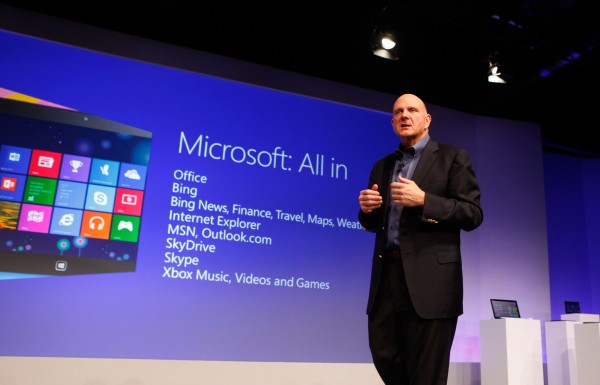
Category: News

  • Why are Windows 8 sales so good when PC shipments are so bad?

    All signs pointed to another disappointing quarter for Microsoft’s Windows division. But, instead, with fiscal second-quarter results announced today, revenue rose 24 percent year over year. Meanwhile, PC shipments are down 6.4 percent during same time period, according to IDC, which doesn’t seemingly reconcile with Windows OEM revenue rising 17 percent. What’s up with that?

    There is sense behind the numbers, which forebode potential trouble ahead the next couple quarters, unless PC shipments pick up or Microsoft hits a big home run with Surface Pro, which goes on sale February 9. Simply stated: The company got big lift by selling cheap Windows Pro upgrades, something that ends January 31. OEM increase is byproduct of PC makers stocking the shelves with new models. Neither is sustainable, raising question: Will Windows 8 be a one-hit wonder? Meaning: One quarter of sales greatness?

    Microsoft reported Windows & Windows Live revenue of $5.88 billion, which benefited from a $622 million deferral. Year over year growth was 24 percent with the deferral, 11 percent without it. From real-world sales then, that’s $5.26 billion. Biggest sales growth came from outside the typical PC ecosystem. “Non-OEM revenue grew over 40 percent, driven by Windows 8 upgrades, sales of Surface and double-digit growth in volume licensing”, Chris Suh, head of Microsoft investor relations, says, during today’s earnings conference call.

    Grand Opening Sale

    Let’s focus on those upgrades first. There are three kinds, all to Windows 8 Pro:

    • $14.99 — for people buying Windows 7 PCs from June 2 to January 31
    • $39.99 — online, direct-from-Microsoft
    • $69.99 — retail packaging with DVD

    The pricing is the lowest Microsoft has ever offered for the Professional product. Heck, the non-pro version isn’t even yet available for sale, outside the OEM version. The lesser Windows 8 goes on sale next week.

    Come February, Windows 8 pricing jacks up big time, presenting a hefty barrier to retail sales, which tend to be strongest during the first few months anyway. But I suggest, given Windows great quarter set against PC declines, those discount upgrades matter big time, and last day is January 31.

    A day later, Windows Pro upgrade will sell for $199.99, a 400-percent increase over the $39.99 deal and 186 percent from the other one. I can easily imagine these perceived price increases suddenly stopping most upgrades. I say perceived since actual Windows 8 and Pro pricing is same as the comparable previous versions. What’s different is how little pay now.

    Question: How does the revenue distribute? In past quarters, Microsoft execs said that OEM sales account for 75 percent of Windows revenue. I must assume higher for the holiday quarter, given sluggish PC sales and low-cost retail upgrades. Microsoft boasts 60 million Windows 8 licenses sold. If you divide that number into $5.26 billion, you get average selling price of $87.64.

    But, technically, Microsoft started selling Windows 8 to some businesses before the quarter started. So while the company would have you believe 60 million since October, the sales period is more like August. Something else: Some smidgen of the Windows & Windows Live division revenue comes from other stuff. I started to cut the numbers various ways but decided it’s unnecessary this late in the day to make the point — that prices go up as much as 400 percent at retail, which is sure to slow license sales.

    Slam the Brakes

    But brakes don’t just stop there. Calendar first quarter is typically slowest for PC sales. For Microsoft what matters is new shipments into the channel, because that’s when license revenue goes on the books. Many years ago, different accounting meant Microsoft didn’t get paid until the PC sold. Now the money comes up front, but not if OEMs don’t build systems to ship.

    The “Who Wants to be a Millionaire?” question: How much PC inventory remains unsold from the holidays? If channels are full, as I expect they are, Microsoft sells fewer Windows 8 licenses during first quarter.

    You see where this is going right?

    There’s still a month of cheap Windows 8 upgrades on the books and, honestly, Microsoft should jack up prices to normal levels. If retail sales will fall off anyway, maximizing margins is the better approach. Timing is the question. Is Microsoft acting too soon, or just right?

    The answer to the question means much. Microsoft is about to launch Office 2013, and there is a longstanding pattern of at least some sales tie to Windows. Many businesses will upgrade Office and OS at the same time. Some consumers, too. That could be good for PC sales, but retail is opportunity. If Mr. Small Business is going to get Office 2013 and Windows 8 Pro anyway, let him pay 200 bucks instead of $40 or $70. From that perspective, Microsoft could make more from the Office glow by ditching cheap Windows upgrades. Surely some bean counter inside the company with access to numbers I don’t has crunched them.

    Then there is Surface Pro, which if successful could open exciting new revenue source for Microsoft.

    So the answer to the question is low-cost upgrades and PC channel stocking. As for the one-hit wonder, there’s still chance that calendar first quarter will be a reprise. Not a No. 1 smash, perhaps, but at least placing on the charts.

  • West Wing Week 01/25/13 or… “Behind the Scenes: Inauguration 2013”

    This week, Washington D.C. was transformed into an historic stage, with an estimated one million people on hand to witness the President and Vice President take the Oath of Office at the United States Capitol. Through it all, West Wing Week was there, from the terrace of the Capitol to backstage at the balls. America, take a moment to look back at where we've been this week for this special edition of West Wing Week, January 18th to the 24th, or "Behind the Scenes: Inauguration 2013."


    Saturday, January 19th

    • The First Family participated in the National Day of Service, helping out in the construction of some new bookshelves at Burrville Elementary School in Washington DC.
    • The first Lady and Dr. Biden kicked off Inauguration weekend by honoring military families at the, “Our Children, Our Future” kids’ concert.

    Sunday, January 20th

    • The Vice President was sworn into office by Justice Sotomayor.
    • The President traveled to Arlington National Cemetery to meet the Vice President for a wreath laying ceremony at the Tomb of the Unknowns.
    • The President was officially sworn into office by Chief Justice Roberts.

    Monday, January 21st

    • The 57th Inaugural Ceremony in our nation’s history occurred on the National Mall, followed by the Inaugural Parade.
    • In the evening, the President attended the Commander-in-Chief’s Ball and the Inaugural Ball, with Jennifer Hudson providing the soundtrack to his dance with the First Lady.

    Tuesday, January 22nd

    • The President, Vice President, First Lady, and Dr. Biden attended the 57th National Prayer Service at the National Cathedral.
    • The President and First Lady greeted guests on a White House tour.
    • The President attended the Staff Ball to thank and celebrate with those who worked on his campaign and in his White House administration.

    Thursday, January 24th

    • The Vice President hosted a “Fireside Hangout” on Google+ to talk about reducing gun violence.
    • The President introduced his nominee to be the Chair of the Securities and Exchange Commission, Mary Joe White, and announced that he will re-nominate Richard Cordray to direct the Consumer Financial Protection Bureau.

    read more

  • Verizon Said To Be Getting A Flagship Nokia Windows Phone (Codenamed “Laser”) Of Its Own

    lumia 900-10

    Don’t get me wrong, HTC’s Windows Phone 8X is great and all, but the rest of Verizon Wireless’ Windows Phone lineup (think the Nokia Lumia 822 and Samsung’s ATIV Odyssey) is a bit lacking in the oomph department.

    If a new report from The Verge’s Tom Warren holds true though, that may not be the case for too much longer. According to sources within Verizon, the carrier is gearing up to release a flagship Nokia Windows Phone with a spec sheet similar to the Lumia 920.

    There’s precious little other information about this device aside from the fact that it’s apparently codenamed “Laser,” and that Verizon reportedly plans to throw its considerable weight behind the device (unlike the case with the ATIV Odyssey, the poor thing). What exactly that means for Verizon is still unclear, but I can hazard a guess or two.

    I chatted with a high-level Nokia representative at Microsoft’s San Francisco Windows Phone 8 event who told me that strong retail partnerships with the country’s carriers was a priority for the Finnish company. That said, it wouldn’t be a shock to see Verizon retail workers getting some extended hands-on time with a forthcoming Windows Phone; after all, an informed retail sales force is key to Nokia moving units to those who don’t spend their days feverishly scouring tech blogs. AT&T also spends a considerable chunk of change on advertising the Lumia 900 when that was the hot new Windows Phone, and Verizon may well be doing the same (the fact that Microsoft is said to be chipping in some funds for advertising certainly doesn’t hurt).

    Oh, and just in case you were hoping against hope that the Laser name actually sticks, you can probably stop now. The moniker was used for a Pantech dumbphone not too long ago, which means the chances of strolling into your local Verizon store and picking up a hot new Laser are pretty slim.

  • The High Cost of Rudeness at Work

    An interview with Christine Porath, associate professor at Georgetown University’s McDonough School of Business and coauthor of the article The Price of Incivility.


    Download this podcast

    A written transcript will be available by February 1.

  • Hey Android Gamers, OUYA Has Heard Your Anguished Cries And Modified Its Controller

    ouya-controller

    The team behind the OUYA Android game console clearly paid a lot of attention to its looks — they nabbed Yves Behar to design the thing, after all — but not every component has passed muster with the masses. Thankfully, after hearing some discontent from early backers and developers, OUYA has taken some crucial feedback about the console’s controller seriously and has decided to make some changes.

    According to recent post on the official OUYA blog, the console’s controller will no longer sport those flat, disc-like d-pads — they’ve been replaced by a more standard cross-shaped affair that should look familiar to anyone to who’s done so much as glance a console controller in the last 20 years. The controller’s dual analog sticks have undergone a bit of a makeover too, as they now feature a grippier finish for increased precision, and the small touchpad nestled in the center of the controller has had its sensitivity bumped up to boot. Throw in some slightly-shifted left and right triggers and a battery door that isn’t as much of a hassle to open, and you’ve got yourself the makings of a half-decent controller.

    Sure, some of these may seem like minor tweaks, but any avid gamer could tell you about the importance of fit, finish, and feel when it comes to a device they’re going to be clutching for hours. And hey, by reacting to feedback early enough in the development process, OUYA (with any luck) doesn’t have to deal with the wide-scale blowback from an underwhelming controller the way Microsoft did with its original, roasted ham-sized Xbox controller. It’s heartening to see that OUYA’s community-first approach to this whole undertaking wasn’t just limited to its means of raising money — hopefully the final product will be just as thoughtful when it starts shipping to the rest of us later this year.

  • Why radical openness is unnerving and necessary: A Q&A with TED eBook authors Don Tapscott and Anthony D. Williams

    RadicalOpenness-Q&A-feature

    Secrecy and propriety used to define our cultural and professional lives. We kept trade secrets, held closed-door meetings, had whispered conversations and kept the details of our comings-and-goings to ourselves. That’s no longer the case. We have entered a new era — one characterized by openness — in which our world and our relationships have become increasingly interconnected.

    Don Tapscott: Four principles for the open worldDon Tapscott: Four principles for the open worldIt’s difficult to say what this new age of collaboration will mean. But in the new TED book Radical Openness: Four Unexpected Principles for Success, authors Anthony D. Williams and Don Tapscott (who gave the TED Talk “Four Principles for the Open World“) explore some of the questions and and uncertainties ignited by this new era. Their big question: what this will mean for the boundless inventiveness of the human mind?

    We sat down with Tapscott and Williams to ask them more.

    What do you mean by the term ‘radical openness’?

    Tapscott: We wrote the book, in part, because the word openness was so ambiguous and ill-defined. It generally tends to have very positive connotations and is associated with concepts like freedom, flexibility, expansiveness, engagement, sharing, access and candor. But in practice we find that “openness” can mean many things, depending on the circumstance. So we’ve looked at four different strategies for openness that ultimately entail some pretty deep changes in business and society.

    That leads to the other reason for writing the book. We think that leaders are not fully exploiting the power of openness in their businesses and institutions. In fact, when it comes to innovation, competitive advantage and organizational success, “openness” is rarely the first word one would use to describe companies and other societal organizations like government agencies or medical institutions. For many, words like “insular,” “bureaucratic,” “hierarchical,” “secretive” and “closed” come to mind instead.

    Williams: The new form of radical openness described in this book stands in stark contrast to the insular, bureaucratic, hierarchical, secretive and closed systems and organizations of the past.  For example, smart organizations, from education to health care to government, are shunning secretive practices and embracing transparency as a means to foster trust and speed up the metabolism of business. Industries — from software to manufacturing to pharmaceuticals — are opening up their innovation processes and treating their customers and partners as valuable sources of intelligence and new ideas. And rather than go to extraordinary lengths to control and protect proprietary resources and innovations, a growing number of companies are sharing intellectual property and releasing patents in a bid to accelerate research, foster relationships and stimulate progress in other areas where they will see profits. All this adds up to nothing less than a paradigmatic, transformative shift in the way organizations — from companies to social movements — compete and succeed.

    You say that old systems are failing us. How so?

    Williams: Times have changed. Organizations either adapt to these dramatic changes or they will die. Take the dramatic increases in transparency for example. While secrecy and opacity have been hallmarks of business behavior in the past, maintaining and defending secrets is costly and difficult in an era where billions of smartphone-wielding citizens can transmit information around the globe in a heartbeat.

    Tapscott: When it comes innovation, it’s simply the case that radical openness produces demonstrably better results. Companies that produce new products in remote, closed-off laboratories, for example, tend to be slower, less agile and less innovative than companies that open up and reach outside their boundaries to find exceptional talent and ideas. Procter & Gamble is a good example of a company that really exemplified the old industrial model of closed innovation for most of its history. This worked well until about the year 2000 when global competition began increasing and P&G found it increasingly difficult to keep up. Since embracing a radically new external collaboration program called “Connect and Develop,” the company has dramatically increased their innovation success rate by enlarging the pool of new product ideas (with close to 60 percent coming from outside the company) and the revenue drawn from them, while still managing to save over $1 billion in R&D costs annually.

    We also see examples of deep institutional failure and cases where radical openness is revolutionizing entire systems and industries, not just individual companies. We write about the crisis of innovation in drug development, for example, where the basic model for inventing and commercializing potentially life-saving medications is broken and failing society badly. The problems there have largely to do with a highly risk-averse and legalistic industry culture that comes at the expense of opportunities to co-develop early-stage technology tools, establish data standards, share clinical trial data or pursue other forms of collaboration that could lift the productivity of the entire industry. Fortunately, companies like GSK are strategically releasing patents and leading the charge toward more open models of drug development that will increase research productivity and stimulate medical progress.

    What factors are forcing the dramatic opening up of society? Financial? Societal?

    Tapscott: Changes in regulation (think the Sarbanes-Oxley Act, for example) have been influential, but arguably the most important force is the digital revolution. For the first time, billions of people can use cheap digital devices to capture and publicly disclose information that people in positions of power would rather remained hidden. This explosive combination of the spread of the Internet and the ability of people everywhere to connect and collaborate around shared interests is forcing an unprecedented degree openness in virtual every major social and economic institution.

    Why is radical openness such an unnerving concept for business?

    Williams: Radical openness is most unnerving when companies are unprepared to operate in a highly transparent environment. In the past, companies were rarely forthcoming with pertinent information, especially with regard to flaws, errors or weakness. But today they operate in a world where the Internet has wrested control of public discourse away from centralized media outlets and empowered millions of people to join the conversation. Companies not only have less and less control over information, they also have less ability to shape and massage public perceptions of their firm. Every step and misstep is instantly subject to scrutiny. And every company with a brand or reputation to protect is vulnerable to the unrelenting webs of “stakeholders” who pass judgment on corporate behavior. It’s understandable that many firms are uncomfortable with such scrutiny, especially as social media continues to accelerate the speed at which critical messages can “go viral.”

    What are the downsides to radical openness? Sometimes, unsavory forces fill the vacuum left by great change.

    Tapscott: That’s true, and we’ve argued that radical openness poses potentially graves risks to our privacy, our identity, our safety and even our sense of personal autonomy. To be sure, there is a real upside to participating in communities, seeing photos, hearing stories or knowing the location of friends and family. Sharing also helps companies deliver personalized products and services.

    But there are massive commercial and government interests, along with malevolent individuals, who have much to gain as each of us reveals highly granular personal information online. Indeed, the real problems begin when this data is assembled into profiles, matched with other info and used by employers, law enforcement officials, public sector agencies and other interested parties to make (automated) judgments about (and decisions affecting) individuals, such as whether to hire them, or whether to admit entry, or to calculate benefits or terms of an offer, or to corroborate a claim. In such circumstances, the effects of privacy loss include discrimination, especially if the data is inaccurate.

    Williams: The bottom line is that each of us has a responsibility to be mindful of the ever-growing trail digital breadcrumbs that we leave behind when a growing proportion of our daily lives play out online.

    Any great examples of organizations that first rejected this openness and then engaged it?

    Williams: It’s actually quite typical for companies to at reject the idea of openness at first. And it’s common to see situations where leaders come to realize the value of openness only after they have seen secrecy and opacity fail spectacularly. A case in point is Micrsoft. When hacking the Xbox Kinect turned into a popular Internet sport, Microsoft initially said that it would “work closely with law enforcement” to keep the Kinect tamper-proof. But after public ridicule, Microsoft quickly reversed its stance, claiming that the Kinect had been left open to tinkerers on purpose. Today, Microsoft benefits from a whole new ecosystem of Kinect applications that have been developed by tech enthusiasts around the world. These include everything from a Minority Report–style multitouch interface to a navigation system for robots to a gesture-based interface for questing in World of Warcraft. A team of students from the University of Warwick in the UK even built a robot that had the potential to navigate through post-earthquake rubble and search for trapped victims. How could this kind of unsanctioned innovation not be valuable, both for Microsoft and for its customers?

    What are some of your favorite examples of radical openness?

    Tapscott: In the book, we write about the unprecedented steps GlaxoSmithKline took in October 2012 to release all of its clinical trials data on the Web. It was an extraordinary move — a bid to aid in the discovery of new medicines and end any suspicion that the pharmaceutical giant had secrets to hide. This was an incredible first in the ultra-secretive world of drug development. Chief executive Andrew Witty called the move essential to finding new drugs to treat the diseases plaguing the world and there has been much admiration for these efforts in the broader medical community.

    In government, a growing number of public officials see openness as a positive force in increasing citizen participation and driving public sector reform. The Eye on Earth portal from the European Environmental Agency (EEA) is a case in point. This interactive mapping platform provides citizens with real-time information about environmental quality (including air and water) in Europe’s 27 member countries. Users can browse the visual imaging interfaces and drill down for detailed, neighborhood-level data about ozone levels, nitrogen dioxide, particle matter and carbon emissions. Citizens can even contribute their own data and observations about the environment around them, including first-hand experiences of climate change or potential explanations for environmental degradation in specific areas. Jacqueline McGlade, the EEA’s executive director, says the real opportunity here is that when more people understand what’s happening in their area, more will contribute to solving environmental problems.

    Does radical openness operate the same globally as in the US?

    Williams: You need only look at the Arab Spring to see that no country is immune to the forces of radical openness. That said, it’s clear that the US and other Western nations with a history of democratic traditions and with widespread access to modern technologies are well ahead of newly emerging democracies and countries like North Korea or Iran where the forces of openness are aggressively curtailed by the current regimes.

    In what ways has radical openness proved successful for different organizations?

    Tapscott: There are many, but let’s take two examples. One way radical openness can improve success is to increase trust, which is really the essential glue that binds together the complex networks of participants involved in the creation of economic value today. Companies that are transparent, and appear to have nothing to hide, are considered more trustworthy by their customers and partners. We reference Zappos, the online footwear retailer, which shares an unprecedented amount of information with its customers and suppliers in order to foster trust-based relationships. As CEO Tony Hsieh puts it: “The more they know about us, the more they’ll like us.”

    Another way that radical openness breeds success is by giving companies access ideas and capabilities that lay outside their corporate boundaries. Think about the world’s most successful mobile platforms like Apple’s App Store or Google’s Android. Conventional wisdom suggests that companies should fiercely protect the products and platforms they have worked hard to develop. But what smart companies like Apple and Google have learned from the open-source community is that exposing these assets to the world creates far greater opportunities for external parties with the right combinations of skills and insight to create something even more valuable.

    The App Store has more than 700,000 applications that have been created almost entirely by third-party developers. Meanwhile, Google has taken openness to whole different level with the open-source Android platform that allows users and handset makers to tinker with the guts of the system. Android (which has 700,000 apps of its own) has been installed on 500 million phones worldwide and is growing by 1.3 million activations a day. In both of these examples, the products themselves (iPhones or Android smartphones) have become open stages on which vast ecosystems of exceptional talent create and assemble some of the world’s best innovations.

    Is Wikileaks a good use of radical openness?

    Williams: Wikileaks is interesting because there are elements of good and bad in the way that the whistleblowing site has been deployed by Julian Assange. On one hand, revealing information about the activities of powerful individuals and institutions is a potent deterrent to misbehavior. The more people can find out, inform others and organize, the less politicians can pursue self-serving behavior, spend taxpayer dollars indiscriminately or act against the public interest. On the other hand, WikiLeaks’s approach of forcing transparency on organizations is hardly unproblematic. Why should we trust its founders to make responsible decisions about the information they disclose when so little is known about its criteria for assessing leaked documents? Who watches WikiLeaks? Can it be held accountable when sensitive and potentially life-threatening information is leaked to the public? These tough questions will be actively debated as the forces of openness intensify.

    .
    Radical Openness
    is part of the TED Books series. It is available for the Kindle and Nook, as well as through the iBookstore.  Or download the TED Books app for your iPad or iPhone. A subscription costs $4.99 a month, and is an all-you-can-read buffet.

  • Quttera URL Scanner bulks up VirusTotal

    VirusTotal.com is perhaps best known for its free virus detection service, which allows you to upload almost any suspect file for a speedy verdict from all the main antivirus engines (and several of the lesser ones, too). The service can also vet URLs for presence of malware, though, and VirusTotal has just extended this capability even further with the inclusion of a URL scanner from Quttera.

    What’s interesting about Quttera is it’s not just another signature matching tool. Instead it uses a wide range of heuristic techniques to detect JavaScript exploits, suspect HTML code, malicious PDF files and exploits concealed in other content.

    Does it work? As with most heuristic technologies, accuracy is variable: it’ll miss some threats, and raise false alarms elsewhere. We’ve had some good results with the tool, though, and its inclusion at VirusTotal is another sign of confidence. The program should be a welcome addition to the service.

    If you could use Quttera yourself, though, perhaps to monitor your own website, it’s worth keeping in mind that the service isn’t just online only. The company has also provided a Windows client which will scan your preferred URLs, entirely free of charge.

    This isn’t quite as convenient as it sounds, unfortunately. The program uses a command line-based interface, for instance, which may require a little thought initially. And you’ll need some web development and security knowledge to get the most from its detailed reports and alerts.

    If you’re running your own website, though, Quttera URL Scanner does provide an easy way to look for changes which might indicate you’ve been hacked. And the company produces similar tools to check sites from Chrome or your WordPress dashboard; check their site for details.

    Photo Credit: Aaron Amat/Shutterstock

  • Watch: “Fireside Hangout” with Vice President Biden on Reducing Gun Violence

    Vice President Joe Biden participates in a Google+ Hangout 1

    Vice President Joe Biden participates in a Google+ Hangout about the Administration’s efforts to reduce gun violence, in the Secretary of War Suite in the Eisenhower Executive Office Building on the White House complex.

    January 24, 2013.

    (Official White House Photo by David Lienemann)

    This afternoon, Vice President Biden sat down with Americans from around the country to talk about proposals to reduce gun violence in a live Google+ Hangout. During the virtual roundtable, participants from all different backgrounds asked the Vice President about topics ranging from an assault weapons ban to the Second Amendment and from mental health checks to making our schools safer. In case you missed the event live, check out the full video below, and learn more about the plan.

    This "Fireside Hangout" was hosted by Google and moderated by Hari Sreenivasan of PBS NewsHour with guests including: Guy Kawasaki, an author and technology expert; Phil DeFranco, a media entrepreneur and host of the Phil Defranco show on YouTube;  Theresa Ttillett, a mother and grandmother living in Hartford, CT; and Kimberley Blaine, a blogger and therapist who leads several parenting communities on Google+. This was the Vice President's first hangout, and the first White House hangout of the second term. 

    read more

  • Belkin To Acquire Linksys From Cisco

    Cisco announced today in a blog post that Belkin will acquire Cisco’s Home Networking Business Unit and its leading brand, Linksys. Cisco had been rumored to be looking to get rid of Linksys, and now it appears it has found a buyer.

    Cisco VP, Head of Corporate Business Development, Hilton Romanski writes:

    Linksys is a strong and enduring brand with a talented team that has helped revolutionize the way we experience the world from our homes through a wide range of home routing and networking solutions with innovative software features that enable anytime, anywhere access and control of the home network and its connected devices.

    Combined, Belkin and Linksys will create a world-class consumer networking technology provider with complementary innovation and engineering strategies. Linksys will enhance Belkin’s capabilities to meet the needs of OEMs, as well as provide access to a large user base. Belkin and Cisco intend to pursue a strategic relationship focused on a variety of initiatives including retail distribution, strategic marketing and products for the service provider market.

    Belkin shortly thereafter put out a press release announcing the acquisition intent, but did not disclose the terms.

    Belkin CEO Chet Pipkin says, “We’re very excited about this announcement. Our two organizations share many core beliefs – we have similar beginnings and share a passion for meeting the real needs of our customers through the strengths of an entrepreneurial culture. Belkin’s ultimate goal is to be the global leader in the connected home and wireless networking space and this acquisition is an important step to realizing that vision.”

    Cisco announced its own intent to acquire Intucell earlier this week.

  • Google’s Site Reliability Team: Ask Them Anything!

    The Google Site Reliability Team is currently taking questions over at Reddit. “We make Google’s websites work. Ask Us Anything!”  Participants include Site Reliability Engineers Kripa Krishnan, Cody Smith, Dave O’Connor and John Collins.

    Among the questions: When was the last time Google’s main page was down? “Home page outages almost never affect all users simultaneously,” Smith writes. “There are many different systems involved in simply connecting users to Google, and most incidents happen outside of our network. We do occasionally have network outages, which are regional, e.g. a few states or countries. We also occasionally introduce language-specific bugs, e.g. garbling CJK. As far as I can recall, the last global outage was back in 2005.”

    They’ll be wrapping up soon, but readers interested in wading through the AMA will find some interesting insights into how Google manages web reliability.

  • Microsoft Announces Record $21.5 Billion In Revenue For Q2

    The promise day has arrived – Microsoft’s Q2 earnings report. After launching a number of high profile devices, including Windows Phone 8 and Surface, many people were wondering how Microsoft’s financials were going to look. In short, Microsoft had a pretty good quarter with only a few divisions posting losses.

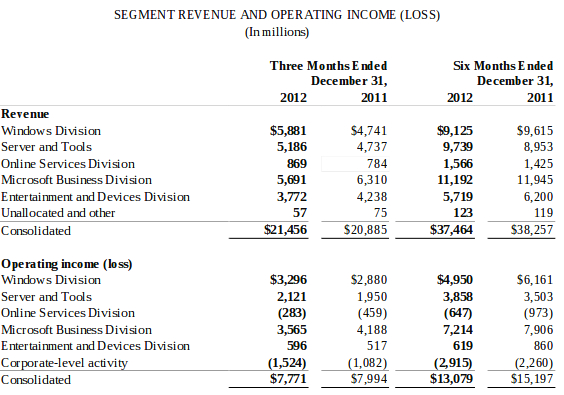
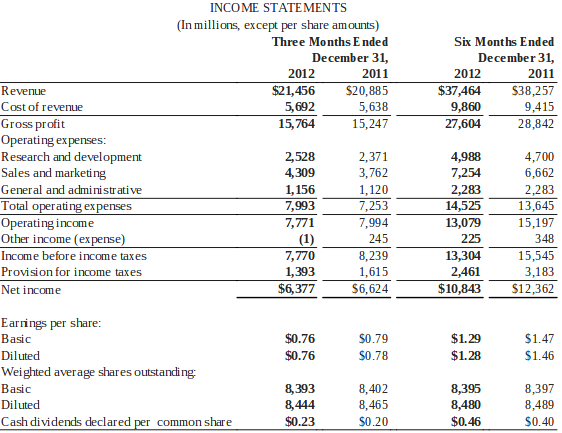
    Microsoft announced today quarterly revenue of $21.46 billion in the last quarter. Operating income for the quarter was $7.77 billion, net income as $6.38 billion and diluted earnings per share was $0.76. Most of the growth seems to have come from the launch of Windows 8 which has sold 60 million licenses to date.

    “Our big, bold ambition to reimagine Windows as well as launch Surface and Windows Phone 8 has sparked growing enthusiasm with our customers and unprecedented opportunity and creativity with our partners and developers,” said Steve Ballmer, chief executive officer at Microsoft. “With new Windows devices, including Surface Pro, and the new Office on the horizon, we’ll continue to drive excitement for the Windows ecosystem and deliver our software through devices and services people love and businesses need.”

    Windows 8 was the big performer last quarter with a posted revenue of $5.88 billion, a 24 percent increase from the past year.

    “We saw strong growth in our enterprise business driven by multi-year commitments to the Microsoft platform, which positions us well for long-term growth,” said Peter Klein, chief financial officer at Microsoft. “Multi-year licensing revenue grew double-digits across Windows, Server & Tools, and the Microsoft Business Division.”

    The Server & Tools Division also saw an increase of revenue to $5.19 billion, an increase of 9 percent from last year. Most of its success can be attributed to “double-digit percentage revenue growth in SQL Server and System Center.”

    “We see strong momentum in our enterprise business. With the launch of SQL Server 2012 and Windows Server 2012, we continue to see healthy growth in our data platform and infrastructure businesses and win share from our competitors,” said Kevin Turner, chief operating officer at Microsoft. “With the coming launch of the new Office, we will provide a cloud-enabled suite of products that will deliver unparalleled productivity and flexibility.”

    The last division to post an increase over last year was Microsoft’s Online Services Division. It posted revenue of $869 million, an 11 percent increase from last year. The big performer this time was Bing with online advertising revenue rising by 15 percent.

    The only two divisions to see a decline over last year were the Business, and Entertainment and Devices Division. the former posted $5.69 billion in revenue, which is a 10 percent decrease from the past year. That being said, Microsoft points out that its productivity software, like Exchange and SharePoint, continues to see double-digit percentage growth.

    The Entertainment and Devices Division took the biggest hit as it only pulled in $3.77 billion in revenue, an 11 percent decrease from last year. Microsoft touts the Xbox 360 as the best-selling console in the United States, but it neglects to mention how well Windows Phone 8 or the Surface tablet are doing. Those details are bound to come forward during the conference call later this evening at 2:30 p.m. PST/5:30 p.m. EST.

    Microsoft Announces Record $21.5 Billion In Revenue

  • Potential AIDS Cure Could Make HIV Dormant

    A new study published this month in the journal Human Gene Therapy has shown that a modified protein from the HIV virus itself could someday be used to prevent AIDS.

    “This is like fighting fire with fire,” said David Harrich, co-author of the study and an associate professor at the Queensland Institute of Medical Research’s (QIMR) Molecular Virology Laboratory. “If this research continues down its strong path, and bear in mind there are a many hurdles to clear, we’re looking at a cure for AIDS.”

    Harrich runs the only research laboratory in Queensland that works with the HIV virus. The protein he and his colleagues discovered, named “Nullbasic,” was formed by mutating an existing HIV protein over many generations. The researchers are confident enough in their findings that animal trials are set to begin this year.

    Patients infected with the HIV virus currently take large doses of expensive drugs to subdue the virus. “Nullbasic” treatments wouldn’t eliminate HIV from patients’ bodies but, according to Harrich, it could significantly reduce the cost of treatment for HIV.

    “I have never seen anything like it. The modified protein works every time,” said Harrich. “You would still be infected with HIV, it’s not a cure for the virus. But the virus would stay latent, it wouldn’t wake up, so it wouldn’t develop into AIDS. With a treatment like this, you would maintain a healthy immune system.”

    Harrich has been studying HIV since the early 1980s, when the very first cases of AIDS began to be diagnosed. He began as a research assistant at the University of California, Los Angeles (UCLA).

    “I’ve come close to giving up in the past,” said Harrich. “But today I’m so encouraged. I feel very fortunate because not a lot of scientists are able to stay in the same game long enough to see these sorts of developments.

    The video below was released by QIMR. It features Harrich discussing his team’s “Nullbasic” findings.

  • Michael Buble: Baby On The Way, According To Video

    Michael Buble is going to be a proud papa.

    The 37-year old crooner and his wife, Luisana Lopilato, announced the news via a brief YouTube video, which shows several seconds of Luisana’s ultrasound.

    “We’re having a baby Buble!” read the caption on the video, which was posted on Michael’s site.

    The singer has said that he has always wanted kids, but wanted to keep the pressure off his wife so that she could think about it when she was ready.

    “I’ve said to her a million times I’d love to have kids,” Bublé said. “But I always say to her when you’re ready — when you feel like you’ve lived and you’ve partied and done all the things you want to do. When you’ve worked your butt off, then tell me.”

    Buble’s stunning bride also announced the news on her Facebook page:

    I wanted to share with you this great joy with which God has blessed our families and us. Thanks to my family for being with me in every second of my anxiety for wanting to tell, and take care of me with love as they do every day. Thanks to my friends for being as happy as me and giving me the most beautiful hugs. And thanks to God for giving me one of the most beautiful joys and opportunities that a woman can get.

  • President Obama: The American People Need Richard Cordray Standing Up for Them

    Today, President Obama announced he would nominate Richard Cordray to continue as Director of the Consumer Financial Protection Bureau.

    The Consumer Financial Protection Bureau, established by the Wall Street Reform Act President Obama signed into law in 2010, is charged with overseeing the federal financial laws that specifically protect consumers—people who keep their money in banks and credit unions, pay for goods and services with their credit cards, and rely on loans to buy homes or pay for college, among other services.

    “Over the last year, Richard has proved to be a champion of American consumers,” President Obama said.  

    Thanks to his leadership, we’ve made it tougher for families to be tricked into mortgages they can’t afford. We’ve set clearer rules so that responsible lenders know how to operate fairly. We’ve launched a “Know Before You Owe” campaign to help parents and students make smart decisions about paying for college. We’ve cracked down on credit card companies that charge hidden fees, and forced those companies to make things right. And through it all, Richard has earned a reputation as a straight shooter and somebody who’s willing to bring every voice to the table in order to do what’s right for consumers and our economy.

    Have questions about how the Wall Street Reform Act is helping protect consumers? Watch the video below, or check out this handy explainer, Consumer Financial Protection Bureau 101: Why We Need a Consumer Watchdog.

    read more

  • Report: Google “Actively” Thinking About Marketing A Smart Watch

    One day in the near future, you may be wearing a Google watch to go with your Google Glass while you sit in your Google driverless car.

    According to a report this morning from Business Insider, Google is “actively exploring the idea of making its own smart watch,” and is “looking at ways it might be able to market” it. The report cites “a source briefed on the plans”.

    Google secured a patent last fall for such a device, but now, if this story holds water, the company may actually be working on such a device, as opposed to just holding the patent for patent’s sake. Here’s the abstract:

    A smart-watch can include a wristband, a base, and a flip up portion. The base can be coupled to the wristband and include a housing, a processor, a wireless transceiver, and a tactile user interface. The wireless transceiver can be configured to connect to a wireless network. The tactile user interface can be configured to provide interaction between a user and the smart-watch. The flip up portion can be displaceable between an open position exposing the base and a closed position concealing the base. Further, the flip up portion can include: a top display exposed when the flip up portion is in the closed position, and an inside display opposite the top display. The inside display can be concealed when the flip up portion is in the closed position and be exposed when the flip up portion is in the open position.

    Smart Watch

    It’s hard to imagine a watch taking the place of today’s smartphones and their nice big screens. You aren’t going to want to play Madden or watch YouTube videos on a watch, the way you do on your phone, unless we’re talking about a phone sized watch, which just seems ridiculous. Combined with a smart Glass, like Google Glass, however, there might be more reason to use it, depending on if that Glass is able to meet all of the user’s needs on its own. Then, of course there are people who will have no interest in wearing such a device on their face to begin with.

    Devices like Glass and Smart Watches aren’t likely to gain the mass market appeal that smart phones have managed to get, in my opinion. That doesn’t mean devices like these won’t find their niches.

    Apple has also been said to be “exploring development” of a smart watch.

  • The Pursuit of “App-iness”

    No two people have the same exact taste when it comes to buying jeans, cars, or even mobile apps — and I believe this is a good thing. Since we all have unique ways of using our BlackBerry devices, we have different app needs. But buying lots of apps can get expensive, so how do you determine which apps will add something to your mobile life? Here are three criteria I use when choosing a mobile app:

    • Price: The value of the right app is endless, but that doesn’t always mean the best apps are free. I like to focus on what the app allows me to do instead of how much it costs. This helps me to consider what value I can receive from the app, and how much I’m willing to pay to get the most out of the apps on my BlackBerry device.
    • Word of Mouth: When perusing the reviews in BlackBerry World, I tend to skim the highest and lowest ratings and focus on 3-star or 4-star reviews. Why? Because I feel these reviewers are posting well-thought out, detailed responses. They want the app to succeed, but they also acknowledge any perceived shortcomings and usually offer feedback for how the developer can make the app better.
    • Usefulness: Like many people I talk to, I also use my BlackBerry device for work, and so I tend to choose apps that will be the most useful to me while on the job. But I also like to have fun. So whether you classify “useful” as a powerful utility or a heart-stopping game, download what you’re going to use, and use what you download.

    Using these criteria, I’ve downloaded many great mobile apps from BlackBerry World that suit my needs for both work and play. How about you? What criteria do you use when choosing your apps? Let us know how you plan for your pursuit of “app-iness” in the comments below!

  • Foursquare Integrates School Stats from ProPublica

    Foursquare has been getting better over the past year or so by adding more information to check-ins. Their list of connected apps has grown to include some pretty useful apps like GeoPollster, which will tell you if the business you just checked-in at supports Democrats, Independent, or Republican candidates with their campaign contributions. Or After Credits, an app that I particularly like which tells you whether or not you need to stay for any bonus scenes after the movie you just checked-into.

    Today, Foursquare is announcing a new connected app – ProPublica’s Opportunity Gap.

    When you check into a school, the app will give you a fact about the school: facts like “did you know 7% of students at PS 234 Independence School receive free or reduced lunch?”

    You can then click through to access a more-detailed set of statistics like the number of students, teachers, AP courses offered, “inexperienced teachers,” and more.

    “With their new Foursquare integration, you can connect your Foursquare account to instantly see statistics for schools you’ve checked in to before. And when you’re out, you can instantly get stats about a school on your phone whenever you check in to one. It’s a great example of how news organizations can use Foursquare to reach their readers with relevant information when they’re out in the real world,” says Foursquare.

    “A year ago when we launched the first version of our “Opportunity Gap” news application, we tightly integrated Facebook in order to make it easy for readers to compare schools and share their school comparisons. Today’s relaunch adds Foursquare, along with adding a slew of new data to the app as well as algorithmically generate narratives by Narrative Science,” says ProPublica.

    Data should be available for around 50,000 schools, they say.

    You can connect your Foursquare account to the app and start receiving school info by going here.

  • New From NAP 2013-01-24 16:20:49

    Final Book Now Available

    This is the 16th Volume in the series Memorial Tributes compiled by the National Academy of Engineering as a personal remembrance of the lives and outstanding achievements of its members and foreign associates. These volumes are intended to stand as an enduring record of the many contributions of engineers and engineering to the benefit of humankind. In most cases, the authors of the tributes are contemporaries or colleagues who had personal knowledge of the interests and the engineering accomplishments of the deceased. Through its members and foreign associates, the Academy carries out the responsibilities for which it was established in 1964.

    Under the charter of the National Academy of Sciences, the National Academy of Engineering was formed as a parallel organization of outstanding engineers. Members are elected on the basis of significant contributions to engineering theory and practice and to the literature of engineering or on the basis of demonstrated unusual accomplishments in the pioneering of new and developing fields of technology. The National Academies share a responsibility to advise the federal government on matters of science and technology. The expertise and credibility that the National Academy of Engineering brings to that task stem directly from the abilities, interests, and achievements of our members and foreign associates, our colleagues and friends, whose special gifts we remember in this book.

    [Read the full report]

    Topics: Biography and Autobiography

  • Microsoft Q2 2013 by the numbers: $21.5B, 76 cents EPS

    Late this afternoon, Microsoft answered a question oft-asked by investors this month: What’s up with Windows 8? The new operating system, which launched October 26, was supposed to lift sagging PC sales and demonstrate the capability to successfully compete with so-called post-PC platforms like Android and iOS. Now we know more. Windows & Windows Live revenue passed Business, making the OS division most-valuable again.

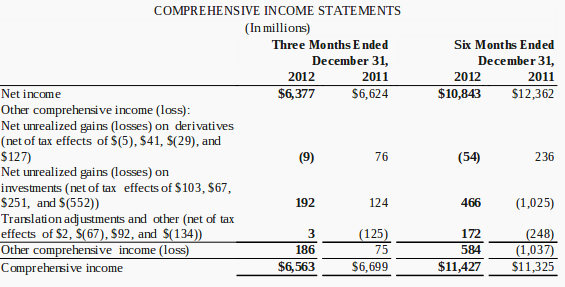
    For fiscal second quarter, ended December 31, Microsoft revenue was $21.46 billion, up 3 percent year over year. Operating income: $7.77 billion, a 3 percent decrease. Net income was $6.38 billion, or 76 cents a share.

    Average analyst consensus was $21.53 billion revenue and 74 cents earnings per share, for the quarter. Revenue estimates ranged from $19.94 billion to $23.32 billion, with estimated year-over-year growth of 3.1 percent — mighty modest for a holiday quarter when new PC and phone operating systems launched and Microsoft released its first tablet, Surface RT.

    Shares dipped by 2 percent in early after-market trading, falling to $27.06 from the $27.63 close. Like Apple yesterday, Microsoft beat earnings consensus but missed on sales.

    When adjusting for the impact of Office and Windows upgrade offers (meaning non-GAAP view), revenue grew by 5 percent to $22 billion, operating income by 4 percent to $8.3 billion, and EPS by 4 percent to 81 cents.

    “Our big, bold ambition to reimagine Windows as well as launch Surface and Windows Phone 8 has sparked growing enthusiasm with our customers and unprecedented opportunity and creativity with our partners and developers”, CEO Steve Ballmer boasts. “With new Windows devices, including Surface Pro, and the new Office on the horizon, we’ll continue to drive excitement for the Windows ecosystem and deliver our software through devices and services people love and businesses need”.

    Windows & Windows Live revenue rose 24 percent year over year to $5.88 billion, buoyed by a deferral from the previous quarter. Without the extra lift, revenue still increased by 11 percent.

    Microsoft’s Perception Problem

    As I’ve oft said, in business, perception is everything. To many people, Windows is Microsoft and the fate of one influences the other. Perception is a devil. Take Apple, for example, which reported $54.5 billion revenue and $13.06 billion net income yesterday. Today, shares closed down 12.35 percent, in part on perception that growth days are over, despite simply huge quarterly numbers. Microsoft’s problem is by no means comparable, but Apple’s situation makes a point. If investors so punish the company for such a great quarter, what can negative or positive perceptions about Windows’ future do?

    Microsoft is no longer bound to Windows, despite marketing hype about “reimagining”. In October, CEO Steve Ballmer described the company’s new direction as “devices and services“. The Business division, with flagship Office, generally generates more revenue than Windows & Windows Live, and last quarter Server & Tools did, too. The company is in process of removing dependence on Windows as top to its hugely successful vertical applications stack built around Office and server software and now extended through cloud services, such as 365,  Azure, Skype and SkyDrive among many others. Windows is still hugely valuable, and anchors a huge ecosystem, but Microsoft can transcend the OS.
    The problem: Public sentiment says something else — that Windows can’t compete in the post-PC, what I call connected-devices, era. If Windows can’t, neither can Microsoft. I don’t agree. Microsoft’s apps, datacenter and server software already are primed to serve multiple devices — not just the PC — and that’s a longstanding development strategy now far advanced. Microsoft is ready to move beyond Windows, and the holiday quarter PC shipments show such a future is inevitable. Windows won’t go away but stand alongside other platforms rather than being the overwhelmingly dominant one.

    Business and Server & Tools succeed for many reasons, and they will continue to do so as long as enterprises stay the course buying annuity contracts. Combined, more than half the two groups’ revenues come from volume-licensing contracts with Software Assurance.

    Companies get the license and annually pay 25 percent or 29 percent of the full price to get upgrades (or even to exercise downgrade rights) over two- or three-year periods. Software Assurance insulates Microsoft from economies’ ups and downs and those for PC purchases. If ever businesses back away in mass from annuity or subscription contracts, that’s the day to seriously worry about Microsoft’s future.

    Whither Windows 8

    Where the flagship operating system matters most is where Microsoft tries to take it: touchscreen devices, such as hybrids and tablets, with Surface RT and Pro serving as reference-designs for OEM partners to emulate. The Redmond, Wash.-based company announced plans to port Windows to ARM processors in January 2011, then followed up with the tile-based Modern UI that unifies ARM and x86 operating systems, including Windows Phone. Pundits poo-poo PC shipments, which stank in Q4, as evidence Surface and Windows 8 are failures. I ask: By what measure? Seems to me, Microsoft already changed Windows’ course to embrace a broader range of devices, with a unifying UI. Transitions like this take time to succeed, or fail.

    There is need. Had Microsoft not made-over Windows, the problem wouldn’t be perception but crisis very real. Three legs support the profit center, and Windows bound to traditional PCs would be one cut off. Instead, Windows 8 holds future device promise. Much depends on the devices the company and its partners produce and apps and services supporting them. Honestly, looking at holiday PC lineup, Surface RT is about the only thing looking good. OEMs failed to deliver compelling products that get people buying.

    PCs continued their more-than-year-long collapse during fourth quarter. Windows 8 gave no meaningful lift. Shipments fell 4.9 percent year over year, according to Gartner. For all 2012: down 3.5 percent. Manufacturers shipped 90.3 million and 352.7 million units for the respective time periods. IDC offers grimmer perspective: PC shipments fell 6.4 percent for Q4 — two points more than forecast — and 3.2 percent for the year.
    Consumers aren’t buying Windows PCs like they used to, and their infatuation with iPad, some other tablets and smartphones, is spreading. “Tablets have dramatically changed the device landscape for PCs, not so much by ‘cannibalizing’ PC sales, but by causing PC users to shift consumption to tablets rather than replacing older PCs”, Mikako Kitagawa, Gartner principal analyst, says, speaking about Q4 PC shipments.

    She no longer believes that PCs and tablets will coexist for a meaningful time. “There will be some individuals who retain both, but we believe they will be exception and not the norm. Therefore, we hypothesize that buyers will not replace secondary PCs in the household, instead allowing them to age out and shifting consumption to a tablet”.

    Combine that with the bring-your-own-device (BYOD) to work movement, and the future looks grim. Or does it? Microsoft already has its apps, cloud and server businesses primed for BYOD, as I’ve written here before. Then there is broader context, for those calling Windows 8 a flop because PC shipments fell in Q4. Apple got hit, too. Analyst consensus was for 5.2 million Macs shipped, but only 4.1 million did. Yesterday, Apple CEO Tim Cook laid blame on late delivery of new iMacs. He said that Mac shipments would have been otherwise higher.

    I don’t find that credible. But let’s assume for a moment he’s right. iMac is an expensive beast, starting at 1,299 and selling for as much as $1,999 in standard config. If Apple can command such selling strength, why can’t Microsoft OEMs? They should, by releasing innovative hybrid desktop and portable designs that capitalize on Windows 8’s best features. I contend they did not in fourth quarter.

    Something else to consider when looking at the PC market and future of Windows. In a compelling rebuttal to claims the PC is dying, Derrick Wlodarz, who owns a computer repair business, makes an observation often ignored: “Whereas customers of mine were getting 3-4 years out of machines back in the early 2000s, they now push their PCs to 4-6 year replacement cycles without much sweat”. Major reason: Older hardware has more than enough processor and graphics power to meet modern needs.
    “Now, a Windows Vista or newer PC could likely run on for five, six, seven or possibly more years without much issue. And this is the untold trend that I see in my customer base”, he asserts. “Solid, secure operating systems installed onto well-engineered computer hardware equals a darn long system life”.

    So if the PC in the den or office is good enough and not in need of replacement, why not buy a new smartphone or tablet? Remember: Microsoft pushes ahead with solutions for both these categories. Then there is fourth quarter to consider, where Windows delivered solid growth — now if only the broader ecosystem could capitalize upon it.

    Division Highlights

    Microsoft reports revenue and earnings results for five divisions: Windows & Windows Live, Server & Tools, Business, Online Services and Entertainment & Devices.

    Windows & Windows Live. Revenue soared 24 percent year over year despite weak PC sales, surely buoyed by low-cost Windows Pro upgrade price that ends January 31. A $622 million deferral helped lift revenue to $5.88 billion. Without it, revenue would have grown by 11 percent.

    To date Microsoft has sold 60-million Windows 8 licenses.

    OEM revenue grew by 17 percent, outpacing the broader PC market.

    Server & Tools. “We see strong momentum in our enterprise business”, Microsoft COO Kevin Turner says. “With the launch of SQL Server 2012 and Windows Server 2012, we continue to see healthy growth in our data platform and infrastructure businesses and win share from our competitors. With the coming launch of the new Office, we will provide a cloud-enabled suite of products that will deliver unparalleled productivity and flexibility”.

    Revenue rose 9 percent, or $347 million, to $5.19 billion. As previously mentioned, the division is insulated against economic maladies, because about 50 percent of revenues come from contractual volume-licensing agreements.

    New bookings increased by 15 percent. Meanwhile System Center revenue grew by 18 percent and SQL Server by 16 percent.

    Business. “We saw strong growth in our enterprise business driven by multi-year commitments to the Microsoft platform, which positions us well for long-term growth”, Microsoft CFO Peter Klein says. “Multi-year licensing revenue grew double-digits across Windows, Server & Tools, and the Microsoft Business Division”.

    Despite touted growth, revenue fell by 10 percent year over year to $5.69 billion. However, when removing adjustments for Office upgrade offer and pre-sales, revenue grew by 3 percent.

    Bookings increased by 18 percent and multi-year licensing by 10 percent. However, consumer revenue fell by 2 percent.

    Like Server & Tools, Business division is largely insulated against sluggish PC sales. Sixty percent of revenue comes from annuity licensing to businesses.

    Online Services Business. Online services revenue rose by 10 percent, or $109 million, to $823 million. However, the division remains unprofitable. Search and display ads drove up online advertising revenue by 15 percent.

    Entertainment & Devices. Microsoft shipped 5.2 million Xbox consoles, down from 8.2 million a holiday quarter earlier. As a platform, Xbox 360 revenue fell 29 percent, or $1.1 billion.

    Xbox Live subscriptions now exceed 40 million.

    Windows Phone sales are up 4 times year over year, which is a polite way of saying they’re not good enough. If they were, Microsoft would say how many.

    Users made 138 billion Skype calls, up 59 percent year over year.

  • Wind Industry Declares War on Plain English in Effort to Expand Subsidies

    The wind industry received a belated Christmas present this year when Congress passed the American Taxpayer Relief Act of 2012 (née fiscal cliff deal). The fiscal cliff deal not only extended the wind Production Tax Credit (PTC) for another year, but expanded the credit to apply to more facilities. But that’s not all. The wind industry now wants the IRS to torture the plain language of the Act to allow even more projects to qualify.

    For the past 20 years, the wind PTC required projects to be placed “in service,” by the end of the year to receive the credit. But the fiscal cliff deal expanded that language to apply to any wind facility “the construction of which begins before January 1, 2014.” Because of this expansion, the Joint Tax Committee estimates that the wind PTC will cost the Treasury $12.1 billion dollars.

    Not content with this victory, the wind industry lobby now wants the IRS to interpret the term “construction of which begins” to have no reference to a physical act of construction, but rather merely mean that construction begins when five percent of the cost of the wind project has been committed.  As the attached white paper will demonstrate, this would be an aberration from the many tax laws that have specified or assumed construction as actual construction work having taken place.

    The Five Percent Rule Tortures the Plain Meaning of the Word “Construction” and Means Delayed Economic Benefit

    If the “five percent” interpretation is implemented, many companies might make that token investment and then wait several years for technology to mature or the economy to improve.  Needless to say, that outcome would be distortionary and wasteful.

    If instead construction “begins” with the physical act of construction, companies that otherwise might have sat on their investments will be incentivized to commence building sooner.  Earlier construction would mean that the economic benefits of construction would be realized more quickly.  While more money might be paid out under the five percent interpretation, more short-term economic stimulus would come from the physical act requirement.

    Senator Mark Udall, a strong supporter of the PTC extension, noted that the extension is meant to “provid[e] a strong incentive for developers to begin projects as soon as possible.” But Udall also understands that the word “construction” should have something to do with physical wok.  As he stated, “So if you put a shovel in the ground on Dec. 31, at the end of this year, the tax credit will apply…”

    That being the case, the policy behind the PTC extension suggests that we should interpret “begins construction” to mean, well, starting physical construction.

    Ample Precedent for the Physical Work Requirement

    The legal precedent is also on the side of the physical work interpretation.  As shown in the attached IER white paper, there is a long history of Congress and administrative agencies interpreting similar phrases (variations on “construction begins”) to require physical work on the project.  To name just a few examples, the common-sense interpretation of beginning construction prevailed in the Tax Reform Act of 1969, the Revenue Act of 1971, the Tax Reform Act of 1976, the Revenue Act of 1978, the Tax Reform Act of 1986, and the American Jobs Creation Act of 2004.  The IRS itself ruled that way many times, including in 2011, 2008, and 2006.

    The Five Percent Alternative

    Against all that precedent, the wind lobby can only offer the American Recovery and Reinvestment Act of 2009, when the Treasury Department interpreted “construction began” as including the five percent rule as a safe-harbor provision. A safe-harbor provision is intended to protect good faith, but unsuccessful, efforts to adhere to a given law.  Similar safe-harbors have appeared in other IRS guidance, but normally as a less-lenient 10% investment rule.

    Bottom Line

    The legal and policy arguments both weigh heavily in favor of the physical work requirement.  Wind industry lobbyists would do well to accept the already-generous PTC subsidy without pushing a dubious interpretation to siphon off even more taxpayer money.

    Adobe_PDF_Icon


     IER’s White Paper on the definition of when “construction begins” is available here.