
Blog
-
Sprint looks to snap up Clearwire with more appealing offer
-
Kate Hudson, Zach Braff Team Up For Kickstarter Film
Kate Hudson has joined the cast of Zach Braff’s Kickstarter-funded film, “Wish I Was Here”, and not everyone is happy about it.
The Kickstarter campaign, which surpassed its $2 million goal in three days, was a highly controversial move on Braff’s part and was the talk of Twitter for a while as moviegoers wondered why they should give up their hard-earned cash to a millionaire actor.
Still, he’s continuing to get backers on the crowd-sourcing site, so there are people who want to see this movie get made. According to Kickstarter, the campaign will end on Friday. Braff, who wrote the script with his brother, will direct and star as a 30-something husband and father who is struggling to find his identity.
Also announced in the cast lineup are Josh Gad and Mandy Patinkin.
Building A Data Center Can Be A Blast: A Little TNT Can Help
Chris Curtis is the co-founder and SVP of Development for Compass Datacenters. We are publishing a series of posts from Chris that will take you inside the complexity of the construction process for data centers. He will explore the ups and downs (and mud and rain) of constructing data center facilities and the creative problem-solving required for the unexpected issues that sometimes arise with every construction process. For more, see Chris’ previous columns on the planning process.
 CHRIS CURTIS
Compass DatacentersHigh explosives. Who doesn’t love them? Isn’t a large part of our culture based on blowing things up? Certainly some of our leading celebrities have made whole careers out of appearing in movies that feature one massive explosion after another. Well, the world of data center development is no different. It doesn’t happen often but, every once in a while, we have to roll out the dynamite and do some serious blasting. Like most things in the development world, the need to conduct controlled explosions has some plusses and some minuses.
Lessons in Geology
Most of the time, the average data center can be built without the need to prepare the site using cataclysmic force, but our site resides on what geologist’s refer to as a “limestone shelf.” In the technical parlance used by we developers. this is referred to as “a bunch of rock.” Maybe not as scientific, but a lot more descriptive. I don’t mind telling you, this news made the on-site guys positively giddy with excitement. The prospect of going to work and getting to say things like “fire in the hole” just seems to bring out the best in folks.
Despite the electric atmosphere that the prospect of dynamite utilization brings, this is serious stuff. You know how your mother used to say that it’s “all fun and games till someone gets hurt,” well, this a few notches above that. Being blown to smithereens has a degree of permanence that you just aren’t going to find with the average office related mishap. Just like any refined activity, there is a protocol that must be followed before you can begin demolishing large swaths of real estate.
Telling the Neighbors
First, you must alert the locals. This means going from house to house to advise the occupants of the homes surrounding your project site that they might just want to keep the kiddies and pets inside between the hours of 9 and 11 this coming Tuesday. Naturally folks have questions, “Will it be loud?,” “Am I at risk from flying debris?,” “Can I watch?,” to which the answers are of course, “Yes,” “No” and “Sorry, but our lawyers won’t allow that.”
Second, you put up signs and mark off the area. With this type of signage I’ve found that it’s best to be simple and declarative: “Blast Site – Keep Out,” for example. Some developers prefer “High Explosive Area – Trespassers Keep Out,”, but I find this a little pretentious and wordy. Short and pithy also eliminates the possibility of your sign being liberally interpreted. No one wants to have someone’s body parts distributed though out your job site because they live in the neighborhood and decided that the word “Trespasser” didn’t apply to them. This type of thing can really hurt morale. When marking off the blast area I prefer to go conservative. Sure it costs you a little more in orange plastic fencing, but I think we can all agree that the phrase “better safe than sorry” applies here.
Dress Code: Hard Hat and Ear Plugs
I don’t think that I can describe the level of anticipation until the big day finally arrives. Remember waiting for that special gift at Christmas? This is better, since you now it’s actually going to happen, and you’re not going to get a sweater instead of that new bike you wanted. When blast day finally comes, everyone gets to wear a hard hat and ear plugs–this is a developer’s version of a Fourth of July celebration. I must admit that even though I’ve been to a few of these things I can barely make it until the time that the big switch is thrown. And once it’s thrown – wow. The explosions are deafening, there’s dirt and debris flying everywhere, grown men are jumping up and down and pointing – you just don’t get entertainment like this every day.
Someone once said that “There is always one guy who doesn’t get the memo,” and that’s the case with blasting. Just accept the fact that no matter how thorough your canvassing, or how many signs you post, someone in the neighborhood is going to complain. This being the case, I was not surprised when I received a nasty email from a local resident complaining about the noise and, helpfully suggesting that I build my data center somewhere else. Since all it takes is one crank with a friend that works at Channel 8 to turn your project into a PR nightmare, I recommend handling these situations in a face-to-face manner. As I said, I’ve been through this drill before so I put on my sympathetic face (Note: It’s good to practice this before your visit. Sometimes a sympathetic face can look more like an “I could care less” face, or worse, the “surly punk” face, so you really need to get into character before you go) and went to visit the offended party.
The Developer’s Listening Skills
My first grade teacher always told me to be a good listener. This is great advice for these types of “disgruntled neighbor” situations because, really, what else can you do? After all, the blasting is already done, and there’s a big hole in the lot behind their house, so you sit and listen. Remember to nod at all the points that they use to tell you that your actions are akin to a crime against humanity and assure them that the data center you are building will not have a negative impact on the neighborhood. And this is true. Since it only takes a few folks to run a facility and the building is full of servers, traffic and noise aren’t going to be on-going issues. This is what folks really want to know. Once you’ve apologized and assured them that the worst is over, even the most disgruntled citizen tends to listen to reason. After all, doesn’t everyone really just want to have their “day in court.”
As a developer, the pendulum of your activity can swing widely. One day, you’re just another swarthy guy enjoying the primal thrill of blowing things up, and the next, a mild-mannered Dr. Phil talking an irate neighbor off the ledge. In this role, you must be prepared for anything.
Stay tuned for the next article in the series, titled, Maybe We Should Turn This Data Center into an Ark: How Bad Weather Can Cause Chaos with a Construction Timeline.
Industry Perspectives is a content channel at Data Center Knowledge highlighting thought leadership in the data center arena. See our guidelines and submission process for information on participating. View previously published Industry Perspectives in our Knowledge Library.
Morgan Creek Capital to Buy Signet Capital’s Alternative Funds
Morgan Creek Capital Management said on Tuesday that it will buy Signet Capital Management‘s Alternative Funds business. No financial terms were disclosed. Under current management, Signet’s Alternative Funds has approximately $700 million in assets. As part of the acquisition, the senior management team at Signet, which include Founder Robert Marquardt, and CEO Dr. Serge Umansky, will join Morgan Creek and continue their current roles. Signet Capital Management Ltd. is a European institutional fixed income investment firm.
PRESS RELEASE
CHAPEL HILL, N.C., May 21, 2013 /PRNewswire/ — Morgan Creek Capital Management today announced it has reached an agreement to acquire the Alternative Funds business of Signet Capital Management Ltd., an award-winning European-based institutional fixed income investment firm. Signet’s Alternative Funds business has approximately $700 million in assets under management.
Under the agreement, Signet will contribute its funds and senior investment management team to Morgan Creek’s platform, where they will apply their global fixed income experience for the benefit of Morgan Creek clients. Robert Marquardt founded Signet, which is well known in the European institutional investor community, in 1993.
The current senior management team at Signet—including the firm’s Founder and Co-Head of Investment Management, Mr. Marquardt, and CEO and Co-Head of Investment Management, Dr. Serge Umansky—will join Morgan Creek and continue their current roles serving clients of Signet’s funds as well as complementing Morgan Creek ‘s fixed income capabilities. Signet’s offices in London, and Lausanne, Switzerland, will become part of Morgan Creek ‘s global network.
“We are excited to have Bob, Serge and the entire Signet team join Morgan Creek , a union that will benefit both our present and future clients,” said Mark W. Yusko , the Chief Investment Officer of Morgan Creek . “This agreement represents a major achievement in our overall strategy to expand our global footprint and bring on talented investment professionals to help address the increasingly complex global investment environment.”
” Morgan Creek is a tremendous investment firm that holds the same values and investment philosophies that we do,” said Mr. Marquardt. “We look forward to adding value by integrating our extensive fixed income expertise with Morgan Creek ‘s well-respected endowment style of investing.”
The transaction is expected to close in the second quarter and is subject to the required regulatory approvals and other closing conditions. Signet Capital Management Ltd. is authorized and regulated by the Financial Conduct Authority, and the agreement to acquire Signet Capital Management Ltd. is subject to the approval of the Financial Conduct Authority.
About Morgan Creek Capital Management
Morgan Creek Capital Management is a global investment management firm focused on active investment management with a long-term investment philosophy and firmly believes in the Endowment style of investing for helping clients achieve their objectives. Consistent with the Endowment Model, Morgan Creek maintains exposures across the investment spectrum, from traditional equities and fixed income to alternatives such as hedge funds, private equity real estate and venture capital. With the collective experience of its senior investment team, Morgan Creek was an early pioneer of the “Outsourced Investment Office.”
Upon close of the transaction, the global firm will add offices in London and Lausanne, Switzerland to its current offices in Chapel Hill, N.C., New York, Singapore, and Shanghai. More information on Morgan Creek’s investment team and strategies is available at www.morgancreekcap.com.The post Morgan Creek Capital to Buy Signet Capital’s Alternative Funds appeared first on peHUB.
Google’s subscription music streaming service coming to iPhone and iPad – unofficially

Data Center Design for a Mobile Environment
This is the sixth and final article in a series on DCK Executive Guide to Data Center Designs.
The trend toward the mobile user continues at an accelerating pace and trends indicate that the mobile applications and hardware (smartphones and tablets and even vehicle-based systems) will exceed the PC based information client. This transformation cuts across many divergent business types from social media and search to streaming entertainment media and even basic financial retail banking, such as using a smartphone to take a picture of a check to deposit it. While on the surface this would not appear to impact the design of the physical data center facility, long term it may well influence the some IT architecture and hardware that resides in the data center. In fact, it is foreseeable that as wireless devices and networks will require and carry more data than existing land based networks and data centers may directly or indirectly need to integrate into the wireless network infrastructure. This may change the design landscape for data centers which may be designed to primarily deliver services to mobile clients.
The Bottom Line
As a senior management executive it is your ultimate responsibility to look down the road and set the course for your organization’s business direction and how it will shape the IT architectural roadmap. In addition to predicting the future, you also need to see around the next corner to foresee the fork in the road or avoid the cliff at the end of a wrong turn. In the information systems world, every year (or sometime every month) seems to bring the “The Next Big Thing”. And while previously most of those trends did not really have much impact on the physical design of data center itself, over the past few years even that has no longer been a certainty.We are still at the dawn of the 21st century and one only needs to look at the technological developments that have occurred since 2000. The rate of change for information technology is accelerating, it is has become totally interwoven with nearly every aspect of daily life. What is commonplace in daily life today was barely imagined in the science fiction stories of the earlier part of last century. The IT hardware built only 5 years ago may still be operational, but in most cases is considered as functionally or technically obsolete, as are many data centers that were built only 10 years ago but were designed based on historic IT requirements.
It may seem easier to simply build on last year’s data center designs and avoid looking too far down the road. Nonetheless, today’s data center needs to be designed for the future, not the past. Do not let the fear of endless “scope or feature creep” limit your consideration of being open to new design options. Yes, you will still need to draw a line somewhere, whether for budget or time constraints, but to not close your own mind or the limit the design team’s options to new ideas without first understanding their advantages (as well as potential pitfalls). Expansion and flexibility must be pre-designed in, not tacked or retrofitted on afterward as requirements change. The entire scale and scope of the demands and the delivery platforms have changed rapidly, and in some cases radical paradigm shifts in designs have occurred.
The physical infrastructure still needs to be reliable and solidly built, since it is the critical underlying foundation necessary to the security and availability of the IT system it contains. However, in today’s socially conscious world, long term sustainability is no longer an option; environmental stewardship is now a requirement when planning any new project. Expect environmental sustainability issues to grow in importance in the immediate and foreseeable future.
And so in closing, we hope that this Executive Series has provided you with the insight and strategies to help guide you to ask the right questions to challenge and provoke yourself, as well as your IT architects and data center designers and ultimately enable you and them to make more informed decisions about what needs to be considered in the design of your next data center.
The complete Data Center Knowledge Executive Guide on Data Center Design is available in PDF complements of Digital Realty. Click here to download.
Graycliff Sells ISCC to Iron Mountain
Graycliff Partners said on Tuesday that Iron Mountain, an information management and storage provider, has bought Information Storage Consolidation Company (ISCC). No financial terms were disclosed. Information Storage Consolidation is a records storage company with facilities in Texas, Michigan and Florida. Prior to Iron Mountain’s acquisition, Graycliff had a majority stake in ISCC.
PRESS RELEASE
NEW YORK–(BUSINESS WIRE)–Graycliff Partners LP (“Graycliff”), a middle market investment firm focused on private equity and mezzanine investments in the US and Latin America, announced that Iron Mountain Incorporated (NYSE:IRM), a provider of storage and information management services, has acquired Information Storage Consolidation Company (“ISCC”), a records storage business with operations in Texas, Michigan, and Florida. Graycliff held the majority ownership of ISCC at the time of the acquisition. Financial terms of the transaction were not disclosed.
Headquartered in Carrollton, Texas, ISCC is a leading provider of outsourced document services, including physical storage, storage services, destruction and imaging to customers throughout the Southern and Midwestern United States in industries such as healthcare, business services, financial and legal.
“It has been a privilege to work with Ron Harper and the ISCC management team in building a leading document storage business that services a diverse group of industries across the country,” said Andrew Trigg, Managing Director, Graycliff Partners. “ISCC has provided exceptional service to its expanding list of customers, and now, Iron Mountain will carry on that legacy of meeting the information needs of our customers.”
“Graycliff worked closely with the management team to grow its competitive position through investments in operations and customer relationships,” said Duke Punhong, Principal, Graycliff Partners.
“Graycliff has been a great partner in facilitating the growth and expansion of ISCC by providing the necessary resources and operational and strategic planning expertise,” said Ron Harper, CEO of ISCC. “With the full backing of Graycliff Partners, ISCC has demonstrated significant growth, market share gains and customer satisfaction. We are excited about sale of our records management businesses to Iron Mountain. Our customers can continue to expect secure storage, attentive service and expert advice.”
About Graycliff Partners LP
Graycliff Partners is an independent investment firm focusing on lower middle market private equity and mezzanine investments in the United States and Latin America. Graycliff Partners LP is an SEC-registered investment advisor under the US Investment Advisors Act of 1940, as amended. Since 1991, the Graycliff Partners team, previously operating as HSBC Capital, has invested over $1 billion and completed over 80 transactions. With offices in New York and São Paulo, Graycliff Partners seeks to partner with companies led by strong, entrepreneurial management teams, providing capital for acquisitions, management buyouts, recapitalizations, growth and expansion. For more information about Graycliff Partners visit www.graycliffpartners.com.The post Graycliff Sells ISCC to Iron Mountain appeared first on peHUB.
Microsoft baits PhoneGap developers with Surface Pro and Windows Phone 8 devices

Despite what some folks would lead you to believe, sheer numbers are actually meaningless when it comes to app stores. That’s just a marketing ploy. It’s the quality that matters and not the quantity. After all, if you can’t get the software that you need, does it really matter if there are 100,000 more apps out there? I’m inclined to believe that the answer is a resounding “No”.
Windows Phone has this very same problem — 145,000 apps available but major titles are still avoiding its Store (no, I’m not going to mention Instagram). Microsoft tried to fix this issue a couple of times before, including paying developers to beef up the ecosystem. Late-yesterday, the software giant has decided to step in again with the new Porting Challenge.
The idea is quite simple — Microsoft wants developers to port their existing PhoneGap apps from other platforms, like Android, BlackBerry and iOS to name a few, to the Windows Phone Store (like with Untappd). This way, hopefully, some attractive ones will make their way to its smartphone operating system.
To make this a competition worth signing up for, Microsoft also announced 17 “first prizes” and three “grand prizes”. The former gets each winner a Windows Phone 8 handset (likely a Nokia Lumia 920), while the lucky contestants on the podium also get a Surface Pro tablet.
Microsoft says that developers must release apps which are “original, innovative, easy to use, engaging and visually appealing to the user” in order to win. Even though I’m not a developer, that doesn’t seem like a particularly difficult feat to achieve for at least 20 talented folks.
Undoubtedly the Porting Challenge is a step in the right direction, but can it bring a much-needed dose of appiness to Windows Phone users? Judging by the PhoneGap featured apps catalog, that doesn’t appear to be the case for those seeking major titles like Dropbox, Google Drive, Google Maps, Instagram (I couldn’t help myself) or even the latest Temple Run game in the series.
Photo Credit: sellingpix/Shutterstock
Powermat marries PowerKiss, vows to use same wireless charging standard
Travelers between the U.S. and Europe have one less barrier to deal with when it comes to wireless charging a mobile phone or tablet. Powermat, a joint venture with Duracell, and Helsinki-based PowerKiss reconciled their differences and became one on Tuesday. The two wireless charging companies previously used incompatible technologies, but are both committed to the PMA standard and will be combined under the Powermat Technologies name.

Between the two, they have more than 2,500 wireless charging installations at public locations such as airports, coffee shops, malls and arenas. PowerKiss recently added some charging mats at select McDonalds Europe locations. The idea behind these installs is to allow customers to place their mobile device on a wireless charging pad and add juice to the battery. Of course, the device has to natively support wireless charging, such as Nokia’s Lumia 920, or be compatible with an add-on product such as a wireless charging cover.
Overall, the ability to recharge a device by placing it on a special mat really hasn’t taken off with the mainstream public. Part of the reason is a battle over the technology standards: If you have a device that supports wireless charging but doesn’t work with a compatible charging mat, you’ll have to plug in your device, of course.
 Powermat Technologies is part of the PMA, or Power Matters Alliance, which boasts that 80 percent of its partner members represent the entire wireless install base. That sounds good, so what’s the issue?
Well, there’s another body, the Wireless Power Consortium, that’s been at this longer than the PMA by about four years and uses the Qi-branded standard. Even worse: Some partners are members of both groups. So while the PMA gained a new member through marriage, there are still plenty of fish in the sea using a different wireless standard.

Related research and analysis from GigaOM Pro:
Subscriber content. Sign up for a free trial.- Podcast: Mobile winners and losers in 2012 and what to expect in 2013
- Analyzing the wearable computing market
- LTE-Advanced: what it is and isn’t


American Consumers Really Hate Their ISP
Internet service providers are pretty awful. It seems that most Americans agree if a recent survey is to be believed.
The American Customer Satisfaction Index has released its report for 2013. This year is particularly interesting as ISPs have been rated for the first time. How did they do?
The survey shows that Vierzon FiOS, the company’s fiber-based wired broadband service, has a satisfaction rating of 71. From there, the scores keep getting lower and lower until it bottoms out with Comcast at a 62.
What about the other major ISPs like Time Warner Cable and ATT? Time Warner came away with a 63 while ATT scored a bit higher with a 65. The average aggregated score among all ISPs was 65.
To put this all into perspective, ISPs were one of four industries to have an average score below 70. The others were the airline, subscription telephone and social media industries. It’s really kind of sad when ISPs are lumped in with an industry that has been the subject of bad standup comedy for decades.
So, why do consumers hate their ISPs so much? The ASCI lists the usual suspects – reliability, speed and highly monthly costs. It doesn’t help that many are also unsatisfied with the current monopolies or duopolies held by many ISPs preventing them from switching to somebody else.
There is hope, however, and that hope is Google Fiber. The ASCI says that services like Google Fiber may eventually shift ISPs to offering faster service for lower costs. It’s probably not going to happen anytime soon, but I can dream, right?
[h/t: BGR]
Pandora Premieres Offers On-Demand Music Before It’s Released
As the battle to win the ears of a streaming music-hungry consumer base heats up, Pandora has just launched a new channel that lets you listen to new albums before they’re official released.
It’s called Pandora Premieres, and the company says it’s a new way to discover music on the site.
Pandora Premieres lets users stream entire albums from both established and emerging artists for free. You can stream any track at any time, as many times as you like until the album is officially released. Pandora says that they will offer a new selection of upcoming albums each week, and some will come with additional exclusive content such as video interviews.
“Pandora Premieres is also a new and unique vehicle for artists, both established and emerging, to reach and expand their audience. Seeing the impact of Pandora on the careers of working musicians continues to be one of the most gratifying parts of this experience,” says Pandora’s Tim Westergren.
The service is kicking off today with John Fogerty’s new album Wrote of Song for Everyone and Laura Marling’s Once I was an Eagle. You can stream these albums, on-demand, for a week.
It’s unclear at this point what kind of albums Pandora will offer with Premieres. If they end up offering pre-streams of high-profile artists, it could be a great addition to the Pandora service.
You can check it out here.
Reboot-To launches the OS you need direct from the desktop
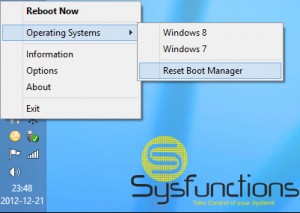 If you’ve installed multiple operating systems on a PC then normally, when your system starts, you’ll have to choose the one you need from a boot menu. And while this isn’t difficult in any way, it can be a minor irritation, especially if you’re switching between operating systems on a regular basis.
Install Reboot-To, though, and you’ll have another option. When you need to restart your PC, just choose one of your installed operating systems from the Reboot-To menu — Window Vista, Windows 7, Windows 8, Windows Server 2008 R2, Windows Server 2012, Ubuntu (wubi) and Ubuntu Server (wubi) are supported — and it’ll reboot directly into that OS, without you ever seeing the boot menu at all.
Reboot-To is straightforward to install, and by default sets itself up to run when Windows starts, adding a Windows service and an icon to your system tray. This is a little more intrusive than we were expecting, but presumably is just to ensure that you can reboot your system as quickly as possible. Fortunately the background processes are extremely lightweight, generally consuming less than 2MB RAM on our test PC, and you can turn them off if you prefer (select “Options”, clear “Start with Windows”).
Once setup is complete, though, the program is straightforward enough to use. When you want to restart your system, right-click the Reboot-To icon, select Reboot > Operating System, choose one of your installed operating systems, and it’ll reboot directly into that OS — no need to worry about the boot menu.
The change is just temporary, of course. If you install and run Reboot-To on Windows 7, for instance, and reboot it to Windows 8, then the boot menu will only disappear for that one time. If you reboot from Windows 8 then the boot menu will return. (Unless you install and use Reboot-To from there, anyway.)
Allowing a program to play around with our system’s BCD (Boot Configuration Data) files in this way makes us just a little nervous. It’s carrying out a very simple and defined task, and there shouldn’t be any problems, ever, but we’d still recommend that you have a Windows recovery disc to hand, just in case.
That aside, though, in our tests Reboot-To worked very well, and if you’re regularly booting between various Windows installations then it could save you some time and hassle.
The future of propaganda: A Q&A with Sean Gourley about big data and the “war of ideas”
In 2009, Sean Gourley, an Oxford-trained physicist, gave a TED talk called “The Mathematics of War.” Gourley had been working with the Pentagon, the United Nations and the Iraqi Government to help them better understand the nature of the insurgency in Iraq, and in his presentation he announced something fairly striking: After analyzing the location, timing, death toll and weapons used in thousands of deadly incidents around the country, he and his small team had discovered that the violence actually had a consistent footprint. In other words, you could develop an equation that would predict the likelihood of an attack of a certain size happening at a certain time.
And this wasn’t just true in Iraq: Gourley’s team had also analyzed insurgent-led wars in other parts of the world — from Colombia to Senegal — and had discovered the very same pattern, even though the underlying issues in those conflicts were totally different.

Sean Gourley, Co-Founder and CTO, Quid Structure Data 2013 Albert Chau / itsmebert.com
Gourley has since moved on from war zones. He helped found a company called Quid that does big data projects for companies like Intel, Visa and Samsung. In March, he spoke at our Structure:Data conference in New York, where he talked about the difference between “data science” (which is about finding correlations) and “data intelligence” (which is about solving problems). He said we need to shift our focus toward the latter if we want to tackle the biggest challenges our world is facing.
I followed up with him after the conference to talk more about big data in wartime. In hindsight, we were fighting the data war in Baghdad with fairly primitive tools. It was before the explosion of social media and the flowering of open-source data. In future battles, he said, governments will be using data not just to predict violence but to fight “the war of ideas.”
Just what does that mean? It means using big data to track the types of conversations that people are having about a war — and then injecting counter-stories back into the system to change those prevailing ways of thinking. A government like the U.S. could use this tactic in a war zone to, say, try to weaken a violent insurgent movement, but the government could also employ it at home to build domestic support for the war.
We often talk about companies using data science to get people to buy more shoes or more airline tickets. But just as drones are helping to automate wars, we’re moving into an era where data can help automate propaganda — and that creates the potential for some pretty potent new experiments in brain washing. It makes dropping cookies on people’s browsers seem quaint.
Below is an edited transcript of my Skype interview with Gourley.
Q: How would you use data differently in Iraq if you were doing it all over again?
A: It’s important to remind ourselves in 2013 where the information landscape was at the start of the Iraq war. In 2003, the world was very excited about something called blogging. We didn’t have Twitter. Cellphone coverage at the start of the war was exceedingly low. What we’ve seen over the past decade as the war unfolded was one of the biggest changes in the information landscape from a militaristic perspective in a long, long time.
The reporters in the bureaus, from the New York Times, say, would be bunkered down in a fortified compound — they didn’t get out a lot. I mean, you wouldn’t if you were there, why would you? They would send stringers out on motorbikes with cellphones and they would text in if any attack happened. They would be paid based on their reporting of events.
A huge window shaking bang here in Abbottabad Cantt. I hope its not the start of something nasty :-S—
Sohaib Athar (@ReallyVirtual) May 01, 2011Since taliban (probably) don’t have helicpoters, and since they’re saying it was not “ours”, so must be a complicated situation #abbottabad—
Sohaib Athar (@ReallyVirtual) May 01, 2011You had a crowdsourced version of Twitter, but it wasn’t Twitter. As the conflict went on, in 2008-09, you saw the first adoption of Twitter coming in. Most of that conflict, it was text-based, written by bureaus, and reported on by collating paid people. And that, in and of itself, gave us a landscape that was more complete and in many ways more accurate than what the military was able to do with their eyes on the ground.
Now, there is already more information being collected by the collective intelligence than by the military intelligence. One one hand, we’re moving into a world where you have drones recording continuous HD video. But we’re also seeing an upscaling in human reporting now with the likes of Instagram. You’re not just tweeting — you’re taking pictures that are triangulated.
The crowdsourced info is still going to be more complete and at a higher resolution than even the stuff that is done with the advent of drones and sensors by the military.
Q: You’ve said that what was missing in Iraq was “narrative structure” to the data. What do you mean by that?
A: The stories being told in Iraq and around the world about why we were going to war, how the war was going. Numbers are one thing, but stories and being able to analyze the stories is another.
Now in 2013, we’re just now at that phase where we can start to process narratives, and that’s pretty exciting. Because as much as wars are fought with bullets, they’re also fought with stories.
There is a DARPA (Defense Advanced Research Projects Agency) contract out at the moment that is looking to South America particularly to track the formation of new ideas. Part of that is to inject new ideas back into the system. {You could say, for example} I don’t like the way people are talking about this, and then inject a new idea {into the conversation}. And not one based on my gut intuition or a random story, but one that recombines existing ideas and is positioned to nudge and manipulate a conversation in a particular direction. It means fine-tuned control of the stories people are telling each other about why the war is happening. We’re going to get a lot better at getting those stories and language adopted.
From the standpoint of how you stop these wars and bring them to a resolution … One thing there is watching the language (in conversations) change from an “us” to an “us” and “them.” As soon as you have an us and them, you can have a war. You can’t really have a war without an us and them.
The second piece of that is the stories that are being told by the different insurgent groups essentially as a recruiting tool. If you want to disrupt an insurgency, one key piece of that is a story that attracts them away from those groups and into jobs that are paying that don’t involve killing. So combating insurgent narratives in a way that allow people to gravitate toward a different kind of activity.
There are patterns in the stories that are told. We can track them, and we can start to have narratives compete against each other. Exactly how that will be used and how it will unfold, we’re in the process of trying to figure that out.
Q: Would the government use this tactic of story manipulation domestically as well as in the war zones themselves?

A: You could have a much higher-resolution storytelling for convincing a nation to go to war. As the war progresses, you see words like “quagmire,” “civil war” and “intractable” — that language starts to pop up.
Could you change the story of civil war and quagmire to something that was made it seem more positive— like the story of the underdogs fighting back? I don’t know how that would play out, but it was the Americans’ willingness to go to war that the insurgents were fighting against. So they’re killing people to change a narrative that America holds. The violence is targeted against that idea. This tool is more likely to be used by political parties inside the country going to war than inside the country at war.
Q: It seems like the U.S. government had a pretty good handle on the marketing of the war. The problem wasn’t the lack of messaging — it was that over time, it simply became a harder sell. Do you think the government could have been more convincing if it had better data?
A: (Laughs) I don’t think I would have gone and advised the government on how to sell their conflict. But a hypothetical person using mathematical tools, yes, absolutely. It becomes a more difficult sell as you go on, but there is basic stuff. Like once 10 people die in an attack, there is a big bump in news coverage. So if you stabilize below 10 in an attack, you can keep the news at a lower proportion. Just how the news of the attack resonates — you can start to see those patterns and then play around with them. That’s one piece of it.
The other is we constructed stories at the start, and then the war got more difficult and the stories that we were telling didn’t evolve and adapt to keep resolution. Was there a story that the American people would have bought half way through the war? Yeah, quite possibility. Would data have helped us get that story? It wouldn’t have come up with it for us, but I think it definitely would have helped us get to it.
You would try 10 different stories, 50 different stories, and see which started to get resonance. You would monitor those that were already out there to see which were getting traction and start to collect those to get a broader narrative. The monitoring and tracking of that stuff would have helped massively.
You could think of a war now using the simple tools of Facebook and Google and targeting ads, pictures and stories. How would you target those things using social networks? You could have hundreds of different stories. A war unfolding in a media landcape like we have today would have a very different set of tools available to manipulate public opinion.

Getty Images
Q: So it’s like the old-style propaganda campaigns, but supercharged by social networks and open-source.
A: That’s right, but it’s also supercharged by an understanding of how people hold ideas in their heads. It’s not just, we can organize a protest via Twitter and we can have a lot of people show up in one place. It’s that we can actually change what they are thinking. That’t the algorithmic side.
With all the sharing of information, we can process that algorithmically and determine the stories that people hold to justify different political beliefs, different idealogical beliefs and different reasons for why they would take certain actions. That’s the big difference. The real breakthrough here is the natural language processing that enables computers to understand stories.
Q: Does the government acknowledge that the majority of useful data now comes from open sources?
A: A former director of the defense intelligence agency said that 90 percent of our data comes from open sources. It’s the 10 percent that is the James Bond stuff. That’s the stuff that people get most excited by, but the reality is that most of the data is from open sources. They (the government) may be slow to the punch, but they’re not stupid.
Q: This war of ideas — you can fight it from some desk in a some office building in some random city, right?
Precisely. You can do a lot of this remotely. Yes, it’s very conceivable it would be done in Arlington, Va., it wouldn’t be done in Baghdad. The people making decisions off this stuff are still the higher ups. They are going to take these recommendations and combine with their gut instincts for what’s going on the ground, their feel for the political, and maybe a conversation they had with a young kid that morning.
This is not a machine that is going to be making all your decisions. The human side of it is still going to combine with recommendations. I don’t think if you were designing this thing you’d just have a computer spit out a message and immediately accept that. Although it might spit out a message that says “experiment and see what resonates.”

Getty Images
Q: How much money would it take and how many people to create this kind of idea-shaping machine for wartime?
A: At the moment, you’d have to do a lot of R&D to get this stuff up and running. There is as a lot of custom fitting that needs to happen. But I’d be surprised if in five years there isn’t something more off the shelf. At the moment, a team of a 100 could very feasibly do this. Maybe if it’s in government it’s going to be 200. But in Silicon Valley, a team of 100 could certainly do it. And that’s today. In five years, that could be cut in half.
You’re probably going to invest $20 million or $30 million in a team that does this.
Q: How close is all this to being a reality?
A: I don’t think we’d be surprised if in 2016-17, this stuff was at the same place that the self driving was at 2008. As far as the militaries of the world are concerned, this is still near-term science fiction. It’s certainly not stuff they’re running here and now today. The state of integrating open source isn’t done in s particularly coherent fashion or a particularly smart fashion. The models they’re running underneath this have little or no impact on the data they’re collecting. Any kind of analysis they’re running on top of the narratives are cutting short at the length of sentiment
The brightest minds in the world out there — they used to be at the NSA. They aren’t now. They used to go to finance. Now they don’t. They come out here to the Valley. The brightest minds doing these linguistic techniques are out in this part of the world — they’re not working for government. So we have a pretty good barometer in this Valley for what is possible.
Q: Propaganda and spin, of course, are nothing new. But now governments have the power to take it to a new level. Should we applaud that or be scared by it?
A: Technology is neither good nor bad — but then it is also never neutral. We as technologists have the responsibility that comes with creating this technology to ensure that it is used to make the world a better place. This, of course, is very difficult — you make bets to give the technology only to one government and not another, and you may end up on the wrong side of an unjust war. Don’t give it to anyone and you risk extending a conflict that could have been ended much sooner.
My own take here is that you ultimately have to believe in the goodness of humanity — that on average, there are more good people in the world than there are people that want to harm it. Thus, the more accessible a technology becomes, the better people will use it, and more good people will do good things with it than bad people will do bad things. A simple equation — but perhaps the right one — and one that requires us to distribute the technology as widely as possible.
As a final note, we already give corporations a huge amount of control over the information we share and in turn allow their algorithms to process and ultimately influence the information we receive. Should we be more or less wary of giving it to a government?

Related research and analysis from GigaOM Pro:
Subscriber content. Sign up for a free trial.- GigaOM Research highs and lows from CES 2013
- How HR can make the case for workforce analytics
- The 2013 task management tools market

Sandisk begins customer sampling of flash memory products based on 1Ynm process technology

It’s no surprise that as the processors for our Android devices get faster, other areas such as the device’s memory get faster as well. That’s why Sandisk has been working behind the scenes on its flash memory technology and recently announced it has begun customer sampling of flash memory products based on its 1Ynm process technology. For those of you not familiar with this technology, Sandisk is able to develop smaller-scale memory cell sizes, allowing for multi-level data storage management schemes which help bring multi-level cell (MLC) NAND flash memory chips— chips that don’t even come close to compromising performance or reliability when used on our devices out there. So the hope is that this brand-new technology will ultimately bring smaller and less circuitry, while simultaneously bringing high capacity memory units at a lower cost. And hey— who wouldn’t want a more efficient and faster microSD card or other flash memory unit?
No word yet on when this technology will hit the general public yet, but hopefully we’ll see it on our devices sooner than later. Hit the break for the full presser from Sandisk.
Why design makes the difference between good and bad apps
 The first stage of developing an app involves no technical skills at all, it’s also the hardest, and that’s coming up with an original idea. There are already thousands of apps out there so you need to make sure that what you’re proposing hasn’t been done before. Or at the very least that you have a new and original twist on an idea that will make it stand out from the crowd.
It’s important to note that just creating an app isn’t going to make you money, research by Canalys in 2012 showed that some two-thirds of apps received fewer than 1,000 downloads in their first year. The store pages have many thousands of “zombie apps” which still appear on the websites but never get downloaded.
Having a quality app that performs a useful function is therefore essential to success. If your app is good it’s more likely to stick on people’s devices. It’s reckoned that on average people only keep 20 or so apps on their phones at any one time so if your app doesn’t do something useful, or it doesn’t work properly, it will quickly be uninstalled. Plus you’re likely to get negative comments on the app store and elsewhere which will damage your reputation when it comes to any future releases you might make.
There are so many apps that you may think all the best ideas have already been done. It’s true that the world probably doesn’t need another email app or Web browser. But if you can come up with something different — a novel way of using a hardware feature like the camera or GPS for example, or a way of presenting information in a friendlier format — then you can still find a market for new apps. A good example of this is the British Gas app for taking meter readings which uses the phone’s built-in flash as a torch so that you can see the meter’s digits clearly. For an app to succeed it really needs to solve a problem. Plus it’s best to focus on one thing and do it well rather than try to pack in too many functions and over complicate the software as a result.
If you’re developing an app to complement an existing business, think about how it can improve the customer experience. We’ve already mentioned the meter reading app, another example might be an app for a lettings agency that uses the phone’s geo location feature to show details of properties available in the area.
Once you’ve had the idea you need to familiarize yourself with the design principles of the OS you’re going to use. Apple, Android and other operating system suppliers like you to conform to their vision for how apps should look and how easy they are to use. Your app is more likely to succeed if you follow these guidelines. It also pays to stick with the look of the operating system. Windows, Android and Apple all have different visual styles and you should try to echo these wherever possible. This is where apps that have been developed for one system often fall down when they’re exported to others as they fail to adapt to the different appearance of the operating system. You don’t have to slavishly copy the look of the OS but you should at least try to make your app look at home on the device.
 Within the constraints imposed by the operating system you need to think about how design affects the way your app will work. Remember that in most cases you’re dealing with a small screen so it pays to keep things as simple and clean as possible. Packing in too many options will make the screen look cluttered and only serve to confuse the user. Try to decide which are the most important functions and make these the easiest to access. A good example here would be the pause button on a music player. Functions that are used less often — like changing the app’s settings — still need to be accessible but don’t have to be as prominent. Using keyboards on touchscreen phones can be fiddly so you should try to keep keyed input to a minimum.
You need to ensure that it’s clear what all of the buttons and functions do. Many mobile users don’t get the best from their devices because they’re not sure how all of the functions work. Where possible use standard or easily understood symbols for functions. Examples would be an envelope for sending email, a handset for phone calls or a “hamburger button” (three short horizontal lines) for accessing program settings. If necessary you should think about including a help page in your app to explain what all of the functions are and how to access them. You can always link to a help page on the Internet rather than bulking out the app itself with this information.
When you’re planning how the app looks, designing buttons and logos and so on, do think carefully about colour and contrast. The screens on modern mobile devices are capable of very subtle color variations, but remember that your app will often be used in bright sunlight or other difficult conditions. Using a high-contrast color scheme will make the screen easier to read in all circumstances. For the same reason it’s also good to define buttons with solid blocks of color rather than subtle shaded outlines.
Consider The User
The size of the buttons you need people to press is important too. It’s unrealistic to expect people to tap accurately on a tiny area of the screen — especially if they’re using the app on the move. Take account of the fact that your app has to be usable by those with fat fingers as well as people with more delicate digits. The same applies to the fonts used on screen, don’t be tempted to pack in more information by making the font so small that people will struggle to read it.
Many development tools take a template-based path to creating the interface of your app. This makes it easier to ensure that everything looks as it should and that all of the elements of the app are in the correct places. The downside is that template-based apps can tend to look similar and it can be hard to find a distinctive touch in order to make your offering stand out.
All of this may seem daunting. However, the key message is that design is important and it pays to take your time over it. The best apps are those where the developer has made an effort to understand both the style of the operating system and the needs of the users such that the finished result not only looks good but is also intuitive and easy to use.
This article is adapted from The Instant Guide to Creating an App available now from the Amazon Kindle Store priced $3.06.
Photo credit: Digital Storm/Shutterstock
How to Assess an Ad’s Creativity
Most measures of creativity are based on the work of psychologist Joy Paul Guilford (1897-1987), who defined creativity as the ability to think differently along a number of clearly defined dimensions. Building on Guilford’s work, psychologist Ellis Paul Torrance (1915-2003), probably the international leader in creativity research, developed the Torrance Tests of Creative Thinking (TTCT), which are used in the business world and in education to assess individuals’ capacities for creativity.
In the early 2000s, Torrance’s metrics were adapted to an advertising context by a group around communications researcher Robert Smith from Indiana University. Focusing only on the components that are directly related to how consumers consume and process advertisements, Smith’s group defined advertising creativity as the degree of divergence from a norm along five dimensions: originality, flexibility, elaboration, synthesis, and artistic value.
As we describe in our HBR article, we used Smith’s scale to assess the creativity of 437 TV advertising campaigns in Germany. We recruited a panel of representative consumers and asked them to give a response on a scale of one to seven to a series of questions. From these responses we were able to assess the various ads and we found that there was significant divergence across ads in terms of the type of creativity that were most salient. Here’s how we defined and assessed the five dimensions:
Originality
An original ad comprises elements that are rare, surprising, or move away from the obvious and commonplace. The focal element here is uniqueness of the ideas or features contained in the ad. To assess originality we asked three questions:
1) Is the ad “out of the ordinary”?
2) Does it depart from stereotypical thinking?
3) Is it unique?The highest originality score was given to Coca Cola’s “Happiness Factory.” The panelists unanimously gave it the maximum score of 7.0. This ad also scored 6.3 for artistic value.
Flexibility
Flexibility is seen in an ad’s ability to link a product to a range of different uses or ideas. We asked panelists the following questions to assess it:
• Does the ad contain ideas that move from one subject to another?
• Does it contain different ideas?
• Does it shift from one idea to another?The highest creativity score was given to Jacob Krönung’s “Time for Chatting” ad that respondents rated at 5.0. This was by some margin the ad’s highest-scoring creativity dimension.
English translation: We think its great that you men are practical in nature. That you are ready to tackle any challenge and never give up. Because Jacobs Krönung has given us time: time to talk, time to enjoy the new coffee specialties from Jacobs Krönung for Tassimo.
Elaboration
Many ads are creative because they contain unexpected details or extend basic ideas so they become more intricate and complicated. We again asked respondents three questions:
• Does the ad contain numerous details?
• Does it extend basic ideas and make them more intricate?
• Does it contain more details than expected?The highest score in this dimension (4.0) was given to the Ehrmann Yogurt “Strawberry Tongue” ad, although this was not the ad’s highest creativity factor (it scored 5.0 for artistic value).
Synthesis
An ad that is creative along this dimension blends normally unrelated objects or ideas. To assess it we asked the following:
• Does the ad connect objects that are usually unrelated?
• Does it contain unusual connections?
• Does it bring unusual items together?The highest synthesis score (6.3) was awarded to Wrigley’s Juice Fruit Squish “Juicy Fruit Ranch” ad. But this was not the ad’s highest score (like the Coke ad, it took 7.0 for originality).
English translation: Background voice: “These are Martin and Schnuffler (male character pointing towards two rabbits). These are their friends (pointing towards more rabbits). This is the production. This is Betsy.” Betsy: “Hello, I am Betsy.” Voiceover: “Crispy on the outside. Fruity on the inside. Juicy Fruit Squish.”
Artistic Value
Ads with a high level of artistic creativity contain aesthetically appealing verbal, visual or sound elements. Their production quality is high, their dialog is clever, their color palettes is original, or their choice of music is somehow memorable. To assess artistic value we ask again three questions:
• Is the ad visually or verbally distinctive?
• Does it make ideas come to life graphically or verbally?
• Is it artistic in its production?The Danone Fantasia Flavor Trip ad gave us the highest score for artistic value (6.67). This ad also scored highly for originality (6.67 as well) and elaboration (6.33).
English translation: New from Danone: Fantasia. Wonderful creamy yogurt. Go on a taste voyage. Let yourself be seduced by Fantasia. For a fantastic €0,29.
As we explain more fully in our article, these was considerable variation in overall creativity across the 437 campaigns we assessed. On the 1-7 scale the average overall creativity score was 2.98, the lowest 1.00, and the highest 6.20. We also found the biggest sales impact from creativity came when two dimensions were emphasized in an ad and there was clear pecking order in terms of which combinations were best.
Combining elaboration with originality had almost double the average impact of a creative pairing on sales, closely followed by the combination of Artistic Value and Originality (1.89, accounting for 11% of all combos). The weakest combination was flexibility and elaboration, which had less than half the average pairing’s impact on sales. Yet we found that in terms of usage there was little difference between them: advertisers did not seem to favor any one combination over the other.
Perhaps the most valuable contribution of our study is that it shows how ad professionals and their clients might better channel the energies of their creative people. By applying research methodologies like ours they can have a better sense of what kind of creativity matters the most for their products and place their creativity investments accordingly.
New Jersey Sinkhole Swallows Warehouse Worker
It seems fantastical that the Earth could simply open up and swallow whatever is above it. However, sinkholes are a real danger, and just over the past few months sinkholes have taken cars, ponds, and people.
This week, a man in East Rutherford New Jersey was pulled into a sinkhole that opened beneath him during work. According to a New Jersey Star-Ledger report, the man was driving a forklift in a food products storage warehouse when the sinkhole swallowed both him and the forklift whole. The sinkhole, which opened right under a loading dock, was estimated to be 40 by 40 feet.
The man was, luckily, rescued and escaped with only minor injuries. The warehouse has been evacuated and building officials are now trying to figure out what caused the sinkhole.
A Florida man earlier this year was not quite as lucky as the warehouse worker. In April a sinkhole swallowed a man named Jeffrey Bush. The man was reportedly lounging in his bedroom when the entire room collapsed from under him. Bush and all of the room’s furniture were buried, and he did not survive.
The horrifying Wii U sales collapse

Webkit-powered Opera browser now available in the Play Store

A new variation of one of the world’s most popular web browsers is now ready for the limelight as Opera’s Webkit-based Opera 14 has officially hit the Play Store. The new build will not only bring a speedier version of the browser— it brings the ability to wrap text while zooming and the ability to view active tabs in full screen. The great thing is while there are some significant additions to the browser, the web browser still brings the simplicity and familiarity that we’ve all grown accustomed to loving. Of course there are a couple of other goodies that users may like, but you’ll have to hit the Play Store and check it out for yourself.

Come comment on this article: Webkit-powered Opera browser now available in the Play Store
Visit TalkAndroid for Android news, Android guides, and much more!


