Blog

  • Yahoo Acquires Tumblr for $1.1 Billion, Promises ‘Not to Screw It Up’

    It’s official. After rumors swirled last week, Yahoo and Tumblr have announced an agreement that will see Yahoo acquire the popular blogging platform for approximately $1.1 billion (all cash). For comparison, that’s just a little more than Facebook wound up paying for Instagram last summer.

    In a blog post, Yahoo CEO Marissa Mayer promises that Yahoo “won’t screw it up.” Yahoo plans to run Tumblr independently, and Tumblr founder David Karp will reamin in his role as CEO. Mayer says that Yahoo will be helping Tumblr to “get even better, faster.”

    Karp is even more adamant that Tumblr will stay the same:

    “Before touching on how awesome this is, let me try to allay any concerns: We’re not turning purple. Our headquarters isn’t moving. Our team isn’t changing. Our roadmap isn’t changing. And our mission – to empower creators to make their best work and get it in front of the audience they deserve – certainly isn’t changing.” he says.

    As for why? Here’s what Mayer had to say about how the two companies will work together:

    “In terms of working together, Tumblr can deploy Yahoo!’s personalization technology and search infrastructure to help its users discover creators, bloggers, and content they’ll love. In turn, Tumblr brings 50 billion blog posts (and 75 million more arriving each day) to Yahoo!’s media network and search experiences. The two companies will also work together to create advertising opportunities that are seamless and enhance user experience.”

    She goes on:

    “Both Tumblr and Yahoo! share a vision to make the Internet the ultimate creative canvas by focusing on users, design – and building experiences that delight and inspire the world every day.”

    Here’s how Mayer made the announcement (with a gif!):

    “As always, everything that Tumblr is, we owe to this unbelievable community. We won’t let you down. F*ck yeah,” says Karp.

  • Armed with Android app support, Jolla’s €399 phone launches by year-end

    Jolla, the Finnish company that continued Nokia’s work on the MeeGo mobile platform, announced details of its first smartphone on Monday. Availability for the Jolla device is expected by year end and can be pre-ordered now; the phone will be priced at no more than €399 (US $512.26). In a Kickstarter-like approach, pre-order packages also include options for Jolla T-shirts and rebate vouchers.

    The Jolla hardware looks similar to that of Nokia’s Lumia, with a clean, button-less front face that houses the 4.5-inch touchcscreen. Jolla’s product page mentions “The Other Half”, which appears to be a removable back cover that comes in different colors, allowing for some device personalization. The phone will use a dual-core processor and support 4G LTE in some regions. Internal storage tops out at 16 GB, but can be expanded via microSD card. The phone also includes an 8 megapixel rear camera with auto focus.

    Jolla is less about hardware, however. Jolla’s Sailfish software has roots in the old MeeGo platform that Nokia and Intel created with their Maemo and Moblin projects. The operating system offers a multitasking style interface and supports apps written with the Qt framework. But the phone is also “Android app compliant” which, in a move similar to that of BlackBerry, can help with available apps at launch.

    Jolla home screen

    While I like the idea of Jolla — a community-based open-source smartphone approach — I think it will be extremely difficult for Jolla to gain serious traction in the marketplace. Handset and component makers already have several platforms to work with and the potential payback to invest efforts in Jolla is relatively small.

    Credit to the Jolla folks though: Even as Android and iOS rule the smartphone markets, the little Davids are still willing to take on the Goliaths.

    Related research and analysis from GigaOM Pro:
    Subscriber content. Sign up for a free trial.


  • Yahoo officially acquires Tumblr for $1.1 billion, promises “not to screw it up”

    Yahoo and Tumblr announced Monday morning that Yahoo has officially acquired Tumblr for $1.1 billion in cash.

    In the release, the companies noted that “Per the agreement and our promise not to screw it up, Tumblr will be independently operated as a separate business. David Karp will remain CEO. The product, service and brand will continue to be defined and developed separately with the same Tumblr irreverence, wit, and commitment to empower creators.”

    Yahoo CEO Marissa Mayer also announced the acquisition on her own Tumblr, while Tumblr CEO David Karp wrote about it on Tumblr’s staff blog.

    Tumblr has over 300 million monthly unique visitors, according to the release. (comScore had pegged the site’s April traffic at 124 million uniques.) The companies say that half of Tumblr’s users use its mobile app, and reiterated one of the reasons that Yahoo was willing to shell out over a billion dollars for a company whose revenues were less than $15 million last year: “The combination of Tumblr+Yahoo is expected to grow Yahoo’s audience by 50 percent to more than a billion monthly visitors, and to grow traffic by approximately 20 percent.”

    “Our team isn’t changing. Our roadmap isn’t changing. And our mission — to empower creators to make their best work and get it in front of the audience they deserve — certainly isn’t changing,” Tumblr CEO David Karp said in a statement. “But we’re elated to have the support of Yahoo and their team who share our dream to make the internet the ultimate creative canvas. Tumblr gets better faster with more resources to draw from.”

    “Tumblr is redefining creative expression online,” Yahoo’s Mayer said. “On many levels, Tumblr and Yahoo couldn’t be more different, but, at the same time, they couldn’t be more complementary. Yahoo is the Internet’s original media network. Tumblr is the Internet’s fastest-growing media frenzy. Both companies are homes for brands — established and emerging. And, fundamentally, Tumblr and Yahoo! are both all about users, design, and finding surprise and inspiration amidst the everyday.”

    Yahoo and Tumblr are holding a conference call at 9 AM ET and we will be on the call.

    Related research and analysis from GigaOM Pro:
    Subscriber content. Sign up for a free trial.


  • Exclusive: Dropbox seeks partners to convert free users to paying customers

    Dropbox wants to convert more of the millions of users of its free file-sync-and-share service into paying customers — and it’s banking that select IT consultants and managed service providers (MSPs) will help it do so.

    Kevin Egan, VP of sales for Dropbox.

    Kevin Egan, VP of sales for Dropbox.

    The San Francisco company says it has more than 100 million users overall. More to the point, it claims a presence in more than 2 million businesses, including 99 percent of the Fortune 500. But like other vendors that led with a free version of its service to win mindshare, it won’t disclose how many pay for the Dropbox for Business version. Dropbox execs say its name recognition among consumers — many of whom brought it to work — is a draw for these resellers that can provide services around Dropbox for Business.

    Pent-up demand?

    “We’ve seen a lot of inbound requests from MSPs and IT consultants who want to bring Dropbox to customers and at this point we feel Dropbox for Business is ready,” Kevin Egan, VP of sales for Dropbox said in an interview.

    Dropbox for Business, once known as Dropbox for Teams, adds IT-friendly features including Active Directory integration, single sign-on and an admin console for managing corporate users — and pricing starts at $795 per year for 5 users.

    Neither Egan or Adam Nelson, the Dropbox executive in charge of the partner push, would share details about the number of partners Dropbox seeks or what sort of incentives they can expect. Nelson said the goal is to select MSP, IT consultant and VAR partners to work collaboratively with the company’s own sales team. “We view partners as an extension of our sales force, evangelists who go out and fulfill demand externally and create a great customer experience,” he said.

    Of course, that’s the pitch most tech vendors make, but the reality is that inside sales teams and third-party partners often end up competing for sales and for the incentives they bring. The rationale here seems to be that there is so much demand for Dropbox and related services, that there will be enough work for everyone.

    A couple of partners familiar with Dropbox’s plans — both of whom requested anonymity because they’re not authorized to speak about them — said the company has a shot.

    One MSP said he gets “a ton” of requests for Dropbox and he sees huge opportunity moving small and medium businesses over to the service instead of updating aging file servers. In return he will get recurring revenue from a service that requires little or no end-user training and will be easy to support.

    An IT consultant said Dropbox inside sales can provide a list of employees in any given account that are already on the free Dropbox version. He can then use that data to convince IT it’s time to go to the paid version that will give admins more control.

    ‘Dropbox of the Enterprise’ wannabes on the rise

    Dropbox has huge name recognition and a devoted consumer base, no question.

    But this is a hotly contested space. Microsoft hopes to parlay its Office-and-Windows-and-SkyDrive play here while  Google  does the same with Google Apps and Google Drive. At the same time, Box has staked its claim as an IT-sanctioned cloud storage and file sharing service and then there’s an array of other players including Accellion, LogMeIn  and OwnCloud  vying for share.

    All of those companies would love to become the “Dropbox for the enterprise.” As Dropbox rolls out more IT-friendly features and a business-focused partner program, it’s clear that it plans to assume that title for itself.

    Related research and analysis from GigaOM Pro:
    Subscriber content. Sign up for a free trial.


  • Jolla announces its catch of the day — a Sailfish OS smartphone

    On Monday, Finnish company Jolla announced its first smartphone running Sailfish OS, called Jolla. The handset, which features mid-range hardware specifications, is available to pre-order for EUR399 and will ship by the end of the year.

    So what do you get for EUR399? The company refrains from providing detailed hardware specifications, but says that the Jolla packs a 4.5-inch display and is powered by a dual-core processor. The handset comes with 16 GB of internal storage alongside a microSD card slot, an 8 MP back-facing camera with autofocus, a removable battery and 4G cellular connectivity (only in supported markets). The Sailfish OS is “Android app compliant”.

    The smartphone is available for pre-order only in a limited number of European countries, including Denmark, Finland, France, Germany, Italy, Sweden and United Kingdom. Jolla says that more local markets will be added to the list “very soon”.

    Prospective buyers can pre-order the smartphone today with no upfront cost (and purchase it later). Folks can also pay EUR40 in advance for a “priority pre-order status” limited edition Jolla and a branded T-Shirt.

    For only EUR60 more on top of the aforementioned option, prospective buyers also get an exclusive “Other Half” (presumably a back cover) and a EUR100 voucher to pay for the Jolla. If you’re into perks, this is the way to go.

    With limited initial availability and considerable upfront cost (there is no carrier support at the moment), the Jolla is not meant to make a dent in the smartphone market, which is dominated by a myriad of Android devices and Apple’s iPhones. Instead the handset is designed to raise awareness among consumers for Sailfish OS and provide a testing platform for developers.

  • Cloak & Dagger: Iowa’s Secret Courtship of Facebook

    facebook-altoona-illustrati

    An artist’s conception of the future Facebook data center in Altoona, Iowa (Image: Facebook)

    What goes on behind the scenes in winning a “codename” data center project? It’s a secretive process in which negotiations begin on a first-name only basis, and continue through anonymized email accounts and subsidiaries with mysterious names, followed by non-disclosure agreements. After many twists and turns, delays and haggling over incentives, the mystery company is finally revealed.

    The Des Moines Register takes readers inside this previously secret site selection process in “How Iowa Landed Facebook,” which provides details of the state of Iowa’s courtship of “Project Catapult,” which culminated in a new Facebook data center project in Altoona, Iowa. The story is based on an examination of 330 emails between state officials and representatives, which were obtained through the state’s open records law.

    When dealing with state and local officials in Iowa, members of the Facebook corporate team all used Gmail accounts to hide the company’s identity. Facebook’s site selection expert used a fake last name (“Siculus”, which was also the name of the legal subsidiary created for the project). Even though Facebook reps pressed Iowa officials to line up permits and incentives to meet their “aggressive timeline,” there were several extensive delays.

    “There were times the project just went dark,” Iowa economic development official Debi Durham told the Register, speculating that the company’s turbulent IPO may have been a factor in the delays. At one point in November 2012, a Facebook rep told Durham last fall that the project was “stuck in corporate approval hell.” The Register story also highlights the fierce competition between Iowa and Nebraska, where the company was known as “Project Edge.”

    It adds up to a revealing look inside the process. If you’re in site selection or economic development, it’s must-read material. Read the full story at the Des Moines Register.

  • LevelUp partners with NCR to bring mobile payments to more restaurants

    LevelUp has struck a deal with one of the largest makers of retail point-of-sale systems, NCR, helping the startup make further inroads into its most important market: restaurants.

    The payments startup is now chummy with the top two POS terminal and software makers used by U.S. restaurants (the other is Micros), and has deals will several smaller suppliers. The startup still has a long way to go before all of the burger joints and bistros that use those systems adopt its payments solution, but it’s comfortable in the knowledge that half the restaurants in the country could easily adopt that solution.

    LeveluUp, NFC, mobile paymentsLevelUp offers both its own mobile payments app and white label technology that retailers can integrate into their own apps. In both cases, the implementation is pretty simple: they generate QR codes linked to a customer’s credit card information, which they can then scan into a terminal at the restaurant to make a mobile payment.

    That terminal could be as basic as the proprietor’s smartphone (several previously cash-only merchants have used LevelUp to start accepting credit card payments), requiring no additional hardware, or it could take the form of a dedicated terminal. LevelUp takes 2 percent off the top of any transaction, but it also uses its platform to track customer data for rewards and promotions, bridging the gap between a loyalty program and a payment processing service.

    At the end of 2012, LevelUp’s apps had about 500,000 users and it was handling about $5 million in transactions each month. Even in the nascent mobile payments market that makes it relatively small, however – in 2012, Square’s annual processing rate was $10 billion. But LevelUp believes it can become the Android to the Square’s iOS by working with other players like NCR in transaction value chain.

    That’s one of the main reasons is focusing on independent restaurants, LevelUp said. Most restaurants already have a fully functioning (and often expensive) POS system in place. Instead of requiring a business to implement a new system for mobile payments, LevelUp merely acts as an appendage to their existing ones.

    Related research and analysis from GigaOM Pro:
    Subscriber content. Sign up for a free trial.


  • How Jamie Dimon Became a Risk Factor

    The annual 10-K report that JPMorgan Chase filed with the SEC in February includes a 13-page section on “Risk Factors.” It’s a lawyerly, exhaustive, exhausting rundown of all the things that could possibly weigh on the earnings of a giant global bank, from regulatory changes to loans going bad to a liquidity crisis to the possibility that “one or more of its employees causes a significant operational breakdown or failure.” What’s missing, though, is something like this:

    CEO Risk: Much of JPMorgan Chase’s excellent performance relative to its peers in recent years can be attributed to its Chairman and CEO, who has proved to be a uniquely valuable combination of careful risk manager and hard-driving business leader. He won’t be around forever, though. In fact, he has threatened to leave if shareholders vote (non-bindingly!) to strip him of his Chairman title. The Corporation’s post-Jamie-Dimon future is extremely uncertain.

    The shareholder proposal to split Dimon’s job is to a certain extent silly. As Ben W. Heineman, Jr. wrote here last week, JPMorgan Chase already has a pretty formidable de facto chairman in lead outside director Lee Raymond, the former CEO of Exxon Mobil. The evidence on whether splitting the chairman and CEO roles improves performance is mixed; when done under shareholder pressure, according to the University of Minnesota’s Aiyesha Dey, it may actually hurt.

    Also, there’s a lot of confusion out there as to what the job of corporate chairman is supposed be. Roger Lowenstein stated on HBR.org that it’s to keep an eye on the CEO on behalf of shareholders. In a similar vein, Eliot Spitzer told Bloomberg Businessweek that, “Even if the leader is spectacular, we want checks on power. We might accept that Thomas Jefferson was a remarkable president, but that doesn’t mean we repeal checks and balances.”

    Those are both somewhat dubious assertions. Do we really want to subject our CEOs to the same checks and balances as our political leaders? A big part of the attraction of the corporate structure is that it allows for both quicker and more-long-term-oriented decision-making than the political process tends to produce. Corporations resemble dictatorships more than democracies — and that’s not necessarily a bad thing. Also, the chairman and the rest of the board are by law responsible not just to current shareholders but to the corporation, meaning they’re free to take into account the concerns of employees, creditors, customers, and other stakeholders. This is of particular import at a giant bank like JPMorgan Chase, where bondholders, depositors, the Federal Deposit Insurance Corp., and U.S. taxpayers together have far more money at stake than shareholders do.

    Still, chairman and CEO are different jobs, and it is worth asking if Dimon (or Raymond, if you prefer Heineman’s version) is performing the first adequately. The chairman’s duties — other than presiding over meetings and signing stuff — aren’t defined with much precision in JPMorgan Chase’s corporate bylaws. But the board of directors, with the chairman at its head, is responsible for determining the corporation’s long-term goals, for positioning it for the future, for making sure that its fortunes can withstand a change in CEO. It’s not clear that JPMorgan Chase’s board has succeeded at this. As pseudonymous investment banker The Epicurean Dealmaker recently wrote of Dimon,

    He has failed to accomplish one of the most important, difficult, and basic tasks a Chairman is supposed to do: establish a succession plan for the CEO. Each and every Board worth its perks and compensation should make finding and grooming successors to the firm’s current senior executives — especially the CEO — its most important agenda item. Not only has Jamie failed at this, he has actively fired key lieutenants and potential successors like Bill Winters and Steve Black, apparently on the basis that they posed too credible a threat to his own power.

    There are corporations where the chairman and CEO jobs are held by the same person that do a great job of succession. General Electric, where Heineman was senior vice president for law and public affairs, is one obvious example. But GE is a company with a well-established culture and a history of well-executed transitions. JPMorgan Chase is a relatively recent amalgam of three giant banks, two of which — Chase and Bank One — were themselves products of merger after merger after merger. The surviving corporate entity is actually Chemical Bank, which merged with Chase in 1995. And in the midst of the financial crisis, JPMorgan Chase added most of the operations of another giant, failed thrift Washington Mutual.

    That Dimon, who had only been at Bank One for four years when it merged with JPMorgan Chase in 2004, was able to steer this ungainly creature safely through the financial crisis was a spectacular accomplishment. Unlike at Goldman Sachs, where risk savvy has long defined the corporate culture, JPMorgan Chase’s ability to avoid company-threatening risks in the years leading up to the financial crisis can be chalked up largely to its CEO. This accomplishment alone makes Dimon perhaps the greatest banker, and one of the greatest chief executives, of his generation.

    Such a CEO, though, is most likely a one-of-a-kind phenomenon — and a good chairman should be focused on the risk of what happens when he’s gone. This is about more than just succession planning. What JPMorgan Chase really could have used after the crisis was for its board and chairman to define what the company stood for and what made it unique — and to help shape the environment in which it operated to favor a less crisis-prone variety of financial capitalism. Dimon seemed perfectly positioned for such a transformative role. He had unparalleled credibility, a happy shareholder base, and an apparent understanding that certain aspects of how banks operated in the 1990s and 2000s were neither healthy nor sustainable. He could have easily pushed for the kind of bold changes in executive pay and other practices that Sallie Krawcheck recommended in her HBR article “Four Ways to Fix Banks.”

    But he didn’t. It’s a little hard for an outsider to tell how hard Dimon has tried to reshape his bank and his industry since the crisis, and even how much headway he has made. But the superficial impression &#8212 reinforced by the current fight over his job titles — is that while he has continued to be a very good chief executive (“London whale” notwithstanding), Dimon has not succeeded in making himself dispensable.

  • Deficit in Nation’s Aquifers Accelerating

    A new U.S. Geological Survey study documents that the Nation’s aquifers are being drawn down at an accelerating rate. 

    Groundwater Depletion in the United States (1900-2008) comprehensively evaluates long-term cumulative depletion volumes in 40 separate aquifers (distinct underground water storage areas) in the United States, bringing together reliable information from previous references and from new analyses. 

    “Groundwater is one of the Nation’s most important natural resources. It provides drinking water in both rural and urban communities. It supports irrigation and industry, sustains the flow of streams and rivers, and maintains ecosystems,” said Suzette Kimball, acting USGS Director. “Because groundwater systems typically respond slowly to human actions, a long-term perspective is vital to manage this valuable resource in sustainable ways.” 

    To outline the scale of groundwater depletion across the country, here are two startling facts drawn from the study’s wealth of statistics. First, from 1900 to 2008, the Nation’s aquifers, the natural stocks of water found under the land, decreased (were depleted) by more than twice the volume of water found in Lake Erie. Second, groundwater depletion in the U.S. in the years 2000-2008 can explain more than 2 percent of the observed global sea-level rise during that period.   

    Since 1950, the use of groundwater resources for agricultural, industrial, and municipal purposes has greatly expanded in the United States. When groundwater is withdrawn from subsurface storage faster than it is recharged by precipitation or other water sources, the result is groundwater depletion. The depletion of groundwater has many negative consequences, including land subsidence, reduced well yields, and diminished spring and stream flows. 

    While the rate of groundwater depletion across the country has increased markedly since about 1950, the maximum rates have occurred during the most recent period of the study (2000–2008), when the depletion rate averaged almost 25 cubic kilometers per year. For comparison, 9.2 cubic kilometers per year is the historical average calculated over the 1900–2008 timespan of the study. 

    One of the best known and most investigated aquifers in the U.S. is the High Plains (or Ogallala) aquifer. It underlies more than 170,000 square miles of the Nation’s midsection and represents the principal source of water for irrigation and drinking in this major agricultural area. Substantial pumping of the High Plains aquifer for irrigation since the 1940s has resulted in large water-table declines that exceed 160 feet in places. 

    The study shows that, since 2000, depletion of the High Plains aquifer appears to be continuing at a high rate. The depletion during the last 8 years of record (2001–2008, inclusive) is about 32 percent of the cumulative depletion in this aquifer during the entire 20th century. The annual rate of depletion during this recent period averaged about 10.2 cubic kilometers, roughly 2 percent of the volume of water in Lake Erie. 

    Learn more

  • Alteryx Raises $12M for Push Into Big Data Analytics

    Alteryx, a provider of data analytics, has raised $12 million in funding from Toba Capital and existing investor SAP Ventures. The company has now raised $18 million in total funding. The company says that over the past year, it has developed partnerships with newly public Tableau and other companies, such as Teradata, Cloudera and Hortonworks, to integrate its data blending and predictive analytics with its infrastructure and visualization platforms. The new funding will help accelerate this momentum.

    PRESS RELEASE

    Alteryx Raises $12 Million to Put Big Data Analytics in the Hands of All Business Analysts

    Quest Founder’s Firm, Toba Capital, Selects Alteryx as its First Analytics Investment – with Renewed Investment from SAP Ventures to Further Fuel Focus on Humanizing Big Data

    Irvine, Calif., May 20, 2013 – Alteryx, Inc., the leading provider of Strategic Analytics, today announced that it has received $12 million in financing from Toba Capital (recently formed by Vinny Smith, former CEO and founder of Quest Software) and existing investor, SAP Ventures.  This financing will support accelerated growth through added sales, marketing and product investments along with international expansion.

    “Alteryx is enabling our customers to Humanize Big Data and answer the critical business questions that can accelerate their growth,”added Dean Stoecker, chairman and chief executive officer at Alteryx. “But to find these answers, business analysts need better tools than spreadsheets and other technologies created decades ago.  Alteryx puts affordable, powerful big data analysis tools in the hands of analysts, and our solutions facilitate complex tasks and the ability to obtain insights from diverse data sets that were once thought impossible to achieve.”

    In 2013, Alteryx was positioned for a second year in a row within the 2013 Business Intelligence and Analytics Magic Quadrant* by Gartner Inc. The company was also listed by Wikibon as one of the top 10 Big Data vendors.  Over the past year, Alteryx has developed partnerships with Tableau (Alteryx is one of the first analytics platform to be able to create Tableau file formats natively), Teradata, Cloudera and Hortonworks to integrate its data blending and advanced spatial and predictive analytics with the best-in-class big data infrastructure and visualization platforms, which provides customers with one unified solution for all of their big data analytic needs.  The new financing will help accelerate this momentum.

    “Toba is committed to investing in companies that deliver real value to their customers, redefine existing markets and have the potential for outsized growth,” stated Smith, founder of Toba Capital. “CMO’s, CFO’s and other line-of-business organizations are realizing the immense business value in applying analytics to drive change and success in their organization.  Alteryx alone addresses their needs without sacrificing power to usability. ”

    “SAP Ventures saw the potential in Alteryx in 2011 when we first invested in the company, and we’ve watched this company thrive and bring continued value to its extensive customer base,” said Jai Das, managing director with SAP Ventures and an Alteryx board member.  “Alteryx is one of the few analytics platform providers which has the right mix of cloud, Big Data and predictive analytics capabilities to be able to leverage the massive changes in the analytics market and grow rapidly to become one of the leading analytics companies.”

    Alteryx Expands Product Footprint

    Two weeks ago, Alteryx released Project Edition, a free version of its Analytic Designer that further supports the Humanization of Big Data by putting powerful analytics into the hands of any business analyst. Project Edition is unique in providing business analysts with an easy and intuitive way to rapidly blend data from a wide range of data sources, perform advanced analytics, and deliver relevant analytic output to business decision makers.

    In concert with Product Edition, the 8.5 version of the Alteryx Strategic Analytics Platform is now generally available. Alteryx Strategic Analytics 8.5 includes significant enhancements such as social media tools for analytics, the first native creation of the Tableau Data Extract, advanced interactive mapping, and a new designer interface specifically designed for line-of-business analysts.  With its new support for delivering output in the native Tableau file format, Alteryx makes it easy for business and data analysts to prepare an analytic data set in Alteryx and visualize it in Tableau.

    *Gartner, Inc., Magic Quadrant for Business Intelligence and Analytics Platforms, Kurt Schlegel, Rita L. Sallam, Daniel Yuen, and Joao Tapadinhas, February 5, 2013.  Gartner does not endorse any vendor, product or service depicted in its research publications, and does not advise technology users to select only those vendors with the highest ratings. Gartner research publications consist of the opinions of Gartner’s research organization and should not be construed as statements of fact. Gartner disclaims all warranties, expressed or implied, with respect to this research, including any warranties of merchantability or fitness for a particular purpose.

    About SAP Ventures
    SAP Ventures is an independent venture capital firm that invests in innovative and disruptive software and services companies globally. We are focused on growth and later-stage opportunities, with a primary goal of generating outstanding financial return. SAP Ventures is affiliated with SAP AG and brings benefits to all parties by facilitating interaction between portfolio companies, including SAP and its ecosystem of customers and partners. Since 1996 SAP Ventures has had a successful track record of building industry-leading companies by partnering with outstanding entrepreneurs and top-tier venture capital firms. For more information, visitwww.sapventures.com. SAP and all SAP logos are trademarks or registered trademarks of SAP AG in Germany and in several other countries. All other product and service names mentioned are the trademarks of their respective companies.

    About Toba Capital
    Toba Capital is a venture firm focused on enterprise software and infrastructure. Toba backs entrepreneurs building transformative businesses, both as an investor and as an ongoing operational partner. The firm was founded by Vinny Smith, the founder of Patrol Software and former CEO of Quest Software.

    About Alteryx, Inc.
    Alteryx provides an indispensable and easy-to-use analytics platform for enterprise companies making critical decisions that drive their business strategy and growth.  Alteryx Strategic Analytics runs analytic applications that empower executives to identify and seize market opportunities, outsmart their competitors, increase customer loyalty and drive more revenue.  It Humanizes Big Data by enabling business analysts and Data Artisans to combine Big Data with market knowledge, location insight, and business intelligence; easily perform predictive and spatial analytics; and produce analytic apps that can be shared via the private cloud or the Alteryx Analytics Gallery public cloud. Customers like Experian Marketing Services and McDonald’s rely on Alteryx daily. Headquartered in Irvine, California, and with offices in Boulder and Silicon Valley, Alteryx empowers 250+ customers and 200,000+ users worldwide. Visit Alteryx, the leader in Strategic Analytics, today at www.alteryx.com or call 1-888-836-4274.
    Alteryx is a registered trademark of Alteryx, Inc.

    The post Alteryx Raises $12M for Push Into Big Data Analytics appeared first on peHUB.

  • Data Center Jobs: Delta Construction Partners

    At the Data Center Jobs Board, we have a new job listing from Delta Construction Partners, which is seeking an Electrical – Project Manager (Data Centers) in Florida.

    The Electrical – Project Manager (Data Centers) is responsible for managing all activities associated with materials, budgeting, labor and production for assigned data center project(s), leading all business aspects of concurrent projects, including mission critical facilities, and ensuring financial targets are met while maintaining established quality standards, planning and scheduling resources to meet project milestones, assuming a key role in maintaining customer relationships to ensure customer satisfaction and quality of service, and managing project-related correspondence and documents. To view full details and apply, see job listing details.

    Are you hiring for your data center? You can list your company’s job openings on the Data Center Jobs Board, and also track new openings via our jobs RSS feed.

  • Exclusive: Onex Fails to Find Buyer for Carestream Health

    Onex Corp has called off its auction of medical imaging firm Carestream Health Inc after failing to find a buyer that was willing to meet its price expectation of as much as $3.5 billion, Reuters is reporting.

    (Reuters) – Onex Corp has called off its auction of medical imaging firm Carestream Health Inc after failing to find a buyer that was willing to meet its price expectation of as much as $3.5 billion, three people familiar with the matter said this week.

    Bain Capital LLC, the last remaining private equity firm that was talking to Onex about a possible deal, dropped out of the auction this week, the people said. Another interested party, Thomas H. Lee Partners LP, exited the process earlier, they added.

    Onex is now considering other options for Carestream, with a dividend recapitalization the most likely outcome, one of the people said. Under that scenario, Carestream would borrow money to pay Onex, a Canadian private equity firm, a special dividend.

    All the people asked not to be identified because the matter is confidential. Representatives of Carestream and Onex did not immediately respond to requests for comment, while Bain and Thomas H. Lee Partners declined to comment.

    With interest rates at record lows, financing markets have never been more favorable for private equity deals. Still, a stock market rally has boosted the price expectations of sellers, even of private companies, and has made buyers wary of overpaying.

    There have been 180 so-called secondary buyouts – involving the sale of a company from one private equity firm to another – announced since the start of the year, with a total volume of $16.3 billion, compared with 191 secondary buyouts worth $11.1 billion in the same period a year ago, according to Thomson Reuters data.

    Rochester, New York-based Carestream was formed in 2007 when Onex bought Eastman Kodak Co’s health group and renamed the business Carestream. The company provides digital X-ray systems, molecular imaging systems and dental imaging products, software and services.

    Onex bought the company for $2.35 billion, equivalent to less than five times its earnings before interest, taxes, depreciation and amortization (EBITDA), and was hoping to receive seven to eight times its EBITDA, the people said.

    Carestream had annual EBITDA of $429 million and net debt of $1.5 billion as of December 31, according to a financial earnings statement from Onex. Onex and its funds collectively own 93 percent of Carestream.

    Much of the investment case for Carestream hinged on it successfully making a transition from X-ray films – which currently account for about half of the company’s profits – to digital technology, people familiar with the matter told Reuters previously.

    The challenges of making this transition, particularly in international markets, led other private equity firms to take a dim view of Carestream’s valuation, the people said. The lack of growth reduced Carestream’s appeal to other medical technology companies involved in the sector, they added.

    Large private equity deals in U.S. healthcare have been few and far between of late. Last month, a consortium of private equity firms comprising Blackstone Group LP (BX.N: Quote, Profile, Research, Stock Buzz), KKR & Co LP (KKR.N: Quote, Profile, Research, Stock Buzz), Carlyle Group LP (CG.O: Quote, Profile, Research, Stock Buzz) and Temasek Holdings made an unsuccessful attempt to acquire Life Technologies Corp (LIFE.O: Quote, Profile, Research, Stock Buzz), a maker of genetic instruments that instead agreed to sell itself to Thermo Fisher Scientific Inc (TMO.N: Quote, Profile, Research, Stock Buzz) for $13.6 billion.

    Carestream, which was working with Goldman Sachs Group Inc (GS.N: Quote, Profile, Research, Stock Buzz), Bank of America Merrill Lynch (BAC.N: Quote, Profile, Research, Stock Buzz) and Credit Suisse Group AG (CSGN.VX: Quote, Profile, Research, Stock Buzz) on the sale, had also attracted interest from Carlyle and KKR earlier in the process, people familiar with the matter have said.

    The post Exclusive: Onex Fails to Find Buyer for Carestream Health appeared first on peHUB.

  • Yahoo’s Board Approves $1.1 Billion Tumblr Acquisition: WSJ

    Yahoo Inc’s board has approved a deal to buy blogging and social networking site Tumblr for $1.1 billion in cash, the Wall Street Journal cited people familiar with the matter as saying on Sunday.

    (Reuters) – Yahoo Inc’s board has approved a deal to buy blogging and social networking site Tumblr for $1.1 billion in cash, the Wall Street Journal cited people familiar with the matter as saying on Sunday.

    Such an acquisition would be Marissa Mayer’s largest deal since taking the helm of the once-iconic Internet company in July 2012. Yahoo is keen on fast-growing Tumblr because its younger user base would bolster the older website’s “cool factor,” the technology blog AllThingsD cited the sources as saying.

    Mayer, who spent 13 years at Google Inc, is trying to revitalize a former Internet powerhouse that in recent years has struggled with declining business. On its home page, Tumblr says it hosts 108 million blogs, with 50.7 billion posts between them.

    Yahoo declined to comment, while Tumblr did not respond to requests for comment.

    The deal comes after a recent failed attempt to buy a controlling stake in French video site Dailymotion, owned by France Télécom SA. Tumblr, one of the more successful Internet start-ups out of New York, has only just begun earning revenue through advertising. On its home page, Tumblr says it hosts 108 million blogs, with 50.7 billion posts between them.

    Yahoo has invited press to an event in Manhattan on Monday at which it promised to “share something special,” without elaborating.

    The post Yahoo’s Board Approves $1.1 Billion Tumblr Acquisition: WSJ appeared first on peHUB.

  • GMT, VSS and Management Provide Growth Capital to IT-Ernity

    European media and communications focused private equity group GMT Communications Partners together with Veronis Suhler Stevenson have teamed up with management to provide growth capital to IT-Ernity, a provider of business critical managed services and shared hosting for SMEs in the Netherlands. Founded in 2002 by its managing director, Sebastiaan de Koning, and R&D manager Tom Pfeifer, IT-Ernity offers a comprehensive catalogue of standardised fully managed solutions, including system administration, protection, security, application management and other outsourcing services.

    PRESS RELEASE

    GMT Communications Partners (“GMT”), the European media and communications focused private equity group, together with Veronis Suhler Stevenson (“VSS”), a private equity firm that invests in the information, education, media, marketing and business services industries in North America and Europe, are delighted to announce that they have teamed up with Management to provide growth capital to IT-Ernity, a provider of business critical managed services and shared hosting for SMEs in the Netherlands.

    Founded in 2002 by its Managing Director, Sebastiaan de Koning, and R&D Manager Tom Pfeifer, IT-Ernity offers a comprehensive catalogue of standardised fully managed solutions, including system administration, protection, security, application management and other outsourcing services. Through the shared services and connectivity categories, the company offers shared hosting, domain registration and secure infrastructure connectivity through xDSL and fibre. Since 2008, the Company has increased in scale through fourteen acquisitions, strengthening its existing customer base and services portfolio.

    The Netherlands is a highly attractive market for the delivery of internet services in Europe due to the success of the AMS-IX exchange, one of the largest data transport hubs in the world, with over 70 connected carriers and the fastest broadband speeds in Europe. Additionally, the regulatory environment is highly favourable with regards data storage and the energy network is one of the most reliable in Europe. As a result of the logistical infrastructure and the country’s central location, it is estimated that a third of the data centres in Europe are located within the Netherlands.

    IT-Ernity deploys its services through a sophisticated flexible cloud server infrastructure and dedicated high-end servers, which are housed in state-of-the-art data centre facilities. The company serves a diverse and growing customer base of over 40,000 customers, including a significant amount of cloud and managed services customers, primarily in the SME market. Expansion capital will be provided through a combination of equity, from GMT, VSS and management, who have acquired the majority shareholding from Nedvest Capital, in addition to debt financing from ING and ABN-AMRO.

    Stefan Franssen, Partner at GMT, who will join the Board of the Company following the transaction, said:
    “This is a fantastic opportunity to acquire a fast-growing business in an attractive niche of the IT industry. The management team at IT-Ernity have done a superb job in recent years, building the company through a string of acquisitions, and we look forward to helping them deliver on their ambitious expansion plans in the coming years.”

    Morgan Callagy, Managing Director at VSS, who will join the Board of the Company following the transaction, said:
    “The success of Sebastiaan de Koning and his team at IT-Ernity speaks for itself, and it is a privilege to be joining forces with them. Since its foundation in 2002, IT-Ernity has delivered excellent growth, driven by strong market fundamentals and an attractive regulatory landscape, and we expect this new partnership to continue to take advantage of these market conditions in the coming years.”

    Sebastiaan De Koning, Managing Director of IT-Ernity commented:
    “This investment will give us the financial and strategic resources we require to take IT-Ernity to the next stage of its development. We have been fortunate over the past 11 years to have established a team of committed and highly skilled individuals, and I look forward to building on our successes to date alongside GMT and VSS.”

    Contact for GMT:
    Equus : Piers Hooper / Sam Barton +44 20 7223 1100
    GMT: Tim Green / Stefan Franssen +44 20 7292 9333

    Contact for VSS:
    Morgan Callagy, Managing Director +44 20 7484 1400
    Tanya Dessereau, Marketing +1 212 381 8556

    Notes to editors:

    GMT Communications Partners is a European independent private equity group focused exclusively on the media, information, entertainment and telecommunications industries, having actively invested in the European marketplace for the past 20 years. As industry practitioners, GMT focuses heavily on developing new strategic directions for established businesses that are able to benefit from new communication technologies. Since its foundation in 1993, GMT has invested in 32 companies and completed 70 bolt-on transactions across 19 countries, exclusively in European media/communications.

    Veronis Suhler Stevenson is a private equity and debt capital fund management company dedicated to investing in the information, education, media, marketing and business services industries in North America and Europe. VSS provides capital for buyouts, recapitalizations, growth financings and strategic acquisitions to companies and management teams with a goal to build companies both organically and through a focused add-on acquisition program. Since the closing of the first VSS buyout fund in 1987, VSS has managed four buyout funds and two structured capital funds with initial aggregate committed capital in excess of $3.1 billion. The six funds have to date invested approximately $2.7 billion in 73 portfolio companies which have in turn completed over 320 add-on acquisitions.

    Nedvest Capital is an independent Dutch private equity firm investing in profitable medium-sized Dutch companies. Nedvest Capital takes a long-term view in its investment decisions, with buy and build activity driving growth. The targeted companies contribute to society and the environment in a sustainable manner. In addition to capital, Nedvest Capital brings knowledge and expertise to its investments.

    The post GMT, VSS and Management Provide Growth Capital to IT-Ernity appeared first on peHUB.

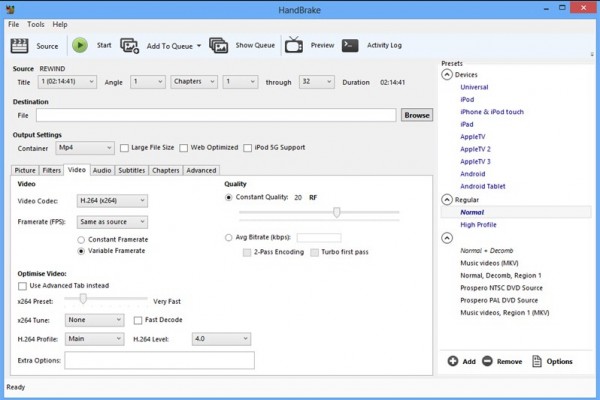
  • HandBrake update makes it easier to convert videos into any format

    Popular cross-platform, open-source video transcoder HandBrake 0.9.9 has been released, and despite the version number increment is actually a major update. HandBrake allows users to convert video from a wide variety of formats — including DVD and Blu-ray — into MP4 or MKV files with support for .H264 and FFmpeg codecs.

    Highlights in the latest release include support for the .H264 codec’s preset, tune and profile options, Blu-ray (PGS) subtitle support, additional video framerates and filter modes, improved audio remix and an updated user interface.

    Core improvements include the addition of support for Blu-ray (PGS) subtitles, which can be burned in, passed through to MKV (but not MP4) and are capable of working with Foreign Audio Search.

    The deinterlace and decomb filters both gain an additional option — “bob”, which doubles the framerate to reduce artefacts — and users gain four additional framerate settings: 30, 50, 59.94 and 60 fps.

    Audio remix support has also been improved, with additional mixdowns including 6.1 and two 7.1 settings. Users can now also upmix “better-than-Stereo” sources to 5.1 surround sound, and gain the option of discarding one channel from stereo sources to create a single mono source based on left or right only.

    Version 0.9.9 also allows the select of higher audio bitrates as well as lower audio samplerates where appropriate, plus supports audio dithering (TPDF) when converting to 16-bit FLAC. DTS audio decoding is now handled by libavcodec, which adds support for DTS-ES 6.1 Discrete.

    The graphical interface has also been overhauled — the Windows build has now been rewritten in WPF (Windows Presentation Foundation) to work more consistently across a range of devices, and users will notice that new fonts have been implemented along with a subtle redesign. All builds gain new Retina-friendly icons and an updated program icon.

    The program has introduced support for the x264 codec’s preset, tune and profile options. These can be found on the Video tab, but users preferring the greater flexibility offered in earlier versions can restore this by “Use Advanced Tab instead”. In conjunction with this change, the built-in presets have also been updated to take advantage of the new option, with “increasingly suboptimal and irrelevant Legacy presets” being dropped.

    We discovered that one side-effect of the new build is that custom presets lost certain settings, specifically those on the Filter tab. We recommend users make a careful note of existing settings before installing the update.

    Platform-specific changes include HandBrake 0.9.9 preventing Mountain Lion from going to sleep during encoding and scanning, plus users can now drag and drop files into the main window or on to the program’s dock icon to scan them. It also updates Growl support to version 2.0.1, so HandBrake can now use the Notification Center when Growl is not installed.

    Also updated to take advantage of HandBrake 0.9.9 is VidCoder 1.4.20, which takes the HandBrake core and overlays a more user-friendly front end. The latest version of this Windows-only software — also available in 64-bit — takes the latest HandBrake 0.9.9 core, but also adds tweaks of its own, including support for a new portable build and support for adding a custom video player. The full release notes can be read here.

    HandBrake 0.9.9 is available now as a free, open-source download for Windows, Linux and Mac. Recommend system requirements include a 64-bit Intel Mac running OS X 10.6 or later, or Windows Vista, 7 or 8 with Microsoft .NET Framework 4 installed.

  • Digital progress

    We’re starting a new group blog, Digital for Development, to introduce you to colleagues around DFID who will share how using digital communications and technology can help us achieve better results and value for money in our programmes.

    You will hear from colleagues working on a new platform to update, improve and replace the existing projects database. We are improving the way to find out where aid funds are spent and giving people the facility to trace those funds through to the people who benefit from it on the ground. You will hear examples from the team behind @dfid_uk on twitter, DFID on Facebook and other social media channels about how they look continually for different ways to interact with new audiences.

    We will share news from colleagues working on ways to transform how we interact with the people and organisations who have contact with us – whether they are applying for a grant, reporting back on programmes they run on our behalf, or finding out how people are benefitting from our work. And last, but definitely not least, from the team who are leading the way in exploring new ways that technology can support development.

    All these areas of work came together under the departmental digital strategy published last year following publication of the overarching government digital strategy.

    Department for International Develop Digital Strategy 2012-2015

    My new role is to have oversight of the many threads and priorities which the strategy covers, and report on progress – which will involve showcasing achievements as well as updates on work which is still to be done. I am looking forward to this work, as it builds on the many different projects I have been involved with as DFID’s digital capacity has developed – from the early days of creating our first ever website in 1995, launching the first intranet in 2000, through the excitement of experimenting with emerging social media channels (which included the creation of this blog platform), to seeing our presence in places like twitter, facebook and others grow.

    The strategy identified the priorities for DFID to 2015 and outlined how we plan to improve digital capabilities across the organisation. There will be more from me on that over the next couple of months as we work out current levels of activity and awareness, what people’s needs are and how to meet them. I look forward to working with colleagues from other government departments to share ideas and approaches.

    There are some pockets of activity and enthusiasm across the organisation already. We have individuals making excellent use of social media to have conversations with specialists in their field, and we have teams working behind the scenes finding efficient ways to share evidence and improve decision making. One of my biggest challenges is to find these examples, so we can showcase how staff are using digital in their work and encourage others to try things out.

  • MicroVentures Reaches $16M in Equity Crowdfunding Investments

    MicroVentures, a combined equity crowdfunding platform and broker-dealer in the US, has announced that accredited investors on its platform have invested $16 million in startups. MicroVentures employs a crowd-sourcing process that enables the power of the crowd to decide which startups will receive investments in an effort to provide a higher probability of successful outcomes.

    PRESS RELEASE

    MicroVentures, the only combined equity crowdfunding platform and broker-dealer in the US, announced today that accredited investors on their platform have invested $16M in startups. With investments in 34 companies, MicroVentures has now invested more with legal, accredited investors than any other equity based crowdfunding platform. MicroVentures employs a crowd-sourcing process that enables the power of the crowd to decide which startups will receive investments in an effort to provide a higher probability of successful outcomes. Further, MicroVentures has a dedicated due diligence team that screens out companies that may have potential growth inhibiting challenges.
    “As we patiently wait for the SEC to enact rules around the JOBS Act, we are utilizing traditional securities laws to connect startups with great investors. This is only possible as a result of our being one of the only registered broker dealer in the space. This is the first time ever that accredited investors have had the ability to invest alongside VC’s without taking major stakes and ending up with similarly diversified portfolios. However, we may find that the crowd does an even better job at picking winners,” said Tim Sullivan, CEO of MicroVentures. “We’ve reached a milestone that proves that our platform doesn’t just ‘work’ — but that there is significant demand from smaller investors to take part in this asset class.”
    MicroVentures’ platform invests primarily in seed stage startups, but will participate in follow on rounds alongside the VCs throughout the life of a company. For example, visual book publishing platform Graphicly (www.graphicly.com) and rich media advertisement platform Republic Project (www.republicproject.com) have both received multiple investments from MicroVentures as they have continued to gain traction and required additional capital to accelerate their growth. Other investments include SupplyHog (www.supplyhog.com), a Tennessee-based company that operates a platform that streamlines the process for buying building supplies and material online, along with Kickfolio (www.kickfolio.com), the first foreign management team, who have created a platform that enables developers to run iOS app demos in a standard web browser.
    “Our platform has created the opportunity for our investors to invest in everything from seed stage startups to huge companies such as Twitter and Facebook through secondary transactions. We’re giving investors the chance to participate and the transparency to make decisions in a way they have traditionally never been able to,” said Sullivan.
    About MicroVentures
    Based in San Francisco, CA and Austin, TX, MicroVentures is a wholly-owned broker-dealer whose capital model allows accredited investors to fund start ups, which are typically inaccessible outside the traditional venture capital ecosystem. Using its online investment platform, MicroVentures enables accredited investors to aggregate smaller commitments, allowing them to create diversified portfolios comprised of crowd-sourced startups.
    Contact Information
    Contact information:
    Ed Zitron
    347-844-2149

    The post MicroVentures Reaches $16M in Equity Crowdfunding Investments appeared first on peHUB.

  • Electranova Capital Invests in Forsee Power

    Electranova Capital, a fund managed by Idinvest Partners in association with EDF, has backed Forsee Power Solutions. Founded in 2011, Forsee Power Solutions specializes in integration which entails designing, developing and assembling battery systems.

    PRESS RELEASE

    Electranova Capital, the private equity innovation fund managed by Idinvest Partners in association with EDF has announced its investment in Forsee Power Solutions, with the aim of supporting its growth and business development.

    Founded in 2011, Forsee Power Solutions is a leading participant in the market for batteries, specializing in integration which entails designing, developing and assembling battery systems.

    Forsee Power Solutions operates in a fast-growth market currently undergoing transformation: solutions for power storage needs driven by the development of renewable energies (residential, commercial and industrial power storage), hybrid and electric vehicles, in addition to mobile devices and equipment (electric powered cycles, medical equipment, robotics, home automation, etc.).

    Equipment manufacturers now need power specialists who can not only provide them with knowledge of the various electrochemical battery solutions available on the market, but also have the resources and expertise to develop BMS (battery management and data processing systems) which are indispensable for battery performance and safety.

    Christophe Gurtner, CEO of Forsee Power Solutions commented: “The investment by Idinvest Partners via Electranova Capital in conjunction with EDF is a recognition of Forsee’s expertise and vision in developing these new markets. More importantly, it will enable us to substantially boost our resources, strengthen our teams, and build business synergies, while also combining our forces in order to bolster the growth potential we offer our customers. “

    Forsee Power Solutions is already working with EDF on a number of R&D and electric vehicle projects. Simultaneously, the company has continued to develop other highly innovative programs with various partners, earning it OSEO’s Société innovante prize for innovation in 2012.

    Nicolas Chaudron, Partner at Idinvest Partners added: ”The energy storage sector has been central to our investment strategy for a long time. We are delighted that Forsee Power Solutions has chosen us to provide it with development support. In our opinion, this company has rapidly set itself apart with a high‑quality leadership team, strong growth, and the desire to become an international market player. What is more, our relationship with EDF will enable Forsee to speed up its development by quickly building strong technical and commercial ties with one of the energy sector’s world leaders.”

    About Forsee Power Solutions

    Forsee Power Solutions was founded in 2011 when Uniross, Ersé and Energyone merged their industrial activities. Its core business is the integration and assembly of rechargeable industrial‑grade batteries for the mobile and stationary energy storage markets. Forsee’s products (batteries, chargers, and battery management systems or BMS) are marketed internationally to high‑profile customers, through sales offices in France and the United States. The company has laboratories and plants in France, Poland, and China.

    About Electranova Capital and Idinvest Partners
    Electranova Capital was launched in May 2012 by Idinvest Partners in association with EDF and with support from Allianz and CDC. The fund’s mission is to back innovative, emerging projects based on new technologies with a view to fostering low‑carbon business.
    With €3.6 billion under management and 40 staff, Idinvest Partners is a leading pan-European private equity manager focused on the middle market segment. Idinvest Partners has developed several complementary areas of expertise including investments in innovative European start-ups, primary, secondary and mezzanine investments in European non-listed companies, and private equity consulting. Founded under the name AGF Private Equity in 1997, Idinvest Partners was formerly part of the Allianz Group until 2010 when it joined forces with IDI Group to become independent.

    Daphné Claude
    Co-founder, Executive Director
    Citigate Dewe Rogerson Paris
    16 rue de Londres
    F-75009 Paris
    Tel +33 (0)1 53 32 78 90
    Mobile +33 (0)6 66 58 81 92

    The post Electranova Capital Invests in Forsee Power appeared first on peHUB.

  • STG’s Consilio Appoints

    Software services business Consilio has appointed Pete Feinberg as vice president of products and Mark Roesler has joined as director of software development. Consilio is a portfolio company of Symphony Technology Group.

    PRESS RELEASE

    Consilio, a Symphony Technology Group (STG) company and global leader in eDiscovery software and services, today announced that Pete Feinberg has joined the company as Vice President of Products, and that Mark Roesler has joined as Director of Software Development.
    “We are dedicated to constantly improving the people, processes and technology our clients need to manage their global eDiscovery projects,” said Andy Macdonald, CEO of Consilio. “The addition of Pete and Mark to our product team enhances our ability to meet these goals and deliver an exceptional service experience to our clients.”
    As Vice President of Products, Feinberg will set the strategy for the products and services Consilio provides its clients. Prior to joining Consilio, he served as senior director of marketing at Blackboard, where he focused on client retention and new business development. Feinberg has served as vice president of marketing at Global Telecom & Technology and vice president of product management and marketing at InPhonic. He has held various other positions in partner marketing, product management and product marketing at mature and start up technology businesses. He holds a mechanical engineering degree from Virginia Tech, and an MBA in marketing from the Smith School of Business at the University of Maryland.
    Mark Roesler joins Consilio as Director of Software Development. In this role, he will guide the technology development and architecture design team for Consilio’s market-leading processing and review technologies. Roesler will also be responsible for global client support delivery and for meeting Consilio’s commitment to high quality in each product release. Roesler brings more than 15 years of information technology experience at Rain-Bird, ING, Cetera and Union Bank. He has a degree in industrial engineering from Northwestern University.
    About Consilio
    Consilio is an international eDiscovery and managed review provider with extensive experience in litigation, antitrust, second requests, and internal and external investigations. The company supports law firms and corporations with cost-effective, end-to-end litigation services that include data collection, computer forensics, expert testimony, multi-lingual and on-site data processing, hosting and document review. Safe Harbor certified, the company can deploy its services rapidly and efficiently to clients anywhere in the world from offices and data centers in North America, Europe and Asia. For more information, please visit www.consilio.com.
    About Symphony Technology Group
    Symphony Technology Group (STG) is a strategic private equity firm with the mission of investing in and building great software and services companies. In addition to capital, STG provides transformation expertise to enable its companies to deliver maximum value to their clients, to drive growth through innovation, to retain and attract the best talent and to achieve best in class business performance. STG’s current portfolio consists of 14 global companies. For more information, please visit http://www.symphonytg.com/
    Consilio and the Consilio logo are trademarks or registered trademarks of Consilio and its affiliates in the U.S. and other countries. Other names may be trademarks of their respective owners.
    Contact Information
    U.S. Media Contact:
    Christine Boomer
    Consilio
    Email Contact
    Telephone (202) 822-6222

    European Media Contact:
    Lena Ahad
    Technology PR
    Email Contact
    Telephone (UK) +44 07908 725212
    EmailPrint Friendly Share

    The post STG’s Consilio Appoints appeared first on peHUB.

  • Walgreens and Alliance Boots to Back AmerisourceBergen

    Walgreen, a retail drugstore chain in the US and KKR portfolio company Alliance Boots, an international pharmacy-led health and beauty group, have received the required regulatory clearances for their equity investment in pharmaceutical services company AmerisourceBergen Corporation. The regulatory clearances permit both the purchase of up to 7 percent of the fully diluted equity of AmerisourceBergen in the open market, and the exercise of two warrants for 16 percent in the aggregate of the fully diluted equity of AmerisourceBergen in 2016 and 2017.

    PRESS RELEASE

    Walgreen Co. (NYSE: WAG) (Nasdaq: WAG), the largest retail drugstore chain in the United States, and Alliance Boots GmbH, a leading international pharmacy-led health and beauty group, today announced that they have received the required regulatory clearances for their equity investment in AmerisourceBergen Corporation, one of North America’s largest pharmaceutical services companies.

    The regulatory clearances permit both the purchase of up to 7 percent of the fully diluted equity of AmerisourceBergen in the open market, and the exercise of two warrants for 16 percent in the aggregate of the fully diluted equity of AmerisourceBergen in 2016 and 2017. The clearances permit the investment in AmerisourceBergen up to 25 percent in the aggregate, including the effect of any stock repurchases that AmerisourceBergen may engage in from time to time. Walgreens and Alliance Boots announced that they had been granted the right to purchase a minority equity position in AmerisourceBergen as part of a broader innovative long-term agreement on March 19, 2013.

    About Walgreens

    As the nation’s largest drugstore chain with fiscal 2012 sales of $72 billion, Walgreens (www.walgreens.com) vision is to become the first choice for health and daily living for everyone in America and beyond. Each day, Walgreens provides more than 6 million customers the most convenient, multichannel access to consumer goods and services and trusted, cost-effective pharmacy, health and wellness services and advice in communities across America. Walgreens scope of pharmacy services includes retail, specialty, infusion, medical facility and mail service, along with respiratory services. These services improve health outcomes and lower costs for payers including employers, managed care organizations, health systems, pharmacy benefit managers and the public sector. The company operates 8,086 drugstores in all 50 states, the District of Columbia and Puerto Rico. Take Care Health Systems is a Walgreens subsidiary that is the largest and most comprehensive manager of worksite health and wellness centers and in-store convenient care clinics, with more than 700 locations throughout the country.

    About Alliance Boots

    Alliance Boots is a leading international, pharmacy-led health and beauty group delivering a range of products and services to customers. Working in close partnership with manufacturers and pharmacists, we are committed to improving health in the local communities we serve and helping our customers and patients to look and feel their best. Our focus is on growing our two core businesses: pharmacy-led health and beauty retailing and pharmaceutical wholesaling and distribution, while increasingly developing and internationalising our product brands.

    Alliance Boots has a presence in more than 25* countries and employs over 108,000* people. Alliance Boots has pharmacy-led health and beauty retail businesses in nine* countries and operates more than 3,100* health and beauty retail stores, of which just over 3,000* have a pharmacy. In addition, Alliance Boots has around 605* optical practices, of which around 190* operate on a franchise basis, and around 390* hearingcare practices. Our pharmaceutical wholesale businesses deliver over 4.6 billion* units each year to more than 170,000* pharmacies, doctors, health centres and hospitals from over 370* distribution centres in 20* countries.

    In June 2012, Alliance Boots announced that it had entered into a strategic partnership with Walgreen Co., the largest drugstore chain in the US, to create the first global pharmacy-led, health and wellbeing enterprise.

    * Figures are approximations as at 31 March 2013 and include associates and joint ventures.

    Walgreens Cautionary Note Regarding Forward-Looking Statements. Statements in this release that are not historical, including, without limitation, estimates of future financial and operating performance, including the amounts and timing of future accretion and synergies, are forward-looking statements made pursuant to the safe harbor provisions of the Private Securities Litigation Reform Act of 1995. Words such as “expect,” “likely,” “outlook,” “forecast, “would,” “could,” “should,” “can,” “will,” “project,” “intend,” “plan,” “goal,” “target,” “continue,” “sustain,” “synergy,” “on track,” “believe,” “seek,” “estimate,” “anticipate,” “may,” “possible,” “assume,” variations of such words and similar expressions are intended to identify such forward-looking statements. These forward-looking statements are not guarantees of future performance and involve risks, assumptions and uncertainties, including, but not limited to, those relating to our commercial agreement with AmerisourceBergen, the arrangements and transactions contemplated by our framework agreement with AmerisourceBergen and Alliance Boots and their possible effects, the Purchase and Option Agreement and other agreements relating to our strategic partnership with Alliance Boots, the arrangements and transactions contemplated thereby and their possible effects, the parties’ ability to realize anticipated synergies and achieve anticipated financial results, the risks associated with transitions in supply arrangements, the risks associated with international business operations, the risks associated with governance and control matters, whether the option to acquire the remainder of the Alliance Boots equity interest will be exercised and the financial ramifications thereof, the risks associated with potential equity investments in AmerisourceBergen including whether the warrants to invest in AmerisourceBergen will be exercised and the financial ramifications thereof, changes in vendor, payer and customer relationships and terms, changes in network participation, levels of business with Express Scripts customers, the implementation, operation and growth of our customer loyalty program, changes in economic and market conditions, competition, risks associated with new business areas and activities, risks associated with acquisitions, joint ventures and strategic investments, the ability to realize anticipated results from capital expenditures and cost reduction initiatives, outcomes of legal and regulatory matters, and changes in legislation or regulations. These and other risks, assumptions and uncertainties are described in Item 1A (Risk Factors) of Walgreen Co.’s most recent Annual Report on Form 10-K, which is incorporated herein by reference, and in other documents that Walgreens file or furnish with the Securities and Exchange Commission. Should one or more of these risks or uncertainties materialize, or should underlying assumptions prove incorrect, actual results may vary materially from those indicated or anticipated by such forward-looking statements. Accordingly, you are cautioned not to place undue reliance on these forward-looking statements, which speak only as of the date they are made. Except to the extent required by law, Walgreens does not undertake, and expressly disclaims, any duty or obligation to update publicly any forward-looking statement after the initial distribution of this release, whether as a result of new information, future events, changes in assumptions or otherwise.

    Contacts

    Investor Relations:
    Walgreens
    Rick Hans / Ashish Kohli
    +1 847 315 2385 / +1 847 315 3810
    or
    Alliance Boots
    Gerald Gradwell
    +44 (0)207 980 8527 (UK), +1 646 688 1336 (US)
    or
    Media Relations:
    Alliance Boots
    Yves Romestan / Laura Vergani / Katie Johnson
    +44 (0)207 980 8585
    or
    RLM Finsbury UK (London)
    James Murgatroyd / Katie Lang / Yim Wong
    +44 (0)207 251 3801
    or
    Walgreens
    Michael Polzin
    +1 847 315 2920
    or
    Walgreens
    Jim Cohn
    +1 847 315 2950
    or
    Brunswick US (New York)
    Steve Lipin / Radina Russell
    +1 212 333 3810

    The post Walgreens and Alliance Boots to Back AmerisourceBergen appeared first on peHUB.