Blog

  • Cura depurativa

    Embora as curas depurativas possam ser feitas em qualquer momento do ano, é costume nos países nórdicos fazê-las no começo da primavera. Graças à alimentação pobre em frutas frescas, durante o inverno, acumulam-se resíduos metabólicos no organismo, que podem ser eliminados mediante a cura depurativa com uma ou várias destas plantas. Plantas depurativas são plantas que facilitam a eliminação, através da urina ou do suor, de substâncias residuais que circulam no sangue e que tendem a despositar na pele.

    Os resultados da cura depurativa são muito eficazes no caso de eczemas, gota, obesidade, etc. As curas depurativas devem durar no mínimo três dias, sendo a duração ideal uma semana. Neste período, é necessário seguir uma dieta vegetal muito leve e ingerir água em abundância, assim como suco de fruta, de verduras e plantas medicinais.

    Borragem – é depurativa de grande eficácia. Usa-se o suco fresco das folhas.

    Cocleária – é antiescorbútica, favorecendo a eliminação das substâncias ácidas residuais. Usa-se como verdura, ou suco fresco.
    Labaça – Usa-se as folhas como verdura, em infusão ou em suco fresco. É depurativa, diurética e antianêmica.

    Erva-alheira (Alliaria petiolata) – O suco fresco da planta é indicada na astenia e fadiga. Muito apropriada para fazer uma cura depurativa.

    Melissa-Bastarda – A infusão da planta é util para as curas de primavera. É diurética e depurativa.
    Cerejeira-Européia – libera o organismo das impurezas e resíduos (cura de cerejas).
    Groselheira-Espinhosa – muito apropriada para curas de primavera pelo seu conteúdo vitaminico. Usam-se as bagas frescas em suco, geléia ou doce.
    Solidago – A decocção das suas sumidades florais é diurético, depurativo, tonificante, limpando o sangue de resíduos.
    Escabiosa-Mordida – a infusão de suas folhas é suavemente diurética e tonificante.
    CURA DEPURATIVA COM XAROPE DE ÁCER[1]
    Da seiva do ácer do Canadá (Acer saccharum Marsh.), também chamado ácer do açúcar, obtém-se o chamado xarope de ácer, que, além de se usar como edulcorante, foi sempre muito apreciado em alguns países para levar a cabo curas depurativas e de emagrecimento. A cura de xarope de ácer é levada a cabo da seguinte maneira:
    • A cura tem de durar, pelo menos, 4 dias. É melhor que dure de 5 a 7 dias. Prolongá-la exige que seja feita sob controlo médico, como qualquer outra cura de jejum.
    • Toma-se um copo de água com 2 colheradas de xarope de ácer e 2 colheradas de sumo de limão, e bebem-se de 8 a 12 copos por dia.
    • A cura complementa-se com infusões de menta (Menta piperita L.) e um consumo abundante de água pura.
    • Se não for tomado nenhum outro alimento, esta cura tem um grande efeito depurativo e adelgaçante.

    Fonte: Enc. plantas
    [1] – Saudelar


  • Straight from Sony Chairman Sir Howard Stringer: Here’s why Google TV is a huge deal for Sony

    By the Betanews Staff, Betanews

    Google Android TVSony Corp. Chairman Sir Howard Stringer concluded a press conference about his company’s forthcoming Android-based Internet TV yesterday with a widely quoted declaration: “This really is a very big deal.” But it wasn’t until his 50-minute sit down with an exclusive group of a dozen journalists and analysts did he get down to explaining why.

    The alliance is one of strange bedfellows. Sony and Google are competitors in mobile phones and supporting services. In addition, consumer electronics companies have typically resisted the advances of high-tech companies. Sony also stands apart from many other consumer electronics companies, by pushing its own technologies and standards rather than embracing others. So Sony’s Google embrace is surprising and foreshadowing: Sony is changing its ways.

    With the planned fall debut of a standalone “Internet TV” and a set-top box that brings the functionality to existing displays, the TV, Stringer said, “is no longer dumb.” By bringing the Internet and, more importantly, a cornucopia of apps to the TV, the same multimedia extravaganza that most people routinely enjoy alone on a PC or smartphone will finally make its way into the living room where they can enjoy it together.

    What’s so special about a Sony-Android TV? “It’s who gets to experience it — the whole family,” Stringer said.

    These announcements often come with a ton of hype. You won’t be blamed if you believe the normally understated British exec is making too much of too little. The Internet has been moving onto the TV for quite some time. Sony has itself been making hay with its “internet-connected” TVs for two years now. Moreover, there are already platforms out there such as Apple TV and Boxee. Yahoo has been pressing its connected-TV “widgets.” And Hulu certainly bridged the gap between PC and TV.

    But the Sony-Google deal really does make for a King Kong — a behemoth big enough and muscular enough to move IPTV from the fringes into the mainstream of modern life. The duo may be savvy enough to make Internet TV a reality. Google gets computers, search, and the Internet; Sony knows TVs.

    But something on the Sony side makes the partnership potentially more potent: Stringer has put the finishing touches on a vast management change in Sony’s TV group by turning its reins over to a group of managers who previously ran Sony’s VAIO PC, PlayStation, networking, and mobile groups.

    Stringer refers to these managers as his “musketeers,” and they include Bob Ishida, senior vice president of Sony’s home entertainment group who ran the VAIO business in the U.S. and Japan for years, and Kuni Suzuki, the SVP in charge of Sony’s network products and services group. Stringer said their involvement was calculated: They don’t just get TVs, they get processors, operating systems and applications, too. Plus, they bring a “much more combative” computer industry mentality to the once, but no longer, staid world of consumer electronics. They’ve managed in a highly price-competitive, innovation-driven segment.

    The cultural revolution isn’t underway just at Sony’s Tokyo headquarters. It’s also unfolding at its San Diego-based Sony Electronics Corp., which makes TVs, computers, MP3 players, cameras, and more for the U.S. market. Just two weeks ago, Sony named Mike Abary, who spent 10 years with the VAIO group, SVP of its Sony Electronics Home Division, which includes its American TV-manufacturing operation.

    Thanks to the VAIO-connected execs, Sony got a jump at working with Google. It began shipping VAIO PCs with Google Chrome in January. And its Sony-Ericsson unit released an Android smartphone to the Japan market in January. As a result, Stringer believes he has a six-month advantage on his rivals.

    Not be underestimated either is the fact that Google will be unleashing the thousands of independent developers already aboard the Android bandwagon, who will now be able to create apps for an OS that spans smartphones, PCs, netbooks, tablets, and now TVs.

    In fact, Sony’s Abary said Android will become the platform for apps that will turn the TV into an information device as utilitarian as other computing devices — apps in numbers and in kinds we simply “can’t imagine now.”

    Stringer paid homage to Google for its quick feet. When Sony called on Google to talk, it was the Google side that first proposed putting Android on Sony TVs — and other gadgets in its portfolio later, he said. Stringer contends the relationship with Google is so far “unblemished” by any major disagreements. “It’s refreshing, ” he said, referring no doubt to the often contentious alliances Sony’s long had with the likes of Microsoft and Intel.

    By Stringer’s own admission, partnerships like the one it has forged with Google often turn into love-hate affairs. In an aside before his sit-down began, he said that running a corporation in today’s world of “coopitition” is like “jumping into a Viking boat where you might be handed an oar or you might be handed an axe.” In short, you never know when you’re friend, or when you’re foe.

    Today, Google has handed him an oar, he jokes. After this, though, he admits who knows.

    Copyright Betanews, Inc. 2010


    Add to digg
    Add to Google
    Add to Slashdot
    Add to Twitter
    Add to del.icio.us
    Add to Facebook
    Add to Technorati


  • Google-AdMob Deal Approved By Feds (GOOG, AAPL)

    friends celebrate happy hug 4x3

    The Federal Trade Commission has finally approved Google’s $750 million deal to acquire AdMob, a mobile advertising network.

    This was the right move, and it’s appalling that the government took so long to approve the deal, which was announced in early November.

    Why? Because the nascent mobile advertising industry is simply too immature for government regulation. NO ONE knows what direction the mobile ad market will grow in, and it would have been a HUGE mistake for the FTC to reject this deal.

    As the FTC notes, Apple’s entry into the market throws everything up in the air, so it’s harmless for Google to acquire AdMob.

    Don’t miss: 25 awesome charts on the state of the wireless industry →

    Here’s the FTC’s statement.

    After Thorough Review, Agency Finds Transaction Not Likely to Harm Competition

    The Federal Trade Commission has closed its investigation of Google’s proposed acquisition of mobile advertising network company AdMob after thoroughly reviewing the deal and concluding that it is unlikely to harm competition in the emerging market for mobile advertising networks.

    In a statement issued today, the Commission said that although the combination of the two leading mobile advertising networks raised serious antitrust issues, the agency’s concerns ultimately were overshadowed by recent developments in the market, most notably a move by Apple Computer Inc. – the maker of the iPhone – to launch its own, competing mobile ad network. In addition, a number of firms appear to be developing or acquiring smartphone platforms to better compete against Apple’s iPhone and Google’s Android, and these firms would have a strong incentive to facilitate competition among mobile advertising networks.

    “As a result of Apple’s entry (into the market), AdMob’s success to date on the iPhone platform is unlikely to be an accurate predictor of AdMob’s competitive significance going forward, whether AdMob is owned by Google or not,” the Commission’s statement explains.

    The Commission stressed that mergers in fast-growing new markets like mobile advertising should get the same level of antitrust scrutiny as those in other markets. The statement goes on to note that, “Though we have determined not to take action today, the Commission will continue to monitor the mobile marketplace to ensure a competitive environment and to protect the interests of consumers.”

    Mobile ad networks, such as those provided by Google and AdMob, sell advertising space for mobile publishers, who create applications and content for websites configured for mobile devices, primarily Apple’s iPhone and devices that run Google’s Android operating system. By “monetizing” mobile publishers’ content through the sale of advertising space, mobile ad networks play a vital role in fueling the rapid expansion of mobile applications and Internet content.

    According to the FTC’s statement, evidence gathered by the agency raised important questions about the transaction. Google and AdMob have competed head-to-head for the past few years, with a notable increase in intensity during the past year. This competition has spurred innovation and allowed mobile publishers to keep a large share of the revenue generated from the sale of their ad space. The companies also have economies of scale that give them a major advantage over smaller rivals in the business, the statement says.

    These concerns, however, were outweighed by recent evidence that Apple is poised to become a strong competitor in the mobile advertising market, the FTC’s statement says. Apple recently acquired Quattro Wireless and used it to launch its own iAd service. In addition, Apple can leverage its close relationships with application developers and users, its access to a large amount of proprietary user data, and its ownership of iPhone software development tools and control over the iPhone developers’ license agreement.

    The Commission vote to close the investigation was 5-0.

    Join the conversation about this story »

  • Frozen Yogurt Season

    Mango, raspberry-lime and honey-goat's milk frozen yogurt (AJC Staff)

    Mango, raspberry-lime and honey-goat's milk frozen yogurt (AJC Staff)

    A few folks have been asking about the frozen yogurt I mentioned in a post the other day. As our friends all know, my family and I eat lots and lots of yogurt during the spring and summer months. Here’s a 2008 story I wrote for the newspaper, with recipes.

    A CULTURED TREAT

    My first batch of homemade frozen yogurt resulted, I recall, from a creative cleaning out of the fridge, which explains the unusual flavor combination: honey-lime-vanilla-goat.

    It was also a bribe for my chore-averse children. If they would not only clear the dinner table but fill the dishwasher and put the leftovers away without bickering or stalling, then I would provide dessert. That seemed fair.

    Working quickly, I flavored a half carton of goat’s-milk yogurt (bought on a whim, never finished) with the aforementioned ingredients and poured them into an ice cream maker. I had no idea what I was doing but figured something cold and sweet …

  • WebM – Novo standard de vídeo para a Web

    WebMDurante o evento Google I/O têm sido reveladas várias novidades que terão um impacto significativo para todos nós, utilizadores da Internet, no que toca à visualização de conteúdos multimédia através da web, nomeadamente Video.

    O Google, que detinha os direitos do VP8, um codec de vídeo semelhante ao H.264, anunciou a disponibilização do mesmo de forma gratuita e opensource, complementado com o codec de áudio Vorbis.

    WebM é o nome do novo formato aberto de vídeo de alta qualidade com estrutura baseada no Matroska que certamente se tornará um standard no que toca a vídeo para a Web. Browsers como o Chrome, Opera e Firefox já estão a implementar o suporte deste novo formato para HTML 5 Video.

    Uma vez que o YouTube é uma das maiores fontes de distribuição de conteúdos multimédia, a implementação deste novo codec nos browsers, vai certamente acelerar o processo de distribuição deste novo formato por todo o mundo.

    Estamos a atravessar um momento de mudanças no que toca a Standards para a Web.

    De lembrar que hoje em dia o uso de dispositivos móveis como smartphones para navegação na web é bastante comum e como existem browsers com suporte a HTML 5 disponíveis para estes dispositivos, é um grande avanço existirem este tipo de codecs.

    É também de louvar que hajam alternativas para visualização de vídeos na web que de outra forma só poderiam ser vistos com Flash ou outros plugins que iriam gastar bateria e consumir recursos em excesso, tornando os dispositivos menos eficientes.

    Poderá encontrar mais informação acerca deste novo formato no site do projecto WebM.

    WebTugaWebM – Novo standard de vídeo para a Web

  • In The Midst Of The Carnage, There’s One Region Where Investors Are Getting More Excited About Stocks

    According to EPFR Global, investors yanked $4.81 billion out of European equity funds and $7 billion out of U.S. funds during the week ending May 19th. This probably isn’t too surprising given the negative market action we experienced.

    What is surprising is that the flight from stocks wasn’t global in the most recent week. Pacific equity funds saw net inflows of $147 million, which was the highest level in 30 weeks. As shown by the chart below, the cumulative fund flow into Asia is now moving towards an all-time high.

    Chart

    While Asian stocks have been under substantial pressure during the last month, sentiment is starting to turn around… even if prices haven’t quite yet. MSCI Asia shown below.

    Chart

    Meanwhile, commodity funds saw net inflows of $1.03 billion, though most of this was gold. The majority of commodities experienced outflows.

    A final notable segment was high yield bonds, which enjoyed a substantial bout of investor love last year. Outlfows remain ugly, at over -$1 billion despite overall positive inflows into global bond funds.

    Chart

    Join the conversation about this story »

  • Verizon rolling out hybrid trucks on Long Island

    From Green Right Now Reports

    Five hybrid aerial-lift trucks were unveiled today at Verizon’s Long Island headquarters, the first of 160 alternative-energy vehicles that the company said it will add to its fleet in New York this year.

    The five vehicles, also known as bucket trucks, have batteries that help power the engine and also provide the sole power for the mechanical boom that raises a four-sided platform, or “bucket,” to enable a technician to work on overhead telephone lines or other equipment. In the traditional versions of Verizon’s bucket trucks, the mechanical booms are powered by the trucks’ gasoline or diesel engines.

    Heavy-duty chargers that plug into an electrical outlet are used to recharge the hybrid trucks’ batteries. The batteries will be recharged at night, when power demand from the nation’s grid — generally the cleanest and most efficiently produced energy — is low, Verizon said.


    (Video from Verizon)

    On an annual basis, each of Verizon’s five plug-in hybrid trucks is expected to use 750 to 1,500 fewer gallons of fuel and cut greenhouse gas emissions by an estimated 7 to 14 tons over the traditional models they replace. Verizon said the hybrid system is also quieter than traditional models, which helps cut noise pollution. The five trucks will be based at the company’s Woodbury garage and primarily serve the northern and central areas of Nassau County.

    “Using lower-carbon alternatives to power our fleet and our highly intelligent broadband networks are just some of the ways we’re reducing greenhouse gas emissions,” James Gowen, chief sustainability officer for Verizon, said in a statement. “We’re proud of the fact that as we increase the sustainability of our business we’re also contributing to improved air quality in New York.”

    Verizon also said it will roll out more than 1,100 alternative energy vehicles across the country this year, and increasing use of biodiesel and flex-fuel (E85) to power 470 vehicles. The company will operate approximately 250 alternative energy vehicles in New York by the end of 2010.

  • Hollywood Park Race Track Great Lady M Stakes Horse Racing Betting Pick Friday 5-21

    Our horse racing play comes from the Great Lady M Stakes run on the Friday night card at Hollywood Park.

    The Great Lady M Stakes will be run at 6 furlongs on the Hollywood Park turf course and its for fillies and mares four year olds and upward.

    With our free pick we will play on #4 Porto Marmay to win.

    Porto Marmay will have the services of David Flores in the saddle and is trained by Julio Canani.

    This five year old returns back to sprinting over the Hollywood Park turf course and it’s a place and distance she has had success in.

    Before spending her past three races running downhill at Santa Anita she had a win at six furlongs in a non grade stakes event last June. Prior to that she recorded a triple digit Beyer figure sprinting in the Lawndale Stakes on the turf at Hollywood. She is working extremely well and the price is nice.

    Play #4 Porto Marmay to win Race 5 at Hollywood Park 6-1 on the Morning Line

    Post Time at 11:57PM Eastern Time televised by TVG

    Courtesy of Tonys Picks

  • Bret Michaels With a Hole in His Heart

    Bret MichaelsBret Michaels, an American singer who is best known as the lead vocalist of the glam metal band Poison, was brought back to the hospital once again. He was brought to the hospital last April for the reason of having a brain hemorrhage just a week after he had an emergency appendectomy.

    This time, the cause of his admission to the hospital is not related to the brain hemorrhage he got. But earlier in this week, Michaels felt numbness in his arm, which he thought that it might be because of his rehabbing twice a day. The finding was said that he had a Transient Ischemic Attack (TIA), or what they call “warning stroke”. While he was at the hospital, the doctors had discovered that Michaels has a patent foramen ovale, which is a small hole in his heart. Doctors say that there is nothing to worry because his condition is treatable.

    Michael’s was even scheduled to appear on the finale of NBC’s The Celebrity Apprentice on May 23.

    Related posts:

    1. Brett Michaels back in hospital after a “Warning Stroke” – Update in his Condition
    2. Bret Michaels Re-Hospitalized Because Of Possible Stroke
    3. Back to the Hospital: Bret Michaels’ Stroke or Warning?

  • Global Average Sea Surface Temperatures Poised for a Plunge

    Via Prison Planet.com » Sci Tech

    Roy W. Spencer, Ph. D.
    Friday, May 21, 2010

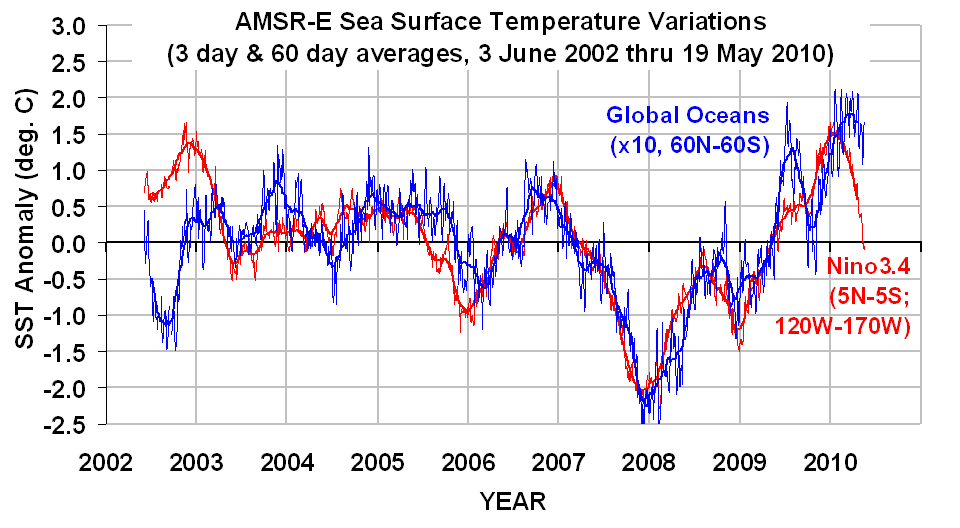
    Just an update…as the following graph shows, sea surface temperatures (SSTs) along the equatorial Pacific (“Nino3.4″ region, red lines) have been plunging, and global average SSTs have turned the corner, too. (Click on the image for the full-size, undistorted version. Note the global values have been multiplied by 10 for display purposes.)

    Global Average Sea Surface Temperatures Poised for a Plunge AMSRE SST Global and Nino34 thru May 19 2010

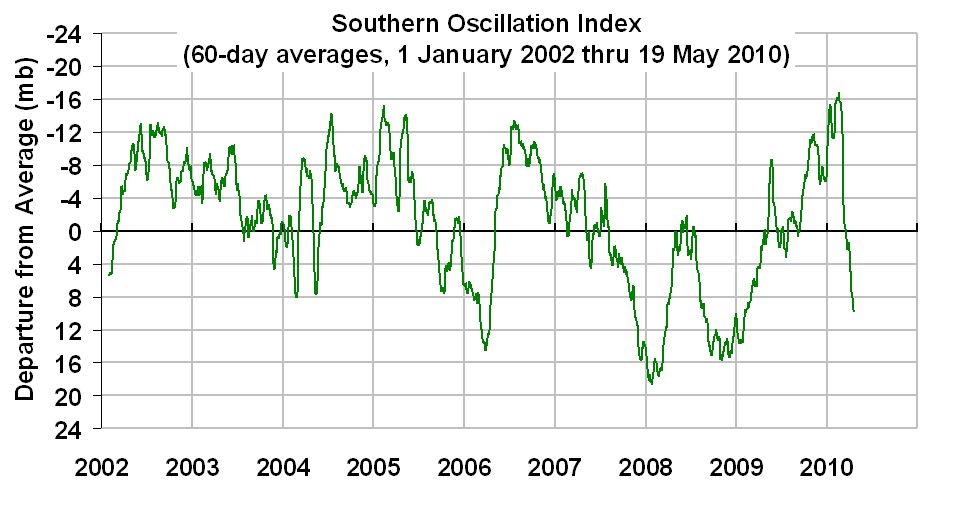
    The corresponding sea level pressure difference between Tahiti and Darwin (SOI index, next graph) shows a rapid transition toward La Nina conditions is developing.

    Global Average Sea Surface Temperatures Poised for a Plunge SOI daily thru May 19 20101

    Being a believer in natural, internal cycles in the climate system, I’m going to go out on a limb and predict that global-average SSTs will plunge over the next couple of months. Based upon past experience, it will take a month or two for our (UAH) tropospheric temperatures to then follow suit.

  • UEFA Champions League Final

    The culmination of the European season, the Champions League Final will be decided this Saturday between Bayern Munich and Inter Milan. The game is set to make history before the ball is even touched because it is the first time the final will be played on a Saturday and much to the joy of American soccer fans, will be broadcast live on network television (FOX).

    Continue reading for more on the UEFA Champions League Final.

    One of the most captivating aspects of the match will be the tactical battle pitting teacher versus student, as Louis Van Gaal will face his former Barcelona assistant Jose Mourinho. Both men have previously tasted Champions League glory, Van Gaal led Ajax to the cup in 1995 and Mourinho did the same with F.C. Porto in 2004. A victory on Saturday will put either man in illustrious company as only the third coach to win the Champions League with two different teams.

    Players to watch

    F.C. Internazionale Milano – Diego Milito has had a wonderful campain for Inter so far scoring 28 goals in all competitions. He scored key goals versus Chelsea and Barcelona during their Champions League run demonstrating his ability come through during critical matches. Look for Milito to feature up front along side Samuel Eto’o with Wesley Sneijder pulling the strings in midfield.

    F.C. Bayern Munich – You can easily say that Bayern would not be in this position without the exploits of Dutch wizard Arjen Robben and the timely goals of Ivica Olic. Robben’s magnificent strike against Manchester United during the Quarterfinals was probably the goal of the tournament (http://www.youtube.com/watch?v=nP6VBXuO_1I&feature=related) and he will be looking to put his mark on the match every time he touches the ball. Olic seemed to score at the most opportune moments all tournament long and he look to run rampant on Saturday.

    Prediction

    The slight advantage has to go to Inter since they knocked off favorites Chelsea and Barcelona on their way to the final. Mourinho’s side also has the deeper bench and will look to take control in the latter stages of the match. Bayern will come out firing in the early stages but Inter will look to hold off and counter. In the end, I see Inter coming out on top 2 -1 in highly contested, well fought match.


  • Fedele Says Business Failure Casts Doubt On Foley Claims; Charges Foley Made Millions ‘On The Backs Of’ Employees

    Republican Lt. Gov. Michael Fedele Friday said that a Courant story “raises serious questions” about sweeping claims of business success by his leading rival for this weekend’s Republican gubernatorial nomination, Greenwich multimillionaire Tom Foley.

    Fedele issued a statement saying: “Today’s Hartford Courant story that Tom Foley’s business practices contrast sharply with his campaign rhetoric raises serious questions about his job creation claims and it suggests that Tom has distorted his record as a job creator.”

    The Courant reported that one of Foley’s claimed success stories — his ownership of The Bibb Co., a textile manufacturer that he bought through a junk-bond-financed leveraged buyout in 1985 — ended with him relinquishing executive control and most of his 95 percent stake in Bibb 11 years later.

    Bibb — whose Bibb City plant on the outskirts of Columbus, Ga., was once known as the largest cotton mill in the world — went through a “prepackaged bankruptcy reorganization” in 1996 that removed Foley from executive control. It never recovered and was sold in 1998 by its new management, and the renowned Bibb City plant closed forever in 1998.

    Foley responded to Fedele’s criticism, saying that “my record of success in business speaks for itself,” and that Fedele should read the Courant article “more carefully.”

    “The Bibb City Plant referred to in the article was very much open and providing jobs and income to its employees at the time I relinquished control of Bibb,” Foley said. “After four years as Lieutenant Governor of Connecticut, our state is still one of only two states with net job losses since 1989. If Mike Fedele is going to create jobs in Connecticut, why hasn’t he done so already?”

    Foley’s Greenwich-based holding company, the NTC Group, collected management fees from Bibb of $4 million each year from 1992 to 1994, then $3.4 million in 1995, even as Bibb struggled and began losing money in 1994, according to filings with the U.S. Securities and Exchange Commission. He estimates he personally collected about 20 percent of those fees.

    Fedele also said in his statement Friday: “I hope he will explain how he can justify making millions of dollars on the backs of long-time employees of this company which failed under his leadership. We certainly don’t want what happened to Bibb City to happen here in Connecticut.”

    While Foley has enjoyed success in business overall, his Bibb venture contrasts starkly with the rosy-hued picture painted in his campaign literature. In an interview carried in the Courant story, Foley defended both his campaign’s positive characterization of the Bibb deal and the collection of the multimillion-dollar management fees from Bibb by his Greenwich-based holding company, the NTC Group.

    Here is part of a 2009 Foley campaign biography that dealt with the Bibb venture: “Tom’s record in business is impressive. His primary operating companies, The Bibb Company, T.B. Woods, Inc., and Stevens Aviation, each more than doubled in revenues and each expanded employment by more than fifty percent while under Tom’s leadership,” said one of his campaign biographies. “Tom believes the same expertise and problem-solving skills he uses to manage and grow businesses can be used to help government improve the economy and expand jobs for Connecticut citizens.”

    Foley said he didn’t think his campaign account was misleading “because when I bought The Bibb Co. it was losing $14 million a year, and shortly after I acquired it we got it turned around and we were earning money. And the company was doing quite well in 1988 so we bought a bigger … textile business from J.P. Stevens.” That acquisition increased the number of the company’s employees, he said.

    But then things turned sour for the business, whose main products included towels and sheets.

    “In the late ’80s, valuations on businesses were pretty high — the economy was very good — and we overpaid for that part of the business,” he said. “We integrated the two businesses. … I think from a management point of view things were doing pretty well. … But we just couldn’t bear the weight of the debt that had been taken on, and so that was the reason for the [bankruptcy] restructuring.”

    “Over the 10-year period I owned The Bibb Co., the textile business was under tremendous pressure from products coming in from overseas,” Foley said. “I think we certainly did much better than the management team that was in place before I bought the business would have done. So I think you have to compare the performance [on the basis of] how long we were able to keep business and hold on under different circumstances.”

    Foley said the annual management fees of up to $4 million, which were collected by NTC as the Bibb Co. struggled, were for “a lot of employees … helping to run the company” out of NTC’s Greenwich office.

    Foley said he is “not really a finance person by background” and instead has specialized in managing companies he buys and improving their performance.

    “I think the image of a slash-and-burn person is more of a trader, somebody who comes in and buys something, and does a quick fix-it-up or face-lift and then tries to sell it for a quick profit or sell of the parts and make money — and that’s done quickly,” Foley said. “I was an investor. I came into these companies, and I tried to make them perform better. I was involved with developing plans to … meet the challenges they were facing.”

  • In the Universe’s Decisive Battle, Why Did Matter Prevail Over Antimatter? | 80beats

    TevatronAs opposed to simply energy, the universe is also made of stuff. Not a whole lot of stuff, mind you, at least if you compare the matter we experience to the vast emptiness of space or the preponderance of dark matter. But enough.

    The continued prevalence of matter has long been one of my favorite attributes of the universe, given that it allows for the existence of galaxies, and Guinness. However, it’s the source of confusion to physicists. In short, there should have been equal amounts of matter and antimatter present at the creation of the universe, which doesn’t make sense:

    If matter and antimatter had come out even in those first moments, they would have instantly destroyed each other, leaving nothing but energy behind [TIME].

    But they didn’t; as sure as I’m sitting here, matter won out. And this week, at the Tevatron particle smasher in Illinois, a new clue to the problem has emerged. In a study for Physical Review D, physicist Dmitri Denisov and his colleagues explain that in long-running proton-antiproton collisions (nearly 8 years of them), they saw a slight favoritism toward normal matter in a particular place:

    “While colliding protons and antiprotons, which creates neutral B mesons, we would expect that when they decay we will see equal amounts of matter and antimatter,” Denisov says. “For whatever reason, there are more negative muons, which are matter, than positive muons, which are antimatter.” According to DZero member Gustaaf Brooijmans, a physicist at Columbia University, “We observe an asymmetry that is close to 1 percent.” [Scientific American].

    The Tevatron team doesn’t know why this asymmetry is there; they just know that it doesn’t make sense based on the current understanding of the universe. And scientists love it when there’s a puzzle to solve. Says team member and particle physicist Stefan Soldner-Rembold:

    ‘Many of us felt goosebumps when we saw the result,” Soldner-Rembold said. “We knew we were seeing something beyond what we have seen before — and beyond what current theories can explain” [Chicago Sun-Times].

    The physics can’t rule out that a new particle would explain this weirdness. And there’s an obvious place to look for it: Europe’s shiny new Large Hadron Collider.

    If it turns out that a new particle is in fact responsible for the odd tendency of B mesons to favor matter over antimatter, it might be unmasked in the unprecedented high-energy collisions at the Large Hadron Collider, or LHC. But don’t count out the workhorse stateside, which has a head start of many years—and reams of well-understood data—on its more powerful European counterpart [Scientific American].

    Related Content:
    DISCOVER: The 11 Great Unanswered Questions of Physics
    Cosmic Variance: Matter v. Antimatter 1: The Baryon Asymmetry
    80beats: Ghost in the Machine? Physicists May Have Detected a New Particle at Fermilab
    80beats: Rumors of the LHC’s Demise Have Been Greatly Exaggerated
    80beats: Physicists Shoot Neutrinos Across Japan to an Experiment in an Abandoned Mine

    Image: Fermilab


  • It’s Official: BP Has Been Massively Lowballing Its Leak Estimate

    Via Prison Planet.com » World News

    Business Insider
    Friday, May 21, 2010

    BP has been sticking to its 5,000 barrels a day estimate of the Deepwater leak (which was already a revision of its 1,000 barrels a day estimate).

    But yesterday, when BP triumphantly claimed to be collecting 5,000 barrels a day with the siphon, savvy readers might have checked the Deepwater live cam or considered that BP had installed a siphon at only one of two leaks.

    Clearly it’s leaking a hell of a lot more.

    Its Official: BP Has Been Massively Lowballing Its Leak Estimate 150410banner1

    BP has admitted their estimate was low but has not provided a new estimate. BP lawyers are well aware that a low estimate of the leak size could save the company millions in court, according to McClatchy.

    Assuming the leak is closer to 95,000 barrels a day, here’s 8 Incredible Things We Could Have Done With All That Oil

  • Why Is Google Bothering with TV?

    If at first you don’t succeed, let Google try.

    The search company announced its plans to merge the Web and TV yesterday with its new Google TV service. In short, they’re bringing their Chrome Web browser, their mobile phone applications and search to TV. But nearly every major tech company has failed at uniting TV and the Web, so why is Google trying and what do they hope will set them apart?

    Answering why is easy: the amount of ad money spent online last year, $22.7 billion, was one-third the size of that spent on TV. It stands to reason that the Web’s largest ad company would want to cash in on the much-larger $68.9 billion TV ad market. But Google doesn’t just want a piece of the TV
    ad market, it wants to wring even more money from it: “we can do even more relevant television advertising, which
    should be worth a lot of money,” Google CEO Eric Schmidt said.

    But as paidContent’s Staci Kramer reminds us, Google is entering a minefield:

    Anyone remember Intel Viiv? Web TV? Joost? Yahoo (NSDQ: YHOO) Connected Life? Paul Allen’s Wired World? The myriad set-top boxes and streaming devices? Apple (NSDQ: AAPL)
    TV? Digeo? Insert your own examples here. They were either ahead of
    their time, not ready for prime time, or in some cases, not worth the
    time.

    And CNet counts nineteen mostly defunct or never truly popular Web gadgets.

    Google hopes to find success by delivering what it already does well online: simplicity and search. The heart of Google TV is a simple search box and the service will deliver targeted content and most likely ads, too. A new feature called YouTube Lean Back will deliver a simple, personalized feed of videos your friends or Google’s algorithm’s recommend.

    But how Google implements its PageRank search algorithm is most important, billionaire entrepreneur Mark Cuban argues. If a search fails to promote the right content, then broadcasters, media companies and customers won’t get on board. “It will be a mess. That would kill the product because if it doesn’t work with the TV shows you want to watch, why buy it?”

    Given the many failed attempts at uniting TV and the net, opinions vary on how Google TV will fare. But if the service proves popular, Google will have successfully entered an ad market three times the size of the one that made them a household name.


    Email this Article
    Add to digg
    Add to Reddit
    Add to Twitter
    Add to del.icio.us
    Add to StumbleUpon
    Add to Facebook


    GoogleAppleEric SchmidtYahooGoogle Chrome

  • Survey shows shoppers want more healthy food, and less packaging

    From Green Right Now Reports

    Mambo Sprouts Marketing, a retail marketing firm that produces newsletters and coupons related to healthy and alternative food choices, recently surveyed 600 consumer to see precisely what they were really looking for in grocery items.

    Quinoa salad, a gluten-free dish (Photo: Mambo Sprouts)

    Quinoa salad, a gluten-free dish (Photo: Mambo Sprouts)

    Given that the 600 adults surveyed online were already interested in organic, alternative and specialty foods, it was no surprise that 8 in 10 of those surveyed reported that they read the labels. This discerning health-conscious group of customers said they were looking for:

    • Organic ingredients (65%)
    • Low sodium grocery items (47%)
    • Low fat/cholesterol foods (39%)
    • Vegetarian items (31%)

    Many also reported that they were seeking calcium-added foods or supplements (44%); Omega 3 oils (44%), anti-oxidants (43%), probiotics/prebiotics (38%), and Vitamin D (30%).

    The findings suggest that these educated customers are well aware of studies showing that extra calcium contributes to bone and neurological health, that Omega oils have positive effects on the circulatory system, that probiotics assist with digestion and help build immunity to disease.

    The surveyors also noted that about 25 percent of the shoppers surveyed were interested in gluten-free products, and that an even higher number, 43 percent, perceived those as healthier for their families. (This is Celiac Awareness month. For more information about this disease that affects millions of Americans consult the National Foundation for Celiac Awareness.)

    All these responses might be expected from health food shoppers. Mambo coupon users would tend to shop at health food groceries or for specialty foods within grocery chains. But apparently this group also was sensitive to environmental concerns. Food makers take note: Four in 10,or 40 percent, of those surveyed said they had recently tried a new brand or switched brands, specifically because it had more earth-friendly packaging.

    Those who had tried a new product with more eco-friendly packaging reported that it had recyclable or recycled packaging or was compostable or biodegradable.

    The Mambo Sprouts Marketing Quick Poll was completed online among 600 MamboTrack health and natural product consumers between April 19th – April 26th, 2010.

  • Germany court rejects motion to dismiss charges against alleged Nazi guard

    Photo source or description

    [JURIST] A German court on Thursday denied a motion to dismiss charges against alleged Nazi war criminal John Demjanjuk [NNDB profile, JURIST news archive]. In a series of motions, Demjanjuk’s lawyer asserted that the charges should be dismissed due to lack of credible evidence. The court rejected the argument, saying they found the evidence against Demjanjuk to be strong. The court did, however, indicate that they wanted to hear evidence from additional sources [AP report] before deciding on the credibility of witness statements already presented. Demjanjuk’s trial marks the first time a Nazi war crimes trial is focusing on a low-ranking foreigner rather than a commander. The Ukrainian-born Demjanjuk faces 27,900 accessory accounts stemming from his alleged involvement as a guard at Sobibor [Death Camps backgrounder] concentration camp. It is alleged that he volunteered to work at Sobibor [Abendzeitung report, in German] after being captured by German forces while serving as a member of the Soviet army. Multiple appeals were filed in regards to Demjanjuk’s health, but he was found fit to stand trial and his appeals were rejected [JURIST reports] in October. Demjanjuk’s trial began [JURIST report] in November, but the hearings have been limited to no more than two-90 minute sessions per day in deference to his health. The trial has been on hold for three days as Demjanjuk recieved medical treatment for chest pains.

    The Holocaust continues to affect today’s legal world. On Tuesday, the US Department of Justice [official website] announced that the Philadelphia Immigration Court [official website] had ordered the deportation [JURIST report] of former SS guard Anton Geiser to Austria for serving as an armed guard at the Sachsenhausen and the Buchenwald concentration camps during World War II. Last month, the Regensburg District Court in southern Germany convicted British Bishop Richard Williamson [JURIST report] of incitement for denying the Holocaust and ordered him to pay a 10,000 euro fine. In March, a German court sentenced [JURIST report] former Nazi SS member Heinrich Boere to life in prison for the 1944 murders of three Dutch civilians. In August, a German district court sentenced [JURIST report] former Nazi army officer Josef Scheungraber to life in prison for the 1944 reprisal killing of 10 Italian civilians. Scheungraber was convicted on 10 counts of murder and one count of attempted murder for ordering soldiers to blow up a barn in Falzano di Cortona, Tuscany, after forcing 11 civilians inside.

  • Markets Rallying… But TED Spread Still Widening

    Just one chart to throw some water on the good news today.

    The TED Spread, a key index of bank health, is significantly wider on the day, with no narrowing. It’s still in the safe zone (by a longshot), but it’s certainly not-confirming what other indicators are showing.

    chart

    Join the conversation about this story »

  • No Habeas Jurisdiction at Bagram

    by Kenneth Anderson

    I’m sure others here at OJ will have more detailed views, but … the U.S. Court of Appeals for the D.C. Circuit has handed down its opinion in Al Maqaleh v. Gates.  Chief Judge David Sentelle’s opinion (joined by Judge David Tatel and Senior Judge Harry Edwards) opens:

    Three detainees at Bagram Air Force Base in Afghanistan petitioned the district court for habeas corpus relief from their confinement by the United States military.1 Appellants (collectively “the United States” or “the government”) moved to dismiss for lack of jurisdiction based on § 7(a) of the Military Commissions Act of 2006, Pub. L. No. 109–366, 120 Stat. 2600 (2006) (“MCA”). The district court agreed with the United States that § 7(a) of the MCA purported to deprive the court of jurisdiction, but held that this section could not constitutionally be applied to deprive the court of jurisdiction under the Supreme Court’s test articulated in Boumediene v. Bush, 128 S. Ct. 2229 (2008). The court therefore denied the motion to dismiss but certified the three habeas cases for interlocutory appeal under 28 U.S.C. § 1292(b). Pursuant to that certification, the government filed a petition to this court for interlocutory appeal. We granted the petition and now consider the jurisdictional question. Upon review, and applying the Supreme Court decision in Boumediene, we determine that the district court did not have jurisdiction to consider the petitions for habeas corpus. We therefore reverse the order of the district court and order that the petitions be dismissed.

    A couple of reactions on a really, really fast read.  First, the opinion does not appear like a big win for either side on its reasoning, rather than result.  It seems nuanced and not at all either, habeas from here to Mars, or no habeas anywhere outside of the territorial US (and Guantanamo).  It seems to hold out the possibility of a different situation reaching a different result – meaning, it does not seem to me that it has clearly removed the federal courts from at least reviewing detention cases worldwide.  Second, it speaks multiple times of “active theatres of conflict” and “zones of conflict” – as a reason for treating Bagram differently; it addresses “all of Afghanistan” as an active theater of conflict.  This follows, of course, from the analysis of different places and Eisentrager, but I wonder whether it signifies in some future case acceptance of the idea that under the laws of war in general armed conflict is geographically defined, including for the purposes that Mary Ellen O’Connell and others have been debating, over targeted killing, for example.  Not clear, I suppose, given that habeas has its own set of considerations not necessarily applicable to the scope of armed conflict as such.  Third, let’s mention, in light of the criticisms of Justice Department lawyers involved in detainee cases, the exceedingly tough government argument is under signature of … Neal Katyal. But this is a really quick read; I could have misread things or got them wrong.

  • Western grid can handle extensive wind and solar power, study shows

    From Green Right Now Reports

    A U.S. government study released today is optimistic about bringing wind and solar power onto the western grid.

    The analysis by the National Renewable Energy Lab (NREL) shows that the Western grid can accommodate a large input from wind and solar operations without extensive and expensive upgrades.

    (Photo: WestConnect)

    (Photo: WestConnect)

    With better coordination among utilities using the grid serving states in the mountain west and southwest, it could produce 35 percent of its electricity from wind and solar energy by 2017.

    The key is that operations would have to take into account the strengths and timing of various power sources to even out supply. Utilities would have to coordinate efforts to manage the grid and the timing of power inputs from wind, which is strongest at night. At the same time, the introduction of these renewable power sources could reduce the need for back up power generation, which contributes to the high cost of producing electricity.

    “When you coordinate the operations between utilities across a large geographic area, you decrease the effect of the variability of wind an solar energy resouces, mitigating the unpredictability of Mother Nature,” said Dr. Debra Lew, who coordinated the study by the NREL , which is run by the U.S. Department of Energy.

    The 35 percent target exceeds many other estimates and targets. Many states are aiming to have 20 or 25 percent of their power come from renewable sources by various points in the 2020s. The federal government has previously said that wind alone could provide 20 percent of the nation’s power by 2030.

    The study looked at the impact of integrating wind and solar power — both photovoltaics, and concentrating solar power — into the power system operated by the WestConnect group of utilities in the mountain and southwest states.

    WestConnect is a group of transmission providers, which includes Arizona Public Service, El Paso Electric Co., NV Energy, Public Service of New Mexico, Salt River Project, Tri-State Generation and Transmission Cooperative, Tucson Electric Power, Western Area Power Administration, and Xcel Energy.

    The NREL study, called the  The Western Wind and Solar Integration Study, also reported that if the WestConnect group got 27 percent of its power from wind energy it would  lower carbon emissions by 25 to 45 percent.

    Fuel and emissions costs could decline by 40 percent, depending on the future price of natural gas.