Blog

  • Consumption of processed meats may affect health

    Consumption of processed meats may affect health
    Consumption of sausages, salami or smoked meat may increase the risk of heart disease and diabetes, according to results of a study today published the journal Circulation.

    Researchers at the School of Public Health at Harvard, USA, found that on average each daily serving, about 50 grams of processed meat, increases by 42 percent the risk of cardiac problems and 19 percent of diabetes.

    However, the intake of such unprocessed food apparently does not represent an increased chance of suffering any of these health problems.

    The study, which was based on a review of 600 thousand jobs, did not assess the relationship between intake of processed foods and the chance of hypertension and increased risk of cancer.


    “To lower risk of heart attacks and diabetes, people should consider which types of meats they are eating…Processed meats such as bacon, salami, sausages, hot dogs and processed deli meats may be the most important to avoid,” said Renata Micha, lead author study.

    She clarified, however, if you eat one serving or less per week than meat will represent less risk to the health.

    “When we looked at average nutrients in unprocessed red and processed meats eaten in the United States, we found that they contained similar average amounts of saturated fat and cholesterol,” said Micha.

    The Harvard team’s findings were rejected by the American Meat Institute, which provides that this study contradicts with previous researches and the nutritional guidelines for Americans.

    Related posts:

    1. Unprocessed Meat Better Than Processed Meat
    2. Health Tips For A Healthy Spring
    3. Dementia “Contagious” Between Spouses

  • World of Warcraft Auction House heads to iPhone; Blizzcon tickets on sale next month

    You can now monitor your World of Warcraft auctions using your iPhone (or iPod touch). A new version of Blizzard’s Armory App now gives users the ability to tap into the game’s Auction House, wherein gamers can keep tabs on their sales of copper stacks and see how much Spellweave is going for.

    There’s also a Web version of the mobile Auction House, but that’s a little less exciting.

    The Auction House functionality is being beta tested right now. As such, it’s totally free to use. Fair warning: Blizzard does intend to charge $2.99 per 30 days for mobile access to the Auction House when the App leaves beta. I’d like to accuse Activision for coming up with that unnecessary fee, as it seems their wont. Do I have any proof of that? Absolutely not.

    Nerd rage aside, it’s actually a fairly neat idea—longtime readers should recognize that “fairly neat” is mighty high praise coming from me. It basically gives you access to the whole of the Auction House while on-the-go (assuming you have AT&T reception, something that isn’t always guaranteed). You can create and bid on auctions; it’s not some two-bit “monitor” where you can see what’s going on but cannot interact at all.

    That said, “serious” auctioneers tend to use the Auctioneer add-on. Essentially, it gives you a whole heck of a lot more control over your auctions. Sorta the difference between driving a manual transmission car vs. an automatic.

    Of course, my realm, Aggramar, isn’t included in the beta. Wonderful.

    In other Blizzard news (which I forgot to mention yesterday), Blizzcon tickets go on sale on June 2 and June 5. (The convention occurs on October 22 and 23 in Anaheim.) They’re releasing tickets in two groups this year, trying to make things more fair. Apparently having a Battle.net accounts makes things easier when trying to buy tickets. Also, just like last year, the convention will be live-streamed online and made available as a DirecTV pay-per-view.


  • Leading the way

    On May 27, thousands of students are graduating from Harvard. Each has a successful past to relate, and a promising future to embrace. In a series of profiles, Gazette writers showcase some of these stellar graduates.

    As a young computer whiz, Lahiru Jayatilaka learned a lasting lesson about the importance of precision.

    His father agreed to let him build a computer for their home, so the eager teen confidently studied “how to” tips, then set about connecting the intricate, costly hardware. In the final step, he quickly inserted a small component into the system’s main control panel. Triumphantly, Jayatilaka pressed the start button, and then watched the “blue screen of death” appear.

    Everything seemed to be in order, but when he re-examined the final piece, Jayatilaka noticed an arrow and three little words: This side up. “The most important part of the machine had been inserted the wrong way,” and every part had to be bought again, he recalled. “I’ll never forget that.”

    Jayatilaka brought that lesson with him to Harvard. As an undergraduate computer science concentrator, the Currier House resident helped to build robotic devices for detecting land mines. It was work in which precision was everything. “I have learned that going slow, taking time, following instructions, and taking a step back are very important,” he said.

    Jayatilaka grew up in Sri Lanka, the son of an engineer and a lawyer, and was largely sheltered from the civil war raging between the government and the separatist Tamil Tigers. But at Harvard, he began to understand the repercussions of the conflict, which ended last year, and in particular the brutal legacy of land mines.

    After a chance encounter at dinner, Jayatilaka spent two years collaborating with Thrishantha Nanayakkara, a one-time Radcliffe Fellow and member of the Scholars at Risk program, administered by the Harvard University Committee on Human Rights Studies, on a robot that would detect land mines. The process deepened his understanding of the explosive devices, which carry sweeping social costs.

    “Children can’t play or roam freely, farmers can’t farm their land and don’t have ways to feed their family, the government can’t support the number of people suffering from injuries and disabilities,” he said of the “frozen societies” that mines create, “not to mention the thousands of refugees displaced from their lands.”

    The work on robots was exciting. But its prohibitive costs, and the challenges of using the technology in such rugged terrain and difficult weather, meant its immediate applications were limited. Wanting to address the problem in the near term, Jayatilaka wrote his senior thesis on patterns of land mine detection.

    His research has produced a visual interface that may enable workers searching for mines to determine the type and location of buried objects with significantly more precision than is possible with currently available equipment.

    He hopes to continue his work with Harvard’s School of Engineering and Applied Sciences next year, to test his prototype mine detector in the field, and to start a Ph.D. in computer science at Harvard.

    But Harvard doesn’t fit into Jayatilaka’s longest-range plans. Sri Lanka does.

    “I have strong opinions about where the country needs to go,” said Jayatilaka, who is interested in politics. “There need to be certain fundamental changes in the way we approach electing our leaders, and the way our leaders approach leading our country.”

    The irony is, he never planned to come to Harvard. His mother submitted the application for him.

    “I didn’t think it was the right fit,” said Jayatilaka, who assumed his mechanical background would be better suited for a certain engineering school farther down Massachusetts Avenue.

    But today, Jayatilaka wouldn’t change a thing, acknowledging that Harvard’s broad exposure to the liberal arts has led to “one of the most formative experiences of my life.”

    He used his time to pursue his passion for computers, but also to dive into courses in government, politics, and economics. That helped him to understand the conflict and unrest in his own country, said Jayatilaka. He also relished exploring history, literature, and philosophy.

    He credits the experience with reshaping the way he channeled his skills as an engineer. “It has pushed me to be more practical and hands-on in addressing an issue,” said Jayatilaka, “rather than being in love with the abstract and theoretical.”

    Next in the series: Loren Galler Rabinowitz — from the ice to Harvard.

  • Leaked Doc Proves Spain’s ‘Green’ Policies — the Basis for Obama’s — an Economic Disaster

    Via Prison Planet.com » Prison Planet

    Christopher Horner
    Pajamas Media
    Wednesday, May 19, 2010

    Pajamas Media has received a leaked internal assessment produced by Spain’s Zapatero administration. The assessment confirms the key charges previously made by non-governmental Spanish experts in a damning report exposing the catastrophic economic failure of Spain’s “green economy” initiatives.

    On eight separate occasions, President Barack Obama has referred to the “green economy” policies enacted by Spain as being the model for what he envisioned for America.

    Later came the revelation that Obama administration senior Energy Department official Cathy Zoi — someone with serious publicized conflict of interest issues — demanded an urgent U.S. response to the damaging report from the non-governmental Spanish experts so as to protect the Obama administration’s plans.

    Most recently, U.S. senators have introduced the vehicle for replicating Spain’s unfolding economic meltdown here, in the form of the “American Power Act.” For reasons that are obvious upon scrutiny, it should instead be called the American Power Grab Act.

    But today’s leaked document reveals that even the socialist Spanish government now acknowledges the ruinous effects of green economic policy.

    Unsurprisingly for a governmental take on a flagship program, the report takes pains to minimize the extent of the economic harm. Yet despite the soft-pedaling, the document reveals exactly why electricity rates “necessarily skyrocketed” in Spain, as did the public debt needed to underwrite the disaster. This internal assessment preceded the Zapatero administration’s recent acknowledgement that the “green economy” stunt must be abandoned, lest the experiment risk Spain becoming Greece.

    (ARTICLE CONTINUES BELOW)

    Leaked Doc Proves Spain’s ‘Green’ Policies — the Basis for Obama’s — an Economic Disaster 260310banner2

    The government report does not expressly confirm the highest-profile finding of the non-governmental report: that Spain’s “green economy” program cost the country 2.2 jobs for every job “created” by the state. However, the figures published in the government document indicate they arrived at a job-loss number even worse than the 2.2 figure from the independent study.

    This document is not a public report. Spanish media has referred to its existence in recent weeks though, while Bloomberg and the Washington Examiner have noted the impact: Spain is now forced to jettison its plans — Obama’s model — for a “green economy.”

    Remarkably, these items have received virtually no media attention.

    An item which has been covered widely, however, is that President Obama is now pressuring Spain to turn off its spigot of public debt in the name of averting a situation similar to that of Greece.

    Also covered widely is Obama’s promotion of the American Power Act — the legislation which would replicate Spain’s current situation in the United States.

    Put simply, Obama is currently promoting a policy in the U.S. which is based on a policy that he wishes to see Spain abandon. Welcome to Obamaland, the particulars of which are explained in a fashion grandly more illuminating than this Obama-Zapatero dance in Power Grab: How Obama’s Green Policies Will Steal Your Freedom and Bankrupt America.

    Full story here.

  • Vídeo: Acidente com carro monstro afoga piloto na lama


    EMBED-Monster Trucks Rolls Over Driver – Watch more free videos

    Quando eu vejo disputas com os famosos “Big Foot“, também chamado de “carro monstro“, me imagino dirigindo uma coisa dessa dessas, a sensação de poder. Deve ser diferente de um caminhão, que também é um veículo alto.

    Dirigir um grandalhão desses tem suas vantagens e desvantagens. O que aconteceria, por exemplo, se um monstro desses capotasse? É o que você verá nesse vídeo logo acima, onde a combinação “Carros monstro“+”Lama“-”Cinto de Segurança” = “Coisa boa jamais“.

    Durante a aceleração do monstro, ele simplesmente deslizou e o piloto com toda a sua expertise, não estava usando o cinto de segurança. Não vou comentar o que acontece agora, é melhor ver o vídeo. Mas fica a lição: “Não usar cinto de segurança, literalmente te coloca na lama“.

    Via | Top Speed


  • Cisco’s Competitors Team Up, Form Unified Communication Interoperability Alliance

    When it comes to unified communications, the biggest challenge to date has been getting products from one company to work with those of another, even if they used similar (or the same) underlying technologies. Whether it was Polycom, Logitech’s LifeSize, Hewlett-Packard or Microsoft — they were all islands of their own. Now, along with Juniper Networks, these companies have created a Unified Communications Interoperability Forum (UCIF), an alliance aimed at removing all the annoyances around unified communications. In plain English — they all want their products to work with each other. The group has already attracted members including VoIP companies such as Acme Packet and BroadSoft.

    With the unified communications market expected to grow to $14.5 billion by 2015, it makes perfect sense for all these companies to interoperate. The changing nature of work is forcing people to use video and audio conferencing more frequently, along with newer forms of collaboration tools. It becomes tough for companies to work together if their communications gear doesn’t talk to each other. From that perspective, UCIF is a great first step.

    I think that if UCIF wants to be successful over the long term, it needs to work with Skype, which in my view is becoming the de facto leader in low-latency, low-cost and easy-to-use collaboration tools. Small and new web companies in particular are shunning expensive gear and using Skype for all their communication needs.

    One company that is conspicuous by its absence in this alliance? Cisco Systems. The San Jose, Calif.-based networking giant is the big gorilla in this market, thanks to it lavish spending to promote its Telepresence solutions and its recent acquisition of Tandberg. Cisco does and will continue to work as an island because as a company it stands to benefit handsomely by selling its own hardware. So it’s safe to say that the UCIF is a broadside against Cisco.


    Alcatel-Lucent NextGen Communications Spotlight — Learn More »

  • Canon Rebel T2i Review: This Should Be Your First DSLR [Review]

    Canon’s Rebel T2i is an incredible camera—everything a first DSLR should be. It takes fantastic photos (and, crucially, video) for the price, it’s easy to use, and perhaps most importantly, it’s a camera you can grow with. More »


    Digital single-lens reflex cameraCanonPhotographyCameraDigital camera

  • Low-Cost Piezoelectric Actuators for Various Levels of Integration

    The lever-amplified piezo actuators of the PiezoMove series from Physik Instrumente (PI) reach travel ranges up to 500 µm and have been designed for a particularly cost effective production of large quantities.
    Those who are not put off by the greater effort required to integrate these actuators, or who prefer to use OEM products for technical or financial reasons can now keep the investment costs at a relatively low level. Their response times of a few milliseconds and resolution in the sub-nanometer range make all three series suitable for both static and dynamic applications.
    The strain gauge sensors (SGS), which can optionally be employed, improve the linearity of up to 99.8%.
    Applications that are particularly suited for employing PiezoMove actuators are for example cavity tuning in laser optics or microscanning in imaging applications. Further applications are dispensers, valves for microdosing devices, pumps in medical technology and biotechnology.

    Piezo Actuators With Improved Reliability:

    The driving force behind the lever-amplified actuators is provided by the PICMA multilayer actuators from PI Ceramic, a subsidiary of PI. Instead of the usual polymer insulation they have full ceramic encapsulation. This protects them from humidity and failure caused by an increase in the leakage current.
    They are thus much more reliable and durable than conventional piezo actuators. The reliable multilayers are also used in all nanopositioning systems from the same manufacturer. They are produced on a large scale for biometry, medical engineering and image processing and can therefore also convince with their exceptionally good price-performance ratio.

  • Piezocube for 3D structuring

    PI’s range of high-precision stages – the NanoCube P-611 (Fig. 1) XYZ nanopositioning systems – prove their ability in new fields of application. The cube sides only measure 44 mm, making it suitable for travel ranges up to 100 x 100 x 100 µm and easy to integrate. The stages are driven by piezo actuators and achieve resolutions of up to 0.2 nm at response times in the millisecond range. The basic (open-loop) model is designed for high-resolution positioning where the absolute position is of secondary importance or whose control loop is closed externally. This is the case with tracking or fiber-positioning applications, for example. A closed-loop version with integrated position sensors is available for applications which require high accuracy both in absolute terms and also in terms of repeatability. Both versions use preloaded high-performance piezo actuators which are integrated into a friction-free, zero-backlash guiding system with FEM optimized flexures. The actuators, guides and sensors are non-wearing, making the systems very reliable and durable. This has already been proven in numerous applications where high precision is required. One example can be found in a product from the French company Teem Photonics, which uses the NanoCube P-611 in the new µFab3D microfabrication system. The system builds three-dimensional microstructures and objects in light sensitive materials such as polymers, proteins or noble metals.
    The microfabrication system operates on the basis of so-called “two-photon absorption,” where a pulsed beam of laser light is used to achieve a sufficiently high supply of energy at the focus. This changes the material structure by polymerization, cross linking of proteins or precipitations of metal ions. The typical fields of application include microfluidics, cell biology and the manufacture of photonic crystal structures in micro-optics.
    The resolution of the system, i.e. the size of the machining points, which can be anywhere within the object, is 200 nm. The objects are fabricated “on the fly” at a speed of 100 µm/s. For a homogenous and high-quality result, the laser and the machining points must be aligned precisely and with constant speed. The NanoCube P-611 provides the optimum conditions here with a travel range of 100 x 100 x 100 µm.

  • Cambia tu Fiat 500 por una bicileta eléctrica

    Interesante a la vez que rara noticia la que nos ha dado hace unas horas Fiat. Acaba de anunciar que en caso de poseer un Fiat 500 y querer cambiarlo, la marca nos ofrece una bicicleta eléctrica, si, estas leyendo bien.

    El director de marketing, Antonie Burguière, ha realizado las siguientes declaraciones:

    Hemos iniciado esta campaña y nuestra asociación con la marca Treck por su coherencia con el ADN de nuestro modelo: democrático (es para todos), pragmático (necesidad de buscar medios más prácticos y rápidos de movilidad) y eco-tecnológico (respetuosas con el medio ambiente y económico).

    Las ciudades en las que podremos acogernos a esta iniciativa son BarcelonaValencia, A Coruña, Sevilla, Valencia y Madrid. Tendremos que esperar unos días o semanas para ver si esta iniciativa ha tenido éxito o ha cae en el olvido.

    Related posts:

    1. Fiat 500 BEV
    2. Fiat y su motor de dos cilindros
    3. Fiat Punto, teaser del restyling
  • Video: Moto Merry-Go-Round yields both disaster and hilarity

    Filed under: , , , ,

    Motorcycle-powered merry-go-round – click above to watch the video after the jump

    Say you and three of your closest buddies find yourselves out for a leisurely Sunday cruise on your motorbikes, when you stumble upon the old schoolyard merry-go-round. Following an intense session of cerebral activity, and the obligatory drawing of straws, it is decided that all the necessary ingredients are on hand for a primitive recreation of the Gravitron. We know, it can feel like so long between carnival visits sometimes.

    Moral of the story: First, if you are the guy in the red pants, it’s officially time to begin the new friend hunt. Second, if you haven’t yet found a use for motorcycles, open your mind, they really are very multifaceted. When was the last time you utilized your car to create a backyard, makeshift carnival ride? Wait, don’t answer that, just hit the jump to watch the complete Moto-Go-Round experience. Thanks for the tip, Duy.

    [Source: YouTube]

    Continue reading Video: Moto Merry-Go-Round yields both disaster and hilarity

    Video: Moto Merry-Go-Round yields both disaster and hilarity originally appeared on Autoblog on Wed, 19 May 2010 09:58:00 EST. Please see our terms for use of feeds.

    Permalink | Email this | Comments

  • GridShift Hydrogen Fuel at $2.51 per Gallon Breakthrough

    There has been a press release circulating for the past couple of days by a company called GridShift Inc. that claims to have made an electrolysis breakthrough that will deliver compressed hydrogen fuel at around $2.51 per kilogram (equivalent to a gallon).

    This press release has met with some skepticism from sources such as Bnet.com. But, I’m a little more optimistic after having a conversation with GridShift’s CEO Robert Dopp (pictured). According to Mr. Dopp, “My goal is to reach the 85-percent energy efficiency at 1 Amp/cm2 by this summer and then verification will begin. I am so far ahead of the field that comparative data will be hard to find.

    “It is due to the coating technique I have developed which coats all surfaces of a 3D shape (like reticulate nickel foam) with nano catalysts in a way that is robust enough to withstand the rigors of electrolysis and still exposes the powders to the electrolyte’s boundary layer. None of the catalysts are Noble or expensive.”

    Much of the technical details of how the new proprietary GridShift technology works in general can be found in a whitepaper on their website. According to the whitepaper, “We use no Noble metals in our work (i.e. no platinum). We then developed a novel way to adhere these powders to a metallic electrode surface … We have developed a unique method to attach nano catalysts to a metallic surface in a way that has very low impedance to the reaction sites, covers all surfaces of a porous structure and leaves the particles well exposed to the boundary layer.”

    According to the GridShift press release, “GridShift’s uses a new catalyst comprised of readily available nano-particles, reducing catalyst costs by up to 97 percent. Platinum is the most often used catalyst for electrolysis based hydrogen generation, but at a cost of over $1700 an ounce, it becomes prohibitive at scale. This newly developed catalyst costs just $58 an ounce.
    “Overall, GridShift’s new method for hydrogen generation produces four times more hydrogen per electrode surface area than what is currently reported for commercial units today. This means that an electrolysis unit using the GridShift method would produce at least four times more fuel in the same sized machine, or require a unit four times smaller than normal to make the same amount of hydrogen. GridShift’s new electrolysis method finally breaks down the barriers that have kept a truly green hydrogen highway from extending across the country.”

    One of the problems that Bnet had with the $2.51 per gallon figure is that it was based upon five cents a kilowatt-hour when the national average is 12-cents. This may partly be true if the electrolysis device is to be used in hydrogen fueling stations during peak hours. But, at night during off-peak hours, when most home hydrogen fueling stations would be used (and presumably hydrogen fueling stations would also use this time to compress and store hydrogen as well) the 5 cent mark is about right. And this figure also becomes less if wind, solar or other alternative energy is used to provide the electrolysis.

    In addition, Bnet states, “The average new car struggles to reach 25 mpg, but hydrogen cars averaged 47 mpg in 2008 …” I’m not sure where they got this figure, but it is low compared to the data I have gathered, putting hydrogen cars more in the 60 mpge to 80 mpge range. Remember, that most hydrogen cars today are also hybrid vehicles and some are even plug-in hybrids.

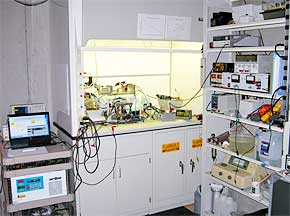
    Also, remember that if the $2.51 per gallon figure is correct and hydrogen cars get double the mileage as the average gasoline-powered automobile this would be the equivalent to around $1.75 per gallon of gasoline, a price we can all live with. The GridShift dual electrolyzer is pictured along with the laboratory it was conceived and tested in.

    I’m optimistic that GridShift will truly provide, as the name implies, a shift in the paradigm from fossil fuels and uncontrollable offshore oil spills to cleaner, home grown alternative fuels of the future in just a few short years.

  • Would you like a mSpot music streaming private beta invite?

    By Joe Wilcox, Betanews

    Betanews has 500 of them. One could be yours.

    The mSpot private beta opened today. The concept is simple: Your music available, anytime, anywhere on anything. The streaming service initially offers clients for Mac, PC and Android 2.1 phones, so mSpot is still working on the anywhere. Perhaps that’s good reason for the private beta.

    I’ve been asserting for years that the future of computing will be cloud services delivering anytime, anywhere access to anything — with the primary emphasis shifting to mobile devices. In the 1980s, computing and informational relevance shifted from the mainframe to the PC because of lower costs and broader availability. The same factors are driving the shift away from the traditional PC client-server model to mobile devices and cloud services.

    With mSpot, users sync their music library to the cloud, then stream it back to any device supporting the service. I like the concept, but a full-streaming, no-upload service would be better — where users verify ownership that unlocks music already available in the cloud. Of course, music licensing restrictions limit what mSpot can do. Such an approach would better align with mSpot’s movie streaming service, which I see as being a much more accessible anytime, anywhere, on-anything service; granted there are additional fees.

    My music library is over 80GB, which would mean paying for upgrades. How large is your music library? The private beta limit is supposed to be 2GB. Services don’t always strictly enforce such limits during private betas. We’ll see what mSpot does. The service also syncs playlists, which is a must-have feature for a service like this one.

    With that brief introduction, I send you off to mSpot. Just go to the Website and use “betanews” to register for the private beta, which is scheduled to lift sometime in the second half of June. Happy streaming — well, for the lucky, first 500 registrants.

    Copyright Betanews, Inc. 2010


    Add to digg
    Add to Google
    Add to Slashdot
    Add to Twitter
    Add to del.icio.us
    Add to Facebook
    Add to Technorati


    mSpotPersonal computerStreaming mediaAndroidCloud computing

  • Performance Reviews Get an 'Unsatisfactory' From Experts

    Oddly enough, the New York Times health blog has an item on performance reviews, which suggests that they’re probably a bad idea.  In theory, they may enhance feedback between manager and employee.  But in practice, employees should be getting feedback a lot more often than once a year, and performance reviews may embody the wrong sort of feedback.

    Annual reviews not only create a high level of stress for workers, he
    argues, but end up making everybody — bosses and subordinates — less
    effective at their jobs. He says reviews are so subjective — so
    dependent on the worker’s relationship with the boss — as to be
    meaningless. He says he has heard from countless workers who say their
    work life was ruined by an unfair review.

    “There is a very bad set of values that are embedded in the air
    because of performance reviews,” he told me.

    Not every expert agrees that reviews should simply be abolished.
    Robert I. Sutton, a Stanford University management professor, says they
    can be valuable if properly executed. But he added, “In the typical
    case, it’s done so badly it’s better not to do it at all.”

    All this is, of course, from the perspective of the worker.  But from the perspective of the employer, the review may not exist to make employees more effective, but rather, to give companies a paper trail.  Lawsuits brought by ex-employees for discrimination or other unlawful behavior probably aren’t as common as human resources managers might think–but even one such lawsuit is one too many.  So companies like to document a record of poor performance and warnings before they fire someone.

    This doesn’t actually mean that jobs are any safer: if before, a boss could fire you because he didn’t like you, he can now write you a bad performance review, and then fire you because he doesn’t like to.  But no one ever said our tort system made a whole lot of sense.


    Email this Article
    Add to digg
    Add to Reddit
    Add to Twitter
    Add to del.icio.us
    Add to StumbleUpon
    Add to Facebook


    Human resourcesNew York TimesEmploymentStanford UniversityRobert I. Sutton

  • KFC extends life of Double Down, shortening that of customers

    KFC-Double-Down

    When KFC introduced its bun-less Double Down sandwich in spot markets last year, bloggers and the lamestream media roasted it as as the gustatory equivalent of the Pontiac Aztek. But who’s laughing now? KFC announced today that it has sold 10 million Double Downs so far, and the chain has decided to keep it around beyond its originally proposed yank date of May 23. "This is truly an example of ‘popular demand,’ " Javier Benito, evp of marketing and food innovation at KFC, said in a written statement. "Our plans were to feature the product only through May 23, but millions of Double Down fans have spoken, and we won’t disappoint them. You’ll continue to be able to get the Double Down at KFC this summer." For all the hue and cry over the sandwich’s purported artery-clogging properties, KFC also points out that the DD contains just 540 calories, or 460 for the grilled version.

    —Posted by Todd Wasserman

  • iPad and E-Reader Recliner is the Perfect Companion for Your La-Z-boy

    iPadReclinerMultiplePositions 300x243 iPad and E Reader Recliner is the Perfect Companion for Your La Z boyAs much as the iPad is cool, sometimes you just want to put your hands behind your head and relax without fear of it slipping off to the floor. So Lapworks has announced the availability of the iPad Recliner. Not only will it work well with iPad’s but other e-readers as well. This iPad stand adjusts quickly and easily to a variety of settings that allows you to enjoy the view of your iPad hands free. The iPad Recliner can elevate the iPad to almost 9 inches, and you can adjust the slant of the device so that it’s easier to see. There are a dozen positions to try and there is a rubber cushion rest at the foot of the iPad that will keep your device safe from slipping off.  The iPad & E-READER Recliner retails for $29.95.

    iPadRecliner11 150x150 iPad and E Reader Recliner is the Perfect Companion for Your La Z boyiPadReclinerVertical 150x150 iPad and E Reader Recliner is the Perfect Companion for Your La Z boyiPadReclinerHorizontal 150x150 iPad and E Reader Recliner is the Perfect Companion for Your La Z boy


  • Blip.tv Raises $10.1M for Web TV Distribution

    Blip.tv has raised a $10.1 million round of financing aimed at rapidly growing its business for the distribution and monetization of web video shows, the company said this morning. The funding round, Blip.tv’s third, was led by Canaan Partners and included existing investors Bain Capital Ventures.

    Over the past year, Blip.tv has seen impressive growth in the number of videos it serves as well as the amount of advertising it’s been able to bring in. The company delivers about 90 million streams per month, and monetizes about 85 percent of those views with ads from blue-chip marketers like GM, General Mills, and AT&T. Now it’s looking to accelerate that growth by investing in new product development and audience development to help its content producers reach a wider range of viewers.

    “We have a business model that works, and when you have a business model that works, you have to step on the gas and accelerate its growth,” CEO Mike Hudack said in a phone interview. “This [funding] will allow us to offer even more for our show producers, business partners and advertisers.”

    Blip.tv recently opened an L.A. office and hired Epic Fu co-creator Steve Woolf to be its West Coast director of content development. It’s also been growing its sales force across the country and internationally. According to Hudack, the company has grown from about 20 employees at the beginning of the year to 27 today, and he expects that number to rise to 30 over the next few months.

    This latest funding round is Blip.tv’s largest to date; the web video startup raised a $2.5 million round in June 2007, followed by a second round of financing worth $5.2 million in October 2008.

    Related content on GigaOM Pro: A Guide To Online Video Monetization Options (subscription required)


    Alcatel-Lucent NextGen Communications Spotlight — Learn More »

  • Gulf Oil Spill: Fishing Ban Expanded; Endangered Turtles Threatened | 80beats

    100515-N-6070S-056With no end to BP’s gushing oil leak in sight, attention has turned to trying to ascertain just how damaging the spill could be for wildlife in the Gulf of Mexico. Yesterday the National Oceanic and Atmospheric Administration (NOAA) doubled the size of the fishing ban in the Gulf. Now nearly 20 percent of the water is off-limits because of the expanding oil slick.

    Because so much oil is under the surface, and diluted but still dangerous, it’s hard to get a handle on just how bad things will be. But turtles seem to be the bellwether for worries about sea life. Since April 30, marine biologists have recorded more than 150 sea turtle deaths, and while they can’t immediately say all those were directly related to the oil spill, it’s a much higher number of deaths that is usual for this time of the year.

    Necropsies, the animal equivalent of an autopsy, have been performed on 40 turtles so far. And tissue samples taken from as many specimens as possible are being analyzed for abnormally high chemical levels associated with oil contamination. Initial necropsy results are expected in a few days, but laboratory tests of the tissue samples will likely take weeks to complete. In many cases these results are needed to make a conclusive finding about the cause of an animal’s death [Reuters].

    Turtles raise special concern because all five species that live in the Gulf region are endangered. And as spring turns to summer, they could be more in the path of danger.

    The nesting season for the sea turtles runs until mid-July, and for most of that time the mothers will remain off Padre Island and the beaches of Mexico, where there is currently no oil. But then things become more chancy, as new sea turtle babies go off to sea, floating on currents in the gulf or on seaweed patches that could be covered by crude [The New York Times].

    100517-G-8744K-001Meanwhile, back at the leak site, BP says that the siphon it successfully installed last week is now carrying 2,000 barrels of oil per day to a tanker on the surface. While the company trumpeted this as capturing 40 percent of the estimated 5,000 barrels of oil per day leaking in the Gulf, we noted last week that the 5,000 figure could be a gross underestimation. If the leak is truly 50,000 barrels and not 5,000, then the 2,000 currently being captured is barely a drop in the bucket.

    In Washington, Democrats in the Senate are pushing a plan to raise the cap on liability for a spill from its present $75 million to at least $10 billion—a more than 130-fold increase. Republicans have blocked the measure thus far.

    And in Florida, people are left to wait and see if Gulf currents bring oil their way.

    Florida Democrat Senator Bill Nelson released a forecast by University of South Florida College of Marine Science experts who said part of the oil slick may reach the Keys in five to six days, and possibly Miami five days after that. “While I always hope for the best, this is looking like really out-of-control bad,” Nelson said in a statement before another round of congressional hearings on Tuesday [Reuters].

    Recent posts on the BP oil spill:
    80beats: Good News: BP’s Oil Siphon Is Working. Bad News: Florida Keys Are in Danger
    80beats: Scientists Say Gulf Spill Is Way Worse Than Estimated. How’d We Get It So Wrong?
    80beats: Testimony Highlights 3 Major Failures That Caused Gulf Spill
    80beats: 5 Offshore Oil Hotspots Beyond the Gulf That Could Boom—Or Go Boom
    80beats: Gulf Oil Spill: Do Chemical Dispersants Pose Their Own Environmental Risk?

    Image: U.S. Navy photo by Mass Communication Specialist 2nd Class Justin Stumberg; U.S. Coast Guard photo by Petty Officer 3rd Class Patrick Kelley.


  • Talk Tomorrow in Philly: “Science and Sustainability in the News” | The Intersection

    Tomorrow evening, I’ll be appearing at the Philadelphia Academy of Natural Sciences for this event: “Who Will Tell the People? Science and Sustainability in the News” Scientists who study the environment and global warming warn us at every turn that dramatic changes are afoot. Why don’t media headlines convey a sense of urgency? What is the best way to get the climate change message to citizens? What obligations do the media have? What prevents them from telling the story? The May Urban Sustainability Forum will take a look at how the media covers issues of science, how shrinking budgets and disappearing science desks are impacting coverage, and how niche media sources are filling a void in sharing vital information. Beth McConnell, Executive Director of the Media and Democracy Coalition, will be speaking on the topic of media consolidation and its effects on journalism, specifically sustainability. Chris Mooney is a 2009-2010 Knight Science Journalism Fellow at MIT and author of three books, including Unscientific America: How Scientific Illiteracy Threatens Our Future (co-authored by Sheril Kirshenbaum). Mr. Mooney and Ms. Kirshenbaum also co-write The Intersection blog for Discovermagazine.com, a contributing editor to Science Progress, and a senior correspondent for The American Prospect magazine. He has been …


  • Man Vs. Machine – Autumn/Winter 2010 Collection

    Man Vs. Machine (MVM) are designed by Jordan White and Charlie Browne. For Autumn/Winter 2010 the duo looks to the American Classics as the basis for their range. Aptly titled, “American Boy,” Mr. Browne exclaims, “For this coming Fall season we took from the American Classics – the classic tale that’s heard from generation to generation – a personal story that never changes and always inspires. If James Dean were alive today a true American Rebel he would wear these clothes.” Key pieces from the range include a Cropped Leather Shearling, Waterproof Harrington Jacket, and Cashmere Sweatpants.

    Continue reading for more images.