Blog

  • Hawaii Joins List of States Offering Big Incentives to Buy Electric Cars

    It’s been a whirlwind of EV news for Hawaii recently. As we already knew, they’ll be getting Better Place’s battery swapping technology, an electric car factory and they were just listed as one of the first areas you’ll be able to buy a Nissan LEAF when it goes on sale at the end of this year.

    Now potential plug-in customers in the island nation have another huge reason to celebrate: a cash rebate worth 20% of the price of a new, highway-capable, battery electric or plug-in hybrid electric vehicle… up to $4,500 total.

    So any electric vehicle over $22,500 will qualify for the full amount? I’m sold.

    (more…)

  • Palm Pixi Plus GSM

    Technology: GSM
    Announced Carrier: AT&T
    Announced Release Date: June 6, 2010

    The Palm Pixi Plus is the newest version of the popular Pixi device.  The Pixi Plus offers a 2MP camera with LED flash, fixed full QWERTY keyboard, Wi-Fi 802.11 b/g, integrated GPS, accelerometer, pinch-to-zoom, and Palm webOS.  The AT&T version of the device will differ from the Verizon model by offering a blue back. 


  • LG Ally for Verizon Wireless Review

    The LG Ally, at first glance, doesn’t look like a stand-out device. In fact, it looks like a lot of other handsets out there: a touchscreen taking up the majority of space, with a few buttons at the bottom for good measure. Pretty standard stuff. Sure, there’s a landscape, physical slide-out keyboard underneath, and that does add a bit of differentiation to the mix (especially with this increase in touch-based only Android handsets), but is it enough to make the LG Ally stand-out amongst the increasing crowd? Or does the LG Ally fall flat in its hopes to shine?

    The Body

    Obviously, one of the first things you consider when getting a new phone, is how it looks. You don’t necessarily want a beast of a phone to show off to your friends (unless you’re into that kind of thing, of course), and we can safely say that the LG Ally, while hefty in its own right, isn’t all that unattractive. Looking at it head-on, the only thing that might detract from its aesthetic appeal, is the obvious difference between the physical buttons, and the touch-sensitive versions right above them. If you’re accustomed to Android, then the button layout itself will seem a bit unorthodox; but after you get used to it, the layout isn’t all that bad. From right to left, you have the End Call button, the Menu button, the Home key, and finally the Call/Answer button. Above these, you have the touch-sensitive activators, which are Search and Back. Not that different, but just different enough to throw a wrench in any user already familiar with Android handsets.

    The 3.2-inch touchscreen itself feels like a large slab of plastic, more so than its Android competitors, but we didn’t find that it missed any touch inputs, and it was as responsive as we would have liked. However, with LG’s decision to go with WVGA resolution on a 3.2-inch screen, we can’t jump on board. We never thought we’d say that there’s too many pixels on our phone’s display, but LG have definitely made the argument possible. Truth be told, on a screen anywhere less than 3.5-inches, HVGA would have been a perfect fit.

    Along the sides, you’ve got the standard features. On the left side, you have the micro-USB charger, and the volume rocker. Along the top there’s just the 3.5mm audio jack. On the right side, there’s the MicroSD card slot, and the physical camera button, which is a sight for sore eyes. And finally, there’s nothing on the bottom. The handset itself is simple, black, and gets right to the point. It’s very reminiscent of other “heavy duty” LG handsets out there, and every time we held it in our hands, we knew that this handset could definitely survive the day-to-day rigors of life.

    On the back of the Ally, you’ll find a 3.2MP camera with a flash. It has the ability to auto-focus, and you can also capture video with it. Our test runs with the camera were pretty positive, but we’ll cover that here in a little while. There’s nothing else on the back, with the exception of the standard branding from Verizon, LG, and Google. All in all, LG makes their point with the LG Ally very clear: here’s a phone that may not win the next award for good looks, but it’s constructed well and feels solid in the hands.

    Also on the back, near the bottom, you’ll find the loudspeaker. And, when we say that this thing is loud, we mean that it’s loud. We actually had to refrain from putting the volume level all the way up, for fear that we’d blow the embedded speaker. This is one of the first times, in all honesty, that we were wholeheartedly pleased with a loudspeaker in a handset. It just works, and it does it very well.

    As for the earpiece, it does an admirable job in of itself. However, through our varied test calls, people on the other end did sound a bit muddied. However, due to our location, that could have been anything: network connection, the other caller, or our phone. We tried a few calls from Google Voice as well, but the situation didn’t change. Though, if you’re a frequent caller on your phone, we wouldn’t say that this should keep you from getting the phone, as it was never all that bad.

    The slider feels remarkably good. We were surprised at how many times we could slide it open and closed, and still feel like, over the course of two years, it wouldn’t lose any of its effectiveness. As for the keyboard underneath, this is yet again another department that LG surprised us. In a good way. It’s a huge, responsive, and comfortable keyboard. It has an expansive four-rows, meaning your number keys are dedicated and don’t need any kind of secondary feature, and each key is separate from one another. There’s a four-way D-pad, with the OK button placed in the center of it. And right above that there’s dedicated buttons for Home and Menu. Typing on the keyboard went rather well, but it still could have been a bit better over a long period of time. It has nice travel and response time with the letter input on the screen. Hands down, the keyboard is definitely one of the defining features of the Ally, and if you are a fan of physical keyboards, this one puts the Motorola Droid to shame.

    The physical parts of the LG Ally are either going to attract new customers, or push them away. It’s heavy in the hand, and has an industrial look and feel to it that, when compared to devices like the HTC Incredible or Droid Eris (both of which are available for Verizon Wireless, hence the comparison) makes its lack of “sex appeal” something that customers will think about. In our case, we’re fans of the way LG put the Ally together, and believe that the extra weight in our hands goes a long way to show that the phone is well made, even if it’s just a psychological thing. Plus, the keyboard is too good to pass up, frankly.

    The Software

    LG, thankfully, managed to stick Android 2.1 on the Ally. That should be enough to sell the device to anyone at this point, but we understand that you probably want us to dig a little deeper. There’s not much to go on here when it comes to the bare bones software of Android 2.1. At least, not that we haven’t covered before. You get all the features of the updated mobile Operating System (OS), and right off the bat it doesn’t look like there’s any skinning going on, either. So, hopefully, that means that when updates do arrive for the Android platform, the LG Ally will be one of the first for Verizon Wireless to get them.

    But! If you do like themes, or skins (like HTC’s Sense UI), then LG’s got you covered. They’ve put the Android 2.1 main software to the fore-front of the device, but they’ve also included their proprietary software on board as well. It’s right in the 3D launcher, and you’ll see it called ‘Themes.’ It puts the software overlay atop Android 2.1, and it does a pretty good job of changing some things up enough to make it pretty interesting. However, it should be noted that this is no way, shape or form, as in-depth as HTC’s Sense User Interface (UI). Basically, the LG Home theme changes up the launcher, and that’s about it.

    The launcher itself, while completely hidden in other Android versions and proprietary skins, isn’t with the LG Home theme. It keeps, what you can picture in your mind, is the first row of the launcher positioned on the screen at all times. You can’t switch around the icons that are there, either. (It took us several tries, but we finally figured out how to change the icons in the home row: you simply hold an application’s icon in the launcher, and when it drops down to put that icon on the homescreen, you can put it in the launcher’s home row. It’s very strange, and not intuitive at all.) So, you’ll find the phone, contacts, messaging, and browser icons always present. We thought it was a good idea at first, and we actually used this theme more than the standard Android one for a few days, but then we wanted the 3D launcher back, along with the ability to save some extra screen real estate with the launcher completely removed from our home screens. Although, it should be added that LG does do a good job of separating pre-installed applications, and ones that you’ve downloaded in the Marketplace, by literally separating them from one another in the launcher. Very odd, especially considering it breaks the collected feel of the launcher, but we imagine that it’s a good way to show which apps you’ve downloaded and which ones were there already, making sure some people don’t delete necessary applications by accident.

    We probably would have found ourselves using the LG Home theme a lot more had there been some more customization and skinning involved. Even some additional widgets would have been nice. Instead, the widgets are interchangeable to each theme, and even the LG version of the Messaging, Weather, and Socialite widgets can be used in the main Android standard theme. So, unfortunately, we just didn’t find a reason to use the LG Home theme.

    Now, the widgets. Considering it’s an Android-based device, we would be remiss if we didn’t talk about the widgets that LG has added. As we just mentioned, they’ve got a Weather widget, the Socialite widget, and a widget for the Messages application. All of which work well for what they’re supposed to do, but, we’ll be honest, they don’t compare to the widgets that HTC developed for Sense.

    The Weather widget is a simple blue bar that sits on one of your home screens. It displays the time for you, and then the temperature and current city you’re in. The date’s included, too. There’s no animation of the weather (we know that that’s not necessarily something people look for, but we have to point it out), and even opening up the application doesn’t do much to provide anything else but the weather. It brings up the six day forecast, all brought to you by the AccuWeather website. No, the widget itself, nor the application underneath, isn’t attractive, but it does do what it’s supposed to do: show you the weather. So, we can’t really say it’s a bad app, or widget.

    The Socialite application is meant to bring your Facebook and Twitter streams to the front and center. And, much like the Weather widget, we have to say that LG definitely didn’t want to bring any unnecessary flair to their applications. It’s almost totalitarian in its presentation, designed to not necessarily attract your eye, but just deliver the information you want. Unfortunately, one of the biggest problems we had with the widget itself, is the fact that it’s not all that dynamic. Instead of being able to scroll up and down in the widget, you have to use arrows positioned at the bottom, which will scroll up and down for you. LG also included their own Twitter client, but you can only access it through the Socialite application.

    And finally, the Messaging widget. Again, simple, and not dynamic in the slightest. It does well to show the message and picture of the contact sending it, but other than that, it’s just right to the point. You can hit options to write a new message without having to go into the Messaging application, along with delete a message. You can also get into the Messaging application simply by hitting the Menu option on the widget as well. Just like the Socialite widget, arrows will take you from one contact’s message to another, but you can’t navigate in any other fashion.

    You can find plenty of other applications and their widgets in the connected Android Marketplace, of course, but as of right now, unless you don’t mind the simplest of design features, the LG versions aren’t going to win anyone over, we don’t think. But, in the end, they do exactly what they’re designed to do, so again, we can’t necessarily say that these are bad widgets in the slightest. We just want a bit of aesthetic appeal to our shiny new toys, and we don’t think that’s too much to ask.

    One last application that we wanted to bring to your attention is the ThinkFree Office application. When we first took a shot at it, we thought it was probably the most brilliant idea we had ever seen. You have to register your device with the software, or you can skip the step and just dig into the features. We skipped the step, and just wrestled around with what the application had to offer. Now, if you’re not familiar with ThinkFree Office, it’s basically an online word document, spreadsheet, and other document creation website, that offers up to 1GB of free storage for you to access what you need on the go. However, the application on the LG Ally not only allows you to access this service, but it also links to your Google Docs, as well as any documents you may have on your SD card. Unfortunately, we felt pretty dismayed when we signed into our Google Docs account, and it then took us to the website, where we had to subsequently sign in again. Basically, it’s just a portal to the Google Docs site, and therefore just one more step and one that we immediately stopped using. However, for viewing documents with ThinkFree Office and on your SD card, it works well.

    Under the Hood

    The LG Ally is powered by a 600MHz processor, and it features the standard Android fanfare: WiFi, GPS, and Bluetooth. As we mentioned above, it does support MicroSD cards, so that you’ll have plenty of space for all your media consumption. It does have all the bells and whistles you’ve come to expect from an Android handset, so LG definitely hit the mark on this one.

    However, we were unexpectedly unimpressed with the processor, especially considering the graphics acceleration it comes with. As we said above, the Ally features a 600MHz MSM7627 processor, so we were thinking that the experience with the Ally would be quick, clean, and crisp. And sometimes it was. So good, in fact, that we loved just moving from one homescreen to the other, launching the 3D launcher, and activating applications. But then, randomly throughout the day, for inexplicable reasons, the whole system would slow down. The 3D launcher would pause, jerk up, and then jerk back down. Transitioning from one homescreen to the other was painful to watch, especially when we had Live Wallpapers activated (and it still happened with just a regular picture activated, too). Even after restarting the phone, the jerkiness would still happen from time to time. It just boiled down to us waiting, as if to give the phone a break, before the processor would start powering the phone like we wanted. But, despite the lag from time to time, the phone is definitely usable. You’ll just have to grit your teeth through the random (and we mean random) slow downs.

    The Camera

    We’ll just come right out and say it: this won’t replace your current digital camera, and if you’re looking for a method to combine your phone and camera, the LG Ally is not going to be your gadget of choice. Yes, we know there’s only a 3.2MP camera on the back, but we’ve taken better pictures with other 3MP camera-phones. And, honestly, it doesn’t get any simpler than that. It does feature auto-focus, video capture, and it has an LED flash, so that may be good enough for some people. And, in fact, the LED flash did well as an actual flash, and in the autofocus assistance department. But, images came out without definition, and more often than not, splotchy and blurry. Shutter speed, when worked in conjunction with the two-stage hardware camera button, is not too bad, but you should wait for the autofocus to kick in, if you want any kind of semblance of a decent picture. There are 8 effects to choose from, a dedicated macro mode, white balance which can be configured, and ISO. But, none of those mattered after awhile, as we just didn’t want to take anymore photos with it.

    The Battery

    Truth be told, we were completely blown away by the battery on our first day with the LG Ally. But, unfortunately, not in a good way. We charged it up completely, and then left it alone for an entire day. We had the standard things running in the background: email, Twitter, and Gmail. When we checked it again, about eight hours later, the battery was completely dead. Now, while that may sound great for anyone looking at it from the hours perspective, we ask you to keep in mind that we weren’t using the phone. That means no voice calls, no texts, and not actually responding or checking those emails. The phone was simply pulling info. Not good at all.

    And yet, it seemed to fix itself over the following days. We were using the phone easily enough throughout the day, with several texts, Google Talk messages, and other Instant Messaging client messages sent, with plenty of emails, Gmail messages, and Twitter messages sent out. With all of that going, we clocked the battery at anywhere between 5 to 8 hours, which should mean that the average user should be able to squeak out a little bit longer than that. Of course, with Android 2.1, you’re able to see what exactly is pulling the power from your battery, and adjust your settings accordingly, which, honestly, we recommend.

    Also worth mentioning, is how long it takes to charge the battery. If you’re like us, then you’ve got your phone plugged into the USB port on your computer more often than not. We do not recommend you charge your phone like this. Especially not the LG Ally. It takes forever. Now, charging it from the standard AC outlet takes a bit of time, too, but it’s nowhere near the length it does from the USB port. And yes, that’s from a USB 2.0 port, as well as a non-USB 2.0 port.

    In the End

    The LG Ally is a phone that, when held in the hand, feels more like a piece of industrial equipment. It’s heavy, it’s not all that attractive to look at, and the buttons on the front are completely mind boggling. However, it does have a relatively roomy touchscreen, and even if the WVGA screen is a bit too much, it does do a great job of showing off all those colors well. The sliding function is great, and while the keyboard may not make everyone happy, we were far more pleased with it than let down. And, while we love Android 2.1, we would say that LG should shy away from the themes from now on, and just let the stock ‘droid take over.

    This may not be at the top of the list for Android handsets out there (it’s certainly not on ours), but for what it’s worth, it does a good job of showing that LG takes the Android handset seriously, and we imagine that the handsets coming down the pipe from the company will be better. However, if you had to ask us right here, right now, if we would recommend the $99 LG Ally to any upcoming Verizon Wireless customers, we simply couldn’t do it. Yes, it’s a better deal than the Motorola Devour, which is still positioned at $150, but that doesn’t mean you should get it just because it’s cheaper. There’s other options to look at, and we strongly suggest you look.


  • Data Google skimmed with street view cars gets destroyed in Ireland, but that’s not good enough for Germany

    By Tim Conneally, Betanews

    Last Friday, Google announced that its Street View cars had accidentally collected private data from unencrypted Wi-Fi networks while making their rounds, and the international response began in full force.

    The same day, the Irish Data Protection Authority asked Google to delete all of that payload that was collected in Ireland. Yesterday, Google wrote, “We can confirm that all data identified as being from Ireland was deleted over the weekend in the presence of an independent third party. We are reaching out to Data Protection Authorities in the other relevant countries about how to dispose of the remaining data as quickly as possible.”

    Independent security firm iSEC Partners Inc also confimed the deletion. Partner Alex Stamos said that Google had consolidated the Wi-Fi packet captures onto four hard drives, organized into folders corresponding to the nation of origin, and the data relevant to Ireland was then destroyed.

    “I created two new encryped volumes on separate hard drives, and copied over all of the data with the exception of the data that was identified as being captured within the Republic of Ireland,” Stamos wrote on Sunday, “I then witnessed the physical destruction of the original four hard drives.”

    Today, however, German data security representative Johannes Caspar said this would not be enough, and that Google has until May 26 to turn over the hard drive with German data on it, so the extent of the infraction can be inspected.

    Caspar told The Thuringer today that Google has to do anything it can to repair its tarnished reputation.

    “Before it can, we must be granted access to all of the collected data,” Caspar said. “Only then can it be clearly documented what kind of data was saved. Despite repeated demands, we’ve had no opportunity yet, to sift through a hard disk with all of the data.”

    Caspar has more meetings with Google this week in Hamburg.

    Copyright Betanews, Inc. 2010


    Add to digg
    Add to Google
    Add to Slashdot
    Add to Twitter
    Add to del.icio.us
    Add to Facebook
    Add to Technorati


  • Tomorrow: Big Guantanamo Day in Congress

    Title XIV of H.R. 5136, the House bill authorizing next year’s Defense Department money, doesn’t look like it carries a major legacy item for President Obama. It’s the banal-appearing 15-part section of the bill that authorizes “ADDITIONAL APPROPRIATIONS FOR OVERSEAS CONTINGENCY OPERATIONS FOR FISCAL YEAR 2011,” a bureaucratic euphemism for “War Money.” Inside it is the difference between closing the detention facility at Guantanamo Bay and leaving the international symbol of U.S. lawlessness and abuse open.

    Tomorrow, the House Armed Services Committee marks up H.R. 5136, its final committee step in the House before heading to the House floor. And within Title XIV of the bill is something called the “Overseas Contingency Operations Transfer Fund.” The version reported on April 26 — the final markup version is now in congressmen’s hands — authorizes $1,551,781,000 for that fund. But if it sounds like you don’t know what that “transfer” fund means, it’s because the opacity is to protect the fund from legislators.

    Robert Hale, the Pentagon comptroller, explained in a press conference when the budget was released this winter that part of that money is for closing the detention facility at Guantanamo. “In fiscal year ‘11, there is a transfer fund that could be used for all aspects of detainee operations, $350 million,” Hale told reporters. “It would permit us to transfer funds to places where we need to close or transition Guantanamo. It would permit us to transfer funds to accounts that would let us open the Thomson, Illinois site.”

    If that fund makes it through the markup, then it’s just passed a major hurdle. The House will approve the entire defense budget, probably as early as next week, and it’s highly unlikely to hold up a huge bill that contains next year’s Afghanistan and Iraq war money for the controversy of closing Guantanamo. (The Senate Armed Services Committee’s markup comes at the end of the month.) If the fund money gets stripped out of the bill during markup, however, then it gets much harder to shut the detention facility down. Given the likelihood of increased Republican ranks in Congress after November, it may become effectively impossible.

  • Final Fantasy XIII is last year’s top seller for Square Enix

    There might be mixed receptions about the linearity of Final Fantasy XIII, but it sure didn’t keep people from buying it. Having sold 5.55 million copies worldwide, the battle between the l’Cie and the fal’Cie is Square

  • Pakistan president pardons interior minister on corruption charges

    Photo source or description

    [JURIST] Pakistani President Asif Ali Zardari [official website] on Tuesday pardoned Interior Minister Rehman Malik [official profile], convicted on corruption charges in 2004. Zardari issued the pardon after the Lahore High Court refused to throw out Malik’s 2004 conviction. Malik was not present in Pakistan when he was convicted and sentenced to serve three years in prison. Last December, a Pakistani court issued an arrest warrant [JURIST report] for Malik related to the corruption charges after the Supreme Court [official website] struck down an amnesty order [JURIST report] that would have granted him immunity. The Supreme Court ruled [order, PDF] that the National Reconciliation Ordinance (NRO) [text], which granted immunity to Zardari and 8,000 other government officials, was unconstitutional. Zardari’s pardon of Malik is seen as an example of the tension [BBC report] existing between the executive and judicial branches within Pakistan.

    The court began hearing [JURIST report] the legal challenge to the NRO late last year. The NRO was signed [JURIST report] by former Pakistani president Pervez Musharraf [BBC profile; JURIST news archive] in 2007 as part of a power-sharing accord allowing former Pakistani prime minister Benazir Bhutto [BBC profile] to return to the country despite corruption charges [JURIST report] she had faced. The ordinance also applies to similar charges against politicians who were charged but not convicted of corruption between 1988 and 1999.

  • Rep. Norm Dicks

    Tax reform would make room for more jobs

    I agree with The Times’ evaluation of Norm Dicks’ congressional performance [“Stormin’ Norm as a deficit hawk,” Opinion, May 17].

    Indeed, “for the good of the entire state, he has been an ally across topics, jurisdictions and party lines.” But the suggestion that “he now must become a deficit hawk” seems Reaganesque. The federal deficit is a concern, but recovery from the current recession and restoration of employment outweigh a balanced budget.

    A healthy economy and tax reform would create a balanced budget. Tax reform in the form of a state income tax is imminent in Washington and expiration of the Bush tax cuts for the wealthy is imminent in Washington, D.C. Both would allow the government to invest in jobs.

    The concern for epic deficits is about a decade late. The federal budget was balanced when former President George W. Bush entered office. His administration ignored fiscal responsibility in an attempt to “starve the beast.” The conservative economic theory is that if the government is broken, it cannot govern. The results of this policy are now painfully evident off the Louisiana shore.

    — Bill Taylor, Renton

  • Groupon Shows How To Properly Explain TOS Changes

    Groupon is a daily deal sort of website, but the reason it’s on Consumerist today is because of how well it communicated some recent changes to its Terms of Service agreement. Consumerist reader Pureboy sent in a copy of the email he recently received where the website explained the changes in plain English, with examples.


    051810-006-groupon-newsletter.jpg


    Was that so hard, every other company that doesn’t bother? Keeping your customers up to date on what they’ve theoretically agreed to should be considered basic customer service.

    If you want to keep track of changes to TOS agreements on your own, try TOSBack.org, an EFF blog that tracks 56 companies and alerts you when their lawyers change something in the fine print.

  • Seattle City Council boycotts Arizona

    Let’s get our own house in order first

    Hopefully I am not the only person, in Washington who is embarrassed and concerned by the actions of the Seattle City Council [“City Council backs Arizona boycott,” News, May 18].

    To boycott another state for wanting to enforce a federal and state law is amazing. This is not a liberal or conservative issue. There is a current law that deals with illegal immigrants.

    I understand that we live in a liberal city, in a liberal county and in a liberal state. What I do not understand is the lack of support of one state to another on this issue.

    This has become a political issue rather than one concerning enforcement of the laws of the land. We do not need the opinion of the City Council unless it is based on a true interpretation of the current law.

    People in our state should not be upset when our city, county or state officials continue to pick and choose which laws they want to enforce. (We seem to have these frequently in Washington.) This state, along with Oregon and California, have enough on their plates without telling another state what they should do. Let’s get our own house in order and then — and only then — could we give direction to another state.

    — Bill Heimkes, Seattle

    We are all immigrants

    “City Council backs Arizona boycott” [News, May 18] simply shows the constant discrimination against other races, which has been a constant characteristic of history.

    It is incredible that the state of Arizona actually passed such a law. We have just made an incredible accomplishment: Electing an African American man as our president should have set an alarm in the Arizona government.

    People seem to forget that we are all immigrants in some way shape or form. This goes against every non-bullying and non-discriminating class held in schools as well as public boycotts, organizations and strikes.

    If that law holds, then there is no doubt that every person would be wrongly accused of being an illegal immigrant. We may as well detain every single person in the United States.

    — Jessica Tran, Seattle

    Do unto Arizona as you would do unto Washington

    The Golden Rule, “do unto others as you would like them to do unto yourself,” came to mind following the Seattle City Council’s decision to boycott Arizona.

    I strongly urge the City Council to reverse that decision or potentially risk creating justification for another city or state boycotting Seattle or Washington’s businesses and conventions. We are the United States. We need to not pass judgment on our brother and sister states, but support each other economically despite our differences.

    Yesterday’s action could start us down a road to a place where Starbucks coffee is not available at the Phoenix airport, Microsoft products are not welcome in Arizona government offices or Arizona employees select Southwest Airlines over Alaska Airlines for travel.

    Washington has too much to lose through taking this negative action. Summer is on the horizon and we want the people of Arizona to travel to Seattle for vacations and conventions. Let’s not give them a reason to go somewhere else.

    — Gregory Kovsky, Redmond

    Preserve the American way of life

    Maybe it’s time for illegal immigrants to get it straight: Arizona is not part of Mexico.

    When marching and demonstrating, why is the Mexican flag carried? We have our U.S. flag; if you want to be an American, carry it.

    In my day, we studied the United States in U.S. history. If we wanted to study about Mexico, we signed up for other classes.

    If we wanted to learn to speak Spanish, we took language classes.

    I think it is time to side with those of us who have worked hard and saved so we could live comfortably and have a comfortable retirement. We love our country and do not need our language and traditions changed.

    — Pat Gee, Federal Way

    Arizona has a big problem

    I wonder why the Seattle City Council is not boycotting Mexico instead of Arizona. Mexico is the real problem, failing to take care of its citizens.

    I just returned from two months in Arizona and am quite sure the average Northwest resident does not have a clue about the problems Arizona faces.

    There were weekly reports on the news of “drop houses” close to where I stayed. An average of 150 illegal immigrants would be brought to a home — usually no more than a three-bedroom — and kept there until they could pay for their shipment to other states. Washington was a popular destination.

    In Arizona, the Walmart fliers are written in Spanish — despite the fact that Arizona residents had voted a few years back to have English as the state’s official language.

    A job-finding spot on one of the news programs was interviewing people looking for work. One woman with a college degree said she was unable to find work, as speaking Spanish fluently was often required.

    Arizona Gov. Jan Brewer has specifically stated that no one would be stopped unless some infraction of the law is obvious. It seems totally unfair that illegal immigrants demanding their rights — hospitalization, education, etc. — are listened to more than the majority of legal citizens who are put down for asking that U.S. and Arizona laws by abided by.

    — Bernice Malone, Mukilteo

    No reason for boycott

    Boycotting a state is immature thinking. A boycott hurts the hardworking, legal citizens for doing the right thing.

    Arizona is the only state with the backbone to abide by the rules of the Constitution regarding illegal citizens — and now it is being chastised by other U.S. cities.

    The term racial profiling is a dramatic and trendy diversion to doing the right thing when moving into our country. All are welcome to the United States, but there are requirements for all who decide to enjoy what is here. Asking to see the paperwork that implies a newcomer is doing what is correct is no different from showing a passport upon entering another country or a legal driver’s license for a traffic violation.

    When undocumented newcomers could collect Social Security, receive free medical care, enjoy education and even receive unemployment plus many more U.S. benefits without following the rules that are in our Constitution, there is no reason to support a boycott.

    — Gail Hoover, Redmond

  • Video: The Onion On Google’s Mobile Ad Ambitions

    What formats of mobile ads will Google (NSDQ: GOOG) eventually introduce? Here’s The Onion on Google’s “announcement” of targeted ads delivered directly into a phone user’s ears. Watch until the end of the clip for a jab at Yahoo (NSDQ: YHOO) too:

    New Google Phone Service Whispers Targeted Ads Directly Into Users’ Ears


  • Apple releases updated MacBook: 10 hour battery life

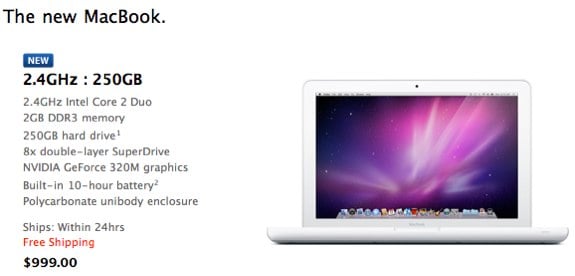
    MacBook early 2010

    Hot on the heels of another leak out of Taiwan, Apple has made public their newly updated , highlighted by a built-in 10-hour battery. The design hasn’t changed—it’s the same unibody white polycarbonate enclosure, but on the inside it now has a 2.4GHz Intel Core 2 Duo processor and an NVIDIA GeForce 320M graphics chip. The other major features are unchanged, like the 2GB DDR3 RAM and 250GB hard drive. Pricing remains the same, right at $999.

    All that’s left now is that sorely-needed update. You can pick up the new MacBook now.


    Tags:

    Apple releases updated MacBook: 10 hour battery life originally appeared on Gear Live on Tue, May 18, 2010 – 10:46:07


  • Dow Off Triple Digits, As German Short-Selling Restrictions Officially Go Into Effect Until 3/31/2011

    Deutsche Mark coin germany

    This is starting to look like a gigantic unforced error on the part of Angela Merkel.

    The new short-selling restrictions are out, and apparently they extend all the way until March 31, 2011 as a response to volatility in the bond market.

    We really have no idea what Angela Merkel is thinking, but if the idea was to reduce volatility, it seems safe to say that it’s already failed badly.

    The Dow is off about 100. The NASDAQ is off 38.

    Next up the euro crashes through 1.22.

    Join the conversation about this story »

    See Also:

  • Tea-party movement

    The Bush legacy

    This is a response to “Stirring the pot,” Pacific Northwest magazine, May 16.

    Viewing some of the signs shown: What freedoms have been taken away? What are the new taxes that have taken effect? What about the deficit that George W. Bush left?

    Bush gave the rich nearly $10 billion in tax cuts and started two wars. The war in Afghanistan cost $70 billion — and we left it to start a war in Iraq, which caused more than 100,000 Iraqi civilian casualties.

    Where were the demonstrations about the mess the Bush administration left behind?

    — Anne & Bill Dillon, Kent

    Carender late to the game

    Where was Keli Carender when the Bush administration started a horrendous pre-emptive war without paying for it?

    Where was her outrage when it was spending $1 billion a month for the occupation of Iraq —much of it in bundles of cash — to out-of-control “defense” contractors?

    In my book, war profiteering is treasonous. I wonder what Carender thinks about the new U.S. embassy in Baghdad, also courtesy of the Bush administration, which is larger than Vatican City and built at U.S. taxpayers’ expense.

    Of course, all of this happened in conjunction with tax cuts and deregulation. Populism could be a wonderful thing, but when it is based on ignorance or willful disregard for the facts, it is frightening.

    — Nancy Anderson, Seattle

    Do your homework

    The tea-party movement exemplifies the United States —land of the free, home of the protester. But if you are going to protest, at least do your homework.

    The hyperbole from this group makes for good sound bites, but much of its logic baffles the mind. Taking statements of national tea-party movement leaders and using them as facts to form your own opinion would likely come back to haunt you. While the movement claims to have no organized leadership there are, in fact, a few high-profile figures who are using this movement to further their own political agenda and careers.

    We are in our current financial mess not because of high taxes, but because of poor decisions made by previous administrations. The first, allowing deregulated mega-financial institutions to gamble, practically risk-free, with our money. The second, maneuvering us into two extremely expensive wars.

    Changing our elected leaders, the supposed purpose of the tea-party movement, would change nothing. Our system is corrupt. Until we devise a system that does not rely on contributions —in most cases, legal bribes —to fund elections, we will get what Will Rogers called “the best government money can buy.”

    If you do a little more homework, you would find that a U.S. Senate race, for example, costs $12 million on average. Divide that by the number of days in a Senate term, 2,190, and you would find that a U.S. senator must raise more than $6,000 every day he or she is in office in order to run for re-election.

    This is accomplished with the help of a friendly lobbyist. Washington, D.C., has more than 17,000 of them. I know — I’m a retired lobbyist.

    — John Creed, Seattle

  • The Alaskan Way Viaduct

    Fix it

    This is a response to “McGinn on tunnel: worth it ‘at all costs’?” [page one, May 14].

    The city is out of money. The county is out of money. The state is out of money.

    How could we afford all the expensive transportation projects being planned?

    If you are unemployed, in debt and underwater on your mortgage, you do not rebuild and re-landscape your home — you make do. That is what we need to do with the viaduct.

    We need to fix the viaduct, not replace it.

    — Connie Knudsen, Ballard

  • Weighing Greenland

    by Seth Shulman

    .series-head{background:url(http://www.grist.org/i/assets/ucs/header.gif) no-repeat; height:68px; text-indent:-9999px;} h3.subscribe-head{padding-left:5px;background-color:black;color:#ff8400;} dl.series-nav{margin-top:-15px;}

    Scott Luthcke weighs Greenland—every 10 days. And the island has been losing weight, an average of 183
    gigatons (or 200 cubic kilometers)—in ice—annually during the past six
    years. That’s one third the volume of water in Lake Erie
    every year. Greenland’s
    shrinking ice sheet offers some of the most powerful evidence of global
    warming.

    Luthcke is a scientist at NASA’s Goddard Space
    Flight Center
    in Greenbelt, Maryland. He specializes in space geodesy, a
    branch of earth sciences that monitors Earth from space by measuring changes in
    the planet’s shape, orientation, and gravitational field.

    Lutchke “weighs” Greenland by processing and
    interpreting data from one of the most sophisticated gravitational “scales”
    ever built: the U.S.-German satellite mission called GRACE—the Gravity Recovery
    and Climate Experiment.

    GRACE consists of two satellites which orbit
    Earth in tandem at a relatively low altitude (450 to 500 kilometers). The pair operate in much the same way as a
    scale that uses a spring to gauge weight.
    “If you use a spring scale and attach a bucket full of tennis balls to
    it, the spring expands,” explains Luthcke. “When you take some of the balls out
    of the bucket, the spring correspondingly contracts and you can measure that
    variation.”

    The two GRACE satellites can measure the
    distance between them with remarkable accuracy. Even though the satellites
    travel 220 kilometers (137 miles) apart from each other (roughly the distance
    from Philadelphia to Washington, D.C.), their sophisticated ranging systems,
    developed by NASA’s Jet Propulsion Laboratory, can detect variations in that
    distance down to a micron-or one-hundredth the width of a strand of human hair.

    The GRACE ranging system functions as a giant
    scale by measuring variations in the gravitational pull of different land
    masses. Big land masses such as mountains exert a slightly stronger
    gravitational pull upon the satellites, causing minute fluctuations in their
    speed as they fly over.

    For example, the two GRACE satellites fly
    over Greenland several times each day. As the
    first satellite approaches, the island’s mass causes the satellite to
    accelerate and thereby move slightly away from its trailing companion. Over
    time, the Grace mission carefully records fluctuations in the distance between
    the two satellites each time  they pass over
    Greenland. 

    By examining the GRACE data, Luthcke can
    monitor subtle changes in the gravitational pull that the land mass exerts on the
    satellites to get a reliable measure of Greenland’s
    shrinking mass. The system, says Luthcke, is accurate enough to “detect the
    loss of just a centimeter of ice over an area the size of Delaware.”

    Luthcke says he got
    hooked on space geodesy when, as a physics major in college, he landed a summer
    job at NASA. He never left, working his way “up from the mailroom” and contributing
    over the years to many NASA missions. “Space geodesy is a fantastic field,” Luthcke says. “I love my work because not only do I
    get to help develop and refine new space-borne sensors, but I get to be
    involved in using them to gather useful information. It is the best of both
    worlds.”

    Because so many important decisions are
    likely to rest on his data, the key for Luthcke is accuracy. The challenge, he
    says, is being sure to “carefully analyze how well we know all the steps
    involved to turn the satellite’s raw observations into usable data.”

    Luthcke strives to come up with a usable,
    regional calculation of the size of Greenland’s
    ice sheet. To do so, he uses sophisticated techniques to correct for “errors” that
    can creep into the data due to localized variations in mass or to other factors
    such as solar radiation pressure on the satellites themselves.  “My goal is to do everything I can to minimize
    the uncertainties involved in these measurements,” he says. “It’s a good job
    for me because I’m a cautious person by nature who always wants to know how
    things will stand up under scrutiny.”

    The good news for Luthcke is that a separate
    team using an entirely different method has come up with measurements of
    Greenland’s melting ice that, he says, are almost identical to his GRACE data.
    The bad news, of course, is that both sets of measurements make it all the more
    certain that Greenland’s ice is melting faster
    than anyone expected.


    This is the second installment of America’s
    Climate Scientists: A series from the Union
    of Concerned Scientists
    .

    Click here to read all the climate scientist profiles.


    Related Links:

    Battle of the Carbon Titans

    American PRIDE – alternative to the Lieberman-Kerry Disaster

    Finding evidence of climate change in the caves of the American Southwest


  • Gameboy-up your iPad

    Yup, a Gameboy iPad sleeve. This is about the best thing you’re going to see on the internet today. [etsy via Likecool]


  • Forget Car-Jacking: Car-Hacking Is the Crime of the Future | 80beats

    CarSharkSticking accelerator pedals were just the beginning. Soon you might lose control of your car not because of a technical failure, but because someone hacked into it from afar.

    Tomorrow at a security conference in California, Stefan Savage and his team will present their research showing how they used the computer systems that oversee different systems in a car to break in and take control—braking and accelerating against the driver’s will.

    The researchers concentrated their attacks on the electronic control units (ECUs) scattered throughout modern vehicles which oversee the workings of many car components. It is thought that modern vehicles have about 100 megabytes of binary code spread across up to 70 ECUs [BBC News].

    The software Savage’s team created, called CarShark, took advantage of the fact that ECUs must communicate between different systems. Electronic Stability Control, for instance, must talk to the brakes, accelerators, and wheels; Active Cruise Control and systems that parallel park the car for you also rely on communication across many systems. The team inserted fake packets of data into the lines of communication to seize control of a car, Savage says.

    He and co-researcher Tadayoshi Kohno of the University of Washington, describe the real-world risk of any of the attacks they’ve worked out as extremely low. An attacker would have to have sophisticated programming abilities and also be able to physically mount some sort of computer on the victim’s car to gain access to the embedded systems. But as they look at all of the wireless and Internet-enabled systems the auto industry is dreaming up for tomorrow’s cars, they see some serious areas for concern [BusinessWeek].

    Savage said he and his team wanted to get a head start on the problem of car-hacking, which is sure to arise when hackers get the chance, especially with more wireless access. In small ways it has already started: A couple of months ago an Austin, Texas, man who was fired by a car dealership broke into the remote system that the dealer used to torment people who were delinquent on their payments by honking the horn or otherwise annoying them. About 100 people found their cars inoperable, or honking like mad, after his hack.

    The researchers said they did not address the question of the defenses the cars might have against remote access, but said the experience of the PC industry, which did not have extensive security problems until computers became networked, was worth remembering. “To be fair, you should expect that various entry points in the automotive environment are no more secure in the automotive environment than they are in your PC,” Mr. Savage said [The New York Times].

    Car companies should probably address this issue before they offer us the networked “road trains” of the future.

    Related Content:
    80beats: Reports: Chinese Hackers Stole Indian Missile Secrets & the Dalai Lama’s E-mail
    80beats: Massive Spanish Botnet Busted, But Hacker Mastermind Remains Unknown
    80beats: Code Protecting 80 Percent of Cellphone Convos Finally Cracked
    80beats: In the Commute of the Future, Drivers Can Let a Pro Take the Wheel

    Image: Savage et. al.


  • Keep installed software up-to-date with UpdateStar

    updatestar-grab.gifMany freeware applications that are downloaded and installed are updated on a regular basis, 
    monthly or, in some cases, weekly. Obviously not all of these updates are hugely significant, but they can
    make applications
    more stable and it may be worth your while downloading and installing them. If you don’t regularly visit download or software
    publisher’s sites, there’s no way of telling if an app has been updated.
    A useful and convenient way of keeping software
    up-to-date is to use an auto-update tool, this enables you to save time as you don’t have to check
    manually.

    UpdateStar
    5.2

    is a popular auto-update tool that automatically finds updates for any
    applications installed on your PC. This latest v5 is more likely to
    find updates for installed applications than previous versions, but that’s not to say it will find updates for everything you have installed.  

    UpdateStar
    5.2
    link.

  • Kendra Wilkinson Sex Tape DVD Cover

    Kendra Wilkinson is inching closer to becoming the web’s next overexxxposed reality star…whether she likes it or not.

    FOX.com’s PopTarts Column has obtained an advance copy of the cover of the married mommy’s racy X-rated video — Kendra Exposed — which reportedly features the former “Girl Next Door” in a variety of compromising positions with multiple partners.

    Vivid Entertainment is forging ahead with plans to release the saucy footage later this month, despite Kendra’s argument that she never signed a release permitting the tape to be distributed.