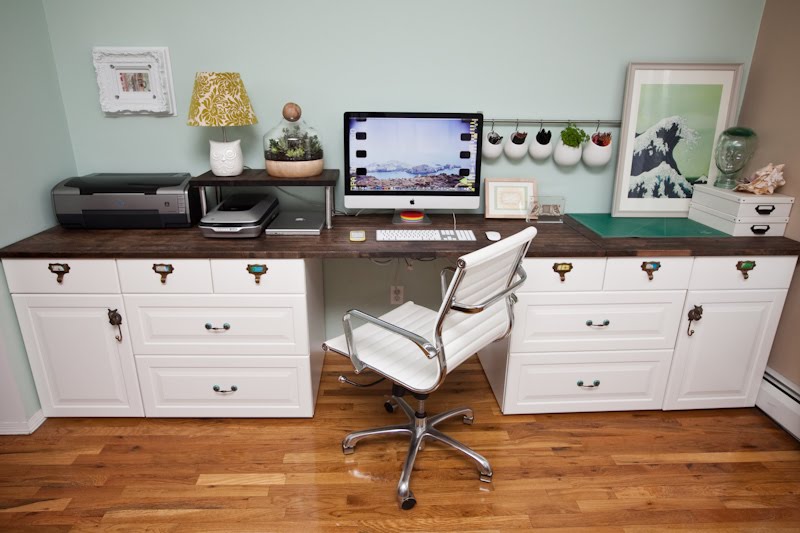
Materials: Akrum base cabinets (two 30″ with large drawers, two 18″ with cabinets), two lengths of Langan countertop (96″ and 49″)
Description: As a photographer, designer and artist, I was in need of a desk solution that would accommodate all my computer/camera equipment and peripherals, plus tons of storage for materials and supplies, and with extra room on top to spare so that it could actually be used as a work/craft surface.

While I am lucky to be blessed with the space for an 11-foot desk, sadly no such product seemed to exist. I headed to the Ikea kitchen section for answers. 4 Akrum base cabinets and 2 lengths of Langan wood countertop solved the problem. The cabinets are designed to sit on legs (keeping them flat on the ground would mean the bottom drawers and cabinets would scrape against the floor), but to avoid extra height I decided to forego the legs and instead placed a few pieces of 1/2″ plywood underneath to lift them just enough.
I needed a 132″ top, and decided to create it out of two lengths of the Langan. The pieces were cut, sanded, stained, and waxed; with the excess used along with the set of Capita stainless steel legs to make a shelf. A hole was cut in one of the pieces to allow cords to pass through.
Even without the cabinets sitting on legs the desk is still several inches taller than normal desk height (32″ instead of 28-29″) but an adjustable-height chair solved the problem.

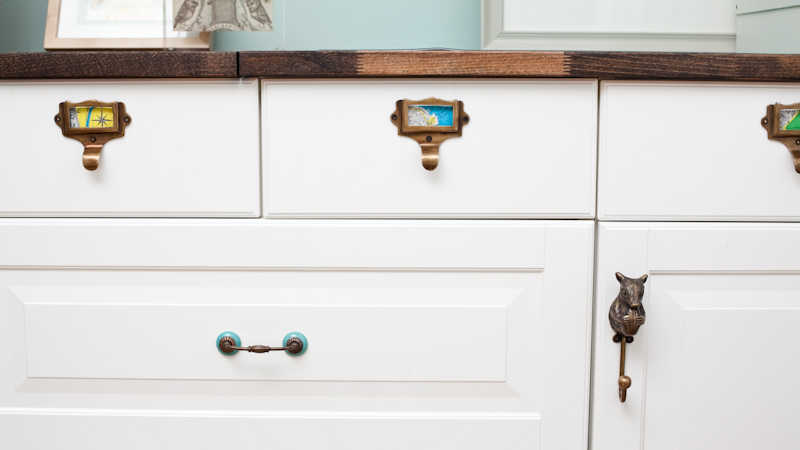
Since the drawer and cabinet faces are not pre-drilled, I was able to choose interesting hardware from another source for the pulls and handles (library card catalog pulls, which I filled with bits from vintage NYC street maps).
~ Steph Goralnick, Brooklyn, NY


 Additive genetic variance just refers to the variation of genes which affect the phenotype by independent and usually small effects which sum together to produce the range of variation of the trait. Imagine for example that the range of variation in height within the population was 10 inches, and that there were 10 genes which varied, and that each gene exhibited co-dominance. One could construct a model where every gene pair could add 0, 0.5 or 1 inch to the height independently, so that the maximum height could be constructed by adding 10 inches to the baseline and 1 inch per locus, and the minimum height by adding no inches to the baseline when each locus is homozygous for null alleles.
 Interestingly when background variables were controlled males tended to show the greatest fitness drag due to inbreeding depression. This would comport with models of sexual selection where males justify their expense (because they can not bear offspring) within the population by serving as the perishable dumping grounds of bad genes. In particular in a polygynous population a few healthy males with good genes could give rise to most of the next generation, and so providing the balance of selection to the background mutational rate.




 Russian physicists OG Sorokhtin, GV Chilingar, and LF Khilyuk noted in their book Global warming and global cooling. Evolution of climate on earth. Developments in Earth & Environmental Sciences (Elsevier 2007) that conventional greenhouse theory is not based on sound physical derivation, with most calculations and predictions based on intuitive models using numerous poorly defined parameters and unproven positive feedback forcing from CO2.


