Verizon Wireless figures if it’s a bit more generous with data spigot it can reel in more prepaid subscribers looking to get a smartphone but not get tied down by a contract. This week it boosted the data caps on its prepaid smartphone plans, making them available to existing customers.
Its $60 and $70 prepaid plans still aren’t exactly cheap, but you get a lot more data value out of them. The $60 plan now includes 2 GB of data (up from 500 MB), while the $70 plan includes 4 GB (up from 2 GB). Both includes unlimited talk and text, but as with the previous plans prepaid customers don’t get access to the LTE network. If you want a 4G connection, you’ll have to sign a contract.
When Google announced the new Hangouts application yesterday, many people were excited to finally have an integrated, synced messaging service. That excitement was tempered by the realization that SMS was not supported – at least, not yet. The lack of SMS integration was curious since the application’s permissions include the ability to send, receive, and read SMS messages. Some users were also getting messages during the installation or upgrade process that seemed to indicate the app was using SMS for phone number verifications.
A message from Dori Storbeck, community manager with Google indicates “SMS integration is coming soon – it is one of our most requested features!” Storbeck did post an update later indicating “We actually have nothing to announce at this time.” The pieces seem to be in place for SMS integration and it is clearly a function that users are interested in having. The question remains as to when it will be made available.
Here’s something we often forget: Competition is good.
The Microsoft that produced the Windows-Office monopoly let its products get fat, dumb and happy. The Microsoft that must contend with the Oracle database juggernaut puts out a pretty good database. That’s why the sudden influx of new public cloud riches exemplified by this week’s official launch of the Google Compute Engine, coming a few weeks after Microsoft launched its Windows Azure IaaS options, may be tough on the competitors but could be very good for smart IT consumers.
Look for price cuts to continue, along with a flow of new services, and better APIs to access those services.
While I haven’t parsed the instance-by-instance price comparison between GCE and AWS, Google’s decision to sell compute instances in sub-hour increments could lead to cost savings vs. Amazon, which prices by the full hour. Don’t be surprised if Amazon responds, however.
We’ve already seen several price skirmishes in cloud including five or six price cuts in cloud storage in the span of a few weeks late last year between Google, AWS and Microsoft. Heck, even Rackspace, which touts its fanatical support rather than low prices, got into the act a little bit later.
Look for this sort of one-upsmanship (one-downsmanship?) to continue as these extremely well-funded and highly motivated competitors angle to get your workloads on their respective clouds. For the discerning IT buyer, whether she’s at a startup or a Fortune 100 company, that is only good news.
Cloud service provider Latisys has launched Disaster Recovery as a Service (DRaaS), a tailored service requiring no capital investment by the customer. The portfolio of DRaaS solutions ranges from simple offsite data backup to near-instantaneous continuous availability (geoclustering) services.
Latisys DRaaS services feature a consultative approach, which that begins with a critical business impact analysis that distills the need for disaster recovery into three key concepts:
A company’s recovery point objective (RPO) – how much data can you afford to lose?
Recovery Time Objective (RTO) – how soon do you need to have your systems up and running?
The Cost of Downtime – how much does an hour of downtime actually cost?
“Our customers are increasingly asking for comprehensive DR solutions,” said Christian Teeft, VP of Engineering, Latisys. “In the past you had to maintain a completely redundant infrastructure at a cost of 2X, putting DR out of reach for most small-to-medium enterprises. Today we have a range of options that can be tailored to your specific RPO (Recovery Point Objective) RTO (Recovery Time Objective), making DR more affordable, more powerful and more effective.”
Based on the traditional concept of cold, warm, and hot site Disaster Recovery, Latisys’ DRaaS offerings include a wide range of options:
Data Protection (cold) – Managed data protection using EMC Avamar. These managed backup services ensure that data can be restored from a disk–a good option if cost of downtime is low, or if there is contractual or regulatory obligation to fulfill.
Storage Replication (warm) – Several options for storage replication are available, including using the HP 3PAR StorServ storage platform to replicate from the storage system to a remote location. This is ideal if RPO and RTO both need to be less than 12 hours.
Workload Replication with VMWare (even warmer) – VMWare Site Recovery Manager (SRM) maintains a scripted recovery plan to shut down specified virtual machines and automatically restore them to a recovery site. RPO is less than one hour and RTO is less than four hours.
Workload Replication with Microsoft (warmer still) – The Microsoft Hyper-V Replica function performs asynchronous replication over commercially-available broadband networks, enabling enterprises to perform manual failover in the event of a disaster. This form of hypervisor replication is a good option for smaller enterprises or those already invested in Microsoft technologies.
Geoclustering (hot) – When cost of downtime is very high, Latisys can design active/active geoclustered database replication and globally load-balanced sites with nearly instant failover. This is a good option for companies with thousands of transactions per hour.
The Latisys Cloud – Powered by the HP CloudSystem Matrix, Latisys’ enterprise cloud infrastructure provides flexible and cost-effective access to DR compute resources.
The portfolio features a range of options, balancing the continuous availability needs of the high end of the market, with simplicity and flexibility needed for a large part of the market looking to get a DR plan together.
“Latisys has made the capital investment in hardware as well as the operating investment in people and processes to tailor a DR solution to specific customer requirements,” said Pete Stevenson, CEO of Latisys. ”DR is an increasingly important component of any enterprise IT business strategy and Latisys is focused on making DR both affordable and available so resources are actually there when businesses need them most.”
You probably don’t need to know how a calculator makes two plus two equal four, or how your favorite smartphone app works, but the way the background software is implemented can make a big difference to the output. Slight rounding errors or slow load times in these cases might be annoying, but when you scale up to big data modeling, for instance, you might want to take a closer look at the software running your calculations before you click go.
Blind trust in black box, or click-and-run, software is a growing problem in science, according to a commentary published Thursday in the journal Science, and the concern extends beyond formal research to other domains that use high performance computing.
The researchers who addressed the “troubling trend in scientific software use” were motivated by a growing unease that the abundance of powerful software is letting scientists derive answers without a thorough understanding of what the software is doing. Software snafus have been responsible for some high-profile data misinterpretations and retractions.
This wouldn’t normally cause a blip on the average citizen’s radar, but now a lot of these scientific conclusions have real-world implications, from climate modeling and weather forecasting to high volume financial trading. In any domain using big data, misplaced trust in the power of software can be problematic, particularly when the decision makers don’t know what the software they are using is doing, said lead author Lucas Joppa of Microsoft Research.
So what does ecology have to do with any of this? Joppa is an ecologist by training, and works on computational techniques in that field that may also have applications for big data more broadly. He and his colleagues surveyed scientists in a sub-field of ecology — species distribution modeling (SDM) — to find out how they choose software and how well they understand its inner workings.
“Lots of SDM techniques are only available as computational methods, but there is a lot of discourse going on in the literature about whether the methods themselves are correct,” said Joppa. Scientists use SDM to forecast where plants and animals will be in the future given current numbers, known habitats, and climate change. It’s a niche area of research, but the disquieting survey results should be noted in any domain where forecasting is done by plugging data into software.
Only 8 percent of the more than 400 scientists who responded had validated their modeling software against other methods. “The number speaks for itself,” said Joppa. “The real crux of the problem is the results from software being published in a peer-reviewed journal, versus the software itself having been peer-reviewed,” which is rare. Software packages, whether proprietary or not, are often black box systems that can’t be opened and inspected. Even if you can get under the proverbial hood, like with open source software, said Joppa, most people will still have no idea what they are looking at, or how to judge its quality.
To top it all off, having confidence in what your software is doing results in a massive computational catch-22: how do you know the software is giving you the right answer, if you can’t get the answer without running the software? The level of confusion over what algorithms are doing in the SDM field is illustrated by a debate over which of two statistical techniques is superior. It turns out, Joppa explained, that the two techniques were mathematically equivalent, but the ways they were implemented in software resulted in big predictive differences.
This sort of mix-up isn’t surprising given the messy nature of software development (if you can even call it that) in research environments. Joppa lauded efforts like Software Carpentry that teach scientists basic software fundamentals for better programming, and said the days of getting a doctorate by merely pushing a button are over.
“Scientists themselves can learn a bare minimum of software engineering,” said Joppa. On the flip side, he said computer science students should have more exposure to scientific methods. “People with traditional software engineering training become uncomfortable with the way scientists want to work with software, where the design and specs are constantly changing. The way that scientific software is built is fundamentally different from consumer apps.”
Developers of scientific software, like MathWorks or SAS, may want to watch this space. If Joppa’s suggestions are implemented, journals may start requiring that even proprietary software be opened up for inspection and peer-review. Nearly half of the surveyed ecologists report using free statistical language R as their primary software, so maybe there is hope yet, both for open, inspectable code, and for computational science becoming more accessible while yielding trustworthy, high impact results.
WASHINGTON, D.C. – IER President Thomas Pyle penned an op-ed in RealClearEnergy today on the Obama administration’s failed energy policies. In the article, Pyle explains how states like North Dakota benefit from the shale boom and hydraulic fracturing, while the …
With yesterday’s announcement about the new Google Play games service, Google also started the process of shutting down Google+ Games. Visiting the Google+ Games page yields visitors a new banner announcing Google+ Games will not be available after June 30th. Some developers are already working on replacements or alternatives for players who want to continue to play a particular title.
If a user had made some payments in the game, Google indicates there are a couple options available. If the developer has an alternative site for the game, the unused balance of payments can be used at the new site. If an alternative is not available, it appears players have until June 30th to use up whatever balance they may still have in their account.
Google’s help page explaining this change also includes a short description of Google’s new game services available through Google Play which provides a framework for cross-platform gaming on Android, iOS, or the web. Since Google wants to see the new game services succeed, it makes sense they would wanted to eliminate competition, even if it is their own platform.
I’m pleased to share an update from the Arrowhead Electric Coop Facebook page – with a reminder that while this is good news, it doesn’t mean service will be available next week…
Big Broadband News!! Progress on backhaul (the all important connection to Duluth) is being made. Monday, make ready work will begin on power poles in Lake County. Once completed the much needed fiber optic cable will be installed and eventually spliced into Arrowhead’s cable. It’s a huge step in the right direction for Arrowhead and everyone in Cook County. No dates to provide at this time…stay tuned….!!
If interested in construction crew locations in Cook County: Fiber Splicers working in Schroeder, Aerial drop crews working in Grand Marais and pulling cable into conduit installed last year along Bethany Dr.
Meeting with contractor today to begin discussing the much anticipated construction crew ramp up…
The latest numbers from IDC show that Windows Phone is still having a tough time gaining traction, as the operating system was found on just 3.2% of all smartphones shipped in the first quarter of 2013. And things could look even worse for Microsoft in the second quarter since Windows Phone devices will have to go toe-to-toe with heavyweight flagships being rolled out by both Samsung and HTC, as well as the low-cost BlackBerry Q5 that BlackBerry is aggressively pushing into emerging markets. In fact, the only company that’s really devoting a lot of resources toward manufacturing and publicizing Windows Phone devices is Nokia, which really has no choice since it has chosen Windows Phone as its exclusive operating system.
Sometimes with cars and motorcycles getting back to basics is the best thing you can do. Take Triumphs new Scrambler 900 for example. A no frills motorcycle that gives the rider everything they need, and nothing they don’t. With 58 hp and 50 lb-ft of torque, the 900 has plenty of power to get you up and rolling, while at the same time, providing one with a bike that’s one of the nicest nostalgia rides we’ve come across in quite some time. Host Jamie Robinson gives us a little insight into just what makes this new Scrambler so special.
Jay Silver demonstrates how a cat’s water bowl can be rigged to take photos. Photo: Ryan Lash
MaKey MaKey — the kit that encourages you to rig a banana piano or control a video game with pencil-etchings — was one of the most successful projects on Kickstarter in 2012. The project raised 2, 272% of its goal in 30 days, bringing in a cool half million from excited makers.
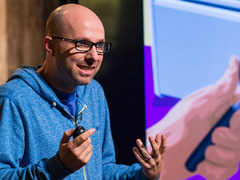
Jay Silver: Hack a banana, make a keyboard!Today’s TED Talk comes from the co-creator of the MaKey MaKey, Jay Silver. In this madcap romp, he reveals his first invention — a pasta spinner rigged from a fork and drill — and how it led him to a fascination with the way that things are made. Throughout the talk, given during our in-office salon TED@250, he shows some incredible projects, both his own and those of others, like a paint brush that makes anything it touches play electronic music and a cat’s water bowl that lets the feline snap photos of itself as it drinks.
“Sometimes what we know gets in the way of what could be, especially when it comes to the human-made world. We think we already know how something works, so we can’t imagine how it could work,” says Silver. “I don’t care that pencils are supposed to be used for writing. I’m going to use them a different way.”
In the talk, Silver also introduces us to the MaKey MaKey, using it in a demo at 7:50 to turn two slices of pizza into a slide clicker. But to him, of course, the fun part isn’t just his own creating his own projects – it’s releasing the kit out into the wild and seeing what people came up with on their own.
Here, a collection of really cool things made with MaKey MaKey.
First, a video from Silver’s JoyLabz, that shows you how to make a banana space bar, a Play-doh video game controller, piano stairs, a synthesizer out of friends (it plays “Eye of the Tiger”), the aforementioned banana piano and cat photo booth, plus an alphabet soup keyboard.
Christian Genco of SMU, an incredibly clever maker, plays the “Star Spangled Banner” by eating his lunch and capping it off with pie.
Here, the people at We Are Genuine turn Star Wars bobble heads into an instrument.
Garrett Heath of Rackspace Hosting creates a cloud server using the MaKey MaKey … and a bacon sandwich.
How to turn dog into a piano, from YouTube user Captain Eagle.
Here is an amazing mashup of MaKey MaKey and another notable Kickstart project, Roy the Animatronic Robot’s Hand.
Brooklyn musician j.viewz takes you to the grocery to buy the fruits and vegetables needed to play Massive Attack’s classic song, “Teardrop.”
Musical paintings from Eric Rosenbaum, who is the co-creator of this incredible kit.
J. Nathan Matias uses his guitar to control an online video game.
A next-generation banana piano, called the Bananamophone, from Beau Silver.
Bonus: DJ Nu-Mark of Jurassic 5 played his necklace onstage at Coachella this year using the MaKey MaKey. See a photo »
And a note: We in the TED office debated the number in this headline extensively. Here is our list of 21 items, in order: bananas, pencils, a drill, forks, paint brushes, a cat’s water bowl, pizza, Play-doh, stairs, your friends, alphabet soup, lunch, pie, bobble head dolls, a bacon sandwich, dogs, Roy the Animatronic Robot’s Hand, fruits and vegetables, paintings, a guitar, and a necklace.
And finally, TED’s own Alex Dean shares his MaKey MaKey project:
At Google I/O, Google announced today that it has rebuilt its AdMob mobile ad network technology. It incorporates tech from other Google platforms like AdSense, and adds some additional features.
The new AdMob includes smarter app promotion features. “Conversion Optimizer helps many AdWords advertisers increase conversions while decreasing cost per acquisition,” explains AdMob product manager Vishay Nihalani. “We’re now bringing Conversion Optimizer to app developers using AdMob to promote their apps, so they can get the best possible number of installs for their budget. Choose a target cost per acquisition for each download, and Conversion Optimizer will show ads when they are most likely to lead to an install.”
“Ensuring that your app is showing quality, relevant ads is important for app developers,” says Nihalani. “Now, developers will have more control over which ads appear in their apps, by blocking sensitive categories, so they can increase relevancy and protect their brand.”
Additionally, AdMob Mediation has a new simplified setup, and there’s new local currency payments.
Finally, there’s a new reporting interface that lets developers slice data in a variety of ways, and has multi-dimensional reports, which can be broken down over time by app, ad unit, platform, country, bid type, etc.
The new AdMob is rolling out to developers starting today. It will be available to all developers globally within the coming months.
If data journalism means the analysis of and reporting on data sets that already exist, sensor journalism goes a step further: Organizations and journalists using sensor technology to create their own real-time data and then report on it. But is sensor journalism feasible or sustainable?
Columbia University plans to explore these issues, Emily Bell, director of the Columbia J-School’s Tow Center for Digital Journalism, said at Betaworks Betaday on Thursday. To that end, the Tow Center will run a weekend workshop on sensor journalism in June and will fund a few projects. And next year, Bell said, the Tow Center plans to run a “sensor newsroom classroom” in partnership with the architecture school.
Some of the challenges are technical: How can journalists and newsrooms build their own low-cost sensing techniques? WNYC’s John Keefe, for instance, built a cicada tracker to figure out exactly when the expected cicada plague will hit New York City this summer. Can other organizations do the same thing?
“How do you get the really efficient things from sense networks in a way that helps you do human reporting?” Bell said. The techniques also create ethical questions: “We are moving into this world where the line between transparency and privacy is constantly in tension. When you can survey everything, what do you report?”
“Practically, we’re very close to being able to survey most of what people do most of the time,” Bell told Betaworks’ Andrew McLaughlin. “I come from Europe, where everything is solved by regulation, In America, the momentum is very much with business rather than the individual. [Google CEO] Eric Schmidt said at the journalism school the other day that privacy is all about making good judgment calls about what you put online. That’s just not true. You can’t make adequate judgment calls to control your own data. That’s only going to get worse.”
It’s been a busy week here at BlackBerry Live 2013 — you’ve heard from the executives, you’ve heard from the experts and now, you get the chance to hear what attendees thought about all of the amazing things that happened at the show.
The energy is there… you could feel the electricity!
Watch the video below to get a feel for the vibrant and palpable energy from attendees at BlackBerry Live 2013.
It’s always one of my favorite parts of the week, when I get to see this video for the first time. Hearing the feedback first-hand is a great feeling. Don’t be shy! Leave us a comment of what you thought of BlackBerry Live 2013 and let us know how we did covering all the action.
Following Larry Page’s impromptu speech and Q&A session at Google I/O, long time Apple observer/writer John Gruber wrote a post entitled Google Versus, wherein he questioned Page’s feel-good commentary. Dave Winer also pointed out this double talk. Here are three comments by Page that got Dave and John riled up:
Let’s be positive
Every story I read about Google is us versus some other company or some stupid thing. Being negative is not how we make progress. The most important things are not zero sum.
Except Microsoft is not playing ball
The Web is not advancing as fast as it should be. Certainly, we struggle with companies like Microsoft. We would like to see more open standards and more people involved in those ecosystems. I wouldn’t grade the industry well with where we have gotten to.
And that other Larry is just greedy
We’ve had a difficult relationship with Oracle, including having to appear in court. Money is obviously more important to them than any collaboration.”
While I am complete agreement with Page’s general sentiment about opportunities and the importance of being positive, I think Larry (and all other technology industry leaders) should actually practice what they preach if they want others to follow.
Google’s effort to unify its messaging platforms isn’t done yet. The new Hangouts app, introduced on Wednesday at the Google I/O developer event, will soon see SMS integration.
After installing the new Hangouts app for iOS and also using the service on my Chromebook Pixel, bringing Chat, Talk and Hangout features all together is a welcome experience. And one that’s long overdue as Google has had several overlapping message services not long after Android arrived on the scene. Oddly, at least to me, is that Google Voice hasn’t been talked about in any of the message unification efforts.
This addition of SMS for Hangouts, which makes sense, is what has me wondering where Google Voice fits in to Google’s grand plans. Since it’s not a true VoIP service, maybe its outside the technical bounds of Hangouts. But traditional SMS is handled by cellular networks and it’s clearly in the scope of Hangouts if it’s coming soon. As a result, Google Voice still feels like the unloved child in Google’s family of services.
I actually use Google Voice to make calls through my computer when working, which essentially are VoIP calls, at least for part of the transmission; the calls originate on my Chromebook over Wi-Fi or LTE. I do this through what used to be Google Talk — there’s a phone icon to place the call.
Perhaps Google is simply leaving well enough alone with Google Voice until data networks mature further and voice over LTE takes root. For now, however, the service just seems left behind while all other Google messaging features are growing up.
It’s been almost two decades since Peter Shor came up with a a breakthrough algorithm for finding the prime factors of a number with a quantum computer, sparking great interest in quantum computing. But commercial adoption has been pretty much nonexistent. On Thursday, though, Google came forward with news that it’s launching a Quantum Artificial Intelligence Lab that will include a quantum computer, apparently making it the second company to pay for a quantum computer. The development suggests that quantum computing could finally be taking off.
Earlier this year Lockheed Martin shared details of its implementation of a D-Wave Systems quantum computer, which reportedly cost $10 million: The contractor is using the computer to develop new aircraft, radar and space systems.
Now Google is taking steps at incorporating more quantum computing into its operations with the Quantum Artificial Intelligence Lab, which will be located at the NASA Ames Research Center in Moffett Field, Calif. Researchers from the Universities Space Research Association will be able to use the machine 20 percent of the time, Forbes reports. That could lead to lots of interdisciplinary thinking and collaboration.
For Google, though, the goal of the initiative is to make strides in machine learning, according to a Thursday Google Research blog post. The best results could trickle down to end users, perhaps in search results and speech-recognition applications.
Quantum computing could mean smarter smartphones
Google has already assembled machine-learning algorithms that involve quantum elements, Hartmut Neven, a Google director of engineering, explained in the post:
One produces very compact, efficient recognizers — very useful when you’re short on power, as on a mobile device. Another can handle highly polluted training data, where a high percentage of the examples are mislabeled, as they often are in the real world.
It’s not hard to imagine how quantum computing could inform machine learning on a smartphone with just a drop of battery life left. It could be that a smarter smartphone one day will take a minuscule amount of input and determine with a high probability who a user wants to talk to or what information it needs right away, rather than forcing the user to cycle through a string of commands and risking the death of the battery altogether.
The applications might have arisen after Google’s earlier partnership with D-Wave, which came to light in a different blog post from Neven in 2009.
Google has already used machine learning to recognize faces and other things in photos and videos. New technology Google executives talked about at the Google I/O developer conference in San Francisco on Wednesday also appears to use machine learning to stitch together photos and clean them up.
What Google has learned so far is the best results come from blending regular binary computing using ones and zeros with quantum style computing. Quantum computing accommodates the space between a one and a zero with quantum bits of information, or qubits. It can express likelihood as well as take shortcuts by approximating when handling certain kinds of workloads. Given what Google has observed thus far, it could decide to build hardware combining quantum and classical computing capabilities.
For now, though, Google is diving deeper into quantum computing with the D-Wave machine. The move could kick off a sort of arms race for webscale companies to buy quantum computers and come up with new notions by way of probabilistic logic. In this way, Google could help push the development of quantum computing much like its invention of MapReduce changed the way firms do distributed data processing.
In any case, quantum computing has a long way to go before reaching commercial viability. That could take decades (so far it has). But because the organization at the helm of the quantum research is Google and not IBM or Bell Labs, regular people could start seeing much more of the advantages in just a few years’ time, which in turn could drive commercialization.
The first day of Google’s I/O Developers Conference keynote has come and gone without a single mention of a potential update to the company’s Android operating system. Despite a number of rumors that suggested Google would announce a new version of Android at the annual event, the company remained quiet on the issue. According to a press release from the Bluetooth Special Interest Group, however, a new version of Android will be announced in the “in the coming months.” The group announced on Wednesday that Google has committed to bringing support for Bluetooth Smart to future versions of the operating system. The power efficient Bluetooth standard is already supported in Apple’s iOS, as well as in a number of Android smartphones such as the Nexus 4, Galaxy S4 and Galaxy Note II. Bluetooth SIG notes that the newest version of Android, rumored to be Android 4.3, will be the first version to support Bluetooth Smart.
Bea Arthur rose to fame as a strong, take-no-crap woman on sitcoms like “Maude” and “The Golden Girls”, and though her deep voice and severe, no-nonsense haircut were usually regarded as masculine traits, some men found her attitude sexy. One man in particular found it sexy enough to want to paint her in the buff, and he did.
Artist John Currin painted the Golden Girl in a nude pose in 1991, although he stressed that he worked from a clothed photo of the actress. The painting has now gone for $1.9 million at auction, but Facebook apparently doesn’t want the photo posted on their site. According to The Daily Beast, they weren’t allowed to upload it due to the exposed breasts in the painting, although Facebook has said before that art doesn’t apply to that rule.
Neither I, nor any of the journalists who are admins of @thedailybeast’s Facebook page can post. 24 hr ban b/c of a piece of Bea Arthur art.
Facebook has caught some backlash before due to their strict “no breast” policy after taking down photos of mothers breastfeeding and showing off pregnant body art. Site reps eventually apologized to The Daily Beast, saying, “Our policy prohibits photos of actual nude people, not paintings or sculptures. Unfortunately, this image was erroneously removed under the same clause we use to prevent more graphic images from propagating on the site.”
Christie’s Auction House sold the piece to an anonymous bidder, but the price was expected to go much higher than it did. When Currin’s show opened in the early ’90s it was lambasted by art critics, one of whom said that the pieces were “acrid fantasy portraits of menopausal women — images suspended, in his words, ‘between the object of desire and the object of loathing.’”
Arthur was aware of the painting before her death in 2009 and said that perhaps Currin was simply drawn to strong women.
“Maybe [Currin] was attracted to the feminist movement of the 1970s. Because of ‘Maude,’ I was the Joan of Arc of feminism. He certainly couldn’t have done anything with Marlo Thomas of ‘That Girl.’”
Check out the painting below, courtesy of Christie’s. Could be NSFW depending on your view of nude art.
Attention Yahoo users: you’re about to see a big change to the homepage newsfeed – tweets.
Yahoo CEO Marissa Mayer announced the new partnership today in a post on the Yahoo blog. “Tweets have become an important information source for many of our users, so we are thrilled to announce our partnership with Twitter to bring Tweets directly into the Yahoo! newsfeed,” saus Mayer.
Look above. Notice anything different about the Yahoo newsfeed? I know, it looks the same – but look closer. Direct your attention to the third item on the main feed. Yes, there it is – at tweet from ABC World News, complete with a timestamp, link, and a follow button.
“As users explore our nearly endless stream of content, we will seamlessly include relevant and personalized Tweets alongside stories from Yahoo! and our other sources. With this greater breadth of compelling content, we’re excited to give our users even more opportunities to learn and connect. Users now also have an easy way to discover relevant and interesting people and publishers to follow on Twitter, personalized to their interests and preferences,” says Mayer.
Relevant and personalized – so that seems to indicate that users that are signed-in to Twitter will enjoy a more robust experience with the new integration. The types of tweets that will fill Yahoo’s newsfeed will come from all types of newsworthy areas including sports, entertainment, music, and more.
Mayer says that the Twitter integration will rollout to U.S. desktop and mobile users in the next few days. No mention on the terms of the deal, however.
Speaking of partnerships between Twitter and search companies (I know, but Yahoo is still primarily a search company), Google and Twitter had a famous falling out back in the summer of 2011. Thanks to an inability to reach an agreement Google’s realtime search, which leveraged tweets, got the ax. Google talked about it’s imminent return shortly after the failed deal, but nearly two years later Twitter and Google are still on the outs.


 Jay Silver: Hack a banana, make a keyboard!


